


1. Introduction
The concept of a derivational network is a natural outgrowth of the discussion on derivational paradigms. Morphologists have come to realize in recent decades that the abyss separating the areas of inflectional and derivational morphology is not so deep and wide as once supposed (Scalise Reference Scalise1988, Dressler Reference Dressler1989, van Marle Reference van Marle, Booij and Marle1995, Booij Reference Booij and Brown2006, ten Hacken Reference ten Hacken, Lieber and Štekauer2014, Štekauer Reference Štekauer, Müller, Ohnheiser, Olsen and Rainer2015). Building on the rather scarce but seminal works of the field's forerunners such as Dokulil (Reference Dokulil1962), Horecký et al. (Reference Horecký, Buzássyová and Bosák1989), van Marle (Reference van Marle, Booij and Marle1995), Bauer (Reference Bauer, Booij and van Marle1997), and Furdík (Reference Furdík2004), the recent decade has brought a number of significant contributions to the problems of derivational paradigms. Worth mentioning in particular are those of Roché et al. (Reference Roché, Boyé, Hathout, Lignon and Plénat2011), Ševčíková and Žabokrtský (Reference Ševčíková, Žabokrtský, Calzolari, Choukri, Declerck, Loftsson, Maegaard, Mariani, Moreno, Odijk and Piperidis2014), Štekauer (Reference Štekauer, Lieber and Štekauer2014), Pala and Šmerk (Reference Pala, Šmerk, Král and Matoušek2015), Boyé and Schalchli (Reference Boyé, Schalchli, Hippisley and Stump2016, Reference Boyé and Schalchli2019), Rodrigues and Rodrigues (Reference Rodrigues and Rodrigues2017), Bonami and Strnadová (Reference Bonami and Strnadová2019), Gaeta and Angster (Reference Gaeta and Angster2019), Hathout and Namer (Reference Hathout and Namer2019), the collection of papers in Fernández-Domínguez et al. (Reference Fernández-Domínguez, Bagasheva and Clares2020), and Körtvélyessy et al. (Reference Körtvélyessy, Bagasheva and Štekauer2020). The latter monograph introduced a new theoretical and methodological approach to the cross-linguistic examination of derivational relations, serving as a point of departure for a comparison of onomatopoeia-based (OW-based) derivational networks in English and in Slovak. The objectives of the present research are (i) to examine the nature and extent of OW-based derivational networks, (ii) to compare the networks in two typologically different languages, and (iii) to evaluate possible similarities/differences between derivational networks based on non-iconic words (NIW) and those based on onomatopoeic words (OW). The results contribute to the theory of onomatopoeias and to the solution of the puzzle hidden in the question of whether or not onomatopoeias are a ‘unique species’ (Körtvélyessy Reference Körtvélyessy2020, Reference Körtvélyessy2021a).Footnote 1
Section 2 presents the theoretical framework of our research, that is, our comprehension of derivational networks (2.1) and onomatopoeias (2.2). Section 3 accounts for the research method, namely the sampling method (3.1), the construction of OW-based networks (3.2), and introduces the basic parameters employed for an analysis and evaluation of derivational networks (3.3), in particular, derivational capacity (3.3.1), maximum derivational network (3.3.2), saturation value (3.3.3), maximum and average number of orders of derivation (3.3.4), distribution and typical combinations of semantic categories (3.3.5), and blocking effects of semantic categories (3.3.6). Section 4 presents and discusses the results obtained from an analysis and comparison of English and Slovak networks by the individual parameters. The data available for the English (Popova Reference Popova, Körtvélyessy, Bagasheva and Štekauer2020) and Slovak (Ivanová Reference Ivanová, Körtvélyessy, Bagasheva and Štekauer2020) NIW-based derivational networksFootnote 2 make it possible to draw conclusions on similarities and differences between NIW-based and OW-based derivational networks (section 5); these networks are compared by the individual parameters introduced in section 3. Section 6 summarizes the fundamental observations and findings of our research.
2. Theoretical framework
The research covers derivational processes in English and Slovak, comprising suffixation, prefixation, prefixal-suffixal derivation, postfixation, and conversion (labeled as transflexion or paradigmatic formation in Slavic word-formation). Körtvélyessy et al. (Reference Körtvélyessy2018) previously compared word-formation processes in European languages in terms of their structural richness. The parameter of structural richness indicates the degree to which a particular word-formation system makes use of the available word-formation options; their research covered 100 comparative concepts Despite being different morphological types, English and Slovak have an identical structural richness of 50%, meaning that they make productive use of 50% of the evaluated word-formation features. The data on the individual processes are very similar too, as indicated in Table 1.
Structural richness of selected word-formation processes in English and Slovak (based on Körtvélyessy et al. Reference Körtvélyessy2018)
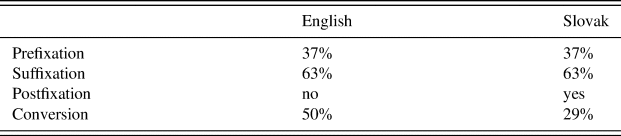
Given the highly similar structural richness of the examined languages, one of the questions addressed by the present research is whether this fact is projected onto similarly rich OW-based derivational networks.
2.1 Derivational networks
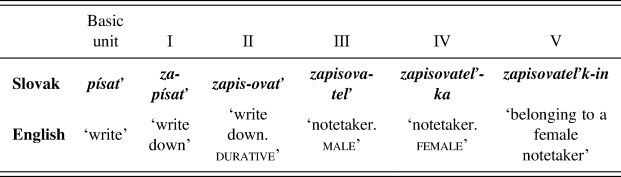
Our concept of derivational networks is closely related to the concept of the derivational nest/family as applied by Dokulil (Reference Dokulil1962), Horecký et al. (Reference Horecký, Buzássyová and Bosák1989), and Furdík (Reference Furdík2004). In their approaches, derivational paradigms are combined with derivational series to create a ‘derivational nest’. The derivational series is conceived as a series of motivated units, starting with a basic, unmotivated unit and followed by more complex units, each motivated by the preceding one. Table 2 illustrates a derivational series for the Slovak lexeme písať ‘to write’ (Furdík Reference Furdík2004: 73).
Derivational series for the Slovak písať ‘to write’ (Furdík Reference Furdík2004: 73)
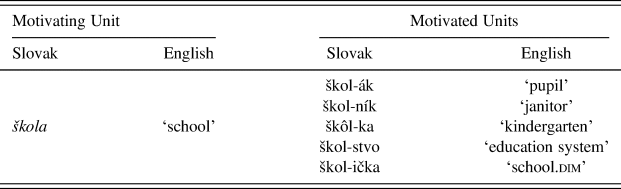
The derivational paradigm is conceived as an ordered system of motivated units grouped around a single motivating unit and constituting motivation pairs with it (Horecký et al. Reference Horecký, Buzássyová and Bosák1989: 28–29). In other words, it is a group of direct derivatives from the same basic underived word. Table 3 exemplifies a derivational paradigm of the Slovak lexeme škola ‘school’ (Furdík Reference Furdík2004: 74).
Derivational paradigm of the Slovak škola ‘school’ (Furdík Reference Furdík2004: 74)
In this article, we follow the fundamental principles of the theory of derivational networks as developed in Körtvélyessy et al. (Reference Körtvélyessy, Bagasheva and Štekauer2020). It elaborates on the above-mentioned idea of derivational nests and lays emphasis on the synchronic transparency of derivational relationships. In this respect, it differs from the approach of Dokulil (Reference Dokulil1962), whose derivational nest can also include lexicalized words,Footnote 3 as well as from the two-dimensional system proposed by Furdík (Reference Furdík2004) and Horecký et al. (1989). A derivational network is conceived as a three-dimensional system of complex words unified by a common word-formation base (simple underived word). Such a network combines the ‘vertical’, paradigmatic dimension (all direct derivatives from a base word), the ‘horizontal’ dimension (all successive linear derivatives from a base word), that is, individual orders of derivation, and, crucially, the semantic dimension (semantic categories defining each derivational step). A semantic category does not define the lexical meaning of a derived word as a whole. Instead, it represents the contribution of a derivational affix, its word-formation meaning. Semantic categories are recursive, that is, one and the same semantic category can occur in more than one order of derivation from the same word-formation base. For example, the Slovak diminutive kôstočka ‘very little bone’ is the 2nd-order derivation from the diminutive kôstka ‘little bone’, which is the 1st-order derivation from the word-formation base kosť ‘bone’.
Another important innovation of the traditional concept of derivational relations is the model proposed by Körtvélyessy et al. (Reference Körtvélyessy, Bagasheva and Štekauer2020) that lays emphasis on the potential capacity of a word-formation system. Since derivational networks are conceived as regular and predictable systems, they make it possible to fill any empty slot with a potential word (that means, to actualize the potential capacity) that fits the three-dimensional system, if necessitated by the naming needs of a speech community. This approach complies with the idea that the only major difference between inflectional and derivational paradigmatic systems concerns the fact that while the former is based on actual units, the latter relies on a combination of actual and potential units (see also Bauer Reference Bauer, Booij and van Marle1997, Štekauer Reference Štekauer, Lieber and Štekauer2014, Boyé and Schalchli Reference Boyé and Schalchli2019, Gaeta and Angster Reference Gaeta and Angster2019). Hence, the capacity to actualize their potential is an inherent feature of derivational networks. The interrelation between potentiality and actualization is reflected in the saturation value parameter that captures the structural richness of a derivational network (i.e., the degree to which individual derivational networks actualize their potential). Section 3 introduces this parameter, together with a few others employed for the evaluation of derivational networks.
2.2 Onomatopoeias
Onomatopoeic words can be narrowly defined as direct imitations of sounds of nature and artifacts and/or sounds resulting from their interaction (Guynes Reference Guynes2014; Laing Reference Laing2019; Körtvélyessy Reference Körtvélyessy2020, Reference Körtvélyessy2021a). This view might suggest that onomatopoeias are a clearly delimited class of image iconic words. Things are, however, much more complicated, because views of the scope of onomatopoeias differ significantly. Apart from the above-mentioned narrowly conceived class of words labeled as ‘primary onomatopoeia’ (Ullmann Reference Ullmann1972) or ‘direct onomatopoeia’ (Bredin Reference Bredin1996), there are views (e.g., Ullmann Reference Ullmann1972, Drabble Reference Drabble2000, Kadooka Reference Kadooka2005, Benczes Reference Benczes2018, Sasamoto Reference Sasamoto2019) that extend the scope of onomatopoeia to words derived from primary onomatopoeias (e.g., cuckoo O > cuckoo N) and to its metaphorical and metonymical extensions (secondary onomatopoeia) (e.g., English buzz ‘humming sound of a bee’ > ‘sound of a buzzer’; Slovak pí-pí ‘sound of a chicken’ > ‘sound of a microwave signal’). Finally, onomatopoeias are, by some authors, included in or identified with a broadly defined class of ideophones, or mimetic words, that is, words that represent all sorts of sensory perception (e.g., Hasada Reference Hasada1994; Kita Reference Kita1997; Dingemanse Reference Dingemanse, Michelucci, Fischer and Ljungberg2011a, Reference Dingemanse2011b, Reference Dingemanse2011c; Akita and Dingemanse Reference Akita, Dingemanse and Aronoff2019; Sasamoto Reference Sasamoto2019). While ideophones are not recognized in Slovak, “there is not a clearly identifiable ideophonic section of the [English] lexicon, … but rather scattered classes of examples which have ideophonic or partly ideophonic character, and which shade off into areas where meanings are iconically arbitrary” (Liberman Reference Liberman1975: 146). Examples are crash and plop (Akita and Dingemanse Reference Akita, Dingemanse and Aronoff2019), and boom in the meaning of motion for ‘bursting motion’, visual for ‘sudden appearance or execution’, and cognitive for ‘surprise’ (Thompson and Do Reference Thompson and Do2019: 10).
Previous research into onomatopoeia mainly dealt with its delimitation in the language system, its scope, and its semiotic nature (e.g., Jakobson Reference Jakobson1971; Nöth Reference Nöth1990; Waugh Reference Waugh1994; Nuckolls Reference Nuckolls1996; Carling and Johansson Reference Carling and Johansson2015; Catricalà and Guidi Reference Catricalà and Guidi2015; Körtvélyessy Reference Körtvélyessy2020, Reference Körtvélyessy2021a), its sound-symbolic and phonological characteristics (e.g., Marchand Reference Marchand1959, Reference Marchand1960; Hinton et al. Reference Hinton, Nichols, Ohala, Hinton, Nichols and Ohala1995; Rhodes Reference Rhodes, Hinton, Nichols and Ohala1995; Tsur Reference Tsur2001; Bergen Reference Bergen2004; Ivanova Reference Ivanova2006; Voronin Reference Voronin2006; Nuckolls Reference Nuckolls2010; Assaneo et al. Reference Assaneo, Nichols and Trevisan2011; Dingemanse Reference Dingemanse, Michelucci, Fischer and Ljungberg2011a, Reference Dingemanse2011b, Reference Dingemanse2011c; Feist Reference Feist2013; Fidalgo et al. Reference Fidalgo, Takahashi, Watanabe and Būraphā2018; Körtvélyessy Reference Körtvélyessy2020; Körtvélyessy and Štekauer Reference Körtvélyessy, Štekauer, Körtvélyessy and Štekauer2020), the metaphoric/metonymic nature of secondary onomatopoeias (Benczes Reference Benczes2018, Sasamoto Reference Sasamoto2019), as well as diachronic aspects of onomatopoeias and their lexicalizationFootnote 4 (Mithun Reference Mithun1982; McMahon Reference McMahon1994; Anderson Reference Anderson1998; Flaksman Reference Flaksman2015, Reference Flaksman, Zirker, Bauer, Fischer and Ljungberg2017, Reference Flaksman2018, Reference Flaksman2019). Very little attention, however, has been paid to the word-formation capacity of primary onomatopoeia. No previous research has examined systematic OW-based derivational relations. In the present article, primary onomatopoeias serve as a point of departure for the construction of derivational networks in Slovak and in English. The choice of the languages was motivated by two reasons: (i) they belong to two different morphological types, and (ii) their word-formation systems feature a very similar structural richness (see Table 1).
3. Method and data
This section introduces the method of constructing onomatopoeia-based derivational networks and the fundamental principles used for their evaluation and comparison.
3.1 Sample
The English sample is based on two online sources. The Onomatopoeia List orders onomatopoeic words alphabetically. The Written Sound makes it possible to search for a word as well as to browse through various semantic categories, for example, ‘human’, ‘engine’, or ‘weather’. Since both these websites include words that do not meet our definition of primary onomatopoeias and, moreover, comprise nonce-formations (i.e., non-institutionalized words), each onomatopoeic word was verified in two online dictionaries (TheFreeDictionary.com; OxfordLearnersDictionaries.com). In this way, we obtained 115 onomatopoeic words, the dictionary definitions of which clearly identified them as sound imitations (defined as either ‘vocalization’ or ‘sound of’) or an example provided in the dictionary unambiguously confirmed their onomatopoeic status.
The Slovak sample was collected from the Slovenský národný korpus (Slovak National Corpus). Since onomatopoeias are classified with interjections in the Slovak linguistic tradition, a list of the top 1,000 interjections was downloaded from the corpus website. From this list, all those words that met our definition of onomatopoeias were selected. The final Slovak sample consisted of 120 onomatopoeic words.
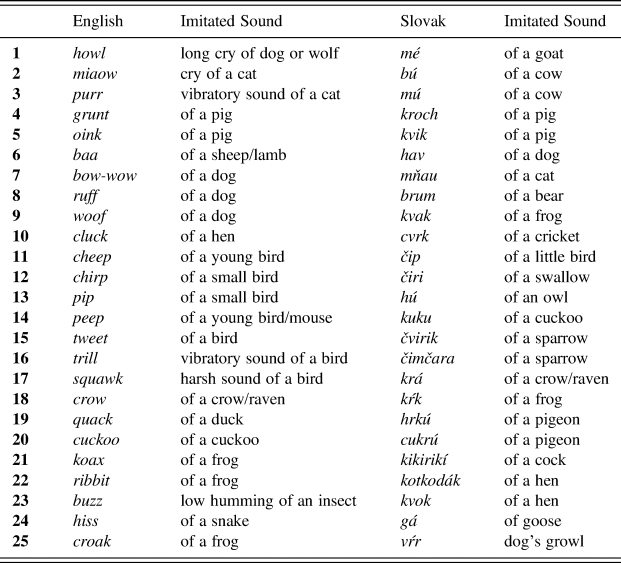
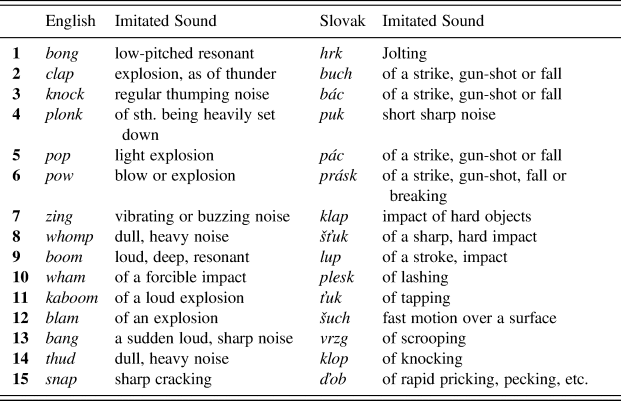
For the sake of constructing semantically-related derivational networks in both languages, the samples were divided into several semantic categories based on the sound type they imitate. We chose two sound types: the sounds of animals (Sound Type 1) and sounds resulting from various falls, strokes, and bursts (Sound Type 2), in order to compare derivational networks based on natural sounds vs. artifacts.Footnote 5 As a result, our sample includes 80 onomatopoeic words, 40 for each language. Sound Type 1 comprises 25 words per language, and Sound Type 2 comprises 15 words per language. In general, there were significantly more onomatopoeic words belonging to Sound Type 1 than to Sound Type 2; this imbalance is, therefore, reflected in our sample. The samples of onomatopoeias are given in Tables 4 and 5.
Onomatopoeic words of Sound Type 1 – animal sounds
Onomatopoeic words of Sound Type 2 – falls, strokes, bursts
3.2 Construction of derivational networks
A derivational network was created for each onomatopoeic word in the sample. This step consisted mostly of searching through dictionaries and corpora. In the Slovak language, we made use of the Slovníkový portál Jazykovedného ústavu Ľ. Štúra SAV (Dictionary Portal of the Linguistic Institute of Ľudovít Štúr), a website that allows the user to search through all the major Slovak dictionaries, and the Slovenský národný korpus (Slovak National Corpus). For the English language, we used the online dictionaries LEXICO, Collins, and Merriam-Webster, as well as the Corpus of Contemporary American English. The objective of these searches was to find as many OW-based derivatives as possible, even if there were some restrictions.
First, potential derivatives that were not attested in the above-mentioned dictionaries or corpora were not taken into consideration. For example, the majority of Slovak onomatopoeic words can derive a durative verb, which in turn derives an inceptive verb by adding the prefix za-, as in the series kvak ‘sound of a frog’ → kvák-ať ‘to make the sound of a frog’ → za-kvákať ‘to start making, for a short period of time, the sound of a frog’. Such a derivational series is highly productive in the Slovak language and is possible for nearly any verb. However, in some cases, it was difficult to find attestations, either in the dictionaries, corpora, or even on Google, as was the case for cukrú ‘sound of a pigeon’ → cukrovať → *zacukrovať. Thus, all potential but unattested derivatives were excluded from our research.
Second, there were restrictions due to changes of meaning that resulted in the loss of the original sound-imitation meaning. Examples of such cases are the derivatives zbúchať ‘to make hastily, without proper care’, derived from the onomatopoeic word buch ‘sound of a strike’, or cukrovať sa ‘to kiss each other’, derived from the onomatopoeic word cukrú ‘sound of a pigeon’. Since such words are not directly connected to the meaning of the original onomatopoeia, they were not included in the network.
Third, there was a problem with fuzzy boundaries between derivation and inflection. This was most visible with the suffixes -ing in English and -nie/-tie in Slovak, which form action nouns, e.g., write → writing or its Slovak equivalent písať → písanie. In Slovak, there are two different approaches to this question. Dvonč et al. (Reference Dvonč, Horák, Miko, Mistrík, Oravec, Ružička and Urbančok1966), for example, maintain that such formation is possible for the whole word class of verbs and, as such, it is an inflectional process. Furdík (Reference Furdík2004), on the other hand, classifies it as a deverbal substantive derivative. For English, Spencer (Reference Spencer, Štekauer and Lieber2006) treats action nominals in -ing as derivatives. Similarly, Marchand (Reference Marchand1960: 241) claims that apart from the participle form itself, “-ing has developed a series of functions and meanings which place it within the sphere of [word-formation].” We decided to include these forms in our derivational networks for both the English and Slovak samples. Adjectives ending in -ing, such as writing in writing table, were also included in the networks.
Fourth, cases of postfixation were included in the derivational networks. Postfixation concerns the derivation of new words in which the derivational morpheme does not precede an inflectional morpheme, in contrast to Greenberg's Universal #28 (Reference Greenberg and Greenberg1966). Instead, it follows an inflectional morpheme.Footnote 6 The most common example from Slovak is the postfix sa ‘self’, used with transitive verbs to denote reflexiveness. While this postfix is added synthetically like any other suffix in some Slavic languages, it is attached analytically in Czech, Polish, and Slovak (e.g., umývať ‘to wash’ → umývať sa ‘to wash oneself’). In the Slavic linguistic tradition, they are considered derivatives and are therefore included in our networks.
Finally, words formed by conversion (e.g., miaow O > miaow V) were included in derivational networks, unlike in the procedure pursued by Körtvélyessy et al. (Reference Körtvélyessy, Bagasheva and Štekauer2020). The decision was based on the predictability of conversion (see Štekauer et al. Reference Štekauer, Díaz-Negrillo and Valera2011).Footnote 7
As pointed out above, derivational networks as three-dimensional systems would not be complete without the semantic dimension. For this reason, each derivative within the network was assigned a semantic category. Accordingly, we used the list of comparative semantic concepts proposed by Bagasheva (Reference Bagasheva, Santana-Lario and Valera-Hernández2017: 53-56).
Since the assignment of a semantic category to a particular derivative can sometimes be subjective, their assignment to each derived word was proposed independently by three experts (and discussed in the event of a lack of agreement). It should be emphasized that a semantic category is always assigned according to the last derivational step. For example, the Slovak verb rozvŕzgať sa ‘start creaking’ is both inceptive and reflexive, but in the derivational network, it is assigned to the category reflexive, as inceptive is already expressed in the preceding order of derivation of rozvŕzgať.
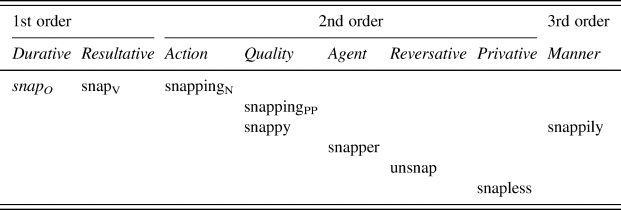
Table 6 provides an example of a derivational network for the English base word snap.
Derivational network for the English ‘snap’
3.3 Parameters
The data on the OW-based derivational networks were evaluated in terms of several parameters, comprising the derivational capacity, the maximum derivational network, the saturation value, the maximum and average number of orders of derivation, and the distribution, typical combinations, and blocking effects of semantic categories. The following sections account for these parameters.
3.3.1 Derivational capacity
The derivational capacity of the basic underived word equals the number of all direct derivatives from that word in all orders of derivation.
3.3.2 Maximum derivational network
The maximum derivational network is obtained by adding up the highest numbers of derivatives for individual semantic categories for a given order of derivation. In our case, this variable was calculated for two samples of onomatopoeias, labeled as Sound Type 1 and Sound Type 2. The method of calculation follows from the example in Figure 1.
Maximum numbers of 2nd-order derivatives per semantic category – Sound Type 2, Slovak sample
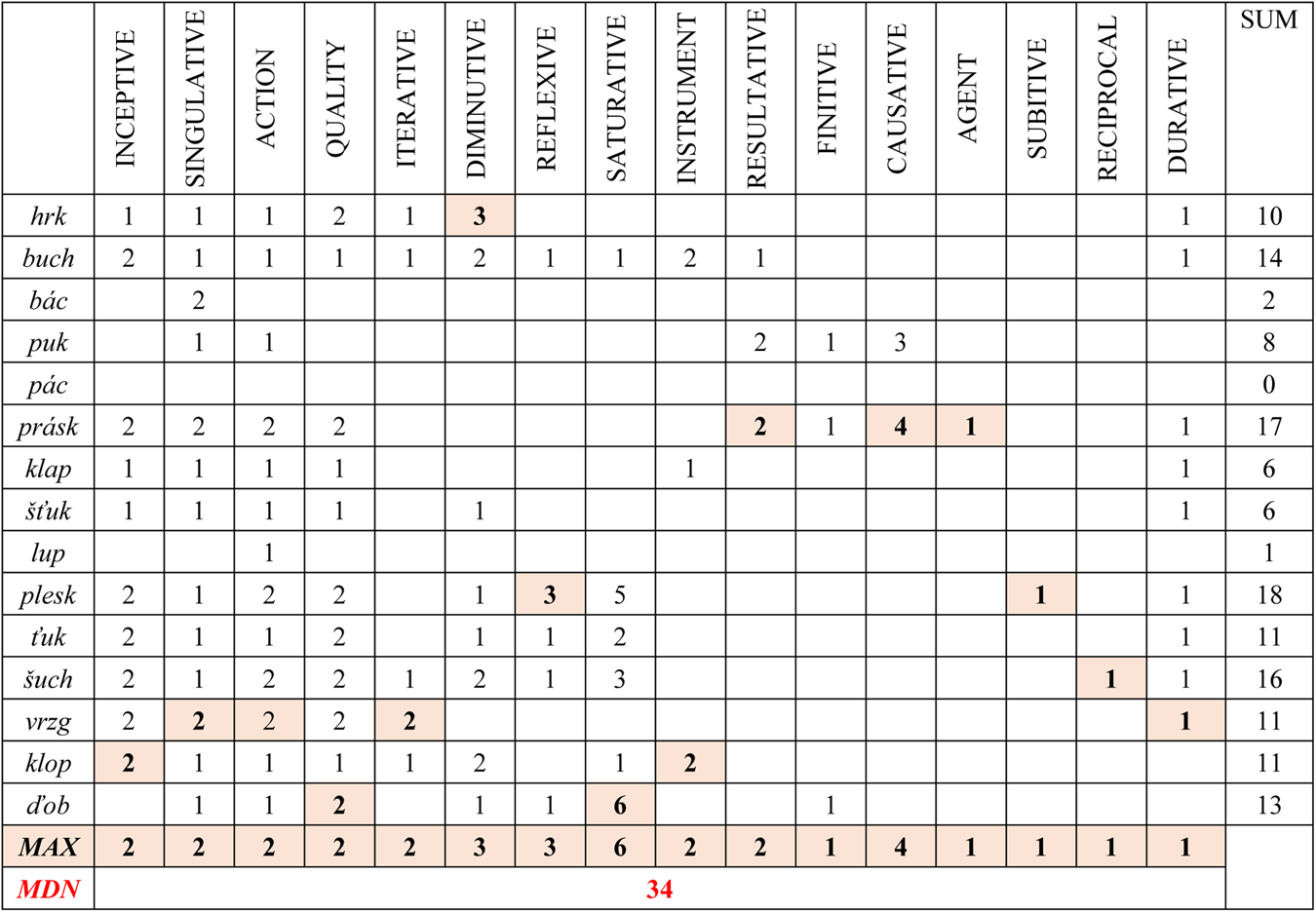
The highlighted cells identify the highest number of derivatives in a given semantic category from all basic words of the examined sample. The adding up of all the highest values per category identifies the maximum derivational network, that is, the postulated maximum number of potential derivatives for the given order of derivation (given in the highlighted row).
3.3.3 Saturation value
The saturation value is calculated as follows:
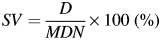 $$SV = \displaystyle{D \over {MDN}} \times 100\;( \% ) $$
where
-
SV = Saturation value,
-
D = Number of derivatives, and
-
MDN = Maximum derivational network.
The saturation value can be calculated for each sample word, for an individual order of derivation, as well as for a whole class of sample words (i.e., the onomatopoeias of Sound Type 1 or 2). Thus, for example, for the base word prásk ‘snap’ in the 2nd order of derivation (Figure 1), the quotient obtained is 17 : 34 = 50%, because the number of derivatives from this basic word is 17 and the maximum derivational network is 34 (MDN in Figure 1). The same procedure can be applied to calculate the saturation value of the whole of Sound Type 2 as well as its individual orders of derivation. For instance, the average saturation value in the 2nd order of Sound Type 2 of Slovak onomatopoeias is 27.43%.
3.3.4 Maximum and average number of orders of derivation
The order of derivation parameter identifies the number of affixation operations available for a given basic underived word. Each such affixation operation represents one order of derivation. This parameter is important for determining the derivational capacity of a given word and the potential derivational capacity of the whole examined class of words.
3.3.5 Distribution and typical combinations of semantic categories
Previous research in the field of word-formation primarily concentrated on the distribution and typical combinations of affixes. The shift to the semantics of derivational relationships logically follows from the fact that each step of affixation is simultaneously a semantic step. By implication, a series of derivational steps is at the same time a series of semantic operations represented by semantic categories. This kind of information can be viewed as complementary to the study of affix ordering and possible affix combinations (e.g., Aronoff and Fuhrhop Reference Aronoff and Fuhrhop2002, Hay and Plag Reference Hay and Plag2004, Manova and Aronoff Reference Manova and Aronoff2010, Saarinen and Hay Reference Saarinen, Hay, Lieber and Štekauer2014, Manova Reference Manova2015).
3.3.6 Blocking effects of semantic categories
This parameter serves to identify semantic categories that systematically block subsequent derivation at individual orders of derivation. While there has been extensive research on the blocking effects of affixes and word-formation rules, the focus on the blocking role of semantic categories can provide additional useful information on the workings of a word-formation system.
4. Data evaluation and discussion
This section presents an analysis of the acquired data on OW-based derivational networks in Slovak and English regarding two categories of onomatopoeias: Sound Type 1, which includes onomatopoeic words representing animal sounds, and Sound Type 2, which includes onomatopoeic words representing various falls, bursts, and strokes.
4.1 Derivational capacity
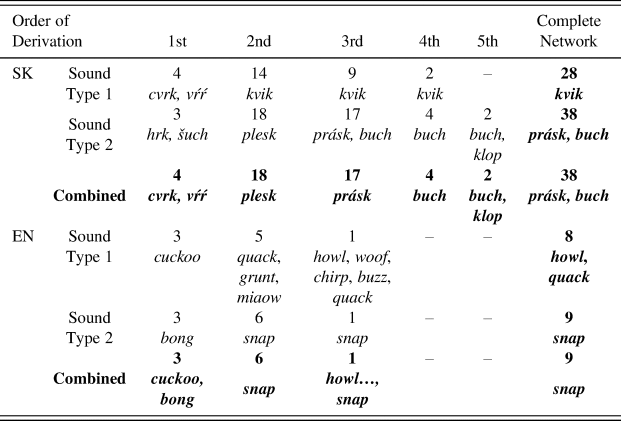
Table 7 provides a comparison of the base words with the highest number of attested derivatives (D) for each order of derivation and identifies the largest derivational network for both Sound Types as well as for the whole sample. Table 8 presents the average size of the derivational networks.
Words with the highest number of derivatives
Average size of derivational networks

Table 7 shows that the largest derivational network is obtained from the Slovak onomatopoeic words prásk ‘snap’ and buch ‘bang’, each comprising 38 derivatives distributed among four and five orders of derivation, respectively. The largest English network – for the base word snap – is significantly smaller, as it consists of only nine derivatives distributed among three orders of derivation. Interestingly, the topmost onomatopoeic words – snap and prásk – are semantically very similar as both of them represent the sound of the striking, cracking, or breaking of an object. The third-largest network in Slovak is plesk (sound of lashing) with 32 derivatives. The three largest networks in English are snap (9), howl (8), and quack (8). At the other end of the scale in Slovak are čimčara (sound of a sparrow) with zero derivatives, pác (sound of a strike, fall) with one, and lup (sound of a strike, impact) with two, and in English ruff, koax, and pow, all with zero derivatives.
Furthermore, it follows from Table 7 that the base words with the highest number of derivatives are attested in the 2nd order for both languages, suggesting that 2nd-order networks feature the highest derivational capacity for our sample onomatopoeias. The 1st order is relatively small, with a maximum of four derivatives for Slovak (base words cvrk and vŕŕ imitating the sound of a cricket and a dog's growl, respectively) and three for English (cuckoo and bong). In fact, the derivational capacity of the 1st order of Slovak Sound Type 1 is at the level of the 4th order and that of Sound Type 2 at the level of the 5th order. Both Sound Types follow the same tendency of the maximum derivational capacity in the 2nd order, followed by a gradual decrease in derivational capacity across the following orders. This tendency is difficult to evaluate for the English sample due to only three orders of derivation existing in both Sound Types. Nevertheless, the ‘Slovak curve’ is adhered to, in principle, with the largest capacity occurring in the 2nd order, followed by a sharp decrease in the 3rd order.
Another important finding is that the two Slovak Sound Types behave differently in terms of this parameter, with Sound Type 2 manifesting systematically higher derivational capacity than Sound Type 1 in individual orders of derivation, with the exception of the 1st order. The differences are especially significant in the 2nd, 3rd, and 4th orders of derivation, especially when the two Sound Types are compared for complete networks with the highest derivational capacity. The reason for the differences should be sought in the interrelationship between extra-linguistic reality, the naming needs of a speech community, and the Slovak word-formation system (Štekauer Reference Štekauer, Štekauer and Lieber2005). First, sounds produced by animals are, basically, of a repetitive nature, which is commonly reflected in their reduplicated form. The repetition of sounds means that they are usually not perceived as a single act, and therefore they are not captured as singulatives by the word-formation system of Slovak. So, while there is the derivative kvákať (iterativity) from kvak, the derivative kvaknúť (singulative) is not an existing word in Slovak. This is projected onto the number of 1st-order derivatives and, logically, onto the number of higher-order derivatives. Second, an important factor is Aktionsart, used in Slovak to express various shades of the basic meaning of a verb. Sound Type 2 is more closely related to a diversity of human activities than the sounds produced by animals, which is reflected in the higher number of Aktionsart-based derivatives. For illustration, the onomatopoeia puk ‘short sharp noise’ establishes a range of derivatives differing in their Aktionsart: puk O, puknúť ‘to cracksingulative’, pukať ‘to crackiterative’, dopukať ‘to finish cracking’, popukať ‘crackdistributive’, vypuknúť ‘break out suddenly’, prepuknúť ‘burst out’, and rozpuknúť ‘burstresultative’, to name just a few.
These differences are not observed for the two English Sound Types. This may be accounted for by the generally small number of derivatives that blur the differences between the two Sound Types.
The findings concerning substantial differences between the Slovak and English networks in terms of their derivational capacity are further supported by a comparison of the average values of the derivational network capacity of the two languages in general (12.37 vs. 4.35) and of both Sound Types. It is especially Sound Type 2 (20.97) that contributes to the major difference in the derivational capacity of the two languages. Similarly, the average values further strengthen the observation of the substantially different derivational capacities of the two Slovak Sound Types. The average capacity of Sound Type 2 is much higher than that of Sound Type 1 (20.97 vs. 10.28). This is different from the situation in English, where the average derivational capacity of Sound Type 1 is slightly higher than that of Sound Type 2 (4.68 vs. 3.80).
The analysis of the derivational networks in terms of their derivational capacity suggests that:
(i) there can be significant differences between languages in their derivational capacity in both the individual orders of derivation and the overall networks;
(ii) there can be significant differences between sound types of onomatopoeias.
4.2 Maximum derivational network
The situation in the derivational networks of the two examined languages is broken down by Sound Type and represented in Table 9.
Maximum derivational networks
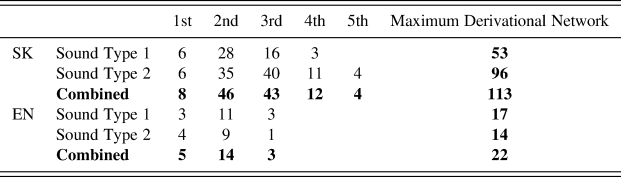
This parameter gives support to the observations arrived at in section 4.1. That is, there are substantial differences between the Slovak and English derivational networks as well as between the networks of the two Slovak Sound Types. The tendency for the gradual decrease in values across individual orders of derivation, starting with the 2nd order, has also been confirmed for the MDN (maximum derivational network) parameter.
Specifically, as can be seen from Table 9, the differences between the two languages are significant. While the MDN of the Slovak onomatopoeias has 113 possible derivatives, the English one only has 22. The same holds for the individual Sound Types, with Sound Type 1 having 53 potential derivatives in Slovak against 17 in English and Sound Type 2 having 96 potential derivatives in Slovak against 14 in English. Comparing the two Sound Types, Sound Type 1 onomatopoeias have a slightly higher number of potential derivatives in English, while in Sound Type 2 they feature a significantly higher derivational potential in Slovak. As with the derivational capacity, the highest MDN values are found in the 2nd order of derivation, with the exception of Slovak Sound Type 2, where the MDN value in the 3rd order is slightly higher than in the 2nd order.
4.3 Saturation value
Table 10 provides average SV (saturation values) for both Sound Types in both languages in individual orders of derivation.
Average saturation value
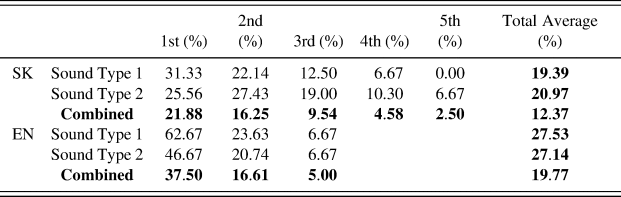
The data suggest that even though Slovak has a bigger potential for derivation from onomatopoeic words than English, the actualization of that potential falls somewhat short. The higher saturation value in English, which can be accounted for by much lower derivational networks, is bound to the 1st order of derivation. In Sound Type 1, for example, the English saturation value is nearly 63%, while in Slovak it is only 31%. A similar ratio can be observed in Sound Type 2. The situation is more balanced in the 2nd order, and in the 3rd it is reversed, especially in Sound Type 2. English is thus fairly predictable in the 1st order but, later on, the derivatives are distributed more sparsely. In general, there is a strong tendency for the saturation value to decrease with each order in both languages, in analogy with the results obtained for the derivational capacity and the MDNs. The only exception is the 2nd order of Slovak Sound Type 2, whose saturation value is slightly higher than that of the 1st order, and basically maps the data for the previous two parameters.
The higher Sound Type 2 values in the previous parameters in the Slovak sample are partly acknowledged for the saturation value, in particular, for the 2nd, 3rd, and 4th orders of derivation. This is in accordance with its much higher derivational capacity in these orders. The higher values of Sound Type 1 of the English sample map the results obtained for the average size of derivational networks.
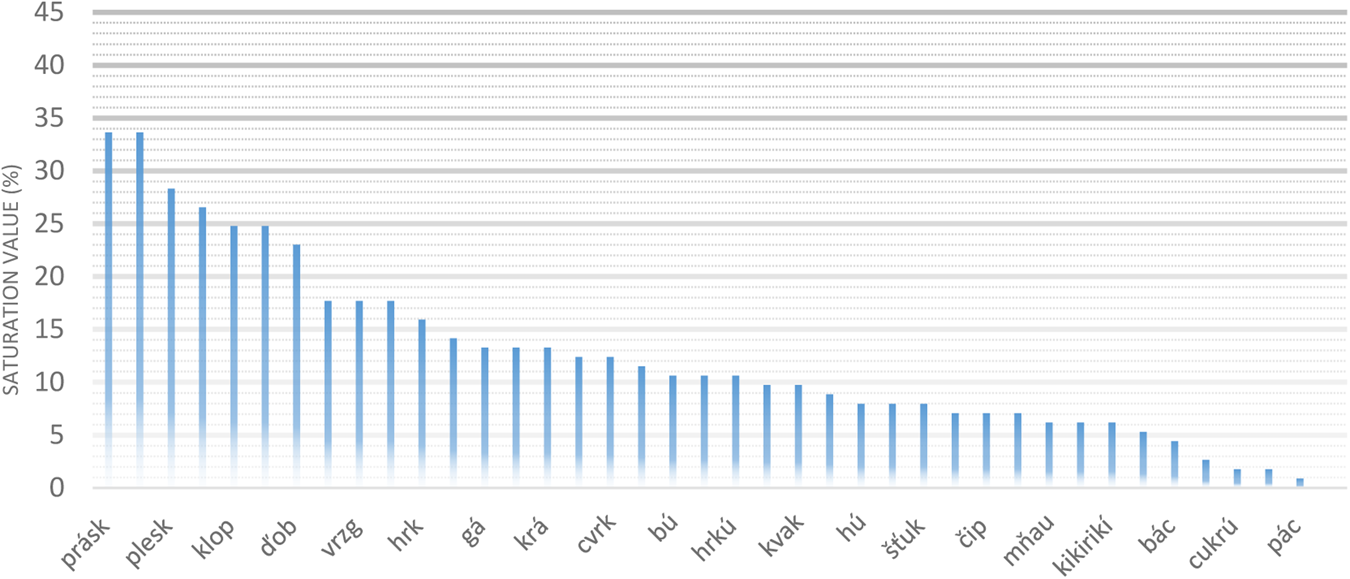
The average saturation of derivational networks is relatively small in both languages, being only about 12% in Slovak and about 20% in English. The saturation of the networks for the individual base words is represented in Figures 2 and 3 below.
Saturation values of Slovak onomatopoeias
Saturation values of English onomatopoeias
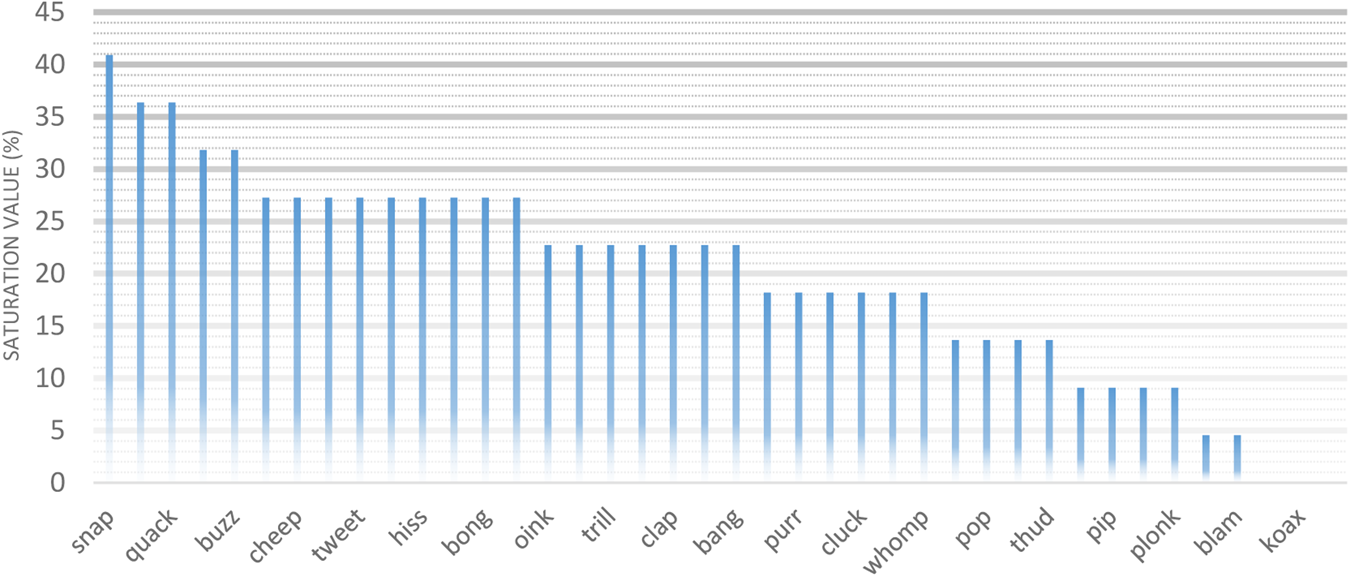
It follows from Figures 2 and 3 that nearly half of Slovak onomatopoeias have a saturation value below 10%, while less than a quarter of them do in English. The highest saturation value in Slovak is 33.63% (prásk ‘snap’ and buch ‘bang’); in English, it is 40.91% (snap, with 9 derivatives). Due to its lower MDN values, English is better at filling the potential network slots, while Slovak has a large number of slots for possible derivatives, many of which are not actualized. This results in large MDN values but low saturation values.
4.4. Number of orders of derivation
The depth of derivational networks represents the syntagmatic dimension, that is, the number of orders of derivation bound to the basic onomatopoeic word. This is represented in Table 11.
Depth of derivational networks
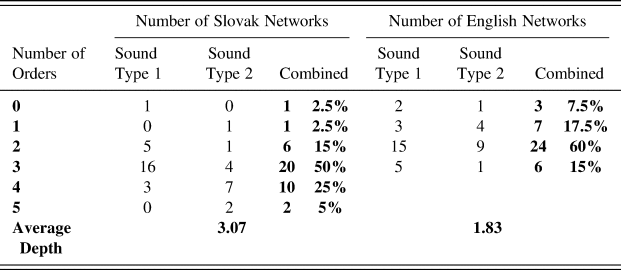
As can be seen, the Slovak networks employ a maximum of five orders of derivation. There are two such words in our sample, both in Sound Type 2, namely buch ‘bang’ and klop ‘knock’. English employs a maximum of three orders of derivation, and there are six such words in our sample. In Sound Type 1, these are howl, woof, chirp, buzz, and quack, while in Sound Type 2, there is only snap. The most typical network in Slovak has three orders: the average depth of networks is 3.07 orders. In total, there are 20 three-order networks in the Slovak sample, which amounts to 50%. However, the typicality is different in Sound Type 2, where the highest number of networks (7) end in the 4th order. Only one network ends in the 1st order (bác).
In English, the majority of networks (24) are restricted to the 2nd order of derivation, making up 60% of the sample. This ratio is similar in both Sound Types of English onomatopoeias, with 15 networks in Sound Type 1 and nine networks in Sound Type 2. The average depth of English networks is 1.83 orders.
4.5 Distribution of semantic categories
Table 12 identifies the number of derivatives for the most productive semantic categories per order of derivation.
Most productive semantic categories

From among the Slovak derivational networks, the largest number of derivatives (91) belongs to the semantic category action. Examples include mňaukanie ‘miaowingN’, búchanie ‘bangingN’, and buchot ‘bangingN’. The high frequency of occurrence of the semantic category of action in the Slovak OW-based networks follows from the high productivity of the action nominal suffix -nie/-tie that can be attached to nearly any verb (Furdík Reference Furdík2004: 109). Moreover, verbs derived from onomatopoeias can also form action nominals by adding the suffix -ot, which is restricted to this group of verbs (Horecký et al. Reference Horecký, Buzássyová and Bosák1989: 114). The fact that these two productive suffixes with similar meanings coexist without any noticeable blocking effect contributes to the high number of derivatives characterized by the semantic category action.
The second most frequent semantic category in the Slovak derivational networks is durative, with 82 instances. The third most frequent category is inceptive with 75 derivatives. These are deverbal verbs formed by the prefixes za- or roz-, such as zavŕzgať ‘to creak’, zaklopať ‘to knock’, rozvŕzgať ‘to start creaking’, or rozbúchať ‘to start pounding’. Similarly to the category of action, these are highly productive prefixes.
Durative is also the most productive semantic category in the 1st order of both Sound Type 1 and Sound Type 2. Here, it serves as a derivational starting point for the rich 2nd order. There is, however, a difference between the two Sound Types. While the Sound Type 1 verbs derive mostly to inceptive, for example, kvíkať ‘to oink’ → zakvíkať/rozkvíkať ‘to start oinking’, Sound Type 2 verbs derive mostly to quality (e.g., vŕzgať ‘to creak’ → vŕzgavý ‘creaky’ and vŕzgajúci ‘creakingA’) or saturative (e.g., šúchať ‘to rub’ → vyšúchať ‘to clean by rubbing/to scrub’).
In the 3rd order of both Sound Type 1 and Sound Type 2, the most productive semantic category is reflexive, creating 13 new derivatives for the former and 27 for the latter. Those are the derivatives created by postfixation (e.g., buchnúť ‘to hit’ → buchnúť sa ‘to hit oneself’).
The two most productive semantic categories in English, namely resultative and quality, have 37 derivatives. The former is mostly formed in the 1st order by the conversion of an onomatopoeia to a noun with the meaning ‘result of an action’ (e.g., snap O → snap N). The latter mostly occurs in the 2nd order as a result of the derivation of deverbal adjectives by the suffix -ing (banging A); a less productive derivation with this result is that which takes the suffix -y (croaky A). Consequently, while resultative is the most productive category in the 1st order, quality prevails in the 2nd. The semantic category manner is typical of the tiny 3rd order, with deadjectival adverbs derived by the suffix -ly, as in chirpy → chirpily.
4.6 Typical combinations of semantic categories
The research reveals a few typical combinations of semantic categories in the OW-based derivational networks. In Slovak, the most frequent combinations include durative-inceptive, as in the combination hrkať ‘rattle’ → zahrkať, durative-action, as in hrkať → hrkanie, and quality-manner, as in the combination of an adjective and adverb, e.g., hrkotavý → hrkotavo. The semantic categories durative and singulative tend to potentiate the category saturative, especially in the Sound Type 2 networks, as in plieskať ‘swashDUR’ → rozplieskať and ďobnúť ‘peckSING’→ rozďobnúť. Another typical sequence for all onomatopoeic bases is a combination of the two semantic categories durative and durative-action. In this sequence, a verb is derived into another, nearly synonymous verb by the suffix -otať, which potentiates the formation of an action nominal ending in -ot (e.g., cvrkať ‘chirpV’ → cvrkotať ‘chirpV’ → cvrkot ‘chirpingN’).
The English networks are much smaller and, probably for this reason, more predictable than the Slovak ones. The onomatopoeic bases tend to derive durative and resultative words. Durative then usually derives the categories of action, quality, and, especially in the Sound Type 1 networks, agent. For instance, the onomatopoeic base word howl underlies the durative verb howl, which subsequently serves the derivation of howling A (quality), howling N (action), and howler (agent).
4.7 Blocking effect of semantic categories
Some semantic categories have a blocking effect. For example, the semantic category singulative in Sound Type 1 blocks any further derivation in 12 out of 14 cases. In Sound Type 2, however, the singulative category does potentiate subsequent derivations, mostly into the reflexive category. The semantic category manner (e.g., vŕzgavo ‘in a creaky way’) blocks any further derivation in all 17 cases where it appears, irrespective of the order of derivation or the Sound Type.
The blocking effect can be observed in English as well. In the 1st order, the semantic category resultative blocks any further derivation in 36 out of 38 cases. The only exception is the combination resultative-diminutive, which is observed with the onomatopoeic bases grunt (grunt N → gruntling N) and boom (boom N → boomlet N). Since the English networks rarely reach the 3rd order and never the 4th one, it is difficult to comment on any other potential blocking within the 2nd or 3rd orders.
4.8 Derivation processes
The last aspect we focused on was the proportion of derivational processes employed in the OW-based derivational networks in the two languages examined.
Table 13 shows that the majority of new derivatives in both languages are formed by suffixation, which represents nearly 60% of all network derivatives in Slovak and nearly 55% in English. In English, these derivatives are mostly of the semantic categories action, as in chirp-ing, quality, as in knock-ing, and to some degree also agent, as in howl-er. English employs two other word-formation processes, namely conversion and prefixation. Conversion is used especially in the 1st order to derive a noun or a verb from an onomatopoeic base, such as snap O → snap N (resultative) or snap V (durative). It accounts for more than 42% of derivatives from the whole sample. Prefixation, on the other hand, is used sparsely, totaling barely 3% of all network words. Examples include un-snap (reversative), anti-knock (instrument), or be-howl (augmentative).
Derivational processes underlying the derivational networks
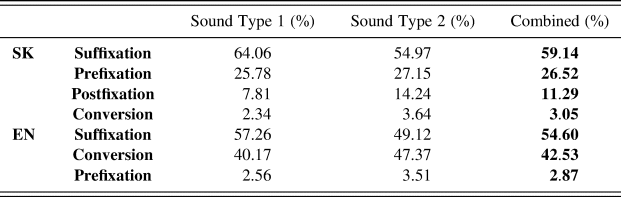
While both Sound Types use suffixation as their most productive word-formation process, the difference between the two processes is significantly lessened in Sound Type 2. This is due to several onomatopoeic words that do not go beyond the 1st order and are therefore unable to create suffixal derivatives, since these can be found only in the 2nd order.
Slovak networks employ four different processes. After suffixation, the most productive word-formation process is prefixation, which produces more than 26% of network derivatives. It mostly creates words falling within the semantic category of inceptive, as in za-bučať ‘moo’, singulative, as in z-bučať ‘moo’, saturative, as in vy-ťukať ‘tap’, or diminutive, as in po-klopať ‘knock’. The third-most productive process is postfixation, which occurs in more than 11% of derivatives, including reflexive, as in búchať sa ‘hit oneself’, or reciprocal, as in búchať sa ‘hit each other’. The last process found in the Slovak sample is conversion, which accounts for only around 3%. Slovak conversion, however, is different from English, as the form of the newly formed derivative can be different from its base, unlike in English. This includes conversions like buchotať ‘to bang’ → buchot ‘bangingN’ and cvrkotať ‘to chirp’ → cvrkot ‘chirpingN’, but also others like čvirik (sound of a sparrow) → čvirik (a twittering bird, usually a sparrow).
The proportionality of the processes is largely the same in individual onomatopoeic sound types as well. The only difference is that postfixation is less productive in Sound Type 1 of the Slovak sample, accounting for only 7.81% of derivatives, whereas in Sound Type 2 it accounts for 14.24%. This is compensated by a higher proportion of suffixation in Sound Type 1.
5. Comparison with the derivational networks of the ‘standard’ wordstock
This section compares the results obtained for the individual parameters of OW-based derivational networks with the data on derivational networks for ‘standard’ (i.e., non-iconic) words in English (Popova Reference Popova, Körtvélyessy, Bagasheva and Štekauer2020) and in Slovak (Ivanová Reference Ivanová, Körtvélyessy, Bagasheva and Štekauer2020). This makes it possible to assess the position of onomatopoeias in the wordstock and, in this way, contribute to the discussion of whether or not it represents a ‘unique species’ (Körtvélyessy Reference Körtvélyessy2020, Reference Körtvélyessy2021a).
Popova's analysis suggests that English derivational networks are “sparse and relatively shallow” (2020: 148): two orders of derivation is the maximum for nouns, verbs usually reach three orders of derivation, and only one adjective (new) has a derivative in the 3rd order. Their saturation values (SVs) are relatively low, with a few exceptions (the SV of the derivational network of the noun dog is as high as 67%, the SV of the verb to hold is 60%, and that of the adjective long is 45%). This is also reflected in a low maximum and average derivational capacity in all three examined word classes.
Contrary to this, Slovak derivational networks feature a high maximum number of orders of derivation. It is twice as high as in English: five for nouns, six for verbs, and four for adjectives. The saturation values are, however, not high, roughly at the level of the English words. A significant difference has been identified for the maximum and average derivational capacity: it is several times higher in Slovak derivational networks. Since these findings map the derivational networks based on 30 words of the core vocabulary, we shall treat them as defining the prototypical derivational networks for Slovak and English, respectively.
A detailed comparison of Slovak and English OW-based and NIW-based networks for all examined parameters in sections 5.1 to 5.6 should show us whether OW-based networks map the prototypical cases.
5.1 Derivational capacity
Tables 14 and 15 compare the maximum and the average derivational capacity of derivational networks in English and Slovak, respectively, for the ‘standard’ and onomatopoeic vocabulary.
Maximum and average derivational capacity in Slovak

Maximum and average derivational capacity in English
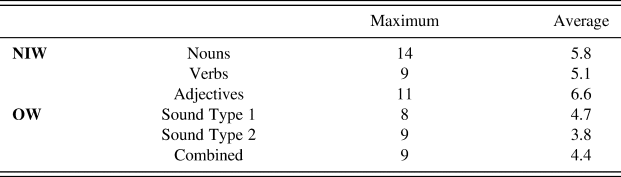
The data show that both the average and the maximum capacity of English derivational networks is lower in the OW-based derivations, even if the maximum capacity is roughly at the level of NIW verbs. The data for Slovak differ as the maximum capacity of Sound Type 2 is identical to the largest (i.e., verb-based) derivational networks of the ‘standard’ vocabulary and is much higher than those based on nouns and adjectives. The same is true of its average capacity, which approaches the average capacity of NIW verbs and is much higher than that of nouns and adjectives.
5.2 Saturation value
A comparison of the average saturation values for the two classes of Slovak and English vocabulary by order of derivation is given in Tables 16 and 17, respectively.
Average saturation values per order of derivation in Slovak

Average saturation values per order of derivation in English
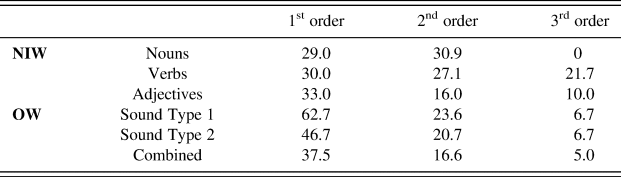
The data indicate different word-formation behaviors of the two Sound Types of onomatopoeic words. While Slovak Sound Type 1 features a higher saturation value in the 1st order of derivation than Sound Type 2, the situation is substantially different in orders 2–4. This is also projected onto the comparison of the saturation values between the NIW-based and OW-based networks: while the saturation value of Sound Type 1 is at the level of nouns, verbs, and adjectives in the 1st order, it is much lower in the following orders, especially in orders 3 and 4. On the other hand, the saturation values of Sound Type 2 are similar to those of adjectives in the 2nd and 3rd orders of derivation. Its value in the 4th order clearly drops to a much lower value compared to the NIW networks. Furthermore, the derivational behaviour of Sound Type 2 imitates that of nouns of the NIW-based networks in violating, in the 2nd order, the gradual decrease in saturation values from the 1st order down to the 5th order, which is so characteristic of verbs and adjectives. While Sound Type 1 also manifests this trend, its 5th order violates it. However, the saturation value of the 5th order must be interpreted with caution, due to the fairly low maximum derivational capacity. All in all, the comparison of the saturation values indicates that Slovak OW-based networks feature a different pattern of derivational behavior to the NIW-based networks.
The English data are analogical in the sense that the saturation value of Sound Type 1 in the 1st degree is much higher than that of Sound Type 2, even much higher than that of the individual word-classes of the NIW-based networks, and it is lower than the saturation values of nouns and verbs (but not of adjectives) of the NIW-based networks in the 2nd and 3rd orders. The general trend of a gradual decrease in saturation values across the individual orders of derivation is very strong in the English OW-based networks.
5.3 Orders of derivation
Tables 18 and 19 compare the maximum and average number of orders of derivation for the two different classes of words in Slovak and in English, respectively.
Maximum and average number of orders of derivation in Slovak

Maximum and average number of orders of derivation in English

In the ‘standard’ vocabulary, it is the verb-based networks that feature the highest average number of orders of derivation in both Slovak and English. Considering Tables 14 and 15, the highest average number of verb-based orders of derivation in Slovak evidently correlates with the highest derivational capacity of the verb-based networks. This, however, does not apply to English. This can be accounted for by richer derivation at the lower levels of the verb-based networks. In the case of OW-based networks, the data parallel the ‘standard’ vocabulary networks; in particular, the higher average number of derivational orders in Sound Type 2 correlates with its much higher derivational capacity. A comparison of the two classes of vocabulary confirms the derivational capacity data, that is to say, lower values for the English OW-based networks and a ‘competitive’ number of derivational orders of the Slovak Sound Type 2.
5.4 Correlation between semantic categories and orders of derivation
This parameter shows substantial differences between the ‘standard’ and onomatopoeic parts of the vocabulary in all orders of derivation. This is understandable and inevitable because the derivational sequence and the derivational capacity of a network significantly depend on the word class of the base word. By implication, the prevalence of particular semantic categories in individual orders of derivation must necessarily vary, as can be seen from Tables 20 and 21.
Most productive semantic categories in Slovak
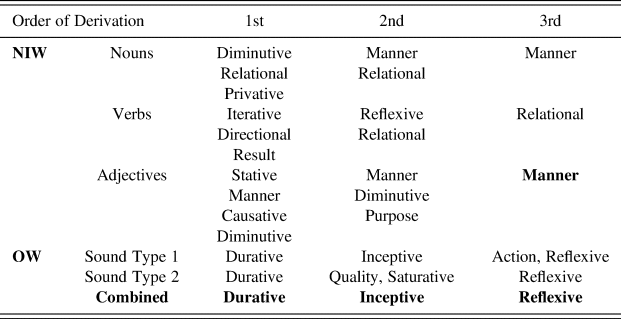
Most productive semantic categories in English
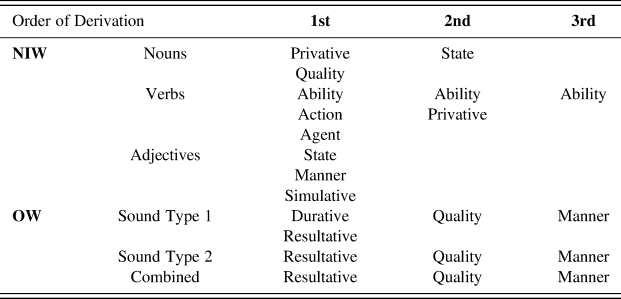
What is interesting, however, is that the two Sound Types in the Slovak derivational networks behave as two different word classes in terms of the correlation between orders of derivation and the prevailing semantic categories. The agreement between Sound Type 1 and Sound Type 2 exists only in the 1st order. On the other hand, the English networks feature complete agreement in all three orders. In general, the OW-based networks are completely different from the derivational networks based on non-iconic words.
5.5 Typical combinations of semantic categories
The observation of unequal correlations between semantic categories and orders of derivation in derivational networks based on non-iconic vs. iconic words is necessarily projected onto unequal typical combinations of semantic categories.
In the Slovak non-iconic networks, the most typical combinations of semantic categories are:
– agent-female, as in zubár ‘dentist’ – zubárka ‘she-dentist’
– relational-manner, as in kamenný ‘stony’ – kamenne ‘in a stony way’
– relational-stative, as in všivavý ‘lousy’ – všivavosť ‘lousiness, the state of being lousy’
– causative-instrument, as in dávkovať ‘dispense’ – dávkovač ‘dispenser’
– causative-agent, as in zradiť ‘betray’ – zradca ‘betrayer’
Typical OW-based networks in Slovak include (for examples, see section 4.6):
– durative-inceptive
– durative-saturative
– durative-durative-action
– quality-manner
– singulative-saturative
In the English non-iconic networks, the most typical combinations of semantic categories are:
– state-quality
– state-privative
– ability-privative
– privative-ability
The OW-based networks in English include such typical combinations as:
– durative-action
– durative-quality
– durative-agent
A comparison of the typical English and Slovak OW-based sequences have only one type of agreement in common (durative-action). Otherwise, the typical sequences are completely different in spite of sharing the semantic category durative as the first member of a combination. A comparison of the typical sequences in the NIW-based networks reveals a complete contrast without a single case of identical combination.
5.6 Blocking effects of semantic categories
A sharp contrast can also be observed in the data regarding the blocking effects of semantic categories. As is evident from Table 22, manner displays a blocking effect in all categories in both NIW- and OW-based networks. Apart from that, however, there is no other overlap between the two types of networks.
Semantic categories with blocking effects in Slovak

Popova (Reference Popova, Körtvélyessy, Bagasheva and Štekauer2020: 153) maintains that “[g]iven how shallow the networks are, it is difficult to comment on blocking effects.” The same is true of the OW-based networks, with the single exception of the semantic category resultative, which blocks any further derivation beyond the 1st order.
6. Conclusions
Our research into the interrelation between onomatopoeic words and derivational networks has resulted in the following observations:
(i) Slovak onomatopoeic words are much more productive in word-formation than their English counterparts. This is evident from all the examined parameters:
• The average size of a Slovak network is 13.98 derivatives; the average English network is only 4.35 derivatives.Footnote 8
• The average network depth (number of orders of derivation) is 3.07 orders in contrast to 1.83 orders in English.
• The largest Slovak network has 38 derivatives; the largest English network has only 9.
• The maximum derivational network in Slovak counts 113 potential derivatives as opposed to only 22 in English.
In short, the Slovak onomatopoeic networks are significantly larger.
(ii) In spite of the findings mentioned in (i), the truth is that the Slovak primary onomatopoeic words themselves do not give rise to many immediate derivatives, which follows from the relatively small numbers for the 1st order of derivation. It is their systematic mutation to verbs, a derivationally very rich category in Slovak, that is a core reason for the large OW-based networks. As pointed out by Ivanová (Reference Ivanová, Körtvélyessy, Bagasheva and Štekauer2020: 102), “there is a rich set of prefixes with different spatial and aspectual meanings that can be added to a verb”, and therefore “[t]he richest derivational networks are typical of Slovak verbs.” Consequently, the derivational networks of onomatopoeias become rich as well. Even though the English onomatopoeic bases generate verbs as well, their derivational capacity cannot compete with the extensive formation of deverbal verbs in Slovak, not to mention the action nominals, which can even benefit from the availability of the suffix -ot reserved specifically for nominals derived from verbs denoting sound.
(iii) Both languages mostly employ suffixation to form new words in OW-based networks, but the Slovak tendency to form verbs by prefixes is an important factor affecting the richness of derivational networks. As pointed out by Ivanová et al. (Reference Ivanová, Kyseľová, Perovská, Ološtiak, Vužňáková, Vojteková and Ološtiak2015), prefixation and postfixation are the two most productive processes in forming deverbal verbs in the Slovak language, together accounting for 68% of derived Slovak verbs. These two processes are productively used in our sample as well, accounting for nearly 38% of all derivatives. English, on the other hand, rarely uses prefixation. A large portion of its derivatives is formed by conversion from the original onomatopoeic base. This process is responsible for the creation of more than 42% of all English derivatives in our sample.
(iv) The frequent mutation into verbs in Slovak also has an impact on the distribution of semantic categories. The most productive semantic categories are either those typical of verbs or of derivatives from verbs, such as action, durative, inceptive, and reflexive. The largest number of derivatives belonging to one category is 91 (for action). In English, the situation is different, since the most productive semantic categories are resultative and quality. These two categories each account for 37 derivatives. The data thus indicate differences in the main directions of derivation and the productivity of the available derivational rules in the examined languages. As a result, the English onomatopoeic networks – unlike the Slovak ones – mostly consist of nouns and adjectives, with verbs only being in the 1st order with the meaning ‘to make the sound of’, and rarely anything else.
(v) Another interesting conclusion can be drawn regarding the systematicity of networks. As already mentioned, the size of English derivational networks does not compare to Slovak networks, but their small size opens the door to a higher saturation value and, therefore, to more predictable derivational networks. For example, an average English OW-based network is saturated up to nearly 30% of the MDN value. An average Slovak OW-based network, on the other hand, is only saturated to 12.37%. The strong systematicity of English networks can be seen especially in the 1st order of derivation, where the saturation exceeds 60% for Sound Type 1 and approaches 50% for Sound Type 2. In comparison, an average network of the same order in Slovak is saturated up to 31% in Sound Type 1 and up to 25% in Sound Type 2.
(vi) Our research unambiguously shows that the structural richness of a word-formation system does not affect the size and complexity of derivational networks.
(vii) The comparison of the NIW-based and OW-based networks gives additional support to the assumption that onomatopoeia is a ‘unique species’ and that, apart from its specific semiotic, phonological, morphological, syntactic, and semantic characteristics, it is also characterized by word-formation characteristics manifested in the structural organization and complexity of its derivational networks:
• Compared to the situation in the NIW-based networks, a lower average derivational capacity for both OW-based Sound Types in English and a substantially lower one for Sound Type 1 in Slovak. This does not hold, however, for Slovak Sound Type 2, which almost reaches the derivational capacity of the verb-based networks, i.e., the most productive word class underlying derivational networks in Slovak.
• Mostly lower saturation values in the Slovak sample with the exception of the 1st order of derivation in Sound Type 1, but much higher values in the English 1st order.
• A specific pattern of saturation values across individual orders of derivation.
• A generally lower average number of orders of derivation with the exception of Slovak Sound Type 2.
• A completely different productivity of semantic categories in individual orders of derivation.
• Completely different typical combinations of semantic categories across orders of derivation both in English and in Slovak.
All in all, the data on OW-based networks and their comparison with NIW-networks in Slovak and in English indicate that:
(i) derivational processes based on onomatopoeias contribute to their comprehension as a special class in the vocabulary of the two examined languages, different from the existing word classes;
(ii) this class of words is not homogeneous in terms of its derivational behavior, requiring the assumption in (i) to be taken with caution; therefore, further research into derivational networks of onomatopoeias is required. This should cover (a) other sound types and (b) more languages.
If the present article gives further support to the comprehension of onomatopoeias as a ‘unique species’, let us emphasize that their treatment as an independent class of words does not mean that all idiosyncratic features of onomatopoeias must occur in each language and have the same manifestation at each level of the language system. This is evident from Körtvélyessy (Reference Körtvélyessy2021a) who maps specific features of onomatopoeias from a cross-linguistic perspective by applying the markedness principle to the semiotic, phonological, morphological, word-formation, semantic, and syntactic levels. This enables her to identify prototypical features of onomatopoeias and illustrate their unequal manifestations in different languages of the world. In addition, her analysis makes it possible to distinguish onomatopoeias from interjections, ideophones, and the NIW vocabulary in general.



