


Statement of Research Significance
Research Question(s) or Topic(s): This study examined whether working memory, processing speed, and selective attention at 7 years mediate the relationship between very preterm (VP) birth and mathematical performance at 13 and 20 years. The primary aim was to evaluate whether hypothetical early intervention on these cognitive domains could reduce the performance gap between VP and term-born peers. Main Findings: VP individuals performed lower in mathematical computation at both ages. Casual mediation modeling showed that intervening on all three cognitive functions could reduce the performance gap by 68.7% at 13 years and 44.1% at 20 years. Working memory had the strongest individual effect. Study Contributions: Using novel statistical modeling techniques, this study identifies key cognitive targets for early intervention. Findings suggest that multi-domain cognitive intervention in childhood may improve long-term mathematical outcomes in VP individuals, offering valuable implications for clinical and educational strategies.
Due to significant advances in perinatal medicine, the mortality associated with VP (<32 weeks’ gestation) birth has decreased significantly over the past several decades (Cao et al., Reference Cao, Liu and Liu2022; Saigal & Doyle, Reference Saigal and Doyle2008). However, those born VP continue to be at an increased risk for long-standing difficulties across multiple domains, including cognitive and academic challenges (Pascoe, Burnett & Anderson; Reference Pascoe, Burnett and Anderson2021; Twilhaar et al., Reference Twilhaar, Wade, de Kieviet, van Goudoever, van Elburg and Oosterlaan2018).
Mathematical computational skills have been consistently identified as an area of concern for those born VP. Mathematical computational skills are defined as the ability to calculate basic addition, subtraction, multiplication, and division and apply these skills to more complex equations (Millians, Reference Millians, Goldstein and Naglieri2011). A large meta-analysis by McBryde and colleagues (Reference McBryde, Fitzallen, Liley, Taylor and Bora2020) demonstrated pronounced difficulties in mathematical performance in children and adolescents born VP compared with their full-term (FT) born peers, with a pooled mean group difference of 8 points which equated to greater than 0.5 SD. Consistent with these findings, it has been reported that 18-year-olds born VP are less likely to have completed mathematics as a core subject at school, when compared with those born FT (Hallin, Hellstrom-Westas & Stjernqvist, Reference Hallin, Hellström-Westas and Stjernqvist2010). Adequate mathematical skills are important to successfully function in modern society. In the general population, mathematical competence in adolescence has been shown to have an important role in later social and economic outcomes (Basten et al., Reference Basten, Jaekel, Johnson, Gilmore and Wolke2015). Within the VP literature, stronger mathematical performance in childhood has been associated with increased enrollment in higher education courses (e.g., post-secondary school; Jaekel et al., Reference Jaekel, Anderson, Bartmann, Cheong, Doyle, Hack, Johnson, Marlow, Saigal, Schmidt, Sullivan and Wolke2022).
The cognitive difficulties underpinning mathematics difficulties in those born VP are unclear but likely to be related to core processes such as working memory, information processing speed, and selective attention. Working memory refers to the ability to hold, update, and manipulate information in one’s mind (Cowan, Reference Cowan2014). Cragg and Gilmore’s theoretical model posits that working memory is important for both learning the facts required for successful mathematical skills as well as for effectively learning the procedures required for various mathematical problems (Cragg & Gilmore, Reference Cragg and Gilmore2014). There is evidence of a relationship between working memory and mathematical computational skills in the VP population (Clayton et al., Reference Clayton, Simms, Cragg, Gilmore, Marlow, Spong and Johnson2022; Mulder et al., Reference Mulder, Pitchford and Marlow2010; Simms et al., Reference Simms, Gilmore, Cragg, Marlow, Wolke and Johnson2013). Slowed information processing speed has also been associated with poorer mathematical attainment in children and adolescents born VP (Mulder et al., Reference Mulder, Pitchford and Marlow2010; Rose et al., Reference Rose, Feldman and Jankowski2011; Trickett et al., Reference Trickett, Bernardi, Fahy, Lancaster, Larsen, Ni, Suonpera, Wolke, Marlow and Johnson2022). It has been theorized that slowed processing speed may impact on mathematical computational skills due to the slowed learning and automaticity of basic numerical facts (Bull & Johnston, Reference Bull and Johnston1997).
While less research has explored the link between selective attention difficulties and mathematics in this population, Trickett and colleagues (Reference Trickett, Bernardi, Fahy, Lancaster, Larsen, Ni, Suonpera, Wolke, Marlow and Johnson2022) demonstrated that selective attention is an independent mediator in the relationship between extremely preterm birth (<28 weeks’ gestation) and overall mathematical skills at 11 years old.
It is yet to be examined how these core cognitive processes in childhood mediate the relationship between VP birth and later mathematical skills at different stages of development. The aim of this study was to examine the extent to which the impact of VP birth on mathematical computation skills at 13 and 20 years of age is mediated by working memory, processing speed, and selective attention at 7 years. Determining the cognitive mechanisms underpinning mathematics performance in this population may provide insights into how and when to intervene to optimize long-term outcome in this domain. It is hypothesized that the mathematical performance of those born VP will be lower than those born FT, at a group level at both 13 and 20 years. It is also hypothesized that hypothetically intervening on working memory, processing speed, and selective attention at 7 will decrease the difference between groups in maths performance at both 13 and 20, with working memory having the greatest impact. These hypothetical intervention effects reflect model-based causal estimates rather than the effects of actual experimental interventions and should therefore be interpreted as informative about potential mechanisms rather than as substitutes for evidence from randomized controlled trials.
Methods
Participants
Participants were part of the Victorian Infant Brain Study (VIBeS) cohort longitudinal study comparing development in those born VP with those born FT. The VIBeS cohort comprises 224 children born VP/very low birth weight (born <30 weeks’ gestational age and/or 1250 g birth weight) at the Royal Women’s Hospital, Melbourne, Australia, between July 2001 and December 2003, as well as 77 children born at term (born 37 to 41 weeks’ gestational age and or ≥2500 g birth weight) recruited at birth (n = 46) from the Royal Women’s Hospital, or at 2 years of age (n = 31) from community child health clinics. For both groups, infants were excluded if they had chromosomal or congenital abnormalities associated with impaired neurodevelopment.
Procedures
Participants in the VIBeS longitudinal cohort study were invited to follow-up studies at 2, 5, 7, 13, and 20 years of age (Figure 1). This research was completed in accordance with the Helsinki Declaration. Ethical approval was obtained by the Human Research Ethics Committee at the Royal Children’s Hospital, Melbourne. Written, informed consent was obtained from the primary caregiver for the follow-up time points up to 13 years. At the 20-year time point, the participants gave written, informed consent. Each follow-up involved a cognitive and academic assessment. Participant vs Non-Participant analyses were done for both the 13-and 20-year time point on neonatal and sociodemographic variables (see Supplementary Materials).
Flowchart of participants through the study. Note: VP = very preterm. FT = full-term.

Measures
The measures collected at each time point used in this study are described below:
Exposure
Birth group (VP vs FT) was used as the exposure.
Mediators
Working memory at 7 years. The Digits Backwards Subtest from the Working Memory Test Battery for Children (Pickering & Gathercole, Reference Pickering and Gathercole2001) was administered. Versions of the Digits Backwards subtest are widely used to measure working memory (Ahmed et al., Reference Ahmed, Ellis, Ward, Chaku and Davis-Kean2022; Reynolds et al., Reference Reynolds, Niileksela, Gignac and Sevillano2022), specifically the maintenance, updating, and manipulation subprocesses. Individuals are read a string of numbers and then asked to recite them backward. Each string length has a block of 6 items and if the child correctly answers 4 items, they progress to the next block in which the string of digits has been increased by one digit. Scores were age standardized, with a normative mean of 100 and standard deviation of 15.
Selective attention at 7 years. Selective Attention was assessed using the Sky Search subtest from the Test of Everyday Attention for Children (TEA-Ch; Manly et al., Reference Manly, Robertson, Anderson and Nimmo-Smith1999). Individuals were instructed to circle target symbols that are interspersed with distractors on an A3 page, as quickly but accurately as possible. The outcome measure for this task is number of correct targets. A scaled score is calculated for each individual, with a mean of 10 and standard deviation of 3.
Processing speed at 7 years. Processing speed was assessed using the Identification subtest from CogState (CogState Ltd., n.d.). This is a reaction time computerized task wherein the participant is instructed to attend to a playing card on the screen and press the “yes” button if the card that turns over is red and the “no” button if the card that turns over is not red. Participants are instructed to respond as quickly and as accurately as possible. The outcome measure for this task is reaction time in milliseconds for correct responses, which is normalized using a logarithmic base 10 transformation (Maruff et al., Reference Maruff, Lim, Darby, Ellis, Pietrzak, Snyder and Research Group2013).
Outcome
Mathematical computation skills at 13 and 20 years. At 13 years, participants completed the Mathematical Computation subtest from the Wide Range Achievement Test – 4th edition (WRAT-4; Wilkinson & Robertson, Reference Wilkinson and Robertson2006), while at the 20-year follow-up, participants completed the same subtest from the updated Wide Range Achievement Test – 5th edition (WRAT-5; Wilkinson & Robertson, Reference Wilkinson and Robertson2017). Participants were asked to complete as many written mathematical problems in 15 minutes. Problems included simple calculation, moving through to more complex concepts involving mathematical reasoning and algebra. Performance was measured as the number of correct answers completed within the 15-minute time period. A standardized score based on age norms was calculated for each participant, standardized to a mean of 100 and standard deviation of 15.
Confounders
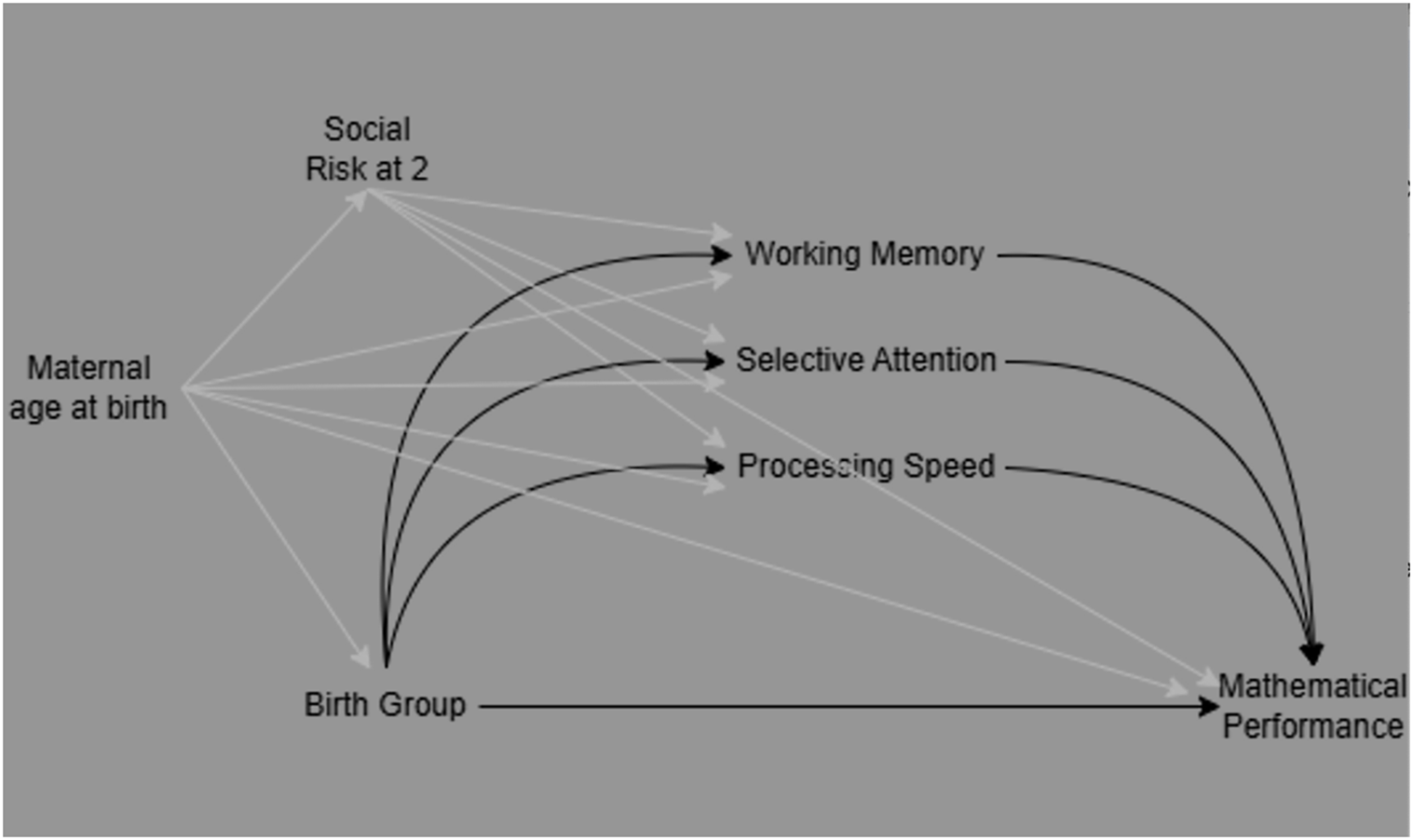
Baseline confounder. Maternal age at birth was used as a baseline confounder. Maternal age is known to be a risk factor of VP birth (Fuchs et al., Reference Fuchs, Monet, Ducruet, Chaillet and Audibert2018). There is also evidence that maternal age is associated with child’s cognitive outcomes and mathematical performance (Augustine et al., Reference Augustine, Prickett, Kendig and Crosnoe2015; Goisis, Schneider & Myrskyla, Reference Goisis, Schneider and Myrskylä2017; Wan et al., Reference Wan, Zhu, Tian, Cheng, Zeng and Zhu2024). The relationship between maternal age and the variables in the analysis are represented in Figure 2.
Directed acyclic graph displaying the relationships between the exposure, confounders, mediators, and outcome at 13 and 20 years.

Intermediate confounder. Social risk at 2 years of age was utilized as an intermediate confounder in the causal models. There is evidence that social risk is associated with both cognitive outcomes and academic skills (Kouros et al., 2020). In this study, social risk was estimated using a composite scale incorporating the following six variables: maternal age at birth (<18 years, 18–21 years or 21+ years of age), education of primary caregiver (less than 11 years of schooling, completed year 11 and/or 12, and received tertiary education), occupation of primary caregiver (unskilled, semiskilled, professional or skilled), employment status of primary caregiver (unemployed/pension, part-time work, and full-time work), main language spoken at home (no English, some English, and only English), and family structure (single caregiver, parents separated but with shared custody, and nuclear family). The composite score was dichotomized around the median into higher social risk (total score of ≥2) or lower social risk (total score of 0 or 1; Roberts et al., Reference Roberts, Howard, Spittle, Brown, Anderson and Doyle2008).
Statistical analyses
Data were analyzed using a combination of Stata 18 (StataCorp, 2021) and R Statistical Software Version 2024.12.1. Participant characteristics were summarized as means and standard deviations for continuous variables and counts and percentage for categorical variables. Preliminary analyses were conducted to ensure the assumed relationships shown in the causal models were consistent with our data. Linear regression fitted with generalized estimating equations (GEEs) using an exchangeable correlation matrix with robust standard errors were used. GEE models were utilized to account for clustering of multiple births (i.e., twins and triplets) within families. All models were adjusted for our baseline and intermediate confounders as indicated by our causal diagrams shown in Figure 2 depicting the assumed causal relationships for 13 and 20 years, respectively.
The hypothesized causal pathways from birth group to mathematical performance at 13 and 20, via working memory, processing speed and selective attention at 7 years, were used to inform the analysis to minimize potential selection bias. To reduce bias caused by missing data, multiple imputation (MI) by substantive model compatible fully conditional specification (SMCFCS) was conducted (Dashti et al., Reference Dashti, Lee, Simpson, Carlin and Moreno-Betancur2025; Bartlett et al., Reference Bartlett2025). Bootstrapping was also used to estimate the variance of our causal effect measures, using the bootImpute procedure and package developed by Jonathan Barlett (Reference Bartlett2025), 1,000 bootstraps with 50 MI were utilized. See Supplementary Materials for the missingness directed acyclic graph depicting the missing data assumptions used to guide MI. Descriptive analyses were conducted using a complete case analysis. All analyses addressing the causal aims of this paper were conducted using the medRCT R package (Chen et al., Reference Chen, Dashti and Moreno-Betancur2025) using the imputed data. We also report results from a complete case analysis to ensure consistency in results (see Supplementary Materials).
Mediation analysis
Causal mediation analyses were used to estimate the potential improvements in mathematical performance for those born VP, at a group level, compared to their term-born peers at both 13 and 20 years, achievable by intervening on working memory, processing speed, and selective attention at 7 years (Moreno-Betancur et al., Reference Moreno-Betancur, Moran, Becker, Patton and Carlin2021; Spry et al., Reference Spry, Moreno-Betancur, Middleton, Howard, Brown, Molyneaux and Patton2021). This approach allows researchers to emulate the effects that would be obtained in a hypothetical randomized control trial. For these analyses, at both time points, we estimated the following:
Interventional indirect effect: The expected improvement in mathematics scores at 13 and 20 years in the VP group under a hypothetical intervention that shifts the distribution for each mediator (e.g., working memory at 7 years) to match that of the FT group, leaving all other mediators unchanged. This corresponds to an interpretable, policy-relevant scenario where a single domain of cognitive functioning is selectively improved via intervention and reflects the indirect effect through that domain.
Total causal effect: The overall difference in standardized mathematics scores at 13 and 20 years between the counterfactual outcomes for each child (i.e., average difference between the outcome if a child was born VP versus if they were born FT). This includes all direct and indirect pathways linking birth group to outcome and provides a benchmark against which the potential impact of mediator-targeted interventions can be evaluated.
We also estimated a “maximum benefit” intervention effect, estimating the improvement in mathematical scores in the exposed (VP) group if all cognitive outcome scores were shifted to the level of the control (term) group simultaneously.
Results
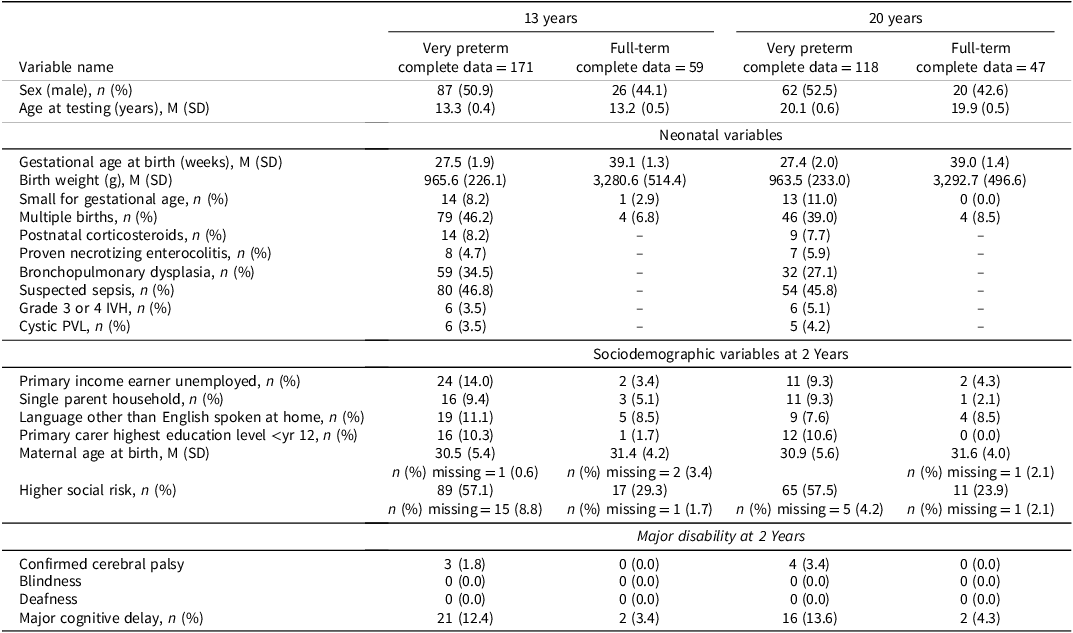
Participant characteristics for both the 13-and 20-year time points are summarized in Table 1.
Participant neonatal and sociodemographic variables

Note: M = Mean. SD = standard deviation. N = number. IVH = intraventricular hemorrhage. PVL = periventricular leukomalacia. Major cognitive delay = standard score of <70 on the Bayley Scales Mental Development Index.
As expected, the VP group had greater neonatal complications compared with their FT peers and the VP group was more likely to be classified at higher social risk at 2 years compared with the term group.
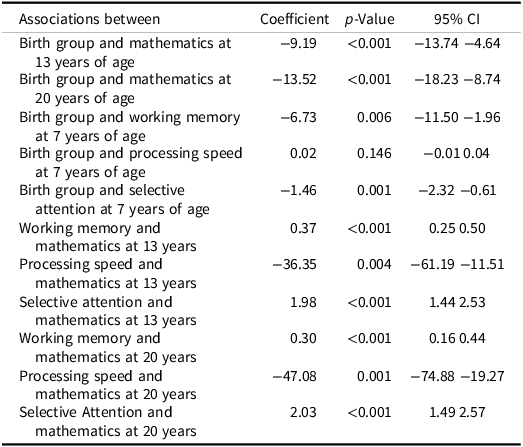
Preliminary analyses, adjusting for maternal age at birth (baseline confounder) and social risk at 2 years (intermediate confounder), confirmed the assumed relationships depicted in Figure 1 (Table 2). There was a strong association between birth group and mathematic performance at both 13 years (magnitude of group difference = 0.6SD) and 20 years (magnitude of group difference = 0.9SD). The associations between birth group and cognitive processes (working memory, processing speed, selective attention) were also as expected, with the VP group performing lower than the FT group at 7 years, although the difference in processing speed was small. Finally, the associations between the cognitive domains and mathematical performance at both 13 and 20 years were in the expected direction, with better working memory, processing speed and selective attention performance associated with better mathematics performance at both 13 and 20 years.
Preliminary analyses showing the relationships between the exposure, mediators, and outcome variables, adjusting for confounders

Controlling for maternal age at birth and social risk at 2 (mediator-outcome models). 95% CI = 95% confidence interval.
Interventional effects
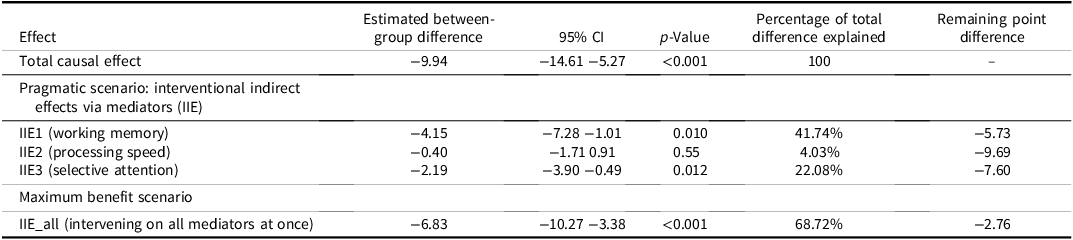
Results from the interventional effects approach at 13 years demonstrated a total causal effect between groups of 9.94 standard score points, wherein those born VP, on average, performed 9.94 standard score points lower than their term-born peers on a task of mathematical computation (Table 3).
Results of evaluation of mediator interventions to reduce difference in mathematical performance between 13-year-olds born very preterm and term using the interventional effects approach

Note: 95% CI = 95% confidence interval. IIE = interventional indirect effect.
Within the pragmatic intervention scenario (i.e., intervening on a single mediator), if we were able to shift the working memory performance of the VP group to that of the FT group, there would be a 41.7% (4.15 points) reduction in the average difference in mathematical performance at 13 years. If processing speed and selective attention were shifted to match the level of the FT group, there would be a 4.0% (0.40 points) and 22.1% (2.19 points) in the group differences, respectively. Under a maximum benefit scenario model wherein working memory, processing speed, and selective attention were simultaneously shifted in the VP group to match the FT group, there would be an estimated reduction in the difference in mathematical performance at 13 years by an average of 68.7% (6.83 points).
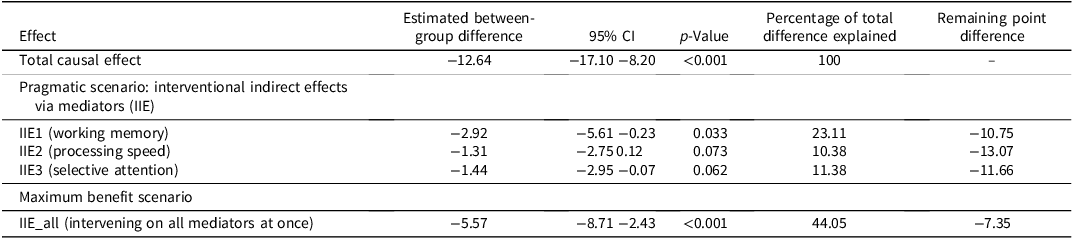
When examining the hypothetical intervention on mathematical performance at 20 years, the total causal effect between groups was 12.6 standard score points (Table 4).
Results of evaluation of mediator interventions to reduce difference in mathematical performance between 20-year-olds born very preterm and term using the interventional effects approach

Note: 95% CI = 95% confidence interval. IIE = interventional indirect effect.
At this time point, in the pragmatic intervention scenario, if working memory performance in the VP group was shifted to that of the FT group, there would be an average reduction in the difference between groups of 2.9 standard score points, equating to 23.1%. If the processing speed of the VP group was shifted to match the FT group, there would be a 10.4% reduction in the difference in mathematical scores at 20 years (1.31 points). When selective attention was hypothetically shifted, with all other mediators held constant, there was an estimated average reduction in mathematical score differences of 11.4% (1.44 points). In the maximum benefit scenario at 20 years, shifting all mediators in the VP group to match the levels of the FT group, we found that this would result in an estimated 44.1% reduction in performance difference (5.57 points). The complete case analysis had similar conclusions across all results (see Supplementary Materials).
Discussion
This study examined the potential benefit of intervening on working memory, selective attention, and processing speed for reducing mathematical difficulties in those born VP compared to those born at term. As expected and consistent with past research, we found large differences in mathematic performance between those born VP and FT (Gutierrez-Ortega et al., Reference Gutierrez-Ortega, Lopez-Fernandez, Tubio and Santiago-Ramajo2024; McBryde et al., Reference McBryde, Fitzallen, Liley, Taylor and Bora2020). We extended on this wealth of literature, demonstrating that this lowered performance in mathematics continues into adulthood in those born VP, with the between-group difference widening between 13 and 20 years. These are meaningful group-level differences, equivalent to nearly one standard deviation; mathematical difficulties of this magnitude are likely to have a functional impact in day-to-day life (Geary, Reference Geary2011).
Simulated interventions targeting working memory, processing speed, and selective attention, applied at 7 years of age could significantly reduce the difference in mathematical performance at 13 and 20 years between those born VP and FT. Specifically, a combined intervention could reduce the difference in performance at 13 years of age by 68.7%. At 20 years of age, the estimated benefit of the same hypothetical intervention was still evident although somewhat attenuated, with a 44.1% reduction in group differences when all three cognitive domains were shifted simultaneously. When modeled independently, working memory consistently demonstrated the greatest individual impact, reducing the difference by 4.2 and 2.9 standard score points at 13 and 20 years, respectively.
Our findings are in line with previous work that demonstrates working memory in children born VP is associated with mathematical performance (Aarnoudse-Moens et al., Reference Aarnoudse-Moens, Weisglas-Kuperus, Duivenvoorden, van Goudoever and Oosterlaan2013; Clayton et al., Reference Clayton, Simms, Cragg, Gilmore, Marlow, Spong and Johnson2022; Collins et al., Reference Collins, Burnett, Pyman, Mainzer, Pascoe, Haebich and Anderson2024; Simms et al., Reference Simms, Gilmore, Cragg, Marlow, Wolke and Johnson2013). Our study differs from previous studies methodologically by using a causal mediation framework, which allows us to draw inferences about the effects of hypothetical interventions. The current study observed an interesting pattern in the relationship between processing speed and mathematics across the two time points, with the hypothetical intervention effect increasing by 0.9 standard point between 13 and 20 years of age. This is in line with the theoretical perspective that efficient processing speed may improve the automatic retrieval of mathematical facts of familiar problems from long-term memory (Andersson & Lyxell, Reference Andersson and Lyxell2007); a particularly important skill when completing more complex, multi-step mathematical equations specifically in adulthood. We observed a moderate impact of selective attention on mathematics performance, with a reduction of 22% at 13 years and 11% at 20 years.
Randomized control trials have evaluated whether academic performance in children born VP can be improved through working memory training programs. This work has suggested limited transfer to academic skills such as mathematics (Anderson et al., Reference Anderson, Lee, Roberts, Spencer-Smith, Thompson, Seal, Nosarti, Grehan, Josev, Gathercole, Doyle and Pascoe2018). This is important to consider given the increased interest in cognitive interventions such as cognitive training for both typically developing and high-risk populations. The cumulative effect of simultaneously intervening on or targeting multiple cognitive domains suggest a potential benefit of interventions that concurrently target multiple cognitive domains.
From a developmental perspective, this study provides important insight into how the relationship between early cognitive abilities and later academic outcomes may change over time for those born VP. We found that on average, intervening on these key cognitive domains early in childhood in those born VP is likely to have less of an impact on mathematic computation with increasing age. These findings may be explained by the cumulative risk theory of development, which proposes that multiple adversities (e.g. medical risk, sociodemographic factors, parenting styles, and environmental instability) have a compounding effect on development over time (Rutter, Reference Rutter1979). In this case the relative contribution of early cognitive skills on academic performance may weaken in those born VP with increasing age due to the accumulation and compounding effect of additional social, biological, and environmental factors.
While this study demonstrated that hypothetically intervening on working memory, processing speed, and selective attention in childhood has a reduced impact on mathematics by 20 years in those born VP, it is important to consider the possibility that other cognitive domains may also play an important role in mathematical computation, especially with increasing complexity as occurs in adulthood. For example, there is some evidence that inhibitory control also contributes to mathematical performance in typically developing populations (Coulanges et al., Reference Coulanges, Abreu-Mendoza, Varma, Uncapher, Gazzaley, Anguera and Rosenberg-Lee2021) and research has shown a relationship between cognitive shifting and mathematical “talent” in adolescents (Abreu-Mendoza et al., Reference Abreu-Mendoza, Chamorro, Garcia-Barrera and Matute2018). While the present study focused on working memory, processing speed, and selective attention based on a priori hypotheses, another additional example may be sustained attention, given the length of the mathematical task (15 minutes). Future research should therefore incorporate a broader range of cognitive domains to more comprehensively characterize the cognitive mechanisms underlying mathematical difficulties.
This study has several important clinical and educational implications. Our findings support trialing the application of multi-component interventions that target multiple cognitive domains. Cognitive interventions have garnered increasing attention in the literature on individuals born VP. The present study highlights the potential value of targeting working memory as a means to improve mathematical performance in this population, underscoring a promising direction for both future research and resource allocation. Importantly, our findings demonstrate that the most marked improvements are likely achieved through multi-domain cognitive interventions. From a policy and funding perspective, this illustrates that investment in comprehensive, multifaceted cognitive intervention approaches is not only justified but may yield more meaningful outcomes than single-domain strategies. It is important to note that while we observed an attenuation of the effects of intervention over time, a VP group deficit persisted of a magnitude that is likely to have clinical and functional benefits for the individual. In addition to unaccounted cognitive domains, other factors such as environmental adversity may also be contributing to this mathematics problems observed in this population.
There are several strengths of the current study. The longitudinal design allowed us to examine the effect of early cognitive skills on mathematics at two different developmental time points within the same cohort. Further, our sample is a well characterized and representative sample of individuals born VP, aiding in generalisability of our study findings. Moreover, we utilized a cutting-edge statistical modeling approach that allowed us to emulate trials with less resources than an actual trial would involve. This statistical method provides an innovative option for examining a range of hypothetical interventions for reducing functional difficulties in those born VP compared with their term peers.
The current study is not without limitations. Each cognitive domain at 7 years was estimated using a single scale. Although each subtest was selected to examine a specific cognitive function, the measures are inevitably tapping multiple cognitive constructs. Future studies may benefit from including multiple tasks per domain to help disentangle the overlapping components in order to acquire a more robust estimate (Jonaitis et al., Reference Jonaitis, Koscik, Clark, Ma, Betthauser, Berman and Johnson2019). Future research would benefit from utilizing a broader range of mathematics tasks that assess different processes including mathematical facts, basic numerical concepts, and more complex reasoning. Further, performance validity measures were not used. While this is a potential limitation that could be addressed in future studies, assessors closely monitored engagement, response consistency, and adherence to standardized administration procedures at each assessment to ensure that the results reasonably reflected participants’ best effort. A further limitation pertains to the developmental assumptions underpinning our models. The simulated intervention scenarios assume that modifying cognitive processes at 7 years could meaningfully alter developmental trajectories that have already been shaped by earlier experiences. However, for children born VP, early neurodevelopmental differences may have ongoing and cumulative effects that are not easily reversed through later intervention. As such, the magnitude of the estimates effects may overstate what is achievable in real-world settings, particularly if earlier developmental constraints limit the extent to which these cognitive domains can be improved. Finally, given this study is a trial emulation, we cannot address the real-world practicability of implementing interventions to address areas of difficulty in this population. The simulated intervention effects should be interpreted at the population level and may not generalize to subgroups with more complex medical or developmental profiles. We also note that investigating differential effects across clinically defined subgroups represents an important direction for future research. While we used MI to improve our estimates and the robustness of our conclusions, we cannot eliminate the possibility that there were still some estimation biases in our results due to unmeasured confounding (Goldfeld et al., Reference Goldfeld, Moreno-Betancur, Gray, Guo, Downes, O’Connor and O’Connor2023).
It is important to note that our hypothetical intervention models assume a complete shift in each cognitive domain such that the VP group matches the FT group. These “full-shift” scenarios represent upper-bound estimates and are unlikely to be achievable in real-world intervention contexts. More realistic scenarios, such as partial improvements that shift cognitive performance only partially toward the performance of the FT group, would be expected to produce smaller reductions in the mathematics gap. Future research using this modeling framework could model graded or incremental intervention effects to provide estimates that better reflect practical intervention impact. Although our analyses simulate the potential benefits of improving specific cognitive domains, these estimates do not reflect the effects of currently available interventions. Existing working memory training programs, for example, show limited transfer to mathematics or broader academic outcomes, highlighting the need for new approaches. Rather than implying that current programs can achieve the effects modeled here, our findings are intended to identify cognitive targets that may inform the development of novel, multi-component interventions that simultaneously address working memory, processing speed, and attention. Such approaches may hold greater promise than single-domain training and represent an important direction for future intervention research. Further, it is important to consider that working memory training can be structured in different ways and focusing on mathematic problems might be more effective than a general working memory training. Finally, future work would also benefit from examining whether those most vulnerable (such as those with an IQ of less than 70 have a different response to hypothetical intervention compared to those born VP with a higher IQ.
In conclusion, this study applied statistical methodologies to examine the potential benefit of intervening on working memory, selective attention, and processing speed for reducing mathematical difficulties in those born VP. The cumulative benefit of hypothetically intervening on all examined cognitive domains at 7 years, for mathematical performance at both 13 and 20 years of age, highlights the importance of intervening on multiple areas of cognition, as opposed to developing interventions that target them in isolation. Moreover, the decreased overall influence of core cognitive processes on the difference in mathematics performance between those born VP and FT by 20 years of age suggests that other factors become increasingly important for mathematical outcomes over time. This highlights the need to consider the complex and broader potential interplay between lower and higher-level cognitive skills and environmental influences when designing interventions to support mathematical outcomes in those born VP.
Supplementary material
The supplementary material for this article can be found at https://doi.org/10.1017/S1355617726102033.
Acknowledgments
The authors would like to acknowledge the individuals and families who took part in this research.
Funding statement
Australian National Health and Medical Research Council [NHMRC; Project Grants 237117, 491209, and 1066555]; Centre for Clinical Research Excellence 546519; Centre for Research Excellence 1060733; Senior Research Fellowships 628371 & 1081288 to PJA; Investigator Grant 1176077 to PJA; US National Institutes of Health HD058056, the Victorian Government’s Operational Infrastructure Support Program.
Competing interests
The authors declare no competing interests.



 Open access

