


1. Introduction
Before 1980, the study of glacier movement in China was focused on surface velocity (Reference Huang and ShiHuang, 1988). From observations of surface flow we can determine the distribution and variation of the surface velocity and relate it to mass balance. Later, research on basal movement and strain rates was initiated in a tunnel (tunnel 1, Fig. 1) in the west tributary of Ürümqi Glacier No. 1, Tien Shan mountains, China (herein referred to simply as Glacier No. 1) (Echelmeyer and Wang, 1987;) (Reference Huang and ZhongxiangHuang and Wang, 1987). Thus, research on glacier movement has been expanded from the surface to the inside and the bottom. Strain rates on glacier surfaces have been studied as well, as on the surface of Glacier No. 1 (Reference Huang, Zhongxiang, Baolin and JiankangHuang and others, 1989), on Chongce ice cap of the west Kunlun mountains (Reference Chen, Nakawo, Ageta, Watanabe and LanshengChen and others, 1989), and on the surface of Dunde ice cap in the Qilian mountains. These studies enrich glacier movement research in China. Research on the basal deformation of Glacier No. 1 from 1988 to 1990 was part of a project to study flow mechanisms (Reference HuangHuang, 1992, this volume). In this paper we present a preliminary analysis of movement patterns and of strain configuration at the glacier base.

Fig. 1. Map showing the location of the ice tunnels. Ρ is a control point. [Inline 1] is a point for observation of surface velocity.
Two tunnels were excavated in Glacier No. 1. One (tunnel 1) in the west tributary was observed from 1980 to 1984, and the second (tunnel 2) in the east tributary was observed from 1988 to 1990 (Fig. 1). Tunnel 2 was excavated to a length of 80 m in October 1988, and further extended to 90m in April 1989. Its cross-section was arch-shaped, 2 m high and 2 m wide. Its longitudinal profile is shown in Figure 2. Point Ρ in Figures 1 and 2, a control point for surveys, was 3730.63 m a.s.l. in 1989.

Fig. 2. Longitudinal profile of the ice tunnel 2

Fig. 3. Average horizontal velocity of pegs in the tunnel floor
The floor of the tunnel coincided approximately with the glacier bed. The bed consisted of debris and ice. Boulders could be seen on the floor. The ice temperature was measured while the tunnel was being extended. The temperature in the tunnel is below 0°C (Reference HuangHuang, 1990, fig. 6). The tunnel was always dry except for a couple of metres near the entrance where surface melting occurred during the ablation period. Electrical d.c. resistivity soundings conducted in the recently deglaciated area near the tunnel entrance reveal a till layer, 11.3 m thick, resting on bedrock (Reference Zeng and GuoqingZeng and Qiu, 1991). A schematic diagram showing the subglacial thermal, dynamic and hydrological conditions was presented by Reference HuangHuang (1992, fig. 3). It is inferred that the interface between the basal till layer and bedrock is also at sub-freezing temperatures, and that sliding over bedrock is insignificant. Thus we believe that the deformation we observed in the floor of the tunnel is actually deformation of a basal ice-laden till layer.
2. Observation Method
Basal movement was observed in tunnel 2. Eight observation pegs, spaced at intervals of 10 m, were established in the floor (D1 D2, … D8) and another eight at corresponding points in the ceiling ([Inline 2]) along the tunnel axis (Fig. 2). The pegs in the floor were emplaced in frozen, ice-laden debris with an ice content of ~50% by volume. The pegs have been surveyed three times, on 8 May, 8 July and 29 September 1989. Because of limitations of observation conditions, distances between pegs had to be measured with a steel tape while vertical and horizontal angles could be obtained by theodolite. The maximum mean error in distance measurements is ±8.7 mm. All observations were connected with the geodetic coordinate system through the control point P. Plumb lines were used to measure the relative motion between the floor and ceiling.
3. Results
3.1. Longitudinal velocity along the tunnel axis
The terminus of a glacier is generally in an area of compressive flow. In addition to the normal decrease in velocity due to thinning of the ice, there are also often dead ice, newly formed terminal moraines, or rock lips in front of the glacier. These obstruct ice flow. The terminus of the east tributary of Glacier No. 1 is obstructed by a recently deglaciated deposit in front of the terminus. Thus the surface velocity decreases rapidly towards the terminus. The average velocity on the floor also decreases gradually towards the tunnel entrance, from 2.9 to 0.7 m a−1 (Fig. 3).
In addition, at point A2’ on the glacier surface above peg D1 in the tunnel, the average velocity was 3.58 m a−1during 1988–89 (Reference Chen and ZuozheChen and Sun, 1989, table 1). Thus the basal velocity near the terminus of the east tributary, at D1, is 78% of the surface velocity. This is consistent with the conclusion of Reference Echelmeyer and ZhongxiangEchelmeyer and Wang (1987), who worked in tunnel 1, that 60–80% of glacier surface movement is provided by deformation of the bed.
3.2. Displacement of ceiling relative to floor
The observed displacements of the ceiling pegs relative to the corresponding floor pegs are listed in Table 1. The observations reveal that the movement of the ceiling is faster than that of the floor, with the difference gradually increasing from the back wall towards the tunnel entrance. The relative velocities over May-July and July-September 1989 are summarized in Table 1 as well. In general, relative velocities vary from 1.3 to 6.6 mm d−1. The velocities from May to July are generally larger than those from July to September.
3.3. Vertical velocity of the floor
The vertical velocity of the tunnel floor is generally upward, and it gradually increases from the back wall towards the tunnel entrance (Table 2). Assuming an average depth from the floor of the tunnel to bedrock of 11 m, as noted above, and assuming that the vertical velocity varies linearly with depth, we can calculate the vertical strain rate. The results are given in Table 2.
Table I. Displacement of ceiling relative to floor

Table 2. Movement and strain on the floor

A certain fraction of the increase, of course, is due to tunnel closure. As a rough correction for this, using the theory of Reference NyeNye (1953) for closure of a cylindrical hole and using the ice thickness to estimate the stress, a vertical velocity due to tunnel closure can be calculated. In the calculation we used n = 3.07 and A = 4.89 × 10⁻¹⁵(kPa)−ns−1 in the flow law. The calculation for 145 days (from 8 May to 29 September) shows that the elevation change due to tunnel closure ranges from 21.0 to 3.5 × 10⁻² mm, decreasing from the back wall to the tunnel entrance (Table 2). This is much less than the observed values. Therefore most of the vertical velocity is not a result of tunnel closure. That the rise is greatest near the entrance also suggests that most of it is not due to tunnel closure.
3.4. Longitudinal strain rate along the tunnel axis
The longitudinal strain rate, έ, along the tunnel axis is calculated from:
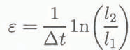
where l1 and l2 are the distances observed at the beginning and end of a time interval of duration Δt.
The results of this calculation are also listed in Table 2. The strain rate between pegs D1 and D2 is positive, so there is a short section extending flow. However, all other sections are negative, revealing a main section of compressive flow. The values in the zone of compression gradually increase from the back wall towards the tunnel entrance, from −0.579 to −5.739 × 10⁻² a−1.
3.5. Principal strain rate and direction along the tunnel axis
As mentioned above, the strain field along the floor of the tunnel is mainly compressive longitudinally and extending vertically. The tunnel can be divided into seven sections by the eight pegs D1, D2 … D8. Assuming that in each section the deformation is homogeneous we can calculate the principal strain rates Δ1 and Δ2, in a vertical plane oriented parallel to the tunnel axis, and their orientation in the vertical plane, ϕ, based on the observed longitudinal and vertical displacements of the pegs. The results are given in Table 2. ϕ is measured from the direction of the major axis of the strain ellipse to the horizontal, and ranges from 45.2 to 22.2°. It decreases gradually from the back wall towards the tunnel entrance. These results are consistent with those of Reference Huang and ZhongxiangHuang and Wang (1987).
3.6. Asymmetrical closure
The lateral wall deforms asymmetrically. The deformation of two cross-sections is shown in Figure 4. One (a) is 60 m and the other (b) 30 m from the tunnel entrance. Dotted lines show the deformed cross-sections after deformation. The asymmetry is due to the fact that the direction of the tunnel axis was not precisely parallel to a flowline. The velocity vector at point A2’ deviated 20° from the tunnel axis.

Fig. 4. Tunnel closure: (a) section 60 m from the entrance, (b) section 30 m from the entrance
IV. Conclusions
Research on basal deformation in a tunnel excavated along a glacier bed is useful for studying the movement and deformation, even though the original configurations of stress and strain have been partially changed by the excavation. The following characteristics of the deformation were found during studies in tunnel 2, 90 m in length, excavated in the east tributary of Glacier No. 1:
-
A significant contribution (78%) of the overall surface motion near the terminus is provided by deformation of ice-cemented till below the tunnel floor.
-
The movement of the ceiling in the tunnel is much faster than that of the floor, with a gradual increase from the back wall towards the tunnel entrance.
-
The velocity of the tunnel floor gradually decreases from the back wall towards the tunnel entrance.
-
Longitudinal strain rates along the tunnel axis on the floor are compressive, ranging from −0.579 to −5.739 × 10⁻² a−1.
-
The angle of the maximum principal strain rate with respect to the horizontal gradually decreases from the back wall towards the tunnel entrance.
These features agree with those found by Reference Echelmeyer and ZhongxiangEchelmeyer and Wang (1987) and by Reference Huang and ZhongxiangHuang and Wang (1987) in their studies in tunnel 1. From the results we have obtained, we conclude that deformation of the basal ice-laden till layer contributes a significant fraction to the glacier flow, particularly in the glacier margins and terminus where the ice thickness is small. The contact area between a glacier terminus and newly deglaciated deposits in front of the terminus is an area where stress changes rapidly. These deposits can obstruct flow of the basal ice-laden till layer, giving rise to longitudinal compression and upward vertical displacements.
Acknowledgements
This research was supported by grants from the National Natural Science Foundation of China. The authors are grateful to Wang Wenti and Wang Xiaoxiang for their help in the preparation of this paper.



