





INTRODUCTION
Politics is the art of deciding who gets what, when, and how (Lasswell Reference Lasswell1986), and politicians in democracies have to make choices about the allocation of government goods and services in order to maximize their chance of winning elections. This article looks at what happens to the allocation of services and goods by local government when political units merge, using the concurrence of municipal mergers in Japan. We argue that boundary consolidations lead to a transformation in the allocation of public spending because they involve a change in the demographic distribution within the jurisdiction, thereby affecting politicians’ calculations as to who gets what, when, and how.
In particular, we contend that incumbent politicians will aim to garner votes from the more populous areas of a merged unit in order to maximize their chances of reelection. Because they will want to muster as many votes as possible under the new situation, with an updated set of voters within a new jurisdiction, we argue that, all things being equal, they are likely to allocate more public spending to the parts of the merged unit where there are a larger number of voters, and less to areas where there are a smaller number of voters. To demonstrate this empirically, we exploit the fact that there were a large number of municipal mergers in Japan in the 2000s.
Understanding the effects of concurrent changes in political units and demographics within the units has been an important area of inquiry for scholars for many years. Theoretically, there are positive features that tend to come with a larger population size, such as the more efficient provision of public goods and services due to economies of scale, while there are also some potentially negative features, such as a higher degree of the heterogeneity of residents’ preferences (Alesina and Spolaore Reference Alesina and Spolaore2003; Dahl and Tufte Reference Dahl and Tufte1973; Newton Reference Newton1982). But it has been challenging to test the impact of size empirically because factors correlated with the population size of political units—such as the degree of urban-ness, residents’ income levels, and tax revenues—also seem to affect the outcome variables we are interested in, such as the provision of public services.Footnote 1 Similarly, people who live in areas governed by small local governments may have chosen to move there or acted together to oppose mergers in the past because they prefer features associated with a smaller size and, similarly, because they believe that smaller local governments are able to offer such benefits (Blom-Hansen, Houlberg and Serritzlew Reference Blom-Hansen, Houlberg and Serritzlew2014).Footnote 2
Despite these challenges, there has been a growing number of empirical studies trying to nail down the effect of boundary consolidation. In particular, recent studies take advantage of the concurrence of municipal consolidations, which allows researchers to investigate the consequences of a sudden change in the population size in a systematic way. Focusing on the concurrence of mergers is useful because it allows us to exploit variation in mergers, where some municipalities are merged, while others remain intact; the intact municipalities can be used as a “control group.” For example, scholars have examined the impact of changes of political boundaries and corresponding demographic changes on the level of spending (Allers and Geertsema Reference Allers and Bieuwe Geertsema2016; Hanes Reference Hanes2015; Miyazaki Reference Miyazaki2018; Moisio and Uusitalo Reference Moisio and Uusitalo2013; Reingewertz Reference Reingewertz2012), specific categories of expenditure (Blesse and Baskaran Reference Blesse and Baskaran2016; Blom-Hansen, Houlberg and Serritzlew Reference Blom-Hansen, Houlberg and Serritzlew2014; Slack and Bird Reference Slack and Bird2013), fiscal balance (Hansen, Houlberg and Pedersen Reference Hansen, Houlberg and Pedersen2014), and the perceived level of public services (Yamada Reference Yamada2018). Others have investigated the consequences of changes in administrative unit size for democracy and political participation, such as voter turnout in national elections (Horiuchi, Saito and Yamada Reference Horiuchi, Saito and Yamada2015), share of female politicians (Matsubayashi and Ueda Reference Matsubayashi and Ueda2012), legislative performance (Suzuki and Ha Reference Suzuki and Ha2018), internal political efficacy (Lassen and Serritzlew Reference Lassen and Serritzlew2011), political trust (Hansen Reference Hansen2013), and satisfaction with municipal government (Hansen Reference Hansen2015; see also Tavares Reference Tavares2018 for a review of empirical studies that examine impacts of municipal mergers).
Our study follows this growing literature on boundary consolidations but is unique in at least two ways. First, while many of the previous studies have focused on cases in Europe, our work focuses on Japan and contributes to a growing body of work on boundary changes, both in Japan and in non-European states more generally.Footnote 3 Second, we examine the potentially uneven impact of mergers within merged municipalities: this has not been fully investigated in the literature on municipal mergers. Empirically, it is difficult to investigate the effect of municipality mergers within merged municipalities, because data for former administrative boundaries usually cease to exist post-mergers. To deal with the issue, we employ remote-sensing data which have not been utilized before in studies of boundary consolidations. Remote-sensing data are especially useful in this line of inquiry because they are not constrained by the current administrative boundaries and thus allow us to track how variables have changed before and after mergers within a merged entity.
A small number of studies have examined the consequences of municipal consolidations within a post-merger municipality. For example, Suzuki and Sakuwa (Reference Suzuki and Sakuwa2017) examine whether the population growth rates after mergers are different across areas within post-merger municipalities. Voda and Svačinová (Reference Voda and Svačinová2019) focus on the spatial distribution of representatives in Czech municipalities after several decades of amalgamations and find that peripheral areas have a smaller number of representatives per capita than municipal centers, while Jakobsen and Kjaer (Reference Jakobsen and Kjaer2016) show that in post-merger Danish municipalities, less populous pre-merger municipalities had a larger number of representatives than their population shares. Our study aims to complement these recent empirical works in several ways. First, by focusing on the case of Japan, we suggest that a different electoral system (e.g., single-member district and proportional representation) may lead to a different outcome in terms of the number of representatives. Second, drawing on the literature about the impact of mergers on the number of representatives, we argue that uneven political leverage through different numbers of representatives within a post-merger municipality also leads to uneven allocation of public spending. Third, by using a novel data set of satellite imagery of the earth at night, which are the most fine-grained and disaggregated data available, we identify how nighttime light images change before and after municipal mergers, and use this information as a proxy for changes in the distribution of public spending. We are aware that the proxy also captures other variables such as general economic activities, and more direct measures of public spending, if available, may thus be a better option. But we reduce the concern of measurement error by combining with original surveys and demonstrate that our political mechanism is indeed plausible.
Our study is also relevant to the literature on distributive politics, which suggests that politicians deliver more benefits to either core or swing voters. Our argument diverges from the previous studies on this topic; we claim that core and swing voters among the new population are unknown to the incumbent in cases of political unit change. Under the new strategic environment, politicians would have to target a new set of unspecified voters. Limited budgets force local governments to select the beneficiaries of public spending, and we speculate that the incumbent has strong incentives to distribute benefits in the most populous geographic areas. As a result, public spending is expected to increase after a merger in locations where the highest numbers of voters live within the newly created municipality, and to decrease in neighborhoods and communities where fewer voters live. Although this expectation is certainly contingent on many other factors, such as electoral rules, partisan composition, and voters’ socioeconomic characteristics, this article suggests that, all things being equal, politicians who are uncertain about new constituencies after political unit changes may tend to target more populous areas to receive electoral support.
ARGUMENT AND HYPOTHESES
Municipal mergers inevitably change the electoral distribution of a municipality, generating a new set of voters. Therefore, municipal politicians (i.e. mayors and assembly members)Footnote 4 in the municipalities that experienced mergers face a situation that requires them to change their electoral strategy to gain popularity. This article focuses on one particular strategy that incumbent municipal politicians may adopt in this situation: to increase and/or protect their electoral bases through the distribution of public spending.Footnote 5 This is not an easy task for politicians because mergers may mean an overall decline in resources available to some new merged entities particularly if a merger is undertaken based on the belief that the economies of scale allow the new entities to achieve the same objectives with less spending, thereby leading to distributional conflicts over the limited resources within the merged entities.
In these circumstances, we argue that local politicians tend to allocate public spending to more populous areas because they have relatively more political leverage in a new merged entity. The change in power distribution happens because less populous areas within the same merged entity experience the following two things: (1) a relative decrease in the number of voters; and (2) a decrease in the number of local assembly members. Here, it is important to note that in Japan, municipal politicians can exert substantial influence on the allocation of public spending within a municipality, although national and local bureaucrats and national politicians can certainly influence the size of local public spending.Footnote 6 To demonstrate our argument, let us consider a hypothetical scenario in which two areas (i.e., pre-merger municipalities), A and B, merge to form a new municipality X. We assume that Area A is smaller than Area B in population size. Following Dur and Staal (Reference Dur and Staal2008) and Yamada (Reference Yamada2018), we argue that the political power of residents who live in municipalities with a small population size is likely to decline substantially after the merger. Voters in the former small municipalities (Area A), by definition, have a smaller number of votes than those from more populous areas of the post-merger municipality X (e.g., 5,000 voters in Area A and 20,000 voters in Area B).Footnote 7 Therefore, in municipality-level elections after a merger, all things being equal, politicians may have less incentive to deliver benefits to and receive votes from those smaller areas than from larger areas (see below for another indirect mechanism). And this tendency should be more pronounced under several conditions: if there is no malapportionment within a municipality; if one's preference is associated with his or her geographic location; and if voters in the same geographic area tend to support the same candidate(s).
The hypothetical scenario suggests that our expectation depends to some degree on electoral rules. The rules used in Japan's municipal elections are indeed likely to encourage politicians to put more emphasis on populous areas of a post-merger municipality than on less populous areas. Mayors are elected using the first-past-the-post rule, while assembly members are elected by the single non-transferrable vote (SNTV) rule from a municipality-wide, at-large district.Footnote 8 Therefore, there is no malapportionment in which some areas within a municipality are allowed to elect a larger or smaller number of politicians per resident than other areas in the same municipality. This implies that municipal politicians in the post-merger municipalities do not have strong incentives to seek votes from Area A due to their small number of votes.
The distributional change in public spending is also facilitated by an indirect mechanism that affects political power: places like the geographic area A are also likely to lose assembly members. Given the SNTV rule in the assembly election, municipal politicians in Japan tend to divide support bases geographically; they typically develop personal support networks that are concentrated in certain geographic areas (Curtis Reference Curtis1971; Horiuchi Reference Horiuchi2005). This implies that the number of representatives that a given locality can elect is roughly proportional to its size. While there is no malapportionment within a municipality, the number of assembly members per person varies across municipalities, where smaller municipalities tend to have a larger number of assembly members per person (Saito and Yamada Reference Saito, Yamada and Caunder2011).Footnote 9
In sum, two important factors emerge. First, as the size of municipality increases, so does the number of votes required for securing a seat. Second, municipal mergers almost always lead to a reduction in the assembly size per person, and the extent to which the assembly size per person declines after mergers is greater for areas with smaller population size. Thus, we expect that small areas that experienced mergers (such as our fictitious Area A) will be unable to elect as many assembly members as they could before the mergers, leading to a decrease in their political leverage to local governments, which in turn leads to a decrease in the public spending allocated to those areas.Footnote 10
Accordingly, we arrive at our first hypothesis:
H1: The level of public spending delivered to areas with a small population size that experienced mergers decreases after the merger.
Our argument also implies that municipal politicians have electoral incentives to cater to the residents of the area that used to be Area B. The second hypothesis is thus:
H2: The level of public spending delivered to the area of the municipality that was largest in population size before the merger increases after the merger.
Finally, our argument is based on the premise that the number of votes that a group of voters (in our case, people who live in the geographic area) can provide in municipal elections, relative to the number of votes that other groups can provide, matters. So, the size of a pre-merger municipality relative to that of the post-merger municipality should have decisive impacts on the political power of the area following the merger. Suppose Area A is smaller than Area B but by a small margin (for example, populations of 5,000 and 5,500, respectively). In this case, Area A is likely to preserve influence within the post-merger municipality because of the relatively large number of votes they can offer in elections and the capacity to elect a high percentage of members in the post-merger assembly. Thus, we have our third hypothesis:
H3: Among those small areas that experienced mergers, the level of benefits decreases more substantially in small areas that merged with disproportionately larger areas than in small areas that merged with areas similar in population size.
We note that population size is just one of the factors that explains the effect of a merger on public spending, and we acknowledge the importance of other factors. For example, even with the same population size, some areas within a municipality may receive more public services if the areas have strong local politicians who have strong ties with national politicians of the incumbent party. Alternatively, if areas are high in social capital, then they may be better at organizing collective action and receiving more public services. Still, all things being equal, we believe that population size affects politicians’ calculations and the number of assembly members, and thereby the allocation of public spending within a merged entity.
Before moving to our empirical analyses, we theoretically discuss several alternative explanations, which should also clarify our argument. First, one might wonder why geographic voting is fixed along the pre-merger municipal boundaries. Instead, residents of a smaller area might be able to team up with residents of a larger area who live close to the border between the two areas, support the same candidate, and secure representation. We acknowledge that such cooperation may be feasible. However, we expect that the magnitude of the decrease in the number of politicians per person is very large for many of the small areas that experienced mergers. Although they may be able to secure representation by electing one or two assembly members, the impact would not be large enough to substantially mitigate or overturn the negative impacts of the merger. Indeed, we implicitly test the above concern in Hypothesis 3. If the relative population size of the pre-merger area is large, then the residents would be more able to preserve their political power.Footnote 11
Second, the literature on Japanese politics and elections suggests that voter turnout tends to be higher in rural areas (e.g., Horiuchi Reference Horiuchi2005). Thus, one might wonder if the higher turnout rate in less populous areas could allow voters there to preserve their political powers. If an area with 1,000 voters (Area A) vote at 100 percent, while its merger partner of 2,000 (Area B) voters vote at 50 percent; then the number of people who turn out to vote in the election is the same. In that case, politicians may have strong incentives to cater to Area A as well. We do not exclude this possibility and would like to carry out further analyses that consider turnout in local elections in more detail in future works. However, if the difference in turnout between rural and urban areas is very large, we should find evidence against our expectations. We hypothesize that small municipalities that experienced mergers would experience a decline in the benefits allocated to the areas; unlike our expectation, if their political powers are somehow preserved due to high voter turnout, then it would be less likely to detect a relative decline in the public spending.
RESEARCH DESIGN
In order to test our hypotheses, we first employ a nationwide survey conducted in 2011–2012 that examines the proposed mechanism of our argument – if a merger decreases political leverage in small areas that merged with large areas, then we should expect that residents in the small areas perceive a decline in public services as well as political activities, compared to the counterparts in non-merged similar-size areas.
The survey randomly selected 46 rural municipalities that merged and 43 rural municipalities that did not merge, and asked voters in each group about the change in politicians’ behaviors as well as the level of public services after municipal mergers. The sample size is 1,913 for the merger group and 1,832 for the non-merger group.Footnote 12
First the survey asked whether or not the respondents observed a change in the level of public services such as construction and maintenance of roads. Although both the merger and non-merger groups observed a decline in the level of public services, the respondents in the merger group overall show more dissatisfaction with the municipalities’ public services. Specifically, 41.4 percent of the respondents in the merger group answered that the quality of public services had deteriorated in the past ten years and only 13.7 percent answered that it had improved. By contrast, 21.8 percent of the respondents in the non-merger group answered that it had deteriorated, and 23.6 percent said that it had improved. In terms of road construction and maintenance, 31.5 percent in the merger group answered that the conditions of roads had deteriorated in the past ten years; only 19.2 percent answered that they had improved. On the other hand, 16.8 percent in the non-merger group answered that the roads had deteriorated, while 35.6 percent reported that they had had improved. These survey findings are largely consistent with our argument.
Next the survey asked questions related to our indirect mechanism: the frequency of interactions between municipal assembly members and voters as reported by the respondents. The percentage of the respondents in the merger group that “frequently” or “occasionally” interacted with municipal assembly members dropped by 24.4 percentage points (45.0 percent to 21.6 percent), whereas it remained rather stable in the intact group (34.6 percent to 33.7 percent). Similarly, the percentage of the respondents in the merger group who “rarely interacted” or “did not interact with them at all” increased from 51.2 percent to 74.7 percent, while the percentage in the non-merger group dropped only marginally (by 1.4 percentage points). The results are again consistent with the mechanism, which may be driving the change in the allocation of public spending: politicians altered the allocation because of the decrease in the need to receive votes from where there are a small number of voters.
The survey results thus provide the first piece of evidence for the proposed political mechanism, but we are also aware that the survey suffers from several shortcomings. First, the survey relies on subjective perceptions about public services and politicians’ behavior, and the perceptions may not be driven by actual changes in these activities or public spending more generally. For example, it is possible that residents in merged areas expected more from a merger and thus were more disappointed at the merger outcomes, which may in turn explain the survey results. Second, the survey is also based on a cross-sectional, (subjective) retrospective assessment and it does not allow us to isolate a change in the distribution of public spending over time while controlling for time-invariant variation in factors between merged and non-merged municipalities.
Building on the survey results, we thus move to comparing the distribution of public spending within merged municipalities and matched non-merged municipalities by using a more objective time-series measure: nighttime light images. As explained in more detail below (along with some downsides of the measure), the measure permits us to measure public spending more objectively and allows us to track changes in it over time even before and after a jurisdiction change.
In the following, we conduct three different analyses based on: (1) a comparison between small merged and small non-merged areas; (2) a comparison between small merged and large merged areas; and (3) a ratio between small merged and large merged areas. The first counterfactual inference corresponds to a test for H1. If our hypotheses are correct, we should observe a decrease in the distribution of public spending proxied with nighttime light images in the small, merged areas, while the spending level should remain constant in the small, non-merged areas. The second analysis is for H2, and we conduct a within-merger case analysis by comparing small, merged areas with larger, merged areas. In this case, we expect to observe a decrease in levels of public spending in the small, merged areas, with spending levels remaining unchanged or even increasing in the larger, merged areas. By contrast, if we observe an increase in the distribution of benefits in small areas that merged, that should serve as sufficient counter-evidence for our argument. Lastly, the third analysis corresponds to a test for H3, and we expect that the larger the ratio of the initial population size of the pre-merger municipalities, the larger a decline in public spending we observe in merged small areas.
DATA
Ideally, we would use public spending data to construct our dependent variable. However, due to an administrative boundary change after a merger, we cannot trace how the distribution of public spending changes within a municipality before and after the merger. For this reason, we use the degree of change in satellite nighttime light images as a proxy. The data come from the National Geophysical Data Center of National Oceanic and Atmospheric Administration (NGDC-NOAA). The NGDC Earth Observation Group (EOG) specializes in nighttime observations of lights and combustion sources worldwide. The group started working with the Defense Meteorological Satellite Program (DMSP) data in 1994 and has produced a time series of annual cloud-free composites of DMSP nighttime lights.
Light images are captured at an altitude of 830 km above the earth. These images reflect outdoor lights, fires, and gas flares at a fine resolution of 0.56 km and a smoothed resolution of 2.7 km.Footnote 13 Yet, since the satellites only capture lights that are stable, the light images in the paper only show human-made light-sources.Footnote 14 The values of the data range from 1 to 63, with background noise replaced with a zero. While several studies confirm that nighttime light images can be used as a proxy of several variables, such as energy consumption, population, gross domestic product, and levels of development or poverty (Elvidge et al. Reference Elvidge, Baugh, Kihn, Kroehl, Davis and Davis1997), we argue that they are a reasonable indicator of public spending (e.g., provision of infrastructure and public works). For example, politicians may reduce the number of streetlights in unimportant areas after a boundary change, while they may increase public works in more strategically important areas. Both actions can be captured by the nighttime light images.Footnote 15
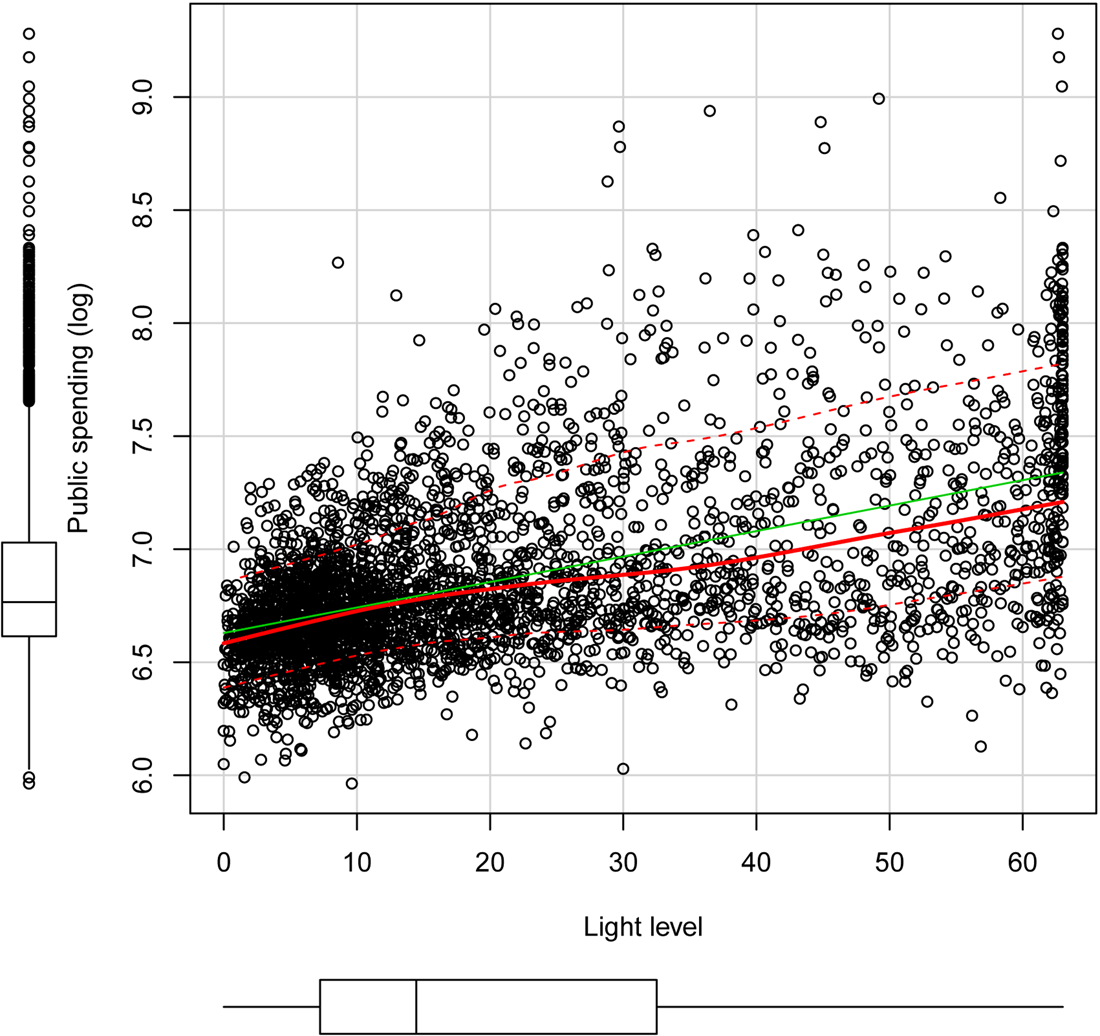
There is no inherent reason to pre-suppose that nighttime lights can only be used to proxy economic activity or development. The first proposed use of nighttime light data was for the “monitoring of natural resources, society, or geophysical phenomena” (Croft Reference Croft1979, 55). In recent works, such data have been used for increasingly diverse reasons, such as to measure vulnerability to floods (Ceola, Laio and Montanari Reference Ceola, Laio and Montanari2014) or to look at the relationship between foreign aid and growth (Civelli, Horowitz and Teixeira Reference Civelli, Horowitz and Teixeira2018). Our argument is that nighttime light data are uniquely able to proxy the spatial distribution of public spending. While this relationship has not yet been established for Japan, Min (Reference Min2015) finds that for Italy, “nighttime light output reflects public investments into electrical infrastructure and is not simply a proxy for private economic activity or industrial output” (Min Reference Min2015, 59). Similarly, for the United States, “nighttime light output reflects government investments in public services and not simply private economic activity” (Min Reference Min2015, 63). To examine the plausibility of this claim that the satellite nighttime images at least in part capture the distribution of public spending, we first correlate our nighttime light images with local public spending data at the premerger municipality level in Figure 1 and confirm that they are positively correlated and nighttime light images can capture some variation in public spending.
Scatterplots Comparing Nighttime Light Data with Spending Proxy
Because infrastructure development—including road maintenance and construction suggested by the survey finding—is one of the major tools for politicians to distribute benefits in Japan, and nighttime light images are likely to capture such large development, we also construct a separate measure of infrastructure as a proxy of public services and compare it with our nighttime satellite image variables. We apply a new method which we believe is better able to capture levels of infrastructure development than the existing widely used proxy (see Appendix for more details). Here, we analyze the complexity of online map images, using the Google Maps server, and find that the more complex the image, the more developed the infrastructure.Footnote 16 For the purposes of this comparison, a map is analyzed based on the coordinates of the centroid of each municipality to give an indication of infrastructure development for that area. Figure 2 shows a scatterplot for the comparison. We see the two variables are also positively correlated, thereby increasing our confidence in our variable.
Scatterplots Comparing Nighttime Light Data with Infrastructure Proxy

These points suggest that variation in nighttime light images can be in part explained by variation in public sector activities, but previous studies also caution us to think that some of the overall variation can also be explained by various private activities—both commercial and residential. Still, we assume that a merger does not exogenously affect these private activities in the short-term before and after a merger. Instead, if we observe an increase in private economic activities, it may be attributed to an increase (or decrease) in localized public services and benefits after a merger. For example, local politicians may decide to install new roads in an area after a merger, and it can lead to more public work as well as private economic activities. Similarly, construction of the new city office building and other public facilities in the city center likely stimulate economic activities (e.g. new restaurants, stores, and housing).Footnote 17 It would be ideal, of course, for the variable to capture only public spending; but for these theoretical reasons, as long as local public spending and private activities are positively correlated and merger is in part responsible for the positive relationship, we believe that the use of the variable is justified and satellite nighttime images can be a reasonable, if not perfect, proxy for the distribution of public spending. Another important caveat is that because we cannot separate the post-merger effect of public spending from the post-merger effect of private activities, we are likely to over-estimate the direct effect of mergers on public spending in terms of its effect size.
METHODS
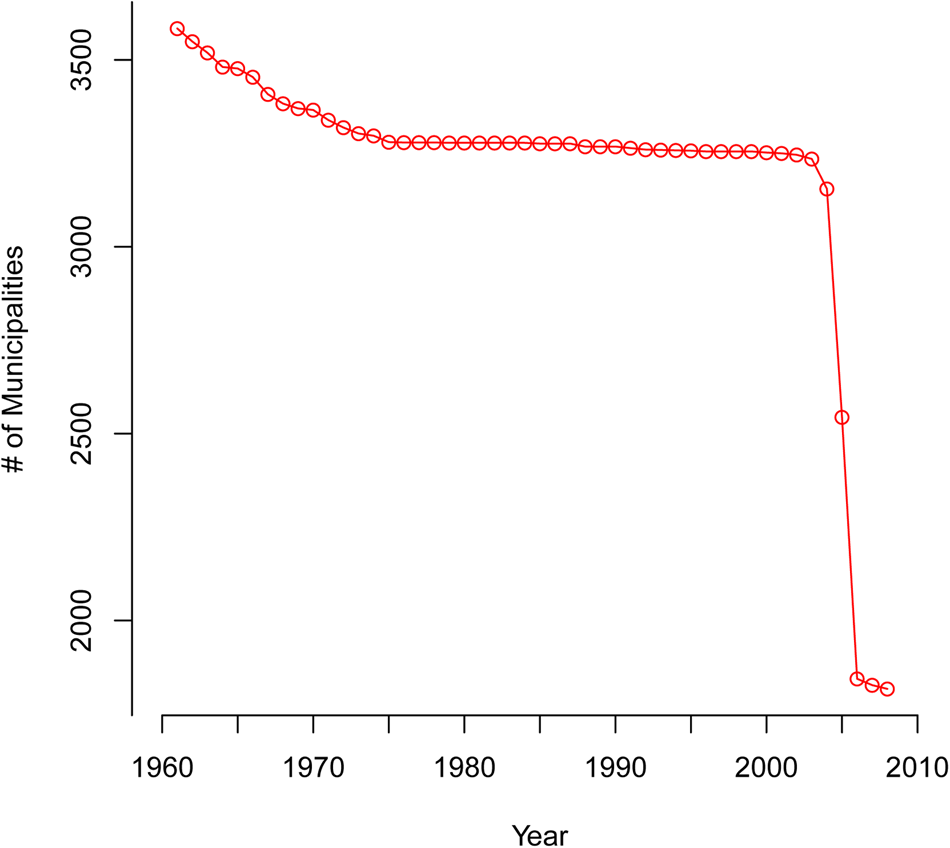
Before presenting our research method and analysis in more detail, we first discuss an overview of municipal mergers in Japan to contextualize our case. As Figure 3 shows, the number of municipalities in Japan suddenly dropped between 2003 and 2006. Due to uncertainty over the merger process, some small and large municipalities merged, while other similar sized areas remained intact. The central government, particularly the ruling Liberal Democratic Party (LDP), promoted mergers with strong financial incentives, and municipalities had a very limited amount of time in which to decide whether to merge (Nishio Reference Nishio2007).Footnote 18 The high degree of uncertainty about possible consequences of mergers impeded the ability of residents of small municipalities and local politicians to precisely anticipate the consequences of mergers with larger municipalities. According to the abovementioned survey of residents in post-merger rural communities, 57 percent of the respondents in rural, merged municipalities were dissatisfied or somewhat dissatisfied with the fact that their municipalities merged, while only 17 percent said they were satisfied or somewhat satisfied with mergers. This implies that it was difficult for residents to clearly and accurately anticipate the impacts of mergers, and it justifies our baseline empirical approach to treat municipal mergers as an exogenous independent variable.Footnote 19 We follow the observation and begin by estimating the treatment effect of a merger on public spending in a simple difference-in-difference setting. Yet, because we cannot fully disregard a possibility that municipalities that were about to lose public spending were more likely to merge, we reduce the concern by using matching methods (see below for more details).
Number of Municipalities in Japan, 1961–2008
Based on the contextual information, we now detail our econometric models for evaluating the effects of a municipal merger on the distribution of public spending. Basically, we estimate a cross-sectional model in which the dependent variable is the difference between light levels pre-merger and light levels post-merger within each municipality. Given that our dependent variable is continuous, we employ a linear regression.Footnote 20
As mentioned above, our main empirical framework is based on a counterfactual analysis between “control” (non-merged municipalities) and “treatment” (merged municipalities) groups, and we employ a difference-in-difference framework (i.e., a test for H1). Our dependent variable comes from the nighttime lights data and measures a change in light images for each municipality. The size of each municipality is an independent variable of our interest, which measures the pre-merger municipality's population size (i.e., the logarithm of population size). The merger variable is a binary indicator flagging whether each municipality experiences a municipal merger. To examine the effect of a municipal merger, we use an interaction term of the municipality size and merger variables. To reduce the concern that omitted variables bias our estimate, we include a vector of control variables in some of the specifications. We also check the parallel trend assumption and confirm that the average nighttime light differences in the pre-merger trends of the merger and non-merger groups are similar, thereby not leading to a biased estimator (see Figure A.1 in the Appendix). It is also possible that unlike our expectation, the differences between the merged, large and small areas reflect some overtime trends from pre-merger periods. For example, some small areas have been losing economic activities over time, thereby leading to the decision to merge with larger and wealthier, neighboring areas. The difference in our dependent variable we may detect may potentially reflect the existing trends. However, we confirm that this is not the case (see Figure A.1 in the Appendix).
In addition to the main specification, to detect the effect of mergers on the distribution of goods and services within a merged municipality, we compare originally large municipalities with originally small municipalities within those municipalities that merged (i.e., a test for H2). The main difference between the first model and the second is that the latter deals only with municipalities that experience a merger; two variables related to merger are thus not included.
For the municipality size variable, we consider two possibilities. First, as in the first model, we measure the actual size of the pre-merger area's population for each area, and this allows us to test H2 directly. Second, to test H3, we use the ratio of the initial population size of the pre-merger area to the population size of all the pre-merger areas involved in the same merger. This variable ranges from 0 to 1. A smaller population ratio indicates that the size of the post-merger area is relatively large. For example, if an area with 5,000 people merged with another area that had 5,000 people, then the population ratio is 0.5 (5,000 divided by 10,000). If the area merged with the other areas which, in total, had 95,000 people, then the population ratio is 0.05 (5,000 divided by 100,000). Our theory suggests that the political power of voters in a geographic area within a merged municipality should be negatively associated with the population ratio, as the number of votes that the locality can provide is relatively small compared to the entire electorate.
Lastly, although the sudden decrease in the number of municipalities provides us with an opportunity to examine the impact of mergers on public spending, it is possible that the decisions of the mergers are not exogenous and thus the analyses suffer from a selection bias problem. For example, areas that are fiscally wealthy at the time of municipality mergers may be less likely to decide on a merger despite fiscal incentives provided by the central government (Yamada Reference Yamada2016). To address the problem, as a robustness check, we also employ an entropy balancing method (Hainmueller Reference Hainmueller2012). Entropy balancing enables us to control for imbalances in covariates and focus on estimating the impact of mergers on public spending. Specifically, we use the Merger variable as a binary treatment variable and entropy balancing re-weights covariates, so that a treatment group (municipalities that decided to merge) and a control group (municipalities that decided not to merge) share the same mean.
CONTROL VARIABLES
The main specifications include two geographical variables which may affect decisions to merge and levels of nighttime lights: Ruggedness and Distance to Capital. The presence of mountainous or rugged terrain in a region has long been regarded as an important factor affecting interaction opportunities (see for example Lemke Reference Lemke1995; Merritt Reference Merritt, Cox, Reynolds and Rokkan1974; Starr Reference Starr2003), and accordingly, a measure of such terrain is useful as a control variable. We quantify rugged terrain by analyzing the elevation variance within each municipality. This technique compares the elevation of each pixel to that of each of the immediately surrounding pixels. A mean is then calculated for the municipality.
Distance to capital is also used as a control variable because of its wide support in the social sciences and in Japan studies (e.g., Alesina and Spolaore Reference Alesina and Spolaore2003; Buhaug, Cederman and Rød Reference Buhaug, Cederman and Rød2008; Le Billon Reference Le Billon2001). As with the infrastructure proxy variable, this figure is based on the coordinates of the centroid of the municipality.Footnote 21
Further, in addition to the Ruggedness and Distance to Capital variables, our entropy balancing analyses control for the following factors that may affect the municipalities’ decisions to merge: Revenue Size, LDP Vote Share, Surface Area, and Island Dummy. First, as mentioned above, we include the Revenue Size variable that captures the per capita revenue size of each municipality government, since wealthy municipalities should have less incentive to merge. Similarly, municipalities where the ruling Liberal Democratic Party (LDP) secures the majority of votes may be less likely to merge with other municipalities. In Japan, local politicians are considered as important actors in national politicians’ election campaigns. Since municipal mergers theoretically lead to a decrease in the number of local politicians, it is costly for the LDP's national politicians to gamble on municipal mergers and lose important activists for their campaigns—to the extent that they are still dependent on their mobilization. If electorally stronger incumbent LDP Diet members were more successful in preventing mergers in their home districts than others, we should observe a lower chance of mergers in places where the LDP's vote shares were higher prior to the municipal mergers. We thus include the LDP Vote Share variable which is the average of the ruling parties’ vote shares for each municipality in the 1990 and 1993 Lower House elections. We also control for two additional geographical variables: Surface Area and Island Dummy. For the former, municipalities that have small surface areas may have more incentive to merge with other municipalities for economies of scale. For the latter, small isolated islands may have technical difficulty in merging with other municipalities, and including them may affect our analysis.
RESULTS
For all the models, we use a sequential modeling strategy and increase complexity in every successive model. The first model is a baseline model without any control variables. Table 1 reports the main results of the counterfactual analysis. First, we find substantial consistency for the results across the models, indicating that our analyses are not sensitive to model specifications. Specifically, with positive significant coefficients of Population*Merger, the estimates from Model 1 to Model 3 provide consistent evidence that municipal mergers lead to a decrease in the distribution of public spending proxied by nighttime light images in smaller areas. In other words, the distribution of benefits would be more likely to decrease in a small area with a merger than in a similar area without a merger. This result is consistent with H1.Footnote 22 For the control variables Ruggedness and Distance from Capital, as expected, more mountainous areas are likely to lose the distribution of benefits. The area that are further away from Tokyo are also likely to experience decreased levels of public spending.
Entropy Balancing Analysis
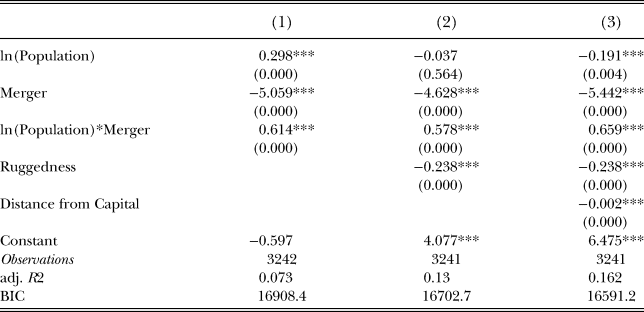
In terms of substantive effects, we simulate the expected change in lights caused by a merger, while holding other explanatory variables at their median. A merger results in a decrease in nighttime light by 5.4 percent.Footnote 23 Since it is difficult to interpret an interaction effect from the table (Berry, DeMeritt and Esarey Reference Berry, DeMeritt and Esarey2010; Brambor, Clark and Golder Reference Brambor, Clark and Golder2006), we plot a marginal effects figure to show the impact of merger status on the probability of affecting light levels across a range of population sizes. Figure 4 illustrates a clear interaction effect of a merger on light levels: A merger has a negative impact on the amount of light when the size of the population is small, but this negative effect decreases as population size becomes larger and moves toward a positive impact on the amount of nighttime light.
Marginal Effect of Merger on Light Images

In a test of H2 and H3, Tables A.3 and A.4 in the Appendix report the results for the within-merger analysis. First, Table A.3 suggests that among areas that merged, larger areas are likely to see more public spending proxied with nighttime lights than smaller ones, which is consistent with H2. In substantive terms, according to Model 3, an increase in population size from the 25th percentile to the 75th percentile results in an increase in light images by 45.6 percent. Similarly, Table A.4 shows the main results for the within-merger analysis with the population ratio variable. The table shows that the variable is positive and significant in all three models, which suggests that larger municipalities that merged with smaller ones are more likely to see an increase in public spending than those that merged with municipalities of a similar size. This is consistent with H3. In terms of substantive effects, an increase in population ratio from the 25th percentile to the 75th percentile (i.e., when the difference becomes larger) results in an increase in light images by 24.7 percent.
The analysis has so far found evidence that is consistent with our argument. However, a possible selection bias may lead to biased estimators—municipalities that merged and did not merge may be significantly different from each other. Thus, we now turn to entropy balancing methods that allow us to improve our causal inference by controlling for imbalances in covariates between the merger group and the non-merged group.Footnote 24
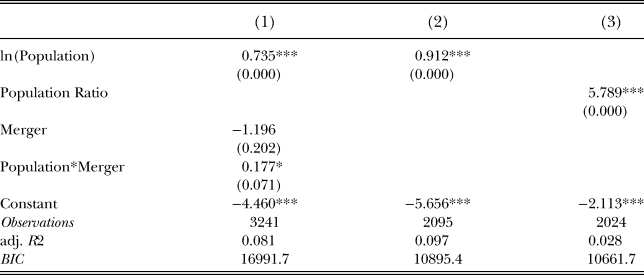
Table 2 reports the results that replicate Model 1 of Tables 1, A.3, and A.4, but adjusts the covariates by entropy balancing. The covariates that are included in each model are: Ruggedness, Distance to Capital, Revenue Size, LDP Vote Share, Surface Area, and Island Dummy. As can be seen, the entropy balancing analyses show similar results to the previous analyses. Model 1 finds that municipal mergers lead to a decline in public spending proxied by nighttime lights, in particular in small areas. Model 2 finds that among areas that merged, larger areas are likely to see more public spending than smaller ones. Finally, Model 3 shows that larger areas that merged with smaller ones are more likely to see an increase in public spending than those that merged with areas of a similar size.
Main Analysis
To illustrate how a merger results in a change in light images, we now describe an example. Figure 5 shows a temporal change in nighttime light images before and after a merger that the city of Toyooka, Hyogo Prefecture, experienced in 2005. The area previously included six different pre-merger municipalities: Toyooka, Kinosaki, Takeno, Hidaka, Izushi, and Tanto. Toyooka was the largest city among the six and had a population of 47,308 in 2000. Hidaka, Izushi, Takeno, and Tanto follow Toyooka in size and had populations of 18,410, 11,207, 5,751 and 5,731, respectively. Kinosaki had the lowest population, with 4,345 residents. If our argument is correct, we would expect that Toyooka experienced an increase in light images, while the other cities observed a decrease in light images.
Comparison of Light Change before and after Merger: A Case of Toyooka
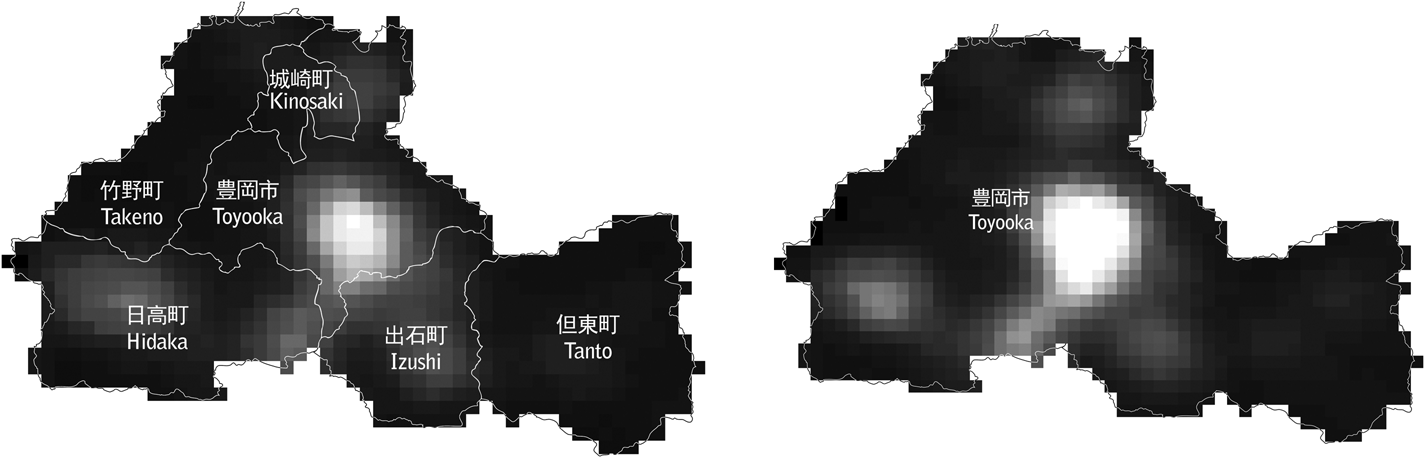
First, the left-panel of Figure 5 shows the pre-merger map of Toyooka taken in 2000 and the right-panel shows the post-merger map captured in 2010. Although we observe some changes in night images and an increase in the amount of light in Toyooka after the merger, the human eye has difficulty in determining these differences.
Figure 6 therefore reports the amount of each municipality's light images divided by the total amount of light for both 2000 and 2010. We see that Toyooka, the largest city, previously accounted for 24.6 percent of total lights in the area. The second and third largest cities, Hidaka and Izushi, produced relatively large amounts of light in 2000 (i.e., 19.2 percent and 22.5 percent, respectively). However, the distribution changed after the merger in 2005. Toyooka accounted for 27.2 percent of total lights in the area for an increase in light by 2.6 percentage points following the merger. By contrast, and consistent with our theoretical expectations, we see the smaller cities experience a reduction in the amount of their nighttime lights, except in the case of Kinosaki. While Kinosaki is the smallest area among the six, the area somehow experienced an increase in nighttime light by 3.6 percentage points. Yet, we do not consider Kinosaki a counter-example for our argument, since it is a famous, historic hot spring destination that receives many tourists every year. This geographic location has characteristics that make it attractive to residents of other localities. In other words, we claim that a majority of the post-merger municipality has incentives to cater to the Kinosaki area not because of an electoral monitoring strategy or socioeconomic redistribution, but because of an asset (the hot springs) tied to this specific location that cannot be relocated. Generalizing and testing this point are beyond the scope of this article and left for future work. Yet, overall, the discussion suggests that Toyooka, as the largest city, has more public spending, while the smaller cities except Kinosaki receive less public spending after the merger.
Ratio of Light for Each Municipality in Toyooka for 2000 and 2010

Overall, our empirical analyses have shown that the findings are consistent with our argument. However, it is still possible that other explanations can explain the findings. For example, municipal mergers might have led to a shift in the center of administrative and economic activities and our nighttime light measure partially captures this. Alternatively, due to economies of scale, the overall budget for public spending might have declined after a merger, and local public officials, not politicians, might have decided to provide public goods more efficiently and allocate more resources to larger areas within the merged entity. Still, although we cannot examine the alternative explanations in this article, combined with the survey results above, we believe our empirical analyses have demonstrated that our political mechanism is also plausible.
CONCLUSIONS
Empirically, it is difficult to examine the effect of boundary consolidations within merged municipalities. Accordingly, this area is notably under-examined. This article has sought to address this issue. We have argued that municipal mergers alter the electoral incentives of municipal politicians and result in a change in the allocation of public spending within a merged municipality. Incumbent politicians are likely to allocate a larger amount of public spending to more populous areas and a smaller amount to less populous areas of the post-merger municipality in order to maximize their chances of reelection. The number of assembly members who have support bases in less populous areas of the post-merger municipality is also expected to decrease and this contributes to the change in the spending allocation. Using remote-sensing data and original surveys, we demonstrated that the observed patterns of the allocation of benefits were consistent with our expectations. We acknowledge the limitations of our measures, and we encourage local governments to keep track of data from previous administrative boundaries even after a boundary consolidation, and to make those data publicly available. Still, despite the limitations, we believe this article provides the foundations for future comparative research about the effect of mergers within merged boundaries.
We believe our article and results are related to other important questions on municipal consolidations. Here, we discuss two of them. First, what are the conditions under which local governments with small population size are able to remain small? Our article found that small areas that merged tended to experience a decrease in the level of public spending allocated to their areas. However, one might wonder why those municipalities had chosen to merge instead of remaining intact if they had expected that their political power would become weaker and the level of benefits might decline as a result after the merger. Immediate reason would include the strong financial incentives by the central government to induce mergers of small areas, along with some ways to mitigate opposition from incumbent municipal politicians such as allowing all the incumbent assembly members to stay in office for two years after mergers without election (Yamada Reference Yamada2016). However, this leads to another puzzle: despite having been providing generous transfers to small areas for decades, why did the Japanese government suddenly decide to raise their cost of remaining autonomous, such that many of those small areas with weak fiscal conditions had to choose mergers?Footnote 25 While investigating this question is beyond the scope of our article, we offer a speculation based on our findings. In general, one of the publicly stated objectives of municipal mergers—in Japan and elsewhere—is to achieve efficiency gains. We showed that the benefits allocated to areas within merged municipalities that have smaller population sizes declined more substantially. Another way to interpret our results would be that those areas used to have a smaller number of residents per municipal politician and thus had been over-represented; compared with municipalities with more residents, they had a larger number of municipal politicians representing them relative to the population size. In that sense, municipal mergers corrected for uneven distributions of municipal politicians and political powers across space. To the extent that sustaining a large number of small municipalities and their politicians is costly, municipal mergers could help the government reduce spending for inter-regional redistribution in the long-run. So, what might have motivated the government—and the LDP, the party in power when municipal mergers were designed and implemented—to alter spatial distribution of powers? One possible factor would be the reapportionment in 1994, which reduced the seat share allocated to rural areas (Horiuchi and Saito Reference Horiuchi and Saito2003). Given the declining electoral importance of rural voters, it was possible, or even necessary, for the LDP to curtail municipalities and municipal politicians in rural areas, which used to be their core supporters (Horiuchi, Saito and Yamada Reference Horiuchi, Saito and Yamada2009; Rosenbluth, Saito and Yamada Reference Rosenbluth, Saito and Yamada2011).
Second, the impacts of municipal mergers might be moderated by electoral rules. In Japan, all the municipalities use the SNTV rule to elect their assembly members; a candidate's reelection directly depends on the number of votes he or she obtains in comparison with other candidates. Therefore, it is difficult for them to get reelected only by catering to and receiving votes from an area with a small population size. However, if a different electoral rule is used, mergers might not lead to a swift and substantial change in politicians’ electoral incentives as well as the allocation of benefits within a post-merger municipality.
For example, Jakobsen and Kjaer (Reference Jakobsen and Kjaer2016) argue that in Denmark, after the wave of municipal consolidations, areas corresponding with pre-merger municipalities of smaller size tended to have a larger number of representatives per person than areas corresponding with pre-merger municipalities of larger population size. Municipalities in Denmark use proportional representation (PR) to elect assembly members. In general, under PR, political parties exert substantial influence on which individuals are included in the party lists presented to the voters. Therefore, PR might make it possible for areas with smaller population size to preserve their political powers, at least in the short-run, to the extent that incumbents from those areas can have influence within their political parties. If so, it is possible that less populous areas of a post-merger municipality receive a higher level of benefits under PR than under SNTV. Future work may test this observable implication and examine whether or not electoral rules mitigate the impact of municipal mergers.
Conflicts of Interest
Steve Pickering, Seiki Tanaka, and Kyohei Yamada declare none.
Acknowledgement
The authors are listed in alphabetical order, implying equal authorship. Earlier versions of the article were presented at the Annual Midwest Political Science Association National Conference, the Annual Conference of the European Political Science Association, and the Japanese Association of Electoral Studies Annual Meeting. We are grateful for comments and suggestions from Kristy Buzard, Mihail Chiru, Dawn Dow, Chris Elvidge, Justin Fisher, Shana Gadarian, Seth Jolly, Marie Kjærgaard, Gladys McCormick, Dan McDowell, Anoop Sadanandan, and Abbey Steele. We also appreciate Leigh Newman for her research assistance. The project is funded by the Japanese Association of Electoral Studies International Joint Research Grant.
SUPPLEMENTARY MATERIAL
The supplementary material for this article can be found at https://doi.org/10.1017/jea.2020.1.


 Open access

