



Food insecurity (FI) in the USA is a leading public health challenge in terms of the national scope and severity of consequences( Reference Gundersen 1 ). During the Great Recession families throughout the country reported unprecedented rates of FI( Reference Oberg 2 ). In 2015, 12·7 % of US households (15·8 million households) were food insecure at some time during the year, meaning that individuals experienced limited or uncertain access to adequate food as a result of lack of money and other resources. Approximately 6·3 million of these food-insecure households experienced ‘very low’ food security, resulting in individuals going hungry or skipping meals( Reference Coleman-Jensen, Rabbitt and Gregory 3 ). Some households are at higher risk for FI, including those with incomes near or below the federal poverty level, Black and Hispanic households( Reference Alaimo, Briefel and Frongillo 4 ), and households headed by a single parent( Reference Coleman-Jensen, Rabbitt and Gregory 3 ), individuals with low education( Reference Coleman-Jensen, McFall and Nord 5 ) or immigrant mothers( Reference Chilton, Black, Berkowitz and Casey 6 ).
The Great Recession had a disproportionate impact on children, as the fractions of children living in poverty and in food-insecure households increased markedly( Reference Oberg 2 ). In 2015, 7·8 % of households with children (3 million households) were food insecure, with parents reporting lack of access to resources to provide adequate, nutritious food for their children( Reference Coleman-Jensen, Rabbitt and Gregory 3 ). When compared with childless households, those with children were nearly twice as likely to be food insecure( Reference Gitterman, Chilton and Cotton 7 ). Among children who experienced ‘very low’ food security, parents or guardians often cited occasions when children went hungry, skipped meals or did not eat for the whole day because the household/family could not afford enough food( Reference Oberg 2 , Reference Defeyter, Graham and Russo 8 ). While recovery from the recession is beginning to be felt across the USA, FI among children remains persistently high( Reference Gundersen and Ziliak 9 , Reference Bartfeld 10 ).
FI among children has been shown to be associated with poor physical and behavioural outcomes such as inadequate intakes of important nutrients( Reference Rose 11 , Reference Rose and Oliveira 12 ), cognitive developmental delays( Reference Pollitt 13 – Reference Rose-Jacobs, Black and Casey 15 ) and psychosocial dysfunction( Reference Lozoff, Jimenez and Hagen 14 – Reference Murphy, Wehler and Pagano 16 ). Children who are food insecure suffer from poor overall health( Reference Alaimo, Olson and Frongillo 17 , Reference Cook, Frank and Berkowitz 18 ) that has lasting effects into adulthood( Reference Gitterman, Chilton and Cotton 7 , Reference Stuff, Casey and Szeto 19 ). Additionally, household FI has been demonstrated to increase the risk of maternal mental health problems including depression, stress and anxiety, poor physical health, and current or past substance use( Reference Gundersen and Ziliak 9 , Reference Mills and Hanson 20 – Reference Chilton and Booth 22 ). These negative outcomes for mothers can in turn have a detrimental impact on children, amplifying the consequences of FI on entire families( Reference Petterson and Albers 23 ).
The US government recognizes the importance of preventing FI in children. Multiple national nutrition assistance programmes have been created to provide essential safety nets for children and families. One of the most prominent and important nutrition safety-net programmes for children is the National School Lunch Program (NSLP), created in 1946, that serves approximately 32 million children annually( Reference Gitterman, Chilton and Cotton 7 , Reference Gundersen, Kreider and Pepper 24 , Reference Gundersen and Ver Ploeg 25 ). Among children participating in the NSLP, many live in low-income households and qualify for free (<130 % of the federal poverty level) or reduced-price meals (130–185 % of the federal poverty level)( 26 ).
Unfortunately, this programme is not reaching all of the children in need, particularly during the summer months when children have decreased access to free and reduced-price meals, and child FI rates increase as caregivers struggle to stretch limited budgets during the break( Reference Defeyter, Graham and Russo 8 , Reference Gundersen and Ver Ploeg 25 , Reference Nord and Romig 27 ). The federal Summer Food Service Program (SFSP) was established in 1975 to bridge the summer meal gap by reimbursing providers (i.e. schools, non-profit agencies, camps, etc.) for providing lunches and snacks to low-income eligible children during the school break( 28 ). Despite widespread utilization of free and reduced-price meals during the school year, only 3·8 million children participated in summer meal programmes in 2014( 28 ), highlighting the difficulty of reaching children during the summer( Reference Bookey 29 ).
Library-based meal programmes
Emerging evidence suggests the role of public libraries in providing essential social services during periods of recession. Libraries play a vital role in helping individuals and communities by providing access to information, resources and support during periods of economic hardship( Reference Rooney-Browne 30 , Reference Veil and Bishop 31 ). They are trusted community organizations( Reference Veil and Bishop 31 , Reference Jaeger and Fleischmann 32 ) with a mission to cultivate healthy minds and healthy bodies( 33 ). They are flexible to community needs, responding to changing social issues and demands( Reference Veil and Bishop 31 ). To address summer FI, libraries across the country began serving lunches to low-income children throughout the summer, with one of the earliest documented programmes starting at an Oakland (California) public library in 2011( Reference Ishuzuka 34 ). Given that libraries are natural places where children and families congregate during the summer to participate in summer enrichment programmes, to utilize resources and in some cases to avoid the heat( Reference Bookey 29 ), serving meals is a natural extension of their mission. Over the last several years, the number of library meal sites has increased and participation by children has gone up exponentially( Reference Bookey 29 ).
Despite the growing involvement of libraries in providing meals to low-income children, no current studies examine the role of library-based meal programmes in addressing FI. While a majority of community-based meal programmes offer only child meals due to SFSP eligibility restrictions, the present study focused on libraries that utilized SFSP funding for child meals but also leveraged private funding to provide adult meals as well. The aim of the study was to: (i) screen for risk of FI among meal programme participants; (ii) gain participants’ perspectives on the library meal programme; and (iii) examine barriers to accessing and utilizing other community food resources.
Methods
Quantitative and qualitative methods were used to examine the meal programmes at ten library sites located in high-poverty areas in Silicon Valley in California. Each library was deemed eligible to participate in the SFSP based on US Department of Agriculture eligibility requirements, which stipulate that ‘50 % or more of children residing in the area must be eligible for free or reduced-price meals’( 28 ). In addition to using SFSP funding to provide unlimited child meals, participating libraries also used private funding from the local children’s hospital and food bank to provide adult meals during lunchtime. Outreach for the meal programme included recruiting through libraries, word of mouth, and in some cases flyers distributed through schools prior to the end of the school year.
Quantitative data collection and analysis
From June to August 2015, adult meal programme participants (≥18 years old) were recruited by library staff to complete an anonymous self-administered survey in English, Spanish or Vietnamese. The aim was to obtain maximum capture across each of the ten library sites. However, it should be noted that meal programme participants were not individually tracked through the lunch programme, so a standard sample size and response rate were not able to be determined. Surveys were distributed multiple days during the data collection period to give participants many opportunities to complete the voluntary survey. Child meal programme participants were excluded from the study.
The surveys were designed to obtain participant demographic data, screen for the risk of household FI, assess meal programme utilization, and examine access and utilization of other community-based food resources (i.e. pantries, hot meals and public safety-net programmes such as the Supplemental Nutrition Assistance Program (SNAP)). Demographic questions were adapted from the California Health Interview Survey( 35 ) and a validated two-item screener was used to determine risk for FI in the last 12 months( Reference Hager, Quigg and Black 36 ). Participants were considered at risk for FI if they answered affirmatively to one or both of the FI questions. The research team and community stakeholders developed and pilot-tested the remaining access and utilization questions before professionally translating and administering the surveys. Survey data were analysed using the statistical software package IBM SPSS Statistics© Version 24.0. Data were stratified by ethnicity, household type and education to determine possible associations between risk for FI and participant characteristics using the χ 2 test of independence.
Qualitative data collection and analysis
A sub-sample of survey participants was asked to voluntarily participate in anonymous one-on-one interviews from July through August 2015. A semi-structured interview guide was developed to examine the primary domains covered in the survey and to elicit a more in-depth examination of participants’ perceptions on the library-based meal programme.
Given the potential heterogeneity of programme participants, maximum variation purposeful sampling was used to capture a range of common perspectives and experiences( Reference Patton 37 ). This involved library staff recruiting a wide range of programme participants to be interviewed, including adults attending the meal programme with or without children, and individuals with regular or sporadic attendance. Interviews were conducted on varying days of the week and times throughout the summer to allow for as diverse a sample as possible, with participation limited to approximately six individuals per site. Interviews lasted 20–30 min and were conducted in English, Spanish or Vietnamese based on participant preference. Interview participants received a $US 15 Target gift card for participating.
English interviews were audio-recorded and transcribed verbatim by a transcription service. Spanish and Vietnamese interviews were also audio-recorded, transcribed and translated by members of the analysis team. Coding software (Dedoose©) was used to organize data and facilitate the analysis process( Reference Fonteyn, Vettese and Lancaster 38 ). A codebook was developed inductively and subsequently applied to the transcripts by the research team through an iterative process of reviewing and highlighting coded excerpts to identify relevant themes for each broad topic area( Reference Bertrand, Brown and Ward 39 – Reference Ryan and Bernard 41 ). The coders obtained a final inter-rater reliability Cohen’s κ score of 0·85. The research team then analysed the coded data to identify emergent themes. Multiple themes were similarly generated through an iterative process among the analysis team and representative quotes identified( Reference Fereday and Muir-Cochrane 42 ). The incorporation of multiple perspectives throughout the critical review process was designed to assess and check the potential influence and biases of the study authors and to strengthen the interpretation and credibility of the data( Reference Malterud 43 ).
Given the anonymous nature of the surveys and interviews, a waiver of documentation for consent was granted by the Stanford Institutional Review Board. During recruitment, participants received a study information sheet in English, Spanish or Vietnamese and provided verbal consent to participate.
Results
In 2015, the ten participating Silicon Valley libraries held meal programmes during the lunch period five days per week for six to eight weeks during the summer break. The libraries provided meals to children, their accompanying parent(s) and other adults not accompanied by a child. During this period approximately 18 000 meals were served to children (12 600 meals) and adults (5600 meals) across the participating libraries.
Quantitative survey findings
Survey participants (n 161) completed the surveys in English (57 %), Spanish (39 %) or Vietnamese (4 %). The majority of participants self-identified as Latino/Hispanic (71 %) or Asian (23 %). Most participants reported living in two-parent/adult-led households (78 %) followed by single-parent/adult-led households (15 %), with only a small number reporting that their households were headed by a grandparent or other guardian (7 %). Only fifteen (9 %) survey participants reported that they did not have children living in their household, suggesting that very few participants were adults not accompanied by a child. Thirty-three per cent of survey participants noted that the head of their household had either a bachelor’s or graduate degree, which contrasted with nearly one-quarter of participants who had completed some high school or less (23 %; Table 1).
Characteristics and food insecurity among library meal programme participants from low-income communities in Silicon Valley, California, USA, summer 2015
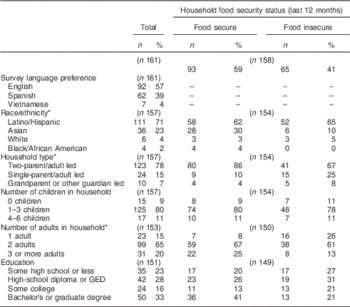
GED, General Educational Development.
Some totals do not equal the total sample size due to differences in response rates.
*Statistically significant at P≤0·05.
Food insecurity and utilization of community food resources
Forty-one per cent of participants screened positive for risk of FI at some time in the past 12 months. There were statistically significant (P≤0·05) relationships between risk of FI and race/ethnicity, household type and number of adults in the household. Among those at risk for FI, the vast majority (85 %) were Latino/Hispanic. Sixty-seven per cent of those at risk for FI were from two-parent households and 25 % were from single-parent households. Most food-insecure participants were from households with two adults (61 %) present. FI status was not significantly correlated with participant education level; however, 21 % of those who were food insecure did hold a bachelor’s or graduate degree (Table 1).
The majority of participants attended the library meal programme regularly. Forty-three per cent of participants attended the lunch programme 1–2 d/week, 27 % attended 3–4 d/week and 21 % attended every day. The vast majority of participants reported that they did not experience any barriers to attending the library meal programme. Additionally, we surveyed participants’ knowledge and use of food resources within the community. Thirty per cent knew of places to get hot meals, pantry items or fresh produce in their community, but among this group only 68 % had used these resources in the past. We also asked about participants’ knowledge and use of SNAP. While the majority of participants knew of SNAP (71 %), only 21 % were enrolled and 16 % indicated that they were ineligible at the time of the survey (Table 2).
Library meal programme participation and utilization of community programmes among participants from low-income communities in Silicon Valley, California, USA, summer 2015
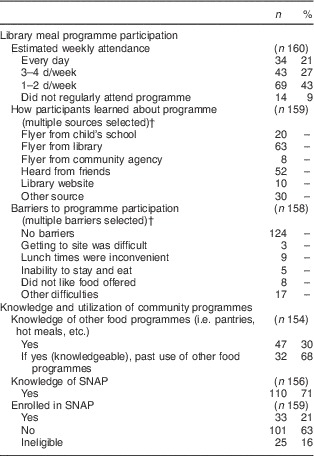
SNAP, Supplemental Nutrition Assistance Program.
Some totals do not equal the total sample size due to differences in response rates.
† Determination of percentages not applicable.
Qualitative interview findings
A sub-sample of sixty-seven adults (accompanied by children and without children) attending the meal programme participated in qualitative interviews conducted in Spanish (54 %), English (42 %) and Vietnamese (4 %). Participants were primarily Latino/Hispanic (67 %), with a small proportion of Asian (16 %) and White (8 %) individuals. Seventy-six per cent of interviewees lived in two-parent households, 13 % in single-parent households and 11 % in homes without children. The interview participants were demographically consistent with the survey participants.
Domain 1. Library meal programme
Theme 1: Libraries provide an open and welcoming atmosphere
When asked to share overall perceptions of the library meal programme, participants highly valued the ‘openness’ of the library. Many noted that they appreciated that the library was open to all and there were no requirements that needed to be met to participate. One Latina female participant noted, ‘It’s a relaxing place to be. I like that it’s open to everybody and there’s so many resources here available for everybody. It’s a nice place to come to.’ Additionally, participants cited the welcoming atmosphere fostered by library staff, which reinforced the ‘openness’ of the library and strengthened the overall perception of the programme. Participants specifically appreciated the friendly and respectful atmosphere conveyed by the library staff (Table 3).
Themes and representative quotes among library meal programme participants (n 67) from low-income communities in Silicon Valley, California, USA, summer 2015
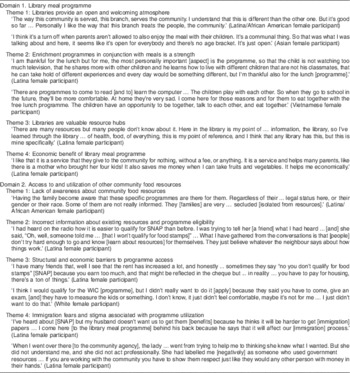
SNAP, Supplemental Nutrition Assistance Program; WIC, Special Supplemental Nutrition Program for Women, Infants, and Children.
Since the library meal programmes in the present study provided meals to both children and adults, participants discussed an overall feeling of inclusiveness as a result of the adult meals. Parent and adult participants valued the ability to eat with children and other community members. Parent participants specifically noted that eating with their children strengthened family bonds. Even adult participants who did not have children appreciated the family atmosphere that the library meal programme fostered.
A few participants described the library as feeling like ‘home’ when they were there, particularly with all of the children around. In the words of one female participant, ‘I enjoy being with the children. I feel like I’m home, at this particular branch.’ Another participant enjoyed that the library provided an atmosphere where people from the community could come together to teach and learn from one another: ‘We meet here. It’s like [a] home away from home [like] your house.’
Theme 2: Enrichment programmes in conjunction with meals is a strength
Participants noted the benefit of coming to the library for the many different services and resources that it offers. While the participating library meal sites varied in terms of the specific programmes offered to children and adults, most participants acknowledged that the library was a place that they came to read, check out materials, use the computer, engage their children in literacy activities, and in some cases have their children participate in structured summer camps.
The enrichment programmes provided at the library offered opportunities to engage children while preventing summer learning loss. While only a few participants said that they came to the library specifically for the meal programme, once at the library, they enjoyed the many resources that the library had to offer.
Parent participants specifically appreciated the opportunity the library provided for their children to socialize with other children. Parents also felt that coming to the library for the enrichment programmes and the lunch was a way to get their children ‘out of the house’ and participating in active play and socialization with other children in the community. Such interactions were seen as a chance to help prepare children for other similar social interactions in their future.
Some adult participants not attending the meal programme with children valued the social interaction during the meals. They appreciated the chance to be around other adults during the meal programme and to develop social networks with other community members and neighbours.
Theme 3: Libraries are valuable resource hubs
Libraries were seen not only as a place to build community, but also as a place to obtain valuable resource information. Some participants noted that the library is a place they go to obtain information regarding community resources, events, classes and enrichment programmes. Libraries were believed to offer much more than traditional library resources such as books, videos and computers. Libraries were viewed as a central place in the neighbourhood to congregate and gain access to needed information and resources, particularly for those without other standard means of gaining information.
Theme 4: Economic benefit of library meal programme
Many participants appreciated the economic benefits of attending the library meal programme. They believed the meal programme provided an economic support to the community at large and they appreciated that the programme was open to everyone. Some noted how other community-based meal programmes are limited to children or have specific requirements for participation. Many participants discussed the ways in which it had helped them ‘stretch their budget’ during the summer break. Having to pay for fewer meals during the summer was viewed as a way to divert savings to other household or family needs.
Domain 2. Access to and utilization of other community food resources
Theme 1: Lack of awareness about community food resources
Similar to survey findings, some participants noted a lack of awareness of available community food resources such as food pantries, hot meals and public safety-net programmes (i.e. Special Supplemental Nutrition Program for Women, Infants, and Children (WIC) and SNAP). When asked to describe where people in the community seek additional food assistance, several participants noted that they did not know of places to go or how to obtain services or resources. There was also a perceived lack of awareness regarding which programmes were accessible to those who were not citizens or legal residents, and which programmes were thought to be welcoming to diverse populations. A few participants believed that immigrants were less knowledgeable and connected to resources due to lack of time in the USA and fewer social connections (Table 3).
Schools were cited as a regular source of information regarding community resources; however, some participants noted receiving less information during the summer. There was the perception that programmes existed, but that during the summer, families did not have the same access to information as during the school year. This temporal information loss was worse in families who did not frequent other community programmes or organizations during the summer. One Latina female participant said, ‘Sometimes they [the schools] send information [home] with children, but … one doesn’t know what’s going on [during the summer].’
Theme 2: Incorrect information about existing resources and programme eligibility
Some participants said that the information they receive regarding food resources (i.e. pantry times, locations and eligibility) was often incorrect or outdated. They added that individuals in the community often rely too heavily on social networks (i.e. family, peers and neighbours) for information, even when such information was frequently inaccurate. Information regarding programmes with more specific eligibility requirements (i.e. WIC, SNAP) was particularly problematic when such requirements were passed from person to person. The reliance on ‘word of mouth’ was perceived to be a significant barrier to programme knowledge, as it was believed that some individuals are unable or unwilling to directly seek out accurate information from knowledgeable agencies and organizations due to lack of time or worries about immigration status.
Theme 3: Structural and economic barriers to programme access
For participants who knew of food resources in their communities, many still cited significant barriers to accessing and utilizing those resources. Several participants discussed structural barriers that prevent them from getting food assistance, such as administrative complexities, lack of adequate transportation and long distances to programme sites. Some programme requirements were seen as cumbersome or overly invasive. Other participants viewed the application process for various programmes to have extremely long and complicated paperwork required to apply. For example, SNAP was believed to require a lot of paperwork that was to be completed by prospective applicants themselves, with little outside assistance. One Latina female participant said, ‘The paperwork [for SNAP] is a lot … because when they sent me the packet to my house it was very thick; it was a lot of work.’
Some participants shared examples of experiences where they did not qualify for programmes due to lack of income eligibility (overly high incomes), despite the perceived need for assistance. The increasingly high cost of rent and other necessities was cited as contributing to FI despite income ineligibility for food assistance programmes.
Theme 4: Immigration fears and stigma associated with programme utilization
Fear of jeopardizing one’s immigration status was noted as a roadblock to applying for community and public programmes and a barrier to accessing needed food resources. Some participants believed that applying for food assistance (i.e. SNAP, WIC) would expose their residency status to government agencies and lead to deportation. A Latina female participant said, ‘If you ask for that kind of help [SNAP] the children are compromised, you can’t take them out of the country or the state will take them away.’
Participants also discussed stigma as a barrier to obtaining food resources, describing negative experiences with programme staff that discouraged families from obtaining services. A few participants recounted the stigmatizing experiences with food resource programmes associated with issues of racial prejudice. A perceived lack of respect and kindness from such programmes was also widely documented among participants. Some participants described being surprised that they would be treated in such a disrespectful way by agency staff who claimed to want to help.
Discussion
Despite the apparent wealth of the Silicon Valley in California, areas of high poverty persist and the food security needs of isolated populations are high. The library meal programmes in the present study targeted children and adults visiting libraries situated in low-income communities across the region. Survey participants reported a high risk of household FI, which many interview participants attributed to the extremely high cost of living and the disproportionally large percentage of household income required for housing. This is in line with previous studies showing that as housing-related costs increase, money available for food expenditures decreases( Reference Kirkpatrick and Tarasuk 44 , Reference Nord and Kantor 45 ). Although our study did not quantitatively assess changes in FI associated with programme participation, other studies demonstrate reductions in the prevalence of summer FI associated with summer meals through the SFSP( Reference Nord and Romig 27 ). Similarly, interview participants in our study qualitatively reported economic benefits associated with participation in the library meal programme, noting that it allowed them to stretch summer budgets. It is expected that the programme provided at least a modest subsidy for household meal costs during the summer break. However, future studies should examine changes in FI associated with community-based summer meal programmes.
Libraries: a welcoming and stigma-free environment
Reaching families living in isolated pockets of poverty is challenging. Libraries situated in low-income communities have the potential to capture some of the hardest-to-reach children and families because of their accessibility and relative distribution across communities irrespective of income. Whether individuals are coming to the library to access information and resources or to utilize enrichment programming, no eligibility is required to use the library. Similarly, the child and adult library meal programme was open to all, with no requirements to participate. Eliminating stringent eligibility requirements and arduous enrolment processes inherent in other food assistance programmes can reduce many of the well-documented administrative barriers to participation in social safety-net programmes such as SNAP and increase programme uptake as a result( Reference Hanratty 46 – Reference Ratcliffe, McKernan and Finegold 49 ).
The libraries’ provision of free summer meals through an ‘open site’ model allowed library patrons to participate without requiring assessments for eligibility. Several study participants mentioned past reluctance to enrol in food assistance programmes due to immigration fears. This is particularly important in largely immigrant communities, where fear of enrolment in social programmes is high and poses a deterrent to utilization of services( Reference Fix and Passel 50 – Reference Ng’andu and Leal Gianfortoni 52 ). Libraries have the potential to better reach immigrant populations given their long history and tradition of providing resources and education to underserved populations( 53 ), particularly individuals seeking help finding jobs, housing and educational opportunities( Reference Burke 54 ). Removing administrative barriers and providing an accessible open site enhance the libraries’ ability to engage and support hard-to-reach populations.
The ‘home-like’ atmosphere conveyed by library staff was cited as one of the most positive aspects of the summer meal programme. Participants appreciated the library meal programme because library staff were friendly and everyone was welcome. The inclusive nature of libraries helped to reduce stigma among participants, as everyone at the library during the lunch period was able to receive a free meal regardless of income, age or immigration status. Stigma associated with participation in safety-net programmes such as SNAP has been found to be a major deterrent to programme participation( Reference Kaye, Lee and Chen 55 ), due to shame and disrespectful treatment when accessing services( Reference Hanratty 46 , Reference Bartlett, Burstein and Hamilton 56 ). The welcoming and stigma-free environment created by libraries is consistent with the library’s inherent culture outlined in the Library Bill of Rights that states, ‘A person’s right to use a library should not be denied or abridged because of origin, age, background, or views’( Reference Luo, Estreicher and Lee 57 ). The library culture effectively breaks down many of the traditional barriers to meal programme participation, making libraries ideal for addressing FI in an environment where people from all backgrounds and socio-economic circumstances can eat together.
Unique to the library meal programmes in the present study was the provision of meals to both children and adults. To our knowledge, no other library-based summer meal programmes provide meals to adults due to SFSP restrictions( 28 ). The libraries in the present study leveraged private funding from the local children’s hospital and food bank to provide free adult meals, which created a unique and inclusive summer meal programme model. There was a sense that feeding children and adults together builds community among library patrons, neighbours and staff as meals are shared. The challenge occurs when the summer meal programmes end, but FI persists. Some libraries in our study are discussing the feasibility of providing year-round ‘supper’ meals to children after school, using federal funds. The problem lies with the private funding for the adult meals, which is more limited in nature. The impact of reducing or eliminating meals after summer should be explored from the perspective of programme participants and library staff.
Libraries: a hub for community resources
To better understand individuals’ ability to access and utilize other community food resources (i.e. pantries, hot meals and public safety-net programmes such as SNAP), participants were asked to share past experiences with such programmes. A primary barrier cited by many participants was a general lack of awareness of existing resources. Among participants who knew about existing food programmes, many cited problems obtaining correct information regarding programme services, eligibility, hours and locations. Other studies have similarly demonstrated how the lack of sufficient information is a considerable barrier to programme participation( Reference Schanzenbach 47 , Reference Kaushal, Waldfogel and Wight 51 , Reference Bartlett, Burstein and Hamilton 56 , Reference Levedahl 58 ). Also documented is a disproportionate impact on immigrants, who avoid obtaining programme information directly from agencies and instead rely heavily on information provided by social networks and through word of mouth, which can amplify the spread of misinformation( Reference Zhu and Xu 59 , Reference Watson 60 ).
The trusted and stigma-free nature of libraries well positions them to be important hubs of information for external community programmes and resources. It is well established that a core purpose of public libraries is to provide local residents with free access to a wide range of information that serves diverse community needs( Reference Veil and Bishop 31 , Reference Luo, Estreicher and Lee 57 ). Library staff are viewed as knowledgeable experts and trusted sources of information about community programmes and organizations. As such, libraries are uniquely suited to partner with external agencies and organizations and expand the scope of the resources provided at libraries( 53 , Reference Luo, Estreicher and Lee 57 , Reference Feinberg and Schull 61 ). As individuals begin to view libraries as part of the social safety net, more will turn to libraries and library staff for critical linkages to other community resources and services. Situating meal programmes at public libraries can further strengthen individuals’ access to information regarding important food and social resources such as WIC and SNAP. It is important to note, however, that it is likely challenging for librarians and staff to oversee federal SFSP sponsorship requirements and implement daily meal programmes in addition to their traditional roles and responsibilities. Further studies are needed to examine the perception of library staff regarding their role in providing meals at the library and promoting greater access to community food resources.
Limitations
Findings from the present study are limited in that they can only be generalized to participants from the participating Silicon Valley library meal sites. We recognize that our study population is not representative of individuals participating in other community-based meal programmes. Nor are the findings reflective of individuals not able to participate in a meal programme that provides child and adult meals, as most library meal programmes are limited to child participants. As such, the attitudes regarding the open and welcoming nature of the library meal programme may be different in settings where adults are not able to eat alongside children due to funding restrictions. Additionally, we were not able to capture accurate sample size and response rates for the survey and interview participants. Due to the manner in which the SFSP requires documentation of meals consumed rather than individual participant counts, we were not able to report these data. Our study findings may be further biased by the meal programme outreach strategies that primarily relied on library-based outreach as opposed to larger community-based strategies. Those participating in the meal programme were likely more representative of individuals already utilizing library resources as opposed to individuals who specifically came to the library for the meal programme.
Conclusion
Despite these limitations, our findings provide a first examination of a library-based approach to addressing FI. Our findings demonstrate the need for innovative community-based summer meal programmes that target hard-to-reach low-income children, particularly those living in areas where high economic disparities persist. Given the difficulty that individuals face accessing and utilizing community and public food resources, our study suggests that public libraries offer a highly trusted place to provide both meals and access to information regarding other programmes and services. As experts in the field continue to call for the expansion of summer food programmes to ease the FI burden among children during the summer months( Reference Gundersen and Ver Ploeg 25 ), library-based meal programmes are well poised to heed this call to action.
Acknowledgements
Acknowledgements: The authors would like to thank Cindy McCown, Tometrius Paxton, Susan Takalo and Jessica Valdez (Second Harvest Food Bank), Elena Valle and Carine Risley (San Mateo County Library), Michelle Amores (San Jose Public Library) and Jennifer Puthoff (YMCA Silicon Valley) for their support in the development and implementation of this study. They would also like to thank Kimmy Phan and Lydia Demissachew for their assistance in data collection, transcription and translation. Financial support: This work was supported by Second Harvest Food Bank, ConAgra Foods Foundation, and the Lucile Packard Children’s Hospital Stanford, Community Benefits. The funders had no role in the design, analysis or writing of this article. Conflict of interest: The authors have no conflicts of interest to disclose. Authorship: J.S.B. and M.M.D.L.C. formulated the research question and designed the study; J.S.B. and M.M.D.L.C. carried out the study; J.S.B., M.M.D.L.C. and G.M. analysed the data; and J.S.B. and M.M.D.L.C. wrote the article. L.J.C. provided mentorship and oversight of the study. Ethics of human subject participation: This study was conducted according to the guidelines laid down in the Declaration of Helsinki and all procedures involving human subjects were approved by the Stanford University Institutional Review Board. A waiver of documentation for consent was granted by the Stanford Institutional Review Board. All subjects provided verbal informed consent which was witnessed and formally recorded.



