




Introduction
What does the adoption of tractors in China from the founding of the People’s Republic in 1949 to the recovery from the Great Leap famine in the early 1960s show us about the Maoist developmental state? Drawing on Katerina Clark’s work on the Soviet Union, Daisy Yan Du argues that Chinese leaders of this era fetishised tractors.Footnote 1 Tractors, they often believed, would lead to social and political transformation. Liao Luyan, the minister of agriculture, said in a speech at a conference of tractor station directors in 1958 that:
The difference between workers and peasants is that workers use machines in production and peasants use their hands. … From this basic difference, many other differences arise. Communism will eliminate the difference between cities and the countryside, and between physical labour and mental labour. The arrival of machinery in the countryside is the start of this great revolution. This has not only economic implications, but also political implications.Footnote 2
Recent research on the cultural history of tractors in Mao’s China has not closely intersected with a wider literature on the adoption of new agricultural technology in developing countries. Much of the latter scholarship attempts to model the interaction of macroeconomic variables such as land area, patterns of land tenure, crops, and prices for credit, grain, labour, fuel, and machinery in shaping the adoption of new technology.Footnote 3 Some research also points to the strength or weakness of different class groups within a political system, particularly in cases where subsidies for tractors and harvesters benefited landlords and harmed tenants and wage labourers.Footnote 4 Many of these variables manifested very differently in Maoist China. There was no private ownership of industrial capital. Prices for key commodities were controlled through state monopolies from the early 1950s. Land was redistributed through land reform, then collectivised from 1956. Thus, it is not clear how prices and macroeconomic variables intersected with the leadership’s positive views of tractors in shaping their introduction to Chinese agriculture.
Some research on the effect of the market reforms of the 1980s suggests that the combination of pervasive economic controls, collectivisation, and fetishisation of tractors led to much more widespread adoption of tractors than would have been the case in a market economy.Footnote 5 After the de-collectivisation of agriculture and introduction of market exchange into the rural economy, the use of large tractors declined as farming households began to use more draught livestock. Moreover, scholars have long understood that by the 1970s, use of tractors in China was high compared to other countries with a similar level of economic development.Footnote 6 But the variables that shaped the adoption of tractors within the Maoist period are not well understood. What was the relative significance, for example, of coercion, or subsidies, or macroeconomic variables like labour supply and demand in shaping institutions and tractor use? The aim of this article is to map the variables that shaped the adoption of tractors in roughly the first half of the Maoist era, before a series of economic and institutional changes that took place after the Great Leap famine.Footnote 7 Some of the findings have implications for the later Mao-era, which we note where relevant.
Use of tractors grew steadily in China from the early 1950s. In 1953, the government established tractor stations in the northern wheat-growing regions to perform work on a contract basis for cooperatives. By the end of 1957, the government had invested 173.5 million yuan in the establishment of 383 tractor stations, which employed around 30,000 workers.Footnote 8 The first Chinese tractors were produced in 1958, so the large majority of the 45,000 tractors in the country at the end of that year were imports from socialist countries. Common models included, from Hungary, DT-413 caterpillar tractors and GS35 and GS25 wheeled tractors, as well as Zetor 25 and 35 models from Czechoslovakia, D-35 and DT-54 from the Soviet Union, KS07 caterpillar tractors from East Germany, and Ursus C-45 from Poland.Footnote 9 Tractor stations typically had a mixture of types.Footnote 10 One station in Hebei referred in its reports to all these except the Soviet models.Footnote 11 Across the country, the station machines ploughed and harrowed an estimated 17,465 km2 of cropland in 1957.Footnote 12 The Great Leap Forward, launched in 1958, saw further commitment to mechanisation. Despite the catastrophe brought on by the Leap, by the early 1960s, tractors were used on a small but significant proportion of the crop land in North China. This amounted to around 20 percent of land in Heilongjiang in 1960.Footnote 13 In Liaoning, it was 27 percent in 1961.Footnote 14 In parts of Shaanxi’s Wei River region, around 20 percent of crop land was machine cultivated in 1963.Footnote 15 In Shandong in 1965, the proportion was around 25 percent.Footnote 16
The work of scholars who examined tractors in the early People’s Republic from a vantage point in the late 1970s or early 1980s showed that the fetish for tractors was, in fact, more precarious than propaganda and literature featuring them implied.Footnote 17 Cooperatives often appeared to be unwilling to use the tractor stations due to concerns about the cost and the quality of the work done.Footnote 18 The national leadership demanded the stations make a profit or at least cover their costs. When this did not happen, leaders blamed many factors including their management and lack of connection with peasant communities.Footnote 19 Leaders in rural Shanghai even stated that ‘tractor stations are exploiting the peasants’.Footnote 20 From around 1958, policy began to emphasise ‘intermediate technology’ and ‘semi-mechanisation’, which meant smaller, simpler innovations such as ball-bearings in wheelbarrows rather than large machinery.Footnote 21 Similarly, in the early 1960s, Chinese factories began to produce large numbers of five- to ten-horsepower two-wheeled hand tractors.Footnote 22 This shift is consistent with the story told in much of the recent historiography of science and technology in Maoist China, which has focused on the rise of the ideal of ‘mass science’.Footnote 23 This emphasised the value of indigenous knowledge and experience, as well as technology that was cheap enough for transformation to be led by villagers with guidance from ‘barefoot’ experts.
Yet the 1960s did not see the abandonment of four-wheeled, 25–50 horsepower tractors in favour of small peasant-friendly alternatives. In 1973, there were around 200,000 four-wheeled tractors, alongside 253,000 two-wheeled tractors.Footnote 24 Rather than the latter eclipsing the former with the rise of discourses of mass science, the two types of technology spread rapidly together. Several questions arise about four-wheeled tractors. How exactly did the institutions of the Maoist system facilitate their adoption in large numbers despite apparently unfavourable macroeconomic factors and price levels? Was it right that the stations were ‘exploiting’ peasants in the 1950s? If so, did they continue to do so in the 1960s? Historians have long demonstrated that the basic system of economic exchange in Maoist China did exploit peasants. Prices for goods produced by peasants were artificially low in relation to goods they purchased.Footnote 25 If tractor stations were – as alleged – part of this exploitation, how did this work in practice? – To what extent were peasant communes or production brigades forced to use tractors? It has been difficult for historians to critically evaluate claims made about machinery – including those made by critics – without better data than was available to scholars working in the 1980s.
Finally, given the criticisms levelled at the tractor stations and four-wheeled tractors, there is a question of what sustained leaders’ faith in the transformative power of large tractors. Some recent agricultural experts have argued that in Africa, it would often be better for poor countries to invest more in draught livestock than tractors.Footnote 26 Although tractors had been symbols of socialist modernisation in the Soviet Union, the Chinese leadership including Mao Zedong began to caution against copying Soviet models in 1956 and turned decisively against them in the early 1960s. The lingering significance of the Soviet affection for tractors does not seem to be enough of an explanation for why the leadership continued to push for their adoption in the face of many problems.
This article is structured as follows: Section one historicises the Communist leadership’s early commitment to tractors by relating it to pressures from agricultural targets within the ecological context of North China in the 1940s. Party leaders concluded that more mechanical power was necessary to increase grain production in this context. This view was grounded in experience, but policy implementation struggled to link increasing machine power to other elements that were necessary for increasing grain production. Section two considers the economics of the tractor stations established from 1953, with particular attention to how prices – for agricultural produce, labour, and fuel – affected local decisions and the operation of the stations. The conclusion of this section is that at the price levels set by the party leadership and the wider macroeconomic context, four-wheeled tractors were simply too expensive for a very poor population with extremely limited options for earning money with the labour tractors displaced. Section three examines how institutions responded to the effect of this context on tractor stations. The party’s commitment to four-wheeled tractors did ensure continued efforts to introduce them at pace. However, there were two key adjustments to the system for doing so, both of which emerged in an ad hoc fashion, involving significant local initiative. These were to significantly downgrade the role of the tractor driver, and to implement what was at first a tacit system of subsidies. There were, therefore, limits to 1) how much fetishisation of tractors could override prices as a factor in shaping adoption, and 2) how exploitative the leadership was willing to allow the system to be in the wake of the Great Leap famine. The final section of the article returns to the question of why party-state leaders nevertheless retained a positive view of four-wheeled tractors despite the problems. This was not necessarily the result of an atavistic fetish embedded in Soviet-inspired socialism, but rather a serious shortage of livestock that emerged with the development of higher-level production cooperatives and communes.
Interaction of ecology with state priorities in the formation of pro-tractor policy
The government promotion of tractors in the early- and mid-1950s reflected the influence of the Soviet Union but was also shaped by the intersection of core policy goals for agriculture and North and Northeast China’s ecology. In the Northeast, the connection between ecology and policy lay in the widely shared assumption that there was plentiful arable land in the region that could only be cultivated with the aid of tractors. In North China, many observers believed that increasing multiple cropping – growing more than one crop on an area of land each year – was both desirable and would require more traction power to speed up ploughing and harrowing. Before the mass production and application of chemical fertiliser from the mid-1960s, increasing multiple cropping was widely seen as the most likely way of boosting grain production in regions where little extra land could be put under cultivation. Leaders who urged an increase in multiple cropping in the mid-1950s included Mao Zedong, Liao Luyan, and Liu Shaoqi, then chairman of the standing committee of the National People’s Congress.Footnote 27
The cold climate and short growing seasons of North China create a very narrow window for harvesting one crop, preparing the ground, and planting the next in time for it to grow.Footnote 28 In Henan, Shaanxi, and Shandong, there were only about 15 days to do this work in the summer.Footnote 29 Further north, in central Hebei, there were only six or seven days.Footnote 30 Based on studies carried out in the late 1940s, in perfect weather, an adult working with one draught animal for ten-hour days needed about 16 days for the summer harvest, ploughing, harrowing, and seeding on ten mu (1 mu = 0.16 acres).Footnote 31 At the end of the Republican period, households had around 30 mu each in Shaanxi, and those in Shandong and Henan around 15–18 each.Footnote 32 This was more than an adult with constant use of an ox or buffalo could put under a second crop even with no interruptions from rain. Sixty percent of the annual rainfall in this region falls from June through August so rain often delayed harvests.Footnote 33 Many households did not have their own draught animal. Since all households needed one at the same time, there were limits on how much animals could be shared for this work. These limitations were one reason that only about fifty-five per cent of agricultural land in Henan was double cropped in 1949.Footnote 34 About 40 per cent in Shandong was.Footnote 35 In southern Hebei, 31 per cent of land was under winter wheat, some of which, 23 per cent of the total cropped area, was replanted with a summer crop.Footnote 36
In the late 1940s, Communist agricultural publications were vexed by the problem of seasonal labour bottlenecks that prevented an increase in multiple cropping. An agricultural journal noted that in 1949, the ‘autumn-harvest, autumn-plough, autumn-plant’ workload was extremely difficult with the available human and animal labour.Footnote 37 Increasing the amount of double cropping would mean adding more sources of power and making people work more, a task they described as increasing the masses’ ‘enthusiasm for production’.Footnote 38 More detailed work in the mid-1950s came to similar conclusions. These reports were influential in central government bodies. By this time, tractors were seen as the solution. In 1957, various bodies in the central government urged promotion of mechanisation to overcome the seasonal labour shortage seen to be limiting multiple cropping in the north.Footnote 39
Thus, the party leadership’s fetish for tractors did not arrive fully formed as a Soviet import. It was also deeply connected to the experience of attempting to increase multiple cropping in North China. This does not mean that tractors were deployed rationally or closely in relation to environmental variables. Increasing multiple cropping required a multi-dimensional package of ecological and technological change that also required more fertiliser and irrigation. This did not go unnoticed during the 1950s. A report from Henan, Shandong, and Shaanxi in 1957 indicated that, in the absence of these things, multiple cropping rates rose by only small amounts, often falling again the following year, or else did not rise at all.Footnote 40 But the state lacked the capacity to co-ordinate fertiliser, irrigation, and tractor station services effectively. Fertiliser use rose dramatically from the mid-1960s, but multiple cropping rates in North China only ever increased by modest amounts from the 1950 levels, even as far more tractors were used in the 1970s. In Shandong, double cropping increased from about 40 percent to 45 percent of land, where it remained until the 1980s.Footnote 41
Prices for tractor services and labour: the wages of agriculture
The following sections consider some of the key prices relevant to tractor stations: the prices they charged, prices for labour at stations and in cooperatives, and prices for fuel. In general, prices charged by tractor stations were considered very high. Since tractors services could not be paid for by increased grain production, many cooperatives were unwilling to pay the high prices to use tractor station services.Footnote 42 As a 1958 report from Shaanxi’s Heyang tractor station explained, cooperative leaders were ‘afraid that paying the fees will affect the lives of members of the cooperative’.Footnote 43 Another station manager from Shaanxi repeated this view:
The costs are high and financial losses large (chengben gao, wukui da), the masses say, “tractors really are good, but they aren’t practical here.” […] Reducing the production costs (shengchan chengben) has become the greatest issue for the development of the tractor stations.Footnote 44
The Ministry of Agriculture’s Agricultural Machinery Management Headquarters accepted this view but blamed it on poor planning that had failed to ensure that tractors led to higher production: ‘in some regions, because planning has not started from the need to increase production, increase incomes, and the needs of the masses, and there was no comprehensive production plan, [tractor stations] decreased peasants’ incomes’.Footnote 45
Since tractors did not increase production in North China, the alternative way for cooperatives or communes to pay tractor station prices was if the displaced agricultural labourers could move into forms of work where they could be more productive and earn more than the cost of the tractors. But alternative employment was not plentiful or productive enough in 1950s China. This was even true in areas like southern Jiangsu, which had a larger non-agricultural sector. A report by the China Agricultural Science Institute compared the costs of tractors and oxen in southern Jiangsu. The Lumu tractor station in Wu County (present-day Suzhou) charged 2.2 yuan per mu for ploughing and harrowing for rice fields, and 1.7 yuan per mu for ploughing and harrowing for wheat, so 3.9 yuan annually for cooperatives that double cropped rice and wheat.Footnote 46 The report estimated that using the tractor station services would save cooperatives 14.5 workpoints per mu through cooperative members not being required for the work. The report assumed that ten workpoints worth of labour could generate 1.1 yuan if deployed elsewhere, so the labour saved per mu would only earn 1.6 yuan. This was far from enough to cover the tractor station services.
Although the institute appears to have picked an expensive tractor station, the difference with cheaper stations was not big enough to change the calculation much. Nationally, the cheapest stations – in Liaoning – kept the cost just under one yuan per mu for ploughing and harrowing wheat fields.Footnote 47 Others charged between 1 and 1.4 yuan per mu for land preparation for each crop.Footnote 48 These rates, although lower than the Lumu tractor station, were mostly in places with fewer opportunities for productively employing the displaced labour.
So tight were the potential returns that the Agricultural Science Institute even looked at whether all cattle could be dispensed with to save money. It estimated that the Xinmin One and Two cooperatives in Wu County paid 203 yuan per year per draft oxen, which included fodder, wages of those charged with looking after them, and the cost of rearing young or buying new animals.Footnote 49 In total, this was 3.6 yuan per mu for the cooperatives. Human labour for ploughing a mu was costed at 1.1 yuan per mu for one ploughing, so the total cost per mu was 4.7 yuan, or 5.8 for two crops. Tractor station services could do the same work for 3.9 yuan. Thus, the tractor station services could save money if the displaced human labour were redeployed, and all the cattle were eliminated. Yet cattle did much more than pull ploughs. They were valuable also as a source of meat and hide, and their dung was used as fertiliser and fuel. As one of the villagers interviewed in Hebei in a study undertaken in the 1980s remembered, ‘The tractor is good, but it doesn’t produce any shit’.Footnote 50 Indeed, the economic exploitation of oxen reached historic highs in the 1950s. As Peter Braden argues, ‘practically all of their bodily tissues’ were commodified.Footnote 51
One of the reasons that rural incomes were so low was that the party-state had required rural communities to focus on grain production and established a state monopoly over the grain trade that fixed prices at much lower levels in relation to industrial goods than market pricing would have.Footnote 52 This was a strategy for financing industrial development borrowed from the Soviet Union. Had grain prices been higher, more cooperatives could have found the tractor station services affordable.
Instead of raising the price of grain, party leaders adopted the perspective that the imbalance between tractor station prices and the ability of communities to pay was the result of the high wages at tractor stations in the mid-1950s. As we shall see, wages were only one reason the tractor station prices were unaffordable, but wages did make up a very large component of station costs in the mid-1950s, especially since depreciation was not included in tractor station accounts until the end of that decade.Footnote 53 Labour costs amounted to 71 percent of the costs at Jiangsu’s Danyang station in the first half of 1957.Footnote 54 As Stavis points out, tractor stations were initially organised like factories, with employees on fixed salaries and with benefits like health insurance.Footnote 55 In many places, tractor driving appears to have been established as a job for veterans with experience with driving military vehicles and for whom some kind of respectable post-demobilisation career had to be found. A 1962 report about Yangling station in Shaanxi revealed that one-third of the drivers were retired military personnel who previously drove tanks or large vehicles.Footnote 56 In 1958, employees at Danyang in Jiangsu were paid an average of 45.08 yuan per month, which was far higher than ordinary workers in cooperatives served by the station. In most higher-level cooperatives in China, the norm appears to have been to allocate ten workpoints to men per day of work.Footnote 57 Using the equation that 10 workpoints equalled 1.1 yuan, from the report on southern Jiangsu discussed above, this could have meant an average income of around 28 yuan per month. Moreover, the station also covered the costs of constructing housing for the families of its employees and basic health care. As we shall see below, one of the key adjustments to the system came in the form of a significant downgrade in the pay and status of tractor drivers, led by the stations themselves, then mandated by the centre.
Prices for fuel: station petrol
Another important element in the cost of tractors was fuel. In a context where daily income for agricultural workers was around 1.1 yuan, the cost of fuel was one reason for the high price of the tractor services in relation to what cooperatives could pay. Some scholars have suggested that fuel was a more significant problem for tractor stations in the 1950s, before the onset of large-scale domestic oil production in the early 1960s. In 1960, the country was dependent on imports for 43 percent of oil products.Footnote 58 As domestic oil production developed in the next decade, the proportion dropped swiftly until most fuel was domestically produced by 1970. The Maoist state had an autarkic ideal and scarce foreign exchange. Considering this macroeconomic and policy context, as well as reports from 1957 that indicated that fuel made up 60 percent of the costs of cultivating a mu of land, Kang Chao drew the conclusion that fuel had been a major problem for the 1950s tractor stations.Footnote 59 Was the start of Chinese oil production the key factor that enabled the rise of four-wheeled tractors in the 1960s after the struggles of the 1950s?
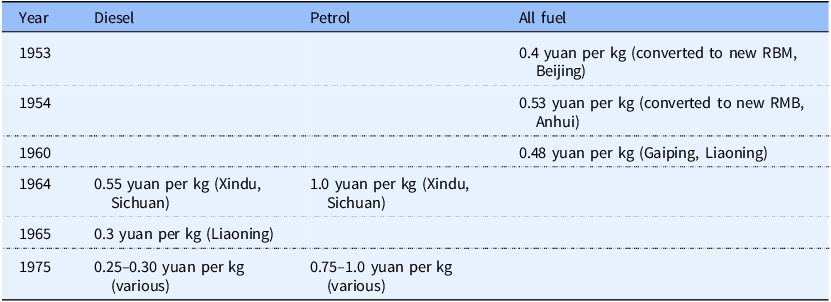
Chinese oil production did not affect the prices paid by users of tractors until the mid- to late-1970s, see table 1. Exact comparisons of prices across time are impossible because prices for different fuels – diesel and petrol – were significantly different and were only included in reports from the mid-1960s. Most tractors at the 1950s stations were models that ran on diesel, which was cheaper than petrol, but it is impossible to know how much work was done with each fuel. Accounting for the impact this has on the figures, there appears to have been very little difference in fuel prices from the early 1950s through the mid-1960s. A team of American experts visiting in 1975 cited diesel prices that were probably slightly cheaper than those paid by tractor stations a decade earlier. Thus, the rise of Chinese domestic production did not bring down the price of fuel paid by agricultural users until the mid-1970s. Domestic oil production thus did not make fuel significantly more affordable in the 1960s, and prices remained high in relation to what communes could pay.
Prices for fuel quoted in tractor station reports

Sources: Beijing (1953): Beijing nongye jiqi tuolaji zhanFootnote 60 ; Anhui Province (1954): Nongye bu nongye jixie guanli zongjuFootnote 61 ; Gaiping (1960): Taiyang People’s CommuneFootnote 62 ; Xindu (1964): Xindu Bayi tuolaji zhanFootnote 63 ; Liaoning Province (1965): Liaoning sheng nongye jixie guanli tingFootnote 64 ; Various (1975): The American Rural Small-Scale Industry DelegationFootnote 65 .
Note: Prices from 1953 and 1954 have been converted into the post-1955 new Renminbi at the official rate of 10,000 old RMB to 1 new RMB.
The estimate cited by Kang Chao that fuel made up 60 percent of costs almost certainly referred to the proportion of fuel in the marginal cost of tractor services per mu, rather than a proportion of stations’ total costs. In January 1958, in Danyang, Jiangsu, fuel was calculated to be about 20 percent of the total costs after the station went through a dramatic cut in personnel.Footnote 66 As we have seen, wages were very high at the Danyang station in 1958, but stations had not yet started to include depreciation in their budgets. From around 1958, wages were slashed, but depreciation was included in budgets. Fuel costs rose as a proportion of spending but remained under one-third of stations’ costs. At a Liaoning commune in 1960, fuel made up 29 percent of stations’ total costs.Footnote 67 Across the whole of Liaoning, fuel was calculated to be 27 percent of stations’ total cost in 1963.Footnote 68
From the mid-1970s, agricultural mechanisation could have been facilitated by domestic oil production because the government could shield agricultural fuel users from the impact of global oil shocks, but the idea that domestic production facilitated the expansion of four-wheel tractors in the 1960s is difficult to sustain. Throughout the 1950s and 60s, fuel was a major element in the high cost of tractor services. Throughout the 1960s, the stations continued to prioritise economising on fuel costs and adopted a range of measures to achieve this. Station managers were given bonuses for conserving fuel.Footnote 69 They also introduced stricter managerial systems to prevent loss through accidents, leaks, and theft, alongside technical measures like better fuel caps.Footnote 70 Stations were also discouraged or forbidden from using tractors for transport for ‘non-agricultural’ purposes (though this was difficult to prevent).Footnote 71 In later decades, tractors were used widely for transport. Transport was one of the most plausible additional uses to which tractors could have been put, so where it was enforced, the ban on non-agricultural transport undermined efforts to make tractors more viable by using them more.
Adjusting the system 1: subsidies
What was the effect of high prices within the system? Were the various institutions of production – cooperatives, communes, or production brigades – forced to pay for services they did not want? Stavis commented that ‘very little is known about the bargaining power of the communes with respect to the [tractor stations]’. Faced with the lack of enthusiasm for tractor services, tractor stations arranged for county-level officials to do ‘thought work’ with cooperatives and communes, within which a combination of outright coercion, hard-selling, education, and corruption is difficult to disentangle. A 1958 report from Shaanxi described one example: ‘Initially the Xiling cooperative had no plans for mechanized cultivation, but after county party secretary Lu personally made a visit to persuade and motivate the cooperative, the cooperative took the initiative and requested a contract for ploughing more than 1,000 mu of land in the summer and winter seasons’.Footnote 72 This sort of ‘thought work’ is likely what led to accusations of bullying and exploitation.
However, rather than being forced to pay for tractor services they could ill-afford, the archival documents reveal that agricultural producers could often simply avoid paying. Instead, they would officially owe the payment to the station, though these debts appear to have seldom been paid. The latter problem was mentioned in a 1968 government publication cited by Stavis – one station was owed 370,000 yuan in fees.Footnote 73 As Stavis acknowledged, such publications gave no sense of how widespread such problems were or if they had been important in the 1950s, or indeed any time outside of the chaotic peak of the Cultural Revolution. Archival documents show that this was a widespread problem that existed well before then. Shanxi provincial officials complained in 1958 that tractor stations in their province had only been paid 30 percent of what they were owed, and one cooperative owed more than 120,000 yuan to the tractor stations.Footnote 74 A document summarising conditions throughout the country in 1957 noted that ‘cooperatives feel the tractor fees are not worth it and often go a long time without paying them’.Footnote 75 Although tractor stations were sometimes accused of being predatory, in general, they were weak institutions that were not able to force rural communities to pay for the work they performed.
In many cases, most of the costs of tractor services were borne by the stations themselves. In turn, this meant that the stations made very significant losses. The government’s goal of profit-making tractor stations was achieved by only 44 percent of stations by the end of 1958.Footnote 76 Overall losses were 7.29 million yuan by the end of 1957.Footnote 77 Soviet experts also appear to have been struck by the system that allowed stations to lose money. One station manager in Shaanxi commented: ‘The Soviet expert also said: if a small number of experimental tractor stations lose money at first, this does not matter in the perspective of the whole country. But if stations continue to lose money even after developing them on a large scale, that will be a big problem’.Footnote 78
In the 1950s, when tractor stations struggled, local Party leaders gave them small, ad hoc loans, though recorded instances of this suggest that such loans would not have been enough to make much difference. Shanxi’s Heyang tractor station received 400 yuan in one instance. In the early 1960s, some provincial governments went further and designed more ambitious interventions. In a 1963 report, the Shaanxi People’s Committee announced plans to remove and consolidate tractor stations that were in poor condition: With the exception of the tractor station in Yangling Commune in Wugong County, all other stations would be taken over by the state, and their required liquidity was to be solved by the Provincial Department of Finance.Footnote 79 Most documents suggest that the state tacitly accepted they would lose money and require significant subsidies, even though reducing the need for subsidies became a core part of their work. For example, Hebei’s Wuan County machinery station lost 330,000 yuan in two years after it was established in 1961.Footnote 80 Liaoning tractor stations calculated that they received a subsidy – a word they used openly – of 5 yuan per shang (15 mu) in 1961.Footnote 81 This meant that in that instance, the government paid around one-third of the price charged to communes.
Adjusting the system 2: the status and downfall of drivers
As Marc Matten and Rui Kunze point out, leaders generally saw problems facing the tractor stations as ‘problems of politics’ rather than general economic constraints.Footnote 82 One of the key political decisions in the search for a viable strategy for mass uptake of full-sized tractors was to downgrade the social status of tractor drivers and cut the number of full-time positions. Liao Luyan told the February 1958 conference that the stations’ 30,000 employees could be slashed to 20,000.Footnote 83 Liao and most tractor station managers also stressed that machinery was used too little and for a too limited range of tasks.Footnote 84 Had the tractors been used a lot more, higher levels of staffing would have made sense so there was some contradiction between the two prescriptions. Perhaps due to national concern to limit fuel imports at a time when autarky was a primary policy goal, the emphasis was generally on cutting staff, rather than finding year-round use for tractors.
In fact, by the time Liao made his call to slash tractor station personnel, many stations had already done this. This adjustment was thus mostly worked out at a local level before leaders in the central government began to call for it. The Danyang tractor station in Jiangsu, for example, had 35 employees at the start of 1957, including 22 drivers, eight administrators, and four others including mechanics.Footnote 85 By September, before Liao called for a one-third cut to staff numbers, Danyang had cut its personnel to only 19, including only seven drivers, one for each working tractor. These savings reduced its wage bill by 53 percent, reducing the costs per mu cultivated from 4.95 yuan to 2.33 yuan. It also implemented systems for hiring drivers only in the periods of the year in which they were needed, though as we shall see, this meant it was harder for employees to become skilled in driving and maintaining the machines.Footnote 86 These cuts did not resolve the problem. 2.33 yuan per mu was still a level at which use of the station would be uneconomical according to the study cited above.
Having cut personnel, administrators also promised to cut wages and implement strict controls over the workforce.Footnote 87 As with reducing staff numbers, some stations appear to have begun to reduce benefits already in 1957, before the centre began to make serious demands in this area. A report from Yan’an in Shaanxi, for example, indicated that canteen costs accounted for 50 percent of an average worker’s salary, and that food was sometimes cut off.Footnote 88 From 1958, many tractors and drivers were transferred to the newly established people’s communes to manage. It is not clear how much really changed, since the basic structure was often retained and repackaged within commune ‘agricultural machinery stations’, and from 1961, state-managed stations were re-emphasised. Either because of the changes in management or trends that were already underway, drivers’ economic position declined significantly. In some places, the changes brought drivers’ income and benefits below the level of other agricultural workers.Footnote 89 In 1961, Liaoning reported that the average tractor driver in the province earned 284 yuan per year, while equivalent workers in communes earned 350 to 400 yuan per year.Footnote 90 Wages made up only about 17 percent of Liaoning tractor stations’ costs in 1963.Footnote 91 Descriptions of station workers’ lives from the early 1960s often indicate considerable hardship. A station in Shanxi reported that ‘an apprentice’s monthly salary was 18 yuan, while their canteen food costs were 17 yuan’.Footnote 92 Drivers sometimes had to sleep in cornstalk huts or mills while doing assignments. A report from Xianyang indicated that Binxian’s tractor drivers were not issued with winter overalls.Footnote 93
Drivers around the country complained about the cuts to their wages and loss of status.Footnote 94 Reports of disgruntled drivers appeared even before their transition to commune management, which reinforces the idea that the downgrading of status began before then. A report from Shaanxi in 1957 noted that: ‘Some [drivers] say ‘it would be better to work in a garment workshop than be a tractor driver, at least then you could find a wife’.Footnote 95 An occupation for former tank drivers – an almost exclusively male activity – was now considered less appealing than the feminised work of clothing production. Complaints such as this were generally given short shrift.Footnote 96
The downgrading of drivers’ status was accompanied and legitimised by the rise of a negative image of drivers as entitled and arrogant. This was starkly at odds with the ideal from propaganda of tractor drivers as the vanguard of industrial modernity in the countryside. A 1957 report from Yan’an in Shaanxi accused drivers of having a sense of superiority in relation to other agricultural workers. They were said to be ‘unwilling to take directions from production brigade leaders from outside their field and look down on their comrades’.Footnote 97 Another report from another county in Shaanxi argued that tractor station employees ‘do not take reasonable suggestions from the masses seriously’.Footnote 98 Danyang’s tractor station noted that ‘Some of the drivers have problems in their thinking due to the undisciplined nature of their lives. They have developed bad habits, like frequently going to the city or staying at home with their families’.Footnote 99 There were serious rifts with other villagers, who would ‘sarcastically say that the “labour models are here” when they saw tractor drivers without anything to do’.Footnote 100 In Shaanxi, drivers who had been students were said to have received insufficient political education and were unwilling to unite with the people.Footnote 101
Blaming staff for high costs became a pattern of thinking that resulted in drivers being held responsible even for problems that were mostly caused by something else. Station managers often blamed drivers for causing breakdowns and accidents by operating or maintaining machinery badly.Footnote 102 A manager in Shaanxi claimed that a system that made drivers pay for breakdowns would ‘massively reduce losses caused by drivers’ carelessness’.Footnote 103 A Hebei station required drivers to pay if equipment valued at more than two yuan was damaged.Footnote 104
To be sure, the cost of breakdowns was significant. In 1957, the Chang’an station in Shaanxi only completed 80 percent of its planned work, due to 121 incidents.Footnote 105 The same year, the Weinan tractor station had planned 1,200 assignments, but only carried out 866, due to 20 accidents and breakdowns.Footnote 106 Between 1954 and 1957, at least 64 tractor drivers were killed and 160 seriously wounded nationwide.Footnote 107 As the number of tractors increased, so did the number of accidents and fatalities. In the first half of 1961, Liaoning province alone reported more than 600 tractor accidents, resulting in 19 deaths.Footnote 108
Some of these accidents must have been the result of driver error, but there were many other factors that explain why accidents happened frequently and why machines were often poorly maintained. Global comparisons remind us that it was normal for a high proportion of vehicles to be broken in a public vehicle fleet at this time. Stavis pointed out that in 1975, roughly one-third of New York City’s garbage trucks were out of service.Footnote 109 In 1950s China, tractor stations often acknowledged that drivers received insufficient training and technical support.Footnote 110 Many workers arrived at the station with no prior knowledge of driving or maintaining tractors. The primary form of training at a station in Shaanxi involved self-learning from books and peer study.Footnote 111 A report to provincial leaders in Shaanxi indicated that students at tractor schools were demobilised and sent home when tractor demand was low, only to be recalled for retraining when needed. This was the result of the drive to reduce costs, but it made it harder to develop skills in operating and maintaining the tractors.Footnote 112 Even in 1961 in Liaoning, where 27 percent of land was already ploughed by tractors, the provincial bureau of agriculture estimated that only 10 percent of drivers were fully trained and competent at all tractor operations.Footnote 113 A further 40 percent were assistant drivers, who did other jobs in the commune, and the rest had even more limited skills.
Several factors also made maintenance very difficult. Tractor stations often had a motley collection of different types of tractors, including mixtures of large and small, diesel and gasoline, wheeled and caterpillar models. Although this allowed the stations to experiment to determine which worked best in local conditions, it meant that employees had to learn to drive and maintain several different types of tractors at once. The quality and availability of parts were also a problem. It was little wonder that tractors often broke down when, for example, piston rings produced in Liaoning were said to be worn out after only 200 hours of operating time, compared to those produced in Shanghai which lasted 800 to 1,000 hours, and imported piston rings that lasted 2,000 hours.Footnote 114
In sum, downgrading the pay and status of drivers, and making them pay for accidents despite the many other causes of accidents, became an important strategy for bringing down the cost of tractor services, justified by an increasingly negative view of tractor drivers at odds with the images presented in pro-tractor propaganda.
Enduring fetish and the burden of beasts
The party leadership persisted with the goal of increasing the use of full-sized tractors. It is difficult to explain this as simple deference to a Soviet-inspired vision of rural modernity focused on tractors. By the early 1960s, the Chinese central leadership had already become critical of many of the tenets of Soviet economic planning. The archival evidence reveals how significant problems with maintaining draught livestock were one critical factor in ensuring support for tractors.
Livestock mortality from disease had been very high in the late 1940s and 50s. In 1948, United Nations Relief and Rehabilitation Administration agents reported a prewar estimate that five per cent of cattle died of disease every year, rinderpest alone killing 200,000 to 300,000 annually.Footnote 115 ‘Single outbreaks sometimes [wipe] out 80 to 90 per cent of the work animals in a community’.Footnote 116 More than a million cattle died of the disease between 1938 and 1941 in western China.Footnote 117 Some Chinese agricultural economy journals reported even higher mortality: one 1945 report reckoned an annual loss of at least 200,000 cattle in Sichuan alone, and a national annual toll of two million.Footnote 118 Rinderpest was largely eliminated in China in 1956 through vaccination, but other diseases, like anthrax, remained potent threats that could wipe out significant numbers of communities’ animals.Footnote 119
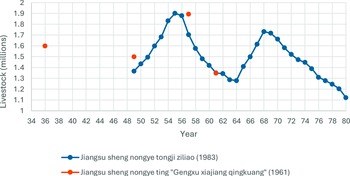
The elimination of rinderpest was achieved the same year that livestock numbers began to fall with the collectivisation of agriculture that began with the advanced producers’ cooperatives. The peak-to-trough fall in the numbers of draught livestock from around 1956 was possibly even greater than the fall brought about by Japanese occupation and fighting during the Second World War in Jiangsu and Shandong. In Jiangsu, the draught livestock population plummeted by around one-third between 1955 and 1964 (Figure 1). Shandong had about 4.6 million cattle in 1952, and only 3 million in 1965. Henan had 4.9 million in 1957 and 3.3 million in 1962.Footnote 120
Estimated numbers of draught livestock in Jiangsu Province (millions), by year. Sources: Jiangsu sheng nongye tongji ziliao shouce (1983); Jiangsu sheng nongye ting (1961).Footnote 121 The decline from around 1970 probably reflected the fact that by this point, machinery had begun to reduce demand for draught livestock.

There were several dimensions to this collapse. Government media often blamed counterrevolutionary sabotage.Footnote 122 This could be reinterpreted as peasants preferring to kill their animals rather than hand them over to advanced production cooperatives.Footnote 123 Yet even Liao Luyan admitted in 1955 that on state farms, ‘care of livestock has often been poor, resulting in low birth rates and high death rates’.Footnote 124 The same year he also wrote about similar problems in production cooperatives.Footnote 125 In 1956, he discussed these problems again at the National Conference on Agricultural Work.Footnote 126 A 1957 report from Henan, Shandong, and Shaanxi also wrote that in the surveyed cooperatives, ‘the strength of livestock has declined, and death rates are high’.Footnote 127 Fodder provision was inadequate.Footnote 128 Even weak animals were expensive, and strong animals could not be obtained at all. In 1957, Jilin Province reported the death of 210,000 draft horses, primarily due to insufficient fodder, excessive labour burdens, and poor management.Footnote 129 Birth rates were low. The investigators in Henan, Shandong, and Shaanxi wrote that ‘the cooperatives do not prioritize [animal breeding], fearing that after mating, female livestock will not be able to do heavy labour. Female animals are rare in these cooperatives’.Footnote 130 Problems of overwork and poor care meant that in 1957, more cattle died than were born in Shaanxi.Footnote 131 In some counties in the province, more than twice the number of cattle died than were born. Another survey from Shaanxi, the same year reported: ‘Each team only cared about its own production, not [the health of] livestock’ and ‘when a large animal became ill, it was not treated, and when it died, the team would report it to the commune and enjoy a free meal’.Footnote 132 Nor can the deaths of livestock be attributed to communes killing surplus animals whose labour had already been replaced by machines: the labour power of the lost animals far exceeded the capacity of the country’s machinery.Footnote 133
The effects of poor care were exacerbated by the emphasis on commune self-sufficiency and controls imposed on inter-regional trade. Before collectivisation, it was common for rural communities in densely populated areas with limited grazing land to buy draught livestock for ploughing and harrowing and sell them after the peak of demand for them had passed.Footnote 134 When this became impossible, local breeding programmes could not replace animals that would have been purchased in previous years.Footnote 135
The famine of 1959–61 – to which the loss of livestock was a contributing factor – further reduced animal populations. A small proportion of this loss was due to the slaughter of livestock for food.Footnote 136 People caught killing livestock faced beatings or execution.Footnote 137 Yet theft continued. In Guizhou, Zunyi district reported that its stock of draught livestock was almost wiped out during the Great Leap due to a combination of theft and undernourishment.Footnote 138 More frequently, livestock starved when people ate their fodder, or died of neglect, or from disease. With the breakdown of veterinary care, rinderpest appears to have returned to Guangdong in 1961.Footnote 139 A 1961 report from Jiangsu criticised the whole system of livestock management under the communes of the Great Leap: ‘The rights of ownership, use, and management of livestock have been broken’.Footnote 140 The authors noted that ‘Most places are reluctant to raise female cattle, or young cattle, instead they take the strong and big cattle, and do not give them any rest, even when people rest’.Footnote 141
Even before the famine, the growing shortage of livestock was an important reason for authorities to persist with encouraging the use of tractors in the face of the cost of tractor stations. A July 1957 report based on an investigation of seven production cooperatives in Henan, Shandong, and Shaanxi wrote that: ‘without using mechanical power to substitute for animal power it will be impossible to resolve the problems caused by shortage of animal power’.Footnote 142 The same year, the China Agricultural Science Institute commented in relation to southern Jiangsu that ‘In general there is a shortage of draft livestock. Many cooperatives are planning to purchase cattle, but in recent years, the cost of cattle has increased a lot. From this point, it is clear that mechanisation is necessary’.Footnote 143 The 1958 report by the Ministry of Agriculture’s Agricultural Machinery Management Central Office noted that ‘Although in general China is densely populated, in some regions and seasons there is still a shortage of draft animal power. Because of this, the mechanisation of agriculture is essential’.Footnote 144
By 1961, draught livestock populations in badly affected provinces reached the depths seen after the slaughter of livestock in the Second World War, and shortages became impossible to ignore. That year, the central government confirmed that agriculture would receive support from industry for expanding the use of tractors and other machinery.Footnote 145 Documents from the central Ministry of Agriculture tended not to link this to the collapse in draught animal numbers. They generally avoided direct acknowledgement of the scale of the Great Leap catastrophe. Local government reports were sometimes more candid, though they too were constrained by taboos associated with discussion of the Leap’s failure. A 1962 report from a successful, surplus-making tractor station near Shenyang admitted even here the masses only wanted to use tractors because they were short of livestock.Footnote 146 ‘If enough livestock can be scraped together, they do not want to use tractors’.Footnote 147 1963 reports from Xuzhou in Jiangsu outlined widespread anxiety among villagers about the loss of animals, and commented on a meeting that had accepted a two-track solution that simultaneously ‘recognized the value of tractors’ alongside efforts to recover the animal population.Footnote 148 The same year the People’s Committee of Chengcheng County in Shaanxi noted that their county lacked sufficient human and livestock labour. The committee indicated that hitherto mechanical power had been an adjunct to animal power in cultivation.Footnote 149 The two would be developed more equally until 1972, after which machines were expected to provide the bulk of traction power. The county envisioned a massive expansion in the number of tractor drivers, from 60 in 1963 to 899 in 1972, and an equivalent surge in the number of tractors.Footnote 150
Conclusion
The leaders of Maoist China had positive views of tractors and implemented controls over many aspects of production and exchange. This combination sustained a commitment to four-wheeled 25–50 horsepower tractors, even as the promotion of ‘mass science’ led to the rise of cheaper, two-wheeled tractors. As post-1978 history suggests, two-wheeled tractors along with greater investment in livestock would likely have eclipsed larger tractors in a more market-orientated system. But the system for managing and using large tractors was dynamic and still responsive to variables that were influential in less pervasively controlled economies, such as prices for machinery, agricultural products, fuel, and labour. Tractor station services were extremely expensive for peasants. The stations could only be made solvent through adjustments to the system. These included a downgrading of the status and pay of tractor drivers and ad hoc subsidies from local and regional governments. Moreover, the commitment to tractors was sustained by more than atavistic visions derived from Soviet socialism. The intersection of ecology and the party-state’s priorities and campaigns fuelled the ongoing support for tractors. Initially, party leaders were inspired by the belief that more traction power was necessary to increase multiple cropping in North China. Then, the collapse of draught livestock populations after collectivisation created a void in traction power, which some communes sought to fill with machines.
This paper has concentrated on the first half of the Maoist era, before the post-Great Leap reforms or widespread use of chemical fertilisers, but there are implications for thinking about the history of the Maoist period as a whole, and the nature of the Maoist developmental state. First, the findings in this article are consistent with scholarship that emphasises the importance of local and regional government agency, and, consequently, inter-regional variation.Footnote 151 The central state set general priorities, imported technology, established tractor stations, and controlled key parameters such as prices for grain. Beyond that, the documents used in this article highlight the significance of local authority in developing responses for the problems that emerged in this system. Some tractor stations were more successful at keeping costs low. One of the levers for doing so was reducing the numbers and pay of drivers, which some stations had begun to do before Liao Luyan called on them to do so. Some local governments intervened to pressure peasant collectives to use tractors, while others were more ready to allow communities to avoid paying. Subsidies were also worked out at a local and provincial level, rather than by the central government. Moreover, as a non-centrally mandated response to the problems that resulted from collectivisation and the Great Leap, the use of tractors in place of decimated animal stocks is likely to have been highly variegated by province, commune, or even production brigade. In many cases, the loss of livestock spurred efforts to increase both machinery and livestock, and a wide range of factors likely shaped the balance of the two. In some cases, available documents do not point to any coordinated strategy, even at a local level; only an acceptance that peasants were reluctantly using machines because not enough livestock were available. Often, the local government agency in the system led to local variation, though one pattern of local government behaviour can be widely observed from Shaanxi to Jiangsu: documents written by local authorities often conveyed a very negative view of tractor drivers in this era. Thus, fetishisation of technology by national leaders and propaganda was part of the same wider system that produced, at a local level, intense criticism of the workers who used this technology.
Secondly, scholarship on agricultural mechanisation in other contexts has often commented on who the winners and losers were, either from mechanisation in general, or from specific government policies to support it.Footnote 152 Within the period this article concentrates on, it is not clear that there were any winners at all. Peasant communities were often pressured into using technology that did not provide a clear advantage over draught livestock given wage levels in those communities. More surprisingly, the tractor drivers were not winners either. As users of modern machinery, tractor drivers were initially seen as equivalent to the industrial workers who were, after revolutionary cadres, the most privileged class in the Maoist system. Very quickly, however, drivers lost the benefits of that class. This shows that sub-groups within the broad class of industrial workers could be disenfranchised relatively easily.
Beyond the period that this article concentrates on, it seems likely that there was a group of winners from the system that took form during the late 1950s and early 1960s. These winners were communes where economic growth by the 1970s began to make tractors more attractive. Such communes then benefited from the local and regional government subsidies for tractors. Benedict Stavis and Robert Hsu both argued that, from the mid-1960s, the increased agricultural output that resulted from greater fertiliser use, inter-cropping, multiple cropping, and new crop strains made mechanisation more viable.Footnote 153 In North China, early hopes that tractors would facilitate an increase in multiple cropping never bore fruit, so the dynamics by which the use of tractors came to be more attractive to peasants were probably different from those Stavis and Hsu envisioned. The expansion of alternative forms of productive employment – powered in part by the green revolution – meant that tractors could be paid for by workers moving into more productive sectors like pork production and light industry. Thus, by the 1970s, there probably was a spatially defined group of winners from the party-state’s system for promoting tractors. This group likely consisted of relatively well-off communes with growing non-agricultural sectors that benefited from state subsidies for tractors. To some extent, this suggests a need to qualify the view that investment in rural communities in the Maoist period was generally paid for by those communities themselves.Footnote 154 State investment was not, however, distributed according to a systematic analysis of need, and within a rural context, was probably concentrated on places that were already wealthier.
Acknowledgements
Early research for this paper was supported by an award from the Economic History Society’s small research grant scheme (2016–2018). More recently, we are also grateful for research funding from the School of History, Classics, and Archaeology at Newcastle University. Our thanks to Annie Tindley for feedback on an earlier draft of this article and to the anonymous reviewers.

 Open access

