

Introduction
The proliferation of international organizations (IOs) in recent decades has led to an increasing focus on the complexity of global governance arrangements. Many domains are rightly described as ‘regime complexes’ with an ‘an array of partially overlapping and non-hierarchical institutions’.Footnote 1 In such policy domains IOs with overlapping mandates and governance functions regularly interact. The dynamics of these interactions have important implications for who sets global agendas and rules on some of the most pressing issues facing the globe, including global energy governance.
However, the dynamics of IO interactions remain understudied. Initially, most studies of regime complexes focused on the causes and consequences, with complexity or fragmentation generally considered as a pathology that undermines effective governance.Footnote 2 This has started to change. Paralleling earlier work on regime interplay,Footnote 3 several studies have focused more closely on the interactions between IOs operating in the same policy domain. Drawing on the insights of organizational ecology, scholars have begun to analyse populations of IOs and particularly the competition that can occur when the density of a population increases.Footnote 4 The unit of analysis therefore shifts from individual organizations to populations of organizations governing a policy domain. In other words, the focus shifts from any one organization to the sea in which they swim.Footnote 5
While this article draws on theories of organizational ecology that are common in sociology,Footnote 6 to demonstrate the insights that an ecological perspective can bring to the study of IOs, critically it highlights the limits of this perspective. In doing so, it suggests the need to consider the insights of other variants of ecological theory that broaden the organizational ecology approach.Footnote 7 In this context, I seek to provide a framework for understanding not only how IOs compete in fragmented governance domains, but also how they can cooperate and adapt. While competition may be the dominant form of interaction between IOs in the same population, as organizational ecology assumes, a failure to permit the possibility of other forms of interaction, such as cooperation, risks tunnel vision. Insights from other variants of ecological theory can draw attention to forms of IO interactions in the periphery, broadening what our theoretical frameworks can see.
The domain of global energy governance provides a good testing ground. Like many other global policy domains, energy is fragmented. Rather than one universal organization that governs energy, there is a mismatch of organizations with overlapping mandates that often work at cross-purposes.Footnote 8 Further, in recent decades the population of energy IOs has grown markedly from the Organization of the Petroleum Exporting Countries (OPEC), which was established in the 1960s, to the International Energy Agency (IEA), which was established in the 1970s, to the International Energy Forum (IEF) and the Energy Charter Treaty both created in the 1990s, to the more recent International Renewable Energy Agency (IRENA), which was established in 2009, among others. At the same time IOs, such as the Organization for Economic Cooperation and Development (OECD), World Bank, and International Monetary Fund (IMF), have also undertaken governance activities on energy issues.
While numerous studies have considered the role of these individual organizations in the domain of energy,Footnote 9 the population of IOs has been largely overlooked. Accordingly, this article has three related aims. First, it aims to explore the extent to which competition between IOs is centred on material resources. In organizational ecology competition is considered the ‘central mechanism’ via which organizations interact.Footnote 10 Populations of organizations within an ecology are expected to compete over a common pool of resources that they depend on for their existence, such as funding, expertise, or exposure.Footnote 11 As an organizational form IOs tend to rely on material resources, such as funding, and symbolic resources, such as legitimacy, to sustain their existence.Footnote 12 Drawing on these theoretical insights, I argue that competition between IOs is likely to concentrate on material resources, such as money, that organizations need to pay for their programmes and staff. However, I also illustrate that symbolic resources, namely legitimacy, are essential for IOs to secure funding in the first place. In other words, symbolic resources act as positive feedback loop for material resources.
Second, if competition is the central mechanism via which organizations interact, the obvious question is can they cooperate? One of the enduring concerns for scholars of regime complexes has been how to improve interactions between institutions.Footnote 13 While organizational ecology assumes that competition is the principal form of interaction, drawing on the insights of interactionist ecological theory,Footnote 14 I argue that IOs in the same population can cooperate and are more likely to when they have a shared governance goal.Footnote 15 And further, I highlight how the specific characteristics of a shared goal can affect the likelihood that IOs will cooperate. In other words, the likelihood that IOs will be able to put aside competitive dynamics, if only temporarily, in order to exchange information, share resources, or even establish formal structures of cooperation, such as joint bodies.
Third, this article seeks to understand if individual IOs can and do adapt. Organizational ecology generally assumes that IOs are inert rather than adaptable.Footnote 16 Theorists in this tradition argue that competition over scarce resources leads to the selection of the most competitive types of organizations, uncompetitive organizational types die off. Hence, it is not individual organizations that adapt, but rather populations adapt to their environment as a result of organizational selection.Footnote 17 However, shifting the focus from the population of energy IOs to the most prominent individual IO in the energy domain, namely the IEA, I argue that individual IOs will adapt in response to changes in their environment, and can do so by changing their goals and boundaries. In recent years, in response to the proliferation of new IOs governing energy, the IEA has proven especially successful at changing its mandate and expanding into new issue areas, such as energy efficiency, and at broadening its organizational boundaries, including via the inclusion of new members.
Employing an adaptive theory method,Footnote 18 the next section draws on the insights of ecological theory to identify three hypotheses that can be employed to consider the dynamics of IO interactions. Section two describes the data and methods used to establish the population of IOs working on global energy governance. Sections three, four, and five assess the three hypotheses in light of the empirical data, before the final section concludes.
1. Theorising competition, cooperation, and adaptation
Scholars have applied the concept of regime complexity to an array of policy domains, including energy.Footnote 19 One of the defining features of regime complexes is not only that institutions overlap, but that there is no formal hierarchy between institutions to coordinate decision-making and resolve conflicts.Footnote 20 However, in recent years there has been a growing interest in exploring not only the strategies that states can employ to exploit such fragmented governance spaces, such as forum shopping, but also to consider how this complexity can be managed.Footnote 21 For example, scholars have emphasised the use of governance strategies, such as enrolment, delegation, orchestration, and bandwagoning, which have the potential to coordinate multiple actors governing in the same domain.Footnote 22
What these studies show is that relations between actors can be coordinated, yet too little is known about the nature of IO interactions. One of the most promising avenues to consider IO interactions is organizational ecology. Organizational ecology developed out of organizational studies in the 1970s with a focus on populations of organizations, rather than individual organizations.Footnote 23 According to this approach, a population refers to aggregates of organizations that are typically alike in some respect, with shared resource pools, which could include, for example, funding, expertise, or technology.
By taking the population to be the unit of analysis, it naturally offers insights into how organizations relate to one another within a given population. In other words, organizational interactions. As noted, the central insight in ecological terms is that because organizations compete over scarce resources, competition will lead to the selection of the most competitive organizational type. Further, as the density of the population increases, typically measured as the number of organizations in a population, so too will the competition between organizations over the finite pool of resources.Footnote 24 A consequence of these processes is that, much like in population biology, organizational selection is determined by changes in the environment. Put differently, populations adapt to their environment, but individual organizations are not considered to be adaptable.Footnote 25
Recently, these insights have been applied to the study of IOs.Footnote 26 For example, Kenneth W. Abbott, Jessica F. Green, and Robert O. KeohaneFootnote 27 have used organizational ecology to analyse the growth patterns of new organizational forms in global governance, namely private transnational regulatory organizations. In doing so, they have adapted the approach, because as they point out some of the ecological ‘definitions do not fit world politics well’. In assessing the density of a population they focus not on the total number of organizations, as is the common approach, but instead on the extent and complexity of governance activities within a population of organizations. In other words, growth in a population is not simply a function of the birth of new organizations, rather it can also occur when existing organizations expand their governance activities into new areas.Footnote 28 Similarly, Susan Block-Lieb and Terence C. Halliday'sFootnote 29 pioneering work in sociology has examined ecologies of global lawmakers. Again taking populations of IOs as the unit of analysis, but using an interactionist variant of ecological theory that permits more agency for organizations, they explore how ecologies are formed, the boundaries between them, and how interactions vary from competition to cooperation. While these works have emphasised different variants of ecological theory, and applied them in different ways, together they have laid the groundwork for a better understanding of IO interactions in global governance domains characterised by complexity. A topic that remains understudied.
Accordingly, in what follows I identify three hypotheses that can be used to consider the dynamics of IO interactions in global energy governance. The hypotheses are generated following Derek Layder's (2006) adaptive theory method, which emphasises the dual influence of prior theoretical ideas and the generation of theory from ongoing data collection.Footnote 30
1.1. Competition between IOs working on global energy governance is likely to centre on material resources
According to organizational ecology, competition is the principal form of interaction between organizations.Footnote 31 This insight stems from the concept of the ‘fundamental niche’. A niche refers to the social, economic, and political conditions that can sustain organizations, or put differently, the common pool of resources that organizations depend on for their survival.Footnote 32 If two populations rely on completely different resource pools, then their niches do not overlap and there will be little competition. If their niches do overlap because they rely on similar sets of resources, competition will follow. And, given that organizations of the same population will have almost identical niches, competition is almost certain. In the words of Micahel Hannan and Glen Carroll, the arguments for inter-population competition hold a fortiori for intra-population competition.Footnote 33
It can be assumed safely, therefore, that IOs working on global energy governance in the same population or in different populations with niches that overlap will be likely to compete. The question then is what are the social, economic, and political conditions that sustain IOs as an organizational form. Scholars of IOs have demonstrated that IOs tend to rely on material resources and symbolic resources for their survival,Footnote 34 or what others refer to as tangible and intangible resources.Footnote 35 IOs need material resources, principally money, to carry out their tasks and pay for their programmes and staff. For most IOs their money is derived from two main sources: membership dues from member states, and voluntary contributions from states and other private sources. IOs also need symbolic resources. Typically this refers to legitimacy, such that members perceive them as legitimate, which is also important for securing material resources. If an IO is perceived as valuable by its members and the international community it will also be more likely to secure financial resources.Footnote 36 For example, Michael Barnett and Liv ColemanFootnote 37 argue that given that IOs are non-profit organizations without an independent source of revenue, ‘they depend on their perceived legitimacy for generating external support’ and are likely to be very attentive to ‘whether they are perceived as serving ends valued by international society in general and key constituencies in particular’.Footnote 38
Competition for resources could manifest in different ways. For example, IOs could compete for governance mandates because of the financial resources they could bring, alongside the related exposure to the organization, increasing its legitimacy in the eyes of the international community. For some IOs new mandates offer the possibility of accessing new streams of voluntary contributions, which can be a welcome source of funding when membership fees cannot be increased. For the same reasons IOs could also compete to ensure that their voices are heard at key forums and that they have a means to influence global agendas and rules.Footnote 39 In regime complexes where there is no formal hierarchy between institutions, it can also be expected that some organizations will compete to be the focal actor in a given policy domain, especially if new organizations threaten their role as the dominant actor. For example, when Interpol's position as the focal actor in the domain of international policing was threatened by the creation of rival actors it responded by pursuing new governance tasks.Footnote 40
1.2. IOs are more likely to cooperate when they have a shared governance goal
In organizational ecology competition is assumed to be the central mechanism via which organizations interact. However, as other scholars in the ecological tradition have shown, this assumption is often too restrictive because cooperation does take place. As Block-Lieb and HallidayFootnote 41 point out, IOs are able to put aside competitive dynamics, even if temporarily, to cooperate. For example, IOs that are competitors may decide to cooperate on specific issues at a given point in time. Such cooperation can take the form of simple exchanges of information, or other resources, such as expertise or personnel. In other cases, it can involve more ambitious forms of joint planning, and the coordination of decision-making and implementation of activities. This can manifest in formal agreements between actors and the creation of joint bodies, or more informal instruments, such as MoUs, or the adoption of common definitions of the problem or principles of action.Footnote 42
Implicit in discussions of cooperation is the notion that actors are engaging in a common effort in support of a shared goal or objective.Footnote 43 When actors share a common goal, be it a broad aspirational goal or one institutionalised with specific targets, cooperation is more likely.Footnote 44 The chief reason for this is that cooperation can help to secure symbolic and material resources. In other words, cooperation can be associated with resource creation.Footnote 45 Shared goals can establish new global priorities, which IOs seek to work on because of the resources associated with that goal. For example, IOs that cooperate to achieve specific UN Sustainable Development Goals (SDGs) may also be the recipients of increased material resources, as funders direct resources towards new global priorities. Achieving a specific goal is likely to enhance an IO's legitimacy, which in some cases may be accompanied by additional funding. Further, in the same way that shared values or ideas can enhance cooperative tendencies,Footnote 46 shared goals may do the same by galvanising the efforts of actors tasked with working towards them.Footnote 47
The role that shared governance goals can play in coordinating IO activities is also consistent with the various approaches advanced to manage fragmentation. As set out in the introduction, scholars of regime complexes have long been concerned with how to improve interactions between institutions, and the literature is replete with governance approaches that can improve coordination.Footnote 48 For example, orchestration emphasises how IOs can enlist other actors informally to strengthen governance arrangements. This approach, like others, assumes that the actors’ goals are correlated and that their interests are sufficiently aligned to overcome conflict. As Abbott, Genschel, Snidal and ZanglFootnote 49 put it, ‘correlated goals are the cement’ of these relationships. Similarly, recent work on governance through global goals, defined as ‘internationally agreed non-legally binding policy objectives’, suggests goals could be used to coordinate the activities of various actors, including IOs. Though as the authors point out, to date there has been almost no empirical work on the effects of goals on governance processes.Footnote 50
If cooperation involves organizations supporting the same goal, then it is important to identify what that goal is. In other words, what are they in shared agreement about doing? In the literature there are a wide range of governance functions that IOs could agree to perform in support of a broad governance goal including: the collection and dissemination of information; agenda-setting; capacity building; rule-making; implementation and enforcement; and monitoring and compliance, among others.Footnote 51 For example, IOs may have a shared governance goal to build capacity in developing nations, which could entail the provision of labor, technical expertise, or technology.
1.3. Individual IOs can adapt by changing their goals and boundaries
Organizational ecology generally assumes that individual IOs are not very adaptable. Traditionally, the argument is that individual organizations are subject to strong forces of inertia, which present significant limitations on the ability of organizations to adapt. For example, sunk costs in personnel and equipment, political constraints, historical precedent, plus the risks to an organization's legitimacy from change, are all potential forces that render organizations inert.Footnote 52 Instead adaptation occurs at the population level. As noted, competition over scarce resources ensures that only the most competitive organizational types survive.
However, in response to lively debates in organizational studies,Footnote 53 some scholars of organizational ecology have, over time, relaxed their assumptions acknowledging that organizational change is possible.Footnote 54 Nevertheless, consideration of how individual IOs can adapt remains a blind spot in the literature. This likely reflects the level of analysis. A focus on the population level and processes of organizational selection have meant that scholars have focused on collecting data on the number of organizations rather than on the internal characteristics of individual organizations.Footnote 55 However, as Jitendra V. Singh and Charles J. Lumsden claim, an ‘interest in populations as the unit of analysis need not necessarily preclude attention to organizational change’.Footnote 56 And other variants in the ecological tradition view organizational selection and organizational adaptation as fundamentally related processes.Footnote 57 For example, some scholars have adopted the lens of an individual IO operating within an ecology of IOs to emphasise how adaptation is a critical part of an IO's survival strategy.Footnote 58
The first question then, is when will organizations adapt? To the extent that the assumption has been relaxed, organizations are expected to adapt in response to changes in their environment.Footnote 59 In particular, it could be expected that as the population of a given set of organizations grows, and competition intensifies, individual organizations could adapt in response. However, because of the limited attention on adaptation in organizational ecology, it is not clear whether all organizations have the ability to adapt, and especially whether all IOs do. For example, large established organizations that are politically well connected may be in a better position to adapt than small powerless organizations.Footnote 60This parallels studies on the so-called liability of smallness and the liability of newness, which have shown that smaller and newer organizations have higher mortality rates because, for example, they find it more difficult to mobilise funding.Footnote 61
If individual organizations can adapt, the second question is how? For IOs it can be expected that they will seek to adapt in ways that maximise the material and symbolic resources that they need for their survival.Footnote 62 First, organizations may seek to transform their goals. For example, IOs may seek to change their mandates to expand into new policy domains in which they have not previously been associated. Or, to persuade member states to delegate additional governance functions, which will not only help to raise their profile, but which could also be associated with additional funding. Second, IOs may seek to broaden their organizational boundaries. There are several strategies that could be employed. For instance, IOs may seek to expand their boundaries by bringing in new organizations, in the same way private firms engage in acquisitions, or by bringing in new member states.Footnote 63 Similarly organizations could establish new organizational units within the structure of the organization that are associated with a broader mandate or new governance functions.Footnote 64 It could also be expected, given the forces of inertia, that the goals of an organization will be more difficult to change than an organization's boundaries.Footnote 65 This seems likely to hold for IOs given that organizational goals for some IOs may be set down in treaties, whereas IOs will have more autonomy to establish new organizational units.
2. The population of energy IOs
In order to consider the dynamics of IO interactions in global energy governance and examine the three hypotheses, it is first necessary to determine the population of IOs working in the domain of energy. This is because the unit of analysis is the population of IOs. To do so, data had to be collected on IOs. This required more than a simple count of IOs as is common in studies of organizational ecology.Footnote 66 A mixed methods approach was used combining data sourced from existing databases and studies mapping global energy governance, with qualitative data sourced from semi-structured interviews.Footnote 67
Three sources of data were used. First, in order to establish a list of potential candidates, I examined the results of eight different efforts to map global energy governance identified in a recent review of the literature.Footnote 68 Second, this list was combined with a recent database that comprises all actors that have worked with the G20 on global energy issues over the last decade.Footnote 69 Third, I drew on the qualitative data described below to supplement this list with additional organizations identified by energy officials. These three sources produced a preliminary list of 114 actors. I use the term ‘actors’ here, because consistent with a considerable body of IO scholarship, I consider IOs as strategic actors that have some autonomy from member states to pursue their own goals and strategies.Footnote 70
To narrow the field of candidates to IOs working on global energy issues several further steps were taken. First, following Michael Hannan and John Freeman,Footnote 71 I defined the population of IOs based on the established characteristics of the organizations in the population. I include both formal IOs and informal IOs. Formal IOs are international intergovernmental organizations formalised through a treaty and institutionalised with a permanent secretariat, such as the IEA, IRENA, or the OECD. Informal IOs are generally distinguished from formal IOs by having no founding treaty codified in international law and limited institutionalisation, such as no permanent secretariat. Although in the literature on informal IOs, some organizations with small secretariats are classified as informal. Typical informal IOs include the G7, G20, and the Clean Energy Ministerial.Footnote 72 Actors that could not be classified as an IO, such as business actors or NGOs, were excluded. Second, because the focus is on global energy governance and not energy governance in Europe, Asia, or Africa, for example, I also excluded organizations that had a specific regional focus, such as the African Union. Third, once the final list of IOs was established, information was collected from searches of individual organizational websites, annual reports, and correspondence with some organizations, to ensure the validity of the data.
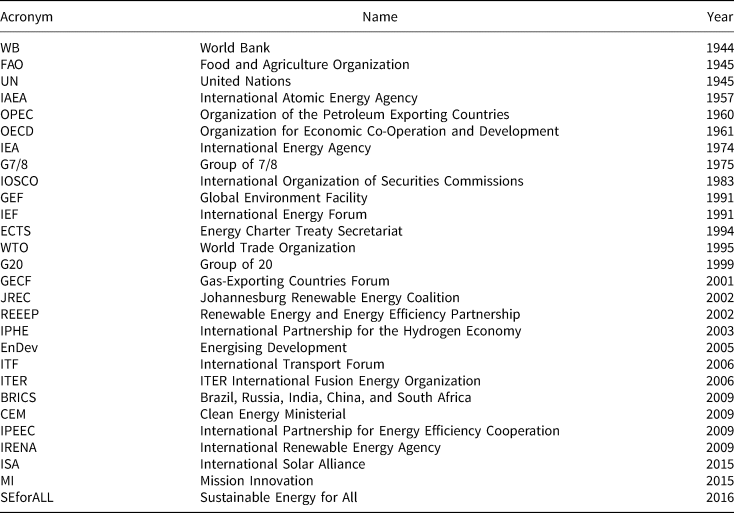
As Table 1 shows, this process resulted in the identification of 28 IOs that work on global energy governance. Each organization is listed chronologically by the year they were established. These include organizations that work across a range of energy issues, such as the IEA, IRENA, or the World Bank, and those that have a narrower focus, such as IPEEC, which works exclusively on energy efficiency. While some of these IOs have been around for decades, others, such as IRENA and IPEEC, are only ten years old.
The population of IOs in the global energy domain.
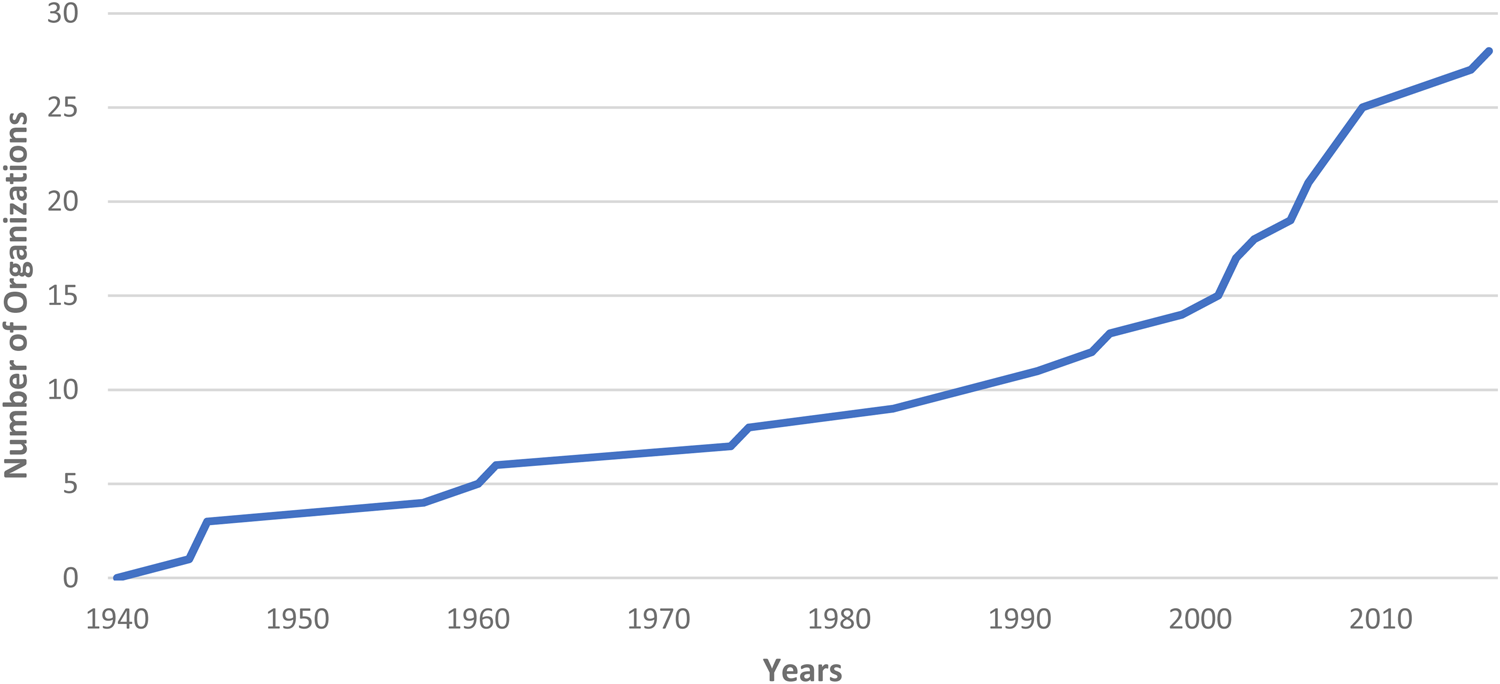
As Figure 1 shows, this population has increased over time. In fact, around a quarter of the IOs that comprise this population were established in the last decade, with many solely dedicated to global energy issues.
Growth in the population of IOs in the global energy domain.
Finally, in order to explore the nature of the interactions between IOs, this demographic data was supplemented with 68 semi-structured interviews that were conducted between 2015 and 2020. Of these, 29 interviews were with current and former officials from a variety of international organizations engaged in the domain of energy, including CEM, GCF, IEA, IMF, IRENA, OECD, OPEC, SE4ALL, World Bank, and the UN, and 39 interviews were with national officials from foreign affairs and energy agencies in key G20 states: Argentina, Australia, China, the European Commission, France, Indonesia, Italy, Japan, the US, and Saudi Arabia. It also became clear following the first round of interviews that some IOs played a more significant role in global energy governance than others, and hence these became the focus of interrogation, as evident in the empirical analysis below. The interviews focused on the period 2008–19 because in the decade after the global financial crisis, not only have a series of new energy IOs been established, but the energy sector itself has been transformed and with it so have many of the issues that these IOs work on.
3. H1: Competition for material resources
The first hypothesis advanced here is that competition between IOs working on global energy governance is likely to centre on material resources. Before turning to consider this hypothesis, the assumption on which it is based, namely that competition is a central form of interaction, was well founded. Indeed, when officials were probed on the dynamics of the interactions between IOs working on global energy issues the overwhelming theme was one of competition. As one put it ‘IOs are competing all the time’,Footnote 73 or as another stated ‘turf wars are a natural part of organizational behaviour’.Footnote 74 And this is directly related to the fact that they are competing for the same set of resources, ‘there are only a small few donors … so you have to prove your worth and uniqueness, which means you have to show that you are better than your collaborators’. Footnote 75
To a large extent, the competition between IOs concentrated on the need to secure funding. As one official explained IOs ‘are constantly trying to show their worth, constantly trying to prove their value in order to get funding’.Footnote 76 Or as another official lamented: ‘all this resourcing is going to staff playing political games because we are all competing for funding’.Footnote 77 However, the empirical data highlights that while competition did centre on material resources as the first hypothesis would expect, symbolic resources, namely legitimacy, were also essential for IOs to secure funding in the first place. In other words, symbolic resources act as positive feedback loop for material resources. The competition for funding underpinned by a need for legitimacy was manifest in several ways.
First, IOs worked to ensure that their voices were visible at key forums. For example, as the G20 has played a larger role in global energy governance since it was elevated to a leaders’ summit in 2008,Footnote 78 it has become ‘a natural playground for competition between IOs’.Footnote 79 One official described this as ‘business development’,Footnote 80 with IOs developing good political relations with states and funders and pitching their work as superior to that of other IOs.Footnote 81 This dynamic has only intensified in recent years as the US's criticisms of IOs under President TrumpFootnote 82 has meant, as one official put it, that ‘you have to make a sales pitch to the US, so that Trump doesn't hate you’.Footnote 83
Second, in the context of the G20 being a playground for competition, it was clear that many IOs, including the IEA, IRENA, OECD, SEforALL, and the World Bank, among others, were eager to seek out governance tasks associated with the G20 even if these were unfunded. This was because these activities could raise their profile among key states, and in turn boost their legitimacy in the eyes of the international community on issues ranging from energy efficiency to energy access, which would increase the likelihood of future funding.Footnote 84 As an IO official explained:
When you are making funding pitches to donors you also point to the fact that you are asked by the G20 to write a report or that your CEO was invited to give a talk at the G20. Those are used as evidence to funders.Footnote 85
Part of this reflects the functional overlap in the energy domain. Several respondents bemoaned the extent of duplication on energy issues, with many IOs performing similar governance functions.Footnote 86 For example, officials noted that ‘there is a lot of competition between IRENA and the IEA’,Footnote 87 given that certain activities overlap, such as the energy scenarios produced in IRENA's Renewable Energy Roadmaps and those produced in the IEA's World Energy Outlooks.Footnote 88 Consistent with organizational ecology, the increasing number of IOs created over the last decade to work on energy issues, including IRENA, appears to have intensified competition, as I discuss below.
Third, in regime complexes where there is no formal hierarchy between institutions, as is the case in the energy domain, IOs compete not just for specific governance tasks, but also to be the focal actor. This dynamic was confirmed by national officials, who pointed out that many of these IOs are ‘competing to be the global authority, they all want to be the best’.Footnote 89 IO officials confirmed this too: ‘as long as there is competition for dollars … organizations not only do their own work, but they try to do what are others are doing as well, so that they become the dominant organization’.Footnote 90
One illustration of this is when new global issues rise in prominence. For example, following the failure of the Millennium Development Goals (MDGs) to include a goal on energy in 2000, the UN campaigned to put energy access on the international agenda, given that billions of people worldwide remained without access to electricity.Footnote 91 It was in this context that SEforALL was established with a key goal to ensure universal access to modern energy services by 2030.Footnote 92 In response, the IEA, which aims to be the focal actor on energy, also began devoting greater attention to energy access, including in its flagship publication the World Energy Outlook.Footnote 93 As one official claimed, the ‘IEA is definitely trying to compete in the energy access space now’, and there is a ‘big turf battle’; between several IOs working on this issue.Footnote 94
Another way to examine how competition over resources has manifest in practice is to consider a specific governance function that was carried out by multiple IOs in the energy domain. Estimating fossil fuel subsidies is a case in point. In 2009, G20 states agreed to ‘rationalize and phase out over the medium term inefficient fossil fuel subsidies’.Footnote 95 One of the first tasks was to estimate the size and scope of fossil fuel subsidies. While IOs had been working on subsidies across various policy domains, such as agriculture, for decades, it was not until the 1990s that several IOs began to turn their attention to fossil fuel subsidies, including the OECD, IEA, and World Bank.Footnote 96 The G20 agreement galvanised IO work on fossil fuel subsidies, which coincided with mounting pressure to combat climate change in the lead up to the 2009 Copenhagen climate conference.Footnote 97 Indeed the G20 agreement called on the ‘IEA, OPEC, OECD, and World Bank, [to] provide an analysis of the scope of energy subsidies and suggestions for the implementation of this initiative and report back at the next summit’.Footnote 98
IO's work in this area was largely driven by competition for resources. In a changing international environment, these IOs recognised that their organizational survival partly depended on acquiring and maintaining symbolic resources, such that their members perceive them as legitimate, which the G20 work offered, and which in turn would positively impact their ability to secure funding.Footnote 99 Officials from several IOs working on fossil fuel subsidies acknowledged that their organizations’ desire to participate was directly related to the increased exposure that the G20 could provide.Footnote 100 For example, officials from the IEA and World Bank noted the benefits of doing analytical work for the G20 because of the ‘political visibility’ it provided, or as another put it, ‘it elevates their status and importance’.Footnote 101
That is not to say there was no cooperation. In 2010 these four IOs – World Bank, IEA, OECD, and OPEC – authored a joint report for the G20 Toronto Summit, which provided more detailed information on subsidies, and further reports followed.Footnote 102 Although there was disagreement over the contents of the joint reports, there appears to have been some cooperation with IOs sharing limited information and expertise.Footnote 103 For instance, the IEA and the OECD had combined their models to run different scenarios on fossil fuel subsidies, which fed into the World Energy Outlooks published by the IEA.Footnote 104 However, competition was never far from the surface. There were minor disputes between IO officials over who would lead the first report, which the World Bank succeeded in doing, before it was agreed that the leadership role would rotate between them.Footnote 105 As one IO official argued, ‘there is quite a bit of competition between IOs about how many times the G20 countries asked them to do something’.Footnote 106 As another stated: ‘We have attempted it [cooperation], but it is not very successful because all the IOs have a different point of view.’Footnote 107
This was especially evident with the IMF's intervention. In 2009 the IEA had estimated that fossil fuel consumption subsidies totaled $300 billion, by 2014 that figure had been revised upward to $500 billion.Footnote 108 Despite some cooperation between IOs, there still remained no consensus on what constitutes a fossil fuel subsidy, which was creating confusion among states. It was in this context that in 2013 the IMF departed from previous definitions of fossil fuel subsidies, by including environmental externalities, to estimate total subsidies at $2 trillion.Footnote 109 In 2015 it raised that estimate again to $5.3 trillion.Footnote 110 The decision by the IMF to enter the fray and publish its own set of numbers raised the ire of other IOs working on the issue. As one official argued,
The IMF comes out in 2013, completely out of the blue with these new set of fossil fuel numbers … They had given us no warning that this was happening, and they did not engage with us at all.Footnote 111
Under Christine Lagarde, who had become the Managing Director of the IMF in 2011, the Fund had been prominent on climate issues,Footnote 112 and several officials claimed that the ‘IMF hierarchy wanted to release the report with the trillion dollar figures’, to as another explained ‘possibly get visibility on the issue’.Footnote 113 Whether this was the case or not, the IMF figures made headlines around the world, with international leaders calling for states to act to limit fossil fuel subsidies.Footnote 114 Yet the IMF estimates also caused a ‘a fair amount of unhappiness from other IOs’, not simply because the Fund had not cooperated with other IOs in producing their report, but arguably also because of the global attention the IMF had received as other IOs were battling for exposure.Footnote 115
4. H2: Cooperation and shared goals
The second hypothesis advanced in this article is that IOs will be more likely to cooperate when they have a shared governance goal, despite the prevalence of competition. Almost unanimously respondents lamented the lack of cooperation between IOs working on global energy issues.Footnote 116 As one IO official joked, ‘the politically correct answer is that we are all working together in a coordinated fashion’,Footnote 117 but as many were quick to acknowledge, this was not the case. Officials pointed out that although some IOs do have individual cooperative arrangements, there are no cooperative structures to facilitate cooperation between multiple IOs in the energy domain.Footnote 118
Consistent with the hypothesis, officials argued that what appears to promote cooperation is the creation of a joint mission or shared goal.Footnote 119 ‘The key is that organizations have the same transparent goal’, which can act as a ‘very strong glue’.Footnote 120 Moreover the empirical data suggest that some types of goals may be more likely to encourage cooperation than others. In other words, the specific characteristics of different goals can affect the likelihood that they lead to cooperation. This was evident in the energy domain with the SDGs. In 2015, the UN adopted 17 SDGs designed to achieve a more sustainable future for the globe. SDG 7 was specifically devoted to energy, with the aim to ensure access to affordable and clean energy for all. Other SDGs, such as SDG 12, which focuses on ensuring sustainable consumption, also touched on energy issues, as I discuss below.Footnote 121
Drawing on the interview data, several specific characteristics associated with the SDGs appear to be related to cooperation. First, and consistent with the hypothesis, was the potential for resource creation. According to IO officials, the SDGs provided an opportunity to secure resources – this was the glue. As one UN official stated ‘it is important for us to contribute to the SDG process as a UN agency, as it gives us some legitimacy’.Footnote 122 Such sentiments were mirrored by other IOs, such as the OECD and the IEA. This was related to the belief that legitimacy is necessary for future funding. As the same UN official made clear, if funders, typically national governments, set goals that require cooperative efforts and direct funding to those goals ‘then working together actually helps us to leverage greater funding and to have a greater impact’.Footnote 123
Two further characteristics stood out that were not hypothesised. One was that if the goal itself cannot be achieved individually, IOs may have to cooperate to achieve it. And two, that substantive goals that produce organizational structures to facilitate their attainment will also encourage cooperation. One way to examine these points is to consider a specific goal. Continuing with the example of fossil fuel subsidies, SDG 12 provides a perfect illustration. Under the SDG process, each of the 17 SDGs has a list of targets, and each target has a list of indicators to measure progress towards that target. Hence SDG 12, which aims to ensure sustainable patterns of consumption and production, includes target 12.C, which aims to rationalise inefficient fossil fuel subsidies. In order to measure progress towards 12.C, indicator 12.C.1 requires the international community to calculate the amount of fossil fuel subsidies per unit of GDP.Footnote 124 Further, every indicator, including 12.C.1, is graded as either a Tier, I, II, or III, with a higher tier reflecting a greater consensus on how to measure the indicator and collect data.Footnote 125 Critically, for the purposes of this discussion, every indicator was assigned a custodian, typically an IO, to coordinate the work programme. For 12.C.1, this role was assigned to the UNEP, a subsidiary organ of the UN, which was tasked with graduating the indicator from Tier III, given there was no internationally agreed methodology on how to calculate fossil fuel subsidies, to Tier II, which designated that there was.Footnote 126
As discussed above, this was no easy task given the competition between IOs. Yet SDG 12.C.1 appears to have been the catalyst for greater IO cooperation on fossil fuel subsidies. To a large extent, the momentum for some IOs to cooperate, especially the UNEP, was the realisation that achieving this goal would not be possible on their own, and hence would require the cooperative efforts of others, including the OECD, IEA, IMF, and World Bank, which had much greater expertise on fossil fuel subsidies.Footnote 127 Indeed several officials pointed out that despite the UNEP's role as custodian of 12.C.1, in part because of its position as a UN agency, ‘it had no background’ on fossil fuel subsidies, and as a relatively small organization it had to reach out to others.Footnote 128
Accordingly, in 2017 the UNEP helped to convene the first meeting of a technical expert group on fossil fuel subsidies, with the aim of pulling together all the key actors who had expertise in this area. While officials described the initial meeting as ‘informal’ and ‘not very official’,Footnote 129 in 2018 in the margins of the G7 in Italy, the UNEP convened a formal meeting of the technical expert group to progress discussions on an internationally agreed methodology for calculating fossil fuel subsidies, a prerequisite for graduating indicator 12.C.1 from Tier III to Tier II. This was a larger meeting, and included many of the IOs listed above, along with others, such as the WTO, and government representatives from countries that were supportive of subsidy reform, such as Germany.Footnote 130
The impetus for the meetings stemmed from the SDG process, with the Inter-Agency and Expert Group on SDG Indicators, which had carriage for reviewing all SDG indicators, establishing guidelines for custodians to engage in consultations.Footnote 131 In other words, the SDG process resulted in organizational structures that invigorated IO cooperation. The creation of joint structures is not unusual. As Oran Young points out, ‘it is relatively easy to establish a causal connection between the articulation of goals and the establishment of organizational arrangements to promote their attainment’.Footnote 132 However, it is often overlooked that goals that establish such joint structures appear more likely to produce cooperative interactions than those that do not.
After all, the SDG process was different to the G20 attempts in 2009 to enlist IOs to co-author reports on fossil fuel subsidies, discussed above. This was because as one IO official argued, ‘joint reports do not create any collaborative structures’, whereas the SDG process did.Footnote 133 Similarly, other examples of IO interactions, such as the IEA and IRENA agreeing in 2012 to make the IEA's renewable energy policies and measures database a joint IRENA–IEA database do not appear to have led to any significant cooperation, other than sharing some data.Footnote 134 This may reflect that goals that require IOs to, for example, share information, are not typically characterised by the possibility of resource creation, in the same way that new global priorities are, such as the SDGs.
In 2020, the technical expert group convened by the UNEP was successful in having indicator 12.C.1 upgraded to a Tier II indicator by the UN Statistical Commission, reflecting an agreement on an ‘internationally established methodology’ for calculating fossil fuel subsidies.Footnote 135 Nevertheless, given the ‘different perspectives’ of IOs, and the variety of estimates of fossil fuel subsidies, cooperation was by no means perfect,Footnote 136 and competitive tendencies did bubble to the surface. For example, at the start of the process there had been some competition between the OECD and UNEP over who would take on the role of custodian, with the UNEP eventually taking the role in part because of its universal membership as a UN agency, compared to the OECD.Footnote 137
5. H3: IO adaptation and the IEA
The third hypothesis is that individual IOs can adapt by changing their goals and boundaries. In this section, I shift the focus from the population of IOs to the most prominent individual IO in the energy domain, the IEA.Footnote 138 The IEA was selected not only because it is prominent, but because it is a most likely case. As organizational ecologists concede, the forces of inertia are less likely to apply to large established organizations that are politically well connected, which the IEA certainly is.Footnote 139 To be sure, the IEA was created in 1974 in response to the oil shocks of the 1970s, with the aim of ensuring the oil security of the largest oil consuming countries of the time, who were also its founding members, including the US, UK, and Japan. Today the IEA has thirty member states, a secretariat of around 250 staff, and a budget of approximately US $30 million, making it one of the best resourced international energy organizations.Footnote 140
However, over the last two decades its external environment has changed considerably. The first and most dramatic change has been the proliferation of new organizations governing global energy. As Figure 1 shows, of the 28 IOs that work on global energy governance, half have been created since 2000. The second change is that several of the IOs within this population have been established in direct response to criticism of the IEA. The clearest example is IRENA, which was established in 2009, partly in response to concern about the IEA's limited attention on renewable energy. In fact, IRENA's creation was led by founding members of the IEA, namely Germany, Denmark, and Spain.Footnote 141
The effect of these changes has been to increase competition for resources, both funding and legitimacy.Footnote 142 As a former IEA official explained:
You have to remember that back in the 1970s there was just OPEC and the IEA, there was no one else, and then we saw an expansion of all these energy organizations.Footnote 143
Further, because the financial resources of most of these IOs are sourced from the same set of donors, largely OECD governments, the competition for resources has intensified.Footnote 144 And not only material resources. The creation of new IOs, such as IRENA in particular, and others such as IPEEC, which I discuss below, have also threatened the IEA's legitimacy as the leading international energy organization in the eyes of the international community.
In response, the IEA has adapted in ways that are largely consistent with the hypothesis. First, in relation to the agency's goals, the IEA has sought to broaden its mandate and expand into new issue areas well beyond its historic focus on energy security defined in terms of oil. While the IEA's Governing Board has not endorsed a change in goals since 1993, over the last two decades the IEA has persuaded member states to delegate additional governance functions.Footnote 145 Indeed, the IEA has become increasingly aware that it has to expand to cover issues associated with advancing a clean energy transition if it is to maximise its material and symbolic resources and remain the focal actor in the energy domain. This is especially so given longstanding criticisms that the agency is too focused on fossil fuels at the expense of renewable energy.Footnote 146
These adaptations have been evident in the issue areas of energy efficiency and energy access. As one IEA official pointed out, ‘10 years ago the IEA wasn't doing anything on energy efficiency’,Footnote 147 and now it is a large part of its work programme.Footnote 148 For example, in 2019 it established the Global Commission for Urgent Action on Energy Efficiency to examine how policy can accelerate energy efficiency.Footnote 149 To a large extent, this has been driven by competition with new IOs, such as IPEEC, which was established in 2009 and aims to enhance global cooperation on energy efficiency, competing with the IEA for the same pool of resources.Footnote 150 The same is true of energy access. The IEA has sought to be a champion for improving energy access in developing countries, again driven in part by competition from SE4ALL, which was created in 2016 specifically to address this issue.Footnote 151 In 2017 the IEA published its World Energy Outlook with a special focus on energy access.Footnote 152
Second, and perhaps more strikingly, the IEA has adapted by broadening its organizational boundaries. This has been manifest in several ways. The clearest illustration has been the agency's attempts to broaden its membership first among OECD countries, such as Mexico, Estonia, and Poland, who have all joined the agency over the last decade. And more significantly since 2015 when Fatih Birol became Executive Director, with emerging economies, including China, India and Brazil, which though they are unable to become full members by virtue of not being members of the OECD, have all been incorporated as associate members.Footnote 153 It has not only been new members. The IEA has also adapted by acquiring new organizations. For example, in 2016 the IEA was successful in having the Clean Energy Ministerial (CEM), which was originally established by the US in 2009 to promote best practices on clean energy, housed within the agency, despite competition from other IOs, such as the UNEP.Footnote 154 In 2020, IPEEC was disbanded and its functions, described above, were incorporated into the IEA as part of a new Energy Efficiency Hub.Footnote 155
Another indication of the IEA broadening its organizational boundaries has been the creation of new organizational units in line with its expanding mandate. Several reviews of the agency have pointed out that in the first thirty years of the IEA's existence the principal divisions established in 1974 hardly varied.Footnote 156 However, as the IEA's external environment has changed, the organization has adapted. For example, the IEA has established the Renewable Energy Division, which tracks the deployment of renewable energy and forecasts market developments, and in 2011 it established the Renewable Industry Advisory Board.Footnote 157 To some extent this was part of a failed attempt to prevent the creation of IRENA in 2009.Footnote 158 In addition, following the ‘modernisation programme’ instituted by the IEA's Executive Director, Fatih Birol, in 2015, the IEA also created an Energy Efficiency Division.Footnote 159 The Division has a staff of around twenty working on energy efficiency, compared to only a handful a few years ago.Footnote 160 IEA officials confirmed that the emergence of these new organizational units has been propelled, in large part, by the growing number of IOs working on global energy governance.Footnote 161
Overall, the case of the IEA highlights that powerful IOs can adapt when their international environment changes, and they can do so in ways that are largely consistent with the hypothesis. The empirical data indicates several IOs adapted in similar ways. The OECD provides another illustration. Over the last two decades the OECD's external environment, much like the IEA's, has undergone significant changes as the rise of emerging economies and creation of new IOs has undermined the OECD's claim to be an exclusive club of rich successful nations.Footnote 162 In fact, in 2006, the OECD's highest decision-making body officially recognised the crisis the organization faced and the risk that it could become irrelevant.Footnote 163
In response the OECD expanded into new issue areas and broadened its organizational boundaries. For example, at the time that the G20 was established as a leaders’ summit in 2008, in the midst of the global financial crisis, officials acknowledged that it was ‘life and death for the OECD’.Footnote 164 The OECD leadership, including the Secretary General Angel Gurria, saw the G20 as an opportunity to work on new issues and increase their exposure and legitimacy within the international community.Footnote 165 Energy was one such issue. As discussed, the OECD sought to work on the G20's fossil fuel subsidies agenda. Much like the IEA, it also expanded its scope to work on issues that might broaden its engagement with emerging economies, such as energy efficiency.Footnote 166 The OECD also adapted by broadening its organizational boundaries and taking a more inclusive attitude towards non-members. From the early 2000s, the OECD ‘strengthened its resolve in this regard’,Footnote 167 and in 2007 it instituted an ‘enhanced engagement program’ directed towards Brazil, China, India, Indonesia, and South Africa, with ‘a view to possible membership’.Footnote 168 While these emerging economies are yet to become new OECD members others, such as Chile and Israel have, and cooperation between the OECD and many of these nations has increased. These efforts have also been associated with reduced criticism of the OECD from emerging economies, which several officials claimed have boosted the organization's legitimacy and led to some voluntary financial contributions.Footnote 169
Conclusion
The domain of global energy governance has changed significantly in the last decade. A rising number of IOs now work on energy issues with overlapping mandates and governance functions. The dynamics of these interactions can have far reaching consequences for which IOs set agendas, rules, or monitor state actions across a range of issues, and which organizations become the focal actor. This is not unique to energy. Many global governance domains, including finance, trade, and health, are now characterised by such complexity. Yet the dynamics of IO interactions remain understudied.
This is the focus of this article. It breaks new ground by providing a framework for understanding IO interactions and considering it in the case of global energy. The framework is broader than the organizational ecology approach, which has begun to be used to analyse populations of IOs, and is largely focused on competition between IOs. Drawing on other variants of ecological theory, the framework proposed here suggests that while competition may be the dominant form of interaction between IOs, cooperation and adaptation are also possible among IOs in the same population.
In relation to the first hypothesis, the evidence indicates that competition between IOs is likely to concentrate on material resources, such as funding. However, it also highlights that the reality is more nuanced than the first hypothesis implies, given that symbolic resources, such as an organization's legitimacy is necessary for attaining material support. In other words, symbolic resources act as positive feedback loop for funding. Competition was manifest in several ways, especially when IOs competed to perform the same governance function, such as estimating the size of global fossil fuel subsidies. Here IOs could not agree on common definitions of the problem, regularly refused to share information, and consistently sought to do work in ways that demonstrated their superiority to other IOs carrying out almost identical tasks.
The second and third hypotheses show why it is necessary to broaden the organizational ecology approach. Contrary to a strict interpretation of organizational ecology, this analysis shows that cooperation between IOs in the same population is possible, and that it is more likely when IOs subscribe to a shared goal. In particular, it suggests that goals that are characterised by the potential for resource creation; goals that cannot be achieved individually; and or goals that produce organizational structures to facilitate their attainment are more likely to encourage cooperation than those that do not. This was highlighted by the role that the SDGs have had on this population of IOs, by precipitating a number of them to pause their competitive tendencies in light of a common mission. This is consistent with several governance approaches that consider relationships between actors, such as orchestration, and has implications for how to address fragmentation, as I elaborate below.
Further, despite the assumption in organizational ecology that adaptation occurs at the population level and that individual IOs are inert, the empirical data presented in this article indicates otherwise. In particular, it highlights that large established organizations that are politically well-connected, such as the IEA, can adapt to their environment, a possibility that remains a blind spot in the literature. The case of the IEA illustrates when and how. IOs will adapt in response to changes in their environment, such as increased competition from other IOs, and they will do so by changing their goals and broadening their organizational boundaries in ways that aim to maximise their material and symbolic resources. For example, the IEA has successfully broadened its mandate and expanded into new issue areas, such as energy efficiency and energy access. At the same time, it has shifted its organizational boundaries by acquiring new members and organizations, such as the CEM, as well as establishing new organizational units that support its changing mandate. In many respects the OECD has pursued a similar approach.
The ecological framework advanced here raises several questions to be examined across different domains and populations. First, while global energy governance is fragmented like many other policy domains, unlike the domains of finance, health or trade, for example, there is no one universal organization, such as the WHO. This fact is likely to affect the dynamics of interactions between IOs. Indeed in regime complexes where there is no formal hierarchy between organizations, as is the case in the energy domain, competition to be the focal actor is to be expected. To what extent this plays out in other domains where there is a focal actor remains to be seen. Though clearly the presence or absence of such an actor is likely to influence the dynamics of IO interactions in important ways, not least the avenues for cooperation.
Second, given the concern among scholars, and policymakers for that matter,Footnote 170 in improving cooperation between organizations, an enduring question remains how? This analysis highlights the important role that shared goals can play in facilitating cooperation. In doing so, it directly responds to calls for more research on the role of governance through global goals.Footnote 171 However, it also raises questions about to what extent different types of goals will have different impacts on the possibilities for cooperation. For instance, while G20 attempts to enlist IOs to co-author reports appear to have done little to improve cooperation, the SDGs seem to have improved cooperation because they helped to facilitate the need for cooperative structures, such as joint forums. Future research, especially research interested in managing fragmentation, should systematically explore different goal types and the impact they have on IO interactions.
Third, this analysis suggests further attention needs to be given to how individual organizations adapt to changes in their environment. Clearly, exploring adaptation has been overlooked in the organizational ecology literature, not least because of the methodological issues raised above. Nevertheless, the case of the IEA highlights how IOs can and do adapt. This could be explored across populations of IOs. In doing so, more work needs to be done on how the dynamics of IO interactions within a population is influenced by the adaptation behaviours of individual IOs. For example, the IEA's efforts to bring the CEM within the IEA, and similar efforts by other actors, will not only affect the membership of a population, but is likely to affect its governance activities as well.
Finally, organizational ecology assumes that organizations in the same population compete for a finite pool of resources.Footnote 172 In international relations this assumption is unlikely to hold. There is every reason to expect that changes in the international environment could lead the pool to grow or shrink. In the current environment, which is challenging for multilateralism, especially given the US's antipathy towards IOs under former President Trump, and constant threats to withdraw material support from them,Footnote 173 the pool of resources can shrink. In this context, future research needs to consider that competition for resources from organizations in the same population will not just be affected by an increasing number of organizations, as organizational ecology assumes, but also by an increase or decrease in the pool of resources itself. A possibility that seems more likely than ever.
Acknowledgements
I am grateful to Maya Bogers, Terry Halliday, Jean-Frédéric Morin, Jensen Sass, and the anonymous reviewers for their comments and encouragement. I am also indebted to the officials who agreed to be interviewed for this project. An earlier version of this article was presented at the Global Goals 2020 Symposium, Utrecht University/Online. Alexis Farr provided excellent research assistance. The project was supported by an Australian Research Council Discovery Early Career Researcher Award (DE180100898).


 Open access

