





1. Introduction and description of the results
1.1. Motivation and formulation of the problem
Given a finite subgroup G of
$SU(2)$
 , the monoidal category of finite-dimensional
$SU(2)$
, the monoidal category of finite-dimensional
$SU(2)$
 -modules acts, by restriction and tensor product, on the category of finite-dimensional G-modules. This observation is the basis of the so-called McKay correspondence, see [Reference McKay33], which, in particular, classifies finite subgroups of
$SU(2)$
-modules acts, by restriction and tensor product, on the category of finite-dimensional G-modules. This observation is the basis of the so-called McKay correspondence, see [Reference McKay33], which, in particular, classifies finite subgroups of
$SU(2)$
 in terms of extended Dynkin diagrams and also connects them to orbifold singularities and simple Lie groups.
Consider the simple complex Lie algebra
$\mathfrak {sl}_2$
 . For this Lie algebra, we have the monoidal category
$\mathscr {C}$
. For this Lie algebra, we have the monoidal category
$\mathscr {C}$
 of all finite-dimensional modules, with the obvious monoidal structure. The category
$\mathscr {C}$
of all finite-dimensional modules, with the obvious monoidal structure. The category
$\mathscr {C}$
 is the obvious Lie-algebraic analog of the category of finite-dimensional
$SU(2)$
is the obvious Lie-algebraic analog of the category of finite-dimensional
$SU(2)$
 -modules. The category
$\mathscr {C}$
-modules. The category
$\mathscr {C}$
 is an interesting and important object of study (see [Reference Etingof, Gelaki, Nikshych and Ostrik11]–[Reference Etingof and Ostrik13], [Reference Kirillov and Ostrik22] and the reference therein).
From the point of view of representation theory, of particular interest is the problem to study various types of
$\mathscr {C}$
 -module categories. The most basic of these are the so-called simple
$\mathscr {C}$
-module categories. The most basic of these are the so-called simple
$\mathscr {C}$
 -module categories (a.k.a. simple transitive in the terminology of [Reference Mazorchuk and Miemietz29]). In particular, simple
$\mathscr {C}$
-module categories (a.k.a. simple transitive in the terminology of [Reference Mazorchuk and Miemietz29]). In particular, simple
$\mathscr {C}$
 -module categories of finite rank (i.e., with finitely many simple objects) were classified in [Reference Etingof and Ostrik13] in terms of certain graphs (and bilinear forms). As was shown in [Reference Etingof and Khovanov12], the combinatorics of a natural subclass of these categories is governed by extended Dynkin diagrams, similarly to the McKay correspondence.
In this article, we are trying to study
$\mathscr {C}$
 -module categories in the context of Lie algebras and their representations. One of our starting questions was: What kind of
$\mathscr {C}$
-module categories in the context of Lie algebras and their representations. One of our starting questions was: What kind of
$\mathscr {C}$
 -module categories one obtains if one looks at the action of
$\mathscr {C}$
-module categories one obtains if one looks at the action of
$\mathscr {C}$
 on the category of finite-dimensional modules over some Lie subalgebra of
$\mathfrak {sl}_2$
on the category of finite-dimensional modules over some Lie subalgebra of
$\mathfrak {sl}_2$
 ? This is not very difficult to answer by direct computations as all Lie subalgebras of
$\mathfrak {sl}_2$
? This is not very difficult to answer by direct computations as all Lie subalgebras of
$\mathfrak {sl}_2$
 are easy to write down.
One immediate observation, as soon as one looks into examples, is that all the categories one obtains in the natural way have infinite rank (i.e., have infinitely many isomorphism classes of indecomposable objects). At the level of the Grothendieck ring, it is known from [Reference Etingof and Khovanov12] that the combinatorics of such kind of categories is governed by the so-called infinite Dynkin diagrams (see [Reference Happel, Preiser and Ringel15], [Reference Happel, Preiser and Ringel16] and §3.4). These are just six infinite diagrams, called
$A_\infty $
 ,
$A_\infty ^\infty $
,
$A_\infty ^\infty $
 ,
$B_\infty $
,
$B_\infty $
 ,
$C_\infty $
,
$C_\infty $
 ,
$D_\infty $
,
$D_\infty $
 , and
$T_\infty $
, and
$T_\infty $
 . It is then natural to ask: Do all of them appear? If one of them appears, then in how many different versions? If one of them appears, then what can one say about the properties of the corresponding
$\mathscr {C}$
. It is then natural to ask: Do all of them appear? If one of them appears, then in how many different versions? If one of them appears, then what can one say about the properties of the corresponding
$\mathscr {C}$
 -module category? These are the questions which we ask and address in the present article.
1.2. Setup and results
For the sake of increased flexibility, we adopt the following setup: we work with a finite-dimensional Lie algebra
$\mathfrak {g}$
 with a fixed surjective Lie algebra homomorphism
$\varphi :\mathfrak {g}\to \mathfrak {sl}_2$
with a fixed surjective Lie algebra homomorphism
$\varphi :\mathfrak {g}\to \mathfrak {sl}_2$
 . In this situation, the pullback along
$\varphi $
. In this situation, the pullback along
$\varphi $
 allows us to consider the monoidal category
$\mathscr {C}$
allows us to consider the monoidal category
$\mathscr {C}$
 as a monoidal subcategory of the category of all
$\mathfrak {g}$
as a monoidal subcategory of the category of all
$\mathfrak {g}$
 -modules.
Further, we are interested in
$\mathscr {C}$
 -module categories
$\mathcal {M}$
-module categories
$\mathcal {M}$
 that are subcategories of
$\mathfrak {g}$
that are subcategories of
$\mathfrak {g}$
 -Mod, closed under the natural action of
$\mathscr {C}$
-Mod, closed under the natural action of
$\mathscr {C}$
 , which have the following properties:
-
• $\mathcal {M}$
 is locally finitary in the sense that all hom-spaces are finite dimensional;
 -
• $\mathcal {M}$
is additive, idempotent split, and Krull–Schmidt; -
• $\mathcal {M}$
is cyclic, in the sense that there exists an object
$M\in \mathcal {M}$
such that
$\mathcal {M}$
coincides with the additive closure of
$\mathscr {C}\cdot M$
.


Note that, automatically, such
$\mathcal {M}$
 contains at most countably many indecomposable objects, up to isomorphism. A typical example of such
$\mathcal {M}$
contains at most countably many indecomposable objects, up to isomorphism. A typical example of such
$\mathcal {M}$
 is the left regular
$\mathscr {C}$
is the left regular
$\mathscr {C}$
 -module category
${}_{\mathscr {C}}\mathscr {C}$
-module category
${}_{\mathscr {C}}\mathscr {C}$
 .
.
In this setup, we obtain the following results about the realization of combinatorially different types of
$\mathscr {C}$
 -module categories:
-
• Type $A_\infty $
is realized via the left regular
$\mathscr {C}$
-module category
${}_{\mathscr {C}}\mathscr {C}$
, moreover, such realization is unique up to equivalence (see Propositions 6 and 7). -
• Type $A_\infty ^\infty $
has uncountably many pairwise non-equivalent realizations via semi-simple categories which can be constructed already inside
$\mathfrak {sl}_2$
-mod (see Propositions 10 and 11). Moreover, we also construct a simple transitive realization of this type via a non-semi-simple category (see Proposition 14). -
• Type $B_\infty $
is not realizable in our setup (see Proposition 23). -
• Type $C_\infty $
admits a realization via projective–injective modules in the BGG category
$\mathcal {O}$
for
$\mathfrak {sl}_2$
(see Proposition 16). We note that any realization of this type must have a non-semi-simple underlying category. -
• Type $D_\infty $
admits a realization via
$\mathfrak {sl}_2$
-Harish-Chandra modules over the semi-direct product
$\mathfrak {g}=\mathfrak {sl}_2\ltimes L(4)$
(see Proposition 19). We also show that every simple transitive realization of this type forces the underlying category to be semi-simple (see Proposition 20). -
• Type $T_\infty $
admits a realization via Whittaker
$\mathfrak {sl}_2$
-modules and also via
$\mathfrak {sl}_2$
-Harish-Chandra modules over the Schrödinger Lie algebra (see Proposition 21). We also show that every simple transitive realization of this type forces the underlying category to be semi-simple (see Proposition 22).





Several of our realizations are taken from the literature, especially from [Reference Mazorchuk and Mrđen30], [Reference Mazorchuk and Mrđen31]. Additionally, we describe all
$\mathscr {C}$
 -module categories inside
$\mathfrak {sl}_2$
-module categories inside
$\mathfrak {sl}_2$
 -mod generated by simple modules and also the
$\mathscr {C}$
-mod generated by simple modules and also the
$\mathscr {C}$
 -module categories coming from the natural action of
$\mathscr {C}$
-module categories coming from the natural action of
$\mathscr {C}$
 on the categories of finite-dimensional modules over Lie subalgebras of
$\mathfrak {sl}_2$
on the categories of finite-dimensional modules over Lie subalgebras of
$\mathfrak {sl}_2$
 .
.
Our non-semi-simple simple transitive realization of type
$A_\infty ^\infty $
 is especially interesting. This is because applying
$\mathscr {C}$
is especially interesting. This is because applying
$\mathscr {C}$
 to simple objects in its abelianization never reaches non-zero projective objects. This is in a very sharp contrast to representations of finitary rigid monoidal categories (cf. [Reference Mazorchuk and Miemietz29, Lemma 12] and [Reference Kildetoft, Mackaay, Mazorchuk and Zimmermann20, Theorem 2]). In fact, as far as we know, this is the first example of such a phenomenon.
1.3. Structure of the article
The article is organized as follows: Section 2 contains all necessary preliminaries. In Section 3, we recall the classifications, characterizations, and combinatorics of Dynkin diagrams, both classical, affine and infinite. Section 4 studies realizations of type
$A_\infty $
 . Section 5 studies realizations of type
$A_\infty ^\infty $
. Section 5 studies realizations of type
$A_\infty ^\infty $
 . Section 6 studies realizations of type
$C_\infty $
. Section 6 studies realizations of type
$C_\infty $
 . Section 7 studies realizations of type
$D_\infty $
. Section 7 studies realizations of type
$D_\infty $
 . Section 8 studies realizations of type
$T_\infty $
. Section 8 studies realizations of type
$T_\infty $
 . Section 9 discusses realizations of type
$B_\infty $
. Section 9 discusses realizations of type
$B_\infty $
 . Finally, Section 10 describes the
$\mathscr {C}$
. Finally, Section 10 describes the
$\mathscr {C}$
 -module categories inside
$\mathfrak {sl}_2$
-module categories inside
$\mathfrak {sl}_2$
 -mod generated by simple modules and also the
$\mathscr {C}$
-mod generated by simple modules and also the
$\mathscr {C}$
 -module categories coming from the natural action of
$\mathscr {C}$
-module categories coming from the natural action of
$\mathscr {C}$
 on the categories of finite-dimensional modules over Lie subalgebras of
$\mathfrak {sl}_2$
on the categories of finite-dimensional modules over Lie subalgebras of
$\mathfrak {sl}_2$
 .
.
2. Monoidal category of finite-dimensional
$\mathfrak {sl}_2$
-modules and its birepresentations

2.1. Preliminaries
We work over the field
$\mathbb {C}$
 of complex numbers and, as usual, write
$\mathbb {C}^*$
of complex numbers and, as usual, write
$\mathbb {C}^*$
 for
$\mathbb {C}\setminus \{0\}$
for
$\mathbb {C}\setminus \{0\}$
 . For a Lie algebra
$\mathfrak {g}$
. For a Lie algebra
$\mathfrak {g}$
 , we denote by
$U(\mathfrak {g})$
, we denote by
$U(\mathfrak {g})$
 the universal enveloping algebra of
$\mathfrak {g}$
the universal enveloping algebra of
$\mathfrak {g}$
 and by
$Z(\mathfrak {g})$
and by
$Z(\mathfrak {g})$
 the center of
$U(\mathfrak {g})$
the center of
$U(\mathfrak {g})$
 . As usual, we denote by
$\mathfrak {g}$
. As usual, we denote by
$\mathfrak {g}$
 -Mod the category of all
$\mathfrak {g}$
-Mod the category of all
$\mathfrak {g}$
 -modules and by
$\mathfrak {g}$
-modules and by
$\mathfrak {g}$
 -mod the category of all finitely generated
$\mathfrak {g}$
-mod the category of all finitely generated
$\mathfrak {g}$
 -modules.
For all details on monoidal categories and their representations, we refer to [Reference Etingof, Gelaki, Nikshych and Ostrik11].
2.2. Finite-dimensional
$\mathfrak {sl}_2$
-modules

Consider the Lie algebra
$\mathfrak {sl}_2$
 with the standard basis
$\{e,f,h\}$
with the standard basis
$\{e,f,h\}$
 , where

For details on the Lie algebra
$\mathfrak {sl}_2$
 and its modules, we refer to [Reference Mazorchuk27].
Denote by
$\mathscr {C}$
 the category of all finite-dimensional
$\mathfrak {sl}_2$
the category of all finite-dimensional
$\mathfrak {sl}_2$
 -modules. The category
$\mathscr {C}$
-modules. The category
$\mathscr {C}$
 is semi-simple with simple objects
$L(m)$
is semi-simple with simple objects
$L(m)$
 , where
$m\in \mathbb {Z}_{\geq 0}$
, where
$m\in \mathbb {Z}_{\geq 0}$
 . The
$\mathfrak {sl}_2$
. The
$\mathfrak {sl}_2$
 -module
$L(m)$
-module
$L(m)$
 is the unique simple
$\mathfrak {sl}_2$
is the unique simple
$\mathfrak {sl}_2$
 -module of dimension
$m+1$
-module of dimension
$m+1$
 . The module
$L(m)$
. The module
$L(m)$
 is a highest weight module of highest weight m. Here, a weight means just an h-eigenvalue.
The category
$\mathscr {C}$
 is monoidal with respect to the usual tensor product of
$\mathfrak {sl}_2$
is monoidal with respect to the usual tensor product of
$\mathfrak {sl}_2$
 -modules. The monoidal unit is the trivial
$\mathfrak {sl}_2$
-modules. The monoidal unit is the trivial
$\mathfrak {sl}_2$
 -module
$L(0)$
-module
$L(0)$
 . Recall the Clebsch–Gordan coefficients for
$\mathfrak {sl}_2$
. Recall the Clebsch–Gordan coefficients for
$\mathfrak {sl}_2$
 : for
$m,n\in \mathbb {Z}_{\geq 0}$
: for
$m,n\in \mathbb {Z}_{\geq 0}$
 , the
$\mathfrak {sl}_2$
, the
$\mathfrak {sl}_2$
 -module
$L(m)\otimes _{\mathbb {C}}L(n)$
-module
$L(m)\otimes _{\mathbb {C}}L(n)$
 decomposes as

The monoidal category
$\mathscr {C}$
 is rigid and symmetric. All objects of
$\mathscr {C}$
is rigid and symmetric. All objects of
$\mathscr {C}$
 are self-dual. The category
$\mathscr {C}$
are self-dual. The category
$\mathscr {C}$
 is generated by
$L(1)$
is generated by
$L(1)$
 as a monoidal category. The category
$\mathscr {C}$
as a monoidal category. The category
$\mathscr {C}$
 is simple in the sense that it does not have any non-trivial monoidal ideals.
To simplify notation, for every
$i\in \mathbb {Z}_{\geq 0}$
 , we will sometimes denote by
$F_i$
, we will sometimes denote by
$F_i$
 the object
$L(i)$
the object
$L(i)$
 of
$\mathscr {C}$
of
$\mathscr {C}$
 .
.
2.3. Locally finitary module categories over
$\mathscr {C}$

Let
$\mathcal {M}$
 be a (left) module category over
$\mathscr {C}$
be a (left) module category over
$\mathscr {C}$
 . We will say that
$\mathcal {M}$
. We will say that
$\mathcal {M}$
 is locally finitary provided that the following conditions are satisfied:\eject
-
• $\mathcal {M}$
is
$\mathbb {C}$
-linear, additive, idempotent split, and Krull–Schmidt; -
• $\mathcal {M}$
has at most countably many indecomposable objects, up to isomorphism; -
• all hom-spaces in $\mathcal {M}$
are finite dimensional (over
$\mathbb {C}$
).


A typical example of a locally finitary module category over
$\mathscr {C}$
 is
$\mathcal {M}=\mathscr {C}$
is
$\mathcal {M}=\mathscr {C}$
 with respect to the left regular action.
Following [Reference Mazorchuk and Miemietz29], we will say that
$\mathcal {M}$
 is transitive provided that, for any indecomposable objects
$X,Y\in \mathcal {M}$
is transitive provided that, for any indecomposable objects
$X,Y\in \mathcal {M}$
 , there exists
$F\in \mathscr {C}$
, there exists
$F\in \mathscr {C}$
 such that Y is isomorphic to a summand of
$F(X)$
such that Y is isomorphic to a summand of
$F(X)$
 . We will say that
$\mathcal {M}$
. We will say that
$\mathcal {M}$
 is simple transitive provided that
$\mathcal {M}$
is simple transitive provided that
$\mathcal {M}$
 does not have any non-trivial
$\mathscr {C}$
does not have any non-trivial
$\mathscr {C}$
 -invariant ideals.
Let
$\{X_i\,:\,i\in I\}$
 be a complete and irredundant set of representatives of the isomorphism classes of indecomposable objects in
$\mathcal {M}$
be a complete and irredundant set of representatives of the isomorphism classes of indecomposable objects in
$\mathcal {M}$
 . Then, with any
$F\in \mathscr {C}$
. Then, with any
$F\in \mathscr {C}$
 , we can associate an
$I\times I$
, we can associate an
$I\times I$
 -matrix
$[F]=(m_{i,j})_{i,j\in I}$
-matrix
$[F]=(m_{i,j})_{i,j\in I}$
 with non-negative integer coefficients in which
$m_{i,j}$
with non-negative integer coefficients in which
$m_{i,j}$
 is defined as the multiplicity of
$X_i$
is defined as the multiplicity of
$X_i$
 as a summand of
$F(X_j)$
as a summand of
$F(X_j)$
 . Then
$\mathcal {M}$
. Then
$\mathcal {M}$
 is transitive if and only if, for all
$i,j\in I$
is transitive if and only if, for all
$i,j\in I$
 , there is some power
$[F_1]^k$
, there is some power
$[F_1]^k$
 of
$[F_1]$
of
$[F_1]$
 such that the
$(i,j)$
such that the
$(i,j)$
 th coefficient in
$[F_1]^k$
th coefficient in
$[F_1]^k$
 is non-zero.
We also define the action graph
$\Lambda _{\mathcal {M}}$
 of
$\mathcal {M}$
of
$\mathcal {M}$
 as an oriented graph (possibly with loops, but without multiple oriented edges) with vertices I, in which there is an oriented edge from i to j if and only if there is
$F\in \mathscr {C}$
as an oriented graph (possibly with loops, but without multiple oriented edges) with vertices I, in which there is an oriented edge from i to j if and only if there is
$F\in \mathscr {C}$
 such that the coefficient
$m_{j,i}$
such that the coefficient
$m_{j,i}$
 in
$[F]$
in
$[F]$
 is non-zero. By taking as F the unit object in
$\mathscr {C}$
is non-zero. By taking as F the unit object in
$\mathscr {C}$
 , we see that
$\Lambda _{\mathcal {M}}$
, we see that
$\Lambda _{\mathcal {M}}$
 has an oriented loop at each vertex. Then
$\mathcal {M}$
has an oriented loop at each vertex. Then
$\mathcal {M}$
 is transitive if and only if
$\Lambda _{\mathcal {M}}$
is transitive if and only if
$\Lambda _{\mathcal {M}}$
 is strongly connected.
2.4. Grothendieck ring of
$\mathscr {C}$

Consider the polynomial algebra
$\mathbb {Z}[x]$
 . For
$i\geq 0$
. For
$i\geq 0$
 , define the polynomials
$R_i(x)$
, define the polynomials
$R_i(x)$
 recursively as follows:

These polynomials are sometimes called ultraspherical polynomials (see, e.g., [Reference Etingof and Ostrik13]). They can also be considered as renormalized Chebyshev polynomials of the second kind (see [Reference Rivlin36]).
The Grothendieck ring
$[\mathscr {C}]$
 of
$\mathscr {C}$
of
$\mathscr {C}$
 is isomorphic to
$\mathbb {Z}[x]$
is isomorphic to
$\mathbb {Z}[x]$
 by sending the class of
$L(i)$
by sending the class of
$L(i)$
 in
$[\mathscr {C}]$
in
$[\mathscr {C}]$
 to
$R_i(x)$
to
$R_i(x)$
 , for
$i\geq 0$
, for
$i\geq 0$
 . Consequently, for any locally finitary
$\mathscr {C}$
. Consequently, for any locally finitary
$\mathscr {C}$
 -module category
$\mathcal {M}$
-module category
$\mathcal {M}$
 , we have
$[F_i]=R_i([F_1])$
, we have
$[F_i]=R_i([F_1])$
 , for
$i\geq 0$
, for
$i\geq 0$
 .
.
Given a locally finitary
$\mathscr {C}$
 -module category
$\mathcal {M}$
-module category
$\mathcal {M}$
 , the split Grothendieck group
$[\mathcal {M}]_\oplus $
, the split Grothendieck group
$[\mathcal {M}]_\oplus $
 of
$\mathcal {M}$
of
$\mathcal {M}$
 has the obvious structure of a
$[\mathscr {C}]$
has the obvious structure of a
$[\mathscr {C}]$
 -module.
2.5. Setup
Let
$\mathfrak {g}$
 be a finite-dimensional Lie algebra with a fixed surjective Lie algebra homomorphism
$\varphi :\mathfrak {g}\to \mathfrak {sl}_2$
be a finite-dimensional Lie algebra with a fixed surjective Lie algebra homomorphism
$\varphi :\mathfrak {g}\to \mathfrak {sl}_2$
 . The trivial example is
$\mathfrak {g}=\mathfrak {sl}_2$
. The trivial example is
$\mathfrak {g}=\mathfrak {sl}_2$
 with
$\varphi $
with
$\varphi $
 being the identity. The pullback along
$\varphi $
being the identity. The pullback along
$\varphi $
 allows us to consider
$\mathscr {C}$
allows us to consider
$\mathscr {C}$
 as a (monoidal) subcategory of
$\mathfrak {g}$
as a (monoidal) subcategory of
$\mathfrak {g}$
 -Mod, up to monoidal equivalence.
We will be interested in
$\mathscr {C}$
 -module categories of the form
$\mathcal {M}\subset \mathfrak {g}$
-module categories of the form
$\mathcal {M}\subset \mathfrak {g}$
 -Mod in which the
$\mathscr {C}$
-Mod in which the
$\mathscr {C}$
 -module structure is given by tensoring over
$\mathbb {C}$
-module structure is given by tensoring over
$\mathbb {C}$
 and then using the standard comultiplication for
$U(\mathfrak {g})$
and then using the standard comultiplication for
$U(\mathfrak {g})$
 . We will be especially interested in such
$\mathcal {M}$
. We will be especially interested in such
$\mathcal {M}$
 given by the additive closure of
$\mathscr {C}\cdot M$
given by the additive closure of
$\mathscr {C}\cdot M$
 , where
$M\in \mathfrak {g}$
, where
$M\in \mathfrak {g}$
 -Mod, with particular emphasis on the case when M is simple. We will denote this kind of category by
$\mathrm {add}(\mathscr {C}\cdot M)$
-Mod, with particular emphasis on the case when M is simple. We will denote this kind of category by
$\mathrm {add}(\mathscr {C}\cdot M)$
 .
.
2.6. Projective functors
The category
$\mathscr {C}$
 is closely connected to the monoidal category of projective endofunctors for
$\mathfrak {sl}_2$
is closely connected to the monoidal category of projective endofunctors for
$\mathfrak {sl}_2$
 (see [Reference Bernstein and Gelfand4]). The latter are endofunctors of the full subcategory
$\mathcal {Z}$
(see [Reference Bernstein and Gelfand4]). The latter are endofunctors of the full subcategory
$\mathcal {Z}$
 of
$\mathfrak {sl}_2$
of
$\mathfrak {sl}_2$
 -Mod that consists of all modules, the action of
$Z(\mathfrak {sl}_2)$
-Mod that consists of all modules, the action of
$Z(\mathfrak {sl}_2)$
 on which is locally finite. Recall that
$Z(\mathfrak {sl}_2)$
on which is locally finite. Recall that
$Z(\mathfrak {sl}_2)$
 is a polynomial algebra generated by the Casimir element
$\mathtt {c}=(h+1)^2+4fe$
is a polynomial algebra generated by the Casimir element
$\mathtt {c}=(h+1)^2+4fe$
 . By [Reference Bernstein and Gelfand4, Subsection 1.8], the category
$\mathcal {Z}$
. By [Reference Bernstein and Gelfand4, Subsection 1.8], the category
$\mathcal {Z}$
 is a direct sum, over all
$\theta \in \mathbb {C}$
is a direct sum, over all
$\theta \in \mathbb {C}$
 , of the full subcategories
$\mathcal {Z}_\theta $
, of the full subcategories
$\mathcal {Z}_\theta $
 of
$\mathcal {Z}$
of
$\mathcal {Z}$
 consisting of all modules on which
$\mathtt {c}-\theta $
consisting of all modules on which
$\mathtt {c}-\theta $
 acts locally nilpotently.
Let us recall classification of indecomposable projective functors from [Reference Bernstein and Gelfand4, Theorem 3.3]. For this, recall that
$\mathfrak {sl}_2$
 admits a triangular decomposition

where e spans
$\mathfrak {n}_+$
 , f spans
$\mathfrak {n}_-$
, f spans
$\mathfrak {n}_-$
 , and h spans
$\mathfrak {h}$
, and h spans
$\mathfrak {h}$
 . We can identify
$\mathfrak {h}^*$
. We can identify
$\mathfrak {h}^*$
 with
$\mathbb {C}$
with
$\mathbb {C}$
 by sending
$\lambda \in \mathfrak {h}^*$
by sending
$\lambda \in \mathfrak {h}^*$
 to
$\lambda (h)$
to
$\lambda (h)$
 . Then, for each
$\lambda \in \mathbb {C}$
. Then, for each
$\lambda \in \mathbb {C}$
 , we have the corresponding Verma module
$\Delta (\lambda )$
, we have the corresponding Verma module
$\Delta (\lambda )$
 with highest weight
$\lambda $
with highest weight
$\lambda $
 and its unique simple quotient
$L(\lambda )$
and its unique simple quotient
$L(\lambda )$
 . Both these modules belong to the BGG category
$\mathcal {O}$
. Both these modules belong to the BGG category
$\mathcal {O}$
 (see [Reference Bernstein, Gelfand and Gelfand3], [Reference Humphreys17]). There, we also have the indecomposable projective cover
$P(\lambda )$
(see [Reference Bernstein, Gelfand and Gelfand3], [Reference Humphreys17]). There, we also have the indecomposable projective cover
$P(\lambda )$
 of
$L(\lambda )$
of
$L(\lambda )$
 . Note that
$P(\lambda )=\Delta (\lambda )$
. Note that
$P(\lambda )=\Delta (\lambda )$
 unless
$\lambda \in \{-2,-3,\dots \}$
unless
$\lambda \in \{-2,-3,\dots \}$
 and
$P(\lambda )=L(\lambda )$
and
$P(\lambda )=L(\lambda )$
 unless
$\lambda \in (\mathbb {Z}\setminus \{-1\})$
unless
$\lambda \in (\mathbb {Z}\setminus \{-1\})$
 .
.
An element
$\lambda \in \mathbb {C}$
 is called dominant provided that
$\lambda \not \in \{-2,-3,\dots \}$
is called dominant provided that
$\lambda \not \in \{-2,-3,\dots \}$
 and anti-dominant provided that
$\lambda \not \in \mathbb {Z}_{\geq 0}$
and anti-dominant provided that
$\lambda \not \in \mathbb {Z}_{\geq 0}$
 . According to [Reference Bernstein and Gelfand4, Theorem 3.3], for each pair
$(\lambda ,\mu )\in \mathbb {C}^2$
. According to [Reference Bernstein and Gelfand4, Theorem 3.3], for each pair
$(\lambda ,\mu )\in \mathbb {C}^2$
 satisfying
-
• $\lambda -\mu \in \mathbb {Z}$
; -
• $\lambda $
is dominant; -
• $\mu $
is anti-dominant if
$\lambda =-1$
;


there is a unique indecomposable projective functor

such that
$\theta _{\lambda ,\mu }\Delta (\lambda )=P(\mu )$
 . All indecomposable projective endofunctors of
$\mathcal {Z}$
. All indecomposable projective endofunctors of
$\mathcal {Z}$
 are of this form. If
$\lambda \not \in \mathbb {Z}$
are of this form. If
$\lambda \not \in \mathbb {Z}$
 , then
$\theta _{\lambda ,\mu }$
, then
$\theta _{\lambda ,\mu }$
 is an equivalence with inverse
$\theta _{\mu ,\lambda }$
is an equivalence with inverse
$\theta _{\mu ,\lambda }$
 .
.
We will say that
$\theta _{\lambda ,\mu }$
 is special provided that
$\lambda \in \frac {1}{2}+\mathbb {Z}$
is special provided that
$\lambda \in \frac {1}{2}+\mathbb {Z}$
 and
$\mu =-\lambda -2$
and
$\mu =-\lambda -2$
 .
.
2.7. Abelianization
Let
$\mathcal {M}$
 be a locally finitary
$\mathscr {C}$
be a locally finitary
$\mathscr {C}$
 -module category. Then we can consider the projective abelianization
$\overline {\mathcal {M}}$
-module category. Then we can consider the projective abelianization
$\overline {\mathcal {M}}$
 of
$\mathcal {M}$
of
$\mathcal {M}$
 (see [Reference Mazorchuk and Miemietz28, Subsection 3.1]). The objects of
$\overline {\mathcal {M}}$
(see [Reference Mazorchuk and Miemietz28, Subsection 3.1]). The objects of
$\overline {\mathcal {M}}$
 are diagrams
$X\to Y$
are diagrams
$X\to Y$
 over
$\mathcal {M}$
over
$\mathcal {M}$
 and morphisms are (solid) commutative squares

modulo the ideal generated by all those squares in which the right vertical morphism admits a factorization via some dotted morphism. The category
$\overline {\mathcal {M}}$
 is a
$\mathscr {C}$
is a
$\mathscr {C}$
 -module category, with the
$\mathscr {C}$
-module category, with the
$\mathscr {C}$
 -action inherited from
$\mathcal {M}$
-action inherited from
$\mathcal {M}$
 .
.
If we additionally assume that, for each indecomposable object
$M\in \mathcal {M}$
 , there are only finitely many indecomposable objects N, up to isomorphism, such that
$\mathcal {M}(M,N)\neq 0$
, there are only finitely many indecomposable objects N, up to isomorphism, such that
$\mathcal {M}(M,N)\neq 0$
 and there are only finitely many indecomposable objects N, up to isomorphism, such that
$\mathcal {M}(N,M)\neq 0$
and there are only finitely many indecomposable objects N, up to isomorphism, such that
$\mathcal {M}(N,M)\neq 0$
 , then the category
$\overline {\mathcal {M}}$
, then the category
$\overline {\mathcal {M}}$
 is an abelian length category in which the original category
$\mathcal {M}$
is an abelian length category in which the original category
$\mathcal {M}$
 naturally embeds via
$P\mapsto (0\to P)$
naturally embeds via
$P\mapsto (0\to P)$
 and the closure of the image of this embedding with respect to isomorphism coincides with the category of projective objects in
$\overline {\mathcal {M}}$
and the closure of the image of this embedding with respect to isomorphism coincides with the category of projective objects in
$\overline {\mathcal {M}}$
 . In full generality,
$\overline {\mathcal {M}}$
. In full generality,
$\overline {\mathcal {M}}$
 is abelian with the above properties if and only if
$\mathcal {M}$
is abelian with the above properties if and only if
$\mathcal {M}$
 has weak kernels (see [Reference Freyd14]). We will call such categories admissible. We refer the reader to [Reference Macpherson25], [Reference Macpherson26] for more details on locally finitary categories, where one can also find some information about how some of the above conditions may be relaxed.
3. Generalized Cartan matrices and Dynkin diagrams
3.1. Generalized Cartan matrix
Let I be an indexing set (finite or infinite). Recall that a generalized Cartan
$I\times I$
 -matrix (GCM) is a matrix
$C=(c_{i,j})_{i,j\in I}$
-matrix (GCM) is a matrix
$C=(c_{i,j})_{i,j\in I}$
 such that
-
• $c_{i,i}\leq 2$
, for all i; -
• $c_{i,j}\in \{0,-1,-2,\dots \}$
, for all
$i\neq j$
; -
• $c_{i,j}=0$
if and only if
$c_{j,i}=0$
, for all
$i,j$
.




Given a GCM C on I, we can associate to it a graph
$\Gamma _C$
 with vertex set I such that, for all
$i\neq j\in I$
with vertex set I such that, for all
$i\neq j\in I$
 , there are exactly
$-c_{i,j}$
, there are exactly
$-c_{i,j}$
 oriented edges from i to j; moreover, for all
$i\in I$
oriented edges from i to j; moreover, for all
$i\in I$
 , there are
$2-c_{i,i}$
, there are
$2-c_{i,i}$
 loops at the vertex i. We denote by
$\widetilde {C}$
loops at the vertex i. We denote by
$\widetilde {C}$
 the adjacency matrix of
$\Gamma _C$
the adjacency matrix of
$\Gamma _C$
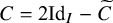
 (with the convention that each loop corresponds to one on the main diagonal) and note that, by definition,
$C=2\mathrm {Id}_I-\widetilde {C}$
(with the convention that each loop corresponds to one on the main diagonal) and note that, by definition,
$C=2\mathrm {Id}_I-\widetilde {C}$
 , where
$\mathrm {Id}_I$
, where
$\mathrm {Id}_I$
 is the identity
$I\times I$
is the identity
$I\times I$
 -matrix. A pair of oppositely oriented edges between i and j, for
$i\neq j$
-matrix. A pair of oppositely oriented edges between i and j, for
$i\neq j$
 , will be simplified to one unoriented edge between these vertices. By convention, all loops are unoriented.
Example 1. The graph associated with the GCM

looks as follows:

3.2. Classical Dynkin diagrams and their characterization
Recall the classical finite Dynkin diagrams, drawn with our convention for the underlying graph (in all cases, the index is the number of vertices):

An important invariant of a Dynkin diagram is the so-called Coxeter number, usually denote by
$\mathtt {h}$
 , given by the following table:

We can now recall the following standard characterization of the classical Dynkin diagrams (see [Reference Kac19, Chapter 4] and [Reference Etingof and Ostrik13, Corollary 3.9]).
Proposition 2. Let Q be an irreducible matrix with non-negative integer coefficients and zero diagonal. Then
$Q=\widetilde {C}$
 , for some classical Dynkin diagram, if and only if the GCM
$2\mathrm {Id}-Q$
, for some classical Dynkin diagram, if and only if the GCM
$2\mathrm {Id}-Q$
 is positive definite. In the latter case, we have
$R_{\mathtt {h}-1}(Q)=0$
is positive definite. In the latter case, we have
$R_{\mathtt {h}-1}(Q)=0$
 , where
$\mathtt {h}$
, where
$\mathtt {h}$
 is the Coxeter number of the Dynkin diagram in question.
In the context of representations of monoidal categories, classical Dynkin diagrams appeared, for example, in [Reference Kildetoft, Mackaay, Mazorchuk and Zimmermann20], [Reference Kirillov and Ostrik22].
3.3. Affine Dynkin diagrams and their characterization
Next, recall the affine Dynkin diagrams (also known as generalized Euclidean diagrams):

The following proposition characterizes the above graphs (see [Reference Happel, Preiser and Ringel15, Theorem 2]).
Proposition 3. A connected GCM on a finite index set which annihilates some vector with positive integer coefficients is the GCM of one of the affine Dynkin diagrams.
3.4. Infinite Dynkin diagrams and their characterization
Finally, recall the following infinite Dynkin diagrams:

The following proposition characterizes the above graphs (see [Reference Happel, Preiser and Ringel15, p. 12]).
Proposition 4. A connected GCM on a countable index set which annihilates some vector with positive integer coefficients is the GCM of one of the infinite Dynkin diagrams.
We refer to [Reference Happel, Preiser and Ringel15], [Reference Happel, Preiser and Ringel16] for more details.
3.5. Combinatorics of transitive
$\mathscr {C}$
-categories

The following corollary follows from the definitions and the above characterizations of the affine and infinite Dynkin diagrams (see [Reference Etingof and Khovanov12, Theorem 4.1]).
Corollary 5. Let
$\mathcal {M}$
 be a transitive
$\mathscr {C}$
be a transitive
$\mathscr {C}$
 -module category for which
$[L(1)]$
-module category for which
$[L(1)]$
 annihilates some vector with positive integer coefficients. Then the action of
$[L(1)]$
annihilates some vector with positive integer coefficients. Then the action of
$[L(1)]$
 on the
$[\mathscr {C}]$
on the
$[\mathscr {C}]$
 -module
$[\mathcal {M}]_\oplus $
-module
$[\mathcal {M}]_\oplus $
 is given by the matrix
$\widetilde {C}$
is given by the matrix
$\widetilde {C}$
 associated with either an affine Dynkin diagram or an infinite Dynkin diagram.
This raises a natural problem to find a realization for each possibility described in Corollary 5 within the context provided by Section 2.5. This is the main problem which we consider in this article. For the case of a finite rank, we have a (combinatorially quite complex) classification of simple
$\mathscr {C}$
 -module categories obtained in [Reference Etingof and Ostrik13]. It is not clear where to look for such categories in our context. Therefore, we focus on the infinite rank case.
4. Realizations of type
$A_\infty $

4.1. First realization
Let
$\mathfrak {g}=\mathfrak {sl}_2$
 with
$\varphi $
with
$\varphi $
 being the identity. Define
$\mathcal {M}_1:=\mathscr {C}$
being the identity. Define
$\mathcal {M}_1:=\mathscr {C}$
 with the left regular action.
Then the indecomposable objects in
$\mathcal {M}_1$
 are
$L(i)$
are
$L(i)$
 , for
$i\geq 0$
, for
$i\geq 0$
 , and the action of
$L(1)$
, and the action of
$L(1)$
 is given by

Therefore, we have

4.2. Second realization
Let
$\mathfrak {g}=\mathfrak {sl}_2$
 with
$\varphi $
with
$\varphi $
 being the identity. Consider the BGG category
$\mathcal {O}$
being the identity. Consider the BGG category
$\mathcal {O}$
 for
$\mathfrak {g}$
for
$\mathfrak {g}$
 (see [Reference Bernstein, Gelfand and Gelfand3], [Reference Mazorchuk27]). For
$\lambda \in \mathbb {C}$
(see [Reference Bernstein, Gelfand and Gelfand3], [Reference Mazorchuk27]). For
$\lambda \in \mathbb {C}$
 , denote by
$L(\lambda )$
, denote by
$L(\lambda )$
 the simple highest weight
$\mathfrak {g}$
the simple highest weight
$\mathfrak {g}$
 -module with highest weight
$\lambda $
-module with highest weight
$\lambda $
 . Also denote by
$P(\lambda )$
. Also denote by
$P(\lambda )$
 the projective cover of
$L(\lambda )$
the projective cover of
$L(\lambda )$
 in
$\mathcal {O}$
in
$\mathcal {O}$
 .
.
Define the category
$\mathcal {N}$
 as the additive closure in
$\mathcal {O}$
as the additive closure in
$\mathcal {O}$
 of the modules
$L(\lambda )$
of the modules
$L(\lambda )$
 and
$P(\lambda )$
and
$P(\lambda )$
 , for
$\lambda \in \{-1,-2,-3,\dots \}$
, for
$\lambda \in \{-1,-2,-3,\dots \}$
 . Note that these are exactly the integral tilting modules in the sense of [Reference Collingwood and Irving6], [Reference Ringel35]. Also, note that
$L(-1)=P(-1),$
. Note that these are exactly the integral tilting modules in the sense of [Reference Collingwood and Irving6], [Reference Ringel35]. Also, note that
$L(-1)=P(-1),$
 while
$L(\lambda )\not \simeq P(\lambda )$
while
$L(\lambda )\not \simeq P(\lambda )$
 , for
$\lambda \in \{-2,-3,\dots \}$
, for
$\lambda \in \{-2,-3,\dots \}$
 .
.
For
$\lambda \in \{-1,-2,-3,\dots \}$
 , we have the following (see [Reference Mazorchuk27, Section 5]):

and

From these formulas, it follows that the additive closure of the modules
$P(\lambda )$
 , with
$\lambda \in \{-1,-2,\dots \}$
, with
$\lambda \in \{-1,-2,\dots \}$
 , is a transitive
$\mathscr {C}$
, is a transitive
$\mathscr {C}$
 -module subcategory of
$\mathcal {N}$
-module subcategory of
$\mathcal {N}$
 . Let
$\mathcal {I}$
. Let
$\mathcal {I}$
 be the ideal in
$\mathcal {N}$
be the ideal in
$\mathcal {N}$
 generated by all
$P(\lambda )$
generated by all
$P(\lambda )$
 , where
$\lambda \in \{-1,-2,\dots \}$
, where
$\lambda \in \{-1,-2,\dots \}$
 . Then the formulas above imply that
$\mathcal {I}$
. Then the formulas above imply that
$\mathcal {I}$
 is
$\mathscr {C}$
is
$\mathscr {C}$
 -stable and hence
$\mathcal {M}_2:=\mathcal {N}/\mathcal {I}$
-stable and hence
$\mathcal {M}_2:=\mathcal {N}/\mathcal {I}$
 is a
$\mathscr {C}$
is a
$\mathscr {C}$
 -module category. Now the above formulas imply Formula (1) for
$\mathcal {M}_2$
-module category. Now the above formulas imply Formula (1) for
$\mathcal {M}_2$
 .
.
4.3. Statements
We can now summarize the content of this section in the following proposition.
Proposition 6. Both
$\mathcal {M}_1$
 and
$\mathcal {M}_2$
and
$\mathcal {M}_2$
 are simple transitive
$\mathscr {C}$
are simple transitive
$\mathscr {C}$
 -module categories of type
$A_\infty $
-module categories of type
$A_\infty $
 .
.
Proof. That
$\mathcal {M}_1$
 and
$\mathcal {M}_2$
and
$\mathcal {M}_2$
 are of type
$A_\infty $
are of type
$A_\infty $
 , follows from Formula (1). That both
$\mathcal {M}_1$
, follows from Formula (1). That both
$\mathcal {M}_1$
 and
$\mathcal {M}_2$
and
$\mathcal {M}_2$
 are simple transitive follows by combining that they are transitive and semi-simple. The latter is obvious for
$\mathcal {M}_1$
are simple transitive follows by combining that they are transitive and semi-simple. The latter is obvious for
$\mathcal {M}_1$
 and follows from Schur’s lemma for
$\mathcal {M}_2$
and follows from Schur’s lemma for
$\mathcal {M}_2$
 , since
$\mathcal {M}_2$
, since
$\mathcal {M}_2$
 is, essentially, the additive closure of simple
$\mathfrak {g}$
is, essentially, the additive closure of simple
$\mathfrak {g}$
 -modules.
We also record the following observation.
Proposition 7. All admissible simple transitive
$\mathscr {C}$
 -module categories of type
$A_\infty $
-module categories of type
$A_\infty $
 are equivalent (as
$\mathscr {C}$
are equivalent (as
$\mathscr {C}$
 -module categories).
Proof. Let
$\mathcal {M}$
 be a simple transitive
$\mathscr {C}$
be a simple transitive
$\mathscr {C}$
 -module category of type
$A_\infty $
-module category of type
$A_\infty $
 . We are going to prove that
$\mathcal {M}$
. We are going to prove that
$\mathcal {M}$
 is equivalent, as a
$\mathscr {C}$
is equivalent, as a
$\mathscr {C}$
 -module category, to the left regular
$\mathscr {C}$
-module category, to the left regular
$\mathscr {C}$
 -module category
${}_{\mathscr {C}}\mathscr {C}$
-module category
${}_{\mathscr {C}}\mathscr {C}$
 .
.
We have that
$[L(1)]$
 is given by Formula (1) and hence there is a unique, up to isomorphism indecomposable object X in
$\mathcal {M}$
is given by Formula (1) and hence there is a unique, up to isomorphism indecomposable object X in
$\mathcal {M}$
 such that
$L(1)\cdot X$
such that
$L(1)\cdot X$
 is indecomposable.
Since
$L(i)\otimes _{\mathscr {C}} L(0)\cong L(i)$
 in
${}_{\mathscr {C}}\mathscr {C}$
in
${}_{\mathscr {C}}\mathscr {C}$
 , the first column of each
$R_i([L(1)])$
, the first column of each
$R_i([L(1)])$
 has only one non-zero entry, namely,
$1$
has only one non-zero entry, namely,
$1$
 in row
$i+1$
in row
$i+1$
 . This means that
$L(i)\cdot X$
. This means that
$L(i)\cdot X$
 is indecomposable, that
$L(i)\cdot X\cong L(j)\cdot X$
is indecomposable, that
$L(i)\cdot X\cong L(j)\cdot X$
 if and only if
$i=j$
if and only if
$i=j$
 and that all indecomposable objects of
$\mathcal {M}$
and that all indecomposable objects of
$\mathcal {M}$
 can be obtained in this way.
Now let us show that the radical of
$\mathcal {M}$
 is
$\mathscr {C}$
is
$\mathscr {C}$
 -invariant. Since
$\mathscr {C}$
-invariant. Since
$\mathscr {C}$
 is generated by
$F_1$
is generated by
$F_1$
 , it is enough to show that the radical of
$\mathcal {M}$
, it is enough to show that the radical of
$\mathcal {M}$
 is
$F_1$
is
$F_1$
 -invariant. Let
$M_0,M_1,\dots $
-invariant. Let
$M_0,M_1,\dots $
 be a list of indecomposables in
$\mathcal {M}$
be a list of indecomposables in
$\mathcal {M}$
 such that, in the corresponding basis of the split Grothendieck group, the action of
$F_1$
such that, in the corresponding basis of the split Grothendieck group, the action of
$F_1$
 is given by Formula (1).
If
$\varphi : M_i\to M_j$
 is a morphism and
$|i-j|\neq 0,2$
is a morphism and
$|i-j|\neq 0,2$
 , then
$F_1(M_i)$
, then
$F_1(M_i)$
 and
$F_1(M_j)$
and
$F_1(M_j)$
 do not have isomorphic summands and hence
$F_1(\varphi )$
do not have isomorphic summands and hence
$F_1(\varphi )$
 is a radical morphism. If
$\varphi : M_i\to M_i$
is a radical morphism. If
$\varphi : M_i\to M_i$
 is a radical morphism, it is nilpotent as
$\mathcal {M}$
is a radical morphism, it is nilpotent as
$\mathcal {M}$
 is locally finitary. Therefore,
$F_1(\varphi )$
is locally finitary. Therefore,
$F_1(\varphi )$
 is also nilpotent. As
$F_1(M_i)$
is also nilpotent. As
$F_1(M_i)$
 does not have isomorphic summands, it follows that
$F_1(\varphi )$
does not have isomorphic summands, it follows that
$F_1(\varphi )$
 is a radical morphism.
It remains to consider the case of a morphism
$\varphi : M_i\to M_{i\pm 2}$
 . Let us assume that
$\varphi : M_i\to M_{i+2}$
. Let us assume that
$\varphi : M_i\to M_{i+2}$
 , in the other case, the arguments are similar. Consider the abelianization
$\overline {\mathcal {M}}$
, in the other case, the arguments are similar. Consider the abelianization
$\overline {\mathcal {M}}$
 and let
$N_i$
and let
$N_i$
 be the simple top of
$M_i$
be the simple top of
$M_i$
 in
$\overline {\mathcal {M}}$
in
$\overline {\mathcal {M}}$
 , for
$i\in \mathbb {Z}_{\geq 0}$
, for
$i\in \mathbb {Z}_{\geq 0}$
 .
.
Lemma 8. For
$i,j\in \mathbb {Z}_{\geq 0}$
 , we have

Proof. Due to (1), the matrices
$[F_2]$
 ,
$[F_3]$
,
$[F_3]$
 , and so on are as follows:

In particular, from [Reference Agerholm and Mazorchuk1, Lemma 8], it follows that
$F_i N_0\cong N_i$
 . Denote by
$\mathcal {N}$
. Denote by
$\mathcal {N}$
 the additive closure of all
$N_i$
the additive closure of all
$N_i$
 . Then
$\mathcal {N}$
. Then
$\mathcal {N}$
 is semi-simple and has the structure of a
$\mathscr {C}$
is semi-simple and has the structure of a
$\mathscr {C}$
 -module category by restriction. By [Reference Agerholm and Mazorchuk1, Lemma 8], the matrix of the action of
$F_1$
-module category by restriction. By [Reference Agerholm and Mazorchuk1, Lemma 8], the matrix of the action of
$F_1$
 on
$\mathcal {N}$
on
$\mathcal {N}$
 is given by (1). Now the statement of the lemma follows from the matrix of
$F_i$
is given by (1). Now the statement of the lemma follows from the matrix of
$F_i$
 .
.
Recall that we have a non-zero morphism
$\varphi : M_i\to M_{i+2}$
 . Then
$\varphi (M_i)$
. Then
$\varphi (M_i)$
 is a submodule of the radical of
$M_{i+2}$
is a submodule of the radical of
$M_{i+2}$
 . By Lemma 8, we have
$F_1(N_{i+2})\cong N_{i+1}\oplus N_{i+3}$
. By Lemma 8, we have
$F_1(N_{i+2})\cong N_{i+1}\oplus N_{i+3}$
 . This means that, applying the exact functor
$F_1$
. This means that, applying the exact functor
$F_1$
 to the short exact sequence

we get a short exact sequence

in which
$F_1(N_{i+2})$
 is isomorphic to the top of
$F_1(M_{i+2})$
is isomorphic to the top of
$F_1(M_{i+2})$
 . Therefore, we have

As
$\varphi (M_i)$
 is a submodule of
$\mathrm {Rad}(M_{i+2})$
is a submodule of
$\mathrm {Rad}(M_{i+2})$
 and
$F_1$
and
$F_1$
 is exact, we obtain that
$F_1(\varphi (M_i))$
is exact, we obtain that
$F_1(\varphi (M_i))$
 is a submodule of
$\mathrm {Rad}(F_1(M_{i+2}))$
is a submodule of
$\mathrm {Rad}(F_1(M_{i+2}))$
 , which means that
$F_1(\varphi )$
, which means that
$F_1(\varphi )$
 is a radical morphism. This is exactly what we needed to prove. This completes our argument that the radical of
$\mathcal {M}$
is a radical morphism. This is exactly what we needed to prove. This completes our argument that the radical of
$\mathcal {M}$
 is
$\mathscr {C}$
is
$\mathscr {C}$
 -stable.
Now, the fact that
$\mathcal {M}$
 is simple transitive implies that the radical of
$\mathcal {M}$
is simple transitive implies that the radical of
$\mathcal {M}$
 is zero. In other words,
$\mathcal {M}$
is zero. In other words,
$\mathcal {M}$
 is semi-simple.
By Yoneda lemma, sending the unit object
$L(0)$
 to X gives rise to a homomorphism of
$\mathscr {C}$
to X gives rise to a homomorphism of
$\mathscr {C}$
 -module categories from
${}_{\mathscr {C}}\mathscr {C}$
-module categories from
${}_{\mathscr {C}}\mathscr {C}$
 to
$\mathcal {M}$
to
$\mathcal {M}$
 . From the previous paragraph, this homomorphism is an equivalence.
5. Realizations of type
$A_\infty ^\infty $

5.1. First realization
Consider the setup of Section 4.2. Let
$\mathfrak {g}=\mathfrak {sl}_2$
 with
$\varphi $
with
$\varphi $
 being the identity. Consider the BGG category
$\mathcal {O}$
being the identity. Consider the BGG category
$\mathcal {O}$
 for
$\mathfrak {g}$
for
$\mathfrak {g}$
 . For
$\lambda \in \mathbb {C}\setminus \mathbb {Z}$
. For
$\lambda \in \mathbb {C}\setminus \mathbb {Z}$
 , consider the simple highest weight module
$L(\lambda )$
, consider the simple highest weight module
$L(\lambda )$
 with highest weight
$\lambda $
with highest weight
$\lambda $
 . Then the module
$L(\lambda )$
. Then the module
$L(\lambda )$
 is also projective in
$\mathcal {O}$
is also projective in
$\mathcal {O}$
 .
.
For a fixed
$\mu \in \mathbb {C}\setminus \mathbb {Z}$
 , let
$\mathcal {N}_1=\mathcal {N}_1(\mu )$
, let
$\mathcal {N}_1=\mathcal {N}_1(\mu )$
 be the additive closure of all
$L(\lambda )$
be the additive closure of all
$L(\lambda )$
 such that
$\lambda -\mu \in \mathbb {Z}$
such that
$\lambda -\mu \in \mathbb {Z}$
 . Then, for any such
$\lambda $
. Then, for any such
$\lambda $
 , we have

In particular,
$\mathcal {N}_1$
 is a semi-simple and transitive
$\mathscr {C}$
is a semi-simple and transitive
$\mathscr {C}$
 -module category.
From the above formula, we get that

5.2. Second realization
Let
$\mathfrak {g}$
 be the Schrödinger Lie algebra in the
$1+1$
be the Schrödinger Lie algebra in the
$1+1$
 -dimensional space–time (see [Reference Dubsky, Lü, Mazorchuk and Zhao9]). This is a Lie algebra with basis
$\{e,f,h,p,q,z\}$
-dimensional space–time (see [Reference Dubsky, Lü, Mazorchuk and Zhao9]). This is a Lie algebra with basis
$\{e,f,h,p,q,z\}$
 , where z is central and the rest of the Lie bracket is given by

The subalgebra of
$\mathfrak {g}$
 generated by
$e,f,h$
generated by
$e,f,h$
 is isomorphic to
$\mathfrak {sl}_2$
is isomorphic to
$\mathfrak {sl}_2$
 and the remaining basis elements of
$\mathfrak {g}$
and the remaining basis elements of
$\mathfrak {g}$
 span a nilpotent ideal. Thus, factoring that ideal out defines a surjective Lie algebra homomorphism
$\varphi :\mathfrak {g}\to \mathfrak {sl}_2$
span a nilpotent ideal. Thus, factoring that ideal out defines a surjective Lie algebra homomorphism
$\varphi :\mathfrak {g}\to \mathfrak {sl}_2$
 . Therefore, we can view
$\mathscr {C}$
. Therefore, we can view
$\mathscr {C}$
 as a monoidal subcategory of
$\mathfrak {g}$
as a monoidal subcategory of
$\mathfrak {g}$
 -mod.
-mod.
We have a natural triangular decomposition
$\mathfrak {g}=\mathfrak {n}_-\oplus \mathfrak {h}\oplus \mathfrak {n}_+$
 , where
$\mathfrak {n}_-$
, where
$\mathfrak {n}_-$
 is spanned by f and q,
$\mathfrak {h}$
is spanned by f and q,
$\mathfrak {h}$
 is spanned by h and z, and
$\mathfrak {n}_+$
is spanned by h and z, and
$\mathfrak {n}_+$
 is spanned by e and p. Associated with this triangular decomposition, we have the corresponding BGG category
$\mathcal {O}$
is spanned by e and p. Associated with this triangular decomposition, we have the corresponding BGG category
$\mathcal {O}$
 (see [Reference Dubsky, Lü, Mazorchuk and Zhao9]). For
$\lambda \in \mathfrak {h}^*$
(see [Reference Dubsky, Lü, Mazorchuk and Zhao9]). For
$\lambda \in \mathfrak {h}^*$
 , we denote by
$L(\lambda )$
, we denote by
$L(\lambda )$
 the simple highest weight
$\mathfrak {g}$
the simple highest weight
$\mathfrak {g}$
 -module with highest weight
$\lambda $
-module with highest weight
$\lambda $
 , this module is an object in
$\mathcal {O}$
, this module is an object in
$\mathcal {O}$
 .
.
Let
$\lambda \in \mathfrak {h}^*$
 be such that
$\lambda (z)\neq 0$
be such that
$\lambda (z)\neq 0$
 and
$\lambda (h)\not \in \frac {1}{2}\mathbb {Z}$
and
$\lambda (h)\not \in \frac {1}{2}\mathbb {Z}$
 . Then, due to [Reference Dubsky, Lü, Mazorchuk and Zhao9, Proposition 3], the module
$L(\lambda )$
. Then, due to [Reference Dubsky, Lü, Mazorchuk and Zhao9, Proposition 3], the module
$L(\lambda )$
 is projective in
$\mathcal {O}$
is projective in
$\mathcal {O}$
 . Let
$\varepsilon \in \mathfrak {h}^*$
. Let
$\varepsilon \in \mathfrak {h}^*$
 be such that
$\varepsilon (z)=0$
be such that
$\varepsilon (z)=0$
 and
$\varepsilon (h)=1$
and
$\varepsilon (h)=1$
 . By comparing the characters, we obtain that

Now, for a fixed
$\mu \in \mathfrak {h}^*$
 such that
$\mu (z)\neq 0$
such that
$\mu (z)\neq 0$
 and
$\mu (h)\not \in \frac {1}{2}\mathbb {Z}$
and
$\mu (h)\not \in \frac {1}{2}\mathbb {Z}$
 , define
$\mathcal {N}_2$
, define
$\mathcal {N}_2$
 as the additive closure of all
$L(\lambda )$
as the additive closure of all
$L(\lambda )$
 such that
$\lambda -\mu \in \mathbb {Z}\varepsilon $
such that
$\lambda -\mu \in \mathbb {Z}\varepsilon $
 . Then the formula in the previous paragraph implies that
$\mathcal {N}_2$
. Then the formula in the previous paragraph implies that
$\mathcal {N}_2$
 is a semi-simple and transitive
$\mathscr {C}$
is a semi-simple and transitive
$\mathscr {C}$
 -module category in which
$[L(1)]$
-module category in which
$[L(1)]$
 is given by Formula (3).
5.3. Third realization
Let
$\mathfrak {g}=\mathfrak {sl}_2\otimes _{\mathbb {C}} \mathbb {C}[x]/(x^2)$
 be the Takiff Lie algebra of
$\mathfrak {sl}_2$
be the Takiff Lie algebra of
$\mathfrak {sl}_2$
 and
$\varphi :\mathfrak {g}\to \mathfrak {sl}_2$
and
$\varphi :\mathfrak {g}\to \mathfrak {sl}_2$
 be the natural projection. For
$g\in \mathfrak {sl}_2$
be the natural projection. For
$g\in \mathfrak {sl}_2$
 , denote by
$\overline {g}$
, denote by
$\overline {g}$
 the element
$g\otimes x\in \mathfrak {g}$
the element
$g\otimes x\in \mathfrak {g}$
 . Then the center
$Z(\mathfrak {g})$
. Then the center
$Z(\mathfrak {g})$
 is generated by the elements

The standard triangular decomposition of
$\mathfrak {sl}_2$
 induces a triangular decomposition of
$\mathfrak {g}$
induces a triangular decomposition of
$\mathfrak {g}$
 in the obvious way. For
$\lambda \in \mathbb {C}\setminus \mathbb {Z}$
in the obvious way. For
$\lambda \in \mathbb {C}\setminus \mathbb {Z}$
 , consider the corresponding highest weight
$\mathfrak {sl}_2$
, consider the corresponding highest weight
$\mathfrak {sl}_2$
 -module
$L(\lambda )$
-module
$L(\lambda )$
 with highest weight
$\lambda $
with highest weight
$\lambda $
 and set

Now, for
$\chi \in \mathbb {C}$
 , define

and, for
$\theta \in \mathbb {C}$
 , define

Then, by [Reference Zhu37, Proposition 3.2], the module
$Q(\lambda ,\chi ,\theta )$
 is a simple
$\mathfrak {g}$
is a simple
$\mathfrak {g}$
 -module if and only if
$\theta \neq \sqrt {\chi }(\lambda +2k)$
-module if and only if
$\theta \neq \sqrt {\chi }(\lambda +2k)$
 , for all
$k\in \mathbb {Z}$
, for all
$k\in \mathbb {Z}$
 . If the latter conditions are satisfied, we have
$Q(\lambda ,\chi ,\theta )\cong Q(\lambda ',\chi ',\theta ')$
. If the latter conditions are satisfied, we have
$Q(\lambda ,\chi ,\theta )\cong Q(\lambda ',\chi ',\theta ')$
 if and only if
$\chi =\chi '$
if and only if
$\chi =\chi '$
 ,
$\theta =\theta '$
,
$\theta =\theta '$
 , and
$\lambda -\lambda '\in 2\mathbb {Z}$
, and
$\lambda -\lambda '\in 2\mathbb {Z}$
 .
.
Now let us fix
$\lambda ,\chi ,\theta $
 as above, satisfying
$\lambda \in \mathbb {C}\setminus \mathbb {Z}$
as above, satisfying
$\lambda \in \mathbb {C}\setminus \mathbb {Z}$
 and
$\theta ^2\neq \chi (\lambda +j)^2$
and
$\theta ^2\neq \chi (\lambda +j)^2$
 , for all
$j\in \mathbb {Z}$
, for all
$j\in \mathbb {Z}$
 , and, additionally,
$\chi \neq 0$
, and, additionally,
$\chi \neq 0$
 . Denote by
$\mathcal {N}_3$
. Denote by
$\mathcal {N}_3$
 the additive closure of
$Q(\lambda +i,\chi ,\theta +i\sqrt {\chi })$
the additive closure of
$Q(\lambda +i,\chi ,\theta +i\sqrt {\chi })$
 , for all
$i\in \mathbb {Z}$
, for all
$i\in \mathbb {Z}$
 .
.
Lemma 9. For
$\lambda ,\chi ,\theta $
 as above, the module
$L(1)\otimes _{\mathbb {C}}Q(\lambda ,\chi ,\theta )$
as above, the module
$L(1)\otimes _{\mathbb {C}}Q(\lambda ,\chi ,\theta )$
 is isomorphic to the module
$Q(\lambda +1,\chi ,\theta +\sqrt {\chi })\oplus Q(\lambda -1,\chi ,\theta -\sqrt {\chi })$
is isomorphic to the module
$Q(\lambda +1,\chi ,\theta +\sqrt {\chi })\oplus Q(\lambda -1,\chi ,\theta -\sqrt {\chi })$
 .
.
Proof. Note that
$\overline {g}$
 kills
$L(1)$
kills
$L(1)$
 , for all
$g\in \mathfrak {sl}_{2}$
, for all
$g\in \mathfrak {sl}_{2}$
 . Therefore,
$\overline {C}$
. Therefore,
$\overline {C}$
 acts on
$L(1)\otimes _{\mathbb {C}}Q(\lambda ,\chi ,\theta )$
acts on
$L(1)\otimes _{\mathbb {C}}Q(\lambda ,\chi ,\theta )$
 with the same scalar, namely,
$\chi $
with the same scalar, namely,
$\chi $
 , as on
$Q(\lambda ,\chi ,\theta )$
, as on
$Q(\lambda ,\chi ,\theta )$
 .
.
Let us determine the action of C. By [Reference Zhu37, Lemma 3.1], the module
$Q(\lambda ,\chi ,\theta )$
 , when restricted to
$\mathfrak {sl}_2$
, when restricted to
$\mathfrak {sl}_2$
 , is a multiplicity-free direct sum of the simple highest weight modules
$L(\lambda +i)$
, is a multiplicity-free direct sum of the simple highest weight modules
$L(\lambda +i)$
 , where
$i\in 2\mathbb {Z}$
, where
$i\in 2\mathbb {Z}$
 . As
$L(1)\otimes _{\mathbb {C}}L(\lambda +i)$
. As
$L(1)\otimes _{\mathbb {C}}L(\lambda +i)$
 is isomorphic to
$L(\lambda +i+1)\oplus L(\lambda +i-1)$
is isomorphic to
$L(\lambda +i+1)\oplus L(\lambda +i-1)$
 , the module
$L(1)\otimes _{\mathbb {C}}Q(\lambda ,\chi ,\theta )$
, the module
$L(1)\otimes _{\mathbb {C}}Q(\lambda ,\chi ,\theta )$
 has two linearly independent elements of weight
$\lambda +1$
has two linearly independent elements of weight
$\lambda +1$
 that are killed by e. Let
$\{b_1,b_{-1}\}$
that are killed by e. Let
$\{b_1,b_{-1}\}$
 be the standard basis of
$L(1)$
be the standard basis of
$L(1)$
 , that is:

Let v be a non-zero highest weight vector of
$L(\lambda )\subset Q(\lambda ,\chi ,\theta )$
 . Then we can take, as two linearly independent vectors in
$L(1)\otimes _{\mathbb {C}}Q(\lambda ,\chi ,\theta )$
. Then we can take, as two linearly independent vectors in
$L(1)\otimes _{\mathbb {C}}Q(\lambda ,\chi ,\theta )$
 of weight
$\lambda +1$
of weight
$\lambda +1$
 that are killed by e, the elements

It is easy to check that the matrix of the action of C on the linear span of u and w in the basis
$\{u,w\}$
 is given by

The eigenvalues of this matrix are
$\theta \pm \sqrt {\chi }$
 and they are different thanks to our assumption
$\chi \neq 0$
and they are different thanks to our assumption
$\chi \neq 0$
 . Now the claim of the lemma follows from the universal property of the modules
$Q(\lambda +1,\chi ,\theta \pm \sqrt {\chi })$
. Now the claim of the lemma follows from the universal property of the modules
$Q(\lambda +1,\chi ,\theta \pm \sqrt {\chi })$
 . Note that here we use the simplicity of the modules
$Q(\lambda +1,\chi ,\theta \pm \sqrt {\chi })$
. Note that here we use the simplicity of the modules
$Q(\lambda +1,\chi ,\theta \pm \sqrt {\chi })$
 which is guaranteed by [Reference Zhu37, Proposition 3.2] and our assumption that
$\theta ^2\neq \chi (\lambda +j)^2$
which is guaranteed by [Reference Zhu37, Proposition 3.2] and our assumption that
$\theta ^2\neq \chi (\lambda +j)^2$
 , for all
$j\in \mathbb {Z}$
, for all
$j\in \mathbb {Z}$
 .
.
Lemma 9 implies that
$\mathcal {N}_3$
 is a semi-simple and transitive
$\mathscr {C}$
is a semi-simple and transitive
$\mathscr {C}$
 -module category in which
$[L(1)]$
-module category in which
$[L(1)]$
 is given by Formula (3).
5.4. Fourth realization
We stay in the setup of the previous section, that is, we let
$\mathfrak {g}=\mathfrak {sl}_2\otimes _{\mathbb {C}} \mathbb {C}[x]/(x^2)$
 be the Takiff Lie algebra of
$\mathfrak {sl}_2$
be the Takiff Lie algebra of
$\mathfrak {sl}_2$
 and
$\varphi :\mathfrak {g}\to \mathfrak {sl}_2$
and
$\varphi :\mathfrak {g}\to \mathfrak {sl}_2$
 be the natural projection. Let
$\chi \in \mathbb {C}^*$
be the natural projection. Let
$\chi \in \mathbb {C}^*$
 and
$\lambda \in \mathbb {C}^*$
and
$\lambda \in \mathbb {C}^*$
 be such that
$\lambda ^2=\chi $
be such that
$\lambda ^2=\chi $
 . Then, [Reference Mazorchuk and Mrđen30, Theorem 31] describes a family of simple
$\mathfrak {g}$
. Then, [Reference Mazorchuk and Mrđen30, Theorem 31] describes a family of simple
$\mathfrak {g}$
 -module
$V(n,\lambda )$
-module
$V(n,\lambda )$
 , for
$n\in \mathbb {Z}$
, for
$n\in \mathbb {Z}$
 , such that
-
• $\overline {C}$
acts on
$V(n,\lambda )$
as
$\chi $
; -
• when restricted to $\mathfrak {sl}_2$
, the module
$V(n,\lambda )$
is a direct sum of
$L(|n|)$
,
$L(|n|+2),$
and so on; -
• $V(n,\lambda )=V(n',\lambda ')$
if and only if
$(n',\lambda ')=(n,\lambda )$
or
$(n',\lambda ')=(-n,-\lambda )$
.





By [Reference Mazorchuk and Mrđen30, Proposition 29], we have

This implies that the additive closure
$\mathcal {N}_4$
 of all
$V(n,\lambda )$
of all
$V(n,\lambda )$
 , for a fixed
$\lambda $
, for a fixed
$\lambda $
 and for all
$n\in \mathbb {Z}$
and for all
$n\in \mathbb {Z}$
 , is a semi-simple and transitive
$\mathscr {C}$
, is a semi-simple and transitive
$\mathscr {C}$
 -module category in which
$[L(1)]$
-module category in which
$[L(1)]$
 is given by Formula (3).
5.5. Statements
We can now summarize the content of this section in the following proposition.
Proposition 10. The categories
$\mathcal {N}_1$
 ,
$\mathcal {N}_2$
,
$\mathcal {N}_2$
 ,
$\mathcal {N}_3$
,
$\mathcal {N}_3$
 , and
$\mathcal {N}_4$
, and
$\mathcal {N}_4$
 are simple transitive
$\mathscr {C}$
are simple transitive
$\mathscr {C}$
 -module categories of type
$A_\infty ^\infty $
-module categories of type
$A_\infty ^\infty $
 .
.
Proof. All these categories are simple transitive as they are transitive and semi-simple. The identification of the type follows from Formula (3).
5.6. Comparison of 𝒩1(μ)
We can also compare the
$\mathscr {C}$
 -module categories
$\mathcal {N}_1(\mu )$
-module categories
$\mathcal {N}_1(\mu )$
 with each other, for varying values of
$\mu $
with each other, for varying values of
$\mu $
 . For the proofs, we need to recall the following notion: for two
$\mathfrak {sl}_2$
. For the proofs, we need to recall the following notion: for two
$\mathfrak {sl}_2$
 -modules M and N, we denote by
$\mathcal {L}(M,N)$
-modules M and N, we denote by
$\mathcal {L}(M,N)$
 the
$U(\mathfrak {sl}_2)$
the
$U(\mathfrak {sl}_2)$
 -
$U(\mathfrak {sl}_2)$
-
$U(\mathfrak {sl}_2)$
 -subbimodule of
$\mathrm {Hom}_{\mathbb {C}}(M,N)$
-subbimodule of
$\mathrm {Hom}_{\mathbb {C}}(M,N)$
 consisting of all elements of the latter, the adjoint action of
$\mathfrak {sl}_2$
consisting of all elements of the latter, the adjoint action of
$\mathfrak {sl}_2$
 on which is locally finite (see [Reference Jantzen18, Kapitel 6] for details).
Proposition 11. Let
$\mu _1,\mu _2\in \mathbb {C}\setminus \mathbb {Z}$
 . Then the
$\mathscr {C}$
. Then the
$\mathscr {C}$
 -module categories
$\mathcal {N}_1(\mu _1)$
-module categories
$\mathcal {N}_1(\mu _1)$
 and
$\mathcal {N}_1(\mu _2)$
and
$\mathcal {N}_1(\mu _2)$
 are equivalent, as
$\mathscr {C}$
are equivalent, as
$\mathscr {C}$
 -module categories, if and only if
$\mu _2\in \pm \mu _1+\mathbb {Z}$
-module categories, if and only if
$\mu _2\in \pm \mu _1+\mathbb {Z}$
 .
.
Proof. For
$\lambda \in \mu _1+\mathbb {Z}$
 , consider
$\theta =(\lambda +1)^2$
, consider
$\theta =(\lambda +1)^2$
 and let
$U_\theta $
and let
$U_\theta $
 denote the (primitive) quotient of
$U(\mathfrak {sl}_2)$
denote the (primitive) quotient of
$U(\mathfrak {sl}_2)$
 by the ideal generated by
$\mathtt {c}-\theta $
by the ideal generated by
$\mathtt {c}-\theta $
 . Due to our choice of
$\lambda $
. Due to our choice of
$\lambda $
 , we have that
$L(\lambda )$
, we have that
$L(\lambda )$
 is a Verma module and hence we have an isomorphism
$\mathcal {L}(L(\lambda ),L(\lambda ))\cong U_\theta $
is a Verma module and hence we have an isomorphism
$\mathcal {L}(L(\lambda ),L(\lambda ))\cong U_\theta $
 of
$U(\mathfrak {sl}_2)$
of
$U(\mathfrak {sl}_2)$
 -
$U(\mathfrak {sl}_2)$
-
$U(\mathfrak {sl}_2)$
 -bimodules (see [Reference Jantzen18, Subsection 6.9).
Further, by [Reference Jantzen18, Subsection 6.8], we have an isomorphism

where
$\mathcal {L}(L(\lambda ),L(\lambda ))$
 is considered as an
$\mathfrak {sl}_2$
is considered as an
$\mathfrak {sl}_2$
 -module under the adjoint action. Comparing this with [Reference Etingof, Gelaki, Nikshych and Ostrik11, Section 7.9], we obtain that algebra
$U_\theta $
-module under the adjoint action. Comparing this with [Reference Etingof, Gelaki, Nikshych and Ostrik11, Section 7.9], we obtain that algebra
$U_\theta $
 is the algebra ind-object corresponding to the internal hom
$\underline {\mathrm {Hom}}(L(\lambda ),L(\lambda ))$
is the algebra ind-object corresponding to the internal hom
$\underline {\mathrm {Hom}}(L(\lambda ),L(\lambda ))$
 for the
$\mathscr {C}$
for the
$\mathscr {C}$
 -module category
$\mathcal {N}_1(\mu _1)$
-module category
$\mathcal {N}_1(\mu _1)$
 . By [Reference Etingof, Gelaki, Nikshych and Ostrik11, Theorem 7.10.1] and [Reference Etingof, Gelaki, Nikshych and Ostrik11, Remark 7.9.1], the latter module category can be recovered as the category of certain
$U_\theta $
. By [Reference Etingof, Gelaki, Nikshych and Ostrik11, Theorem 7.10.1] and [Reference Etingof, Gelaki, Nikshych and Ostrik11, Remark 7.9.1], the latter module category can be recovered as the category of certain
$U_\theta $
 -modules in the ind-completion of
$\mathscr {C}$
-modules in the ind-completion of
$\mathscr {C}$
 .
.
This implies that the
$\mathscr {C}$
 -module categories
$\mathcal {N}_1(\mu _1)$
-module categories
$\mathcal {N}_1(\mu _1)$
 and
$\mathcal {N}_1(\mu _2)$
and
$\mathcal {N}_1(\mu _2)$
 are equivalent, as
$\mathscr {C}$
are equivalent, as
$\mathscr {C}$
 -module categories, if and only if there exists
$\lambda _i\in \mu _i+\mathbb {Z}$
-module categories, if and only if there exists
$\lambda _i\in \mu _i+\mathbb {Z}$
 , for
$i=1,2$
, for
$i=1,2$
 , such that
$U_{(\lambda _1+1)^2}\cong U_{(\lambda _2+1)^2}$
, such that
$U_{(\lambda _1+1)^2}\cong U_{(\lambda _2+1)^2}$
 . By [Reference Dixmier7, Theorem 6.4], we have
$U_{(\lambda _1+1)^2}\cong U_{(\lambda _2+1)^2}$
. By [Reference Dixmier7, Theorem 6.4], we have
$U_{(\lambda _1+1)^2}\cong U_{(\lambda _2+1)^2}$
 if and only if
$(\lambda _1+1)^2=(\lambda _2+1)^2$
if and only if
$(\lambda _1+1)^2=(\lambda _2+1)^2$
 . The claim follows.
5.7. Non-semi-simple realization
In this section, we construct, slightly outside of our setup, a non-semi-simple simple transitive
$\mathscr {C}$
 -module category of type
$A_\infty ^\infty $
-module category of type
$A_\infty ^\infty $
 .
.
Consider the Lie algebra
$\mathfrak {g}=\mathfrak {sl}_2$
 and its Borel subalgebra
$\mathfrak {b}$
and its Borel subalgebra
$\mathfrak {b}$
 generated by h and e. Denote by
$\mathcal {N}$
generated by h and e. Denote by
$\mathcal {N}$
 the category of all
$\mathfrak {b}$
the category of all
$\mathfrak {b}$
 -modules that are
-
• finitely generated;
-
• h-diagonalizable;
-
• free over $U(e)$
.

For
$\lambda \in \mathbb {C}$
 , we have a
$\mathfrak {b}$
, we have a
$\mathfrak {b}$
 -module
$N(\lambda )\in \mathcal {N}$
-module
$N(\lambda )\in \mathcal {N}$
 with basis
$\{v_\mu \,:\,\mu \in \lambda +2\mathbb {Z}_{\geq 0}\}$
with basis
$\{v_\mu \,:\,\mu \in \lambda +2\mathbb {Z}_{\geq 0}\}$
 and the
$\mathfrak {b}$
and the
$\mathfrak {b}$
 -action given by

The
$\mathfrak {b}$
 -module
$N(\lambda )$
-module
$N(\lambda )$
 is indecomposable and is a free
$U(e)$
is indecomposable and is a free
$U(e)$
 -module of rank one. Every object in
$\mathcal {N}$
-module of rank one. Every object in
$\mathcal {N}$
 is a direct sum of finitely many objects of the form
$N(\lambda )$
is a direct sum of finitely many objects of the form
$N(\lambda )$
 . Note that
$\mathcal {N}$
. Note that
$\mathcal {N}$
 is not semi-simple as
$N(\lambda +2)\hookrightarrow N(\lambda )$
is not semi-simple as
$N(\lambda +2)\hookrightarrow N(\lambda )$
 , for any
$\lambda $
, for any
$\lambda $
 . For
$\lambda \in \mathbb {C}$
. For
$\lambda \in \mathbb {C}$
 , denote by
$Q(\lambda )$
, denote by
$Q(\lambda )$
 the quotient
$N(\lambda )/N(\lambda +2)$
the quotient
$N(\lambda )/N(\lambda +2)$
 . Then
$Q(\lambda )$
. Then
$Q(\lambda )$
 is a simple
$\mathfrak {b}$
is a simple
$\mathfrak {b}$
 -module and any simple finite-dimensional
$\mathfrak {b}$
-module and any simple finite-dimensional
$\mathfrak {b}$
 -module is of such form.
Lemma 12. The category
$\mathcal {N}$
 has the structure of a
$\mathscr {C}$
has the structure of a
$\mathscr {C}$
 -module category by restriction.
Proof. Given
$N\in \mathcal {N}$
 and a finite-dimensional
$\mathfrak {sl}_2$
and a finite-dimensional
$\mathfrak {sl}_2$
 -module V, we need to show that
$(\mathrm {Res}^{\mathfrak {sl}_2}_{\mathfrak {b}}(V))\otimes _{\mathbb {C}}N$
-module V, we need to show that
$(\mathrm {Res}^{\mathfrak {sl}_2}_{\mathfrak {b}}(V))\otimes _{\mathbb {C}}N$
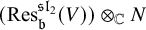 belongs to
$\mathcal {N}$
belongs to
$\mathcal {N}$
 . This module is, clearly, h-diagonalizable and it is finitely generated as N is finitely generated and V is finite dimensional. The fact that this module is
$U(e)$
. This module is, clearly, h-diagonalizable and it is finitely generated as N is finitely generated and V is finite dimensional. The fact that this module is
$U(e)$
 -free is proved similarly to the well-known statement that tensoring with finite-dimensional modules in category
$\mathcal {O}$
-free is proved similarly to the well-known statement that tensoring with finite-dimensional modules in category
$\mathcal {O}$
 preserves the category of modules with Verma flag.
For a fixed
$ \lambda \in \mathbb {C}$
 , denote by
$\mathcal {N}_5=\mathcal {N}_5(\lambda )$
, denote by
$\mathcal {N}_5=\mathcal {N}_5(\lambda )$
 the full additive subcategory of
$\mathcal {N}$
the full additive subcategory of
$\mathcal {N}$
 generated by all
$N(\mu )$
generated by all
$N(\mu )$
 , for
$\mu \in \lambda +\mathbb {Z}$
, for
$\mu \in \lambda +\mathbb {Z}$
 . Clearly,
$\mathcal {N}_5$
. Clearly,
$\mathcal {N}_5$
 inherits from
$\mathcal {N}$
inherits from
$\mathcal {N}$
 the structure of a
$\mathscr {C}$
the structure of a
$\mathscr {C}$
 -module category by restriction.
Remark 13. Note that, for any
$\lambda ,\lambda '\in \mathbb {C}$
 , the categories
$\mathcal {N}_5(\lambda )$
, the categories
$\mathcal {N}_5(\lambda )$
 and
$\mathcal {N}_5(\lambda ')$
and
$\mathcal {N}_5(\lambda ')$
 are equivalent as
$\mathscr {C}$
are equivalent as
$\mathscr {C}$
 -module categories. The equivalence from
$\mathcal {N}_5(\lambda )$
-module categories. The equivalence from
$\mathcal {N}_5(\lambda )$
 to
$\mathcal {N}_5(\lambda ')$
to
$\mathcal {N}_5(\lambda ')$
 is given by tensoring with
$Q(\lambda '-\lambda )$
is given by tensoring with
$Q(\lambda '-\lambda )$
 with the inverse given by tensoring with
$Q(\lambda -\lambda ')$
with the inverse given by tensoring with
$Q(\lambda -\lambda ')$
 . In particular, the group
$\mathbb {Z}$
. In particular, the group
$\mathbb {Z}$
 acts on
$\mathcal {N}_5(\lambda )$
acts on
$\mathcal {N}_5(\lambda )$
 by self-equivalences, where
$k\in \mathbb {Z}$
by self-equivalences, where
$k\in \mathbb {Z}$
 maps
$N(\lambda )$
maps
$N(\lambda )$
 to
$N(\lambda +k)$
to
$N(\lambda +k)$
 .
.
Proposition 14. The
$\mathscr {C}$
 -module category
$\mathcal {N}_5$
-module category
$\mathcal {N}_5$
 is simple transitive of type
$A_\infty ^\infty $
is simple transitive of type
$A_\infty ^\infty $
 .
.
Proof. It is easy to check that

from which it follows that
$\mathcal {N}_5$
 is a transitive
$\mathscr {C}$
is a transitive
$\mathscr {C}$
 -module category of type
$A_\infty ^\infty $
-module category of type
$A_\infty ^\infty $
 .
.
Any radical morphism in
$\mathcal {N}_5$
 is a linear combination of some morphisms of the form
$\psi (\mu ,k):=\big (N(\mu +2k)\hookrightarrow N(\mu )\big )$
is a linear combination of some morphisms of the form
$\psi (\mu ,k):=\big (N(\mu +2k)\hookrightarrow N(\mu )\big )$
 , for
$k\in \mathbb {Z}_{>0}$
, for
$k\in \mathbb {Z}_{>0}$
 . Let
$\{v_\nu \,:\, \nu \in \{\mu +2k,\mu +2k+2,\dots \}\}$
. Let
$\{v_\nu \,:\, \nu \in \{\mu +2k,\mu +2k+2,\dots \}\}$
 be the standard basis of
$N(\mu +2k)$
be the standard basis of
$N(\mu +2k)$
 . Let
$\{w_\nu \,:\, \nu \in \{\mu ,\mu +2,\dots \}\}$
. Let
$\{w_\nu \,:\, \nu \in \{\mu ,\mu +2,\dots \}\}$
 be the standard basis of
$N(\mu )$
be the standard basis of
$N(\mu )$
 . Let
$\{e_{-1},e_1\}$
. Let
$\{e_{-1},e_1\}$
 be the standard basis of
$L(1)$
be the standard basis of
$L(1)$
 .
.
Applying
$F_1$
 , we get an embedding of the module
$N(\mu +2k+1)\oplus N(\mu +2k-1)$
, we get an embedding of the module
$N(\mu +2k+1)\oplus N(\mu +2k-1)$
 into
$N(\mu +1)\oplus N(\mu -1)$
into
$N(\mu +1)\oplus N(\mu -1)$
 . The summand
$N(\mu +2k-1)$
. The summand
$N(\mu +2k-1)$
 is generated by
$e_{-1}\otimes v_{\mu +2k}$
is generated by
$e_{-1}\otimes v_{\mu +2k}$
 and
$F_1(\psi (\mu ,k))$
and
$F_1(\psi (\mu ,k))$
 maps the latter element to
$e_{-1}\otimes w_{\mu +2k}$
maps the latter element to
$e_{-1}\otimes w_{\mu +2k}$
 .
.
The summand
$N(\mu -1)$
 is generated by
$e_{-1}\otimes w_{\mu }$
is generated by
$e_{-1}\otimes w_{\mu }$
 . Applying
$e^k$
. Applying
$e^k$
 to the latter outputs the element

Therefore, projecting from
$N(\mu +1)\oplus N(\mu -1)$
 onto
$N(\mu +1)$
onto
$N(\mu +1)$
 maps
$e_{-1}\otimes w_{\mu +2k}$
maps
$e_{-1}\otimes w_{\mu +2k}$
 to a non-zero element of
$N(\mu +1)$
to a non-zero element of
$N(\mu +1)$
 . In other words, the ideal generated by
$F_1(\psi (\mu ,k))$
. In other words, the ideal generated by
$F_1(\psi (\mu ,k))$
 contains
$\psi (\mu +1,k-1)$
contains
$\psi (\mu +1,k-1)$
 . Proceeding inductively, we eventually get the identity morphism on
$N(\mu +k)$
. Proceeding inductively, we eventually get the identity morphism on
$N(\mu +k)$
 . This implies that the
$\mathscr {C}$
. This implies that the
$\mathscr {C}$
 -stable ideal generated by any non-zero morphism in
$\mathcal {N}_5$
-stable ideal generated by any non-zero morphism in
$\mathcal {N}_5$
 contains the identity morphism on some non-zero objects. This means that
$\mathcal {N}_5$
contains the identity morphism on some non-zero objects. This means that
$\mathcal {N}_5$
 is simple transitive and completes the proof.
It is easy to check that, for any
$i\in \mathbb {Z}_{\geq 0}$
 , the
$\mathfrak {b}$
, the
$\mathfrak {b}$
 -module
$F_i(Q(\lambda ))$
-module
$F_i(Q(\lambda ))$
 is isomorphic to the quotient
$N(\lambda -i)/N(\lambda +2+i)$
is isomorphic to the quotient
$N(\lambda -i)/N(\lambda +2+i)$
 , we denote the latter module by
$Q(\lambda ,i)$
, we denote the latter module by
$Q(\lambda ,i)$
 . If we consider the additive closure
$\mathcal {N}_6$
. If we consider the additive closure
$\mathcal {N}_6$
 of all
$Q(\lambda ,i)$
of all
$Q(\lambda ,i)$
 , for a fixed
$\lambda $
, for a fixed
$\lambda $
 and for all
$i\in \mathbb {Z}_{\geq 0}$
and for all
$i\in \mathbb {Z}_{\geq 0}$
 , then it has the natural structure of a
$\mathscr {C}$
, then it has the natural structure of a
$\mathscr {C}$
 -module category.
Proposition 15. The
$\mathscr {C}$
 -module category
$\mathcal {N}_6$
-module category
$\mathcal {N}_6$
 is simple transitive of type
$A_\infty $
is simple transitive of type
$A_\infty $
 .
.
Proof. It is straightforward to check that the
$\mathfrak {b}$
 -module
$F_1(Q(\lambda ,i))$
-module
$F_1(Q(\lambda ,i))$
 is isomorphic to
$Q(\lambda ,i-1)\oplus Q(\lambda ,i+1)$
is isomorphic to
$Q(\lambda ,i-1)\oplus Q(\lambda ,i+1)$
 , for
$i>0$
, for
$i>0$
 . This implies that
$\mathcal {N}_6$
. This implies that
$\mathcal {N}_6$
 is transitive of type
$A_\infty $
is transitive of type
$A_\infty $
 . Simplicity is equivalent to the semi-simplicity of the underlying category of
$\mathcal {N}_6$
. Simplicity is equivalent to the semi-simplicity of the underlying category of
$\mathcal {N}_6$
 , that is, the equality

Recall that
$Q(\lambda ,k)$
 is a uniserial module with top
$Q(\lambda -k)$
is a uniserial module with top
$Q(\lambda -k)$
 , socle
$Q(\lambda +k),$
, socle
$Q(\lambda +k),$
 and other composition subquotients
$Q(\lambda -k+2)$
and other composition subquotients
$Q(\lambda -k+2)$
 ,
$Q(\lambda -4)$
,
$Q(\lambda -4)$
 ,…,
$Q(\lambda +k-2)$
,…,
$Q(\lambda +k-2)$
 . In particular, since the top of
$Q(\lambda ,k)$
. In particular, since the top of
$Q(\lambda ,k)$
 has multiplicity one, any endomorphism of
$Q(\lambda ,k)$
has multiplicity one, any endomorphism of
$Q(\lambda ,k)$
 is scalar.
If
$i>j$
 , then
$[Q(\lambda ,j):Q(\lambda -i)]=0$
, then
$[Q(\lambda ,j):Q(\lambda -i)]=0$
 and hence there are no non-zero homomorphisms from
$Q(\lambda ,i)$
and hence there are no non-zero homomorphisms from
$Q(\lambda ,i)$
 to
$Q(\lambda ,j)$
to
$Q(\lambda ,j)$
 as the top of
$Q(\lambda ,i)$
as the top of
$Q(\lambda ,i)$
 has nowhere to go. If
$i<j$
has nowhere to go. If
$i<j$
 , then we have
$[Q(\lambda ,i):Q(\lambda +j)]=0$
, then we have
$[Q(\lambda ,i):Q(\lambda +j)]=0$
 and hence there are no non-zero homomorphisms from
$Q(\lambda ,i)$
and hence there are no non-zero homomorphisms from
$Q(\lambda ,i)$
 to
$Q(\lambda ,j)$
to
$Q(\lambda ,j)$
 as there is nothing to cover the socle of
$Q(\lambda ,j)$
as there is nothing to cover the socle of
$Q(\lambda ,j)$
 . This completes the proof.
We can alternatively construct
$\mathcal {N}_6$
 by first considering
$\overline {\mathcal {N}_5}$
by first considering
$\overline {\mathcal {N}_5}$
 , where
$Q(\lambda )$
, where
$Q(\lambda )$
 is a simple object and then taking the
$\mathscr {C}$
is a simple object and then taking the
$\mathscr {C}$
 -module subcategory of
$\overline {\mathcal {N}_5}$
-module subcategory of
$\overline {\mathcal {N}_5}$
 generated by this object
$Q(\lambda )$
generated by this object
$Q(\lambda )$
 .
.
The example of the categories
$\mathcal {N}_5$
 and
$\mathcal {N}_6$
and
$\mathcal {N}_6$
 shows a striking difference between the behavior of
$\mathscr {C}$
shows a striking difference between the behavior of
$\mathscr {C}$
 and that of finitary monoidal categories (more precisely, the fiat bi- and 2-categories in the sense of [Reference Mazorchuk and Miemietz28]). In the latter case, starting from a simple object of the abelianization of a simple transitive
$2$
and that of finitary monoidal categories (more precisely, the fiat bi- and 2-categories in the sense of [Reference Mazorchuk and Miemietz28]). In the latter case, starting from a simple object of the abelianization of a simple transitive
$2$
 -representation and applying certain elements of
$\mathscr {C}$
-representation and applying certain elements of
$\mathscr {C}$
 will output projective objects, see [Reference Mazorchuk and Miemietz29, Lemma 12] and, more generally, [Reference Kildetoft, Mackaay, Mazorchuk and Zimmermann20, Theorem 2]. In our case, none of the
$Q(\lambda ,i)$
will output projective objects, see [Reference Mazorchuk and Miemietz29, Lemma 12] and, more generally, [Reference Kildetoft, Mackaay, Mazorchuk and Zimmermann20, Theorem 2]. In our case, none of the
$Q(\lambda ,i)$
 is projective in
$\overline {\mathcal {N}_5}$
is projective in
$\overline {\mathcal {N}_5}$
 . The major contributor to this behavior is the failure of [Reference Kildetoft and Mazorchuk21, Proposition 18] in the non-finitary context.
The
$\mathscr {C}$
 -module category
$\mathcal {N}_6$
-module category
$\mathcal {N}_6$
 does not depend on
$\lambda $
does not depend on
$\lambda $
 , up to equivalence.
6. Realization of type
$C_\infty $

6.1. First realization
Consider the setup of Section 4.2. Let
$\mathfrak {g}=\mathfrak {sl}_2$
 with
$\varphi $
with
$\varphi $
 being the identity. Consider the BGG category
$\mathcal {O}$
being the identity. Consider the BGG category
$\mathcal {O}$
 for
$\mathfrak {g}$
for
$\mathfrak {g}$
 and the projective–injective modules
$P(\lambda )\in \mathcal {O}$
and the projective–injective modules
$P(\lambda )\in \mathcal {O}$
 , for
$\lambda \in \{-1,-2,\dots \}$
, for
$\lambda \in \{-1,-2,\dots \}$
 . Let
$\mathcal {K}_1$
. Let
$\mathcal {K}_1$
 be the additive closure of these modules. Then
$\mathcal {K}_1$
be the additive closure of these modules. Then
$\mathcal {K}_1$
 is exactly the category of integral projective–injective modules in
$\mathcal {O}$
is exactly the category of integral projective–injective modules in
$\mathcal {O}$
 . Consequently, it is closed with respect to tensoring with finite-dimensional
$\mathfrak {sl}_2$
. Consequently, it is closed with respect to tensoring with finite-dimensional
$\mathfrak {sl}_2$
 -modules and hence is a
$\mathscr {C}$
-modules and hence is a
$\mathscr {C}$
 -module category.
From Formula (2), we have

6.2. Second realization
Let
$\mathfrak {g}=\mathfrak {sl}_2$
 with
$\varphi $
with
$\varphi $
 being the identity. For a fixed non-zero
$\xi \in \mathbb {C}$
being the identity. For a fixed non-zero
$\xi \in \mathbb {C}$
 , let
$M(\xi )$
, let
$M(\xi )$
 be the
$\mathfrak {g}$
be the
$\mathfrak {g}$
 -module defined as the quotient of
$U(\mathfrak {g})$
-module defined as the quotient of
$U(\mathfrak {g})$
 by the left ideal generated by
$\mathtt {c}$
by the left ideal generated by
$\mathtt {c}$
 and
$e-\xi $
and
$e-\xi $
 . Then, the module
$M(\xi )$
. Then, the module
$M(\xi )$
 is a simple
$\mathfrak {g}$
is a simple
$\mathfrak {g}$
 -module that appeared first in [Reference Arnal and Pinczon2]. The module
$M(\xi )$
-module that appeared first in [Reference Arnal and Pinczon2]. The module
$M(\xi )$
 is a Whittaker module in the sense of [Reference Kostant23].
Set
$X_{-1}:=M(\xi )$
 and, for
$i\in \{1,2,\dots \}$
and, for
$i\in \{1,2,\dots \}$
 , define
$X_{-1-i}$
, define
$X_{-1-i}$
 as the kernel of the central element
$(\mathtt {c}+i^2)^2$
as the kernel of the central element
$(\mathtt {c}+i^2)^2$
 acting on
$L(i)\otimes _{\mathbb {C}}M(\xi )$
acting on
$L(i)\otimes _{\mathbb {C}}M(\xi )$
 . Then, by [Reference Miličić and Soergel34, Theorem 5.1] (see also [Reference Mazorchuk and Stroppel32, Theorem 67] and [Reference Mackaay, Mazorchuk and Miemietz24, Corollary 20]) all these
$X_{-1-i}$
. Then, by [Reference Miličić and Soergel34, Theorem 5.1] (see also [Reference Mazorchuk and Stroppel32, Theorem 67] and [Reference Mackaay, Mazorchuk and Miemietz24, Corollary 20]) all these
$X_{-1-i}$
 are indecomposable (in fact, have length
$2$
are indecomposable (in fact, have length
$2$
 with isomorphic subquotients) and the additive closure
$\mathcal {K}_2=\mathcal {K}_2(\xi )$
with isomorphic subquotients) and the additive closure
$\mathcal {K}_2=\mathcal {K}_2(\xi )$
 of all
$X_j$
of all
$X_j$
 , with
$j\in \{-1,-2,\dots \}$
, with
$j\in \{-1,-2,\dots \}$
 , is closed under tensoring with finite-dimensional
$\mathfrak {sl}_2$
, is closed under tensoring with finite-dimensional
$\mathfrak {sl}_2$
 -modules.
6.3. Statements
We can now summarize the content of this section in the following proposition.
Proposition 16. Both
$\mathcal {K}_1$
 and
$\mathcal {K}_2$
and
$\mathcal {K}_2$
 are simple transitive
$\mathscr {C}$
are simple transitive
$\mathscr {C}$
 -module categories of type
$C_\infty $
-module categories of type
$C_\infty $
 .
.
Proof. That
$\mathcal {K}_1$
 has type
$C_\infty $
has type
$C_\infty $
 , follows from Formula (4). If
$\mathcal {K}_1$
, follows from Formula (4). If
$\mathcal {K}_1$
 is not simple transitive, then there exists a non-trivial endomorphism
$\psi $
is not simple transitive, then there exists a non-trivial endomorphism
$\psi $
 of some
$P(\lambda )$
of some
$P(\lambda )$
 , for
$\lambda \in \{-2,-3,\dots \}$
, for
$\lambda \in \{-2,-3,\dots \}$
 , such that the
$\mathscr {C}$
, such that the
$\mathscr {C}$
 -stable ideal
$\mathcal {I}$
-stable ideal
$\mathcal {I}$
 generated by
$\psi $
generated by
$\psi $
 does not contain any identity morphism of a non-zero object in
$\mathcal {K}_1$
does not contain any identity morphism of a non-zero object in
$\mathcal {K}_1$
 .
.
If
$\lambda =-2$
 , then, tensoring with
$L(1)$
, then, tensoring with
$L(1)$
 and taking the kernel of
$\mathtt {c}$
and taking the kernel of
$\mathtt {c}$
 gives a nilpotent, but non-zero endomorphism of
$L(-1)\oplus L(-1)$
gives a nilpotent, but non-zero endomorphism of
$L(-1)\oplus L(-1)$
 . As
$\mathrm {add}(L(-1))$
. As
$\mathrm {add}(L(-1))$
 is semi-simple, it follows that
$\mathcal {I}$
is semi-simple, it follows that
$\mathcal {I}$
 contains the identity on
$L(-1)$
contains the identity on
$L(-1)$
 , a contradiction.
If
$\lambda <-2$
 , then, tensoring with
$L(1)$
, then, tensoring with
$L(1)$
 and taking the kernel of
$(\mathtt {c}-(\lambda +2)^2)^2$
and taking the kernel of
$(\mathtt {c}-(\lambda +2)^2)^2$
 maps
$\psi $
maps
$\psi $
 to a non-zero endomorphism of
$P(\lambda +1)$
to a non-zero endomorphism of
$P(\lambda +1)$
 which must thus belong to
$\mathcal {I}$
which must thus belong to
$\mathcal {I}$
 . Proceeding inductively, we will eventually come to the situation described in the previous paragraph. This proves that
$\mathcal {K}_1$
. Proceeding inductively, we will eventually come to the situation described in the previous paragraph. This proves that
$\mathcal {K}_1$
 is simple transitive.
For
$\mathcal {K}_2$
 , the claim follows from the claim for
$\mathcal {K}_1$
, the claim follows from the claim for
$\mathcal {K}_1$
 and the equivalence given by [Reference Miličić and Soergel34, Theorem 5.1].
Remark 17. The category
$\mathcal {K}_1$
 is not semi-simple as the endomorphism algebras of the projective modules
$P(\lambda )$
is not semi-simple as the endomorphism algebras of the projective modules
$P(\lambda )$
 are non-trivial, if
$\lambda \in \{-2,-3,\dots \}$
are non-trivial, if
$\lambda \in \{-2,-3,\dots \}$
 (in fact, all these endomorphism algebras are isomorphic to the dual numbers). This gives another example of a non-semi-simple simple transitive module category over a semi-simple rigid monoidal category.
In fact, semi-simple simple transitive
$\mathscr {C}$
 -module categories of type
$C_\infty $
-module categories of type
$C_\infty $
 (or
$B_\infty $
(or
$B_\infty $
 ) do not exist. Indeed, in each such category simple and projective objects coincide and hence, by [Reference Agerholm and Mazorchuk1, Lemma 8], the matrix
$[F_1]$
) do not exist. Indeed, in each such category simple and projective objects coincide and hence, by [Reference Agerholm and Mazorchuk1, Lemma 8], the matrix
$[F_1]$
 should be symmetric. In type
$B_\infty $
should be symmetric. In type
$B_\infty $
 , we will have a stronger negative result in Proposition 23.
Proposition 18. All categories
$\mathcal {K}_1$
 and
$\mathcal {K}_2(\xi )$
and
$\mathcal {K}_2(\xi )$
 , for
$\xi \neq 0$
, for
$\xi \neq 0$
 , are equivalent as
$\mathscr {C}$
, are equivalent as
$\mathscr {C}$
 -module categories.
Proof. That
$\mathcal {K}_1$
 is equivalent, as a
$\mathscr {C}$
is equivalent, as a
$\mathscr {C}$
 -module category, to
$\mathcal {K}_2(\xi )$
-module category, to
$\mathcal {K}_2(\xi )$
 , for any
$\xi \neq 0$
, for any
$\xi \neq 0$
 , follows from [Reference Miličić and Soergel34, Theorem 5.1].
Here is a more elementary argument that all
$\mathcal {K}_2(\xi )$
 are equivalent. For
$c\in \mathbb {C}^*$
are equivalent. For
$c\in \mathbb {C}^*$
 , we have an automorphism
$\varphi _c$
, we have an automorphism
$\varphi _c$
 of
$\mathfrak {sl}_2$
of
$\mathfrak {sl}_2$
 which keeps h, sends e to
$ce,$
which keeps h, sends e to
$ce,$
 and also sends f to
$\frac {1}{c}f$
and also sends f to
$\frac {1}{c}f$
 . Directly from the definitions, we see that twisting
$M(\xi )$
. Directly from the definitions, we see that twisting
$M(\xi )$
 by this automorphism outputs
$M(c\xi )$
by this automorphism outputs
$M(c\xi )$
 (or
$M(c^{-1}\xi )$
(or
$M(c^{-1}\xi )$
 , depending on the twisting conventions). Since such twisting preserves
$\mathscr {C}$
, depending on the twisting conventions). Since such twisting preserves
$\mathscr {C}$
 , it gives rise to an equivalence between
$\mathcal {K}_2(\xi )$
, it gives rise to an equivalence between
$\mathcal {K}_2(\xi )$
 and
$\mathcal {K}_2(c\xi )$
and
$\mathcal {K}_2(c\xi )$
 .
.
Using the ideas of [Reference Miličić and Soergel34, Theorem 5.1] and, more generally, the results in [Reference Mazorchuk and Stroppel32, Theorem 67] and [Reference Mackaay, Mazorchuk and Miemietz24, Corollary 20], we can generalize the example of the
$\mathscr {C}$
 -module category
$\mathcal {K}_2$
-module category
$\mathcal {K}_2$
 by taking as M any simple
$\mathfrak {g}$
by taking as M any simple
$\mathfrak {g}$
 -module which satisfies the condition
$\mathtt {c}M=0$
-module which satisfies the condition
$\mathtt {c}M=0$
 .
.
7. Realization of type
$D_\infty $

7.1. The realization
Consider the semi-direct product
$\mathfrak {g}=\mathfrak {sl}_2\ltimes L(4)$
 , where
$L(4)$
, where
$L(4)$
 is an abelian ideal and let
$\varphi :\mathfrak {g}\twoheadrightarrow \mathfrak {sl}_2$
is an abelian ideal and let
$\varphi :\mathfrak {g}\twoheadrightarrow \mathfrak {sl}_2$
 be the natural projection (see [Reference Mazorchuk and Mrđen31]). Let
$\{v_i\,:\,i\in \{0,\pm 2,\pm 4\}\}$
be the natural projection (see [Reference Mazorchuk and Mrđen31]). Let
$\{v_i\,:\,i\in \{0,\pm 2,\pm 4\}\}$
 be the standard basis of
$L(4)$
be the standard basis of
$L(4)$
 , that is, we have
$h\cdot v_i=iv_i$
, that is, we have
$h\cdot v_i=iv_i$
 , then
$e\cdot v_4=0$
, then
$e\cdot v_4=0$
 and
$e\cdot v_{4-2i}=(5-i)v_{6-2i}$
and
$e\cdot v_{4-2i}=(5-i)v_{6-2i}$
 , for
$i=1,2,3,4$
, for
$i=1,2,3,4$
 . The elements

are central in
$U(\mathfrak {g})$
 . In [Reference Mazorchuk and Mrđen30, Theorem 68], see also [Reference Mazorchuk and Mrđen31, Theorem 12], for every
$\mu \in \mathbb {C}^*$
. In [Reference Mazorchuk and Mrđen30, Theorem 68], see also [Reference Mazorchuk and Mrđen31, Theorem 12], for every
$\mu \in \mathbb {C}^*$
 , one can find a construction of simple
$\mathfrak {g}$
, one can find a construction of simple
$\mathfrak {g}$
 -modules
$V'(0,\mu )$
-modules
$V'(0,\mu )$
 ,
$V'(2,\mu ),$
,
$V'(2,\mu ),$
 and
$V(n,\mu )$
and
$V(n,\mu )$
 , for
$n\in \mathbb {Z}_{\geq 1}$
, for
$n\in \mathbb {Z}_{\geq 1}$
 , such that
-
• $C_2$
and
$C_3$
act on each such module as
$\mu ^2$
and
$\mu ^3$
, respectively; -
• the restriction of each of these modules to $\mathfrak {sl}_2$
is a direct sum of simple finite-dimensional modules with finite multiplicities.


By [Reference Mazorchuk and Mrđen31, Lemma 14], see also [Reference Mazorchuk and Mrđen30, Remark 75], we have

This means that, with respect to the basis given by the order

we have

We denote by
$\mathcal {Y}'$
 the additive closure of all these
$V'(0,\mu )$
the additive closure of all these
$V'(0,\mu )$
 ,
$V'(2,\mu )$
,
$V'(2,\mu )$
 ,
$V(1,\mu )$
,
$V(1,\mu )$
 ,
$V(2,\mu )$
,
$V(2,\mu )$
 ,
$V(3,\mu ),\dots $
,
$V(3,\mu ),\dots $
 .
.
7.2. Statement
We have the following proposition.
Proposition 19. The category
$\mathcal {Y}'$
 is a simple transitive
$\mathscr {C}$
is a simple transitive
$\mathscr {C}$
 -module category of type
$D_\infty $
-module category of type
$D_\infty $
 .
.
Proof. Simple transitivity follows by combining transitivity of the action of
$\mathscr {C}$
 with the semi-simplicity of the underlying category. The identification of the type follows from Formula (5).
7.3. Additional properties
Proposition 20. Let
$\mathcal {Y}$
 be an admissible simple transitive
$\mathscr {C}$
be an admissible simple transitive
$\mathscr {C}$
 -module category of type
$D_\infty $
-module category of type
$D_\infty $
 . Then
$\mathcal {Y}$
. Then
$\mathcal {Y}$
 is a semi-simple category.
Proof. We need to prove that the radical of
$\mathcal {Y}$
 is
$\mathscr {C}$
is
$\mathscr {C}$
 -invariant. Consider the abelianization
$\overline {\mathcal {Y}}$
-invariant. Consider the abelianization
$\overline {\mathcal {Y}}$
 . Let
$Y_0,Y_1,\dots $
. Let
$Y_0,Y_1,\dots $
 be the list of indecomposables in
$\mathcal {Y}$
be the list of indecomposables in
$\mathcal {Y}$
 such that
$[F_1]$
such that
$[F_1]$
 is given by (5) in the corresponding basis of the Grothendieck group. These are the indecomposable projectives in
$\overline {\mathcal {Y}}$
is given by (5) in the corresponding basis of the Grothendieck group. These are the indecomposable projectives in
$\overline {\mathcal {Y}}$
 . Let
$S_0,S_1,\dots $
. Let
$S_0,S_1,\dots $
 be the corresponding simples in
$\overline {\mathcal {Y}}$
be the corresponding simples in
$\overline {\mathcal {Y}}$
 . Note that (5) is a symmetric matrix and therefore the matrix of the action of each
$F_i$
. Note that (5) is a symmetric matrix and therefore the matrix of the action of each
$F_i$
 in the basis of projectives coincides with the matrix of the action of this
$F_i$
in the basis of projectives coincides with the matrix of the action of this
$F_i$
 in the basis of simples.
We thus have
$F_1(S_0)\cong F_1(S_1)\cong S_2$
 . The module
$F_1(S_2)$
. The module
$F_1(S_2)$
 has length three with simple subquotients
$S_0$
has length three with simple subquotients
$S_0$
 ,
$S_1$
,
$S_1$
 , and
$S_3$
, and
$S_3$
 , all appearing with multiplicity one. For
$i\in \{0,1\}$
, all appearing with multiplicity one. For
$i\in \{0,1\}$
 , by adjunction, we have

and

Thus,
$S_i$
 appears both in the socle and in the top of
$F_1(S_2)$
appears both in the socle and in the top of
$F_1(S_2)$
 , which implies that
$F_1(S_2)\cong S_0\oplus S_1\oplus S_3$
, which implies that
$F_1(S_2)\cong S_0\oplus S_1\oplus S_3$
 .
.
Next, we see that
$F_1(S_3)$
 has length two with simple subquotients
$S_2$
has length two with simple subquotients
$S_2$
 and
$S_4$
and
$S_4$
 , both appearing with multiplicity one. By adjunction, we have

and

Therefore,
$S_2$
 appears both in the socle and in the top of
$F_1(S_3)$
appears both in the socle and in the top of
$F_1(S_3)$
 implying that we have
$F_1(S_3)\cong S_2\oplus S_4$
implying that we have
$F_1(S_3)\cong S_2\oplus S_4$
 .
.
Proceeding inductively, we obtain that
$F_1(S_i)\cong S_{i-1}\oplus S_{i+1}$
 , for all
$i\geq 3$
, for all
$i\geq 3$
 . Let
$\tilde {\mathcal {Y}}$
. Let
$\tilde {\mathcal {Y}}$
 be the additive closure of all
$S_i$
be the additive closure of all
$S_i$
 , where
$i\geq 0$
, where
$i\geq 0$
 . We have just shown that
$\tilde {\mathcal {Y}}$
. We have just shown that
$\tilde {\mathcal {Y}}$
 is invariant under the action of
$F_1$
is invariant under the action of
$F_1$
 . Since
$F_1$
. Since
$F_1$
 generates
$\mathscr {C}$
generates
$\mathscr {C}$
 , it follows that
$\tilde {\mathcal {Y}}$
, it follows that
$\tilde {\mathcal {Y}}$
 is
$\mathscr {C}$
is
$\mathscr {C}$
 -invariant. In other words,
$\tilde {\mathcal {Y}}$
-invariant. In other words,
$\tilde {\mathcal {Y}}$
 is a simple transitive
$\mathscr {C}$
is a simple transitive
$\mathscr {C}$
 -module category of type
$D_\infty $
-module category of type
$D_\infty $
 .
.
The rest is similar to the proof of Proposition 7. We need to show that the radical of
$\mathcal {Y}$
 is
$F_1$
is
$F_1$
 -invariant. Let
$\varphi :Y_i\to Y_i$
-invariant. Let
$\varphi :Y_i\to Y_i$
 be a radical morphism, for some i. Then
$\varphi $
be a radical morphism, for some i. Then
$\varphi $
 is nilpotent since
$\mathrm {End}_{\mathcal {Y}}(Y_i)$
is nilpotent since
$\mathrm {End}_{\mathcal {Y}}(Y_i)$
 is finite dimensional. Hence,
$F_1(\varphi )$
is finite dimensional. Hence,
$F_1(\varphi )$
 is also nilpotent. Since
$F_1(Y_i)$
is also nilpotent. Since
$F_1(Y_i)$
 does not have isomorphic summands, it follows that
$F_1(\varphi )$
does not have isomorphic summands, it follows that
$F_1(\varphi )$
 is a radical morphism.
Let
$\varphi :Y_i\to Y_j$
 be a non-zero morphism, for
$i\neq j$
be a non-zero morphism, for
$i\neq j$
 (hence
$\varphi $
(hence
$\varphi $
 is automatically radical). Then
$\varphi (Y_i)$
is automatically radical). Then
$\varphi (Y_i)$
 belongs to the radical of
$Y_j$
belongs to the radical of
$Y_j$
 . Applying the exact functor
$F_1$
. Applying the exact functor
$F_1$
 to the short exact sequence

we get a short exact sequence

in which
$F_1(S_j)$
 is isomorphic to the top of
$F_1(Y_j)$
is isomorphic to the top of
$F_1(Y_j)$
 by the above. Therefore, we have

As
$\varphi (Y_i)\subset \mathrm {Rad}(Y_{j})$
 and
$F_1$
and
$F_1$
 is exact, we obtain that
$F_1(\varphi (Y_i))$
is exact, we obtain that
$F_1(\varphi (Y_i))$
 is a submodule of
$\mathrm {Rad}(F_1(Y_j))$
is a submodule of
$\mathrm {Rad}(F_1(Y_j))$
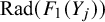 , which means that
$F_1(\varphi )$
, which means that
$F_1(\varphi )$
 is a radical morphism. As the radical of
$\mathcal {Y}$
is a radical morphism. As the radical of
$\mathcal {Y}$
 is generated by radical morphisms between indecomposable objects, it follows that the radical of
$\mathcal {Y}$
is generated by radical morphisms between indecomposable objects, it follows that the radical of
$\mathcal {Y}$
 is
$\mathscr {C}$
is
$\mathscr {C}$
 -stable and completes the proof.
8. Realization of type
$T_\infty $

8.1. First realization
Let
$\mathfrak {g}=\mathfrak {sl}_2$
 with
$\varphi $
with
$\varphi $
 being the identity. For a fixed non-zero
$\xi \in \mathbb {C}^*$
being the identity. For a fixed non-zero
$\xi \in \mathbb {C}^*$
 and
$\lambda \in \mathbb {Z}+\frac {1}{2}$
and
$\lambda \in \mathbb {Z}+\frac {1}{2}$
 , let
$M(\lambda ,\xi )$
, let
$M(\lambda ,\xi )$
 be the
$\mathfrak {g}$
be the
$\mathfrak {g}$
 -module defined as the quotient of
$U(\mathfrak {g})$
-module defined as the quotient of
$U(\mathfrak {g})$
 by the left ideal generated by
$\mathtt {c}-(\lambda +1)^2$
by the left ideal generated by
$\mathtt {c}-(\lambda +1)^2$
 and
$e-\xi $
and
$e-\xi $
 . Then, the module
$M(\lambda ,\xi )$
. Then, the module
$M(\lambda ,\xi )$
 is a simple Whittaker
$\mathfrak {g}$
is a simple Whittaker
$\mathfrak {g}$
 -module (see [Reference Arnal and Pinczon2], [Reference Kostant23]). Note that
$M(\lambda ,\xi )\cong M(-\lambda -2,\xi )$
-module (see [Reference Arnal and Pinczon2], [Reference Kostant23]). Note that
$M(\lambda ,\xi )\cong M(-\lambda -2,\xi )$
 due to our choice of
$\lambda $
due to our choice of
$\lambda $
 .
.
As
$\lambda $
 is not an integer, the functor
$L(1)\otimes _{\mathbb {C}}{}_-$
is not an integer, the functor
$L(1)\otimes _{\mathbb {C}}{}_-$
 goes from
$\mathcal {Z}_{(\lambda +1)^2}$
goes from
$\mathcal {Z}_{(\lambda +1)^2}$
 to
$\mathcal {Z}_{\lambda ^2}\oplus \mathcal {Z}_{(\lambda +2)^2}$
to
$\mathcal {Z}_{\lambda ^2}\oplus \mathcal {Z}_{(\lambda +2)^2}$
 and is isomorphic to the direct sum of
$\theta _{\lambda ,\lambda -1}$
and is isomorphic to the direct sum of
$\theta _{\lambda ,\lambda -1}$
 and
$\theta _{\lambda ,\lambda +1}$
and
$\theta _{\lambda ,\lambda +1}$
 . It follows that
$L(1)\otimes _{\mathbb {C}}M(\lambda ,\xi )$
. It follows that
$L(1)\otimes _{\mathbb {C}}M(\lambda ,\xi )$
 is a direct sum of
$M(\lambda -1,\xi )$
is a direct sum of
$M(\lambda -1,\xi )$
 and
$M(\lambda +1,\xi )$
and
$M(\lambda +1,\xi )$
 . Denote by
$\mathcal {X}_1$
. Denote by
$\mathcal {X}_1$
 the additive closure of all
$M(\lambda +i,\xi )$
the additive closure of all
$M(\lambda +i,\xi )$
 , for
$i\in \mathbb {Z}$
, for
$i\in \mathbb {Z}$
 . This coincides with the additive closure of all
$M(-\frac {3}{2}-i,\xi )$
. This coincides with the additive closure of all
$M(-\frac {3}{2}-i,\xi )$
 , for
$i\in \mathbb {Z}_{\geq 0}$
, for
$i\in \mathbb {Z}_{\geq 0}$
 , the latter now being pair-wise non-isomorphic.
If
$\lambda =-\frac {3}{2}$
 , then
$M(\lambda +1,\xi )\cong M(\lambda ,\xi )$
, then
$M(\lambda +1,\xi )\cong M(\lambda ,\xi )$
 . If
$\lambda =-\frac {1}{2}$
. If
$\lambda =-\frac {1}{2}$
 , then
$M(\lambda -1,\xi )\cong M(\lambda ,\xi )$
, then
$M(\lambda -1,\xi )\cong M(\lambda ,\xi )$
 . Therefore, we have

8.2. Second realization
Let
$\mathfrak {g}$
 be the Schrödinger Lie algebra as in Section 5.2 (see [Reference Dubsky, Lü, Mazorchuk and Zhao9]), and
$\varphi :\mathfrak {g}\to \mathfrak {sl}_2$
be the Schrödinger Lie algebra as in Section 5.2 (see [Reference Dubsky, Lü, Mazorchuk and Zhao9]), and
$\varphi :\mathfrak {g}\to \mathfrak {sl}_2$
 be the natural projection. Then, for each
$\theta \in \mathbb {C}^*$
be the natural projection. Then, for each
$\theta \in \mathbb {C}^*$
 , [Reference Mazorchuk and Mrđen30, Theorem 54] describes a family of simple
$\mathfrak {g}$
, [Reference Mazorchuk and Mrđen30, Theorem 54] describes a family of simple
$\mathfrak {g}$
 -modules
$V(n,\theta )$
-modules
$V(n,\theta )$
 , where
$n\in \mathbb {Z}$
, where
$n\in \mathbb {Z}$
 , such that
-
• z acts on $V(n,\theta )$
as
$\chi $
; -
• when restricted to $\mathfrak {sl}_2$
, the module
$V(n,\lambda )$
is a direct sum of
$L(|n|)$
,
$L(|n|+1),$
and so on; -
• $V(n,\theta )=V(n',\theta ')$
if and only if
$(n',\theta ')=(n,\theta )$
or
$(n',\theta ')=(-n,\theta )$
.





By [Reference Mazorchuk and Mrđen30, Proposition 53], we have

For a fixed
$\theta \in \mathbb {C}^*$
 , denote by
$\mathcal {X}_2$
, denote by
$\mathcal {X}_2$
 the additive closure of all
$V(n,\theta )$
the additive closure of all
$V(n,\theta )$
 , for
$n\in \mathbb {Z}$
, for
$n\in \mathbb {Z}$
 . By the above,
$\mathcal {X}_2$
. By the above,
$\mathcal {X}_2$
 is semi-simple and has a natural structure of a
$\mathscr {C}$
is semi-simple and has a natural structure of a
$\mathscr {C}$
 -module category in which
$[L(1)]$
-module category in which
$[L(1)]$
 is given by (6).
8.3. Statement
We can now summarize the content of this section in the following proposition.
Proposition 21. The categories
$\mathcal {X}_1$
 and
$\mathcal {X}_2$
and
$\mathcal {X}_2$
 are simple transitive
$\mathscr {C}$
are simple transitive
$\mathscr {C}$
 -module categories of type
$T_\infty $
-module categories of type
$T_\infty $
 .
.
Proof. Simple transitivity follows by combining transitivity of the action of
$\mathscr {C}$
 with the semi-simplicity of the underlying categories. The identification of the type follows from Formula (6).
8.4. Additional properties
Proposition 22. Let
$\mathcal {X}$
 be an admissible simple transitive
$\mathscr {C}$
be an admissible simple transitive
$\mathscr {C}$
 -module category of type
$T_\infty $
-module category of type
$T_\infty $
 . Then
$\mathcal {X}$
. Then
$\mathcal {X}$
 is a semi-simple category.
Proof. We need to prove that the radical of
$\mathcal {X}$
 is
$\mathscr {C}$
is
$\mathscr {C}$
 -invariant. Consider the abelianization
$\overline {\mathcal {X}}$
-invariant. Consider the abelianization
$\overline {\mathcal {X}}$
 . Let
$X_0,X_1,\dots $
. Let
$X_0,X_1,\dots $
 be the list of indecomposables in
$\mathcal {X}$
be the list of indecomposables in
$\mathcal {X}$
 such that
$[F_1]$
such that
$[F_1]$
 is given by (6) in the corresponding basis of the Grothendieck group. These are the indecomposable projectives in
$\overline {\mathcal {X}}$
is given by (6) in the corresponding basis of the Grothendieck group. These are the indecomposable projectives in
$\overline {\mathcal {X}}$
 . Let
$S_0,S_1,\dots $
. Let
$S_0,S_1,\dots $
 be the corresponding simples in
$\overline {\mathcal {X}}$
be the corresponding simples in
$\overline {\mathcal {X}}$
 . Note that (6) is a symmetric matrix and therefore the matrix of the action of each
$F_i$
. Note that (6) is a symmetric matrix and therefore the matrix of the action of each
$F_i$
 in the basis of projectives coincides with the matrix of the action of this
$F_i$
in the basis of projectives coincides with the matrix of the action of this
$F_i$
 in the basis of simples.
In particular,
$F_1(S_0)$
 has length two with simple subquotients
$S_0$
has length two with simple subquotients
$S_0$
 and
$S_1$
and
$S_1$
 , both appearing with multiplicity one. Then
$S_0$
, both appearing with multiplicity one. Then
$S_0$
 must appear either in the top or in the socle of
$F_1(S_0)$
must appear either in the top or in the socle of
$F_1(S_0)$
 . However, by adjunction, we have

and thus
$S_0$
 appears both in the socle and in the top, which implies that
$F_1(S_0)\cong S_0\oplus S_1$
appears both in the socle and in the top, which implies that
$F_1(S_0)\cong S_0\oplus S_1$
 .
.
Next, we see that
$F_1(S_1)$
 has length two with simple subquotients
$S_0$
has length two with simple subquotients
$S_0$
 and
$S_2$
and
$S_2$
 , both appearing with multiplicity one. By adjunction, we have

and

Therefore,
$S_0$
 appears both in the socle and in the top of
$F_1(S_1)$
appears both in the socle and in the top of
$F_1(S_1)$
 implying that we have
$F_1(S_1)\cong S_0\oplus S_2$
implying that we have
$F_1(S_1)\cong S_0\oplus S_2$
 .
.
Proceeding inductively, we obtain that
$F_1(S_i)\cong S_{i-1}\oplus S_{i+1}$
 , for all
$i\geq 1$
, for all
$i\geq 1$
 . Let
$\tilde {\mathcal {X}}$
. Let
$\tilde {\mathcal {X}}$
 be the additive closure of all
$S_i$
be the additive closure of all
$S_i$
 , where
$i\geq 0$
, where
$i\geq 0$
 . We have just shown that
$\tilde {\mathcal {X}}$
. We have just shown that
$\tilde {\mathcal {X}}$
 is invariant under the action of
$F_1$
is invariant under the action of
$F_1$
 . Since
$F_1$
. Since
$F_1$
 generates
$\mathscr {C}$
generates
$\mathscr {C}$
 , it follows that
$\tilde {\mathcal {X}}$
, it follows that
$\tilde {\mathcal {X}}$
 is
$\mathscr {C}$
is
$\mathscr {C}$
 -invariant. In other words,
$\tilde {\mathcal {X}}$
-invariant. In other words,
$\tilde {\mathcal {X}}$
 is a simple transitive
$\mathscr {C}$
is a simple transitive
$\mathscr {C}$
 -module category of type
$T_\infty $
-module category of type
$T_\infty $
 .
.
The rest is similar to the proof of Proposition 7. We need to show that the radical of
$\mathcal {X}$
 is
$F_1$
is
$F_1$
 -invariant. Let
$\varphi :X_i\to X_i$
-invariant. Let
$\varphi :X_i\to X_i$
 be a radical morphism, for some i. Then
$\varphi $
be a radical morphism, for some i. Then
$\varphi $
 is nilpotent since
$\mathrm {End}_{\mathcal {X}}(X_i)$
is nilpotent since
$\mathrm {End}_{\mathcal {X}}(X_i)$
 is finite dimensional. Hence,
$F_1(\varphi )$
is finite dimensional. Hence,
$F_1(\varphi )$
 is also nilpotent. Since
$F_1(X_i)$
is also nilpotent. Since
$F_1(X_i)$
 does not have isomorphic summands, it follows that
$F_1(\varphi )$
does not have isomorphic summands, it follows that
$F_1(\varphi )$
 is a radical morphism.
Let
$\varphi :X_i\to X_j$
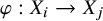 be a non-zero morphism, for
$i\neq j$
be a non-zero morphism, for
$i\neq j$
 . Then
$\varphi (X_i)$
. Then
$\varphi (X_i)$
 belongs to the radical of
$X_j$
belongs to the radical of
$X_j$
 . Applying the exact functor
$F_1$
. Applying the exact functor
$F_1$
 to the short exact sequence

we get a short exact sequence

in which
$F_1(S_j)$
 is isomorphic to the top of
$F_1(X_j)$
is isomorphic to the top of
$F_1(X_j)$
 by the above. Therefore, we have

As
$\varphi (X_i)\subset \mathrm {Rad}(X_{j})$
 and
$F_1$
and
$F_1$
 is exact, we obtain that
$F_1(\varphi (X_i))$
is exact, we obtain that
$F_1(\varphi (X_i))$
 is a submodule of
$\mathrm {Rad}(F_1(X_j))$
is a submodule of
$\mathrm {Rad}(F_1(X_j))$
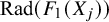 , which means that
$F_1(\varphi )$
, which means that
$F_1(\varphi )$
 is a radical morphism. As the radical of
$\mathcal {X}$
is a radical morphism. As the radical of
$\mathcal {X}$
 is generated by radical morphisms between indecomposable objects, it follows that the radical of
$\mathcal {X}$
is generated by radical morphisms between indecomposable objects, it follows that the radical of
$\mathcal {X}$
 is
$\mathscr {C}$
is
$\mathscr {C}$
 -stable and completes the proof.
9. Good and bad news on realizations of type
$B_\infty $

9.1. A realizations dual to
$C_\infty $

The easiest way to find a
$B_\infty $
 -combinatorics is, of course, by taking the dual of a
$C_\infty $
-combinatorics is, of course, by taking the dual of a
$C_\infty $
 -combinatorics. Let us do this with the example from Section 6.1.
Let
$\mathfrak {g}=\mathfrak {sl}_2$
 with
$\varphi $
with
$\varphi $
 being the identity. Consider the BGG category
$\mathcal {O}$
being the identity. Consider the BGG category
$\mathcal {O}$
 for
$\mathfrak {g}$
for
$\mathfrak {g}$
 and the projective–injective modules
$P(\lambda )\in \mathcal {O}$
and the projective–injective modules
$P(\lambda )\in \mathcal {O}$
 , for
$\lambda \in \{-1,-2,\dots \}$
, for
$\lambda \in \{-1,-2,\dots \}$
 . Let
$\mathcal {K}_1$
. Let
$\mathcal {K}_1$
 be the additive closure of these modules. Then
$\mathcal {K}_1$
be the additive closure of these modules. Then
$\mathcal {K}_1$
 is a simple transitive
$\mathscr {C}$
is a simple transitive
$\mathscr {C}$
 -module category of type
$C_\infty $
-module category of type
$C_\infty $
 (see §6.1 and Proposition 16).
Consider the projective abelianization
$\overline {\mathcal {K}_1}$
 of
$\mathcal {K}_1$
of
$\mathcal {K}_1$
 (see §2.7).
Each indecomposable projective object
$P(\lambda )$
 of
$\overline {\mathcal {K}_1}$
of
$\overline {\mathcal {K}_1}$
 has unique simple top, which we denote by
$L(\lambda )$
has unique simple top, which we denote by
$L(\lambda )$
 . It can be identified with the simple highest weight
$\mathfrak {sl}_2$
. It can be identified with the simple highest weight
$\mathfrak {sl}_2$
 -module with highest weight
$\lambda $
-module with highest weight
$\lambda $
 . Note that here
$\lambda $
. Note that here
$\lambda $
 is a negative integer. Recall that

Now, note that each element of
$\mathscr {C}$
 acts as an exact endofunctor of
$\overline {\mathcal {K}_1}$
acts as an exact endofunctor of
$\overline {\mathcal {K}_1}$
 . From (2), it follows that, in the basis
$\{[L(-1)],[L(-2)],\dots \}$
. From (2), it follows that, in the basis
$\{[L(-1)],[L(-2)],\dots \}$
 of the Grothendieck group of
$\overline {\mathcal {K}_1}$
of the Grothendieck group of
$\overline {\mathcal {K}_1}$
 , the action of
$L(1)$
, the action of
$L(1)$
 is given by the following matrix:

which is a type
$B_\infty $
 matrix (i.e., the transpose of the type
$C_\infty $
matrix (i.e., the transpose of the type
$C_\infty $
 matrix).
9.2. Impossibility of realizations of type
$B_\infty $
in our setup

Proposition 23. Locally finitary, admissible, simple transitive
$\mathscr {C}$
 -module categories of type
$B_\infty $
-module categories of type
$B_\infty $
 over the complex numbers do not exist.
Proof. Let
$\mathcal {X}$
 be a simple transitive
$\mathscr {C}$
be a simple transitive
$\mathscr {C}$
 -module category of type
$B_\infty $
-module category of type
$B_\infty $
 . Let
$X_1,X_2,\dots $
. Let
$X_1,X_2,\dots $
 be fixed representatives of isomorphism classes of indecomposable objects in
$\mathcal {X}$
be fixed representatives of isomorphism classes of indecomposable objects in
$\mathcal {X}$
 such that, with respect to them, the matrix
$[L(1)]$
such that, with respect to them, the matrix
$[L(1)]$
 is given by (7). Consider the abelianization
$\overline {\mathcal {X}}$
is given by (7). Consider the abelianization
$\overline {\mathcal {X}}$
 as in the previous section and, for
$i=1,2,\dots $
as in the previous section and, for
$i=1,2,\dots $
 , denote by
$N_i$
, denote by
$N_i$
 the simple top of
$P_i:=(0\to X_i)$
the simple top of
$P_i:=(0\to X_i)$
 in
$\overline {\mathcal {X}}$
in
$\overline {\mathcal {X}}$
 .
.
All elements of
$\mathscr {C}$
 operate on
$\overline {\mathcal {X}}$
operate on
$\overline {\mathcal {X}}$
 as exact self-adjoint functors. Therefore, we can consider the matrix of each such element written in the basis of the Grothendieck group of
$\overline {\mathcal {X}}$
as exact self-adjoint functors. Therefore, we can consider the matrix of each such element written in the basis of the Grothendieck group of
$\overline {\mathcal {X}}$
 given by simple objects. By [Reference Agerholm and Mazorchuk1, Lemma 8], this matrix is just the transpose of the matrix in the basis of the indecomposable projective objects. Therefore, the corresponding matrix for
$L(1)$
given by simple objects. By [Reference Agerholm and Mazorchuk1, Lemma 8], this matrix is just the transpose of the matrix in the basis of the indecomposable projective objects. Therefore, the corresponding matrix for
$L(1)$
 is given by (4), that is, it has type
$C_\infty $
is given by (4), that is, it has type
$C_\infty $
 .
.
Directly from this matrix of
$L(1)$
 , we see that
$F_1(N_1)\cong N_2$
, we see that
$F_1(N_1)\cong N_2$
 . Also,
$F_1(N_2)$
. Also,
$F_1(N_2)$
 is a module of length three with composition subquotients
$N_1$
is a module of length three with composition subquotients
$N_1$
 , appearing with multiplicity
$2$
, appearing with multiplicity
$2$
 , and
$N_3$
, and
$N_3$
 , appearing with multiplicity one. As
$N_2$
, appearing with multiplicity one. As
$N_2$
 is a simple object and
$\mathbb {C}$
is a simple object and
$\mathbb {C}$
 is algebraically closed, we have
$\overline {\mathcal {X}}(N_2,N_2)=\mathbb {C}$
is algebraically closed, we have
$\overline {\mathcal {X}}(N_2,N_2)=\mathbb {C}$
 . By adjunction, we thus have

Similarly, we also have

We have
$F_1\circ F_1\cong F_0\oplus F_2$
 . Therefore,

The module
$F_2(N_1)$
 has length two with composition subquotients
$N_1$
has length two with composition subquotients
$N_1$
 and
$N_3$
and
$N_3$
 . Therefore,
$N_1$
. Therefore,
$N_1$
 must appear either in the top or in the socle of
$F_2(N_1)$
must appear either in the top or in the socle of
$F_2(N_1)$
 . In the first case, we have two copies of
$N_1$
. In the first case, we have two copies of
$N_1$
 in the top of
$F_1\circ F_1(N_1)$
in the top of
$F_1\circ F_1(N_1)$
 leading to a contradiction with (9), In the second case, we get a similar contradiction with (8). This proves the claim.
Proposition 23 implies that, in order to have a chance to construct a locally finitary simple transitive
$\mathscr {C}$
 -module category of type
$B_\infty $
-module category of type
$B_\infty $
 , we need to change the base field to some field that is not algebraically closed, which would allow the endomorphism algebra of a simple object to have dimension greater than one. Note that one can satisfy the equalities (8) and (9), for example, if
$\overline {\mathcal {X}}(N_2,N_2)$
, we need to change the base field to some field that is not algebraically closed, which would allow the endomorphism algebra of a simple object to have dimension greater than one. Note that one can satisfy the equalities (8) and (9), for example, if
$\overline {\mathcal {X}}(N_2,N_2)$
 has dimension two while
$F_2(N_1)\cong N_1\oplus N_3$
has dimension two while
$F_2(N_1)\cong N_1\oplus N_3$
 and
$\overline {\mathcal {X}}(N_1,N_1)$
and
$\overline {\mathcal {X}}(N_1,N_1)$
 has dimension one.
10. General results
10.1. Module categories inside
$\mathfrak {sl}_2$
-mod generated by simple modules

Let
$\mathfrak {g}=\mathfrak {sl}_2$
 with
$\varphi $
with
$\varphi $
 being the identity. Consider the
$\mathscr {C}$
being the identity. Consider the
$\mathscr {C}$
 -module category
$\mathrm {add}(\mathscr {C}\cdot M)$
-module category
$\mathrm {add}(\mathscr {C}\cdot M)$
 , where M is a simple
$\mathfrak {sl}_2$
, where M is a simple
$\mathfrak {sl}_2$
 -module. By Schur’s lemma, see [Reference Dixmier8, Proposition 2.6.8], there is
$\vartheta \in \mathbb {C}$
-module. By Schur’s lemma, see [Reference Dixmier8, Proposition 2.6.8], there is
$\vartheta \in \mathbb {C}$
 such that
$(\mathtt {c}-\vartheta )M=0$
such that
$(\mathtt {c}-\vartheta )M=0$
 . We can explicitly classify the types of simple transitive subquotients of
$\mathrm {add}(\mathscr {C}\cdot M)$
. We can explicitly classify the types of simple transitive subquotients of
$\mathrm {add}(\mathscr {C}\cdot M)$
 .
.
Theorem 24. Under the above assumptions, we have:
-
(a) If $\vartheta $
is not the square of a half-integer, then
$\mathrm {add}(\mathscr {C}\cdot M)$
is a simple transitive
$\mathscr {C}$
-module category of type
$A_\infty ^\infty $
. -
(b) If $\vartheta $
is the square of a half-integer but not an integer and there is a special projective functor
$\theta $
such that
$\theta M\cong M$
, then
$\mathrm {add}(\mathscr {C}\cdot M)$
is a simple transitive
$\mathscr {C}$
-module category of type
$T_\infty $
. -
(c) If $\vartheta $
is the square of a half-integer but not an integer and the condition in (b) is not satisfied, then
$\mathrm {add}(\mathscr {C}\cdot M)$
is a simple transitive
$\mathscr {C}$
-module category of type
$A_\infty ^\infty $
. -
(d) If M is finite dimensional, then $\mathrm {add}(\mathscr {C}\cdot M)$
is a simple transitive
$\mathscr {C}$
-module category of type
$A_\infty $
. -
(e) In all other cases, there is a short exact sequence
$$ \begin{align*} 0\to\mathcal{M}\to \mathrm{add}(\mathscr{C}\cdot M)\to \mathcal{N}\to 0 \end{align*} $$in the sense of [Reference Chan and Mazorchuk5, Subsection 5.2], where $\mathcal {M}$
is a simple transitive
$\mathscr {C}$
-module category of type
$C_\infty $
and
$\mathcal {N}$
is a simple transitive
$\mathscr {C}$
-module category of type
$A_\infty $
.


Note that the situations described in both Claims (b) and (c) are possible (see §§5.1 and 8.1).
Proof. Let M be a simple
$\mathfrak {sl}_2$
 -module. If M is finite dimensional, then
$\mathrm {add}(\mathscr {C}\cdot M)=\mathscr {C}$
-module. If M is finite dimensional, then
$\mathrm {add}(\mathscr {C}\cdot M)=\mathscr {C}$
 and hence Claim (d) follows from Proposition 6.
Assume now that M is infinite-dimensional and let
$L(\lambda )$
 be a simple highest weight module with the same annihilator in
$U(\mathfrak {sl}_2)$
be a simple highest weight module with the same annihilator in
$U(\mathfrak {sl}_2)$
 as M (see [Reference Duflo10]). This means, in particular, that
$\vartheta =(\lambda +1)^2$
as M (see [Reference Duflo10]). This means, in particular, that
$\vartheta =(\lambda +1)^2$
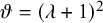 . Assume first that
$\lambda \not \in \frac {1}{2}\mathbb {Z}$
. Assume first that
$\lambda \not \in \frac {1}{2}\mathbb {Z}$
 . Then

with both
$\theta _{\lambda ,\lambda +1}M$
 and
$\theta _{\lambda ,\lambda -1}M$
and
$\theta _{\lambda ,\lambda -1}M$
 simple (as both
$\theta _{\lambda ,\lambda \pm 1}$
simple (as both
$\theta _{\lambda ,\lambda \pm 1}$
 are equivalences of appropriate categories) and non-isomorphic (as the two modules have different annihilators). Moreover, the annihilators of both
$\theta _{\lambda ,\lambda \pm 1}M$
are equivalences of appropriate categories) and non-isomorphic (as the two modules have different annihilators). Moreover, the annihilators of both
$\theta _{\lambda ,\lambda \pm 1}M$
 are different from the annihilator of M. Note that both
$\lambda \pm 1\not \in \frac {1}{2}\mathbb {Z}$
are different from the annihilator of M. Note that both
$\lambda \pm 1\not \in \frac {1}{2}\mathbb {Z}$
 . Therefore, we can continue this recursively, ending up with Claim (a).
Next, let us assume that
$\lambda \in \frac {1}{2}+\mathbb {Z}$
 . Then we still have the decomposition (10) with both summands being simple and non-isomorphic modules. However, if
$\lambda \in \{-\frac {1}{2},-\frac {3}{2}\}$
. Then we still have the decomposition (10) with both summands being simple and non-isomorphic modules. However, if
$\lambda \in \{-\frac {1}{2},-\frac {3}{2}\}$
 , then one of the two modules
$\theta _{\lambda ,\lambda \pm 1}M$
, then one of the two modules
$\theta _{\lambda ,\lambda \pm 1}M$
 will have the same annihilator as M and thus we might have the situation that either
$\theta _{\lambda ,\lambda + 1}M$
will have the same annihilator as M and thus we might have the situation that either
$\theta _{\lambda ,\lambda + 1}M$
 or
$\theta _{\lambda ,\lambda -1}M$
or
$\theta _{\lambda ,\lambda -1}M$
 is isomorphic to M. This splits our situation in two cases (with both occurring, see §§5.1 and 8.1).
In the first case, when neither
$\theta _{\lambda ,\lambda + 1}M$
 nor
$\theta _{\lambda ,\lambda -1}M$
nor
$\theta _{\lambda ,\lambda -1}M$
 is isomorphic to M, we get that
$\mathrm {add}(\mathscr {C}\cdot M)$
is isomorphic to M, we get that
$\mathrm {add}(\mathscr {C}\cdot M)$
 is of type
$A_\infty ^\infty $
is of type
$A_\infty ^\infty $
 similarly to Section 5.1. In the other case, that is, when either
$\theta _{\lambda ,\lambda + 1}M$
similarly to Section 5.1. In the other case, that is, when either
$\theta _{\lambda ,\lambda + 1}M$
 or
$\theta _{\lambda ,\lambda -1}M$
or
$\theta _{\lambda ,\lambda -1}M$
 is isomorphic to M, we get that
$\mathrm {add}(\mathscr {C}\cdot M)$
is isomorphic to M, we get that
$\mathrm {add}(\mathscr {C}\cdot M)$
 is of type
$T_\infty $
is of type
$T_\infty $
 similarly to Section 8.1. This proves Claims (b) and (c).
It remains to consider the case
$\lambda \in \mathbb {Z}_{<0}$
 . In this case, due to our conventions on the notation for projective functors, the decomposition (10) becomes

with both summands being simple and non-isomorphic modules provided that
$\lambda \neq -1$
 . If
$\lambda =-1$
. If
$\lambda =-1$
 , then we have

In this way, recursively, starting from M, we can construct simple modules
$N(k)$
 , for each
$k\in \mathbb {Z}_{<0}$
, for each
$k\in \mathbb {Z}_{<0}$
 , with M being one of these modules, such that
$N(k)$
, with M being one of these modules, such that
$N(k)$
 has the same annihilator as
$L(k)$
has the same annihilator as
$L(k)$
 and
and

for all
$k\neq -1$
 . Using [Reference Mazorchuk and Stroppel32, Theorem 67], we further have that the module
$N'(-2):=L(1)\otimes _{\mathbb {C}}N(-1)$
. Using [Reference Mazorchuk and Stroppel32, Theorem 67], we further have that the module
$N'(-2):=L(1)\otimes _{\mathbb {C}}N(-1)$
 is indecomposable, has the dual numbers as the endomorphism algebra, and has simple top and socle isomorphic to
$N(-2)$
is indecomposable, has the dual numbers as the endomorphism algebra, and has simple top and socle isomorphic to
$N(-2)$
 and no other infinite-dimensional simple subquotients. Setting
$N'(-1):=N(-1)\oplus N(-1)$
and no other infinite-dimensional simple subquotients. Setting
$N'(-1):=N(-1)\oplus N(-1)$
 , we can now recursively define the indecomposable modules
$N'(k)$
, we can now recursively define the indecomposable modules
$N'(k)$
 , for
$k\leq -3$
, for
$k\leq -3$
 , via
, via

Let
$\mathcal {M}$
 be the additive closure of all
$N'(k)$
be the additive closure of all
$N'(k)$
 , where
$k\leq -1$
, where
$k\leq -1$
 . Let
$\mathcal {N}$
. Let
$\mathcal {N}$
 be the additive closure of all
$N(k)$
be the additive closure of all
$N(k)$
 , for
$k\leq -2$
, for
$k\leq -2$
 . Then
$\mathcal {M}$
. Then
$\mathcal {M}$
 is closed under the action of
$\mathscr {C}$
is closed under the action of
$\mathscr {C}$
 and the quotient of
$\mathrm {add}(\mathscr {C}\cdot M)$
and the quotient of
$\mathrm {add}(\mathscr {C}\cdot M)$
 by the ideal generated by
$\mathcal {M}$
by the ideal generated by
$\mathcal {M}$
 is equivalent to
$\mathcal {N}$
is equivalent to
$\mathcal {N}$
 . Therefore, we get Claim (e) by the same arguments as in Section 6.2. This completes the proof.
10.2. Module categories coming from restrictions to subalgebras
Let
$\mathfrak {a}$
 be a Lie subalgebra of
$\mathfrak {sl}_2$
be a Lie subalgebra of
$\mathfrak {sl}_2$
 . Then
$\mathscr {C}$
. Then
$\mathscr {C}$
 acts, via restriction, on the category of all finite-dimensional
$\mathfrak {a}$
acts, via restriction, on the category of all finite-dimensional
$\mathfrak {a}$
 -modules. In this section, we will describe simple transitive
$\mathscr {C}$
-modules. In this section, we will describe simple transitive
$\mathscr {C}$
 -module categories of this kind generated by simple finite-dimensional
$\mathfrak {a}$
-module categories of this kind generated by simple finite-dimensional
$\mathfrak {a}$
 -modules. In the extreme case
$\mathfrak {a}=\mathfrak {sl}_2$
-modules. In the extreme case
$\mathfrak {a}=\mathfrak {sl}_2$
 , we just get the left regular
$\mathscr {C}$
, we just get the left regular
$\mathscr {C}$
 -module category
${}_{\mathscr {C}}\mathscr {C}$
-module category
${}_{\mathscr {C}}\mathscr {C}$
 . The other extreme case
$\mathfrak {a}=0$
. The other extreme case
$\mathfrak {a}=0$
 is trivial.
It remains to consider the two cases when
$\mathfrak {a}$
 has dimension
$1$
has dimension
$1$
 or
$2$
or
$2$
 . Let us start with the case
$\dim (\mathfrak {a})=1$
. Let us start with the case
$\dim (\mathfrak {a})=1$
 . Then
$\mathfrak {a}$
. Then
$\mathfrak {a}$
 is the linear span of some non-zero element
$g\in \mathfrak {sl}_2$
is the linear span of some non-zero element
$g\in \mathfrak {sl}_2$
 , in particular,
$U(\mathfrak {a})\cong \mathbb {C}[g]$
, in particular,
$U(\mathfrak {a})\cong \mathbb {C}[g]$
 , the polynomial algebra in g. For
$\lambda \in \mathbb {C}$
, the polynomial algebra in g. For
$\lambda \in \mathbb {C}$
 , let
$\mathbb {C}_\lambda $
, let
$\mathbb {C}_\lambda $
 denote the one-dimensional
$\mathbb {C}[g]$
denote the one-dimensional
$\mathbb {C}[g]$
 -module on which g acts via
$\lambda $
-module on which g acts via
$\lambda $
 .
.
We have the following two cases:
-
• the element g is nilpotent;
-
• the element g is semi-simple with eigenvalues $\mu \neq 0$
and
$-\mu $
.


In the first case, we have a non-split short exact sequence

For
$n\in \mathbb {Z}_{>0}$
 , denote by
$M(n,\lambda )$
, denote by
$M(n,\lambda )$
 the n-dimensional
$\mathbb {C}[g]$
the n-dimensional
$\mathbb {C}[g]$
 -module on which g acts via an
$n\times n$
-module on which g acts via an
$n\times n$
 Jordan cell with eigenvalue
$\lambda $
Jordan cell with eigenvalue
$\lambda $
 . Let
$\mathcal {Y}(\lambda )$
. Let
$\mathcal {Y}(\lambda )$
 be the additive closure of
$M(n,\lambda )$
be the additive closure of
$M(n,\lambda )$
 , for all n, and let
$\widetilde {\mathcal {Y}}(\lambda )$
, for all n, and let
$\widetilde {\mathcal {Y}}(\lambda )$
 be the semi-simplification of
$\mathcal {Y}(\lambda )$
be the semi-simplification of
$\mathcal {Y}(\lambda )$
 , that is, the quotient of
$\mathcal {Y}(\lambda )$
, that is, the quotient of
$\mathcal {Y}(\lambda )$
 by its radical.
In the second case, we have

Let
$\mathcal {X}=\mathcal {X}(\lambda )$
 denote the additive closure of all
$\mathbb {C}_{\lambda +n\mu }$
denote the additive closure of all
$\mathbb {C}_{\lambda +n\mu }$
 , where
$n\in \mathbb {Z}$
, where
$n\in \mathbb {Z}$
 .
.
Proposition 25. We have the following two cases:
-
(a) If g is nilpotent, then, for each $\lambda \in \mathbb {C}$
, the category
$\mathcal {Y}(\lambda )$
is a transitive
$\mathscr {C}$
-module category of type
$A_\infty $
with simple transitive quotient
$\widetilde {\mathcal {Y}}(\lambda )$
. -
(b) If g is semi-simple, then, for each $\lambda \in \mathbb {C}$
, the category
$\mathcal {X}(\lambda )$
is a simple transitive
$\mathscr {C}$
-module category of type
$A_\infty ^\infty $
.


Proof. If g is nilpotent, then Formula (11), which can be written as

generalizes, by a direct computation, to

for
$n>1$
 . This implies that
$\mathcal {Y}(\lambda )$
. This implies that
$\mathcal {Y}(\lambda )$
 is a transitive
$\mathscr {C}$
is a transitive
$\mathscr {C}$
 -module category of type
$A_\infty $
-module category of type
$A_\infty $
 . In order to prove that the simple transitive quotient of
$\mathcal {Y}(\lambda )$
. In order to prove that the simple transitive quotient of
$\mathcal {Y}(\lambda )$
 is
$\widetilde {\mathcal {Y}}(\lambda )$
is
$\widetilde {\mathcal {Y}}(\lambda )$
 , it remains to show that the radical
$\mathcal {R}$
, it remains to show that the radical
$\mathcal {R}$
 of
$\mathcal {Y}(\lambda )$
of
$\mathcal {Y}(\lambda )$
 is
$\mathscr {C}$
is
$\mathscr {C}$
 -invariant. Since
$\mathscr {C}$
-invariant. Since
$\mathscr {C}$
 is generated by
$L(1)$
is generated by
$L(1)$
 , we just need to show that
$\mathcal {R}$
, we just need to show that
$\mathcal {R}$
 is invariant under the action of
$L(1)$
is invariant under the action of
$L(1)$
 .
.
It is easy to see that
$\mathcal {R}$
 is generated by the projections
$M(n,\lambda )\twoheadrightarrow M(n-1,\lambda )$
is generated by the projections
$M(n,\lambda )\twoheadrightarrow M(n-1,\lambda )$
 and the injections
$M(n,\lambda )\twoheadrightarrow M(n+1,\lambda )$
and the injections
$M(n,\lambda )\twoheadrightarrow M(n+1,\lambda )$
 . Applying
$L(1)$
. Applying
$L(1)$
 to the former, we get a projection of
$M(n-1,\lambda )\oplus M(n+1,\lambda )$
to the former, we get a projection of
$M(n-1,\lambda )\oplus M(n+1,\lambda )$
 onto
$M(n,\lambda )\oplus M(n-2,\lambda )$
onto
$M(n,\lambda )\oplus M(n-2,\lambda )$
 (or just onto
$M(2,\lambda )$
(or just onto
$M(2,\lambda )$
 , if
$n=2$
, if
$n=2$
 ), which is obviously in
$\mathcal {R}$
), which is obviously in
$\mathcal {R}$
 since the domain and the codomain of this projection do not have isomorphic indecomposable summands. Similarly, applying
$L(1)$
since the domain and the codomain of this projection do not have isomorphic indecomposable summands. Similarly, applying
$L(1)$
 to the latter, we get an injection of
$M(n+1,\lambda )\oplus M(n-1,\lambda )$
to the latter, we get an injection of
$M(n+1,\lambda )\oplus M(n-1,\lambda )$
 (or just of
$M(2,\lambda )$
(or just of
$M(2,\lambda )$
 , if
$n=1$
, if
$n=1$
 ), into
$M(n+2,\lambda )\oplus M(n,\lambda )$
), into
$M(n+2,\lambda )\oplus M(n,\lambda )$
 , which is obviously in
$\mathcal {R}$
, which is obviously in
$\mathcal {R}$
 for the same reasons as above. This implies that
$\mathcal {R}$
for the same reasons as above. This implies that
$\mathcal {R}$
 is
$\mathscr {C}$
is
$\mathscr {C}$
 -invariant and completes the proof of Claim (a).
If g is semi-simple, then
$\mathcal {X}(\lambda )$
 is a semi-simple and transitive, hence simple transitive,
$\mathscr {C}$
is a semi-simple and transitive, hence simple transitive,
$\mathscr {C}$
 -module category of type
$A_\infty ^\infty $
-module category of type
$A_\infty ^\infty $
 thanks to Formula (12). Claim (b) follows and the proof is complete.
We proceed with the case
$\dim (\mathfrak {a})=2$
 . Up to an inner automorphism, the only two-dimensional subalgebra
$\mathfrak {a}$
. Up to an inner automorphism, the only two-dimensional subalgebra
$\mathfrak {a}$
 of
$\mathfrak {sl}_2$
of
$\mathfrak {sl}_2$
 is the standard Borel subalgebra
$\mathfrak {b}$
is the standard Borel subalgebra
$\mathfrak {b}$
 generated by h and e. All simple finite-dimensional modules over this algebra have dimension one and have the following form: for each
$\lambda \in \mathbb {C}$
generated by h and e. All simple finite-dimensional modules over this algebra have dimension one and have the following form: for each
$\lambda \in \mathbb {C}$
 , we have the unique one-dimensional
$\mathfrak {b}$
, we have the unique one-dimensional
$\mathfrak {b}$
 -module
$Q(\lambda )$
-module
$Q(\lambda )$
 which is annihilated by e and on which h acts via
$\lambda $
which is annihilated by e and on which h acts via
$\lambda $
 . The
$\mathscr {C}$
. The
$\mathscr {C}$
 -module category
$\mathrm {add}(\mathscr {C}\cdot Q(\lambda ))$
-module category
$\mathrm {add}(\mathscr {C}\cdot Q(\lambda ))$
 appears in Proposition 15 where it was denoted by
$\mathcal {N}_6$
appears in Proposition 15 where it was denoted by
$\mathcal {N}_6$
 . In Proposition 15, it was shown that this is a semi-simple simple transitive
$\mathscr {C}$
. In Proposition 15, it was shown that this is a semi-simple simple transitive
$\mathscr {C}$
 -module category of type
$A_\infty $
-module category of type
$A_\infty $
 . Moreover, as a
$\mathscr {C}$
. Moreover, as a
$\mathscr {C}$
 -module category, it does not depend on
$\lambda $
-module category, it does not depend on
$\lambda $
 , up to equivalence.
Acknowledgements
The first author presented the results of this article at the XLII Workshop on Geometric Methods in Physics in Białystok in July 2025. The authors are grateful to the organizers for this opportunity.
Funding statement
The first author is partially supported by the Swedish Research Council. The second author is partially supported by the Zhejiang Provincial Natural Science Foundation of China, Grant No. LQN25A010023.


 Open access

