





1. Introduction
First language (L1) acquisition and adult second language (L2) acquisition are often believed to constitute two qualitatively different processes. Some researchers have even gone to great lengths to explicitly distinguish between these two processes by using the terms acquisition and learning to refer to the way children and adults develop their L1 and L2, respectively (Krashen, Reference Krashen1981; Paradis, Reference Paradis2009; Terrell, Reference Terrell1977). This distinction reflects the difference in the learning mechanisms that are thought to underlie language development. Specifically, it is commonly assumed that although the acquisition of one’s native language (L1) proceeds almost fully through automatic, implicit learning mechanisms, adults must rely on conscious, explicit mechanisms to learn their L2 (DeKeyser, Reference DeKeyser2000, Reference DeKeyser, Doughty and Long2003; DeKeyser & Larson-Hall, Reference DeKeyser, Larson-Hall, Kroll and De Groot2005; Montrul, Reference Montrul2008; Paradis, Reference Paradis2009; Ullman, Reference Ullman2001). This view is most clearly typified by the fundamental difference hypothesis (FDH; Bley-Vroman, Reference Bley-Vroman, Gass and Schachter1989, Reference Bley-Vroman1990). According to this theory, children have access to their innate, domain-specific language faculty, which allows them to master their L1 effortlessly and unconsciously. However, in adulthood, these implicit mechanisms provided by the language faculty are thought to be inefficient or even inaccessible; hence, late L2 acquisition heavily draws on domain-general cognitive abilities. Since these abilities are mostly explicit and deliberate in nature (e.g., working memory, analogical reasoning, metacognition), they are subject to conscious control and constrained in capacity, making L2 acquisition more effortful and less successful.
There are (at least) two testable predictions that can be derived from this discontinuous view of the learning processes that underlie language development. First, despite varying input and experiences, through relying on innate implicit mechanisms, native speakers are expected to converge almost invariably on the same grammatical system, attaining full mastery of their L1 (Birdsong, Reference Birdsong, Davies and Elder2004; Bley-Vroman, Reference Bley-Vroman2009; Chomsky, Reference Chomsky1975, Reference Chomsky1986; Crain et al., Reference Crain, Thornton and Murasugi2009; Lidz & Williams, Reference Lidz and Williams2009). In this case, individual differences among speakers are expected to be minimal, stemming only from increased cognitive burden on their language-external cognitive systems. This is at odds with the outcome of late L2 acquisition, which is characterized by significant individual variation caused by differences in learners’ domain-general cognitive and perceptual abilities, measured primarily through (explicit) language aptitude tests (Carroll, Reference Carroll and Diller1981; DeKeyser, Reference DeKeyser2000; Li, Reference Li2015, Reference Li2016; Sasaki, Reference Sasaki1996). A second related prediction is that these conscious, explicit learning mechanisms are expected to contribute to variance in L2 but not in L1 outcomes, which are posited to be independent of such processes.
However, the claims of the FDH have come under scrutiny in recent years. Concerning the first of the two predictions outlined above, it is now well understood that implicit learning abilities themselves vary substantially between learners (e.g., Kaufman et al., Reference Kaufman, DeYoung, Gray, Jiménez, Brown and Mackintosh2010; Siegelman & Frost, Reference Siegelman and Frost2015) and that, like L2 learners, native speakers also exhibit considerable individual differences in their grammatical abilities (Dąbrowska & Street, Reference Dąbrowska and Street2006; Street & Dąbrowska, Reference Street and Dąbrowska2010; see also Dąbrowska, Reference Dąbrowska2012, Reference Dąbrowska, Dąbrowska and Divjak2015; Kidd et al., Reference Kidd, Donnelly and Christiansen2018; Kidd & Donnelly, Reference Kidd and Donnelly2020, for reviews). As regards the second prediction, a recent series of studies has found L1 grammatical competence to be robustly related to mechanisms for explicit learning, particularly language analytic ability, a component of explicit language aptitude (Dąbrowska, Reference Dąbrowska2018; Llompart & Dąbrowska, Reference Llompart and Dąbrowska2020, Reference Llompart and Dąbrowska2023; Prela et al., Reference Prela, Llompart and Dąbrowska2022; Winckel & Dąbrowska, Reference Winckel and Dąbrowska2024), and non-verbal intelligence (Dąbrowska, Reference Dąbrowska2018; West et al., Reference West, Vadillo, Shanks and Hulme2018), two factors considered to be relevant for L2 only. These findings appear to bring the notion that L1 and L2 are fundamentally different into question, calling for a better characterization of the potential similarities (and differences) between L1 and L2 concerning the involvement of explicit learning mechanisms. Here, we build on this line of work and explore the relationship between individual differences in mechanisms in the explicit domain, specifically language analytic ability and non-verbal abstract reasoning, and adults’ ability to comprehend L1 sentences containing complex syntactic structures on the one hand and sentences of a newly acquired language on the other.
Explicit language aptitude has long been considered the factor explaining the largest proportion of variance in late L2 outcomes. Drawing from early work by Carroll (Reference Carroll and Glaser1962, Reference Carroll and Diller1981; Carroll & Sapon, Reference Carroll and Sapon1959) and after reconceptualizations (Li, Reference Li2016; Skehan, Reference Skehan and Robinson2002), explicit language aptitude is typically operationalized as a multifaceted construct, consisting of three components: phonetic coding, rote memory, and language analytic ability. It is the latter of these components that has been found to be the most predictive of grammar learning, with an average correlation coefficient of 0.35 (0.27–0.43) (see Li, Reference Li2015, Reference Li2016, for meta-analyses). Language analytic ability refers to the capacity to consciously analyze the input, infer linguistic systematicities (rules and structures), and draw generalizations. Tests employed to assess this ability, such as Pimsleur Language Aptitude Battery (PLAB) 4 language analysis (Pimsleur et al., Reference Pimsleur, Reed and Stansfield2004), Modern Language Aptitude Test (MLAT) 4 words in sentences (Carroll & Sapon, Reference Carroll and Sapon2002), and sentence pairs (Llompart & Dąbrowska, Reference Llompart and Dąbrowska2023), vary in their focus. PLAB 4 is concerned with inferring the structure of sentences in a new language, whereas the other two focus on the identification of words with analogous grammatical functions in pairs of sentences. Despite these differences, all tests require participants to rely on metalinguistic awareness, pattern recognition, and analogical reasoning.
While language analytic ability tests have been extensively used in L2 research, they have received little consideration in research on L1 development until recently. Yet, cognitive operations invoked by such tests, in particular, pattern recognition and analogical reasoning, are not alien to native language acquisition. In fact, according to emergentist and constructivist approaches, they are taken to constitute the driving force of the acquisition of constructional schemas (Behrens, Reference Behrens, Hundt, Mollin and Pfenninger2017; Dąbrowska, Reference Dąbrowska2004; Tomasello, Reference Tomasello2003). Evidence that language analytic ability is correlated with native language acquisition was first reported by Skehan and Ducroquet (Reference Skehan and Ducroquet1988), who found significant associations between measures of early L1 development from children tested at 15–60 months of age and aptitude measures administered more than 10 years later. Drawing from these results, Dąbrowska (Reference Dąbrowska2018) explored whether language analytic ability can predict individual differences in adult native speakers’ grammatical knowledge. Performance on the language analysis subject of the PLAB emerged as a significant predictor of grammar scores, suggesting that explicit learning abilities, captured by aptitude tasks, are also relevant for L1 acquisition. Subsequent studies succeeded in replicating these findings, using different measures of language analytic ability and grammatical proficiency (e.g., picture selection, grammaticality judgment tasks and other two-alternative forced choice tasks) (Llompart & Dąbrowska, Reference Llompart and Dąbrowska2023; Winckel & Dąbrowska, Reference Winckel and Dąbrowska2024).
Like explicit language aptitude, intelligence is another cognitive factor tightly linked to L2 proficiency (e.g., Brooks et al., Reference Brooks, Kempe and Sionov2006; Flahive, Reference Flahive, Oller and Perkins1980; Genesee & Hamayan, Reference Genesee and Hamayan1980). Although originally claimed to be unrelated to aptitude (Carroll, Reference Carroll and Diller1981), research has consistently reported moderate-to-strong correlations between the two abilities, a pattern reflected in Li’s (Reference Li2016) meta-analysis (r = .50 for mixed aptitude measures). Despite their close relationship, intelligence and explicit language aptitude constitute distinct abilities as evidenced by, first, the lack of perfect correlation between them and, second, the tendency for language aptitude measures to explain a larger portion of the variance in L2 performance compared to intelligence.
Much of the remaining overlap can be attributed to the similarities in cognitive computations required in the tests used to assess the two constructs. Such similarities can be found between language analytic ability and non-verbal intelligence tests. Non-verbal intelligence is the ability to analyze information, reason, and solve problems using novel visual information. Therefore, measures of this ability typically require individuals to detect complex patterns and induce abstract relations to find the shape that best completes the pattern presented. Indeed, many widely used assessments of non-verbal intelligence, like the Raven’s progressive matrices (Raven, Reference Raven1938), typically target abstract reasoning ability. Recall that these are explicit reasoning, problem-solving skills that language analytic ability tasks are also thought to tap into. Still, while non-verbal intelligence (and the skills underlying it) is expected to account for individual differences in L2 grammar outcomes, grammatical proficiency in the L1 is often assumed to be independent of it, an assumption likely rooted in the idea that native language is almost exclusively underpinned by implicit learning mechanisms (Bley-Vroman, Reference Bley-Vroman, Gass and Schachter1989; Chomsky, Reference Chomsky1986; DeKeyser, Reference DeKeyser2000; Pinker, Reference Pinker1999). In contrast, viewing language as emergent from experience through mechanisms of general cognition, non-verbal intelligence would also be expected to contribute to variation in native speakers’ grammatical knowledge.
Evidence for a positive relationship between L1 grammar and non-verbal Intelligence Quotient (IQ) can be traced in research with atypical populations (e.g., children with cognitive impairments or developmental language disorder), where participants with higher IQ scores tend to perform with higher accuracy on tasks assessing their grammatical abilities (Poll et al., Reference Poll, Miller and Van Hell2016; van der Schuit et al., Reference van der Schuit, Segers, van Balkom and Verhoeven2011; West et al., Reference West, Vadillo, Shanks and Hulme2018). Similar results have been reported for typically developing adults (Andringa et al., Reference Andringa, Olsthoorn, Van Beuningen, Schoonen and Hulstijn2012; Dąbrowska, Reference Dąbrowska2018; Favier & Huettig, Reference Favier and Huettig2021). In fact, Dąbrowska (Reference Dąbrowska2018) found that non-verbal intelligence emerged as the strongest predictor of grammatical accuracy, surpassing factors such as print exposure, education, and language analytic ability. Importantly, the grammar task employed in that study included constructions that occur less frequently in oral language (e.g., passives, postmodified subjects, object clefts, object relative clauses, quantifiers) and can, hence, pose difficulties for speakers with low print exposure. Therefore, it stands to reason that, just like in L2 (Robinson, Reference Robinson and DeKeyser2007), increasing the reasoning demands of the L1 material to be processed, and by extension limiting the reliance on input-related factors (e.g., frequency of use), could increase the involvement of non-verbal intelligence.
2. The present study
In this study, we investigate the relationship between L1 and L2 grammatical comprehension abilities (RQ1) and ask whether individual variation in grammatical proficiency in L1 and early-stage acquisition of L2 grammar are similarly predicted by the same cognitive abilities (RQ2). To answer this question, two predictors potentially relevant for both L1 and L2 acquisition were targeted: language analytic ability and non-verbal abstract reasoning. By focusing on these predictors, we aimed at determining the extent to which L1 and L2 grammatical comprehension can be modulated by individual differences in cognitive abilities in the explicit domain. In order to control for exposure to L2 input and L1 background effects, English native speakers were trained to comprehend artificial language sentences over multiple sessions, a process that was taken to serve as a proxy for L2 development (e.g., Ettlinger et al., Reference Ettlinger, Morgan-Short, Faretta-Stutenberg and Wong2016; Kempe & Brooks, Reference Kempe, Brooks, Granena, Jackson and Yilmaz2016).
Two possible outcomes were considered. If language acquisition relies on domain-general cognitive mechanisms, as predicted by usage-based accounts (Beckner et al., Reference Beckner, Blythe, Bybee, Christiansen, Croft, Ellis, Holland, Ke, Larsen-Freeman and Schoenemann2009; Bybee, Reference Bybee2010; Tomasello, Reference Tomasello2003), we would expect the same cognitive abilities to influence performance not only in L2 grammatical comprehension tasks but also in L1. Note that this does not necessitate that the contribution of those abilities would be of the same strength. Conversely, if L1 and L2 acquisition are fundamentally different and thus utilize different mechanisms (Bley-Vroman, Reference Bley-Vroman, Gass and Schachter1989, Reference Bley-Vroman2009; DeKeyser, Reference DeKeyser2000; Pinker, Reference Pinker1999), then a narrow range of variation would be expected for L1, with domain-general cognitive abilities affecting only L2 grammatical abilities.
3. Method
3.1. Participants
There were 77 participants (Mage = 28.97, SDage = 4.42; female = 40) in this study, recruited online through Prolific (www.prolific.co). All participants were monolingual native speakers of English living in the United Kingdom at the time of testing. The group varied in terms of years of education (11–24) but, overall, was relatively highly educated (M = 14.8, SD = 2.4). Before the study commenced, participants were asked to fill in a language background questionnaire and give informed consent via an online form. The study was carried out in accordance with the Declaration of Helsinki. Data from 24 additional participants were removed either because they failed to pass a vocabulary learning check administered in the first session of the study (N = 17) or because they did not complete all experimental sessions (N = 7).
3.2. Materials and procedure
3.2.1. Artificial language
Participants were auditorily exposed to Arepo, an artificial language that was modeled after Kepidalo (Kenanidis et al., Reference Kenanidis, Llompart, Santos and Dąbrowska2024). The artificial language consisted of ten nonce words, six nouns (birk, vels, skom, prat, zof, and flup) that denoted aliens and four verbs (mulek, dolek, varek, and firek) which referred to four different transitive actions (catapult, chase, jump over, and approach). The subject of the sentence was not marked for case, whereas the object carried the marker -o. The language had a verb–object–subject (VOS) word order. However, the presence of case marking also allowed for verb–subject (VS) and verb–object (VO) sentences, with optional object and subject, respectively. Example sentences are shown in (1)–(3) (see also Figure 1).
-
1) Mulek skom-o vels.
jumping over skom-ACC vels-NOM
-
2) Mulek skom-o.
jumping over skom-ACC
-
3) Mulek vels.
jumping over vels-NOM.
Still images of the visual stimuli presented in the sentence training task (left: the vels is jumping over the skom; right: the zof is chasing the birk). The left scene corresponds to sentences (1)–(3) shown above.

The vels is jumping over the skom.
The use of the same three structures across all actions was intended to prevent participants from attending to and forming systematic associations between individual verbs and specific grammatical patterns, which would effectively introduce an additional learning contingency. This design ensured that learning was not confounded by idiosyncratic syntactic properties of individual verbs, while also allowing testing whether participants can adapt their processing by relying on case marking, rather than their L1-preferred word order strategy, to identify agent and patient roles, given that word order cues are not available in VS and VO sentences and are therefore less reliable overall.
A set of 120 novel sentences was generated using the Google Cloud Text-to-Speech service. Short Graphics Interchange Format (GIF) animations depicting different sentences were constructed to accompany the auditory stimuli (Figure 1). The study was conducted online via the Gorilla experiment builder (gorilla.sc; Anwyl-Irvine et al., Reference Anwyl-Irvine, Massonnié, Flitton, Kirkham and Evershed2020) and was conducted over four separate days (with 1–2 days in between). A summary of the tasks is displayed in Table 1.
The research design of the study

Table 1. Long description
The table is organized into four columns representing Session 1 through Session 4.
* Session 1 includes a background questionnaire, vocabulary pre-training (consisting of single exposure, pre-training, and lexical training), and sentence training.
* Session 2 includes vocabulary practice, sentence training, and a test for Language analytic ability.
* Session 3 includes vocabulary practice, sentence training, L 1 grammatical comprehension (part 1), a Non-verbal reasoning test, and L 1 grammatical comprehension (part 2).
* Session 4 includes vocabulary practice and sentence training.
In the original table, the Language analytic ability, L 1 grammatical comprehension (parts 1 and 2), Non-verbal reasoning test, and the final sentence training in Session 4 are highlighted in bold to indicate they are the primary tests discussed in the study.
Note: Tests discussed here are highlighted in bold.
3.2.2. Artificial language tasks
Vocabulary pre-training. Participants were first introduced to the vocabulary items of the artificial language. This was aimed at minimizing the need for an extended vocabulary learning process, enabling participants to focus on the grammar learning task. During this phase of the study, the ten nonce words were auditorily presented in isolation, one at a time, while the corresponding alien (for nouns) or action (for verbs; depicted being performed by two geometric shapes) was displayed on the screen. The block of ten words was repeated twice.
Following this stage, additional vocabulary training was provided, this time in the form of a four-alternative forced-choice (4AFC) task. During this task, a set of four images was presented, one in each screen quadrant, while a nonce word referring to one of them was played. Participants were instructed to choose the image they thought corresponded to the word they heard and received feedback on their responses. Each vocabulary item served as a target six times, yielding a total of 60 trials. When the target item was a verb, four short dynamic scenes in which the actions described by the four novel verbs (one target and three distractors) were shown, whereas for noun trials, static images of four different aliens were displayed. To gamify the experiment, participants were awarded with virtual coins and gems for consecutive correct answers.
Training was followed by two testing blocks. Participants were required to score at least 90% (18/20) to advance to the next phase of the study. If they failed, they were given two more opportunities to repeat the testing blocks. Failure to pass after three attempts resulted in exclusion.
Vocabulary practice. A short vocabulary practice was administered at the beginning of sessions 2–4 to remind participants of the words of the artificial language. Vocabulary practice consisted of two parts. The first part was similar to the 4AFC task from vocabulary pre-training with each target word occurring once (10 trials). In the second part, participants were asked to orally provide the correct label for an alien or an action shown on the screen (10 trials).
Sentence training task. Following vocabulary pre-training, participants were exposed to the novel artificial language by means of a two-alternative forced-choice task (2AFC). Each trial consisted of an auditorily presented sentence in the artificial language and two scenes, a target and a distractor, that were presented simultaneously side by side on the screen (Figure 1). Participants had to select the scene that the sentence referred to and received feedback on their responses. The two scenes played repeatedly in a loop until participants registered their response, while the sentences could be replayed once if participants wanted.
There were two types of trials: vocabulary trials, in which distractor scenes depicted different participants or actions, and grammar trials where distractors showed the reversed agent–patient relations. The vocabulary trials contained 90 unique items in total. There were 30 items that differed in three features (i.e., in both the participants and the action depicted, e.g., scenes corresponding to dolek prato flup versus firek skomo birk). All 30 of these items appeared with sentences with the full VOS order. From the remaining 60 trials, 30 involved 2-feature differences (e.g., mulek zofo birk versus varek zofo vels) and 30 constituted minimal pairs as they differed only in a single feature (e.g., mulek flupo prat versus mulek skomo prat). Each of these two sets of trials included 10 trials for each of the VOS, VS, and VO word orders. Thirty of the scenes that served as targets for the previously mentioned vocabulary trials were selected to serve as grammar trials. For each target scene, a distractor was constructed by swapping the agent and patient roles of the aliens (e.g., dolek prato flup versus dolek flupo prat).
In the first session, participants were initially presented with the 30 lexical items differing in three features and then with the 30 trials differing in two features followed by the minimal pairs intermixed with the grammar trials. This order of presentation was chosen based on the increasing difficulty of the trial types. The 120 items were repeated twice for a total of 240. The task was divided into three blocks of 80 trials. To keep participants motivated, a total score showing the number of correct responses was presented at the end of each block, along with a message prompting them to beat their score in the next block.
The same task was used in sessions 2, 3, and 4, albeit with slight modifications. First, with respect to the order of presentation, vocabulary and grammar trials were intermixed. Second, in session 4, grammar trials consisted of 26 trials that never occurred as targets in the previous sessions (new grammar trials) and 34 trials that were randomly selected from the above-mentioned set of 90 sentences (old grammar trials). Distractors for the 90 lexical trials differed across but not within sessionsFootnote 1.
3.2.3. L1 grammatical comprehension
Participants’ language comprehension skills were measured using the grammatical comprehension task developed by Winckel and Dąbrowska (Reference Winckel and Dąbrowska2024). This task tested comprehension of four types of structures, namely complex noun phrases (NPs) (e.g., Linda complained that the fact that cycling in the main square is forbidden annoys tourists.), X-is-difficult-to-answer constructions (e.g., James will be easy to persuade Walter to help.), reduced relatives (e.g., A child staring at a dog chasing a postman was afraid.), and ditransitives (e.g., Mr. Peters showed her baby the picturesFootnote 2.). In each trial, participants saw a sentence on the screen, which was followed by a series of questions (e.g., for the ditransitive example sentence: 1) Who saw something? 2) Who showed someone something?). For every question, two alternative answers were shown. As soon as participants indicated the answer for the question, the task proceeded to the next question or next sentence. Each sentence of the first two structures was followed by three questions, whereas reduced relatives and ditransitives included one test and one control question. The control questions asked participants to identify the subject and object of the sentence (Winckel & Dąbrowska, Reference Winckel and Dąbrowska2024). These were always simple NPs appearing in canonical positions, and hence, they were not expected to pose difficulties for adult native speakers (see example question 2 above). To ease cognitive burden, the task was presented in two parts, each consisting of 16 test items.
Following Winckel and Dąbrowska (Reference Winckel and Dąbrowska2024), an ‘all-or-nothing’ score was calculated for each participant, such that for an item to be considered correct (1), participants had to respond accurately to all of the questions this item included (e.g., 3/3 for an ‘X-is-difficult-to-answer’ item)Footnote 3. Items were scored as incorrect (0) if participants failed to achieve a perfect score. Note that since the number of trials differed across the four structures, overall chance-level performance in this task was 31.25%. Chance performance was 50% for relatives and ditransitives items that consisted of a single test question but 12.5% for complex NP and X-is-difficult-to-answer items, which had three questions.
3.2.4. Cognitive abilities tasks
Language analytic ability. Language analytic ability was measured using the sentence pairs task (Llompart & Dąbrowska, Reference Llompart and Dąbrowska2023), which is an adaptation of the words in sentences subtest from MLAT (Carroll & Sapon, Reference Carroll and Sapon1959). During the task, participants were presented with pairs of English sentences. Each pair comprised a first sentence in which one word was printed in capitals and a second sentence with five words in bold letters. Five boxes, one for each of the bold-faced words, were displayed below the two sentences. The participants’ task was to choose from these five alternatives the word that had the same function as the word in capital letters in the first sentence (Figure 2). The task began with four practice items to acquaint subjects with the procedure. In these practice trials, visual feedback was provided on the screen, and in case of incorrect answers, participants were given the chance to click on another box until they chose the correct answer. The task consisted of 32 test items and took approximately 8 minutes to complete. The proportion of correct responses was extracted for each participant to obtain a measure of language analytic ability.
Example of a trial in the sentence pairs task.

Non-verbal reasoning. To measure participants’ non-verbal reasoning, sets 1 and 3 from the matrix reasoning item bank (Chierchia et al., Reference Chierchia, Fuhrmann, Knoll, Pi-Sunyer, Sakhardande and Blakemore2019) were used during sessions 3 and 4, respectively. We did not use set 2 because of the longer response times reported for this set compared to set 1 (Chierchia et al., Reference Chierchia, Fuhrmann, Knoll, Pi-Sunyer, Sakhardande and Blakemore2019). For each trial, participants saw a three-by-three matrix of abstract shapes with one of them missing. They had 30 seconds to choose the shape that best completes the matrix from the four alternatives offered. When 5 seconds remained, participants saw a clock that counted down the remaining seconds. If no answer was given after 30 seconds, the next trial commenced. The test had 80 trials in total and took 8 minutes to complete. Responses with reaction times (RTs) less than 250 ms were discarded as outliers (45 out of 8726; 0.52%). The overall percentage of correct responses in both sessions was then calculated and used as a measure of non-verbal reasoning ability for each participant.
4. Results
All reported analyses were conducted in R (version 4.3.2; R Core Team, 2023). For the artificial language task, responses with extreme RTs in each session – defined here as three median absolute deviations (MADs) above or below the individual’s median for a given session – were removed from the final dataset. This resulted in the exclusion of 8.89% (6573 out of 73920) of the total data points collected. Individual scores for the vocabulary and grammar trials were then computed for each participant. For the purposes of this study, only data from the grammar trials completed during session 4 (290 out of 4620; 6.28%) were entered into subsequent analyses. Spearman–Brown corrected split-half reliability for all tasks was computed with the default 5000 random splits using the splithalf package (version 0.8.2; Parsons, Reference Parsons2021) in R.
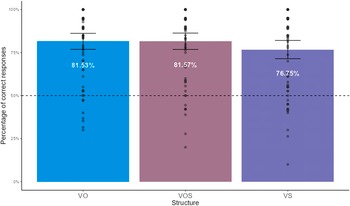
Note that, in session 4, while 26 of the grammar trials were entirely novel, accuracy rates for old and new items were almost identical (M = 80.1, SD = 20.2 for old items and M = 79.8, SD = 20.6 for new items). Furthermore, a Kruskal–Wallis test that was used to examine differences in accuracy rates across the three types of grammatical structures (VOS, VS and VO) did not return significant differences (χ2(2) = 1.61, p = .45). Hence, this contrast was not considered in the final analysis. Performance across the three structures is shown in Figure 3.
Percentage and distribution of correct responses by structure in the grammar trials of the artificial language sentence training task.

Figure 3. Long description
The y-axis represents the Percentage of correct responses from 0% to 100% with a dashed horizontal line at the 50% chance level. The x-axis is labeled Structure and contains three categories.
* V O is a blue bar with a mean of 81.53%. Individual data points are clustered between 30% and 100% with error bars centered around the mean.
* V O S is a mauve bar with a mean of 81.57%. Individual data points range from 20% to 100% with error bars centered around the mean.
* V S is a purple bar with a mean of 76.75%. Individual data points range from 10% to 100% with error bars centered around the mean.
All three structures show performance well above the 50% chance line, with V O and V O S showing nearly identical mean performance levels.
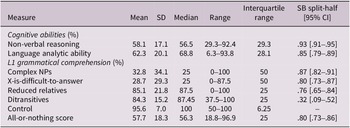
Mean accuracy rates, cleaned mean RTs, and Spearman–Brown corrected reliability estimates are presented in Table 2, while descriptive statistics for performance in the cognitive abilities measures and the L1 grammatical comprehension task are reported in Table 3. As evident from the tables as well as from Figure 2, both the artificial language learning outcomes and the L1 grammatical comprehension scores exhibit substantial inter-individual variability, which seems to hold not only for overall performance but also for performance across individual grammatical structures.
Descriptive statistics for performance on grammar trials of the artificial language sentence training task in session 4 and for the two individual differences measures

Table 2. Long description
The table contains seven columns: Measure, Mean, S D, Median, Range, Interquartile range, and S B split-half with 95 percent C I.
Under the Accuracy percentage category for Session 4:
- Mean: 79.9
- S D: 19.8
- Median: 89.1
- Range: 38.3 to 100
- Interquartile range: 38.1
- S B split-half [95 percent C I]: .94 [.92 to .96]
Under the Reaction time category for Session 4:
- Mean: 1537.6
- S D: 767.6
- Median: 1324.5
- Range: 449.2 to 3626.9
- Interquartile range: 878.5
- S B split-half [95 percent C I]: .95 [.93 to .97]
Descriptive statistics for the explicit cognitive abilities and L1 comprehension measures

Table 3. Long description
The table contains seven columns: Measure, Mean, S D, Median, Range, Interquartile range, and S B split-half [95% C I].
Category 1: Cognitive abilities (%)
* Non-verbal reasoning: Mean 58.1, S D 17.1, Median 56.5, Range 29.3–92.4, Interquartile range 29.3, S B split-half .93 [.91–.95].
* Language analytic ability: Mean 62.3, S D 20.1, Median 68.8, Range 6.3–93.8, Interquartile range 28.1, S B split-half .85 [.79–.89].
Category 2: L 1 grammatical comprehension (%)
* Complex N Ps: Mean 32.8, S D 34.1, Median 25, Range 0–100, Interquartile range 50, S B split-half .87 [.82–.91].
* X-is-difficult-to-answer: Mean 28.7, S D 29.3, Median 25, Range 0–87.5, Interquartile range 50, S B split-half .80 [.73–.87].
* Reduced relatives: Mean 85.1, S D 21.8, Median 87.5, Range 0–100, Interquartile range 25, S B split-half .76 [.65–.84].
* Ditransitives: Mean 84.3, S D 15.2, Median 87.45, Range 37.5–100, Interquartile range 25, S B split-half .32 [.09–.52].
* Control: Mean 95.6, S D 7.0, Median 100, Range 50–100, Interquartile range 6.25, S B split-half not provided.
* All-or-nothing score: Mean 57.7, S D 18.3, Median 56.3, Range 18.8–96.9, Interquartile range 25, S B split-half .80 [.73–.86].
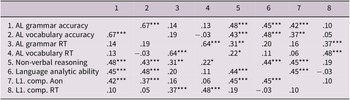
A correlation matrix summarizing the relationships between the language and explicit cognitive abilities measures is provided in Table 4. Correlations between the two cognitive abilities and the different sentence types in the L1 grammatical comprehension task are provided in Supplementary Table S1. Most importantly for the present study, participants’ accuracy on the novel artificial language’s grammar trials was moderately to strongly correlated with their performance on the L1 grammatical comprehension task (rho = .42, p < .001), and RTs across these two tasks also demonstrated a comparable relationship (rho = .37, p < .001). Concerning the two target explicit abilities, in line with previous findings, performance on these tasks also showed a correlation that was medium to strong in size (rho = .44, p < .001). Furthermore, both cognitive abilities were significantly associated with performance on the language tasks, with correlation coefficients ranging narrowly between rho = .45 and .48, indicating a consistent pattern of relationships across measures.
Correlations among the language variables and the cognitive predictors

Table 4. Long description
A correlation matrix with 8 numbered columns and 8 corresponding rows.
Variables:
1. A L grammar accuracy
2. A L vocabulary accuracy
3. A L grammar R T
4. A L vocabulary R T
5. Non-verbal reasoning
6. Language analytic ability
7. L 1 dot comp dot Aon
8. L 1 dot comp dot R T
Key Correlations:
- Row 1 (A L grammar accuracy) correlates with column 2 at .67, column 5 at .48, column 6 at .45, and column 7 at .42 (all p < .001).
- Row 2 (A L vocabulary accuracy) correlates with column 5 at .43, column 6 at .48 (p < .001), and column 7 at .37 (p < .01).
- Row 3 (A L grammar R T) correlates with column 4 at .64, column 8 at .37 (p < .001), and column 5 at .31 (p < .01).
- Row 4 (A L vocabulary R T) correlates with column 8 at .48 (p < .001) and column 5 at .22 (p < .05).
- Row 5 (Non-verbal reasoning) correlates with column 6 at .44 and column 7 at .45 (p < .001).
- Row 6 (Language analytic ability) correlates with column 7 at .45 (p < .001).
Note: A L stands for artificial language. L 1 dot comp Aon stands for L 1 grammatical comprehension, all-or-nothing score. R T stands for reaction time.
Note: AL = artificial language, L1. comp Aon = L1 grammatical comprehension, all-or-nothing score.
*p < .05; **p < .01; ***p < .001 level.
4.1. Predicting novel grammar learning
In order to test which factors predicted learning of the artificial language’s grammar, a generalized linear mixed effects model with accuracy in session 4 as the binary outcome variable (0 = incorrect, 1 = correct) was created using the lme4 package (version 1.1–34; Bates et al., Reference Bates, Mächler, Bolker and Walker2015). The two cognitive abilities and their two-way interaction were entered as predictors. The model was initially fit with the maximal random-effects structure justified by the design (Barr et al., Reference Barr, Levy, Scheepers and Tily2013; Bates et al., Reference Bates, Mächler, Bolker and Walker2015) and was reduced by iteratively removing the random slope with the smallest SD until the model converged. To obtain the best fixed effects structure, we used likelihood ratio tests via the drop1() function, which compared the full model to the reduced model in order to determine the predictor that was droppable and remove it from the model. This resulted in the removal of the interaction between the two predictors. Odds ratios (ORs) and 95% confidence intervals (CIs) for predictors, and marginal and conditional R2 for the full model were calculated using the tab_model function of the sjPlot package (version 2.8.16; Lüdecke, Reference Lüdecke2024).
Inspection of the best-fitted model (Table 5) showed that, overall, participants performed above chance in grammar trials, as indicated by a significant intercept. Concerning the predictors, the model revealed main effects of matrix reasoning item bank and sentence pairs, which suggest that learners with higher non-verbal reasoning and language analytic ability were more likely to provide correct responses to grammar trials.
Best fitting model for accuracy on grammar trials of the artificial language sentence training task

Table 5. Long description
The table consists of six columns: Variable, beta-hat, S E, z, p, and Odds ratios with C I.
Fixed Effects:
- Intercept: beta-hat 2.00, S E 0.16, z 12.54, p less than .001, Odds ratio 7.38 with C I 5.40 to 10.09.
- Non-verbal reasoning: beta-hat 0.57, S E 0.18, z 3.23, p .001, Odds ratio 1.76 with C I 1.25 to 2.48.
- Language analytic ability: beta-hat 0.47, S E 0.17, z 2.73, p .006, Odds ratio 1.59 with C I 1.14 to 2.23.
Random Effects:
- Item: Variance 0.08, S D 0.29.
- Participant: Variance 1.53, S D 1.24.
Model Fit Statistics:
- Marginal R super 2: .14.
- Conditional R super 2: .42.
4.2. Predicting L1 grammatical comprehension
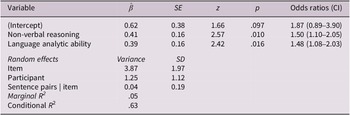
A second generalized linear mixed effects model was fitted to the data from the L1 grammatical comprehension task to determine whether the two explicit cognitive abilities also contributed to differences in native speakers’ comprehension abilities. Participants’ all-or-nothing score on each item (0 versus 1) was the outcome variable, while language analytic ability, non-verbal abstract reasoning and their interaction were added as predictors. The procedure followed for identifying the best-fitting model was identical to that described in the previous section. The final model is shown in Table 6. Significant main effects for the two explicit abilities were found, such that participants with higher scores in the administered measures were more likely to respond correctly in the L1 grammatical comprehension task.
Best fitting model for accuracy on the L1 grammatical comprehension task

Table 6. Long description
A table with six columns: Variable, beta-hat, S E, z, p, and Odds ratios (C I).
Fixed Effects:
- (Intercept): beta-hat 0.62, S E 0.38, z 1.66, p .097, Odds ratio 1.87 (0.89–3.90).
- Non-verbal reasoning: beta-hat 0.41, S E 0.16, z 2.57, p .010, Odds ratio 1.50 (1.10–2.05).
- Language analytic ability: beta-hat 0.39, S E 0.16, z 2.42, p .016, Odds ratio 1.48 (1.08–2.03).
Random Effects (Variance, S D):
- Item: Variance 3.87, S D 1.97.
- Participant: Variance 1.25, S D 1.12.
- Sentence pairs | item: Variance 0.04, S D 0.19.
Model Fit Statistics:
- Marginal R super 2: .05.
- Conditional R super 2: .63.
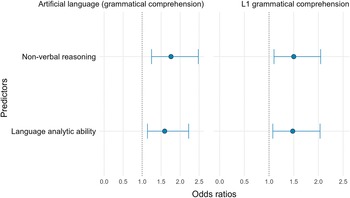
Taken together, the ORs for both predictors in the two models were greater than 1.0 (the 95% CIs did not include 1.0) indicating positive effects of the two explicit abilities on performance in both the artificial language and the L1 grammatical comprehension tasks. The ORs can be interpreted such that an increase in the non-verbal reasoning score by one unit corresponds to a 76% increase in the odds of a correct response in the artificial language grammar trials (OR = 1.76) and a 50% increase in the L1 grammatical comprehension task (OR = 1.50). Notably, the effect sizes appear comparable across the two language tasks, suggesting consistent contributions of these explicit cognitive abilities to grammatical comprehension in both contexts (Figure 4).
Odds ratios (represented by dots) and confidence intervals (represented by the blue lines) for predictors in the two regression models.

Figure 4. Long description
The multi-panel graph features a vertical Y axis labeled Predictors and a horizontal X axis labeled Odds ratios. The X axis ranges from 0.0 to 2.5 with a vertical dotted line at 1.0 indicating the null effect.
Left Panel: Artificial language (grammatical comprehension).
- Non-verbal reasoning: The odds ratio is approximately 1.75, with a confidence interval extending from 1.25 to 2.5.
- Language analytic ability: The odds ratio is approximately 1.6, with a confidence interval extending from 1.1 to 2.2.
Right Panel: L 1 grammatical comprehension.
- Non-verbal reasoning: The odds ratio is approximately 1.5, with a confidence interval extending from 1.1 to 2.1.
- Language analytic ability: The odds ratio is approximately 1.5, with a confidence interval extending from 1.1 to 2.1.
In all cases, the confidence intervals are entirely to the right of the 1.0 null line, indicating statistically significant positive associations.
5. Discussion
The present study examined the grammatical comprehension abilities of adult speakers in their L1 and a newly acquired L2. To this end, over four experimental sessions, participants were trained to acquire a novel artificial language using cross-situational statistics (i.e., co-occurrences between sentences and animated scenes) complemented with corrective feedback. Grammatical competence in the native language was assessed via a 2AFC task that involved relatively demanding syntactic structures (Winckel & Dąbrowska, Reference Winckel and Dąbrowska2024). The main objective was to determine if L1 grammar abilities are related to early L2 abilities (RQ1) and whether individual differences found in both are linked to the same explicit cognitive abilities, namely language analytic ability and non-verbal abstract reasoning (RQ2).
Our results revealed a moderately strong correlation between participants’ scores on tasks tapping their L1 and L2 grammatical comprehension (.42), along with a moderate positive correlation between the RTs for the two tasks (.37). This finding seems to tie in well with prior research showing a positive relationship between grammatical competence in both languages among adult populations (e.g., Bylund et al., Reference Bylund, Abrahamsson and Hyltenstam2012; Falk et al., Reference Falk, Lindqvist and Bardel2015; Prela et al., Reference Prela, Llompart and Dąbrowska2022). Similar results have also been documented in studies with bilingual children (Blom et al., Reference Blom, Soto-Corominas, Attar, Daskalaki and Paradis2021; Castilla et al., Reference Castilla, Restrepo and Perez-Leroux2009; Soto-Corominas et al., Reference Soto-Corominas, Daskalaki, Paradis, Winters-Difani and Janaideh2022). It is important to point out that although the current study focuses on the initial state of L2, it does so through an artificial language with a small vocabulary and a restricted number of tokens of each of the three target grammatical structures, allowing participants to reach high levels of proficiency after relatively brief exposure to it. Given the high accuracy scores attained by the participants (M = 80%), the results obtained here align more closely with patterns typically observed in advanced rather than beginner L2 learners.
Further similarities between L1 and L2 grammatical comprehension emerge from the descriptive statistics. Most notably, performance on the two language tasks is characterized by vast interindividual variation, with scores ranging from below chance to near-perfect accuracy (Tables 2 and 3). In the context of L2 grammar, such variation is unsurprising. Virtually all researchers converge on the notion that non-native language acquisition outcomes are marked by significant individual differences (for an overview of theories and their predictions, see Li et al., Reference Li, Hiver, Papi, Li, Hiver, Papi, Li, Hiver and Papi2022). By contrast, the range of variation in adult L1 speakers’ linguistic competence and the effect this may have on the rate of acquisition and processing have been the subject of considerable debate. Although variability is expected when it comes to the rate of learning novel lexical items, as well as the size of the vocabulary speakers develop, traditional formal approaches generally maintain that native grammar (or the implementation of its formal rules) remains largely uniform across speakers of the same language (Bley-Vroman, Reference Bley-Vroman2009; Crain & Thornton, Reference Crain and Thornton1998; Lidz & Williams, Reference Lidz and Williams2009). Our findings contrast with this assumption and are instead consistent with emergentist accounts of language acquisition, which posit that speakers are not homogeneous in their level of mastery of the grammatical system of their native language.
In addition to the numerous studies that have established the presence of differences in native language attainment at the behavioral level (see Dąbrowska, Reference Dąbrowska2012, Reference Dąbrowska, Dąbrowska and Divjak2015, Reference Dąbrowska2018; Kidd et al., Reference Kidd, Donnelly and Christiansen2018; Kidd & Donnelly, Reference Kidd and Donnelly2020), there is mounting evidence from neuroimaging studies suggesting that interindividual variability can also be found at a neural level. Event-related potential (ERP) research has shown that the commonly reported biphasic response of a left anterior negativity (LAN) followed by a late positive-going wave (P600) to grammatical violations in L1 sentences is more the result of group-level analyses rather than a reflection of processing at the level of individual speakers. Exploration of the individual ERP profiles reveals that some L1 speakers exhibit more N400-dominant responses, whereas others tend toward a P600 effect (Grey, Reference Grey2023; Tanner, Reference Tanner2019; Tanner & Van Hell, Reference Tanner and Van Hell2014). Research on L2 speakers has reported comparable findings (Grey, Reference Grey2023, and references therein). Importantly, this variation can reflect differences in speakers’ abilities to retrieve lexical/semantic information (considering the previous context) (N400) or their effort to integrate this information into the unfolding utterance context (P600) (Delogu et al., Reference Delogu, Brouwer and Crocker2019; see Grey, Reference Grey2023 for an alternative interpretation of the ERP correlates). Note that, in these studies, native speakers consistently demonstrated highly accurate performance on tasks evaluating their comprehension/processing abilities. However, the present study found notable interindividual variability when more difficult syntactic structures are introduced. This raises the question of whether similar variability in N400/P600 dominance will persist as the complexity of syntactic constructions increases, a possibility that could be explored in future research.
With regard to our second research question, regression analyses showed strong positive effects of language analytic ability and non-verbal abstract reasoning – two abilities in the explicit domain – on accuracy scores in both the L1 and L2 tasks. Interestingly, the effects of the two predictors on the language tasks were almost equivalent in size, as illustrated in Figure 3. These findings are in line with previous research that has attested to the critical role of explicit abilities in late L2 outcomes. As noted in the introduction, language analytic ability, a component of ‘foreign’ language aptitude, is frequently cited as the strongest predictor of L2 grammar, a finding reflected in Li’s (Reference Li2015) meta-analysis, where an aggregate correlation coefficient of .35 was found.
However, against the common assumption that links language analytic ability solely to L2 grammatical competence in late acquirers (e.g., DeKeyser, Reference DeKeyser2000; DeKeyser et al., Reference DeKeyser, Alfi-Shabtay and Ravid2010; Granena, Reference Granena2013), recent research suggests that this ability is also predictive of L2 achievement in child learners as young as 8 years old (Roehr-Brackin & Tellier, Reference Roehr-Brackin and Tellier2019). Moreover, studies have consistently found an even more robust relationship with grammatical competence in adult (e.g., r = .46 in Dąbrowska, Reference Dąbrowska2018; .48 and .45 in Llompart & Dąbrowska, Reference Llompart and Dąbrowska2023; .37 in Prela et al., Reference Prela, Llompart and Dąbrowska2022; .68 in Winckel & Dąbrowska, Reference Winckel and Dąbrowska2024) and adolescent native speakers (r = 36. in Wright et al., Reference Wright, Geertsema, Le Roux, Winckel and Dąbrowska2024), as well as in younger bilingual children (r = .62 in Grose-Hodge et al., Reference Grose-Hodge, Dabrowska and Divjak2025). Our findings add to this growing body of evidence supporting the idea that explicit abilities may also be important for L1 acquisition (Dąbrowska, Reference Dąbrowska2010; Llompart & Dąbrowska, Reference Llompart and Dąbrowska2020, Reference Llompart and Dąbrowska2023).
It is worth noting that despite employing the same tasks used in Winckel and Dąbrowska (Reference Winckel and Dąbrowska2024) to assess participants’ L1 grammatical competence and language analytic ability, the correlation coefficient in our study did not reach the same magnitude. While the reason for this discrepancy is not entirely clear, one possible explanation may lie in differences in performance on the language analytic ability task. Participants in our study scored higher (M = 62.3%, median = 69%) than those in Winckel and Dąbrowska (M = 57%, median = 59%). Another potential reason could be attributed to the age of the participants; our sample was younger and more homogeneous than that of Winckel and Dąbrowska (Reference Winckel and Dąbrowska2024) (M age = 45.1, range = 23–73), with age-related variability potentially influencing the strength of the observed correlation. Regardless of these differences, our results corroborate earlier findings suggesting that the role of language analytic ability extends beyond L2 acquisition to L1 proficiency.
The results also showed a robust relationship between performance on the grammar tests and non-verbal abstract reasoning. At a theoretical level, the role of abstract reasoning in accounting for individual differences in L1 grammatical comprehension does not sit well with the FDH and the idea that native grammar is independent of intelligence and explicit learning abilities (e.g., Bley-Vroman, Reference Bley-Vroman, Gass and Schachter1989; DeKeyser, Reference DeKeyser2000; DeKeyser & Larson-Hall, Reference DeKeyser, Larson-Hall, Kroll and De Groot2005). In contrast, our findings offer empirical support for emergentist, usage-based accounts according to which domain-general processes, such as reasoning by analogy, play a foundational role in language acquisition (e.g., Behrens, Reference Behrens, Hundt, Mollin and Pfenninger2017; see Dąbrowska & Blake, Reference Dąbrowska, Blake, Piske and Steinlen2022; Winckel & Dąbrowska, Reference Winckel and Dąbrowska2024, for illustrations of an analogical mapping process).
As noted in the introduction, the two predictors of interest in the present study are not entirely independent of one another. In order to respond accurately in language analytic ability tests, participants need to engage analogical processes enabling them to identify relational commonalities between pairs of sentences and the functions of their individual elements (and, sometimes, as in PLAB 4, induce new rules or patterns). Hence, measures of language analytic ability seem to tap into cognitive mechanisms that are also typically involved in measures of abstract reasoning (e.g., problem-solving, pattern recognition, analogy). This overlap is reflected in the correlation between them (rho = .44), which is consistent with the strong positive relationship between language aptitude and intelligence documented in the literature (r = .64; Li, Reference Li2016). In spite of their overlap, the absence of perfect correlations as well as the differing percentages of variance they account for when considered together render the two constructs distinct.
One point that merits discussion concerns the direction of causality between language analytic ability (and explicit language aptitude more broadly) and grammatical proficiency. Following the line of reasoning typically employed in L2 research, the present study assumes that individual differences in language analytic ability can be predictive of variation in speakers’ native grammatical knowledge. Still, arguments in the opposite direction have also been proposed (Sparks, Reference Sparks2022; Sparks & Dale, Reference Sparks and Dale2023). Nevertheless, given that access to and processing of the native language are rather automatic, particularly in functional monolinguals like the participants in this study, faster acquisition or more accurate use of native constructions does not necessarily entail greater metalinguistic awareness – though this remains a possibility that cannot be entirely ruled out.
Speakers’ metalinguistic awareness is understood to develop gradually over time (Bialystok, Reference Bialystok2001; for empirical evidence, see Roehr-Brackin & Tellier, Reference Roehr-Brackin and Tellier2019). Though children possess metalinguistic skills (e.g., rhyming; Snow et al., Reference Snow, Burns and Griffin1998) from a young age, the onset of literacy has been highlighted as a pivotal point for the further development of metalinguistic awareness (Sparks & Dale, Reference Sparks and Dale2023; see also Dąbrowska, Reference Dąbrowska, Mauranen and Vetchinnikova2020). Learning to read and write allows exposure to complex grammatical structures that are infrequent in spoken language and, importantly, can be processed without temporal constraints. At the same time, as individuals mature, their cognitive abilities (e.g., intelligence, memory) continue to develop, making processes such as explicit hypothesis testing and abstract reasoning more efficient. Furthermore, ongoing exposure to both their native and additional languages renders speakers more experienced language users, with an expanded repertoire (and number of stored exemplars) of constructions. With enhanced cognitive and linguistic abilities, individuals become better equipped to treat language as an object of analysis and hence make inferences about the grammatical functions of words in sentences, identify grammatical rules, and draw generalizations. Notably, individual differences across every aspect mentioned above (e.g., print exposure, cognitive abilities, input quantity, and level of bilingualism) may lead to variation in speakers’ ability to reflect on and analyze language. This variability in language analytic skills is, in turn, likely to feed back to language abilities, manifesting as differences in L1 and L2 grammatical proficiency, which is what our results reflect.
The account of the relationship between language analytic ability and L1 and L2 proficiency outlined above suggests a dynamic interaction throughout development in the form of mutual, rather than a one-way, influence. However, to gain a clearer understanding of these intricate interactions, further longitudinal research is essential. Given the significant role of literacy, tracking how language analytic abilities evolve alongside L1 and L2 skills in children from preliterate to school age offers a promising avenue for future research.
A further point of note pertains to the relationship between explicit learning abilities targeted here and learners’ implicit learning abilities. Although cognitive abilities in the implicit domain have been shown to contribute to both L1 and, contrary to the predictions of the FDH, L2 grammatical development and processing (e.g., Chang et al., Reference Chang, Dell and Bock2006; Dell et al., Reference Dell, Kelley, Hwang and Bian2021; Kidd, Reference Kidd2012; Williams & Rebuschat, Reference Williams, Rebuschat, Godfroid and Hopp2022), they are generally assumed to rely on mechanisms distinct from those underlying explicit learning abilities (e.g., Yang & Li, Reference Yang and Li2012) and to be weakly related, if at all, to cognitive abilities such as intelligence and executive functions, which are central to explicit learning (Gebauer & Mackintosh, Reference Gebauer and Mackintosh2007; Kaufman et al., Reference Kaufman, DeYoung, Gray, Jiménez, Brown and Mackintosh2010; Pedraza et al., Reference Pedraza, Farkas, Vékony, Haesebaert, Phelipon, Mihalecz, Janacsek, Anders, Tillmann, Plancher and Németh2024). Characteristically, Winckel and Dąbrowska (Reference Winckel and Dąbrowska2024) reported a weak and non-significant correlation between language analytic ability, assessed via the sentence pairs task also used here, and a measure of implicit-statistical learning (r = .19). From this perspective, the effects of language analytic ability and non-verbal abstract reasoning observed in the present study are unlikely to reflect (strong) indirect influences via implicit learning ability, suggesting that explicit-domain abilities account for unique variance in L1 and L2 grammatical comprehension over and above any effects attributable to implicit learning. At the same time, however, further research on disentangling the independent and interactive contributions of explicit and implicit learning abilities to grammatical development in both L1 and L2 remains necessary (though see Bogaerts et al., Reference Bogaerts, Crepaldi, Zhou, Bautista, Brown, Chang, de Diego-Balaguer, Hofweber, Isbilen, Joanisse, Kemeny, Kenanidis, Lukics, Marimon, Milne, Németh, Nielsen, Oliveira, Qi and Siegelman2025, for important considerations regarding task selection).
Regardless of the nature of the relationship between explicit and implicit learning, and without denying the centrality of implicit learning, particularly in child language acquisition, the results of the present study indicate that explicit learning mechanisms, such as language analytic skills and non-verbal reasoning, play a crucial role in both L1 and L2 acquisition. Furthermore, the presence of substantial individual differences in L1 grammatical proficiency observed here underscores the idea that native language abilities may not be as homogeneous or ‘automatically’ acquired as traditionally suggested. These findings seem to challenge the FDH (Bley-Vroman, Reference Bley-Vroman, Gass and Schachter1989, Reference Bley-Vroman1990; DeKeyser, Reference DeKeyser2000; DeKeyser et al., Reference DeKeyser, Alfi-Shabtay and Ravid2010), which posits a distinct divide between the processes underpinning native and non-native language acquisition, thereby contributing to a growing body of evidence that suggests – at least when it comes to the mastery of more complex grammatical structures – L1 and L2 acquisition may share more similarities than differences.
Supplementary material
The supplementary material for this article can be found at http://doi.org/10.1017/langcog.2026.10096.
Data availability statement
The experimental data and R script used for the analysis of this study can be found in the following OSF repository: https://osf.io/atyx4
Competing interests
The authors declare none.






 Open access

