


Introduction
In September 1933, a small delegation of Indian women lobbied the League of Nations and the International Labour Office (ILO) as part of a campaign to gain a formal role in world governance. Their efforts were focused on the League’s Advisory Commission for the Protection and Welfare of Children and the ‘Women’s Work’ section of the ILO, where they sought direct access to international officials and independent representation on influential committees. Although these efforts were obstructed somewhat by the India Office in London, over subsequent years the All-India Women’s Conference (AIWC) became increasingly integrated into the ‘social work’ of the League and the ILO. By 1937, it had become the only non-Western women’s organization to be listed as a ‘correspondent member’ of the League’s Advisory Committee of Social Questions. In asserting their right to independent representation and, to some extent, actually bypassing the influence of the imperial state, anti-colonial women working at the level of civil society helped mould the system of world governance into a site for undermining European imperialism. In doing so, their activities brought new meanings to liberal internationalism, tempering its association with imperial power structures and enabling state and non-state processes of decolonization.
The campaign was spearheaded by two anti-colonial nationalists who were also women’s rights activists with strong international connections. Amrit Kaur (1889–1964) and Shareefah Hamid Ali (1883–1971) arrived in Geneva directly from London, where they had spent the summer months campaigning on the issue of women’s suffrage. During that time, they had consolidated productive working relationships with a number of British women’s organizations that would prove crucial in facilitating their access to official and non-official actors in Geneva. Kaur, an English-educated Christian and the daughter of a titled Indian prince, was a close associate of M. K. Gandhi who divided her time between her role as one of the Mahatma’s personal secretaries and AIWC work. Both her parents had been active in elite philanthropic circles and Kaur had personal links to the Young Women’s Christian Association (YWCA), a transnational society with headquarters in Geneva. Later, she would become Minister for Health in India’s first independent cabinet and an active figure at the United Nations Economic, Social and Cultural Organization (UNESCO) and the World Health Organization. Hamid Ali was a social campaigner with family links to Gandhi and the politics of mass civil disobedience. The daughter of an English-educated Muslim barrister, she spoke several languages and, during the 1930s, became India’s most regular spokesperson at international women’s conferences.Footnote 1 One of the few prominent Muslim women in the AIWC leadership, after Indian independence she served as India’s representative on the United Nations Commission on the Status of Women.
Indian women’s interactions with interwar world governance represent a distinct thread in the interwar ‘crisis of empire’. In structural terms, liberal internationalism upheld the imperial order.Footnote 2 But it also opened up a space for diverse actors to confront the international status quo. As recent research has demonstrated, beyond the high politics of ‘great power’ diplomacy, the vibrant international arena that grew up around the League of Nations was a hive of below-state-level activism.Footnote 3 Among the participants in this ‘global civil society’ were anti-colonial petitioners attracted by the League’s purported commitment to self-determination, and activists exploiting opportunities for expressing grievance within the mandates system.Footnote 4 European colonial empires remained entrenched (for now) but the persistent questioning of ‘great power’ authority called imperialism and its claims into question.
The recent historiographical focus on the ‘technical’ work of international institutions has opened up a rich seam of enquiry and brought multiple non-state actors into view.Footnote 5 However, despite recent work that recovers new, non-Western histories of liberal internationalism, the role of Indian women’s organizations has so far been overlooked.Footnote 6 Meanwhile, in the historiography of South Asia, we have many excellent accounts of the Indian women’s movement in a national or imperial context but the internationalist dimensions of this history are largely obscured.Footnote 7 Consequently, in accounts of Indian women’s activism, international institutions are viewed as external forces to which Indians were subject rather than arenas in which they themselves intervened in meaningful ways.Footnote 8 By contrast, this article presents an analysis of the AIWC’s relationship with international institutions that foregrounds Indian women’s agency.
In associating the Indian women’s movement with Geneva-centred narratives of imperial crisis, this article brings the historiography of international institutions into conversation with global and transnational histories of decolonization. A recent strand of scholarship emphasizes how far anti-colonial struggles for national liberation were interconnected – bound together by transnational solidarities and activism across borders.Footnote 9 This incorporates an extensive historiography relating to the border-crossing activities of anti-colonialists in Europe, including in Switzerland.Footnote 10 We know, too, that the League of Nations itself was deemed, initially, to hold great promise for anti-colonial actors and, for a ‘moment’ at least, attracted hopeful petitioners encouraged by the rhetoric of self-determination.Footnote 11 However, because prominent anti-colonialists soon became disillusioned with interwar liberal internationalism, Geneva in the 1930s has remained outside the scope of these studies.Footnote 12
As new global and transnational histories demonstrate, the border-crossing practices of anti-colonial activists reflect cosmopolitan worldviews that situated national struggles for independence in a wider global context.Footnote 13 Undoubtedly, after the Second World War, ‘nationalism won’ as the guiding geopolitical principle of anti-colonial movements.Footnote 14 But interwar visions of decolonization were more fluid. As Manu Goswami reminds us, the sovereign nation-state was only one of the ‘possible futures’ available to those who sought to subvert colonial rule.Footnote 15 Acknowledging this level of contingency, historians have pointed to the Indian nationalist leader, Jawaharlal Nehru, who embraced the anti-imperialist internationalism of the Left, and others who imagined and organized along Marxist, pan-Asian, pan-religious, or ‘coloured cosmopolitan’ lines.Footnote 16 Thus, when viewed through the lens of anti-colonial movements, the interwar imperial crisis appears as a moment of subversive creativity when activists appropriated diverse ideologies in pursuit of an imagined global future.Footnote 17
The Indian women’s campaign in Geneva combined the anti-colonial, internationalist, and social reformist ideas of its leaders and moulded them to the context of interwar world governance.Footnote 18 Their interactions with international institutions in Geneva also represent a particular form of public activism that blurred the boundary between the social and the political. In contrast to petitions directed at the General Assembly or the Permanent Mandates Commission, their campaign targeted the specialist ‘social’ committees of world governance. Much of the work of these bodies related to the established programmes of Indian women’s organizations on issues such as the reform of marriage customs, education, health, and prostitution. Consequently, they provided a natural focus for their activities.
The approach of Amrit Kaur and Shareefah Hamid Ali in Geneva reproduced a parallel effort then taking place in India, where anti-colonial feminists sought to combine the social movement for women’s rights with the political project of national independence. As such, their activities were connected to, but distinct from, mainstream Indian nationalism. Although women’s emancipation was theoretically integral to the nationalist project, the practice of pursuing it – as a matter of equal importance – alongside the anti-colonial struggle somewhat clashed with other priorities. Nehru, while being supportive of women’s rights in principle, maintained that they were contingent on political freedom, which, in practice, meant that they could be deferred.Footnote 19 Although social reform was at the heart of Gandhi’s nationalist vision, he was less committed to women’s civic and political rights.Footnote 20 Furthermore, both men were hostile to the League of Nations, which they viewed as an imperialist prop.Footnote 21 AIWC activists adopted a unique approach that appropriated the framework of world governance and incorporated anti-colonial ideas into the global movement for social reform.
Indian women’s collective social activism contributed in specific ways to the crisis of imperial authority in the interwar period. As Mrinalini Sinha’s study of the controversy surrounding Katherine Mayo’s Mother India (1927) demonstrates, women’s activities played a crucial role in effecting shifts in colonial discourse that helped delegitimize the Raj in the imperial context.Footnote 22 Indian feminists’ refutation of Mayo’s scurrilous claims about the degraded status of Indian womanhood countered wider assertions of Indian ‘backwardness’. Meanwhile, campaigns led by Indian women’s organizations around the issue of child marriage highlighted the impotence of the colonial state in effecting social reform and undermined the ‘civilizing’ pretentions of the British Raj.
This article builds on Sinha’s insights by exploring Indian women’s distinctive role in undermining imperial legitimacy within the framework of world governance. Although the campaign in Geneva occupied the realms of ‘social work’, it was inherently political. The delegation’s claim to represent the women of India implicitly questioned the authority of the imperial machine, which maintained control over the Government of India’s League and ILO business. Furthermore, because justifications for the British Empire rested on assertions of civilizational superiority, Indian women’s self-representation as modern, well-informed experts in the field of social reform challenged the validity of colonial rule. Throughout the life of the League, the India Office impeded their efforts and maintained control over state-level appointments to Geneva. But, below the level of the state, multiple civil society actors, including League and ILO officials, accepted Indian women’s claims at face value.
If Indian women’s activism undermined the legitimacy of the imperial state, it also confronted the imperialist implications of international feminism. As important scholarship has long emphasized, the Western-led international women’s movement reproduced imperial claims to authority at a level beyond and below the state. It was also infused with condescending cultural assumptions about colonial ‘backwardness’ that legitimized the imperial order.Footnote 23 This bestowed a sense of entitlement on Western feminists, who presumed to speak on their colonized sisters’ behalf.Footnote 24 Yet Indian women’s claims to self-representation disrupted these assumptions, and transnational networks of women, in themselves, became productive sites where anti-colonial claims could be effected. For over a decade before the campaign in Geneva, Indian women had sought to challenge the endemic imperialistic assumptions of Western feminism. As a result, they secured allies who were willing to accept Indian women’s claims and, in so doing, shifted the internal dynamics of transnational women’s networks. The campaign in Geneva both built on and contributed to these shifts.
Some of the historical significance of Indian women’s internationalist activities is captured by the concept of ‘idea-shift’, which has been used in international relations scholarship to describe the process by which ideas emanating from the non-West radically alter global norms.Footnote 25 Indian women’s interactions with the global arena challenged the received assumptions of the imperial order, while beginning to normalize the inclusion of non-Western actors in the international sphere. Of course, in macro terms, this issue was a long way from resolution. Women from the Global South would protest their marginalization in the international women’s movement for decades to come, and many sought alternative routes to empowerment through ‘Third World’ women’s networks.Footnote 26 However, the partial integration of Indian nationalist women into international institutions helped establish the principle of inclusion, which, in turn, prepared the ground for later developments.
Whatever the remaining tensions within global feminism, Indian women’s interactions with Geneva in the 1930s incubated processes of decolonization more usually associated with the United Nations. The United Nations featured prominently in the foreign policy of the early postcolonial Indian state, and women are acknowledged to have performed an important role in that context.Footnote 27 From 1946 onwards, the new Indian regime relied heavily on AIWC activists, a number of whom led delegations, including to the United Nations General Assembly, the Economic and Social Council, and the World Health Organization. This not only conferred international prestige on the Indian state but also helped establish the United Nations as an agent of decolonization.Footnote 28 India’s appointment of women to high-profile international roles after independence has been portrayed as a tokenistic attempt to establish the new state’s modern legitimacy.Footnote 29 However, this interpretation overlooks how far women’s international appointments were contingent on experience and credibility gained though interactions with the League of Nations and ILO in the 1930s. In light of this factor, the activities of Indian women represent a clear line of continuity between pre- and post-Second World War international institutions.
Just like the imperial structures they disrupted, twentieth-century processes of decolonization flowed from below-state-level, transnational social movements. This article examines one of those threads. First, it will introduce some of the background to the campaign in Geneva, tracing the history of the Indian women’s movement, including engagements with international feminist networks in the 1920s. Next, it will examine the official and non-official components of the campaign in 1933, before analysing subsequent interactions between Indian women and international institutions up to the outbreak of the Second World War. Finally, an epilogue connects this interwar activism to the post-war era of decolonization.
Prelude to Geneva: the Indian women’s movement and international feminism after the First World War
The AIWC-led campaign in Geneva was the first time that representatives of the all-India women’s movement claimed an independent role in world governance. But it built on an earlier record of Indian women activists confronting imperial inequalities in the context of international feminism. In the years following the end of the First World War, rising nationalism in India coincided with the growth of the Indian women’s movement and, globally, an expansion of feminist internationalism. Amid these converging forces, the international women’s movement became, for Indian women activists, a productive site for contesting the imperial order. While many Western women resisted this challenge, others were more sympathetic and became supporters and allies. This, in itself, wore away at the structures of imperial dominance. In addition, these connections were useful in facilitating interactions between Indian women and influential contacts in Geneva.
Transnational networks of women constituted part of what Mrinalini Sinha has usefully conceptualized as the ‘imperial social formation’: a globally articulated, multi-scaled framework that ordered relations within and between societies under imperialism.Footnote 30 Although they functioned at a level below the state, women’s networks reproduced imperial asymmetries of power. In the period immediately following the First World War, these were additionally bolstered by recently enfranchised British women seeking to embed their newly acquired citizenship through imperial projects relating, for example, to the status of Indian women. Beyond the British empire, this was replicated in international women’s organizations such as the International Woman Suffrage Alliance (IWSA), which sought to extend their activism eastwards.Footnote 31 By challenging the hierarchical cultural assumptions that infused the international women’s movement, Indian women undermined the leadership claims of their European and American counterparts.
In India during the interwar period, an emerging national women’s movement was at the forefront of social reform projects relating to women’s health, education, position within the family, and political rights. The Women’s Indian Association (WIA), the first all-India women’s organization, was founded in 1917. Within a decade, alongside numerous local and community-based societies, it had been joined by the National Council of Women in India (NCWI) and the AIWC, which were founded in 1925 and 1927 respectively. Although the political outlooks of individual members ranged significantly and changed over time, there was considerable consistency in social policy and much overlap in personnel between the three organizations. They also regularly worked together, as they did in Geneva in 1933, to campaign on social and political issues such as child marriage, prostitution, and suffrage. Collectively, the three organizations claimed to represent the women of India and made much of their democratic credentials. In reality, the membership was dominated by the educated middle classes. Notwithstanding the leadership of Shareefah Hamid Ali in the AIWC, Muslim women were significantly under-represented and increasingly drawn towards separate Muslim organizations. While individual Muslim women, such as Jahanara Shah Nawaz, were internationally connected, their organizations did not become integrated into transnational networks in the same way.
From the outset, British women, including some with strong connections to the imperial establishment, were prominently active in the all-India women’s movement. The NCWI was an affiliate of the International Council of Women under the presidency of Lady Aberdeen, while the AIWC had links to Lady Irwin, the vicereine (1926–31). Working alongside such organizations were imperial and transnational societies such as the Association of Moral and Social Hygiene and the YWCA. Nationalist women felt increasingly uneasy about the implications of these connections, which undermined anti-colonial claims to self-determination. Yet British connections brought valuable financial investment, prestige, and practical assistance. Often, they were also based on cordial affective relationships. Nominally, these tensions were resolved by the insistence that Indian women’s organizations were ‘non-political’, their activities being confined to social issues such as women’s education and welfare rights, while they remained ‘neutral’ on the question of national independence.
In reality, the women’s movement had never been entirely ‘non-political’. The WIA was founded by two nationalist-supporting, Irish feminists, one of whom, Margaret Cousins, went on to co-found the AIWC. Sarojini Naidu, the WIA’s leading spokesperson on women’s suffrage, was also one of the era’s most prominent critics of the Raj. As the nationalist struggle intensified, women social reformers joined Gandhi’s mass civil disobedience campaigns in large numbers. Furthermore, nationalist women increasingly dominated the all-India women’s movement. All three national women’s organizations followed the Indian National Congress in boycotting the first Round Table Conference on constitutional reform (1930–31), despite their hopes for increasing the women’s franchise. Later, when delegations were formed to visit London and Geneva, it was nationalist women who spoke on the joint behalf of the three organizations. So-called ‘Congress women’ were particularly active in the AIWC, which they sought to align with the nationalist struggle despite the organization’s ‘non-political’ stance. Spelling out this position in 1937, Amrit Kaur argued that ‘[w]hile I believe that all social and educational and economic reform is complementary to the larger struggle for freedom the latter cannot be ignored by us.’Footnote 32
Although British connections produced tensions within the Indian women’s movement, they provided access to wider networks that enabled nationalist women to challenge imperial dominance in the international arena. In 1920, a specially invited Indian delegation of ten attended the Eighth Congress of the IWSA in Geneva. The inclusion of ‘women of the East’ (two Japanese women and a lone representative from Turkey were also invited) was part of a bid by the European leadership to help ‘raise the status of the women of all races’.Footnote 33 Yet many among the non-Western contingent found the maternalist tone and universalizing logic of the meeting alienating. Sarojini Naidu’s response was to emphatically undermine the leadership pretensions of Western women. In a rousing speech she criticized European feminists who ‘imitated men in a fierce, resentful, revengeful kind of way’ and instead asserted an independent Indian path to women’s emancipation.Footnote 34
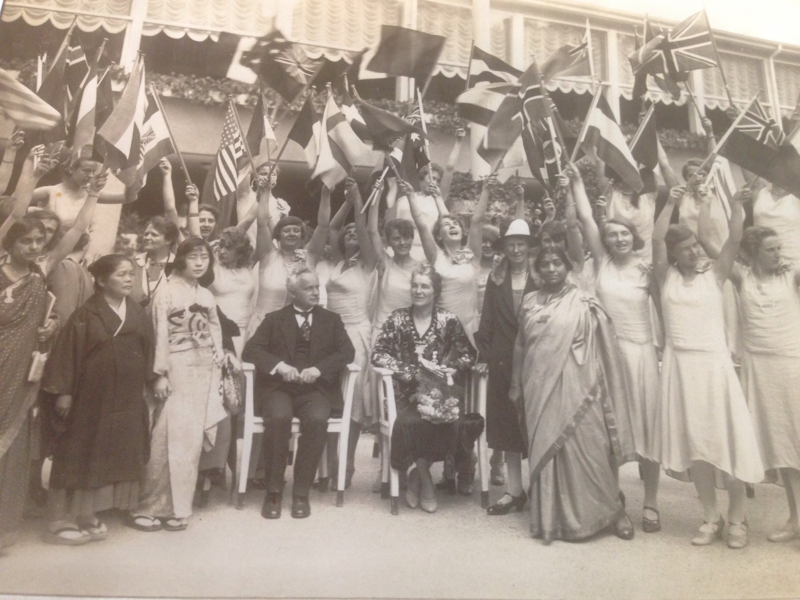
By the end of the decade, nationalist women were using international women’s conferences to send an even stronger message. At the International Alliance of Women for Suffrage and Equal Citizenship Congress in Berlin in 1929 (see figure 1), the Indian delegation, indignant at being ‘huddled under the all pervasive British Union Jack’, communicated their anti-colonial politics by fashioning an Indian National Congress flag from their saris.Footnote 35 Naidu reported back to Gandhi that ‘The East is making a lovely show – Egypt, Turkey, India, Japan, China, and Persia, and for the first time the Indian national flag has found a place among the flags of the world!’Footnote 36
The opening of the International Alliance of Women for Suffrage and Equal Citizenship Congress in Berlin, 1929. Sarojini Naidu in a sari, front right; Kamaladevi Chattopadhyaya, far left. Source: The Women’s Library, London.
Indian nationalist women’s continual rejection of Western leadership assertions in the international arena gradually made an impression – at least among some British women’s organizations. In the summer of 1933, while campaigning on the issue of the women’s franchise in London, Amrit Kaur and Shareefah Hamid Ali worked closely with a network of British women’s organizations that they termed the ‘five friendly societies’.Footnote 37 Unlike more imperialist-minded organizations, which claimed to speak on behalf of Indian women on the basis of their ‘greater experience’, the ‘friendly societies’ committed to listening to Indian women’s demands and acting accordingly. Meeting shortly before the arrival of the Indian women, the British branch of the Women’s International League for Peace and Freedom signalled its intention to ‘wait until the views of the [Indian] Women’s Organisations were known’ before intervening on their behalf.Footnote 38 Subsequently, Amrit Kaur received assurances that the organization would ‘do all in [its] power to make the point of view of the organised women in India known in this country’.Footnote 39 Later, in 1934, members of the ‘five friendly societies’ formed the Liaison Group of British Women’s Societies, which acted as a mouthpiece for Kaur and her allies after they had left Britain.Footnote 40
The stance of the ‘friendly societies’ represents a move towards the recalibration of imperial relationships within international feminism. In contrast to the assumed hierarchies of the imperial order, the terms of these alliances insisted that Indian women had equal status. But, while any suggestion of Western superiority was rejected, the Indian delegation accepted practical support. In fact, links to the ‘five friendly societies’ were crucial in enabling access to influential figures in Geneva.
The Campaign in Geneva
Amrit Kaur and Shareefah Hamid Ali arrived in Geneva in mid September 1933. As hopeful petitioners, they were not alone. The ‘League around the League’ was active all year round but September in Geneva was uniquely busy owing to the influx of delegates, lobbyists, and journalists drawn by meetings of the League Council and annual General Assembly.Footnote 41 Ultimately, the delegation’s campaign to be recognized as the legitimate representatives of Indian women on the League’s Advisory Commission for the Protection of Women and Children was thwarted by the India Office in London, which resisted attempts to bypass its authority. However, the campaign was an opportunity to promote anti-colonial perspectives in Geneva. It also marked a substantive turning point in the history of the AIWC, which now began to establish itself as an independent, internationalist organization with direct links to League and ILO figures. The significance of the campaign lay, first, in the discursive challenge it presented to imperial legitimacy and, second, in the influence gained by anti-colonial Indian women at a non-state level among international bureaucrats and civil society actors.
Given the scepticism felt by leading Indian nationalists towards liberal internationalist institutions in the 1930s, it is not surprising to find that the plan to travel to Geneva was attended by a degree of hesitation among the delegation.Footnote 42 But a new opportunity had opened up on the ‘social’ committees of the League of Nations, and the proximity of Geneva to London (where the women had spent the summer) made the trip logistically tenable. A year earlier, the AIWC had become aware that the make-up of certain League committees was under review and that J. C. Coyajee, the British-appointed Indian representative in Geneva, was seeking to secure Indian representation on the Advisory Commission for the Protection and Welfare of Children.Footnote 43 The AIWC-led delegation’s aim was to ensure that any Indian appointment was jointly approved by India’s three national women’s organizations, which, in practice, meant a figure such as Amrit Kaur who had the confidence of nationalist women.
The prospect of representation on the Advisory Commission offered a unique opportunity for Indian women to undermine the civilizational assumptions that supported the imperial order. The commission was comprised of two committees – the Child Welfare Committee and the Traffic of Women and Children Committee – and fell under the jurisdiction of the League Secretariat’s Social Section. The Indian delegation’s engagement with this work conformed to widespread assumptions in Geneva and beyond about the proper concerns of women. (The handful of female delegates appointed to the League General Assembly invariably found themselves consigned to the Assembly’s Fifth Committee, which dealt exclusively with ‘feminine’ social and humanitarian issues.Footnote 44 ) However, involvement with the Advisory Commission was a chance for Indian women to demonstrate their expertise and, in so doing, challenge the concept of Western ‘tutelage’. ‘Tutelage’ legitimized the League of Nations’ mandates system and was inherent in imperial policy in India, where constitutional reforms purportedly marked the gradual evolution of Indian self-government.Footnote 45 It implied that mandated or colonized peoples were not yet ready to rule themselves. Any international acknowledgement of Indian women’s expertise in field of social reform would suggest otherwise.
The campaign brought Indian anti-colonial ideals to bear on the liberal internationalist rhetoric of self-determination and transnational cooperation. In doing so, it reflected the revitalization of Indian nationalism under Gandhi and the demand for purna swaraj (complete independence) made by the Indian National Congress in 1929. But it also channelled an older cosmopolitan tradition within Indian nationalism, traceable to late nineteenth-century thinkers, that associated colonial self-determination with the greater global good.Footnote 46 In London, Amrit Kaur spoke of this in terms of ‘world brotherhood’, invoking the desire of Indian nationalists to ‘throw off the fetters which [India] feels are binding her and preventing her from fulfilling her mission in the world’.Footnote 47 In Geneva, this was translated as a desire ‘to contribute our mite towards the solutions of world problems’.Footnote 48 The campaign, therefore, combined nationalist and cosmopolitan ideals and refashioned them to produce a new anti-colonial interpretation of liberal internationalism.
The Indian women’s visit to Geneva turned the Advisory Commission for the Protection of Women and Children into a site where the competing interests of imperialism and anti-colonial nationalism clashed. Although an unusual choice for anti-colonial activism, the women’s strategy displays an informed understanding of international diplomacy. In diplomatic terms, the technical work of world governance was an opportunity for state representatives to gain international prestige.Footnote 49 The interest of Coyajee, the Government of India representative, in the Advisory Commission reflects this point. Coyajee, like other Indian liberals, sought to use the League of Nations to promote India on the world stage, albeit within the context of empire.Footnote 50 Likewise, for the British government, India’s proposed appointment to the Advisory Commission was a chance to showcase its credentials as an exemplar of good imperial governance. Consequently, in keeping with imperial policy, the British authorities exerted tight control over the question of Indian representation on the Advisory Commission. Until 1928, the Government of India’s representatives in Geneva had been British officials.Footnote 51 After that point, loyalist Indians filled those positions but the Cabinet Office and the India Office in London maintained control over appointments.Footnote 52
The case for Indian women’s representation at the League was formally made on 27 September, when Amrit Kaur and Shareefah Hamid Ali were joined by Ammu Swaminadhan, an AIWC member, and Keron Bose of the NCWI. The four women made an official submission to the President of the Council of the League of Nations on the joint behalf of the three all-India women’s organizations. The submission was carefully drafted to emphasize the Indian delegation’s legitimacy and expertise alongside internationalist commitments to cooperation and the global good: ‘We constitute one-fifth of the world’s women; we are keenly alive to the vital importance of the Council’s work; we are systematically studying the problems connected with the position, rights and duties of women and could, therefore, co-operate to international advantage.’Footnote 53
The submission to the President of the Council was the centrepiece of the campaign. But further official interactions followed. Some days later, a meeting was held with Harold Butler, the director of the ILO. This elicited information about a forthcoming conference on women’s labour issues and provided an opportunity for the delegation to assert their legitimacy as representatives of India’s three national organizations. Amrit Kaur also joined a delegation organized by the International Council of Women to Joseph Avenol, the Secretary General of the League, where she used the wider campaign for women’s representation in Geneva as a platform from which to make the specific Indian case.Footnote 54
In addition to the formal petitioning of world governance institutions, the women’s campaign sought wider publicity among global civil society and international bureaucrats. It therefore included a busy round of informal lobbying that enabled the women to advance their claims publicly and make useful contacts. Their efforts reached two categories of people. On the one hand were civil society actors, mainly members of international women’s organizations, who were potential allies in the campaign for representation and, more widely, influencers of global public opinion. The second group comprised influential League and ILO officials, including Eric Einar Ekstrand and Gabrielle Radziwill of the Social Section, who, it was hoped, might support Indian women from within.
The delegation’s non-official interactions relied on transnational connections established during the women’s visit to London during the summer. Their activities there had created momentum, enhancing their profile and securing allies who were willing to support their claims. The most practical support in Geneva came from Agatha Harrison, a prominent member of the Women’s International League for Peace and Freedom, the YWCA, and the Indian Conciliation Group, an organization established in 1931 to promote the Indian nationalist cause in Britain.Footnote 55 Harrison was well connected in League circles, where she was recognized as an expert in industrial and social welfare, and enjoyed a close relationship with Ekstrand, the director of the League’s Social Section. She became a crucial link to international civil society, arranging meetings and speaking opportunities to enable the Indian delegation to reach an international audience.Footnote 56
The campaign of 1933 was the first time that an Indian women’s organization had claimed a formal role in world governance. But Kaur and Hamid Ali were undoubtedly aware of the workings of Geneva civil society prior to their visit. In 1928, the AIWC’s co-founder, Margaret Cousins, had been part of a ‘Women’s Deputation’ to the President of the League of Nations. Cousins was enthusiastic about the possibilities of Geneva, which she described on her return to India as ‘a city to which people from every country in the world come to exchange ideas and to help in making a unified world-consciousness and a resultant world-peace’.Footnote 57 Three years later, the All Asian Women’s Conference, a meeting that Kaur helped organize, appointed a liaison officer tasked with establishing relations between the conference executive and ‘Geneva and international organisations’.Footnote 58 In the event, this overture amounted to little, but it established a blueprint that would guide later interactions with international civil society.
The Indian women’s visit coincided with an international effort to increase the role of women at the League, which, for many feminists, was ‘the key to equality’, the hope of peace, and an important site for feminist activism.Footnote 59 The international women’s movement was by no means united in terms of ideology and method and, indeed, by the 1930s there existed a substantial amount of scepticism about the value of the League.Footnote 60 However, in 1931, the Liaison Committee of Women’s International Organisations was formed to streamline the work of women’s organizations in Geneva and, within the League Secretariat itself, a liaison officer, Gabrielle Radziwill, was appointed as an official point of contact. Amrit Kaur was introduced to the strategy of the women’s Liaison Committee by contacts in London. ‘What we do here’, explained one correspondent, ‘is to press our Government to include women in the British delegations to the Assembly and to the International Labour Conference.’Footnote 61 This established framework provided the delegation with structure and a network of potential allies.
In civil society circles, the women asserted their anti-colonial claims more explicitly than in official representations. Hamid Ali spoke at an event billed as the ‘Third International Conference for India’, which publicized examples of British repression and passed resolutions in favour of Indian independence.Footnote 62 At a reception hosted by the YWCA, Hamid Ali and Amrit Kaur spoke on the social and political work of the women’s movement and described how nationalist India sought ‘free and full development within her own borders’ so that she might ‘make her real contribution to the solution of international problems’.Footnote 63 The Women’s Disarmament Committee meeting presented an opportunity for the women to air grievances about the British use of force to put down protests in India; at the same time, they argued for Indian representation at the League on the grounds that ‘there could not be any world peace if the East was excluded from Geneva’.Footnote 64
The AIWC’s supporters declared the campaign a great success. Una Saunders of the World’s YWCA reported the ‘joy and enlightenment which the visit of these last few days has brought to many of us here in Geneva’ and described Kaur’s work there as ‘epoch-making’.Footnote 65 In London, the Women’s International League Executive noted ‘the very warm welcome which had been extended to [Kaur and her colleagues] from all quarters, including the L.N. Secretariat and the I.L.O.’Footnote 66 Amrit Kaur herself also painted a hopeful picture, reporting to colleagues that the President of the Council was receptive to their democratic claims: ‘he was particularly interested to hear that we were elected representatives of the Women’s organisations and actually made a note of this fact’.Footnote 67
Meanwhile, the strategy of securing allies among global civil society and the League Secretariat seemed to have paid off. A month after the visit to Geneva came confirmation that the Council of the League of Nations had invited India to serve on the Advisory Commission for the Protection and Welfare of Children, which immediately raised the question of who should be appointed. The delegation had repeatedly demanded that any Indian representative should be selected from one of the three all-India women’s organizations. Now that they were back in India, Edith Bigland of the Joint Standing Committee of Women’s International Organisations advocated on their behalf, writing to the President of the Council in October to press their case. She also wrote to Amrit Kaur to ask for information about possible candidates. ‘If we can know their names quickly,’ she urged, ‘we will do our best to support them.’Footnote 68
Building on earlier interactions with the international women’s movement, the campaign in Geneva made gains in establishing the legitimacy of Indian women on the world stage. Their claims wore away at the logic of civilizational superiority that underpinned the imperial order. They also made more explicit criticisms of British rule in India, further undermining the imperial system. Additionally, in practical terms, they secured international allies who would continue to support their cause in the coming years. Perhaps the most path-breaking achievement was the forging of relations with members of the League Secretariat. A few months after the women’s visit, Gabrielle Radziwill of the League’s Social Section sent Kaur a collection of League documents on the work of the Advisory Commission.Footnote 69 This act bypassed the imperial authorities entirely and established a relationship between the AIWC and world governance that would outlast the British Raj.
Consolidation and war, 1933–39
Throughout the 1930s, amid rising disillusionment regarding the League of Nations’ diplomatic functions, the ‘technical’ work of international institutions continued. British imperial authorities maintained control over official appointments, just as the Indian nationalist leadership remained aloof from the League. But by persistently building on relationships established in Geneva in 1933, the AIWC carved out a non-state role as a correspondent of the Social Section of the League and the ‘Women’s Work’ section of the ILO. India was years away from independence, which only appeared more certain after the end of the Second World War, but nationalist members of the AIWC were, in effect, already working outside the framework of empire. This signalled a gradual shift in the internal dynamics of world governance institutions and foreshadowed the more inclusive practices adopted by the United Nations in subsequent decades.
After returning to India in late 1933, Amrit Kaur continued as the driving force behind the AIWC’s Geneva-facing activities. One of her first suggestions to the AIWC executive was the creation of the new office of ‘liaison officer with Europe’ – a position that held responsibility for maintaining contact with international women’s organizations, the League Secretariat, and the ILO. Kaur herself was appointed to this role, followed, in 1935, by Shareefah Hamid Ali. Thereafter, as lines of communication became better established, interactions between the AIWC and Geneva were incorporated into the work of the AIWC’s honorary organising secretary. In projecting itself as the authentic, independent voice of Indian women, the AIWC distinguished itself from the NCWI, an affiliate of the International Council of Women, which also remained in touch with the League and the ILO.
Initially, however, the AIWC’s status in Geneva was uncertain. Ignoring a list of six women candidates organized by Amrit Kaur and approved jointly by the three national women’s organizations, the India Office installed their own choice of delegate on the Advisory Commission for the Protection and Welfare of Children. The appointment they made, in February 1934, was Radhabhai Subbarayan, a social reformer and the wife of a former chief minister of Madras. Insiders referred to her as ‘a very able lady … a good choice but of course not the best’. She also, reportedly, ‘enjoy[ed] the confidence of the Government of India’ and was seemingly untainted by nationalist associations.Footnote 70 Kaur’s objection that Subbarayan was ‘a woman who has never been a working member of any of our organisations’ no doubt made her all the more suitable in the eyes of the imperial authorities.Footnote 71 Kaur was further displeased by the additional appointment of Subbarayan to the ILO’s conference on labour conditions in June 1934. Writing to a British contact, she complained that ‘I am sure [Subbarayan] has never been inside an Indian Factory or mill whereas we have special women members detailed to study Labour conditions in particular.’Footnote 72
Subbarayan’s two appointments set the tone for imperial policy relating to ‘women’s issues’ in Geneva. For the remainder of the League’s existence, the India Office would pointedly ignore the nationalist voice emanating from the Indian women’s movement and instead appoint loyalist figures. However, at the same time, Kaur and others in the AIWC sought to maintain relations at an alternative, non-state level by communicating directly with international bureaucrats. Undeterred by Subbarayan’s appointment, Kaur commissioned a special report for submission to the ILO conference, arguing that ‘there is no harm in our making our views known through our own agency’. ‘In fact’, she added, ‘we should do so.’Footnote 73 Determined that the report should hit the target, as well as sending it to the ILO, she sent a copy to her new contact Eric Einar Ekstrand: ‘Please be kind enough’, she urged, ‘to use your influence and help us to get the questions mentioned in this memorandum considered at the International Labour Conference.’Footnote 74
Over time, the determination of Amrit Kaur to consolidate direct relations with Geneva-based officials bore fruit. From a strategic point of view, she was probably right in her instinct that ‘it was essential for us to send in something to the [ILO] Conference in order to strengthen our hand for the future’.Footnote 75 Indeed, from 1935 onwards, the AIWC was reporting annually to the ILO, and the ILO was publishing these reports in its publication, Industrial and Labour Information.Footnote 76 During the same period, the Indian branch of the ILO, which reported monthly to the ILO headquarters in Geneva, included news of AIWC activities in its dispatches.Footnote 77 In December 1938, these connections were cemented when P. M. Hage of the ‘Women’s Work’ section of the ILO travelled to India and met with AIWC figures. The connection with the ILO strengthened the AIWC’s authority as an agent of reform in India and gave the organization an international presence.
The AIWC also maintained a direct relationship with the League of Nations Social Section, chiefly through knowledge-exchange activities. The League Secretariat shared expertise on issues such as sanitation and hygiene, maternity and child welfare, education, and women’s labour. In return, AIWC officers responded with news from India. A typical missive might include a report on AIWC work being carried out, for example, in training Indian midwives or promoting child nutrition, or a list of AIWC resolutions on issues such as maternity care, prostitution, and child labour.Footnote 78 These reports, which were received in Geneva with assurances that they were of ‘immense value’ to the social work of the League, provided evidence of Indian women’s expertise, and lent the AIWC credibility and prestige.Footnote 79
The relationship with the League Social Section took on a more concrete turn in February 1937 with the convening of the Conference of Central Authorities in Eastern Countries in Bandung on the subject of Traffic in Women and Children. India was represented by the AIWC chairman, Mrs S. C. Mukerjee – an appointment that appeared to legitimize the AIWC as the sole representative of Indian women.Footnote 80 On his way back from Bandung, Erik Einar Ekstrand, who had served as secretary-general of the conference, conducted a lecture tour of India upon the invitation of the AIWC. Indicating the respect that the AIWC had attracted in Geneva, Ekstrand later praised the AIWC’s organising secretary, Ammu Swaminadhan, ‘who so efficiently and with such great competence organised the tour’.Footnote 81
Later in 1937, the AIWC was appointed a ‘correspondent member’ of the League’s Advisory Committee on Social Questions, which no doubt came about owing to the organization’s careful nurturing of its relationship with the League’s Social Section. This was not a state-level appointment. Rather it was an official advisory role created for the purpose of ‘keeping the Committee in touch with voluntary movements in different countries’.Footnote 82 The official remit of a correspondent member included the ‘privilege’ of receiving materials from the committee and the opportunity of raising issues of concern. The criteria for the appointment included being internationally affiliated ‘in a substantial number of countries’, employing a ‘full-time secretariat’, and ‘carrying out an active programme of work’.Footnote 83 As far as the Social Section was concerned, the AIWC had convincingly demonstrated its credentials as experts in social reform. Notably, the AIWC was now explicitly advertising its stance as an organization engaged in social and educational work of a ‘nation-building character’, a process that foreshadowed formal decolonization.Footnote 84
The collapse of the interwar system of world governance after 1939 was a blow to the AIWC’s rising status in Geneva. Among the last pieces of correspondence to reach the AIWC was a letter from the ILO’s P. M. Hage in December 1939 declining an invitation to the AIWC’s annual meeting because the international situation made travel to India impossible.Footnote 85 The situation inside India also became critical. Because the Government of India declared war on India’s behalf without consulting Indian nationalist leaders, official Indian National Congress policy opposed the war effort and the AIWC followed suit. This tested transnational bonds of feminist solidarity. Several British feminists, including members of the ‘five friendly societies’ who had previously given unconditional support to Indian women’s campaigns in London and Geneva, signed an open letter to the women of India urging them to support the war effort. The response from a group of prominent Indian women, including Amrit Kaur, reflected an intractable tension between anti-colonial women and their British counterparts, which, while the war continued, proved impossible to resolve: ‘As we see the reality, it is this. It is a war between the British Empire and Nazis and Fascists for world domination, meaning in effect exploitation of the non-European races. We cannot be in love with Nazism and Fascism. But we may not be expected to be in love with British Imperialism.’Footnote 86
The gains made by anti-colonial women in Geneva during the 1930s could not be sustained during the war. Few allies in Europe accepted the Indian nationalist position on the war, while interactions with Geneva became impossible as the League of Nations ceased to function. However, the AIWC’s interactions with world governance in the 1930s contributed to longer-term shifts in the dynamics of international institutions. In a general sense, their activities affirmed their right to self-representation and wore away at negative cultural stereotypes that underpinned the imperial system. More specifically they established the AIWC as an internationally respected, expert organization in the field of social reform. While these developments counted for little in the short term, they were deeply rooted enough to be significant as the world transitioned to a new order after the Second World War.
Epilogue
Despite ruptures caused by the war, the AIWC’s interactions with world governance in the 1930s link the League of Nations to its successor, the United Nations. In April 1945, the San Francisco Conference on International Organization was called, the purpose of which was to bring the new system of world governance into being. Meanwhile, in India, the leadership of the Indian National Congress (with the exception of Gandhi) was in jail, having been imprisoned in 1942. As the San Francisco conference opened, many around the world protested the exclusion of nationalist figures from the Indian delegation, which, critics claimed, was made up of British ‘stooges’. Among those raising an objection was the AIWC, which found international expression through its links to the Liaison Group of British Women’s Societies established by Amrit Kaur over a decade earlier. In solidarity, the Liaison Group organized a public appeal to the British government demanding that the nationalist leadership be released from prison so as to be available to attend the San Francisco conference: ‘At a time when plans are being made for the post-war world’, the appeal stated, ‘we share the Indian Women’s concern that their trusted leaders should take their rightful place in national and international affairs.’Footnote 87
The most visible critic of the British-appointed Indian delegation was Vijaya Lakshmi Pandit, a former AIWC president and the sister of Jawaharlal Nehru, who ran an unofficial campaign in San Francisco as the ‘sole spokesman’ for India. Her campaign, which combined formal petitioning with unofficial lobbying at the level of civil society, was in many ways reminiscent of her AIWC colleagues’ Geneva campaign and built on international prestige established by them in the 1930s. As India transitioned to independence and in the decade that followed, Pandit became a prominent figure at the United Nations, most notably as the President of the General Assembly in 1953.
Within a few months of the San Francisco conference, the situation in relation to Indian representation was beginning to change. In November 1945, Amrit Kaur took her place as the delegate for India at the inaugural meeting of UNESCO, where she was also appointed a vice-president of the conference. In a speech at this meeting, Kaur combined her urgent call for international cooperation with a strong Gandhian message on non-violence, her remarks asserting Indian moral leadership as a remedy for the destruction of the Second World War.Footnote 88 Kaur’s appointment at UNESCO broke new ground in its elevation of an anti-colonial woman, signalling the beginning of a new international era. But her career suggests continuity. Her international appointments at UNESCO and, later, the World Health Organization built on experience gained in world governance during the 1930s. There is also notable coherence in her ideas. In Geneva she campaigned for Indian women to be allowed to ‘contribute our mite towards the solutions of world problems’.Footnote 89 In 1949, as Minister for Health in India’s first independent cabinet, she articulated her mission as ‘mak[ing] of India a country which will help lead this troubled world into the paths of peace’.Footnote 90
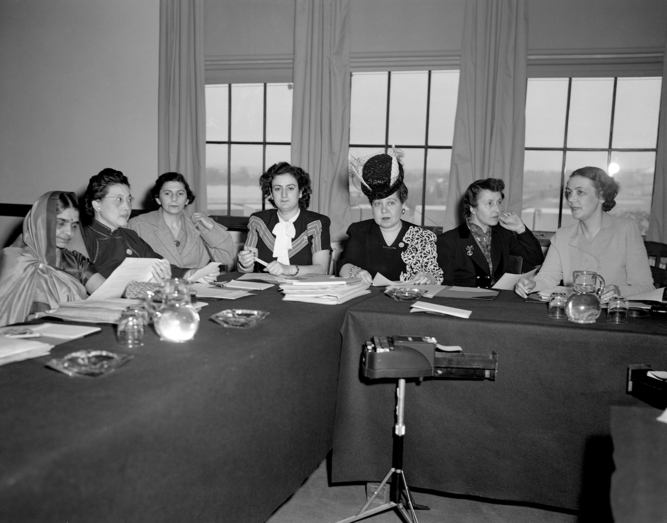
‘Transfer of power’ negotiations began in India shortly after the end of the war, culminating, in August 1947, with the partition of the subcontinent and the creation of the independent nation-states of India and Pakistan. As the attention of the Indian National Congress shifted from resistance to governance, the interim government led by Jawaharlal Nehru appointed Hansa Mehta, the then president of the AIWC, as India’s representative on the newly formed United Nations Sub-Commission on the Status of Women (see figure 2). In many ways, Mehta was a symbol of change and historical rupture, her appointment advertising the soon-to-be-independent status of India, the global leadership role that the new state hoped to play, and the possibility of a new world order. Her work on the Sub-Commission asserted Indian women’s authority in the field of social work, seemingly consigning the civilizing claims of imperial rule to the past. Notably, she introduced to the Sub-Commission the ‘Indian Women’s Charter’ as a blueprint for women’s rights globally.Footnote 91 These AIWC-drafted recommendations would go on to form the basis of the United Nations approach to gender equality, reflecting new possibilities for feminist internationalism in a decolonizing world.
Members of the Sub-Commission on the Status of Women, 8 May 1946. Left to right: Hansa Mehta, India; Way Sung New, China; Fryderyka Kalinowska, Poland; Angela Jurdak, Lebanon; Minerva Bernardino, Dominican Republic; Marie Hélène Lefaucheux, France; Bodgil Begtrup, Denmark. Source: UN Photo.
At the same time, Mehta was a figure of continuity. As a representative of the AIWC, she brought to the United Nations experience gained from links to transnational civil society and intergovernmental organizations in the interwar years. Reflecting these connections, she was among those on the Sub-Commission to recommend that the United Nations’ work on gender equality be linked to global civil society so as to maintain independence from state authorities.Footnote 92 Moreover, her assertion of Indian leadership in this work was not so much a break from the past but a continuation of the AIWC-led campaign in Geneva. It built on claims made and, to some extent, accepted within the framework of world governance in the 1930s, and continued the slow, quiet process of delegitimizing empire below and beyond the politics of state.
Conclusion
The ‘technical’ work of world governance opened up a distinct, gendered opportunity for anti-colonial Indian women to engage with the international community. By developing and exploiting global civil society networks, they were able to use this opening to gain international recognition as agents of reform. In doing so, they chipped away at the legitimacy of the imperial system – a world order that sustained not just imperial states but also the below-state-level dynamics of women’s transnational civil society networks. This discursive undermining of imperialism was an essential component of geopolitical decolonization. But the campaign in Geneva also prepared the ground for a new world order in more practical ways. When national independence came, Indian women associated with the AIWC were well placed to build on prestige and experience amassed during the interwar period. This served the interests of the new Indian state as it sought to establish itself as a leading force of decolonization after the end of the Second World War. This may be contrasted with the position of Pakistan, which lacked an internationally experienced women’s organization and was not so quickly integrated into the social work of the United Nations.
The role played by the AIWC in Geneva has implications for how we think about the history of liberal internationalism. Although leading anti-colonialists viewed the League of Nations as a ‘tool in the hands of the great powers’, Indian women’s involvement with international institutions in the 1930s suggests a more complex history.Footnote 93 Far from being a static bastion of the imperial order, interwar world governance was dynamic and evolving. Over time, it developed – transnationally and below the level of the state – through the agency of civil society activists. Indian women’s interventions in and around world governance shifted the terms of liberal internationalism and, incrementally, helped reshape global institutions. Asymmetries of power and negative cultural assumptions remained. But their activism began to normalize the integration of non-Western women and their ideas into international institutions in a process that ran ahead of geopolitical developments.
The AIWC’s interactions with world governance reflect some of the nuances of decolonization as a historical phenomenon. Just like the imperial frameworks it disrupted, twentieth-century decolonization implies a range of geopolitical, economic, and social processes that took place in multiple locations across uneven timescales. This includes the activities of women working through the movement for social reform in the arena of world governance. It is of course true that many of the cultural assumptions and global inequalities associated with European imperialism persisted well beyond the end of empire. But, conversely, it is also the case that AIWC activists were successfully eroding the legitimacy of the imperial order decades in advance of formal independence. Nationalist women working within the Indian women’s movement made imaginative use of the framework of interwar world governance to confront the political and social structures of the interwar world order. By subverting the ‘civilizing’ logic of European imperialism while at the same time working for the reform of society, they made available a possible global future where colonial freedom was compatible with international cooperation and advances for women.
Rosalind Parr is Lecturer in Modern History at the University of St Andrews. Her research interests centre on the transnational histories of Indian activists in the twentieth century with a focus on gender, knowledge exchange, and cosmopolitanism. She is completing a book on the international careers of anti-colonial Indian women during the 1920s and 1930s.



