

INTRODUCTION
Speakers’ oral fluency depends to a large extent on their ability to execute the conceptualization and formulation of messages effectively and on their ability to translate formulated messages into articulatory actions smoothly during the speech production process. However, speakers differ greatly in their speaking skills and whereas some manage to communicate fluently, others’ speech is characterized by various dysfluent phenomena, such as clause-internal pauses or lexical repetitions and reformulations, which reflect inefficient functioning causing a fluency breakdown at any of the stages in the speech production process (Segalowitz, Reference Segalowitz2010). This study investigates to what extent fluency in spontaneous speech in both first (L1) and second (L2) languages can be explained by individual differences in articulatory skills. Differences in speaking fluency are apparent when people speak in their native language and, as has been shown across different language pairs, these differences carry over to how people speak in their second language (De Jong, Groenhout, Schoonen, & Hulstijn, Reference De Jong, Groenhout, Schoonen and Hulstijn2015; Derwing, Munro, Thomson, & Rossiter, Reference Derwing, Munro, Thomson and Rossiter2009; Towell & Dewaele, Reference Towell, Dewaele and Dewaele2005). Individual differences in L2 fluency can therefore only partly be accounted for by differences in L2 proficiency. Another substantial part of this individual variability can be attributed to personal ways of speaking that surface in both L1 and L2 speech.
Where do such individual differences between speakers come from? This report investigates one potential source of these individual differences, namely individual variability in skills speakers need to resort to in the very last stage of speech production: articulation. Previous research has shown that normally developed speakers without any speech impairment may differ in their L1 articulatory skills. Some speakers can implement completed speech plans into overt articulation faster and more efficiently than others and some may accomplish articulatory plans more accurately and fluently as overt speech unfolds in time by moving their articulators at more efficient rates than others (Johnson, Ladefoged, & Lindau, Reference Johnson, Ladefoged and Lindau1993). The research reported here investigates the relation between individual differences in articulatory skills and individual differences in L1 and L2 speaking fluency in semispontaneous speech.
L2 FLUENCY: PROFICIENCY OR SPEAKING STYLE
Research on individual differences in L2 speaking fluency has usually focused on explaining such differences by L2 proficiency. For most speakers, L2 speech is less fluent than their L1 speech (Derwing et al. Reference Derwing, Munro, Thomson and Rossiter2009), and L2 speech is more fluent for higher proficiency speakers than for lower proficiency speakers (De Jong, Reference De Jong2016; Riazantseva, Reference Riazantseva2001), suggesting that as speakers become more proficient (and presumably can rely more on automaticity), the less often they encounter problems during the linguistic formulation of messages. This is further evidenced by findings showing that L2 fluency increases over time with increased L2 experience and proficiency (Segalowitz & Freed, Reference Segalowitz and Freed2004).
In addition to explaining individual differences in L2 fluency by proficiency or L2 experience-related factors, researchers have shown that aspects of L2 fluency can carry over from how speakers speak in their L1. Towell and Dewaele (Reference Towell, Dewaele and Dewaele2005) measured speech rate in 12 L2 learners of French recounting a cartoon film and reported strong correlations between L1 (English) and L2 (French) speech rate before and after a 6-month stay abroad. Derwing et al. (Reference Derwing, Munro, Thomson and Rossiter2009) obtained temporal measures of L2 fluency from L1 Slavic and L1 Mandarin beginning learners of English in a narrative picture-based task at three points in time (2, 10, and 12 months) after their arrival in Canada. L1 and L2 temporal fluency measures correlated significantly for both groups after two months, and still after 10 and 12 months for the L1 Slavic group. In another study correlating a number of fluency measures between L1 and L2, De Jong et al. (Reference De Jong, Groenhout, Schoonen and Hulstijn2015) had L1 English and L1 Turkish speakers with intermediate to advanced proficiency in L2 Dutch carry out eight speaking tasks in each language, matched in difficulty and setting for L1 and L2. All measures of L1 and L2 fluency correlated significantly and equally strongly for both groups. To summarize, even though the strength of the relationship between L1 and L2 fluency may depend on L1 group and proficiency level, research has generally found medium to strong correlations between L1 and L2 fluency measures.
We may therefore conclude that part of the individual differences in L2 fluency are related to a given set of speech features that identify a speakers’ personal speaking “style” (as they surface similarly in both L1 and L2 speech) and only part of the individual differences can be traced to (lack of) L2 proficiency and automaticity specific to L2 speaking. Understanding better which aspects of L2 fluency, and to what extent, qualify as manifestations of speaking style rather than L2 proficiency and L2 automaticity is useful and informative in validating speaking tests and in teaching L2 speaking, as such aspects may not be amenable to instruction. Aspects of fluency that (mainly) reflect personal speaking style can be argued to be inadequate as measures of L2-specific speaking proficiency because they do not reflect developmental gains in L2 oral ability or speech production skills.
POTENTIAL SOURCES OF INDIVIDUAL DIFFERENCES IN SPEAKING FLUENCY
Speaking is an incremental process, such that speakers may articulate a previously planned utterance while conceptualizing and formulating the next utterance. If, at any of the stages in speaking, a speaker encounters a difficulty while executing the previously completed speech plan, the articulation process may be momentarily discontinued, resulting in a disfluency. Such a disfluency may be a silent pause, a filled pause, or a repetition or reformulation of a previously articulated utterance. The frequency and nature of disfluencies has been shown to depend on the linguistic context. For example, pauses are more frequent and longer at major syntactic boundaries than within clauses (e.g., Riazantseva, Reference Riazantseva2001 for L2; Swerts, Reference Swerts1998 for L1), and articulating words with complex syllable onset clusters (#CCV-) and polysyllabic words is harder than articulating words with simple onsets (#CV-) and monosyllabic words (Meyer, Roelofs, & Levelt, Reference Meyer, Roelofs and Levelt2003).
Speaking involves a number of stages in speech planning (e.g., Levelt, Reference Levelt, Brown and Hagoort1999). To communicate successfully and fluently, a speaker needs to make the processes at each of the stages of speech production run efficiently. Speaking can therefore be broken down into a number of subskills: a skill to conceptualize the preverbal message, a skill to retrieve the intended lexical items quickly along with their morphosyntactic and phonological characteristics, and skills to phonetically encode phonological representations and send motor programs to the articulators to produce intelligible sounds. According to Levelt, Roelofs, and Meyer (Reference Levelt, Roelofs and Meyer1999), the main processes during conceptualizing a message are preverbal, and the main individual trait that can therefore be hypothesized to underlie the conceptualizing skill is nonverbal intelligence. Executive control skills (working memory, attention, and inhibition) have also been shown to play a role during L1 speech production (Shao, Roelofs, & Meyer, Reference Shao, Roelofs and Meyer2012) and are hypothesized to play an even larger role in L2 speaking (Meuter & Allport, Reference Meuter and Allport1999). During formulation in speech production, lexical, morphosyntactic, and phonological knowledge play a role, presumably more so for the L2 than for the L1, simply because we expect more interspeaker variation in L2 than in L1. Finally, for the last stages of speech production, motor skills in articulation are hypothesized to play a role (Van Zaalen-op’t Hof, Wijnen, & De Jonckere, 2009). Intersubject differences in articulatory fluency, which we can define as a speakers’ ability to efficiently, rapidly, and accurately accomplish articulatory targets to produce speech sounds in running speech, might be related to temporal measures of utterance fluency in the L1 and the L2.
In the current research report, we focus on this last stage of speech production and investigate to what extent individual differences in articulatory skills may be predictive of individual differences in L1 and L2 fluency.
RESEARCH QUESTION
In the present study we address the following question: Do measures of fluency in L1 and L2 relate to measures of articulatory skill?
We hypothesize that fluency in spontaneous speech, irrespective of language, depends in part on individual differences in how fast and efficiently an individual can accomplish articulatory targets in the production of sound sequences (i.e., in articulatory skills). In addition, differences also exist between speech motor control in the L1 and the L2, as perceptual categories for sounds are less accurately defined in the L2 than in the L1 and this leads to less accurate articulation of sound targets (Franken, McQueen, Hagoort, & Acheson, Reference Franken, McQueen, Hagoort and Acheson2015), and less efficient integration of motor and sensory control in the L2 than in the L1 (Simmonds, Wise, Dhanjal, & Leech, Reference Simmonds, Wise, Dhanjal and Leech2011). We therefore hypothesize that L2-specific measures of articulatory skills will be stronger predictors of L2 spontaneous fluency than L1 measures of articulatory skills.
In addition, the present study also aims to replicate earlier studies that have investigated the relation between L1 and L2 fluency for a new language pair, namely for L1 Spanish and L2 English. Here we predict that measures of fluency in L1 Spanish are related to measures of fluency in L2 English.
Method
Participants performed three picture-based speaking tasks in the L1, and three comparable tasks in the L2 from which L1 and L2 fluency measures were obtained. To measure participants’ articulatory skills, we chose two tasks. The first task, the delayed picture-naming task, is typically used in psycholinguistic studies to investigate articulatory processes. Whereas immediate picture naming reflects all processes from picture recognition up to preparing and articulating the picture’s name, delayed picture naming isolates the stages after accessing the phonology—thus the articulatory processes (Barry, Hirsh, Johnston, & Williams, Reference Barry, Hirsh, Johnston and Williams2001). The second task, the diadochokinetic (DDK) task, was a speeded syllable production task used by speech-language pathologists to assess articulatory speed when diagnosing speech disorders (e.g., Yang, Chung, Chi, Chen, & Wang, Reference Yang, Chung, Chi, Chen and Wang2011). The tasks were administered in the same order for all participants in two sessions: Participants performed the L1 speaking tasks, the L2 speaking tasks, the L1 delayed picture-naming task, and the DDK task in session 1, and the L2 delayed picture-naming task and the L2 vocabulary size tests in session 2, approximately 1 week later.
PARTICIPANTS
The participants were 51 upper-intermediate adult L1 Spanish learners of English (M age = 22, SD = 4.2) who had started learning English in a foreign language school environment, where they had received instruction in L2 English (3 to 4 hours per week for about 9 years) by L1 Spanish teachers (age of onset of L2 learning: M = 6.4, SD = 3.7) in Spain. They did not use English regularly outside the instructional context. Their vocabulary size in English ranged from 3,350 to 8,200 words (M = 6144, SD = 1161) as measured through X/Y_Lex vocabulary size tests, indicating an upper-intermediate to advanced level of proficiency (Meara & Miralpeix, Reference Meara and Miralpeix2016). One participant was excluded due to incomplete data.
MATERIALS AND PROCEDURES
Speaking Tasks
To gauge fluency in L1 and L2 speaking, three speaking tasks were chosen and translated into Spanish from the L1 speaking tasks in De Jong et al. (Reference De Jong, Groenhout, Schoonen and Hulstijn2015). These tasks were a formal descriptive task (B1 level, see Hulstijn, de Jong, Steinel, Florijn, & Schoonen, Reference Hulstijn, de Jong, Steinel, Florijn and Schoonen2012), a formal persuasive task (B2 level), and an informal persuasive task (B2 level). Three tasks that matched the L1 speaking tasks in type and difficulty were also taken from the same study for gauging L2 English fluency. Participants navigated the tasks themselves. Each task started with two screens that provided detailed visual and written information about a communicative situation. After a set time of up to 17 seconds, participants had 30 seconds to prepare their response (shown through a colored countdown shrinking time bar). A similar larger time bar then appeared prompting participants to speak for up to 120 seconds (or less). Participants were encouraged to imagine they were in the situation described. As a warm-up, participants carried out a practice task in which they had to tell a friend about the research project in which they were participating.
Delayed Picture-Naming Tasks
Two delayed picture-naming tasks were administered, one in L1 Spanish and one in L2 English. Seventy easily identifiable line drawings of common objects were chosen from Snodgrass and Vanderwart’s (1980) set of standardized pictures. Thirty-five pictures were presented for naming in Spanish and the other 35 pictures for naming in English. The purpose of this task was to obtain a measure of how fast speakers could set their articulators in motion once processes involving phonetic encoding and articulatory planning are over. Thus, this measure of articulatory skill was deemed appropriate for relating articulatory skills in L1 and L2 to L1 and L2 fluency measures, respectively. Because our focus was on relationships within languages, rather than on comparisons between L1 and L2, we were not concerned about matching the pictures on lexical frequency (frequency per million words in Spanish: M = 31.5, SD = 71.1, min = 0.31, max = 402.5; and in English: M = 84.4, SD = 102.6, min = 32, max = 483.1), word onset complexity (Spanish: 23 CV-, 1 CCV-, 6 VC-; English: 22 CV-, 6 CCV-, 2 VC-), or word length in number of phones (Spanish: M = 5.89, SD = 1.69; English: M = 3.51, SD = 0.89).Footnote 1
The L1 and L2 delayed picture-naming tasks consisted of a familiarization section and a test section. In the familiarization section participants named the 35 objects appearing on the screen after a fixation cross. When naming each object, feedback on naming accuracy was provided by the target word appearing underneath, so that participants could check that their naming was correct. If wrongly named, participants correctly renamed the object. Immediately after the practice section, participants performed the test section, which consisted of the same 35 objects previously named. However, in the test section no feedback was provided, and participants were instructed to name the object as fast as they could immediately after a naming cue, which consisted of the simultaneous presentation of a green border around the picture and a 200-ms beep sound. The naming cue was presented after the object appeared on the screen with an unpredictable varying time delay (1,000–1,500 ms). The inter-stimulus interval (ISI) in the test session was between 4,000 and 4,500 ms (fixation cross = 1,000 ms + picture = between 1,000 to 1,500 ms + picture with green border = 1,000 + blank screen = 1,000). The test session contained five practice trials before the 35 experimental trials. Both the practice and the test sessions were digitally recorded through a Shure SM58 microphone and a PreSonus Audiobox 44VSL sound card. The vocal responses and the beep sound were simultaneously recorded onto a Marantz PMD660 recorder (44.1 kHz, 16-bit) onto different channels.
Diadochokinetic Task
To gauge the skill of moving the articulators fast and efficiently, we employed the DDK task (Yang et al., Reference Yang, Chung, Chi, Chen and Wang2011), which is often used in the diagnosis of motor speech disorders in children and adults (Gadesmann & Miller, Reference Gadesmann and Miller2008). In this task, participants were asked, after some practice, to pronounce sequences of the syllables /pa/, /ta/, /ka/, /pa.ta/, and /pa.ta.ka/ as fast as they could for approximately 5 seconds. The sequences /pa.ta/ and /pa.ta.ka/ required participants to rapidly change the place of articulation of stop closures (labial-alveolar and labial-alveolar-velar, respectively) and consequently the number of sequences participants could produce by time unit would reflect interspeaker variation in articulatory speed (Fletcher, Reference Fletcher1972). The researcher demonstrated the task while written instructions appeared on the computer screen asking participants to repeat the syllable(s) as fast and as accurately as possible. A PowerPoint presentation showed a “start” sign that prompted participants to start producing repetitions of the target syllable. Participants performed five such tasks, one for each of the syllables “pa,” “ta,” “ka,” “pata,” and “pataka” in this order. Their productions were recorded with the same equipment described in the preceding text.
Measures
To measure fluency in L1 and L2 speech, we opted for automatic measures of fluency. For each participant, we separately concatenated the three speaking tasks in the L1 and in the L2 to gain robust measures for L1 and L2 fluency, respectively. This led to total durations in L1 and L2 ranging from 62 to 295 and 53 to 333 seconds, respectively. We used the script written in Praat (Boersma & Weenink, Reference Boersma and Weenink2016) by De Jong and Wempe (Reference De Jong and Wempe2009) to extract the number of syllables, the number and durations of all silent pauses and total duration of speaking time. This script measures the intensity of the signal and detects syllable nuclei as voiced peaks (surrounded by dips) in intensity. De Jong and Wempe (Reference De Jong and Wempe2009) showed high correlations (> .8) between automated and manual measures, for longer stretches of speech such as those used in the current study. We set the silence threshold to -25 dB, minimum dip as 2 dB, and used 250 milliseconds as minimum duration for silent pauses, as recommended by De Jong and Bosker (Reference De Jong, Bosker and Eklund2013). From the raw measures obtained from the script we calculated, for both L1 and L2, the following fluency measures: mean syllable duration (i.e., inverse articulation rate), the number of silent pauses per minute (speaking time), and mean duration of silent pauses.
From the delayed picture naming, we measured response latency (RT) to 1-millisecond accuracy as the onset time difference between the onset of the auditory cue (recorded in channel 1) and the onset of the vocal response (recorded in channel 2) extracted through a script written in Praat. Unnamed or wrongly named trials (16 out of 3,150 trials, or 0.5%) were excluded from analysis. For both measures in both languages, we set the maximum response time to 3 SD above the grand mean. In this way, 1% of all articulation latency and articulation duration measures were removed from the data. Cronbach’s alpha for these measures ranged between .81 and .97. We subsequently computed mean RTs and duration times for L1 and L2 per participant.
Two measures of articulatory motor skill (speed in moving articulators to produce oral closures across labial-alveolar-velar places of articulation) were obtained from the DDK task using participants’ productions of the /pa.ta.ka/ syllable sequences. We measured speech rate (number of syllables produced in 5 seconds of repeated /pa.ta.ka/ utterances) and error rate (number of mispronounced /pa.ta.ka/ sequences). Pronunciation errors typically consisted of either a skipped syllable (/pa.ka/ for /pa.ta.ka/) or failure to produce one or more of the three stop closures in the sequence (e.g. /pa.ða.ka/).
Data Analyses
After calculating the means of all measures per participant, we ascertained whether normality could be assumed to carry out the correlations that were needed to test the relations between articulatory skills and fluency measures. The Shapiro–Wilk test showed that for many variables, normality could be assumed (Ws > .95). For a number of measures (RTs in L1 and L2 delayed picture naming; as well as the fluency measures mean pause duration in L1 and L2 in the speaking tasks), a logarithm transformation led to Ws > .95. Finally, we applied a square root transformation to the error-rate score from the DDK task leading to reasonable normality (W = .91).Footnote 2 With a power of .8 (at a significance level of .05), this study can pick up Pearson correlations of .38 and above. In other words, medium-to-large effects could be detected. In the following section, we provide descriptive statistics for the L1 and L2 fluency measures and report on these Pearson correlations. Cohen’s d for paired t-tests were calculated as described in Dunlop, Cortina, Vaslow, & Burke (Reference Dunlop, Cortina, Vaslow and Burke1996).
Results
The descriptive statistics of the fluency measures in L1 and L2, as well as the measures from the articulatory skills tasks and the vocabulary size measure are provided in Table 1.
Means, standard deviations, and ranges for all measures

The results from paired t-tests showed that with respect to the measures of fluency in spontaneous speech, the participants had shorter syllable durations in L1 than in L2 (t (49) = 12.10, p < .001, d = 1.33), lower silent pause rates in L1 compared to L2 (t (49) = 13.36, p < .001, d = 1.30), but that mean silent pause duration did not differ between L1 and L2 (t (49) = -1.41, p = .166). With respect to the speed measures in the delayed picture-naming task, we used linear mixed-effects modeling to ascertain whether there were differences between the languages (calculations carried out with lme4 package in R, with lmerTest package). We used participant and item as crossed random effects, and had language as fixed factor. Number of phonemes was added as a fixed variable to control for a potential effect of word length. It turned out that there were no differences between L1 and L2 RTs (t (65.9) = -1.36, p = .178) or between L1 and L2 articulation durations (t(66.08) = 0.65, p = .52). For the latter model, word length was a significant predictor (B = 0.10; t(66.12) = 3.59, p < .001).
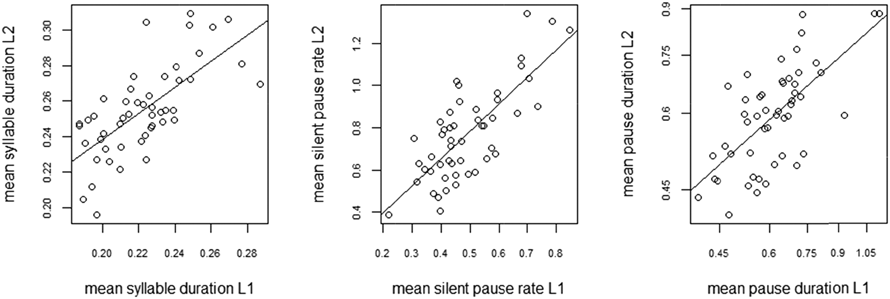
With respect to the semispontaneous speaking performances, Table 2 and Figure 1 show the correlations between the measures of L1 fluency with the same measures in the L2. Replicating earlier studies, large correlations were found: Fluent L1 speakers tend to be more fluent L2 speakers, too. Table 2 also shows the correlations between L2 proficiency (L2 vocabulary size) and L2 fluency measures: For the mean syllable duration measure, this correlation was significant, indicating that L2 learners with larger vocabulary sizes tended to have shorter mean syllable durations, hence faster articulation rates.
Pearson correlations between measures of L1 and L2 fluency and between measures of vocabulary and L2 fluency

* p < 0.05.
Scatterplots of fluency measures in L1 and L2.
Note: Syllable and pause durations are in seconds (axis for pause duration shows values on a transformed scale). Silent pause rate is the number of silent pauses divided by speaking time.
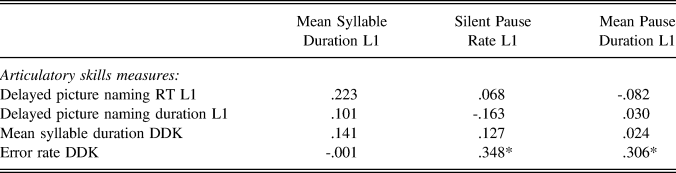
The crucial analysis for this report, however, involves exploring the relationship between the measures of articulatory skills and those of speaking fluency in the L1 (Table 3) and in the L2 (Table 4). The error rate in the DDK task was found to be related to both the number and the duration of silent pauses in L1 speech: Participants producing more errors and/or disfluencies while producing /pa.ta.ka/, tended to have more and longer pauses in their L1 speech. In the L2, the error rate in the DDK task was significantly related to the duration of silent pauses in L2 speech, but its relationship with silent pause rate failed to reach significance (p = .051).
Pearson correlations between measures of L1 fluency and (L1) articulatory skills
* p < 0.05.
Pearson correlations between measures of L2 fluency and (L2) articulatory skills

* p < 0.05.
Subsequently, we set out to obtain L2-specific (i.e., L1-corrected) measures of performance in the delayed picture-naming task by calculating residualized scores for both the delayed picture-naming RTs and the articulation durations (as in Segalowitz & Freed, Reference Segalowitz and Freed2004). These residualized scores constitute L2-specific measures of L2 RT and L2 articulation duration, as they represent the amount of variance in the L2 after correcting for performance in the L1. The last two rows of Table 4 show the correlations between the measures of L2 fluency, and the L1-corrected measures in the delayed picture-naming task. For the RT measure, the correction led to two significant correlations: for L2 silent pause rate (r (48) = .425, p = .002) and for L2 mean pause duration (r (48) = .326, p = .021). Apparently, it is not the time participants needed to start articulating L2 words in the delayed picture-naming task that is related to measures of L2 fluency, but it is the L2-specific measure that is related: The slower participants were in articulating the L2 words as could be expected on the basis of their L1 RTs, the more and longer pauses they used in L2 speaking tasks.
Finally, to gauge the extent to which L1 and L2 measures of fluency could be explained by the measures of articulatory skills combined, we carried out (backward) stepwise regression analyses: For L1 fluency measures, we used the L1 delayed picture-naming measures (reaction times and articulation durations) and both measures from the DDK task as predictors. The models for silent pause rate (with total adjusted R 2 = .10) and for silent pause duration (total adjusted R 2 = .07) were significant. For the L2 fluency measures, we entered all predictors in the model (L1 and L2 measures of delayed picture naming, as well as measures of the DDK task). It turned out that for silent pause rate in the L2 and for mean pause duration in the L2, the final regression models were significant, with total R 2 of .19 and .27, respectively.
DISCUSSION AND CONCLUSION
In the current study, we investigated to what extent articulatory skills, which are hypothesized to play a role in both L1 and L2 speaking, are related to fluency in L1 and L2 spontaneous speech.
Participants carried out speaking tasks in their L1 (Spanish) and their L2 (English). In addition, participants performed tasks capturing their articulatory skill (delayed picture-naming tasks in L1 and L2 and a DDK task). We replicated the finding that L1 and L2 measures of fluency in spontaneous speech are strongly related. Likewise, as in previous studies, we found that overall L2 speech was less fluent than L1 speech (more silent pauses and slower articulation rate). The duration of silent pauses was not different for L1 and L2 speech, in line with research by Towell, Hawkins, and Bazergui (1996) and De Jong et al. (Reference De Jong, Groenhout, Schoonen and Hulstijn2015).
In answering the main research question, it was found that for individual differences in L1 fluency, performance (error rate) on the DDK task was related to the number and duration of silent pauses. With respect to individual differences in L2 fluency, we likewise found that the error rate in the DDK task was related to duration of silent pauses in spontaneous speech. Because speech motor control in the L2 is less accurate (Franken et al., Reference Franken, McQueen, Hagoort and Acheson2015), and less efficient (Simmonds et al., Reference Simmonds, Wise, Dhanjal and Leech2011) than in the L1, we hypothesized that L2-specific measures of articulatory skills would be most strongly related to measures of L2 fluency. Indeed, we found that the L2-specific RT measure of the delayed picture-naming task (residualized scores taking L1 RTs into account) was related to both the number and duration of pauses in L2 spontaneous speech.
Neither in L1 nor in L2 spontaneous speech was articulation rate related to the articulatory skills. Note, however, that with a sample size of 51, the current study did not have sufficient power to pick up effects of small sizes. De Jong, Steinel, Florijn, Schoonen, and Hulstijn (2013) did report a significant (and indeed small; R 2 = .03) relation between (inverse) articulation rate and RTs in delayed picture naming for speakers of L2 Dutch. The current finding that articulation rate was not related to articulatory skills (and only weakly related in De Jong et al., 2013) is in line with findings suggesting that speed fluency (i.e., articulation rate) in L2 reflects L2-specific proficiency, rather than language-independent speaker styles (De Jong et al., Reference De Jong, Groenhout, Schoonen and Hulstijn2015; Kahng, Reference Kahng2014). Speech motor articulatory skills can be seen as language-independent skills, and were therefore considered in the current study as potential sources of the language-independent individual differences with respect to fluency in L1 and L2.
In summary, only a small portion of the variance in L1 fluency could be explained by general, language-independent, articulatory skills (10% and 7% of variance for silent pause rate and silent pause duration, respectively). For L2 fluency, the variance explained was higher (19% and 27% for silent pause rate and silent pause duration, respectively). We may speculate therefore that most language-independent individual differences in L1 and L2 fluency originate from other processes in language production, such as conceptualizing, formulating, and monitoring. To conclude, having good articulatory skills may lead to more fluent speech in the L1 and L2, at least with respect to pausing, but not to slower or faster articulation rate in semi-spontaneous speech.


 Open access

