





Conceptual models of Person×Environment interaction often seem to imply that there are two kinds of people, those affected greatly by their developmental experiences (e.g., parenting) and environmental exposures (e.g., neighborhood safety) and those affected hardly, if at all. Almost as often, though perhaps more so in the case of differential susceptibility than diathesis-stress theory and research, these views of developmental plasticity are cast in domain-general rather than domain-specific terms. This implies that individuals whose development is highly susceptible to contextual conditions are affected by many different experiences and exposures and with respect to many different aspects of development. Herein we empirically address both of these issues – bimodal versus normal distribution and general versus domain specificity – as well as potential temperamental and genetic underpinnings of susceptibility to the investigated environmental effects.
Toward this end, we rely on a new, influence-statistic approach, first implemented by Belsky, Zhang, and Sayler (Reference Belsky, Zhang and Sayler2021) in a paper that only addressed – for proof-of-principle reasons – the second issue just raised (i.e. domain specificity). As such, the current paper builds on and extends this prior work. We extend the previous research by focusing on putative family as well as child-care effects and on five rather than just two developmental outcomes. We also investigate whether children who as infants scored high on temperamental difficulty or on a three-gene, polygenic plasticity index proved more susceptible to multiple environmental effects on multiple child outcomes.
Developmental plasticity: Two types of people?
With regard to whether there are two types of people when considering variation in developmental plasticity – and thus whether susceptibility to environmental influences is best conceptualized in bimodal, typological or normally distributed, continuous terms – two person–environment conceptual frameworks merit attention. First consider diathesis–stress thinking. This model of Person×Environment interaction –or at least most work based on it (e.g., Caspi et al., Reference Caspi, Sugden, Moffitt, Taylor, Craig, Harrington and Poulton2003) – presumes that, whereas some individuals are vulnerable to adversity because they carry an organismic risk factor (e.g., risk gene, negative temperament), others prove resilient to the same stressor because they do not carry the organismic source of risk. Where differential susceptibility thinking differs from this vulnerability–resilience framework is in characterizing those putatively vulnerable to adversity as more generally developmentally plastic, and thus especially susceptible to both the benefits of supportive conditions and the negative effects of adverse ones. This makes such individuals distinct from others who are far less susceptible or generally unsusceptible to environmental influences (Belsky & Pluess, Reference Belsky and Pluess2009; Reference Belsky and Pluess2013; Belsky, Bakermans-Kranenburg, & van IJzendoorn, Reference Belsky, Bakermans-Kranenburg and van IJzendoorn2007; Ellis, Boyce, Belsky, Bakermans-Kranenburg, & van Ijzendoorn, Reference Ellis, Boyce, Belsky, Bakermans-Kranenburg and van Ijzendoorn2011). This latter view serves as the basis for the claim that the very individuals, again due to some organismic characteristic, who diathesis–stress models conceptualize as resilient in the face of stress also prove to be unaffected – or possibly simply less affected – by contextual support and enrichment (i.e., not developmentally plastic) (Belsky & van IJzendoorn, Reference Belsky and van IJzendoorn2017).
In the case of theory and research on differential susceptibility, this two-types-of-people conceptualization (i.e., fixed vs. plastic) is evident in a number of places. Consider first Boyce and Ellis’ (Reference Boyce and Ellis2005) theory of biological sensitivity to context which characterizes some children who are highly susceptible – “for better and for worse” (Belsky et al., Reference Belsky, Bakermans-Kranenburg and van IJzendoorn2007) – as “orchids” and others who are not as “dandelions”. Consider next Aron and Aron's (Reference Aron and Aron1997) notion of the “sensitive person” which explicitly calls attention to general variation in sensitivity to environmental influences, identifying some individuals as highly susceptible to environmental influence and others as not. Then there is the most recent distinction between highly susceptible “doves” and far less susceptible “hawks” (e.g., Suor, Sturge-Apple, Davies, & Cicchetti, Reference Suor, Sturge-Apple, Davies and Cicchetti2017). Finally, consider the graphic figure first produced by Belsky et al. (Reference Belsky, Bakermans-Kranenburg and van IJzendoorn2007) and reproduced many times since that depicts some people as susceptible to both positive and negative environmental conditions and others as not at all.
It seems notable that this two-types-of-people view remains popular despite there being compelling evidence that it often does not fit the data. Perhaps the best such evidence comes from genetic studies that have relied on (non-genomewide association studies (GWAS)-derived) polygenic scores. Belsky and Beaver (Reference Belsky and Beaver2011) were the first to chronicle what could be regarded as a gradient in developmental plasticity in that the more putative plasticity alleles (of a set of five genes) adolescents carried, the more susceptible they proved to be – and in a for-better-and-for-worse manner – to the effects of parenting on self-regulation; for related findings, see Stocker et al. (Reference Stocker, Masarik, Widaman, Reeb, Boardman, Smolen and Conger2016). Similar gradient-related Gene × Environment interactions (G×E) have now emerged in a wide variety of studies, using different sets of genes, including ones linking perceived racial discrimination with Black teen's “risky cognitions” (Gibbons et al., Reference Gibbons, Roberts, Gerrard, Li, Beach, Simons and Philibert2012); socioeconomic conditions with aggressive behavior (Simons et al., Reference Simons, Lei, Beach, Brody, Philibert and Gibbons2011); and, as a final example, parenting in adolescence with both hostile or positive romantic relations in young adulthood (Masarik et al., Reference Masarik, Conger, Donnellan, Stallings, Martin, Schofield and Widaman2014; Simons et al., Reference Simons, Simons, Lei, Beach, Brody, Gibbons and Philibert2013).
It is not, however, just in G×E research in which a continuum of plasticity proves evident, as Bradley and Corwyn (Reference Bradley and Corwyn2008) revealed much the same when contrasting effects of parenting in infancy on externalizing behavior in first grade in children who as infants had easy, average, and difficult temperaments. Tsotsi and associates ( Reference Tsotsi, Broekman, Shek, Tan, Chong, Chen and Rifkin‐Graboi2019) reported much the same when focusing on degree of positive affectivity (i.e., exuberance) rather than negative emotionality as the plasticity factor moderating effects of parenting stress during early childhood on preschoolers’ behavior problems 6 months later. It is also worth mentioning the work using physiological reactivity as the moderator, in this case of classroom–climate effects on kindergarteners’ externalizing problems; it, too, revealed a gradient of developmental plasticity (Roubinow, Bush, Hagan, Thompson, & Boyce, Reference Roubinow, Bush, Hagan, Thompson and Boyce2020). All these data would seem to suggest that it is time to move beyond a dual-person model of Person×Environment interaction, such as orchids and dandelions or vulnerable and resilient, recognizing that variation in susceptibility to environmental influence is, like so many other traits, continuous in character.
Having said that, it should also be pointed out that there are perhaps times and places when even treating a continuous variable categorically can be theoretically and empirically useful. The study of temperament may be one such area, as it certainly has been productive to think of some children, especially infants, as having difficult temperaments and others as not. Then, of course, there is the reality in physics that both wave and particle conceptualizations and measurements of light have merit. At the very least, though, binary typological approaches like those under consideration would seem to need justification in the face of continuous distributions of the constructs under study. As we investigate variation in susceptibility to multiple environmental features and developmental phenotypes herein, the guiding hypothesis, despite the comments just made, is that susceptibility to multiple contextual conditions will prove to be normally rather than bimodally distributed. It will thus vary along a continuum rather than reveal two types of children.
Domain specific or domain general?
Even if a continuous model of variation in developmental plasticity emerges, another issue, more mentioned than investigated, arises; namely whether developmental plasticity should be regarded as a general trait. Are some individuals more susceptible than others to a wide array of contextual conditions (e.g., family, child care, peers, school) and with respect to a wide array of developmental phenotypes (e.g., behavior problems, language development)? Do individuals vary with regard to the environmental influences to which they are highly susceptible or with respect to the developmental domains affected by their experiences and exposures?
To many it might seem unlikely that there could be a more or less general trait of environmental susceptibility or developmental plasticity given the possibility – or probability – that different developmental experiences and environmental exposures affect different neurobiological processes and, thereby, distinct phenotypes (e.g., McLaughlin, Sheridan, & Lambert, Reference McLaughlin, Sheridan and Lambert2014). From such a view, why would it be expected that susceptibility to the effects of harsh parenting would have anything to do with susceptibility to the effects of language stimulation; or even why susceptibility to peer pressure would have anything to do with susceptibility to parental discipline? However reasonable such questioning would seem to be, much of the writing about differential susceptibility has seemed to imply if not explicitly postulate a more general trait of susceptibility to environmental influences, as already noted.
Perhaps the best reason why a domain-general perspective remains not entirely unreasonable is due to empirical evidence. Truth be told, many studies of differential susceptibility, whether focused on temperament, physiology or genes as moderators of environmental effects (in a for-better-and-for-worse manner), indicate that the same putative plasticity factors condition – in very similar ways – the effects of a wide variety of environmental features (e.g., prenatal stress, maternal empathy, marital conflict, teacher–child conflict, economic hardship) on a wide variety of developmental phenotypes (e.g., externalizing problems, executive function, attentional bias, sleep, pubertal development) (reviewed in the Belsky & Pluess, Reference Belsky and Pluess2009, Reference Belsky and Pluess2013; Ellis et al., Reference Ellis, Boyce, Belsky, Bakermans-Kranenburg and van Ijzendoorn2011). In other words, however simplistic a general trait-like view of susceptibility to environmental influences might appear, this possibility would seem to be somewhat empirically grounded.
In contrast to this plausible reading of what are mostly across-study comparisons, a recent report addressed this domain-general versus domain-specific issue using data from the same study and thus on the very same children (Belsky et al., Reference Belsky, Zhang and Sayler2021). In this prior work which the current effort extends, again using data from the well-known National Institute of Child Health and Human Development (NICHD) Study of Early Child Care and Youth Development (NICHD Early Childcare Research Network, 2005), the question was whether two core findings regarding the effects of child care applied to the same or different children. Thus, it investigated whether the children whose cognitive–linguistic development proved most or least affected by the quality of child care they experienced were the same ones whose behavior problems proved most or least affected by the quantity (or dosage) of care they experienced. In both cases, as herein, the focus was on experiences across the first 4.5 years of life in predicting development just prior to school entry at age 4.5 years.
Results proved interesting in two ways, with the first summarized here, the second in the next subsection. Findings were more consistent with a domain-specific than domain-general view. Most children who scored high or low in susceptibility to one of the child-care effects in question were not similarly affected by the other. In light of the fact that even more contextual conditions and more developmental phenotypes are examined in this than the prior report, it is predicted that results will prove, once again, more consistent with a domain-specific than domain-general model of environmental influence. In the current report, however, focus will be on multiple family as well as child-care effects.
Temperament and developmental plasticity
Child temperament has long been regarded as an organismic factor that moderates effects of developmental experiences and exposures on child development, perhaps most notably in diathesis–stress or dual-risk-related work that regards negative emotionality, often treated continuously, and difficult temperament, often treated categorically, as risk factors making children more vulnerable to the negative effects of adversity (Rothbart & Bates, Reference Rothbart, Bates, Eisenberg, Damon and Lerner2006). Yet in recent years both observational and experimental-intervention evidence has emerged which indicates that children, perhaps especially infants, with such “risky” temperaments are not just more likely to be adversely affected by problematic contextual conditions (e.g., insensitive parenting, poverty), but are likely to benefit more than others from supportive, enriched, and even just benign contextual conditions (for review, see Belsky & Pluess, Reference Belsky and Pluess2009, Reference Belsky and Pluess2013; Ellis et al., Reference Ellis, Boyce, Belsky, Bakermans-Kranenburg and van Ijzendoorn2011). Most recently, perhaps, Zhang, Sayler, Hartman and Belsky (Reference Zhang, Sayler, Hartman and Belsky2021) found this to be the case using data from the large-scale Avon Longitudinal Study of Parents and Children (ALSPAC, N = 14,541) while focused on effects of parenting. These results were in line with those of a meta-analysis documenting similar Parenting×Temperament interactions (Slagt, Dubas, Deković, & van Aken, Reference Slagt, Dubas, Deković and van Aken2016). Thus, we predict that children who as 6-month-olds score higher than others on an index of difficult temperament will prove most susceptible to the environmental effects investigated in this report.
Genetic make-up and developmental plasticity
Given repeated evidence in both observational and experimental-intervention research that children's genetic make-up distinguishes those who prove more and less susceptible to environmental effects in a differential-susceptibility-related, “for-better-and-for-worse” manner (Belsky & van IJzendoorn, Reference Belsky and van IJzendoorn2017), the final hypothesis of the current study focuses on such personal characteristics. Drawing on three polymorphisms selected a-priori based on prior differential-susceptibility-related findings and their availability in the NICHD Study data set, we predict that children who prove especially susceptible to more rather than fewer environmental effects will score higher on a polygenic plasticity score reflecting the number of presumed “plasticity alleles”. This prediction is based, even if only in part, on the second set of (predicted) results from the previous work (Belsky et al., Reference Belsky, Zhang and Sayler2021) referred to above. The higher children scored on the polygenic plasticity index, the more susceptible they were to effects of both quality of care on cognitive–linguistic development and of quantity of care on behavior problems.
Many critiques have been made of genetic research that focuses, as we do herein, on one or a few genetic variants in behavioral research (Manuck & McCaffery, Reference Manuck and McCaffery2014; Moffitt & Caspi, Reference Moffitt and Caspi2014; Moffitt, Caspi, & Rutter, Reference Moffitt, Caspi and Rutter2005, Reference Moffitt, Caspi and Rutter2006; Salvatore & Dick, Reference Salvatore and Dick2015). Concerns have been raised about statistical power, multiple testing, and –perhaps most importantly – hard-earned appreciation that most phenotypes are influenced – or at least predicted by – numerous genes. This is due to the fact that individual genes have strikingly small effects, with rare exceptions. In focusing on three select genes in the current inquiry, we do not reject these critiques. In fact, to the extent possible, they inform our decision making.
As we are restricted by the available data set to only a limited number of polymorphisms, we focus on three previously identified as the ones most consistently shown to moderate environmental effects in a differential-susceptibility-related manner in prior (published) G×E research, that is, “best bets” (Belsky et al., Reference Belsky, Newman, Widaman, Rodkin, Pluess, Fraley and Roisman2015, Table 2). These are serotonin transporter linked promoter polymorphic region (5-HTTLPR), brain-derived neurotrophic factor (BDNF) and dopamine receptor D4 (DRD4). Whereas initial, candidate G×E research based gene selection on the “biological plausibility” of how a gene might influence a phenotype, we eschewed that basis of gene selection – just as genomewide association studies (GWAS) based, “theory-free” work has. As Zhang and Belsky (Reference Zhang and Belsky2020) recently pointed out, the biological-plausibility arguments that informed candidate G×E work were implicitly if not explicitly based on a diathesis–stress model of Person×Environment interaction and most certainly not on a differential susceptibility one. This is because gene selection in this (mostly) psychiatric research was based on previously established associations linking the candidate gene in question with either the phenotype to be predicted (e.g., depression) or some correlate of the phenotype, like a neurotransmitter (e.g., Caspi et al., Reference Caspi, McClay, Moffitt, Mill, Martin, Craig and Poulton2002, Reference Caspi, Sugden, Moffitt, Taylor, Craig, Harrington and Poulton2003). Thus, virtually all psychiatric–genetic research was based on dual-risk thinking: Problems emerge when an environmental risk and a genetic risk co-occur.
In contrast, differential susceptibility research is based on the notion that there may exist genes not so much for psychiatric (or other health and behavioral) phenotypes that serve as “vulnerability genes” (Rutter, Reference Rutter2006), but for developmental plasticity and thus function as more general “plasticity genes” (Belsky et al., Reference Belsky, Jonassaint, Pluess, Stanton, Brummett and Williams2009). Thus, to repeat, it was not biological plausibility claims that led to the gene selection in the prior and current study, but the authors’ reading of the empirical evidence.
Identifying susceptible children via influence statistics
To date, all differential-susceptibility-related G×E research has involved exploratory tests of Person×Environment interaction in a regression model. Here we adopt a different approach, based on influence statistics, just as in the prior proof-of-principle study (Belsky et al., Reference Belsky, Zhang and Sayler2021) to identify children whose social–behavioral and cognitive–linguistic functioning are more and less affected by each of the family and child-care conditions under investigation.
Influence statistics illuminate how – and the extent to which – particular individuals affect the overall estimate of any detected association of interest (e.g., Belsley, Kuh, & Welsch, Reference Belsley, Kuh and Welsch1980; Cook & Weisberg, Reference Cook and Weisberg1982). This is accomplished by a “leave-one-out” approach, that is, re-estimating an association repeatedly, each time dropping a single case. This affords determination of how much such (a minor) sample modification results in the association increasing (i.e., a negative influencer) or decreasing (i.e., a positive influencer), as reflected by the slope parameters, usually ever so modestly.
Here we use an influence statistic to score each and every case in terms of the degree and direction of its influence on each of the many associations that are the focus of this report (i.e., effects of multiple family and child-care features on multiple developmental outcomes). In this report, those cases that, when dropped, result in an association's absolute value decreasing are given positive values reflecting the degree of their apparently greater susceptibility to the contextual condition in question. In contrast, those cases which, when dropped, result in the same association's absolute value increasing are given negative values reflecting the degree of their apparent insensitivity to the influence of the contextual condition.
Current study
Herein we use these directional influence statistics to address three issues already considered, drawing on five widely studied family and three child-care conditions, some repeatedly measured across the child's first 4.5 years of life (and composited), and five measures of child development at 4.5 years of age long thought to be influenced by environmental experiences and exposures. The first issue concerns whether the distribution, across children, of 40 influence-statistic-derived and composited susceptibility scores (i.e., 8 contextual predictors × 5 child outcomes) proves bimodally rather than normally distributed – and if the same is true of 25 family effects (i.e., 5 predictors × 5 outcomes) and 15 child-care effects (i.e., 3 predictors × 5 outcomes). Recall the prediction that data would be more consistent with the former than latter possibility.
The second issue addressed two related concerns: (a) are children more or less susceptible to family effects also more or less, respectively, susceptible to child-care ones and (b) are children whose cognitive–linguistic development proves more or less susceptible to contextual effects the same whose social–behavioral development also proves, respectively, more or less susceptible to contextual conditions? Recall that we predicted greater support for the domain-specificity view.
The final issue involves whether two child characteristics (i.e., polygenic plasticity, infant temperament) are associated with susceptibility to environmental effects. As already noted, we predict that a history of difficult temperament in infancy will be related to increased susceptibility to environmental effects. Turning to genetic influence, because Belsky and associates’ (Reference Belsky, Newman, Widaman, Rodkin, Pluess, Fraley and Roisman2015) prior work with this sample revealed virtually no effects of genetic plasticity when focused on a single family effect (sensitive parenting) and single candidate genes, there are grounds for expecting the same to be true in this inquiry. This would seem to be so even though we rely herein on a three-gene polygenic score created a priori and a composite index of multiple family factors. Furthermore, because the prior proof-of-principle study revealed that the same polygenic score used herein was related to two distinct child-care effects (quality and quantity of care), each on a different outcome (preacademic skills, problem behavior), it would seem reasonable to expect a similar result herein. This would seem to be so even as an additional feature of child care is considered in the current inquiry (i.e., center-care exposure) and thus three different child-care effects are examined on more than just the two outcomes used in the prior study. In advancing these genetic-plasticity “predictions,” we mean to make clear that their evaluation cannot be considered entirely independent of the prior paper (Belsky et al., Reference Belsky, Zhang and Sayler2021). Again, this is so even though the current approach to evaluating genetic effects on susceptibility varies in important ways from those used in the two just-cited prior reports.
Method
Participants
Families were recruited through hospital visits to mothers shortly after the birth of a child in 1991 in 10 locations in America. During selected 24-hr intervals, 8,986 women giving birth were screened for eligibility. From that group, 1,364 families (boys = 705; white = 1,097, black = 176; other = 91) completed a home interview when the infant was 1 month old and became the study participants. Details of the sampling plan can be found in NICHD ECCRN (2005). In terms of demographic characteristics at study enrollment, 26% of the mothers had no more than a high school education and 21% had incomes no greater than 200% of the poverty level. Data used in this report were collected from 1991 to 1996.
Among the 1,364 children in the enrolled sample, 666 of them missed at least one of the predictor and outcome variables used in this report. Those with missing values, relative to children without missing values, were more likely upon entering the study to be male (X2 = 4.83, df = 1, p = .03) and to live in a household with lower income-to-needs ratio (t (1,271) = 5.73, p < .001), lower level of mother education (t (1,355.9) = 7.56, p < .001), higher maternal depression (t (1,335.1) = −2.16, p = .03), and lacking a father (t (1,265.6) = 4.20, p < .001). More details of this attrition analysis are included in the online supplement (Supplementary Table S1). By means of multiple imputation, the analysis sample remained 1,364, with the exception of analyses using genetic data.
In order to reduce risk of confounding genotype and ethnicity, genetic analysis was restricted to the white subsample who provided genetic data (n = 449). Compared to these white children, those white children lacking genetic data were more likely to be male (X2 = 5.24, df = 1, p = .02), and born into families with lower income to needs ratio (t (996.51) = 2.26), p = .02), lower maternal education (t (1042.7) = 2.32, p = .02), and more maternal depression (t (1051.2) = −1.99, p = .05).
Overview of data collection
Children were followed from birth to 4½ years of age for purposes of this report. Mothers were interviewed in person when infants were 1 month old. Detailed measures of home, family, and child care were obtained repeatedly thereafter. Children's development was assessed at 4½ years. Genetic data were collected at age 15 years via buccal cheek cells.
Measures
We first delineate child-care predictors, followed by family predictors, followed by dependent child outcomes, followed by genotyping.
Child-care predictors
Usage of nonmaternal child care was obtained by maternal telephone interviews at 3-month intervals through 36 months and at 4-month intervals thereafter, through 54 months of age, resulting in a total of 16 measurement epochs. If children were in nonmaternal care for more than 10 hr per week, efforts to observe quality of care were made at five different ages.
Quantity
The hours spent in all settings for each of the 16 measurement epochs, based on maternal interview, were averaged to calculate mean hours each week spent in child care from 1 to 54 months of age.
Center care proportion
The number of epochs in which the child's primary child-care arrangement (i.e., most hours) was center based indexed exposure to center care.
Quality
Observed quality of care was assessed at whatever arrangement the mother deemed as the primary arrangement when more than one was being used and whenever a child was in regularly scheduled non-family child care for 10 or more hours per week. Caregiving quality was assessed during two half-day visits scheduled within a 2-week interval at 6, 15, 24, and 36 months of age and one half-day visit at 54 months. At 6, 15, and 24 months, a positive caregiving composite score reflected the mean of five 4-point qualitative ratings made by highly trained observers (sensitivity to child's nondistress signals, stimulation of cognitive development, positive regard for child, emotional detachment [reflected], and flatness of affect [reflected]). At 36 months, two additional ratings (fosters child's exploration, intrusiveness [reflected]) were included in the positive caregiving composite. At 54 months the composite quality-of-care score was the mean of four 4-point ratings [sensitivity–responsivity, stimulation of cognitive development, intrusiveness (reflected), and detachment (reflected)]. Cronbach α for all composited quality scores exceeded .70). Each positive caregiving composite was standardized and averaged across age to create the index of overall quality of child care (NICHD ECCRN, 2002).
Family predictors
Of the many potential predictor variables included in the NICHD Study data set, we selected ones that have a long history of being conceptualized as determinants of child well-being, broadly conceived, in developmental, sociological, demographic, and public health research. Each has often been used as a covariate when investigating some of the others.
Parenting
A composite measure of parenting was based on maternal sensitivity ratings and scores of the Home Observation for Measurement of the Environment (HOME, Caldwell & Bradley, Reference Caldwell and Bradley1984). To assess maternal sensitivity, Mother×Child interactions were videotaped in semi-structured, 15-minute sessions at 6, 15, 24, 36, and 54 months. Composite sensitivity scores were created from sums of different ratings scales (e.g., maternal sensitivity to child nondistress, intrusiveness [reflected], positive regard). Cronbach α exceeded .70 at every age. The HOME was administered during home visits at 6, 15, 36, and 54 months. Information used to score multiple items (e.g., parental responsivity, variety of experience) is based on observation and semi-structured interview. Cronbach α exceeded .77 at each age. The HOME and maternal sensitivity scores were standardized and averaged within and then across age to create a parenting quality composite score.
Income to needs ratio
Ratios calculated by dividing total family income by the poverty threshold for family size at 6, 15, 24, 36, and 54 months were averaged (NICHD ECCRN, 2002).
Partner
The proportion of 16 telephone interviews at which presence of a husband or partner in the home was reported indexed partner presence.
Maternal depression
Assessments at 6, 15, 24, 36, and 54 months using the Center for Epidemiological Studies Depression Scale (Radloff, Reference Radloff1977; Cronbach α > .85), a self-report measure of depressive symptomatology, were averaged to index depression.
Maternal education
Years of education was collected at the 1-month interview.
4 ½-year child outcomes
Behavior problems
Caregivers completed the 100-item Caregiver-Teacher Report Form (C-TRF) developed for children ages 2–5 years of the Child Behavior Checklist (Achenbach, Reference Achenbach1991) and we used the total-problems’ score based on the internalizing problems’ (Cronbach α = .90) and externalizing problems’ subscales (Cronbach α = .95). Raw scores were converted into standard T scores, based on normative data for children of the same age.
Social competence
Social competence was evaluated by caregivers’ completion of the California Preschool Social Competency Scale (CPSCS; Levine, Elzey, & Lewis, Reference Levine, Elzey and Lewis1969), which includes 30 items relevant in child-care settings (e.g., safe use of equipment, initiating group activities). The Total Social Competency score (Cronbach α = .88) was the sum of the CPSCS and another four items measuring specific features of peer play (cooperation, following rules in games, empathy, and aggression).
Preacademic skills
This measure represents the standardized average of two subtests of the Woodcock–Johnson Psycho-Educational Battery – Revised (Woodcock & Johnson, Reference Woodcock and Johnson1990). The Letter–Word Identification test measures skills at identifying letters and words. The Applied Problems test measures skill in analyzing and solving practical problems in mathematics.
Language competence
This was assessed using the Preschool Language Scale (PLS; Zimmerman, Steiner, & Pond, Reference Zimmerman, Steiner and Pond1979), which includes two subscales that were averaged together: auditory comprehension and expressive language.
Short-term memory
This was assessed using the Memory for Sentences subtest of the Woodcock–Johnson Psycho-Educational Battery – Revised (Woodcock & Johnson, Reference Woodcock and Johnson1990).
Infant temperament
Temperament was assessed by maternal report at age 6 months using an adapted version of the Infant Temperament Questionnaire (Carey & McDevitt, Reference Carey and McDevitt1978). Items were designed to capture approach, activity, intensity, mood, and adaptability. An overall summary of “difficultness” was created by averaging items.
Genotyping
DNA was collected from 695 adolescents. We selected three genetic markers (out of the 59 single nucleotide polymorphism [SNPs] and four variable number tandem repeats [VNTRs] available) that have been widely used in differential-susceptibility-related research. Polygenic plasticity scores were based on the number of putative “plasticity alleles” that each child carried (i.e., 0, 1, 2): short alleles for 5-HTTLPR, met alleles for BDNF, and 7-repeats for DRD4. This resulted in polygenic scores ranging from 0 to 6. The number of children with 0, 1, and 2 “plasticity alleles” for 5-HTTLPR is, respectively, 203, 327, and 147; for BDNF is 357, 167, and 34; and for DRD4 498, 142, and 26. Frequency distributions for BDNF (rs6265 χ2 = 5.33, p < .05) departed significantly from Hardy–Weinberg equilibrium (HWE), as did the VNTR DRD4 (p < .01), using exact tests estimated using Markov chains (GENEPOP 4.2; Raymond & Rousset, Reference Raymond and Rousset1995), but not that of 5HTT.
To empirically evaluate potential genotyping errors, we conducted reliability analyses for both the SNPs and the VNTRs. Specifically, reliability was ascertained by twice genotyping somewhat more than 10% of the subsample providing DNA; all discrepancies were resolved via a third genotyping. For BDNF, 13.4% of available samples could not be genotyped but the others yielded 97% agreement. For DRD4 VNTR, 4.7% of available samples could not be genotyped but the others yielded 83% agreement. For 5-HTT VNTR, 3.2% of available samples could not be genotyped but the others yielded 80% agreement. As explained in great detail in a prior publication, analysis of potential genotyping errors – via repeated assays – suggested that “deviation from Hardy–Weinberg equilibrium is likely not a strong indicator of genotyping error in the present data” (Belsky et al., Reference Belsky, Newman, Widaman, Rodkin, Pluess, Fraley and Roisman2015, p. 734).
Statistical analysis
Recall that we imputed missing data. As the data may be missing at random, we first conducted multiple imputation using multivariate imputation by chained equations (MICE; van Buuren & Groothuis-Oudshoorn, Reference van Buuren and Groothuis-Oudshoorn2011) in R on all listed variables except for the genetic scores. All analyses and thus results not involving genetic information are based on 30 imputed data sets.
To evaluate children's susceptibility to effects of a specific family or child-care predictor on a specific 4.5-year outcome, we relied on the influence statistic, DFBETAS (Belsley et al., Reference Belsley, Kuh and Welsch1980), which is a continuous, standardized quantity for each observation representing the change of each regression parameter (i.e., intercept and slopes on each predictor) after removing the observation. DFBETAS better serves this purpose than other influence statistics (e.g., residuals, Cook's D) because it (a) incorporates information from both residuals (i.e., vertical departure from estimated values of the outcome) and leverages (i.e., horizontal departure from the mean of the predictor); (b) quantifies the influence of each observation on a specific parameter rather than the collective influence on all the parameters; and, more importantly, (c) reflects both direction and magnitude of the influence exerted by each observation.
Positive and negative values of DFBETAS for a specific regression parameter for a child indicate that the specific parameter will increase and decrease, respectively, with the absolute values of DFBETAS, thus documenting the magnitude of change of the parameter, by including versus excluding this child in the model. Positive and negative values of DFBETAS of a slope parameter reflect more and less contributions (i.e., susceptibility) to positive associations (e.g., parenting:language), but less and more contributions (i.e., susceptibility) to negative associations (e.g., depression:language), respectively. This can be illustrated by the fact that a regression line showing positive association will become (a little) steeper when adding an observation with positive DFBETAS, but one showing negative association will become (a little) flatter after adding an observation with positive DFBETAS.
We focused on DFBETAS of regression slope parameters herein, given our interests in identifying how susceptible each child is in terms of each predictor–outcome association; that is, susceptibility is operationalized to be DFBETAS of regression slopes for each of the simple regression analyses involving a single environmental predictor and a single developmental outcome under investigation. For illustration purpose, we provided equations used to estimate DFBETAS in the online supplementary material. With each imputed data set, we ran simple regressions using the eight predictors (i.e., parenting, income, partner, maternal education, maternal depression, child-care center, quantity, and quality) for each of five outcome variables (i.e., behavioral problems, social competence, preacademic skills, language competence, short-term memory), resulting in DFBETAS for each of the 40 predictor–outcome associations for each child. The resulting DFBETAS for each child were then averaged across imputed data sets, representing each child's susceptibility to the effect of each of eight predictors on each of five outcomes (e.g., parenting affecting problems; care quality affecting preacademic skills).
For sake of consistency, we reversed the sign of DFBETAS for theoretically anticipated negative associations (i.e., parenting–behavior problems, partner–behavior problems, mom education–behavior problems, income to needs ratio–behavior problems, care quality–behavior problems, care quantity–social skills, center care–social skills, mom depression–preacademic skills, mom depression–memory, mom depression–language development, and mom depression–social skills). Therefore, for all associations, larger DFBETAS represents higher susceptibility to either the anticipated beneficial effects of supportive experiences (e.g., care quality, parenting) or the anticipated adverse effects of unsupportive experiences (e.g., mom depression, care quantity).
Considering 40 values of DFBETAS for each child seemed excessive, increasing the risk of chance results. Therefore, we conducted preliminary, data-reduction-oriented factor analyses using the psych package in R (Revelle, Reference Revelle2021). Factors were extracted using maximum likelihood method, with the number of factors determined based on the screen test and conceptual interpretability; resulting factors were rotated obliquely using promax rotation. Proceeding this way also took into account statistical dependencies among contextual predictors, among developmental outcomes and among their interrelations. Guided by conceptual and contextual considerations, we separately factor analyzed two distinct subsets of the 40 susceptibility indices (i.e., the 40-DFBETAS for each child): 25 family-related ones based on five family predictors and five outcomes and 15 child-care-related ones based on three child-care predictors and five outcomes. We then created factor scores for each resulting factor for all individual susceptibility scores (i.e., DFBETAS) loading above .40. From these we created three composite, factor-derived susceptibility scores, one representing family-related susceptibility, another child-care-related susceptibility, and a third general susceptibility (i.e., family + child care).
Results
Following preliminary, data-reduction analyses, some or all of the factor-derived susceptibility scores (i.e., individual factors, family composite, child-care composite, general composite) were used in the primary analysis to address three core issues: (a) whether susceptibility scores were bimodally rather than normally distributed; (b) the interrelation of susceptibility to (i) family- and child-care effects and (ii) effects on different developmental outcomes; and (c) the relation between (a) infant temperament and (ii) the polygenic plasticity (for white children only) and the composite susceptibility score. Notably, white children who did and did not provide genetic data did not differ on any of the composite susceptibility scores. (See Supplementary Table S2 in the online supplementary material for details including the means, standard deviations, and statistical tests of differences of the composite susceptibility scores for white children with and without genetic data.)
Preliminary analysis: Data-reduction
Tables 1 and 2 display, respectively, results of the separate maximum likelihood exploratory factor analyses of family and child-care susceptibility scores (i.e., DFBETAS). Recall that these are the component susceptibility scores on which composite susceptibility scores are based, and that only component susceptibility scores with loadings larger than .40 were used to create composite susceptibility scores. Notably, the factor–analytic results were replicated with another commonly used exploratory factor analysis method, principal axis factoring, again with oblique rotation.
Factor analysis for susceptibility to family-related effectsa

a Items with bolded weightings, meeting criteria of being >0.40, were used to create unit-weighted composite susceptibility scores.
Factor analysis for susceptibility to child-care-related effectsa
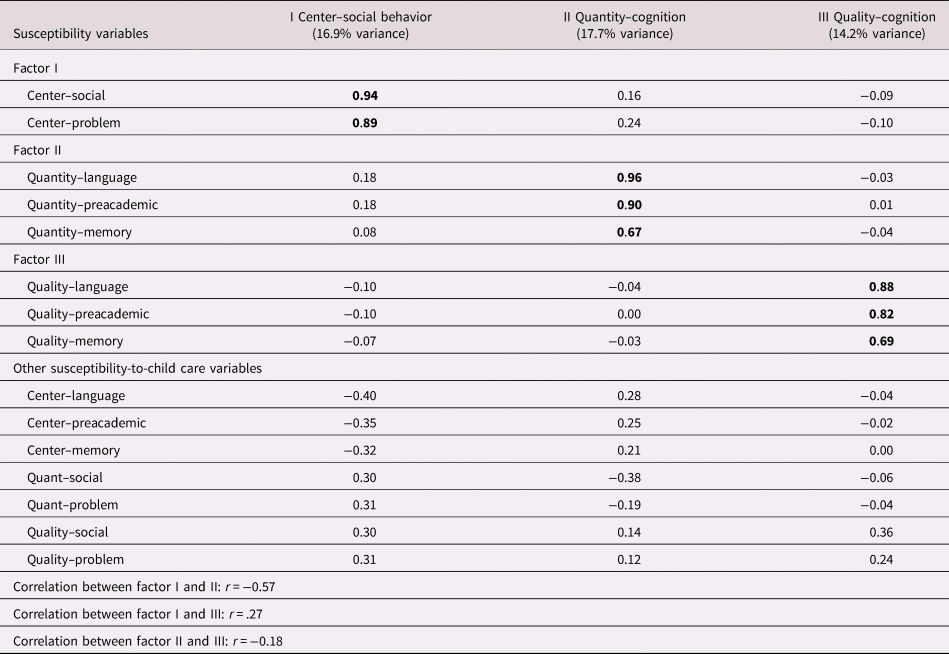
a Items with bolded weightings, meeting criteria of being >0.40, were used to create unit-weighted composite susceptibility scores.
The factor analysis of the family susceptibility indices yielded two, high-loading summary scores reflecting susceptibility to family effects on social behavior and on cognitive–linguistic functioning; the two resulting factor scores were summed to create a third, total-family susceptibility score. The factor analysis of the child-care susceptibility indices yielded three, high-loading composite scores reflecting susceptibility to center-care effects on social behavior; to quantity-of-care effects on cognitive–linguistic functioning; and to quality-of-care effects on cognitive–linguistic functioning. The three composite child care–susceptibility effect scores were combined to create a fourth, total child-care susceptibility score. Finally, all five factor-derived susceptibility scores were further combined to create a general susceptibility score. For each of the susceptibility factor scores and composites, higher scores represent greater susceptibility to the corresponding effects.
Primary analysis 1: Distribution of susceptibility
To investigate whether the distribution of susceptibility is bimodal, we conducted Hartigan's dip test (Hartigan, Reference Hartigan1977, Reference Hartigan1978) for unimodality or multimodality on the three composite susceptibility factor scores. This test is designed to evaluate whether there is more than one mode in a distribution. The null hypothesis of this test is that the data conform to unimodality. For the five-factor general composite, two-factor family composite, and three-factor childcare composite, D proved insignificant (Ds = .005, p = 1.00; .005, p = 1.00; .007, p = .98). These results along with inspection of Figure 1 clearly suggest that susceptibility is normally and not bimodally distributed, irrespective of which composite susceptibility score is considered. Thus, most children are neither highly susceptible orchids nor very unsusceptible dandelions, at least with regard to overall or family or child-care effects, as evaluated herein.
The graphs depict the (normal) distributions of susceptibility scores for (a) five-factor general composite, (b) two-factor family composite, and (c) three-factor child-care composite. Dashed lines distinguish low, moderate, and high terciles of these composited influence-statistic distributions.

Primary analysis 2: Interrelation of susceptibility effects
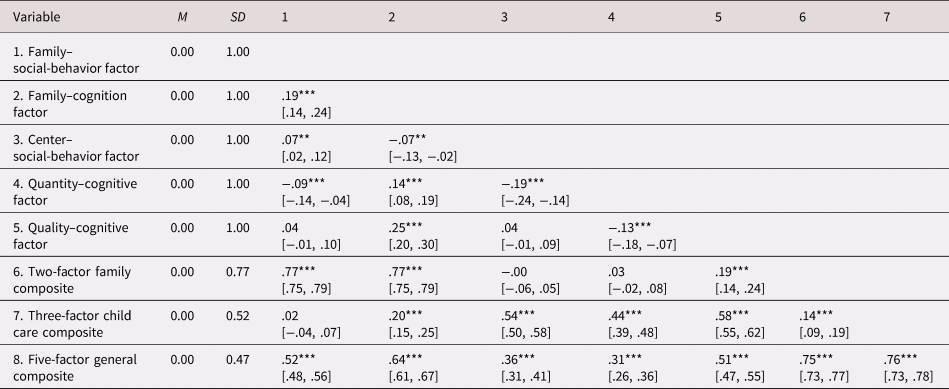
The intercorrelations of all eight (individual and composite) factor-derived influence-statistics’ scores of susceptibility are displayed in Table 3. The modest, even if significant associations among the two family susceptibility scores and among the three child-care susceptibility scores are at least in part a product of the oblique rotation employed when factor analyzing the relevant subsets of the 40 influence-statistic susceptibility scores.
Means, standard deviations, and correlations with confidence intervals for susceptibility factors and composite scores
** p < .01; ***p < .001
Beyond such expected associations, the data displayed in the table address two questions regarding the interrelation of susceptibility effects. The first concerned whether children more susceptible to family effects were also more susceptible to child-care effects. Some modest evidence indicated that this is the case. Consider first that children who proved more or less susceptible to family effects proved more or less susceptible to child-care effects, as revealed by the significant, even if small positive correlation between the two composite susceptibility scores (r = .14, p < .001). Consider next that this proved true in the case of both cognitive–linguistic development and social development when separately examined: Children scoring high on the family–cognition susceptibility factor also scored higher, again modestly but significantly, on both child-care factor susceptibility scores related to cognition (quality: r = .25, p < .001; quantity: r = .14, p < .001). The same proved true, even if to a lesser extent, when considering family and center-care effects on social behavior (r = .07, p < .01). Perhaps surprising, though, is the small negative association between family–social and quantity–cognition susceptibility effects (r = −.09, p < .001). It indicates that the more susceptible children proved to be to the beneficial effects of family support and resources on social behavioral development, the less susceptible they proved to be to the detrimental effect of lots of time in care on cognitive competence.
The second question regarding the interrelation of susceptibility effects concerned whether children whose cognitive–linguistic development proved highly susceptible to contextual effects were the same ones whose social–behavioral development proved highly susceptible to contextual conditions. The answer to this question proved mixed. First, some evidence revealed small but significant associations – between family–social and family–cognition effects (r = .19, p < .001) and between family–social and quantity-of-care-cognition effects (r = −.09, p < .001). However, there was also some evidence of no association – between family–social effects and quality-of-care-cognition effects (r = .04, p > .05).
Primary analysis 3: Temperament, genotype, and susceptibility
For the final analyses, the infant temperamental difficulty score and the polygenic score were each correlated with the factor-derived susceptibility scores. Inspection of results displayed in Table 4 provides some modest support for predictions. In the case of a number of susceptibility scores, small but significant effects emerged linking more difficult infant temperament with greater susceptibility to both family and child-care effects. Perhaps notably, a higher polygenic score only proved related to greater susceptibility to some effects of child care, not family-related ones.
Association between polygenic scores and susceptibility factors

* p < .05; **p < .01; ***p < .001
Discussion
Recall that the primary purpose of this investigation extending a prior proof-of-principle study (Belsky et al., Reference Belsky, Zhang and Sayler2021) was threefold: (a) to evaluate whether susceptibility to multiple environmental effects was bimodally distributed; (b) to determine (i) whether children more and less susceptible to family effects would prove similarly susceptible to child-care effects and (ii) whether children whose cognitive–linguistic development proved more or less susceptible to contextual effects were the same as those whose social–behavioral development revealed them to be similarly susceptible; and (c) to determine whether (i) temperament and (ii) genotype would be associated with susceptibility to environmental influence. As this research can also be thought of as a proof-of-principle investigation, there is no reason to assume that any particular findings are generalizable beyond the data from the NICHD Study of Early Childcare and Youth Development on which this report is based. This is an especially important point to make given that we restricted our analyses to the White subsample of the NICHD Study. We would hope that others would endeavor to address the same questions we have, perhaps using different contexts, different environmental measures, different developmental phenotypes, and different racial/ethnic subgroups.
Distribution of susceptibility
Even though much discussion of susceptibility to environmental effects, especially in the differential-susceptibility literature, would seem to imply that developmental plasticity is bimodally distributed (e.g., orchids and dandelions), the findings reported herein clearly suggest otherwise. Irrespective of whether we considered just family effects or just child care ones – or both together – we were forced to reject the two-types-of-children hypothesis. Moreover, the data displayed in Figure 1 clearly reveal a normal distribution of susceptibility to environmental influences as indexed using influence statistics.
All this is not to say that consideration of two types of people has not been heuristically useful. It most certainly has succeeded in stimulating theory and research on the topic of Person×Environment interaction and especially in moving inquiry beyond tests of diathesis-stress or dual-risk thinking. Nevertheless, it seems time to question the (often implicit) assumption that bimodality characterizes variation in susceptibility to environmental influences. This is not to say, however, that there may not be some plasticity-related phenomena that prove to be bimodal or that a bimodal representation of them never proves empirically useful. One can easily imagine that in certain cases this may prove to be the case. This returns us to the analogy of light introduced in the Introduction. Recall the observation that physicists find conceptions of light as both a wave and a particle as scientifically useful, meaning that one representation is not always the right or best one. At the very least, then, it would seem to be time to eschew the presumption that the orchid–dandelion dichotomy most accurately represents differential susceptibility to environmental influences. This way of thinking leads us to further suggest that it may be time to stop reproducing Belsky et al.'s (Reference Belsky, Bakermans-Kranenburg and van IJzendoorn2007) widely disseminated figure representing differential susceptibility in bimodal terms. Toward that end, we offer Figure 2 as a replacement, or at least alternative, for graphically depicting differential-susceptibility-like variation – and thus individual differences – in susceptibility to environmental influence.
Conceptual model of gradient of susceptibility to environmental influences.

Interrelation of susceptibility effects
Even though the question of whether susceptibility to environmental influences should be conceptualized in domain-general or domain-specific terms has been highlighted frequently (Belsky et al., Reference Belsky, Bakermans-Kranenburg and van IJzendoorn2007; Belsky & Pluess, Reference Belsky and Pluess2009, Reference Belsky and Pluess2013; Ellis et al., Reference Ellis, Boyce, Belsky, Bakermans-Kranenburg and van Ijzendoorn2011), we believe this is the first investigation to directly examine it empirically. Clearly there was some support for the domain-general view and thus that there is (some) merit in thinking about susceptibility to environmental influence in trait-like (and continuous) terms. After all, individual differences in susceptibility to family and child-care effects proved to be positively and significantly correlated; and this proved the case whether susceptibility was based on the composite measures of such effects or at levels involving prediction of cognitive–linguistic and social–behavioral development. This even proved the case within family effects and between family and child-care effects to some extent (see Table 3). In virtually all cases, however, significant effect sizes were at best modest, no larger than r = .19 and in other cases less than r = .10. Such results would seem to suggest that domain specificity may be more the rule than the exception.
Having said that, the relatively low correlations among susceptibility effects could derive from limited associations among environmental presses for particular behavior. Consider, for example, an otherwise highly susceptible child who may behave in a highly extroverted manner at school – with peers – but much less so with family members at home if such a social style is discouraged. In such a case, the DFBETAS could be of opposite valence across the two environments and thus tend to lower their cross-context correlation, despite the child evincing susceptibility to environmental influence in both places. Thus, the latent potential to be more or less susceptible to environmental influence may be domain-general, but realized susceptibility could be domain-specific, depending on the degree to which a particular environment encourages or discourages particular ways of behaving. Clearly, more research on the issue of domain-generality versus domain-specificity of susceptibility to environmental influence is called for. If nothing else, we hope the current work will stimulate further consideration – and investigation – of this critical issue.
Temperament, genotype, and susceptibility
Turning to the final issue addressed empirically concerning child characteristics as potential plasticity factors, results revealed, as hypothesized, that children who as infants had more difficult temperaments proved more susceptible to some of the environmental effects investigated. Clearly, though, (correlational) effect sizes were small, with significant ones ranging only from .06 to .10. Nevertheless, these data are consistent with other evidence and suggest that highly negatively emotional and difficult-to-manage infants are somewhat more susceptible to both family and child-care influences than are others. This heightened developmental plasticity may stem from the fact that these children have very sensitive nervous systems on which experiences register especially easily and deeply (Aron & Aron, Reference Aron and Aron1997). This could be the source of their difficulty, in that they are more easily over aroused and dysregulated than others.
Turning to the genetic findings, the first point to be made is that it would be a mistake to assume that the three genes selected, a priori, to comprise the polygenic score are the most important ones when studying susceptibility to environmental influences. Recall that 5-HTTLPR (short alleles), DRD4 (7-repeats), and BDNF (met alleles) were treated as plasticity alleles because they were available in the NICHD Study data set, had been among those polymorphisms most often found to moderate environmental influences in differential-susceptibility-related fashion in prior G×E work, and were a focus in the prior proof-of-principle investigation (Belsky et al., Reference Belsky, Zhang and Sayler2021). The fact that the investigators have used these three genes before when investigating variation in developmental plasticity must temper any conclusions regarding the current results. As stated at the outset, even though the current inquiry differed in important ways from – and extended – the prior work (Belsky et al., Reference Belsky, Newman, Widaman, Rodkin, Pluess, Fraley and Roisman2015; Belsky et al., Reference Belsky, Zhang and Sayler2021), the current tests are not independent of prior ones.
This would seem especially important to point out given that the current results seem in line with prior ones. Just as in a prior G×E investigation that considered multiple candidate genes – but only one gene at a time – along with only one family predictor (i.e., maternal sensitivity) (Belsky et al., Reference Belsky, Newman, Widaman, Rodkin, Pluess, Fraley and Roisman2015), we failed to detect genetic influence on family effects in the primary in this study that relied on a three-gene composite and multiple family predictors, including parenting. In addition, just as in the prior proof-of-principle investigation focused on two different child-care features (i.e., quality and quantity of care), with each related to a different developmental phenotype (preacademic skills, behavior problems) (Belsky et al., Reference Belsky, Zhang and Sayler2021), the current inquiry detected a relation between our polygenic score and susceptibility to child-care effects, this time including three features of child care and the prediction of five rather than just two phenotypes. It seems notable that results revealed apparent genetic effects irrespective of whether the focus was on overall child-care effects, more specific effects of quality and center care (but not of quantity of care), or distinct effects on cognitive–linguistic and on social–behavioral development (see Table 4).
Even though significant effect sizes were small (ranging from r = .10 to .18), these genetic results seem intriguing. They might imply that genetics play more of a role in affecting how nonfamily factors shape child development than family factors. Clearly, though, no strong conclusion is warranted given that our polygenic score was comprised of only three polymorphisms. Then there is the fact that much other differential-susceptibility-related G×E research has revealed genetic moderation of a variety of family factors (e.g., parental warmth, maternal depression, parental stress, family cohesion; for review, see Belsky & Pluess, Reference Belsky and Pluess2009, Reference Belsky and Pluess2013; Ellis et al., Reference Ellis, Boyce, Belsky, Bakermans-Kranenburg and van Ijzendoorn2011). Ultimately, the question of whether the same or different or any genes affect children's susceptibility to familial and nonfamily influences merits more attention.
One final point needs to be made regarding the genetic findings in particular – and it returns us to the issue of whether variation in susceptibility is bimodally or more normally distributed. As an astute reviewer pointed out, if any variable – meaning correlate of susceptibility in the current context – is scored absent versus present and multiple such variables are composited, any resulting significant association with another variable will reveal a continuous rather than bimodal association. This will be true even if the association of each and every component of the composite actually related to the variable being predicted in a bimodal manner. This should alert the reader, as it did the authors, to the possibility that the significant associations reported herein between genotype and susceptibility should not be regarded as unambiguous evidence that susceptibility is never bimodally distributed. To repeat what was stipulated earlier, this could certainly prove to be the case. As also made clear throughout, however, it would seem misguided to presume that it is without considering the alternative possibility.
Conclusion
In this report we set out to “move the ball down the field” of variation in susceptibility to environmental influences. We regard our findings as neither conclusive nor necessarily generalizable, for reasons – that is, limitations – already articulated (i.e., a single data set, restriction to White children, reliance on three polymorphisms, genetic findings from other studies on the same sample). Nevertheless, we think this follow-up study to our proof-of-principle one addresses some issues that have heretofore not been directly examined empirically, most especially whether (a) susceptibility to environmental influences should be assumed to be bimodally distributed as orchid–dandelion terminology implies and (b) should be conceptualized in domain-general terms versus domain-specific terms. As such, the ultimate goal has been to stimulate others to tackle these issues, whether implementing the novel, influence-statistic approach that has now twice been shown to be useful or some other strategy.
Acknowledgments
DNA extraction and genotyping was performed at the Genome Core Facility in the Huck Institutes for Life Sciences at Penn State University.
Supplementary Material
The supplementary material for this article can be found at https://doi.org/10.1017/S0954579421000821
Funding Statement
This research received no specific grant from any funding agency, commercial, or not-for-profit sectors.
Conflicts of Interest
Note


 Open access

