


Methylmercury (MeHg) is a well-known environmental neurotoxicant. Since MeHg readily crosses the placenta, fetuses are a high-risk group for MeHg exposure. A delay of development of cognitive function in children caused by prenatal MeHg exposure was shown in some epidemiological studies(Reference Grandjean, Weihe, White, Debes, Araki, Yokoyama, Murata, Sorensen, Dahl and Jorgensen1–Reference Murata, Weihe, Renzoni, Debes, Vasconcelos, Zino, Araki, Jorgensen, White and Grandjean3). Therefore, there has been concern about MeHg exposure during pregnancy. To minimize the risks of adverse effects of MeHg, several thresholds of safety have been proposed; e.g. a provisional tolerable weekly intake (PTWI)(4), a reference dose (RfD)(5) and a minimal risk level(6). In Japan, the tolerable weekly intake (TWI) for MeHg of 2·0 μg/kg body weight per week for pregnant and potentially pregnant women was proposed by the Japan Food Safety Commission(7).
Assessment of exposure to MeHg usually has been conducted using biomarkers such as blood and hair(8). As the source of MeHg exposure is mostly seafood because of food chain transfer, it might be possible to conduct exposure assessment by estimating MeHg intake from seafood consumption. If we can conduct such assessment using a dietary survey, it will have the following merits. There will be no need to collect biological samples. Rapid assessment on the spot will be possible, because there is no need for chemical analysis. It will also be possible to conduct dietary guidance during pregnancy at the same time.
It is known that the biological half-life of MeHg in man is 70 d(8). Therefore, long-term dietary intake data are needed to assess the chronic dietary exposure to MeHg from seafood. There are highly accurate dietary survey methods available such as duplicate meals and dietary records, but it is difficult to continue a survey for a long time by these methods. In this respect, the FFQ is one reasonable survey method for assessing MeHg exposure because it can obtain information about eating patterns over a longer period with a simple questionnaire(Reference Mouratidou, Ford and Fraser9, Reference Segovia-Siapco, Singh, Jaceldo-Siegl and Sabate10). The FFQ is commonly used in epidemiological studies in different contexts, groups and populations(Reference Hibbeln, Davis, Steer, Emmett, Rogers, Williams and Golding11, Reference Oken, Radesky, Wright, Bellinger, Amarasiriwardena, Kleinman, Hu and Gillman12).
We have been performing a prospective birth cohort study, the Tohoku Study of Child Development (TSCD), since 2001 to examine the effects of perinatal exposure to MeHg and persistent organic pollutants on child development, in which an FFQ was used to assess the food intake for pregnant women and maternal blood and hair were collected to determine the level of exposure to MeHg(Reference Nakai, Suzuki and Oka13). In the present study, we estimated the MeHg intake from seafood consumption based on the FFQ and confirmed the accuracy of the estimated value by comparison with biomarkers to examine whether the FFQ can be used for assessment of exposure to MeHg.
Methods
Study design
From January 2001 until September 2003, a total of 687 pregnant women who were in the 22nd to 28th week of pregnancy were enrolled in the TSCD and eligible for inclusion (i.e. no severe diseases such as thyroid dysfunction, hepatitis, immune deficiency, malignant tumours and mental diseases; no in vitro fertilization; and Japanese as their native language). The study was carried out with their informed consent and approval of the Ethics Committee of Tohoku University Graduate School of Medicine.
Information on characteristics of the subjects including age, body weight and height before pregnancy, smoking and alcohol consumption during pregnancy, and education was collected by self-administered questionnaires at enrolment or 4 d after delivery. Blood samples were collected at the 28th week of pregnancy using a vacuum-system heparin tube. Collected peripheral blood (30 ml) was centrifuged within 4 h for 20 min at 3000 rpm, and then red blood cells (RBC), plasma and whole blood were stored at −80°C. Hair samples were collected at 4 d after delivery. The hair was cut next to the scalp, in the occipital area, with stainless steel scissors. The hair samples were placed in a plastic bag and kept in a desiccator. The FFQ was conducted 4 d after delivery.
Estimation of methylmercury intake based on the FFQ
The FFQ was conducted by trained interviewers who showed the subjects full-scale pictures of seafood dishes(Reference Date, Yamaguchi and Tanaka14). The subjects gave the frequency and portions of consumption over the past year according to each picture. The amounts of consumption were calculated from the frequencies and the portions given by the subjects individually. We selected several kinds of seafood that were often found at the fish market in the study area and classified them into thirteen items: i.e. large predatory fish (such as tuna, swordfish and marlin), bonito, whale, salmon, eel, yellowtail, silvery blue fish, white-meat fish, other fish, squid, shellfish, salmon roe and canned tuna, considering MeHg level and type of seafood. It is thought that these thirteen items cover almost all fish/shellfish consumed in this area. Because shark is rarely consumed in this area, we did not include shark in the thirteen items.
To estimate the MeHg intake, a calculation was performed, multiplying the amount of each of the thirteen items of seafood consumption (g/week) obtained from the FFQ by the total mercury (T-Hg) concentration in that item (μg/g). The T-Hg concentrations in the items were obtained from a database maintained by the Japan Ministry of Health, Labor and Welfare(15). This database was constructed based on the data of T-Hg and MeHg concentrations in 385 kinds and 9712 samples of seafood surveyed in Japan. It contains the MeHg concentrations in some, but not all kinds of seafood. The number of samples for MeHg listed is not sufficient compared with the number of samples for T-Hg. Therefore we did not use the data for MeHg but used the data for T-Hg instead. It has been suggested that MeHg comprises >90 % of the T-Hg in seafood(Reference Honda, Hylander and Sakamoto16, 17); thus we assumed that the amount of MeHg was 100 % of the T-Hg concentration in the items in order to prevent underestimation.
Determination of total mercury in biological samples
We used RBC and hair as the exposure indices of MeHg based on evidence that more than 90 % of T-Hg in RBC and hair is MeHg(Reference Berglund, Lind, Björnberg, Palm, Einarsson and Vahter18). It has been reported that permanent waving decreases the mercury concentration in hair(Reference Yamamoto and Suzuki19, Reference Dakeishi, Nakai and Sakamoto20), but Ohba et al.(Reference Ohba, Kurokawa, Nakai, Shimada, Suzuki, Sugawara, Kameo, Satoh and Satoh21) reported that the average mercury concentration of 3-cm segments of hair from the proximal end showed no significant decrease by permanent waving. In our cohort, 21·2 % of the subjects had permanent waving or straightening. Therefore we used 3-cm segments from the proximal end, which provided an accurate exposure level.
T-Hg in RBCs and hair were determined by cold vapour atomic absorption spectrophotometry according to the method of Akagi and Nishimura(Reference Akagi and Nishimura22). Each sample was acid digested with HNO3, HClO4 and H2SO4 at 200°C for 30 min. The resultant inorganic mercury was then reduced to mercury vapour by adding 10 % SnCl2 to a flameless atomic absorption monitor (HG-201; Sanso Co., Ltd, Tokyo, Japan). To ensure the accuracy of the determination, whole-blood reference material Seronorm 201605 (SERO, Billingstad, Norway) and human hair reference material NIES CRM No. 13 (National Institute of Environmental Studies, Tukuba, Japan) were used.
Statistical analysis
The estimated MeHg intake and the T-Hg concentrations in RBC and hair were not normally distributed. The associations of estimated MeHg intake with T-Hg concentrations in RBC and hair were analysed using Pearson’s correlation coefficient (r) after logarithmic transformation. One-way ANOVA was conducted for evaluation of the differences among T-Hg concentrations in RBC and hair by quartile of estimated MeHg intake. This analysis was also performed after logarithmic transformation of T-Hg concentrations in RBC and hair. All statistical analyses were carried out using the JMP software package version 7·0 (SAS Institute Inc., Cary, NC, USA).
Results
Characteristics of the subjects
Six hundred and nine pregnant women enrolled in the TSCD who donated blood and hair and completed the FFQ were included in the present analysis. The characteristics of these 609 women are shown in Table 1. Mean (sd) age was 31·5 (4·4) years. The mean (sd) weight, height and BMI before pregnancy were 52·6 (7·6) kg, 158·6 (4·9) cm and 20·9 (2·7) kg/m2, respectively. During pregnancy, 7·2 % of the subjects smoked and 32·3 % consumed alcohol. Seventy-five per cent of the subjects had >12 years of education.
Characteristics of the study subjects: 609 pregnant Japanese women enrolled in the Tohoku Study of Child Development
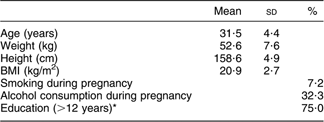
*Data were missing for two subjects.
The distributions of T-Hg concentrations in RBC and hair are shown in Fig. 1. The median (5th, 95th percentile) T-Hg concentration was 13·1 (5·8, 27·6) ng/g for RBC and 2·0 (0·9, 4·4) μg/g for hair. There was a significant correlation between T-Hg concentrations in RBC and hair (Pearson’s correlation coefficient after log-transformation: r = 0·916, P < 0·0001; data not shown).
Distributions of total mercury (T-Hg) concentrations in red blood cells (RBC) (a) and hair (b) in 609 pregnant Japanese women enrolled in the Tohoku Study of Child Development. The median (5th, 95th percentile) of T-Hg concentration is 13·1 (5·8, 27·6) ng/g for RBC and 2·0 (0·9, 4·4) μg/g for hair

Estimated methylmercury intake based on the FFQ
The frequencies and amounts of consumption and estimated MeHg intake for the thirteen items are shown in Table 2. In total, the median (5th, 95th percentile) frequency of consumption was 5·4 (1·9, 12·6) times/week and amount was 309·7 (93·1, 742·5) g/week. The most frequently consumed item was salmon (mean of the ratio to total consumption for all subjects: 17·6 %), followed by silvery blue fish (14·7 %), canned tuna (11·3 %) and white-meat fish (10·7 %). Silvery blue fish was the most consumed item in terms of amount (17·7 %), followed by white-meat fish (15·6 %), large predatory fish (13·5 %) and salmon (11·8 %). Whale was rarely consumed. Median (5th, 95th percentile) total MeHg intake was estimated to be 42·3 (8·8, 134·0) μg/week. Large predatory fish were the principal source of MeHg (43·0 %), followed by white-meat fish (12·7 %) and silvery blue fish (11·3 %). Every other item had a contribution of less than 10·0 %. Dividing the total MeHg intakes (μg/week) by the body weights of individuals measured before pregnancy, the median (5th, 95th percentile) MeHg intake was calculated to be 0·8 (0·2, 2·6) μg/kg body weight per week. The distribution of MeHg intake per kilogram of body weight per week is shown in Fig. 2. It was found that 12·5 % of the subjects exceeded the TWI.
Frequency and amount of consumption, and estimated methylmercury (MeHg) intake, for the thirteen seafood items: 609 pregnant Japanese women enrolled in the Tohoku Study of Child Development

The median, mean and sd were calculated for every subject (n 609).
Distribution of estimated methylmercury (MeHg) intake in 609 pregnant Japanese women enrolled in the Tohoku Study of Child Development. The median (5th, 95th percentile) of MeHg intake is 0·8 (0·2, 2·6) μg/kg body weight per week. The broken line indicates the Japanese tolerable weekly intake of 2·0 μg/kg body weight per week

Association of methylmercury intake with total mercury in red blood cells and hair
The T-Hg concentrations in RBC and hair were significantly correlated with the estimated MeHg intake: r = 0·325 (P < 0·0001) for RBC, r = 0·305 (P < 0·0001) for hair (Fig. 3). The T-Hg concentrations in RBC and hair by quartile of MeHg intake are shown in Table 3. As the MeHg intake increased, the T-Hg concentrations in RBC and hair increased significantly (P < 0·0001 for RBC, P < 0·0001 for hair).
Correlations between estimated methylmercury (MeHg) intake and total mercury (T-Hg) concentrations in red blood cells (RBC) (a) and hair (b), after log transformation, in 609 pregnant Japanese women enrolled in the Tohoku Study of Child Development. (a) MeHg intake and T-Hg in RBC (ng/g): Y = 0·805 + 0·187X (r = 0·325, P < 0·0001). (b) MeHg intake and T-Hg in hair (μg/g): Y = 0·016 + 0·175X (r = 0·305, P < 0·0001)

Total mercury (T-Hg) concentrations in red blood cells (RBC) and hair by quartile of estimated methylmercury (MeHg) intake: 609 pregnant Japanese women enrolled in the Tohoku Study of Child Development

P values calculated by one-way ANOVA.
Discussion
In the present study, the MeHg intake was estimated to be 42·3 μg/week (median), and nearly half of it was taken from large predatory fish such as tuna, swordfish and marlin. Tuna, a popular fish in Japan, is often eaten as ‘sashimi’ and ‘sushi’, and it has been reported that about one-third of the catch of tuna in the whole world is provided for Japan(23). In our study subjects, the large predatory fish consumption was also relatively high as shown Table 2. It was found that 12·5 % of the subjects exceeded the Japanese TWI(7) (Fig. 2). Additionally, considering the PTWI of 1·6 μg/kg body weight per week proposed by the Joint FAO/WHO Expert Committee on Food Additives(4) and the RfD of 0·1 μg/kg body weight per d proposed by the US Environmental Protection Agency(5), 17·4 % and 57·5 % of our study subjects exceeded these reference points, respectively. Worldwide, the seafood consumption of our country is definitely not high(23), and the level of exposure to MeHg in our study subjects was not high compared with other studies(Reference Grandjean, Weihe, White, Debes, Araki, Yokoyama, Murata, Sorensen, Dahl and Jorgensen1–Reference Murata, Weihe, Renzoni, Debes, Vasconcelos, Zino, Araki, Jorgensen, White and Grandjean3, Reference Davidson, Myers and Cox24, Reference Myers, Davidson and Cox25). Nevertheless, there was a group highly exposed to MeHg. Total seafood consumption of the subjects who exceeded the TWI was higher than for other subjects, and large predatory fish consumption, especially, was higher (Student’s t test: P < 0·0001; data not shown). From these results, it could be thought that large predatory fish such as tuna, swordfish and marlin are the main sources of exposure to MeHg in the Japanese.
On the other hand, although containing MeHg, seafood is part of a nutritious diet and a good source of n-3 PUFA which are known to be beneficial for the brain in fetal development. In contrast to several studies(Reference Grandjean, Weihe, White, Debes, Araki, Yokoyama, Murata, Sorensen, Dahl and Jorgensen1–Reference Murata, Weihe, Renzoni, Debes, Vasconcelos, Zino, Araki, Jorgensen, White and Grandjean3), no consistent pattern of adverse effects of prenatal MeHg exposure was found in others such as the Seychells study(Reference Davidson, Myers and Cox24, Reference Myers, Davidson and Cox25), which focused on nutrients in fish(Reference Myers, Davidson and Strain26, Reference Bonham, Duffy, Wallace, Robson, Myers, Davidson, Clarkson, Shamlaye and Strain27). Another large epidemiological study has also suggested the benefits of seafood intake(Reference Hibbeln, Davis, Steer, Emmett, Rogers, Williams and Golding11). If pregnant women excessively restrict seafood consumption to lessen MeHg intake, there will be a shortage of nutritious substances such as n-3 PUFA. Adverse effects of MeHg may depend on the balance between MeHg and beneficial nutritional components in the seafood consumed(Reference Mahaffey28).
The main objective of the present study was to confirm the accuracy of the estimated value for MeHg by comparison with biomarkers. The correlation coefficients of the estimated values for T-Hg in RBC and hair were 0·325 (P < 0·0001) and 0·305 (P < 0·0001), respectively. In other studies, Sanzo et al.(Reference Sanzo, Dorronsoro, Amiano, Amurrio, Aguinagalde and Azpiri29) reported that the correlation coefficient between T-Hg intake and T-Hg in RBC for 120 individuals in Spain was 0·36 (P < 0·005), Iwasaki et al.(Reference Iwasaki, Sakamoto, Nakai, Oka, Dakeishi, Iwata, Satoh and Murata30) reported one of 0·335 (P < 0·001) between T-Hg intake and T-Hg in hair for 154 Japanese women, and Ohno et al.(Reference Ohno, Sakamoto, Kurosawa, Dakeishi, Iwata and Murata31) reported a correlation coefficient of 0·551 (P < 0·01) between T-Hg intake and T-Hg in hair for fifty-nine Japanese women. Although the sample sizes and significance levels were different among studies, our result of ‘about 0·3’ was similar to the former two studies.
There are several factors that influence the association between estimated intake values and biomarkers. The first is the uncertainty of the dietary survey method, i.e. the FFQ. Although validity of the information collected by FFQ has been shown by many validation studies(Reference Mouratidou, Ford and Fraser9, Reference Segovia-Siapco, Singh, Jaceldo-Siegl and Sabate10), this information is not as detailed as that collected by dietary records because it involves a recall bias(Reference Tsubono and Hisamichi32). It has been reported that the FFQ has a tendency of overestimate when there are many food items, and underestimate when there are few food items, compared with a dietary record(Reference Tsubono and Hisamichi32). In the present study, from the large positive intercepts and gentle slopes in Fig. 3, it was found that MeHg intake had a tendency to be overestimated at lower exposure levels and underestimated at higher exposure levels. Another factor is the uncertainty of the database on mercury concentrations in seafood. Iwasaki et al.(Reference Iwasaki, Sakamoto, Nakai, Oka, Dakeishi, Iwata, Satoh and Murata30) reported that the average amount of estimated T-Hg intake determined using the FFQ was 15·3 μg/d (geometric mean), although they used a different database(Reference Yamamoto, Matsuda and Sato33, Reference Nakagawa, Yumita and Hiromoto34) from the one used in our study for calculation. This estimated value is about 2·5 times higher than our result. If the exact amount of seafood consumption can be obtained, the estimated value will vary greatly contingent on the database. The concentration of mercury in fish depends on size, age and the surroundings of the fish(17). To estimate the MeHg intake accurately, a more detailed database that has a sufficient number of samples and considers these factors of concentration variability will be needed.
In conclusion, the correlation coefficient between the estimated MeHg intake based on the FFQ and biomarkers was ‘about 0·3’. The accuracy of the estimated value was generally indicated because the association was statistically significant, and at a level similar to other studies(Reference Sanzo, Dorronsoro, Amiano, Amurrio, Aguinagalde and Azpiri29, Reference Iwasaki, Sakamoto, Nakai, Oka, Dakeishi, Iwata, Satoh and Murata30). Although the estimated value involves the uncertainties mentioned above, it appears that the FFQ is a useful tool for assessment of exposure to MeHg.
Acknowledgements
Sources of funding: This study was supported by grants from the Ministry of Health, Labor and Welfare (Research on Risk of Chemical Substances) and the Ministry of Education, Culture, Sports, Science and Technology (Grant-in-Aid for Scientific Research [B]), Japan. Conflict of interest declaration: There are no conflicts of interest. Authorship responsibilities: K.Y.-S. and H.S. conceived the study design and supervised data analysis. K.N. and K.S. organized the data collection of the cohort study. M.S., T.O. and S.K. carried out the analysis of total mercury. N.K. gave advice about statistical analysis. Finally, K.Y.-S. wrote the manuscript and the other authors critically revised the manuscript. Acknowledgments: We thank all the participants of this study.



