

1.1 Introduction
This chapter provides a summary of steps needed to make useful mathematical models of physical systems. I refer to these steps as “estimation analysis” but in hallways of science and engineering schools or engineering offices they are often referred to as hand calculations or back-of-the-envelope calculations. I am not a big fan of these terms, as they convey a sense of sloppiness, which is far from accurate. This type of analysis is useful for building deeper understanding of integrated circuits and systems, but the methodology is very general and can be applied to most systems governed by some kind of mathematics. From deep space astrophysics to microscopic systems such as integrated circuits you will find broad applications of this kind of thinking. With this broad applicability it is no surprise that the principles we outline here are somewhat vague, but we will discuss enough examples in the rest of the book to enable the reader to develop a good sense of how to proceed in different situations. A mastery of these ideas will only come with experience. The process can be time-consuming initially because it involves digging into the core of the system under consideration. If the system is new to the user, the learning process can take even longer. But oftentimes, and with practice, the systems are similar enough to other systems the user has seen before that the process can be quite swift. We will start by outlining the principles and then discuss each of them in some depth. We will then refer to these steps in the following chapters, where many examples are provided.
After a model has been developed one can use it as a starting point for fine-tuning in a simulator or on the bench or whatever might be practical.
1.2 Principles
A beginner often tries to solve a problem with brute force, using three dimensions, full nonlinear equations, etc. The problem will then quickly become intractable with myriads of sums and complex expressions yielding little insight. With experience one learns that the core behavior is often much simpler to catch but it requires thinking the problem through before full calculations start. For the novice this can often be frustrating but with practice one learns to see the value of this approach.
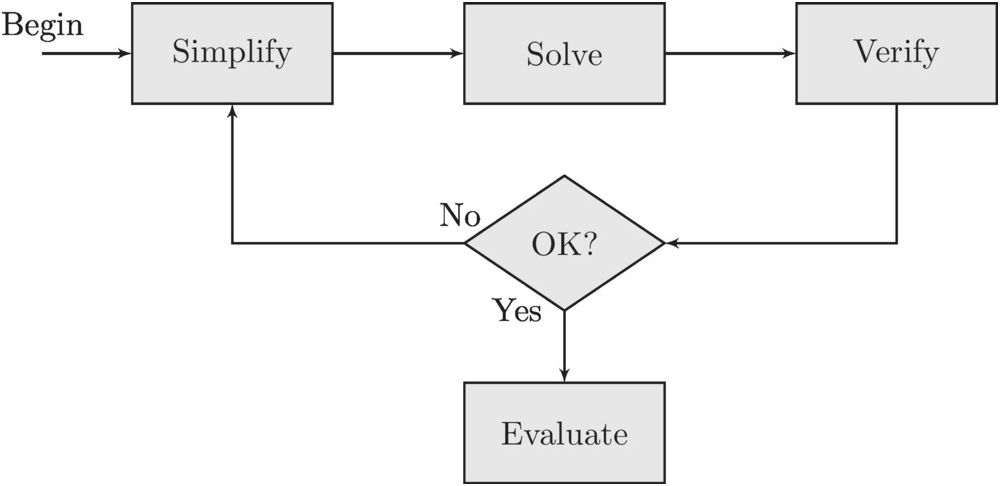
In a typical modeling situation there are four steps to follow:
(1) Simplify – This is often the most difficult step because it attempts to get to the core of how the system works.
(2) Solve – If step 1 is executed properly this will be relatively easy.
(3) Verify – Here we verify the solution in step 2 is correct by for example checking extreme cases and/or comparing to simulations and/or exact calculations. If something is wrong, go back to step 1.
(4) Evaluate – In this section we analyze what the solution means.
We will discuss each of these in turn: see Figure 1.1 for a simple flow diagram.
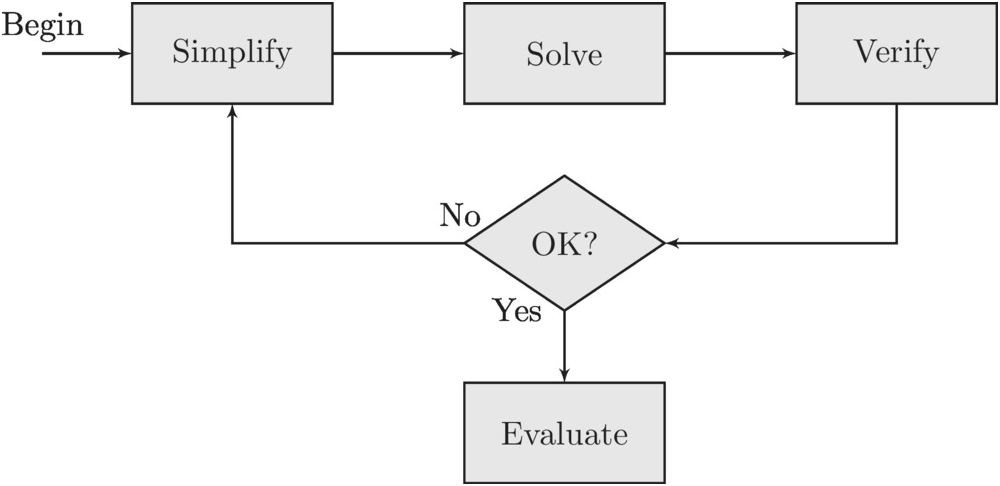
Figure 1.1 Estimation analysis work flow.
Simplify
To properly simplify we need to be able to understand what we actually want to know. Is it a length scale, gain, bandwidth, linearity, etc.? How can we simplify the system so that this property will be highlighted? Can we make it two-dimensional, one-dimensional, cylindrical symmetry, spherical symmetry, planar symmetry? Can we linearize it? If we are interested in gain or noise, linearization is a great technique. Perhaps a harmonic tone is causing headache and perturbation calculation is in order? If we are looking at a clocked system, perhaps an ideal switch with infinite edge rate will suffice?
Solve
This often involves fairly simple algebra. In some cases there are some useful mathematical techniques available and in this book we will describe them as we move along and for more complex techniques we will refer to the literature.
Verify
This step is often neglected in practice but it is critical. If we have missed something essential in the model, the behavior of the model will simply be wrong and we will not have learned what we set out to learn. Oftentimes one can find similar calculations in the literature that can be used for verification. At other times one can simulate to confirm that the model fully captures the desired properties. This simulation is not to be used as a substitute for understanding, but to confirm the model assumptions and calculations are correct. A good technique is to take various parameters and go to the extremes to make sure the behavior is as expected. For example, if we are investigating the gain of an amplifier with a degeneration resistor, does the model go to the correct limit when this resistor is zero or infinite?
Evaluate
What does the solution mean? Is there something one can do with a certain variable combination that will result in something useful, like improved jitter or reduced power? If we need smaller inductance, will widening the metal width be efficient?
Most education comes with experience. The road is narrow and sometimes long but it is a great journey and the joy of understanding something on a deeper level cannot be overstated.
In this book we will illustrate estimation analysis methodology by going through many specific examples to showcase what can be done. My hope is that the reader will be inspired to go well beyond what is described here and invent great things. We will do simple circuit analysis that most readers will already be familiar with and then move on to complex examples such as the direct solution of Maxwell’s equations and system analysis of analog-to-digital converters (ADCs) and phase-locked loops (PLLs). We will also discuss deeper physical concepts such as the nature of jitter and its relationship to phase noise.
1.3 Integrated Circuit Applications
Having established a simple model we can proceed to the design phase by applying the model to a specific design problem. We derive a set of parameters such as transistor sizes, interconnect width, etc. and use those as a starting point for the design in the simulator. The idea is to use the simulator to fine-tune the design. We should already know, within the accuracy of the simple model, what to expect from simulation. This kind of approach presents a huge shortcut in the design effort.
In this book we will build various models and use them in real-world design examples to establish a good starting point for fine-tuning in simulators.