


Impact statement
Plastic pollution is a global problem, yet the UN negotiations for a global plastics treaty overlook the very system that moves plastics across borders: trade. Our letter highlights this blind spot and explains why bringing trade rules into the treaty is essential for real-world impact. Trade acts as the bloodstream of the plastics economy, carrying feedstocks, finished goods and waste from factory floors to distant shorelines. Without safeguards, this flow shifts environmental burdens onto countries least able to manage them and undercuts efforts to redesign products or scale recycling. Embedding smart trade provisions – transparent reporting, consistent product codes and support for customs and port authorities in tracking plastics products and waste trade flows – would close loopholes, spur investment in circular materials and ensure that all nations play by the same rules. By reframing trade from a side (dialogue) issue to a core solution, our analysis and recommendations offer negotiators a practical path to reduce pollution, level the playing field for smaller economies and unlock new markets for safer alternatives. Integrating trade governance turns the treaty from aspiration into enforceable action – benefiting communities and ecosystems worldwide.
Introduction
As the global plastics treaty enters its final negotiation phase, one issue - trade - remains largely unaddressed. Negotiations for the global treaty to end plastic pollution (the plastics treaty) will enter a pivotal phase at the Intergovernmental Negotiating Committee, INC-5.2, in Geneva in August 2025, and governments face critical choices. Will the treaty establish binding commitments across the full plastics lifecycle – from production and design to waste management – or focus only on downstream measures? Will it include legally binding lists of chemicals of concern and problematic products? Will countries be required to report plastic production, trade and pollution consistently and transparently?
Trade is the invisible engine of the plastics economy. From fossil fuel feedstocks and plastic resins to final goods and post-use waste, plastics cross borders at every stage of their lifecycle. In 2021 alone, global trade in plastics reached at least $1.2 trillion, roughly 5% of total world trade, including primary polymers, additives, packaging, synthetic textiles and waste. Finished plastic goods alone accounted for $510 billion, while trade in resins and pellets reached $384 billion (Deere Birkbeck et al., Reference Deere Birkbeck, Barrowclough, Sugathan, Bellmann and Souza Campos Rodrigues2023). Major economies such as China, the United States and Germany dominate both exports and imports (UNCTAD, 2020). Meanwhile, many smaller and lower-income countries that produce no plastic of their own import products in plastic containers or packaging and receive plastic waste, yet often lack the infrastructure to manage it safely (UNEP, 2021). For example, textiles comprising synthetic, semi-synthetic, and non-synthetic fibers are often exported to Africa labeled as second-hand clothing, but 40% end up as waste in landfills or the ocean (Ginatta and Isler, Reference Ginatta and Isler2024).
The transboundary nature of plastics creates a globally entangled system: decisions about what is produced, consumed and discarded in one country reverberate across others. Yet trade has remained a marginal topic in treaty deliberations (TESS, 2023). This omission jeopardizes implementation and equity. Without integrating trade into the treaty’s architecture, negotiators risk building an agreement that regulates plastics in theory but not in practice.
Unequal flows: Trade, power and the plastics economy
National positions at the treaty negotiations often reflect underlying structural roles in the global plastics economy. Countries like Saudi Arabia and the United States, which export large volumes of resins and petrochemical feedstocks, tend to resist binding production caps. Meanwhile, smaller and lower-income countries, many of which import plastic goods and waste, call for stronger transparency, financial support and enforceable controls.
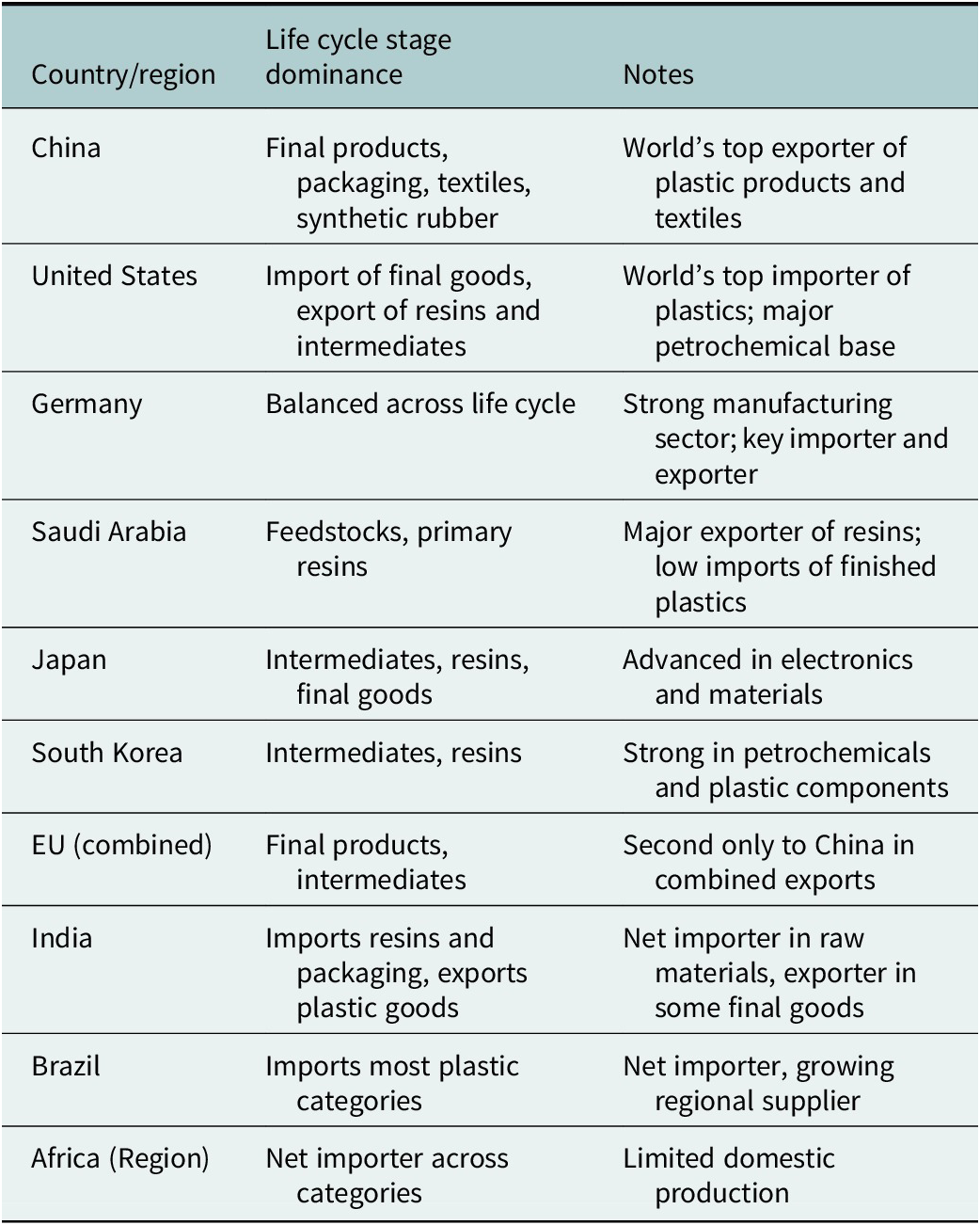
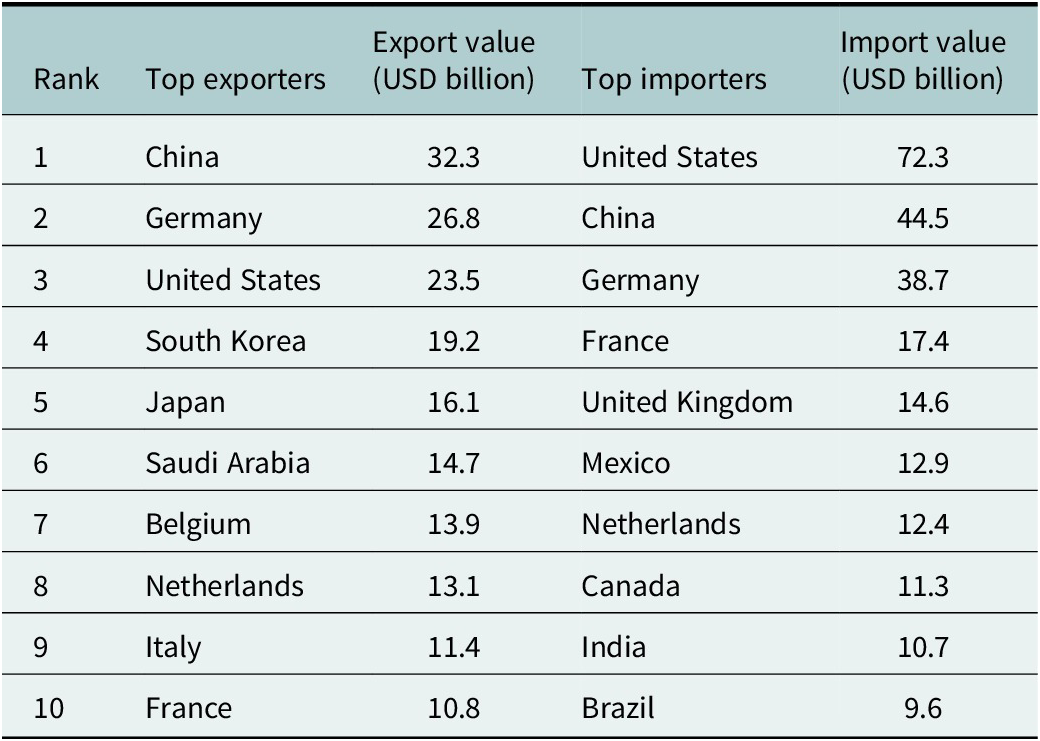
As Table 1 shows, finished plastic goods and resins dominate global trade by both value and volume, highlighting the scale of transboundary flows that make national policies insufficient on their own. These differing positions are further shaped by countries’ specific trade profiles. Table 2 illustrates that some countries focus their economies on the production of feedstocks, others on finished goods, while many developing nations remain import-dependent, which makes them prone to higher exposure to unmanaged plastic waste. Table 3 shows the top 10 global importers and exporters of plastics and illustrates that they differ widely in the type and scale of plastic trade. Countries’ roles in the plastics value chain determine their national interests and negotiating positions. Without careful attention to these dynamics, treaty outcomes may deepen existing asymmetries rather than correct them.
Global plastics trade by product category and value (2021)

Key players across the plastics life cycle
Top 10 global importers and exporters of plastics (2023) (Based on HS Chapters 39 and 40 for plastics and rubber products; approximate trade values)
Several countries have enacted trade-related restrictions on plastics, illustrating the need for coordinated action. National bans on single-use plastic items and plastic waste imports have been impactful, but without harmonized definitions, standards and enforcement, trade flows have simply shifted (Deere Birkbeck et al., Reference Deere Birkbeck, Barrowclough, Sugathan, Bellmann and Souza Campos Rodrigues2023). For example, China’s 2018 “National Sword” policy banned the import of plastic waste, triggering a ripple effect across global waste flows as plastic waste was diverted to Southeast Asia and overwhelmed local infrastructure (UNEP, 2018).
Malaysia, India and Kenya have followed with their own import bans or restrictions, often in response to the environmental and infrastructural strain of redirected waste (Schroeder, Reference Schroder2020; UNCTAD, 2020). The European Union has enacted the Single-Use Plastics Directive, which also applies to imported goods, thereby shaping global trade norms (European Commission, 2019). Governance measures have become increasingly divergent across countries and contexts, putting strain especially on smaller states whose markets do not have the power and capacity of larger nations. This underscores the need for a harmonized global treaty framework.
Trade rules were designed well before plastics were identified as a problem, and the WTO provisions under the Technical Barriers to Trade (TBT) and Sanitary and Phytosanitary (SPS) Agreements can be invoked to challenge national plastic restrictions (WTO, 2024). A global plastics treaty without a clear trade interface risks legal disputes that could undermine environmental ambition (Deere Birkbeck et al., Reference Deere Birkbeck, Barrowclough, Sugathan, Bellmann and Souza Campos Rodrigues2023).
Harnessing trade for circularity
Properly designed trade measures can support the treaty’s objectives. Tools such as green tariff classifications, trade facilitation for environmentally sound technologies and structured trade-related notifications under the WTO could support treaty implementation and innovation.
Examples abound of how trade can be a force for good. The European Union has lowered tariffs on certain recycled polymers and packaging alternatives, and its Ecolabel sets criteria that apply equally to imports. Kenya and India have enacted import bans on plastic bags and waste to reduce pollution burdens. South Korea and France extend producer responsibility schemes to imported goods, leveling the regulatory playing field. The World Customs Organization is revising customs codes to improve tracking of recycled and problematic plastics, and WTO’s Aid for Trade program has supported recycling infrastructure in countries like Rwanda and Ghana. Positive trade instruments are already in use and could be scaled globally through the plastics treaty.
Ensuring equity for small states
Trade-related measures place burdens on small states that contribute little to global plastic production. Many small states are net importers of plastic goods and recipients of unwanted or misclassified waste. Yet, they lack the infrastructure to monitor trade flows, to enforce product standards or to process imported plastic waste (UNCTAD, 2020; UNEP, 2021). For example, Pacific Island countries such as Vanuatu and Samoa have taken strong domestic steps to ban single-use plastics, but face challenges in regulating imported goods or participating in global standard-setting without technical support (SPREP, 2019; UNEP, 2021). Similarly, Rwanda and the Maldives have led with bold national bans but rely on international partnerships to build recycling capacity and track trade data (REMA, 2020).
To address this imbalance, the plastics treaty must incorporate differentiated responsibilities and robust capacity-building mechanisms. Aid for Trade programs, modeled on successful WTO initiatives, can provide technical assistance and training (WTO, 2022). A dedicated fund for sustainable trade transition, akin to the Montreal Protocol’s Multilateral Fund, could support small states in aligning national policies with treaty obligations, implementing customs reforms and accessing clean production and recycling technologies (Multilateral Fund Secretariat, 2024).
Without such support, trade rules may entrench inequality by penalizing the countries least responsible for the problem and least equipped to adapt. With it, trade can become a tool of transformation, empowering small states to lead on implementation and shape global solutions.
Learning from environmental agreements
Several Multilateral Environmental Agreements (MEAs) make use of trade measures that could provide models for the plastics treaty. The Montreal Protocol banned trade in ozone-depleting substances with non-Parties, thus incentivizing compliance and promoting universal participation. The Multilateral Fund supported technology transfer and financial assistance to developing countries and countries with economies in transition. Its structure is a model for balancing environmental integrity and trade equity.
The Convention on International Trade in Endangered Species (CITES) offers a model of tiered trade controls based on environmental risk. Its global permit system ensures traceability and accountability in cross-border trade. A similar approach could be designed for certain categories of plastics, particularly for those considered problematic or avoidable.
Amendments to the Basel Convention, effective January 2021, created three plastic-waste categories – clean recyclables, hazardous waste and mixed/contaminated waste – and extended the Prior Informed Consent (PIC) procedure to nearly all shipments. Exporters now need approval from importing countries party to the convention, closing loopholes that had allowed unchecked exports of low-grade plastics to developing countries. Challenges persist, however, as the United States is not party to the Convention and has relied on a separate OECD (Organisation for Economic Cooperation and Development) agreement for waste trade (Khan, Reference Khan2019; epa.gov).
These MEAs demonstrate both the potential and limitations of trade-based controls. They reinforce the value of harmonized standards, institutional coordination and stronger enforcement. Most importantly, they show that trade measures, when thoughtfully integrated, can reinforce rather than inhibit environmental protection.
Aligning treaty and global trade rules
An effective plastics treaty would hinge on the transparency of plastics trade flows. At present, outdated Harmonized System (HS) codes blur the distinction between primary and recycled polymers, conceal chemical additives and overlook embedded plastics in traded goods such as packaging. The World Customs Organization’s 2027 revision of the HS is therefore critical: by expanding plastic product classifications and codes, it could enable more granular tracking of trade flows across the plastic life cycle – essential for monitoring compliance with the treaty provisions.
The WTO Dialogue on Plastic Pollution (DPP) has identified eight focus areas in its workplan: (1) engaging in the INC negotiations to support the future plastics agreement implementation; (2) enhancing transparency in plastic trade flows; (3) providing technical assistance and capacity-building; (4) increasing transparency of members’ trade-related plastic measures (TrPMs); (5) promoting best practices for TrPMs; (6) fostering trade in recycled and recyclable materials to advance circularity; (7) achieving greater harmonization to identify single-use plastic goods; and (8) improving access to technologies and services for environmentally sustainable waste management and substitutes (WTO, 2025). The WTO can translate these themes into concrete support for the INC process, particularly by (i) steering HS reform, (ii) mapping credible international standards for plastic products, non-plastic substitutes and related chemicals and (iii) facilitating technology transfer and capacity-building.
Trade governance systems were not designed with plastics in mind. Institutions such as the WTO and the Basel Convention are still adapting, while national trade-related plastics measures continue to proliferate without harmonized definitions or enforcement, provoking trade tensions. Integrating a trade coordination mechanism in the treaty, such as establishing a standing INC–WTO coordination group or formal consultation process, would give negotiators a forum to vet new measures and help identify safe spaces for environmentally justified trade restrictions that are aligned with global rules.
In this dual-track approach – long advocated by Deere Birkbeck and TESS – the plastics treaty sets binding environmental targets while the WTO supplies the procedural and statistical infrastructure that makes them enforceable.
Recommendations for INC-5.2
-
1. Include a dedicated article on trade and sustainable markets.
-
2. Establish a working group with the WTO and WCO to align trade and environmental rules.
-
3. Mandate transparent tracking of plastic trade flows.
-
4. Create a financial mechanism to support trade-related transition for developing countries.
-
5. Ensure all trade-related measures are designed to be WTO-consistent while retaining strong environmental ambition.
Conclusion: Creating a coherent treaty
To be effective, the global plastics treaty must address the real-world architecture of the plastics economy, where trade is the connective tissue. At INC-5.2, negotiators must seize the opportunity to design a treaty that is both environmentally ambitious and structurally sound. Trade must be reimagined as a tool for transformation. If trade is the connective tissue of the plastics crisis, it must also be part of the cure.
Open peer review
To view the open peer review materials for this article, please visit http://doi.org/10.1017/plc.2025.10008.
Acknowledgements
This letter builds on the extensive work of scholars and institutions who have elevated the visibility of trade in global plastics governance, most notably Carolyn Deere Birkbeck, whose insights have informed and inspired the perspectives shared here.
Author contribution
Maria Ivanova and Jamel Zarrouk contributed equally to this letter. They collaboratively developed and conceptualized the project, collected and analyzed the data, composed and critically revised the manuscript, approved the final version for submission and assumed full responsibility for the accuracy and integrity of its content.
Financial support
This research was partially supported by Carnegie Corporation of New York through their grant to Prof. Maria Ivanova on Reimagining Environmental Multilateralism.
Competing interests
The authors declare none.
Author biography
Prof. Maria Ivanova (Director, School of Public Policy and Urban Affairs and Co-Director, Plastics Center, Northeastern University, Boston, USA) and Dr. Jamel Zarrouk (Founder & Managing Director, Boulder Economics Consultancy, Dubai, UAE).


 Open access


Comments
Dear Editors,
We are pleased to submit our letter to the editor, “Binding the Flows: Why Trade is Central for a Global Plastics Treaty,” for consideration in Cambridge Prisms: Plastics.
As the global plastics treaty enters its final stage of negotiations, this article addresses a critical and underexplored dimension of the plastics economy: international trade. Trade flows span fossil feedstocks, plastic resins, finished products, and waste, and are both a driver of the crisis and a potential instrument for its resolution. Our analysis brings together global trade data, country cases, and institutional models to propose how trade can be integrated into the treaty’s architecture to support environmental ambition, equity, and effective implementation.
In alignment with Prisms’ mission to provide transdisciplinary insight on complex sustainability challenges, this article bridges environmental policy, global governance, trade law, and development. We believe it will be of particular interest to scholars, policymakers, and practitioners working on circular economy solutions, international law, and multilateral environmental agreements.
We confirm that the manuscript is original, has not been published elsewhere, and is not under consideration by any other journal. We do not have a graphical abstract but could produce one as needed. We are open to suggestions and welcome examples of such an abstract.
Thank you for your consideration. We hope you find this submission a valuable contribution to current global conversations on plastics governance.
Warm regards,
Maria Ivanova and Jamel Zarrouk