


Introduction
People use animal parts for a variety of reasons including as food, clothing, trophies, traditional medicine, luxury goods and as integral parts of various cultural rituals (Brashares et al., Reference Brashares, Arcese, Sam, Coppolillo, Sinclair and Balmford2004). Because of the demand for these animal parts, unsustainable harvest pressure has in many instances led to local extirpation of wildlife populations (Lyons & Natusch, Reference Lyons and Natusch2011). Illegal hunting, commonly referred to as poaching, is an important source of harvest pressure (Knapp, Reference Knapp2012). Three predominant motivations for poaching are recognized: trophy (acquisition of animal parts for decorations, trade, rituals or luxury goods), medicative (incorporation of wildlife parts in traditional remedies, aphrodisiacs or health supplements) and consumptive (use of wildlife as primary or secondary sources of protein; Montgomery, Reference Montgomery2020). People who engage in illegal hunting have various motivations for doing so (e.g. fulfilling basic needs, financial incentives; Duffy et al., Reference Duffy, St John, Büscher and Brockington2016). For instance, poachers may target animals for non-commercial purposes to meet their basic needs, for which personal well-being and survival are the primary drivers (Kahler & Gore, Reference Kahler and Gore2012). Therefore, the various uses of parts from poached animals probably have complex correlations with the socio-economic characteristics of the participants (Knapp, Reference Knapp2012; Montgomery, Reference Montgomery2020).
The Global South is undergoing rapid human population growth and infrastructure development (Kummu & Varis, Reference Kummu and Varis2011), and poaching of wildlife is a significant conservation problem (Scheffers et al., Reference Scheffers, Oliveira, Lamb and Edwards2019). Consumptive poaching and trade of animal parts are common in rural households in many parts of sub-Saharan Africa, especially amongst communities living adjacent to protected areas (Fa & Brown, Reference Fa and Brown2009). Ungulates are often targeted by poachers because they provide an important food source for small-scale agricultural landholders, particularly during times of crop loss (Wilfred & Maccoll, Reference Wilfred and Maccoll2015). Poachers also seek parts from high-value animal species that are traded either as trophies or for their purported medicinal properties. Rhinoceroses Ceratotherium simum and Diceros bicornis, for example, are poached for their horns, which are incorporated in traditional medicines, often in East Asian markets, and can reach prices of USD 60,000/kg (Hübschle, Reference Hübschle2016; Cheung et al., Reference Cheung, Mazerolle, Possingham and Biggs2018). The skins, claws and teeth of large carnivores are used predominantly as trophies, curios or regalia when incorporated in traditional costumes (Naude et al., Reference Naude, Balme, Rogan, Needham, Whittington-Jones and Dickerson2020; Torrents-Ticó et al., Reference Torrents-Ticó, Fernández-Llamazares, Burgas, Nasak and Cabeza2022). Species targeted by poachers are often of conservation importance. Rare species or animal parts that have various uses and high value often command a high price in wildlife markets (Pires & Clarke, Reference Pires and Clarke2012; Challender & MacMillan, Reference Challender and MacMillan2014).
Historically, giraffes occupied habitats both within and outside protected areas (O'Connor et al., Reference O'Connor, Stacy-Dawes, Muneza, Fennessy, Gobush and Chase2019). Given range contractions, however, there are now more giraffe populations in private and community-owned conservancies than in government-managed protected areas, especially in East Africa (O'Connor et al., Reference O'Connor, Stacy-Dawes, Muneza, Fennessy, Gobush and Chase2019). In the last 35 years giraffe populations have gone extinct in seven sub-Saharan countries, with the rates of decline highest in East and Central Africa (Muller et al., Reference Muller, Bercovitch, Brand, Brown, Brown and Bolger2018). The extent to which poaching could have influenced this decrease remains largely unquantified. Giraffes body parts are used for trophy, medicinal and/or consumptive purposes. The skin, for example, is a prized trophy that is preferred for use in carrying water or milk because the skins of other animals are believed to bring bad luck (Muneza et al., Reference Muneza, Doherty, Hussein, Fennessy, Marais, O'Connor and Wube2018). Poachers also seek out giraffes solely for their tails, which are used as dowries in traditional marriages because they connote high social status (Hall, Reference Hall2016). Some communities believe that certain giraffe body parts have medicinal properties. Giraffe bone marrow, skulls, bones and organs are incorporated into traditional remedies for HIV/AIDS (Arusha Times, Reference Arusha Times2004; Nkwame, Reference Nkwame2022). Poaching of giraffes for consumption is more widespread and is considered to be a major threat to their conservation (Muller et al., Reference Muller, Bercovitch, Brand, Brown, Brown and Bolger2018). For example, giraffe meat is often sold in Kenya disguised as livestock meat, facilitating pathways for individuals to illegally purchase wild meat either purposely or unwittingly (Ouso et al., Reference Ouso, Otiende, Jeneby, Oundo, Bargul and Miller2020). Although the extent of giraffe poaching remains largely unquantified, it is recognized as a threat across the species’ range (Strauss et al., Reference Strauss, Kilewo, Rentsch and Packer2015; Muller et al., Reference Muller, Bercovitch, Brand, Brown, Brown and Bolger2018).
Here we examine correlations between socio-economic factors and the use of giraffe body parts in southern Kenya, which is an important stronghold for the Masai giraffe Giraffa tippelskirchi and an area that experiences comparatively high levels of human–wildlife conflict and poaching (Mukeka et al., Reference Mukeka, Ogutu, Kanga and Roskaft2020). Poaching is often linked to socio-economic factors such as income and ownership conditions (Nieman et al., Reference Nieman, Leslie, Wilkinson and Wossler2019). Therefore, we collected data on nine socio-economic explanatory variables (Table 1). Specifically, we collected information on whether household members had obtained giraffe body parts and their intended use. Evaluating the socio-economic factors associated with the use of wildlife parts is vital for mitigation efforts, including community outreach and management responses (Holechek et al., Reference Holechek, Cibils, Bengaly and Kinyamario2017). We discuss the implications of this research for wildlife conservation in coupled human and natural systems and detail the complex nature of poaching and trade of a species of conservation concern.
Descriptions and summaries of the explanatory variables used in the models to assess the socio-economic drivers that influence the use of Masai giraffe Giraffa tippelskirchi body parts in the Tsavo Conservation Area, Kenya (Fig. 1). We collected these data during June–July 2019 via 331 face-to-face interviews with representatives of households.

Study area where we conducted the semi-structured interviews in households in the Kasigau Corridor of the Tsavo Conservation Area, Kenya, during June–July 2019 to assess the use of Masai giraffe Giraffa tippelskirchi body parts. (Readers of the printed journal are referred to the online article for a colour version of this figure.)

Study area
We conducted our study in the Tsavo Conservation Area (hereafter referred to as Tsavo), which covers c. 60,000 km2 in south-eastern Kenya (Fig. 1). This landscape includes a matrix of village lands situated amongst two of the oldest and largest national parks in Kenya, Tsavo East and Tsavo West (Fig. 1), and a number of seasonal rivers that supply water to neighbouring communities (Oremo et al., Reference Oremo, Mulwa and Oguge2019). Tsavo is a critical landscape for a number of large mammals in Africa, including large carnivores (Henschel et al., Reference Henschel, Petracca, Ferreira, Ekwanga, Ryan and Frank2020). Approximately 40% of the African bush elephants Loxodonta africana in Kenya occur in Tsavo (Lamprey et al., Reference Lamprey, Pope, Ngene, Norton-Griffiths, Frederick, Okita-Ouma and Douglas-Hamilton2020). Voi is the largest town in Tsavo, with a population of c. 110,000 people across c. 32,000 households (Kenya National Bureau of Statistics, 2019). Hunting of wildlife has been illegal in Kenya since 1977 and perpetrators are considered poachers subject to prosecution under the Wildlife Conservation and Management Act of 2013. This Act recognizes different forms of poaching and associated penalties. Since the introduction of the Act, convictions for wildlife crimes have increased from 44% in 2013 to 91% in 2019 (ODPP, 2016; Kahumbu et al., Reference Kahumbu, Halliday and Morrison2019). A person convicted of hunting wildlife for subsistence is subject to a fine of > KES 30,000 (c. USD 300) or imprisonment for a term > 6 months, whereas people caught with wild meat for trade are fined > KES 200,000 (c. USD 2,000) or imprisoned for a term > 1 year (Kenya Wildlife Service, Reference enya Wildlife Service2016). In contrast, a person who engages in poaching for trophy or medicinal use could face severe penalties, including fines of KES 1,000,000–20,000,000 (c. USD 10,000–200,000) or an imprisonment term ranging from 2 years to life, depending on the conservation status of the wildlife species listed in the Act (Kenya Wildlife Service, Reference enya Wildlife Service2016). Hunting threatened animals such as giraffes leads to the most severe punishments (USD 200,000 and life imprisonment) and in all of these cases the monetary and prison fines can be applied concurrently (Kenya Wildlife Service, Reference enya Wildlife Service2016). Finally, Kenya has implemented a shoot-to-kill policy by anti-poaching patrols that encounter poachers in protected areas, in effect since 1989 (Asaka, Reference Asaka2018).
Methods
Semi-structured surveys
To assess the socio-economic factors that correlate with the use of giraffe body parts, we conducted semi-structured interviews during June–July 2019 in six villages within Tsavo (Fig. 1). We selected these villages because they participate in the Kasigau Corridor REDD+ (Reducing Emissions from Deforestation and forest Degradation) project, which promotes coexistence of wildlife and people for social improvement. When assessing illegal behaviours such as the use of animal parts, it is vital to gain the trust of respondents and to make clear they will not be subject to criminal penalty from any information they provide (Travers et al., Reference Travers, Archer, Mwedde, Roe, Baker and Plumptre2019). In building relationships of trust, we trained 10 research assistants, drawn from local communities, who were fluent in Kiswahili, Kamba, Taita and Maa, to conduct the interviews along with ABM, BA and SK. The research assistants had a high level of familiarity with the study area, in that they had already participated in the local REDD+ project, conducting surveys and recording human–wildlife conflict. Having individuals from the survey population participate in data collection is a technique that is used to acquire reliably truthful documentation of illegal activities (Vaske, Reference Vaske2008). We chose households randomly in the participating villages at the start of each day and arbitrarily selected houses at 2-km intervals. We measured this distance, using a GPS, along tracks used by residents. Before each interview, we described the objective of our research, explained there would be no criminal penalties resulting from the information provided and presented a consent form to the respondent. We asked for one representative individual in each household to participate in the interview and explained that (1) the interview could be terminated at any time that the respondent chose, (2) no data would be collected that could possibly be used to identify the respondent, and (3) anonymity would be maintained throughout the course of the study. The respondents gave consent verbally and the questioner recorded this in writing at the start of each interview.
We designed our survey to determine which socioeconomic factors influence the use of giraffe body parts and to evaluate how the parts were acquired. We asked the respondents whether any resident in the household had previously used giraffe meat, skin, bone, bone marrow, hair, tail, skull or any other part. We then selected six categories to describe the means by which respondents acquired the giraffe body parts, including widely known market areas (i.e. established shops or commercial areas), widely known suppliers (i.e. well-known individual without an established area of trade), one-time suppliers (i.e. a transaction that occurred only once), self, opportunistic or other. We did not ask respondents to name the market areas or the suppliers, to maintain anonymity. Self refers to instances in which a member of the household set out to hunt giraffes specifically. Opportunistic access to giraffe body parts is typified by instances in which an animal either died of natural causes (drought, fatal injury, carcass left behind by predators), was culled by wildlife authorities or died from collision with a car or train, and as such was not a commercially driven transaction. Finally, amongst respondents who stated they had used giraffe body parts previously but no longer did so, we asked why they had made this choice, to explore whether price, laws, community rules, affordability of tools, availability of giraffes and/or any other factor played a role in this decision.
Data analysis
To determine the socio-economic factors that correlate with the use of giraffe body parts, we reported and grouped the parts into consumptive, trophy or medicinal categories. We then assessed the number of times individuals had used giraffe body parts and for what purpose (Table 1). We selected these categories because violations of the law are sometimes considered to be learnt behaviours, and as such the practice typically includes techniques of committing the violation, specific rationalizations and understanding of conditions favourable to lawbreaking (Eliason, Reference Eliason1999). We then fit logistic regression models using the package brant (Brant, Reference Brant1990) in R 4.0.3 (R Core Team, Reference Core Team2020). We checked for collinearity amongst predictor variables with package rms using variance inflation factors and excluded variables sequentially with inflation factors > 5 (Harrell, Reference Harrell2016). Firstly, we used a logistic regression model to examine the relationships between the use of giraffe body parts (i.e. yes = 1 and no = 0) and gender, occupation, area of birth of respondent, changes in income, land ownership, type of land ownership, level of education and composition of household (Table 1). We then used an ordinal logistic regression model to predict the number of times a household used giraffe body parts as a cumulative link function of the nine socio-economic factors (Table 1). We implemented a stepwise elimination approach for model selection, and used a cut-off of P < 0.1 to select the best model and interpret model results for statistical significance.
Results
We completed 331 interviews across 350 households in six villages in Tsavo. More than half of the respondents were women (53.2%, n = 176) and 46.8% (n = 155) of the respondents were men. The mean size of a household was 7.1 (range 1–37) and 72.5% (n = 240) of the respondents stated that they were born within the study area. More than half of the respondents owned land in the study area (68.6%, n = 227). Amongst the individuals who owned land, 86.3% (n = 196 of 227) inherited land through family members, 11.0% (n = 25) possessed land through a community conservancy or ranch system and 2.6% (n = 6) of the respondents declined to respond. Almost half of the respondents (48.3%, n = 160 of 331) identified crop farming as their primary source of income, 14.5% (n = 48) were business owners, 12.7% (n = 42) were pastoralists and 2.1% (n = 7) worked in the ecotourism sector. Approximately 22.4% (n = 74 of 331) of the respondents selected ‘other’ as a source of income, which included casual workers or professions that we had not listed. Monthly median income in the study area was KES 15,000 (c. USD 150). A majority of the respondents (82.2%, n = 272 of 331) reported their monthly income had declined or had not changed compared to the previous year, and 5.7% (n = 19) of the respondents did not provide a response. Only 12.1% (n = 40) reported there had been an increase to their monthly income compared to the previous year.
More than a third of the households (36.0%, n = 119 of 331) had members who had used giraffe body parts at least once in their lifetimes. Giraffe body parts were most often used for consumption (71.0%, n = 184 of 259) involving meat (63.6%, n = 117 of 184), bone (20.1%, n = 37), bone marrow (15.2%, n = 28) and tail (1.1%, n = 2). More than a quarter of the uses described (26.6%, n = 69 of 259) were trophy poaching of giraffes for skin (37.7%, n = 26 of 69), tail hair (26.1%, n = 18), tail (18.8%, n = 13), meat (7.2%, n = 5), bone (5.8%, n = 4), skull (1.4%, n = 1) and bone marrow (1.4%, n = 1). Additionally, we received one report (1.4%) of giraffe fat being used in cultural rituals. The use of giraffe body parts in traditional medicines was reported amongst 2.3% (n = 6 of 259) of the households and involved the incorporation of meat, skin and bone marrow into remedies for chest pains and fevers. Bows and arrows (29.4%, n = 101 of 343) and a combination of bright lights and machetes (29.4%, n = 101 of 343) were the most common tools that poachers used to kill giraffes (Fig. 2).
The documented types of tools used to poach Masai giraffes within the Tsavo Conservation Area, Kenya (Fig. 1), and the number of households in which respondents reported using each type.

More than a third of giraffe body parts used by households were acquired through a one-time supplier (35.8%, n = 87 of 243), with giraffe meat being obtained in 58.6% (n = 51 of 87) of these transactions (Fig. 3). Amongst households that once used giraffe body parts but had stopped doing so, 41.7% (n = 50 of 120) identified government laws as the strongest deterrent, followed by 20.8% (n = 25) that listed inability to sell giraffe body parts as a limiting factor. Approximately 15.0% (n = 18) listed the combination of both government laws and the inability to sell giraffe body parts as the reason why they had stopped using giraffe body parts. Only one person (0.8%) stated having lost interest in poaching giraffes as the reason for stopping, and no respondent selected the affordability of tools or identifying an alternative source of income as a deterrent.
Sources of reported Masai giraffe body parts used in households within the Tsavo Conservation Area. We obtained these data from members of 119 households that reported using giraffe body parts at least once.

Our binary regression model results showed that three variables related significantly to using giraffe body parts. Men were more likely to use giraffe body parts (β = 0.502, n = 155, P = 0.052) than women within Tsavo. We also found that individuals who owned land within Tsavo (β = 0.879, n = 227, P = 0.003) and individuals who listed tourism as their primary source of income (β = 2.233, n = 7, P < 0.027) were more likely to use giraffe body parts compared to pastoralists (Table 2). The results from the ordinal logistic regression model also showed that men (β = 0.458, n = 155, P = 0.072), tourism workers (β = 1.782, n = 7, P = 0.039) and individuals who owned land (β = 0.290, n = 227, P = 0.003) within Tsavo were more likely to use giraffe body parts multiple times (Table 2).
Model variable estimates, standard errors and statistical significance of the ordinal and binary logistic models predicting variable correlations with the use of Masai giraffe body parts in the Tsavo Conservation Area, Kenya. We fitted the models using data from 331 semi-structured surveys in the Tsavo Conservation Area conducted in 2019. Variable descriptions are provided in Table 1.

*P < 0.1; **P < 0.05; ***P < 0.01.
Discussion
We found that giraffe body parts were used for consumption, medicines and as trophies by approximately a third of surveyed household members in Tsavo. Households with more adults were less likely to use giraffe body parts (Table 2). We speculate that this could be because higher numbers of household members could provide secondary sources of income. In Tsavo, crop farming was the primary occupation for almost half of the households. Although there were fewer tourism workers living in Tsavo, they were more likely to use giraffe body parts. This could be because of tourism workers receiving few benefits despite their knowledge of wildlife distribution patterns (Melita & Mendlinger, Reference Melita and Mendlinger2013). As such, using giraffe products could provide an alternative source of income or protein. Many farmers and landowners use fences to protect their crops and demarcate portions of their land and developmental infrastructure (McNutt et al., Reference McNutt, Stein, McNutt and Jordan2017), but fences represent a major threat to wildlife in southern Kenya (Kenya Wildlife Service, Reference Kenya Wildlife Service2008). During our surveys, we found a discarded giraffe carcass on the farm of one respondent (Plate 1), who reported accessing giraffe meat after the animal was trapped inadvertently in a fence. Six individuals reported accessing giraffe body parts via opportunistic means including giraffe deaths because of fences and collisions with trains or vehicles. Almost half of landowners who used giraffe body parts acquired them opportunistically through chance events in which the animals died near their farms or infrastructure developments. Individuals who acquired giraffe body parts opportunistically mainly sought bones, bone marrow, skulls, tail hair and tails to use as trophies (Fig. 3). Although the impacts of infrastructure developments in Tsavo on giraffes and other wildlife have been documented previously (Nyumba et al., Reference Nyumba, Sang, Olago, Marchant, Waruingi and Githiora2021), these need to be included in updated management and grazing plans (Durant et al., Reference Durant, Becker, Creel, Bashir, Dickman and Beudels-Jamar2015) as a means to foster co-existence, reduce human–wildlife conflict and monitor trade routes for the use of animal parts.
(a) Masai giraffe Giraffa tippelskirchi calf trapped in a fence in southern Kenya. The calf was removed successfully from the fence following the intervention of veterinary doctors from the Kenya Wildlife Service. In some instances the veterinary team might not arrive before the giraffe dies, in which case local people could acquire meat and other body parts opportunistically; (b–c) the remains of a giraffe that was consumed in the Tsavo Conservation Area, Kenya. Photos: Moses Kinaiya (a); Alfred Kalama (b,c).

Amongst individuals who reported using giraffe body parts at least once, a large majority utilized meat, bone, bone marrow and skin. Meat and bones, which are used in stews and soups, were acquired from a diverse set of sources (Fig. 3). Trophy poaching of giraffes provided a conduit for crafting items such as bags (from skin), fly whisks (from tails) and bracelets (from tail hair) that are either used in traditional costumes or sold locally for financial gain. One respondent also acknowledged that giraffe fat was an important component of traditional rituals. The use of giraffe body parts for traditional remedies was reported by only 2.3% of households, for treating chest pains and fevers. This low level of use of giraffe body parts for traditional medicine could be attributed to the adoption of sedentary and modern lifestyles in historically pastoralist areas (Western et al., Reference Western, Nightingale, Mose, Ole Sipitiek and Kimiti2019).
Approximately 16% of respondents procured giraffe body parts from widely known markets. One-time suppliers, although infrequent, were the most common channel for acquiring giraffe body parts. This could be because the availability of animal parts and derived products in widely known markets is often affected by supply shortfalls (McNamara et al., Reference McNamara, Rowcliffe, Cowlishaw, Alexander, Ntiamoa-Baidu, Brenya and Milner-Gulland2016), which is an important factor in areas where these transactions are illegal. Only 11.5% of respondents reported hunting giraffes for their own use, although we acknowledge this could be an underestimate given that respondents may have been concerned about self-incrimination despite our efforts to promote trust and anonymity. This is important because government laws were listed as the strongest deterrent compared to any other factor. More than 40% of respondents who had used giraffe body parts previously reported they disengaged from this illegal activity because of the stringent laws. Poachers are subject to fines that were further increased with the implementation of the Wildlife Conservation and Management Act of 2013. With a median monthly income of c. KES 15,000 (c. USD 150) in Tsavo, many of the respondents would be affected significantly by these financial penalties if they were caught poaching. Approximately 21% of respondents stated they were unable to sell giraffe body parts and, as such, stopped poaching. This could be a result of the ambiguity of the descriptions provided in the laws. If a poacher is caught with giraffe meat, the minimum sentence (i.e. 6-month jail term, KES 30,000 fine or both) would apply only if the accused could prove that the primary use for the meat was consumption. However, we found that giraffe meat is also incorporated in traditional medicines and used as trophies, which would attract a more severe penalty. Thus, the comparatively low financial penalties for the consumptive use of animal parts could represent an escape clause for individuals who face the strongest penalties of the Wildlife Conservation and Management Act of 2013.
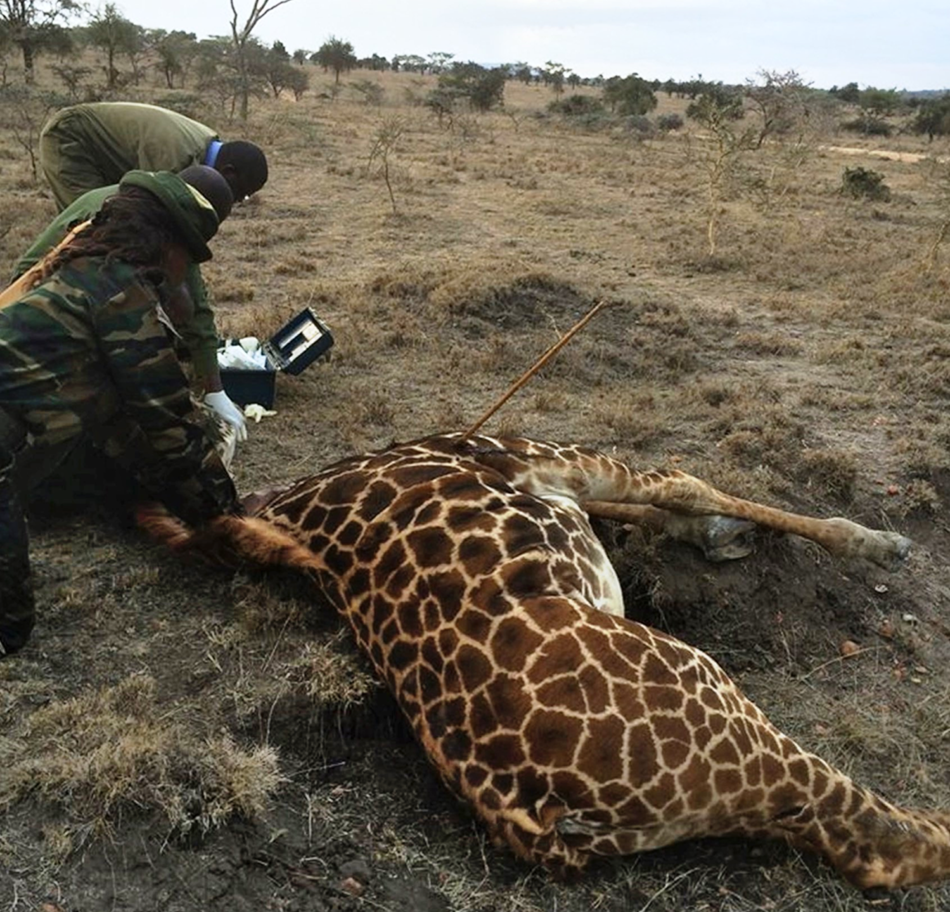
Since 1977 giraffe numbers have declined by 67% throughout their range in Kenya (Ogutu et al., Reference Ogutu, Piepho, Said, Ojwang, Njino, Kifugo and Wargute2016), although the ways in which poaching has affected this trend remain unclear. We found that only 10% of households stopped poaching because of the long travel distances required to locate giraffes or because giraffes were no longer found locally. One of the most common methods used by poachers to kill giraffes included the use of bright lights to blind the animals then cutting down the target animal with machetes and packaging the parts for transport by motorbike (Taita Taveta Wildlife Forum, pers. comm., 2019). Using motorbikes to transport giraffe body parts expediently allows poachers to avoid detection by law enforcement. Given the significant penalties that can result from being caught poaching in Kenya, these illegal activities are conducted typically in areas where ranger patrols are less intensive (Kyale et al., Reference Kyale, Ngene and Maingi2011; Asaka, Reference Asaka2018). Bows and arrows, wire snares and spears were also commonly used when poaching giraffes (Fig. 2), although using these tools could result in the animals escaping (Plate 2) or require more time to kill the target animal. In some landscapes, wire snares are readily available and thus are used more often to trap wildlife (Mudumba et al., Reference Mudumba, Jingo, Heit and Montgomery2020). Given that poaching of giraffes is conducted with the use of readily available tools, it is important to dedicate more research efforts to quantifying the population-level effects of poaching (Dunn et al., Reference Dunn, Connor, Veríssimo, Ruppert, Glikman, Fennessy and Fennessy2021).
A Masai giraffe being treated for an arrow wound by Kenya Wildlife Service veterinary doctors after escaping an illegal hunting attempt in southern Kenya. Photo: Stephen Tankard.
Considering that the majority of our survey respondents were crop farmers and that there has been a documented increase in human–wildlife conflict in Tsavo because of changes in the landscape (Muteti et al., Reference Muteti, Mukeka, Mwita, Ndambuki, Mareale and Kenana2018), wildlife management policies should focus on co-existence strategies in partnership with local communities. It is probable that poaching will persist if mitigation efforts are not adapted to the local context given the increase in human settlements and changes in land-tenure systems occurring in southern Kenya (Nyumba et al., Reference Nyumba, Sang, Olago, Marchant, Waruingi and Githiora2021). Although we documented various uses of giraffe body parts in southern Kenya, additional studies are required to quantify the degree to which poaching has affected giraffe populations there. Our findings also indicate that more research is needed to determine the extent of the availability of giraffe meat and identify common trade routes, to mitigate illegal trade. Communities have shown a willingness to adopt co-existence measures when they receive benefits from wildlife and are involved in conservation (Western et al., Reference Western, Nightingale, Mose, Ole Sipitiek and Kimiti2019). Given that it is improbable illegal hunting of wildlife will be mitigated without the participation of local communities, it is important to incorporate traditional knowledge into wildlife management strategies. Understanding the various cultures and practices in poaching hotspots can improve community-based conservation efforts (Dickman, Reference Dickman2010; Montgomery et al., Reference Montgomery, Borona, Kasozi, Mudumba and Ogada2020). This can also increase trust and collaboration with law enforcement (Challender & MacMillan, Reference Challender and MacMillan2014), addressing one of the enduring challenges of the 21st century in the Global South. It is only through the involvement and participation of multiple stakeholders within these coupled human and natural systems that novel approaches can be identified for long-term solutions.
Acknowledgements
We thank S. Ahmed, J. Kibwanga, M. Wario, J. Mwangeje, C. Kazungu, A. Kalingu, L. Mwazaule, M. Mwasi, E. Mwakoro and A. Juma for their assistance in collecting data and improving the clarity of the semi-structured survey in local languages; and the Leiden Conservation Foundation, the Giraffe Conservation Foundation, the Wildlife Conservation Network, the African Wildlife Foundation and the National Geographic Society for the support that made this research possible.
Author contributions
Study design: ABM, DBK, RAM; fieldwork; ABM, BA, SK, MG; methodological development and writing: all authors.
Conflicts of interest
None.
Ethical standards
All survey techniques were reviewed and approved by the Michigan State University Institutional Review Board (study ID 00001610). Our research was also approved by the National Commission for Science and Technology of Kenya (permit number NACOSTI/P/20/5611) and the Kenya Wildlife Service, and otherwise abided by the Oryx guidelines on ethical standards.


 Open access

