Introduction
Weed control programs in corn-based cropping systems in the United States are heavily reliant on glyphosate due to widespread adoption of glyphosate-resistant (GR) corn in the last two decades (Benbrook Reference Benbrook2016; USDA-NASS 2019). The repeated use of glyphosate for weed control resulted in the evolution of GR weeds (Kniss Reference Kniss2018; Powles Reference Powles2008). As of 2020, 48 weeds have evolved resistance to glyphosate worldwide including 17 in the United States and six in Nebraska (Heap Reference Heap2020). The use of PRE herbicides has been widely recommended as a part of a diverse herbicide program in corn (Knezevic et al. Reference Knezevic, Osipitan, Scott and Nedeljkovic2019a; Page et al. Reference Page, Cerrudo, Westra, Loux, Smith, Foresman, Wright and Swanton2012; Parker et al. Reference Parker, York and Jordan2006). Corn is highly susceptible to weed interference during its early growth stages (Hall et al. Reference Hall, Swanton and Anderson1992), highlighting the benefit of effective use of PRE herbicides to control early emerging weeds. The application of PRE herbicides could possibly delay and reduce the need for POST weed control inputs, including application of glyphosate in GR corn. Soil-applied PRE herbicides with multiple sites of action have been reported to provide 90% to 100% early emerging weed control in corn for up to 21 d after application (Ganie et al. Reference Ganie, Lindquist, Jugulam, Kruger, Marx and Jhala2017; Jhala et al. Reference Jhala, Knezevic, Ganie and Singh2014a; Osipitan et al. Reference Osipitan, Scott and Knezevic2018). In addition to early season weed control, PRE herbicides with multiple sites of action provide effective control of herbicide-resistant weeds such as Palmer amaranth (Amaranthus palmeri S. Watson; Chahal and Jhala Reference Chahal and Jhala2018) and is recommended for minimizing the selection pressure and delaying the evolution of herbicide-resistant weeds.
A statewide survey conducted in 2015 in Nebraska revealed that 74% of corn growers apply PRE herbicides in Nebraska (Sarangi and Jhala Reference Sarangi and Jhala2018a). Commonly used PRE corn herbicides in Nebraska were atrazine alone or in premix or mixed with mesotrione, S-metolachlor, acetochlor, flumetsulam, or clopyralid (Sarangi and Jhala Reference Sarangi and Jhala2018a). A survey conducted in 19 states suggested that atrazine was the most used herbicide in corn, accounting for 60% of total herbicides in 2016 (USDA-NASS 2017). The process of discovering a new herbicide with a novel site of action is very expensive and challenging for industry; therefore, a common approach is to premix existing herbicides and develop a product with multiple sites of action (Duke Reference Duke2012). It is easier for growers to apply a single premix herbicide product compared with mixing them separately. A study conducted in Nebraska evaluated a few new premixtures of PRE herbicides used in corn fields for broad-spectrum weed control in till and no-till systems (Sarangi and Jhala Reference Sarangi and Jhala2018b). Results revealed that the majority of premix herbicides that were tested provided 80% to 99% control of velvetleaf (Abutilon theophrasti Medik.) and foxtail (Setaria spp.) 28 d after treatment, which emphasized the importance of using premix herbicides with multiple sites of action in till and no-till corn-based cropping systems (Sarangi and Jhala Reference Sarangi and Jhala2018b).
The critical time of weed removal (CTWR) marks the beginning of a period during the crop growing season in which weeds must be removed to prevent unacceptable yield loss (Hall et al. Reference Hall, Swanton and Anderson1992; Knezevic et al. Reference Knezevic, Evans, Blankenship, Van Acker and Lindquist2002). Understanding the CTWR in corn, with or without PRE herbicides, would help to understand the extent to which POST weed removal could be delayed to avoid unacceptable yield loss. In addition, understanding the CTWR would ensure timely weed removal, increase our ability to manipulate the timing for in-season weed control with an aim of minimizing glyphosate or other POST herbicide application, and could potentially minimize the evolution of GR weeds in GR corn-based cropping systems. Many factors contribute to CTWR in various crops. Previous studies estimating CTWR in crops have demonstrated that the CTWR is location specific and can be influenced by crop type, weed composition and density, agronomic practices, and environmental conditions (Adigun et al. Reference Adigun, Osipitan, Lagoke, Adeyemi and Afolami2014; Evans et al. Reference Evans, Knezevic, Lindquist, Shapiro and Blankenship2003; Knezevic et al. Reference Knezevic, Pavlovic, Osipitan, Barnes, Beiermann, Oliveira, Lawrence, Scott and Jhala2019b; Osipitan et al. Reference Osipitan, Adigun and Kolawole2016; Teasdale Reference Teasdale1995; Tursun et al. Reference Tursun, Datta, Sakinmaz, Kantarci, Knezevic and Chauhan2016). Limited studies have demonstrated how preplant and PRE herbicides could influence the CTWR and delay the need for POST weed control input in popcorn, soybean, and sunflower (Barnes et al. Reference Barnes, Knezevic, Lawrence, Irmak, Rodriguez and Jhala2019; Elezovic et al. Reference Elezovic, Datta, Vrbnicanin, Glamoclija, Simic, Malidza and Knezevic2012; Knezevic et al. Reference Knezevic, Pavlovic, Osipitan, Barnes, Beiermann, Oliveira, Lawrence, Scott and Jhala2019b). Barnes et al. (Reference Barnes, Knezevic, Lawrence, Irmak, Rodriguez and Jhala2019) reported that CTWR started at the V10 or V15 stage with a PRE application of atrazine/S-metolachlor, compared to a CTWR at V4 when no PRE herbicide was used in popcorn. Little information exists on how early-season weed control by PRE herbicides could influence CTWR and the need for POST weed control in corn.
The majority of corn growers in Nebraska use premix residual PRE herbicides (Sarangi and Jhala Reference Sarangi and Jhala2018a) andgrowers in other states may do so as well. Therefore, it is important to evaluate CTWR as affected by type of PRE herbicide applied to determine the difference between an herbicide with a single site of action such as atrazine, versus a premix herbicide with multiple sites of action, such as saflufenacil/dimethenamid-P plus pyroxasulfone. The objective of this study was to evaluate the influence of PRE herbicides on the CTWR in corn. We hypothesized that herbicides with multiple sites of action would delay the CTWR compared with atrazine alone.
Materials and Methods
Site Description and Experimental Design
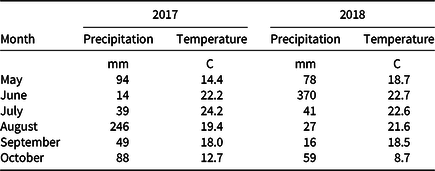
Field experiments were conducted in 2017 and 2018 at the University of Nebraska Haskell Agricultural Laboratory, in Concord (42.37°N, 96.95°W), NE. The soil at the research site was a Uly silty clay loam (mesic-typic Haplustolls) with 20% sand, 32% clay, 54% silt, 4.7% organic matter, 31 meq/100 g cation exchange capacity and pH 6.1. The field was previously planted with soybean, and was conventionally tilled before establishing the study. Total monthly rainfall and average monthly temperature varied between both years of study (Table 1). GR corn (Pioneer P0636AM, DuPont Pioneer, Johnston, IA 50131) was planted at 61,700 seeds ha−1 at a depth of about 5 cm on May 16, 2017, and May 28, 2018.
Total monthly precipitation and average temperature from May to October in 2017 and 2018 at Concord, Nebraska. a

a Precipitation and temperature data were obtained from High Plains Regional Climate Center (HPRCC; http://www.hprcc.unl.edu)
The study was arranged in a split-plot design with three herbicide regimes as the main plot treatments and seven weed removal timings as the subplot treatments in four replications. Individual subplots (experimental unit) were 3 m wide and 8 m long with four rows of corn spaced 0.75 m apart. The herbicide regimes included no PRE, PRE application of atrazine (2,240 g ai ha−1; AAtrex® 4L, Syngenta Crop Protection, Inc., Greensboro, NC 27419) and PRE application of a premix of saflufenacil/dimethenamid-P mixed with pyroxasulfone (72/635 + 65 g ai ha−1; Verdict® plus Zidua®, BASF Corporation, Research Triangle Park, NC 27709) applied on the same day after planting corn on a weed-free field. Weeds were removed at V3, V6, V9, V12, and V15 corn growth stages. Weed-free and nontreated controls were included for a comparison. For each of the weed removal timing, weeds were allowed to grow and were removed at aforementioned timings, and then the plots were maintained weed-free for the remainder of the corn growing season. Weeds were removed by application of glyphosate (1,400 g ae ha–1; Roundup PowerMAX®, Monsanto, St Louis, MO 63167) at V3, V6, and V9 corn growth stages, and at V12 and V15 by hoeing. Herbicides were applied using a CO2-pressurized backpack sprayer at 276 kPa and equipped with six 56-cm-spaced flat-fan AIXR10002 nozzles (TeeJet® Technologies, Spraying Systems Co., Wheaton, IL 60187) that delivered 140 L ha−1 solution.
Data Collection
Data were collected within the two middle corn rows of each plot. Weed density was counted within a 0.5 m2 quadrat placed randomly in middle two corn rows of each plot prior to weed removal. Within 0.75 m2 area in each plot, three corn plants were sampled at the tasseling stage to determine leaf area index (LAI) and biomass. At maturity, corn was hand harvested from the two middle rows on November 4, 2017, and October 19, 2018. Yield components such as plant per meter, ear per plant, seeds per ear, and 100-seed weight were measured from a 1-m length of one of the two middle rows. The ears per plant were counted from five randomly selected plants and seeds per ear were counted from seven randomly selected ear samples from the 1-m row length. The 100-seed weight was measured from seeds collected from the seven ear samples described above. The hand-harvested corn ears from the center two rows were threshed by machine to determine the yield, which was adjusted to 15% moisture level.
Data Analysis
Data analysis was performed using R (R Core Team 2018) using the drc package (Ritz et al. Reference Ritz, Baty, Streibig and Gerhard2015). A four-parameter log-logistic regression model was used to describe the relationship between corn LAI, biomass, yield, yield components or yield loss, and weed removal timings (Knezevic et. al. Reference Knezevic, Evans, Blankenship, Van Acker and Lindquist2002):
 $${Y = } {{C + \left( {D - C} \right)} \over {\left\{ {1 + exp\;\left[ {B\left( {logX - logE} \right)} \right]} \right\}}}$$
where Y is any of the aforementioned response variables; C is the lower limit; D is the upper limit; X is weed removal timing expressed in growing degree days (GDD) after corn emergence, E is the GDD at the inflection point (I 50), and B is the slope around the inflection point. This model was used to estimate the weed removal timing (in GDD) that caused different levels of response. The GDDs were calculated using an equation described by Gilmore and Rogers (Reference Gilmore and Rogers1958):
 $$GDD = \sum \left[ {{{{T_{max}} + {T_{min}}} \over 2}} \right] - {T_{base}}$$
where Tmax and Tmin are daily maximum and minimum temperatures (C), respectively, and Tb is the base temperature (10 C) for corn growth (Gilmore and Rogers Reference Gilmore and Rogers1958). To estimate the CTWR, the GDD values for 5% yield loss (ED5) with or without PRE herbicides were obtained from the regression model and these values were compared using their respective standard errors (Ritz et al. Reference Ritz, Baty, Streibig and Gerhard2015). As an initial analysis, the model was tested for lack of fit by using an approximate F-test that compared the regression model with a more general ANOVA model; a value of P > 0.05 suggest a good fit, the greater the P-value, the better the fit (Ritz et al. Reference Ritz, Baty, Streibig and Gerhard2015).
Results and Discussion
Weed Density and Species Composition
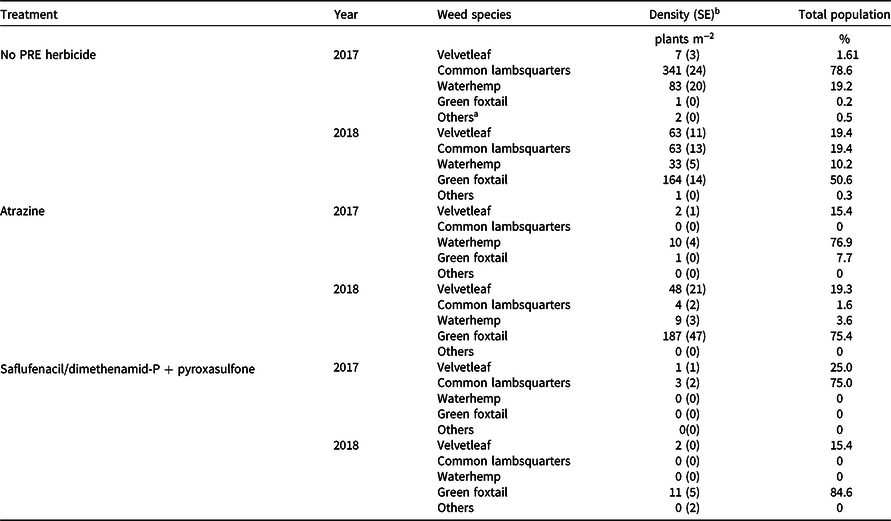
Weed density varied with year and herbicide regimes (Table 2). The most common weed species in 2017 was common lambsquarters (Chenopodium album L.; 341 plants m−2) without PRE herbicide; but it was reduced to 0 to 3 plants m−2 with PRE herbicides. The most common weed species in 2018 was green foxtail (Seteria viridis L.) with a density of 164 plants m−2, which was not affected by atrazine, while saflufenacil/dimethenamid-P + pyroxasulfone reduced the density to as low as 11 plants m−2 (Table 2). Previous studies have demonstrated that saflufenacil/dimethenamid-P provided broad-spectrum weed (including common lambsquarters and green foxtail) control (≥80%) when used alone or mixed with other herbicides (Miller et al. Reference Miller, Soltani, Robinson, Kraus and Sikkema2012; Moran et al. Reference Moran, Sikkema and Swanton2011; Walsh et al. Reference Walsh, Soltani, Shropshire and Sikkema2015). The density of waterhemp (Amaranthus rudis L.) was 83 plants m−2 in 2017 and 23 plants m−2 in 2018 without PRE herbicide. The use of saflufenacil/dimethenamid-P provided a complete reduction of the waterhemp density to zero in both years, whereas atrazine reduced it to 10 and 9 plants m−2 in 2017 and 2018, respectively (Table 2). Oliveira et al. (Reference Oliveira, Jhala, Gaines, Irmak, Amundsen, Scott and Knezevic2017) reported that PRE application of saflufenacil/dimethenamid-P resulted in an 84% reduction in waterhemp density 56 d after treatment.
Weed density and weed species composition affected by no PRE herbicide, atrazine (2,240 g ai ha−1), and saflufenacil/dimethenamid-P (72/635 g ai ha−1) + pyroxasulfone (65 g ai ha−1).

a Other weeds included ivyleaf moringglory (Ipomoea hederacea Jacq.), Palmer amaranth (Amaranthus palmeri S. Watson), and redroot pigweed (Amaranthus retroflexus L.) during both years.
b Weed density and composition were recorded prior to weed removal at V3, V6, V9, V12, and V15 corn growth stages.
Corn Leaf Area Index and Biomass
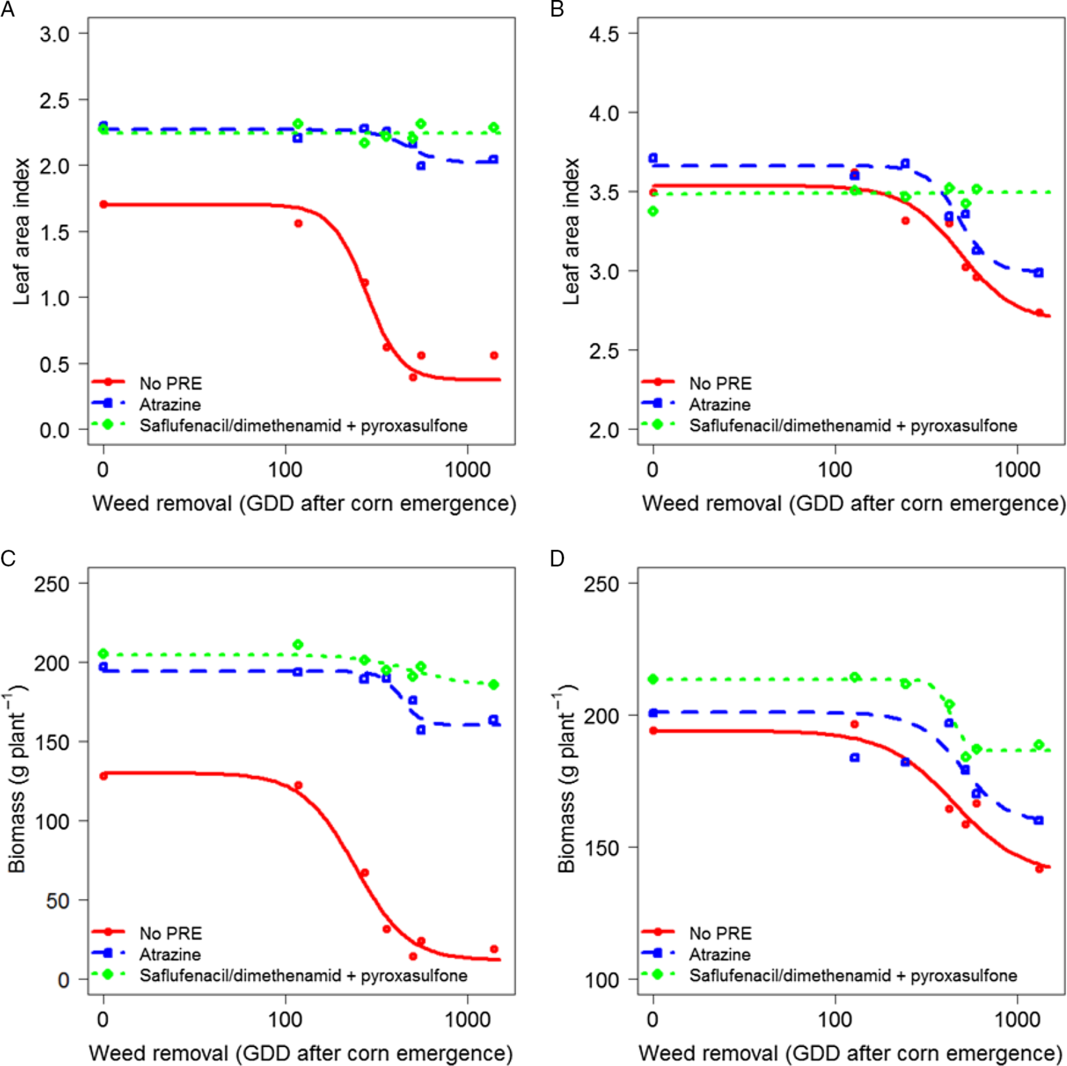
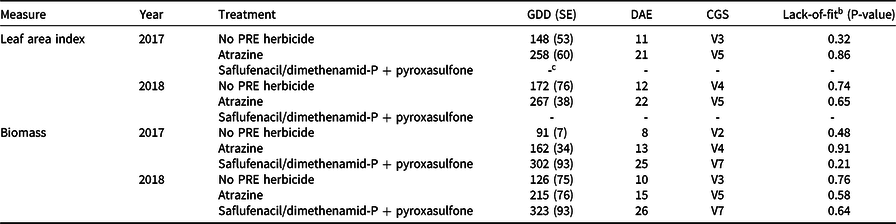
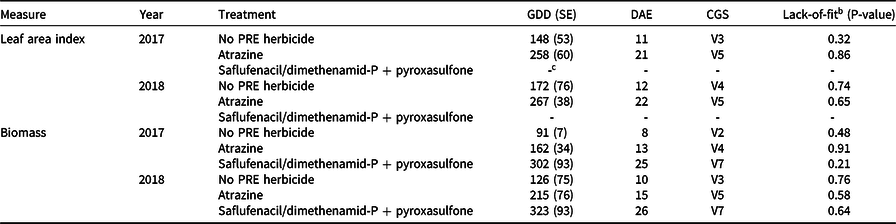
The LAI was generally greater in 2018 than in 2017 (Figure 1). For example, LAI ranged from 3.4 to 3.7 in weed-free treatment in 2018 compared to 1.7 to 2.3 in weed-free treatment in 2017; values ranged across herbicide regimes. The increased LAI recorded in 2018 was most likely due to increased rainfall, particularly in June (370 mm; Table 1). Corn LAI was reduced with a delay in weed removal timing, except when saflufenacil/dimethenamid-P + pyroxasulfone was used (Figure 1). A delay until the V3 growth stage (148 GDD) in 2017 or V4 growth stage (172 GDD) in 2018 was estimated to cause a 5% reduction in corn LAI without PRE herbicide (Table 3). With PRE application of atrazine, a 5% reduction in corn LAI was estimated to occur when weed removal was delayed until the V5 growth stage, the equivalent to 258 GDD in 2017 or 267 GDD in 2018 (Table 3). The PRE application of saflufenacil/dimethenamid-P + pyroxasulfone prevented a reduction in LAI even in season-long delayed weed removal (Figure 1). A similar study in soybean indicated that the effect of season-long weed interference on soybean LAI was 38% with PRE application of sulfentrazone + imazethapyr compared with 71% reduction without PRE herbicide (Pavlović et al. Reference Pavlović, Osipitan and Knežević2018).
Leaf area index (A) 2017 and (B) 2018 and corn biomass (C) 2017 and (D) 2018 at tasseling stage affected by no PRE herbicide, atrazine (2,240 g ai ha−1), and saflufenacil/dimethenamid-P (72/635 g ai ha−1) + pyroxasulfone (65 g ai ha−1) at different weed removal timings in field experiments conducted at Concord, Nebraska.

Estimated delay in weed removal timing that caused 5% reduction in leaf area index (LAI) and biomass of corn as affected by no PRE herbicide, atrazine (2,240 g ai ha−1), and saflufenacil/dimethenamid-P (72/635 g ai ha−1) + pyroxasulfone (65 g ai ha−1). a
a Abbreviations: GDD, growing degree days; DAE, days after emergence; CGS, corn growth stage.
b Model was tested for lack of fit by using an approximate F-test that compared the regression model with a more general ANOVA model; a value of P > 0.05 suggest a good fit, the greater the P-value, the better the fit.
c Not estimated due to limited or no response to weed removal timing.
Similar to LAI, corn biomass was greater in 2018 than in 2017. The extent of weed removal delay for a certain level of corn biomass reduction to occur varied with PRE herbicide regimes (Figure 1). For example, a 5% reduction in corn biomass was caused by not removing weeds until the V2 (91 GDD) or V3 (126 GDD) growth stage without PRE herbicide in 2017 and 2018, respectively (Table 3). However, with atrazine, a 5% reduction in corn biomass occurred when weeding did not occur until the V4 stage (162 GDD) or until the V5 stage (215 GDD) in 2017 and 2018, respectively; and a further time until weed removal to the V7 growth stage (302 to 323 GDD) occurred with saflufenacil/dimethenamid-P + pyroxasulfone. A previous study also demonstrated that application of a PRE herbicide substantially delayed the 5% biomass reduction in soybean until the V5 stage compared with the V1 stage without PRE herbicide (Pavlović et al. Reference Pavlović, Osipitan and Knežević2018). Any management input that impacts weed interference would likely influence crop growth (as measured by LAI and biomass in this case) with subsequent influence on crop yield; and crop yield is the basis for estimating CTWR (Hall et al. Reference Hall, Swanton and Anderson1992).
Corn Yield Components
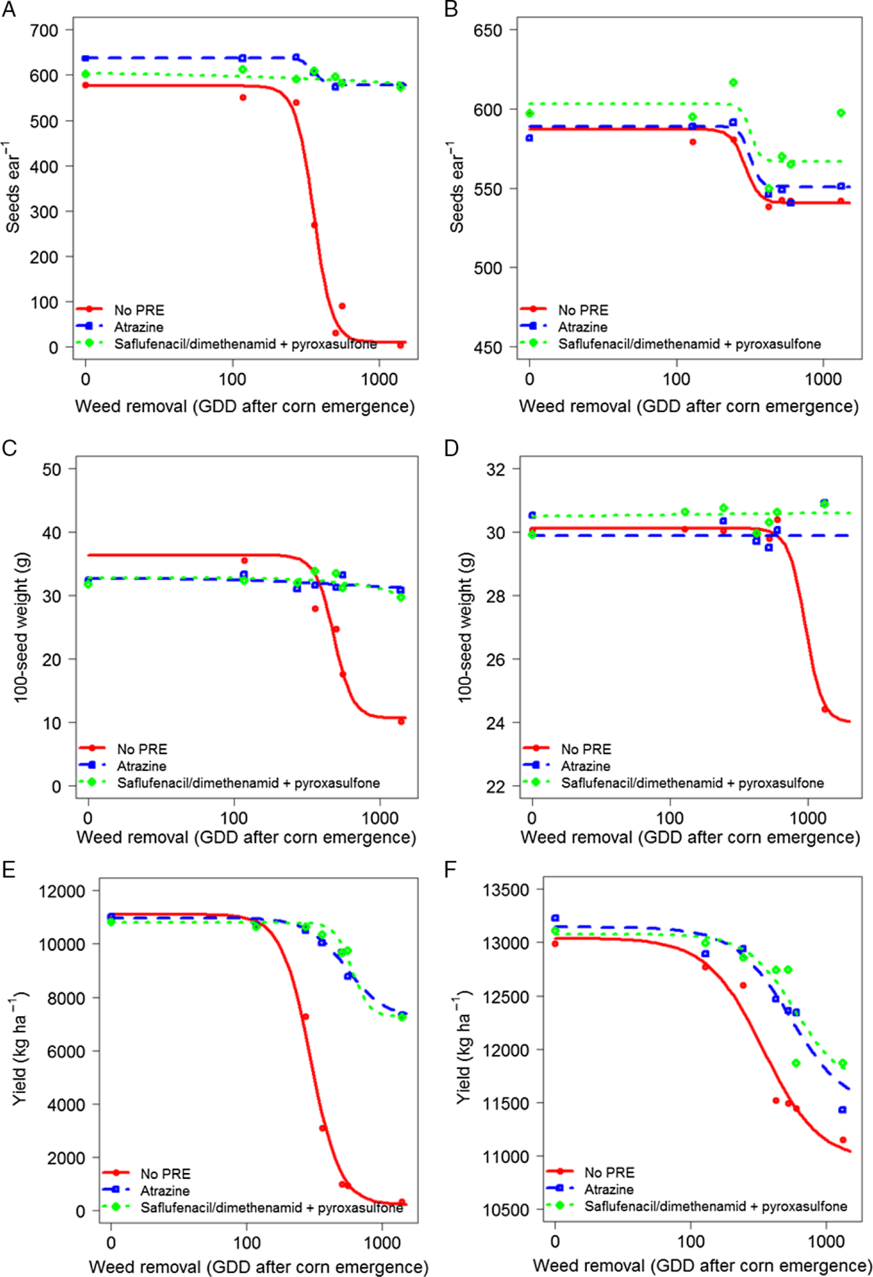
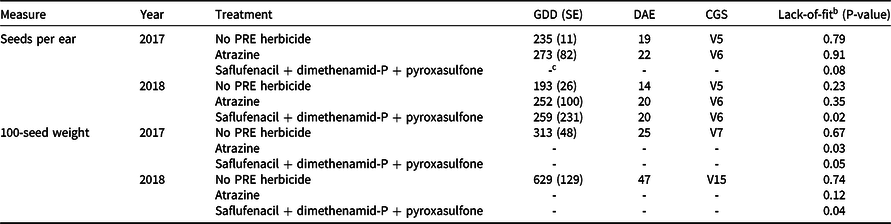
Weed removal timing influenced the number of seeds per ear and 100-seed weight depending on PRE herbicide regimes and year (Figure 2, Table 4). In the weed-free treatment without PRE herbicide, the average number of seeds was 590 ear−1 and 597 ear−1 in 2017 and 2018, respectively; a season-long delay in weed removal reduced the number of seeds to 5 per ear in 2017 and 542 per ear in 2018 (Figure 2). A greater number of seeds per ear in 2018 was likely due to high rainfall, which improved crop productivity. With the use of PRE herbicides, there was little or no impact of a delayed weed removal on seeds per ear. Similarly, Barnes et al (Reference Barnes, Knezevic, Lawrence, Irmak, Rodriguez and Jhala2019) reported 478 seeds per ear of popcorn [Zea mays (L.) var. everta] in a weed-free treatment and zero seed per ear with a season-long delay in weed removal; however, with PRE-applied atrazine/S-metolachlor, the impact of the season-long delay in POST weed removal on seeds per ear was substantially minimized, resulting in 293 seeds per ear. A 5% reduction in the number of seeds per ear was estimated to be caused by not removing weeds until 193 to 235 GDD (V5 stage), without PRE herbicide, across years. Whereas with PRE herbicides, a 5% reduction in seeds per ear was caused by not removing weeds until 252 to 273 GDD (V6 stage), across years (Table 4). Previous studies suggested that a lack of weed removal in corn or popcorn until the V5 to V9 stage caused a reduction in seeds per ear with impacts on yields (Barnes et al. Reference Barnes, Knezevic, Lawrence, Irmak, Rodriguez and Jhala2019; Cox et al. Reference Cox, Hahn and Stachowski2006; Evans et al. Reference Evans, Knezevic, Lindquist, Shapiro and Blankenship2003).
Number of seeds per ear (A) 2017 and (B) 2018, 100-seed weight (C) 2017 and (D) 2018, and corn yield (E) 2017 and (F) 2018 affected by no PRE herbicide, atrazine (2,240 g ai ha−1), and saflufenacil/dimethenamid-P (72/635 g ai ha−1) + pyroxasulfone (65 g ai ha−1) at different weed removal timings in field experiments conducted at Concord, Nebraska.

Estimated delay in weed removal timing that caused 5% reduction in number of seeds per ear and 100-seed weight affected by no PRE herbicide, atrazine (2,240 g ai ha−1), and saflufenacil/dimethenamid-P (72/635 g ai ha−1) + pyroxasulfone (65 g ai ha−1). a

a Abbreviatons: GDD, growing degree days; DAE, days after emergence; CGS, corn growth stage.
b Model was tested for lack of fit by using an approximate F-test that compared the regression model with a more a general ANOVA model; a value of P > 0.05 suggest a good fit, the greater the P-value, the better the fit.
c Not estimated due to limited or no response to weed removal timing.
In the weed-free treatment without PRE herbicide, 100-seed weight averaged 36 and 30 g in 2017 and 2018, respectively (Figure 2); however, with season-long weed interference, the 100-seed weight decreased to 8 and 24 g in 2017 and 2018, respectively. It was estimated that a 5% reduction in 100-seed weight was caused by a delay in weed removal until the V7 (313 GDD) or V15 (629 GDD) growth stage without PRE herbicide in 2017 and 2018, respectively (Table 4). There was no reduction in 100-seed weight, even with a season-long delay in weed removal with PRE herbicides. Previous studies showed that a season-long delay in weed removal could cause an 8% to 27% reduction in seed weight without PRE herbicide (Cathcart and Swanton Reference Cathcart and Swanton2004; Cox et al Reference Cox, Hahn and Stachowski2006). Evans et al. (Reference Evans, Knezevic, Lindquist, Shapiro and Blankenship2003) suggested that seed weight is a less important variable in measuring the impact of weed interference on field corn, compared to seeds per ear, which substantially accounted for corn yield response under increasing duration of weed interfere. Nonetheless, results suggest that weed interference negatively impacted yield components and a PRE herbicide could reduce this impact.
Corn Yield
The regression model adequately described the relationship between corn yield and weed removal timing as the lack of fit test showed P-value ranging from 0.56 to 0.98 (Table 5). Corn yields varied between years, with greater yields in 2018 (Figure 2). Weed removal timings and PRE herbicides affected corn yield (Figure 2, Table 5). Corn yields in weed-free treatment areas without PRE herbicide were 11,479 kg ha−1 in 2017 and 12,987 kg ha−1 in 2018, respectively, compared with 332 kg ha−1 (97% reduction) in 2017 and 11,150 kg ha-1 (14% reduction) in 2018, respectively in a season-long weed interference (Figure 2). The greater yield reduction in 2017 was likely due to limited soil moisture that resulted in competition for moisture between early emerging weeds and corn, particularly in treatments without PRE herbicide. For example, total monthly precipitation in June 2017 was 14 mm compared with 370 mm in 2018 (Table 1). Early weed competition compared to late-season competition is known to be more negatively impactful on crop yield (Soltani et al. Reference Soltani, Dille, Burke, Everman, VanGessel, Davis and Sikkema2016). The use of PRE herbicides reduced the negative impact of delayed weed removal. Corn yield with a season-long delayed postemergence weed removal was 7,320 to 7,327 kg ha−1, representing an approximately 36% yield reduction with the use of PRE herbicides in 2017. In 2018, corn yield was 11,431 kg ha−1 (12% yield reduction) and 11,868 kg ha−1 (8% yield reduction) in a season-long delayed postemergence weed removal treatment with PRE application of atrazine and saflufenacil/dimethenamid-P + pyroxasulfone, respectively.
Estimated CTWR based on 5% corn yield loss affected by atrazine (2,240 g ai ha−1), and saflufenacil/dimethenamid-P (72/635 g ai ha−1) + pyroxasulfone (65 g ai ha−1), and no PRE herbicide. a

a Abbreviations: GDD, growing degree days; DAE, days after emergence; CGS, corn growth stage.
b Model was tested for lack of fit by using an approximate F-test that compared the regression model with a more general ANOVA model; a value of P > 0.05 suggest a good fit, the greater the P-value, the better the fit.
Critical Time of Weed Removal
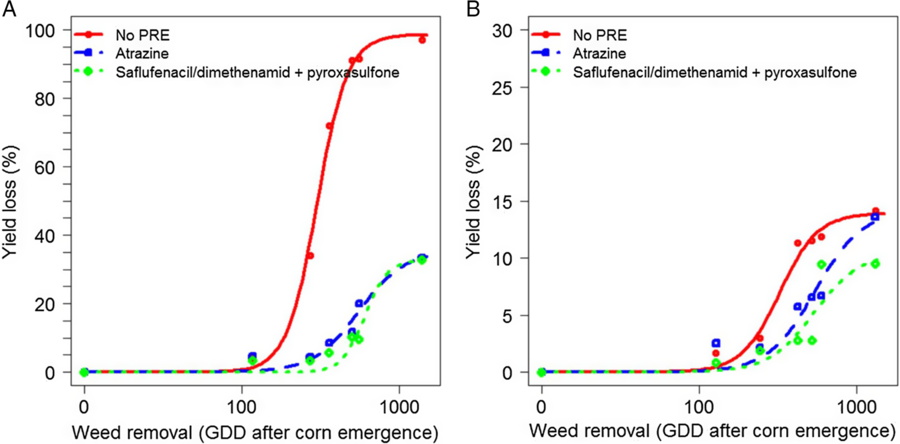
The CTWR in corn was estimated using a 5% acceptable yield loss threshold (Knezevic et al. Reference Knezevic, Evans and Mainz2003). In 2017, the CTWR ranged from 157 to 371 GDD, which corresponds to V3 to V10 corn growth stages, depending on herbicide. Without PRE herbicide, CTWR started at the V3 corn growth stage (157 GDD, 11 days after corn emergence [DAE]; Figure 3, Table 5). Atrazine applied PRE delayed the CTWR to the V5 corn growth stage (208 GDD, 16 DAE), whereas the PRE application of saflufenacil/dimethenamid-P + pyroxasulfone delayed the CTWR to the V10 corn growth stage in 2017 (371 GDD, 32 DAE; Figure 3, Table 5); coinciding with canopy closure. Thus, residual activity of atrazine and saflufenacil/dimethenamid-P + pyroxasulfone resulted in a delay of the CTWR by 5 d and 21 d, respectively. In 2018, the CTWR ranged from 144 to 315 GDD, which corresponds to the V3 to V8 corn growth stages, depending on the herbicide regimes. Without application of PRE herbicide, CTWR started at the V3 corn growth stage (144 GDD, 11 DAE; Figure 3, Table 5). Atrazine and saflufenacil/dimethenamid-P + pyroxasulfone applied PRE delayed the CTWR to the V5 and V8 corn growth stages, which corresponded to 198 and 315 GDD, and 14 and 26 DAE, respectively, in 2018 (Figure 3, Table 5). The reduced difference in the CTWR between atrazine and saflufenacil/dimethenamid-P + pyroxasulfone in 2018 may be due to the confounding effect of high rainfall, which increased soil moisture and reduced crop-weed competition for water. Previous studies have shown that rainfall could cause substantial variation in estimated CTWR (Van Acker et al. Reference Van Acker, Swanton and Weise1993; Weaver and Tan Reference Weaver and Tan1987). In addition to the relatively less delayed CTWR by atrazine, it is advisable not to use atrazine alone because atrazine-resistant weeds such as Palmer amaranth have been confirmed in Nebraska and other states (Heap Reference Heap2020; Jhala et al. Reference Jhala, Sandell, Rana, Kruger and Knezevic2014b; Nakka et al. Reference Nakka, Godar, Thompson, Peterson and Jugulam2017). In both years, lack of PRE herbicides made corn more vulnerable to weed interference, which resulted in earlier CTWR (V3 stage). Application of PRE herbicides suppressed early emerging weeds, and protected corn growth and yield, thereby resulting in delayed CTWR until the V5 growth stage with atrazine, and further to the V8 or V10 growth stage with the use of saflufenacil/dimethenamid-P + pyroxasulfone, an herbicide mix with a broader weed control spectrum. Corn at the V10 growth stage is near canopy closure depending on the row spacing and thus would substantially reduce the competitive impact of emerging weeds on grain yield (Knezevic et al. Reference Knezevic, Evans and Mainz2003; Tursun et al. Reference Tursun, Datta, Sakinmaz, Kantarci, Knezevic and Chauhan2016). Results from previous studies suggested that the CTWR varied with season, crop type, agronomic practice, and environmental factors (Adigun et al. Reference Adigun, Osipitan, Lagoke, Adeyemi and Afolami2014; Evans et al. Reference Evans, Knezevic, Lindquist, Shapiro and Blankenship2003; Hall et al. Reference Hall, Swanton and Anderson1992; Knezevic et al. Reference Knezevic, Pavlovic, Osipitan, Barnes, Beiermann, Oliveira, Lawrence, Scott and Jhala2019b; Norsworthy and Oliveira Reference Norsworthy and Oliveira2004; Tursun et al. Reference Tursun, Datta, Sakinmaz, Kantarci, Knezevic and Chauhan2016). Tursun et al. (Reference Tursun, Datta, Sakinmaz, Kantarci, Knezevic and Chauhan2016) reported that the CTWR could be as early as V1 in corn and popcorn, and V2 in sweet corn without PRE herbicide using a 5% yield loss threshold. Williams (Reference Williams2006) reported that CTWR in sweet corn started at V4 or VT, depending on whether corn was planted in late June or early May, respectively. A recent study in Nebraska suggested that the CTWR in popcorn commenced at V4 or V5 without PRE herbicides, while PRE application of atrazine/S-metolachlor delayed the CTWR until V10 to V15 (Barnes et al. Reference Barnes, Knezevic, Lawrence, Irmak, Rodriguez and Jhala2019).
Corn yield loss affected by no PRE herbicide, atrazine (2,240 g ai ha−1), and saflufenacil/dimethenamid-P (72/635 g ai ha−1) + pyroxasulfone (65 g ai ha−1) at different weed removal timings in (A) 2017 and (B) 2018 in field experiments conducted at Concord, Nebraska.

The results of this study showed the benefit of PRE herbicides for controlling early emerging weeds, which are the most competitive against corn and could cause unacceptable yield loss. This research suggests that the application of PRE herbicide with multiple sites of action and broad weed control spectrum could reduce the need for multiple glyphosate applications in GR corn by delaying the critical time for POST weed control input and by providing alternative sites of action, which is necessary for managing GR and other troublesome weeds.
Acknowledgments
We thank Dr. Maxwel Oliveira, Pavle Pavlovic, Luka Milosevic, Kristyna Muller, and Megan Muller for their support during the field studies. This research received no specific grant from any funding agency, commercial, or not-for-profit sectors. No conflicts of interest have been declared.