Book contents
- Frontmatter
- Contents
- Contributors
- Introduction
- 1 The Moral Personality
- 2 The Moral Functioning of the Person as a Whole: On Moral Psychology and Personality Science
- 3 Moral Science? Still Metaphysical After All These Years
- 4 Cultural Pluralism and Moral Identity
- 5 Neuroscience and Morality: Moral Judgments, Sentiments, and Values
- 6 Triune Ethics Theory and Moral Personality
- 7 Early Foundations: Conscience and the Development of Moral Character
- 8 The Development of the Moral Personality
- 9 Urban Neighborhoods as Contexts for Moral Identity Development
- 10 Moral Personality Exemplified
- 11 Greatest of the Virtues? Gratitude and the Grateful Personality
- 12 The Elusive Altruist: The Psychological Study of the Altruistic Personality
- 13 Growing Toward Care: A Narrative Approach to Prosocial Moral Identity and Generativity of Personality in Emerging Adulthood
- 14 Moral Identity, Integrity, and Personal Responsibility
- 15 The Dynamic Moral Self: A Social Psychological Perspective
- 16 The Double-Edged Sword of a Moral State of Mind
- 17 Moral Identity in Business Situations: A Social-Cognitive Framework for Understanding Moral Functioning
- 18 The Moral Functioning of Mature Adults and the Possibility of Fair Moral Reasoning
- 19 Moral Personality: Themes, Questions, Futures
- Author Index
- Subject Index
10 - Moral Personality Exemplified
Published online by Cambridge University Press: 05 June 2012

Book contents
- Frontmatter
- Contents
- Contributors
- Introduction
- 1 The Moral Personality
- 2 The Moral Functioning of the Person as a Whole: On Moral Psychology and Personality Science
- 3 Moral Science? Still Metaphysical After All These Years
- 4 Cultural Pluralism and Moral Identity
- 5 Neuroscience and Morality: Moral Judgments, Sentiments, and Values
- 6 Triune Ethics Theory and Moral Personality
- 7 Early Foundations: Conscience and the Development of Moral Character
- 8 The Development of the Moral Personality
- 9 Urban Neighborhoods as Contexts for Moral Identity Development
- 10 Moral Personality Exemplified
- 11 Greatest of the Virtues? Gratitude and the Grateful Personality
- 12 The Elusive Altruist: The Psychological Study of the Altruistic Personality
- 13 Growing Toward Care: A Narrative Approach to Prosocial Moral Identity and Generativity of Personality in Emerging Adulthood
- 14 Moral Identity, Integrity, and Personal Responsibility
- 15 The Dynamic Moral Self: A Social Psychological Perspective
- 16 The Double-Edged Sword of a Moral State of Mind
- 17 Moral Identity in Business Situations: A Social-Cognitive Framework for Understanding Moral Functioning
- 18 The Moral Functioning of Mature Adults and the Possibility of Fair Moral Reasoning
- 19 Moral Personality: Themes, Questions, Futures
- Author Index
- Subject Index
Summary
In the absence of a compelling model of moral functioning, the field of moral development has been languishing and is in critical need of resuscitation. Although in recent years some important conceptual insights have been advanced, corresponding empirical paradigms have been in short supply; and so the most promising theories remain largely unsubstantiated and without practical “legs.” As a further consequence, moral educators have had few viable frameworks on which to base intervention efforts. This vacuity is primarily attributable to the once inordinate interest in moral rationality, an interest that initially gave spark to the field and fanned its flames for a time, but is an enterprise now reduced to a few smoldering embers.
This focus on moral cognition arose through the magisterial contributions of Piaget (1932/1977) and Kohlberg (1969) who heralded the cognitive revolution within psychology. These structural-developmental theorists forcefully advocated the notion that the fundamental core of moral functioning entailed processes of deliberative moral judgment. Their models embraced the formalist assumptions of the philosophical mindset of the Enlightenment Era, which conceptualized human nature dualistically, pitting rationality against personality. Moral rationality was hoisted onto a pedestal, regarded as not only necessary to define the moral quality of situations, but also as imbued with sufficient oomph to motivate moral action. In striking contrast, however, emotions, personal desires, and other aspects of personality were tossed into the garbage “bag of virtues” (Kohlberg, 1981, p. 78), regarded as potentially contaminating influences that the moral agent must eschew in order to adhere to the purer dictates of reason.
Information
- Type
- Chapter
- Information
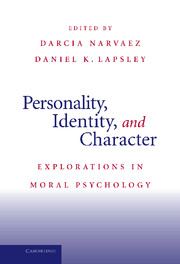
- Personality, Identity, and CharacterExplorations in Moral Psychology, pp. 232 - 255Publisher: Cambridge University PressPrint publication year: 2009
Accessibility standard: Unknown
Why this information is here
This section outlines the accessibility features of this content - including support for screen readers, full keyboard navigation and high-contrast display options. This may not be relevant for you.Accessibility Information
Accessibility compliance for the PDF of this chapter is currently unknown
and may be updated in the future.
- 25
- Cited by