

On July 30, 1909, Ella Flagg Young became one of the most famous women in the country when newspapers coast-to-coast carried front-page news that she would be Chicago's next superintendent of schools. The Chicago Board of Education, after launching an extensive search specifically seeking a man for the position, instead chose a woman to lead the schools of the nation's second-largest city.Footnote 1
The news was surprising, perhaps even shocking, to some. At the time, though, some significant forces had aligned in Young's favor. Teaching had shifted over the previous century from men's to women's work. Women also had begun winning elected county superintendencies.Footnote 2 Suffrage activists, many of them current or former teachers, had campaigned partly so women educators could vote on matters affecting their working conditions, and because their service as school leaders might prove the public good that women might accomplish. And crucially, some of Chicago's teachers, awakened to their need for collective power, had organized the Chicago Teachers’ Federation (CTF) to counter antagonistic city and corporate officials. In 1909, the Federation had sought a superintendent who wanted to improve teachers’ conditions—and Young stood out as their best bet (see Figure 1).
Portrait of Ella Flagg Young, Superintendent, 1910. (World's Work 20, no. 4 [August 1910], 13223).

Beyond these external conditions, Young also brought extraordinary personal gifts to her work—and she did so just as opportunities for women opened in education. She had studied at Chicago High School nearly a half-century earlier, precisely at its inflection point when young women were beginning to graduate in greater numbers than young men.Footnote 3 Throughout her long and distinguished career, she was one of the first, if not the first, woman to rise through a succession of new levels of educational leadership: After teaching for only three years, she became a teacher of teachers, then one of the first women principals of a large school, one of the first women assistant superintendents, among the earliest women professors at a major university, and eventually the first woman elected president of the National Education Association (NEA). Along the way, she cleared paths for other women to join her.
Young thought that women's school leadership would continue expanding, something she confidently predicted after becoming superintendent.Footnote 4 From her perspective, conditions also appeared ripe for teachers to free themselves from the constraints of stale older methods as well as those pushed by a new class of administrators bent on centralization and standardization. She envisioned teachers enjoying greater freedoms in schools while cultivating their unique gifts and nurturing those of their students. She expected teaching to become ever-more intellectually and creatively engaging work. And she believed that the women who overwhelmingly dominated the ranks of teachers would work together with their allies in a spirit of community, buoyed by the suffrage-driven women's movement.
As her career progressed, Young built community among educators. At the same time, she fiercely promoted “Individuality. Freedom for the teacher and freedom for the pupil,” which she described to a reporter as her hobbies.Footnote 5 Young staunchly opposed the efforts of some prominent male education leaders seeking to increasingly centralize power in schools, mechanize their operations, divide units into discrete and often disconnected parts, and disempower the largely female teaching force. She instead shared power with teachers, facilitated their working together toward ends they determined collectively, and respected their individuality, all while insisting on high-quality work. As superintendent, she and Chicago's educators and students soon demonstrated that a large school system could defy prevailing administrative trends by empowering rather than disempowering its members, by working together rather than retreating into isolation, and by improving the quality of the system through volition rather than compulsion. Morale soared during much of her superintendency, as she supported teachers’ and students’ efforts—and as they in turn supported hers.
Ella Flagg Young's story, then, sheds light on an important historical moment when officials increasingly configured school administration for men, enlarging their administrative powers while simultaneously stripping away freedom, individuality, and a sense of community from the recently feminized teaching force. In this way, the gender polarization of schoolwork aligned closely with the movement to disempower teachers. Young's story also reveals the important ways she resisted this trend. She essentially sought to build community among educators while simultaneously enlarging their freedoms and respecting their individuality. They in turn organized, grew more powerful, and rallied to support her and each other through an array of vexing challenges. This mutual support was vital to her superintendency as well as to the welfare of teachers and students alike.
Though Young thought that women would exercise ever-greater leadership in education, from the classroom to the superintendent's office, the question remained open as to whether her superintendency would prove to be a fluke or a harbinger of deep change.
Early Life
Young's pursuit of individuality and freedom began early. She was, after all, a gifted and eccentric child in a family that valued uniqueness. Her parents urged their children to learn on their own rather than by attending school. Her mother read avidly. Her father, orphaned as a child, quickly earned his freedom from a metalworking apprenticeship to become a renowned fine-instrument maker. Young's older brother, an aspiring artist, enlisted at the start of the Civil War; then, as a talented “base ball” pitcher, he founded one of the earliest baseball teams and leagues in the country.Footnote 6 Young's brilliant older sister, whose name she never spoke publicly, supported herself as a seamstress; then in early adulthood, she was committed to the House of the Good Shepherd, where she lived as an inmate until her death at sixty-one. Flagg family members followed their own paths.
Ella Flagg did not learn to read until she wanted to—at eight or nine. After her mother read aloud a newspaper account of a fatal school fire, Ella was inconsolable over the tragedy and, with her mother's help, studied the article. Reportedly, she read voraciously from then on.Footnote 7 At thirteen, she attended grammar school for a couple of months, but found classwork so boring that she dropped out. At fifteen, her friends persuaded her to take the teachers’ examination, and though she passed, she was too young to get a teaching certificate. Instead, the superintendent invited her to enroll in Chicago High School's new Normal Department.Footnote 8 First, however, she needed to pass the admissions examination. Principal George Howland asked her to recite a poem—which she did in an idiosyncratic manner by accenting syllables in odd places. Perplexed, he asked her why she had done this. She explained that she intended to keep the poem from being too smooth. Howland laughed and admitted her.Footnote 9 In later years, he became superintendent and hired her as assistant superintendent, eventually even recommending her as his possible replacement.Footnote 10 From the start, the unconventional Ella Flagg thought about schools from an outsider's perspective, but she eventually flourished with support from accepting mentors like Howland.
Principal Young
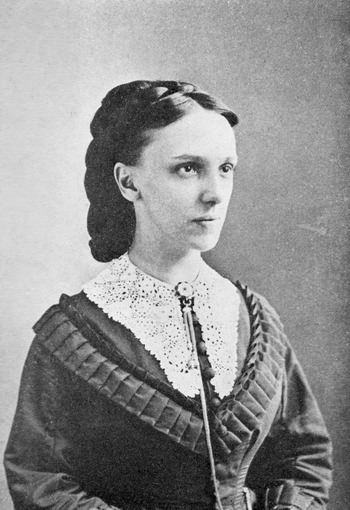
Ella Flagg began teaching in 1862 as men enlisted for service in the Civil War. Women already held all of Chicago's grade school teaching positions other than principal.Footnote 11 She quickly excelled in some of the city's toughest classrooms. After her third year, she became principal of the new School of Practice, charged with preparing the city's future grade school teachers (see Figure 2).Footnote 12 The superintendent soon lauded the School of Practice. With her leadership, he explained, it “is not excelled by any similar school in the country.”Footnote 13 Notwithstanding his exuberant praise, Young ran into trouble when Board members pushed her to admit weak students. Instead, she refused and resigned, returning to teaching a regular class.Footnote 14
Ella Flagg Young as principal of the School of Practice, ca. 1865. From John McManis, Ella Flagg Young and a Half-Century of the Chicago Public Schools, 1916.
After Illinois passed a law in 1873 allowing women to hold elected school offices, ten women quickly won contested county superintendencies.Footnote 15 During this early wave of Illinois women moving into school administrative positions, the Chicago Board appointed Young to a full principalship, making her “one of the first five or six women principals [of large schools] in the country,” as she later recounted.Footnote 16 The Board promoted her again three years later, this time to the principalship of one of the largest and most visible schools in the city.Footnote 17 She worked closely with teachers in this school, urging them to cultivate unique pedagogical approaches. They made decisions together. And rather than holding meetings at school, she regularly hosted teachers in her home, where she served lavish refreshments and encouraged lively discussions of books that teachers chose. Her school became known as one of the finest, if not the finest, in the city, and visitors regularly requested tours. Many of the school's inspired teachers soon rose to leadership positions across the city.
Superintendent Howland was confident enough about Young's capabilities that he asked her to lead meetings of the city's Principals’ Association in his absence—rather than any of the more long-serving male principals.Footnote 18 Howland also invited A. E. Winship, a prominent education journalist, to visit Young's school during the Chicago portion of his national tour of schools in 1887. Winship observed the one class Young taught while principal. He left saying, “That is the most remarkable teacher I ever saw.”Footnote 19 Winship then lavished her with praise in speeches he delivered around the country and in articles he published, bringing Young to national attention.
Leveraging Assistant Superintendency for Women's Greater Power
A few months after Winship lauded her, the Board promoted Young and another woman to assistant superintendencies, the first women to reach this level in Chicago's history and certainly among the first in the country. Young's selection surprised no one.Footnote 20 Persistent pressure from Chicago Woman's Club members had contributed to this breakthrough.Footnote 21
The Chicago Woman's Club invited Young to join after she became assistant superintendent. She accepted and then helped members understand the intricacies of the city's significant school-related matters.Footnote 22 The Club immediately intensified its efforts to lobby for women to be appointed to the Chicago Board of Education, an effort that had run aground in the past. With Young's guidance, however, their efforts finally paid off. Chicago soon had its first woman Board of Education member—and in the years to come, more would be named including Jane Addams.Footnote 23
Young's stature grew during her years as assistant and then district superintendent. Though cozy teachers’ meetings in her residence were no longer feasible, she instead created a teachers’ council to stay in close communication with educators throughout her sprawling district, which extended well over a hundred city blocks from north to south. This was perhaps one of the first, if not the first, teachers’ councils organized for decision-making rather than simply as a professional association. Other assistant superintendents in the city followed her example.Footnote 24 Young also organized a series of popular Teachers’ Institutes. One attendee said, “Her lectures are largely attended not from duty, but from pleasure. She is a fascinating speaker.”Footnote 25 As a further expression of admiration, some Chicago women principals formed an organization they called the “Ella Flagg Young Club” in her honor, despite her protest.Footnote 26 When the city created a teacher pension fund in 1895, Young became a trustee, winning by far the greatest number of votes among all school employees.Footnote 27 One writer explained that the lopsided vote reflected teachers’ “high personal respect for her” and that she had “every reason to be proud of this expression of the esteem and affection in which she is held by the teachers of Chicago.”Footnote 28
Young also capitalized on her growing reputation by helping to instigate a statewide meeting of women teachers and administrators in 1888. Men already had their state education associations she reasoned, but women had none. So during this founding event, attendees formed not one but two new associations of women educators: the School Mistresses’ Club, which selected Young as its first president, and the Illinois Women's Teachers’ Association.Footnote 29 Before the gavel brought the meeting to a close, these new, conjoined groups decided to lobby the governor to appoint a woman to the Illinois Board of Education. The governor responded immediately by naming Young, who then became the first woman on the state Board, serving for twenty-five years with distinction.Footnote 30
Taking a Stand
Young enjoyed the years with Superintendent Howland at the helm. He engaged the city's administrators in spirited discussions about a wide range of issues and vigorously supported those who implemented innovative programs. He granted them independence if their schools performed well, creating an environment in which Young thrived.Footnote 31 She also respected Superintendent Albert Lane, who succeeded Howland. Matters quickly changed, however, when Benjamin Andrews became superintendent in 1898.
William Rainey Harper, the University of Chicago's ambitious president, served briefly on Chicago's Board of Education. He thought the city needed a new superintendent, one with superb academic credentials rather than a career educator who had risen through the ranks, as had been the tradition. Harper wanted Benjamin Andrews, former president of Brown University and Harper's old friend and mentor.Footnote 32 Harper and other board members then pushed out the amiable Superintendent Lane and instead hired Andrews. Once Andrews settled into his new work, he said, “I never in my life was engaged in so absorbing a work as this. … The work is hard, much harder than that of a college president, but also much more important.”Footnote 33
Harper then cycled off the Board. He went on to lead the Chicago Education Commission, or “Harper Commission,” in formulating its famous report arguing for reducing Board of Education powers while increasing those of the superintendent—a change teachers derisively called “one-man power.” The Commission also proposed that men be paid more than women so more men could be hired, which women teachers found particularly odious.Footnote 34 Finally, the Commission recommended that the city stop hiring married women teachers.Footnote 35
Ella Flagg Young wasted no time in criticizing some of the Commission's recommendations. In January 1899, she delivered an address to a packed gathering of two thousand people from several new educators’ organizations in the city. She decried the recommendation that men be paid more than women in comparable positions. She adamantly disapproved of barring married women from teaching.Footnote 36 She particularly criticized the Harper Commission for dodging “the woman question,” even though she contended that it attended in detail to other matters of much less concern. She said, “Why [the commission] … could not recognize its inability to cope with the woman question … puzzles some of us.”Footnote 37
Young then criticized the new class of administrators who contributed to the Commission's report, asserting that they wanted to exert minute control over teachers. She argued that the Commission had failed to include teachers meaningfully in its process, hiding its true aims while wasting teachers’ time with pointless committee work. In the end, she said, “Teachers have been forced to resemble too closely the housewife who goes about from room to room, making sure that no speck of dust rests therein,—the housewife who deceives herself into thinking that she would enjoy a brush with the world outside, or things in art, literature, and science if she only had time after attending to the important, the essential things of this world—the specks of dust.”Footnote 38
Young completed the link between the condition of teachers, mostly women, and the increasing strictures on their work. And she envisioned what must happen instead to inspire needed changes: “One condition is essential—an evolution of individuality in principals, teachers, and superintendents; that is, an evolution of the gifts peculiar to each soul.” Each person possesses individual gifts, she argued, but these often remain undeveloped. For individual talents to be realized, “we must have opportunity for what is called play of [thought]. If our daily work contains so much of the directions and plans of others that the feeling of drudgery permeates it and us, then that necessary free play of [thought] is lacking.” The “serious defect in the organization of our schools,” however, is that teachers are required to carry such heavy curricular loads that “the sense of uneasiness from superficial preparation and the sense of weariness from continual skimming result in a feeling of drudgery.”Footnote 39
Young closed by congratulating teachers in the city for creating their new organizations in the face of these challenges, especially the CTF. She encouraged them all to grow stronger—the room thundered with applause.Footnote 40 Hundreds of teachers crowded around her after she finished, thanking her for having articulated their thoughts so accurately.Footnote 41
A few days later, Young resigned from her district superintendency, ending her thirty-seven years of service to the Chicago schools. Her long-time companion, Laura Brayton, explained: “The time came when the autocratic regime, which reduced assistants to mere machines, and the everlasting playing of politics in the office of the Superintendent of Schools, became unbearable and she resigned.”Footnote 42 Young herself said, “The present ideal seems to be a one-man power, and my work is rendered unnecessary.”Footnote 43
The news shocked and devastated teachers around the city. One lamented, “The women teachers of the Chicago schools needed Mrs. Young's help and guidance now more than ever … to help them against the policy of the school management,” which seemed “disposed … to remove women from positions of responsibility.”Footnote 44 The editorial board of the Chicago Daily Tribune described Young's departure as a “grievous loss” for the city.Footnote 45 Another editor deemed it a calamity because “it is next to impossible to place a man or woman in her position who can hope to win the unanimous support and goodwill of teachers, patrons, pupils and supervisors to the extent which Mrs. Young has possessed them.”Footnote 46
Young and the Federation
Young then completed her doctoral studies with John Dewey at the University of Chicago, and joined the faculty, first as associate and then as full professor. From this vantage, Young stayed near the city's teachers—and they regularly packed auditoriums to hear her speak. However, while teachers largely admired her, her early positive relationship with the Federation, and its founding teachers she had originally supported, grew more complex.Footnote 47 On the other hand, she later explained, “I saw the beginnings of the Chicago Teachers’ Federation, and I felt very uneasy; I feared those teachers were becoming too grasping. … I was not large enough in the beginning to see … that these women were realizing that they had not the freedom, the power, which people should have who are to train the minds of the children.”Footnote 48
Despite any misgivings she may have developed, Young found ways to assist Federation members as they pushed for a greater leading presence of women teachers in the NEA. As the Federation's Margaret Haley demanded the right to speak from the floor of the NEA general assembly and Catherine Goggin devised strategies to broaden women teachers’ powers in the association, Young worked in concert with them, but from a different vantage. Remarkably, Young served on the NEA's National Council of Education, the group David Tyack called the “educational trust,” or old guard.Footnote 49 In this role, though, Young refused to be muzzled by Council members. Instead, during a general assembly, she spoke out against the consolidation of power by other members of the Council. She charged that “high salaried” NEA officials happily pointed the “way to educational perfection” to extremely low-salaried teachers who also paid the greatest part of the dues.Footnote 50 With Young's help, Haley, Goggin, and other teachers began tipping the balance of power in the NEA.
First Year as Superintendent
Before Young became superintendent in 1909, the city's schools had suffered through a period of administrative and political dysfunction, first during Benjamin Andrews's brief tenure in office and then during Edwin Cooley's tenure. Cooley had antagonized teachers by implementing his notorious secret teacher evaluation system, among other things. He continually battled with teachers, particularly the CTF. His health consequently suffered and he took extended leaves to recover.Footnote 51 He finally resigned early in 1909.Footnote 52 Meanwhile, the assistant and district superintendents, who worked together to lead the city's schools in Cooley's absence, performed so admirably that members of the Board presented a resolution to eliminate the superintendency altogether.Footnote 53 The resolution failed, but its authors had made their point.
Chicago's mayor strongly opposed women holding such public office, and by mid-July 1909, the Board had considered fifty men for the next superintendent.Footnote 54 Nonetheless, the Board ultimately interviewed six finalists, including Young. The first five candidates spoke with the Board for about twenty minutes each, but Young engaged with them for over two hours. Board members reportedly “forgot she was a woman” as “the irresistible impression of ability, of sympathy, of tact, of power and broad mindedness … emanated from her.” Then they “thought only of getting her to rule the schools,” and they voted unanimously for Young.Footnote 55 A woman Board member said, “I consider [Young] the best educator in the United States, so far as public school work is concerned. … The selection of Mrs. Young as superintendent of schools is the wisest thing that the board could possibly have done.” She then noted that Young would address the Board's pressing concerns about the relationship between the new superintendent and organized teachers: “She will harmonize the whole teaching force. The teachers haven't felt in the past that they had the sympathy of the superintendent and this is the one thing the Chicago schools need more than anything else.”Footnote 56 And finally, Haley later recounted that Board members had asked each candidate what they would do about the Federation. She explained that other candidates dodged and “side tracked,” but Young simply replied, “I'd treat it as an educational organization.” Haley concluded, “They gave her the job.”Footnote 57
On Young's first day, she vowed to keep her door open to the city's six thousand teachers, a promise she kept. She stressed her readiness to “receive representatives of the Chicago Teachers’ Federation and I hope that all of us, working together, may bring harmony and the highest efficiency to the school system of Chicago.”Footnote 58 This was particularly important because Young sometimes had opposed Federation efforts in its early years—and the Chicago Daily Tribune even reported that, “The choice of Mrs. Young was a blow to the Teachers’ Federation. … At the time of its formation it had the sympathy of Mrs. Young, but not after she perceived the uses to which it was being put.”Footnote 59
Young had to mend her relationship with the Federation, and she soon saw a path to this end. After she moved into her new office, city officials learned that President Taft would visit Chicago in a few weeks. They asked Young to stage an enormous rally of Chicago's students to welcome him, so she and a team of organizers immediately got to work. When the day arrived, well over a hundred and fifty thousand students and teachers from Chicago Public Schools lined a twelve-mile route, singing, dancing, performing instrumental music, and displaying their artistic handiwork as Taft's motorcade slowly drove through. Amazingly, the entire event went off without a hitch, much to the surprise of worried city residents. Reportedly, Taft said he had never witnessed any demonstration like it, both in scale and meaningful intent.Footnote 60 He reflected that these “150,000 Chicagoans … are growing up to follow in the footsteps of their fathers and mothers, and make this the greatest—certainly one of the greatest centers of influence—for good, and the elevation of the human race, that the world knows.”Footnote 61
The great success of this enormous spectacle translated into strong political support for Young and the city's schools. Soon after “Taft Day,” Young pushed for and won pay increases for teachers, the first in over two decades. She eliminated Cooley's teacher evaluation system.Footnote 62 She also won sick pay for teachers, long opposed by Cooley.Footnote 63 With these changes, she convincingly gained teachers’ support. Then Young and teachers campaigned together for a broad array of other reforms. For four years, Young enjoyed unprecedented support, not only from teachers but also from the people of Chicago, as the city's schools became a source of immense pride—rather than shame.
At the end of Young's first year as superintendent, Chicago's teachers staged a massive celebration in her honor. They packed the great Auditorium Theatre, filling its five thousand seats, overflowing into the large lobby, and spilling into the street. Teachers planned the event for nearly a year through representatives they elected from each school. The elaborate celebration featured songs written for Young, hundreds of children placing roses around her chair, processions of teachers, an orchestra, dancers, and speakers, all while Young smiled and occasionally bowed. The Chicago Daily Tribune reported, “These old friends … [who] have fought for and with Mrs. Young have clung to her, stood with her, believed in her, and made others do the same through the thick and thin of the school fights to which Chicago has been heir. … [They] had something of a right to their pride.”Footnote 64 Young said, “This demonstration … has been one of the most inspiring evenings of my life.”Footnote 65 Not just a Chicago story, though, the Journal of Education reported, “Never, on either side of the sea, was there anything to compare with this. … And this was in Chicago! In the city that had been so long represented as one great chaotic mass of professional discord!”Footnote 66
Around this time, the Chicago Principals Club announced that it had “launched a movement to elect Mrs. Young president of the National Educational Association.”Footnote 67 Independently, other educators around the country had the same idea. A Boston teacher and suffragist wrote to a woman state superintendent to see what she thought of the idea of soliciting Young to run. “It has struck many of us that this would be a strategic time to try to elect a woman as president of the NEA, and owing to the widespread notice attracted by Mrs. Young's appointment, we have felt that it might be possible to swing the election for her.” She continued, “The teaching force of the country is so largely made up of women that it certainly is only fair that we should have a woman President of this organization once, and my thought is that this is perhaps the most possible time, while the interest in Mrs. Young is still fresh and keen.”Footnote 68
Through strategic organizing, hundreds of women teachers from around the country found ways to obtain NEA memberships for the first time and then traveled to the Boston general assembly.Footnote 69 Though another woman candidate for president had emerged through a misunderstanding, some deft behind-the-scenes work by the CTF's Haley and Goggin resolved tensions—with women teachers fully supporting Young.Footnote 70 The old guard vigorously championed their own candidate, but in the end Young decisively won with 617 votes to 376 for her opponent (see Figure 3).Footnote 71 The Boston Journal detailed the remarkable scene with “hundreds of women madly embracing each other and screaming with joy. … It was a distinct triumph for the women of the country, a triumph without parallel in the history of women's organizations and they won out because they held the best hand.”Footnote 72 The Woman's Journal explained that Young's opposition was based “solely on the ground that she was a woman,” and that this “campaign has made many converts to suffrage among the women.”Footnote 73
Introduction of Ella Flagg Young as president of NEA, 1911. Author's personal collection.

Backlash
Back in Chicago, teachers went to unprecedented lengths to demonstrate their wholehearted support for Young. She needed that help, particularly as several politically charged matters emerged during her fourth year as superintendent. First, newly appointed Board members sought to strip Young of her responsibility to choose the city's textbooks; they wanted to choose textbooks instead and receive kickbacks from publishers.Footnote 74 Second, as African Americans moved to Chicago early in the Great Migration, Young vigorously opposed racially segregated schools, despite some white communities agitating for them. She said, “I cannot align myself in opposition to segregation of the sexes and favor separate schools for the whites and Blacks. … We have mixed schools, and we are proud of them.”Footnote 75 Third, she sought to implement the nation's first sex education program, but despite careful planning and strong early support, opponents launched powerful protests, effectively shutting the effort down.Footnote 76
Finally, Illinois granted women suffrage on July 1, 1913. Young said, “It is the greatest thing Illinois ever has done.”Footnote 77 That day, Young rode near the front of Chicago's large “automobile parade” in celebration.Footnote 78 The famed British suffrage leader Emmeline Pankhurst said, “I am convinced that the women of Illinois, among them are numbered such world-famous women as Jane Addams and Ella Flagg Young, will worthily use their newly won liberty.”Footnote 79
However, the celebratory spirit quickly ended for Young, as several Board members successfully removed some of her powers. Only a few weeks after the city's suffrage celebration, Young submitted her resignation because of this Board interference.Footnote 80 Immediately, women leaders around the city exploded with indignation at the conditions that had compelled Young to leave—they demanded that the mayor eliminate the “hostile influences” on the Board.Footnote 81 John Dewey wrote his daughter about these events, confidently explaining that, “This is where woman's suffrage in Illinois comes in handy; the women will probably force the mayor and the board to keep her and not meddle anymore.”Footnote 82 Dewey was partially correct: the mayor did contact Young in an attempt to address her concerns. He also insisted that the Board restore her powers. She decided to return to the superintendency—for a while.Footnote 83
Shortly after Young's return, however, a Board committee nonetheless removed some of Young's powers once again. And then a coup by these same “heckling” members resulted in Young's ouster on December 11, 1913.Footnote 84 The mayor expressed his regret at Young's removal, but most found his response tepid.Footnote 85 One Board member pinned the blame squarely: “The One man responsible is Mayor Carter H. Harrison, and none else. … Mrs. Young could not be used, and she retires with honor.”Footnote 86
So many Chicago women clamored to protest on Young's behalf that a strategy meeting had to move several times to successively larger venues.Footnote 87 They ultimately planned a mass meeting at the Auditorium Theatre.Footnote 88 Feeling pressure, the mayor removed five men from the Board for actions hostile to Young, although they fought to stay on.Footnote 89 Finding this insufficient, organizers of the mass meeting proceeded with their plans, completely filling and overflowing the Auditorium Theatre.Footnote 90 Several speakers, including Jane Addams, urged women to bring their new political power to bear on Young's behalf. Attendees approved a resolution demanding that the mayor restore Young to the superintendency.Footnote 91 Others weighed in from across the country: thousands of teachers attending a Los Angeles institute passed a resolution supporting her continued service.Footnote 92 Facing national as well as local pressure, Mayor Harrison finally reconfigured the Board sufficiently that Young was re-elected superintendent. She resumed her duties.Footnote 93
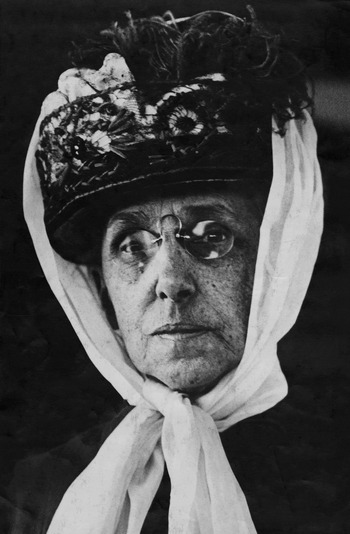
Young served as Chicago's superintendent for two more years, but these final years were marked by bitter battles with some Board members (see Figure 4). Regardless, she found ingenious means of carrying on. For instance, when, as she put it, “college experts who are making a specialty of testing and standardizing public schools earnestly desire to march on the schools of Chicago,” threatening an expensive external evaluation, Young instead proactively summoned the assistance of all school employees in conducting a thorough self-study on their own terms, published as her 1914 Annual Report of the Superintendent.Footnote 94 Nonetheless, Young grew weary as ever-shifting forms of resistance dogged her efforts. She worked her last day in Chicago in December 1915.Footnote 95
Ella Flagg Young, ca. 1917. Author's personal collection.
Conclusion
Young died three years later during the Spanish flu pandemic, and Chicago's flags flew at half-mast in her honor. Few were permitted to attend the graveside funeral, however, because of the city's restrictions on public assembly during the deadly outbreak.Footnote 96 Thousands of students contributed pennies in her honor to help poor children attend school.Footnote 97 Organized Chicago women planned a larger drive to build a “city hall for women” in Young's name, but the effort later faltered as the pandemic and a severely weakened postwar economy sapped resources.Footnote 98 Young had asked her close friends to protect her privacy and they complied. She did not leave archives. Within a generation, Young's efforts largely were forgotten. Some of her ideas were attributed to others, including John Dewey.Footnote 99
Young had thought that women and men eventually would share power on equal terms in schoolwork. This appeared to be the trend over the course of her life—and she herself certainly played many important roles in making it happen.
Among school workers and students, she staunchly cultivated individuality and freedom, her “hobbies.” She protested the encroaching movement toward standardization in schools. Instead, she inspired teachers to creatively modify the curriculum and bring their unique pedagogical approaches to their students. “What new ideas have you today?” was her favorite greeting with teachers, administrators, and students alike. Their responses often led to changes in the schools.Footnote 100 She resisted calls for centralized power, instead choosing to share power as much as possible while retaining her ultimate responsibility for the welfare of the whole. In her classrooms, students had voice in how activities unfolded. In her schools, she encouraged teachers to make important decisions together about governance, pedagogy, and curriculum—with attention devoted to arts, humanities, and creative expression. In her district, she established a teachers’ council in which large numbers of teachers systematically deliberated curriculum, governance, and policy—with meaningful implementation of results. As superintendent, she established numerous channels through which she dialogued with members of the broad Chicago schools community, motivating them to contribute ideas and to work together to realize them.
Young encouraged individuality and freedom; at the same time, she nurtured a sense of community that made them possible. At each step in her career, she created ways for people to meet with each other to discuss work-related topics of their choice and in settings that promoted their relaxed enjoyment. Food consistently played a key role in these events. So too did lively banter, give-and-take, and making plenty of room for “free play of thought.” Teachers looked forward to these meetings, as they shared ideas, questioned orthodoxies, came to trust one another more deeply, and ultimately helped each other in creating new ideas and practices. Young spent almost her entire career in the Chicago schools. She had taught many of its teachers and administrators, worked beside them, and fought with them to improve working conditions. She knew them, and they in turn knew her. They knew they could count on her to work on their behalf and to make good on her commitments. A remarkable number of teachers and administrators did their best to reciprocate. This broad and deep sense of community across the city provided the context in which a staggering number of important reforms flourished, especially during the first four years of Young's superintendency.
In the end, Young faced significant backlash in her work. Much of it came from individuals and groups that feared women were becoming too powerful, significantly overstepping their traditional bounds. Young, as the woman holding the greatest position of public service in the country, no doubt served as a lightning rod for such attacks. She persisted as fully as she could while knowing that if she succumbed, it would be a setback for the larger movement. Right after Illinois granted women full suffrage, Emmeline Pankhurst addressed a Chicago gathering of women activists, including Young. Regarding both Illinois suffrage and Young's superintendency, Pankhurst said, “Your victory has been our victory.” More ominously, though, she declared, “If one set of women fail, all women fail together.”Footnote 101
In the years since Young's superintendency, women largely still do not hold a proportional share of school leadership positions across the country.Footnote 102 So too do teachers continue to struggle against the constraints of tightly centralized power and pressure toward standardization, both of which minimize the importance of teachers’ individuality and freedom, not to mention their sense of community. Nonetheless, there was a brief moment when Chicago's school workers felt empowered, and Young's legacy provides us with a remarkable example of how schools might work if freedom, individuality, and community were truly honored.



