





Highlights
-
• Enhanced self-actualisation feedback was judged as more accurate than genuine.
-
• L2 presentation did not globally reduce self-enhancement in feedback accuracy.
-
• Language context affected the relative accuracy of feedback components.
-
• Accuracy ratings were lower for Time Competence than Inner-Directedness in L2.
1. Introduction
Initially explored in the context of decision making (e.g., Costa et al., Reference Costa, Foucart, Arnon, Aparici and Apesteguia2014; Keysar et al., Reference Keysar, Hayakawa and An2012), foreign language effect (FLE) research has seen rapid expansion, with recent studies also addressing psychological distance (Hu et al., Reference Hu, Suitner and Navarrete2024; Yavuz et al., Reference Yavuz, Küntay and Brouwer2024) and self-referential evaluation (e.g., Purpuri et al., Reference Purpuri, Vasta, Filippi, Wei and Mulatti2024, Reference Purpuri, Vasta, Filippi, Wei and Mulatti2025; Zhang et al., Reference Zhang, Lan, Li, Gao, Hu and Gao2023). Early accounts of bilingual language–emotion relations (e.g., Dewaele, Reference Dewaele2010, Reference Dewaele2013; Pavlenko, Reference Pavlenko2005) proposed that differences in affective grounding across languages shape individuals’ emotional experience and subjective engagement with language. Relatedly, some strands of FLE research (e.g., Costa et al., Reference Costa, Foucart, Arnon, Aparici and Apesteguia2014; Hayakawa et al., Reference Hayakawa, Costa, Foucart and Keysar2016) have been informed by dual-process perspectives to motivate empirical contrasts between native and foreign language use. In particular, Kahneman’s (Reference Kahneman2003, Reference Kahneman2011) distinction between intuitive, fast, and affectively driven processing (Type 1) and slower, more deliberative, and controlled processing (Type 2) has often been used as a conceptual reference point when discussing potential shifts in cognitive style across language contexts. Within this line of reasoning, operating in a foreign language has been hypothesised to attenuate intuitive or affect-laden responses and to increase reliance on more deliberative modes of thought. Importantly, such parallels have typically served as broad interpretive frameworks rather than direct explanations of how the effect arises. Their relevance has been evaluated primarily through experimental comparisons between L1 and L2 performance rather than direct tests of dual-process engagement, that is, whether participants rely more on fast, intuitive processing or on slower, more reflective processing. Of note, recent integrative reviews and meta-analytic evidence (Białek, Reference Białek2023; Circi et al., Reference Circi, Gatti, Russo and Vecchi2021; Del Maschio et al., Reference Del Maschio, Del Mauro, Bellini, Abutalebi and Sulpizio2022; Stanković et al., Reference Stanković, Biedermann and Hamamura2022) indicate that foreign language effects are neither uniform in direction nor consistent in magnitude, and call into question the adequacy of any single explanatory mechanism. Instead, it is argued that multiple, partially independent sources of variability determine when and how language context modulates judgment.
One prominent source of variability stems from differences in task structure and judgment domain (Circi et al., Reference Circi, Gatti, Russo and Vecchi2021). Specifically, foreign language use has been associated with increased utilitarian responding in moral dilemmas and with reduced susceptibility to gain–loss framing in classic framing tasks, meaning that equivalent options are less likely to be evaluated differently depending on whether they are presented as gains or losses. By contrast, effects are considerably weaker or inconsistent in economic choice and probabilistic reasoning tasks that lack a clear normative–intuitive conflict. Therefore, emotional load alone does not appear to reliably predict the presence of a foreign language effect; rather, such effects have been linked to the way the task is structured, whether it involves a clear normative–intuitive contrast, and the criteria participants use when making their evaluations.
A second major aetiological pathway concerns participant-level heterogeneity in bilingual experience. Synthesising evidence from diverse bilingual populations, Stanković et al. (Reference Stanković, Biedermann and Hamamura2022) argue that foreign language effects cannot be meaningfully interpreted without careful consideration of language proficiency and dominance, as well as the onset and context of second-language acquisition. Their review shows that highly proficient bilinguals with extensive formal and functional exposure to a second language often exhibit less pronounced or qualitatively different effects compared to less proficient or less balanced bilinguals, calling into question accounts that treat foreign language status as a uniform cognitive manipulation.
At a broader level, meta-analytic evidence further points to variability as a core feature present in the foreign language effect literature. Del Maschio et al. (Reference Del Maschio, Del Mauro, Bellini, Abutalebi and Sulpizio2022) report a small but reliable overall foreign language effect across decision-making studies, alongside substantial between-study heterogeneity and wide prediction intervals that include null and reversed effects. Moreover, the meta-analysis also shows that commonly examined moderators, such as proficiency or age of acquisition, only account for a limited proportion of this variability, confirming that language-related modulation of judgment cannot be captured by a single, domain-general mechanism.
Taken together, recent literature suggests that foreign language effects are best understood in terms of aetiology and boundary conditions rather than as a unitary phenomenon. While proposals linking foreign language use to reduced emotional grounding and shifts between intuitive and deliberative processing (Dewaele, Reference Dewaele2010, Reference Dewaele2013; Kahneman, Reference Kahneman2003, Reference Kahneman2011; Pavlenko, Reference Pavlenko2005, Reference Pavlenko2014) provide explanatory scope, they also leave room for further specification regarding how and when such shifts are triggered across tasks and populations. Addressing this gap, one recent account proposes that foreign language use affects metacognitive monitoring by disrupting confidence–accuracy cues, thereby modulating the likelihood of reflection and constraining the conditions under which foreign language effects emerge (Białek, Reference Białek2023). Moreover, although evidence from autobiographical memory, affective processing, and introspective reports supports differential emotional resonance across languages, these factors alone cannot explain the heterogeneity observed across judgment and decision-making tasks (Circi et al., Reference Circi, Gatti, Russo and Vecchi2021; Del Maschio et al., Reference Del Maschio, Del Mauro, Bellini, Abutalebi and Sulpizio2022; Pavlenko, Reference Pavlenko2017).
Within this framework, self-referential evaluations, such as judgments about how accurate personality feedback seems, provide a particularly informative context for examining the boundary conditions of foreign language effects. These judgments engage both experiential and analytical forms of self-knowledge and are inherently motivationally relevant (e.g., Epstein, Reference Epstein2014). A strand of research particularly relevant to the present study concerns the interaction between language context and self-enhancement processes. Self-enhancement refers to a robust and pervasive motivational tendency to maintain or increase the positivity of one’s self-concept while avoiding or reducing its negativity (Sedikides & Strube, Reference Sedikides, Strube and Zanna1997). In other words, people tend to evaluate themselves in overly positive ways and prefer favourable information about themselves. Unlike foreign language effects, it has been documented across a wide range of cognitive, affective, and evaluative domains (e.g., Taylor et al., Reference Taylor, Collins, Skokan and Aspinwall1989, Reference Taylor, Lerner, Sherman, Sage and McDowell2003), and constitutes a central feature of human self-regulation (Alicke & Sedikides, Reference Alicke, Sedikides, Alicke and Sedikides2011). At the mechanistic level, self-enhancement is supported by motivational and informational processes that govern attention to, interpretation of, and evaluation of self-referential information. These processes include preferential weighting of positive self-relevant cues, asymmetric attributional patterns that favour internal explanations for success over failure, and reduced critical scrutiny of information that affirms the self-concept (Alicke & Sedikides, Reference Alicke, Sedikides, Alicke and Sedikides2011; Sedikides & Alicke, Reference Sedikides, Alicke and Ryan2019). Converging evidence further suggests that these processes are closely linked to domain-general mechanisms of positive emotion regulation, which serve to amplify or sustain positive affect. At the neural level, self-enhancement has been associated with functional coupling between regulatory prefrontal regions and reward-related structures, with stronger connectivity predicting greater self-enhancement tendencies (Parrish et al., Reference Parrish, Dutcher, Muscatell, Inagaki, Moieni, Irwin and Eisenberger2022).
Among the cognitive mechanisms underlying self-enhancement, selective information processing is particularly relevant to the present study, as it involves attributing greater weight to favourable self-relevant information and subjecting it to less critical scrutiny than unfavourable or neutral information. Accumulated evidence consistently shows that positive personality feedback is not only preferred but also typically perceived as more accurate than unfavourable feedback, even when its objective diagnostic value is held constant (Ditto & Boardman, Reference Ditto and Boardman1995; Fisher, Reference Fisher1979). The robustness of this bias makes explicit evaluations of self-relevant feedback a theoretically informative – and potentially challenging – domain for examining whether and to what extent language context can modulate motivational tendencies that are otherwise remarkably stable.
While still limited, empirical work examining the interaction between foreign language context and self-enhancement further illustrates the variability of effects observed in this domain. Early studies suggested that language context may modulate self-evaluative tendencies in different ways, depending on task and cultural framing. For example, using cultural mindset priming, Lee et al. (Reference Lee, Oyserman and Bond2010) reported stronger self-enhancement in English than in Chinese among Chinese participants across several social comparison tasks. However, subsequent research has more consistently documented attenuated self-related positivity biases in foreign language contexts. Ivaz et al. (Reference Ivaz, Costa and Duñabeitia2016), for instance, observed reduced self-bias in perceptual matching tasks among Spanish–English bilinguals, while Zhang et al. (Reference Zhang, Lan, Li, Gao, Hu and Gao2023) and Liu et al. (Reference Liu, Schwieter, Wang and Liu2023) reported diminished implicit self-positivity in L2 English using behavioural and electrophysiological measures. Ivaz et al. (Reference Ivaz, Griffin and Duñabeitia2019) also showed that reduced self-bias was specific to foreign, rather than merely non-native, language use in trilingual speakers. Taken together, these findings indicate that language-related modulation of self-enhancement is sensitive to task characteristics, measurement modality, and bilingual experience, mirroring the broader pattern of heterogeneity documented in the foreign language effect literature, rather than reflecting a uniform pattern across studies.
Despite these advances, relatively little is known about how self-enhancement operates in the evaluation of explicit self-relevant feedback across language contexts. From a theoretical perspective, self-referential evaluation constitutes an informative test case, as it combines explicit judgment, strong motivational relevance, and sensitivity to the structure and content of self-relevant information, while remaining open to modulation by language contexts. Examining whether self-enhancement persists across languages therefore allows for a more precise specification of the boundary conditions under which foreign language effects on self-referential evaluation emerge. Against this background, the present study investigates whether the language of feedback presentation (L1 Polish versus L2 English) modulates perceived accuracy ratings of genuine and enhanced personality feedback.
First, on the basis of prior work, we expect participants to rate enhanced personality feedback as more accurate than their genuine feedback in both language conditions, reflecting the well-established tendency towards self-enhancement. Second, we test for a reduction in self-enhancement when feedback is presented in a foreign language relative to the native language. Given prior evidence that foreign language effects depend on task demands and evaluative structure, self-enhancement may alternatively remain stable across languages, which would suggest that explicit self-evaluation constitutes a context in which foreign language effects are constrained.
To examine these questions, the present study employs the Personal Orientation Inventory (POI; Educational and Industrial Testing Service, 2016; Shostrom, Reference Shostrom1964), a standardised measure of self-actualisation assessing motivational orientations and self-regulatory dispositions central to self-functioning. The POI operationalises self-actualisation through two major scales (i.e., Time Competence and Inner-Directedness), ten subscales, and two ratio indices (i.e., Time Ratio and Support Ratio) derived from the major scales. Here, we focus on the two major scales and the two ratio indices explicitly included in the feedback materials. The POI presents feedback as a graphical score profile, accompanied by narrative interpretations of the major scales and ratio indices, and brief descriptions of each dimension’s low and high poles. This allows feedback favourability to be manipulated while keeping both the content and the presentation of each feedback component constant across conditions. At the same time, responses to POI feedback may be subject to at least two exploratory sources of variation. First, POI components differ in substantive content and may recruit partially distinct domains of self-knowledge during introspective judgment. Present-oriented indices (Time Competence and Time Ratio) relate to temporal self-appraisal and the integration of past, present, and future experience, whereas autonomy-related indices (Inner-Directedness and Support Ratio) concern reliance on internal versus external standards (Knapp, Reference Knapp1990; Shostrom, Reference Shostrom1964). Second, feedback on specific components differs in presentation format in ways that may affect interpretive processes. While major scale scores are displayed as individual score profiles, ratio scores are presented in comparison with normative benchmarks characteristic of self-actualising individuals. Accordingly, responses to POI feedback may vary both as a function of the self-domain being evaluated and the format in which the information is presented. These distinctions are not central to our primary hypotheses, but they provide a basis for examining whether language and favourability effects operate uniformly or vary across feedback components. For this reason, analyses of feedback components are treated as exploratory.
2. Method
2.1. Participants
Participants in the study were Polish–English bilingual young adults, enrolled in full-time undergraduate and graduate programmes with English as a major at a large public university in Poland. In these programmes, English functions both as the subject of instruction and the primary language of instruction across consecutive semesters. Students complete recurrent, credit-bearing coursework in English over multiple years of study (three years at the BA level and two years at the MA level), involving regular classroom interaction as well as academic reading, writing, and evaluative tasks carried out in English. Following Grosjean’s (Reference Grosjean2010) functional view of bilingualism, participants were classified as experienced late bilinguals with sustained formal exposure to English, based on their regular use of two languages across distinct domains rather than on balanced or native-like proficiency. Crucially, Polish was the dominant first language for all participants, whereas English functioned as a well-established second language acquired primarily through formal education.
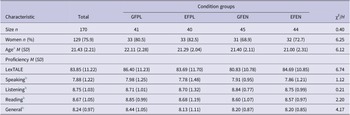
A total of 201 participants initially enrolled in the study; 187 completed the first stage and 170 completed the second stage and were included in the final analyses. Participants predominantly identified as women (n = 129, 75.9%), and were aged 18–29 years. They were randomly assigned to one of four experimental conditions defined by the language of feedback presentation (L1 Polish versus L2 English) and feedback favourability (genuine versus enhanced). The resulting groups did not differ significantly with respect to age, gender distribution, or English proficiency (see Table 1). English proficiency was assessed using the Lexical Test for Advanced Learners of English (LexTALE; Lemhöfer & Broersma, Reference Lemhöfer and Broersma2012) and self-reported proficiency ratings. Participants achieved a mean LexTALE score of 83.85 (SD = 11.22), indicating high levels of receptive lexical proficiency, as well as reported an overall high L2 English proficiency (M = 8.24, SD = 0.97 on a 10-point scale).
Characteristics of the total sample and the condition groups

Table 1. Long description
A table with seven columns: Characteristic, Total, and four condition groups (G F P L, E F P L, G F E N, E F E N), followed by Chi-square or H values.
* Size n: Total 170. G F P L 41, E F P L 40, G F E N 45, E F E N 44. Chi-square 0.40.
* Women n (percentage): Total 129 (75.9). G F P L 33 (80.5), E F P L 33 (82.5), G F E N 31 (68.9), E F E N 32 (72.7). Chi-square 6.25.
* Age M (S D): Total 21.43 (2.21). G F P L 22.11 (2.28), E F P L 21.29 (2.04), G F E N 21.40 (2.11), E F E N 21.00 (2.31). Chi-square 6.12.
* Proficiency M (S D) Lex T A L E: Total 83.85 (11.22). G F P L 86.40 (11.23), E F P L 83.69 (11.70), G F E N 80.83 (10.78), E F E N 84.69 (10.85). Chi-square 6.74.
* Speaking: Total 7.88 (1.22). G F P L 7.98 (1.25), E F P L 7.78 (1.48), G F E N 7.91 (0.95), E F E N 7.86 (1.21). Chi-square 1.12.
* Listening: Total 8.75 (1.03). G F P L 8.71 (1.01), E F P L 8.70 (1.32), G F E N 8.84 (0.77), E F E N 8.75 (0.99). Chi-square 0.21.
* Reading: Total 8.67 (1.05). G F P L 8.85 (0.99), E F P L 8.68 (1.19), G F E N 8.60 (1.07), E F E N 8.57 (0.97). Chi-square 2.20.
* General: Total 8.24 (0.97). G F P L 8.44 (1.05), E F P L 8.13 (1.11), G F E N 8.20 (0.87), E F E N 8.20 (0.85). Chi-square 4.17.
Note: G F P L is genuine feedback in Polish, E F P L is enhanced feedback in Polish, G F E N is genuine feedback in English, and E F E N is enhanced feedback in English.
Note: Chi-square and Kruskal–Wallis tests were used to compare groups. GFPL = genuine feedback in Polish, EFPL = enhanced feedback in Polish, GFEN = genuine feedback in English, EFEN = enhanced feedback in English.
a = 12 participants (7.1%) were missing data on age.
b = self-reported proficiency in English (1–10).
2.2. Materials
Participants’ English proficiency was assessed using the Lexical Test for Advanced Learners of English (LexTALE; Lemhöfer & Broersma, Reference Lemhöfer and Broersma2012) and supplemented with self-reported overall L2 English proficiency ratings on a 1–10 Likert scale. The Personal Orientation Inventory (POI; Educational and Industrial Testing Service, 2016; Shostrom, Reference Shostrom1964) was used to generate individualised personality feedback profiles for the experimental task. The POI consists of 150 forced-choice items yielding scores on two major scales (i.e., Time Competence and Inner-Directedness), two derived ratio scores (i.e., Time Ratio and Support Ratio), and ten subscales. Within the POI framework, the major scales and ratio scores are treated as primary indicators of self-actualisation, whereas the subscales provide a more differentiated profile of self-actualising tendencies (Shostrom & Knapp, Reference Shostrom and Knapp1966).
Accuracy ratings were obtained using a set of single-item judgment scales, designed to assess perceived accuracy of POI-based feedback at both the component and global levels, in line with prior work on personality feedback evaluation (Poškus, Reference Poškus2014). Accuracy judgments were also collected for the full POI profile; however, only the four indices explicitly represented in the experimental feedback materials were included in the present analyses: the two major scales and the two ratio scores. For each of these four components, perceived accuracy was assessed using a 6-point scale ranging from 1 (totally inaccurate) to 6 (totally accurate).
A personalised POI feedback sheet was used, in which scores were converted to T scores and presented graphically, accompanied by brief interpretative descriptions and normative reference information. Major scale scores were displayed as single-bar representations of individual results with descriptive labels, whereas ratio scores were presented in a comparative parallel-bar format juxtaposing participants’ scores with normative values characteristic of self-actualising profiles. In the genuine feedback condition, displayed scores corresponded to participants’ actual POI results. In the enhanced feedback condition, participants’ scores were replaced with values characteristic of self-actualising individuals, based on POI norms reported by Shostrom (Knapp, Reference Knapp1990) and previous research conducted with comparable Polish samples (Przybył, Reference Przybył2025). Accordingly, all participants in the enhanced feedback condition received identical enhanced profiles. Across conditions, feedback materials retained an identical visual layout and interpretative content, differing only in the score values. Experimental feedback materials were based on the POI score profile format and are not publicly shared due to copyright and licensing restrictions.
2.3. Procedure
The study was conducted online in two stages. In the pre-experimental stage, participants accessed a Polish-language MS Forms platform, where they received general study information, provided informed consent, and completed a demographic questionnaire as well as self-ratings of overall English proficiency. Participants then completed two assessment instruments administered in L2 English: (1) the LexTALE (Lemhöfer & Broersma, Reference Lemhöfer and Broersma2012), used to index receptive lexical proficiency, and (2) the Personal Orientation Inventory (POI; Educational and Industrial Testing Service, 2016; Shostrom, Reference Shostrom1964). This procedure ensured equivalent task demands across participants and prevented uncontrolled language-related variation prior to the experimental manipulation.
Following the pre-experimental stage, participants were randomly assigned to one of four conditions defined by feedback language (L1 Polish versus L2 English) and feedback favourability (genuine versus enhanced). A between-subject design was used for the language manipulation to avoid carry-over and contamination effects (e.g., direct comparison between language conditions or heightened awareness of the manipulation) that might arise if participants were exposed to feedback in both languages. This design also helped reduce demand characteristics and preserve the credibility of the feedback, while maintaining ecological validity (i.e., reflecting typical real-world settings). Approximately one week after completing the pre-experimental stage, each participant received a personalised POI feedback sheet by email. All feedback materials, instructions, correspondence, and incentive-related information were provided exclusively in the language corresponding to the assigned condition. Participants were instructed to review the feedback on their POI scores and to rate the perceived accuracy of each feedback component as well as the feedback overall using online judgment scales. During the interval between stages, participants continued regular academic activities involving sustained exposure to both Polish and English through coursework, academic reading, writing, and classroom interaction.
Upon completing the judgment task, participants were fully debriefed, informed about the use of enhanced feedback where applicable, granted access to their genuine POI results, and compensated for their involvement with online bookshop vouchers. The study was approved by the Ethics Committee for Research on Humans at Adam Mickiewicz University (Decision no. 4/2023/2024) and conducted in accordance with the Declaration of Helsinki.
2.4. Data analysis
We conducted linear mixed-effects modelling to predict the perceived accuracy of POI feedback. Analyses were conducted in jamovi (Gallucci, Reference Gallucci2024; R Core Team, 2024; The jamovi project, 2024) using the GAMLj module for linear mixed-effects modelling; sensitivity power analyses were performed in R using the simr package (Green & MacLeod, Reference Green and MacLeod2016). Fixed effects included feedback language (L1 Polish vs. L2 English), feedback favourability (genuine vs. enhanced), and POI components (Time Competence, Inner-Directedness, Time Ratio, Support Ratio) along with their interactions. Analyses involving POI components were treated as exploratory and examined whether language and favourability effects varied across feedback components differing in content and presentation format. Random intercepts for participants were included to account for repeated measurements and between-participant variability in baseline accuracy ratings. LexTALE scores were entered as a covariate to control for individual differences in participants’ receptive lexical proficiency. Fixed factors were dummy-coded, and the covariate was centred on its mean.
Model assumptions were evaluated through inspection of residual distributions and standard mixed-effects diagnostic checks of model fit. We looked for the best fixed structure using data-driven model comparison from the most complex (i.e., three-way interaction) to the simplest model (i.e., main effects). Nested models were compared using likelihood-ratio tests, and final model selection was guided by Akaike and Bayesian information criteria. Post-hoc contrasts were adjusted for multiple comparisons where applicable. Simulation-based sensitivity power analyses were conducted to evaluate the sensitivity of the final model under the observed sample size and model structure. Power estimates were obtained by simulating data from the fitted mixed-effects model and calculating the proportion of simulations in which each fixed effect reached statistical significance.
3. Results
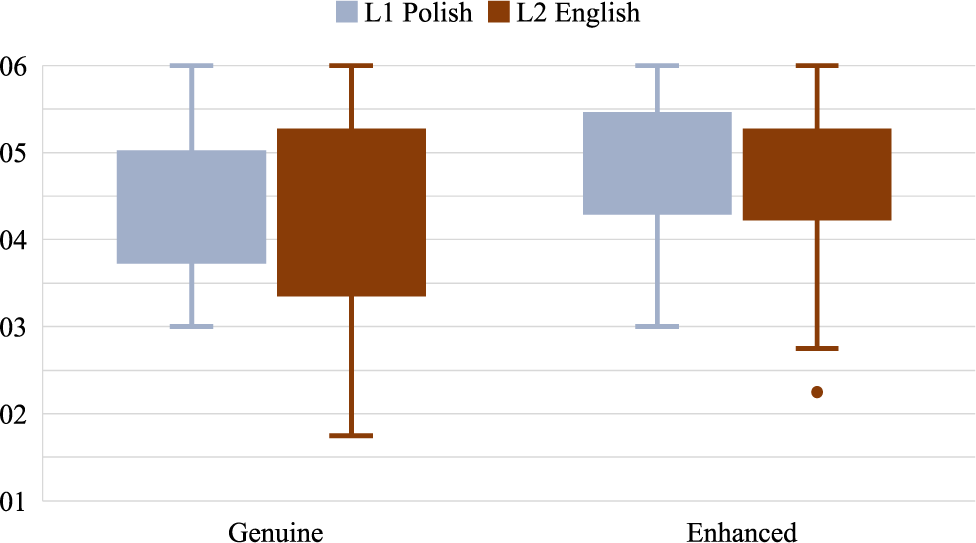
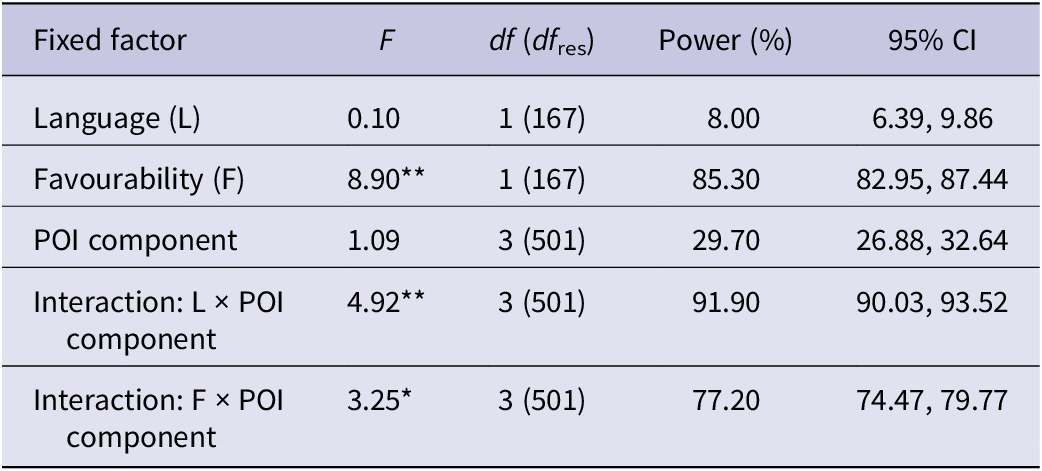
Descriptive statistics for perceived accuracy ratings across conditions are shown in Figure 1, and fixed-effects omnibus test outcomes for the final model are presented in Table 2. A significant main effect of feedback favourability was observed, F(1, 167) = 8.90, p = .003, indicating that enhanced feedback was judged as more accurate than genuine feedback (Ms = 4.81 vs. 4.43, SE = 0.09). No significant main effects of feedback language or POI component were found.
Mean accuracy ratings across conditions with the main effect of the favourability of the POI feedback.

Figure 1. Long description
The y-axis represents accuracy ratings ranging from 01 to 06. The x-axis contains two categories: Genuine and Enhanced. A legend at the top identifies light blue boxes as L 1 Polish and dark brown boxes as L 2 English.
* In the Genuine category, the L 1 Polish box is centered around 04.5 with whiskers extending from 03 to 06. The L 2 English box has a similar median but a much wider range, with the lower whisker reaching down to approximately 01.5.
* In the Enhanced category, the L 1 Polish box shows a higher median near 05 with whiskers from 03 to 06. The L 2 English box shows a slightly lower median than the Polish counterpart, with a whisker extending to 02.5 and a single outlier point plotted near 02.2.
Both conditions show that L 1 Polish ratings are generally more concentrated, while L 2 English ratings exhibit greater variance.
Fixed-effects omnibus tests from the linear mixed-effects model predicting perceived accuracy of POI feedback

Table 2. Long description
The table consists of five columns: Fixed factor, F, d f (d f res), Power (%), and 95% C I.
* Language (L): F equals 0.10, d f is 1 (167), Power is 8.00%, and 95% C I is 6.39, 9.86.
* Favourability (F): F equals 8.90 (significant at p < .01), d f is 1 (167), Power is 85.30%, and 95% C I is 82.95, 87.44.
* P O I component: F equals 1.09, d f is 3 (501), Power is 29.70%, and 95% C I is 26.88, 32.64.
* Interaction: L x P O I component: F equals 4.92 (significant at p < .01), d f is 3 (501), Power is 91.90%, and 95% C I is 90.03, 93.52.
* Interaction: F x P O I component: F equals 3.25 (significant at p < .05), d f is 3 (501), Power is 77.20%, and 95% C I is 74.47, 79.77.
Note: Power estimates are simulation-based sensitivity estimates. Asterisks indicate statistical significance levels.
Note: Power estimates are simulation-based sensitivity estimates obtained from the final fitted model and the observed sample size. They indicate the proportion of simulations in which each fixed effect reached statistical significance. * p < .05; ** p < .01.
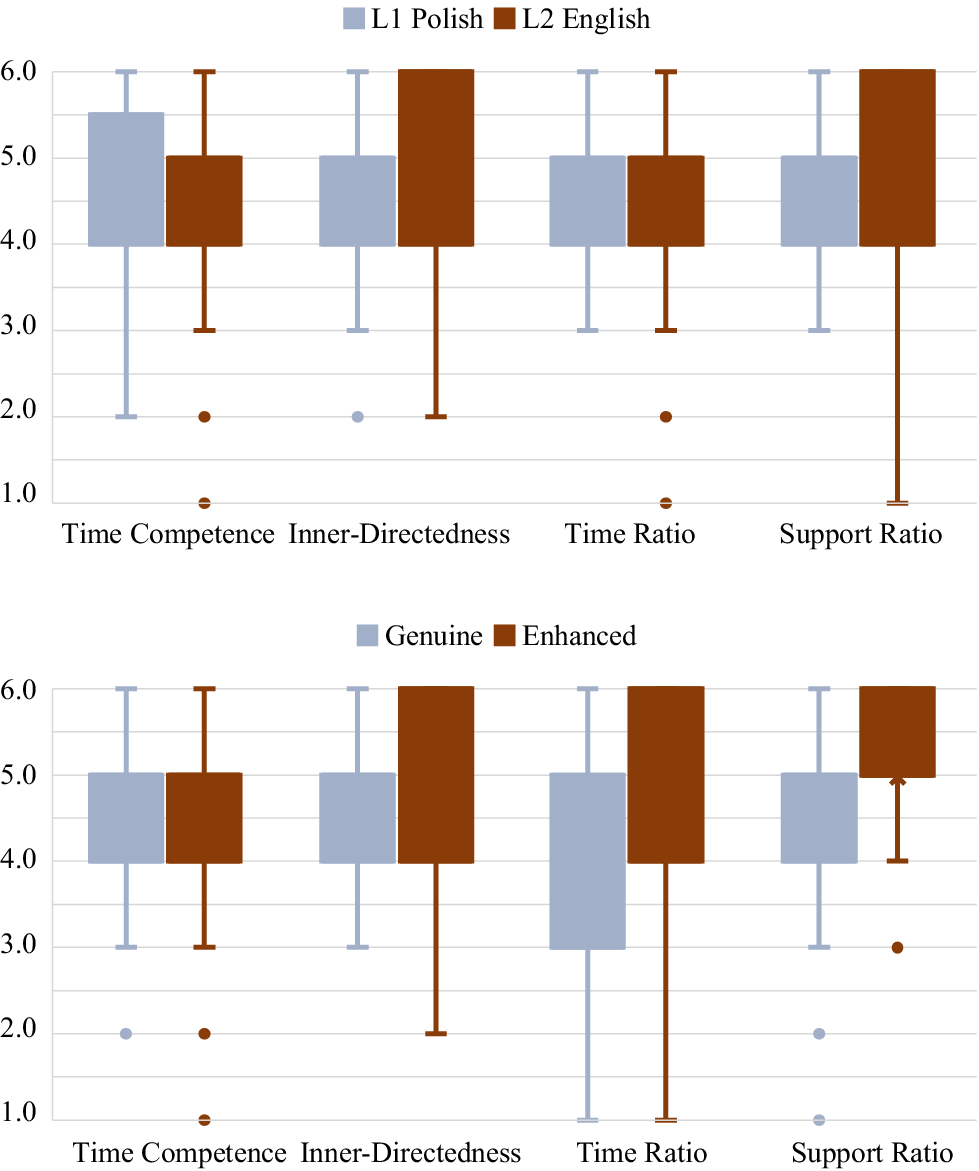
In exploratory analyses, a significant interaction between language and POI component was observed, F(3, 501) = 4.92, p = .002, indicating that the effect of language differed depending on the component of feedback being evaluated. Follow-up comparisons indicated that when feedback was presented in L2 English, perceived accuracy differed between the two POI major scales: feedback concerning Time Competence was judged as less accurate than that concerning Inner-Directedness, t(501) = −3.06, p = .047 (Ms = 4.38 vs. 4.77, SEs = 0.12). No such difference was observed when feedback was presented in L1 Polish.
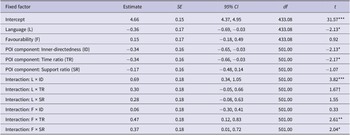
An exploratory interaction between favourability and POI component was also significant, F(3, 501) = 3.25, p = .022, indicating that the effect of favourable versus genuine feedback differed across feedback components. Post-hoc analyses showed that enhanced feedback was judged as more accurate than genuine feedback for both Time Ratio, t(433.08) = −3.71, p = .006 (Ms = 4.92 vs. 4.29, SEs = 0.12), and Support Ratio, t(433.08) = −3.10, p = .043 (Ms = 4.98 versus 4.46, SEs = 0.12). At the same time, no significant favourability effects were observed for the two POI major scales, and no other interactions reached significance. The random intercept for participants accounted for a substantial proportion of variance in perceived accuracy ratings (ICC = .43). Fixed-effect parameter estimates are reported in Table 3, and Figure 2 demonstrates significant interaction effects.
Fixed-effect parameter estimates from the linear mixed-effects model predicting perceived accuracy of POI feedback

Table 3. Long description
The table consists of six columns: Fixed factor, Estimate, S E, 95% C I, df, and t.
* Intercept: Estimate 4.66, S E 0.15, 95% C I 4.37 to 4.95, df 433.08, t 31.57 (p < .001).
* Language (L): Estimate -0.36, S E 0.17, 95% C I -0.69 to -0.03, df 433.08, t -2.13 (p < .05).
* Favourability (F): Estimate 0.15, S E 0.17, 95% C I -0.18 to 0.49, df 433.08, t 0.92.
* P O I component Inner-directedness (I D): Estimate -0.34, S E 0.16, 95% C I -0.65 to -0.03, df 501.00, t -2.13 (p < .05).
* P O I component Time ratio (T R): Estimate -0.34, S E 0.16, 95% C I -0.66 to -0.03, df 501.00, t -2.17 (p < .05).
* P O I component Support ratio (S R): Estimate -0.17, S E 0.16, 95% C I -0.48 to 0.14, df 501.00, t -1.07.
* Interaction L x I D: Estimate 0.69, S E 0.18, 95% C I 0.34 to 1.05, df 501.00, t 3.82 (p < .001).
* Interaction L x T R: Estimate 0.30, S E 0.18, 95% C I -0.05 to 0.66, df 501.00, t 1.67 (p < .07).
* Interaction L x S R: Estimate 0.28, S E 0.18, 95% C I -0.08 to 0.63, df 501.00, t 1.55.
* Interaction F x I D: Estimate 0.06, S E 0.18, 95% C I -0.30 to 0.41, df 501.00, t 0.33.
* Interaction F x T R: Estimate 0.47, S E 0.18, 95% C I 0.12 to 0.83, df 501.00, t 2.61 (p < .01).
* Interaction F x S R: Estimate 0.37, S E 0.18, 95% C I 0.01 to 0.72, df 501.00, t 2.04 (p < .05).
Note: Parameter estimates reflect conditional effects defined by the dummy-coding scheme used in the model, with genuine feedback in L1 Polish on the Time Competence scale as the reference category. They therefore do not represent the overall effects across all levels of the interacting variables reported in Table 2; consequently, the two sets of tests are not directly equivalent. † p < .07; * p < .05; ** p < .01; *** p < .001.
Interaction effects of feedback language, favourability, and POI component on perceived accuracy ratings.

Figure 2. Long description
A multi-panel figure containing two vertically stacked box plot charts. Both charts use a y-axis representing accuracy ratings from 1.0 to 6.0 and an x-axis with four categories: Time Competence, Inner-Directedness, Time Ratio, and Support Ratio.
Top Panel: Compares L 1 Polish (light blue) and L 2 English (brown).
* Time Competence: L 1 has a higher median around 5.5 compared to L 2 at 5.0.
* Inner-Directedness: L 1 median is at 5.0 while L 2 is at 6.0.
* Time Ratio: Both L 1 and L 2 have medians at 5.0.
* Support Ratio: Both L 1 and L 2 have medians at 5.0, but L 2 shows a much wider downward whisker reaching 1.0.
Bottom Panel: Compares Genuine (light blue) and Enhanced (brown) favorability.
* Time Competence: Both Genuine and Enhanced have medians at 5.0.
* Inner-Directedness: Both Genuine and Enhanced have medians at 5.0, but Enhanced has a higher upper quartile reaching 6.0.
* Time Ratio: Genuine median is at 5.0 while Enhanced is at 6.0.
* Support Ratio: Genuine median is at 5.0 while Enhanced is at 6.0 with a much tighter interquartile range.
Individual data points (outliers) are indicated by small dots below the whiskers in several categories, particularly for Time Competence and Support Ratio.
Sensitivity power estimates indicated that the study was underpowered for detecting main effects of language or POI component, but sufficiently powered to detect the main effect of favourability and interactions involving POI indices (Table 2).
4. Discussion
This study addressed two main questions: whether highly proficient Polish bilinguals would rate enhanced personality feedback as more accurate than genuine feedback in explicit self-evaluation, and whether L2 use would attenuate this self-enhancement effect. Consistent with prior work, participants in both language conditions rated enhanced feedback as more accurate, confirming the expected self-enhancement effect. Contrary to hypotheses derived from accounts linking foreign language use to increased reflective scrutiny, however, no evidence was found that presenting feedback in L2 reduced self-enhancement or altered overall perceived accuracy. Exploratory analyses nevertheless suggested that both the magnitude of the favourability effect and the influence of language varied across feedback components.
The most robust and theoretically unambiguous finding is the main effect of feedback favourability. Across language contexts, feedback portraying participants as more self-actualising was perceived as more accurate than feedback reflecting their actual POI scores. This pattern is consistent with extensive prior evidence documenting self-enhancement as a pervasive, pre-eminent, and universal self-evaluative motive (Ditto & Boardman, Reference Ditto and Boardman1995; Sedikides & Strube, Reference Sedikides, Strube and Zanna1997; Alicke & Sedikides, Reference Alicke, Sedikides, Alicke and Sedikides2011). Importantly, the present task required explicit, reflective judgments about the accuracy of structured feedback, rather than responses made under time pressure or in an implicit paradigm. The persistence of self-enhancement under these conditions aligns with evidence that it reliably manifests even during deliberate evaluation of self-relevant information (e.g., Bosson et al., Reference Bosson, Brown, Zeigler-Hill and Swann2003; Harré & Sibley, Reference Harré and Sibley2007). This pattern supports the view that self-enhancement operates in reflective self-evaluation but does not address implicit or time-pressured contexts.
Contrary to expectations, a significant favourability effect emerged without a language × favourability interaction. Thus, the tendency to endorse favourable feedback held across L1 and L2. The absence of a language by favourability interaction reinforces the view of self-enhancement as a robust baseline against which any modulation by language must operate, at least among highly proficient bilinguals. One alternative explanation concerns cross-linguistic differences in pragmatic norms governing the expression and acceptance of praise and criticism. Research on Polish–English pragmatics indicates that positive evaluations are more readily expressed and accepted in English, whereas in Polish they are used more sparingly and are more likely to be downplayed, in line with norms of modesty (e.g., Dronia & Ślęzak-Świat, Reference Dronia and Ślęzak-Świat2026; Jakubowska, Reference Jakubowska1999). Accordingly, identical enhanced feedback may have been more readily endorsed in English but evaluated more critically in Polish, independently of any foreign language effect. Such a bias would work against our hypothesis, potentially masking a reduction in self-enhancement in the foreign-language context. Although this account is constrained by the use of a single bilingual sample, random assignment, and identical feedback content across languages, it cannot be ruled out. Future work could test this explanation by assessing perceived praise intensity, appropriateness, or credibility across languages, or by using measures less sensitive to pragmatic response norms.
Beyond this pragmatic account, a complementary explanation concerns the level of processing at which language effects emerge. Specifically, foreign language effects may be more evident at implicit rather than explicit levels of self-processing. For example, Zhang et al. (Reference Zhang, Lan, Li, Gao, Hu and Gao2023) tested Chinese–English bilinguals on an implicit self-positivity paradigm (i.e., an IAT task) while recording behavioural responses and electrophysiological indices. They found that self-positivity was robust in participants’ native language but diminished in their foreign language, as reflected in reduced behavioural facilitation and less pronounced neural markers of self-positivity. Against this background, the absence of a language effect in the present study may reflect the explicitly evaluative nature of the task, which required deliberate judgments about feedback accuracy. Future work could directly test the supposed dissociation between implicit and explicit self-evaluation to clarify whether foreign language processing weakens automatically activated affective links between self and positivity while leaving reflective self-enhancement largely intact.
No main effect of feedback language was observed, indicating that language context did not produce a global shift in perceived accuracy. Although this comparison was not central to our primary hypotheses, it constrains the interpretation of the language × POI component interaction by showing that language influenced the relative evaluation of feedback components rather than overall response levels. This pattern is consistent with meta-analytic evidence suggesting that foreign language effects are often modest, variable, and contingent on task demands and participant characteristics (Circi et al., Reference Circi, Gatti, Russo and Vecchi2021; Del Maschio et al., Reference Del Maschio, Del Mauro, Bellini, Abutalebi and Sulpizio2022; Stanković et al., Reference Stanković, Biedermann and Hamamura2022). At the same time, the absence of a global effect does not imply that language-related differences in affective processing are absent more broadly. Neurophysiological studies have demonstrated robust differences in the emotional language processing between L1 and L2, even among highly proficient and immersed bilinguals (e.g., Hsu et al., Reference Hsu, Jacobs and Conrad2015; Jończyk et al., Reference Jończyk, Boutonnet, Musiał, Hoemann and Thierry2016, Reference Jończyk, Naranowicz, Bel-Bahar, Jankowiak, Korpal, Bromberek-Dyzman and Thierry2025). However, such effects are typically observed at early, automatic stages of processing and are indexed by implicit neural responses rather than by explicit evaluative judgments. The present task required deliberate assessment of structured personality feedback – a level of processing at which early affective differences may not necessarily translate into observable changes in judgment. Accordingly, the absence of a global language effect is compatible with evidence suggesting that foreign language effects may be selectively constrained in reflective, self-evaluative contexts.
Exploratory analyses provided preliminary evidence that language-related patterns differed across feedback components. In particular, when feedback was presented in L2 English, Time Competence feedback was judged as less accurate than Inner-Directedness feedback. Time Competence reflects the extent to which individuals experience themselves as affectively and temporally embedded in the present, linking past and future into a meaningful lived continuity (Knapp, Reference Knapp1990; Shostrom, Reference Shostrom1964). Evaluating such content may involve integrating verbal descriptions with affectively grounded, experiential self-representations. Prior work on self-referential and autobiographical processing suggests that such judgments rely on richly elaborated semantic–episodic networks, which may be less readily accessed or less fluently mapped in a foreign language (Pavlenko, Reference Pavlenko2012; Schrauf & Rubin, Reference Schrauf and Rubin2000). In contrast, Inner-Directedness concerns reliance on internalised values and autonomous self-regulation (Knapp, Reference Knapp1990; Shostrom, Reference Shostrom1964), and its evaluation may rely more strongly on abstract, trait-like representations of the self. One tentative interpretation is that the relative elevation of Inner-Directedness feedback accuracy over Time Competence in L2 may reflect differences in representational demands of these components, with foreign language processing favouring more abstract, decontextualised self-representations over affectively salient, experiential ones. One possible mechanism underlying this pattern concerns metacognitive monitoring during self-evaluation. It has been proposed that foreign language use weakens confidence–accuracy cues, reducing the subjective reliability of internally generated experiential evidence (Białek, Reference Białek2023). Under such conditions, individuals may rely more on semantic, conceptually organised self-knowledge that is less dependent on affective stimulation. The present findings are tentatively compatible with this account, suggesting that language context may influence self-evaluation not by dampening bias globally, but by altering the evidential basis of judgments. Importantly, these findings were not derived from strong a priori hypotheses; they should therefore be interpreted with caution. Future studies directly manipulating autobiographical versus trait-based self-referential content would be needed to test this interpretation.
Exploratory analyses also suggested that feedback favourability differed across POI components, with significant effects observed for the ratio-based indices: Time Ratio and Support Ratio. Unlike the POI major scales, these indices were graphed in a norm-referenced format, explicitly positioning participants’ scores against those of self-actualising individuals. Such comparative framing may emphasise relative appraisal rather than interpretative integration of descriptive content. Visual displays that highlight relative position are known to promote comparative judgment strategies by directing attention to relative standing rather than absolute self-description (Cleveland & McGill, Reference Cleveland and McGill1984; Tversky & Kahneman, Reference Tversky and Kahneman1981). Moreover, social-comparison research indicates that people tend to evaluate themselves more positively when comparison information reflects favourably rather than unfavourably on them, and that engagement in comparison processes is strongest when comparison targets are salient (e.g., Buckingham & Alicke, Reference Buckingham and Alicke2002). In the present design, the direct juxtaposition of individual and normative scores may have amplified the impact of enhanced feedback by making the discrepancy between the self and an idealised standard more salient. Given their exploratory nature, these findings require independent replication. Future research could disentangle whether this effect is driven primarily by social comparison engagement, perceived diagnosticity of norm-referenced displays, or visual salience.
Taken together, the present findings refine existing accounts of foreign language effects by supporting a boundary-conditions perspective. Rather than attenuating self-enhancement or globally altering perceived accuracy, foreign language use was associated with differences in the relative appraisal of specific feedback components. Self-enhancement remained evident across languages, whereas language-related effects emerged in how evaluative weight was distributed across elements of the feedback profile. This component-sensitive pattern contributes to current debates by moving beyond overall L1–L2 contrasts and highlighting the importance of analysing the internal structure of explicit self-evaluative judgments.
Several limitations should be acknowledged. First, the POI component-specific effects were examined exploratorily. Although omnibus tests involving the POI were adequately powered, component-level follow-up contrasts were less precise. Accordingly, the risk of both chance findings and false null findings should be considered. In addition, sensitivity analyses indicated that the study was underpowered to detect small global language effects; therefore, a Type II error cannot be ruled out, and the absence of such effects should be interpreted with caution. Second, although the POI affords a fine-grained assessment of self-actualising orientation across ten subscales (Knapp, Reference Knapp1990; Shostrom, Reference Shostrom1964), the present analyses focused on the two major scales and two ratio indices explicitly represented in the feedback materials. While this design ensured coverage of both content and presentation format differences, more specific facet-level characteristics may show different patterns of language-related sensitivity. Finally, the study relied on explicit accuracy judgments, capturing reflective evaluation rather than online processing dynamics. Future research could complement this approach with process-sensitive measures, such as response latencies or confidence ratings, to further disentangle differences in interpretive effort and evaluative certainty across language contexts.
Data availability statement
The anonymised dataset supporting the findings of this study is openly available in Zenodo (Pilarska & Przybył, Reference Pilarska and Przybył2026). Experimental stimuli and feedback materials are not publicly shared due to copyright and licensing restrictions.
Acknowledgments
The authors thank the anonymous reviewers for their constructive comments on earlier versions of the manuscript.
Competing interests
The authors declare none.

 Open access

