





1. Introduction and research questions
The study of metaphor in politics spans several fields, including cognitive linguistics (Lakoff, Reference Lakoff2016), critical discourse analysis (Musolff, Reference Musolff2012), political discourse analysis (Dijk, Reference Dijk1997), critical metaphor analysis (Charteris-Black, Reference Charteris-Black and Charteris-Black2004) and cognitive linguistics critical discourse studies (Hart, Reference Hart2018). Political discourse is rich in metaphors, as political topics such as education, economy, environment, health care, and international affairs involve abstract concepts. Researchers find the use of metaphors in discourse about such recent events as Russian–Ukrainian war (Nytspol & Kobuta, Reference Nytspol and Kobuta2022), COVID-19 (Neshkovska & Trajkova, Reference Neshkovska and Trajkova2020), Brexit (Charteris-Black, Reference Charteris-Black2019; Musolff, Reference Musolff2021; Negro Alousque, Reference Negro Alousque2020), climate change (Deignan et al., Reference Deignan, Semino and Paul2019) or general, universal political problems such as corruption (Isaza & Ossewaarde, Reference Isaza and Ossewaarde2021), health care (Ervas et al., Reference Ervas, Rossi, Ojha and Indurkhya2021), elections (D’Angelo & Lombard, Reference D’Angelo and Lombard2008), terror (Lakoff, Reference Lakoff2016), power division in government (Perrez & Reuchamps, Reference Perrez and Reuchamps2015), racism (Asma, Reference Asma1995) and migration (Porto, Reference Porto2022).
These issues however, as well as being political and metaphorical, are emotionally charged. Political topics are emotional, because politicians choose to stir up public opinion with emotion in order to convince the voters to support their arguments. At the same time political topics are metaphorical, because as abstract concepts they form target domains for conceptual metaphors (Lakoff & Johnson, Reference Lakoff and Johnson1999, Reference Lakoff and Johnson2003). We find similar explanations of this interaction in studies of UK and US leaders’ speeches, where metaphor is “central to the creation of persuasive belief systems […] because it exploits the subliminal resources of language by arousing hidden associations that govern our systems of evaluation” (Charteris-Black, Reference Charteris-Black and Charteris-Black2004, p. 2). People differ in decision making if the problem is metaphorically framed in different ways, as it has been shown in an experiment with the framing of violence: as a virus or as a beast (Thibodeau & Boroditsky, Reference Thibodeau and Boroditsky2011). We believe that both frames are emotionally loaded, as they both elicit fear and anger. Possible solutions, combating violence through education reform or by strengthening penalties may also elicit mixed emotions: education reform can trigger positive emotions, whereas strengthening penalties may reassure some and frighten others.
When studying the interaction between metaphors, arguments and emotional appeals in political discourse, however, we shall not rely solely on intuitive qualitative judgements, the way we used (Thibodeau & Boroditsky, Reference Thibodeau and Boroditsky2011) as an illustration. Instead, we will use a replicable method of identifying words that appeal to emotions. We present an analysis of metaphors and emotional appeals in argumentation within political discourse based on systematic methods of annotation: Metaphor Identification Procedure (PRAGGLEJAZ Group, 2007), dictionary-based sentiment analysis (Riegel et al., Reference Riegel, Wierzba, Wypych, Żurawski, Jednoróg, Grabowska and Marchewka2015; Wierzba et al., Reference Wierzba, Riegel, Wypych, Jednorwóg, Turnau, Grabowska and Marchewka2015, Reference Wierzba, Riegel, Kocoń, Miłkowski, Janz, Klessa, Konat, Grimling, Piasecki and Marchewka2021) and argumentative discourse units identification based on Inference Anchoring Theory (IAT) (Reed & Budzynska, Reference Reed and Budzynska2011). Following IAT, we conceptualise an argument as a minimum of two propositions: premise and conclusion, in which one is used by the speaker to provide support for the other. In our previous study we analysed the relation between metaphors and arguments as dynamic discourse phenomena (Juszczyk et al., Reference Juszczyk, Konat and Fabiszak2022). In the current study, we contribute an additional layer of analysis: emotional appeals, that is, cases where speakers attempt to elicit emotional responses in hearers for rhetorical gain. We selected pre-election debates as a case material for studying interactions between metaphors, arguments, and emotional appeals as in the example below:

In example (1) the speaker employs the argument scheme, in which the premise “Polska służba zdrowia jest w stanie przedzawałowym” (“Polish health service is in a heart-attack threatening condition…”) leads to the conclusion that there is a need for the “pakt na rzecz polskiego zdrowia” (“pact for the Polish health”). He uses the metaphor Polish health service is a patient (metaphorical expressions are underlined), which contributes to the rhetorical cohesion, and appeals to the emotions of the hearers through “zdrowie” (“health”) (marked in bold) as eliciting happiness in Polish, following the classification in (Wierzba et al., Reference Wierzba, Riegel, Kocoń, Miłkowski, Janz, Klessa, Konat, Grimling, Piasecki and Marchewka2021). If we were analyzing this example based on our intuitions rather than on automatic identification of emotional appeals, then we would also identify “zawał” (“heart attack”) and “nie przeżyje” (“won’t survive”) as expressions appealing to negative emotions, most likely fear. But the dictionary (Wierzba et al., Reference Wierzba, Riegel, Kocoń, Miłkowski, Janz, Klessa, Konat, Grimling, Piasecki and Marchewka2021), that is, a list of words that were evaluated and coded in the experiment and which is now used as a means for automatic identification of expressions appealing to emotions, does not contain “zawał” (“heart attack”) or “nie przeżyje” (“won’t survive”).Footnote 1 In terms of argument analysis, the speaker uses the argument from fear appeal (Walton, Reference Walton2000, p. 22), where negative or threatening result is used to justify the need for an action. This example consists of negative premise (“heart attack as a problem“) and positive conclusion (“pact as a solution”).
Example (1) illustrates persuasive strategies used by politicians. In this type of discourse, the speakers will combine metaphorical expressions and emotion-eliciting words into their argumentation with the aim of greater rhetorical effect, as every utterance in pre-election debates can be considered as having persuasive intent. Based on the literature presented above, we may assume high saturation of both metaphors and emotional appeals in political discourse. Hence, the aim of this study is to analyse the frequency and interaction between three discursive phenomena present in pre-election debates: metaphors, arguments, and emotional appeals, using both concepts and methods from three theoretical traditions and combining them into one cohesive methodology.
As shown in Figure 1, there are several possible combinations of discourse phenomena:
-
1. Texts containing only arguments (i.e., as premise or conclusion), but not metaphors or emotional appeals;
-
2. Texts containing arguments and metaphors, but not emotional appeals;
-
3. Texts containing arguments and emotional appeals, but not metaphors;
-
4. Texts containing arguments, metaphors and emotional appeals;
-
5. Texts containing only emotional appeals;
-
6. Texts containing both metaphors and emotional appeals but not arguments;
-
7. Texts containing only metaphors.
Discourse phenomena under investigation and their combinations.

The aim of this study is to analyse the frequency of the three discursive phenomena: metaphors, arguments, and emotional appeals and the frequency of their combinations. As shown in Figure 1, each of these phenomena may appear by themselves or in combinations of two or three. Our starting point is the identification of arguments, and the interaction of arguments with the remaining two phenomena, therefore we will not consider combinations of metaphors and appeals to emotion that may happen outside argumentative discourse units (this concept is explained in Section 2.2). We propose three hypotheses relating to the co-occurrences of the three phenomena in political discourse:
H1: Arguments containing metaphors are more frequent than arguments without metaphors.
H2: Arguments containing emotional appeals are more frequent than arguments without emotional appeals.
H3: Arguments containing metaphors and emotional appeals are more frequent than any other type (arguments without metaphors and without emotional appeals; arguments with metaphors, but without emotional appeals; arguments with emotional appeals, but without metaphors).
These hypotheses can be represented by referring to our previous Venn diagram (Figure 1):
H1 predicts that there will be more items in the sum of areas 2 and 4 than in the sum of areas 1 and 3.
H2 predicts that the sum of areas 3 and 4 will be bigger than the sum of areas 1 and 2.
H3 predicts that the number of items in area 4 will be bigger than the sum of all other types of arguments in areas 1, 2 and 3. These hypotheses can be represented on the following scale (see Figure 2).
The scale of frequency of arguments and arguments combined with metaphors and emotional appeals from most frequent to least frequent.

These hypotheses will undergo further specification and operationalization in terms of corpus linguistics methods in Section 3. In Section 2 we present our conceptualization of key notions used in this study: metaphors, arguments and, emotional appeals. Section 4 contains quantitative summary of our results, concluded in Section 5.
2. Key concepts
Metaphors, arguments and emotional appeals: all three concepts analysed in this paper can be conceived as dynamic discourse phenomena. They are realized by the speakers using linguistic means to obtain communicative goals. They are inherently pragmatic and interactive in nature: framing an issue with metaphor, arguing or appealing to emotions makes sense only if there is an interlocutor whom we want to inform, convince, or impress. In this section, we present the theoretical background for the three concepts presented in this paper and propose an initial operationalization of them in a joint research framework.
2.1. Metaphors
Political discussions, specifically political debates, represent a unique form of verbal engagement where journalists pose questions to politicians, allowing them to highlight their perspectives, criticize adversaries, and present their party’s vision for a better world. These debates are intricate communication events because speakers not only respond to the host’s inquiries but also address in-studio attendees and television viewers. Throughout such events, politicians employ metaphors, persuasive arguments and emotional appeals to promote their vision of the current political issues. A comprehensive meta-analysis of 91 studies of metaphorical framing in political discourse has shown that “metaphors can influence individuals’ reasoning through words as well as concepts” (Brugman et al., Reference Brugman, Burgers and Vis2019).
Our perspective stems from discourse dynamics approach to metaphor, where linguistic metaphors are analysed in order to discover what people think and how they think about it. Researchers such as Cameron, Maslen, Low and many others believe that metaphor allows to “reveal something of speakers’ emotions, attitudes and values” (Cameron & Maslen, Reference Cameron and Maslen2010, p. 7). As Cameron stated: “the affective, that is, emotions and feelings that influence human activity (Damasio, Reference Damasio2003), has often been neglected in metaphor studies” (Cameron, Reference Cameron, Cameron and Maslen2010, p. 78).
Metaphors are used in political discourse to simplify political topics and frame social problems (Landau et al., Reference Landau, Robinson and Meier2014). We assume that politicians use metaphors, arguments and emotional appeals to build and present their conceptualization of the world to the audience. In political discourse, speakers use emotion-eliciting words in combination with metaphorical understanding of socio-political situations and arguments aimed at convincing the audience of their solutions to political problems identified in metaphors. Many researchers have explored the link between emotions and metaphors in corpus studies. Emotions expressed with metaphors were studied in the context of reconciliation talk (Cameron, Reference Cameron2012). Researchers (Ogarkova & Salinas, Reference Ogarkova and Salinas2014) and (Reali & Arciniegas, Reference Reali and Arciniegas2014) both highlight the role of the body in shaping emotional experiences, with Ogarkova focusing on the physiological dimension and Reali on the metaphorical, framing of emotions. Studies by (Louw & Milojkovic, Reference Louw and Milojkovic2015) and (Theodoropoulou, Reference Theodoropoulou2012) further analyze the linguistic and experiential aspects of this link, with Louw and Milojkovic emphasizing the role of shared meaning in texts and Theodoropoulou examining the embodied experience of joy and happiness. These studies collectively suggest that emotions are not only shaped by metaphors, but also have a significant impact on the way we use and understand language. A contrastive linguistic analysis of emotion concepts is performed within-corpus and cognitive linguistics (Lewandowska-Tomaszczyk, Reference Lewandowska-Tomaszczyk2019). There are also multilingual studies of emotions in metaphors, such as (Ogarkova & Soriano, Reference Ogarkova and Soriano2014), who investigate the embodied conceptualization of emotions from a cognitive linguistic perspective, focusing on the metaphorical construal of the body and its parts as containers for various types of anger in English, Russian, and Spanish. Additionally, there are reasons to assume that human annotators perceive metaphorical language as more emotional and more abstract than literal language, implying that metaphorical expressions are more emotional and abstract than literal expressions (Piccirilli & Schulte im Walde, Reference Piccirilli and Schulte im Walde2022).
Metaphors as unit of analysis, following MIP (Metaphor Identification Procedure) (PRAGGLEJAZ Group, 2007), are understood here as words whose basic dictionary meaning and contextual meaning differ. Such words are metaphorically used expressions which, according to Conceptual Metaphor Theory (Lakoff, Reference Lakoff1993, Reference Lakoff2016; Lakoff & Johnson, Reference Lakoff and Johnson1999, Reference Lakoff and Johnson2003), are realizations of conceptual metaphors. Moving from the word level to the conceptual level allows researchers to identify systematic mappings between concrete and abstract concepts, where the latter can be expressed, described and understood through the former.
2.2. Arguments
Inference Anchoring Theory (IAT) (Reed & Budzynska, Reference Reed and Budzynska2011) provides the framework for understanding arguments as dynamic discourse phenomena occurring when the speaker attempts to persuade the hearer during dialogical interaction. Based on the concepts of dialogical turns and illocutionary forces, IAT postulates that each inference (i.e., the relation between premise and conclusion of an argument) is “anchored” in dialogical exchange. According to IAT, arguments are constructed between dialogical turns and are related to the speech act of arguing, making them highly dynamic and pragmatic in nature. This approach is suitable for the material proposed in the current paper – pre-election debates – which consists of spoken arguments, uttered in highly persuasive contexts.
In terms of argument structure, IAT postulates that an utterance containing just one proposition is not yet an argument – it is simply an assertion, where the speaker is stating their opinion. It is only in the context of dialogical challenges, when the speaker is providing a justification for their proposition, that an argument is constructed. An argument then, is a pair of (at least) two propositions: a conclusion (a claim) and a premise justifying it. In Example 1, presented in Section 1 of this paper, the proposition “Polish health service is in a heart-attack threatening condition” serves as a premise, justifying “we propose the pact for Polish health service…”, which then becomes a conclusion. Following IAT, we adopt a descriptive rather than prescriptive approach in argument analysis, refraining from judging the quality of arguments proposed by the speaker. The aim of our annotation is to identify argument structures (i.e., premise-conclusion pairs), based on the context indicating argumentative intention (realized in the speech act of arguing). Whether a given premise really justifies a given conclusion is not assessed in our analysis. This method allows us to separate argumentative fragments of texts from non-argumentative ones, allowing us to identify only those metaphors and emotional appeals that appear within argument structures. Figure 3 presents the premise and conclusion pair in OVA+ software, used to annotateFootnote 2 them in text.
Example of premise and conclusion pair (English translation of Example 2, analyzed in detail in Section 3.3).

2.3 Emotional appeals
To conceptualize emotions within the framework of discourse dynamics, our analysis centers on emotional appeals that speakers use to affect the listener’s cognitive state. We understand emotional appeal as speaker’s attempt to elicit emotions in hearers, which is akin to the psychological tradition of inducing emotions in experiments. In doing so, we move away from expressing the speakers’ own emotions and focus on the emotions they induce in the hearers. We conceptualize emotion categories following Plutchik’s (Plutchik, Reference Plutchik2003) idea of emotions as chains of events – each category of emotions is described by its prototypical stimulus event, cognitive evaluation of the stimulus, the feeling state, manifested behaviour, and effect.
In our paper, we follow Plutchik with Wierzba’s (Wierzba et al., Reference Wierzba, Riegel, Kocoń, Miłkowski, Janz, Klessa, Konat, Grimling, Piasecki and Marchewka2021) modification and accept the following definitions of fiveFootnote 3 categorial emotions:
-
• Happiness : is evoked by the gain of valued object which can be possessed, retained, and, in effect, leads to gaining resources;
-
• Fear : is caused by a threatening stimulus, related to a cognitive state of danger and reaction of escaping to safety;
-
• Anger : is elicited by the presence of an obstacle, enemy, leading to the attack aiming at destroying obstacle;
-
• Sadness : is caused by a loss of valued object, related to cognitive state of abandonment, and behavioural expressions such as crying, effect is the need of reattachment to the lost object;
-
• Disgust : stimulated by the presence of unpalatable objects, cognitively recognized as poison, with physical reactions such as vomiting with the effect of ejecting poison.
Emotional responses can be triggered by both the physical and linguistic actions of individuals. Our interest lies in the linguistic aspect, focusing on how words themselves can evoke specific emotions through their symbolic meanings rather than their physical presence. This approach allows us to analyse language in terms of emotionally charged expressions, ranging from aggressive speech, such as verbal harassment, to the use of words that inherently carry emotional weight, leading to particular emotional responses. This conceptual framework is informed by the study of stimulus words, which are identified as those having the capacity to elicit specific emotions. Among these, certain terms, like “podatki” (“taxes”), have been shown to induce negative emotional reactions, such as anger and fear, within specific cultural contexts. This assertion is supported by research within the Polish cultural sphere, utilizing the NAWL (Riegel et al., Reference Riegel, Wierzba, Wypych, Żurawski, Jednoróg, Grabowska and Marchewka2015; Wierzba et al., Reference Wierzba, Riegel, Wypych, Jednorwóg, Turnau, Grabowska and Marchewka2015) lexicon, a tool culturally adapted from the broader tradition of emotional lexicons like English ANEW (Bradley & Lang, Reference Bradley and Lang2017) and German BAWL-R (Briesemeister et al., Reference Briesemeister, Kuchinke and Jacobs2011). The findings from these studies, which draw on the emotional evaluations by a vast number of participants across a wide array of words, underscore the significance of verbal cues in provoking distinct emotional states, as documented by researchers in the field of psychology. We have chosen two emotion lexicons, which are based on the list of Polish vocabulary: Nencki Affective Word List (NAWL) (Riegel et al., Reference Riegel, Wierzba, Wypych, Żurawski, Jednoróg, Grabowska and Marchewka2015; Wierzba et al., Reference Wierzba, Riegel, Wypych, Jednorwóg, Turnau, Grabowska and Marchewka2015) and Emotional Meaning (EMEAN) (Wierzba et al., Reference Wierzba, Riegel, Kocoń, Miłkowski, Janz, Klessa, Konat, Grimling, Piasecki and Marchewka2021). The first one – NAWL – is a cultural adaptation of the Berlin Affective Word List-Reloaded (BAWL-R) for Polish. The NAWL list consists of 2,902 Polish words with ratings of emotional valence, arousal and imageability. Ratings were collected from 266 Polish participants. Words were translated from the German version and back-translated to check the validity of the list (the detailed procedure is described in the original paper by Riegel et al., Reference Riegel, Wierzba, Wypych, Żurawski, Jednoróg, Grabowska and Marchewka2015). The distribution of the parts of speech in the NAWL list was matched with proportions of Polish language and the frequency of words was controlled using the National Corpus of the Polish Language (Pęzik, Reference Pęzik, Przepiórkowski, Bańko, Górski and Lewandowska-Tomaszczyk2012). The NAWL list is based on “a dimensional view of emotions, which assumes that emotion can be defined as the coincidence of values on a number of different dimensions” (Riegel et al., Reference Riegel, Wierzba, Wypych, Żurawski, Jednoróg, Grabowska and Marchewka2015, p. 1225), which was first used in Osgood’s study on measurement of word meaning (Osgood et al., Reference Osgood, Suci and Tannenbaum1957). All words were rated on three scales: emotional valence, arousal and imageability. The valence scale ranges from −3 to 3, whereas the arousal scale ranges from 1 to 5. The second set of scales was used to assess the same list of words and with the same number of participants. Following basic emotions were tested: happiness, anger, sadness, fear, and disgust (Ekman, Reference Ekman1992; Ortony & Turner, Reference Ortony and Turner1990; Panksepp, Reference Panksepp1992). These scales were 7-point and participants were asked to assess the intensity of each emotion as their immediate and spontaneous reaction to words presented on computer screen (Riegel et al., Reference Riegel, Wierzba, Wypych, Żurawski, Jednoróg, Grabowska and Marchewka2015). Going back to the word “taxes”, mentioned before, the NAWL list describes its mean value of anger at 4.12, fear at 3.27, and happiness only at 1.38. In this way, emotional lexicons provide grounds and cultural context for assessing emotive words.
The EMEAN list is more recent than NAWL, since the database was published in 2021 and broader, since the list is twice longer and it was assessed by 21,878 participants. EMEAN stands for Emotional Meaning, and it consists of 6,000 word meanings which were used to elicit 8 basic emotions: anger, disgust, fear, sadness, anticipation, happiness, surprise and trust. Additionally, participants were asked to rate valence and arousal on scales ranging from −3 to +3 and from 0 to +4, respectively. Word meanings were chosen from the initial pool of 30,080 items, but only partial results of the study had been disclosed for public, non-commercial use. Eliciting emotional reactions to word meanings allows to solve the problem of polysemy and ambiguity of words. Words differ in meaning depending on their context (De Deyne et al., Reference De Deyne, Navarro, Collell and Perfors2021; Wierzba et al., Reference Wierzba, Riegel, Kocoń, Miłkowski, Janz, Klessa, Konat, Grimling, Piasecki and Marchewka2021).
Emotion lexicons are used to study emotional appeals via automatic detection of emotion-eliciting words in texts from social media, political speeches and debates, press, market research or as verbal stimuli used in psycholinguistic or neurolinguistic studies. Emotion lexicons are extensively used in many disciplines, mainly in psychological studies of emotions and their influence on other cognitive processes (Barrett et al., Reference Barrett, Lindquist and Gendron2007; Lindquist, Reference Lindquist2017) or in corpus linguistics, discourse studies and media monitoring, where detection of emotional words in large collections of text is automated and applied to develop computational models of natural language use (Cowen & Keltner, Reference Cowen and Keltner2021; Dodds et al., Reference Dodds, Clark, Desu, Frank, Reagan, Williams, Mitchell, Harris, Kloumann, Bagrow, Megerdoomian, McMahon, Tivnan and Danforth2015). The emotional features of words from EMEAN list merge two theoretical frameworks: dimensional (valence and arousal; Bradley & Lang, Reference Bradley and Lang1994; Osgood et al., Reference Osgood, Suci and Tannenbaum1957; Russell & Mehrabian, Reference Russell and Mehrabian1977) and categorical (anger, disgust, fear, sadness, anticipation, happiness, surprise and trust; Ekman, Reference Ekman1992; Ortony & Turner, Reference Ortony and Turner1990; Plutchik, Reference Plutchik1982).
Studies indicate that emotional arguments are present and hold considerable importance in the realm of argumentation. Carozza (Reference Carozza2022) examines into various interpretations of emotional arguments and offers a normative framework for their assessment. Both Benlamine et al. (Reference Benlamine, Villata, Ghali, Frasson, Gandon and Cabrio2017) and Villata et al. (Reference Villata, Cabrio, Jraidi, Benlamine, Chaouachi, Frasson and Gandon2017) present empirical evidence for the link between emotions and argumentation, demonstrating that emotions can influence the way individuals reason and debate. Carozza (Reference Carozza2008) investigates the reluctance to recognize emotional arguments, positing that belief systems and personality styles are crucial to the emotional aspect of argumentation. Together, these papers emphasize the significance of emotions in argumentation and advocate for their consideration when evaluating arguments.
2.4. Operationalization of hypotheses
In sum, the conceptualization of three dynamic discourse phenomena proposed in this paper allows us to investigate the interaction between them in one analytical frame presented in Table 1.
Conceptualization of metaphors, arguments and emotion-eliciting words as used in this paper

Based on such conceptualizations we propose the following operationalization of hypotheses presented in Section 1:
H1: Premise-conclusion pairs with metaphorical lexical units (annotated manually) are more frequent in the corpus than premise-conclusion pairs without metaphorical lexical units and without emotion-eliciting words.
H2: Premise-conclusion pairs with emotion-eliciting words are more frequent in the corpus than premise-conclusion pairs without emotion-eliciting words.
H3: Premise-conclusion pairs with metaphorical lexical units and emotion-eliciting words are more frequent than the sum of all other types of combination (premise conclusion-pairs without metaphorical lexical units and without emotion-eliciting words; premise-conclusion pairs with emotion-eliciting words, but without metaphorical lexical units; premise-conclusion pairs with emotion-eliciting words, but without metaphorical lexical units).
3. Methods and materials
3.1. Political debates
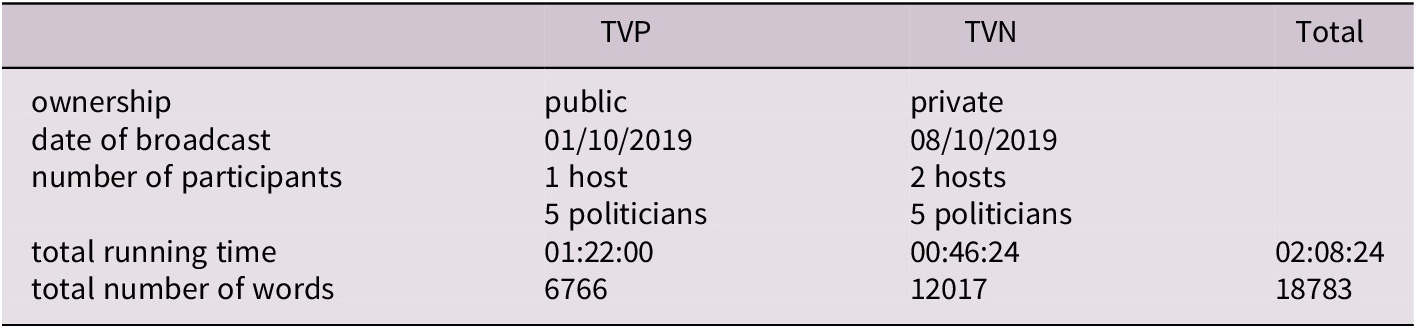
Our study is based on the corpora of two Polish 2019 pre-election debates (18,783 words in total), annotated with metaphors using Metaphor Identification Procedure (PRAGGLEJAZ Group, 2007) and arguments using Inference Anchoring Theory (Reed & Budzynska, Reference Reed and Budzynska2011). The third layer consists of automatic identification of emotion-eliciting words based on EMEAN and NAWL databases (Wierzba et al., Reference Wierzba, Riegel, Kocoń, Miłkowski, Janz, Klessa, Konat, Grimling, Piasecki and Marchewka2021). This allows us to capture the elements of the debate where speakers not only use metaphors in their argumentation (Juszczyk et al., Reference Juszczyk, Konat and Fabiszak2022), but they are also adding an emotional appeal to increase the persuasive power of their words. The information about the debates is summarised in Table 2.
Description of the TVP and TVN corpus of 2019 pre-election debates
3.2. Procedure
In our procedure, three layers of analysis are conducted independently, by separate groups of analysts.
First, the recording of both debates is transcribed manually.
Second, metaphors are manually annotated. They are identified in transcripts as metaphorical lexical units using Metaphor Identification Procedure (PRAGGLEJAZ Group, 2007) and eMargin software (Kehoe & Gee, Reference Kehoe and Gee2013). Metaphorical expressions were annotated in accordance with (Juszczyk & Kamasa, Reference Juszczyk, Kamasa, Knapik, Odelski, Chruszczewski and Chłopicki2016), which adapted the Metaphor Identification Procedure (MIP) (PRAGGLEJAZ, 2007). In order to facilitate online group discussions about metaphorical units the team of annotatorsFootnote 4 used the e-Margin: A Collaborative Textual Annotation Tool (Kehoe & Gee, Reference Kehoe and Gee2013), and the resulting data is publicly available.Footnote 5 After reading the text excerpt (step 1 in MIP) and identification of lexical units (step 2 in MIP), raters established contextual meaning of each unit (step 3a in MIP) and determined if it has a more basic contemporary meaning in other contexts (step 3b in MIP). The lexical unit was marked as metaphorical if its contextual meaning contrasted with the basic meaning but could be understood in comparison with it (steps 3c and 4 in MIP). Contextual meanings were identified using Wielki Słownik Języka Polskiego (Great Dictionary of the Polish Language) (Żmigrodzki, Reference Żmigrodzki2019). There are 814 metaphors identified in the entirety of the transcripts and 313 metaphors in our corpus of arguments.
Third, argument structures are manually annotated. The debate transcript is segmented into Argumentative Discourse Units (ADUs). In this way, we identify premise–conclusion pairs. In our corpus, there are N = 615 such pairs. Argumentative Discourse Units are marked using Online Visualization of Arguments (OVA+) tool (Janier et al., Reference Janier, Lawrence and Reed2014), which allows for the diagramming of the structures described in Inference Anchoring Theory and storing the resulting annotations in the form of Argument Interchange Format – AIF ontology (Chesnevar et al., Reference Chesnevar, McGinnis, Modgil, Rahwan, Reed and Simari2006) as part of AIFdb publicly available database.
Fourth, emotion-eliciting words are automatically extracted using lexical lists: EMEAN (Wierzba et al., Reference Wierzba, Riegel, Kocoń, Miłkowski, Janz, Klessa, Konat, Grimling, Piasecki and Marchewka2021) and NAWL (Riegel et al., Reference Riegel, Wierzba, Wypych, Żurawski, Jednoróg, Grabowska and Marchewka2015; Wierzba et al., Reference Wierzba, Riegel, Wypych, Jednorwóg, Turnau, Grabowska and Marchewka2015). Intersection of NAWL and EMEAN gave us a list of 7674 unique items. In doing so, we follow the psychological tradition in researching emotional appeal. We do not use wordlists produced for clarin or WordNet.
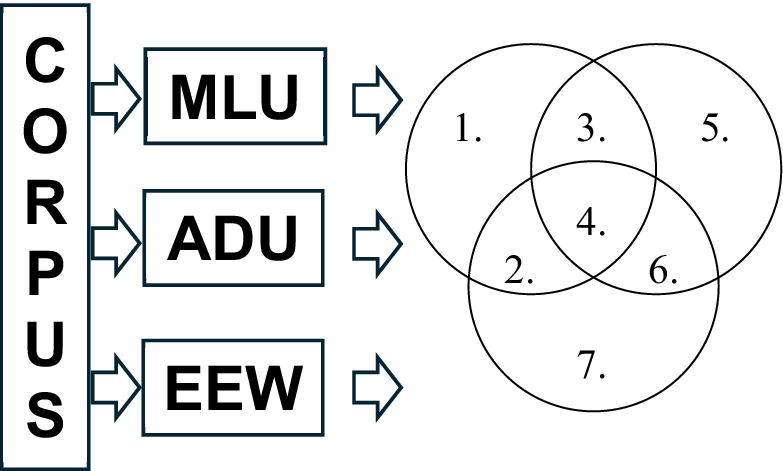
Fifth, text in MLU and ADUs is lemmatized and sixth, overlap between metaphors, arguments, and emotional appeals is identified using Excel formulas. Our analytic procedure can be summarized in steps shown on Figure 4:
The procedure of data analysis. MLU: Metaphorical Lexical Units; ADU: Argumentative Discourse Units, EEW: Emotion Eliciting Words. Numbers refer to sets of discourse phenomena and their combinations presented in Figure 1.
3.3. Data overview (types and tokens)
Table 3 shows descriptive statistics of types and tokens of lemmatized pairs of premises and conclusions. This data was obtained using AntConc (Anthony, Reference Anthony2022) and Excel formulas.
Type-token analysis of the data

As we can see on the chart in Figure 5, happiness is the emotion most intensely appealed to, followed by fear, anger and sadness, which have equal intensity, while disgust is the least intense emotion in our study.
Average intensity of five basic emotion-eliciting words in premise-conclusion pairs.

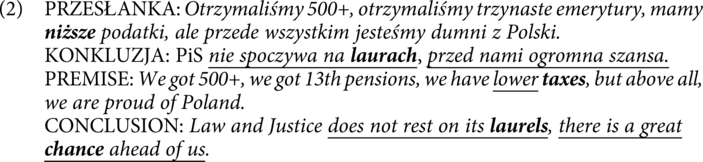
Example (2) (presented below and in Figure 3) presents three layers of annotation integrated into one data set. It is a premise and conclusion pair with emotion-eliciting words and metaphorical lexical unit:
4. Results
What are the types of interaction between metaphors, arguments and emotion-eliciting words? Table 4 shows proportions of types of interaction in our data in the order of hypothesis presented in Section 1.
Types of interaction and their proportions
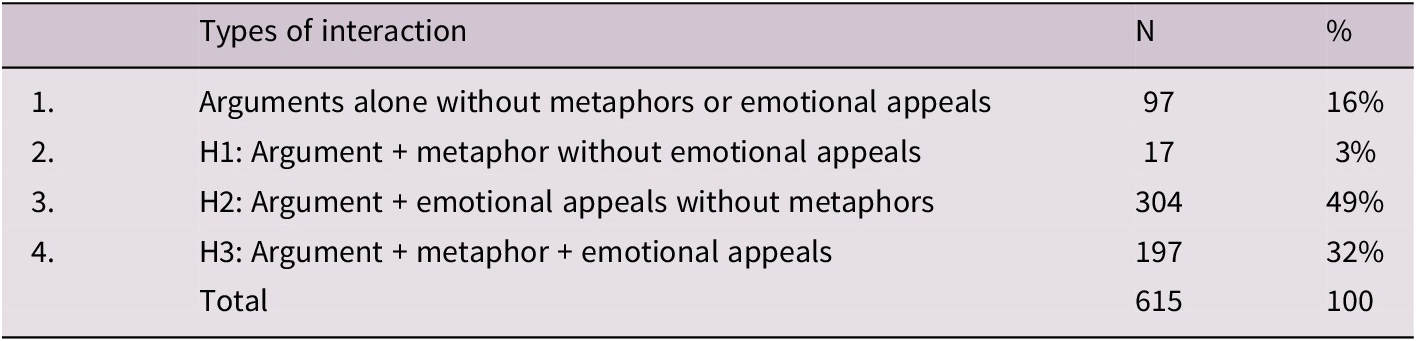
H1 tests whether ADUs are used more often with metaphorical lexical units or without them. Sums of rows 2 and 4 compared to 1 and 3 suggest that we need to reject H1, since the number of ADUs with metaphorical lexical units is smaller than without them (35% vs 65%). As we can see in Table 4, ADUs in combination with metaphorical lexical units and without emotion-eliciting words constitute 3% of our data, arguments in combination with emotion-eliciting words and without metaphorical lexical units constitute 49%, and arguments in combination with both metaphorical lexical units and emotion-eliciting words 32%. This means that ADUs contain over 2x as many emotion-eliciting words (sum of rows 3 and 4 is 81%) as metaphorical lexical units (sum of rows 2 and 4 is 35%), whereas metaphorical lexical units in combination with emotion-eliciting words appear roughly 16 times as often as on their own (row 3 > row 2). The most frequent ADUs with emotion-eliciting-words (sum of rows 3 and 4 is 81%) followed by ADUs with metaphorical lexical units (sum of rows 2 and 4 is 35%) and finally ADUs without metaphorical lexical units and without emotion-eliciting-words (row 1 is 16%). Therefore, as far as H2 is concerned, the number of ADUs with emotion-eliciting words (sum of rows 3 and 4) is bigger than the number of ADUs without emotion-eliciting words (sum of rows 1 and 2) (81% vs 19%), so H2 is verified. H3 is falsified, because the number of ADUs with metaphorical lexical units and emotion-eliciting words is smaller than the sum of other combinations (32% vs 68%).
Analyses presented above allowed us to identify a specific sub-set of our corpus, in which all three phenomena of our interest appear together: the 197 cases of arguments (32%) in which both metaphors and emotion-eliciting words appear. There are two types of the interplay between metaphors and emotional appeals within an argument:
-
1) metaphorical lexical units and emotion-eliciting words overlap;
-
2) metaphorical lexical units and emotion-eliciting words are expressed with different lexemes.
In type (1), within a given premise-conclusion pair, there is a partial overlap between metaphorical lexical units and emotion-eliciting words (N = 46), as illustrated by example (3), where metaphorical lexical units are underlined and emotion-eliciting words are marked in bold:

In example (3) there are two metaphorical expressions: “nie spoczywa na laurach” (“does not rest on its laurels” and “przed nami ogromna szansa” (“a great opportunity ahead of us”) each of which contains an emotion-eliciting word – “laury” (“laurels”) and “szansa” (“opportunity”) – which provoke positive emotions in the recipients.
Type (2) of interaction takes place when, within a given premise or conclusion, metaphorical lexical units and emotion-eliciting words are expressed through different lexemes (N = 151), that is, there is no overlap between metaphors and emotion-eliciting word, however, they co-occur in the same argument (that is the same ADU), like in example (4):

In example (4), the word “zapobiegać” (“prevent”) elicits happiness, when “pustoszy” (“ravages”) is used metaphorically.
5. Conclusion
The aim of this paper was to analyse the interaction of three discourse phenomena: metaphors, arguments, and emotional appeals. To achieve this goal, we performed the comparison of three layers of annotation in natural language corpora of pre-election debates in Poland. As all three of the phenomena can be used for persuasive gain, we postulated that arguments containing metaphors would be more frequent in our data than arguments without metaphors (H1). This proved not to be the case: arguments containing metaphors constitute 35% of all arguments (214 of 615 premise-conclusion pairs). Our second hypothesis (H2) posited that arguments with emotional appeals will be more frequent than arguments without them. This hypothesis has been verified, as 81% of all arguments contained emotion-eliciting words (501 out of 615). Our third hypothesis (H3) that arguments with metaphors and with emotional appeals will be the most frequent of all the investigated types has not been verified. It ranks second in frequency (32%, 197 arguments out of 615) after arguments with emotional appeals. This means that in our data the predominant form of argumentation is relying on emotional appeals.
What is most interesting, however, is that of all identified uses of metaphors in arguments, a majority (197 cases of 214) also contained emotional appeals, thus indicating that metaphors alone have a much smaller frequency of use in political argumentation. Our results show that when the speakers are introducing metaphors in their arguments, they also tend to use emotion-eliciting words. The presence of arguments with metaphors but without emotion-eliciting words is minimal in our data. This might suggest that when the speakers use metaphors in arguments to conceptualise abstract concepts, they also select a specific frame by their choice of specific source domain. Due to the inherently persuasive nature of the pre-election debates, when faced with the need for metaphorization, the speakers are not selecting emotionally neutral domains, but instead, are framing the abstract concepts in emotion-eliciting wording, to increase the persuasive power of arguments (on axiological marking of concepts and metaphors see Krzeszowski, Reference Krzeszowski1997). Hence, “Polska służba zdrowia jest w stanie przedzawałowym” (“Polish health service is in a heart threatening condition”) is not only a metaphor – it is an emotional metaphor, where specific source domain is chosen by the speaker as a persuasive strategy. This is in accordance with the previous studies pointing to the fact that the selection of specific source domain can influence the choice of further action (Thibodeau & Boroditsky, Reference Thibodeau and Boroditsky2011).
One limitation of our study is the lack of sensitivity to the contexts in which emotional words are used. Lexicons provide broad and general information about emotions evoked by a given word, but its use in a certain context can heavily influence this effect. This is the factor that has not been taken into account in our study and could possibly be included in future work using more advanced computational methods. A limitation related to this lies also in the construction of lexicons. Some words that probably could elicit emotions are not present in lexicons, and therefore are not included in our analysis, leading to its incompleteness. The dynamic discourse phenomena analysed here depend on the dialogical co-text and context, including previous turns, relation between speakers and the audience and so forth. While we tried to contextualise those in our interpretation of examples, the actual analysis of persuasive effects of the use of metaphors, emotional appeals, and arguments remains in the realm of psycholinguistic experiments.
What our study contributes to this line of research is emphasis on emotive element of selected metaphorical framings. Speakers can, and often do, select specific frames in order to provoke a positive or negative effect towards given phenomena or/and to elicit specific emotions in hearers. In this paper, we presented how using tools from computational linguistics, argument analysis, and psychological lexicons can uncover these persuasive strategies.
Supplementary material
The supplementary material for this article can be found at http://doi.org/10.1017/langcog.2024.35.
Data availability statement
Files uploaded at https://osf.io/hv7xw/?view_only=4a9db0a92ac14a1a85b5f7f8073ade80
-
1. Recordings of debates were transcribed manually; see files ‘1.TVP-DEBATE-TRANSCRIPT.docx’ and ‘1.TVN-DEBATE-TRANSCRIPT.docx’.
-
2. Metaphors (manual annotation): MIP, 814 metaphorical lexical units; see files ‘2.TVP-DEBATE-METAPHORS.csv’ and ‘2.TVN-DEBATE-METAPHORS.csv’.
-
3. Argumentative Discourse Units: 615 pairs of premise and conclusion (manual annotation); see files ‘3.PAIRS of premises and conclusions from TVP debate.json’ and ‘3.PAIRS of premises and conclusions from TVN debate.json’.
-
4. Emotion-eliciting words (automatic extraction) from EMEAN and NAWL databases; see file ‘4.Emotion-eliciting words.xlsx’.
-
5. Since words listed in EMEAN and NAWL are lemmas, in order to extract emotion-eliciting words, text from Argumentative Discourse Units was lemmatized as well; see file ‘5.LEMMSofPRE&CON.xlsx’.
-
6. The three layers are integrated into one dataset and overlap between arguments and metaphorical lexical units (6.a.), arguments and emotion-eliciting words (6.b.), and emotion-eliciting words and metaphorical lexical units in arguments (6.c.) are identified; see file ‘6.ADUwithMLUandEMO.xlsx’.
Acknowledgements
We are grateful to the anonymous reviewers for their comments on earlier versions of this article.
Funding statement
The work reported in this paper was partially supported by the Polish National Science Centre under grant 2020/39/D/HS1/00488.
Competing interest
The author(s) declare none.


 Open access

