The recent outbreaks of SARS, Mad Cow Disease, Foot-and-Mouth Disease, and other communicable diseases in human and animal populations remind us of how vulnerable our health and economy are to threats from an inherently unstable biological environment. To combat contagious diseases, most countries and international agencies draw on a well-established set of research and monitoring institutions and on legal structures that were developed during past crises. This study analyses the early efforts to limit the trade in cattle infected with bovine tuberculosis in an age when the disease-control apparatus was in its infancy. These efforts played an important role in the formation of the American animal-disease-control system. In a companion piece, we show that in 1917 the federal government embarked on a national campaign to eradicate bovine tuberculosis (TB) from the United States. This led to an unprecedented peacetime use of the state's police power as federal and state authorities sent testers to every dairy and cattle operation in the nation and ordered the destruction of 3.8 million TB reactors, with only partial compensation to the owners. This campaign brought the disease under control by 1941, generating returns to the livestock sector of roughly ten times the total program costs and saving tens of thousands of human lives.1
Olmstead and Rhode, “Impossible Undertaking.”
This study examines the period preceding the federal program to better understand why such a draconian, compulsory national approach emerged. We argue that experiments with private initiatives and state and local regulations to prevent the spread of bovine tuberculosis were largely ineffective and often counterproductive. Piecemeal state and local pure-food campaigns and the development of new diagnostic technologies increased profit opportunities for arbitragers who purchased suspect animals in areas with active programs and then resold them elsewhere. Thus, decentralized efforts to control bovine TB, paradoxically, contributed to a wider geographic dispersion and more rapid increase in the overall incidence of the disease.
The article focuses on the case of James Dorsey, one of a number of cattle dealers in northern Illinois who specialized in trading tuberculous cattle in the 1910s. Dorsey and his ilk created nightmares for public health officials by exploiting a weak regulatory regime in Illinois to turn the state into a “clearing house” for the distribution of diseased animals. Dorsey's activities alone established “at least 10,000 foci of tuberculosis among the dairy herds” of the nation and exposed thousands of families to the disease.2
National Archives and Records Administration, Records of the Bureau of Animal Industry [hereafter U.S. BAI], Chief of the Bureau to Fitts, 9 July 1920. Oregon veterinarians claimed that the disease increased significantly in their state due to Dorsey's shipments.
The tort system provided injured parties with few remedies due to high enforcement costs and the likelihood that the party causing injury would have insufficient resources to pay damages. This represents a case where it was more efficient to prevent damages via
ex ante technological regulation than to identify the sources of harm and correct them
ex post. Jurisdictional issues made it difficult for state livestock sanitary officials to apply the specificity criterion to limit the trade of diseased animals. Unable to attack the problem at its source, these officials were forced to try to check the spread of the disease in myriad, far-flung locations and ultimately to impose blanket quarantines. Besides endangering the general public and imposing large losses on dairymen by infecting their herds, the failure to limit the trade in tuberculous animals created serious unmediated externalities for legitimate cattle dealers. By the early 1910s cattle breeders and dealers throughout Illinois suffered from a “lemons problem” because buyers could not distinguish between healthy animals and tubercular stock. They suffered further when a dozen states effectively quarantined Illinois cattle shipments. The expanded federal role in the anti-bovine tuberculosis campaign came at the behest of state agricultural authorities, leaders in the cattle trade, public health officials, and countless farmers.
The story we tell ties into a broader literature on the origins of government regulation.3
For a recent summary, see Glaeser and Shleifer, “Rise,” pp. 401–25.
The traditional accounts of food-safety laws, inspired by the muckraking exposés of Upton Sinclair and scores of journalists, viewed the federal government's intrusion as nothing less than a triumph of good over evil. New federal laws and regulatory agencies reined in special interests that were callously endangering public health. Over the past few decades however, with the rise of the public choice school, this view has lost favor. According to the public choice literature, rent-seeking special interests vied for government protection to limit competition, only to see the cost of capturing regulatory agencies dissipate much of their gains. The pursuit of the public interest typically played little or no role in explaining the origins of the safety legislation or in determining the
ex post effects of the legislation. As an example, in his prize-winning article, Gary Libecap argued that the passage of the Meat Inspection Act of 1891 arose primarily as a result of intra-industry rivalries between the major Chicago-based meat packers on one hand and the smaller local slaughterhouses on the other. The legislation, in his view, represented a classic case of special interests trying to capture the regulatory process to limit competition from more efficient producers. Libecap further argued, “there is no evidence that a documented consumer information problem or a domestic health threat were the principal factors behind adoption of the 1891 law.”
4 Moreover, he repeatedly asserted that there were no serious threats to public health. In a recent and important article that examines the adoption of state pure-food laws, Marc Law gives more emphasis to problems that consumers faced detecting adulteration. However, he too downplays health concerns.
5 Law, “Origins,” pp. 1103–30.
Edward Glaeser and Andrei Shleifer summarize the recent literature on consumer protection regulation: “The list goes on, but the basic point remains: Progressive Era regulation was captured by industry, leaving consumer interests in the dustbin.”
6 Glaeser and Shleifer, “Rise,” p. 418.
Our story of the early efforts to control bovine TB offers a concrete counterexample to the general view that early consumer safety legislation was of little consequence. We show that there was a clear and present danger to the consuming public that private and state initiatives were not only failing to stop but in fact were making more acute. The cooperative federal-state regulatory response to the disease did succeed in slowing and eventually controlling the contagion, thereby serving public interests.
7 The history of bovine TB puts a different hue on the origins of U.S. federal meat inspection legislation. In the 1880s, 1890s, and 1900s there was an outpouring of literature detailing genuine health concerns about the handling and consumption of meat from diseased animals. The problem of disease was prominently discussed during the legislative process. As an example, in December 1890, a U.S. House of Representatives Committee on Commerce report noted that “It is a recognized fact that in cases of animals suffering from certain diseases, the flesh of the carcasses is unfit for human food absolutely….” The report lists six specific diseases and parasites, including tuberculosis in cattle and hogs and trichinosis in pork as threats to human health. U.S. House of Representatives, “Inspection,” pp. 1–2. Even earlier, in 1884, the first report of the U.S. BAI contained an extensive discussion, drawn from the 1883 World Veterinary Congress, of the dangers from eating meat from tuberculous cattle. The report called for the postmortem examination of all slaughtered animals. In the four years leading up to the 1891 act, the United States Veterinary Medical Association repeatedly passed resolutions alerting the public to health hazards and calling for a rigorous postmortem inspection. Law, “International Veterinary Congress,” pp. 321–70. (Concerns about tuberculous cattle and hogs entering the meat supply were also raised in the debates leading to the 1906 legislation; see for example, Sinclair, Jungle, pp. 113–14; and U.S. House of Representatives, Beveridge Amendment, pp. 37, 58, 138, 280, 285, 288–89, 338–43, 348.)
Indeed, before 1891, most western European nations and many U.S. cities had already strengthened their meat inspection systems, in part in response to the spread of new scientific knowledge associated with the germ theory of disease. The U.S. Secretary of Agriculture's Annual Report for 1889 noted that “… as long as we neglect to take the precautions universally adopted by the governments of those countries in which we seek a market for these products, … it is impossible for us to present as forcible arguments as we could otherwise do against restrictions on our trade ….” p. 39. The threat to American exports provided the immediate stimulus for congressional action, but this need arose in part because the United States was out of step with what had become de facto standards elsewhere.
The passage of federal meat inspection legislation not only contributed to the lowering of European nontariff trade restrictions, but also directly reduced the supply of tuberculous meat in the domestic food chain, lessening the exposure of consumers and meat handlers to the disease. Over the 1906–1916 period, federal inspectors retained 1,256 thousand cattle, 1.8 percent of the total slaughtered, for tuberculosis. Most were trimmed of the infected portions and sent on for human consumption, but 288 thousand were so thoroughly rotten that they were condemned and tanked (i.e., boiled and used for fertilizer). In all, tuberculous cattle represented 68 percent of the bovines condemned by federal inspectors. Over this period, more than 500 thousand hogs were also tanked due to bovine and avian tuberculosis. Additional tubercular animals were removed by state and local inspectors, but many reports suggest their standards were weaker. Myers, Man's Greatest Victory, pp. 200–10; Salmon, “Bovine Tuberculosis,” pp. 332–53; U.S. Bureau of Agricultural Economics, “Statistics of Cattle,” p. 76; and Kiernan, “Tuberculosis,” p. 9.
THE GROWING PROBLEM OF BOVINE TUBERCULOSIS
Bovine tuberculosis represented an insidious threat because apparently healthy animals could be both infected with the disease and contagious. Indeed “[m] ost M. bovis infected cattle appear normal.”8
National Research Council, Livestock, p. 13. In the medical literature, M. bovis refers to bovine tuberculosis and M. tuberculosis refers to the human form of the disease.
Only after the disease progressed for several years did infected cattle develop tuberculous lesions in organs, tissues, and bones. Infected cows had difficulty maintaining weight and suffered a roughly 10 to 25 percent reduction in milk production.
9 Melvin, “Economic Importance,” p. 103, and in the recent literature including National Research Council, Livestock, p. 56.
Eventually the cattle might show external signs of lesions, have coughing attacks, and die prematurely. The microorganism spread among cattle by contact with infected animals or with contaminated materials. According to testimony from agricultural experiment station reports, the most common avenue of contagion was for a dairy farmer to “buy in” the disease by mistakenly purchasing one or more infected, but apparently healthy, animals to add to an existing herd. The disease would then spread through the herd.
10 Russell and Hoffman (“Three Year Campaign,” pp. 11–12) suggest that more than three-quarters of infected herds in Wisconsin acquired the disease by “buying in” tuberculous stock. Another common means of spreading the disease—through skim milk processed at a factory separating plant—was also associated with dairy modernization. Thus “laudable attempts” to improve dairying were fraught with danger in this period. Russell, “Spread,” pp. 3–5.
Rates of infection tended to be higher among closely confined cattle, such as dairy cows and purebred stock, than in free-range animals. The prevalence also increased with the animal's age.11
U.S. BAI, Diseases 1916, p. 409.
As a result, bovine TB was far more common in dairy herds in the northeastern and north central states. Early tuberculin test results (see the discussion of tuberculin that follows) often shocked public health officials, with over 50 percent reaction rates in many prized herds.
12 Myers, Man's Greatest Victory, pp. 272–74; Smith, Conquest, p. 4; and Olmstead and Rhode, “Impossible Undertaking.”
Circa 1917, the consensus opinion held that 5 percent of U.S. cattle were infected, including 10 percent of dairy animals and 1–2 percent of range cattle. Before the advent of the federal-state eradication campaign, the incidence of the disease was rapidly increasing. Just a decade earlier (in 1908) only 3.5 percent of U.S. cattle were infected.
13 Hull (Diseases, p. 8) notes bovine tuberculosis “was rarely seen in the United States before 1870.”
Without intervention, it is likely that infection rates would have approached those found in northern Europe where in many regions well over 50 percent of all cattle were diseased.
The impact of bovine tuberculosis was not limited to livestock, far from it. Humans could also contract the disease and, indeed, it was possible to transmit the disease directly from animals to humans, humans to animals, and from humans to humans. As with the human form of the disease (M. tuberculosis), the bovine type could attack almost anywhere in the human body. The primary form of transmission to humans was through contaminated milk, with children proving the most vulnerable. Contaminated beef and pork also posed a risk for meat handlers and consumers. In this period, tuberculosis was the leading killer in most advanced nations, responsible for more than one of every ten deaths in the United States. Prevailing medical opinion suggests that before 1917, over 20 percent of tuberculosis cases in children under five years of age and between 8 and 25 percent of all TB cases in the United States were due to the bovine form of the disease.14
There remains considerable controversy within the scientific community as to the relative importance of the bovine form of the disease in humans. For a discussion of this issue see Olmstead and Rhode, “Impossible Undertaking,” Appendix. For further evidence on the incidence in children see Savage, Prevention, pp. 11–29; and Myers and Steele, Bovine Tuberculosis Control, p. 59.
Our lower-bound estimates translate into about 15,000 human deaths a year around 1917. Many times this number suffered prolonged pain and lifetime disfiguration from the disease.
15 Olmstead and Rhode, “Impossible Undertaking.” To put the human suffering caused by bovine tuberculosis into perspective, the Centers for Disease Control and Prevention estimate that in recent years, all food-borne diseases have killed about 5,000 Americans annually. Given that the current population of the United States is roughly three times that of 1917, the death rate from bovine tuberculosis in 1917 was at least nine times that from all food-borne diseases today. As another metric, the Centers for Disease Control and Prevention estimate that 153 people worldwide presently are afflicted with variant Creutzfeldt-Jakob disease, the human form of bovine spongiform encephalopathy (Mad Cow disease). By comparison hundreds of thousands of humans in the United States and Europe suffered from bovine TB in 1917. http://www.cdc.gov/ncidod/diseases/cjd/bse_cjd_qa.htm.
In the late nineteenth and early twentieth centuries, scientific knowledge about tuberculosis was rapidly advancing. The single most important step was Robert Koch's discovery of the tubercle bacillus in 1882. But progress was not without serious controversy. In 1898 Theobald Smith showed that there were small but identifiable differences in strains obtained from bovine and human sources.16
Myers, Man's Greatest Victory, pp. 106–09. Among other evidence, Ravenel reported on cases where veterinarians had accidentally inoculated (or cut) themselves while working with tuberculous animals and shortly thereafter the wounds developed tuberculous lesions. Myers, Man's Greatest Victory, pp. 211–15.
In 1901 Koch seriously misinterpreted Smith's findings and proclaimed that bovine tuberculosis posed little threat to humans and, indeed, that exposure provided children with immunity against the human form.
17 Myers and Steele, Bovine Tuberculosis Control, p. 57.
Despite a growing body of evidence to the contrary, Koch was slow to recant his dangerous and erroneous beliefs, thereby lending support to dairy interests opposed to the wholesale elimination of cattle suspected of carrying bovine TB. The controversy, unfortunately, continued to echo in public debates about TB control for decades after the scientific arguments were settled.
Another crucial advance was the development of tests to diagnose the disease. In 1890 Koch developed tuberculin, a sterilized, filtered concentrate of the broth in which the tubercle bacilli were cultured. Tuberculin made it possible for the first time to detect TB in animals that did not have visible symptoms.18
Bernhard Bang of Denmark or W. Gutmann (aka Guttman) of Russia usually receives the credit for this breakthrough, but it appears that many researchers hit on the same principle at about the same time. Myers, Man's Greatest Victory, p. 115; and U.S. BAI, Diseases 1916, pp. 416–17.
The procedure made its way to the United States by 1892. The early form of the test, which was time-consuming and expensive, proved highly controversial. Many farmers mistakenly believed that the test induced abortion, reduced milk output, and could actually infect the animals with tuberculosis. Detecting a “reaction” was clearly a judgment call, and both false positive and false negative results occurred.
19 U.S. BAI, Diseases 1916, pp. 417–18; Smith, Conquest, pp. 7–9; Houck, Bureau, pp. 364–66; and Myers, Man's Greatest Victory, p. 125.
Uncertainty about the reliability of the test, as well as the earlier scientific controversy questioning the dangers that bovine TB posed to humans, created an environment in which many farmers felt justified in following their self-interests by resisting and even subverting the testing process.
Perhaps more important, because tuberculin proved to provide an extended immunity to further reactions, this innovation in the absence of government controls made the operation of markets worse. Tuberculin widened the information asymmetries inherent in the livestock market, giving new urgency to the edict caveat emptor. Sellers had much better information than buyers about the characteristics of their animals. Using privately administered tests, it was possible for livestock owners to detect the disease in their cattle and then sell the reactors to buyers who could not accurately retest the animals for two to three months. By this time a few sick animals could have infected whole herds. Once the animals crossed state lines, it became more difficult to rely on the tort system to protect the buyer's interests.20
Ironically, because it was illegal to knowingly ship a sick animal across state lines a buyer who upon retest found his animals were infected could not return them.
“Plugging the test,” by recent exposure of the animal to tuberculin, represented such a problem that the test material became a controlled substance in most, but not all, jurisdictions by the early 1920s.
21 See, for example, Waterman and Fowler, State Laws, 1917–1922, passim.
THE DEVELOPMENT OF AMERICAN DAIRYING
The increasing incidence of bovine tuberculosis was one negative trend in a dairy industry experiencing what T. R. Pirtle called its era of “Great Development.”22
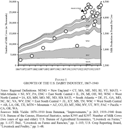
The growth and changing structure of the industry contributed to the spread of the disease, which in turn threatened to slow productivity growth in this dynamic and increasingly important sector of the agricultural economy. In 1900 dairy production accounted for about 16 percent of all U.S. farm output, and by 1940 it accounted for about 30 percent. In this era, there was a substantial shift in production from the northeast to the north central, western, and southern states, reflecting the growth in urban populations and rising incomes in these regions (see
Figure 1 on the distribution of dairy cows by region). This was also a period of growing specialization and commercialization. Whereas the percentage of farms reporting dairy cows declined slightly from 1900 to 1940, the average number of cows kept for milk per farm increased from 3.3 to 5.2.
23 U.S. Bureau of the Census, Sixteenth Census, pp. 606–07.
GROWTH OF THE U.S. DAIRY INDUSTRY, 1867–1940
With the increase in scale and push for modernization, yields climbed. Figure 1 shows that between 1870 and 1910 the national average milk yield per cow increased from 2,670 pounds to 3,570 pounds, or by about one-third. By 1940 milk yields were up to almost 4,400 pounds.24
Bateman, “Improvements,” p. 263; and U.S. Bureau of the Census, Historical Statistics, series K595 and K597.
The major sources of these yield improvements were better care of animals (in particular better feeding practices) and improved breeding.
25 A key technological innovation driving the change was the development in 1890 of the Babcock butterfat test at the University of Wisconsin. By improving the ability to monitor quality, this procedure reduced the free rider problem and gave farmers a stronger incentive to adopt better practices and breeds. Lampard, Rise, pp. 153–62 and 197–204. Beginning in 1906 farmers across the country formed local cow (and bull) testing associations to select those lines which produced the most milk and especially butterfat. By 1926 there were over 1,000 such improvement associations covering more than 327,000 cows in the United States. Pirtle, History, p. 31.
The nondescript dual-purpose cow whose milk production dried up in the winter was becoming a distant memory. One indicator of breeding activity, as detailed in
Table 1 was the growth in the number of registered purebred dairy cattle in the United States from roughly 90,000 animals in 1885 to 273,000 in 1895, and 900,000 in 1920. The purebred animals had a significant impact on herd quality far beyond their actual numbers. According to the Chief of the Bureau of Animal Industry (BAI) Dairy Division, the genetic material from the purebred lines had so “generally diffused” that by 1900 the average dairy cow in the United States was probably 50 percent of “improved blood.”
26 Alvord, “Dairy,” p. 392; also see pp. 381–403.
By 1920 virtually all nonpurebred dairy cows were classified as “grades” of the improved breeding lines.
27 Pirtle, History, pp. 35–56; Larson et al., “Dairy Industry,” pp. 324–31; and Houck, Bureau, p. 187. Between 1900 and 1920 the percentage of purebreds among the dairy herds had roughly doubled, from about 1.5 percent to about 3 percent, and the quality of the grade stock had also increased. Houck's estimates of the number of registered purebred dairy cattle are in rough conformity with the data offered above. Given that not all purebreds were registered, the actual numbers would be somewhat greater. Pirtle, History, pp. 33–35 notes that due to their higher productivity the 3 percent of dairy population that were purebreds accounted for 10 percent of the milk output, with the grade animals accounting for the other 90 percent.
The superior breeding lines spread through the dairy population through several channels. Farmers establishing herds, for example in the newer regions, would purchase purebreds or their close descendents as starter animals from specialized breeders or dealers in the dairy belt. Another common strategy was for a dairyman with an existing herd to purchase “a few pure bred animals that … were better milk-producers than those which he originally possessed. With this influx of new blood, he started … to ‘build up’ a herd by gradual selection of the best animals.”28
Russell, “History,” p. 1.
Unfortunately, as commentators noted, such attempts to improve herds all too frequently resulted in “buying in” tuberculosis as the improved stock proved to be carriers of the disease. The rate of infection of purebreds was two to three times the rate of ordinary dairy stock. Moreover, the piecemeal state and local efforts to control the disease encouraged its wider geographic spread.
ARBITRAGING ACROSS POLICY REGIMES
Before the federal eradication campaign began in 1917, numerous states experimented with programs to control bovine tuberculosis. The story of Wisconsin and Illinois illustrates how uncoordinated policy responses led to serious unintended economic consequences. Tuberculin testing began at the Wisconsin Experiment Station dairy in 1893 where over 80 percent of the 30 purebreds reacted. When postmortem inspections confirmed the presence of lesions, cattle breeders swamped the experiment station to have their private herds tested. The campaign received a boost when W. D. Hoard, the editor of the influential Hoard's Dairyman, endorsed the testing program. In 1901 the state created a Livestock Sanitary Board that established regulations concerning tuberculous cattle. If an animal reacted the owner could quarantine it or sell it to a federally inspected stockyard for immediate slaughter. In either case the state offered no compensation. If the farmer rejected these options, the state would dispose of the animal and pay the farmer an indemnity equal to a set fraction of the animal's appraised value as healthy stock.29
“State and Territorial,” pp. 70–72; Lampard, Rise, pp. 188–89; Wisconsin. Department of Agriculture, Biennial Report 1915–1916, pp. 83–95, and Biennial Report 1919–1920, pp. 41–47; and Reynolds, “Problem,” pp. 451–54.
Other midwestern states such as Minnesota and Michigan had similar, albeit less generous, anti-TB schemes.
One exceptional feature of the Wisconsin program was that in order to promote widespread participation, the State Experiment Station provided test administration training to individuals ranging down the professional pecking order as low as undergraduate dairy majors and students in university short-courses. Wisconsin authorities also distributed tuberculin rather promiscuously and thus could exert relatively little control over either testing or doping against future tests. Circa 1906, nonprofessionals performed roughly two-thirds of the tests officially conducted in the state. When the state passed a stricter law in 1909 requiring that all cattle sold for dairy or breeding purposes pass an official tuberculin test, it explicitly exempted animals sold for export from the state.30
Breeder's Gazette, 30 November 1910, pp. 1169–70. Over the 1910/11 fiscal year, some 207 thousand cattle were officially tested. Hastings, “What Has Been Done,” pp. 6–7. But as noted in 1909, “the actual amount of testing” was greater than the official figures suggest because “many owners have secured private tests on their herds….” Russell and Hoffman, “Three Year Campaign,” p. 7. In its detailed training literature, the Wisconsin Experiment Station observed that the “test is very simple in its application and requires no especial technical skill …. Anyone who is familiar with the handling of cattle can make a successful test….” Russell and Hasting, “Distribution,” p. 9.
Intense opposition by farmers led to the repeal of this law in June 1911 after only seven months of operation, and the program returned to its largely voluntary form. The Wisconsin program thus provided the tools for farmers to test their stock and created incentives to export the reactors to other states.
In contrast, Illinois made almost no lasting effort to combat bovine tuberculosis before 1914. In 1899 Governor John R. Tanner issued a proclamation requiring tuberculin testing for imported dairy and breeding cattle.31
“Bars Diseased Cattle: Governor Tanner Issues Prohibitive Proclamation,” Chicago Tribune, 14 June 1899, p. 7.
But in response to legal challenges from a cattle dealer from the Elgin district, bordering Chicago, the Illinois courts ruled that the underlying statutes granted police powers to limit the introduction of animals carrying “contagious and infected” diseases only from specific localities where the disease was “epidemic.” Furthermore, Illinois statute law did not authorize the use of tuberculin or even declare tuberculosis a “contagious” disease. Fearful of allowing the destruction of valuable animals without compensation on the basis of “mere” theory, the courts declared Tanner's proclamation unconstitutional.
32 Charles A Pierce et al. and State Board of Live Stock Commissioners v. E. B. Dillingham, 96 Ill. App. 300; 203 Ill. 148.
Thereafter (until 1914), Illinois stockowners operated in a regulatory environment with no mandatory government-testing program, no real limits on the use of tuberculin, and no restrictions on importing animals. In contrast to the situation in Illinois, by 1910, 34 states required tuberculin testing of cattle imported from other states for breeding and dairy purposes. One unintended consequence of the more aggressive efforts in other states—and especially in Michigan, Wisconsin, and Minnesota—against bovine TB was to generate large pools of suspect animals whose owners stood to gain by exporting. Given its lax laws and central location, Illinois became the “undisputed dumping ground” for these suspect animals.
The major cities of Illinois and Wisconsin did not stand idle as the threat posed by bovine tuberculosis became increasingly clear. For example, Milwaukee passed legislation requiring tuberculin testing in 1908.33
Leavitt, Healthiest City, p. 183.
These actions incited a storm of protests and legal challenges among local dairy owners and milk dealers, as was common wherever cities passed clean milk laws in this period. The courts, beginning with the Minnesota Supreme Court in 1896 and including the U.S. Supreme Court in November 1913, almost always upheld the constitutionality of these public health measures. The 1913 case,
Adams v. Milwaukee, established the right of the municipality to test cows supplying the city's milk even if they were kept outside the city limits. Even after this decision, Milwaukee's attempts to impose its controls induced farmer boycotts and local milk famines.
34 Tobey, Legal Aspects, p. 76. The U.S. Supreme Court case was Adams v. Milwaukee (1913), 228 U.S. 572, 57 L. Ed 971, 33 S. Ct. 610. The city could not fully enforce its law until 1926.
But by this time, 14 Wisconsin cities had tuberculin-testing requirements for dairy cows providing their milk supplies.
In 1908, the same year that Milwaukee enacted its law, Chicago passed an ordinance requiring pasteurization of milk sold in the city and tuberculin testing of the cows that supplied the milk. Not content with just fighting the Chicago milk-quality regulations in the courts, the organized dairy interests in the Elgin area used their influence to capture the Illinois legislature. Their main ally was long-time Speaker of the House, Edward Shurtleff. According to the Chicago Tribune:
In the forty-sixth general assembly of Illinois [1909] Edward D. Shurtleff of Marengo, in the Elgin district, was chairman of a joint committee of the house and senate to investigate the tuberculin test and the pasteurization of milk in relation to a clean-up bill then pending. Of ten members on that committee a majority were from the districts most affected by its findings. Shurtleff had long been an opponent of tuberculin and was known as the attorney of the Elgin interests.35
Chicago Tribune, 20 September 1914, part 2, p. 3.
After helping these interests capture the committee investigating milk health measures, Shurtleff spearheaded the passage of the 1911 state law prohibiting cities from requiring tuberculin testing. According to his committee's report, it made as much sense for Chicago's Commissioner of Health to require tuberculin testing of dairy cows as it would for him to attempt “by the wave of his hand, to order Lake Michigan to give up and destroy any germs of disease that may come through its waters to the consuming public ….”
36 Illinois, “Joint Committee,” p. 184; and Woods, Blue Book, p. 254. Chicago did retain the power to require pasteurization as the Illinois Supreme Court ruled in May 1914, “Chicago Milk Ordinance Upheld,” Hoard's Dairyman, 15 May 1914, p. 605. Conflicts between municipal governments and organized dairy suppliers over tuberculin testing continued into the mid-1920s in the milk sheds of Chicago, Milwaukee, and other major cities. One might think that producers of high-quality milk would support such ordinances to reduce competition from lower-quality producers. We found little evidence of such divisions among the Elgin-area dairymen in the period when Dorsey was active. In late 1925, however, a group of Chicago-area dairy producers did break away to form the Pure Milk Association and adopt a stance of greater accommodation to the city's tuberculin testing regulations, which went into full effect in April 1926. “Pasteurization Good, Cow Test Best-Bundesen,” Chicago Tribune, 8 January 1926; “Pure Milk Association,” Cook County Daily Herald, 26 February 1926.
Given the proximity of Milwaukee to Chicago and the differing regulatory regimes in Wisconsin and Illinois, the problems of the two milk sheds were closely intertwined. In 1914 the Breeder's Gazette predicted that “now that Milwaukee is strictly enforcing an ordinance against the sale of milk from untested cows, it is reasonable to expect that a considerable number of condemned cows will be shifted out of Wisconsin herds and shipped to the counties in northern Illinois.”37
“A Federal Quarantine in Northern Illinois,” Breeder's Gazette, 27 August 1914, p. 317.
In fact, farmers and cattle dealers had been arbitraging between the state regulatory regimes for years.
THE TUBERCULOUS CATTLE TRUST
In the fall of 1914 the federal government and the state of Illinois began to crack down on a criminal conspiracy know as the “Tuberculous Cattle Trust.” The press had a field day with such banner front-page headlines as: “Elgin Clearing House For Tubercular Cows- Government Orders Quarantine of Five Illinois Counties From Which Entire West Has Flooded With Diseased Dairy Cattle for Last Ten Years – Prosecutions are Expected” and “‘Tuberculous Cattle Trust's’ Operations So Extensive U.S. Will Quarantine Five Northeastern Illinois Counties to Save Dairy Industry of Fifteen States.”38
St. Louis Republic, 1 September 1914, pp. 1–2 and 20 September 1914, p. 1.
The government charged that a group of cattle dealers concentrated in the Elgin district had defrauded legitimate farmers and endangered the public by knowingly selling diseased animals, often with falsified bills of health. By 1914, the tubercular dairy cows were widely dispersed among the “herds supplying Western cities with milk and have sown the ‘seeds of death’ in thousands of homes using this milk.”
39 St. Louis Republic, 1 September 1914, p. 1.
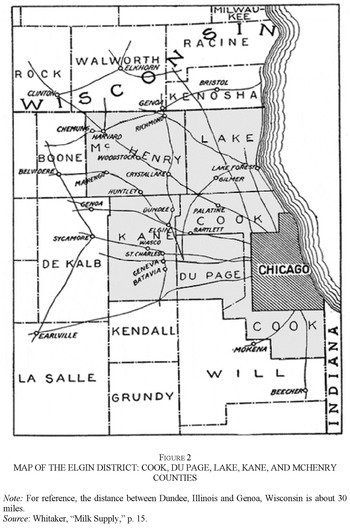
The Elgin district surrounded Chicago and directly bordered on Wisconsin (see
Figure 2).
MAP OF THE ELGIN DISTRICT: COOK, DU PAGE, LAKE, KANE, AND MCHENRY COUNTIES
James Dorsey of Gilberts, Illinois (near Dundee in the Figure) was the largest dealer in the Elgin area, selling cattle to nearly every state in the Union as well as to Canada and Mexico. USDA officials asserted that he “was for many years probably the leading dealer in dairy cows in the United States.”40
U.S. BAI, Chief of the Bureau to Fitts, 9 July 1920. See also “U.S. Grand Jury Hears Evidence Against Dorsey,” Elgin Daily News, 29 September 1915, p. 1
At the height of his business, Dorsey was buying and selling annually some 20,000 animals, of which about one-half were tuberculous. By 1914 Dorsey had become such a prominent member of the local community that he headed the committee organizing the Elgin Auto Road Race, a major national event that rivaled the Indianapolis 500 during this period.
41 “Crowd Records are Shattered: 100,000 Are Here,” Elgin Daily Courier, 22 August 1914, p. 1.
Dorsey operated a number of large, modern farms and advertised in the leading farm journals.
Beginning as a small-scale dealer in 1904, Dorsey achieved his rapid ascent by arbitraging between state regulatory regimes. He traded in “animals that had reacted to the tuberculin test or that the dairyman had reason to believe were tuberculous and wished to dispose of before the test was applied to his herd ….”42
U.S. BAI, Chief of the Bureau to Fitts, 9 July 1920.
Although Dorsey became the lightning rod for the government's attack, thousands of dairymen knowingly participated by supplying him and other dealers with diseased stock. According to the
St. Louis Republic, “It was clearly understood among many cattlemen that if tuberculosis developed in a herd that all that was necessary was to communicate with the ‘clearing-house’ at or near Elgin and a buyer would appear who would take over the cattle at a reduction of but $5 to $10 on the head below the market price.”
43 St. Louis Republic, 1 September 1914, p. 1. According to E. O. Ellason, the State Veterinarian of Wisconsin, Dorsey was in the market for diseased cattle and “kept buyers in Wisconsin and other dairy districts where a clean-up and weeding out of tubercular dairy cows was underway.” Ellason further stated that these practices would continue “as long as Illinois had no regulations barring cattle from being shipped there without a tuberculosis test.” St. Louis Republic, 20 September 1914, p. 1.
Such an offer would be very tempting to many dairy owners.
Let's do the math. In 1914 the average value of a dairy cow in the Upper Midwest was about $60. Under the Wisconsin program, a farmer with a reactor might expect to be compensated about $45, suffering a $15 loss. Assuming that Dorsey and the farmer split the difference, the farmer could, by selling to Dorsey, cut this loss significantly. In Illinois, where no state compensation was forthcoming, a farmer who did the “right thing” by slaughtering known reactors would only receive the meat value of about $20, suffering a $40 loss. For a purebred animal worth about $150, there was even more room for an advantageous (and to this point, legal) exchange. A cost advantage of even $10 a head for Dorsey would translate into $100,000 in excess profits a year assuming annual sales of 10,000 tuberculous animals and no transaction costs above those of an honest dealer.
Importing animals from Minnesota, Wisconsin, Pennsylvania, and several other states, Dorsey then paid unscrupulous Illinois veterinarians to sign certificates of health that fraudulently claimed the cattle had passed a tuberculin test, and in this manner, falsified the “good housekeeping seal of approval” in standard use.44
St. Louis Republic, 1 September 1914, p. 1.
In many cases, he created phony paper trails and used surrogates to market the cattle to unsuspecting buyers. Through these practices, Dorsey became the nexus of bovine tuberculosis. According to the BAI, “as a conservative estimate … Dorsey established at least 10,000 foci of tuberculosis among the dairy herds of this country.”
45 U.S. BAI, Chief of the Bureau to Fitts, 9 July 1920.
This likely led to thousands of humans contracting the disease. In comparison to Dorsey, the infamous Typhoid Mary, who was once dubbed “the most dangerous woman in America,” was a mere piker, responsible for 47 confirmed cases of typhoid fever and three deaths.
46 Leavitt, Typhoid Mary, pp. xvii–xviii.
ON DORSEY'S TRAIL
The first reference to Dorsey found in the surviving Bureau of Animal Industry records dates to 25 May 1910 when S. H. Ward, the State Veterinarian of Minnesota, informed A. D. Melvin, Chief of the BAI, that Illinois residents were buying reacting cattle in Wisconsin for re-export to other states. Ward singled out Dorsey as the principal offender. Melvin responded on 6 June 1910 that “Immediate steps will be taken to investigate this matter.”47
U.S. BAI, S. H. Ward to A. D. Melvin, 25 May 1910, and Chief of the Bureau to S. H. Ward, 6 June 1910.
Dorsey proved to be a slippery foe because it took the BAI several years to shut him down. Indeed, Dorsey was selling cattle up to the day he was finally indicted in 1915.
48 “Dorsey Sees Plot in U.S. Indictment,” Elgin Daily News, 1 October 1915, p. 1 noted that although indicted, “Mr. Dorsey continues to do business.”
On 19 October 1910 Ward again wrote to Melvin detailing three specific cases of Dorsey shipping cattle to Minnesota with falsified test charts. Upon retesting in Minnesota nearly one-half reacted. Ward concluded by asking “is it not possible for your department to put a stop to this nefarious traffic as the Illinois authorities are apparently helpless notwithstanding they admit Dorsey has tuberculosis in his herd.”49
U.S. BAI, S. H. Ward to A. D. Melvin, 19 October 1910.
Melvin's response, which was couched in terms of state's rights and responsibilities, was less than encouraging. He told Ward that the state of Minnesota chose to accept signatures of accredited Illinois veterinarians and that Ward should take the matter up with Illinois officials. If the two states could not resolve the matter, then Minnesota could refuse to accept documents signed by individuals “whose work is thought to be unreliable.”
50 U.S. BAI, Chief of the Bureau to S. H. Ward, 2 November 1910.
In short, Minnesota could erect its own trade barriers governing interstate cattle shipments.
Over the next few years, state officials, individual farmers, their lawyers, and BAI inspectors from across the country barraged BAI administrators in Washington, D.C., with similar complaints. Major farm journals also joined the anti-Dorsey effort. As an example, in June 1913, Hoard's Dairyman published an announcement warning farmers about Dorsey's dealings and noting that for several years the magazine had refused to accept his advertisements.51
Hoard's Dairyman, 20 June 1913, and correspondence in U.S. BAI, Dorsey file. Attacking Dorsey by name carried risks. In response to the September 1914 articles in the St. Louis Republic and Chicago Tribune, Dorsey threatened to sue for libel. See “Libel Suits Threatened in Attack on Dorsey,” Elgin Daily News, 20 November 1914, p. 4.
After mid-1914
Orange-Judd Farmer, Prairie Farmer, Twentieth Century Farmer, and Breeder's Gazette all stopped carrying Dorsey's ads.
52 St. Louis Republic, 20 September 1914, p. 2.
As his notoriety increased, Dorsey took steps to hide his involvement in cattle transactions. After his advertisements were refused, he found accomplices to place ads in their names. Officials in Colorado and Nebraska complained that Dorsey shipped cattle on circuitous routes to avoid inspection or to disguise the fact that they came from him.53
U.S. BAI, A. Bostrom to A. D. Melvin, 24 March 1913, and H. Busman to Chief of Bureau of Animal Industry, 26 November 1913.
In Iowa, authorities accused a local farmer of being a front for Dorsey's vast operation and offered him leniency if he turned state's evidence. The farmer “stood pat.”
54 U.S. BAI, W. P. Walsh to A. D. Melvin, 14 October 1912.
In Wyoming the State Veterinarian, B. F. Davis, warned farmers not to buy cattle from H. C. Glissman, the proprietor of the Rockbrook Farm near Omaha, Nebraska. According to Davis, Glissman was part of a conspiracy to launder infected cattle: James Dorsey sold the animals to H. L. Dunning of Genoa Junction, Wisconsin, who in turn sold them to Glissman, who then resold them to innocent farmers.
55 Davis, “Warning,” 10 August 1914.
In 1914 D. F. Luckey, the State Veterinarian of Missouri, charged that Dorsey had been shipping diseased cattle into that state for nine years. He further noted that a recent “shipment of cattle Dorsey sent into Missouri were driven twenty-five miles across the Wisconsin line and shipped from a station in that state.”
56 Chicago Tribune, 20 September 1914, part 2, p. 3.
Missouri's struggle to deal with Dorsey illustrates the seriousness of the problem and the difficulties of regulating the trade at the state level. In October 1911 the state issued tough bovine tuberculosis quarantine orders that significantly restricted interstate commerce. Due to railroad resistance, enforcement was delayed until the regulations were upheld in the federal courts in December 1912. The regulations as posted in January 1914 required railroad companies to do much of the state's enforcement and held them liable if they failed to comply. Before shipping dairy and breeding cattle into the state, the railroads had to forward copies of health certificates to the State Veterinarian. Furthermore, “railroad companies are especially warned to accept certificates of inspection from Illinois, only from a federal inspector or a certificate approved in writing and bearing the signature of O. E. Dyson, State Veterinarian. All other certificates of health for the State of Illinois are void ….”57
U.S. BAI, D. F. Luckey, “Cattle Quarantine Regulations,” 1 January 1914.
Any cattle entering Missouri from Illinois and New York without federal health certificates would be quarantined for 90-days and then retested at the owner's expense. D. F. Luckey even barred Missouri veterinarians from traveling to Illinois or New York with prospective cattle buyers for the purpose of administering TB tests because of the prevalence of “plugged” cattle in those states.
58 U.S. BAI, Luckey to Deputy State Veterinarians, nd, but from context 1914.
Luckey was not alone in advising reputable veterinarians not to test cattle in Illinois because of “plugging.” In fact, even the Illinois State Veterinarian (Dyson) proclaimed in September 1914, “I would not test a cow owned by Dorsey.”
59 Chicago Tribune, 20 September 1914, part 2, p. 3, col 2.
The problem was that, given Dorsey's complex laundering schemes, it would be very difficult to know whether or not he “owned” the cow.
South Dakota also refused to accept the signatures of rank-and-file veterinarians licensed in Illinois and required railroads to assist in the quarantine effort. Frank R. Rock of the South Dakota State Live Stock Sanitary Board advised a representative of the C. M. & St. Paul Railroad to “familiarize yourself with one of the regulations” of the board. Specifically “all live stock of any class originating in the State of Illinois destined to the State of South Dakota, must be accompanied by a Certificate of Health issued by a Veterinary Inspector of the United States Bureau of Animal Industry.” Animals without a federal certificate would have to enter quarantine to be retested at the owner's expense.60
U.S. BAI, Frank R. Rock to Edwin L. Grantham, 22 September 1913. Oregon had similar regulations. See U.S. BAI, W. H. Lytle to W. D. Hoard, 28 November 1913. According to an internal U.S. BAI memo, “the government of Wyoming and later of other middle western states, issued a proclamation forbidding the importation of cattle from Dorsey, and later from the whole State of Illinois.” U.S. BAI, Chief of the Bureau to Fitts, 9 July 1920.
Although these various state quarantines helped prevent the spread of the disease, state officials were clearly annoyed that their policy responses violated what economists would later call the “specificity criterion.” The officials knew it would have been far more efficient to attack the problem at its source in Illinois.
Railroads began to feel the heat. D. D. Cutler, the General Live Stock Agent of the Chicago & North Western Railway Company, noted in April 1913 that his company had refused to accept Dorsey's cattle for shipment to the Northwest because they would be held up at the Minnesota transfer. Cutler further presumed that “our competitors will not take any more of his shipments.”61
U.S. BAI, Cutler to Ramsey, 28 April 1913.
In May, Cutler boasted that “we are going to keep after this man Dorsey and try to fix him in some way, so that he will not ship any cattle over the NorthWestern [
sic] line,” and requested the BAI's advice as to whether the company could legally insist that Dorsey provide government inspection of breeding cows. Cutler further stated that because of recent tuberculosis claims against the company, its legal department was developing new policies requiring parties to sign a release to absolve the railroad from liability.
62 U.S. BAI, Cutler to Ramsey, 19 May 1913.
The Chicago and North Western's actions represented one of a number of ways that the private sector (assisted by a strong dose of state government intervention) struggled to address the problems created by Dorsey and his ilk. As we note later, individual cattle buyers also could and did take private measures. However, such actions imposed high costs on farmers, legitimate cattle dealers, and railroads, which is one reason why agents representing all of these interests lobbied for federal intervention.
63 We do not know how greatly these actions actually reduced Dorsey's sales because of the apparent ease of employing surrogates, even in other states. We do know he was selling cattle until the day of his indictment.
This was certainly the case for state veterinarians.
Frustrated by their inability to deal with the problem at the local level, state veterinarians discussed the tuberculosis problem at their national meeting in Omaha. On 1 July 1913 the veterinarians adopted a resolution asking that the UDSA quarantine the entire “state of Illinois on breeding and dairy cattle.”64
Chicago Tribune, 20 September 1914, part 2, p.1.
The activities of the “tuberculous cattle trust” were severely disrupting interstate trade with adverse effects extending well beyond Dorsey and his immediate associates. For example, C. N. McArthur of Portland, Oregon, wrote to
Hoard's Dairyman in December 1913 that the “Interstate traffic is broken down … there is an utter lack of uniformity in the laws and regulations of the different states in the matter of receiving shipments and honoring the certificates of veterinarians from other states.”
65 U.S. BAI, Letter, 2 December 1913. It is unclear whether or not this letter was published.
By 1914, in an attempt to prevent the disease from spreading, at least a dozen states had imposed quarantines on cattle from Illinois.
66 The Chicago Tribune put the number at 15 states. “‘Cattle Trusts’ Methods Bared,” Chicago Tribune, 20 September 1914, part 2, pp. 1, 3. Hoard's Dairyman asserts that “twelve states now refuse to accept cattle from Illinois unless accompanied by a certificate of federal inspection.” “Elgin District Under Federal Quarantine,” Hoard's Dairyman, 11 September 1914, p. 162. Some states also restricted imports from New York because of a similar reputation for fraudulent practices.
FEDERAL QUARANTINES AND COURT ACTIONS
Faced with mounting pressure from other states as well as from honest Illinois cattle breeders whose businesses were being damaged, the Illinois authorities began to take action. In December 1913 and July 1914 the state revoked the licenses of two of Dorsey's corrupt veterinarians, Drs. A. Tyler and C. L. Passmore. In January 1914 Governor E. F. Dunne issued a proclamation making it illegal to import dairy and breeding cattle into the state without evidence that the cattle had passed a tuberculin test.67
Chicago Tribune, 20 September 1914, part 2, pp. 1, 3; “Tyler's License Ordered Revoked,” Elgin Daily News, 8 December 1913, p. 1
The crushing blow came on 1 October 1914 when the USDA imposed a federal quarantine on Lake, McHenry, Kane, DuPage, and Cook counties in northern Illinois that, according to a contemporary account, “will practically put an end to cattle shipping into or out of that district for any purpose other than that of immediate slaughter.”
68 Chicago Tribune, 20 September 1914, part 2, p. 3, col. 3.
Illinois imposed a parallel state quarantine on the area and unleashed a team of 135 specially licensed assistant state veterinarians to administer tests and help enforce the quarantine.
69 “Illinois Advance in Live Stock Sanitation,” Breeder's Gazette, 15 October 1914, p. 656.
The quarantine remained in effect for 22 months, until 1 August 1916.
70 “Tuberculosis Quarantine Lifted from Illinois,” Hoard's Dairyman, 4 August 1916, p. 39.
This joint federal-state campaign effectively put a stop to Dorsey's operation. In the exposé accompanying the federal quarantine, it became apparent that, although Dorsey was the largest dealer in tuberculous cattle, the Elgin district was home to numerous other fraudulent operators.
The Breeder's Gazette, Hoard's Dairyman and many others in the cattle trade applauded the federal quarantine as long overdue. Most responsible parties understood that the activities of Dorsey and others in the Elgin district created a “lemons problem” for legitimate cattle dealers. A. F. Nelson, the state veterinarian of Indiana, called Dorsey “the greatest menace [to] the honest dealer in Holstein cattle.”71
St. Louis Republic, 20 September 1914, p. 1.
Along the same lines,
Hoard's noted that “for several years honest breeders have had difficulty in shipping from Illinois to surrounding states,” and “with rigid federal inspection, healthy Illinois cattle will be free from any suspicions cast upon them by the practices of the small percentage of cattle men who have misused the privilege of private inspection in the past.”
72 “Illinois Breeders Favor the Tuberculin Test,” Hoard's Dairyman, 8 May 1914, p. 555, and “Elgin District Under Federal Quarantine,” Hoard's Dairyman, 11 September 1914, p. 162, and “Traffic in Tubercular Cattle, Hoard's Dairyman, 11 September 1914, p. 172.
Echoing the same theme a southern cattle trader noted that “Illinois had acquired a reputation the world over as a dumping ground for tubercular cattle and we have received export orders with the express stipulation that they should not come from that particular state. Fortunately Dr. O. E. Dyson, the new state veterinarian, and the board of live stock commissioners are rapidly placing Illinois on a plane with other states in respect to satisfactory test sheets.”
73 “Unreliable Tuberculin Test Certificates,” Hoard's Dairyman, 20 November 1914, p. 478.
The
Breeder's Gazette carried a similar message, noting that the quarantine would free “law-abiding dealers and breeders” from the “unfair and unlawful competition from dealers in diseased cattle.”
74 “A Federal Quarantine in Northern Illinois,” Breeder's Gazette, 27 August 1914, p. 317. A referee noted that if Dorsey's activities were besmirching the reputation of Illinois dairy cattle dealers, the price of the state's dairy cows should have declined relative to those in Wisconsin with its stricter legislation. In fact, the Illinois price did fall from a premium of 11.5 percent above the Wisconsin price in 1910 to 7 percent below by mid-1914. And after the crackdown in Illinois, the premium on the state's cows returned. The price of Illinois dairy cows relative to the prices in other neighboring states followed the same pattern—falling in the years before 1914 and then rebounding after that date. Sarle and Ward, “Prices.”
The fall in the price of Illinois cows may understate the impact of Dorsey and other unscrupulous cattle traders, because the prices in neighboring states may also have suffered due to the suspicion that Dorsey and others were shipping directly from those locales. Although these price movements are consistent with our story, we do not want to make too much of them. Other factors may have mattered, and over the long run, the price series showed considerable volatility. Nevertheless, it was rare for the prices in Illinois to fall below those in neighboring states as happened in 1914. These price movements represented one way the market responded to Dorsey's actions. Without federal intervention, a continued fall in the relative price of Illinois cattle might have driven honest cattle dealers out of the state as they sought the quality certification provided by tougher inspection regimes. This would have further depressed the price in Illinois. Alternatively such price declines would have stimulated Dorsey to invest more in subterfuge and stimulated honest dealers to seek a regime change in Illinois.
On 31 September 1915 a federal grand jury in Chicago indicted Dorsey.75
“Dorsey Ready to Face Probe by Government,” Elgin Daily News, 29 September 1915, p. 1; “U. S. Grand Jury Indicts Dorsey,” Chicago Tribune, 1 October 1915, p. 5, col. 5; “Dorsey Sees Plot in U.S. Indictment,” Elgin Daily News, 1 October 1915, p. 1.
After lengthy delays, the trial began on 23 January 1918 with Kenesaw Mountain Landis serving as judge.
76 “James Dorsey on Trial for Misuse of U.S. Mails,” Elgin Daily News, 23 January 1918, p. 1.
According to the local press, the trial “promises to be one of the most bitterly fought cases in recent years.”
77 “Dorsey Trial Witness Tells of Purchases,” Elgin Daily Courier, 23 January 1918, p. 1.
The prosecution delivered a major blow when it called Dr. Alexander Tyler as a hostile witness and forced the admission that he had signed blank tuberculin test certificates to be subsequently filled out by Dorsey and his associates. “Dorsey's employees may have inserted the description of the cows Dorsey shipped. He warned Dorsey that this practice would probably involve both in trouble.” Tyler testified that he received 75 cents per head and received $200 to $300 per month for his services.
78 “Question Tyler Several Hours in Dorsey Case,” Elgin Daily Courier, 25 January 1918, p. 1; “Landis Forces Tyler to Testify in Dorsey Case,” Elgin Daily News, 25 January 1918, p. 1.
Eight farmers from throughout the West then testified as witnesses friendly to the prosecution, asserting under oath that the “clean” animals they purchased from Dorsey proved tubercular soon after receipt. The defense responded by calling numerous character witnesses for Dorsey, including nine prominent local farmers who each testified that he had never received diseased or unsound stock in his decade or more of trading cattle with Dorsey.
79 “Dorsey's Trial Nearing End,” Elgin Daily Courier, 30 January 1918, pp. 1, 3; “Dorsey Acquittal Seen by Friends,” Elgin Daily News, 30 January 1918, pp. 1, 8. Dorsey's defense against these charges reveals little understanding of the germ theory of disease. For example, Glenn R. Beverly, one of Dorsey's attorneys argued in reference to the complaints of one of Dorsey's victims, William Spath: “The cattle sold were Holstein cows, which are the most delicate dairy animals known. They were accustomed to commodious, well heated and ventilated dairy barns such as are found in this [Elgin] section. Spath has no dairy barn and placed the cows in a shed with no floor. The water they drank was polluted by a pig pen and other things. Three months later, is it any wonder they develop tuberculosis? … Dorsey's accusers are men living west of the Mississippi, accustomed to raising steers who need no shelter in winter, and who know little of the care of dairy cows.” Elgin Daily Courier, 5 October 1915, p. 1.
Dorsey did not take the stand on his own behalf. On 31 January 1918 the jury convicted Dorsey, and, two weeks later, Landis sentenced him to eight years in the Leavenworth penitentiary.
80 “Dorsey Guilty of Misuse of Mails, Asks New Trial,” Elgin Daily News, 31 January 1918, p. 1; “‘Guilty,’ Dorsey's Verdict,” Elgin Daily Courier, 31 January 1918, p. 1; “8 Years, $3,000, Dorsey Sentence,” Elgin Daily News, 15 February 1918, p. 1; “Eight Years for James Dorsey,” Elgin Daily News, 15 February 1918, p. 1; “Dorsey Brought to Justice,” Hoard's Dairyman, 1 March 1918, p. 240.
However, the irony is that Dorsey was convicted of mail fraud, not for violating probations regulating the shipment of diseased animals. Dorsey remained free while his case was on appeal.
81 Dorsey was well represented in his legal proceedings. For example, his attorney in his unsuccessful appeal to the U.S. Supreme Court (James Dorsey v. United States, 249 U.S. 616, 5 May 1919) was Benjamin Bachrach, who later served with Clarence Darrow on the defense team in the Leopold-Loeb case.
As a postscript, in 1920 President Wilson commuted Dorsey's sentence, cutting it to four years. This action elicited an outburst from Judge Landis: “This millionaire cattle king was sentenced some time ago to serve eight years in the Federal prison for using the mails to sell tubercular cattle throughout the West …. The sentence was affirmed by the Court of Appeals, but sentence was stayed a number of times. Finally, through the oversight of some one, Dorsey was placed in the penitentiary.”82
New York Tribune, 9 July 1920.
A disillusioned Landis went on to note that in light of Wilson's actions, “I don't see much use in staying on the bench.”
83 Chicago Tribune, 9 July 1920. In the Elgin Daily News version of the story, “Cut In Sentences Riles Judge Landis,” 9 July 1920, p. 1, Landis claims Dorsey “sold an average of 12,000 cattle a year, making a profit of $10 per head.
Within a year Landis began his quarter-century reign as the Commissioner of Baseball.
84 Pietrusza, Judge, pp. 153–72. Dorsey's pardon, resulting from actions of the executive branch, is especially interesting in light of the argument in Glaeser and Shleifer, “Rise,” regarding the higher propensity of the judiciary to be corrupted.
The Dorsey case is one, albeit the most prominent, among numerous BAI files on suspected dealers in infected animals. The BAI records indicate that most of those convicted were careless small operators who shipped a few diseased cattle across state lines. Typically, these amateurs pled guilty and were fined $100. Many claimed to have been ignorant of the law. In one such case, the judge levied a $1,000 fine because he wanted to “jolt” the defendant.85
U.S. BAI, Chief, Field Inspection Division to the Solicitor, Department of Agriculture, 29 September 1913.
There were extensive investigations of several professional dealers linked to the northern Illinois cattle “trust.” All of these cases bore striking similarities to the Dorsey case with a plethora of complaints from both swindled farmers and officials from across the country. BAI documents show that the dealers regularly sold and transferred the title to the cattle in Illinois so that the buyer legally shipped the animals from Illinois to himself, thereby allowing the dealer to avoid any liability for interstate shipments. There were assertions that the dealers defrauded customers by testing one set of cows and then shipping a different set of animals, switching ear tags from one animal to another, doping animals with tuberculin so that they would not react when tested by the buyer, and providing fraudulent test certificates. The case files generally named one or more licensed veterinarians whom the BAI agents regarded as not “wholly honest.” One veterinarian, Dr. W. W. Welsh, associated with a New York dealer who shipped to the Elgin area, reportedly did testing for Dorsey. In one case, BAI officials discovered a vial of tuberculin and a syringe that a suspected dealer had purchased from a local druggist.
86 For a sample of the U.S. BAI investigations of large-scale operators see U.S. BAI, Files on H. L. Dunning, C. F. Dunning, R. C. Judd, W. C. Keynon, and C. F. Hunt. C. F. Dunning, Judd, and Keynon all resided in the Elgin area. Hunt lived in New York and was accused of providing rotten cattle to the Elgin dealers.
The surviving BAI records do not indicate whether any of these investigations led to convictions.
The difficulty that the USDA and the various states had in prosecuting Dorsey and other Elgin-area dealers testifies to the inadequacy of federal legislation for protecting public health and legitimate businesses. There was legislation on the books dating back to 29 May 1884 making it illegal (with specific exceptions) to knowingly move any animal across state lines that was “affected with any contagious, infectious, or communicable disease.”87
Powell, Bureau, p. 123. Also see Kiernan, “Tuberculosis Eradication,” p. 31. The 1884 law did not hold shippers strictly liable, but rather applied a negligence test (knowingly shipping diseased stock). In 1905 the USDA gained authority to quarantine any state (or any part thereof) where animals “are affected with any contagious, infectious, or communicable disease” or “vectors which may disseminate any such disease may exist ….” (21 U.S.C. 123). These were the powers used in 1914.
As early as 23 September 1910 an internal BAI memo suggested that the agency was considering prosecuting Dorsey under this act for shipping diseased cattle from Illinois to Tennessee.
88 U.S. BAI, Memo for Dr. Melvin, 23 September 1910.
There appears to have been an enormous gap between the laws on the books and the reality of trying to enforce those laws. The key problem was demonstrating that the shipper had prior knowledge that an animal was infected. The BAI's inaction was not because of a lack of desire to prosecute the case. To the contrary, many BAI and state officials despised Dorsey and were obsessed with obtaining evidence of intent against him.
As an example, one receives a palpable sense of anticipated success and relieved frustration from the correspondence of D. F. Luckey of Missouri when he finally closed in his prey. On or around 13 October 1913, Luckey caught wind that Dorsey would soon receive a return shipment of 12 head of tuberculous cows from William Spath of Lewiston, Missouri, as part of a compromise in a dispute over Dorsey's guarantee to deliver sound animals. The shipment would have to cross state lines to return to Dorsey's Elgin home base, presumably “by way of the O. K. Railroad to Quincy, Illinois.” Luckey noted that Dorsey “knows that these cows are tuberculous and will, therefore, be knowingly violating the Federal statutes.” This voided Dorsey's standard defenses, namely that he was not aware of the health status of the animals or that they became infected in transit. Luckey proposed that Illinois authorities assist him in setting a trap for Dorsey. Luckey intended to send an agent to Lewistown who would telegram Illinois officials when the cattle were shipped. The Illinois authorities could then swoop down on the cattle at Quincy in order to “make a case against Dorsey for violation of the Federal statutes.” Luckey added “PS: I think we have a chance to land some big game here.”89
U.S. BAI, D. F. Luckey to Dr. Ira C. Mattatal, 13 October 1913. Luckey took the Dorsey case so personally that he even sent out a memo noting how his family had been endangered by tuberculous dairy cows that had entered the state from New York with forged documents. U.S. BAI, Memo to Deputy State Veterinarians, 22 December 1913.
Luckey was correct, because this affair played an important role in the subsequent trial. In 1918 John A. Kiernan, who headed the BAI's TB eradication division, reflected on the Dorsey case, noting that in light of the 1884 legislation:
It might seem that some official is derelict in his duty not checking that traffic [in tuberculous cattle], and prosecuting the perpetrators. The reason, however, that the latter course is so infrequently followed is due to the difficulties of obtaining positive evidence that the animal or animals were actually diseased. We may have knowledge that a certain person deals almost exclusively in tuberculous cattle, but it is more difficult to convict such a person than is usually believed, a demonstration of which is shown by the length of time it took to obtain the evidence to convict a notorious dealer in tuberculous cattle, who is not unknown to this assemblage ….90
Kiernan, “Tuberculosis Eradication,” p. 32.
Dorsey and the other Elgin area traffickers in infected cattle evidently succeeded for so long because of the favorable political climate in Illinois. They found a reservoir of supporters among dairymen already mobilized by the recurrent and bitter conflicts between the large city and “down-state” interests over the organized efforts of producers to fix urban milk prices and of cities to regulate milk quality. The St. Louis Republic quoted Dr. Luckey: “Through his political connections with the old Republican machine in Illinois, he [Dorsey] has been able to defy public opinion and sell cattle that were diseased despite the strongest efforts of the Illinois authorities.”
91 “Elgin Clearing House for Tubercular Cows,” St. Louis Republic, 1 September 1914, pp. 1–2.
A clear policy shift occurred with the change in administration from Charles Deneen, the two-term Republican governor, to Edward F. Dunne, a Democrat and former Chicago mayor, and the Democratic Party's capture of the Illinois House in the 1912 election.92
Morton, Justice, pp. 87–88. The Elgin area had a long history of conflict between urban milk consumers and organized rural dairy producers over prices as well as municipal health regulations.
By early 1914, both Governor Dunne and his newly appointed state veterinarian, Dyson, were receiving praise from the pro-testing forces. In 1915 the Live Stock Sanitary Association commended Illinois for reinstating quarantine measures and tuberculin testing, whereas only four years earlier the same association had deplored the state's inaction.
93 Black, Animal Health, Ch. 4, p. 3.
Later in the decade, Illinois became one of the first states to participate in the cooperative state-federal tuberculosis eradication campaign.
THE FAILURE OF THE TORT SYSTEM AND REPUTATION SOLUTIONS
The Dorsey case represents a real-world test where many solutions were tried and found wanting. It is useful to understand in detail why relying on litigation and reputation mechanisms proved unequal to the task. The microscopic nature of the TB organism, its long incubation period, and the innumerable channels of infection made it almost impossible to detect and document in court when and how a sick animal or person contracted the disease. For example, in Dorsey's trial, his attorney argued that Dorsey was not liable because the suspect cattle became infected in transit, by contact with other animals, or on the buyer's farm. A difficult situation was made considerably worse by the possibility of “plugging” the tuberculin test. Compared to monitoring sparks from a locomotive or pollution from an industrial plant, the information costs of determining the specific individual responsible for infecting one's family or animals were prohibitively high. In addition, many others were potentially affected by the same source, creating “free rider” problems in enforcing the property rights against being infected. Given the contagious nature of the disease, trying to handle the problem ex post increased the likelihood that it would spread to third parties.94
Dealing with a contagious disease creates even more problems under a Coasian framework than handling pollution. According to a standard textbook treatment, the Coase theorem requires that “the cost of bargaining does not deter the parties from finding their way to the efficient solution,” and that “resource owners can identify the source of damages to their property and legally prevent the damages.” Rosen, Public Finance, p. 100. Both conditions were harder to attain with a contagious disease.
It is important to keep in mind that in the late-nineteenth-century property rights concerning animals infected with dangerous contagious diseases were clearly defined in law. In almost every state, ownership of animals with contagious diseases was illegal and, if discovered, the animals were subjected to immediate destruction. In Lawton v. Steel (1894), 152 U.S. 136, 38 L. Ed. 338, 14 S. Ct. 4999, the U.S. Supreme Court held that such destruction of diseased animals was an abatement of a public nuisance rather than a taking of private property for public use. See Ch. 5 in Tobey, National Government, pp. 48–60 and Novak, People's Welfare, Ch. 6.
The Dorsey case also shows that it was difficult to use the tort system to collect damages. In a handful of cases, injured parties won verdicts against Dorsey. But the damages did not come close to the economic losses resulting from the sales of the tubercular cattle. Dorsey purportedly “amassed a considerable fortune” from his business but probably not enough to merit his appellation as the “millionaire cow king.” Moreover, his wealth “was largely dissipated by the cost of his trial which extended over a long period and was fought at every turn by the best legal talent obtainable.”95
BAI, Chief of the Bureau to Fitts, 9 July 1920.
There were few if any resources left to compensate successful plaintiffs, let alone the countless others whose property rights and health were harmed.
Dorsey's case sheds light on why second-party reputation mechanisms were ineffective in preventing the fraudulent sales in diseased animals. The standard account is that cheating will be deterred if the short-run gains from cheating are outweighed by the probability of getting caught times the long-run financial losses.96
Klein and Leffler, “Role,” pp. 615–41.
Large, established concerns stand to lose larger flows of net earnings and, according to the predictions of standard accounts, are less likely to cheat. Dorsey's example reveals how reputation (and its recognized association with large scale and advertising) could be manipulated. By his own account, Dorsey was the “largest Holstein dealer in the U.S.” His Gilberts barns were expensive, modern, and, to outside appearances, sanitary facilities. Until he was eventually refused, he regularly advertised in leading livestock journals such as
Breeder's Gazette and
Hoard's Dairyman. As testimony at his trial indicates, Dorsey attained high standing in the Elgin community, and both prominent local farmers and large-scale outside buyers reported to be “absolutely satisfied” with their repeated transactions with Dorsey. Thus, he created a concentrated local body of goodwill. This he exploited to engage in a form of informational market discrimination. His fraud was committed primarily against a diffuse and distant collection of small-scale, one-time purchasers, who found pursuing their complaints through the courts costly. The small fraction of cases brought, Dorsey argued, paled in comparison to the total volume of his business. Furthermore, he could plausibly assert that the negligent practices of the shippers and buyers actually caused the damages. As complaints began to catch up with Dorsey, he resorted to the device of using surrogate sellers.
At a deeper level, Dorsey's deceptive practices relied on using fraudulent (nominally third-party) certification devices, the tuberculin test forms signed by a veterinarian. Given the weak enforcement regime in Illinois, the certification process was closer to a second-party mechanism than a true third-party mechanism. The seller contracted for the test by a private veterinarian who was subject to little or no check. Dorsey employed veterinarians who were willing to risk their licenses to be in his service.97
According to genealogical sources, McCornack, “McCornack,” http://mccornack.www.50megs.com/mcmillan.html, Dorsey's leading veterinarian, Alexander Tyler, was born in 1852, and thus, in the twilight of his career when under Dorsey's employ. Thus, the losses from having his license revoked were relatively small.
Dorsey's use of fraudulent test certificates, ironically, contributed to the prevailing sentiment that the tuberculin test was unreliable, a view which he exploited to mobilize opposition against government milk supply regulations. Further, Dorsey's practices weakened the test's value as a certification device.
In the absence of collective action controlling the trade of diseased animals and providing reliable health information, cattle owners were left to take costly and inefficient private measures to prevent infection.98
It is well worth noting that contemporaries discussed in detail contractual approaches to addressing the problems of trade in tubercular livestock. For example, in a 1915 letter to Hoard's Dairyman, C. J. Schroeder, secretary of the Holstein-Friesian Association of Wisconsin, provided the basic outline of the contractual provisions that appeared to provide the template for a Coasian solution. Schroeder recommended that buyers retest cattle in 90 days and return those that failed the test. But such a procedure created the possibility for buyer fraud and Schroeder recognized that it would not work without significant institutional changes. In fact, federal laws would have prohibited the return of animals known to be diseased. “The ‘Fake’ Tuberculin Test and Health Certificate Problem,” letter from C. J. Schroeder to Hoard's Dairyman, 8 January 1915, p. 706.
Owners could attempt to protect their stock by keeping their herds physically isolated. Even today authorities recommend: “One of the best ways to avoid TB—and other diseases—is to keep a closed herd.”
99 U.S. Animal and Plant Health Inspection Service, APHIS FactSheet, p. 2.
And during the period of Dorsey's operations, many buyers did in fact introduce self-imposed quarantines and retesting procedures before allowing newly purchased animals to mingle with their existing herds. But maintaining strict isolation was costly, requiring greater care and larger investment in fencing and barns, raising the prospect of genetic problems due to excessive inbreeding, reducing the scope for specialization, and limiting potential gains from trade.
100 Relying on private insurance was also problematic. The market of livestock insurance in the United States was poorly developed in this period because as a leading student of the industry reported in 1928: “The moral hazard in livestock insurance is excessive as compared with other branches of the business, and arises from the fact that there are so many simple ways in which an animal may be permitted to die without deliberately killing it.” Kopf, “Origins,” p. 302.
Thus, truly effective private efforts to stop the spread of the disease would have denied farmers access to the most important sources of productivity growth and limited the geographical spread of the industry.
The Dorsey case stimulated voluminous commentary among cattlemen as well as state and federal officials about the advantages of federal versus state regulation. From the perspective of many the ability of the Elgin-area dealers to swindle thousands of farmers over the previous decade demonstrated the impotence of the tort system and of state regulations. A growing consensus held that only federal measures could remedy the interstate conflicts. A western cattleman expressed this view to Hoard's, noting that “the only practical solution of this important problem lies in Federal regulation … make a tuberculin test by a Federal veterinarian a prerequisite to an interstate shipment.”101
U.S. BAI, McArthur to Hoard's, 2 December 1913.
The
Elgin Daily News reported that even some Elgin area dairymen, who were opposed to the TB test, preferred a federal program if there in fact had to be testing: “This, they declare would do away with the possibility of cows passed in one state condemned in another after a railway journey.”
102 “Dorsey Prepares Fight on Foes,” Elgin Daily News, 29 September 1914, p. 1.
The primary reason for a preference for federal regulation was that it would provide a uniform national standard, reducing complications arising from a multiplicity of state regulations.
The possibility of an individual state quarantining shipments of live cattle from other states is especially interesting in light of the 1890 U.S. Supreme Court decision in the Minnesota vs. Barber case (136 US 313; 10 S. Ct. 862) that received much attention in articles by Charles McCurdy and Libecap.103
McCurdy, “American Law”; and Libecap, “Rise.”
In this decision, the Court ruled that Minnesota could not require local inspection of all animals slaughtered for human food within 24 hours before slaughter. Such a requirement was an unconstitutional “burden of interstate commerce” because it “will prevent altogether the introduction into the State of sound meats, the product of animals slaughtered in other States.” The Supreme Court here was siding with large Chicago meatpacking concerns against states imposing barriers to interstate trade.
In general, states and cities did retain the power to enact measures limiting trade to protect the public health and morals of their inhabitants. The U.S. Constitution explicitly recognizes broad police powers of the states to impose quarantine and inspection regulations in Article I, Section 10, which reads that “No state shall, without the consent of the Congress, lay any imposts or duties on imports or exports, except what may be absolutely necessary for executing it's inspection laws … [emphasis added].” When Chief Justice Marshall ruled in the 1824 case of Gibbons vs. Ogden (22 U.S. 1) that navigation was a part of interstate commerce and therefore subject to federal, rather than state regulation, he added that “(i) inspection laws, quarantine laws, and health laws of every description” were among the “immense mass of legislation” which are “not surrendered to the general government” and “which can be most advantageously exercised by the states themselves.”104
See Ch. 5 in Tobey, National Government, pp. 48–60.
Later courts ruled that quarantine restrictions had to be reasonable and non-discriminatory. In the 1877
Railroad Company vs. Husen case (95 U.S. 465), the Court declared unconstitutional a Missouri law prohibiting any Texas cattle drive from entering the state between March and November as an interference with transportation “beyond what is absolutely necessary for self protection.” With the 1901
Rasmussen vs. Idaho (181 U.S. 198) and 1902 Reid vs. Colorado (187 U.S. 137) decisions, however, the Supreme Court sustained more narrow state quarantines on livestock to prevent the spread of contagious diseases. But as the literature on internal barriers to trade attests, it was potentially costly to allow the states a free hand in independently imposing health restrictions, given their tendency to erect barriers to interstate trade for anti-competitive purposes.
105 Taylor, Burtis, and Waugh, USDA, esp. pp. 5–16; See also McCurdy, “American Law,” pp. 631–49.
CONCLUSION
In the first decades of the twentieth century bovine tuberculosis was a growing problem in cattle and humans in the United States and throughout western Europe. Increases in scientific knowledge about the disease—about its devastating effects on cattle and humans, its method of transmission, and how to identify it at an early stage with the use of tuberculin—created both the demand and the scientific basis for limiting the spread of the disease. However, progress required a number of legal, economic, and political innovations. A variety of private initiatives were tried, but as was the case with the efforts to control most communicable diseases, these proved ineffectual.106
Easterlin, “How Beneficent,” pp. 257–94; Geoffard and Philipson, “Disease Eradication,” pp. 222–30.
Early state and local efforts to control the disease also met with limited success. Indeed, it was the differences in the intensity of regulatory and enforcement efforts across states that initially enhanced the arbitrage opportunities.
A group of unscrupulous cattle dealers, many of whom resided in the Elgin area of northwestern Illinois, facilitated this trade. James Dorsey was by far the most prominent of these dealers. Their modus operandi was to purchase suspect animals in areas with aggressive testing programs; doctor the animals' credentials by creating fraudulent tuberculin test certificates, changing ear tags, and disguising their true origin; and then to sell the cattle to unsuspecting buyers across the United States, Canada, and Mexico. In the process these dealers were responsible for infecting countless herds and exposing thousands of humans. The ability to use tuberculin to mask an animal's infection further enabled Dorsey and his ilk to carry out their business. In an effort to prevent the importation of diseased cattle, numerous states erected trade barriers targeted at all cattle exported from Illinois. Contemporary observers understood that state-level trade restrictions requiring the detailed tracking of every animal that crossed a state boundary with mandatory quarantines were inefficient relative to a set of policies that attacked the problem at its source.
The impotency of both private individuals and the several states, along with the desire for more specific policies, help explain the widespread support for federal intervention from most segments of the farm sector, state regulators, and public health advocates. Bovine tuberculosis was a national concern and the disease could easily spread across state borders if neighboring states failed to police their territories. These spillover problems called for a national policy. James Dorsey played a major role in galvanizing support for federal intervention, as state and federal officials from across the country cited his activities as a reason for new regulatory options. Even 20 years after his conviction, policymakers were still referring to problems Dorsey had caused for the livestock trade and the dairy industry. This was for good reason because with bovine tuberculosis a single initiating event resulting in just one new locus of infection can unleash a widespread contagion—Dorsey created thousands of such events every year. Once a coordinated set of state and federal institutions capable of regulating the interstate trade in animals was in place, it became apparent that a more efficient solution to the problem of bovine tuberculosis was to eradicate the disease by repeatedly testing all dairy cows and breeding stock and slaughtering the reactors. Within a quarter century of the creation of a state-federal test-and-slaughter program the nation's herds were declared free of the disease (meaning that every county in the country recorded less than a 0.5 percent reaction rate among tested animals). By 1940 the incidence of the bovine form of tuberculosis in humans became so rare that “it is practically impossible to find such cases for the clinical instruction of medical students.”107
Mohler, “Infectious Diseases,” p. 376; and Olmstead and Rhode, “Impossible Undertaking.”
We would like to acknowledge the helpful comments of Julian Alston, Victor Goldberg, Barbara Orland, James Steele, and seminar participants at the Triangle Economic History Workshop; the 2004 Allied Social Science Associations meeting at San Diego; the Department of Agricultural and Resource Economics at the University of California, Davis; the Department of Economics at Stanford University; the European University Institute, Florence, Italy; and the Institute of Agricultural Economics, Swiss Federal Institute of Technology, Zurich, Switzerland. We also appreciate the assistance of Phyllis Goodnow, Shelagh Mackay, Philip Perry, Sigrid Perry, and Janine L. F. Wilson. This article is much improved thanks to the comments of the editor of this JOURNAL and the anonymous referees. Work on this article was facilitated by a fellowship granted by the International Centre for Economic Research (ICER) in Turin, Italy.