



Consumption of caffeinated energy drinks has increased dramatically. Whereas sales of regular soda pop have declined in recent years, sales of energy drinks have continued to grow and are estimated at 14 % of sugary drink sales in the USA( 1 ).
Advertising and marketing of energy drinks has been an important component in the rising popularity of energy drinks, particularly among young people. Expenditures for energy drink advertising in the USA have been increasing steadily, including on television (TV), magazines, Internet, radio, newspapers, free-standing insert coupons and outdoor advertising( 1 ). An analysis of advertising airtime over US TV channels found that energy drink manufacturers advertised primarily on channels that appeal to adolescents, with sports programming among the most common channel themes( Reference Emond, Sargent and Gilbert-Diamond 2 ). According to Nielsen data, adolescents aged 12–17 years were estimated to have viewed 165 TV advertisements (ads) for energy drink brands during 2012, and children aged 2–11 years saw an average of sixty-six( 3 ). Several studies also suggest greater marketing exposure among youth compared with adults, and significant exposure to ads among young children( 1 , 3 ). Indeed, among teens, energy drinks were the most viewed categories of beverage ads in 2013, and 5-hour Energy® was the most advertised individual brand to all age groups on TV( 1 ). Although TV advertising accounts for the vast majority of advertising expenditure, energy drinks are marketed through a wide variety of other channels, including sports sponsorships, retail displays and price promotions( 3 ). Recent evidence suggests that exposure to digital marketing campaigns of leading energy drink manufacturers increases positive attitudes and intentions to use energy drinks among young adults( Reference Buchanan, Kelly and Yeatman 4 ).
Advertising to children has been identified as a concern, given the potential risks of caffeinated energy drink consumption among young people( Reference Seifert, Schaechter and Hershorin 5 , Reference Arria and O’Brien 6 ). Caffeine is generally safe to consume at typical doses( 7 ). Although serious adverse events are rare, excessive caffeine consumption is a concern for two important sub-populations: pregnant women and children. High levels of maternal caffeine consumption (e.g. more than 200 mg/d) have been linked with an elevated risk of fetal growth retardation, decreased birth rate and late-term miscarriages( 7 – Reference Vik, Bakketeig and Trygg 9 ). Although there is relatively little research on the effects of caffeine consumption among children, they may be at higher risk due to lower body weight and lower caffeine tolerance( Reference Seifert, Schaechter and Hershorin 5 ). Potential effects of high consumption among children (e.g. more than 3 mg/kg body weight) include exacerbation of cardiovascular conditions, detrimental effects on bone mineralization, and interactions with drugs for attention-deficit hyperactivity disorder and antidepressants( Reference Seifert, Schaechter and Hershorin 5 ). Recent reviews of the safety of energy drink intake among young people and caffeine-naïve individuals have noted growing evidence of adverse health effects and risk behaviours among children and youth( Reference Visram, Cheetham and Riby 10 , Reference Temple, Bernard and Lipshultz 11 ). For this reason, the American Academy of Pediatrics, Health Canada and other public health agencies have concluded that energy drinks should not be consumed by, or promoted to, young people( Reference Schneider and Benjamin 12 , Reference MacDonald, Hamilton and Malloy 13 ).
Advertising that associates energy drink consumption with physical activity is of particular concern. Energy drink intake among healthy adults is generally regarded as ‘safe’; however, the interaction between physical activity and energy drink consumption increases risk among important sub-populations, including pregnant women, children and those with pre-existing conditions( 7 ). High intakes of caffeine during physical activity may reduce insulin sensitivity and increase arterial blood pressure, with the potential to exacerbate underlying cardiovascular risk factors( Reference Lee, Hudson and Kilpatrick 14 , Reference Bichler, Swenson and Harris 15 ). Substitution of energy drinks for water during strenuous physical activity can also promote natriuresis and the effects of dehydration( Reference Riesenhuber, Boehm and Posch 16 ). For these reasons, energy drink consumption is not recommended for use during sports or strenuous physical activity( Reference Rodriguez, DiMarco and Langley 17 ), particularly among young people( Reference Schneider and Benjamin 12 ). Despite this, sporting activities are among the most common themes in energy drink advertising( 1 ). Major global brands such as Red Bull® and Monster Energy® engage in high-profile sports sponsorships, particularly those that appeal disproportionately to young people, such as the X Games, biking, skiing and skateboarding events. Consistent with this marketing, several studies suggest that energy drinks are being consumed by youth to improve their sports performance( Reference Nowak and Jasionowski 18 – Reference Paddock 20 ). For example, a 2012 study conducted with more than 52 000 respondents from sixteen European countries found that more than half of adults and 40 % of youth who consume energy drinks reported consuming them before, during or after sport activities, with a majority reporting they usually drink more than one can per session( Reference Zucconi, Volpato and Adinolfi 21 ).
The advertising and marketing practices of energy drink companies have led to several investigations( Reference Tanne 22 ), as well as calls for a ban on the marketing of energy drinks to adolescents under the age of 18 years( 23 ) from leading health organizations, including the American Medical Association and US Senate Commerce Committee( 24 ). In Canada, energy drinks were reclassified in 2011 to be regulated under the Food & Drug Act, and became subject to greater restrictions. Since 2012, energy drinks have received Temporary Marketing Authorization, which allows them to be marketed subject to specific conditions, and requires collection of data to inform future regulatory development. Among these conditions, Health Canada requires that energy drinks must not be promoted to children( 25 ). In addition, energy drinks should not be promoted for ‘sport performance’ or in ways that convey ‘mixed messages’ about use: ‘This directive applies in particular to any health claims (implied or explicit) making reference to physical performance (for example, physical exertion, endurance, aerobic, anaerobic, power, strength, motor performance, recovery, or sports)’( 25 ).
To date, there is very little evidence on levels of exposure to different types of energy drink advertising, as well as the extent to which young people perceive the content of ads. The current study sought to examine the frequency of exposure to energy drink advertising among Canadian youth and young adults, as well as perceptions of four online ads, including the age group the ad was perceived to target, and whether the ad was perceived to promote the use of energy drinks during sports.
Methods
Data were collected via web-based surveys completed in October 2014. A full description of the study methods and sample profile can be found in the Technical Report (available at http://davidhammond.ca/wp-content/uploads/2015/11/2014-CED-Technical-Report.pdf).
Sample
Respondents across Canada were recruited via email through the Légerweb consumer panel for online surveys, which has over 400 000 active members, half of which are probability-based (using the Canadian Census). Respondents aged 18–24 years were recruited directly, while those aged 12–17 years were recruited through their parents, and parental consent was obtained prior to youth accessing the survey. Prior to beginning the survey, all respondents were provided with information about the study and asked to give consent for participation. The survey was available in English or French, and took approximately 20 min to complete. Respondents received remuneration in accordance with Léger’s usual incentive structure, which includes points-based or monetary rewards (that may be redeemed as cash or donated), as well as monthly chances to win monetary and other prizes.
A total of 2055 respondents completed the survey; seven were deleted due to missing data on the variables used for weighting (age, sex or province) and the eight respondents from the territories were excluded. Thus, a total of 2040 were retained for analysis: 1013 youth aged 12–17 years and 1027 young adults aged 18–24 years. A total of 1329 English and 711 French interviews were included. Sample weights were constructed based on population estimates from the 2011 National Household Survey( 26 ). Sample probabilities were created for forty demographic groups (age group by sex by region) based on weighted National Household Survey proportions and applied to the data set.
Measures
Brand awareness
All respondents were asked about awareness of eleven top brands of energy drinks and one ‘bogus’ brand that did not exist (‘Before starting the survey, had you heard of any of the following brands of energy drinks? Select all that apply’). The forty-seven respondents (2·3 %) who reported hearing about the ‘bogus’ brand were removed from analyses of brand awareness. For respondents with valid responses (refusals and ‘bogus’ brand excluded; ‘don’t know’ responses treated as ‘no’), a brand awareness index, ranging from 0 to 12, was created by summing the number of real brands selected (eleven plus ‘Other’).
Exposure to marketing
To measure perceived exposure to marketing, all respondents were asked ‘Have you ever seen the following types of ads or marketing for energy drinks?’ and could select all that applied from seven possible advertising channels: (i) ads on TV; (ii) as part of social media sites, like Facebook or Twitter; (iii) ads online/on the Internet; (iv) ads in magazines or newspapers; (v) posters or signs in a convenience or grocery store; (vi) promotion or sponsorship, such as links with sports or extreme or adventure competitions; and (vii) free samples or giveaways (plus: ‘none of the above’, ‘don’t know’, ‘refuse to answer’). An ad exposure index, ranging from 0 to 7, was created by summing the number of advertising channels selected (refusals not included; ‘don’t know’ responses treated as ‘no’). For each channel selected, a follow-up question asked when the last time was that they recalled seeing that type of promotion: ‘in the last 24 hours’, ‘in the last 7 days’, ‘in the last 30 days’, ‘in the last 6 months’, ‘in the last 12 months’ or ‘more than 12 months ago’ (plus: ‘don’t know’, ‘refuse to answer’). Finally, all respondents were asked ‘Do you own any clothing, posters, stickers, or other products that includes a brand of energy drink?’ (‘yes’, ‘no’, ‘don’t know’, ‘refuse to answer’).
Perceptions of advertising experiment
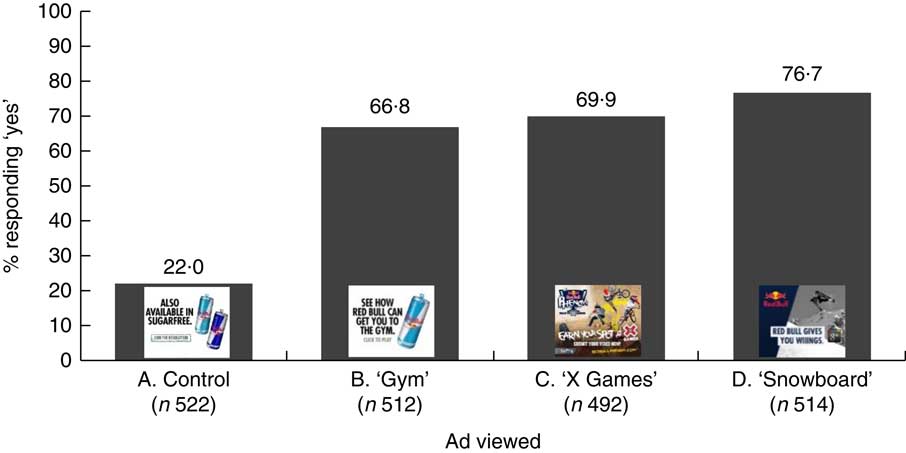
After completing measures of brand awareness and marketing exposure, a between-group experiment was conducted, in which participants were randomly assigned to view one of four online ads for Red Bull, shown in Fig. 1 (see online supplementary material, Supplemental Fig. 1, for larger images). All ads were drawn from Moat Ad Search (http://www.moat.com). We selected three ads that were sport-themed and one control ad that did not feature sport-related content. Among the sport-themed ads, one featured an official sport sponsorship (‘X Games’) with a related image, another included general text with an image of a sporting activity (snowboarding) and the third included a text reference to sporting activity (going to the gym) with a general product image. Each participant was shown one ad on-screen and asked who they thought the ad targeted: ‘What age group does this ad target? Select all that apply’ (‘people younger than me’, ‘people my age’, ‘people older than me’, ‘don’t know’, ‘refuse to answer’); responses for each option were coded as 1=selected or 0=not selected. With the same ad showing, respondents were asked ‘Does this ad promote using Red Bull during sports?’ (‘yes’, ‘no’, ‘don’t know’, ‘refuse to answer’).
Perceptions of advertisement (ad) messaging promoting use during sports, by ad, among Canadian youth and young adults aged 12–24 years participating in an online survey, 2014. Weighted percentage responding ‘yes’* (n 2040) to the question ‘Does this ad promote using Red Bull during sports?’ (*‘don’t know’ and ‘refused’ responses included in the denominator)
Analysis
Unless otherwise specified, all point estimates reported are weighted. Chi-square analyses tested differences in demographic characteristics between conditions and differences in outcomes between age groups. Regression models tested differences in outcomes between experimental conditions: multiple regression for linear outcomes (index scores) and logistic regression for binary outcomes. Analyses were conducted using the statistical software package SAS version 9.4.
Results
Sample characteristics
Table 1 shows the sample characteristics.
Characteristics of the sample of Canadian youth and young adults aged 12–24 years participating in an online survey, 2014

BC, British Columbia; AB, Alberta; SK, Saskatchewan; MB, Manitoba; ON, Ontario; QC, Quebec; NB, New Brunswick; NL, Newfoundland and Labrador; NS, Nova Scotia; PEI, Prince Edward Island.
* Data are presented as unweighted percentages and numbers, unless indicated otherwise.
Brand awareness
All respondents were asked about awareness of eleven leading brands of energy drinks (n 1983). Overall, 97·0 % reported hearing of at least one brand, including 95·3 % of 12- to 14-year-olds, 97·4 % of 15- to 17-year-olds, 95·9 % of 18- and 19-year-olds, and 98·1 % of 20- to 24-year-olds; a small but significant difference by age group (
 $$\chi _{{({\rm df}{\equals}3)}}^{2} {\equals}9\!\cdot\!4,$$
P=0·03). A majority of respondents reported awareness of Red Bull (91·7 %), Monster (81·4 %) and Rockstar® (73·6 %). The mean number of brands selected was 4·5 (sd=2·5); older respondents reported a greater number of brands (B=0·52, se=0·046; P<0·0001): age 12–14 years reported a mean of 3·6 (sd=2·34), age 15–17 years reported 4·2 (sd=2·00), age 18–19 years reported 4·5 (sd=3·04) and age 20–24 years reported 5·2 (sd=2·66).
$$\chi _{{({\rm df}{\equals}3)}}^{2} {\equals}9\!\cdot\!4,$$
P=0·03). A majority of respondents reported awareness of Red Bull (91·7 %), Monster (81·4 %) and Rockstar® (73·6 %). The mean number of brands selected was 4·5 (sd=2·5); older respondents reported a greater number of brands (B=0·52, se=0·046; P<0·0001): age 12–14 years reported a mean of 3·6 (sd=2·34), age 15–17 years reported 4·2 (sd=2·00), age 18–19 years reported 4·5 (sd=3·04) and age 20–24 years reported 5·2 (sd=2·66).
Exposure to energy drink marketing
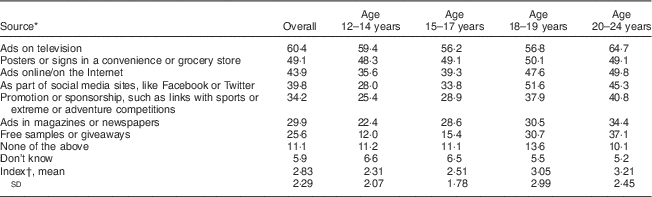
Table 2 presents sources of exposure to energy drink marketing. Of all respondents who provided valid responses, 83·0 % reported ever seeing ads through at least one channel, with no significant difference by age group (
 $$\chi _{{({\rm df}{\equals}3)}}^{2} {\equals}2\!\cdot\!8,$$
P=0·43). When asked about the last time they had seen ads through these channels, 18·4 % reported seeing advertising in the last 24 h, 45·4 % in the last week and 61·9 % in the last month.
$$\chi _{{({\rm df}{\equals}3)}}^{2} {\equals}2\!\cdot\!8,$$
P=0·43). When asked about the last time they had seen ads through these channels, 18·4 % reported seeing advertising in the last 24 h, 45·4 % in the last week and 61·9 % in the last month.
Places where energy drink advertisements (ads) were seen, among the sample of Canadian youth and young adults aged 12–24 years participating in an online survey, 2014 (n 2031)
* Data are presented as weighted percentages, unless indicated otherwise. Percentages do not sum to 100, as respondents could select multiple sources (as applicable).
† Index is the sum of the number of places where advertising was seen (range 0–7).
Overall, respondents reported a mean of 2·83 (sd=2·29) channels. Older respondents reported a significantly greater number of channels (Β=0·32, se=0·042; P<0·0001): age 12–14 years reported a mean of 2·31 (sd=2·07), age 15–17 years reported 2·51 (sd=1·78), age 18–19 years reported 3·05 (sd=2·99) and age 20–24 years reported 3·21 (sd=2·45). As Table 2 indicates, participants were most likely to report seeing ads on TV, followed by posters/signs in stores and online.
In addition, 7·5 % of respondents reported owning clothing, posters, stickers or other products that included an energy drink brand. This varied significantly by age group (
 $$\chi _{{({\rm df}{\equals}3)}}^{2} {\equals}13\cdot4,$$
P=0·004) and was more common among younger respondents: 10·6 % of youth aged 12–14 years, 8·9 % of youth aged 15–17 years, 6·8 % of youth aged 18–19 years and 5·3 % of young adults aged 20–24 years reported owning a branded item.
$$\chi _{{({\rm df}{\equals}3)}}^{2} {\equals}13\cdot4,$$
P=0·004) and was more common among younger respondents: 10·6 % of youth aged 12–14 years, 8·9 % of youth aged 15–17 years, 6·8 % of youth aged 18–19 years and 5·3 % of young adults aged 20–24 years reported owning a branded item.
Finally, respondents who reported greater exposure to energy drink marketing (i.e. higher index scores) also reported higher levels of awareness of any energy drink brand (adjusted OR (AOR)=1·45; 95 % CI 1·23, 1·72), as well as a greater number of energy drink brands (Β=0·41, se=0·023; P<0·0001), controlling for age group.
Perceptions of energy drink advertisements
Respondents were randomly assigned to view one of the four energy drink ads. There were no significant differences in sample characteristics between experimental conditions, for age (
 $$\chi _{{({\rm df}{\equals}3)}}^{2} {\equals}11\!\!\cdot\!\!3,$$
P=0·26), sex (
$$\chi _{{({\rm df}{\equals}3)}}^{2} {\equals}11\!\!\cdot\!\!3,$$
P=0·26), sex (
 $$\chi _{{({\rm df}{\equals}3)}}^{2} {\equals}2\!\!\cdot\!\!1,$$
P=0·54) to ever use of caffeinated energy drinks (
$$\chi _{{({\rm df}{\equals}3)}}^{2} {\equals}2\!\!\cdot\!\!1,$$
P=0·54) to ever use of caffeinated energy drinks (
 $$\chi _{{({\rm df}{\equals}3)}}^{2} {\equals}1\!\!\cdot\!\!2,$$
P=0·75).
$$\chi _{{({\rm df}{\equals}3)}}^{2} {\equals}1\!\!\cdot\!\!2,$$
P=0·75).
Use of energy drinks during sports
Across the three sport-themed conditions, 71·1 % of respondents thought that the ad they viewed promoted the use of energy drinks during sports, compared with 22·0 % in the control condition. As shown in Fig. 1, there was a significant difference between conditions (P<0·0001): respondents were significantly more likely to believe the ad promoted energy drink use during sports if they viewed the ‘X Games’ ad (69·9 %; AOR=8·29; 95 % CI 6·24, 11·02), ‘snowboard’ ad (76·7 %; AOR=11·85; 95 % CI 8·82, 15·92) or ‘gym’ ad (66·8 %; AOR=7·29; 95 % CI 5·52, 9·64), compared with the control ad, in a model controlling for age group. No significant differences were observed by age group (P=0·12).
Respondents who reported greater exposure to energy drink marketing (based on the 7-item index of exposure shown in Table 2) were significantly more likely to perceive study ads as promoting use of energy drinks during sports, after adjusting for age and experimental condition (AOR=1·20; 95 % CI 1·15, 1·26).
Target audience of advertisements
Table 3 shows the perceived target age of the ads. Overall, the majority of respondents (70·1 %) thought the ad they viewed targeted people their own age. Among the youngest group of respondents, those aged 12–14 years, 42·2 % reported that the ads targeted people their age or younger, ranging from 25·6 % of those viewing the control ad to 71·7 % of those viewing the ‘X Games’ ad. Overall, there were significant differences across experimental conditions (P<0·0001) in perceiving a younger target audience, in a model controlling for age group: the ‘X Games’ (36·5 %; AOR=4·16; 95 % CI 3·00, 5·77) and ‘snowboard’ ads (19·2 %; AOR=1·50; 95 % CI 1·06, 2·13) were significantly more likely to be perceived as being aimed at ‘people younger than me’ compared with the control ad (13·3 %), while the ‘gym’ ad was less likely (9·5 %; AOR=0·64; 95 % CI 0·43, 0·95). There was no significant interaction between age group and condition (P=0·25), when added to model with condition and age group.
Perceived advertisement (ad) targets, by ad and age group, among the sample of Canadian youth and young adults aged 12–24 years participating in an online survey, 2014 (n 2040)

* Data are presented as weighted percentages. Percentages do not sum to 100, as respondents could select multiple responses (age groups).
Discussion
The current study indicates high levels of exposure to energy drink marketing among young people in Canada. Awareness of at least one energy drink brand was nearly ubiquitous, with most youth reporting awareness for a range of leading brands, consistent with advertising expenditures( 1 ). TV remained the most common source of exposure to energy drink marketing among youth and young adults, which reflects a high level of TV advertising expenditures by the energy drink industry. The findings are consistent with an analysis of the types of TV shows that display energy drink ads, most of which have considerable viewership among children and youth( 1 ). Exposure to marketing in convenience and grocery stores was the second-most common channel. The results are consistent with data from other domains, such as tobacco advertising, which demonstrates the importance of product displays and in-store advertising as a primary way to reach children and youth( 27 ). The findings also reflect the growing importance of marketing online and through social media, both for reaching young people and as a proportion of industry advertising expenditures( 3 ). For example, in 2014, Red Bull had 43 million ‘likes’ on Facebook: the fifth-most of any corporate brand( 28 ), while company websites, such as 5HourEnergy.com, received more visits in 2013 than major soda brands, such as MyCokeRewards.com( 3 ).
Young adults reported advertising exposure through a greater number of channels than youth; however, exposure was relatively high across all age groups. This is generally consistent with previous studies that have found high levels of advertising exposure among youth, including through online and social media channels( Reference Buchanan, Kelly and Yeatman 4 , Reference Kumar, Onufrak and Zytnick 29 ). Older respondents were more likely to report ad exposure online, through social media and sports sponsorships; however, exposure through these channels remained high even among the younger age groups.
To our knowledge, the current study is among the first to experimentally test consumer perceptions of the content of energy drink marketing. The findings clearly establish that ads for a leading brand promote energy drinks for use during sports and physical activity. All three of the ads that depicted either a message or an image related to sports or physical activity were perceived by the majority of respondents as promoting consumption during sports, and were significantly more likely to be perceived this way than the control ad. This was particularly true for the sponsorship ad for the X Games, which was perceived by over 40 % of those aged 12–14 years as being targeted at their age group or younger. In addition, prior exposure to advertising was associated with the belief that energy drink ads promote use during sport, which suggests that similar messages are being perceived through naturalistic exposure to energy drink marketing.
Limitations
The present study has limitations common to survey research. Web panels may encounter issues of representation due to self-selection bias (as members opt in), under-coverage of some populations (although less of an issue for young people) and panel attrition. While this sample was not a probability-based, representative sample of the general population, there was good geographic representation across the provinces among panel participants and the sample was weighted to match national estimates for demographic groups (based on age, sex and geographic region). Self-reported recall of advertising exposure is also subject to recall biases; however, the measures of self-reported recall in the current study were highly consistent with other sources of data on energy drink advertising, including studies of advertising expenditures and ‘viewership’( 1 – 3 ). The study was cross-sectional, so causal inferences cannot be made from the associations identified. The experimental design was a considerable strength, as was the use of ‘real’ ads.
Conclusions
The current study suggests that the sport themes in energy drink advertising are perceived as promoting these products for use during physical activity. In Canada, energy drink marketing is prohibited from making any implied or explicit health claims that reference ‘physical performance (for example, physical exertion, endurance, aerobic, anaerobic, power, strength, motor performance, recovery, or sports)’( 25 ). Although the study did not specifically refer to sports ‘performance’, the association observed in the current study between energy drink ads and sports is consistent with the reasons for using energy drinks reported by youth and young adults. For example, approximately 7 % of Canadian youth report having used an energy drink ‘to improve sports performance or physical activity’( Reference Reid, MCrory and White 30 ); estimates are significantly higher in other countries( Reference Zucconi, Volpato and Adinolfi 21 ). The current data are also consistent with findings that many youth confuse energy drinks with ‘sports drinks’ such as Gatorade® ( Reference Costa, Hayley and Miller 31 , Reference Costa, Hayley and Miller 32 ). Health Canada’s Expert Panel previously commented on these risks in a 2010 report: ‘Health Canada must act to mitigate the growing confusion for the general public between electrolyte replacement beverages and these stimulant drug containing drinks as more of these stimulant drug containing drinks now contain electrolytes and are marketed as sports drinks’( Reference MacDonald, Hamilton and Malloy 13 ).
Despite claims by the industry that energy drinks are ‘intended for adults’( Reference Sherwood 33 ), the current findings suggest that the industry’s voluntary marketing codes are ineffective. The industry’s codes restrict advertising in ‘child-directed media’ where 35 % or more of the audience is under 12 years of age( 34 ); however, these policies have failed to prevent advertising from reaching a majority of children and youth, and from preventing advertising content that is highly appealing to these age groups( 35 ). More generally, the findings raise questions about how ‘child-directed advertising’ is defined in advertising codes, and the feasibility of targeting energy drink advertising in mass media and online channels that have broad reach across children and youth( Reference Harris, Sarda and Schwartz 36 ). In many ways, energy drink marketing practices, particularly in the case of sports sponsorships tested in the current study, parallel those of cigarette companies through much of the 20th century: while tobacco advertising was ostensibly targeted only at adults, it nevertheless achieved very high levels of reach and appeal among young people( 27 ). In short, both the evidence and common sense indicate that advertising featuring sports and BMX biking – such as the ad used to promote Red Bull’s X Games sponsorship – will be highly effective among children and youth. Given these practices, and the potential risks of energy drink consumption among youth, health authorities such as the American Medical Association have endorsed a ban on marketing energy drinks to children and adolescents less than 18 years old( 37 ).
Acknowledgements
Financial support: This work was supported by a Canadian Institutes for Health Research Operating Grant (‘Evaluating the impact of Canada’s caffeinated energy drink policy among youth and young adults’). Additional support was provided by a Canadian Institutes for Health Research New Investigator Award (D.H.); a Canadian Cancer Society Research Institute Junior Investigator Research Award (D.H.); and a Canadian Institutes for Health Research–Public Health Agency of Canada Applied Chair in Public Health (D.H.). The sponsors had no role in the design, analysis or writing of this article. Conflict of interest: None. Authorship: D.H. formulated the research questions and designed the study; J.R. assisted in study design and conducted the data collection and analysis; D.H. and J.R. drafted the article. Ethics of human subject participation: This study was conducted according to the guidelines laid down in the Declaration of Helsinki and all procedures involving human participants were reviewed by and received ethics clearance from the Office of Research Ethics at the University of Waterloo. Informed consent was obtained from all participants and indicated in an online survey.
Supplementary material
To view supplementary material for this article, please visit https://doi.org/10.1017/S1368980017002890



