In Kalimantan, Indonesia, hunting of wildlife has long been part of the indigenous Dayak culture but in the interior it has been minimal and opportunistic because of the area’s inaccessibility and low human population densities. However, as natural resource extraction and infrastructure has increased many upland Dayak communities have migrated to lowland settlements and have been joined by immigrants from other islands. This has led to increased demand for wildlife products, and hence an increase in their hunting and trading.
Hunting, particularly for trade of bat meat (Wiles et al., Reference Wiles, Engbring and Otobed1997; Lee et al., Reference Lee, Gorog, Dwiyahreni, Siwu, Riley, Alexander, Paoli and Ramono2005), but also for pest control, sport, food or medicinal products, has been a major conservation concern for many flying fox species (Mickleburgh et al., Reference Mickleburgh, Hutson and Racey1992). On Pacific islands flying foxes have important roles as pollinators and seed dispersers, and therefore extirpation of populations may have considerable ecological and economic impacts (reviewed in Mickleburgh et al., Reference Mickleburgh, Hutson and Racey1992). Elsewhere, the large flying fox Pteropus vampyrus is a pollinator of several commercial trees, including durian Durio zibethinus (Kunz & Jones, Reference Kunz and Jones2000). Six subspecies of P. vampyrus occur from Myanmar to the Philippines, Java and Timor (Simmons, Reference Simmons, Wilson and Reeder2005). International trade of all subspecies is restricted by Appendix II of CITES but, although conservation assessments have been made, they are outdated (Mickleburgh et al., Reference Mickleburgh, Hutson and Racey1992). Most records suggest that the Bornean subspecies P. v. natunae commonly roosts in large colonies on branches in mangroves and peat swamp forests. The remoteness of many of these wetlands has buffered colonies from anthropogenic disturbances and, given extensive deforestation throughout Borneo (Rijksen & Meijaard, Reference Rijksen and Meijaard1999), such areas are becoming increasingly important sites for bat conservation (Gumal, Reference Gumal2000; Struebig et al., Reference Struebig, Galdikas and Suatma2006).
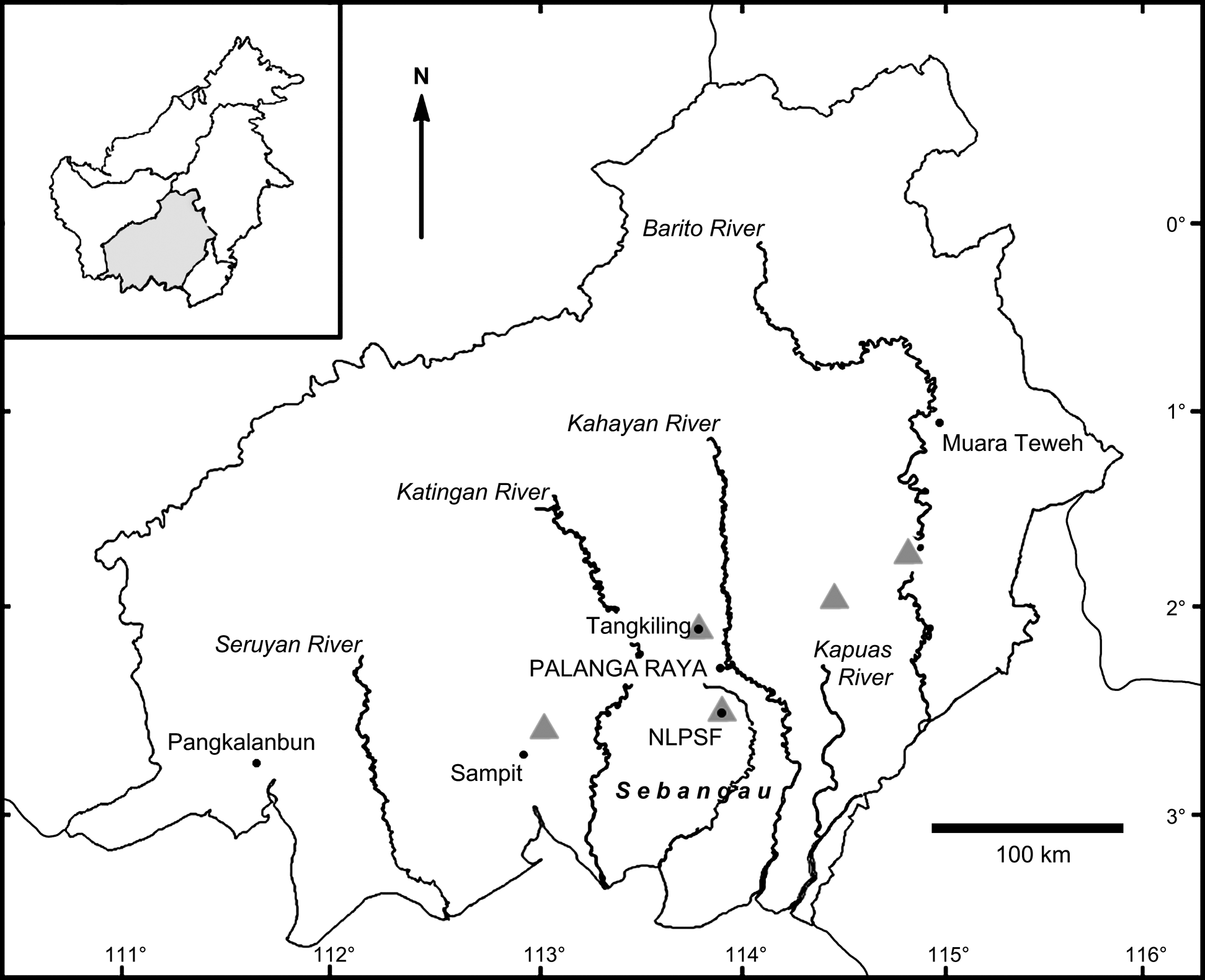
Central Kalimantan is a sparsely populated province and contains the largest proportion of Borneo’s coastal wetlands (Rieley et al., Reference Rieley, Ahmad-Shah, Brady, Maltby, Immirzi and Safford1996); it is therefore a priority region for the conservation of P. v. natunae. The Sebangau catchment forms the largest tract of contiguous peat swamp; it lies between the Katingan and Kahayan rivers c. 20 km south of Palangka Raya (Fig. 1). This provincial capital is relatively small but has received a large amount of recent immigration (BPS, 2000). We have observed that trade in P. v. natunae and other live animals occurs throughout much of the year.
Borneo, showing the location of hunting sites in Central Kalimantan (inset). Triangles represent approximate areas discussed in the text from left to right: Katingan district, Tangkiling, Natural Laboratory for Peat Swamp Forest (NLPSF, Sebangau), Kapuas and Barito districts.

To determine the extent of P. v. natunae hunting around the city informal interviews were conducted with vendors in Kahayan market (n = 27) and one hunter during August-September 2002 as part of a study on forest use (Lyons, Reference Lyons2003). Additional informal discussions were conducted in November 2003 and March 2006 with hunters (n = 7) and the head of the forest patrol team coordinated by the University of Palangka Raya.
As in Malaysia (Fujita, Reference Fujita1988), non-Muslims in Kalimantan consider bat meat and liver the best cure for general malaise and respiratory ailments. We found that P. v. natunae was the only bat species traded in Palangka Raya and, because buyers prefer fresh meat, it was usually kept alive in markets, killed and then prepared on sale. Individuals were purchased from hunters for IDR 4,000-10,000 (c. USD 0.50-1.25), with higher prices representing large, living individuals. Market traders sold these bats for IDR 5,000-17,500 (USD 0.63-2.20) each, with higher prices reflecting times of scarcity. All vendors reported increased demand during the time they had been selling bats, with one vendor stating that most sales were for medicine for respiratory ailments caused by forest fire smoke.
Vendors reported several sources of P. v. natunae, determined largely by transportation costs and declines in intensively hunted areas. During 2002-2004 most individuals were sourced from around the Sebangau, with the remainder purchased from hunters working in Kapuas district and Tangkiling (Fig. 1). However, by 2005 more were being sourced from Kahayan district and Tangkiling because, according to interviewees, catches in the Sebangau were declining. Vendors consistently described a ‘bat season’ from November to December. In the Sebangau this typically coincides with the fruiting of Palaquium leiocarpum. Shorter peaks in availability were also reported that coincided with flowering of Madhuca and fruiting of Calophyllum in the Sebangau, and flowering of D. zibethinus elsewhere.
The Sebangau catchment was a popular hunting area. Most hunting took place within the Natural Laboratory for Peat Swamp Forest, a research area managed by the University of Palangka Raya and the subject of several long-term peatland studies. Close proximity to Palangka Raya and accessibility were the main reasons why hunting was so prolific, and P. v. natunae hunting has been permitted as long as no new hunting sites are developed. P. v. natunae was captured using fine-weave fishing nets obstructing flight paths near fruiting or flowering trees. Dayak hunters claimed this method originated in Barito districts, where hunting was also extensive. Prior to this, guns were used. For netting, an area of forest was cleared and a tower built opposite the focal tree. Two hunters typically worked one site. Nets (up to 12*12 m) were attached to poles set in the canopy up to 50 m away, and raised on a pulley system from the tower. A single bat was tied to the tower and beaten because the distress calls were believed to attract other bats. In January 2006 we surveyed 250 ha of the Natural Laboratory for Peat Swamp Forest and found nine clearings averaging 355 m2, all of which could be accessed from a disused logging extraction railway that passed through the research camp. Only four were still active, although seldom used, and five had been inactive for a year. We believe it likely that few hunting sites existed outside this research area because of access difficulties. The most common feeding trees in these clearings were P. leiocarpum, with other trees including Palaquium cochlearifolium, Calophyllum hosei, Calophyllum sclerophyllum and Madhuca mottleyana.
The number of P. v. natunae captured was variable. Between 15 and 50 bats were usually captured per clearing per night during fruiting/flowering seasons, with annual yield per person in 2002 averaging 475 individuals. However, in August 2003 one hunter reported catching >200 individuals in one night. Our counts of catches in the Natural Laboratory for Peat Swamp Forest during 30 days of fruiting in 2003 revealed that at least 4,500 individuals had been removed. All clearings were being used, and at least five two-man hunting teams were censused each day carrying an average of 30 bats per team as they passed the camp. All hunters reported declines in yields over the previous 10 years, with one hunter quantifying a decline in his 2001-2002 yield from 2,400 to 850 individuals (35%) with similar collecting effort. In the 2005 and 2006 seasons we observed little hunting.
Our findings suggest that the hunting of P. v. natunae in the Sebangau between 2002 and 2006 was intensive and was likely to have had a negative effect on local populations. Because there are no historical data on the bat populations of Kalimantan it is difficult to assess hunting impact. However, because this species has a low reproductive rate (Kunz & Jones, Reference Kunz and Jones2000) that coincides with peaks of food abundance (Mohd-Azlan et al., Reference Mohd-Azlan, Zubaid and Kunz2001) it is likely that hunting during this period could limit a population’s ability to recover.
As far as we are aware hunting of the extent we observed around Palangka Raya has not been reported elsewhere in Kalimantan. Trade of bat products was not observed in villages and markets surveyed in Central, West and East Kalimantan in the mid-late 1990s (E. Meijaard, pers. comm.). However, we have witnessed some roadside trade near Buntok (Central Kalimantan), Pontianak (West Kalimantan) and between Balikpapan and Samarinda (East Kalimantan). An evaluation of hunting and trade in P. v. natunae is needed in these areas, as well as in the Barito region.
There is also a clear need for an island-wide survey of this species to update information on its distribution and conservation status. In the past P. v. natunae was considered widespread and abundant, with colonies of >15,000 individuals reported (Lyon, Reference Lyon1911). However, as forests become more accessible and demand for bat products increases, populations will probably decline. In Sarawak average colony size was only known to exceed 1,500 in 1988 (Fujita, Reference Fujita1988), and state-wide surveys located only five colonies, all in remote wetlands (Gumal, Reference Gumal2000). Our 2003 extraction estimate of at least 4,500 individuals from the Natural Laboratory for Peat Swamp Forest indicates that entire colonies could be eliminated in a single season, a finding supported by reports of declines in yields, and a decrease in hunting effort at this site as bats have reportedly declined or moved elsewhere.
The restriction of hunting is necessary if viable populations of P. v. natunae are to remain around Palangka Raya. In Peninsular Malaysia Mohd-Azlan et al. (Reference Mohd-Azlan, Zubaid and Kunz2001) suggested a closed season every other year would allow local populations to recover. However, given the low reproductive and population growth rates of flying foxes (McIlwee & Martin, Reference McIlwee and Martin2002) it is unlikely this would be sufficient. Low biological productivity also makes farming of this species uneconomical (Mockrin et al., Reference Mockrin, Bennett and LaBruna2005). A complete refuge area, in which no hunting is permitted, is probably the best option, but as in Sulawesi (Lee et al., Reference Lee, Gorog, Dwiyahreni, Siwu, Riley, Alexander, Paoli and Ramono2005) hunting controls are likely to be unenforceable outside monitored areas. Although hunting intensity appears to have decreased recently, the future of this species around Palangka Raya remains uncertain.
Acknowledgements
We thank Anna Lyons, Victoria Smith, Ape Konity, Claire Thompson, Zery Yeen, Santiano, Kris Yo-Yo and Angela Benton-Browne for conducting and assisting with interviews. We also thank Simon Husson and Helen Morrogh-Bernard for phenology information and Erik Meijaard for information regarding his bushmeat surveys in Kalimantan. Anne Brooke commented on an earlier version of this manuscript. Finally, we thank the Centre for International Co-operation in the Management of Tropical Peatland and the Indonesian Institute of Sciences for research permissions in the Sebangau.