




Introduction
Across Central Asia, archaeological studies of Early Islamic communities have focused on lowland urban contexts, framing highland and rural populations as engaged in heterodox, or even insincere, religious practices (Jackson Reference Jackson, Amitai and Biran2005: 274 & 277; Pfeiffer Reference Pfeiffer and Komaroff2006). Here, we report the results of the recent excavation of burials at the Tashbulak cemetery in the highlands of south-eastern Uzbekistan and argue for the presence of an early frontier Muslim community for whom mortuary practice was central to the maintenance of local identity. Burial analysis provides insight into global integration and community practice of Muslim populations, and the Tashbulak cemetery presents an opportunity to document these dynamics in an understudied region.
Background and rationale
Increasingly, research on the Central Asian highlands has focused on multi-directional, inter- and intra-regional connections. As early as the Bronze Age (third to second millennium BC), the Inner Asian Mountain Corridor—a piedmont zone spanning the Hindu Kush to the Altai Mountains—facilitated the movement of crops and other commodities across Eurasia (Frachetti Reference Frachetti2012); in turn, these plants and goods were integrated into the economies of pastoralist groups (Spengler et al. Reference Spengler2014; Li et al. Reference Li2019). Recent archaeological investigations focusing on the medieval period (eighth to thirteenth century AD) reveal that upland regions of Central Asia were socio-political mosaics, shaped by communication and commerce across extensive Silk Route networks (Franklin Reference Franklin, Bonney, Franklin and Johnson2016). These regions were also home to groups engaging in a range of subsistence strategies, from highly mobile pastoralism to settlements based around intensive mining (Stark et al. Reference Stark, Eshonkulov, Gütte and Rakhimov2010; Frachetti et al. Reference Frachetti, Smith, Traub and Williams2017).
In contrast to this emphasis on interconnectivity and exchange, the narrative for the introduction of Islamic traditions into rural and frontier regions primarily remains one of unidirectional colonisation. In this framing, unorthodox practices are seen as corrupted or diluted versions of cultural norms (Bulliet Reference Bulliet1994; Eger Reference Eger2019) that deviate from those of ‘true’ urban centres of cultural production (see Lawrence & Wilkinson Reference Lawrence, Wilkinson and Sauer2017; Linduff et al. Reference Linduff, Sun, Cao and Liu2017). Indeed, within historical scholarship, there is a cliché that Islam “‘sat lightly’ or superficially upon nomads” in Central Asia (DeWeese Reference DeWeese1994: 9). The governor of Khorasan initiated the Islamisation of the mountains and steppe of Central Asia in the early ninth century AD, although the process is described as sporadic and unsuccessful until the thirteenth century (Bregel Reference Bregel2003: 18; Deom Reference Deom, Bonora, Pianciola and Sartori2009: 101). Sufi practitioners are also credited with the eventual conversion of nomadic groups, in part through integrating Islamic and indigenous practices (DeWeese Reference DeWeese1994; Shingiray Reference Shingiray2018: 15). Because of the emphasis on nomads in many of these historical accounts, rural and highland regions are often equated with these groups in broad-brush narratives, masking social and economic diversity.
The medieval cemetery at Tashbulak, a high-altitude population centre in the historical territory of Ustrushana (the area surrounding the Zeravshan River, in modern south-eastern Uzbekistan), presents an opportunity to dispense with core-periphery models and to examine the religious landscape of highland Central Asia through a multidimensional lens. Here, we frame the Central Asian highlands as a frontier, emphasising active adaptation to and engagement with political and social events at multiple scales (Eger Reference Eger2019: 6–7). During the Early Islamic period, highland Ustrushana was an area of interaction between Sogdian, Persian and Turkic groups, a zone spanning lowland and alpine ecosystems, and a region contested by sectarian and Caliphal forces (Bregel Reference Bregel2003: 16–17). The study of burial at Tashbulak cannot be assumed to represent every mountain site, but our approach documents specific religious practices, adding complexity to our understanding of early Islam in highland regions beyond the syncretic nomad narrative. Although architecture and household deposits may capture changes in economic, religious and social practices, periodicity can be difficult to delineate in these contexts (Hastorf & D'Altroy Reference Hastorf, D'Altroy, D'Altroy and Hastorf2001). Cemeteries, in contrast, capture discrete events and thus, barring secondary burial, mortuary assemblages document a sequence of ideological behaviour in a community's history (Dethlefsen Reference Dethlefsen1981).
The site of Tashbulak
The site of Tashbulak was identified during fieldwalking survey in 2011 in the Malguzar Mountains of Jizzakh Province, Uzbekistan (Figure 1) (Frachetti & Maksudov Reference Frachetti and Maksudov2014). The site is located at approximately 2100m asl, in a shallow depression surrounded by low ridges. Excavation and geophysical survey conducted from 2012 to 2017 by the Archaeological Research of the Qarakhanids (ARQ) project revealed dense occupation covering approximately 7–10ha, comprising several distinct sectors, including a citadel and workshops, and dating from the late eighth to the early eleventh century AD (Maksudov et al. Reference Maksudov, Baumer and Novák2019). Beyond the site's core lie potential hearth features with no associated permanent structures, but with corrals, a tower, and a gate. A magnetometry survey of the western slope bordering the settlement identified hundreds of rectangular, low-magnetic anomalies (Figure 2). Excavation has confirmed these to be burials, revealing mortuary practices conforming to Islamic prescriptions.
Map showing the location of Tashbulak (map by E. Bullion).

Tashbulak magnetometry survey: a) survey boundaries overlaid onto aerial imagery; b) visualisation of gradiometer data overlaid onto aerial imagery (blue circle denotes the location of the cemetery); c) close-up of gradiometer results over the cemetery (low [white] magnetic rectangles represent grave shafts) (figure by E.R. Henry).

Islamic burial
Muslim burial rites—a defining component of Islamic identity—follow universal prescriptions of practice, intertwined with regional and temporal traditions (Petersen Reference Petersen, Tarlow and Stutz2013). These rites are guided by the Qur’ān, hadith (a collection of traditions, words and actions of the Prophet Mohammad) and other early literary works, such as the qisas al-ʾanbiyā (stories of the prophets) (Zaman Reference Zaman2001: 27). Interpretation of these sources by individuals and communities in different regions results in burials that vary in exact form and ritual, but which adhere to underlying prescriptions. According to the hadith, although Mohammad was buried in his house, the Prophet expressed a preference for burial in cemeteries to avoid the later desecration of graves (Echevarria Reference Echevarria2013). Islamic cemeteries are generally laid out in a row-and-column pattern, with a preference for proximity to mosques or shrines (Halevi Reference Halevi2007: 147). Early Islamic cemeteries with these elements have been widely documented in Central Asia, for example at Tok-kala in Khoresm and the Shah-i-Zinda in Samarkand (Gudkova Reference Gudkova1964: fig. 22; Nemtseva et al. Reference Nemtseva, Rogers and Yāsīn1977).
Muslim burial form and arrangement orientate the dead within Islamic cosmology. Because of connotations between soil and hell, the face of the deceased is protected from direct contact with earth by structures such as niches, and the body, laid directly on the ground, is separated from the soil by only a shroud(s) (Halevi Reference Halevi2007: 92 & 213). Orientation of the corpse is determined by the location of Mecca, with the deceased's face, head or feet pointed towards the birthplace of Mohammad (Petersen Reference Petersen, Tarlow and Stutz2013: 248). The doctrine of taswiyah al-qubūr holds that all Muslims are equal in death, and graves should therefore not be built to distinguish individuals based on their wealth in life (Talmon-Heller Reference Talmon-Heller2007: 165). While mausolea have violated this prescription since the beginnings of Islam (Mulder Reference Mulder2014), this doctrine is observed in other widespread practices, including the absence of grave goods.
In many regions, prohibitions on disturbing the dead prevent excavation of Islamic-period cemeteries (Insoll Reference Insoll1999: 169). We fully considered this aspect before excavating the Tashbulak cemetery. Discussions with Uzbek members of our team, including the project's co-director, as well as with the local community, revealed a consensus in support of excavation for research purposes. In general, the excavation of Muslim burials is common in Uzbekistan. The team thus chose to proceed, deciding to prioritise our local colleagues’ opinions, rather than imposing assumptions about religious prescriptions.
The Tashbulak cemetery
The cemetery at Tashbulak stretches approximately 110m along the hillside above the settlement, and 60m up-slope. It contains approximately 400 burials, based on a direct count from the magnetometry survey (n = 281), plus an additional 100–150 burials estimated from test excavations. Burials are organised in rows placed perpendicular to the slope, each containing 5–25 graves (Figure 3). No evidence of headstones or external tomb structures was recovered, although the regularity of the rows and lack of overlapping burials suggest that some form of surface markers were present during the cemetery's use.
Plans of Tashbulak cemetery: a) location of AMS-dated burials; b) distribution of grave types; c) distribution of males, females and sub-adults; d) estimated season of burial based on face orientation (figure by E. Bullion).

Burial forms
Forty-one graves were excavated across the Tashbulak cemetery, and three types documented: cist burials, niche burials and pit/undetermined (Figure 3b). In all forms, a rectangular grave shaft was dug perpendicular to the slope and a burial chamber excavated within the grave shaft to a depth of 0.30–1.10m, with most reaching 0.70–1m. Adult grave dimensions range between 1.15 and 2.10m in length and between 0.33 and 0.52m in width, while sub-adult graves range between 0.48 and 1.62m in length and between 0.11 and 0.42m in width.
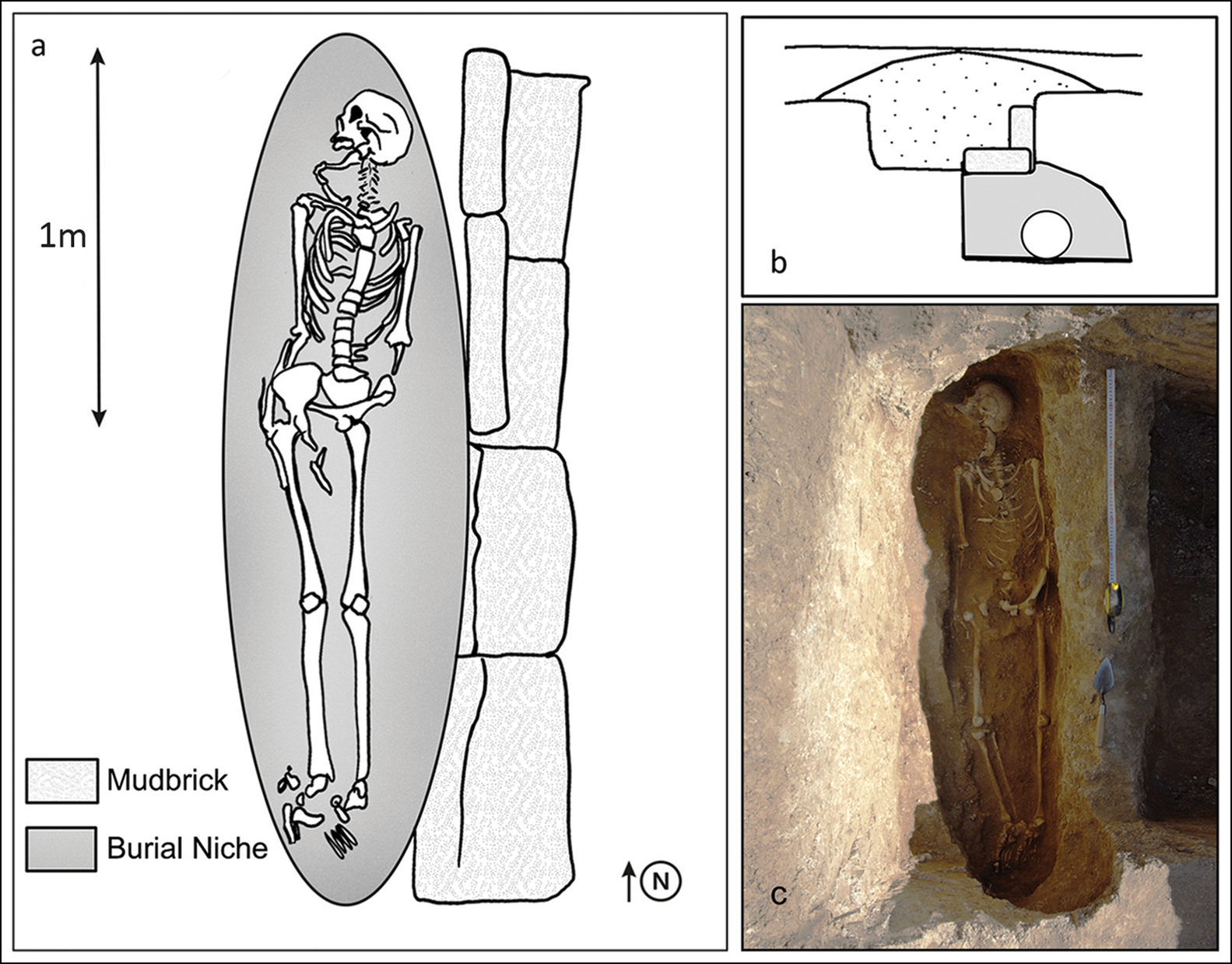
In the 32 excavated niche graves, a burial chamber was set into the western wall of the grave shaft, slightly below the level of its floor (Figure 4). After the body was placed in the niche, the space was sealed with mudbricks. One row of bricks was laid flat along the length of the niche and then another row was placed upright on top to close the chamber off from the grave shaft, which was then filled with soil. Mudbricks conform to standardised dimensions of approximately 0.10 × 0.14–0.17 × 0.40–50m and included a high percentage of small gravel inclusions.
Niche burials: a) plan; b) side view from the north; c) photograph of burial 12 (figure by E. Bullion).
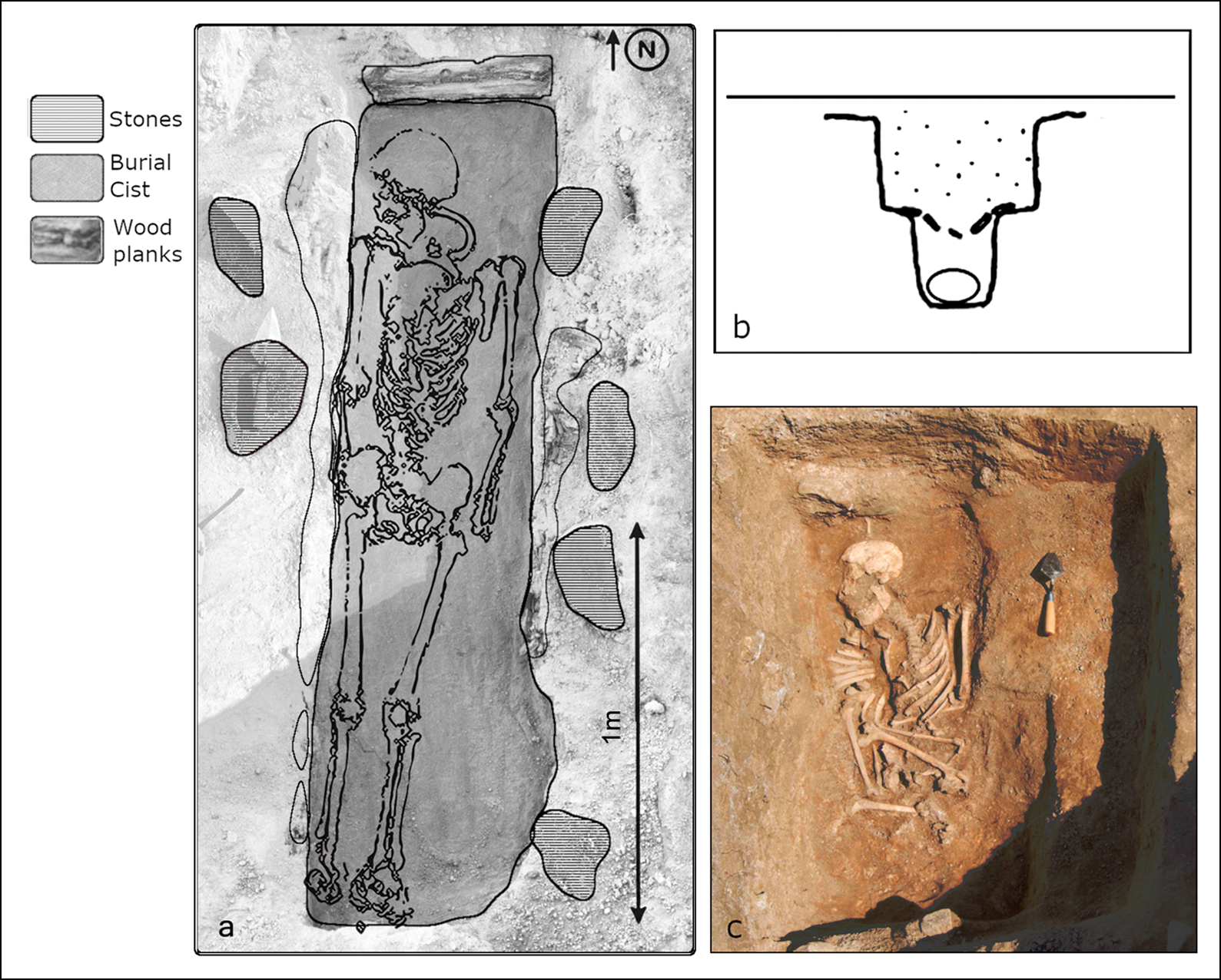
In the five excavated cist burials, a rectangular chamber—smaller than the grave opening—was cut into the base of the pit and lined with large, natural, usually flat stones. In some cist burials, these stones were placed only in the corners or sparsely along the walls, while in others, they form a more continuous cist. Within these stone arrangements, wooden beams were laid along all sides of the chamber, but not on the floor, leaving a space just large enough for the body (Figure 5). After the body had been placed in the chamber, the latter was closed with timber beams and the grave filled with soil. Preserved beams range in size from approximately 0.10–0.50m in length and 0.10–0.30m in diameter. The larger beams were used to line the walls of the burial chamber, while smaller ones were used to roof it.
Cist burials: a) plan; b) side view from the north; c) photograph of burial 8 (figure by E. Bullion).
In four burials, no structure beyond the grave cut was identified. Two were infant burials, no more than 0.30m below the ancient ground surface. The other two were of adults, including one with a small quantity of wood fragments above the area of the body, but no evidence of a burial chamber or cist.
Body treatment
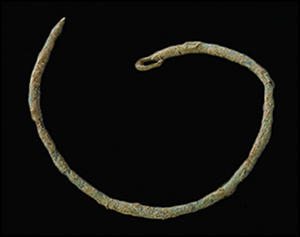
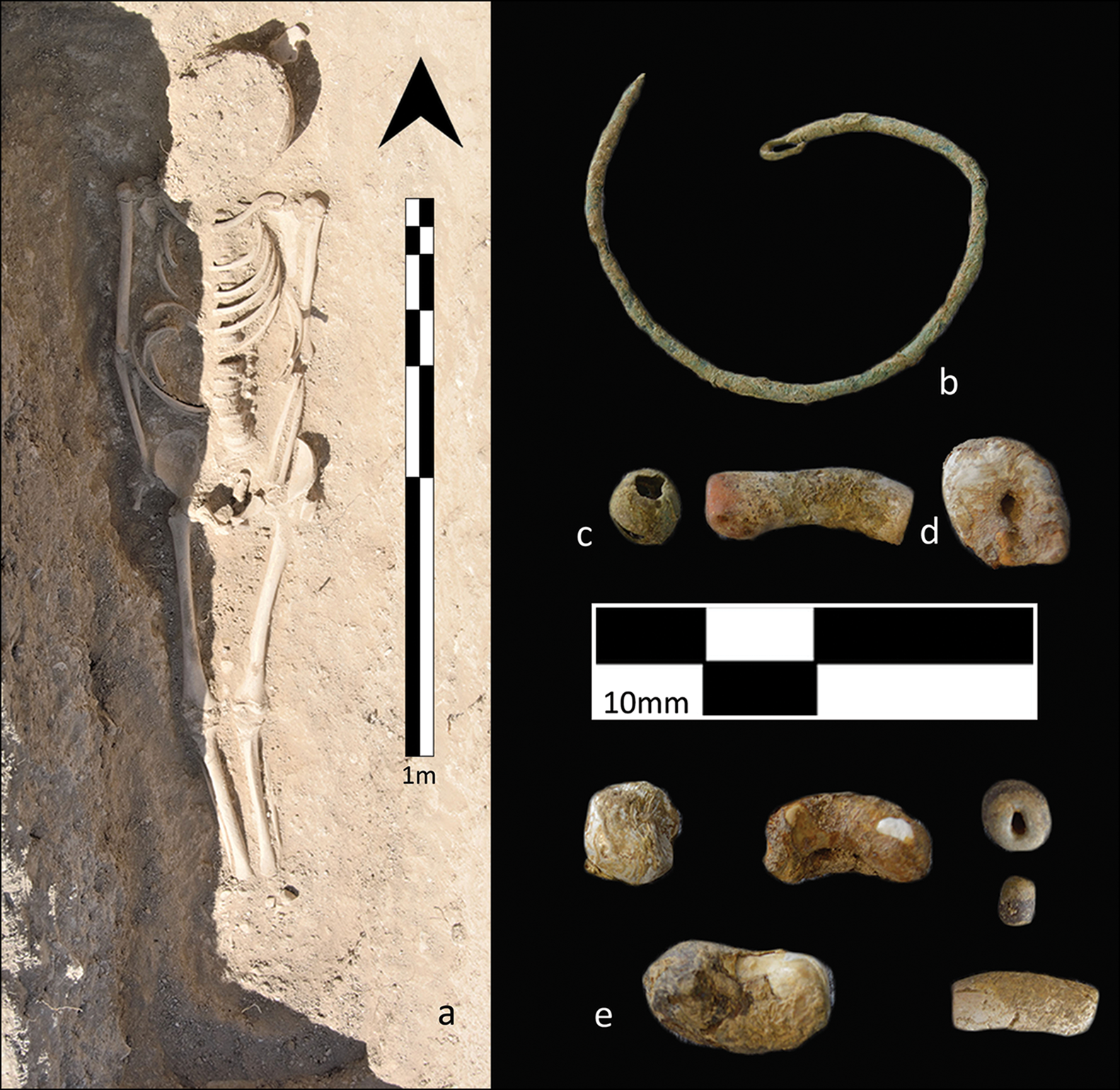
The dominant body position is extended and supine, with individuals laid on their backs, with legs fully extended. Arms are either extended by the individual's side (n = 20), placed on the pelvic area (n = 5), or tucked underneath the pelvis (n = 5). The only exceptions are the individual in burial 8, who was interred in a semi-flexed position—a situation necessitated by a degenerative joint condition (Figure 5c) (Greer & Bullion Reference Greer and Bullion2021)—and burial 36, an individual placed in an extended position on their right side. Excavations documented only one individual buried with grave goods: burial 38 (Br38), a cist grave of an older juvenile (8–12 years), containing a bronze earring, a bronze bead, six shell and bone beads, and two ceramic beads (Figure 6) in the chamber fill above the head and torso region.
Burial 38: a) in situ photograph; b) bronze earring; c) bronze bead; d) ceramic beads; e) shell or bone beads (photographs by E. Bullion).
The heads of the individuals were orientated between north-northwest (335–360°) and north-northeast (0–20°), with faces orientated towards west-southwest (245–270°) to west-northwest (270–290°) (Table 1). Mecca is located to the south-west (242° from geographic north) of Tashbulak, and this seems to have been the focal point for facing individuals at the site. In early Islam, astronomical calculations were often used to determine the qibla (the direction of the Kaaba in Mecca, used to orient prayers, religious buildings and burials; King Reference King and Rashed1996: 155–60). Hinterland communities probably used simpler means, such as the location of the rising and setting sun (Gorzalzcany Reference Gorzalzcany2007: 76). The azimuth of the sunrise varies at Tashbulak between approximately 123.5° in January to 85° in July. In winter, therefore, orienting the dead toward Mecca would result in faces orientated between 284° and 303°, and summer burials between 265° and 284°. These ranges match the burial orientations found at Tashbulak (Table 1; Figure 3d). The smaller number of winter burials (n = 9) may be due to the seasonal mobility of some portions of the population, although we should also consider the difficulty of digging graves in frozen ground. Two infants in adjacent burials and one adult in the same column have faces pointing straight up.
Demographic and burial information for excavated individuals (Y = 18–35 years of age; MA = 35–50 years of age; OA = 50+ years of age).

Demographic profile
Sex estimation was based on os coxae and cranial morphology (Phenice Reference Phenice1969; Walker, in Buikstra & Ubelaker Reference Buikstra and Ubelaker1994). Adult age was estimated by scoring changes to the pubic symphysis and auricular surface of the os coxae (Meindl & Lovejoy Reference Meindl, Lovejoy and Iscan1989; Brooks & Suchey Reference Brooks and Suchey1990). Sub-adult age was estimated from tooth eruption and formation, and epiphyseal closure and long bone length (Ubelaker Reference Ubelaker1984; Scheuer & Black Reference Scheuer and Black2000; Al Qahtani et al. Reference Al Qahtani, Hector and Liversidge2010).
Twice as many sets of excavated individuals were estimated to be female (n = 16) compared with male (n = 8). Males and females are similarly distributed across age groups (Table 1). Orientation and grave construction do not differ significantly between age categories, although no infants were buried in cists (Figure 3b–c). There is also a slight tendency of males, females and sub-adults to be buried next to at least one other individual of the same sex or age category, although these small groups are distributed across the cemetery.
Chronology
Bone collagen from the metatarsals of six individuals from burials at the cemetery was AMS dated (Figure 3a). The resulting ranges cover a period from AD 680–970 (at 95.4% confidence, calibrated in OxCal v.4.3.2 using the IntCal13 curve; Reimer et al. Reference Reimer2013; Bronk Ramsey Reference Bronk Ramsey2017) (Table 2; Figure 7), overlapping the occupation of Tashbulak's settlement, which ceramic typology, numismatics and radiocarbon dating place from the early to mid-eighth century to the mid-eleventh century (Maksudov et al. Reference Maksudov, Baumer and Novák2019). It is important to note that the radiocarbon curve plateau between c. AD 800 and 900 results in wider estimated ranges (Youssef-Grob Reference Youssef-Grob, Kaplony and Marx2019).
Radiocarbon distribution curves for dated human remains (calibrated in OxCal v.4.3.2 using the IntCal13 curve (Reimer et al. Reference Reimer2013; Bronk Ramsey Reference Bronk Ramsey2017)) (figure by E.R. Henry).

AMS dating of Tashbulak samples.

* Calibration in OxCal v4.3.2 (Bronk Ramsey Reference Bronk Ramsey2017), using the IntCal13 atmospheric curve (Reimer et al. Reference Reimer2013). Dates have been rounded to the nearest 10 years.
Discussion
Archaeological studies of Islamic burials are unevenly distributed and often emphasise ‘universal’ Islamic traits, with less attention paid to community belief and choice (Bradbury Reference Bradbury, McPhillips and Wordsworth2016: 201). The past decade has nevertheless seen an increasing number of studies that have focused on Islamic burial variation, especially in rural or nomadic regions (e.g. Bradbury Reference Bradbury, McPhillips and Wordsworth2016). Shingiray (Reference Shingiray2018), for example, documents a thirteenth to fourteenth century burial in the Golden Horde at Bolshoi Tsaryn in Kalmykia (Russia), in the Lower Volga region, which combines Islamic body positioning and the inclusion of nomadic grave goods. Other recent studies use evidence of ‘typical’ Islamic burial traits not only to identify Muslims, but also to discuss the formation of these groups and their relationships with other local communities (e.g. Gleize et al. Reference Gleize2016; Srigyan et al. Reference Srigyan2020). These studies often document contexts in frontier regions or in areas where Islam was recently introduced or rarely practised. The few Islamic cemeteries documented in the medieval Central Asian highlands (e.g. Bubnova Reference Bubnova and Asimov1985; Stark et al. Reference Stark, Eshonkulov, Gütte and Rakhimov2010), however, have not been analysed within their social and political context.
There is no obvious deviation from ‘universal’ Islamic prescriptions in the Tashbulak graves. Men, women and children were, for the most part, interred without grave goods, in an extended, supine position and with faces turned towards Mecca, in graves that protected their faces (through the construction of niche and cist chambers). Burials identical to the Tashbulak niche and cist graves are documented in Early Islamic rural and urban cemeteries across Central Asia (Amirov Reference Amirov, Betts and Kidd2010: 60–64). From this evidence, it appears that individuals at Tashbulak were adhering to orthodox Islamic prescriptions for burial—at least in non-perishable aspects of mortuary practice. This is an important distinction, since behavioural deviations from orthodoxy in burial generated more concern than those associated with construction in the early centuries of Islam (Grabar Reference Grabar1966: 8). Ethnographic studies document the persistence of pre-Islamic traditions among Central Asian Turkic groups, such as visiting graves and tying flags at pilgrimage sites. Other typical Islamic funerary elements, including washing the body and processions, are similarly unlikely to leave significant archaeological traces (Dawut Reference Dawut2009).
The orthodox nature of burial forms at Tashbulak should also be evaluated. The niche grave (podboy) was widely used by steppe populations, and some scholars suggest its use in Islamic Central Asia derives from pre-Islamic practice (Fedorov-Davydov Reference Fedorov-Davydov1966: 125; Vlaskin et al. Reference Vlaskin, Garmashov, Naumenko, Vlaskin, Garmashov, Dode and Naumenko2006: 46). Grabar (Reference Grabar1966: 8) provides a counter to this, arguing that Islamic societies tended to break from earlier mortuary forms rather than integrate them. In addition, niche burials are found throughout the Early Islamic world. Although burial form alone cannot be taken as evidence of religious orthodoxy, Tashbulak does appear to have been a community with access to knowledge of widespread Islamic grave forms and body treatment.
In medieval cities, Islamic scholars provided guidance on proper burial, and specific funerary-related occupations emerged, including mourning and grave digging (Halevi Reference Halevi2007: 90). Outside of urban centres, these networks of experts were largely absent. Bulliet (Reference Bulliet1994: 32–33) argues that many communities learned Muslim practice not through formal instruction, but by observing and questioning pious individuals and jurists about daily rituals and behaviours. Early Muslims were exhorted to distinguish themselves from members of other religions through funerary practices, which would have made these rituals crucial for fledgling communities such as Tashbulak (Zaman Reference Zaman2001: 32–33; Halevi Reference Halevi2007: 3).
The date range of the earliest Tashbulak burial firmly overlaps the earliest AMS dates from the settlement. This suggests that the cemetery was established concurrently with the core of the site, and that knowledge of Islamic burial was present at that time. It is possible that Islamic burial was introduced to Tashbulak through contact with dynastic or sectarian forces and groups. The earliest burials at Tashbulak date to a period of caliphal incursions into Ustrushana. Military fortifications or destruction of sites are usually cited as evidence of caliphal military presence (Deom Reference Deom, Bonora, Pianciola and Sartori2009: 108). There is no such evidence at Tashbulak, but we cannot rule out the temporary presence of Umayyad or Abbasid forces. The earliest Central Asian dynastic assemblages at Tashbulak are attributed to the Samanids (AD 819–899), a Persianate Islamic polity, although they are outnumbered by remains of objects associated with the Turkic Qarakhanids (Maksudov et al. Reference Maksudov, Baumer and Novák2019), who converted to Islam in the mid-tenth century.
Sufi groups credited with shaping ‘indigenous’ Islam were not widely active until the eleventh to twelfth century. From the early eighth century, however, other sectarian groups holding anti-Caliphate agendas, and with ideologies combining Iranian religions with Islamic teachings, were present in the highlands (Deom Reference Deom, Bonora, Pianciola and Sartori2009: 101). These movements, such as the Khurramiyya, were commonly allied with Turkic groups, many of whose leaders converted to Islam and embraced heterodox beliefs (e.g. the Qarluq yabghu [ruler] converted in AD 780, embracing the Mubayyidites’ creed; Crone Reference Crone2012: 139). These movements appealed to Central Asians of all social classes for their emphasis on equality, piety and asceticism (Daftary Reference Daftary, Bosworth and Asimov1998: 53). By the eighth century, Islam was practised in many major Central Asian cities (Bregel Reference Bregel2003: 18). It is therefore possible that one or several Muslim individuals or families from these cities and regions helped found Tashbulak and shared their knowledge of proper burial.
Whatever the origins of Islamic mortuary ritual at Tashbulak, its practice was sustained throughout the life of the site. Burials at Tashbulak show virtually no variation in grave form and body treatment across the cemetery, which we suggest reflects a community of practitioners maintaining knowledge about proper burial rites. Communities of practice comprise individuals interacting around a shared objective and require continual creation of technical knowledge and social understanding (Lave & Wenger Reference Lave and Wenger1991). As individuals engage in a joint enterprise, they develop norms and expectations, reified through the enactment and transmission of shared knowledge. Communities of practice are also resistant to external influence, with practices embedded in a system of relationships that remain constant across generational and societal changes (Sassaman & Rudolphi Reference Sassaman and Rudolphi2001: 422). This type of community would explain the consistency of burial at Tashbulak over at least a century and potentially more than three, in the face of external influences from trade and dynastic elements.
The grave-form variation at Tashbulak could reflect the identities of those interred or of those who constructed the graves. While the form of a grave does not correlate to its occupant's age or sex, it is possible that it was related to another type of identity. Multiple social and economic classes existed at Tashbulak. Glazed finewares—similar to those found throughout major cities of the region—and the remains of imported fruits and nuts hint at an elite echelon (Spengler et al. Reference Spengler2018). Handmade, slip-painted ceramics of a type attributed to pastoralist groups, along with evidence of ephemeral occupation and corrals, suggest that a portion of the population could have engaged in seasonal mobility, while workshops and metalworking artefacts indicate the presence of artisans (Maksudov et al. Reference Maksudov, Baumer and Novák2019). The absence of grave goods makes it difficult to assess the social identity of the occupants of the Tashbulak burials, but future isotopic and osteological studies may identify markers of occupation and status. Both niche and cist forms vary little across the cemetery, and the date range for the directly dated cist burial (Br38) overlaps with most of the niche burials (Table 2). If different grave forms were created by different practitioners, it is likely that they were operating concurrently.
Conversion to Islam was often communal and defined by the performance of correct acts, emphasising the idea that the heart will follow the body (DeWeese Reference DeWeese1994: 25–26). Muslim funerals bring together communities for rituals that reinforce gender roles and social hierarchies according to Islamic ideologies (Halevi Reference Halevi2007: 231). Through preparing the body, funerary processions and prayers, members of the Tashbulak population would have affirmed their place within the Muslim community, with the cemetery acting as a focal point for the maintenance of Islamic identity.
Conclusion
Burial practice at Tashbulak reflects the presence of a Muslim community in the Central Asian highlands potentially as early as the mid-eighth century AD. This community organised its cemetery in the same fashion as, and with burials identical to, those found in cities and towns across Early Islamic Central Asia. The consistency of grave placement and form across 400 burials suggests a group of practitioners dedicated to maintaining knowledge of Islamic burial norms. Our study demonstrates that Islamic practice in highland Central Asia was not necessarily characterised by syncretism or unorthodoxy, although we cannot rule out heterodox behaviours not captured in the archaeological record. The establishment of the cemetery at the same time as the settlement suggests that Islamic burial practice was known to the founders of Tashbulak. Finally, engagement in funerary rituals would have reinforced Islamic identity, making the cemetery a prominent shaper of both the physical and religious landscapes of the community.
Acknowledgements
The authors thank Samiriddin Mustafakulov and Amriddin Berdimuradov at the Institute of Archaeology in Samarkand for institutional support. Jay Johnson and the Center for Archaeological Research at the University of Mississippi kindly permitted use of their equipment for magnetometry survey. Many thanks also to the Archaeological Research of the Qarakhanids project crews.
Funding statement
Funding was provided by the National Geographic Society (PI: M. Frachetti), Max von Bercham Foundation (PI: M. Frachetti), the National Science Foundation (grant BCS-1724495, PI: M. Frachetti, Co-PI: E. Bullion), the Barakat Trust, Lambda Alpha International, the Association for Asian Studies and I-CARES (Washington University in St Louis).


 Open access

