




Non-technical Summary
Stalked crinoids belonging to various groups such as isocrinids, bourgeticrinids, and cyrtocrinids are restricted to deep water habitats today. In contrast, they were widespread in shallow marine environments during the Jurassic (about 150–200 million years ago). Herein we document a diversified assemblage of cyrtocrinids from Spain including six different species. The crinoids were found in the Yátova Formation, which has been interpreted as a shallow marine sponge-dominated unit sporadically affected by storm events. Specimens are disarticulated but preserve all anatomical elements including cups, columnals, brachial plates, and attachment structures. Some of the attachment structures suggest that cyrtocrinids were encrusters on sponges. A global database suggests cyrtocrinids and reefs followed a similar pattern of diversification, which supports the idea that both groups had similar requirements in the Jurassic.
Introduction
Cyrtocrinids are a well-supported clade of modern crinoids belonging to Articulata Zittel, Reference Zittel1879, and are a sister group of Hyocrinida (Rouse et al., Reference Rouse, Jermiin, Wilson, Eeckhaut and Lanterbecq2013). Cyrtocrinids are characterized by the absence of, or very reduced basal plates, short or absent column without nodals and cirri, immovable articulation (symplectial to cryptosymplectial) between columnals, short arms with only one or two primibrachials, and cemented attachment disc (Hess and Messing, Reference Hess and Messing2011). Modern representatives (i.e., Holopus d'Orbigny, Reference d'Orbigny1837; Neogymnocrinus Hess, Reference Hess2006) include only a few species that live in relatively deep water that can reach depths of 900 m (Bourseau et al., Reference Bourseau, Améziane-Cominardi, Avocat and Crosnier1991; Hess, Reference Hess, Hess, Ausich, Brett and Simms1999; Donovan and Jakobsen, Reference Donovan and Jakobsen2004; Syverson et al., Reference Syverson, Messing, Stanley and Baumiller2015) and are commonly seen in association with sponges (Gorzelak and Salamon, Reference Gorzelak and Salamon2023, fig. 12).
Cyrtocrinids are known from the Lower Jurassic (Hess and Thuy, Reference Hess and Thuy2018) but highly diversified faunas from this age suggest they originated earlier. Based on molecular data, Rouse et al. (Reference Rouse, Jermiin, Wilson, Eeckhaut and Lanterbecq2013) suggested that stem cyrtocrinids probably originated in the Late Triassic. Unfortunately, the Triassic has failed thus far to provide unquestionable cyrtocrinids (Hess and Thuy, Reference Hess and Thuy2018; but see alternative in Hess, Reference Hess2006, or in Salamon et al., Reference Salamon, Gorzelak and Zatoń2009). The group increased its diversity rapidly in the Pliensbachian (Lower Jurassic) with a peak in the Late Jurassic–Lower Cretaceous (Romano et al., Reference Romano, Manni and Nicosia2016; Brom, Reference Brom2019).
During the Jurassic cyrtocrinids were abundant in a wide range of depths and environments (Hess and Spichiger, Reference Hess and Spichiger2001; Charbonnier et al., Reference Charbonnier, Vannier, Gaillard, Bourseau and Hantzpergue2007; Salamon and Gorzelak, Reference Salamon and Gorzelak2007; Brom, Reference Brom2019). Detailed systematics of Jurassic cyrtocrinids include material from different parts of the Tethys, including France, Poland, Italy, Germany, and Switzerland, among others (Goldfuss, Reference Goldfuss1826–1833; Manni and Nicosia, Reference Manni and Nicosia1990; Hess, Reference Hess2006; Charbonnier et al., Reference Charbonnier, Vannier, Gaillard, Bourseau and Hantzpergue2007; Salamon and Gorzelak, Reference Salamon and Gorzelak2010a), but the material from Spain, which was first mentioned in Zamora et al. (Reference Zamora, Aurell, Veitch, Saulsbury, López-Horgue, Ferratges, Arz and Baumiller2018), remains undetailed.
This work aims to provide the first detailed description of cyrtocrinid material from the Spanish Jurassic collected in the village of Tosos (Iberian Cordillera, NE Spain), where the quality of fossil preservation allows a proper systematic approach. This locality has well-exposed outcrops of the Yátova Formation (Urresti, Reference Urresti1995; Aurell et al., Reference Aurell, Bádenas, Bello, Delvene, Meléndez, Urresti and Ramajo1999) with the development of sponge meadows. Based on abundant disarticulated material containing cups, brachials, columns, and holdfasts, we provide information about the paleoecology of the group. Finally, we compare the diversity of the sponge meadows with the diversity of cyrtocrinids to understand potential causes of diversity fluctuations.
Geological setting and stratigraphy
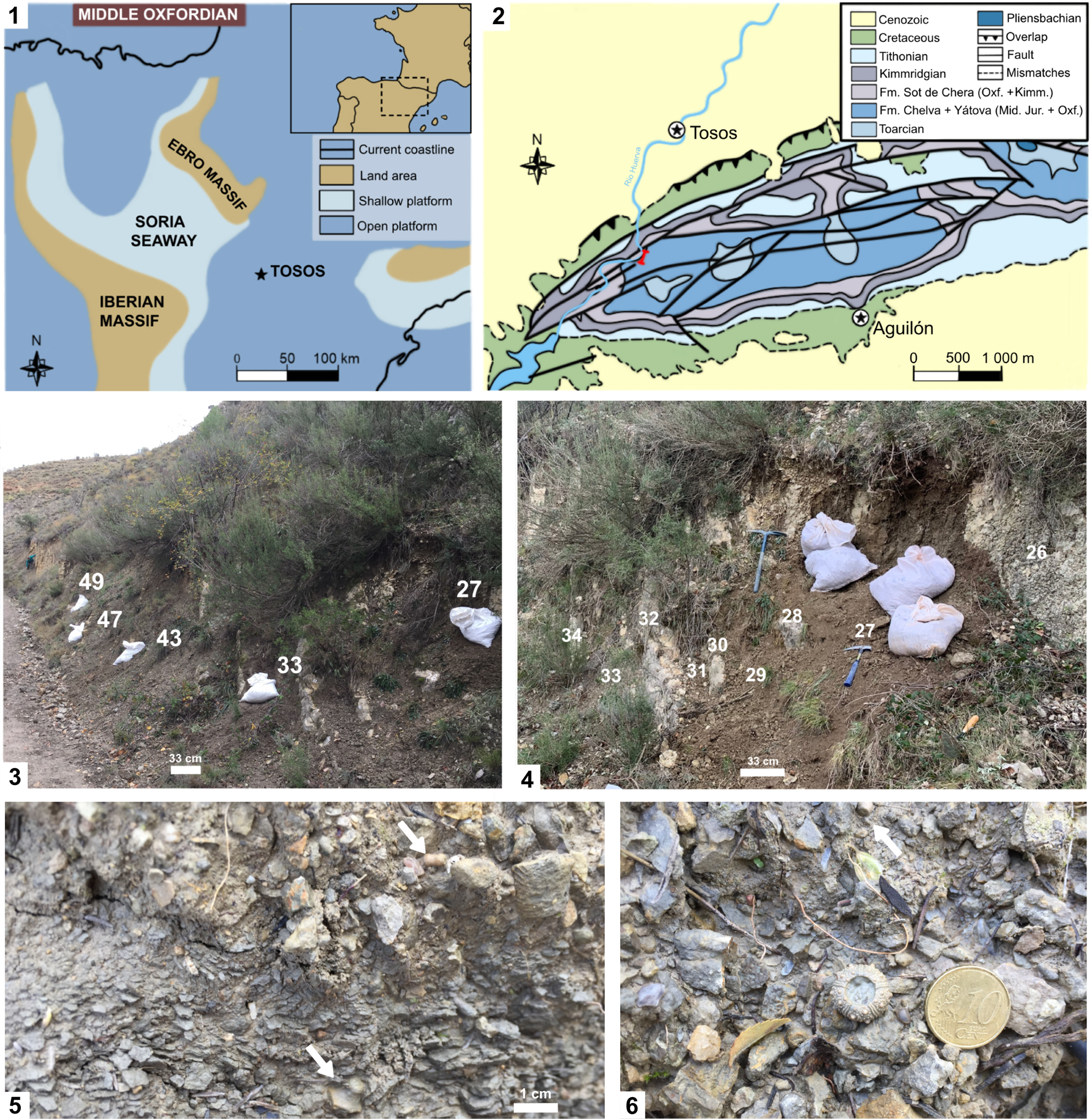
The village of Tosos lies in the Huerva valley, 50 km southwest of Zaragoza. Most of the town is surrounded by Cenozoic strata, but to the south of Tosos Mesozoic exposures of Cretaceous and Jurassic age crop out in an anticline structure (Fig. 1.2). The section studied here (TO.3), which is located a few kilometers south of Tosos (Fig. 1.2), consists of around 90 levels (Fig. 2), with alternating sponge limestones and marls (Urresti, Reference Urresti1996). This outcrop corresponds to the Yátova Formation, and calibrating with ammonoids suggests it expands from the beginning of the middle Oxfordian (Transversarium Biozone) to the upper Oxfordian (Bimammatum Biozone) (Urresti, Reference Urresti1995; Aurell et al., Reference Aurell, Bádenas, Bello, Delvene, Meléndez, Urresti and Ramajo1999).
(1) Paleogeographic map of northeastern Spain during the Oxfordian, with the location of the village of Tosos (modified after Ramajo and Aurell, Reference Ramajo and Aurell2008). (2) Simplified geological map of the area around the village of Tosos, with the TO.3 outcrop in red. Abbreviations: Fm. = Formation; Oxf. = Oxfordian; Kimm. = Kimmeridgian; Mid. Jur. = Middle Jurassic (modified after Lendinez et al., Reference Lendinez, Fernandez and Carls1989). (3) Photograph of the outcrop of the Yátova Formation in Tosos (Zaragoza, Spain), showing the first sampling of marly levels. (4) Photograph of the outcrop during resampling of level 27. (5) Outcrop surface with cyrtocrinid material indicated by white arrows. (6) Example of associated fauna including complete tests of echinoids (Plegiocidaris sp.); cyrtocrinid material indicated by white arrow.
Stratigraphic log of the “TO.3” outcrop at Tosos (Zaragoza, Spain), with details of lithology and fossil content at the Yátova Formation; levels with crinoid material are indicated in gray. Abbreviations: m = meter; M = mudstone; W = wackestone; P = packstone; Fm. = Formation; St. = Stage; Bz. = Biozone; Bimam. = Bimammatum (modified after Ramajo, Reference Ramajo2006).
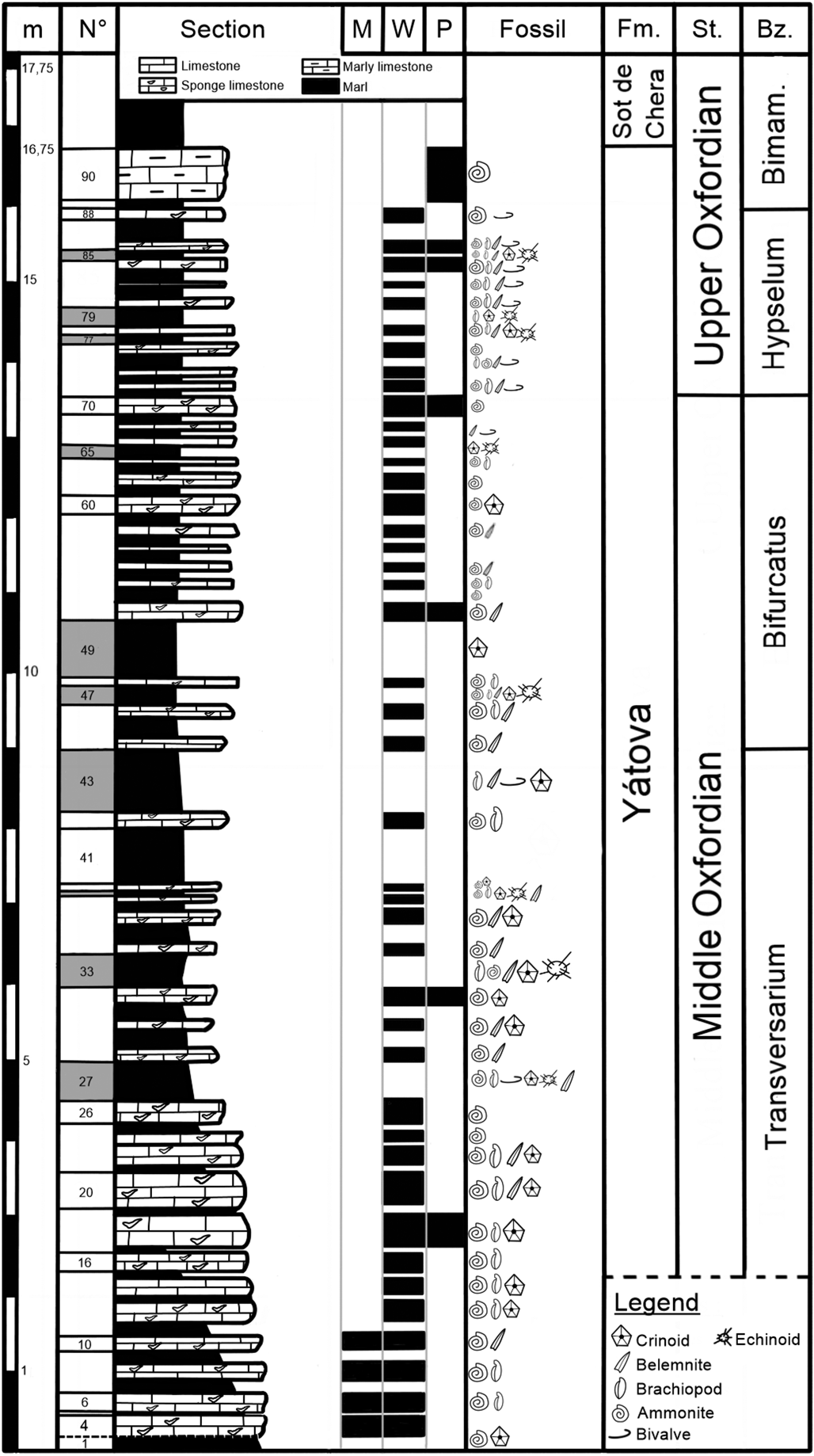
The transition between the middle and upper Oxfordian is marked by the transition to the Hypselum Biozone (Meléndez et al., Reference Meléndez, Atrops, Bello, Brochwicz-Lewinski, D'Arpa, Fözy, Urresti, Ramajo and Sequieros2009). Other organisms are abundant in these layers (Fig. 2), such as brachiopods, echinoids, belemnites, sponges, bivalves, and serpulids (Aurell et al., Reference Aurell, Bádenas, Bello, Delvene, Meléndez, Urresti and Ramajo1999). Magnetostratigraphic studies have confirmed the dates provided by biostratigraphy (Juárez et al., Reference Juárez, Osete, Meléndez, Langereis and Zijderveld1994). Crinoids are common in 10 layers (27, 33, 39, 43, 47, 49, 65, 77, 79, 85) of marly interbeds along the Yátova Formation (Fig. 2; also see methodology).
During the middle Oxfordian, and more specifically during the Transversarium Biozone (Fig. 2), the different parts of the East Iberian carbonate platform evolved into a very wide and homogeneous carbonate ramp, resulting in several major deposits of carbonate sequences, including the Yátova Formation and its sponge limestones. This platform reached its maximum depth shortly after the boundary between the middle and upper Oxfordian (Meléndez et al., Reference Meléndez, Atrops, Ramajo, Urresti and Delvene2006). After this transgressive event, a regression began in the Hypselum biozone and became widespread in the Bimammatum biozone, extending into the Kimmeridgian (Meléndez et al., Reference Meléndez, Atrops, Ramajo, Urresti and Delvene2006; Ramajo, Reference Ramajo2006).
Paleoenvironment
The Jurassic is marked by a global event of reef proliferation in the oceans, caused by a reconfiguration of global circulation (Leinfelder et al., Reference Leinfelder, Schmid, Nose, Werner, Flügel, Kiessling and Golonka2002). During the Late Jurassic, coral diversity appears to have peaked, which explains the sharp increase in coral reefs. The abundance of siliceous sponges increased sharply in the northern part of the Tethys during the Middle and Late Jurassic (Leinfelder et al., Reference Leinfelder, Schmid, Nose, Werner, Flügel, Kiessling and Golonka2002). According to some authors (Veron, Reference Veron1995; Leinfelder et al., Reference Leinfelder, Schmid, Nose, Werner, Flügel, Kiessling and Golonka2002), the “Reef Age” of the Late Jurassic can be explained by the formation of a global east–west current system, which favored distribution and mixing of the larvae of these organisms. In northeastern Spain, during the Oxfordian, the Basque–Cantabrian Basin was connected to the Iberian Basin by a shallow carbonate platform known as the Soria seaway (Fig. 1.1). Numerous siliciclastic inputs were supplied to this platform and its surroundings by the Ebro Massif to the north and the Iberian Massif to the south (Strasser et al., Reference Strasser, Aurell, Badenas, Meléndez and Tomas2005). This geographical configuration, and the generalized transgression during the Transversarium zone (where level TO.3/27 is found), contributed to the development of a facies of mudstone to packstone limestones with sponges and bioclasts around Tosos (Figs. 1.1, 2). Sedimentation rates, nutrient supply and energy from the environment were sufficiently stable to allow the formation of sponge meadows and other associated photo-dependent organisms (Leinfelder et al., Reference Leinfelder, Schmid, Nose, Werner, Flügel, Kiessling and Golonka2002; Ramajo, Reference Ramajo2006). However, the low height of the sponge meadows and the few levels of remobilization, interpreted as produced by the action of storms, suggest a bathymetry below the lower limit of storm wave action but eventually spreading out around that limit (Ramajo, Reference Ramajo2006). This environment enabled numerous cyrtocrinid colonies to establish themselves and increase their diversity.
Materials, preservation, and methods
Preliminary work included sampling several marly levels from the Tosos 3 section (see above). About 10 kg of marls from 10 levels were sampled (levels indicated in gray in Fig. 1.3) and cleaned with hot water and hydrogen peroxide (H2O2). All levels were positive for echinoderm material and more than 500 first cyrtocrinid cups (or calyces) were discovered and preliminarily studied. However, different types of preservation were observed, with some levels preserving the material better than others. Some preliminary results were published in Zamora et al. (Reference Zamora, Aurell, Veitch, Saulsbury, López-Horgue, Ferratges, Arz and Baumiller2018). Therefore, a second sampling was done in the level 27 (this study) from the same section (Fig. 1.4) because this level records the best-preserved specimens and a high diversity of cyrtocrinids. In all, 130 kg of marls were collected and prepared following the aforementioned procedure. Samples were sieved using mesh sizes of 5 mm, 2 mm, and 1 mm. Most cups and columnals remained in the 5-mm and 2- mm mesh size so only those sediment fractions were studied in detail. The 1-mm mesh size revealed mostly brachials and other small elements. Of the 3,647 crinoid remains found, there were around 1603 brachials, 1412 columnals, 47 attachment structures, and 585 cups, the latter representing number of individuals.
In this study, the cups are used mainly for systematic purposes because they offer a wider range of characters to study and allow better identification of specimens than the other skeletal parts of crinoids (except for rare forms). Attachment structures also were studied in order to extract paleoecological information, as well as certain columnals with marks of parasites or epizoans. When possible, some isolated columnals are assigned to certain cups. Most cyrtocrinid remains are disarticulated, with the exception of some columnals, a few roots and, more rarely, some cups.
Most of the collected specimens were prepared with potassium hydroxide (KOH), cleaned with water, and neutralized with acetic acid (10%). They were photographed using a Nikon D7100 equipped with a 60 mm AF-S Micro NIKKOR lens. Before photography, the specimens were coated with ammonium chloride to increase contrast. Some specimens were photographed using SEM model JSM 6360-LV in the “Servicio General de Apoyo a la Investigación-SAI, Universidad de Zaragoza.”
The resulting diversity of cyrtocrinids was analyzed using a rarefaction curve produced with PAST software. Since only one level was studied, this curve was used to show the sampling effort and the diversity, rather than a comparison with other sites. The global diversity of Jurassic cyrtocrinids was explored using a database referencing the total number of cyrtocrinid species and genera known in the literature, considering a single occurrence per species (or genus) and per stage, which then were linked in the intermediate stages, using a range-through approach according to Foote (Reference Foote2000) (see Supplementary Data). This was made in order to compare the diversity curve for cyrtocrinids in the Jurassic with the curves for reef domains and siliceous sponge reefs taken from Leinfelder et al. (Reference Leinfelder, Schmid, Nose, Werner, Flügel, Kiessling and Golonka2002). A simple correlation test and a cross-correlation between these data was carried out (Pearson coefficient) to explore the possible relationship between cyrtocrinid diversity and abundance of sponge reefs.
Repository and institutional abbreviation
All figured specimens and important non-figured specimens have a museum number and are deposited in the following institution: Museo de Ciencias Naturales de la Universidad de Zaragoza, Zaragoza, Spain, under the acronyms MPZ2024/97–204. There is also extra cyrtocrinid material that remains in the same collection.
Systematic paleontology
Classification and terminology
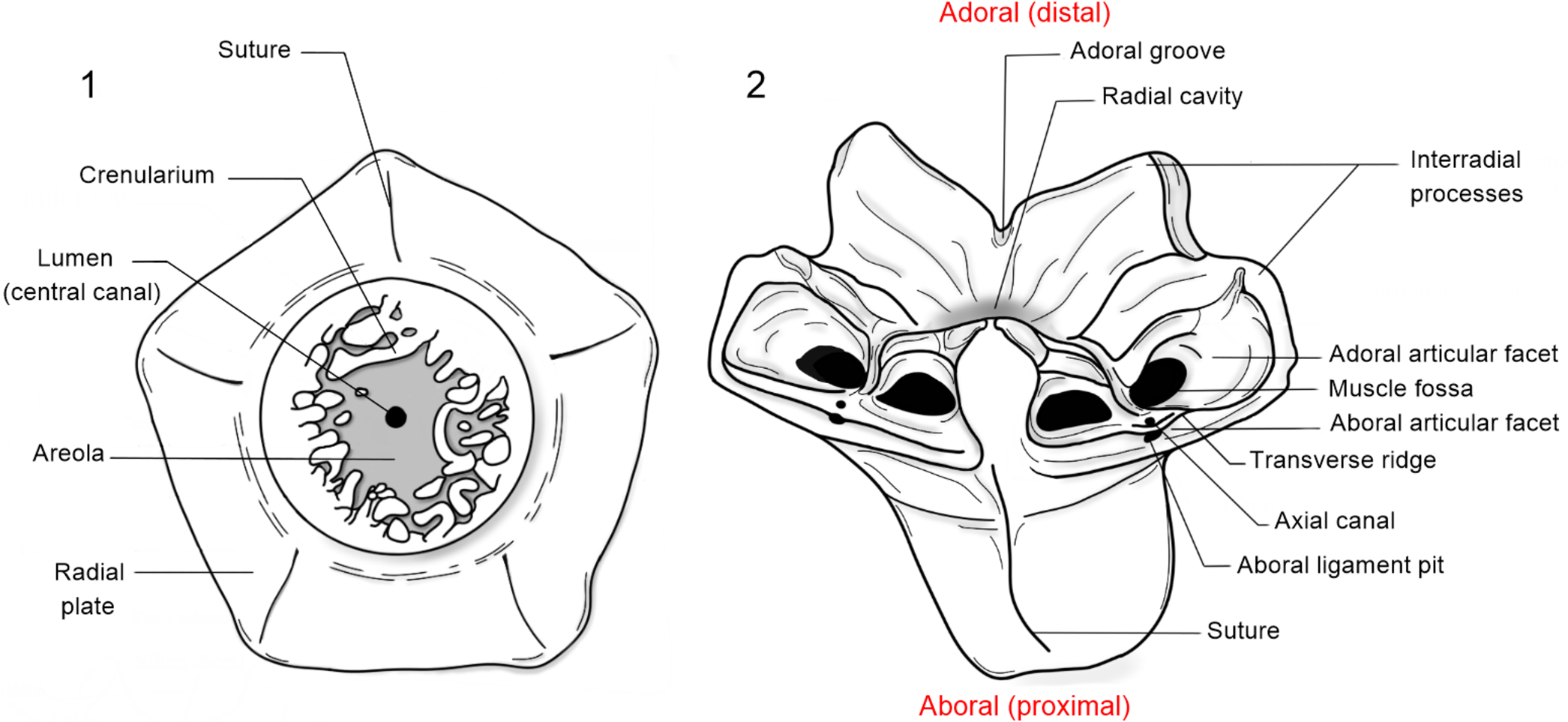
The classification and most of the terminology used in descriptions (Fig. 3) follow Hess and Messing (Reference Hess and Messing2011).
Schematic cup of a cyrtocrinid of Eugeniacrinitidae Roemer, Reference Roemer and Bronn1855, typical morphology (1) in aboral view and (2) in lateral view, describing the terminology used here.
Class Crinoidea Miller, Reference Miller1821
Subclass Articulata Zittel, Reference Zittel1879
Order Cyrtocrinida Sieverts-Doreck in Moore et al., Reference Moore, Lalicker and Fischer1952
Suborder Cyrtocrinina Sieverts-Doreck in Moore et al., Reference Moore, Lalicker and Fischer1952
Superfamily Eugeniacrinitoidea Roemer, Reference Roemer and Bronn1855
Family Eugeniacrinitidae Roemer, Reference Roemer and Bronn1855
Genus Eugeniacrinites Miller, Reference Miller1821
Type species
Encrinites cariophilites von Schlotheim, Reference von Schlotheim1813.
Diagnosis
Cup conical to funnel-shaped, rarely nearly cylindrical. Radial articular facets steep and wide in adults, with small aboral ligament fossa and deeply excavated adoral muscle fossae, separated from radial cavity by narrow ledges extending from interradial processes to median notch; interarticular ligaments indistinct. Articular facets separated by small interradial projections. Radial cavity wide and rather shallow. Aboral side of cup entirely occupied by almost flat, articular facet for column. First primibrachials very low. Axillary second primibrachials large, with compact, spearhead-shaped, median prolongation above small, lateral, articular facets for secundibrachials, and joined aborally by symplectial facets as protective covers over adoral side of cup when retracted. Arms small, may be coiled between second primibrachials. Columnals cylindrical to slightly conical, commonly high. Uppermost columnal with diameter equal to base of cup, commonly closely attached to cup. Articular facet of columnals with marginal granulation (after Hess and Messing, Reference Hess and Messing2011; Hess, Reference Hess2014b).
Eugeniacrinites cariophilites (von Schlotheim, Reference von Schlotheim1813) Figure 4
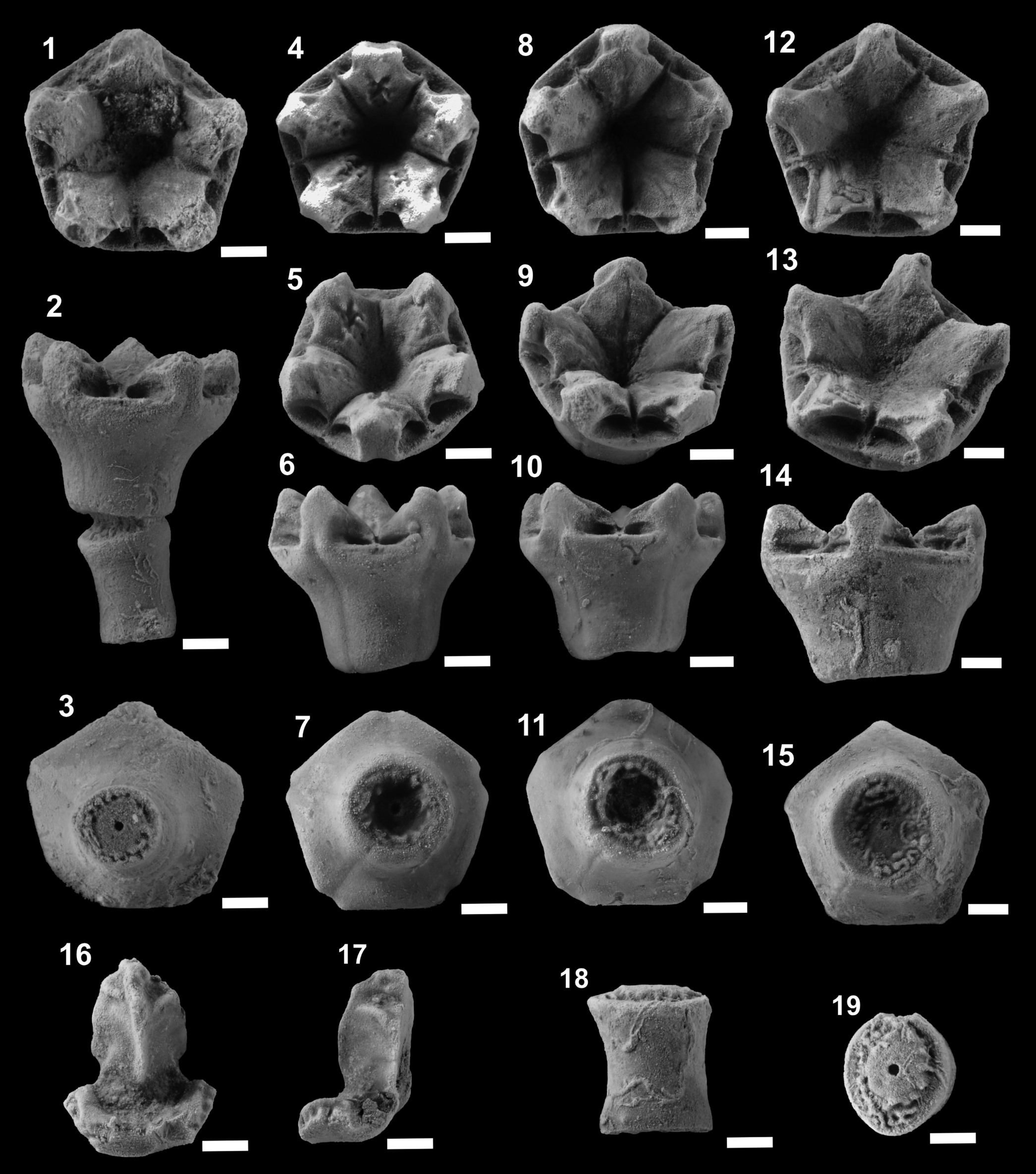
Eugeniacrinites cariophilites (von Schlotheim, Reference von Schlotheim1813) from the middle Oxfordian of Tosos (Zaragoza, Spain), Yátova Formation, layer TO3/27. (1–3) Cup with first columnal still attached in adoral, lateral, and aboral views (MPZ2024/104); (4–7) cup with adoral groove crenulated in adoral, oblique, lateral, and aboral views (MPZ2024/97); (8–11) cup with very distinct interradial processes in adoral, oblique, lateral, and aboral views (MPZ2024/100); (12–15) cup with small interradial processes in adoral, oblique, lateral, and aboral views (MPZ2024/98); (16, 17) second primibrachial in adoral and lateral views (MPZ2024/102); (18, 19) columnal with serpulids in lateral and articular views (MPZ2024/101). All specimens photographed whitened with ammonium chloride sublimated; all scale bars = 1 mm.
- Reference Klikushin1996
Eugeniacrinites cariophilites; Klikushin, p. 103, pl. 1, figs. 3–22 (with previous synonymy).
- Reference Kaufmann1998
Eugeniacrinites cariophilites; Kaufmann, p. 10, text-fig. 7.5?.
- Reference Hess, Salamon and Gorzelak2011
Eugeniacrinites cariophilites; Hess and Messing, p. T181, text-fig. 88.1.
- Reference Hess2014b
Eugeniacrinites cariophilites; Hess, p. 123, figs. 2–14.
- ?Reference Zamora, Aurell, Veitch, Saulsbury, López-Horgue, Ferratges, Arz and Baumiller2018
Eugeniacrinites cariophilites; Zamora et al., p. 788, text-fig. 9a.
- Reference Krajewski, Ferré and Salamon2020
Eugeniacrinites cariophilites; Krajewski et al., p. 70, text-fig. 5e, f.
Holotype
Cup figured by Knorr (Reference Knorr1775, pl. 36, fig. 20) and refigured by von Schlotheim, Reference von Schlotheim1813, from the Jurassic of Switzerland (according to Rasmussen, Reference Rasmussen1961, p. 223).
Emended diagnosis
Cup smooth, funnel-shaped, slightly conical or bowl-shaped; pentagonal in adoral view. Radial articular facet steep, large, and almost flat, muscle fossae deep, wide, and oval in adult, more rounded in juveniles. Interradial processes not very high, with a triangular apex, sometimes with a rounded angle. Aboral part of the cup circular or subcircular, flat or slightly concave, with marginal and irregular roughness made up of tubercles that are sometimes elongated and can be folded up. Columnals cylindrical, sometimes with concave sides, crenularium with the same roughness pattern as the aboral part of the cup.
Occurrence
Late Jurassic (Oxfordian) of Spain, Oxfordian and Kimmeridgian of France, Switzerland, Germany, and Early Cretaceous of France? (Rasmussen, Reference Rasmussen1961).
Description
Cups of varying sizes and shapes, slightly higher than wide, funnel-shaped, with a cylindrical aboral part (Fig. 4.2, 4.6). Other cups are wider than high, bowl-shaped (Fig. 4.14). Slight asymmetry sometimes visible. Cups smooth, sutures of radial plates visible, sometimes forming slight grooves in small cups. Clearly pentagonal in adoral view, radial cavity varies in width, moderately deep, adoral groove well marked, fairly deep, interradial grooves more or less distinct, sometimes with crenulated edges (Fig. 4.4, 4.5). Interradial processes of variable height and width, triangular or slightly angular apex (Fig. 4.6, 4.10, 4.14).
Radial articular facet not outward sloping, aboral articular facets slightly crescent-shaped to almost flat, aboral ligament pit small and shallowly depressed, axial canal round, very small, slightly more depressed. Adoral articular facets not very high, wide, sunken, muscular fossae deep, wide, oval (Fig. 4.6) to subrectangular (Fig. 4.14), separated by a deep adoral groove, varying in width. Aboral face circular, sometimes subcircular (Fig. 4.11), facet for the column slightly depressed, contour ornamented with irregular ridges in the crenularium, well-developed areola, central canal small and round. Columnals of variable size, generally short, cylindrical (Fig. 4.2) or with concave sides (Fig. 4.18). Articular facets circular or oval, areola developed, crenularium ornamented with irregular tubercles more or less elongated and branched, lumen small and rounded (Fig. 4.19). Axillary second primibrachial spearhead-shaped (Fig. 4.16), basal part forming an almost right angle with the distal part, articular facet for the secundibrachials small and laterally arranged (Fig. 4.17).
Materials
Several cups, some with columnals still attached (MPZ2024/103–104), others isolated (MPZ2024/97–100), columnals (MPZ2024/101), brachials (MPZ2024/102), and additional material from the TO3/27 level middle Oxfordian, Yátova Formation.
Remarks
The funnel or bowl shape of the cups and the wide adoral articular facets and muscular fossae in adults (Fig. 4.1–4.14) are characteristic of the species Eugeniacrinites cariophilites (Hess, Reference Hess2014b). Variation of the shape of the cups has already been demonstrated by various authors (Quenstedt, Reference Quenstedt1876; Hess, Reference Hess2014b). Some small cups have slightly rounder and narrower muscular fossae, but this is a juvenile feature of the species because the muscular fossae follow the widening of the facets with growth (Fig. 4.6, 4.10, 4.14) (Hess, Reference Hess2014b). The same applies to the interradial fossae, which are more or less distinct depending on the stage of development (Fig. 4.6, 4.10) (Hess, Reference Hess2014b). The Tosos specimens are also variable in the shape of the interradial processes, which can be wider and higher.
The studied material differs from the morphologically related species Lonchocrinus dumortieri (de Loriol, Reference de Loriol1882) in their interradial processes, which are generally still less high, less acuminated, and more curved inwards (Fig. 4.5, 4.9) (de Loriol, Reference de Loriol1882–1884; Hess and Messing, Reference Hess and Messing2011). In addition, L. dumortieri has more vertical and round muscular fossae than E. cariophilites, as well as outwardly sloping radial facets (de Loriol, Reference de Loriol1882–1884). Eugeniacrinites cariophilites can be distinguished from E. crenulatus d'Orbigny, Reference d'Orbigny1850, another Oxfordian species, by its facet to the column, which does not show the same ornamentation (de Loriol, Reference de Loriol1882–1884). In fact, E. cariophilites columnals are cylindrical, with a fine lumen on the articular surface, and a broad areola surrounded by a marginal, irregular crenularium.
Family Sclerocrinidae Jaekel, Reference Jaekel1918
Genus Gammarocrinites Quenstedt, Reference Quenstedt1858
Type species
Eugeniacrinites compressus (Goldfuss, Reference Goldfuss1829).
Diagnosis
Cup low, compact, more or less oblique, with granular surface, radial cavity rather small. Facet to column wide, deep, and concave (after Hess and Messing, Reference Hess and Messing2011).
Remarks
The genus name Sclerocrinus Jaekel, Reference Jaekel1891, has no prevalence over Gammarocrinites (Hess, Reference Hess2004; ICZN, 2006), so Gammarocrinites is used here. These two genera differ in shape. The calyx is more massive in Sclerocrinus than in Gammarocrinites and the radial articular facets are rounded in Sclerocrinus (Hess and Messing, Reference Hess and Messing2011) and rather flat in Gammarocrinites. The specimens studied here are low forms, with rather flat articular facets, thus suggesting inclusion in Gammarocrinites.
Gammarocrinites compressus (Goldfuss, Reference Goldfuss1829)
Figure 5
- Reference Goldfuss1829
Eugeniacrinites compressus Goldfuss, p. 164, pl. L, fig. 5.
- Reference Quenstedt1852
Eugeniacrinites compressus; Quenstedt, p. 615, pl. 53, figs. 42, 43.
- Reference Quenstedt1858
Eugeniacrinites compressus; Quenstedt, p. 654, pl. 80, figs. 70–78.
- Reference Quenstedt1876
Eugeniacrinus compressus; Quenstedt, p. 429, pl. 106, figs. 6–9.
- Reference Quenstedt1885
Eugeniacrinites compressus; Quenstedt, p. 936, pl. 74, figs. 35–38.
- Reference Jaekel1891
Sclerocrinus compressus; Jaekel, p. 626, pl. XXXIV, figs. 1–8.
- Reference Rasmussen1961
Sclerocrinus compressus; Rasmussen, p. 217, pl. 32, fig. 5.
- Reference Arendt1974
Sclerocrinus compressus; Arendt, p. 109, pl. XI, figs. 1–8, 14, 19, text-fig. 14a–c.
- Reference Rasmussen, Moore and Teichert1978
Gammarocrinites compressus; Rasmussen, p. T831, text-fig. 557.3.
- Reference Gluchowski1987
Gammarocrinites compressus; Głuchowski, p. 26, pl. 7, figs. 2–8, pl. 8, figs 1–7, text-fig. 14:8.
- ?Reference Salamon and Gorzelak2010a
Sclerocrinus compressus; Salamon and Gorzelak, p. 875, text-fig. 2H–J.
- Reference Hess and Messing2011
Gammarocrinites compressus; Hess and Messing, p. T188, text-fig. 90.4.
- ?Reference Zamora, Aurell, Veitch, Saulsbury, López-Horgue, Ferratges, Arz and Baumiller2018
Gammarocrinites sp., Zamora et al., p. 788, text-fig. 9c.
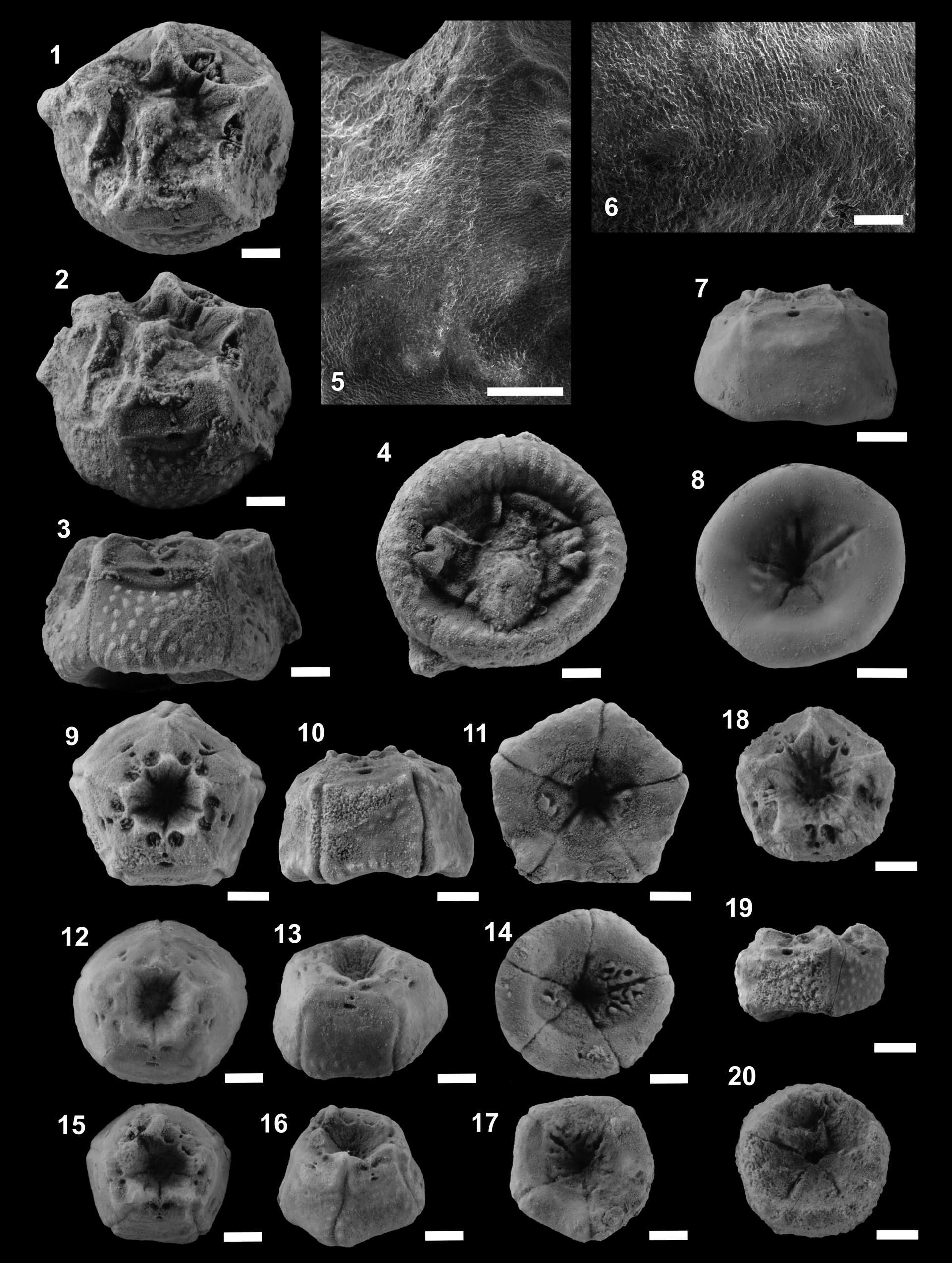
Gammarocrinites compressus (Goldfuss, Reference Goldfuss1829) from the middle Oxfordian of Tosos (Zaragoza, Spain), Yátova Formation, layer TO3/27. (1–4) Cup with well-detailed sutures and granulations in adoral, oblique, lateral, and aboral views (MPZ2024/105); (5) suture of radial plate observed through a scanning electron microscope (MPZ2024/105); (6) microstructure and granulation observed through a scanning electron microscope (MPZ2024/105); (7, 8) slightly abraded cup in lateral and aboral views (MPZ2024/117); (9–11) medium-sized cup with detailed sutures and granulations in adoral, lateral, and aboral views (MPZ2024/123); (12–14) cup with slightly erased granulation in adoral, oblique, and aboral view (MPZ2024/112); (15–17) cup with a flared base in adoral, oblique, and aboral views (MPZ2024/114); (18–20) small cup with granulation in adoral, lateral, and aboral views (MPZ2024/115). All specimens photographed whitened with ammonium chloride sublimated with exception of 5 and 6 which are covered by gold under SEM; scale bars = 1 mm (1–4; 9–20); 500 μm (5, 7, 8); 200 μm (6).
Lectotype
Cup from the Jura limestone of Germany, Jurassic (Goldfuss, Reference Goldfuss1829, p. 164, pl. L, fig. 5; according to Rasmussen, Reference Rasmussen1961, p. 218).
Emended diagnosis
Cup rather low, wider than high, granulated, asymmetric. Adoral articular facet almost flat, muscle fossae rounded. Sides of radial plates in lateral view straight, slightly concave, or flared at base, with distinctive suture, very finely and geometrically sinuous. Aboral cavity large, delimited by fine edges.
Occurrence
Late Jurassic, Oxfordian from Spain, Oxfordian to Tithonian in Europe (Hess and Messing, Reference Hess and Messing2011).
Description
Cup low, very or slightly asymmetrical, wider than high, pentagonal with rounded edges in adoral view. Highly variable aboral part, ranging from cylindrical (Fig. 5.4) to very flared, sometimes forming slight lobes (Fig. 5.17). Radial cavity highly variable in size, from small (Fig. 5.12) to moderate (Fig. 5.15, 5.18), funnel-shaped form, smooth cavity wall, interradial grooves more or less visible. Interradial processes of variable height, forming small spikes. Radial plate sutures clearly visible, with alternating rectangular lobes and hollows (zygosynostosis) at each end of the plate, becoming entangled at the sutures (Fig. 5.3, 5.5, 5.10, 5.16, 5.19). Marked, rather regular granulation on the cup surface, with small circular granules becoming larger and elongated aborally (Fig. 5.3), sometimes granulation is only visible on the lower contour of the aboral articular facet or totally faded and absent.
Radial articular facets generally slightly sloping outwards, adoral facets fairly flat and shallowly depressed, with variable size and inclination, trapezoidal in lateral view, circular or subcircular muscle fossae. Distinct transverse ridge, sometimes protruding when unabraded. Aboral articular facet of variable size, sometimes higher than the adoral articular facet, sometimes lower, generally as wide as the base of the adoral facets, rounded. Axial canal circular, sometimes subcircular, fairly large, sunken, located above the transverse ridge. Aboral ligament pit large, oval, and deep. Aboral face subcircular (Fig. 5.4), sometimes more pentagonal (Fig. 5.11), moderately deep, large, and conical, with quite distinct suture and sometimes with the outer edges granulated. Facet to the column shows a small, more pronounced depression at the bottom of the cavity and sometimes shows a slight crenularium with irregular granulation (Fig. 5.14, 5.17).
Materials
Several cups (MPZ2024/105–131) and additional material from the TO3/27 level, middle Oxfordian, Yátova Formation.
Remarks
Specimens are included within the species Gammarocrinites compressus because of the very distinct granulation around the entire circumference of the section (Fig. 5.3, 5.19) or around the aboral facets, the flat adoral articular facet (Fig. 5.3, 5.10, 5.13, 5.19), the small radial cavity, whose diameter does not appear to exceed the radius of the total section, and the protruding transverse ridge (as described in Goldfuss, Reference Goldfuss1826–1833; Rasmussen, Reference Rasmussen1961; Hess and Messing, Reference Hess and Messing2011). Given the large number of well-preserved samples we studied, we assume that G. compressus and Cyrtocrinus nutans (Goldfuss, Reference Goldfuss1829) have very similar cups, as already discussed in literature (de Loriol, Reference de Loriol1882–1884; Hess and Messing, Reference Hess and Messing2011; Hess, Reference Hess2012). Indeed, granulation is sometimes absent (Fig. 5.7, 5.8), although it remains present on the majority of specimens.
As described by de Loriol (Reference de Loriol1882–1884), it seems that the diameter of the radial cavity is an important feature in the variation of several morphological characters in the adoral part, such as the size of the interradial processes, or the orientation of the adoral articular facet. However, by observing calyxes from other Spanish levels, or by looking at photographs of Cyrtocrinus nutans cups made available to us by the Museum national d'Histoire naturelle de Paris (lot MNHN.F.A08034, collection d'Orbigny 3865), certain differences become apparent in the aboral part or in the shape of the radial plates, thus separation of two species is justifiable. Indeed, in the G. compressus specimens presented here, the aboral cavity appears large and flared, possibly shallow, and surrounded by thin radial plates (Fig. 5.4), sometimes to the point of making the delineation of the aboral cavity indistinct (Fig. 5.11). In C. nutans, this cavity is deep, always well delimited by thick radial plates, making it narrower and more circular. Also, in G. compressus, in lateral view, the radial plates are straight (Fig. 5.3, 5.10), slightly concave, or convex at the base of the sides, showing the maximum width of these plates, most often in the aboral part (sometimes becoming small lobes, as in Fig 5.16) or close to mid-height. Conversely, in C. nutans, the radial plates have strongly convex sides in lateral view, reaching their maximum width just below the aboral radial articular facet, the minimum width being at the base of the calyx.
The species studied here is easily distinguished from the Tithonian species Ascidicrinus pentagonus (Jaekel, Reference Jaekel1891) by its discoidal base without distinct interradial lobes. Material described here is distinguished from many other species by the particular simplexy suture of its radial plates (Fig. 5.3) In literature, only some specimens of the species Cyrtocrinus praenutans Hess, Reference Hess2012, appear to have similar sutures, but are still different in that they are composed of non-rectangular lobes and hollows (Hess, Reference Hess2012). Finally, G. compressus appears to be the only species of the genus Gammarocrinites described from the Oxfordian of Europe.
Genus Pilocrinus Jaekel, Reference Jaekel1907
Type species
Eugeniacrinus moussoni Desor, Reference Desor1845.
Diagnosis
As for the species by monotypy.
Pilocrinus moussoni (Desor, Reference Desor1845)
Figure 6
- Reference Desor1845
Eugeniacrinus Moussoni Desor, p. 220.
- Reference Quenstedt1852
Eugeniacrinites coronatus, Quenstedt, p. 615, pl. LIII, fig. 45.
- Reference Quenstedt1858
Eugeniacrinites coronatus; Quenstedt, p. 654, pl. LXXX, fig. 79.
- Reference Quenstedt1867
Eugeniacrinus coronatus; Quenstedt, p. 733, pl. LXVII, fig. 45.
- Reference Quenstedt1876
Eugeniacrinus coronatus; Quenstedt, p. 425, pl. 106, figs. 1–5.
- Reference de Loriol1879
Eugeniacrinus moussoni; de Loriol, p. 212, pl. XVIII, figs. 53–67.
- Reference de Loriol1882–1884
Eugeniacrinus moussoni; de Loriol, p. 138, pl. 14, figs. 13–24.
- Reference Quenstedt1885
Eugeniacrinus coronatus; Quenstedt, p. 936, pl. 74, fig. 38.
- Reference Jaekel1891
Gymnocrinus moussoni; Jaekel, p. 639, pl. XVIII, figs. 1, 2, text-fig. 17.
- Reference Rasmussen1961
Pilocrinus moussoni; Rasmussen, p. 226, pl. 32, fig. 6.
- Reference Arendt1974
Pilocrinus moussoni; Arendt, p. 113, pl. XII, figs. 5–8, pl. XIII, fig. 1.
- Reference Hess1975
Pilocrinus moussoni; Hess, p. 73, pl. 23, figs. 5–10, 17–18, pl. 25, fig. 5.
- Reference Rasmussen1975
Pilocrinus moussoni; Rasmussen, p. 281, text-fig. 1.
- Reference Rasmussen, Moore and Teichert1978
Pilocrinus moussoni; Rasmussen, p. T833, text-fig. 559.3.
- Reference Gluchowski1987
Pilocrinus moussoni; Gluchowski, p. 27, pl. 25, fig. 15, text-figs. 5, 17, 18.
- Reference Kästle1990
Pilocrinus moussoni; Kästle, p. 96, text-fig. 64.
- Reference Klikushin1996
Pilocrinus moussoni; Klikushin, p. 106, pl. 2, figs. 1–15, text-figs. 2, 7.
- Reference Kaufmann1998
Pilocrinus moussoni; Kaufmann, p. 10, text-fig. 7.4?.
- Reference Gorzelak2008
Pilocrinus moussoni; Gorzelak, p. 228, text-fig. 2E.
- Reference Salamon2008
Pilocrinus moussoni; Salamon, p. 88, text-fig. 4J, K.
- Reference Hess and Messing2011
Pilocrinus moussoni; Hess and Messing, p. T189; text-fig. 92.2.
- ?Reference Zamora, Aurell, Veitch, Saulsbury, López-Horgue, Ferratges, Arz and Baumiller2018
Pilocrinus sp., Zamora et al., p. 786, text-fig. 9B.
- Reference Salamon, Bubík, Ferré, Duda and Płachno2021
Pilocrinus moussoni; Salamon et al., text-fig. 3O.
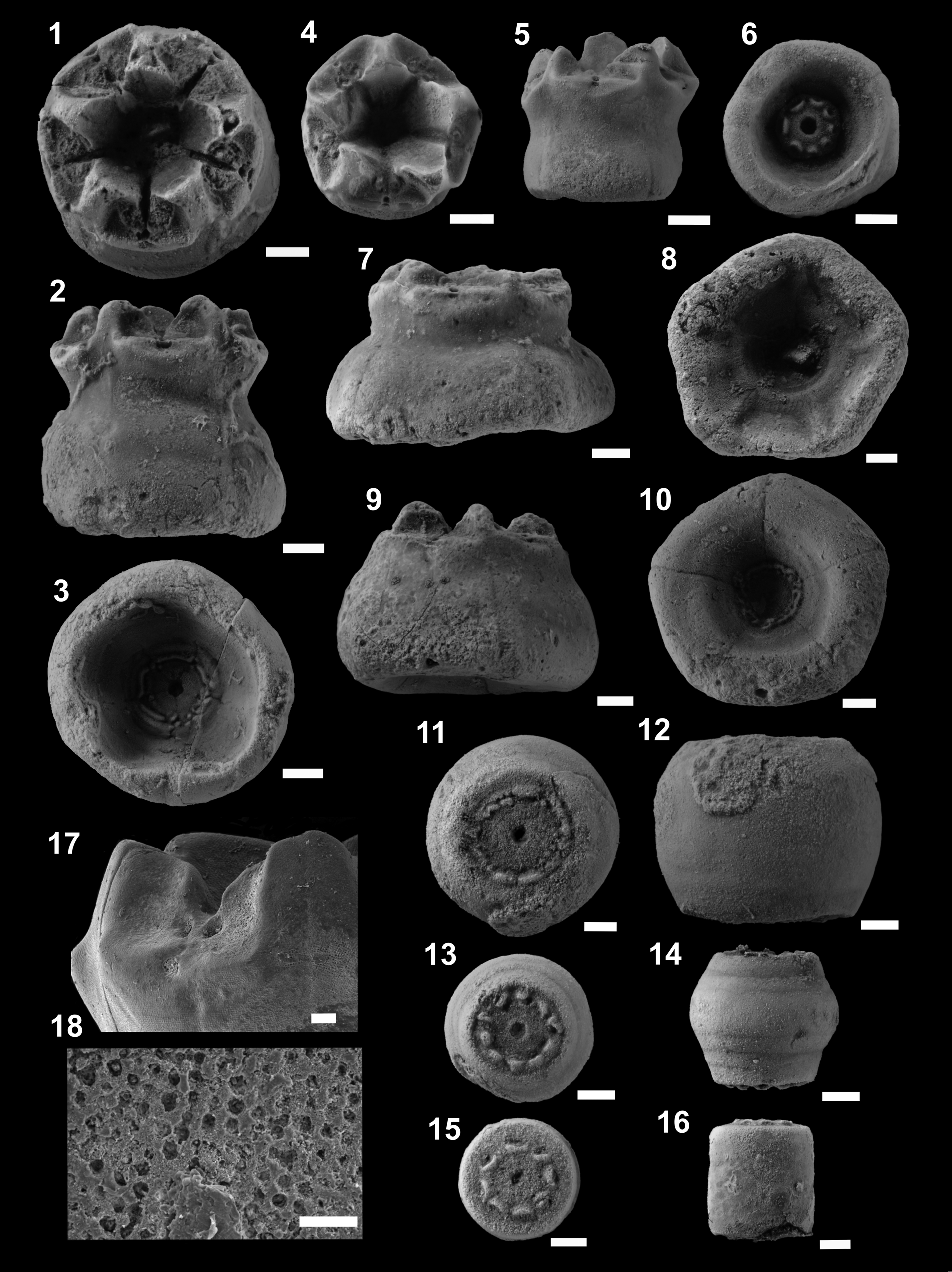
Pilocrinus moussoni (Desor, Reference Desor1845) from the middle Oxfordian of Tosos (Zaragoza, Spain), Yátova Formation, layer TO3/27. (1–3) High cylindrical cup in adoral, lateral, and aboral views (MPZ2024/137); (4–6) cup with first columnal still attached in adoral, lateral and aboral views (MPZ2024/145); (7, 8) cup with very wide basal part in lateral and aboral views (MPZ2024/136); (9, 10) thick cup in lateral and aboral views (MPZ2024/144); (11, 12) thick columnal in articular and lateral views (MPZ2024/139); (13, 14) strongly convex columnal in articular and lateral views (MPZ2024/141); (15, 16) cylindrical columnal in articular and lateral views (MPZ2024/140); (17) radial articular facet of a cup observed through a scanning electron microscope (MPZ2024/143); (18) stereom of a cup (MPZ2024/143). All specimens photographed whitened with ammonium chloride sublimated with exception of 17 and 18 which are covered by gold under SEM; scale bars = 1 mm (1–16); 200 μm (17); 50 μm (18).
Holotype
Rasmussen (Reference Rasmussen1961) referred to P. moussoni as the type species of the genus Pilocrinus, but indicated that no holotype had been designated for P. moussoni.
Diagnosis
Wide, cylindrical or conical cup, with a more or less pronounced mid-height restriction, differentiating a cylindrical adoral part in lateral view and circular in adoral view, from an aboral part forming a more or less flared cap, with a pentagonal or subcircular shape in aboral view. Radial cavity deep and narrow surrounded by well-developed interradial processes. Articular facets are wide and slightly inclined outwards, adoral facet as a sub-horizontal base. Aboral part of cup has a very deep, concave cavity, with a rather wide articular facet for column. Cylindrical to strongly convex columnals. Primibrachials 1 and 2 united by synostosis. Primibrachial 2 axillary with thickened sides, mostly united adorally and enclosing radial furrow. Secundibrachials commonly prolonged on one side but may also be united adorally (modified after Hess and Messing, Reference Hess and Messing2011).
Occurrence
Late Jurassic (Oxfordian) from Spain. Middle Jurassic (Callovian) from Poland (Salamon, Reference Salamon2008) to Late Cretaceous (Campanian) from Europe (Rasmussen, Reference Rasmussen1975).
Description
Cup high, aboral part considerably wider (Fig. 6.7) to slightly wider (Fig. 6.2) than adoral part, constriction at mid-height of varying degree. Smooth cup surface, plate sutures slightly developed, sometimes finely sinuous (Fig. 6.5). Adoral part of cup rounded, aboral part with subcircular or pentagonal outline. Radial cavity deep, moderately wide, adoral grooves deep and distinct, interradial grooves mostly indistinguishable. Thick interradial processes, rather high. Radial articular facets sloping outwards, aboral facet small, more rounded than crescent-shaped, aboral ligament pit relatively large, oval and deep, axial canal rounded, clearly distinguishable on the other side of the transverse ridge. Adoral facet wide and high, with rounded corners, generally sunken, so that its base forms a plateau almost perpendicular to the aboral articular facet, muscle fossae subvertical, elliptical, relatively deep (Fig. 6.2, 6.5, 6.17). Aboral side wide, sometimes with very thick edge (Fig. 6.10), large and deep cavity, radial plate sutures more or less visible. Facet to column large, circular, with thin but clearly visible crenularium, which appears to be composed of long irregular tubercles in adults (Fig. 6.3, 6.10), and much shorter and regular tubercles in juveniles (Fig. 6.6). Lumen circular, moderately wide, large areola. Columnals barrel-shaped, with significant shape variation (Fig. 6.12, 6.14, 6.16), sometimes the same width throughout, sometimes much wider at mid-height, generally convex, articular surfaces with moderately wide lumen, thin crenularium, and large areola.
Materials
Several cups (MPZ2024/136–138, MPZ2024/142–144), some with columnals still attached (MPZ2024/145), several columnals (MPZ2024/139–141), and additional material from the TO3/27 level, middle Oxfordian, Yátova Formation.
Remarks
The constriction at mid-height (Fig. 6.2) and the deep, wide aboral part of the cup (Fig. 6.3, 6.10) are characteristic of the species P. moussoni (de Loriol, Reference de Loriol1882–1884). The radial cavity of the specimens is moderately wide, but deep (Fig. 6.2, 6.10), as originally described by Desor (Reference Desor1845) and later considered by de Loriol (Reference de Loriol1882–1884). Other diagnostic features of the specimens are their large size in the adult stage, and their “cap-like appearance” (Desor, Reference Desor1845). This appearance is explained by a wide, very deep aboral cavity. The shape and structure of the radial articular facet (Fig. 6.17) agree with descriptions by de Loriol (Reference de Loriol1882–1884). Specimens show an important variability in different morphological characteristics, such as the size of the cup, the form of the aboral part (Fig. 6.3, 6.8, 6.10), the size of the interradial processes (Fig. 6.2, 6.7), their asymmetry, and the thickness of the cup (Fig. 6.3, 6.10), contradicting the explanations of Jaekel (Reference Jaekel1891). This phenomenon could be linked to an occurrence in shallow water, which could indicate adaptations to hydrodynamic regimes or stronger predation pressures, but this requires further study on a larger number of specimens. Columnals show a variety of shapes, but most often barrel-shaped, sometimes very wide (Fig. 6.12), convex, and their articular surface has a wide lumen with marginal tubercles arranged in a circle, whose organization seems to vary according to specimen size (Fig. 6.11, 6.13, 6.15). These characteristics correspond to specimens figured in Salamon (Reference Salamon2008) and Salamon et al. (Reference Salamon, Bubík, Ferré, Duda and Płachno2021).
Pilocrinus moussoni seems to be the only species of the genus Pilocrinus described from the Oxfordian and is very characteristic of this period (de Loriol, Reference de Loriol1882–1884; Jaekel, Reference Jaekel1891; Hess and Messing, Reference Hess and Messing2011), but some columnals have been described from the Callovian (Salamon, Reference Salamon2008), and others from the Cretaceous (Rasmussen, Reference Rasmussen1961). A cup of this species also has been recorded from the Campanian of Germany (Rasmussen, Reference Rasmussen1975). For some reason, some authors seem not to integrate the later discovery into the stratigraphic extension of the species (Hess and Messing, Reference Hess and Messing2011; Salamon et al., Reference Salamon, Bubík, Ferré, Duda and Płachno2021).
Genus Ascidicrinus Hess, Salamon, and Gorzelak, Reference Hess, Salamon and Gorzelak2011
Type species
Ascidicrinus armatus Hess, Salamon, and Gorzelak, Reference Hess, Salamon and Gorzelak2011.
Diagnosis
Cups rather low, bulging or lobed interradially, especially in proximal view, commonly ornamented; radial articular facets broad, not sunken; radial cavity relatively deep, variable in diameter; facet for the column deep (after Hess et al., Reference Hess, Salamon and Gorzelak2011).
Ascidicrinus pentagonus (Jaekel, Reference Jaekel1891)
Figure 7.1–7.9
- Reference Jaekel1891
Sclerocrinus strambergensis var. pentagona Jaekel, p. 624, pl. XXXVII, figs. 8, 9.
- Reference Žítt1974
Sclerocrinus pentagonus; Žítt, pl. 3, figs. 1–12, pl. 4, figs. 7–12.
- Reference Manni, Nicosia and Szabó1992
Gammarocrinites bakonicus Manni, Nicosia, and Szabó, pl. 1, figs. 3, 4, text-fig. 4.
- Reference Hess and Messing2011
Ascidicrinus pentagonus; Hess et al., p. 124, text-fig. 2A.
- Reference Krajewski, Ferré and Salamon2020
Ascidicrinus pentagonus; Krajewski et al., p. 70, text-fig. 7A, B.
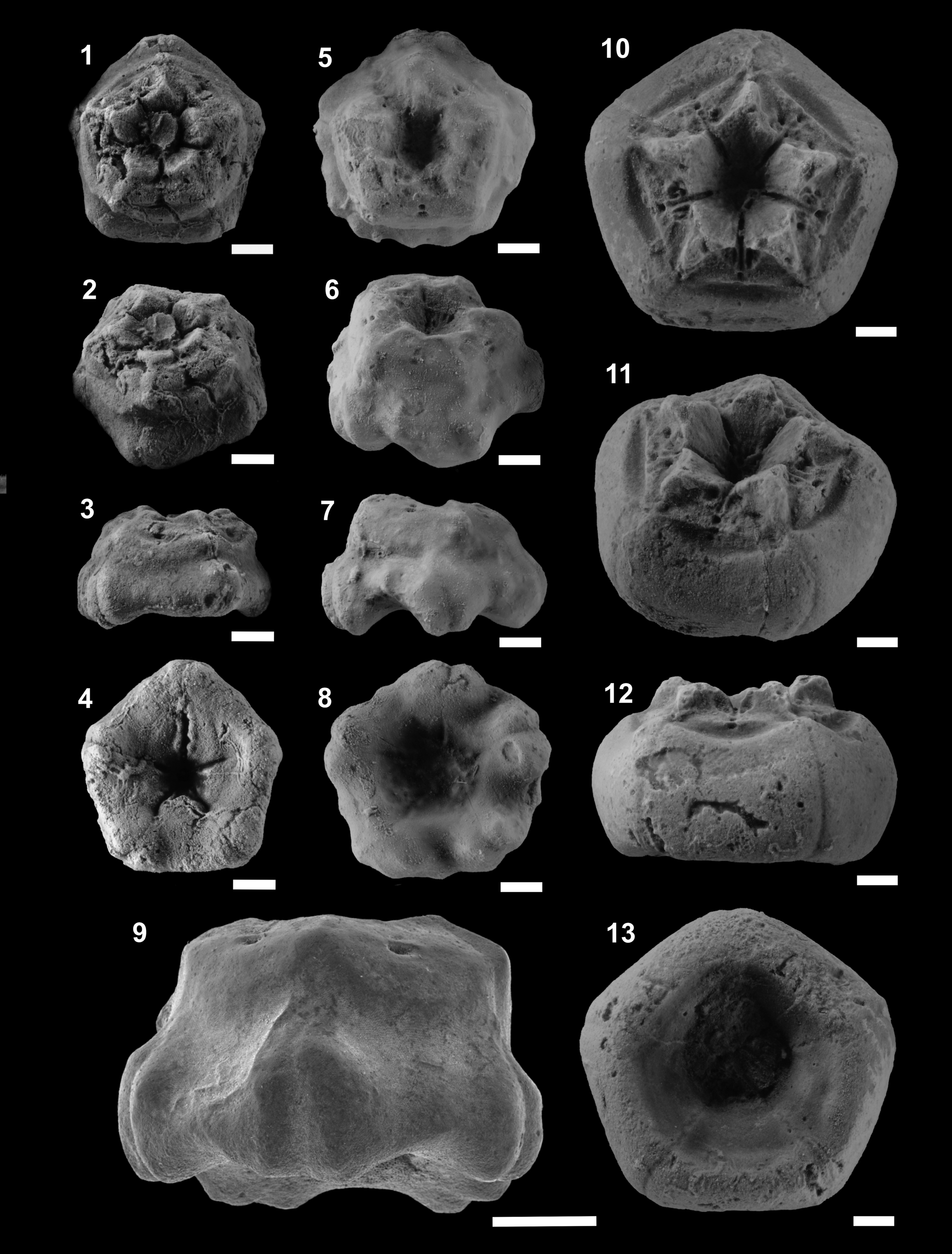
Other Sclerocrinidae Jaekel, Reference Jaekel1918, from the middle Oxfordian of Tosos (Zaragoza, Spain), Yátova Formation, layer TO3/27. (1–4) Ascidicrinus pentagonus (Jaekel, Reference Jaekel1891) cup with serpulids in adoral, oblique, lateral, and aboral views (MPZ2024/133); (5–8) A. pentagonus cup slightly abraded in adoral, oblique, lateral, and aboral views (MPZ2024/134); (9) A. pentagonus complete cup observed through a scanning electron microscope in lateral view (MPZ2024/135). (10–13) Sclerocrinus cf. S. strambergensis Jaekel, Reference Jaekel1891 cup with pits and scratches in adoral, oblique, lateral, and aboral views (MPZ2024/146). All specimens photographed whitened with ammonium chloride sublimate with exception of (9), which is covered by gold under SEM; all scale bars represent 1 mm.
Lectotype
According to Žítt (Reference Žítt1974), cup from red marl of Štramberk, Czech Republic, early Lower Cretaceous (Jaekel, Reference Jaekel1891, pl. XXXVII, fig. 8).
Emended diagnosis
Cup low, pentagonal, generally smooth or very finely granular, with well-developed and robust interradial lobes in adoral part. Radial cavity narrow, moderately deep.
Occurrence
Late Jurassic, Oxfordian of Spain, Tithonian of Hungary, to Early Cretaceous (Berriasian–Valanginian) of France, Poland, Ukraine, and Czech Republic (Hess et al., Reference Hess, Salamon and Gorzelak2011).
Description
Rather small, low cup, slightly restricted at mid-height (Fig. 7.3, 7.7), aboral part wider than adoral part. Clearly pentagonal in oral and adoral views. Suture of radial plates generally slightly distinct but forms a very visible groove on the interradial lobes (Fig. 7.8). Smooth or slightly granular surface. Interradial lobes rather developed in basal part, very visible in lateral view, sometimes less indented in aboral view (Fig. 7.4). Interradial processes poorly developed, surrounding a small, fairly deep, circular to slightly pentagonal radial cavity with clearly visible adoral grooves. Articular facets of radial plates shallowly depressed and sloping outwards, aboral facet small, rounded or crescent-shaped, with fairly wide, subcircular aboral ligament pit, axial canal very small, rarely visible (Fig. 7.3, 7.7). Adoral facet wider and higher, rather trapezoidal (Fig. 7.2, 7.6), muscle fossae small, round when visible (Fig. 7.2). Aboral cavity pentagonal, wide, fairly deep, sutures of radial plates clearly visible, sometimes toothed (Fig. 7.4), facet to the column small but deep with crenulated edges.
Materials
Several cups (MPZ2024/132–135) from the TO3/27 level, middle Oxfordian, Yátova Formation.
Remarks
The pentagonal shape and the fairly distinct interradial lobes (Fig. 7.3, 7.7, 7.9) are the main characters that allow these specimens to be assigned to Ascidicrinus pentagonus. Other features such as the narrow radial cavity, aboral cavity, and general appearance of the specimen are in line with the description by Hess et al. (Reference Hess, Salamon and Gorzelak2011). Some specimens also correspond to the description of A. pentagonus from Manni et al. (Reference Manni, Nicosia and Szabó1992), in that the aboral articular facets are subvertical, crescent-shaped, with a wide aboral ligament pit and a small axial canal (Fig. 7.9). The adoral articular facet, on the other hand, is wider, with subcircular or circular muscular pits (Fig. 7.3) (Manni et al., Reference Manni, Nicosia and Szabó1992). This morphology of the facets supports the species determination of these specimens, even though the interarticular lobes are not as well developed, a feature already discussed by Hess et al. (Reference Hess, Salamon and Gorzelak2011). Finally, the surface of the specimens studied here appears to have little or no ornamentation (Fig. 7.3, 7.7), unlike the specimen of Manni et al. (Reference Manni, Nicosia and Szabó1992), but Hess et al. (Reference Hess, Salamon and Gorzelak2011) did not consider this as a characteristic of the species A. pentagonus. Moreover, A. pentagonus was also described as a small form, with no particular granulation by Jaekel (Reference Jaekel1891). The difference in ornamentation, added to the pentagonal shape of the specimen, easily distinguishes this species from Ascidicrinus armatus Hess, Salamon, and Gorzelak, Reference Hess, Salamon and Gorzelak2011.
The specimens described here, and particularly the smaller forms, resemble certain individuals of Gammarocrinites compressus by their adoral part and the general shape of their articular facet. However, the presence of interradial lobes in the aboral part is a diagnostic character of A. pentagonus. Thus, the attribution of these specimens to different species seems difficult. This discovery modifies the stratigraphic distribution of this species, making this the oldest known occurrence for A. pentagonus.
Genus Sclerocrinus Jaekel, Reference Jaekel1891
Type species
Sclerocrinus strambergensis Jaekel, Reference Jaekel1891.
Diagnosis
Cup mostly round, extremely massive; radial articular facet rounded, sloping strongly outward, with very small muscle fossae; radial cavity small. Facet to column large and deep, with differentiated inner part containing minute columnals (slightly modified after Hess and Messing, Reference Hess and Messing2011).
Sclerocrinus cf. S. strambergensis Jaekel, Reference Jaekel1891
Figure 7.10–7.13
Occurrences
Late Jurassic (Oxfordian) of Spain, Tithonian of Czech Republic (Jaekel, Reference Jaekel1891), and Early Cretaceous (Valanginian) from Poland (Salamon and Gorzelak, Reference Salamon and Gorzelak2010b).
Description
Fairly large, compact cup, very wide and not very high, slightly asymmetrical. Wide and thick, convex-sided radial plates with flat lower edge and concave upper edge in lateral view (Fig. 7.12). Smooth cup surface with well-marked, straight or sometimes finely striated interradial sutures (Fig. 7.12, 7.13). Pentagonal adoral face with rounded rim, rather small radial cavity, a bit smaller than half the diameter of the cup, smooth rim. Deep, moderately narrow adoral grooves, interradial grooves inconspicuous (Fig. 7.10). Fairly well-developed interradial processes, surrounding a wide radial articular facet, whose edges meet the radial plate sutures. Aboral articular facet subvertical, crescent-shaped, rounded, not very high, sunken. Deep aboral ligament pit, moderately wide, subcircular or oval, more or less pronounced transverse ridge, thin, deep axial canal, slightly recessed, similar in size to the aboral ligament pit. Slightly high adoral articular facet, with a subhorizontal base, then, more vertical as the interradial processes rise, trapezoidal in shape with more or less rounded sides, fairly deep (Fig. 7.12). Muscle fossae almost subvertical in lateral view (Fig. 7.12), oblong or oval in adoral view (Fig. 7.10). Thick-edged, pentagonal aboral face with no visible lobes, surrounding a circular or elliptical, fairly wide and deep cavity with rather visible, sometimes raised sutures.
Materials
One cup (MPZ2024/146) from the TO3/27 level, middle Oxfordian, Yátova Formation.
Remarks
The overall shape of the specimen combined with the thick radial plates that make it globular (Fig. 7.11, 7.12) are reminiscent of the S. strambergensis specimens described by Jaekel (Reference Jaekel1891) or Rasmussen (Reference Rasmussen1961). However, there are a number of characteristics that make species assignations problematic, such as the radial cavity, which is not as small as that of previously described specimens (Jaekel, Reference Jaekel1891; Rasmussen, Reference Rasmussen1961), the aboral face, which is not completely exposed (Fig. 7.13), making it impossible to observe the facets to the column. These features combined with the scarcity of material prevent a confident assignation to S. strambergensis.
This specimen differs from those of the Cyrtocrinus nutans and Gammarocrinites compressus in its large size, globular shape, the form of its radial articular facets, and its well-developed interradial processes. It also differs from the Pilocrinus moussoni specimens in that its adoral part is not raised and has straight edges; also, there is no constriction at mid-height, just the opposite, with the greatest width at this point. It differs from the Tithonian species Cyrtocrinus praenutans by the shape of its radial plates and by the size or the shape of the aboral cavity. The sutures of the specimen are sometimes slightly sinuous, giving patterns similar to those of G. compressus, C. praenutans, and P. moussoni, perhaps indicating that this feature may be peculiar to the Sclerocrinidae.
Superfamily Plicatocrinoidea Zittel, Reference Zittel1879
Family Tetracrinidae Nicosia, Reference Nicosia1991
Genus Tetracrinus Münster, Reference Münster1839
Type species
Eugeniacrinites moniliformis Münster in Goldfuss, Reference Goldfuss1826.
Diagnosis
Cup low, compact, with 3–6, commonly 4, radials, separated by a constriction and suture, more or less distinct from compact basal element, which may be discoidal, lenticular, barrel-shaped, or low subconical, resembling a columnal. Radial cavity moderate, continued in shallow central depression in basal element, generally less than half diameter of cup. Radial articular facet large and broad, occupying entire distal edge of cup and meeting along interradial sutures. Primibrachials 1 and 2 fused. Columnal articular facets with few crenulae or ridges, commonly in 4 groups (slightly modified after Hess and Messing, Reference Hess and Messing2011).
Tetracrinus moniliformis (Münster in Goldfuss, Reference Goldfuss1826–1833)
Figure 8
- Reference Goldfuss1829
Eugeniacrinites moniliformis Münster in Goldfuss, p. 200, pl. LX, fig. 8.
- Reference Münster1839
Tetracrinus moniliformis; Münster, p. 88, pl. XI, figs. 3a, b, 4.
- Reference Bronn1851–1852
Tetracrinus moniliformis; Bronn, p. 117, pl. XV, fig. 15a–d.
- Reference Quenstedt1852
Eugeniacrinites moniliformis; Quenstedt, p. 616, pl. LIII, fig. 52.
- Reference Quenstedt1852
Tetracrinus moniliformis; Quenstedt, p. 616, pl. LIII, figs. 49, 50.
- Reference Pictet1857
Tetracrinus moniliformis; Pictet, p. 335, pl. CII, fig. 2.
- Reference Quenstedt1858
Tetracrinus moniliformis; Quenstedt, p. 655, pl. LXXX, figs. 82–92.
- Reference Goldfuss1862
Eugeniacrinites moniliformis Goldfuss, p. 155, pl. LX, fig. 8a–i, k–m.
- Reference Quenstedt1876
Tetracrinus moniliformis; Quenstedt, p. 437, pl. 106, figs. 72–107.
- Reference de Loriol1879
Tetracrinus moniliformis; de Loriol, p. 243, pl. XIX, figs. 37–48.
- Reference de Loriol1882–1884
Tetracrinus moniliformis; de Loriol, p. 182, pl. 19, figs. 1–10.
- Reference Quenstedt1885
Tetracrinus moniliformis; Quenstedt, p. 937, pl. 74, figs. 41–44.
- Reference Bather1889
Tetracrinus moniliformis; Bather, p. 167, pl. VI, fig. 16.
- Reference Jaekel1892
Tetracrinus moniliformis; Jaekel, p. 647, pl. XXVII, figs. 1–18, pl. XXVIII, figs. 7–9.
- Reference Reměs1902
Tetracrinus moniliformis; Reměs, p. 206, pl. XX, fig. 3a, b.
- Reference Arendt1974
Tetracrinus moniliformis; Arendt, p. 86, pl. I, fig. 1–9, pl II, figs. 1–15, text-fig. 13a–c.
- Reference Hess1975
Tetracrinus moniliformis; Hess, p. 75, pl. 23, fig. 20, pl. 26, figs. 1–11.
- Reference Rasmussen, Moore and Teichert1978
Tetracrinus moniliformis; Rasmussen, p. T829, text-fig. 557.2.
- Reference Zatoń, Salamon and Kaźmierczak2008
Tetracrinus moniliformis; Zatoń et al., p. 564, text-fig. 2F.
- Reference Salamon2008
Tetracrinus moniliformis; Salamon, p. 84, text-figs. 3E–H, 5A.
- Reference Hess, Salamon and Gorzelak2011
Tetracrinus moniliformis; Hess and Messing, p. T196, text-fig. 96.1
- Reference Quereilhac and Guinot2011
Tetracrinus moniliformis; Quereilhac and Guinot, p. 43, pl. 6, fig. 4.
- Reference Zamora, Aurell, Veitch, Saulsbury, López-Horgue, Ferratges, Arz and Baumiller2018
Tetracrinus sp., Zamora et al., p 786, text-fig. 9E.
- Reference Salamon, Bubík, Ferré, Duda and Płachno2021
Tetracrinus moniliformis; Salamon et al., p. 8, fig. 3P–T.
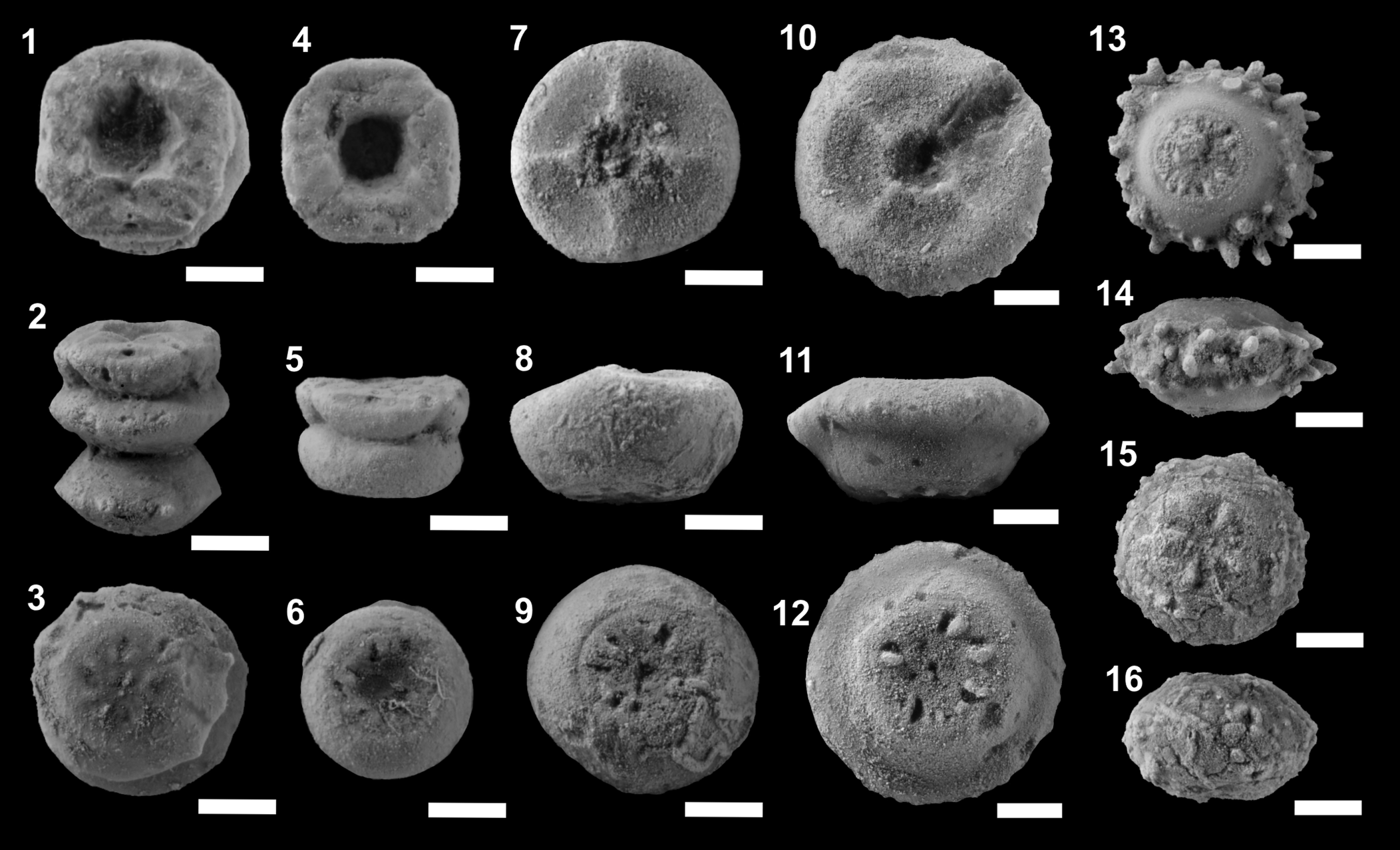
Tetracrinus moniliformis (Münster, 1829, in Goldfuss, Reference Goldfuss1826–1833), specimens from the middle Oxfordian of Tosos (Zaragoza, Spain), Yátova Formation, layer TO3/27. (1–3) Cup with basal circlet and first columnal still attached in adoral, lateral, and aboral views (MPZ2024/150); (4–6) cup with basal circlet still attached in adoral, lateral, and aboral views (MPZ2024/148); (7–9) basal circlet in adoral, lateral, and aboral views (MPZ2024/151); (10–12) basal circlet in adoral, lateral, and aboral views (MPZ2024/147); (13, 14) columnal in articular and lateral views (MPZ2024/149); (15, 16) slightly abraded columnal in articular and lateral views (MPZ2024/152). All specimens photographed whitened with ammonium chloride sublimate; all scale bars represent 1 mm.
Lectotype
Basal circlet from the Jurassic of Streitberg (Oberfranken, Germany) (Münster in Goldfuss, Reference Goldfuss1826, p. 165, pl. LX, fig. 8l, m).
Diagnosis
Cup low, conical, well differentiated from the basal circlet. Basal circlet flat, strongly circular with a discoidal appearance and sometimes an enlarged top edge where granulation is located. Columnals varying in shape with fine and more or less regular granulation at mid-height, sometimes thorny. Aboral side of basal circlet and columnals with a large number of tubercles placed in a circle.
Occurrences
Middle Oxfordian of Spain, Callovian of Poland (Salamon and Feldman-Olszewska, Reference Salamon and Feldman-Olszewska2018), and Kimmeridgian of Czech Republic (Arendt, Reference Arendt1974).
Description
Small cup, rectangular in adoral view, with 4 radials surrounding a fairly deep, subrectangular radial cavity, relatively small in diameter (Fig. 8.1, 8.4). Radial plates not very high, convex, and bear a flat, almost horizontal adoral articular facet, as well as more outwardly inclined aboral articular facet with small and round axial canal, a slightly larger, oval aboral ligament pit, and a filiform transverse ridge. Cup can be found still articulated with the basal circles (Fig. 8.2, 8.5), and the suture seems quite deep and clearly discernible. Basal circlet flat, strongly circular with a discoidal appearance, rounded or sometimes with raised edge in lateral view (Fig. 8.2, 8.5, 8.8, 8.11), ornamented or smooth. Four crests running from center to outside of the circle in adoral view, with fairly small, shallow cavity. On some specimens (Fig. 8.10) the four ribs do not reach the outer edge of the basal circlet and the articulation facets for the radials are small, revealing a wide areola between these zones and the edge of the basal circlet. With these types of ossicles, basal circlet is wider than the rest of the cup, revealing part of its adoral side (Fig. 8.2). Aboral face flat or slightly concave, facet to the column comprises a small lumen (Fig. 8.9, 8.12), surrounded by a slightly wide areola and a crenularium composed of elongated tubercles, alternating with grooves, arranged in a circle (Fig. 8.6, 8.9, 8.12). Columnals cylindrical, convex laterally, sometimes discoid with almost triangular sides (Fig. 8.2), sometimes as high as wide, granulation at mid-height with tubercles more or less aligned, most of the time forming distinct spines (Fig. 8.13, 8.14). Articular surface smooth on the edges, with facet in the center featuring a small lumen and a few laterally flattened and regular granules on its contour (Fig. 8.13).
Materials
Cup with basal circlet (MPZ2024/148) and sometimes first columnals (MPZ2024/150) still attached, isolated basal circlets (MPZ2024/147, MPZ2024/151), few columnals (MPZ2024/149, MPZ2024/152), and additional material from the TO3/27 level, middle Oxfordian; Yátova Formation.
Remarks
This species is particularly recognizable by a cup with four radials well separated from a flat basal circlet (Fig. 8.2, 8.5). Disarticulated basal circlets are flat, bearing four ribs, sometimes the surface is marked with granulations, recalling the description of de Loriol (Reference de Loriol1879). The material described here shows considerable variability in terms of basal circlets and columnals, and some specimens also vary from those in the literature. Basal circlet varies from laterally rounded (Fig. 8.5, 8.8) to flanged (Fig. 8.2, 8.11). In plan view, articulation facet also changes and is sometimes restricted to the whole width of the basal circlet (Fig. 8.7), having in other cases a relatively wide epifacet (Fig. 8.10). These differences also have been described in the literature (see Jaekel, Reference Jaekel1892).
In terms of columnals, there is significant variation in ornamentation, with most of the columnals described here having ornamentation composed of tubercles transformed into long spines (Fig. 8.13, 8.14), while others have less developed ornamentation (Fig. 8.15, 8.16) or lack ornamentation. The shape of the columnals is also variable, but the first columnal still attached to the section (see Fig. 8.2) has a single row of spines that is different from material described in Hess and Messing (Reference Hess and Messing2011, fig. 96, 1a), which is barrel-shaped. However, despite all these variations on several types of T. moniliformis ossicles, this species was described by Jaekel, Reference Jaekel1892, as highly variable, reinforcing the idea that our specimens are included in this species. Further studies are still needed, with much more material.
All the specimens described here can be distinguished from Tetracrinus galei Hess, Reference Hess2014a, by the numerous tubercles surrounding the facet for the column in aboral view (Fig. 8.3, 8.6, 8.9, 8.11), its well-defined suture between the cup and the basal circlet, and by its extensive granulation (Fig. 8.13, 8.14). Tetracrinus moniliformis also has finer, more regular granulation on its stem articles than T. galei, whose ornamentation is more tessellated and irregular (Hess, Reference Hess2014a).
Discussion
Diversity and taphonomy of cyrtocrinids from the studied interval
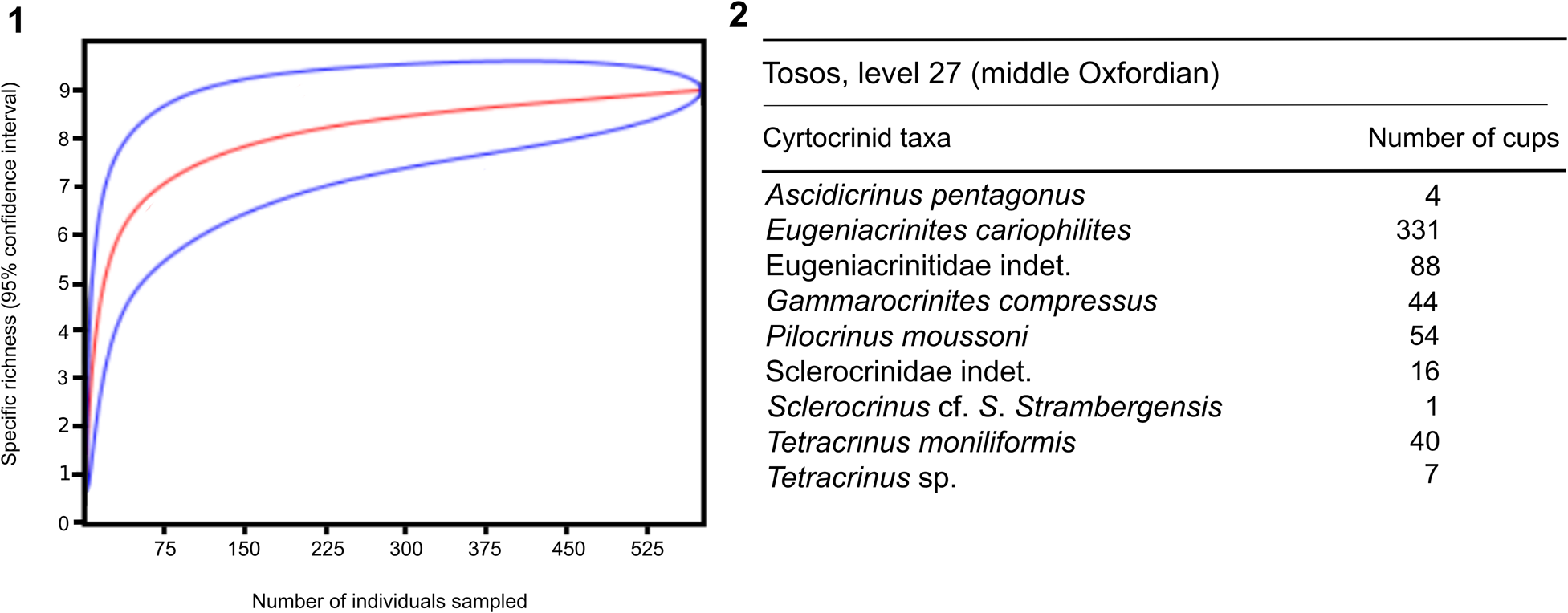
Cyrtocrinids are important components in Jurassic sponge meadows from the Tethyan realm (Klikushin, Reference Klikushin1996; Salamon, Reference Salamon2008; Zatoń et al., Reference Zatoń, Salamon and Kaźmierczak2008 Hess et al., Reference Hess, Salamon and Gorzelak2011) but they have been only figured in Iberia by Zamora et al. (Reference Zamora, Aurell, Veitch, Saulsbury, López-Horgue, Ferratges, Arz and Baumiller2018). According to this new study, at least six species of cyrtocrinids are present in the middle Oxfordian of Tosos (level 27), for a total of 585 cups. Sampling of the level appears to have been statistically representative, since it seems to have captured the majority of the species present (Fig. 9).
(1) Rarefaction curve for Tosos cyrtocrinids (level 27), within a 95% confidence interval, rapidly reaching a plateau. (2) Cyrtocrinid species studied with their respective number of cups.
The cyrtocrinids discovered in the Yátova Formation (Tosos, Zaragoza) appear to be an important parautochthonous component of the paleoenvironment of this locality during the Oxfordian. In fact, several remains are sometimes as well preserved as in certain Lagerstätten (Charbonnier et al., Reference Charbonnier, Vannier, Gaillard, Bourseau and Hantzpergue2007) with complete cups (sometimes articulated to the proximal columnals) and other disarticulated elements (brachials, columnals, holdfasts) that even preserve traces of stereom (Figs. 5.6, 6.18). This degree of preservation is incompatible with long-distance and/or high-energy transport, suggesting parautochtony.
Cyrtocrinids can be classified as taphonomic type III echinoderms (Brett et al., Reference Brett, Moffat and Taylor1997; Zatoń et al., Reference Zatoń, Salamon and Kaźmierczak2008; Salamon et al., Reference Salamon, Bubík, Ferré, Szydło, Nescieruk, Płachno, Brachaniec and Paszcza2020), especially because they have cups composed with fussed radials. They may have remained on the seafloor for some time without being disarticulated (Brett et al., Reference Brett, Moffat and Taylor1997), so they might have undergone some transport. The fact that some specimens are well preserved but contain epibionts points to some exposure time before final burial. Preservation varies from excellent to moderate (with some ossicles showing traces of abrasion), which is compatible with time-averaged communities that remain on the sea floor after death in environments with low sedimentation rates (Zamora, Reference Zamora2022).
The cyrtocrinids from Tosos appear to have lived in a shallow environment, which may have slightly exceeded the lower limit of storm wave action (Zamora et al., Reference Zamora, Aurell, Veitch, Saulsbury, López-Horgue, Ferratges, Arz and Baumiller2018), dominated by sponge meadows alongside many other organisms. The presence of a rich and diverse fauna of cyrtocrinids, sponges, brachiopods, and other suspension-feeding organisms, combined with geological and paleogeographical contexts that may have generated numerous siliciclastic deposits, indicates a nutrient-rich environment, but does not necessarily indicate a high rate of sedimentation. In fact, because remains from the environment contain a large number of epibionts (notably serpulids) and because cyrtocrinid larvae potentially need a time of lower sedimentation rate to attach themselves to the substrate (Zamora et al., Reference Zamora, Aurell, Veitch, Saulsbury, López-Horgue, Ferratges, Arz and Baumiller2018), this indicates a generally low or episodically interrupted sedimentation rates during deposition of the Yátova Formation. However, the hypothesis of occasionally interrupted sedimentation seems less appropriate in view of the stable conditions that are necessary for the development of sponge meadows (Leinfelder et al., Reference Leinfelder, Schmid, Nose, Werner, Flügel, Kiessling and Golonka2002).
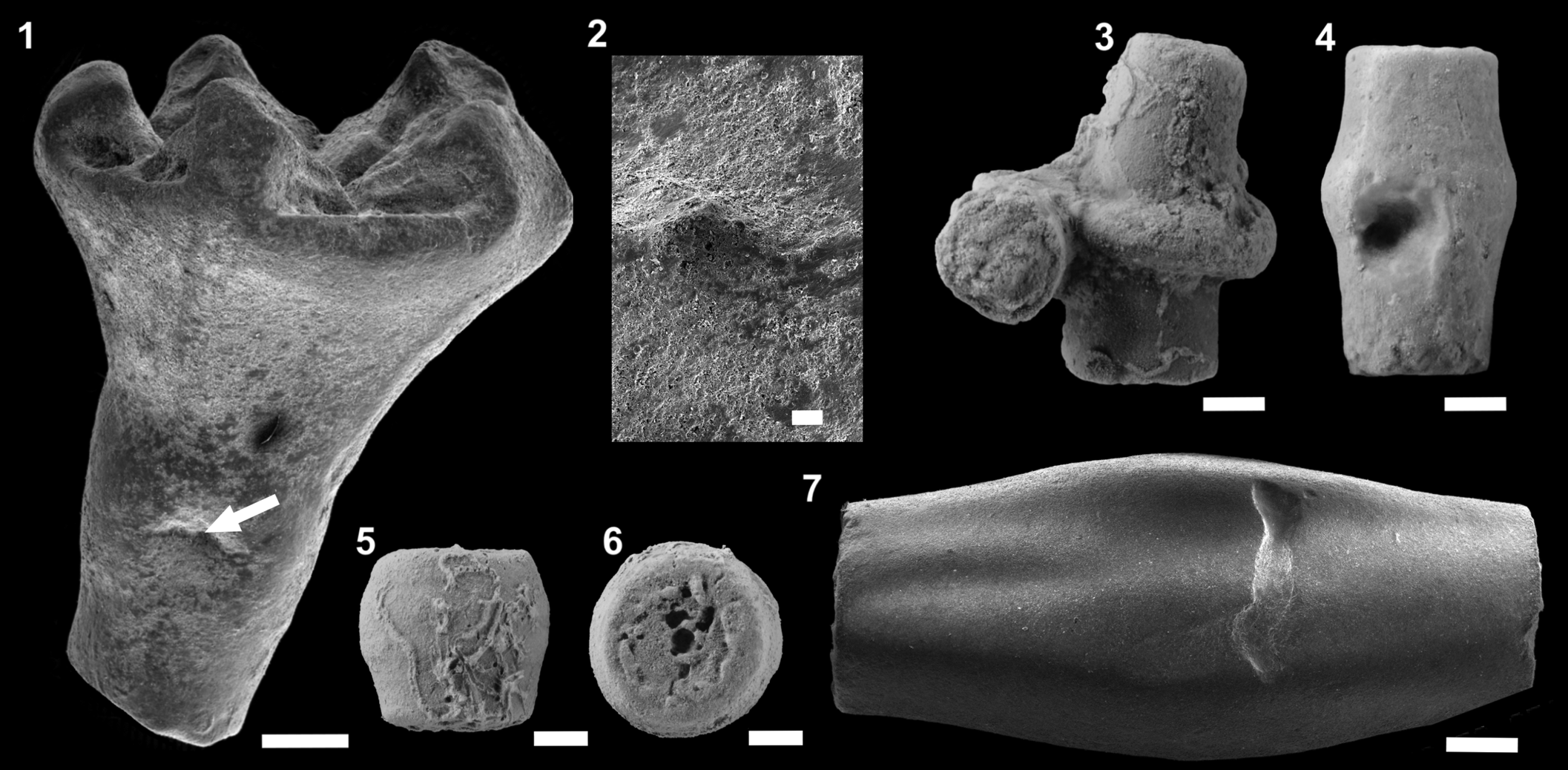
Concerning epizoans, it seems that the small sizes of cyrtocrinids do not make them a preferential substrate for many organisms, with the exception of serpulids (Klikushin, Reference Klikushin1996). From the latter, only two forms seem to be present here, most of which are very thin serpulids, less than a millimeter in diameter, generally running along a single face of a cup or column, in the form of more or less pronounced zigzags (Fig. 10.5). These forms probably settled after the death of the animal because they are present on only one side and/or on articular facets (Figs. 10.6, 11.3), but sometimes they were able to encrust the animal during life (Klikushin, Reference Klikushin1996). More rarely, serpulids are found in the form of a girdle (“girdling serpulids”) around a cyrtocrinid stem (Fig. 10.3), which may point to syn-vivo encrustation (Klikushin, Reference Klikushin1996).
Traces of interactions on cyrtocrinids remains from the middle Oxfordian of Tosos (Zaragoza, Spain), Yátova Formation, layer TO3/27. (1, 2) Eugeniacrinites cariophilites with parasite on the suture between cup and first columnal (MPZ2024/103), observed through a scanning electron microscope in lateral and enlarged views; (3) serpulid surrounding a cyrtocrinid columnal (MPZ2024/153); (4) Ooichnus sp. in a columnal (MPZ2024/202); (5, 6) serpulids on one side of a Pilocrinus moussoni columnal in lateral and articular views (MPZ2024/204); (7) trace of predation on a columnal (MPZ2024/201). All specimens photographed whitened with ammonium chloride sublimated with exception of (1, 2, 7), which are covered by gold under SEM; scale bars = 1 mm (1, 3–7); 100 μm (2).
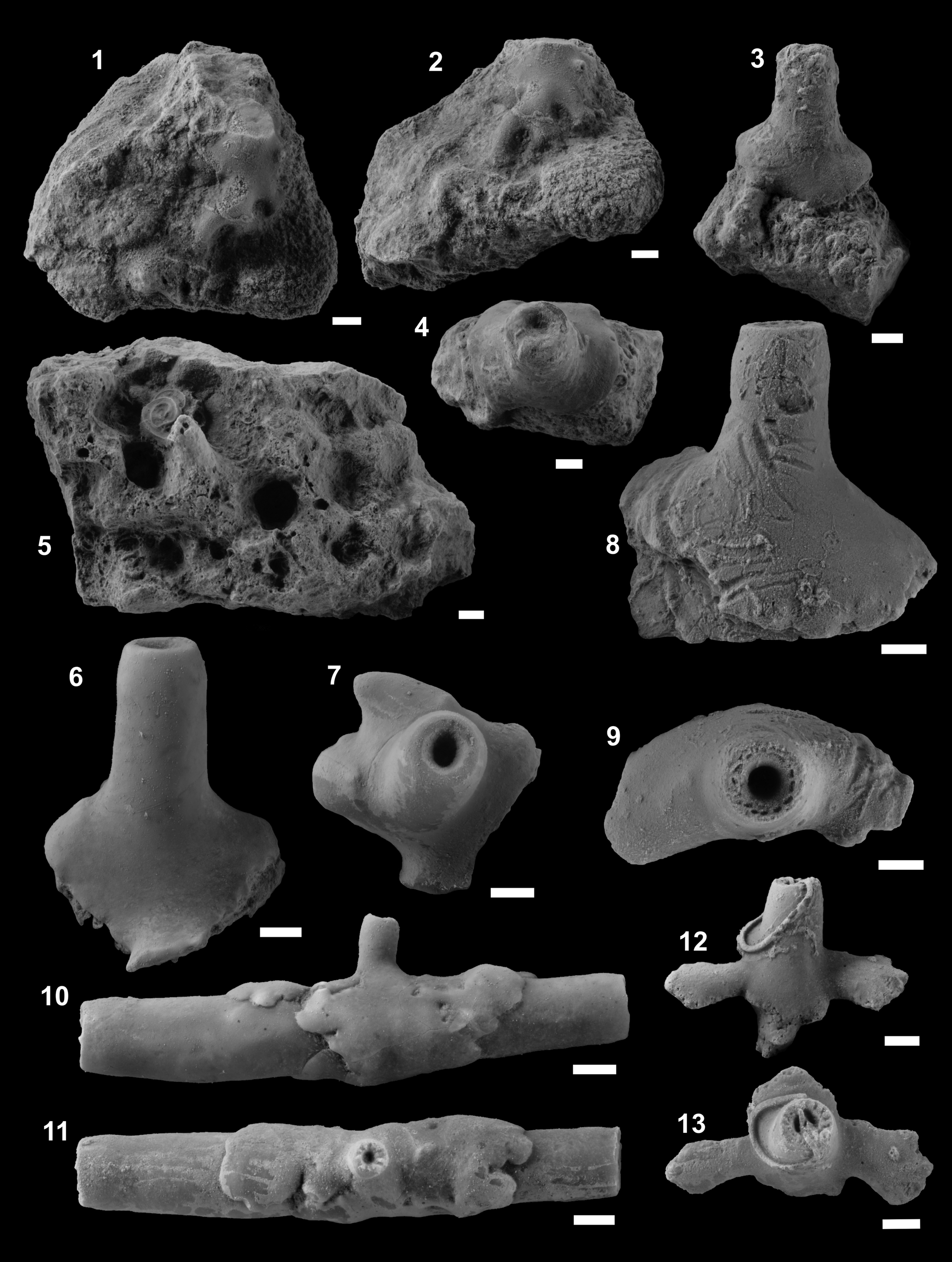
Cyrtocrinid holdfasts from the middle Oxfordian of Tosos (Zaragoza, Spain), Yátova Formation, layer TO3/27. (1, 2) Root-like holdfast on a sponge in articular and lateral views (MPZ2024/155); (3, 4) disk-like holdfast on a sponge with serpulids and a few traces of predation in lateral and articular views (MPZ2024/158); (5) abraded holdfast on a sponge (MPZ2024/161); (6, 7) disk-like holdfast on a sponge in lateral and articular views (MPZ2024/156); (8, 9) disk-like holdfast on a mollusk shell with traces of predation and/or grazing, in lateral and articular views (MPZ2024/160); (10, 11) disk-like holdfast on a cyrtocrinid columnal in lateral and articular views (MPZ2024/157); (12, 13) cross-like holdfast with serpulid in lateral and articular views (MPZ2024/159). All specimens photographed whitened with ammonium chloride sublimate; all scale bars = 1 mm.
Finally, some cyrtocrinids appear to have been affected by parasites (Fig. 10.1, 10.4). In fact, some cyrtocrinid remains show more or less deep cavities on their cups or columnals, having pierced their skeleton. The part of the cyrtocrinid stereom around these cavities appears abnormally swollen. This suggests that a foreign body entered or attached itself to the surface of the crinoid skeleton, causing a reaction (swelling). These galleries have been observed in other crinoids, especially in millericrinids (Klikushin, Reference Klikushin1996; Wilson et al., Reference Wilson, Reinthal and Ausich2014; Zamora, Reference Zamora2022). There are some occurrences of these pits on cyrtocrinid radials, without showing any particular swelling around the cavity (Hess and Thuy, Reference Hess and Thuy2018). Previous works have included these marks in the ichnogenus Oichnus Bromley, Reference Bromley1981, which may be caused by gastropods or octopods (Wilson et al., Reference Wilson, Reinthal and Ausich2014; Zamora, Reference Zamora2022). Other authors have referenced similar traces, with a slit-shaped form when the parasite settles on a suture between cup and first columnal (Fig. 10.1 for example), or oval-shaped when it settles in a single columnal (Fig. 10.4 for example). According to some authors, they could be typical of myzostomids worms (Arendt, Reference Arendt1961; Klikushin, Reference Klikushin1996). These traces are still uncommon compared with the number of columnals discovered here and require further research on modern cyrtocrinids.
Evidence of predation or grazing on some specimens (Figs. 10.7, 11.8) suggests that cyrtocrinids from Tosos were exposed to predators. Predator–prey relationships have been documented in other cyrtocrinids from different localities (Salamon and Gorzelak, Reference Salamon and Gorzelak2010a; Zamora and López-Horgue, Reference Zamora and López-Horgue2022). Considering that predation in the Mesozoic was more frequent in shallow areas than in deep areas (Oji, Reference Oji1996; Baumiller and Gahn, Reference Baumiller and Gahn2013; Syverson et al., Reference Syverson, Messing, Stanley and Baumiller2015), it is not surprising to find those signs in the Jurassic of Tosos. Predation in shallow environments has been considered the main reason for migration of cyrtocrinids to deep environments during the Mesozoic Marine Revolution (Gorzelak et al., Reference Gorzelak, Salamon and Baumiller2012; Zamora and López-Horgue, Reference Zamora and López-Horgue2022).
Substrate preferences
As obligate encrusters, cyrtocrinids preferred hard substrates (Hess, Reference Hess2006; Charbonnier et al., Reference Charbonnier, Vannier, Gaillard, Bourseau and Hantzpergue2007; Hess and Messing, Reference Hess and Messing2011). Forty-seven holdfasts have been documented from the material of Tosos, 18 of which were found on sponge fragments (Fig. 11.1–11.7), 27 are no longer attached to any substrate, one was found on a mollusk shell (Fig. 11.8, 11.9), and another on a cyrtocrinid stem (Fig. 11.10, 11.11). Because a large number of attachment structures were found on sponges, we suggest that they were preferential substrates (benthic islands) for cyrtocrinids, as has been documented previously in other assemblages (Zatoń et al., Reference Zatoń, Salamon and Kaźmierczak2008; Hess and Messing, Reference Hess and Messing2011; Zamora and López-Horgue, Reference Zamora and López-Horgue2022). The sponges probably also provided protection from predators and more elevated areas for filter feeding. The presence of an attachment disc wrapped around a cyrtocrinid stem is notable and interesting. The stem is well preserved (Fig. 11.10, 11.11) and it cannot be ruled out that colonization occurred during life.
Possible link between sponges and cyrtocrinids in the Jurassic
The cyrtocrinids of Tosos developed in an environment shaped by sponge meadows and show a particular link with the latter because they attach to them (see above). To explore a link between cyrtocrinids and sponges, we developed a database of cyrtocrinids and sponge reefs in the Jurassic (see below). Despite a lack of paleontological data concerning the exact number of sponge taxa in the Jurassic (Leinfelder et al., Reference Leinfelder, Schmid, Nose, Werner, Flügel, Kiessling and Golonka2002), studies of reefs and bioherms in general provide a general overview of their abundance and diversity.
The curves for the abundance of reef domains around the world in the Jurassic, the abundance of reefs built only by siliceous sponges, and the diversity of cyrtocrinids show a similar trend (Fig. 12). Diversity in the Early Jurassic was rather low (except for cyrtocrinid diversity), then increased slightly in the Middle Jurassic, although with the lowest peak during the Aalenian (Fig. 12), and increased drastically in the Late Jurassic (Oxfordian), followed by a more or less continuous decline from the Kimmeridgian onwards (Fig. 12). Similar trends were noted previously (Leinfelder et al., Reference Leinfelder, Schmid, Nose, Werner, Flügel, Kiessling and Golonka2002), given that siliceous sponges are the least known reef builders in the Early Jurassic, except in northern Italy (e.g., Zempolich, Reference Zempolich, Loucks and Sarg1993; Leinfelder et al., Reference Leinfelder, Schmid, Nose, Werner, Flügel, Kiessling and Golonka2002), unlike in the Late Jurassic where they are abundant. It is also important to note that during the Oxfordian, the majority of siliceous sponge reefs formed along a belt at the northern margin of the Tethys, passing through France, Spain, Switzerland, southern Germany, Poland, and Romania (Leinfelder et al., Reference Leinfelder, Schmid, Nose, Werner, Flügel, Kiessling and Golonka2002) and that important cyrtocrinid faunas were described from rocks of this age in these countries (de Loriol, Reference de Loriol1879, Reference de Loriol1882–1884; Zatoń et al., Reference Zatoń, Salamon and Kaźmierczak2008; Zamora et al., Reference Zamora, Aurell, Veitch, Saulsbury, López-Horgue, Ferratges, Arz and Baumiller2018). Taking such a link into account, the decrease in cyrtocrinid diversity in the Kimmeridgian could then be explained by a well-known fundamental change in the northern Tethys (Leinfelder et al., Reference Leinfelder, Schmid, Nose, Werner, Flügel, Kiessling and Golonka2002), which is marked by an increased influx of siliciclastic material that led to a significant decrease in sponge reefs.
Abundance of siliceous sponge reefs classified in categories ranging from extremely rare (1) to abundant (5), abundance of reef domains and diversity of cyrtocrinid species and genera in the world through the Jurassic; p-value and Cor (Pearson's coefficient) are calculated between the abundance of reef domain and cyrtocrinid species diversity data using a simple correlation test (in black) or with a cross-correlation test (in red).
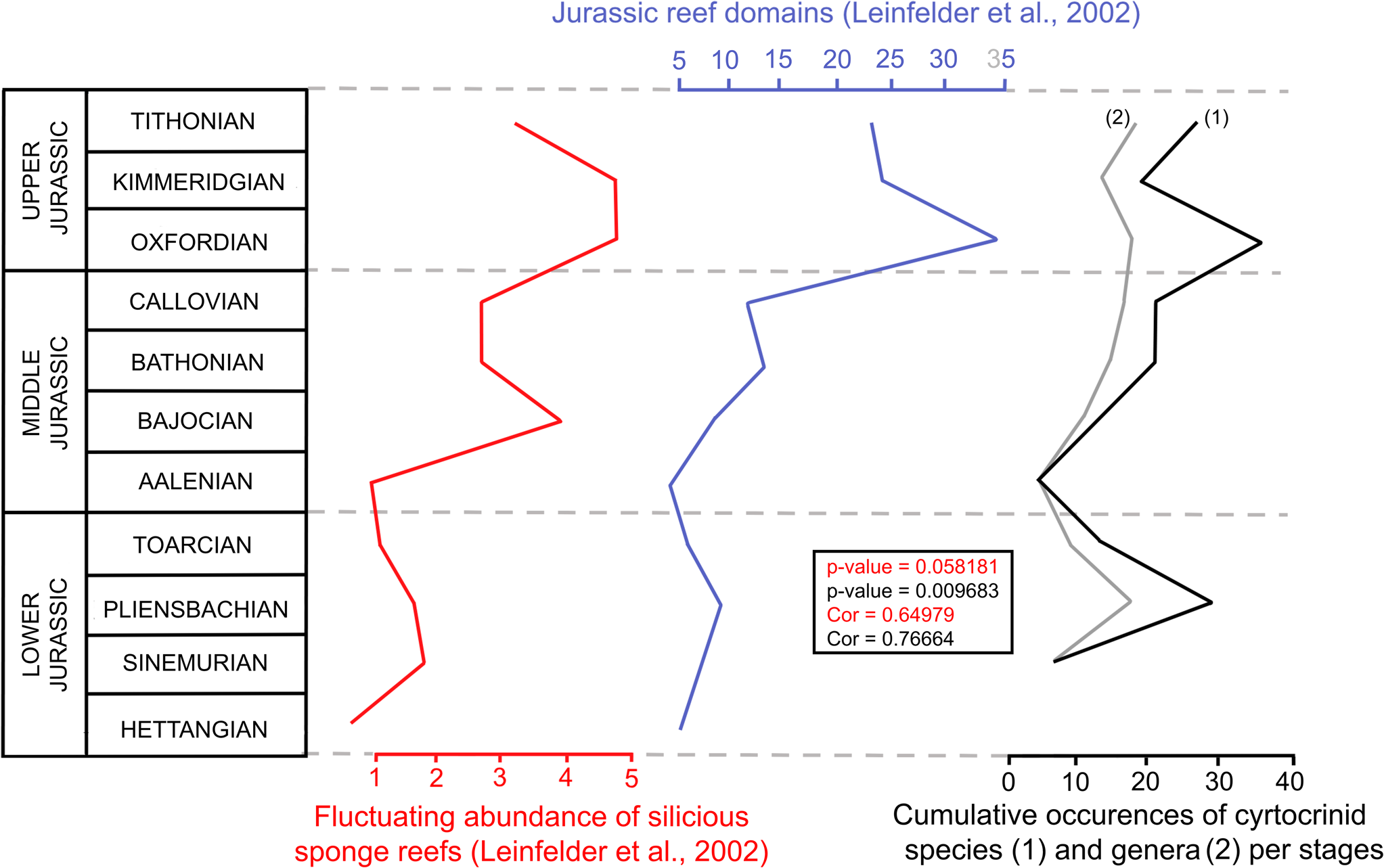
Finally, the difference between trajectories of the curves in the Pliensbachian (i.e., much greater diversity of cyrtocrinid than sponges; Fig. 12) could be explained by a sampling bias of sponge diversity in Lower Jurassic units (Leinfelder et al., Reference Leinfelder, Schmid, Nose, Werner, Flügel, Kiessling and Golonka2002), or by the existence of the Arzo paleontological site (Switzerland), where many cyrtocrinid species are endemic (Hess, Reference Hess2006). At the same time, the peak in abundance of siliceous sponge reefs in the Bajocian (Fig. 12), which is not observed in cyrtocrinid diversity, could be caused by scarcity of paleontological sites with Bajocian-age cyrtocrinids, which likely is the case for Spain.
Although a possible link between cyrtocrinids and sponges is observed, the statistical relationships between Jurassic reef domains and cyrtocrinid diversity are more complex. A simple correlation test confirms a moderate correlation (see p-value and Pearson coefficient in Fig. 12). However, a cross-correlation test does not provide enough confidence and the correlation itself is less significant (see p-value and Pearson coefficient in Fig. 12). Thus, the hypothesis of a potential link between sponges and cyrtocrinids needs further analyses that include more data and likely encompass other geological periods.
Conclusions
The cyrtocrinids from Tosos, detailed for the first time in the Spanish Oxfordian, provide a rather significant diversity, including six species: Ascidicrinus pentagonus, Eugeniacrinites cariophilites, Gammarocrinites compressus, Pilocrinus moussoni, Sclerocrinus cf. S. strambergensis, and Tetracrinus moniliformis. They display considerable intraspecific variation, making systematic work sometimes difficult, thus necessitating abundant and well-preserved material. The Yátova Formation around Tosos was deposited in a shallow marine environment, which expands the distribution of those taxa in such environments to the wester Tethys. This research confirms that cyrtocrinids were able to live in shallow environments in the Jurassic period, and that their distribution today in deep water is probably a consequence of the Mesozoic Marine Revolution. In addition, the numerous attachment structures discovered at Tosos confirm a preference for hard substrates, and especially for sponges. The diversity of cyrtocrinids and sponge reefs in the Jurassic suggests there might be a link between these two groups, but additional data are necessary to confirm or reject this hypothesis.
Acknowledgments
This is a contribution to project E18_20 R “Aragosaurus: Recursos geológicos y paleoambientales” from the Government of Aragón. I. Pérez (Zaragoza) helped with photography. The authors would like to acknowledge the use of Servicio General de Apoyo a la Investigación-SAI, Universidad de Zaragoza and especially to Mª J. Marín. Reviewers M. Salamon and P. Gorzelak greatly improved the resulting manuscript with important comments. P. Gorzelak is also acknowledging for help during the editorial process.
Competing interests
The authors declare none.
Data availability statement
Data available from the Zenodo Digital Repository: https://doi.org/10.5281/zenodo.13378362.


 Open access

