

Introduction
What is the world like beyond all human–object relations, outside the relation between thinking and being? Do known objects have parts of their being which are independent of our knowledge of them? Can human thought conceptualize the possibility of external realities that are not accessible to thought? These are some of the seemingly paradoxical questions raised by the controversial new movement in contemporary philosophy known as speculative realism (SR).
Loosely affiliated under the broad umbrella of SR are numerous approaches (Meillassoux Reference Meillassoux and Brassier2008; Bryant Reference Bryant2011a; Bryant et al. Reference Bryant, Srnicek and Harman2010; Grant Reference Grant2006; Reference Grant, Bryant, Srnicek and Harman2010; Harman Reference Harman2010; Reference Harman2011b; Morton Reference Morton2013) unified only by their opposition to the ‘correlationism’ claimed to be inherent in much modern philosophy. Correlationism is what speculative realists seek to escape from: it is the idea ‘according to which we only ever have access to the correlation between thinking and being, and never to either term considered apart from the other’ (Meillassoux Reference Meillassoux and Brassier2008, 5) – a pattern of thinking said to go back to Kant's Critique of pure reason in 1781. As a result, objects are invariably construed in terms of the relation between humans and objects, rather than in their own right. The problem becomes how to describe the world independently of human access to it. SR can be characterized as a philosophical attempt to speculate on the nature of external reality – the ‘great outdoors’ or ‘absolute outside’ – beyond the limits of human knowledge, with all the paradoxes that such an endeavour entails.
Speculation in this context means more than mere conjecture. In its philosophical sense the verb ‘to speculate’ refers to thinking beyond the surface appearances of the phenomenal world (Gratton Reference Gratton2014, 7) or, in the case of speculative realism, ‘beyond human finitude’ (Meillassoux Reference Meillassoux and Brassier2008).
SR is a controversial movement within philosophy which has also opened up vibrant areas of debate in the arts and social sciences. In archaeological theory, considerable influence can be discerned in recent writing on symmetrical archaeology and ontology of things (Webmoor and Witmore Reference Webmoor and Witmore2008; Olsen Reference Olsen2010; Olsen et al. Reference Olsen, Shanks, Webmoor and Witmore2012), New Materialist perspectives (Witmore Reference Witmore2014), and object-oriented studies of archaeological material (Normark Reference Normark, Alexandersson, Andreeff and Bünz2014).
Following on from these useful analyses, this paper develops the view that there is a deep resonance between SR and archaeology. There are the obvious shared concerns with objects and with time, but it is more than that. The imperative of SR to go beyond the furthest bounds of thought (one of the sins, we should remember, for which Ulysses was condemned to Hell in Dante's Inferno) is broadly in keeping with the essential spirit of the archaeological enterprise, which seeks to go beyond surface appearances and explore parts of the world which are buried and hidden. The resonance works both ways. In examining the relevance of SR to archaeology, then, an important question to consider is, ‘what can archaeology usefully contribute towards the SR project?’
With that in mind, the first part of the paper engages with some of the ideas of perhaps the best-known variant of SR – the object-oriented ontology (OOO) of Graham Harman – especially its central notions of the withdrawn inner core of objects and the inexhaustibility of things. The second part considers the material entities encountered by archaeologists with regard to some of SR's more time-transgressive conceptual objects – the arche-fossil of Quentin Meillassoux and the hyperobject of Timothy Morton.
I have argued elsewhere that the artefacts, features, materials and surfaces uncovered during excavation constitute an ‘extraordinary ground’ against which ideas can be thrown into the world, to be challenged and transformed – literally ‘grounded’ (Edgeworth Reference Edgeworth and González-Ruibal2013). This applies to more than just theories about the past. We can take the philosophical ideas of SR with us out into the field too, and see what happens to these in contact with archaeological objects. One thing is certain. Ideas that get drawn into such a material encounter will not be the same when they come out . . .
Beyond subject and object
To make a start I draw initially from the various essays and conference papers collected together in the book Towards speculative realism (Harman Reference Harman2010). The pivot around which Harman's thinking turns, and to which he comes back again and again, is Heidegger's famous analysis of equipment – where the fundamental distinction between Zuhandenheit (readiness-to-hand) and Vorhandenheit (presence-at-hand) is drawn. How might we draw the crucial distinction between readiness-to-hand and presence-at-hand in archaeological terms?
Well, just think of what happens on an excavation. Archaeologists use all sorts of tools to unearth and record material evidence – spades, trowels, buckets, mattocks, wheelbarrows, planning grids, cameras etc. We could select any of these to illustrate the point. The trowel-in-use does not usually come to attention as an object in its own right because it is being used to excavate the material field. While in use it is an unsung part of that ‘subterranean machinery’ (Harman Reference Harman2010, 6) that is so rarely in the foreground of awareness because it does the very work that renders and makes possible the emergence of objects of archaeological investigation – the material remains that are uncovered or brought to light. Archaeologists would practically never use such a term, but this is unmistakeably Zuhandenheit or what Harman would call ‘tool-being’ (Harman Reference Harman2002).
When the trowel breaks or the barrow wheels clog up with mud, however, such tools revert from their readiness-to-hand to suddenly appear as objects in themselves, and thus become present-at-hand (though never revealing anywhere near all of their inexhaustible possibilities, and keeping some aspects of themselves hidden). This is Vorhandenheit, the opposite face of tool-being. The ‘veiled reality of equipment-in-action is torn loose . . . and set on display “as” what it is’ (Harman Reference Harman2010, 97).
Or consider what happens to the material evidence during excavation. This too oscillates between readiness-to-hand and presence-at-hand. While we are working on it, we see it partly in terms of features to be dug, sections to be cut, layers to be removed, soil boundaries to be followed, material patterns to be explored, problems of stratigraphy to be solved through digging, as well as artefacts to be found. This is Zuhandenheit or readiness-to-hand. But stop working on any part of it and disengage from the material field – perhaps to draw a section, write a context sheet or take a photograph – and the evidence immediately reverts to Vorhandenheit or present-at-hand again. Put the camera and drawing board to one side, pick up the trowel or spade to re-engage with the unfolding material field and it reverts back to Zuhandenheit or readiness-to-hand once more. At any moment in the process of archaeological practice (at least in this simplified account of it), then, some things are ready-to-hand and some present-at-hand, and the oscillation between them is part of the rhythm of archaeological work.
This type of Heideggerian analysis of archaeological discovery is fine as far as it goes. It encourages us to understand the emergence of material evidence and the production of knowledge in terms of a practical interplay between archaeologist and material evidence. In so doing it seems to offer a partial dissolution of the divide between subject and object. But it is unashamedly correlational. And simply overcoming the subject–object divide, as Harman points out, is nowhere near radical enough by itself: ‘The problem is not the divide. The problem is that subjects and non-human objects are wrongly proposed as the two ubiquitous ingredients of the universe’ (Harman Reference Harman2010, 156, original emphasis). It is this relation that Harman seeks to move beyond.
Affordances and the inner core of objects
Harman takes the Heideggerian analysis of tools much further than did Heidegger. It is not just tools like hammers and nails and trowels that oscillate between the two states of being of Vorhandenheit and Zuhandenheit, but all entities, including human beings and (crucially) those objects that have no connection with humans whatsoever. It is a ‘global dualism that saturates every corner of the universe’ (Harman Reference Harman2010, 47).
Here we can follow his argument on the withdrawn inner core of objects by making use of the idea of affordance as one type of relation which can exist between objects. Coming from the ecological psychology of James Gibson (Reference Gibson1979), the concept of affordances is not used by Harman himself but corresponds very roughly to what he refers to as ‘sensual qualities’. The idea is, however, established in archaeological theory (Knappett Reference Knappett, DeMarrais, Gosden and Renfrew2004; Hodder Reference Hodder2012, 48–50, 113–15). To Gibson, affordances are what an object provides or affords a perceiver/agent – as a chair may afford sitting, or standing on to reach something else, or chopping up to use as firewood. Such affordances can appear objective, but they are not reducible to the properties of objects, and are actually relations between perceivers and objects. An individual may perceive more than one affordance of the same object, depending on need or circumstance. Individuals from various cultural backgrounds may share perceptions of the same affordances or see different ones.
The important thing is that it would be impossible for anyone to apprehend the totality of all possible affordances of any given object or surface. Most of these inevitably remain hidden to the perceiver. The very focus on a specific affordance or set of affordances inevitably sends others receding back into the shadows, or never reaches into the object's inner core to trouble all those other possible affordances in the first place. This fits in with one of the central themes of Harman's argument – that objects cannot be apprehended in their entirety: there will always be multiple aspects of them which are withdrawn, and therefore inaccessible to interpretation.
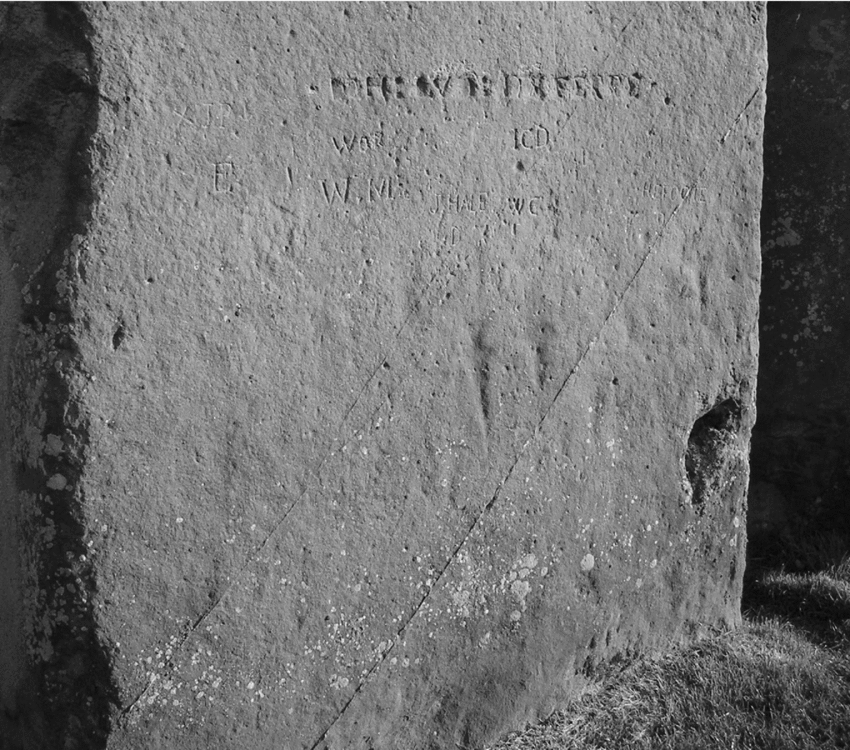
Even familiar objects may have hidden aspects to them. Consider the north-west face of stone 53 at Stonehenge (figure 1). Countless visitors never noticed the now famous carvings of axehead and dagger first seen by Richard Atkinson in 1953, obvious as they seem today. Atkinson recognized them in light of their affordances for archaeological knowledge, and he and others went on to find more carvings during that decade (Walker and Lawson Reference Walker and Lawson1995). But hidden from them at that time were 28 carvings on the same stone face, some invisible to the human eye, detected through application of laser scanning technology in the early 21st century (Abbott and Anderson-Whymark Reference Abbott and Anderson-Whymark2012, 33–34). More may be discovered in the future. In OOO terms, the example raises the question, how much do we really know about the objects we think we are familiar with? What further, as yet unknown, aspects will one day reveal themselves, or recede, or remain forever untapped and buried in the object's withdrawn inner core?
Bronze Age carvings of dagger and axehead on stone 53, an upright of one of the sarsen trilithons at Stonehenge, England (photo by Kristian H. Resset, 2005).

Objects may have affordances for non-human as well as human perceivers, or combinations of humans and machines (such as laser scanners). The Stonehenge trilithon with its carvings may have served architectural, symbolic and ritual purposes for people in the distant past, or afforded a source of information for archaeologists about the past, but it could also have been a place to scratch rumps for cattle, or a locus of interesting smells for passing dogs. An ancient disused urn intended to hold liquids could be perceived as a convenient burrow for small mammals, a place to seek shelter from the hot sun for lizards, or a site in which to build a nest for certain types of bee and other insects. Some affordances of objects may be perceived by more than one species, while others are clearly species-specific. There are no limits to the number of possible affordances, apart from constraints imposed by the shape and size and other properties of the object relative to the capabilities of a living being that might make use of it. Objects have affordances for plants as well as animals. The side of a stone wall facing away from the sun affords a suitable place for moss to grow. Dark earths that are microbially rich and contain much charcoal and other organic material – such as Amazonian terra preta – afford a fertile soil matrix for many types of plant to root in (Schmidt et al. Reference Schmidt, Py-Daniel, de Paula Moraes, Valle, Caromano, Texeira, Barbosa, Fonseca, Magalhães, Silva do Carmo Santos, da Silva e Silva, Guapindaia, Moraes, Lima, Neves and Heckenberger2014). Again, the crucial point here is that for each and every affordance that manifests there are countless potential affordances that are withdrawn.
Since affordances are defined in terms of perception, the concept is not usually extended to cover relations between non-sentient things, where no perceptual relation could be said to exist. But even non-living and non-perceiving things can be understood to relate to each other or interact through affordance-like sets of relations. A gutter on the edge of a cambered road surface has the affordance of collecting and channelling water that has fallen as rain (other useful archaeological examples are provided by Witmore Reference Witmore2014). Rivers afford transport of fine-grained sediment from one place to another. Cliff ledges afford surfaces for snow to settle on. Coming back to the chair mentioned earlier, it is not just a chair for humans; it is also a chair for the dust falling on it (Morton Reference Morton2014). And for every such relation that comes into play there are always any number of possible relations that are withdrawn. Thus Harman maintains that objects withdraw not only from human beings but also from each other. The withdrawn inner core of objects is always so much greater than accessible surface manifestations.
In so far as objects are connected through affordances and relations of other types into complex assemblages and networks, they still retain some integrity as things in their own right. Harman concurs with Latour that collectives exist and are important, but points out that objects are by no means exhausted or subsumed by the totality of relationships within them (Latour, Harman and Erdéli Reference Latour, Harman and Erdéli2011, 37). This fits in well with archaeological experience – at least in terms of discovered artefacts like arrowheads or pottery vessels. In most cases, such things have long since been removed from the past networks of material and social relations in which they were constituted (through being dropped, lost, hoarded, hidden, buried, broken, forgotten, discarded). However they got there, once in the earth they entered a new set of associations with soil particles, earthworms, rhizomes, roots and beetles, in stratigraphic relation to objects deposited at different times in layers above and below. Plucked from the earth again, perhaps hundreds or thousands of years later, they emerge – now in the guise of objects of archaeological interest – into new social and material networks. Something about the object remains the same, but parts of it are transformed through each succeeding set of relationships.
Through close familiarity with such time-transgressive things, many archaeologists would probably agree that objects ultimately have ontological primacy over the relational networks, entanglements and assemblages in which they may at any one time be embedded, and that objects are irreducible to those relations.
Emerging and receding objects
There is, however, a real problem in assimilating Harman's version of objects to archaeological practice. The nub of the problem is this. In his object-oriented ontology, the things that Harman thinks with are invariably already given and complete-unto-themselves. Objects are ‘unified’ and ‘autonomous’ (Harman Reference Harman2011b, 7, 19) rarely emerging out of, merging with or receding into other things. In so far as they withdraw, they withdraw into their own hidden depths. He rarely looks at objects that are still forming or losing form, such as volcanic lava cooling and solidifying into rock, or ice melting and becoming fluid once again. The opaque surfaces of preformed objects seem closed to the crucial dimension of time, at least as we normally understand it. There is no process, no flow. By alighting on the essences of things underlying their ‘accidents, relations, and qualities’ (Harman Reference Harman2010, 146), he arguably de-temporalizes them. By leaving behind the shifting facade of things, it could be said that he leaves behind time itself.
Now, to be fair to Harman, it is important to point out that he rejects the notion of time and space as containers for objects, while rejecting also the idea of time as a flow along which objects are borne or a continuum along which objects are spaced. Instead he sees time as being generated within the inner core of objects (Harman Reference Harman2010, 165). For sure the ‘time-as-container’ metaphor needs to be critically examined and alternative ways of thinking about time need to be explored. But the question here is whether Harman's version helps us to better understand the specific objects that archaeologists deal with.
It works fine if we are talking about trowels or spades, wheelbarrows or spirit levels, plans and context sheets, tape measures or balls of string (tools and instruments of archaeological practice). It also works for arrowheads, potsherds, rocks, lumps of mud, worms, bits of animal bone and other things that are routinely unearthed during excavation. These are all discrete preformed things with closed surfaces that fit quite neatly into Harman's description of unified and autonomous objects. For all that they are part of a wider context of equipment or assemblages and networks of material objects, they also stand as things in their own right.
But other kinds of object that emerge in excavation are not like that at all. Features such as ditches, pits, postholes, animal burrows, palaeo-channels, traces of ice crevices, other periglacial features and so on are rarely encountered in their entirety all at once. They do not suddenly appear in fully fledged being like potsherds or arrowheads do. Their surfaces are open rather than closed, and have to be disentangled from the convoluted stratigraphic sequences in which they are embedded. Their edges are often indistinct and fuzzy. They may comprise numerous component parts, imperfectly fused or separated in space. They are inherently incomplete, sometimes being cut or truncated by other features. Their partial and open-ended outline is defined by soil boundaries which disappear out of sight to be followed along with the tip of the trowel, the continuations hidden by occluding layers of soil which must be dug out with mattock and spade. They split into divergent objects or merge into composite ones, or get partially covered over or removed. These emergent/receding and merging/fragmenting entities can be followed or tracked, but rarely can they be apprehended all at once in a single instant. At any moment only part of the feature is visible, and by the time the last of it is found most of the rest of it has been destroyed.
There is a sense here in which some of these emerging objects only become objects as such when they enter into the human world, to be drawn into scientific/cultural processes of objectification. Before the material and cognitive transactions of archaeological practice, it could be surmised, archaeological patterns of evidence may exist in a pre-objective state. The question can be posed, might there perhaps be alternative ways of conceiving of external or primordial realities, and the entities that are speculated to exist there, other than framing them as objects?
While stratigraphic entities have a certain openness to them, the objects of OOO can sometimes appear by comparison too solid, too closed, too well defined, too static, too spatially and temporally bounded, too unified, too autonomous, too neatly separated off from other things. Deep thinking has refined their surfaces, until these are as smooth and as well wrought as those of a Neolithic polished stone axe. But not all objects in reality have such clear edges so smoothly worked. Where, one might reasonably ask, are all the fuzzy edges? Where are the interface layers, the overlaps, the interbeddings and the interminglings?
Harman would reply with the radical claim that objects do not touch, therefore no intermingling between objects is possible. As soon as two objects come into relation with each other, he argues, that relation immediately generates a new object that encompasses both objects and relationships between them (Harman Reference Harman2010, 117). Thus a person perceiving a tree becomes part of a larger object which includes both himself and the tree and the perceiving relation between them. Or, to put it another way, an archaeologist finding an arrowhead becomes part of a larger object which includes both her and the arrowhead, along with all the affordances and other sensual qualities of the object that are perceived. In the event of someone else coming along to observe this interaction a yet larger object would form, which now includes at least two sets of perceiving relations. And so on.
The trouble is that, far from escaping the subject–object divide, this places the archaeologist right back in it again, except with the added philosophical encumbrance of enclosing him or her inside an encompassing object – which is itself only part of an infinite hierarchical regress of such objects. Whatever the merits of Harman's analysis of objects, the ontological priority accorded to objects over flows and processes means there are limits to how far this can help in understanding subtle transitions between layers, lenses, fills, feature outlines, and other archaeological entities that emerge in the mud and flux of excavation.
Even so, we can usefully deploy Harman's philosophical device to shift scales somewhat and regard the whole site – consisting of multiple objects, object–object and subject–object relations – as a single object.
The site as object
The idea that an object is never wholly given to us, even when we have it right there in front of us, and that it inevitably withdraws the greater part of itself, resonates with archaeological experience. That is exactly what archaeological sites are like. Material fields on which archaeologists work have huge buried components to them. Although these vast hidden realities cannot be seen, there are multiple clues to their existence. Visible parts of the site such as cuts and other soil boundaries extend into sides of trenches or slope down underneath occluding layers, receding beyond the limits of visibility. The site (or smaller material field opened up within the site) is bounded by edges and soil horizons that effectively mark the limit of the known at any given moment, and here visible patterns do not so much come to an end as get covered over, their continuations obscured by as yet unexcavated material. The partial nature of knowledge of the site, and the fact that there must be things that extend beyond it, are all too materially apparent. The incompleteness of things is evident everywhere. An external reality surrounding the site on all sides can almost be glimpsed at the limits of peripheral vision, always just out of reach or disappearing beyond the next soil horizon.
This applies in temporal as well as spatial terms, since apprehending the site involves speculation about events and processes that have happened there in the past, bringing about the observable configurations of evidence. When it comes down to it there are remarkable parallels between archaeological views of the past and Harman's concept of the inaccessible inner core of the object. The past is withdrawn and beyond all direct access, yet it presents itself indirectly through present-day surface manifestations – in the form of patterns of soil boundaries and deposits and features, and material traces such as potsherds that have survived the ravages of time. The past is not exhausted by its physical remnants, any more than the site is by its surface manifestations. Just by virtue of inferring about the past, or asking questions of it that can be partially answered through investigation of physical traces of it, archaeologists are engaging in a form of SR.
While it is under excavation, the site unfolds on multiple levels and multiple scales. It is not just that it unfolds because archaeologists are working on it. Tempting though it may be to put emphasis on the active role of archaeologists in shaping the site and its unfolding objects at the ‘trowel's edge’ (Hodder Reference Hodder1997), something else is going on too.
There is another force at work – a material agency that does not derive from humans but comes from the depths of the earth and the past, pushing its way through. This is the sheer ‘vibrancy’ of matter that Jane Bennett (Reference Bennett2010) describes. It is also a kind of ‘material resistance’ (Shanks Reference Shanks1998), acting back against the applied force of archaeological interventions and interpretations. While it is actually emerging, a configuration of evidence interpreted as part of a ditch cannot be shaped into a ditch if it is really a tree-throw. Any attempt to follow the sides of the supposed ditch with the blade of the trowel encounters soil boundaries that slope the wrong way or head in the wrong direction, forcing realignment of interpretation and digging strategy, effectively realigning the excavator herself. For a detailed example of how a whole site can resist interpretation and force a complete rethink of what it actually is, changing the whole excavation strategy, see Edgeworth (Reference Edgeworth and González-Ruibal2013, 38–41).
However, Harman is right to insist that emphasis on material resistance is merely a ‘half-hearted realism’ (Harman Reference Harman2011a, 126). The active role of materials is not limited to resisting the physical and cognitive forces applied by archaeologists. Materials and objects also exert forces on each other, while resisting or giving in to forces exerted back on them, irrespective of what humans are doing. Material forces are exerted on archaeologists too, conditioning muscles and reshaping the structure of neurons in the brain through the presentation of problematic evidence, challenging bodily skills and interpretive schema. As Bennett remarks of art objects, it is not just a matter of what we can do with things, but also of what things do to us (Bennett Reference Bennett2015).
At this point it may be objected by the reader that we are still wholly entangled in subject–object relations, and this, of course, is true. Archaeologists cannot escape the correlationist circle any more than philosophers can: it is part of the human condition to be enmeshed in relations with objects of one kind or another. But here, out on site, close to the ground from which archaeological objects emerge, we can observe that not all objects are bound by such constraints. Some move in and out of interactions and relations with human beings. We see them come into our world and occasionally disappear from it again. If ever there was evidence that things must have an existence outside subject–object relations, this is surely it.
Where objects unfold
It is time now to consider what archaeology, as an object-oriented discipline and practice, can substantially contribute to SR. I will argue that it has something extremely important to offer. It is already alluded to in the previous discussion. I will call it the edge of the unknown.
The edge of the unknown can be defined as any place where the known world comes to an abrupt end, such as the vertical side of a trench. On the horizontal ground surface inside the trench are numerous features, cuts, spreads, lenses and other objects and patterns that are meaningful to the archaeological practitioner. These configurations of evidence run on and into the vertical trench edge, and are visible in the section, but what happens to them on the other side is unknown. They may or may not carry on as expected, or they may do something radically different. The only way to find out for sure would be to extend the trench by digging into the side, following the horizontal surface along and revealing further patterns of evidence. In such a scenario the edge of the unknown turns into a threshold, across which objects may pass from the unknown to the known. This is where objects emerge from the outer circumference of the archaeological clearing.
It does not have to be in the form of a vertical face. The edge of the unknown can also manifest as a horizontal surface being worked over with a trowel or other tool, used to scrape away occluding layers to come down onto the upper bounding surface of stratigraphically earlier layers. Each scrape with trowel or spade removes some material evidence to reveal new configurations. This is where objects unfold from the depths of the site.
The paradox is that as soon as such objects cross the threshold from the unknown to the known, emerging from that state of being buried and hidden under the ground, they get transformed into objects of knowledge – or at least some of them do. You can watch it happen. If you were to turn up as an ethnographer of archaeological practice and observe what occurs (Edgeworth Reference Edgeworth2003; Yarrow Reference Yarrow2003) you would see that some objects such as potsherds get picked out by hand and placed in finds trays or finds bags, to be labelled and given context numbers and thus to be assimilated into the system of archaeological knowledge. They get wrapped up in synthetic materials and indelibly marked with inscriptions written in waterproof ink. Features which are not detachable from the material field get planned, photographed and described in detail on context sheets – to become in every sense objects of archaeological significance.
Not all objects, however, get selected for cultural transformation and representation in this way. The vast majority are shovelled into a bucket and from there emptied into a wheelbarrow, which is used to transport them to the spoil heap. The spoil heap might be said to comprise all the material not considered to be relevant, having no significance whatsoever. The fact that in the teeming procession of objects crossing the threshold not all of them make the transition into objects of knowledge gives yet another indication of the existence of material realities outside any knowing relation.
It is important to state that during excavation the emergence and unfolding of objects coincides with the destruction of other objects. That is to say, emergent objects and patterns are only revealed by the physical removal of other objects and patterns. On complex fields of evidence, every motion with the trowel simultaneously brings aspects of new objects to light while scraping aspects of others away, and these processes of destruction (like that of emergence) are spread out over time. There is also a covering over of objects not noticed or not deemed to be of significance. The place where objects unfold, then, is also the place where objects recede. Objects can cross the edge of the unknown in either direction.
Why should the edge of the unknown be of importance to speculative realists? Because it is the closest anyone can get, in a practical sense, to the furthest reaches of the correlationist circle (in which we are all enmeshed to some degree, though some may be more enfolded in its webs than others). It enables us to be literally within an arm's length of an external reality that, at least for the moment, exists outside the domain of human knowledge. In more diffuse and distributed forms, such a frontier exists in all aspects of life, but it is rare to find it as clearly demarcated as it is in archaeological practice. Here it can take the shape of a moving line of spoil on the ground being pulled back as the trowel bites deeper into the ground, or a vertical edge that can be cut into, with objects-yet-to-emerge clearly buried on one side of the threshold and the team of investigators and the array of recording equipment lined up ready to assimilate it on the other. In most situations of everyday life the boundary is much more spread out and less clear cut than that. An archaeological excavation is a good place to go to witness what occurs when never-before-encountered objects make the transition across this threshold into the universe of cultural things.
It is in relation to the edge of the unknown that the uniqueness of archaeological objects can be appreciated. Until recently they have been buried in the earth, often for centuries or millenia. That makes them different from objects that have already established their place in the world relative to other things. Not being suspended in densely entangled webs of relations (or, at least, having just been wrenched out of their relationships with other objects in soil and strata of the upper part of the geosphere) they are not so closed or resistant to forming parts of new networks and assemblages.
It is also to do with the fact that these archaeological objects originate in another time and another culture. When they cross the edge of the unknown they emerge into our cultural universe for the first time, suddenly having to be assimilated into wholly new systems of signification (or not, as the case may be, in which case they get folded back into the earth). To be sure, most things are expected or at least half anticipated. They may seem roughly familiar in the sense that other similar things have been found before. But there is a hint of the uncanny, as there would be with any object that travels through time from another world to emerge in or pass through the present moment. The archaeological object is an object out of its temporal context. It is anachronistic (Martinez Reference Martinez2011). Such an object can break out of the depths of the past into our space and time, figuratively speaking, like a meteor from the outer reaches of the solar system, plunging through the atmosphere to suddenly be found smouldering in an impact crater on the surface of the Earth. Being time-transgressive, the object is travelling through time. It has a momentum to it. That uncanny quality of having just emerged from the other side of the edge of the unknown lends archaeological objects, for a brief period of time, a certain aura and a certain power.
Time-transgressive objects 1: the arche-fossil
There is one type of object in speculative realism that bears a remarkable resemblance to the anachronistic and time-transgressive archaeological objects discussed above. This is the arche-fossil or fossil-matter considered by Quentin Meillassoux (Reference Meillassoux and Brassier2008).
An arche-fossil is different from an archaeological object in that it is much older, pre-dating all human life. Furthermore, it is older than geological fossils too in so far as it originates in a time that precedes all forms of terrestrial life. ‘Arche’ is the Greek word for beginning or origin. An example of an arche-fossil furnished by Meillassoux is radioactive material used to date ancient rock strata. Thus the age of some of the oldest rocks on Earth has been determined by potassium–argon dating. The dating method measures the decay of the isotope potassium-40 (K) as it changes into an inert gas called argon (Ar). Since the rate of decay is known (the isotope has an extremely long half-life of 1.25 billion years), the date of ancient rocks can be established by measuring the amount of argon which has accumulated in the rock. The K–Ar dating method was recently used by the Curiosity Rover on Mars to determine the age of Martian surface rocks as between 3.86 billion and 4.56 billion years.
The reason that Meillassoux needs the arche-fossil to be so ancient is to make a crucial point. In escaping from correlationism, it is necessary to show that statements can be made about real things which exist independently of relationships between living things and their environments (such as affordances, for example). To achieve this, he uses the example of ancient material older than all forms of life. On the basis of his consideration of arche-fossils, he makes (amongst others) the following important claims:
that being is not co-extensive with manifestation, since events have occurred in the past which were not manifest to anyone . . .
that what is preceded in time the manifestation of what is . . .
that thought is in a position to think manifestation's emergence in being, as well as a being or time anterior to manifestation . . .
that the fossil-matter is the givenness in the present of a being that is anterior to givenness (Meillassoux Reference Meillassoux and Brassier2008, 14, original italics).
These statements have relevance for archaeology as much as for SR. They apply equally to objects that can be dated to 100 years old or 1,000 years old, as they do to material that is determined to be billions of years old. In fact once the crucial point is made and taken – about the possibility of an arche-fossil being older than all forms of life, therefore proving that it is reasonable to speculate on something that existed independently of any relation between a living thing and its environment – it is no longer necessary to insist that an arche-fossil should be that old, or that it should have nothing to do with living beings. Layers containing early hominid artefacts at Olduvai Gorge have been dated to between just over 2 million and roughly 1.5 million years old, by deploying the same method of K–Ar dating on material from lava flows above and below (Tatersall Reference Tattersall1995). As I see it, that material is an arche-fossil too. Likewise, radiocarbon dating measures the decay of the radiocarbon isotope (C14) using material that was once part of a living organism. Because the half-life of this isotope is only 5,568 years, dating is practically restricted to material younger than 50,000 years. This material too has many of the attributes of the arche-fossil, though not to the strict exclusion of relation to any living being.
I realize I am at risk of being accused of corrupting Meillassoux's argument here. But if the arche-fossil was defined simply as ‘the givenness in the present of a being that is anterior to givenness’ (dropping the strict criteria for pre-dating all forms of life), the concept could usefully be extended to cover all geological/archaeological objects and materials. It still retains its speculative realist flavour and its relevance. Geologists and archaeologists need to infer independent and prior existence of things irrespective of the date of the evidence they happen to be working with, whether or not it contains traces of humans or other living things.
The arche-fossil is time-transgressive beyond the sense that it travels from the past to the present. The present is not the ultimate destination – or at least it is only the end of its journey if the fossil matter in question is intercepted and destroyed by scientists. It travels on into the future. Much the same might be said of archaeological objects that emerge on excavations and ‘end up’ in museums. We tend to think that stone or ceramic artefacts in museums have somehow become permanent residents. But actually their presence in glass cabinets on display or in basement storage is only a temporary stay. Being both durable and time-transgressive, they will outlive the cultural institution of the specific museum, the whole ethos of museums in general, and the material fabric of the buildings (and indeed the cities that museums are part of) that offer them a kind of overnight stop on their journey. One way or another, they will inevitably end up once more in the dark earth – in a new set of stratigraphic relations with other objects in the ground.
As I write this section, I am aware that some of the electrical components of the laptop computer on which it is written may survive, crushed and embedded in a rock matrix, as a fossil. A million years in the future, or a hundred million years even, it is conceivable and perhaps probable that human beings will no longer inhabit the Earth, and it may even be that all life is extinguished by that time. Yet material traces of present-day human activity – extracted out of the mesh of bodily relations, social networks, World Wide Web and electricity grid – will be preserved in a new configuration of stratigraphic relations. Layers of landfill deposits, perhaps containing traces of my computer, will survive, compressed and contorted, in rock strata – along with the remains of cities like London and New York (Zalasiewicz Reference Zalasiewicz2008) – even if, as seems likely, there will be no human being around to observe and interpret such stratigraphic evidence.
To speculate on the possible future existence of fossilized traces of our own activity outside all relation to humans or other living beings – the postulated manifestation of the arche-fossil (whose being is now) in the far future – somehow follows on naturally from speculating on the origin of the arche-fossil that manifests now and comes from the remote past. The ‘fossil-as-non-human-past’ implicates the notion of the ‘fossil-of-future-time’ (Barikin Reference Barikin and Schweizer2014, 4).
Time-transgressive objects 2: hyperobjects
Of all the types of object considered by speculative realists, it is hyperobjects that may ultimately prove to be of most interest to archaeologists. Defined as ‘massively distributed in time and space relative to humans’ (Morton Reference Morton2013, 1), hyperobjects are said to occupy vast swathes of time on scales somewhere between geological time and human time, and the spaces taken up by them are correspondingly huge. Accordingly, they can never be apprehended in anything like their totality. At any given moment, the greater part of their being is withdrawn and inaccessible (in this respect, at least, they are similar to Harman's objects), intermittently phasing in and out of the human world. Being invisible to humans for much of the time, their manifestations are inevitably partial and local. It is precisely this that gives them their uncanny character. As Morton (Reference Morton2013, 53) puts it, ‘because we can't see the end of them they are necessarily uncanny’.
Many of the objects identified by Morton as hyperobjects, such as global warming or radioactive waste, are part-artefacts in the sense that humans have been involved in bringing them into being. Mark Hudson, in his useful comparison of the concept of the hyperobject with the archaeological notion of artefact, calls them ‘dark artefacts’ (Hudson Reference Hudson2014). But that does not mean they are entirely under human control, as instruments of our intention. They have agency of their own, and they act independently and unpredictably, phasing in and out of human experience in unexpected ways.
The fact that much of what used to be categorized as natural or non-human, such as climate, is actually a hybrid reality partly shaped by humans, presents challenges to those varieties of SR which seek to find a ‘great outdoors’ or ‘absolute outside’ (Meillasoux Reference Meillassoux and Brassier2008). The age-old vision of humans and culture being situated on the inside of an enclosing and encompassing Nature or Wilderness no longer holds. Such an idea is nicely countered by Levi Bryant's ‘wilderness ontology’. In decentring humans, Bryant acknowledges their integral place in the order of things, as one kind of being among others, none of whom are accorded privileged status. As he puts it, ‘wilderness ontology should not be conceived as the absence of humans’ (Bryant Reference Bryant2011b, original emphasis). This so-called flat ontology, according all beings equal status in principal, is necessary in order to understand hyperobjects as assemblages of beings and forces, of which humans are one.
I am going to develop an argument here that may take archaeologists by surprise – that the totality of archaeological evidence or humanly modified ground can itself be considered as a hyperobject in Morton's terms. We are used to viewing material evidence on the scale of the individual site or landscape, and are somewhat unaccustomed to thinking about it on a larger scale. But I would like to ask the reader here to shift perspective beyond the local and regional to consider archaeological evidence as part of a much broader and more extensive entity. Let us call it, for want of a better term, the ‘archaeosphere’ (Capelotti Reference Capelotti2010; Edgeworth Reference Edgeworth, Waters, Zalasiewicz, Williams, Ellis and Snelling2014).
The archaeosphere can be described as the sum of humanly modified deposits on the surface of the Earth. Occupation debris, landfill, urban artificial ground, quarried materials, ploughsoils, other cultivation soils, dumps of industrial waste, more ancient strata containing cultural material – all these together now form an enveloping and rapidly growing layer or set of layers over a large proportion of land surfaces in densely settled and cultivated parts of the world. Within these layers are novel materials unprecedented in the rest of nature – pottery, glass, concrete, plastics and so on – often in teeming profusion and variety of artefact form. Running through the deposits are service trenches containing vast networks of pipes, wires, fibre-optic cables.
According to Morton, hyperobjects have a viscosity about them which sticks to everything, including us. He gives the example of radioactive materials. ‘The more you try to get rid of them, the more you realize you can't’ (Morton Reference Morton2013, 36). Archaeosphere deposits are like this too. They stick to the surface of the Earth, and we are stuck to them. Most of us, if we are city dwellers, live on top of accumulations of anthropogenic ground up to several metres thick, and everything we do is contingent upon it. It is at once the material residue of urban life and the very ground or platform which makes that life possible.
Because they are so vast, hyperobjects are distributed far beyond the spatial area and temporal duration of any local manifestation: their location is ‘epiphenomenal to a deeper atemporal implicate structure’ (Morton Reference Morton2013, 37). Thus we find that the archaeosphere is generally more extensive than any local investigation of it. No matter how large the excavation trench may be, layers and soil boundaries usually extend outwards beyond the site edges in all directions. Sites or landscapes containing archaeological stratigraphy are just local manifestations of a much larger and more extensive deposit.
Morton observes that hyperobjects are so stretched out in time that they are almost impossible to hold in mind (Morton Reference Morton2013, 58). It is the same with the archaeosphere. This started forming on parts of the Earth's surface many thousands of years ago. Since then isolated patches of it have coalesced in both horizontal and vertical directions to form much larger composite deposits. It is still growing at increasing rates today, and will continue to grow into the future. Living in and on it, we can only experience it through its partial manifestations, as in the following example.
Case study: the archaeosphere as hyperobject
In 1964 a driver attempted to drive his lorry through the Newport Gate in Lincoln, UK. There was a crash. The lorry jammed firmly between the road and the top of the arch, severely damaging the structure in the process (figure 2).
Aftermath of collision, May 1964. South-facing aspect of Newport Gate, with lorry jammed between it and the ground surface. Photo courtesy of Lincoln Central Library and Lincolnshire Archives, reference LCL 26000.
Tempting though it is to blame the driver for his misjudgement, thus attributing the responsibility for the accident to a human agent, there is actually another agential entity which should also be held to account. That hidden contingency is the archaeosphere.
To understand the role of the archaeosphere in this collision, we have to go back eighteen centuries, close to when it first started to accumulate in this location. In the 3rd century A.D. the Newport Gate was built as one of the main openings in the city walls enclosing Lindum Colonia (now Lincoln). It was the main northern gateway of the city, and through it ran Ermine Street – then the principal north–south route in Britain linking Londinium (London) and Eboracum (York). At that time the ground was 2.5 metres lower than now, and the gateway easily large enough for a lorry-sized vehicle like a hay wagon to pass through (Carver Reference Carver1987, 12).
Over hundreds of years the road surface got repaired and replaced numerous times. Each successive road surface was laid on top of the previous one. Sometimes river cobbles were used, sometimes gravel or quarried stone was utilized. Plants rooted in the dust that settled in crevices between stones. Earthworms digested vegetable matter, made burrows and left casts. Soil formed. Sewers and service pipes and cables were laid within it. Every now and again the level of the surface was reduced by people removing material but the overall trend was for the ground to push upwards. Eventually the modern road was laid on top. Similar processes of accumulation took place on either side. As houses were constructed, demolished and replaced, a build-up of occupation debris and demolition rubble took place, raising the ground surface. Almost imperceptibly, the archaeosphere grew, its upper surface rising by an average of about a centimetre every ten years.
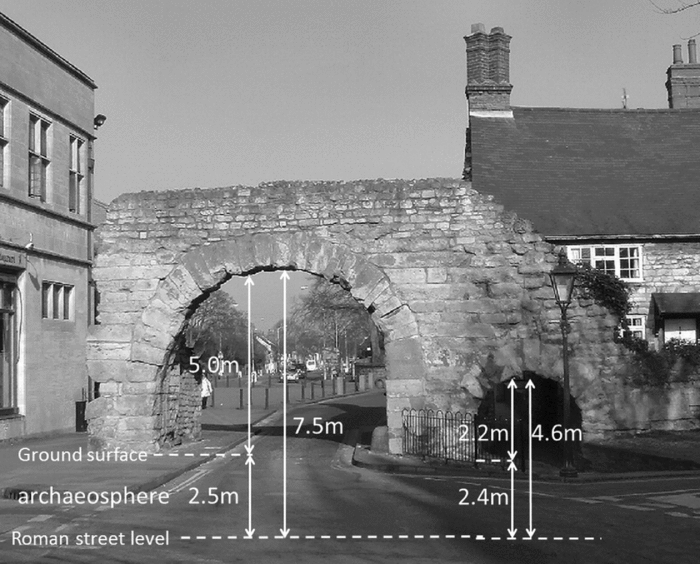
The lower portions of the gateway still survive below ground level. But the gateway did not sink into the ground: rather the ground rose up around it, engulfing and partially submerging it (figure 3). If it were not for the growth of the archaeosphere, reducing the height of the gateway, the accident would not have happened.
Estimated depth of the archaeosphere (accumulation of archaeological stratification from original 3rd-century A.D. road surface to 20th-/21st-century A.D. road surface), indicating original height of gateway and proportion of structure buried below ground. Photo: Lincolnian, 2006, CC by 2.0, based in part on measurements from Ward (Reference Ward1911).
The accident took place in a split second, but there is a longer time scale involved. It was a collision of processes taking place on different temporal scales – a crash between the temporality of everyday human life (the lorry and driver travelling at speed in a horizontal direction) and much slower archaeological time (the upper surface of the archaeosphere pushing slowly skywards).
The hyperobject as geological force
The archaeosphere is much larger, both spatially and temporally, than any local or momentary manifestation of it. It has both depth and lateral extension to it. But it takes an event like a landslip, subsidence or the kind of event described above to bring the growth of it to our attention. This ground has been forming throughout the historic core of cities for centuries. It is a submerged presence in cities throughout the world, and extends far beyond urban centres into rural areas.
It is envisaged that this set of deposits will still be present in some form in the stratigraphy of the Earth, albeit compressed and contorted, even in hundreds of millions of years.
The archaeosphere is far from being a passive entity, or mere record of human–environment interaction. It has real agency, real effects. It impinges on many aspects of human life and Earth's ecological systems. As it grows, it pushes upwards, cuts downwards and extends laterally across terrestrial surfaces, smothering some forms of life and sustaining others. Intermeshed with the biosphere, pedosphere and hydrosphere, it interposes itself between upper layers of the geosphere and the lower layers of the atmosphere.
Crucially, the archaeosphere can be described as something at least partly external to the human domain, pressing in from outside as well as pressing out from in. It would be inaccurate to call it ‘artificial’ or ‘man-made’, as it is formed through multiple agencies, both human and non-human, working together. Parts of it are intentionally formed, but most is an unintentional by-product or material residue of human–environment interaction. Humans play a significant role in the formation of it, but so too do other living beings like plants and earthworms and soil bacteria, as well as non-living forces such as erosion and sedimentation, or movement of groundwater. It is more like a geological force, with humans a part of it rather than apart from it. Since it is still forming, it is as much to do with the future as with the past.
The formation of this material ground is not unconnected with the more abstract ontological ground that philosophers discuss. In his Naturphilosophie (1799) the German thinker Schelling argued that geological processes of the Earth provide the ground surface underlying ideas and representations, affording the necessary physical conditions that make human history possible. This ‘geocentric’ or ‘geophilosophical’ perspective has been taken up by some speculative realists such as Iain Hamilton Grant (Reference Grant2006) and Ben Woodard (Reference Woodard2013). Put simply, ‘deposition of a ground over time is necessary to any prosecution of events upon it’ (Grant Reference Grant2006, 48). The crucial contribution that archaeology can make here is to show how the natural forces of ‘grounding’ combine with effects of human action to produce a hybrid reality that is as objectively real as any other geological force. Indeed, in the present, partly human-induced, ecological crisis, it is one of many such interrelated hybrid entities (climate change and the pollution of oceans and lakes by plastic waste are other examples) that exert huge material pressures on human existence, and on the habitats of other living beings.
Transformations of the material ground – as Hamilton Grant and Woodard realize – have radical implications for the philosophical understanding of the ontological ground of being (Woodard Reference Woodard2013; Grant Reference Grant, Bryant, Srnicek and Harman2010).
Conclusion
This paper has explored overlaps between SR and archaeology, bringing some of the central ideas of the former into contact with the ‘extraordinary ground’ of the latter. In comparing the conceptual objects of SR with more concrete archaeological objects, it became clear that archaeologists have manifold dealings, both speculative and practical, with material realities that partially exist, once existed or will continue their existence outside the human world.
Even if archaeologists and speculative realists alike are trapped within the correlationist circle as strictly defined, it is apparent that archaeological objects (or aspects of objects) can cross the outer circumference of the circle in both directions. This is where – in answering the question posed at the beginning of the paper – archaeology can contribute something of real value to the SR project. In the practical context of excavation, objects can be observed making the transition from the realm of the unknown to that of the known, and vice versa. That is to say, they can be seen to emerge or unfold from earth, or (when a feature or site is backfilled) to disappear back into it again, across the threshold that I call the edge of the unknown. Such time-transgressive things can enter into the human sphere from outside and eventually depart from it again, with many destined to return to a buried state outside any human relation. OOO is full of examples of objects that seem static and timeless. Archaeology provides plentiful examples of objects which are time-saturated and time-mobile.
We have also seen how even familiar archaeological objects may have aspects to them which are hidden, which later come to light, and from these we might surmise that there must be further hidden aspects, some of which will remain forever buried in the object's inner core. The same goes for archaeological objects on larger scales, except here it is the object itself that phases in and out of the human world. In the case of hyperobjects such as the archaeosphere, these are just too big, too extended in time and space, for us to be able to grasp them in their totality: it is only possible to get some inkling of their larger reality through the partial evidence presented in temporary and local manifestations.
Not everything about SR fits easily with archaeology and its materials. It has been difficult to concur with the ontological primacy accorded by some (not all) speculative realists to objects over flows and processes, for example. But consideration of questions posed by SR can help rethink archaeological understandings of materiality, time and the anachronistic objects that emerge from the ground during the course of excavation, and these in turn can complicate and refine the concepts of SR. There is much to be gained, and numerous avenues of enquiry yet to be explored, through creative engagements between archaeology, speculative realism and the object world.
Acknowledgements
Thanks to the editor and both anonymous reviewers for valuable comments. The section on the archaeosphere as hyperobject appeared as an exhibit in the Contingency Plans: Or, Living with Unstable Ground exhibition, Shanghai Study Centre, Shanghai, China, in March–June 2014.