

1. INTRODUCTION
Faroese is the smallest of the North Germanic languages, spoken as a first language by almost all of the approximately 50,000 inhabitants of the Faroe Islands, as well as by an unknown number of expatriate Faroese, predominantly in Denmark. Perhaps because of its small size, the language has been a welcome subject for linguistic research, particularly in the area of syntax, but also in phonology, contact linguistics, and other fields. Braunmüller & Jacobsen (Reference Braunmüller and Jacobsen2001) and Thráinsson et al. (Reference Thráinsson, Petersen, Jacobsen and Hansen2004) give a fairly comprehensive overview of the linguistic work on Faroese, including references. In recent years, this formal linguistic work has benefited considerably from judgement and production data collected during a 2008 NORMS workshop in the Faroe Islands.
A linguistic field that has thus far received relatively little attention in relation to Faroese is sociolinguistics (Akselberg 2001). A considerable part of the sociolinguistic research into the language concerns attitudes, either to different varieties of the language (Holm Reference Holm1992, Jacobsen Reference Jacobsen, Akselberg and Bugge2011) or to Faroese in general in relation to other languages, such as Danish or English (Søndergaard Reference Søndergaard1987, Jacobsen Reference Jacobsen2008). Studies focusing particularly on socially constrained variation in Faroese, on the other hand, are strikingly few: to date, only two studies have been published, on Tórshavn (Selås Reference Selås1997) and Northern Streymoy (Jónsdóttir Reference Jónsdóttir2005) varieties, in addition to an unpublished exploratory study of language in the media and the Suðuroy dialect (Jespersen & Arge Reference Jespersen and Arge1985).
The research gap, then, looks clear: more (quantitative) studies of socially and/or geographically constrained variation in Faroese are needed to obtain a more detailed picture of patterns of change in the language, which we may expect to occur in response to social developments in the last decades. In addition to strengthening our knowledge of Faroese, such studies may also inform sociolinguistics more widely: the Faroe Islands are marked by dense social networks, widespread bilingualism, and a weak spoken standard language. Moreover, the time depth of most social developments is such that their effects are within reach of the apparent-time method, whereas for many other, more frequently studied languages, the equivalent developments go much further back.
This article takes a step towards this quantitative description of variation and change in the language by analysing two sociolinguistic variables in a small corpus of spoken Faroese. The focus in the analysis is on the development of a putative supralocal variety, Central Faroese. The article begins with a discussion of recent social developments in the Faroe Islands and how these may be influencing variation and change in the language (Section 2). This is followed by a discussion of the two variables in the Nordic Dialect Corpus and what these suggest about the characteristics and origins of Central Faroese (Sections 3–4). The article concludes with an outlook for further sociolinguistic research on Faroese (Section 5).
2. LANGUAGE AND SOCIETY IN THE FAROE ISLANDS
2.1 Dialectal variation in Faroese
Despite the small number of speakers and restricted geographical spread of the language, Faroese displays marked geographical variation. The islands are traditionally divided into four or five dialect areas based on a handful of phonological features. Morphological and syntactic variation roughly follows the same isoglosses. A comprehensive account, with references to detailed local studies, is given in Chapter 6 of Thráinsson et al. (Reference Thráinsson, Petersen, Jacobsen and Hansen2004).
As is the case for many other countries in Europe, the 20th century, in particular the period after World War II, has brought significant social change in the Faroe Islands. Developments in demography, transport, education, and media have had an impact on society and language. Although Thráinsson et al.'s (2004) picture of dialectal variation is generally accepted, we may expect these social changes to have an effect on language variation in Faroese.
2.2 The development of a spoken standard
It is often stated that Standard Faroese exists as a written variety only; there is no spoken Faroese standard (Barnes 2005:1796). In the past few decades, however, a spoken standard appears to have been developing, although there is no consensus about its form, origins and current role in society (Jespersen & Arge Reference Jespersen and Arge1985, Barnes 2005, Hagström 2005, Jacobsen Reference Jacobsen, Akselberg and Bugge2011). Jakobsen's (2011:185) definition of this miðføroyskt, or ‘Central Faroese’, has a clear geographical component – a pronunciation based on both Tórshavn phonology and the written standard – but he stresses that it is ‘not an actual dialect, but a supradialectal prestige variety’.Footnote 1 Hagström (2005:1757), too, finds the incipient ‘colloquial standard’ ‘essentially identical with cultivated ways of speaking in the Tórshavn area’, and acknowledges an increasing influence of the written language, while Barnes (2005:1796) describes it as a reading pronunciation based on the dialects of Streymoy, southern Eysturoy and Vágar. He also notes that in practice, speakers avoid the most locally marked dialect features in formal speech. This links back to the discussion in Jespersen & Arge (1985:4), who see a role for dialect levelling in the development of a spoken standard.
The pronunciations and pronouns typical of Central Faroese (Jakobsen 2011) occur in the Tórshavn dialect as well, and this might suggest that the new variety is being established through a process of dialect spread. However, none of the Central Faroese features are local only to Tórshavn, and although some alternative pronunciations – e.g. [ɔɪ] for ei (Tórshavn, Central Faroese [aɪ]), [ɛʊ] for long ó (Tórshavn, Central Faroese [ɔʊ]) – are almost equally widespread, the majority of the oppositions Jacobsen mentions in his overview involve very localised or socially stigmatised features. A simple stock-taking of Central Faroese features, then, does not give clear evidence about how this supra-local variety developed; a clearer picture may be obtained when the development is put in the context of social and linguistic change in the Faroe Islands.
2.3 Developments in Faroese society
2.3.1 Demographic developments
The Faroese population underwent explosive growth in the 20th century, as a result of economic developments. The country was transformed from the traditional farming community of the 19th century to the fishing villages of the 20th, and then to a more modernised and globalised community from the 1990s onwards (Finnsson & Kristiansen Reference Finnsson and Kristiansen2006). The population grew from just over 15,000 inhabitants in 1900 to almost 32,000 in 1950, and to 49,000 in 2009 (all population data in this section are from Hagstova Føroya, http://www.hagstova.fo/).
Population growth has not been equally high in all areas of the country, however. Especially since the second half of the 20th century, the country has seen a steady urbanisation, with the capital Tórshavn accounting for a growing percentage of the Faroese population. In 1900, only some 10% of the Faroese population lived in Tórshavn; this grew to about 20% in 1950, 30% around 1990, and then to 40% today, i.e. 20,000 inhabitants. By contrast, peripheral areas are seeing a population decline in absolute as well as relative numbers.
The population has not been increasing steadily, either. In the early 1990s, the population of the islands even declined rapidly due to an economic crisis. Between 1990 and 1994, almost 10,000 Faroese (a fifth of the 1990 population) emigrated to Denmark. Half of them never returned to live on the Faroe Islands. Some 75% of the emigrants were under 30 years old, and 14% were children under the age of 10.Footnote 2 Post-crisis government policy led to the beginning of a counter-urbanisation (Holm Reference Holm2004), where people move away from Tórshavn to the countryside, while still retaining a focus on the capital for employment, shopping and leisure.
The demographic developments of the 20th century contributed to, and were made possible by, a continuing increase of mobility both within the Faroe Islands and between the islands and the outside world. In the past 40 years in particular, the Faroese islands and villages have become more closely connected by a network of roads, tunnels, bridges, causeways and underwater tunnels, effectively transforming most of the Faroe Islands north of Skopunarfjørður into one big, connected mainland, while the southern and outlying islands remain reliant on ferry links. International transport by air and by sea offers frequent connections abroad, especially to Denmark and Iceland.
2.3.3 Media
A loss of isolation is seen not only in increased mobility, but also in mass media such as newspapers, radio, and television. Faroese-language content has increased in the national newspapers Dimmalætting and Sosialurin, and a number of smaller, more local newspapers and magazines are published in Faroese. Nevertheless, a large proportion of the magazines read in the Faroe Islands is imported from Denmark. Faroese radio (est. 1957) offers fully Faroese programming, but over two-thirds of the programmes on Faroese television (est. 1984) are in Danish or in English with Danish subtitles. Most households can also receive Danish television and other Scandinavian or English-language channels.
2.3.4 Education
Faroese children attend schools from the age of seven. Despite government aims that especially the earliest years of schooling are to be as local as possible, older pupils and pupils in particularly remote areas may have to travel for their education. Education has been Faroese-medium since 1938, but teaching materials are often not available in Faroese. Teaching staff are often trained in Denmark and a considerable number of them are Danes. Danish is seen as educationally useful by both staff and students, and the use of Danish has been on the increase since the 1990s (Nauerby Reference Nauerby1996:125–130; Petersen Reference Petersen2010b:119).
The Faroese participate increasingly in tertiary education, whether this is vocational or academic. The University of the Faroe Islands, Fróðskaparsetur Føroya, was founded in 1965 and offers a limited range of locally relevant degree subjects. Many Faroese attend tertiary education in Denmark; smaller numbers to go Iceland and the UK. Clear statistics about this educational migration are unfortunately lacking.
2.3 Linguistic consequences of social change
2.3.1 Developments related to Danish
Changing roles for Faroese and Danish have changed the country from a diglossic to a bilingual society. The Danish as used by L1 speakers of Faroese shows differing degrees of influence of Faroese on phonology, syntax, and lexicon, with increased input from native-speaker models through modern mass media leading to especially younger generations of speakers having a pronunciation similar to that of Danish speakers in Denmark (Petersen Reference Petersen2010a, Reference Petersen2011; Kühl Reference Kühl, Kranich, Becher, Höder and House2011, Reference Kühl2013).Footnote 3
2.3.2 Social change and the development of Central Faroese
More interesting for our purposes is the question of how social change and increasing mobility, in both geographic and social space, may have influenced the development of Central Faroese. We know that increased contact tends to lead to decreased dialect diversity (e.g. Kerswill Reference Kerswill, Britain and Cheshire2003), but the social developments described in the previous section can lead to the same outcome of decreased dialect diversity and a supra-local variety through different linguistic processes. The question is which of these processes we can find evidence for in the language.
Firstly, the increased exposure to, familiarity with, and competence in, standard written Faroese that is the result of developments in education and written media may be giving rise to a diglossia in Faroese different from the earlier situation, in which Danish served as the high-prestige ‘H’ language (see Ferguson Reference Ferguson1959). This involves a change in status of a particular variety of Faroese, at this point probably predominantly written Faroese, which most clearly differs from lower-prestige ‘L’ varieties in making more puristic lexical choices (Hagström 2005). This new diglossia can in turn lead to standardisation or de-dialectisation, i.e., the loss of traditional dialect features that are not in accordance with the standard (written) language. In this scenario, dialect diversity is lost, not as, for example, in Denmark, by giving way first to regiolects, then regionally coloured versions of the standard, and finally a standard spoken language, but instead by abrupt dialect loss, as attested for Low German (Auer 2005:31).
Secondly, there are many factors that one could expect might lead to dialect levelling. Greater mobility and exposure to different dialects in the media may work as mutual catalysts (Kerswill Reference Kerswill, Britain and Cheshire2003:14) to cause locally and/or socially marked features to be lost in favour of less marked features, resulting in mutually converging dialects. Other than the loss of marked features, variation in dialect levelling is resolved through simplification, reallocation, and the development of new ‘inter-dialect’ compromise features (Kerswill 2002).
Finally, given the demographic weight of the Tórshavn conurbation and the fact that Tórshavn is the focal point of many Faroese speakers’ social and economic lives, such dialect levelling may be expected to be a very asymmetrical process, effectively resulting in dialect spread or ‘Tórshavnification’ of other dialects. If such dialect spread exists, it is conceptually closer to standardisation than to dialect levelling, as it is a telic rather than a non-telic process. We may hypothesise that areas with better transport links to Tórshavn would be most strongly affected, while outlying non-connected areas – Sandoy and Suðuroy, in particular – may not be affected as much (see Britain 2002). A strong regional or local identity may likewise prevent, slow down, or alter the course of dialect levelling (Kerswill Reference Kerswill, Britain and Cheshire2003:238–239).
To be able to tell these processes apart, and to identify whether dialect change in Faroese and the development of Central Faroese is the result of standardisation, dialect levelling, or dialect spread, it is most useful to investigate variation in features where different outcomes may be hypothesised for the three processes. Purely social factors may also play a role in distinguishing the processes: for example, outlying areas may be less affected by dialect levelling and local centres may be less affected by dialect spread from Tórshavn, while there is little reason to assume either would be resistant to influence from the written standard. Finally, different processes may be at work at different levels of the linguistic system. Mother tongue education in the Faroe Islands is based on the standard written language and focuses on a strict adherence to the written norm, especially with regard to morphology (Weyhe Reference Weyhe1996:116). The absence of an official phonological norm means there is greater tolerance of phonological than of morphological variation in schools (but see Barnes 2005:1796 on the sporadic promotion of Tórshavn pronunciation in education). It may therefore be that phonological and morphological variables are subject to different processes.
In the next section of this paper, I discuss a small exploratory quantitative study of two variables for which the geographical variation is well described in the literature, and which were commented on by informants in the Nordic Dialect Corpus when asked about differences between Faroese dialects. The first of these is morphological, the second phonological. It is hoped that this analysis can form the first step towards uncovering the processes involved in the establishment of Central Faroese and understanding the influence of recent social change in this development.
3. VARIATION AND CHANGE IN SPOKEN FAROESE
3.1 Variables
3.1.1 -st endings
The first variable is the occurrence of the inflectional ending -st in the second-person singular in the past tense of strong verbs (tú komst ‘you came’) and the present tense of preterite-present verbs (tú kanst ‘you can’) (Werner Reference Werner1970, Weyhe Reference Weyhe1996). The ending has an allomorph -t after verb roots ending in r, e.g. tú fórt ‘you went’.
The occurrence of -st endings varies dialectally, and three main systems can be distinguished (see Table 1). Type I has invariant -st endings; this system occurs in the written standard and is also the most widespread among dialects north of Skopunarfjørður. Type II dialects do not have -st endings in the relevant verbs, but have a zero ending instead; these dialects occur on the island of Sandoy. Finally, Type III dialects distinguish between subject–verb and verb–subject word order, where verb–subject word order has the -st ending and subject–verb word order has the zero ending.Footnote 4 Dialects on Suðuroy belong to this third type. Forms without -st endings may occur in Type I areas as secondary forms, but there are lexical and semantic-pragmatic constraints on their occurrence (Werner Reference Werner1970:341).
The three types of systems for the occurrence of -st 2sg endings in Faroese dialects.

Hypotheses for the behaviour of this variable in the three linguistic processes are very similar. Standardisation, first of all, would lead to a stricter adherence to Type I from the written standard. As this system is also found in the Tórshavn dialect, we would expect Type I to increase also in the case of dialect spread. Dialect levelling, too, could account for an increase in the use of Type I, as it is the most common system among speakers most frequently in contact on the ‘mainland’, especially if we assume that forms without endings are locally marked and therefore more likely to be lost in accommodation. However, as dialect levelling could also lead to structural simplification, Type II is also a possible outcome as it, too, does not differentiate between word orders and moreover would bring the 2sg forms in line with the zero endings in 1sg and 3sg.Footnote 5 The Type II system is also more similar to the system in Danish, which lacks person distinctions in verbal inflection completely. Even Type III would be a possible outcome of dialect levelling as an intermediate compromise form.
3.1.2 -ir and -ur endings
The second variable lies on the intersection of morphology and phonology. The endings -ir and -ur occur frequently in nominal, verbal and adjectival paradigms. They draw on the same range of variants for their pronunciation: the ‘full’ realisations [ɪɹ] and [ʊɹ], and three ‘reduced’ variants, [əɹ], [ɹ], and zero. Traditional dialectology focuses on variation in the distribution of full variants; more recent variationist work has also taken the reduced variants into account.
Thráinsson et al. (2004:349) distinguish four types of dialects for the realisation of unstressed [ɪ] and [ʊ], summarised in Table 2. (This is a slightly idealised representation of dialect differences; Hagström (Reference Hagström1961) offers a more detailed account which, although over fifty years old, may serve as a baseline for this study.) The first set of dialects, on the islands of Viðoy, Fugloy and Svínoy, has merged these vowels to an [ɪ]-type sound, e.g. gulur and gulir ‘yellow (m.sg/pl)’ are both pronounced [ɡuːlɪɹ]. The second type of dialects, on the other hand, has merged the vowels to an [ʊ]-type sound; this is the system in Suðuroy dialects. Thirdly, there are dialects – those of Kunoy, Borðoy (i.e., Klaksvík), and the Tórshavn area – that have an [ɪ]-type merger before r, but distinguish the vowels in unstressed endings before n. The remaining dialects distinguish the vowels in all contexts, although their distribution may be different from what has been codified for standard written Faroese (Thráinsson et al. Reference Thráinsson, Petersen, Jacobsen and Hansen2004:351–353). For our study, which focuses on -ir and -ur endings only, Types I and III are essentially identical.
The four types of systems for the realisation of [ɪ] and [ʊ] in unstressed endings in Faroese dialects. Adapted from Thráinsson et al. (2004:350).

The merger in -ir in the Tórshavn dialect is the subject of one of the very few variationist studies on Faroese (Selås Reference Selås1997). In this small study, the variables are operationalised with the five variants mentioned above, but the three reduced variants [əɹ], [ɹ], and zero are often grouped together as ‘neutralisations, where one cannot see which orthographic ending is realised’ (Selås Reference Selås1997:75–76). She describes the realisations [ɪɹ] for orthographic -ur and [ʊɹ] for orthographic -ir as ‘swaps’.
Approximately three-quarters of the -ir and -ur realisations in Selås’ data were neutralisations, and Selås’ discussion focuses mainly on the remaining ‘full’ realisations. There are a few linguistic factors constraining the variation, but Selås also found some small significant effects for social factors. Both -ir and -ur have fewer [ɪɹ] and more [ɹ] realisations in formal styles, a difference which is greater for female than for male speakers. Younger speakers show more ‘swaps’ and more [ɹ] realisations than older speakers. Frequent readers have more [ʊɹ] realisations for -ur, but there is no reading effect for -ir endings. The lower rates of [ɪɹ] in formal styles, even for -ir, suggest that, although it is unusual to accommodate to a normative high language (Selås Reference Selås1997:86), people are trying to avoid a salient Tórshavn feature.
Additional work on this variable has been done by Jónsdóttir (Reference Jónsdóttir2005) in the Northern Streymoy area. Although Jónsdóttir only distinguishes three realisations – [ɪɹ], [ʊɹ] and [əɹ] – which makes a comparison to Selås’ study difficult, there are certain parallels with Tórshavn to be found: the traditional merger in [ɪɹ] appears to be giving way to a generally unmerged pattern for the younger speakers, with many neutralised [əɹ] realisations.
For this variable, we may hypothesise that standardisation would lead to change in the direction of a Type IV system, with -ir and -ur distinguished in pronunciation and distributed as in the written standard. Dialect spread from Tórshavn would lead to the spread of the Type III system: a merger of -ir and -ur in [ɪɹ]. (As nasal endings are not analysed in this study, Type III is indistinguishable from Type I, which would be evidence against dialect spread from Tórshavn.) Finally, dialect levelling will most likely lead to a merged system. The relatively wide spread of a merger in [ɪɹ] makes this the most likely target in accommodation, although Selås’ study shows that this may be a socially stigmatised feature from the Tórshavn dialect. A merger in [ʊɹ] may be more likely because of the relative frequency of -ur and -ir endings, but on the other hand marked as a salient Suðuroy feature. A realisation such as [əɹ] may also be a likely outcome; Selås called this a neutralised realisation since it obscured the distinction between the two endings, but its neutrality in a social sense may work in its favour in dialect levelling. Note, however, that although [ɪɹ] is the stigmatised Tórshavn variant, [əɹ] is a frequent realisation in that area, too, and a merger in [əɹ] is not unequivocal evidence of dialect levelling per se.
Factors outside of dialect contact may also play a role in the development of this feature. First of all, Danish has long lost the distinction between -ir and -ur endings and only employs reduced variants; compare such Faroese–Danish word pairs as hestur ~ hest ‘horse (nom)’, hestir ~ heste ‘horses (nom)’ and lesur ~ læser ‘read (3sg)’. In fact, phonological reduction is often seen as the first step towards the breakdown of the case and gender system in Mainland Scandinavian (e.g. Delsing Reference Delsing, Bandle, Braunmüller, Jahr, Karker, Naumann and Teleman2002:939, pace Enger Reference Enger2013). In addition to possible Danish influence, there is a dialectally differentiated merger of nominative and accusative forms in certain noun classes in Faroese (Weyhe Reference Weyhe1996:83–92), which could promote (reduced or non-reduced) merged forms throughout the system.
3.2 The corpus
The analysis is based on the Faroese material in the Nordic Dialect Corpus (Johannessen Reference Johannessen2009, Johannessen et al. Reference Johannessen, Priestley, Hagen, Åfarli, Vangsnes, Jokinen and Bick2009), collected at the NORMS fieldwork workshop in the summer of 2008. The corpus consists of recordings of conversations between and interviews with 20 informants from five locations in the Faroe Islands: Tórshavn, Klaksvík, Fuglafjørður, Sandur, and Tvøroyri (see Figure 1). The total corpus of approx. 45,000 words, spanning just over six hours’ data equally divided between conversations and interviews, has been orthographically transcribed by a native speaker of Faroese.
Map of the Faroe Islands indicating the locations surveyed in the Nordic Dialect Corpus. The squares for each place give the number of speakers: top row – older speakers, bottom row – younger speakers; left column – female speakers, right column – male speakers.

For various organisational reasons, the collectors of the Faroese data have had to depart from the pattern elsewhere in the Nordic Dialect Corpus of recording one male and one female speaker from each of two age groups. Although both genders and (apart from Tvøroyri) both generations were recorded in each location, the spread of social characteristics is therefore imbalanced. Most, but not all, informants were recorded in both speech styles.
3.3 Results
3.3.1 -st endings
The study of morphological variation is often hampered by low token counts in normal conversation. This is also the case here: despite some of the relevant verbs being relatively high-frequency lexical items, there were only 266 tokens of the variable context in the corpus. A third of these (89 tokens) were forms of the verb vita ‘to know’ used as a discourse marker. This appears to have lexicalised in the form tú veit ‘you know’, regardless of the speaker's behaviour for other verbs (73 tokens; most of the exceptions to this form were produced by a single speaker). Excluding vita as a discourse marker, but retaining it as a lexical verb, this analysis is based on 177 tokens.
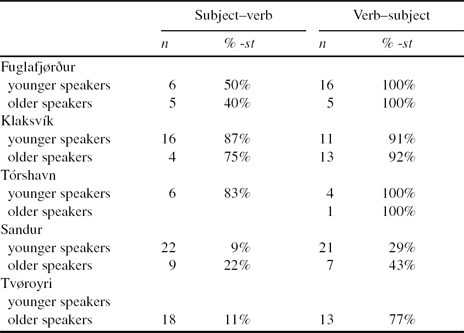
The distribution of -st verb endings in the corpus is summarised in Table 3, distinguishing between subject–verb and verb–subject word order and between younger and older speakers in the five locations. This disposition of the data is necessary to be able to discuss dialect change, but has led to very low token counts in many of the cells. An analysis by speech style underlines this problem: because speakers were asked to talk about themselves in interviews, very few second-person constructions were used in that style. Only 28 tokens (16%) occurred in the interviews.
Proportion of -st 2sg endings in subject–verb and verb–subject word order in the corpus, by generation (n = 177).
The behaviour of -st endings in the corpus confirms patterns described in traditional dialectology. Speakers from Tórshavn and Klaksvík predominantly have -st endings in both word orders, and speakers from Sandur have relatively few -st endings – although the 22% -st endings found in Sandur differs significantly from traditional dialect descriptions which show exclusively zero endings here. Tvøroyri shows the described split between word orders, with few -st endings when the verb follows the subject and much more frequent endings when it precedes it. Only Fuglafjørður deviates from traditional patterns, with relatively fewer endings in subject–verb word order. Although the pattern is not as clear as in Tvøroyri, the Fuglafjørður speakers seem to employ a weaker version of a Type III system.
Comparing the use of -st endings by older and younger speakers is a diagnostic for dialect change in apparent time. This is unfortunately only possible for three locations where data for both generations are available. Especially in Fuglafjørður and Klaksvík, the percentages of -st endings produced by older and younger speakers are very similar. Only in Sandur does there seem to be change: the younger speakers here have a lower proportion of -st endings than the single older speaker in the corpus. It therefore seems that local systems are not changing; if anything, they are becoming more entrenched.
3.3.2 -ir and -ur endings
The second variable is considerably more frequent than the first. Tokens were extracted from the second half of all conversations and interviews, but at least five minutes of data per interview and ten minutes per conversation were analysed. This gave a total of just over 1,500 tokens, equally divided between interview and conversation data. Approximately a quarter of tokens were realisations of orthographic -ir endings, three-quarters were orthographic -ur endings.
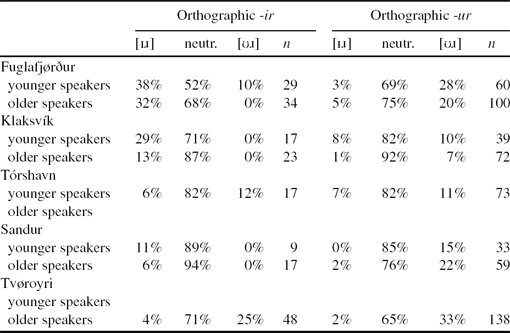
For consistency with Selås’ study, the variables were coded auditorily with five variants. For this stage of the analysis, however, and in accordance with Selås’ practice, the three neutralised variants were collapsed into one category, leading to the distribution shown in Tables 4 (for conversations) and 5 (for interviews).
Distribution of [ɪɹ] and [ʊɹ] realisations and neutralisations for -ir and -ur endings, in conversational style (n = 194 for -ir, n = 576 for -ur, overall n = 770).

Distribution of [ɪɹ] and [ʊɹ] realisations and neutralisations for -ir and -ur endings, in interview style (n = 194 for -ir, n = 574 for -ur, overall n = 768).
The high reduction rate across the board (77% of all tokens) mirrors what was found by Selås, but where Selås excluded the neutralised tokens from her analysis, they will be maintained here exactly because they are so frequent. We restrict our analysis here to the question of whether realisations of orthographic -ir and -ur endings are merged in the corpus data and make comparisons with descriptions of traditional dialects. Even with 1,500 tokens, the fragmentation of the data results in token counts that are too low to perform reliable statistical tests; what follows is a brief discussion of the pattern in each of the five locations.
According to Thráinsson et al.'s (2004:349–350) description, the Fuglafjørður dialect has a distinction between -ir and -ur, and this is confirmed by the corpus data. For both age groups and in both styles, we find relatively few neutralisations, and relatively many full realisations that conform to the orthographic form. Further, the description of the Klaksvík dialect point to a merger in [ɪɹ]. Apart from high neutralisation rates especially for older speakers, we find relatively many full [ɪɹ] realisations for -ir compared to full [ʊɹ] realisations for -ur; also, swaps occur for -ur but not for -ir. There is therefore a preference for [ɪɹ], but not a clear merger of -ir and -ur. The expected merger in [ɪɹ] in Tórshavn does not appear in our data either; rather, the younger speakers show a merger in a neutralised variant, possibly [əɹ],Footnote 6 while the older speakers keep the two endings distinct predominantly through more full and fewer neutralised realisations for -ur. In Sandur, the traditional descriptions describe a distinction between -ir and -ur, and despite very high neutralisation rates, the full realisations [ɪɹ] and [ʊɹ] more often than not correspond to the orthographic forms, suggesting the traditional patterns are maintained. Finally, also in Tvøroyri, the expected pattern, a merger in [ʊɹ], is borne out by the data, which show high rates of [ʊɹ] and very few [ɪɹ] realisations for both spellings in addition to very frequent neutralisations.
4. DISCUSSION
4.1 Variation and change in spoken Faroese
The findings with regard to the two variables in this study largely corroborate descriptions in the literature of the traditional dialects in the survey locations with recent quantitative data. Exceptions to this general rule are, firstly, the relatively low rates of -st endings in subject–verb word order in Fuglafjørður, and secondly, the very high rates of neutralised realisations of -ir and -ur endings in all five locations. The patterns of occurrence of -st endings may be explained by pragmatic and semantic factors (see Werner Reference Werner1970), but the necessary qualitative analysis has not been undertaken here. The high neutralisation rates for -ir and -ur, on the other hand, may indicate a deviation from traditional patterns, although the data do confirm the expected (non-)mergers and the preferences for [ɪɹ] and [ʊɹ] as non-neutralised realisations. The correspondences between traditional dialect descriptions and the corpus data, then, as well as the fact that the corpus data do not show any meaningful generational differences in language use, give no strong evidence for language change in progress. If this means a (near-)absence of dialect levelling in Faroese, this would not be unique to Faroese: also in Norway, for example, we find limited dialect levelling and extensive dialect diversity in spite of supposedly centralising forces (Røyneland Reference Røyneland2009).
The data are not only fairly homogeneous with respect to generational differences, but also style differences in the corpus are at best marginal. The only difference between the interview and conversation data is a slightly higher proportion of -st endings in interviews, although low token counts make it impossible to ascertain the significance of this difference. Differences between the two speech styles for -ir and -ur endings are even less clear. This could mean that, at least for these two features, there are no differences between formal and informal styles of speech. Alternatively, the two tasks did not differ enough to give informants reason to employ different styles. A possible reason for this is that the interviews were recorded in the same locations as the conversations and had a relatively informal feel to them, and that – unsurprisingly in such a small community – the interviewees could easily place the interviewer relative to their own social networks, i.e., they were no strangers to each other. Another reason is that interviewees may have consciously or subconsciously resisted style-shifting, either because they were told that the task concerned their own local dialects, or because they held on to their own dialect as an act of identity in opposition to the interviewers from Tórshavn.
The lack of a style difference also means that little can be said about the characteristics and origins of Central Faroese, which might otherwise have been expected to appear in interview style. There is no evidence of informants using a different form of language in arguably more formal styles, or even of differences between the various local forms of language diminishing in favour of, perhaps, Central Faroese forms. Whether this is a result of the choice of variables in this study or whether this pattern is replicated for other variables will have to be confirmed by further analysis of the corpus. This further analysis may focus on several of the morphological variables described by Weyhe (Reference Weyhe1996), which may lie below the level of conscious awareness, and for which often clearly differing hypotheses for the three relevant processes may be formulated.
This study was restricted to analysing raw token counts and identifying broad patterns in the data. The analysis could be refined by investigating the exact social and linguistic constraints on the variation by age group and by location. A variable-rule analysis may well show stylistic or generational differences in the choice of certain variants and may even indicate similarities between younger speakers or interview styles that could be argued to constitute evidence of change towards a Central Faroese variety. Currently, however, this would mean a fragmentation of the corpus to such an extent that we would have been left with insufficient data. Moreover, as stated in the introduction to the corpus (Section 3.2), there is an uneven spread of social characteristics such as age and gender in all the locations, making such an analysis more difficult and unreliable.
Another issue is the use of the Nordic Dialect Corpus for variationist-sociolinguistic research. Such studies are not the prime objective of the corpus: it is meant to facilitate augmenting attitudinal and judgement studies with an analysis of production data – many such studies from the 2008 fieldwork workshop are reported in the journal Nordlyd, vol. 36, no. 2 (2009). Moreover, the corpus is used in regional-dialectological research into the (almost purely geographical) spread of forms and features. The study of the two variables presented here suggests that the corpus does in fact allow a verification of previous claims regarding geographical distribution and has a utility in assessing relevant quantitative data, but that it can show social variation by age, gender and speech style only at a very coarse level. For more detailed variationist-sociolinguistic research, the corpus is lacking in size and coverage of social characteristics. A more complete description of linguistic variation in the Faroe Islands therefore requires significant augmentation of corpus material.
5. CONCLUSION AND OUTLOOK
Faroese has only sporadically been the subject of variationist-sociolinguistic research. This is unfortunate, not only because of the rich geographical variation in the language, but also because of the unique situation of rapid social change in this small and tight-knit language community. Urbanisation and counter-urbanisation, emigration, the increase of internal and external mobility, and changing roles for the language in education and mass media have relatively recently paved the way for dialect change. Each of these social changes individually can be expected to lead to either standardisation, dialect levelling, or dialect spread, but the linguistic outcome of the conglomerate of changes is unclear. Moreover, a new unofficial spoken standard, known as Central Faroese, has recently been described, but the origins of this variety and its place in the constellation of Faroese dialects have as yet not been identified.
As a first step towards answering these questions, two sociolinguistic variables were investigated in the Faroese part of the Nordic Dialect Corpus: the occurrence of the -st verb ending, and the phonetic realisation of the (nominal, adjectival and verbal) -ir and -ur endings. The analysis of both variables confirmed that geographical patterns of variation described for traditional dialects are valid in the sense that they indicate the relative frequency of the variants occurring in the different varieties, but such descriptions only capture part of the variation and cannot easily account for, for example, the different rates of use for neutralised variants of the -ir and -ur variables. No generational differences could be identified in the data that are suggestive of language change in progress, and there were no stylistic differences, meaning that little can be said about the role of Central Faroese, which was expected to be used in more formal contexts. The lack of conclusive results in this study may, at least in part, be due to the use of a small, non-sociolinguistic corpus.
Geographical location explains part of the linguistic differences found in spoken Faroese, but in order to get a more complete description of the language and to understand processes of variation and change, including the development of a spoken standard, a departure from a predominantly geographical perspective on variation is needed, and more weight needs to be put on age-related, stylistic and social factors. Further work on variation in Faroese would benefit from collection of corpora that focus not only on obtaining a wide geographical spread, but also on surveying a larger number of informants per location in a number of sufficiently different speech styles. The social and socio-historical characteristics of the Faroese speech community offer a unique opportunity to investigate the interplay of different sociolinguistic processes of change, but this potential can only be realised when adequate data are collected.
ACKNOWLEDGEMENTS
I thank Janne Bondi Johannessen for giving me the chance to work on the Faroese section of the Nordic Dialect Corpus during and after a research visit to the University of Oslo in 2010. Also Signe Laake, Kristin Hagen and Anders Nøklestad have been tremendously helpful in my work with the corpus. I also thank Edit Bugge and Jógvan í Lon Jacobsen for discussing some of the theoretical issues presented here with me, and Victoria Absalonsen for helping me out with some of the questions I had about the data. Chris McCully, Koen Sebregts, Edit Bugge, Sandra Jansen, and three anonymous reviewers for the Nordic Journal of Linguistics have given valuable feedback on earlier drafts of this article. The responsibility for opinions expressed and errors committed remains, of course, my own.