

Governments around the globe increasingly limit fundamental rights such as freedom of expression or assembly to manage divisions and contestation within their own societies, raising concerns about democratic erosion and putting the debate about how liberal states can legitimately defend themselves against internal threats high on the research agenda (see, e.g., Bateman Reference Bateman2025; Bolleyer and Schroeder Reference Bolleyer and Schroeder2025; Bourne Reference Bourne2022; Bourne and Olsen Reference Bourne and Olsen2023; Capoccia Reference Capoccia2001; Reference Capoccia2013; Reference Capoccia, Malkopoulou and Kirshner2019; Chaudhry Reference Chaudhry2022; Chaudhry and Heiss Reference Chaudhry and Heiss2022; Della Porta Reference della Porta2013; Glasius, Schalk, and De Lange Reference Glasius, Schalk and De Lange2020; Malkopoulou and Moffitt Reference Malkopoulou and Moffitt2023; Müller Reference Müller, Rosenfeld and Sajó2012; Reference Müller, Jacobsohn and Schor2018; Reference Müller2019; Schupmann Reference Schupmann2024; Swiney Reference Swiney2022). Relatedly, the growth of rights restrictions to counter threats to the liberal democratic state has raised widespread concerns, especially following the terrorist attacks of September 11, 2001, about the transformation of liberal systems into “quasi-militant” or “preventive” states (e.g., Ashworth and Zedner Reference Ashworth and Zedner2014; Rak and Bäcker Reference Rak, Bäcker, Rak and Bäcker2022; Steiker Reference Steiker1998; Zedner and Ashforth Reference Zedner and Ashworth2019)—that is, states that promote, through provisions that unduly limit fundamental rights, “an erosion of the constitutional state in the name of effectively protecting order” (Sajó Reference Sajó2006, 2290). As Fishman (Reference Fishman2025, 100) stressed in a recent piece on how to distinguish demonstrations that deepen democracy from those that endanger it, if “the moats of institutional defense are drawn too narrowly, the effect would be to unnecessarily weaken democracy” instead of strengthening it.
These interconnected concerns gain salience as antidemocratic and illiberal societal actors push the boundaries of fundamental rights guarantees to challenge liberal governments, while illiberal leaders and parties in power stretch, if not overstep, the boundaries of legal instruments to implement their political agendas. In light of this dual attack on the liberal democratic state’s legal foundation, which a growing number of systems are experiencing, this paper addresses two closely intertwined questions: First, when can we interpret formal legal provisions imposing limits on citizens’ fundamental rights as a justifiable part of a liberal democratic state’s repertoire for constitutional self-defense, leaving basic liberal values and requirements intact, and when do they constitute unjustifiable incremental violations of the liberal democratic framework? And second, if democracies have indeed experienced a “restructuring of fundamental rights” in the post–September 11 period (Sajó Reference Sajó2006, 2265), to what extent have the legal architectures of liberal democracies become empirically more “defensive” and to what extent have they become more “illiberal”? The adoption of defensive measures aligns with notions of liberal democratic militancy, suggesting a basic compatibility between preemptive rights limitations and fundamental liberal principles that potentially make liberal democracy more resilient. On the other hand, illiberal measures suggest an incremental erosionFootnote 1 of the liberal foundations of democratic orders.
These important questions raise normative, theoretical, analytical, and empirical challenges that our paper aims to address. There is widespread agreement that to ban a group for displaying extremist beliefs (but not behavior), for instance, is “objectively” a limitation on freedom of association, if not freedom of expression (Kirshner Reference Kirshner2014; Malkopoulou and Kirshner Reference Malkopoulou and Kirshner2019; Tyulkina Reference Tyulkina2015; Zeller and Vaughan Reference Zeller and Vaughan2024). Nevertheless, granting democratic states the legal authorization to do so tends to be evaluated in conflicting ways depending on the literatures consulted: as a normatively problematic infringement of the fundamental rights that liberal democracies ought to guarantee, or as an essential part of a robust regime for self-defense that is able to counter internal threats to the liberal democratic system and its foundations.Footnote 2 Generally, different (to date disconnected) strands of research across the social sciences are fundamentally conflicted over the status of legal provisions that affect or condition the “free” exercise of fundamental rights in pluralist societies, treating them either as illiberal and restrictive of citizens’ rights or as defensive and potentially protective of the liberal democratic state. They include a rapidly growing body of work on democratic militancy or self-defense that has developed in response to new, pressing challenges facing democracies, such as Islamic extremism, populism, and the election of illiberal leaders and parties; work on the growing readiness of citizens to tolerate or even endorse increasingly coercive and possibly repressive government policies that address fundamental crises; and theoretical and empirical research on the increasingly prescriptive nature of liberalism as it increasingly manifests itself legally in the regulation of harmful intentions and beliefs rather than the regulation of harmful behavior.Footnote 3
Speaking to these debates, this paper addresses the above questions in three steps. First, it specifies a minimum baseline to establish which formal legal limitations on fundamental rights might be justifiable as safeguards within liberal democratic frameworks in light of the latter’s own constitutive characteristics, and hence can qualify as “militant-style” means of constitutional self-defense in liberal democratic states. Approaching militant democracy as “a way of understanding certain laws” (Tyulkina Reference Tyulkina2015, 527),Footnote 4 we distinguish three types of serious harm that individual legal provisionsFootnote 5 ought to substantively address to qualify as means of self-defense—harm against the state, harm against the democratic process, and harm against liberal values—in addition to meeting basic, procedural conditions associated with the “principled restraint” generally expected from liberal states whenever they place limits on citizens’ basic rights (Zedner and Ashforth Reference Zedner and Ashworth2019, 443–44). Second, we formulate two expectations about the nature of legal change in fundamental rights domains, distinguishing a defensive from an illiberal logic of rights restructuring, drawing on scholarship on “militant democracy” to underpin the former and on the “preventive state” to underpin the latter. Third, we empirically assess these theoretical expectations using new legal data across 12 European democracies that trace, over two decades, the introduction (or removal) of 148 types of rights limitations on freedom of assembly, freedom of expression, and freedom of association—three critical legal domains that guarantee the right to opposition, a constitutive pillar of liberal democracy (Dahl Reference Dahl1971, 4). By distinguishing a “defensive” from an “illiberal” logic of rights restructuring and then analyzing the evolution of democracies’ actual rights infrastructures—both on the level of individual provisions and in terms of aggregate trends—we make explicit our normative standards when evaluating how liberal democracies regulate fundamental rights. This advances the state of the art theoretically, empirically, and normatively.
In theoretical terms, we contribute to a growing literature on authoritarian legalism or legislative lawfare, which stresses that legal provisions that are benign when adopted in isolation might erode liberal democracies when operating in combination (see, e.g., Bolleyer et al., Reference Bolleyer, Eick, Falci, Bejma, Di Mascio, Salát, Spyropoulou, Zorigt and Katzforthcoming; Ermakoff Reference Ermakoff2020; Gloppen, Gerzso, and Van de Walle Reference Gloppen, Gerzso, van de Walle, Arriola, Rakner and van de Walle2023; Scheppele Reference Scheppele2013; Reference Scheppele2018). Relatedly, normatively problematic, illiberal restrictions might only entail negative systemic effects in terms of democratic erosion when combined with other restrictions (see, e.g., Smidt et al. Reference Smidt, Perera, Mitchell and Bakke2021). Rather than zooming in on specific types of rights limitations in single countries, then, this makes it useful to theorize developments in democracies’ rights infrastructures in terms of different basic logics of governmental control, which captures whether legal provisions across different legal domains comply with or violate minimum standards derived from basic liberal democratic principles. This is illustrated by Hungary, a now autocratized order (see, e.g., Boda Reference Boda2024; Enyedi and Mikola Reference Enyedi and Mikola2024). Among the countries analyzed below, it stands out because it combines a range of provisions that have successively enhanced the government’s legal authority to interfere in fundamental rights domains, including provisions that meet and provisions that violate liberal democratic minimum standards. That many of these provisions have long formed a “normal” part of rights architectures in many democracies highlights the importance of an encompassing and comparative approach (see, e.g., Scheppele Reference Scheppele2013).
Regarding our empirical contributions, as Capoccia (Reference Capoccia, Malkopoulou and Kirshner2019, 134) highlights, more encompassing cross-national analyses on the evolution of the range of legal limitations on political participation and expression that are available to democracies—the core focus of researchers on militant democracy—are widely absent.Footnote 6 This is the case even though legally enshrined “self-defense measures” are mostly defined narrowly with a focus on preemptive measures against nonviolent, radical, and politically active organizations (Müller Reference Müller, Jacobsohn and Schor2018, 415; Vinx Reference Vinx2020, 685–86). This paper provides the first encompassing and systematic assessment of how 12 European countries have legally “conditioned” the use of fundamental rights since 2000. It does so based on a more inclusive conceptualization of constitutional self-defense in liberal democratic states, which a number of scholars have called for in light of the challenges that liberal democracies have been facing (e.g., Bourne Reference Bourne2022; Bourne and Rijpkema Reference Bourne and Rijpkema2022; Khramova and Troitskaya Reference Khramova, Troitskaya, Cremades and Hermida2021; Tyulkina Reference Tyulkina2015). Our analysis will show that democracies’ repertoires of self-defense provisions that are in line with basic liberal democratic requirements have not only broadened over the last two decades across all examined rights domains, but have also predominantly been rationalized as instruments that counter harm to the state and to liberal values. Provisions that fall outside the broader remits of constitutional self-defense because they violate basic requirements have gained prominence as well.
Both findings have significant normative and practical repercussions for debates around the resilience and legitimacy of liberal democratic systems. The growth of illiberal provisions can be read as a symptom of incremental liberal democratic erosion, evidencing a growing discrepancy between political orders’ legal architectures and the foundation of values that underpins them (see, e.g., Chaudhry and Heiss Reference Chaudhry and Heiss2022; Sajó Reference Sajó2006). In contrast, the growth of defensive measures indicates a qualitative change in the nature of self-defense embraced by liberal democratic orders, suggesting a more expansive understanding of how the authorities can interfere with pluralism and individual rights to guarantee liberty, which in turn might generate societal backlash and radicalization and thereby unnecessarily weaken democracy (Börzel and Zürn Reference Börzel and Zürn2021; Della Porta Reference della Porta2013; Fishman Reference Fishman2025, 100; Invernizzi Accetti and Zuckerman Reference Invernizzi Accetti and Zuckerman2017). When a liberal democratic state becomes more invasive of individual and group autonomy and the private sphere—when, for example, it monitors beliefs that can be legitimately expressed in public—this inevitably raises fundamental questions about the point at which liberalism, as a positive doctrine telling people how to live their lives, risks violating its own essential principles, such as state neutrality, value pluralism, and tolerance (see, e.g., Adamson, Triadafilopoulos, and Zolberg Reference Adamson, Triadafilopoulos and Zolberg2011; Enyedi Reference Enyedi2024; Kis Reference Kis, Rosenfeld and Sajó2012; Mouritsen and Olsen Reference Mouritsen, Olsen, Dobbernack and Modood2013). Finally, regardless of whether new provisions are inside or outside boundaries of liberal democratic self-defense to start with, increasing legal complexity in the regulation of fundamental rights grants authorities more governmental control over society and thus more leeway for government abuse. This might be viewed as normatively undesirable, especially as more actors whose commitment to liberal values and willingness to accept legal limits is doubtful at best come to power, as indicated by the Trump administrations in the US.
In the following, we develop benchmarks for legal provisions to qualify as means of constitutional self-defense in liberal democratic states. On this basis, we formulate two theoretical expectations about the nature of rights restructuring that might follow a defensive or illiberal logic. Having presented our methodology and data, we examine these expectations empirically and conclude with the broader repercussions of our findings and avenues for future research.
The Notion of Principled Restraint and the Outer Boundaries of Constitutional Self-Defense in Liberal Democratic States
Two decades ago, Sajó (Reference Sajó2006, 2257) reminded us in a seminal piece “that restrictions are not normal, though might be legitimate” in liberal democratic settings (italics added). At around the same time, Pfersmann (Reference Pfersmann and Sajó2004, 53) argued that “democracies are always more or less militant.” Since then, there have been significant conceptual advancements on democratic self-defense and militancy that explore the boundaries between rights limitations in line or clashing with different variants of militant democracy (see, e.g., Bourne Reference Bourne2022; Bourne and Rijpkema Reference Bourne and Rijpkema2022; Malkopoulou and Kirshner Reference Malkopoulou and Kirshner2019; Müller Reference Müller2019; Stahl and Popp-Madsen Reference Stahl and Popp-Madsen2022; Vinx Reference Vinx2020). Nevertheless, we still lack normative benchmarks for which rights limitations can be considered justifiable according to basic liberal democratic standards (Fishman Reference Fishman2025, 93–94; Sajó Reference Sajó2006, 2257), which are critical to “how democracies trying to defend themselves can avoid eroding their own foundations” (Müller Reference Müller, Rosenfeld and Sajó2012, 1255; italics in original). While in themselves relevant to ongoing controversies among theorists, normative benchmarks—and their translation into analytical tools—to distinguish justifiable from unjustifiable rights limitations are in fact urgently needed empirically. We need them to evaluate which provisions among the diversity of rights limitations adopted by elected governments over the last few decades comply with and are justifiable in terms of basic liberal principles—what we refer to as defensive provisions—and which ones violate even minimum standards derived from the latter—referred to in the following as illiberal provisions.
This distinction is critical, as governments tend to publicly justify inevitably controversial rights limitations as functionally necessary to counter serious harm, whatever their motivation. Yet normatively unjustifiable limitations that qualify as illiberal according to even basic standards—mere mutations of militant democracy (Müller Reference Müller, Jacobsohn and Schor2018, 422)—reflect a paradigm of governmental control at odds with liberal democracies as rights-based systems (Ashworth and Zedner Reference Ashworth and Zedner2014; Steiker Reference Steiker1998; Zedner and Ashworth Reference Zedner and Ashworth2019). When adopting such provisions specifically, authorities engage in legal reforms that result in a violation of constitutive values defining liberal democratic orders, which thus can be read as a symptom of liberal democratic erosion and as detrimental to the resilience of liberal democratic states.Footnote 7
To analytically locate an actual rights limitation—defined as a legal provision that imposes costs on, curtails, or conditions the exercising of fundamental rights by citizens, and forms part of a political order’s normal legal architecture,Footnote 8 either outside or within the remit of self-defense—we deliberately start with the concept of constitutional self-defense because this concept “allows [us] to expand the range of protected principles, as well as the range of measures of self-defense” beyond those commonly discussed (Khramova and Troitskaya Reference Khramova, Troitskaya, Cremades and Hermida2021, 4; Sajó Reference Sajó, Malkopoulou and Kirshner2019a, 193–94). Simultaneously, it requires that rights limitations are justifiable in relation to constitutive principles of the type of order that provisions claim to defend, both in substantive and procedural terms (Kuo Reference Kuo2024, 418–19). In liberal democratic orders committed to ensuring the “equal liberty of citizens” (Shklar Reference Shklar2023, 283) and characterized by a legal system in which state authorities are required to safeguard individual rights (Ermakoff Reference Ermakoff2020, S166), essential minimum requirements that determine when authorities can coercively interfere with citizens’ fundamental rights can be derived from the notion of principled restraint (Ashworth and Zedner Reference Ashworth and Zedner2014; Zedner and Ashworth Reference Zedner and Ashworth2019). This notion has substantive and procedural implications. First, in terms of their substantive purposes, defensive provisions in liberal democratic states need to meaningfully address a serious harm to constitutive parts of the liberal democratic order (or to its necessary preconditions), and thus be justifiable as protections of constitutive characteristics that are essential for the order’s continued existence. Only then can provisions be interpreted as being meaningfully directed toward enhancing an order’s resilience (Holloway and Manwaring Reference Holloway and Manwaring2023; Merkel and Lührmann Reference Merkel and Lührmann2021).Footnote 9 Second, any written statute curtailing rights, irrespective of purpose, needs to meet basic procedural rule-of-law requirements (Fuller [1964] Reference Fuller1969, 39; Zedner and Ashworth Reference Zedner and Ashworth2019, 443–44). These implications jointly constitute the smallest common denominator that rights limitations must comply with under any notion of liberalism that is committed to the “equal liberty of citizens,” enabling us to identify provisions clearly located outside the boundaries of what authorities might legitimately justify as constitutional self-defense in the context of any liberal democratic setting.Footnote 10 We develop each benchmark to distinguish justifiable defensive provisions from unjustifiable illiberal provisions in turn.
The Substantive Core of Defensive Rights Limitations: Countering Serious Harm to the Liberal Democratic State
In a liberal state, “the authorized deprivation of basic rights” is “in need of moral and political justification. The roots of this justification may be found in the harm that the coercion is designed to avert or minimize” (Ashworth and Zedner Reference Ashworth and Zedner2014, 7–8; Fishman Reference Fishman2025; Sajó Reference Sajó2006; Reference Sajó, Malkopoulou and Kirshner2019a). As we ultimately strive for conceptual distinctions suitable for empirical analysis, it is critical that the notion of constitutional self-defense recognizes that “there is no single standard of what constitutes a threat to [liberal] democracy and reasonable countries, so to speak, can reasonably differ on the issues” (Müller Reference Müller, Jacobsohn and Schor2018, 423; see also Fishman Reference Fishman2019; Reference Fishman2025; Klamt Reference Klamt, Bruinsma and Nelken2007; Pfersmann Reference Pfersmann and Sajó2004; Thiel Reference Thiel and Thiel2009a). Accordingly, liberal democratic states might adopt a variety of rights limitations to “counter ‘evil’” (Sajó Reference Sajó, Malkopoulou and Kirshner2019a, 187). To capture such variety, we define constitutional self-defense in terms of three categories of serious harm to the liberal democratic state (rather than just liberal democracy), each referring to one pillar that is constitutive of the identity of this type of order (i.e., critical to its resilience) (Merkel and Lührmann Reference Merkel and Lührmann2021): (1) harm to the state and its basic functions/functioning, (2) harm to the constitutive features of the democratic process, and (3) harm to liberal values.
If legal provisions can be rationalized as a means to counter serious harm to any of these constitutive elements, rights limitations can, at least in substantive terms, be considered as part of a liberal democracy’s arsenal for self-defense, a perspective that aligns with Loewenstein’s (Reference Loewenstein1937a; Reference Loewenstein1937b) seminal work. His concern with self-defense of the democratic state (or “constitutional government”—i.e., political orders in which rule of law is constitutive) (Reference Loewenstein1937a, 418–19, 428), led him to include legal means that address these three types of harm, from rights limitations on organizations “inimical” to the state or public order, to provisions preventing the subversion of the democratic process by antidemocratic actors, to restrictions on degrading speech toward minorities (Loewenstein Reference Loewenstein1937b, 648–53).Footnote 11 We specify each notion of harm and the conceptual boundaries between them in turn.
Harm to the state refers to threats that pose a risk to the foundations and stability of the state apparatus, and is thus a concern for any political order, democratic or not (Pfersmann Reference Pfersmann and Sajó2004, 57; Sajó Reference Sajó and Sajó2004, 213). It includes threats to territorial integrityFootnote 12 and to the functioning of state institutions, as well as threats to the state’s ability to provide those basic entitlements that citizens in any order can expect from political authority, such as public order, freedom from violence, and crime prevention (Ashworth and Zedner Reference Ashworth and Zedner2014; Loewenstein Reference Loewenstein1937b, 645). While the justifiability of defending the state does not strictly derive from liberal principles—a reason why many authors do not regard such legal provisions as part of the liberal democratic self-defense repertoire or militant democracy—a functioning state is nevertheless an empirical precondition for any liberal order, which unlike other regime types must also strike an appropriate balance between freedom and security (Thiel Reference Thiel and Thiel2009b, 1). The defense of the state can therefore be conceived more broadly as a form of constitutional self-defense, without which the legal order cannot exist (Sajó Reference Sajó, Malkopoulou and Kirshner2019a, 194).
Harm to the democratic process refers to threats that endanger democracy, democratic institutions, and its central actors, including basic preconditions for ensuring and protecting the “equal liberty” of citizens as political participants and for maintaining government accountability to the citizenry as a whole (Fishman Reference Fishman2025, 99–100). While this type of harm covers, for instance, totalitarian speech and actions that deny political participation to certain groups, it does not cover harm to the equality of groups in broader societal discourses beyond the political sphere (e.g., racist speech) (Vinx Reference Vinx2020).
Finally, harm to liberal values goes beyond the previous category’s concern with the democratic process and the equality of individuals qua citizens, instead referring to threats to human dignity in all spheres of life. We follow Glasius’s (Reference Glasius2018, 517) separate conceptualization of authoritarian and illiberal practices, which focuses on the main type of harm each type of practice inflicts. While authoritarian practices (such as undermining accountability structures in the political domain) align with our notion of harm to the democratic process, illiberal practices violate norms of individual autonomy and dignity, corresponding to our notion of harm to liberal values (530–31). When applying this notion of harmful behavior to citizens (instead of state actors), it helps to identify when the exercising of rights by citizens may qualify as abuse and justify governmental restrictions. This notion also parallels Merkel and Lührmann’s (Reference Merkel and Lührmann2021, 869–70) understanding of illiberal (as compared with authoritarian) challenges by actors in a political order not fully committed to its liberal dimensions.
Examples of justifiable provisions that refer only to this third category of harm would be prohibiting speech that degrades minorities, banning racist organizations that lack public or political engagement, and restricting any discriminatory display of symbols in public assemblies. In all three cases, the state addresses broader human rights problems at the societal level, which do not necessarily concern the democratic process as strictly understood (Glasius Reference Glasius2018).Footnote 13 Such limitations could be seen—depending on a democracy’s self-understanding—as a way of defending foundational values of liberal constitutionalism, again reflecting a broader notion of constitutional self-defense.Footnote 14
Basic Procedural Expectations toward Defensive Rights Limitations
Moving to the procedural requirements associated with principled restraint, in liberal democratic states any rights limitation deemed necessary by lawmakers for whatever reason “should be so adjusted as to ensure that the liberty of all persons involved is preserved as far as possible” (Ashworth and Zedner Reference Ashworth and Zedner2014, 257). This essentially means that provisions authorizing rights limitations ought to contain basic safeguards against the inherent risk of government abuse (Invernizzi Accetti and Zuckerman Reference Invernizzi Accetti and Zuckerman2017, 190; Sajó Reference Sajó2006, 2257; Zedner and Ashforth Reference Zedner and Ashworth2019, 443–44). Building on Fuller’s ([1964] Reference Fuller1969) influential work, the generality and clarity of written statutes form two necessary procedural requirements that, in line with our conceptualization of self-defense, constitute minimum thresholds that government behavior must meet to comply with rule-of-law principles (Murphy Reference Murphy2005, 262).Footnote 15 Laws ought to prohibit or permit future behavior of a certain kind (rather than target individual citizens, institutions, or actors) and allow citizens to clearly identify what they are prohibited from doing or permitted or required to do (Fuller [1964] Reference Fuller1969, 39). As highlighted by key work on the preventive state (Ashworth and Zedner Reference Ashworth and Zedner2014; Zedner and Ashforth Reference Zedner and Ashworth2019), the vagueness or indeterminacy of legal provisions regarding the harm they address or the activities they prohibit are problematic because they invite the use of too much discretionary power, as are provisions that violate the generality and prospectivity of the law. Relatedly, fundamental rights limitations should be nondiscriminatory (Cassidy Reference Cassidy2015, 6). Accordingly, legal provisions that target individually named organizations or create pre-inchoate offences such as criminalizing (vaguely specified) support for organizations would be excluded from the remit of constitutional self-defense as they risk making citizens shy away from exercising their fundamental rights (Malkopoulou and Norman Reference Malkopoulou and Norman2018, 447; Schupmann Reference Schupmann2024, 61–63). Rule-of-law principles would further exclude provisions authorizing the withdrawal of basic rights—such as the right to peaceful protest—for preventive reasons if they are based on past violations that have already been sanctioned, or if the government is not required to provide an assessment of the likelihood of risks materializing as a result of the exercise of such rights (Ashworth and Zedner Reference Ashworth and Zedner2014, 264; Della Porta Reference della Porta2013, 163–64; Zedner and Ashforth Reference Zedner and Ashworth2019, 443–44).
Inside and outside the Boundaries of Self-Defense: Toward a Defensive or an Illiberal Logic of Governmental Control?
Militant democracy and the preventive state can be understood as neighboring normative concepts denoting related paradigmatic responses to fundamental threats that confront liberal democratic states. Both are concerned with the legally authorized, coercive deprivation of basic rights by government authorities to address or avert serious harm to constitutive features of the political order. Both concepts represent a departure from traditional principles that animate liberal democratic states as rights-based systems. However, the rights limitations prominently referred to in these literatures differ in their adherence—or lack thereof—to that minimum baseline of principled self-restraint that ought to guide liberal democracies when they curtail rights (see, e.g., Beširević Reference Beširević, Tushnet and Kochenov2023; Engelmann Reference Engelmann2012; Khramova and Troitskaya Reference Khramova, Troitskaya, Cremades and Hermida2021; Melander Reference Melander2023; Müller Reference Müller, Rosenfeld and Sajó2012; Reference Müller, Jacobsohn and Schor2018; Reference Müller2019; Roach Reference Roach and Sajó2004; Sajó Reference Sajó2006; Reference Sajó, Malkopoulou and Kirshner2019a; Tyulkina Reference Tyulkina2015; Zedner and Ashforth Reference Zedner and Ashworth2019). Integrating them underpins the normative distinction between a defensive and an illiberal form of rights restructuring, each denoting a different logic of governmental control. Each logic empirically manifests itself in distinct changes to democracies’ legal architectures that reflect qualitatively different shifts in the legal contours of their rights infrastructures, the former suggesting a potential bolstering of the resilience of liberal democratic regimes, the latter signifying its incremental erosion.
Our defensive logic of rights restructuring aligns with interpretations of democratic militancy as a legal principle requiring “democratic means of a militant nature” to be associated with safeguards to ensure the ongoing commitment of political orders to basic constitutional principles (Beširević Reference Beširević, Tushnet and Kochenov2023, 662; Macklem Reference Macklem2012; Rak and Bäcker Reference Rak, Bäcker, Rak and Bäcker2022; Sajó Reference Sajó, Malkopoulou and Kirshner2019a, 193–94). In terms of empirical expectations, then, we propose that a defensive, militant-style logic of restructuring basic rights manifests itself through the adoption of provisions compliant with at least the minimum requirements derived from the notion of principled restraint presented earlier. Legal provisions falling outside these basic parameters instead align with an illiberal logic of governmental control that violates basic requirements of principled restraint substantively, procedurally, or both. A growing number of these provisions indicates an incremental erosion of fundamental liberal principles and values as a growing variety of (not necessarily serious) harms are countered at the cost of increasingly and unduly curtailing fundamental rights, guarantees, and protections—a development prominently problematized in the literature on the preventive state. Different from an even broadly defined militant-style notion of constitutional self-defense like that informing our defensive logic of rights restructuring, this illiberal logic of rights restructuring increasingly “insulates the state’s actions from the limits of the law” (Steiker Reference Steiker1998, 806). As pointed out by leading scholars in this field, such a tendency does not just depart from but risks eroding liberal democracy as a rights-based system (Melander Reference Melander2023, 12; Sajó Reference Sajó2006, 2268–70; Zedner and Ashforth Reference Zedner and Ashworth2019, 431–32).
Both normative and empirical research suggests that legal changes in fundamental rights domains have led to a growth of provisions of either type. Widely discussed reasons for this include a variety of domestic pressures such as terrorism, illiberal populism, radicalization, and extremism, as well as international pressures or diffusion processes that invite the adoption of provisions designed to avert existential threats to liberal democratic orders (see, e.g., Ashworth and Zedner Reference Ashworth and Zedner2014; Bleich Reference Bleich2011; Bourne Reference Bourne2022; Della Porta Reference della Porta2013; Fox and Nolte Reference Fox and Nolte1995; Khramova and Troitskaya Reference Khramova, Troitskaya, Cremades and Hermida2021; Macklem Reference Macklem2012; Müller Reference Müller, Rosenfeld and Sajó2012; Rak and Bäcker Reference Rak, Bäcker, Rak and Bäcker2022; Roach Reference Roach and Sajó2004; Tyulkina Reference Tyulkina2015). Despite the prominence of such claims, we still lack systematic cross-national evidence able to trace how pronounced each development has become across the fundamental rights domains that are constitutive of liberal democratic orders (e.g., Capoccia Reference Capoccia, Malkopoulou and Kirshner2019; Merkel and Lührmann Reference Merkel and Lührmann2021). This is surprising, as distinguishing the two logics theoretically and empirically is, as noted, critical to evaluate the nature of rights restructuring that elected governments bring about through legal reform in many democracies. Change aligning with each logic can have different, even opposite, repercussions for democratic governance: defensive ones may potentially enhance resilience, while illiberal ones signify the incremental erosion of liberal democratic norms.Footnote 16
From Normative Logics to Empirical Analysis
In the following, we empirically examine 12 European democracies to determine to what extent and how democracies have restructured their legal architectures in line with an illiberal and a defensive logic. Provisions aligning with militant-style defensive logic as opposed to an illiberal logic are specified using the substantive and procedural benchmarks introduced earlier: the degree to which they address a serious harm to constitutive elements of the liberal democratic order and the degree to which they comply with basic procedural expectations toward how liberal states legally curtail fundamental rights. At this stage, our adoption of a broad notion of constitutional self-defense based on three categories of harm becomes methodologically consequential. While such a notion is consistent with legal pluralism—which suggests that different conceptions of self-defense are endorsed by European democracies (Klamt Reference Klamt, Bruinsma and Nelken2007; Kuo Reference Kuo2024; Macklem Reference Macklem2006; Reference Macklem2012)—whatever number of actual provisions we identify as falling outside the outer boundaries of self-defense (i.e., corresponding to an illiberal logic of rights restructuring) will be a highly conservative estimate, since our benchmarks are based on a thin minimum normative baseline. Finding even a moderate growth of illiberal provisions across the democracies we examine can be interpreted as a symptom of democratic erosion (Chaudhry and Heiss Reference Chaudhry and Heiss2022).
Country Selection and Examination Period
We analyze how democratically elected governments in 12 European countries have changed the regulation of freedom of expression, association, and assembly between 2000 and 2022.Footnote 17 We cover Austria, France, Germany, Greece, Hungary, Ireland, Italy, Latvia, Malta, Poland, Spain, and the United Kingdom, which have been European Union member-states for the whole or most of our examination periodFootnote 18 and—ceteris paribus—face high expectations from their population as well as political pressures from abroad to protect their citizens’ fundamental rights. These factors make the European region an unlikely context for the successive erosion of liberal democratic standards through formal legislation—a development some scholars have called “legal lawfare” (Gloppen, Gerzso, and Van de Walle Reference Gloppen, Gerzso, van de Walle, Arriola, Rakner and van de Walle2023)—especially since responsibility for officially enacted legislation cannot be denied by governments in charge (Glasius, Schalk, and De Lange Reference Glasius, Schalk and De Lange2020). Reflecting this, all but one of our countries are at least electoral democracies throughout the examination period. The exception is Hungary, which in 2019 was downgraded to an “electoral autocracy” by the Varieties of Democracy project (see Coppedge et al. Reference Coppedge, Gerring, Knutsen, Lindberg, Teorell, Altman and Angiolillo2025), a development we return to in our analysis. Simultaneously, our 12 countries also represent a wide variety of legal, political, and cultural traditions that suggest variation in the degree to which state authorities interfere in fundamental rights (see, e.g., Bolleyer Reference Bolleyer2018; Klamt Reference Klamt, Bruinsma and Nelken2007). Since an early comparative study by Thiel (Reference Thiel and Thiel2009b, 6), they have been exposed to crises or threats to their constitutional order to very different extents, inviting different manifestations of the “militant democracy principle” (on this, see also Sajó Reference Sajó2006; Tyulkina Reference Tyulkina2015).Footnote 19 These include exposure to domestic terrorism, economic crisis, government parties with illiberal agendas, and, most recently, the COVID-19 pandemic, all associated with enhanced regulatory restrictiveness in the domains of freedom of association, assembly, and expression (see, e.g., Ashworth and Zedner Reference Ashworth and Zedner2014; Bolleyer Reference Bolleyer, Sajó, Uitz and Holmes2022; Della Porta Reference della Porta2013; Sajó Reference Sajó2006; Swiney Reference Swiney2022). If, despite such variation, we nonetheless find shared patterns in rights restructuring (whether inside or outside the remit of constitutional self-defense), then rather than being a reflection of intense crisis exposure, this suggests an incremental modification of liberal democratic states’ normative foundations.
Data and Methodology
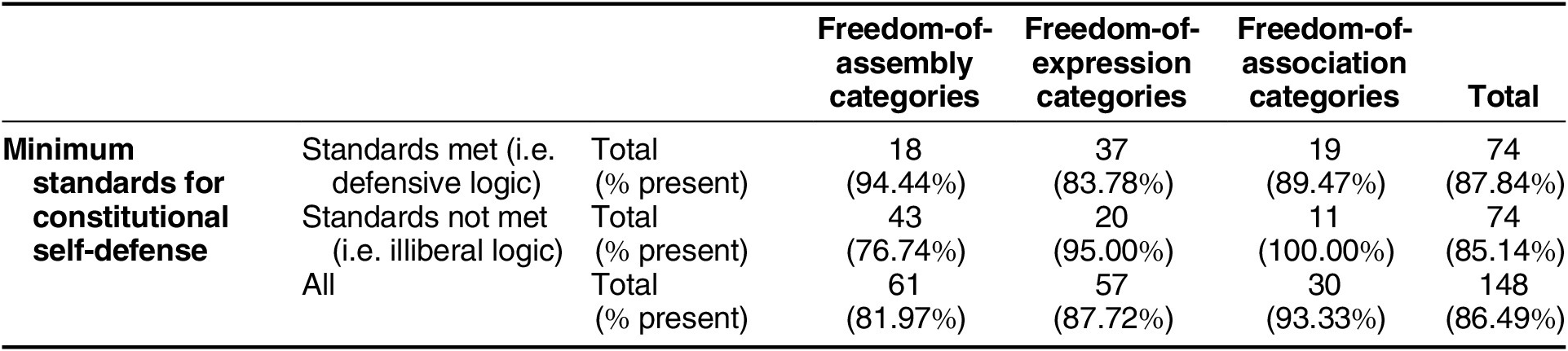
To systematically study the changing contours of how democracies regulate fundamental rights, we collected primary data in line with earlier comparative analyses that have traced legal change based on coding original legislation across different legal domains and jurisdictions over time (Bloodgood, Tremblay-Boire, and Prakash Reference Bloodgood, Tremblay-Boire and Prakash2014; Bolleyer Reference Bolleyer2018; DeMattee Reference DeMattee2022). We developed three separate coding schemes—one per rights domain—comprising a total of 148 coding categories (see table 1 below). Each codebook was designed to capture an encompassing inventory of limitations governments might legally adopt (or remove) in the areas of freedom of assembly, association, and expression—three rights domains essential for citizens’ political participation (Dahl Reference Dahl1971, 4; Swiney Reference Swiney2022).Footnote 20 The specification of the respective inventories of coding categories in each domain was inductive—that is, informed by a detailed assessment of cross-national, in-depth, and longitudinal studies focused on each rights domain, often conducted by legal scholars.Footnote 21 The goal was to be as exhaustive as possible, although governments might always invent new types of limitations. The coding categories (in the form of questions with standardized dichotomous answers) allowed a team of trained coders analyzing original legislationFootnote 22 regulating each domain to capture unambiguously the presence or absence (or the adoption or removal) of those rights limitations in any given year.Footnote 23
Number of Categories Complying with Minimum Standards for Constitutional Self-Defense and Proportion of Corresponding Provisions Found in the Data

Note: Percentage of provisions corresponding to these categories found in the data given in parentheses.
Building on earlier research on militant democracy and on the preventive state literature, both of which engage with the comparative assessment of political orders’ legal inventories through normatively anchored conceptual categories (Ashworth and Zedner Reference Ashworth and Zedner2014; Bourne and Casal Bértoa Reference Bourne and Bértoa2017; Capoccia Reference Capoccia2001; De Leeuw and Bourne Reference de Leeuw and Bourne2020), we organized our 148 coding categories into two groups according to our benchmarks, thereby distinguishing between those that capture defensive legal changes and those that capture illiberal ones. To qualify as defensive, we considered, first, whether the legal limitations captured by a category substantively addressed one of the three types of serious harm defined above (harm to the state, to the democratic process, or to liberal values) and, second, whether they met the basic, procedural minimum requirements, typically enshrined in fundamental rule-of-law principles, that authorities compliant with basic liberal norms must meet when interfering with fundamental rights.Footnote 24
Table 1 presents the results of our classification of coding categories per domain alongside the percentage of rights limitations for each of the six subcategories that formed part of at least one of the countries’ legal frameworks at some point during the examination period. Of the total of 148 categories, 86.49% (128) appear in our data. Specifically, out of 74 categories that do not meet the minimum standards to qualify as constitutional self-defense and hence reflect an illiberal logic, 85.14% (63) appear at some point in our data, while we find that 87.84% (65) of a total of 74 categories correspond to a defensive logic instead. Table 1 suggests not only that our codebook captures the diversity of inventories of rights limitations employed by democratic governments but also that provisions located outside a broad remit of constitutional self-defense—that is, illiberal rather than defensive, militant-style measures—are relatively widespread.
Empirical Analysis: The Defensive and Illiberal Restructuring of Fundamental Rights in European Democracies
We now provide an initial overview of the evolution of rights limitations comparing the evolution of provisions associated with the two basic logics of governmental control. To understand what the restructuring of basic rights entails, and to consider how it might relate to ongoing processes of democratic erosion in Europe or to states’ attempts to proactively strengthen their orders’ resilience, we explore in turn the substance of legal changes displaying a defensive and illiberal logic in the next two subsections.
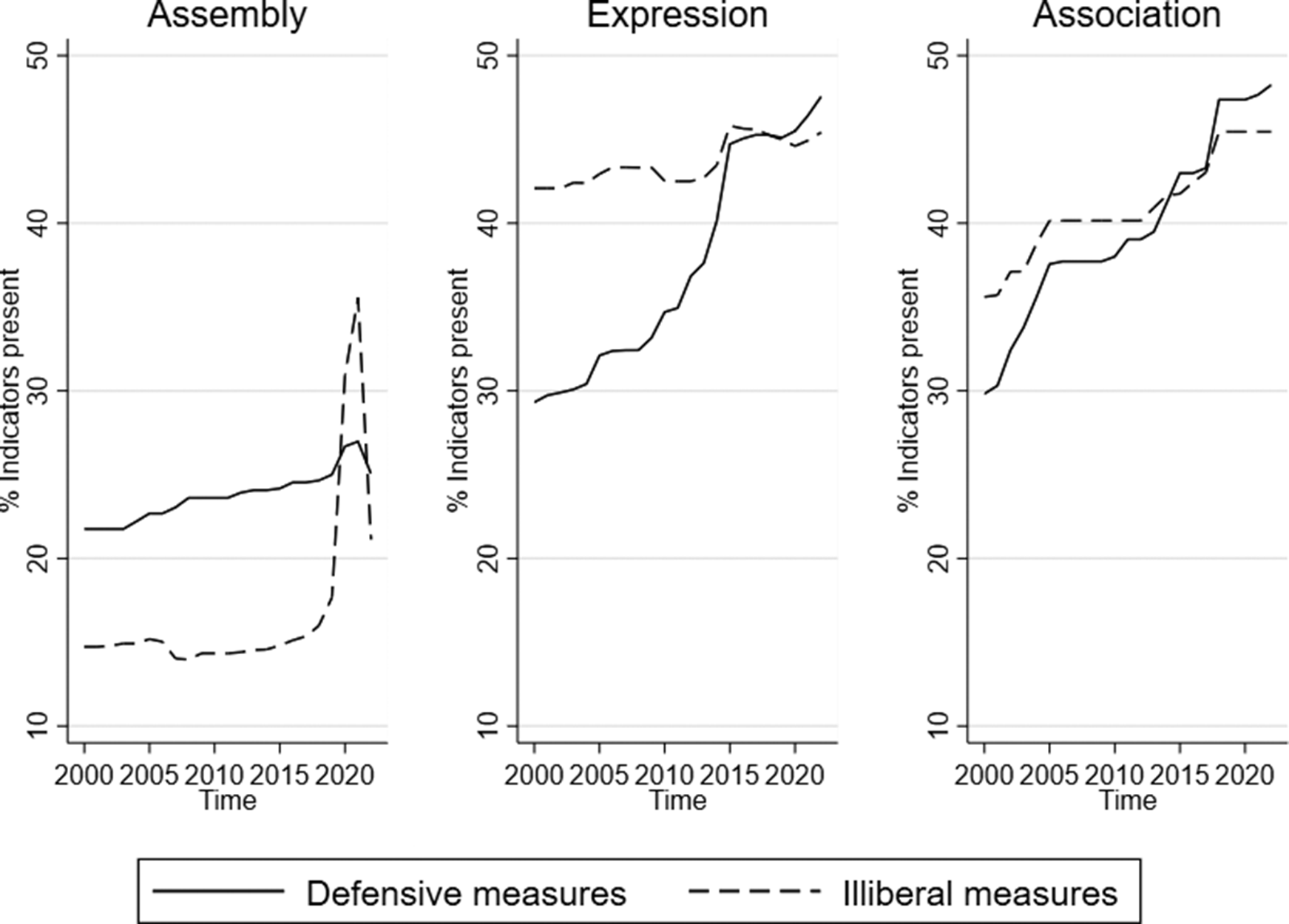
Figure 1 displays the evolution of justifiable rights limitations that follow a defensive logic—that is, limitations falling inside the boundaries of constitutional self-defense, vis-à-vis those following an illiberal logic and thus falling outside these boundaries—in the domains of freedom of assembly, expression, and association.Footnote 25 The countries studied increasingly adopted rights limitations of both types across all three domains. In each domain, rights limitations reflecting a defensive logic grew proportionally more than illiberal ones. Legal reforms in the region have thus broadly moved within the boundaries set by liberal democracies’ own normative foundations. In principle, this may be interpreted to mean that democracies are adopting militant-style provisions to strengthen their resilience to crises and other serious challenges to the political order. Simultaneously, illiberal rights limitations that fall outside the boundaries of liberal democratic self-defense have long formed a non-negligible part of the legal infrastructure of European democracies across all domains and are, moreover, on the rise.Footnote 26
Evolution of Provisions inside (Defensive) and outside (Illiberal) the Boundaries of Liberal Democratic Self-Defense (by Domain)
Note: Each graph plots the proportion of defensive vis-à-vis illiberal rights limitations that countries have adopted relative to all defensive/illiberal limitations at their disposal in the domains of freedom of assembly, expression, and association. See section C of the online appendix for a detailed description of our aggregate measures.

As shown in the figure, the three domains start out from different baselines and the extent and timing of change varies considerably, indicating that different contexts have prompted specific legal reforms in each. Still, in the second and third graphs—capturing changes in the regulation of freedom of expression and freedom of association, respectively—we see a sharp increase in provisions that express a defensive logic of governmental control over society, indicating a degree of regulatory convergence across countries in these two domains that has been triggered by transnational actors, such as the EU, and common crises, such as international terrorism. The freedom-of-expression graph, which represents an area that has long been highly regulated on the European continent (Bleich Reference Bleich2011; Casarosa Reference Casarosa2021), shows a steep increase in defensive rights limitations that qualify as constitutional self-defense, particularly between 2010 and 2015, in line with earlier literature on the increasing complexity of free-speech laws (Barendt [1985] Reference Barendt2007). This trajectory primarily reflects similar changes across countries in legislation to combat hate speech, especially following the EU framework decision issued in 2008 on the matter.Footnote 27 In contrast, the curve capturing illiberal provisions does not display a similarly steep upward change. Rather, the period preceding 2013 saw a temporary decline in such limitations. Countries such as the UK, Malta, Greece, and Ireland repealed speech restrictions related to religious blasphemy during this time. Such provisions are difficult to justify as acts of constitutional self-defense in liberal democratic states. Interestingly, though the same applies to limitations on religion that are intended to protect a country’s constitutional identity—such as restrictions on the display of religious symbols (Müller Reference Müller, Jacobsohn and Schor2018, 417)—these have actually become more common over time, as will be discussed below.
In the freedom-of-association graph, we observe a parallel increase in both limitation types, with two marked waves of growth: the first occurring between 2000 and 2005, and the second from 2013 onward. In the early 2000s, most countries in the region approved or reinforced counterterrorism legislation in response to rising rates of domestic terrorism, adding violence and terrorism—two limitations that are compatible with the defensive logic of rights restructuring and prevent harm to the state—to the list of grounds on which groups may be proscribed (see Roach [Reference Roach and Sajó2004] for a discussion on antiterrorism laws adopted in this period). In some cases, legal changes included more ambiguous grounds for curtailing the right to associate, such as those related to “public order disturbance,” “interference with authorities,” or to “unlawful or criminal behavior,” categories that follow an illiberal logic as they are both vague—lacking a clear legal definition and thus potentially allowing the scope of prohibited organizations to be unduly expanded—and indeterminate—granting authorities wide discretion in applying rights limitations. The second wave from 2013 is less marked and new limitations echoed a wider range of concerns, including as grounds to ban groups not only group violence, terrorism, and state integrity, but also public order and discrimination.
In contrast, the flatter trajectory of the lines in the freedom-of-assembly graph (leaving aside the extraordinary period during the COVID-19 pandemic) suggests that governments have amended assembly laws mainly in response to domestic issues.Footnote 28 Here we observe the lowest initial levels of rights limitations and more stability in both limitation types until about 2019.Footnote 29 From 2012 to 2019, there is a small increase in the adoption of limitations reflecting both logics, including a more pronounced growth in 2018 associated with Hungary’s extensive and restrictive reform of the law regulating freedom of assembly. In the postpandemic period, despite the revocation of COVID-19 measures in all cases,Footnote 30 both curves present slightly higher levels of restriction at the end of 2022 than in early 2019 because a few countries, such as Latvia and Greece, altered their laws on assembly during the 2020–22 period, creating new defensive and illiberal grounds to limit the right.
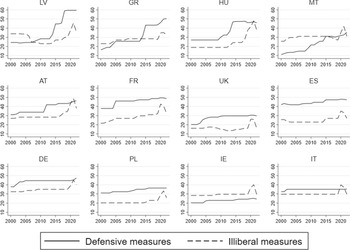
Figure 2 shows how the number of defensive and illiberal rights limitations has changed in the 12 countries we examined.Footnote 31 It essentially substantiates the picture established by figure 1, as all countries adopted more provisions that limited fundamental rights over the examination period, expanding their self-defense repertoire to include provisions that suggest a defensive logic of government control as well as provisions that align with an illiberal logic. Only Spain, Latvia, Malta, and the UK experienced temporary reductions in the number of limitations that do not qualify as constitutional self-defense. Furthermore, by 2022, all countries had adopted proportionally more defensive than illiberal rights limitations, except for Ireland, which has fewer limitations overall than most of its counterparts.
Evolution of Provisions inside (Defensive) and outside (Illiberal) the Boundaries of Liberal Democratic Self-Defense (by Country)

Although the countries started from very different baselines in 2000, we see greater cross-country convergence in the development of both defensive and illiberal provisions toward the end of our examination period. This suggests increasing similarity in the degree to which the two basic logics of governmental control manifested themselves in the rights infrastructures of each country. As discussed in relation to figure 1, this convergence can be partly attributed to similar external developments, which led to legal reforms across many countries in at least two of our legal domains. However, it also partly reflects the fact that some countries, particularly newer democracies, had less extensive regulation in the three domains in the early 2000s and were catching up over time, whereas older democracies already had extensive rights limitations in place, which resulted in less pronounced growth patterns. In fact, Latvia, Hungary, Malta, and Greece show significantly more variation than Italy, Ireland, and Germany—as they do in regard to limitations that do not align with a defensive logic, a subject we return to below. That said, the numbers of rights limitations qualifying as militant-style self-defense in Latvia, Hungary, Malta, and Greece grew more and eventually reached levels similar to those observed in states that were more regulated from the outset, such as France and Germany. This is also the case in Poland: because the country adopted and abrogated rights limitations simultaneously across domains—so that many changes offset one another—its legal framework is less stable than figure 2 implies. Overall, the data indicates that newer democracies caught up with older ones on aspects of the three fundamental freedoms that had not been regulated previously, especially in terms of strengthening rights limitations that formally qualified as defensive in nature.
While older democracies also show a clear trend toward more limitations on rights, notable differences have existed and persist between them, indicating that national conceptions of democracy and regulatory approaches still matter. Germany, France, and Spain started from higher levels of rights limitations while Ireland and the UK maintain comparatively lower levels. This discrepancy echoes earlier research on the influence of state traditions on regulatory approaches, as well as research on militant measures indicating that states respond to threats differently depending on the conception of democracy they endorse (Bourne and Casal Bértoa Reference Bourne and Bértoa2017). Notably, statist states such as Germany and France have long empowered state authorities to proactively regulate society to implement public interests, while “weak states” like the UK and Ireland tend to understand governments and their interests as reflections of societal interests, and thus have been much less inclined to regulate society (Birnbaum Reference Birnbaum1988; Bolleyer Reference Bolleyer2018).
Exploring the Defensive Restructuring of Liberal Democracies’ Legal Architectures
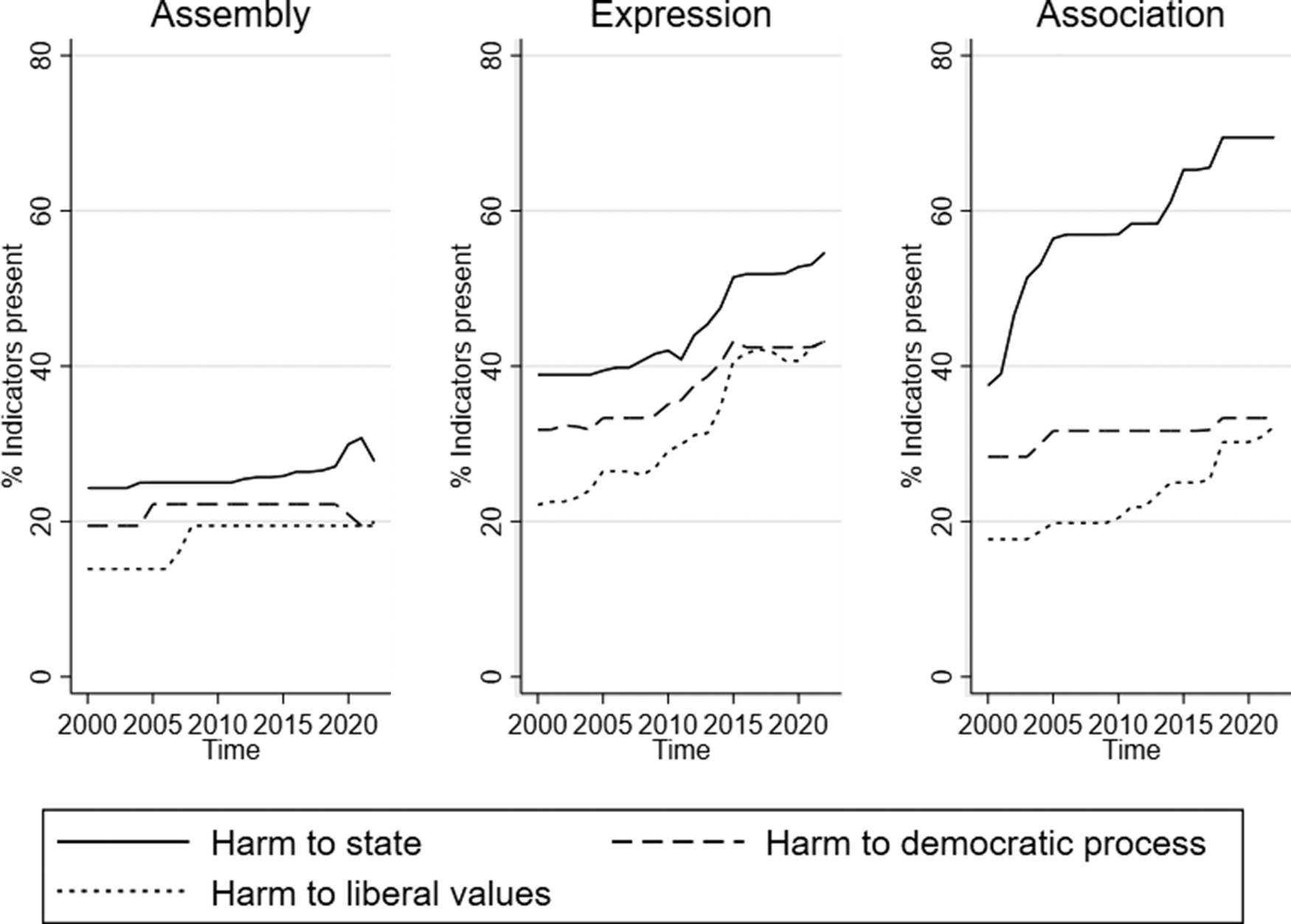
Figure 3 displays the evolution of limitations addressing harm to the state and its basic functions, to the democratic process, and to liberal values in each domain.Footnote 32 It shows that constitutional self-defense has become more centered on the protection of the state than on other types of protection, an observation that remains valid over time and across domains. This echoes literatures identifying a greater regulatory focus on security and preemptive legal measures in response to contemporary threats, a development that has become especially prominent since the September 11 attacks and affects all three rights domains (see, e.g., Della Porta Reference della Porta2013; Roach Reference Roach and Sajó2004; Tyulkina Reference Tyulkina2015). Aside from legal changes linked to terrorism, most countries expanded their legal grounds to limit speech inciting violence generally. The freedom-of-assembly graph tallies the growing number of reasons countries have used to either prohibit or disperse assemblies, such as advance assembly bans based on public order or safety concerns and assembly dispersal where participants are carrying weapons.
Evolution of Provisions Addressing Harm to the State, to the Democratic Process, and to Liberal Values across All Countries by Domain over Time

The number of limitations addressing serious harm to liberal values reaches that of provisions addressing harms to the democratic process, which are comparatively more stable. These trends are more pronounced in countries that experienced more legal change—particularly Greece, Hungary, and Latvia—but can be also observed in longer-lived democracies, such as France, the UK, and Austria. Overall, the increased focus on the protection of liberal values and the state again indicates some convergence in how countries have strengthened a defensive logic of governmental control within their rights infrastructures. This development is particularly clear in the regulation of freedom of expression indicated by the adoption of laws governing hate speech and genocide denial. In the freedom-of-association domain, we also observe the introduction of new legal grounds to proscribe groups on the basis of discrimination and violation of international norms, while new restrictions on the display of certain symbols, signs, and chants during public meetings, such as those related to particularly controversial groups, regulate freedom of assembly.
Exploring the Illiberal Restructuring of Liberal Democracies’ Legal Architectures
Illiberal rights limitations fall outside the boundaries of constitutional self-defense either because they do not address any serious harm to the constitutive features of liberal democratic states to start with, or because they violate fundamental procedural expectations about how a liberal state can curtail basic rights (Ashworth and Zedner Reference Ashworth and Zedner2014; Sajó Reference Sajó2006; Zedner and Ashforth Reference Zedner and Ashworth2019). The latter has been the more prevalent type of illiberal limitation in European democracies, and has grown more than the former, which has increased only marginally overall and has declined in some countries. This means that European democracies are progressively abandoning fundamental legal safeguards, enshrined in rule-of-law principles, in the way they regulate basic rights.
Many of the provisions that fail to meet procedural standards have long existed in a majority of the countries we studied, such as vague or imprecise limitations on speech or association that are based on an undefined and potentially far-reaching concept of public order and therefore risk giving too much discretion to the authorities enforcing the law. This is especially true in contexts where public order is not defined narrowly and its application is not properly scrutinized by the courts (Cassidy Reference Cassidy2015, 7–9). Such indeterminacy could easily lead the authorities to apply rights limitations in an arbitrary way.Footnote 33 Despite the infringements that these and other illiberal provisions make upon the rule of law, more countries have adopted them over time. Poland, Greece, and Hungary now allow authorities to ban assemblies in advance, without having to provide any risk assessment or evidence that an assembly is likely to cause harm. This not only increases the risk of arbitrariness in the application of the law but also makes it difficult to establish that a ban is the least intrusive way to achieve regulatory goals.Footnote 34 The 2018 Hungarian law on assembly incorporated many illiberal limitations that are difficult to justify even when applying a minimum standard for constitutional self-defense. Greece followed a similar path when reforming its assembly law in 2020, changing dispersal and prohibition clauses and making it easier for state authorities to overreach and violate basic standards of restraint when curtailing fundamental rights.
Turning to the claim that illiberal rights limitations fail to substantively address a relevant and serious harm to the state, to the democratic process, or to liberal values, legal changes suggest a tendency among some states to restrict rights in order to defend dominant values, groups, or notions of morality (Della Porta Reference della Porta2013, 164). Leading scholars have called these developments abuses of the militant democracy principle as it is traditionally understood (Müller Reference Müller, Jacobsohn and Schor2018, 415–16). Taken together, such trends in promajority and minority-restricting provisions can be read as attempts by governments to respond to the challenges posed by the increasingly plural character of their societies and, relatedly, to reinforce their core values, be they related to notions of nationhood, the republic, or liberal democracy.Footnote 35 Some limitations benefiting majorities are nearly universal (e.g., restrictions to speech that are ostensibly to protect privileged political symbols such as national flags and anthems) or are present in most countries (e.g., provisions protecting the dignity of the state and state representatives). While we observe a net increase in the number of this type of majority-benefiting limitations between 2000 and 2022, there are two particularly noteworthy legislative innovations. In 2013, Hungary introduced provisions limiting freedom of speech to protect the “majority nation,” only one element in a range of measures curtailing pluralism adopted under Fidesz, the governing party (Boda Reference Boda2024). In 2015, Spain introduced speech restrictions to safeguard powerful individuals and groups such as members of the security forces, a move that echoed the tendency of political elites to try to build a moat around the political arena and reflected the restrictive notion of institutional defense observed in assembly-law reform (Fishman Reference Fishman2019, 143; Reference Fishman2025). Similarly, we see a growth in the number of legal provisions that limit ideas, ways of life, or symbolic displays that cannot be considered seriously harmful from a self-defense perspective, such as restrictions on wearing or displaying religious symbols or using masks at assemblies.Footnote 36 Hungary incorporated some of these limitations into its normal legal framework, as did Austria, France, and Germany. All of these countries have tried to control religious displays, especially those of minority religions. Likewise, there has been an increase in broadly defined speech restrictions presented as youth protections, such as Hungary’s move to “protect” children from gender-diverse displays—provisions that clash with liberal values in society and promote a specific moral view. Rights limitations based on particular understandings of morality remained common in European democracies in 2022, even though countries such as the UK, Malta, Greece, and Ireland had abrogated their blasphemy laws.
Concluding with a broader observation, some countries have undergone particularly pronounced changes regarding provisions that follow an illiberal logic (Hungary, Latvia, Austria, France) whereas others have remained largely stable in this respect (Ireland, Italy), as seen in figure 2. Countries that display steeper growth in provisions following an illiberal logic increasingly step outside the boundaries of constitutional self-defense when limiting fundamental rights. This is likely a symptom of democratic erosion, especially if the growth occurs consistently over time, across domains, and is systematically driven by the same political actors or forces. While individual legal changes—even illiberal provisions—do not necessarily translate into autocratization, a “configurational view” on successively adopted changes that highlights their interactional effects can have fundamental implications for the constitutive character of a liberal democratic order (Scheppele Reference Scheppele2013; Reference Scheppele2018). Using Scheppele’s (Reference Scheppele2018, 549) characterization, such growth can constitute a “concerted and sustained attack,” in our case on the fundamental rights that safeguard vertical accountability in democracies. While this pattern is not evident in most of the countries we studied, Hungary does stand out in this respect, echoing findings that this country is becoming increasingly autocratic (e.g., Boda Reference Boda2024; Enyedi and Mikola Reference Enyedi and Mikola2024; Sajó, Uitz, and Holmes Reference Sajó, Uitz and Holmes2022). While Hungary adopted some rights limitations that had been present in a majority of our cases (here Hungary, as new EU member-state, might have been merely “catching up”), over time Viktor Orbán’s government has, as noted above, not only introduced illiberal rights limitations across all three domains but has also been a source of legislative innovation, creating provisions to protect the nation and its moral values while limiting minority speech. The government has added further restrictions to the law on assembly while expanding the country’s proscription regime, making it easier for authorities to interfere with the fundamental rights of association and assembly.
Conclusion
In this article we addressed the question of when to regard legal limitations to fundamental rights as compatible with the fundamental values that animate liberal democratic orders, and when to regard them as illiberal encroachments that violate even minimum liberal democratic standards. The question of when a right ought to be limited to prevent the abuse of that right is a critical one confronting many liberal democracies today, as antidemocratic or illiberal actors forcefully exploit fundamental rights guarantees to pursue their political goals (e.g., Bleich Reference Bleich2011; Cram [2006] Reference Cram2016; Fishman Reference Fishman2025). Recognizing that the readiness of democracies to place legal limits on the use of fundamental rights varies considerably, we established a minimum normative baseline for rights limitations to qualify as means of constitutional self-defense, aligning with a militant-style defensive logic of rights restructuring. We distinguished these from rights limitations embodying an illiberal logic that fall outside even broadly defined boundaries of constitutional self-defense. Applying these distinctions to new legal data capturing legal changes in the domains of freedom of association, expression, and assembly in 12 European democracies from 2000 to 2022 enabled us to systematically analyze the nature of rights restructuring these political systems have undergone. Doing so generated two main findings, both of which raise concerns about the resilience of liberal democratic regimes in Europe and elsewhere.
First, European democracies have continuously expanded their repertoires of constitutional self-defense in a way that is consistent in normative terms with a defensive, militant-style logic. While the relative number of normatively justifiable measures countering harm to the democratic process changed little, rights limitations against harm to the state and to liberal values grew consistently. We are thus witnessing a shift toward a broader understanding of constitutional self-defense, one that allows governments to respond to an increasingly complex range of harms that far transcend the threat of totalitarian ideologies that traditional militant democracy measures were designed to counter. This finding echoes calls to adopt a more inclusive conceptualization of “self-defense” in recognition of the new challenges encountered by present-day democracies—calls that are not uncontroversial (see, e.g., Bourne Reference Bourne2022; Capoccia Reference Capoccia2013; Reference Capoccia, Malkopoulou and Kirshner2019; Malkopoulou and Kirshner Reference Malkopoulou and Kirshner2019; Müller Reference Müller, Jacobsohn and Schor2018; Reference Müller2019; Rak and Bäcker Reference Rak, Bäcker, Rak and Bäcker2022; Schupmann Reference Schupmann2024; Stahl and Popp-Madsen Reference Stahl and Popp-Madsen2022; Vinx Reference Vinx2020).
Attempting to ensure the resilience of liberal democracies by expanding the ways in which state authorities can interfere with fundamental rights poses practical risks. While meeting our minimum liberal democratic standards, and thus formally qualifying as defensive, is a crucial condition for a rights limitation to support the resilience of a liberal democratic order, it is not a sufficient one. Implementation matters. Take the procedural implications of principled restraint: written statutes that qualify as defensive according to principled restraint may meet basic rule-of-law requirements. But as often highlighted in legal scholarship, the actual realization of the rule of law requires enforcement to be in line with the formal content of statutes (Fuller [1964] Reference Fuller1969, 39; Murphy Reference Murphy2005, 241). The potential discrepancy between the two makes clear that an increasingly differentiated defensive inventory of rights limitations, though formally compliant with principled restraint requirements, gives governments more opportunities to legally interfere with, and potentially violate, the autonomy and self-determination of citizens and groups when enforcing regulation (Della Porta Reference della Porta2013, 158–59, 163). This becomes all the more problematic as the “defensive legal shield” of states increasingly extends beyond countering behavior harmful to the political process, regulating the expression of beliefs in the societal sphere as well.
Relatedly, the notion that the government’s capacity to limit rights in the name of liberal values can yield protective consequences is premised on the assumption that governments entrusted with the promotion of such values remain committed to them (Issacharoff Reference Issacharoff2007, 1442; Loewenstein Reference Loewenstein1937b, 654). As illiberal parties and leaders have entered government in democracies whose consolidation has long been taken for granted, this critical assumption has become problematic. As Graber (Reference Graber2024) highlighted in a piece on “militant democracy U.S. style,” “[i]f popular majorities do not favor persons committed to the rules of liberal democracy, liberal democracy becomes a contradiction.” When authoritarian or illiberal actors win office, defensive (“quasi-militant”) provisions designed to counter rights abuses by citizens might be exploited by authorities to deliberately further democratic erosion (Graber Reference Graber2024; Invernizzi Accetti and Zuckerman Reference Invernizzi Accetti and Zuckerman2017; Issacharoff Reference Issacharoff2007; Rak and Bäcker Reference Rak, Bäcker, Rak and Bäcker2022). The usage of coercive measures inside the boundaries of self-defense by governments that are in principle liberally minded might also unintentionally reinforce existing social contestations against liberal democratic norms, eroding the order’s legitimacy even further (e.g., Bourne Reference Bourne2022; Fishman Reference Fishman2025; Malkopoulou and Moffitt Reference Malkopoulou and Moffitt2023; Malkopoulou and Norman Reference Malkopoulou and Norman2018).
These concerns are all the more salient when considering the simultaneous (though less pronounced) trend toward illiberal rights restructuring—our second main finding—which violates even minimum conditions for constitutional self-defense. Our assessment shows that such provisions have long been a part of many democracies’ legal frameworks. This is often overlooked, which serves to explain why illiberal governments such as the one in Hungary proactively try to legitimate legal reforms by pointing to “some law just like it somewhere in Europe” (Scheppele Reference Scheppele2013, 561). Paradoxically, such a strategy ought to become less successful as liberal democratic states as a whole are intruding more on fundamental rights, eroding especially the procedural standards of principled restraint that are central to the liberal state as a rights-based system (Ashworth and Zedner Reference Ashworth and Zedner2014; Fuller [1964] Reference Fuller1969; Sajó Reference Sajó2006). In particular, trends toward illiberal rights restructuring highlight the need to subject the legal frameworks of both older and newer democracies to the same scrutiny (Körtvélyesi Reference Körtvélyesi2020), as it becomes increasingly untenable to assume that what has been formally adopted in the former provides a “liberal democratic blueprint” to assess the latter. The upsurge in legislation to defend majority groups and dominant social values —also in older democracies—makes this clear, substantiating recent observations that European states not only promote liberal concepts but also other types of dominant ideals, including vague interpretations of national principles (Müller Reference Müller, Jacobsohn and Schor2018, 416). While Hungary criminalizes speech that degrades dominant groups since 2011, France banned the display of overt religious symbols in schools already as early as 2004. More recently, amendments to Austria’s School Education Act in 2019 and 2025 have sought to restrict the display of religious garments worn by minorities. The growth of such illiberal measures across the globeFootnote 37 indicates an incremental violation of liberal democratic values, which is problematic in itself. More worryingly, once we understand a “legal order as a system with interacting parts,” as Scheppele (Reference Scheppele2013, 562) rightly urges us to do, the systematic adoption of especially illiberal provisions across legal domains, as exemplified by Hungary, presents itself as a larger process. Such a process is more than the sum of its parts, risking to erode accountability structures and individual rights protections that are constitutive of liberal democratic orders (Boda Reference Boda2024; Chaudhry and Heiss Reference Chaudhry and Heiss2022; Enyedi Reference Enyedi2024; Glasius Reference Glasius2018; Sajó, Uitz, and Holmes Reference Sajó, Uitz and Holmes2022).
Supplementary material
To view supplementary material for this article, please visit http://doi.org/10.1017/S1537592725104155.
Acknowledgments
We are grateful to the three Perspectives on Politics reviewers for their thoughtful comments. Earlier versions of this paper were presented in September 2024 at the 75th Anniversary Conference of the International Political Science Association in Lisbon, and in March 2025 at the DVPW Section Conference “Citizen’s trust and societal polarization in times of transformation” at Saarland University, Saarbrücken. We thank all participants for their constructive feedback. We also thank Tanja A. Börzel, Angela Bourne, Zsolt Enyedi, Anthoula Malkopoulou, Jan-Werner Müller, Hans-Jürgen Puhle, and Georg Wenzelburger for their helpful feedback on earlier versions of this article. Finally, we thank Hannah Laier and Celina Schneider for their excellent research assistance. All remaining errors are solely ours.
This research has received funding from the European Research Council (ERC) (Grant agreement No. 101001458, CIVILSPACE). This support is gratefully acknowledged. Views and opinions expressed are however those of the author(s) only and do not necessarily reflect those of the European Union or the European Research Council. Neither the European Union nor the granting authority can be held responsible for them.
Data replication
Data replication sets are available in Harvard Dataverse at: https://doi.org/10.7910/DVN/TIFJZE


 Open access

