


As the evidence for the health benefits of a diet rich in fruit and vegetables is substantial( Reference Van Duyn and Pivonka 1 ), the WHO recommends a daily intake of at least 400 g of these foods which, unfortunately, most children do not meet( Reference Vereecken, De Henauw and Maes 2 ). As low intakes of fruit and vegetables track into adolescence and adulthood( Reference Kelder, Perry and Klepp 3 , Reference te Velde, Twisk and Brug 4 ), many campaigns are trying to increase the intake of these healthy foods in children. Fruit and vegetable variety was suggested as a potential factor that may increase choice of these foods in schoolchildren( Reference Krolner, Rasmussen and Brug 5 ). Vegetable variety was shown to improve meal composition in adults( Reference Bucher, van der Horst and Siegrist 6 ). If two vegetables were offered instead of one, people served themselves a higher proportion of energy from vegetables while the overall energy of the meal was not altered( Reference Bucher, van der Horst and Siegrist 6 ). A similar result was found by Meengs et al.( Reference Meengs, Roe and Rolls 7 ).
However, even though vegetable variety was shown to be effective in improving the composition of adults’ meals, it is not clear whether vegetable variety also improves the composition of children's meals. A randomized controlled trial that examined the effect of choice offering on consumption of vegetables in 4- to 6-year-olds did not show an increased intake( Reference Zeinstra, Renes and Koelen 8 ). When younger children select a meal, food-related cues such as variety might be of minor importance, while the responsiveness to liking or signals such as hunger and satiety might be more important( Reference Ashcroft, Semmler and Carnell 9 ). Recently, an observational study found that the fraction of children who ate at least one serving of fruit and vegetables during lunch was higher in schools that offered more fruit and vegetables( Reference Just, Lund and Price 10 ).
The fake food buffet, a new method that uses replica food items for experimental investigation of food choice, has recently been proved a reliable and valid method to investigate the effect of external influences( Reference Bucher, van der Horst and Siegrist 11 ). It was shown that the amount of food served from fake foods is highly correlated with the amount of food served from a buffet containing the corresponding real food items( Reference Bucher, van der Horst and Siegrist 11 ). Using fake foods instead of real foods for experimental studies reduces food waste, preparation effort and costs, as the items do not need to be cooked and are reused. Most importantly, the fake food buffet allows for the study of individual subjects under controlled laboratory conditions. Therefore, this method is very suitable for the investigation of environmental influences on food choice.
In the present study, we used a fake food buffet to assess whether vegetable variety improves 7- to 10-year-old children's meal composition. We used the same experimental setting that was applied in our previous study, where we showed that vegetable variety is effective to improve adults’ meal composition( Reference Bucher, van der Horst and Siegrist 6 ).
Methods
The fake food buffet
We used a fake food buffet for the experiment. For the present study, a buffet was prepared with four replicas of foods commonly eaten for a hot meal in Switzerland: carrots, green garden beans, pasta and fried skinless chicken breast. The replica foods were obtained from Döring GmbH, Munich (Germany). The replica food items were placed on a small table in metal serving dishes. The energy content of the fake foods was estimated by comparison with corresponding real food items. Further methodological details are presented elsewhere( Reference Bucher, van der Horst and Siegrist 6 , Reference Bucher, van der Horst and Siegrist 11 ).
Participants
Children aged 7 to 10 years and their parents were invited by mail to participate in a study about children's food preferences. One hundred children participated in the study (fifty-two boys). Children following a medically prescribed diet were excluded from participation. Written informed consent was obtained from all parents. Descriptive characteristics of the study population can be found in Table 1.
Descriptive characteristics of the study population and correlation analysis (Pearson's correlation coefficient r) of control variables with the outcome variables total energy from vegetables, total energy from meal and percentage of energy from vegetables: children aged 7 to 10 years and their parents

*Significant at P < 0·01, **significant at P < 0·001. No significant differences were found between the experimental groups.
†BMI percentiles were calculated from children's weight and height measures using the Centers for Disease Control and Prevention growth charts.
‡Hunger levels were measured on a three-point scale (1 = ‘not hungry’ to 3 = ‘hungry’).
§Picky eating was assessed with a six-item scale (Cronbach's α = 0·88) within the parents’ questionnaire. The items were derived from Wardle et al.( Reference Wardle, Guthrie and Sanderson 12 ).
||Food preferences were measured on a five-point scale (1 = ‘I like it very much’ to 5 = ‘I don't like it at all’).
¶Parental education was measured in categories ranging from 1 = ‘no education’ to 8 = ‘university degree’. The data were analysed using non-parametric statistics; Spearman's correlation coefficients are reported.
Experimental procedure
Hunger and preference for the foods were assessed before the experiment. Each child was randomly assigned to one of three different replica food selections. The buffet under condition ‘carrots’ (n 32) consisted of cooked carrots, pasta and chicken; under condition ‘beans’ (n 34), children could serve themselves green beans, pasta and chicken; and under condition ‘carrots & beans’ (n 34), children were offered both vegetables in addition to pasta and chicken. In the experiment each child was asked to serve him- or herself a meal, from the presented selection, such as they would like to eat for lunch from the presented selection on a normal school day. The experiment took place in the absence of the parent. The child's height and weight were measured by the experimenter.
Measures
The theoretical energy of the fake foods was determined by weighing the replica foods and multiplying the weight by a conversion factor to correct for weight differences between fake and real foods( Reference Bucher, van der Horst and Siegrist 6 ). The outcome variable percentage of energy from vegetables was determined by computing the relative energy from vegetables compared with the total energy.
Measured weight and height were used to calculate the children's BMI (weight in kilograms divided by the square of height in metres (kg/m2)). Hunger was measured with the question ‘How hungry do you feel right now?’ on a three-point scale (1 = ‘not hungry’, 2 = ‘medium’, 3 = ‘hungry’). Preferences were assessed with the question ‘How much do you like this food?’ on a five-point smiley scale (1 = ‘I like it very much’ to 5 = ‘I don't like it at all’). Picky eating was assessed with a six-item scale (Cronbach's α = 0·88) which was included in the parent's questionnaire. The items were derived from Wardle et al.( Reference Wardle, Guthrie and Sanderson 12 ).
Statistical analysis
Data were analysed using the statistical software package IBM SPSS Statistics Version 19. Univariate ANOVA was conducted to determine whether the buffet conditions were associated with the three outcome variables. Effect sizes (η 2) are reported. In the case of a significant omnibus F test, planned group comparisons were made using the Bonferroni correction (P values of the least significant difference test are multiplied by the number of comparisons). Means, standard deviations and Pearson correlation coefficients (r) are reported. All tests are based on a 0·05 significance level.
Results
One-way ANOVA did not detect any significant differences between the experimental groups in terms of age (mean 8·8 (sd 1·1) years), BMI percentile (mean 52·2 (sd 24·6)), preference for the offered food items (carrots: mean 2·2 (sd 1·1); beans: mean 2·6 (sd 1·3); pasta: mean 1·4 (sd 0·7); chicken: mean 2·0 (sd 1·1)), hunger (mean 1·6 (sd 0·6)) or picky eating (mean 19·6 (sd 7·3)).
To test whether vegetable variety affects the total energy from vegetables (kJ), the means of the energy derived from vegetables were compared between experimental groups (Table 2). ANOVA revealed a significant main effect (F (2,97) = 5·10, P = 0·008, η 2 = 0·10). The energy derived from vegetables increased significantly when two vegetables were offered instead of only one. Planned contrasts showed statistically significant differences between the condition ‘carrots & beans’ (mean 64 (sd 51) kJ) and conditions ‘carrots’ (mean 37 (sd 25) kJ, P = 0·018) and ‘beans’ (mean 38 (sd 34) kJ, P = 0·025).
Differences in meal composition depending on the experimental condition (one-way ANOVA): children aged 7 to 10 years (n 100, fifty-two boys)

a,bMean values within a row with unlike superscript letters were significantly different (P < 0·05). Bonferroni post hoc tests are reported (α = 0·05).
The same results were observed when the percentage of energy from vegetables was analysed, which indicates that children offered two vegetables served themselves a healthier meal.
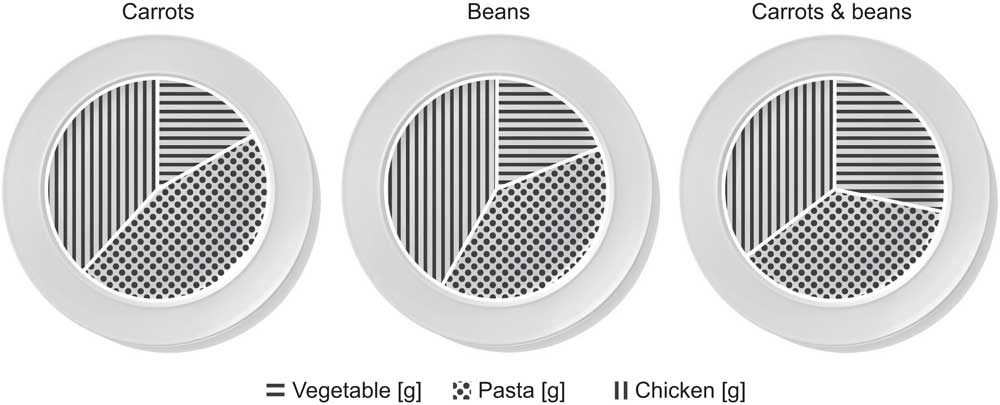
The variety of vegetables presented did not influence the total energy of the meal (F (2,97) = 0·81, P = 0·448, η 2 = 0·016; Table 2). Note that the test results of the effect of the experimental condition on the outcome variables total energy from vegetables and percentage of energy from vegetables are similar. This is because the energy from the total meal was equal throughout the conditions. A visualisation of the proportions of foods served on the plate is found in Fig. 1.
Visualisation of the food proportions on the plate. Children who were offered two vegetables instead of one chose a more balanced meal, containing a higher proportion of vegetables (grams of food were calculated based on the energy per 100 g values derived from the SwissFIR nutrient database( 17 ))
Moreover, the amount of vegetables served (t (98) = 0·30, P = 0·77) and the total energy of the meal (t (98) = 1·43, P = 0·16) did not differ between genders. The preference ratings for the individual food items were significantly related to the amount of the item that was served (chicken: r = 0·52, P < 0·001; pasta: r = 0·31, P = 0·002; carrots: r = 0·33, P = 0·001; beans: r = 0·57, P < 0·001). Picky eating was inversely related to the amount of vegetables scooped (r = −0·35, P < 0·001). Correlations of control variables with outcome variables are found in Table 1.
In addition to ANOVA, ANCOVA was conducted to control for the effect of children's preferences for chicken, pasta, carrots and beans on the outcome variables; and the analysis led to the same conclusions. The effect of the experimental condition on the served energy from vegetables and on the percentage of energy from vegetables was even higher when the preference ratings were included as covariates. The energy from vegetables was significantly higher in the two-vegetable group (F (2,90) = 11·7, P = <0·001, η 2 = 0·207), as was the percentage of energy from vegetables (F (2,90) = 13·34, P = < 0·001, η 2 = 0·231). The energy of the meal was not affected by the experimental condition (F (2,90) = 1·34, P = 0·124, η 2 = 0·029), even after controlling for the preferences. Note that picky eating was not included in the ANCOVA, as the measure is related to the preferences for the vegetables. BMI percentiles were not included, as there was no significant covariation with the outcomes after controlling for preferences.
Discussion
While most children like fruits, they are pickier when it comes to vegetables. Increasing children's vegetable intake is therefore more difficult. In the present study we showed that vegetable variety has the potential to increase the amount of vegetables selected and thereby improve children's meal composition.
The percentage of energy from vegetables almost doubled from 6 % (37 kJ and 38 kJ) to 11 % (64 kJ) when two vegetables were served instead of only one. At the same time, the energy of the total meal was not changed, suggesting that children chose a healthier meal containing a higher proportion of energy from vegetables. The result is consistent with our previous findings in adults. In contrast to previous findings with younger children( Reference Zeinstra, Renes and Koelen 8 ), we found a positive effect of offering a choice of vegetables to children aged 7 to 10 years. It might be that younger children are less responsive to food-related cues compared with older children.
The effect of variety on food consumption is commonly explained by a reduction of the so-called sensory-specific satiety( Reference Rolls, Rowe and Rolls 13 , Reference Rolls, Rolls and Rowe 14 ). The phenomenon of sensory-specific satiety refers to the declining satisfaction generated by the consumption of a certain type of food and the subsequent renewal of appetite upon exposure to another still-palatable food( Reference Rolls, Rolls and Rowe 14 ). However, as the fake foods were not consumed, this explanation can be excluded. Rather, these data support previous findings from Kahn and Wansink, who showed that the mere perception of variety leads to increased consumption( Reference Kahn and Wansink 15 ). They showed that children took more jellybeans when they were organised according to colours than when they were scrambled together( Reference Kahn and Wansink 15 ). The authors suggested that the assortment structure could serve as a consumption rule that suggests a quantity that is acceptable to eat. For organised assortments, the number of categories might serve as a benchmark of how much should be consumed. Therefore, if a variety of vegetables are served in several serving bowls, children might assume that it is appropriate to serve at least a little bit from every bowl. This consumption rule could explain why children, as well as adults, served themselves more vegetables if they were offered two instead of only one item. Hence, this effect is likely to be lost if vegetables are scrambled together in a dish such as in ratatouille.
Studies on moderators of the variety effect in adults suggest that the sensory-specific satiety effect is very stable( Reference Remick, Polivy and Pliner 16 ). Children who participated in the present study were mostly of normal weight. Remick et al. found that, in general, internal moderators like weight or dietary restraint do not influence the effect of variety( Reference Remick, Polivy and Pliner 16 ). Therefore, we would not expect a different experimental outcome in a population of obese or overweight children. However, this would need to be tested by future research.
The foods chosen for our study were relatively low in energy. If non-vegetable items which would have been higher in energy density had been chosen, the energy of a meal could have been reduced by increasing the variety of vegetables. The findings are limited to food choice to a certain extent, as the replica foods were not consumed. Nevertheless, the result that choice can be improved is relevant, because once healthy foods are on the plate, the likelihood that they will also be consumed is higher. The children were asked to choose only foods that they would like to eat and the amounts of food chosen were related to their preferences. Furthermore, children who were classified as picky eaters based on their parents’ assessment chose fewer vegetables. These findings are a measure of face validity and indicate that, overall, the children behaved naturally during the experiment.
Conclusion
Vegetable variety can increase the proportion of vegetables selected by both adults and children. Serving a bigger variety of vegetables at lunch in school cafeterias or after-school nurseries seems to be a simple and effective strategy to improve children's food choices. Further research should investigate this within a natural eating environment.
Acknowledgements
Sources of funding: This research was supported by the Swiss Foundation for Nutrition Research (SFEFS). The SFEFS had no role in the design, analysis or writing of this article. Conflicts of interest: There are no conflicts of interest for this study. Ethics: The study was approved by the ethics committee of the ETH Zurich (EK 2012-N-37). Authors’ contributions: T.B., M.S. and K.v.d.H. contributed to the design of the analysis. T.B. directed the study, conducted the analysis and wrote the manuscript by incorporating critical inputs from all authors. All authors approved the final manuscript. Acknowledgements: The authors are grateful to the families who participated in this research and to all who assisted in data acquisition.



