





Introduction
Appetite loss during ageing is a common condition among older adults, affecting approximately 15% to 30% of the community-based population and even at higher rates in individuals in hospitals and nursing homes(Reference Dericioglu, Methven and Clegg1,Reference Fielding, Landi and Smoyer2) . Extensive evidence has demonstrated the association between appetite loss and adverse outcomes in older people, particularly malnutrition and mortality(Reference Fielding, Landi and Smoyer2). Despite the high prevalence and potential prognostic value, appetite loss remains understudied and overlooked in real-life environments, constituting an unmet clinical need for many older individuals. Recent publications from the International Conference on Frailty and Sarcopenia Research (ICFSR) Task Force have elaborated on the factors contributing to appetite loss during ageing, the available assessment tools and potential approaches for clinical management(Reference de Souto Barreto, Cesari and Morley3,Reference de Souto Barreto, Cesari and Morley4) . However, the association between reduced appetite and functional decline and the mechanisms driving this relationship are still underexplored.
The aim of this review is to highlight the potential role of appetite loss as a marker of loss of function and frailty in older adults. Three main aspects will be approached in this review: first, we summarise the current evidence about the effects of appetite loss on frailty and functional outcomes; second, we evaluate various appetite-related phenotypes among older adults, that is, experiencing appetite loss along with concomitant clinical conditions, such as weight loss; finally, we discuss the issue of age-related appetite loss under the perspective of geroscience and the central role of biological ageing.
Terminology
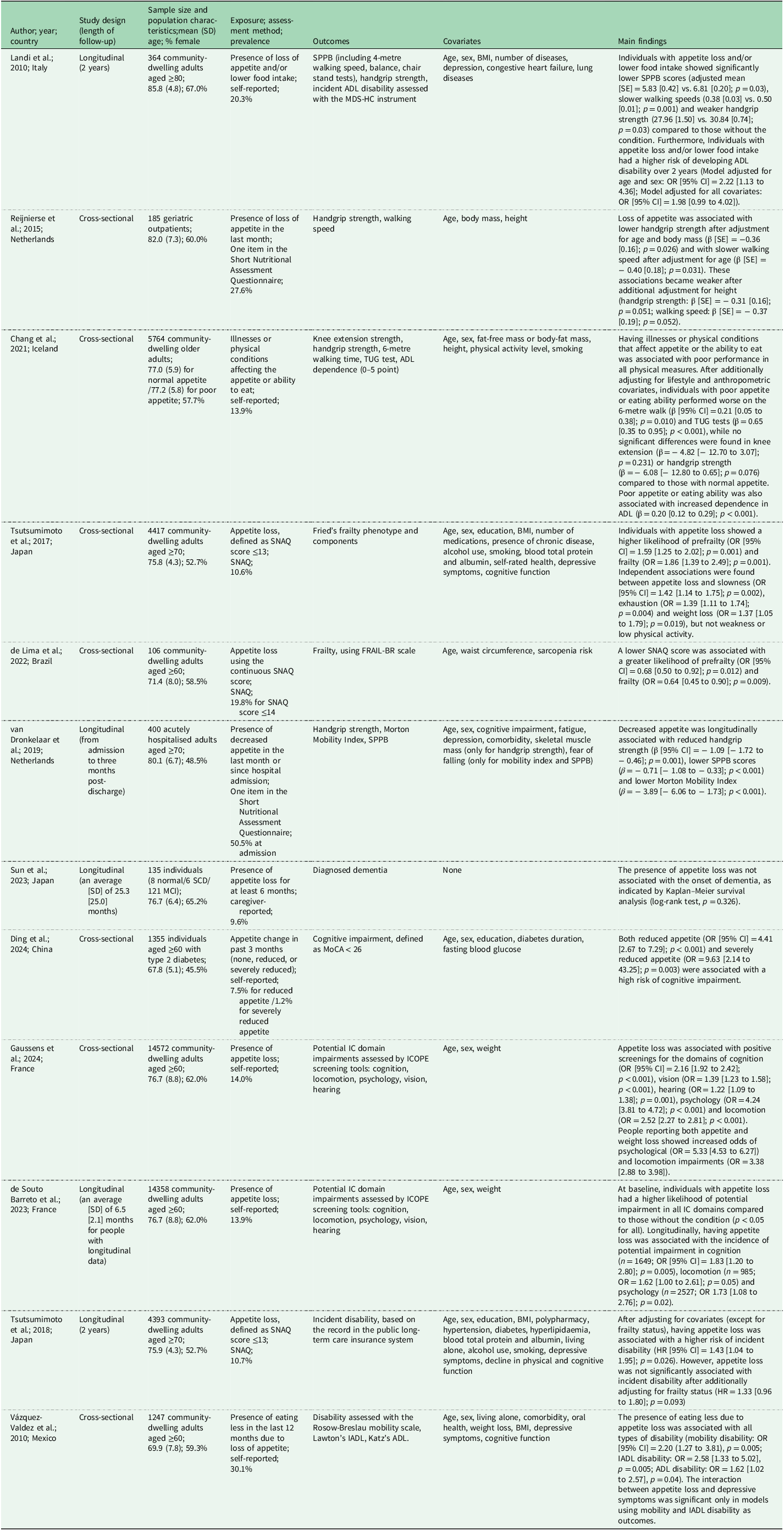
Prior studies used heterogeneous terminologies to define self-reported loss of appetite over a given period. In this review, we have unified the term ‘appetite loss’ throughout the text to avoid confusion. For studies that examined multiple aspects of eating-related problems in older adults, rather than focusing solely on appetite, we will specify their definitions in the description. Definitions and assessment methods of appetite loss used in the original papers are listed in Table 1, which summarises the study characteristics and main results of each study.
Characteristics and main results of studies investigating the associations between appetite loss, functional outcomes and frailty

ADL, activities of daily living; BMI, body mass index; CI, confidence interval; HR, hazard ratio; ICOPE, Integrated Care for Older People; IADL, instrumental activities of daily living; IC, intrinsic capacity; MCI, mild cognitive impairment; MDS-HC, Minimum Data Set for Home Care Assessment Instrument; MoCA, Montreal Cognitive Assessment; OR, odds ratio; SCD, subjective cognitive decline; SE, standard error; SNAQ, Simplified Nutritional Appetite Questionnaire; SPPB, Short Physical Performance Battery; TUG, timed up-and-go.
The terms ‘cachexia’ and ‘sarcopenia’ will be mentioned several times as common consequences of appetite loss. According to the prior papers(Reference Fearon, Strasser and Anker5,Reference Groarke, Crawford and Collins6) , cachexia is defined as involuntary body weight loss of >5% in the past six months or of >2% when body mass index (BMI) <20 kg/m2 (definition often used in the context of cancer). ‘Sarcopenia’, a condition characterised by the loss of muscle mass and function, is diagnosed or assessed using established criteria (e.g., EWGSOP2 guidelines(Reference Cruz-Jentoft, Bahat and Bauer7)) or questionnaires (e.g., the 5-item SARC-F questionnaire(Reference Malmstrom, Miller and Simonsick8); higher scores indicate a greater risk of sarcopenia).
Impacts of appetite loss on functional outcomes and frailty
Although the mechanistic link between appetite loss and negative outcomes remains unclear, it is widely believed that a decreased appetite leads to reduced food intake, resulting in insufficient energy and nutrients to meet metabolic demands(Reference Picca, Calvani and Coelho-Júnior9,Reference Cox and Lim10) . In other words, appetite loss could be a prodromal state of malnutrition that increases vulnerability to stressors and unfavourable health outcomes.
Several studies have investigated the effects of appetite loss on physical function, primarily focusing on components related to frailty and sarcopenia such as lower grip strength and slower walking speed (Table 1). Landi and colleagues investigated 364 community-dwelling octogenarians and compared participants with appetite loss and/or reduced food intake to those without either condition(Reference Landi, Russo and Liperoti11). They found that those with appetite loss and/or reduced food consumption performed significantly worse on Short Physical Performance Battery (SPPB) and handgrip strength than those without the condition. Moreover, participants with reduced appetite and/or food consumption demonstrated twice the risk of developing disability in basic activities of daily living (ADL) over two years compared to individuals without the condition; however, the association became insignificant after adjusting for BMI and comorbidity(Reference Landi, Russo and Liperoti11). A study by Reijnierse et al. involving 185 geriatric outpatients (mean ± SD age = 82.0 ± 7.3 years) reported similar results(Reference Reijnierse, Trappenburg and Leter12). They found that having appetite loss in the last month, assessed by an item in the Short Nutritional Assessment Questionnaire, was cross-sectionally associated with reduced handgrip strength and slower walking speed, but this association was no longer significant after additionally adjusting for body height (handgrip strength: β [SE] = −0.31 [0.16]; p = 0.051; walking speed: β [SE] = −0.37 [0.19]; p = 0.052)(Reference Reijnierse, Trappenburg and Leter12). A cross-sectional study of 5764 community-dwelling older adults from the AGES-Reykjavik Study identified participants whose appetite or eating ability was affected by illnesses or somatic problems(Reference Chang, Geirsdottir and Launer13). In that study, individuals with appetite loss or eating ability performed worse on the 6-metre walk (β [95% CI] = 0.21 [0.05 to 0.38]; p = 0.010) and timed up-and-go (TUG) tests (β = 0.65 [0.35 to 0.95]; p < 0.001), while no significant differences were found in knee extension (β = −4.82 [−12.70 to 3.07]; p = 0.231) or handgrip strength (β = −6.08 [−12.80 to 0.65]; p = 0.076) compared to those with normal appetite after adjusting for lifestyle and anthropometric covariates. Poor appetite or eating ability was also associated with increased dependence in ADL (β = 0.20 [0.12 to 0.29]; p < 0.001)(Reference Chang, Geirsdottir and Launer13). Another cross-sectional study of 4417 community-dwelling Japanese aged ≥70 found that the likelihood of prefrailty and frailty was 1.6 and 1.9 times higher, respectively, among individuals with appetite loss, defined by a Simplified Nutritional Appetite Questionnaire (SNAQ) score ≤13, compared to those without appetite loss(Reference Tsutsumimoto, Doi and Makizako14). When analysing the components of frailty, loss of appetite was associated with slowness, exhaustion and weight loss, but not with weakness or low physical activity(Reference Tsutsumimoto, Doi and Makizako14). Further evidence from a Brazilian cohort of 106 adults aged ≥60 reported that the odds of being prefrail and frail increased by 32% and 36%, respectively, for every point decrease of the SNAQ score(Reference de Lima, Zukeran and Valentini Neto15). Finally, Van Dronkelaar et al. evaluated appetite loss in 400 acutely hospitalised older adults aged ≥70 using Short Nutritional Assessment Questionnaire from admission to three months post-discharge(Reference Van Dronkelaar, Tieland and Aarden16). Decreased appetite was longitudinally associated with reduced handgrip strength (β [95% CI] = −1.09 [−1.72 to −0.46]; p = 0.001), lower SPPB scores (β = − 0.71 [−1.08 to −0.33]; p < 0.001) and impaired mobility (evaluated by Morton Mobility Index; β = −3.89 [−6.06 to −1.73]; p < 0.001)(Reference Van Dronkelaar, Tieland and Aarden16).
Appetite loss is a major contributor to weight loss, which are known risk factors for cognitive impairment(Reference Alhurani, Vassilaki and Aakre17). Moreover, appetite loss and weight loss were associated with poor cognitive performance and a higher risk of dementia in older adults with major depressive disorder(Reference Potter, McQuoid and Steffens18,Reference Saha, Hatch and Hayden19) . Nevertheless, an observational study involving 135 older adults (mean ± SD age = 76.7 ± 6.4 years) with normal cognitive function, subjective cognitive decline, or mild cognitive impairment failed to demonstrate difference in the onset of dementia between individuals with and without appetite loss using the Kaplan-Meier survival analysis (a log-rank test: p = 0.326)(Reference Sun, Matsuoka and Imai20). It is important to note that this study had a relatively short follow-up period (an average of 25.3 months), and appetite changes were reported by caregivers rather than participants(Reference Sun, Matsuoka and Imai20). In another study focusing on 1355 individuals aged ≥60 living with type 2 diabetes, loss of appetite over the past three months was associated with a higher likelihood of cognitive impairment, defined as Montreal Cognitive Assessment (MoCA) <26; the odds ratio was 4.4 times higher for individuals reporting reduced appetite and 9.6 times higher for those with severely reduced appetite, compared to their stable-appetite counterparts(Reference Ding, Lu and Li21).
Data derived from the Integrated Care for Older People (ICOPE) programme implementation in the Toulouse region (located in southwestern France)(Reference Tavassoli, de Souto Barreto and Berbon22) showed that loss of appetite could predict potential functional impairments in older adults(Reference Gaussens, González-Bautista and Bonnefoy23). In brief, the World Health Organization (WHO) ICOPE programme is a function- and person-centred healthcare pathway to promote healthy ageing(24). It centres on preserving intrinsic capacity (IC), a composite of physical and mental capacities, across six core domains: locomotion, cognition, psychology, vision, hearing and vitality (the domain related to nutritional status). In the ICOPE programme, appetite loss, along with weight loss, is used to evaluate the vitality domain at the basic assessment phase (i.e., ICOPE Step 1) to screen for malnutrition. From January 2020 to February 2022, the Toulouse ICOPE programme screened 14,572 older individuals (mean ± SD age = 76.7 ± 8.8 years) through health professionals in primary care settings, with 14.0% people reporting appetite loss. Individuals with appetite loss showed a higher probability of having deficits in the other five domains compared to those without appetite loss, after controlling for age, sex and body weight(Reference Gaussens, González-Bautista and Bonnefoy23). An analysis of more recent data and a larger sample size from the Toulouse ICOPE programme confirmed the same findings(Reference de Souto Barreto, Cesari and Morley4). Moreover, in subgroup analyses among people with two consecutive visits, having appetite loss at the first visit was associated with future impairment in cognition (OR [95% CI] = 1.83 [1.20 to 2.80]; p = 0.005), locomotion (OR [95% CI] = 1.62 [1.00 to 2.61]; p = 0.05) and psychology (OR [95% CI] = 1.73 [1.08 to 2.76]; p = 0.02)(Reference de Souto Barreto, Cesari and Morley4).
Fielding et al. suggested that the association between appetite loss and adverse outcomes could be either direct or mediated through secondary outcomes(Reference Fielding, Landi and Smoyer2). Indeed, Tsutsumimoto and colleagues followed 4393 community-dwelling individuals aged ≥70 for two years and found that appetite loss, as assessed by SNAQ, increased the risk of disability by 1.4 times(Reference Tsutsumimoto, Doi and Makizako25). However, this association became insignificant after adjusting for frailty status. Their structural equation modelling analysis further confirmed an indirect association between appetite loss and disability through frailty(Reference Tsutsumimoto, Doi and Makizako25). Furthermore, the relationship between appetite loss and functional disability may vary by stage. A cross-sectional study of 1247 community-dwelling Mexicans aged 60 and older revealed significant associations between self-reported appetite reduction and disability across multiple scales, including the Rosow-Breslau mobility scale, Lawton’s instrumental ADL (IADL) and Katz’s ADL(Reference Vázquez-Valdez, Aguilar-Navarro and Ávila-Funes26). The Rosow-Breslau scale measures the ability to perform three physical tasks: doing heavy work around the house, walking up and down stairs and walking a half mile without help. Lawton’s IADLs cover eight complex tasks, including managing finances and medications, telephoning and using transportation. Katz’s ADLs refer to six basic, daily self-care activities, such as bathing, dressing, eating and toileting. These three disability scales reflect different stages of disability, from early limitations in physical performance and doing complex tasks to more advanced impairments affecting basic self-care. Interestingly, a significant interaction between appetite loss and depressive symptoms was observed for mobility and IADL disability, but not for ADL disability. The authors thus suggested that appetite reduction had a more independent impact in the advanced stages of disability(Reference Vázquez-Valdez, Aguilar-Navarro and Ávila-Funes26). However, given the cross-sectional nature of the study design, reverse causation is also possible – that is, appetite loss may result from physical inactivity due to disability, rather than be a contributing factor.
Phenotypes of appetite loss during ageing
Current literature indicates that appetite loss is a geriatric condition with multifaceted causes(Reference Malafarina, Uriz-Otano and Gil-Guerrero27,Reference Cox, Morrison and Ibrahim28) . Therefore, the population facing appetite loss represents a heterogeneous group, potentially comprising multiple phenotypes hosted under the term ‘loss of appetite’, but which might have their roots in different etiological factors. The multiple phenotypes of appetite loss may also coexist with different clinical conditions, such as involuntary weight loss, malnutrition, or frailty. Therefore, it is plausible to think that the different appetite phenotypes may have various prognoses and require distinct management. Findings from two separate studies – one involving patients with heart failure(Reference Saitoh, dos Santos and Emami29)and the other focusing on octogenarians(Reference Landi, Russo and Liperoti11) – revealed that individuals experiencing both appetite loss and involuntary weight loss exhibited worse physical performance, compared to those without appetite loss or those who had appetite loss alone. Another study on 2757 older adults receiving home care also identified a gradient of increasing all-cause mortality risk over a mean follow-up of 10 months, with the highest mortality risk found in people experiencing poor appetite or decreased food intake accompanied by weight loss(Reference Landi, Liperoti and Lattanzio30). Our data from the ICOPE implementation in Toulouse also observed similar findings. Individuals aged ≥60 who experienced both appetite loss and weight loss showed higher odds of potential psychological and locomotion impairments, as assessed by the ICOPE Step 1 screening tools, than those with only appetite loss or weight loss(Reference Gaussens, González-Bautista and Bonnefoy23).
Appetite loss in the geroscience era
There has been an increasing interest on the understanding of the biological processes underpinning appetite loss during ageing in order to identify key biomarkers for the screening and assessment of this condition and to inform the development of potential therapeutic solutions(Reference Cox, Morrison and Robinson31,Reference Cox, Ibrahim and Sayer32) . Given the close association between ageing and reductions in food intake, experts have suggested that appetite loss in older adults might share biological underpinnings with the ageing process(Reference de Souto Barreto, Cesari and Morley4,Reference de Souto Barreto33) . Biological ageing results from the complex interplay of numerous and only partially understood processes at the molecular, cellular, organ and system levels (i.e. the hallmarks of ageing)(Reference López-Otín, Blasco and Partridge34,Reference López-Otín, Blasco and Partridge35) . Under the geroscience principles, given the interplay between ageing biology and the biology of age-related diseases, the intervention on mechanisms involved in biological ageing would assist in the prevention or delay of chronic conditions(Reference de Souto Barreto, Guyonnet and Ader36). But so far, the extent to which biological ageing processes determine appetite loss is still largely unknown(Reference de Souto Barreto33).
Accumulating evidence points to appetite regulation mechanisms that might be altered along the ageing process and that might be potential targets for interventions(Reference de Souto Barreto, Cesari and Morley4). The main source of inputs to the appetite-control regions in the brain are the stomach and the gut, with enteroendocrine cells detecting variations in dietary molecules and digestion products, leading to the secretion of appetite-regulation hormones into the bloodstream(Reference Gribble and Reimann37,Reference Gribble and Reimann38) . Together with reduced stomach compliance and delayed gastric emptying, the alteration of this complex neuroendocrine circuitry(Reference Malafarina, Uriz-Otano and Gil-Guerrero27,Reference Sturm, Parker and Wishart39,Reference Clarkston, Pantano and Morley40) , might lead to the extended satiety times and the reduction in hunger feelings and food intakes observed with ageing.
Classical main anorexigenic hormones involved in nutrient-sensing appetite regulation include cholecystokinin (CKK), glucagon-like peptide-1 (GLP-1), gastric inhibitory polypeptide (GIP), leptin and peptide tyrosine tyrosine (PYY). Recently, a potent appetite-inhibitory role of growth differentiation factor 15 (GDF-15), a stress-signalling protein closely linked to ageing, has also been described(Reference Conte, Martucci and Mosconi41). CKK upregulation is observed in post-prandial states and mediates early satiating signals after food intake, whereas GLP-1 and PYY are involved in delayed appetite suppression at the lower GI system(42). On the other hand, ghrelin, the only orexigenic hormone, is secreted in fasting situations by stomach mucosal cells and induces hunger and intake initiation, with levels drastically falling upon eating(Reference Pradhan, Samson and Sun43,Reference Holliday, Horner and Johnson44) . Some studies have investigated which alterations in appetite-regulating hormones are related to ageing. In a recent meta-analysis by Johnson et al., differences between healthy older adults compared to younger populations in appetite-related hormones have been described, namely increases in both fasted and post-prandial CKK and greater levels of PYY after food consumption, with no clear differences in ghrelin, GIP or GLP-1(Reference Johnson, Shannon and Matu45). In addition, a recent work by Dagbasi et al. showed an increased GLP-1 and PYY activity after food consumption in older adults with appetite loss, compared to non-anorectic counterparts(Reference Dagbasi, Warner and Catterall46).
Beyond these nutrient-sensing-related hormones, other active processes related to energy homeostasis sensing, considered as part of the energy availability signalling system that is often modified during ageing, seem to play a role in appetite loss. A key anorexigenic circulating peptide is insulin, released from the pancreas in response to increased postprandial glucose levels in blood. The levels of the latter are well known to be elevated both in the fasted state and post-prandially in response to overproduction following peripheral insulin resistance that progressively develops with age(Reference Johnson, Shannon and Matu45,Reference Kmiec47) . Another key energy-related anorexigenic peptide, leptin, is mainly secreted by adipocytes and enterocytes of the small intestine and is believed to be a marker of energy storage in the form of fat. Increases in both fasted and post-prandial leptin(Reference Dent, Hoogendijk and Wright48–Reference Balaskó, Soós and Székely51) have been described in older adults. However, whether these elevated levels are secondary to an increase in the activity of leptinergic pathways or result from leptin resistance at old age, with no effect on appetite, is a current matter of discussion(Reference Yanik and Durhan52).
In the realms of the hallmarks of ageing, the bulk of research exploring associations between ageing-related biological mechanisms and appetite is restricted to the exploration of the role of low-grade chronic inflammation(Reference Sánchez-Sánchez, Guyonnet and Lucas53). Ageing is associated with an increase in circulating inflammatory markers (interleukins 1 and 6 [IL-1 and IL-6], tumour necrosis factor alpha [TNF-α])(Reference Franceschi, Garagnani and Parini54,Reference Fulop, Larbi and Pawelec55) . These has been shown to suppress appetite at peripheral (by contributing to delayed gastric emptying and intestinal motility) and central (anorexigenic signal at the appetite control centre in the hypothalamus) levels(Reference Yeh, Blackwood and Schuster56,Reference Laviano, Meguid and Inui57) , and to be associated with several of the consequences of appetite loss of ageing, such as sarcopenia, malnutrition and frailty(Reference Sánchez-Sánchez, Guyonnet and Lucas53,Reference Morley58) .
The link between inflammation and appetite suppression is mainly supported by evidence derived from disease models characterised by both high inflammatory levels and appetite loss, such as cancer and Crohn’s disease. According to these observations, inflammation could reduce hunger feelings by upregulating nutrient sensing, impairing the secretory activity of enterocytes at the gut level with increases in PYY, CCK and GLP-1(Reference Dagbasi, Fuller and Hanyaloglu59,Reference Wysokiński, Sobów and Kłoszewska60) and decreases in orexigenic peptides. Furthermore, the promotion of ghrelin resistance and upregulation of leptin-related pathways through the action of pro-inflammatory cytokines on glucose-sensitive neurons in the ventromedial hypothalamus in individuals with chronic disease may lead to an impaired response to peripheral energy deficit signalling(Reference Braun and Marks61).
An important role of micronutrient deficits in the link between inflammation and appetite loss has been recently suggested. Namely, low levels of selenium(Reference García-Esquinas, Carballo-Casla and Ortolá62), zinc(Reference Schulz and Rink63) and vitamin D(Reference Coperchini, Greco and Teliti64) have been linked to increased inflammatory processes, which might in turn, lead to appetite loss(Reference Hara, Freiria and Silva65).
More recently, increased activity of the GDF-15-GFRAL axis has been suggested as a core mechanism linking appetite loss and ageing(Reference Iglesias, Silvestre and Díez66). GDF-15 is a stress-signalling protein elevated in ageing, inflammation and mitochondrial stress(Reference Chang, Hong and Kang67,Reference Lerner, Hayes and Tao68) . Given the tight connections between increased GDF-15 and both chronological(Reference Tanaka, Biancotto and Moaddel69,Reference Semba, Gonzalez-Freire and Tanaka70) and biological(Reference Torrens-Mas, Navas-Enamorado and Galmes-Panades71) ageing, age-related conditions(Reference Li, Hu and Xie72), physical and cognitive functions(Reference Lu, Guyonnet and Martinez73) and late-life adverse outcomes(Reference Wiklund, Bennet and Magnusson74,Reference Daniels, Clopton and Laughlin75) , GDF-15 has been suggested as a potential transversal biomarker in the geroscience field(Reference Justice, Ferrucci and Newman76). Furthermore, in relation to appetite, it has displayed a strong anorexigenic potential in animal models, to be elevated in older adults with appetite loss(Reference Sánchez-Sánchez, Guyonnet and Lucas53,Reference Johnen, Lin and Kuffner77) and to be associated with appetite and weight loss in cancer cachexia(Reference Johnen, Lin and Kuffner77,Reference Patel, Lee and Baz78) . Pharmacological manipulation of the GDF-15-GFRAL axis has shown promising perspectives to modulate appetite in cancer cachexia/obesity, with both inhibition and stimulation (respectively), showing potential to treat these conditions(Reference Baek and Eling79,Reference Liu, Huang and Lyu80) . With regard to appetite stimulation, a recent phase-2 randomised clinical trial by Groarke et al., the pharmacological inhibition of GDF-15-GFRAL axis by means of a humanised monoclonal GDF-15 antibody was effective in increasing appetite and weight in patients with cancer and cachexia in a dose-response manner(Reference Groarke, Crawford and Collins6). Importantly, treated patients also improved body composition, physical function and their quality of life, demonstrating a beneficial effect of GDF-15 beyond weight loss.
Worthy of mention is the potential involvement of dysbiosis, a recently incorporated hallmark of ageing, in the alteration of nutrient sensing at the gastrointestinal level. With ageing, there is a progressive decrease in gut microbiome diversity(Reference Cox, Morrison and Robinson31,Reference Schoultz, Claesson and Dominguez-Bello81) , which might lead to the derangement of intestinal barrier integrity, further alter nutrient sensing and promote the release of anorexigenic peptides, as well as foster chronic low-grade inflammation(Reference Odamaki, Kato and Sugahara82). Unfortunately, given the limited number of studies and the complexity of the microbiome, findings around these topics need further research.
At present, it is almost impossible to discern whether the described mechanisms putatively associated with the development of appetite loss in ageing result solely from the ageing process or from sub-clinical/clinical changes secondary to disease. Cutting-edge studies, such as the one by Turesson et al.(Reference Turesson, Koochek and Nydahl83) are trying to shed light on this issue. Relying on recently incorporated biological ageing measures, such as epigenetic and inflammatory clocks that allow to compute a biological age of an individual, authors have tried to explore whether individuals across the entire adulthood spectrum (from 20 to 102 years old) with appetite loss were biologically older than their counterparts, independently of sociodemographic characteristics or diseases. They found that individuals reporting having appetite loss were biologically older than their healthy counterparts, according to the GrimAge epigenetic clock. Importantly, this clock is trained on key proteins related to appetite regulation, such as leptin and GDF-15, suggesting a critical role of these peptides as mediators of appetite loss during ageing.
In summary, given the tight link between ageing biology and appetite loss, it is possible that both processes could share biological underpinnings; therefore, addressing biological ageing might promote appetite retention in older adults, and the latter might in turn prevent further progression of the biological ageing process. Further research exploring links of biological ageing in both absence and presence of diseases with the development of appetite loss and other chronic conditions might open the venue for the development of ageing biology-targeted interventions(Reference Mandelblatt, Antoni and Bethea84) and the promotion of healthy ageing.
Final considerations and future directions
Available evidence supports the association of appetite loss in older adults with frailty and loss of function, particularly in physical performance. Most existing studies used cross-sectional designs and focused on various populations, spanning from community-dwelling individuals and geriatric outpatients to patients with specific diseases. Definitions and assessments of appetite loss also varied across studies (Table 1). While a single question may be easier applied during the regular screening (such as ICOPE Step 1), validated questionnaires like SNAQ have strengths in quantifying the overall appetite quality of an individual. Overall, these methodological differences may contribute to the inconsistencies observed in the findings. Given the limited number of studies investigating the relationship between appetite loss and cognitive or other IC domains, further research, especially longitudinal studies with sufficient follow-up periods, is required.
The presence of co-occurring conditions in individuals reporting appetite loss, such as unintentional weight loss, may reflect greater severity and complexity, resulting in an elevated risk of adverse outcomes such as mortality. Notably, data from the Toulouse ICOPE programme showed that appetite reduction was not only a marker of malnutrition but also related to deficits in other IC domains. The findings underscore the importance of appetite assessment and management at an early stage to enhance the overall functional ability of older individuals. Future approaches to managing appetite loss in older adults may benefit from personalised strategies tailored to their phenotypes and determinants (physiological, psychosocial, environmental, etc.) and should incorporate multidomain interventions that include both nutritional and non-nutritional components(Reference de Souto Barreto, Cesari and Morley4). It is important to note that the extensive data on functional performance and ageing phenotypes from the Toulouse ICOPE programme can identify multiple appetite-related phenotypes, including concomitant malnutrition, frailty and depression, for which relevant evidence is currently lacking in the literature. The large population involved in the Toulouse ICOPE programme also allows for having sufficient participants in each appetite-related phenotype and for investigating more personalised management for specific subgroups.
Randomised controlled trials specifically targeting older adults with appetite loss can also provide valuable insights into this issue. For example, the ongoing multi-centre plAnt Protein fibre and Physical activity solutions to address poor appEtite and prevenT undernutrITion in oldEr adults (APPETITE) study investigates the effects of plant protein fibre and physical activity on appetite in community-dwelling adults aged 65 and older(Reference Horner, Mullen and Quinn85). With comprehensive data being collected on nutritional, functional and clinical outcomes, this study is expected to shed light on the relationship between appetite loss and functional status, and to help identify effective interventions that address both.
From a biological perspective, appetite loss during ageing is influenced by age-related changes in appetite-regulating molecules. Emerging evidence also indicates a link between reduced appetite and biological ageing, involving mechanisms such as epigenetic alterations, chronic inflammation and the upregulation of GDF-15. Future studies on appetite loss are encouraged to adopt a geroscience approach by investigating the interplay between appetite-regulating molecules and biological ageing, and examining whether interventions targeting the cellular and molecular pathways of ageing could prevent or attenuate the severity of appetite loss in older adults. For instance, the pharmacological agent targeting the GDF-15-GFRAL pathway has shown potential to improve cancer-related cachexia(Reference Groarke, Crawford and Collins6). It is important to explore the effectiveness of GDF-15/GFRAL manipulation in disease-free ageing models as a therapeutic target for interventions aimed at stimulating feelings of hunger and increasing food intake in older adults with appetite loss. Furthermore, non-pharmacological approaches such as physical exercise have been shown to influence both appetite regulation and GDF-15 levels(Reference Caruso, Zauli and Vaccarezza86,Reference Klein, Kleinert and Richter87) . Evidence suggests that GDF-15 levels rise acutely during exercise but decrease with long-term physical activity(Reference Raffin, Rolland and Parini88). Clinical trials, specifically focusing on older adults, are needed to evaluate whether exercise interventions can improve appetite and to determine whether this effect is mediated by changes in GDF-15(Reference de Souto Barreto33).
The uncertainty regarding the extent to which biological ageing processes determine appetite loss might result from the fact that appetite control is a complex and multifaceted process, in particular in older adulthood, involving hedonic inputs comprising societal, behavioural, endocrine, neural and physiological cues(Reference Sánchez-Sánchez and Rolland89,Reference Bilman, van Kleef and van Trijp90) that remain far from being fully understood. Notably, if the focus is on appetite loss during ageing, it is crucial to distinguish those physiological factors directly related to the condition from other conditions that might limit food intake (dysphagia, loneliness, poor economic status, or functional disability) in the absence of overt reductions in appetite. Also, to better understand the intersection of ageing biology and appetite dysregulation, it is essential to understand central and peripheral physiological changes occurring as a result of biological ageing processes, dissociating them from those resulting from pathological processes.
Conclusions
This review explores how appetite loss may serve as an early indicator of functional impairment and frailty. Distinct appetite-related phenotypes, associated with varying risks for adverse outcomes, have been identified among community-dwelling older adults. Emerging evidence linking reduced appetite to biomarkers of ageing reinforces the need to investigate how appetite-regulating molecules interplay with the biology of ageing. Adopting a geroscience perspective may enhance our understanding of appetite loss and foster the development of effective interventions.
Acknowledgements
None.
Financial support
This work was performed in the context of the IHU HealthAge, which has benefited from funding by the Agence Nationale de la Recherche under the France 2030 programme (reference number: ANR-23-IAHU-0011). The funders had no role in study design, data collection and analysis, decision to publish or preparation of the manuscript.
Competing interests
PSB declares to have received research grant and consultancy fees from Pfizer. All the other authors declare no conflicts of interest.

 Open access

