





1. Introduction
When understanding language, people typically draw on multiple sources of information in order to derive meaning. Among these information sources are both long-term linguistic (e.g., morphosyntactic or semantic) knowledge as well as world knowledge (e.g., a child is likely to drink milk, not wine, before bed; Van Berkum et al., Reference Van Berkum, Van Den Brink, Tesink, Kos and Hagoort2008). It has also been shown that more fine-grained knowledge (such as specialised knowledge about a book series, or knowledge of the history of art, architecture, music or celebrities) is taken into account during language comprehension (e.g., Hagoort et al., Reference Hagoort, Hald, Bastiaansen and Petersson2004; Martin et al., Reference Martin, Garcia, Breton, Thierry and Costa2014; Troyer & Kutas, Reference Troyer and Kutas2018). It is possible that all of these are (similarly) rapidly integrated in relation to linguistic cues, as parsimony would suggest. But, empirically, we are far from having a grasp of how different facets of our individual world knowledge may contribute to language comprehension. Consider actions or events. They can be ongoing or completed, and this can be marked morphosyntactically on a given verb. Importantly, though, such morphosyntactic marking can also be used to express events (and even states) that are particularly salient, such as whether someone is alive or deceased. For example, from the out-of-the-blue sentence ‘Robinson Diaz has starred in many films’, it would be possible to infer that Robinson Diaz is alive, even if you do not know who this person is. Morphosyntactic tense markings are thus interwoven with our experience of referents and events in the world, and it is unclear how and when this type of communicated information is integrated during processing.
Consider further that a referent’s lifetime status can be (more or less well) known to comprehenders. It could also be introduced via a discourse context. If it is generally known to comprehenders whether a referent is alive or dead (as might be the case with celebrities, such as Natalie Portman), then such information could be re-activated by directly mentioning the referent in a present-tense sentence (e.g., ‘Natalie Portman lives in Paris’). That information might then be available for further processing – both per comprehenders’ world knowledge and because of its recent mention. But sometimes comprehenders encounter new lifetime status information, and for that, too, we would want to know how it must be accommodated in accounts of language processing. Would reading about Robinson Diaz (who we might not know) living in Bogotá also activate that referent’s lifetime status? Would it be similarly activated and available for later language (verb tense) processing as our knowledge of Natalie Portman? Further, we often merely see cultural figures in photographs or films, and this sort of non-linguistic visual context might also activate associated world knowledge about that referent’s lifetime status. Most accounts of language processing would assume a non-linguistic visual context to rapidly affect language (and tense) processing. However, not all information in a non-linguistic context is equally effective during language processing (e.g., Anderson et al., Reference Anderson, Farmer, Goldstein, Schwade and Spivey2011; De Almeida et al., Reference De Almeida, Di Nardo, Antal and Von Grünau2019; Maquate & Knoeferle, Reference Maquate and Knoeferle2021; Ronderos et al., Reference Ronderos, Münster, Guerra, Kreysa, Rodríguez, Kröger, Kluth, Burigo, Abashidze, Nunnemann and Knoeferle2018). To better specify extant accounts of language processing, we would thus want to (i) have a good grasp of how robustly and with what time course tense marking and lifetime status of a referent are integrated during comprehension and (ii) to what extent it matters how context supports a referent’s lifetime status (explicit mention and world knowledge; explicit mention only; world knowledge only activated via a referent’s photograph). Teasing apart the latter three contextual setups in their effect on referent lifetime-tense processing is important for uncovering how distinct context sources contribute to language processing. The present research contributes to accommodating the effects of distinct information sources on language processing through three self-paced reading experiments and addresses two research questions (RQs) that are motivated by the above rationale.
Research question 1: Emergence of lifetime-tense congruence effects. Does lifetime information influence the processing of verb tense, and do lifetime-tense congruence effects differ between tenses?
Research question 2: Effect of lifetime knowledge source. How is incremental processing of verb tense modulated by long-term world knowledge versus newly given contextual lifetime information, compared to when both of these provide information about the referent’s lifetime status? In particular, do differences emerge at the critical verb region or in subsequent regions?
We addressed these two research questions in three internet-based, cumulative self-paced reading experiments. In what follows, we situate the reported research against the state of the art on effects of the distinct information sources we investigated (new information from a discourse context versus long-term world knowledge) considering what is known about the processing of tense in relation to lifetime status, eliciting so-called ‘lifetime effects’ (Section 1.1) and both linguistic and non-linguistic context information (Section 1.2). Following this, we provide an overview of the reported experiments in the context of RQ1 and RQ2 and then report the methods and results from these experiments, followed by a General Discussion and Conclusions.
1.1. Processing tense and lifetime effects
Temporal discord between an adverb and verb tense (e.g., Last week, John *goes to the store) has been found to elicit processing costs across a range of languages in both first-language (L1) and second-language (L2) processing (e.g., L1-Dutch: Baggio, Reference Baggio2008; L1-Spanish: Biondo et al., Reference Biondo, Vespignani and Dillon2019, Reference Biondo, Bergamini, Vespignani and Torrens2021; L1-English: Chen & Husband, Reference Chen and Husband2018; Steinhauer & Ullman, Reference Steinhauer and Ullman2002; Roberts & Liszka, Reference Roberts and Liszka2013; L2-Spanish: Mao et al., Reference Mao, Biondo and Zheng2022).Footnote 1 However, the emergence of these processing costs differs as a function of the verb tense, constituting a violation. Specifically, violations of present tenses by use in a past-referring temporal context have been reported to elicit rapid effects, compared to when used in congruent present-referring contexts (e.g., Baggio, Reference Baggio2008; Bos et al., Reference Bos, Dragoy, Stowe and Bastiaanse2013; Chen, Reference Chen2017; Dragoy et al., Reference Dragoy, Stowe, Bos and Bastiaanse2012; Roberts & Liszka, Reference Roberts and Liszka2013; Steinhauer & Ullman, Reference Steinhauer and Ullman2002). Conversely, past-tensed verbs in incongruent present-referring (vs. congruent past-referring) contexts have been reported to elicit effects in later and/or off-line measures (Chen, Reference Chen2017; Dragoy & Bastiaanse, Reference Dragoy and Bastiaanse2013; Roberts & Liszka, Reference Roberts and Liszka2013), or none at all. As the studies described above vary in their method and the language of investigation, direct comparisons must be made with caution. However, a general pattern emerges: early, online effects when (semantically) present-referring tenses are used in incongruent temporal contexts, with later and/or offline effects for (semantically) past-referring tenses used in incongruent temporal contexts. Importantly, previous self-paced reading studies have demonstrated that adverb-tense discord elicits processing costs at or from the critical verb region (Mao et al., Reference Mao, Biondo and Zheng2022; Roberts & Liszka, Reference Roberts and Liszka2013), as does lifetime-tense discord (Chen, Reference Chen2017; Palleschi et al., Reference Palleschi, Ronderos and Knoeferle2025).
Relevant to the current study, verb tense can give rise to a so-called ‘lifetime’ inference with certain predicates. Lifetime effects are often discussed in the context of individual-level predicates with the simple present and simple past tenses (e.g., Loreto is/was from Frosinone), but apply to the experiential readings of the English present perfect, and to some extent to the simple past in the same contexts. For example, ex. 1a gives rise to the inference that Loreto is currently living. There remains some debate regarding the felicity of ex. 1b in out-of-the-blue contexts, however.

While the English simple past is used to describe past actions regardless of the lifetime status of the referent(s), it has been argued to be anaphoric in a similar manner to pronouns (Kratzer, Reference Kratzer1989; Partee, Reference Partee1973, Reference Partee1984), requiring a past temporal link either explicitly mentioned (e.g., Loreto worked with many bricklayers before he hurt his back) or implied through discourse context or shared knowledge (e.g., Loreto worked with many bricklayers in the Soviet Union). Statements that lack any such past reference, such as ex. 1b, have been argued to be left ‘hanging in the air’ (Klein, Reference Klein1992, p. 543), or to even be uninterpretable (Michaelis, Reference Michaelis1994, p. 122; Partee, Reference Partee1984, p. 254). In such instances, a dead referent’s lifetime can stand in as a completed past time reference. However, Meyer-Viol and Jones (Reference Meyer-Viol and Jones2011) state that the simple past makes ‘no claim’ regarding a referent’s lifetime at speech time (p. 247), whereas presuppositional accounts of lifetime effects predict stronger lifetime effects for present than past tenses (Mittwoch, Reference Mittwoch2008a; for a more detailed discussion of lifetime accounts for the simple past see Palleschi et al., Reference Palleschi, Ronderos and Knoeferle2025). These accounts would make competing predictions regarding whether lifetime inferences are licensed by the simple past in such utterances: If the simple past makes no claim on the lifetime of the referent, then no differences should emerge when used in living versus dead contexts. If, conversely, the tense is uninterpretable when used in out-of-the-blue contexts, then the lifetime of a (known) dead referent could stand in as a past reference time, whereas the lifetime of a living referent would not. This would then elicit processing costs for the simple past in living (compared to dead) contexts.
This distinction is relevant to research question 1, which addresses whether lifetime information is integrated during the processing of the English present perfect and simple past tenses, and how this integration unfolds. Chen (Reference Chen2017) and Palleschi et al. (Reference Palleschi, Ronderos and Knoeferle2025) have already provided evidence that contextually defined referent-lifetime information is available during processing of English present tenses, reliably eliciting longer self-paced reading times in post-critical regions when following dead (compared to living) referent-lifetime contexts (present simple: Chen, Reference Chen2017; present perfect: Palleschi et al., Reference Palleschi, Ronderos and Knoeferle2025).Footnote 2 The studies differed in their findings of online effects for the simple past, however; while Palleschi et al. (Reference Palleschi, Ronderos and Knoeferle2025) reported smaller and later congruence effects in self-paced reading times for the simple past conditions compared to present perfect conditions, Chen (Reference Chen2017) reported congruence effects for the simple past conditions in off-line grammaticality judgements only. Importantly, Palleschi et al. (Reference Palleschi, Ronderos and Knoeferle2025) reported longer eye-tracking during reading times and self-paced reading times and lower naturalness judgements elicited by the present perfect when preceded by contexts describing a famous dead referent and explicitly defining their lifetime status (Experiments 1–3; e.g., context: Whitney Houston was an American performer. She died in California. critical: She has performed in many arenas.), with smaller and later congruence effects found in the same direction for the simple past than the present perfect (Experiment 3).
While Palleschi et al. (Reference Palleschi, Ronderos and Knoeferle2025) reported lifetime-tense congruence effects for both the English present perfect and simple past tenses, the stronger and earlier emergence of effects in the present perfect compared to the simple past supports presuppositional accounts of lifetime effects (Mittwoch, Reference Mittwoch2008a; Sudo & Romoli, Reference Sudo and Romoli2017). However, the experiments were not able to tease apart the role of the source of lifetime knowledge, as lifetime context sentences confounded the source of lifetime information: The lifetime of the famous referents was presumably available through long-term (world) knowledge (e.g., prior knowledge that Whitney Houston is dead), but was additionally mentioned in the context sentences (e.g., Whitney Houston was an American performer. She died in California.). If a participant had never heard of Whitney Houston, the referent-lifetime context sentences would have provided the lifetime information required to detect lifetime-tense incongruencies. Thus, the study established that lifetime information influences the processing of ensuing verb tense, but conclusions cannot be drawn as to the influence of long-term (world) referent-lifetime knowledge versus contextually stated referent-lifetime information.
1.2. Context and world knowledge effects in comprehension
In the last few decades, there has been a growing body of research into how rich and varied contexts are integrated with linguistic knowledge during comprehension. One critical finding to come out of this research is that prior long-term world knowledge appears to be rapidly available during comprehension (e.g., in which city the Eiffel Tower can be found or the nationality of the current Pope). Violations of this specific, high-level world knowledge have been found to elicit rapid processing costs at the incongruent word (Hagoort et al., Reference Hagoort, Hald, Bastiaansen and Petersson2004; Hald et al., Reference Hald, Steenbeek-Planting and Hagoort2007; Martin et al., Reference Martin, Garcia, Breton, Thierry and Costa2014; Metzner et al., Reference Metzner, von der Malsburg, Vasishth and Rösler2015; Nieuwland & Martin, Reference Nieuwland and Martin2012; Xu et al., Reference Xu, Zhong, Jin and Mo2015). For example, Metzner et al. (Reference Metzner, von der Malsburg, Vasishth and Rösler2015) utilised co-registered EEG/eye-tracking to explore the processing of world knowledge violations (Rome/Paris is the capital of France), reporting N400 effects time-locked to the first-fixation on the critical region (France) when it was preceded by an incongruent (Rome) versus a congruent (Paris) sentence context, given world-knowledge.Footnote 3 Disruptions in early reading measures were also found at the critical word, with increased first fixation, first-pass reading time and regression probability for the incongruent versus the congruent condition. Similar rapid effects have been found when prior knowledge about well-known fictional characters and worlds is violated, such as well-known cartoon characters (eye-tracking during reading: Filik, Reference Filik2008; Filik & Leuthold, Reference Filik and Leuthold2013; Warren et al., Reference Warren, McConnell and Rayner2008; self-paced reading: Foy & Gerrig, Reference Foy and Gerrig2014) or the wizarding world of Harry Potter (EEG: Troyer et al., Reference Troyer, Urbach and Kutas2020, Reference Troyer, McRae and Kutas2022; Troyer & Kutas, Reference Troyer and Kutas2018, Reference Troyer and Kutas2020). These studies provide evidence that prior (world) knowledge guides expectations and is rapidly available during comprehension, with inter- and intra-individual knowledge playing a role on a case-by-case basis.
Self-paced reading time studies have also reported context effects, with longer reading times elicited by critical words which contradict the global discourse context in self-paced reading (Albrecht & O’Brien, Reference Albrecht and O’Brien1993) and earlier effects emerging when the incongruent word is strongly (vs. weakly) inconsistent with the global context (Cook & O’Brien, Reference Cook and O’Brien2014), and when critical sentences are inconsistent with prior knowledge about well-known fantasy characters introduced in preceding narrative contexts (Foy & Gerrig, Reference Foy and Gerrig2014). For example, Foy and Gerrig (Reference Foy and Gerrig2014) utilised sentence-by-sentence self-paced reading to investigate the influence of prior knowledge about well-known fictional characters, such as Shrek, on sentence processing. They reported faster self-paced reading times for critical sentences consistent with prior, long-term knowledge about a fantasy character (e.g., Shrek eating slugs) compared to when they were inconsistent with prior knowledge (e.g., Shrek eating yogurt with raisins). Participants were also able to assimilate fantastic actions with new fantasy characters (e.g., Shrek’s cousin Krug eating slugs). These findings provide evidence that comprehenders check new narrative information against prior knowledge of familiar (and new fantastical) characters, and are in line with similar narrative context effects of prior knowledge of well-known fantasy worlds in eye-tracking during reading (Filik, Reference Filik2008; Filik & Leuthold, Reference Filik and Leuthold2013) and EEG (Filik & Leuthold, Reference Filik and Leuthold2013; Troyer et al., Reference Troyer, Urbach and Kutas2020; Troyer & Kutas, Reference Troyer and Kutas2018; Troyer & Kutas, Reference Troyer and Kutas2020). Relevant for the current study, Foy and Gerrig (Reference Foy and Gerrig2014) find that information inconsistent with prior knowledge of familiar characters elicits processing costs in the form of longer self-paced reading times at the critical sentence.
In addition to linguistic contexts, visual contexts can be rapidly integrated with the incoming linguistic signal and have been shown to guide anticipatory looks to an expected upcoming referent. In the eye-tracking in the Visual World Paradigm, participants are presented with a visually depicted scene and hear auditory linguistic input related to the scene while their eye movements are recorded. In this paradigm, visual attention has been shown to be modulated by spoken linguistic input, with eye movements towards relevant visually depicted targets emerging around 200 ms post-critical-word onset (for review see Huettig et al., Reference Huettig, Rommers and Meyer2011; Pyykkonen-Klauck & Crocker, Reference Pyykkonen-Klauck and Crocker2016). Importantly, studies utilising the Visual World Paradigm have shown expectation of an upcoming referent can be modulated by various information encoded in a verb, such as plausible syntactic arguments based on general real-world knowledge (Altmann & Kamide, Reference Altmann and Kamide1999), morphosyntactic marking and semantic constraints (Kamide et al., Reference Kamide, Scheepers and Altmann2003) or temporal marking (Altmann & Kamide, Reference Altmann and Kamide2007; Minor et al., Reference Minor, Mitrofanova, Guajardo, Vos and Ramchand2023, Reference Minor, Mitrofanova and Ramchand2022). In Altmann and Kamide (Reference Altmann and Kamide2007), anticipatory looks were directed at a visually presented target prior to its mention as a function of the verb tense (e.g., viewing a scene with an empty wine glass and a full beer stein and hearing The man has drunk/will drink all of the wine/beer). The authors attributed this to the requirement of an object to be drinkable (similar to Altmann & Kamide, Reference Altmann and Kamide1999), and the interpretation of the visually depicted scene in relation to its ‘temporal relationship to the event denoted by the unfolding sentence’ (Altmann & Kamide, Reference Altmann and Kamide2007, p. 510). In other words, the temporal marking on the verb modulated the temporal interpretation of the event as being completed (has drunk) or yet-to-occur (will drink), thereby determining the anticipated object of the drinking (an empty wine glass or full beer stein). The temporal information encoded in the verb was thus integrated with the semantics of the verb and the visual scene to modulate anticipatory looks to the relevant upcoming referent before it was named. These findings provide insight into what types of information extracted at the verb (i.e., semantic, morphosyntactic, and/or temporal constraints) are integrated with visual contexts, and that this information is rapidly available during comprehension, guiding anticipation of upcoming arguments.
The current study builds on the literature reviewed by investigating how referent-lifetime information interacts with the processing of present- and past-referring tenses, specifically the English present perfect and simple past. Relevant for RQ1, when temporal concord between a temporal adverb and ensuing verb tense is violated, previous studies report rapid processing costs for present tenses (with past-referring adverbs), with more varying results for past tenses (with non-past-referring adverbs). Importantly, previous self-paced reading studies have investigated lifetime-tense congruence effects in the English simple past compared to the simple present (Chen & Husband, Reference Chen and Husband2018) and to the present perfect (Palleschi et al., Reference Palleschi, Ronderos and Knoeferle2025), each finding effects in post-critical regions for the present tense when following dead (vs. living) contexts, and congruence effects found in the simple past condition in (Palleschi et al., Reference Palleschi, Ronderos and Knoeferle2025) but not (Chen & Husband, Reference Chen and Husband2018).
Regarding RQ2, when lifetime information is explicitly stated, we can ask whether it is more readily available to be checked against the incoming linguistic input, or is long-term knowledge of a referent’s lifetime rapidly available, even when it has not been foregrounded through explicit mention? As discussed above, unexpected words elicit rapid effects when they contradict narrative contexts (e.g., Nieuwland & van Berkum, Reference Nieuwland and van Berkum2006) and prior knowledge (e.g., Hagoort et al., Reference Hagoort, Hald, Bastiaansen and Petersson2004) alike. However, violations of temporal relations have elicited more varied qualitatively distinct ERP effects (LAN and/or P600: Dragoy et al., Reference Dragoy, Stowe, Bos and Bastiaanse2012; Newman et al., Reference Newman, Ullman, Pancheva, Waligura and Neville2007; Steinhauer & Ullman, Reference Steinhauer and Ullman2002; Baggio, Reference Baggio2008; Sentence Final Negativity (SFN): Dragoy et al., Reference Dragoy, Stowe, Bos and Bastiaanse2012). This suggests the processing of lifetime-tense violations plausibly involves cognitive mechanisms distinct from those involved in these classical world-knowledge violation studies, which have reliably elicited the N400 effect. The present study turns to this question: What is the role of the source of lifetime information in the processing of lifetime effects, namely prior (world) knowledge and referent-lifetime context sentences?
2. Current study
Building on previous findings of high-level prior knowledge modulating incremental language processing, as well as (lifetime) context effects in tense processing, we aimed to extend the findings from Palleschi et al. (Reference Palleschi, Ronderos and Knoeferle2025) to cases where referent-lifetime information is available only through context sentences (Experiment 2), only through high-level prior knowledge (Experiment 3), or both (Experiment 1). Within studies, lifetime-tense congruence effects in the present perfect and simple past are compared. The English present perfect is a present tense that refers to completed past or ongoing events, and is infelicitous with a dead referent in the active voice. Conversely, the English simple past can be used felicitously with either the living or the dead, with the requirement of a specified past time frame when used with the living. Otherwise, in out-of-the-blue or discourse-initial contexts, the simple past does not have a past temporal antecedent.
The three experiments differed in their referent-lifetime contexts only, as critical sentences were identical across experiments (Table 1). Critical sentences described a professional accomplishment of the referent in either the present perfect (congruent with the living, incongruent with the dead) or the simple past (congruent with the dead, odd with the living in out-of-the-blue contexts). The set of experiments, therefore, explores the role of referent-lifetime knowledge source in the incremental processing of lifetime-tense congruence with the English present perfect and simple past.
Example stimuli across Experiments 1–3
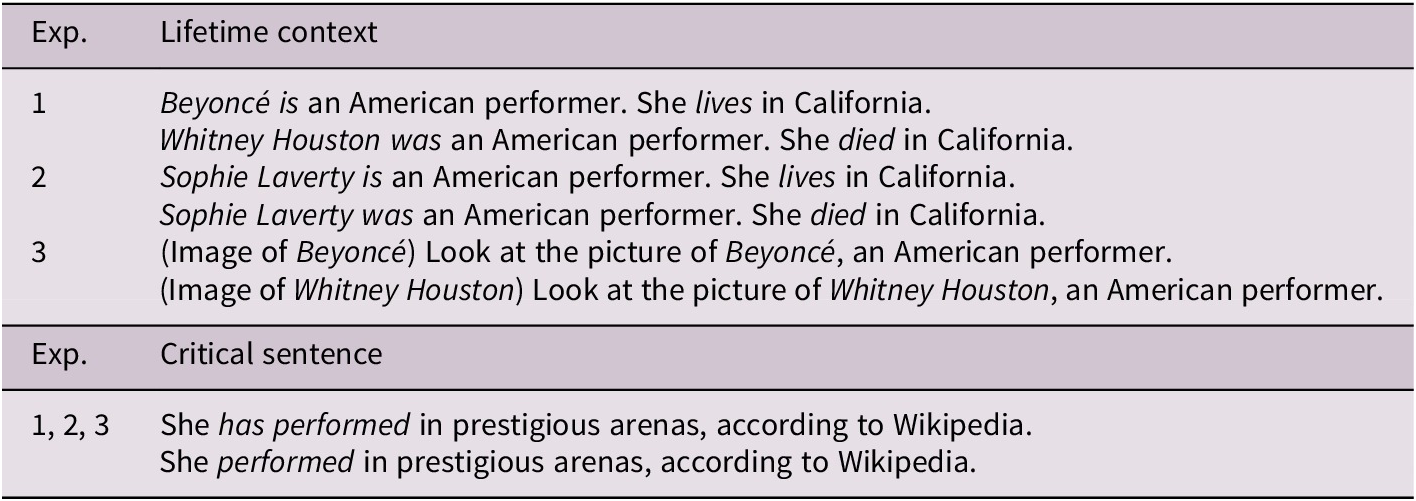
Note: Italics indicate critical manipulations. Critical sentences were identical across Experiments 1–3.
The set of experiments additionally provides an opportunity to further explore previously observed asymmetries in the processing of temporal violations of present- and past-referring verbs. Specifically, whether the English present perfect and simple past both elicit longer reading times and fewer naturalness acceptances when used with incongruent lifetime contexts, and whether these effects are larger and emerge in earlier sentence regions for the present perfect.
2.1. Research questions
The research questions for Experiments 1 through 3 examine whether and how the different sources of lifetime information influence the processing of verb tense. We additionally explore whether the differences between the latency and size of the present perfect versus simple past effects reported in Palleschi et al. (Reference Palleschi, Ronderos and Knoeferle2025) replicate (Experiment 1) and hold across different sources of lifetime information (Experiments 2 and 3).
Research question 1: Emergence of lifetime-tense congruence effects. Does the source of lifetime information (long-term knowledge vs. contextually defined lifetime) influence the processing of verb tense referring to that person? In other words, do the findings from Palleschi et al. (Reference Palleschi, Ronderos and Knoeferle2025) replicate (in main, interaction and nested effects), regardless of the source of lifetime information?
Research question 2: Effect of lifetime knowledge source. How is incremental processing of verb tense modulated by long-term, versus contextual, lifetime information, compared to when both are available? In other words, are there interaction effects of lifetime-tense congruence effects and knowledge source when experiments are directly compared?
3. Experiment 1
In Experiment 1, a replication of Experiment 3 from Palleschi et al. (Reference Palleschi, Ronderos and Knoeferle2025), participants were presented with lifetime context sentences that contain names of famous cultural figures whose lifetime status (dead/alive) was also explicitly mentioned. The experiment was followed by a prior-knowledge probe task (which was not part of Experiment 3 in Palleschi et al., Reference Palleschi, Ronderos and Knoeferle2025), in which participants were presented with each famous name and indicated whether they were familiar with the referent prior to the experiment, and whether they believed the referent was currently alive or dead. The post-experimental responses were used to filter out trials where participants did not have the relevant prior knowledge (familiarity with the cultural referent and/or knowing their current lifetime status), following a similar task for lexical world knowledge violations in Martin et al. (Reference Martin, Garcia, Breton, Thierry and Costa2014).
3.1. Methods
Experiments 1–3 were internet-based, cumulative self-paced reading experiments hosted on Ibex (Drummond, Reference Drummond2013) and programmed using PennController for Ibex (PCIbex; Zehr & Schwarz, Reference Zehr and Schwarz2018), an open-source extension of Ibex. Scripts for all three experiments can be accessed on the OSF, with links to demo versions of each experiment available in the OSF description.
3.1.1. Participants
Participants (n = 160, aged 18–31) were recruited through Prolific (prolific.co.uk), an online research recruitment platform. Before taking part in the experiment, participants confirmed they were monolingual native English speakers who grew up in and currently live in England, and reported no reading deficits. All participants were right-handed and received 3.66 British Pounds for their participation. The number of participants follows that from Experiments 2 and 3 in Palleschi et al. (Reference Palleschi, Ronderos and Knoeferle2025), which were based on a power analysis of a pilot study of Experiment 2. These experiments were also Internet-based cumulative self-paced reading studies exploring referent-lifetime congruence effects. Prolific profiles that had taken part in previous related experiments or pilot studies were excluded from each subsequent experiment in order to ensure unique participants per experiment.
3.1.2. Materials and design
Critical items (n = 20) contained two lifetime-tense contexts, one for a living and one for a dead cultural figure (ex. 2), and two critical sentence describing a common accomplishment of these cultural figures in either the present perfect (PP) or simple past (SP) (ex. 3). Ten accomplishment/achievement verbs were used with plural objects resulting in an existential/experiential reading in the present perfect condition, triggering the Lifetime Effect.


Filler items (n = 30) contained 15 ‘fake’ and 15 ‘famous’ cultural figures, bands or sports teams (e.g., ‘The Beatles were a British rock band. They were formed in Liverpool.’). Ten filler items contained violations pertaining to the number or gender of a pronoun. As in critical items, violations in filler sentences were only detectable when considering the preceding context. In other words, each sentence was felicitous on its own.
3.1.3. Procedure
The experiment began with a practice session (n = 5), which was followed by experimental items (n = 50; 20 critical, 30 filler) separated into two blocks (n = 25/block). Referent-lifetime context sentences were presented in a cumulative self-paced reading style (using the spacebar to advance), followed by the critical sentence. Once participants had revealed the last sentence region, they again pressed the spacebar to proceed to a binary naturalness judgement task where they indicated whether the final sentence fit ‘naturally with the previous mini-biography’ by pressing the F or J key (counterbalanced between participants for yes/no). Participants had 7 seconds to make their decision, after which the next trial would begin. The experiment was followed by a post-experimental task in which participants indicated whether they were familiar with the cultural figures presented in critical items, and whether they believed a given cultural figure was currently alive or dead. Each question in the post-experimental task had a three-second time limit, after which the next question would appear. Trials that did not receive a positive familiarity response and a correct lifetime response were excluded from analyses. Participants who did not achieve a minimum of 70% accuracy (correctly rejecting 7 out of 10 incongruent filler items) in post-trial responses to unambiguously incongruent filler items were excluded from analyses.
3.1.4. Predictions
The predictions for Experiment 1 are based on the findings from Experiment 3 in Palleschi et al. (Reference Palleschi, Ronderos and Knoeferle2025), as the procedure is identical, with the exception of the post-experimental task in the current study. As in Palleschi et al. (Reference Palleschi, Ronderos and Knoeferle2025), effects of (lifetime-tense) congruence and interactions of tense and congruence are of interest. As in Palleschi et al. (Reference Palleschi, Ronderos and Knoeferle2025), effects of tense were not interpreted due to the confounds of region length and tense frequency, but are reported in-text. Longer reading and total-sentence reaction times are taken to reflect processing costs. Acceptance rates are taken to reflect metalinguistic awareness.
Research question 1: Emergence of lifetime-tense congruence effects. Lifetime knowledge was expected to influence tense processing, eliciting costs for (lifetime-tense) incongruent versus congruent conditions. Specifically, the incongruent (vs. congruent) conditions were expected to elicit longer reading times in self-paced reading times (from the critical ‘verb’ region or later), reflecting incremental processing costs, and in total-sentence reading times, reflecting cumulative processing costs. Incongruent conditions were also expected to elicit fewer acceptances than congruent conditions, reflecting metalinguistic awareness of the violations. Differences between the tenses were likewise expected to replicate the findings from Experiment 3 in Palleschi et al. (Reference Palleschi, Ronderos and Knoeferle2025): longer reading times for the present perfect than the simple past (main effect of tense), with significantly larger effects of congruence for the present perfect than simple past.
3.1.5. Data analysis
Critical sentences were divided into six regions. The regions for an example critical sentence are shown in Table 2, and were identical across experiments.
Sentence regions across Experiments 1–3

Reading times for a single region were excluded if they were shorter than 100 milliseconds or longer than 10 seconds. Following visual inspection and a BoxCox test (boxcox() function in the MASS package v.7.3.60.2; Venables & Ripley, Reference Venables and Ripley2002) on the reading and reaction time data, the inverse square root transformation was run on reading times (Box & Cox, Reference Box and Cox1964; Osborne, Reference Osborne2010). Linear mixed-effect models were fit to the self-paced reading time and total-sentence reaction time data (lmer() function in lmerTest package; Kuznetsova et al., Reference Kuznetsova, Brockhoff and Christensen2017), and a generalised linear mixed-effects model was fit to the binary naturalness response data (glmer() function in lme4 package; Bates, Mächler, et al., Reference Bates, Mächler, Bolker and Walker2015b).
Separate reading time models were run from the verb region onward (a total of 5 regions). Fixed effects were the factors congruence (congruent, incongruent) and tense (present perfect, simple past), as well as their interaction, with centred trial order as a covariate. Participant and item were included as random effects, with main and interaction effects of congruence and tense as random slopes. Factors were coded using sum contrasts, with the levels congruent, and simple past coded as −0.5, and incongruent and present perfect +0.5. Where interaction effects emerged, follow-up nested contrasts were used to investigate lifetime-tense congruence effects within each tense (Brehm & Alday, Reference Brehm and Alday2022; Schad et al., Reference Schad, Vasishth, Hohenstein and Kliegl2020). Model estimates are provided in tables. Per-condition model predictions (with 95% confidence intervals) were produced with the ggpredict() function from the ggeffects package (v.1.5.2; Lüdecke, Reference Lüdecke2018) in order to produce visualisations of back-transformed predictions and supplementary tables (on the OSF).
Model selection was carried out in order to determine the most parsimonious model given the observed data, following Bates, Kliegl, et al. (Reference Bates, Kliegl, Vasishth and Baayen2015a). This began with the maximal model justified by the experimental design, including all random slopes and intercepts described above (Barr et al., Reference Barr, Levy, Scheepers and Tily2013). For each model run, a random effects principal component analysis was run (summary(rePCA(model)) from the lme4 package; Bates, Mächler, et al., Reference Bates, Mächler, Bolker and Walker2015b) and variance-covariance matrices examined (VarCorr(model) from the lme4 package Bates, Mächler, et al., Reference Bates, Mächler, Bolker and Walker2015b) in order to determine whether/how to reduce the random effects structure until the model converged (Bates, Kliegl, et al., Reference Bates, Kliegl, Vasishth and Baayen2015a). Random slopes that had correlation values close to 0 or 1 and/or that explained the least amount of variance were removed step-wise, as indicated by the model’s variance-covariance matrix. If a model converged but was overfit (indicated by the random effects principal components analysis), the model was further simplified using the same method as a non-converging model. In such cases, model comparisons were run on converging models with varying random effects structures using anova(model1, model2) in order to confirm whether the final model was the best fit to the data based on the Akaike information criterion (AIC). Only once the most parsimonious (and final) model was selected were the fixed-effect estimates inspected (summary(model) function). Data and code are available in the supplementary materials (OSF).
The alpha level for self-paced reading times was Bonferroni corrected for five comparisons, one for each model run for the five sentence regions ( $ \alpha $
=.05/5 =.01; von der Malsburg & Angele, Reference von der Malsburg and Angele2017). Only effects that were significant based on the Bonferroni corrected alpha-levels are discussed in-text. Model summary tables for all models are provided in the supplementary materials on the OSF with estimated p-values and Bonferroni-corrected alpha levels, as well as model formulae and the number of observations per model and per grouping factor.
$ \alpha $
=.05/5 =.01; von der Malsburg & Angele, Reference von der Malsburg and Angele2017). Only effects that were significant based on the Bonferroni corrected alpha-levels are discussed in-text. Model summary tables for all models are provided in the supplementary materials on the OSF with estimated p-values and Bonferroni-corrected alpha levels, as well as model formulae and the number of observations per model and per grouping factor.
3.2. Results
Of the 160 participants who participated in Experiment 1, 150 met the inclusion criteria (a minimum of 70% accuracy in acceptances for unambiguously incorrect filler items). Of the 3000 remaining trials (20 trials per 150 participants), 2282 (76%) received the required post-experimental responses (‘yes’ familiarity response and correct referent-lifetime response). Analyses were run on the remaining 2260 trials (75%). Trial exclusion resulted in the removal of 4 trials per participant on average. A full summary of the distribution of observations per participant per model can be found in the supplementary materials on the OSF repository.Footnote 4
3.2.1. Naturalness judgements
The distribution and mean responses are visualised in Figure 1 (with 95% confidence intervals). Model summaries are provided in Table 3.
Experiment 1 distribution of binary naturalness responses (A) and model-predicted probability of an acceptance with 95% confidence intervals (B). +CON: congruent; −CON: incongruent.

Experiment 1 binary naturalness responses model summary (estimates are in log odds)

Alpha-levels: * <.05, ** <.01, *** <.001.
Overall, more acceptances than rejections were given, as the intercept was significantly larger than zero ( $ \hat{\beta} $
= 2.9 [95% CI: 2.4, 3.3], z = 13, p <.001). A main effect of tense emerged in naturalness responses with the simple past eliciting more acceptances than the present perfect condition (
$ \hat{\beta} $
= 2.9 [95% CI: 2.4, 3.3], z = 13, p <.001). A main effect of tense emerged in naturalness responses with the simple past eliciting more acceptances than the present perfect condition ( $ \hat{\beta} $
= −0.61 [−0.94, −0.27], z = −3.5, p <.001). A main effect of lifetime-tense congruence was found, with congruent conditions eliciting more acceptances than incongruent conditions (
$ \hat{\beta} $
= −0.61 [−0.94, −0.27], z = −3.5, p <.001). A main effect of lifetime-tense congruence was found, with congruent conditions eliciting more acceptances than incongruent conditions ( $ \hat{\beta} $
= −1.3 [−1.9, −0.73], z = −4.4, p <.001). An interaction of tense and congruence did not emerge (
$ \hat{\beta} $
= −1.3 [−1.9, −0.73], z = −4.4, p <.001). An interaction of tense and congruence did not emerge ( $ \hat{\beta} $
= 0.46 [−0.23, 1.1], z = 1.3, p =.192).
$ \hat{\beta} $
= 0.46 [−0.23, 1.1], z = 1.3, p =.192).
3.2.2. Total sentence times
Predicted total-sentence reading times (from presentation of verb−1 region until final button press after verb+4) are shown in Figure 2. Model summaries in Table 4 report main and interaction effects and nested effects.
Experiment 1 total-sentence reaction times distribution (A) and back-transformed model predictions with 95% confidence intervals (B). +CON: congruent; −CON: incongruent.

Experiment 1 total-sentence reaction time model summary (negative inverse square-root transformed milliseconds)

Alpha-levels: * <.05, ** <.01, *** <.001.
A main effect of tense emerged in total-sentence reading times with the present perfect eliciting longer total reading times than the simple past condition ( $ \hat{\beta} $
= 244 ms [163, 325], t = 5.9, p <.001). A main effect of lifetime-tense congruence was found, with incongruent conditions longer total reading times than congruent conditions (
$ \hat{\beta} $
= 244 ms [163, 325], t = 5.9, p <.001). A main effect of lifetime-tense congruence was found, with incongruent conditions longer total reading times than congruent conditions ( $ \hat{\beta} $
= 322 ms [221, 422], t = 6.6, p <.001). An interaction between tense and congruence was found (
$ \hat{\beta} $
= 322 ms [221, 422], t = 6.6, p <.001). An interaction between tense and congruence was found ( $ \hat{\beta} $
= 483 ms [316, 651], t = 5.7, p <.001), with nested comparisons indicating a congruence effect nested within the present perfect (longer reaction times for incongruence versus congruent;
$ \hat{\beta} $
= 483 ms [316, 651], t = 5.7, p <.001), with nested comparisons indicating a congruence effect nested within the present perfect (longer reaction times for incongruence versus congruent; $ \hat{\beta} $
= 565 ms [436, 694], t = 8.8, p <.001), but not the simple past (
$ \hat{\beta} $
= 565 ms [436, 694], t = 8.8, p <.001), but not the simple past ( $ \hat{\beta} $
= 81 ms [−48, 210], t = 1.2, p =.217).
$ \hat{\beta} $
= 81 ms [−48, 210], t = 1.2, p =.217).
3.2.3. Self-paced reading times
Predicted self-paced reading times from the verb region onward are shown in Figure 3. Model summary tables per region are provided in the supplementary materials on the OSF. Main and interaction effects of tense and congruence are reported first, followed by differences between experiments.
Experiment 1 back-transformed predicted self-paced reading times across sentence regions (with 95% confidence intervals).

A main effect of tense was present in all regions, with the Present Perfect eliciting longer reading times than the Simple Past in all cases (verb: $ \hat{\beta} $
= 11 ms [4, 18], t = 3.2, p =.002; verb+1:
$ \hat{\beta} $
= 11 ms [4, 18], t = 3.2, p =.002; verb+1: $ \hat{\beta} $
= 32 ms [19, 45], t = 5, p <.001; verb+2:
$ \hat{\beta} $
= 32 ms [19, 45], t = 5, p <.001; verb+2: $ \hat{\beta} $
= 25 ms [13, 38], t = 4.1, p <.001; verb+3:
$ \hat{\beta} $
= 25 ms [13, 38], t = 4.1, p <.001; verb+3: $ \hat{\beta} $
= 35 ms [15, 56], t = 3.6, p =.002; verb+4:
$ \hat{\beta} $
= 35 ms [15, 56], t = 3.6, p =.002; verb+4: $ \hat{\beta} $
= 42 ms [−5, 89], t = 1.8, p =.079). A main effect of lifetime-tense congruence emerged in the verb+3 and +4 regions, with longer reading times for incongruent than congruent conditions (verb+3:
$ \hat{\beta} $
= 42 ms [−5, 89], t = 1.8, p =.079). A main effect of lifetime-tense congruence emerged in the verb+3 and +4 regions, with longer reading times for incongruent than congruent conditions (verb+3: $ \hat{\beta} $
= 35 ms [16, 54], t = 3.8, p =.001; verb+4:
$ \hat{\beta} $
= 35 ms [16, 54], t = 3.8, p =.001; verb+4: $ \hat{\beta} $
= 135 ms [85, 185], t = 5.4, p <.001). An interaction of tense and lifetime-tense congruence emerged in the verb+3 and +4 regions (verb+3:
$ \hat{\beta} $
= 135 ms [85, 185], t = 5.4, p <.001). An interaction of tense and lifetime-tense congruence emerged in the verb+3 and +4 regions (verb+3: $ \hat{\beta} $
= 59 ms [29, 90], t = 3.8, p <.001; verb+4:
$ \hat{\beta} $
= 59 ms [29, 90], t = 3.8, p <.001; verb+4: $ \hat{\beta} $
= 213 ms [127, 302], t = 4.9, p <.001). Nested comparisons indicated an effect of congruence nested in the present perfect in both regions (verb+3:
$ \hat{\beta} $
= 213 ms [127, 302], t = 4.9, p <.001). Nested comparisons indicated an effect of congruence nested in the present perfect in both regions (verb+3: $ \hat{\beta} $
= 65 ms [41, 89], t = 5.4, p <.001; verb+4:
$ \hat{\beta} $
= 65 ms [41, 89], t = 5.4, p <.001; verb+4: $ \hat{\beta} $
= 243 ms [177, 310], t = 7.3, p <.001), but not the simple past (verb+3:
$ \hat{\beta} $
= 243 ms [177, 310], t = 7.3, p <.001), but not the simple past (verb+3: $ \hat{\beta} $
= 5 ms [−19, 30], t = 0.5, p =.65; verb+4:
$ \hat{\beta} $
= 5 ms [−19, 30], t = 0.5, p =.65; verb+4: $ \hat{\beta} $
= 29 ms [−37, 95], t = 0.9, p =.39).
$ \hat{\beta} $
= 29 ms [−37, 95], t = 0.9, p =.39).
4. Experiment 2
In Experiment 2, famous names from Experiment 1 lifetime-context sentences (e.g., Charlie Chaplin) were replaced by names not belonging to famous individuals (e.g., Josh Milligan), with the explicitly mentioned lifetime status intact. Experiment 2 thereby relied solely on contextually available referent-lifetime information, as no prior (world) knowledge should be present for the ‘fake’ cultural figures. Any differences between congruent and incongruent conditions in Experiment 2 could therefore only be due to referent-lifetime information presented in the context sentences.
4.1. Methods
4.1.1. Participants
Participant (n = 160, aged 18–31) recruitment was identical to Experiment 1, with the additional exclusion of Prolific users who had participated in Experiment 1.
4.1.2. Materials and design
Critical items (n = 20) were identical to Experiment 1, with the exception that the names of famous cultural figures in the lifetime-contexts sentence (Experiment 1) were replaced with ‘fake’ names, thereby removing any contribution of prior knowledge of the referent (ex. 4). ‘Fake’ names did not belong to any well-known cultural figure, which was verified by entering each name into a search engine to ensure it did not belong to a cultural figure unknown to the experimenter. Critical sentences (ex. 5) and filler items (n = 30) were unchanged.


4.1.3. Procedure
The procedure was identical to Experiment 1, but did not contain a post-experimental task probing for prior familiarity with the cultural figures presented in critical items, as Experiment 2 did not contain real-world cultural figures.
4.1.4. Predictions
Research question 1: Emergence of lifetime-tense congruence effects. We expected to replicate the findings from Experiment 1: The violation conditions (incongruent: dead-PP and living- PS) were predicted to elicit longer reading and reaction times and lower acceptance rates than their congruent counterparts (congruent: living-PP and dead-PS). This would be taken to represent processing costs for the violation conditions (reading/reaction times) and metalinguistic awareness of the lifetime-tense violations (naturalness responses). Nested lifetime-tense congruence effects were expected to be larger in the present perfect (vs. simple past) condition. Effects in self-paced reading times were expected at or from the critical verb region onward.
Research question 2: Effect of source of lifetime-knowledge. If activation of lifetime information is ‘boosted’ when it is dually available through prior knowledge (of a known referent; present study) and context information (Experiment 1), compared to when it is only available through context information (for an unknown referent; Experiment 2), then we should find weaker/later effects in Experiment 2 compared to Experiment 1. Alternatively, if the prior lifetime-knowledge in Experiment 1 has no additive effect in the activation of lifetime information (when also explicitly mentioned), we should see no significant differences between the two experiments.
4.1.5. Data analysis
Analyses and model selection were identical to Experiment 1. As in Experiment 1, the alpha-level for self-paced reading times was Bonferroni corrected for five comparisons, one for each model run for the five sentence regions ( $ \alpha $
=.05/5 =.01; von der Malsburg & Angele, Reference von der Malsburg and Angele2017).
$ \alpha $
=.05/5 =.01; von der Malsburg & Angele, Reference von der Malsburg and Angele2017).
4.2. Results
Of the 160 participants who participated in Experiment 2, 154 met the inclusion criteria (a minimum of 70% accuracy in acceptances for unambiguously incorrect filler items). A total of 0.8% (n = 130) of by-region observations were removed due to self-paced reading times being either shorter than 100 milliseconds or longer than 10 seconds. Analyses were run on the remaining observations. A summary of the distribution of observations per participant per model can be found in the supplementary materials on the OSF repository.
4.2.1. Naturalness judgements
The distribution and mean responses are visualised in Figure 4 (with 95% confidence intervals). Model summaries in Table 5 report main and interaction effects as well as nested effects.
Experiment 2 binary naturalness responses distribution (A) and model-predicted probability of an acceptance with 95% confidence intervals (B). +CON: congruent; −CON: incongruent.

Experiment 2 binary naturalness responses model summary (estimates are in log odds)

Alpha-levels: * <.05, ** <.01, *** <.001.
Overall, more acceptances than rejections were given, as the intercept was significantly larger than zero ( $ \hat{\beta} $
= 3.1 [2.6, 3.5], z = 14, p <.001).
$ \hat{\beta} $
= 3.1 [2.6, 3.5], z = 14, p <.001).
A main effect of tense emerged in naturalness responses with the simple past eliciting more acceptances than the present perfect condition ( $ \hat{\beta} $
= −0.9 [−1.4, −0.41], z = −3.6, p <.001). A main effect of lifetime-tense congruence was found, with congruent conditions eliciting more acceptances than incongruent conditions (
$ \hat{\beta} $
= −0.9 [−1.4, −0.41], z = −3.6, p <.001). A main effect of lifetime-tense congruence was found, with congruent conditions eliciting more acceptances than incongruent conditions ( $ \hat{\beta} $
= −1.4 [−1.9, −0.87], z = −5.3, p <.001).
$ \hat{\beta} $
= −1.4 [−1.9, −0.87], z = −5.3, p <.001).
An interaction of tense and congruence was also found ( $ \hat{\beta} $
= 1.1 [0.47, 1.8], z = 3.4, p <.001). Nested comparisons revealed a congruence effect within both tenses, with more acceptances for congruent than incongruent conditions. This effect was larger in the simple past (
$ \hat{\beta} $
= 1.1 [0.47, 1.8], z = 3.4, p <.001). Nested comparisons revealed a congruence effect within both tenses, with more acceptances for congruent than incongruent conditions. This effect was larger in the simple past ( $ \hat{\beta} $
= −1.9 [−2.6, −1.3], z = −5.7, p <.001) than the present perfect (
$ \hat{\beta} $
= −1.9 [−2.6, −1.3], z = −5.7, p <.001) than the present perfect ( $ \hat{\beta} $
= −0.83 [−1.4, −0.3], z = −3.1, p =.002).
$ \hat{\beta} $
= −0.83 [−1.4, −0.3], z = −3.1, p =.002).
4.2.2. Total sentence times
Predicted total-sentence reading times (from presentation of verb−1 region until final button press after verb+4) are shown in Figure 5. Model summaries in Table 6 report main and interaction effects and nested effects.
Experiment 2 total-sentence reaction times distribution (A) and back-transformed model predictions with 95% confidence intervals (B). +CON: congruent; −CON: incongruent.

Experiment 2 total-sentence reaction time model summary (negative inverse square-root transformed milliseconds)

Alpha-levels: * <.05, ** <.01, *** <.001.
A main effect of tense emerged in total-sentence reading times with the present perfect eliciting longer total reading times than the simple past condition ( $ \hat{\beta} $
= 187 ms [109, 265], t = 4.7, p <.001). A main effect of lifetime-tense congruence was found, with incongruent conditions having longer total reading times than congruent conditions (
$ \hat{\beta} $
= 187 ms [109, 265], t = 4.7, p <.001). A main effect of lifetime-tense congruence was found, with incongruent conditions having longer total reading times than congruent conditions ( $ \hat{\beta} $
= 335 ms [250, 421], t = 7.8, p <.001). An interaction between tense and congruence was not found (
$ \hat{\beta} $
= 335 ms [250, 421], t = 7.8, p <.001). An interaction between tense and congruence was not found ( $ \hat{\beta} $
= 80 ms [−75, 236], t = 1, p =.312).
$ \hat{\beta} $
= 80 ms [−75, 236], t = 1, p =.312).
4.2.3. Self-paced reading times
Predicted self-paced reading times from the verb region onward are shown in Figure 6. Model summary tables per region are provided in the supplementary materials on the OSF. Main and interaction effects of tense and congruence are reported first, followed by differences between experiments.
Experiment 2 back-transformed predicted self-paced reading times across sentence regions (with 95% confidence intervals).

A main effect of tense was present in the regions verb ( $ \hat{\beta} $
= 14 ms [8, 20], t = 4.4, p <.001), verb+1 (
$ \hat{\beta} $
= 14 ms [8, 20], t = 4.4, p <.001), verb+1 ( $ \hat{\beta} $
= 41 ms [29, 53], t = 7.1, p <.001) and verb+2 (
$ \hat{\beta} $
= 41 ms [29, 53], t = 7.1, p <.001) and verb+2 ( $ \hat{\beta} $
= 26 ms [13, 39], t = 3.9, p <.001). In all cases, the present perfect elicited longer reading times than the simple past.
$ \hat{\beta} $
= 26 ms [13, 39], t = 3.9, p <.001). In all cases, the present perfect elicited longer reading times than the simple past.
A main effect of lifetime-tense congruence emerged in the verb+3 and +4 regions (verb+3: $ \hat{\beta} $
= 30 ms [16, 44], t = 4.3, p <.001; verb+4:
$ \hat{\beta} $
= 30 ms [16, 44], t = 4.3, p <.001; verb+4: $ \hat{\beta} $
= 146 ms [96, 197], t = 6, p <.001). In all cases, incongruent conditions elicited longer self-paced reading times than congruent conditions. Interaction effects were not present in any region.
$ \hat{\beta} $
= 146 ms [96, 197], t = 6, p <.001). In all cases, incongruent conditions elicited longer self-paced reading times than congruent conditions. Interaction effects were not present in any region.
5. Experiment 3
In Experiment 3, famous referents were again presented with all explicit mentions of their lifetime removed from context sentences. Instead, each referent’s picture was presented along with a referent-establishing sentence with no temporally marked verb (e.g., Look at the picture of Charlie Chaplin, a British actor and director.). Two prior-knowledge probes were used to exclude trials that had missing or incorrect relevant prior knowledge: a pre-experimental binary familiarity task (with the referent’s picture and name) and a post-experimental binary referent-lifetime task. Trials that received a ‘no’ familiarity response, and/or an incorrect referent-lifetime response were removed prior to analyses. Any differences between congruent and incongruent conditions in Experiment 3 could therefore only be drawn from prior knowledge about the referent and their lifetime status, prompted by their picture and the referent-establishing context sentence.
5.1. Methods
5.1.1. Participants
Participant (n = 160, aged 18–31) recruitment was identical to Experiments 1 and 2, with the additional exclusion of Prolific users who had participated in either Experiment 1 or Experiment 2.
5.1.2. Materials and design
In Experiment 3, context sentences contained the same famous referents as in Experiment 1. However, all explicit mention of their lifetime was removed from context sentences. Instead, each referent’s picture was presented along with a referent-establishing sentence with no temporally marked verb (ex. 6). Critical sentences (ex. 7) were identical to those in Experiments 2 and 3. Any differences between congruent and incongruent conditions in Experiment 3 could therefore only be drawn from prior knowledge about the referent and their lifetime status, prompted by their picture and the referent-establishing context sentence.


For the ‘fake’ cultural figures in filler items, pictures of actors from a German crime show, not well-known abroad, were used. Only pictures of actors who had not appeared in any English-language productions were used. These pictures were chosen to have convincing settings for a cultural figure (e.g., red carpet or a headshot). As the participants were screened to include monolingual English speakers, it was unlikely that the participants would recognise pictures of actors from a German-language crime show.
5.1.3. Procedure
The experimental procedure was slightly altered for Experiment 3, which relied solely on participants’ prior knowledge of famous referents. Experiment 3 contained a pre-experimental prior-familiarity task, the self-paced reading experiment (as in Experiments 1 and 2) and a post-experimental prior-familiarity and -knowledge probe task (as in Experiment 1). In the pre-experimental prior knowledge probe, participants were presented with each cultural figure’s picture and name and indicated whether they were familiar with them. This was followed by the experimental self-paced reading trials, in which a picture of a cultural figure was presented alongside the referent-establishing context sentence (ex. 6), followed by the critical sentence (ex. 7). Trials that received a ‘no’ pre-experimental familiarity response, and/or an incorrect post-experimental referent-lifetime response were removed prior to analyses.
5.1.4. Predictions
Research question 1: Emergence of lifetime-tense congruence effects. We expected to replicate the findings from Experiments 1 and 2, namely longer reading/reaction times and fewer acceptances for incongruent versus congruent conditions. If these effects were absent, this would be taken to reflect the requirement of explicitly mentioned referent-lifetime information (as in Experiments 1 and 2) to trigger the processing of lifetime-tense constraints.
Research question 2: Effect of prior knowledge. If lifetime information is similarly ‘activate’ during processing when prompted by a picture and short biography (without any temporally inflected verbs), compared to when prompted by contextually stated lifetime information (Experiment 1), then we should not find any differences in the results between the two experiments.
Alternatively, if this prior lifetime information is not as strongly activated as when it is explicitly stated, then we should find differences in the emergence of effects between the experiments, reflecting smaller or absent effects in Experiment 3 versus Experiment 1.
5.1.5. Data analysis
Analyses and model selection were identical to Experiments 1 and 2. Again, the alpha-level for self-paced reading times was Bonferroni corrected for five comparisons, one for each model run for the five sentence regions ( $ \alpha $
=.05/5 =.01; von der Malsburg & Angele, Reference von der Malsburg and Angele2017).
$ \alpha $
=.05/5 =.01; von der Malsburg & Angele, Reference von der Malsburg and Angele2017).
5.2. Results
Of the 160 participants who participated in Experiment 3, 131 met the inclusion criteria (a minimum of 70% accuracy in acceptances for unambiguously incorrect filler items). Of the 2620 remaining trials (20 trials per 131 participants), 492 (19%) were removed due to a ‘no’ post-experimental familiarity response (n = 312; 10%) and/or an incorrect post-experimental referent-lifetime response (n = 286; 9.50%). Analyses were run on the remaining 2298 observations. After filtering trials, participants contributed observations from an average of 16 observations in each model (i.e., each measure and in each sentence region). A full summary of the distribution of observations per participant per model can be found in the supplementary materials on the OSF repository.
5.2.1. Naturalness judgements
The distribution and mean responses (with 95% confidence intervals) are visualised in Figure 7. Model summaries are provided in Table 7.
Experiment 3 binary naturalness responses distribution (A) and model-predicted probability of an acceptance with 95% confidence intervals (B). +CON: congruent; −CON: incongruent.

Experiment 3 binary naturalness responses model summary (estimates are in log odds)

Note: Alpha-levels: * <.05, ** <.01, *** <.001.
Overall, more acceptances than rejections were given, as the intercept was significantly larger than zero ( $ \hat{\beta} $
= 3.4 [2.9, 4], z = 12, p <.001). A main effect of tense emerged in naturalness responses with the simple past eliciting more acceptances than the present perfect condition (
$ \hat{\beta} $
= 3.4 [2.9, 4], z = 12, p <.001). A main effect of tense emerged in naturalness responses with the simple past eliciting more acceptances than the present perfect condition ( $ \hat{\beta} $
= −0.37 [−0.73, −0.0058], z = −2, p =.046). A main effect of lifetime-tense congruence was not found (
$ \hat{\beta} $
= −0.37 [−0.73, −0.0058], z = −2, p =.046). A main effect of lifetime-tense congruence was not found ( $ \hat{\beta} $
= −0.36 [−0.89, 0.17], z = −1.3, p =.182). An interaction of tense and congruence emerged (
$ \hat{\beta} $
= −0.36 [−0.89, 0.17], z = −1.3, p =.182). An interaction of tense and congruence emerged ( $ \hat{\beta} $
= −1.2 [−1.9, −0.45], z = −3.2, p <.01), with a significant effect of congruence in the present perfect (
$ \hat{\beta} $
= −1.2 [−1.9, −0.45], z = −3.2, p <.01), with a significant effect of congruence in the present perfect ( $ \hat{\beta} $
= −0.9 [−1.4, −0.4], z = −3.6, p <.001), but not the past simple (
$ \hat{\beta} $
= −0.9 [−1.4, −0.4], z = −3.6, p <.001), but not the past simple ( $ \hat{\beta} $
= 0.28 [−2.4, 0.8], z = 1, p =.299), with more acceptances for congruent than incongruent conditions.
$ \hat{\beta} $
= 0.28 [−2.4, 0.8], z = 1, p =.299), with more acceptances for congruent than incongruent conditions.
5.2.2. Total sentence times
Predicted total-sentence reading times (from presentation of verb−1 region until final button press after verb+4) are shown in Figure 8. Model summaries in Table 8 report main and interaction effects and nested effects.
Experiment 3 total-sentence reaction times distribution (A) and back-transformed model predictions with 95% confidence intervals (B). +CON: congruent; −CON: incongruent.

Experiment 3 total-sentence reaction time model summary (negative inverse square-root transformed milliseconds)

Alpha-levels: * <.05, ** <.01, *** <.001.
A main effect of tense emerged in total-sentence reading times with the present perfect eliciting longer total reading times than the simple past condition ( $ \hat{\beta} $
= 163 ms [116, 209], t = 6.8, p <.001). A main effect of lifetime-tense congruence was found, with incongruent conditions longer total reading times than congruent conditions (
$ \hat{\beta} $
= 163 ms [116, 209], t = 6.8, p <.001). A main effect of lifetime-tense congruence was found, with incongruent conditions longer total reading times than congruent conditions ( $ \hat{\beta} $
= 65 ms [19, 112], t = 2.7, p =.006). An interaction between tense and congruence was found (
$ \hat{\beta} $
= 65 ms [19, 112], t = 2.7, p =.006). An interaction between tense and congruence was found ( $ \hat{\beta} $
= 237 ms [142, 332], t = 4.9, p <.001), with nested comparisons indicating and a congruence effect nested within the present perfect (longer reaction times for incongruence versus congruent;
$ \hat{\beta} $
= 237 ms [142, 332], t = 4.9, p <.001), with nested comparisons indicating and a congruence effect nested within the present perfect (longer reaction times for incongruence versus congruent; $ \hat{\beta} $
= 183 ms [117, 250], t = 5.4, p <.001), but not the simple past (
$ \hat{\beta} $
= 183 ms [117, 250], t = 5.4, p <.001), but not the simple past ( $ \hat{\beta} $
= −53 ms [−120, 13], t = −1.6, p =.118).
$ \hat{\beta} $
= −53 ms [−120, 13], t = −1.6, p =.118).
5.2.3. Self-paced reading times
Predicted self-paced reading times from the verb region onward are shown in Figure 9. Model summary tables per region are provided in the supplementary materials on the OSF. Main and interaction effects of tense and congruence are reported first, followed by differences between experiments.
Experiment 3 back-transformed predicted self-paced reading times across sentence regions (with 95% confidence intervals).

A main effect of tense was present in all regions, with the Present Perfect eliciting longer reading times than the Simple Past in all cases (verb: $ \hat{\beta} $
= 25 ms [19, 32], t = 7.9, p <.001; verb+1:
$ \hat{\beta} $
= 25 ms [19, 32], t = 7.9, p <.001; verb+1: $ \hat{\beta} $
= 20 ms [13, 28], t = 5, p <.001; verb+2:
$ \hat{\beta} $
= 20 ms [13, 28], t = 5, p <.001; verb+2: $ \hat{\beta} $
= 21 ms [11, 31], t = 4, p <.001; verb+3:
$ \hat{\beta} $
= 21 ms [11, 31], t = 4, p <.001; verb+3: $ \hat{\beta} $
= 10 ms [−1, 21], t = 1.9, p =.07; verb+4:
$ \hat{\beta} $
= 10 ms [−1, 21], t = 1.9, p =.07; verb+4: $ \hat{\beta} $
= 42 ms [19, 66], t = 3.6, p <.001). A main effect of lifetime-tense congruence emerged in the verb+4 region, with longer reading times for incongruent than congruent conditions (verb+4:
$ \hat{\beta} $
= 42 ms [19, 66], t = 3.6, p <.001). A main effect of lifetime-tense congruence emerged in the verb+4 region, with longer reading times for incongruent than congruent conditions (verb+4: $ \hat{\beta} $
= 28 ms [2, 54], t = 2.1, p =.035). An interaction of tense and lifetime-tense congruence emerged in the verb+4 region (
$ \hat{\beta} $
= 28 ms [2, 54], t = 2.1, p =.035). An interaction of tense and lifetime-tense congruence emerged in the verb+4 region ( $ \hat{\beta} $
= 119 ms [71, 167], t = 4.9, p <.001). Nested comparisons indicated an effect of congruence nested in the present perfect (
$ \hat{\beta} $
= 119 ms [71, 167], t = 4.9, p <.001). Nested comparisons indicated an effect of congruence nested in the present perfect ( $ \hat{\beta} $
= 88 ms [52, 123], t = 4.9, p <.001), but not the simple past (
$ \hat{\beta} $
= 88 ms [52, 123], t = 4.9, p <.001), but not the simple past ( $ \hat{\beta} $
= −31 ms [−66, 4], t = −1.7, p =.084).
$ \hat{\beta} $
= −31 ms [−66, 4], t = −1.7, p =.084).
6. Experiment comparisons
The findings from Experiments 1 through 3 suggest differences in effects between experiments, suggesting that the differing sources of referent-lifetime knowledge differentially elicit referent-lifetime congruence effects. However, as described in Gelman and Stern (Reference Gelman and Stern2006), the difference between two exclusive analyses in terms of statistical significance (significant vs. insignificant) is not itself necessarily statistically significant. In other words, the difference between statistically significant (e.g., p <.05) and statistically insignificant (e.g., p >.05) is in itself not necessarily significant, and so ‘comparing statistical significance levels is a bad idea’ (Gelman & Stern, Reference Gelman and Stern2006, p. 329). To make direct comparisons between the experiments and thereby determine whether reading/reaction times and/or acceptance rates across experiments were significantly different, additional models were run.
6.1. Data analysis
The data from all three experiments were combined into a single dataset with an additional variable, knowledge type, which contained a level for each experiment (Experiment 1: dual; Experiment 2: context; Experiment 3: prior knowledge). This variable was then used as a fixed effect in the subsequent models.
The additional models were identical to those in the previously reported models, with the addition of the three-level factor knowledge type: Linear mixed-effect models were fit to the self-paced reading time and total-sentence reaction time data (lmer() function in lmerTest package; Kuznetsova et al., Reference Kuznetsova, Brockhoff and Christensen2017), and a generalised linear mixed-effects model was fit to the binary naturalness response data (glmer() function in lme4 package; Bates, Mächler, et al., Reference Bates, Mächler, Bolker and Walker2015b). In addition to tense, congruence and the covariant trial order, knowledge type was included as a fixed effect. Interactions between the three predictors (tense, congruence and knowledge type) were included. The maximal random effects structure remained unchanged to avoid overfitting (by-participant and -item varying intercepts and slopes for tense and congruence: measure ~ tense*congruence*knowledge_type + trial_centred + (1 + tense*congruence | participant) + (1 + tense*congruence | item)). Sum contrast coding was again used, with the levels simple past, congruent and dual coded as −0.5, and the levels present perfect, incongruent, context and prior knowledge coded as +0.5. The model selection procedure was identical to the previous models (Table 9).
Model summaries for naturalness ratings in Experiments 1–3 (estimates are in log odds)

As in the prior analyses, sum contrast coding was used as it results in more interpretable slope and intercept estimates in models with interaction effects than dummy/treatment contrast (see e.g., Brehm & Alday, Reference Brehm and Alday2022; Schad et al., Reference Schad, Vasishth, Hohenstein and Kliegl2020). Comparisons of Experiments 2 and 3 were not investigated as there were multiple differences between the experiments, namely whether lifetime status was provided in context sentences (Experiment 2) or was part of prior knowledge (Experiment 3) and whether referents were famous (Experiment 3) or not (Experiment 2).
7. Results
Model summary tables for self-paced reading times are provided in the supplementary materials on the study’s online repository (https://osf.io/n38tk). Where observed, two-way interactions of tense and congruence were not investigated further, as the intention is to observe differences between experiments (i.e., knowledge source). In addition, in all previous models exploring the individual datasets, where such a two-way interaction was found to reflect larger nested effects of congruence in the present perfect than in the simple past.
7.1. Naturalness judgements
The naturalness judgement model summary is provided in Table 9. A main effect of tense emerged in naturalness responses with the simple past eliciting more acceptances than the present perfect condition ( $ \hat{\beta} $
= −0.53 [−0.7, −0.35], z = −5.8, p <.001). A main effect of lifetime-tense congruence was found with congruent conditions eliciting more acceptances than incongruent conditions (
$ \hat{\beta} $
= −0.53 [−0.7, −0.35], z = −5.8, p <.001). A main effect of lifetime-tense congruence was found with congruent conditions eliciting more acceptances than incongruent conditions ( $ \hat{\beta} $
= −0.86 [−1.1, −0.6], z = −6.5, p <.001).
$ \hat{\beta} $
= −0.86 [−1.1, −0.6], z = −6.5, p <.001).
Differences between the experiments in overall acceptance rates emerged, with more acceptances in Experiment 3 (prior knowledge) than Experiment 1 (dual) ( $ \hat{\beta} $
= 0.41 [0.035, 0.79], z = 2.1, p =.032). No overall differences in acceptance rates emerged between Experiments 1 vs. 2 (
$ \hat{\beta} $
= 0.41 [0.035, 0.79], z = 2.1, p =.032). No overall differences in acceptance rates emerged between Experiments 1 vs. 2 ( $ \hat{\beta} $
= −0.04 [−0.4, 0.32], z = −0.22, p =.826).
$ \hat{\beta} $
= −0.04 [−0.4, 0.32], z = −0.22, p =.826).
Two-way interactions effects were observed between congruence and knowledge source, with differences between Experiments 1 and 2 ( $ \hat{\beta} $
= −0.88 [−1.4, −0.31], z = −3, p =.002), as well as between Experiments 1 and 3 (
$ \hat{\beta} $
= −0.88 [−1.4, −0.31], z = −3, p =.002), as well as between Experiments 1 and 3 ( $ \hat{\beta} $
= 1.7 [1.1, 2.3], z = 5.5, p <.001). These observed effects indicate that the congruence-effect differences between the respective single-experiment naturalness response models reported above are significant (there was a significantly larger effect of congruence in Experiment 2 compared to Experiment 1, and no effect of congruence in Experiment 3). There were no other two-way interactions.
$ \hat{\beta} $
= 1.7 [1.1, 2.3], z = 5.5, p <.001). These observed effects indicate that the congruence-effect differences between the respective single-experiment naturalness response models reported above are significant (there was a significantly larger effect of congruence in Experiment 2 compared to Experiment 1, and no effect of congruence in Experiment 3). There were no other two-way interactions.
Three-way interactions were found between tense, congruence and knowledge source for Experiments 1 and 2 ( $ \hat{\beta} $
= 1.9 [0.88, 2.8], z = 3.7, p <.001) and Experiments 1 and 3 (
$ \hat{\beta} $
= 1.9 [0.88, 2.8], z = 3.7, p <.001) and Experiments 1 and 3 ( $ \hat{\beta} $
= −2.5 [−3.6, −1.5], z = −4.8, p <.001). These three-way interaction effects indicate that differences in tense and congruence interaction effects between the respective single-experiment naturalness response models reported above are significant (i.e., larger effect of congruence in Experiment 2 compared to Experiment 1, and no effect of congruence in Experiment 3). There were no other two-way interactions.
$ \hat{\beta} $
= −2.5 [−3.6, −1.5], z = −4.8, p <.001). These three-way interaction effects indicate that differences in tense and congruence interaction effects between the respective single-experiment naturalness response models reported above are significant (i.e., larger effect of congruence in Experiment 2 compared to Experiment 1, and no effect of congruence in Experiment 3). There were no other two-way interactions.
7.2. Total sentence times
The total sentence times model summary is provided in Table 10. A main effect of tense emerged in total-sentence reading times with the present perfect having longer total reading times than the simple past condition ( $ \hat{\beta} $
= 198 ms [149, 247], t = 8.5, p <.001). A main effect of lifetime-tense congruence was found, with incongruent conditions having longer total reading times than congruent conditions (
$ \hat{\beta} $
= 198 ms [149, 247], t = 8.5, p <.001). A main effect of lifetime-tense congruence was found, with incongruent conditions having longer total reading times than congruent conditions ( $ \hat{\beta} $
= 225 ms [182, 269], t = 10.2, p <.001).
$ \hat{\beta} $
= 225 ms [182, 269], t = 10.2, p <.001).
Model summaries for inverse square-root transformed total-sentence reading times in Experiments 1–3

Significant effects of knowledge source emerged, with longer total-sentence reaction times for Experiment 2 than Experiment 1 ( $ \hat{\beta} $
= 509 ms [293, 727], t = 4.7, p <.001), but longer total-sentence reaction times for Experiment 1 than Experiment 3 (
$ \hat{\beta} $
= 509 ms [293, 727], t = 4.7, p <.001), but longer total-sentence reaction times for Experiment 1 than Experiment 3 ( $ \hat{\beta} $
= −661 ms [−892, −434], t = −5.8, p <.001).
$ \hat{\beta} $
= −661 ms [−892, −434], t = −5.8, p <.001).
A two-way interaction effect was observed between congruence and tense ( $ \hat{\beta} $
= 245 ms [165, 325], t = 6, p <.001), and between congruence and knowledge source (Experiments 1 vs. 3:
$ \hat{\beta} $
= 245 ms [165, 325], t = 6, p <.001), and between congruence and knowledge source (Experiments 1 vs. 3: $ \hat{\beta} $
= −290 ms [−419, −162], t = −4.5, p <.001). A three-way interaction was found between tense, congruence and Experiments 1 and 2 (
$ \hat{\beta} $
= −290 ms [−419, −162], t = −4.5, p <.001). A three-way interaction was found between tense, congruence and Experiments 1 and 2 ( $ \hat{\beta} $
= −352 ms [−567, −138], t = −3.2, p =.001), but not for Experiments 1 and 3 (
$ \hat{\beta} $
= −352 ms [−567, −138], t = −3.2, p =.001), but not for Experiments 1 and 3 ( $ \hat{\beta} $
= 66 ms [−167, 299], t = 0.6, p =.578). Given that two-way interaction effects were found in Experiments 1 and 3, but not Experiment 2, the three-way interaction effects reflect the observed interaction of tense and congruence in Experiments 1 and 3 did not significantly differ, whereas the present effect in Experiment 1 differed significantly from the absent effect in Experiment 2.
$ \hat{\beta} $
= 66 ms [−167, 299], t = 0.6, p =.578). Given that two-way interaction effects were found in Experiments 1 and 3, but not Experiment 2, the three-way interaction effects reflect the observed interaction of tense and congruence in Experiments 1 and 3 did not significantly differ, whereas the present effect in Experiment 1 differed significantly from the absent effect in Experiment 2.
7.3. Self-paced reading times
A main effect of tense was present in all regions, with the Present Perfect eliciting longer reading times than the Simple Past in all cases (verb: $ \hat{\beta} $
= 17 ms [13, 20], t = 8.5, p <.001; verb+1:
$ \hat{\beta} $
= 17 ms [13, 20], t = 8.5, p <.001; verb+1: $ \hat{\beta} $
= 31 ms [23, 39], t = 8.4, p <.001; verb+2:
$ \hat{\beta} $
= 31 ms [23, 39], t = 8.4, p <.001; verb+2: $ \hat{\beta} $
= 25 ms [18, 32], t = 7.1, p <.001; verb+3:
$ \hat{\beta} $
= 25 ms [18, 32], t = 7.1, p <.001; verb+3: $ \hat{\beta} $
= 16 ms [7, 26], t = 3.5, p =.002; verb+4: t =
$ \hat{\beta} $
= 16 ms [7, 26], t = 3.5, p =.002; verb+4: t = $ \hat{\beta} $
= 46 ms [22, 70], t = 4, p <.001). A main effect of lifetime-tense congruence emerged from the verb+2 region onward, with longer reading times for incongruent than congruent conditions (verb+2:
$ \hat{\beta} $
= 46 ms [22, 70], t = 4, p <.001). A main effect of lifetime-tense congruence emerged from the verb+2 region onward, with longer reading times for incongruent than congruent conditions (verb+2: $ \hat{\beta} $
= 13 ms [5, 21], t = 3.4, p =.004; verb+3: t =
$ \hat{\beta} $
= 13 ms [5, 21], t = 3.4, p =.004; verb+3: t = $ \hat{\beta} $
= 22 ms [14, 30], t = 5.6, p <.001; verb+4:
$ \hat{\beta} $
= 22 ms [14, 30], t = 5.6, p <.001; verb+4: $ \hat{\beta} $
= 94 ms [73, 114], t = 9, p <.001). An interaction of tense and lifetime-tense congruence emerged in the verb+3 and +4 regions (verb+3:
$ \hat{\beta} $
= 94 ms [73, 114], t = 9, p <.001). An interaction of tense and lifetime-tense congruence emerged in the verb+3 and +4 regions (verb+3: $ \hat{\beta} $
= 27 ms [12, 42], t = 3.5, p <.001; verb+4:
$ \hat{\beta} $
= 27 ms [12, 42], t = 3.5, p <.001; verb+4: $ \hat{\beta} $
= 129 ms [88, 171], t = 6.2, p <.001).
$ \hat{\beta} $
= 129 ms [88, 171], t = 6.2, p <.001).
A main effect of knowledge source was found in the verb+3 and verb+4 regions, reflecting overall differences in self-paced reading times at these regions between experiments. In the verb+3 region, this difference was between Experiments 1 and 3 ( $ \hat{\beta} $
= −46 ms [−79, −14], t = −2.8, p =.006), with longer self-paced reading times for Experiment 1 than Experiment 3. In the verb+4 region, this difference was between Experiments 1 and 2 (
$ \hat{\beta} $
= −46 ms [−79, −14], t = −2.8, p =.006), with longer self-paced reading times for Experiment 1 than Experiment 3. In the verb+4 region, this difference was between Experiments 1 and 2 ( $ \hat{\beta} $
= 266 ms [185, 348], t = 6.6, p <.001) with longer reading times for Experiment 2, as well as Experiments 1 and 3 (
$ \hat{\beta} $
= 266 ms [185, 348], t = 6.6, p <.001) with longer reading times for Experiment 2, as well as Experiments 1 and 3 ( $ \hat{\beta} $
= −320 ms [−408, −234], t = −7.5, p <.001) with longer reading times for Experiment 1.
$ \hat{\beta} $
= −320 ms [−408, −234], t = −7.5, p <.001) with longer reading times for Experiment 1.
Interaction effects between tense and knowledge source emerged in the verb and verb+1 regions only. In the verb region, differences were found in tense effects between Experiments 1 versus 3 ( $ \hat{\beta} $
= 17 ms [6, 28], t = 2.9, p =.003). In the verb+1 region, differences were found in tense effects between Experiments 1 versus 2 (
$ \hat{\beta} $
= 17 ms [6, 28], t = 2.9, p =.003). In the verb+1 region, differences were found in tense effects between Experiments 1 versus 2 ( $ \hat{\beta} $
= 20 ms [6, 35], t = 2.7, p =.007), and between Experiments 1 versus 3 (
$ \hat{\beta} $
= 20 ms [6, 35], t = 2.7, p =.007), and between Experiments 1 versus 3 ( $ \hat{\beta} $
= −22 ms [−38, −6], t = −2.7, p =.007).
$ \hat{\beta} $
= −22 ms [−38, −6], t = −2.7, p =.007).
Interaction effects between congruence and knowledge source (Experiments 1 vs. 3) emerged in the verb+3 and verb+4 regions. In both regions, the interaction was between congruence and Experiments 1 and 3 ( $ \hat{\beta} $
= −32 ms [−55, −9], t = −2.8, p =.006; verb+4:
$ \hat{\beta} $
= −32 ms [−55, −9], t = −2.8, p =.006; verb+4: $ \hat{\beta} $
= −112 ms [−172, −52], t = −3.7, p <.001). A three-way interaction of tense, congruence and knowledge source did not emerge in any region.
$ \hat{\beta} $
= −112 ms [−172, −52], t = −3.7, p <.001). A three-way interaction of tense, congruence and knowledge source did not emerge in any region.
8. General discussion
In three internet-based cumulative self-paced reading experiments, we investigated whether lifetime-tense congruence effects in the English present perfect and simple past reported in Palleschi et al. (Reference Palleschi, Ronderos and Knoeferle2025) replicated and generalised to different contexts. Across the three experiments, we assessed the effect of how lifetime information was made available: via mention of the referent’s name and knowledge of famous people (Experiment 1); only contextually defined referent lifetime information (Experiment 2); and by showing a photograph of the same famous people as in Experiment 1 but without mentioning the referent’s name (Experiment 3). Our research questions pertained to whether the observed lifetime-tense congruence effects patterned as those reported in Palleschi et al. (Reference Palleschi, Ronderos and Knoeferle2025) (Experiment 3) (research question 1) and whether the observed effects differed as a function of the source of referent-lifetime knowledge (research question 2).
Experiment 1 was a replication of Palleschi et al. (Reference Palleschi, Ronderos and Knoeferle2025) (Experiment 3) with the addition of a post-experiment prior-knowledge probe, which was used to filter out trials for which participants were not familiar with a referent and/or did not know their current lifetime status. Lifetime-tense congruence effects emerged in later regions in Experiment 1 (from the verb+3 region) than they did in Palleschi et al. (Reference Palleschi, Ronderos and Knoeferle2025) (in the verb+1, verb+3 and verb+4 regions). However, an interaction of congruence and tense was found in one region earlier in Experiment 1 (verb+3 and verb+4) than in Palleschi et al. (Reference Palleschi, Ronderos and Knoeferle2025) (only in verb+4), with follow-up models with nested contrast coding indicating an effect of lifetime-tense congruence nested within the present perfect conditions in both regions, but only in the final region for the simple past. In sum, Experiment 1 replicated the direction of effects reported in Palleschi et al. (Reference Palleschi, Ronderos and Knoeferle2025) with deviations in terms of the latency of lifetime-tense congruence effects. Relevant to research question 1, lifetime-tense congruence effects were found in both the English present perfect and simple past, with earlier and larger effects for the former compared to the latter, following predictions and the findings from Palleschi et al. (Reference Palleschi, Ronderos and Knoeferle2025).
In order to investigate the role of referent-lifetime knowledge source (research question 2), lifetime contexts were manipulated between experiments to establish referent-lifetime explicitly (contextually defined; Experiment 2), by establishing a famous referent whose lifetime was previously known (prior-held; Experiment 3), or both (Experiment 1). The reported experiments broadly replicated the findings from Palleschi et al. (Reference Palleschi, Ronderos and Knoeferle2025), namely the finding of longer reading times and lower naturalness judgements for the English present perfect in incongruent (dead) contexts (Experiments 1–3 in Palleschi et al., Reference Palleschi, Ronderos and Knoeferle2025), and for the simple past in incongruent (living) contexts (Experiment 3 in Palleschi et al., Reference Palleschi, Ronderos and Knoeferle2025). Importantly, in the present study, lifetime-tense congruence effects were found across experiments in naturalness judgements, post-critical regions in self-paced reading times, and in total sentence reading times. The latency and size of these effects varied as a function of how referent-lifetime knowledge was made available, but the effects were always in the same direction: longer reading and reaction times and fewer naturalness acceptances for incongruent (vs. congruent) conditions. These inter-experiment variations are discussed below in relation to research question 2.
8.1. Source of referent-lifetime knowledge
Relevant to research question 2 was whether lifetime-tense congruence effects differed as a function of referent-lifetime information: dually through prior knowledge and supported by explicit contextual mention (Experiment 1), solely through explicit contextual mention (Experiment 2), or solely through prior knowledge activated by a picture (Experiment 3). As critical sentences were identical across experiments, any inter-experiment differences were taken to reflect effects due to the manipulations in the referent-lifetime context sentences. If the source of referent-lifetime knowledge influences the size and latency of congruence effects, then, broadly speaking, larger and/or earlier effects were expected when this knowledge was dually available via prior knowledge and context (Experiment 1) compared to only context (Experiment 2) or only prior knowledge (Experiment 3). This would be taken as evidence of an additional ‘boost’ of activation of lifetime knowledge when both sources of information were available, compared to only one.
Total-sentence reaction times and self-paced reading times were shorter for Experiment 3 than Experiment 1, possibly due to the difference in presentation styles: Experiment 1 presented context sentences as well as critical sentences in cumulative self-paced reading, whereas Experiment 3 presented the context sentence in its entirety along with the picture of the cultural figure. This may have altered participants’ rhythm. Experiment 2 elicited slower reaction and reading times than Experiment 1. As the only difference between these two experiments was whether the referent names belonged to a famous referent (Experiment 1) or not (Experiment 2), this suggests a facilitation effect when reading about familiar versus unfamiliar referents.
Both contextually defined referent-lifetime (Experiment 2) and prior referent-lifetime knowledge (Experiment 3) were shown to be sufficient to elicit lifetime-tense congruence effects during processing, as nested lifetime-tense congruence effects were observed in either experiment. When both types of referent-lifetime information were available (Experiment 1), effects also emerged, with some differences in the latency of effects between experiments. However, the inter-experimental differences in congruence effects were not themselves significantly different in most measures: only in the penultimate (verb+3) and final (verb+4) sentence regions were significant differences found between Experiments 1 and 3, in that there was an effect of congruence in Experiment 1 but not in Experiment 3. However, the two-way interaction of tense and congruence (with larger congruence effects for the present perfect than simple past) did not significantly differ between experiments in both regions. The presence of congruence effects in all three experiments (albeit only in the present perfect for Experiment 3) provides evidence that referent-lifetime information is available during processing and influences naturalness judgements – whether it is activated via a name and/or picture of a familiar referent (Experiment 3), preceding context sentences (Experiment 2) or both (Experiment 1).
When referent-lifetime knowledge was available solely through discourse contexts (Experiment 2), overall self-paced reading times were longer than in Experiment 1 in the sentence-final region (verb+4) and in total-sentence reaction times. This suggests a facilitation effect of reading about familiar versus unfamiliar referents. In addition, differences between Experiments 1 and 2 were found in naturalness responses, with larger congruence effects in Experiment 2, as well as an interaction effect in Experiment 2 but not Experiment 1, with this difference significant in the pooled analysis.
In Experiment 3, discourse contexts and pictures were used only to establish a famous cultural figure as referent, without any mention of their lifetime status (Look at the picture of Beyoncé/Whitney Houston, an American performer). Here, the main effects of lifetime-tense congruence were present in total-sentence reaction times and in the verb+2 sentence region, with longer reaction/reading times for incongruent (vs. congruent) conditions. However, an interaction of congruence and tense was found in Experiment 3 in naturalness responses, total-sentence reading times and from the verb+2 region in self-paced reading times. In all cases, follow-up analyses found nested lifetime-tense congruence effects in the present perfect (longer reading/reaction times, fewer acceptances for incongruent versus congruent conditions), but not the simple past.
As in Palleschi et al. (Reference Palleschi, Ronderos and Knoeferle2025), the present perfect elicited congruence effects in the expected direction across measures, while the simple past elicited smaller and later (Experiments 1 and 2) or absent (Experiment 3) congruence effects. Lifetime information was thus available regardless of its source, but differentially affected the tenses. Notably, the absence of nested congruence effects in the simple past but presence of effects in the present perfect in Experiment 3 suggests that the removal of contextually stated lifetime information did not affect the availability of lifetime information overall. Rather, it could be that, as has been suggested by Mittwoch (Reference Mittwoch2008b) and empirically supported by Chen (Reference Chen2017), lifetime inferences are less robust in the past tense than in the present tense, and may further require contextual (lifetime information) priming to strengthen these inferences. It could also be that, due to the weaker inference elicited by the simple past, the context sentences elicited structural priming effects in the simple past conditions: Living context sentences contained the present-tensed verbs ‘is’ and ‘lives’, while the dead context sentences contained the past-tensed verbs ‘was’ and ‘died’. The longer reading times and/or lower acceptance rates for the living-simple past compared to dead-simple past may have been due to this structural priming in addition to, or instead of, lifetime inferences in the simple past conditions. Following Palleschi et al. (Reference Palleschi, Ronderos and Knoeferle2025), the pattern of findings from Experiments 1 through 3 supports accounts of lifetime effects that predict stronger effects for present versus past tenses (Mittwoch, Reference Mittwoch2008a; Sudo & Romoli, Reference Sudo and Romoli2017), with the differences between experiments suggesting lifetime effects for the English present perfect and simple past are differentially reliant on the source of lifetime-information.
9. Conclusions
This study presented three self-paced reading experiments exploring the processing of the so-called Lifetime Effect in the English present perfect and simple past tenses. The source of referent-lifetime knowledge was manipulated between experiments to be available via narrative contexts (Experiment 2), prior knowledge (Experiment 3), or both (Experiment 1). The source of referent-lifetime information was not found to affect the presence of lifetime-tense congruence effects, but did differentially affect nested congruence effects between the tenses. In particular, effects were absent in the simple past condition when referent-lifetime knowledge was only available via prior long-term knowledge of famous referents (Experiment 3). These findings indicate that the (English) present perfect robustly elicits processing costs when used with dead referents, but that the simple past is less dependent on the lifetime of a referent. Future investigations into the processing of the (English) present perfect and simple past could utilise eye-tracking during reading to observe more temporally fine-grained processing differences between the tenses, and/or could extend these findings to other languages that exhibit a ‘Perfect’ lifetime effect.
Data availability statement
The experimental items (critical, fillers and practice), data and analysis code from all three experiments are available on the study’s online repository on the OSF: https://osf.io/n38tk.
Acknowledgements
This article builds upon Daniela Palleschi’s doctoral dissertation, which included all three experiments (Palleschi, Reference Palleschi2024). We would also like to thank the Berlin School of Mind and Brain.
Authors contribution
Analyses – code review: C.R.R.; Analyses – implementation: D.P.; Conceptualisation: D.P.; Experimental set-up: D.P.; Funding acquisition: P.K.; Supervision: P.K.; Writing – original draft preparation: D.P.; Writing – review and editing: D.P., C.R.R., P.K.
Funding statement
This research was supported by a PhD scholarship awarded to D.P. by the Einstein Center for Neurosciences Berlin, as well as a grant awarded to P.K. by the German Research Foundation (DFG, grant KN 897/9-1: ‘Effects of lifetime and fact knowledge in language comprehension’).
Competing interests
The authors have no competing interests to declare.
Ethics statement
This study fell under a laboratory-wide approval from the ethics review board of the German Linguistics Society (DGfS, ethics vote number 2020-10-200807).

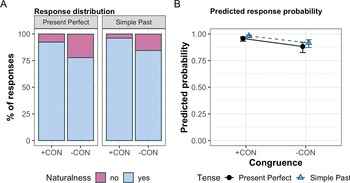
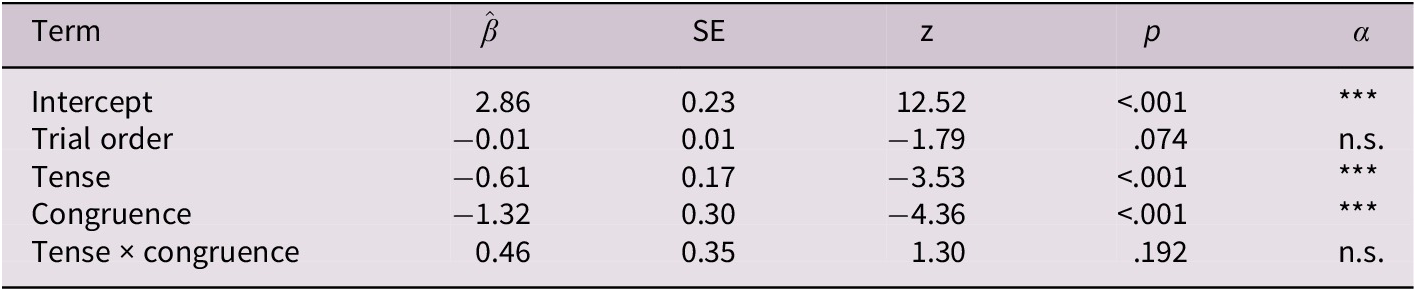
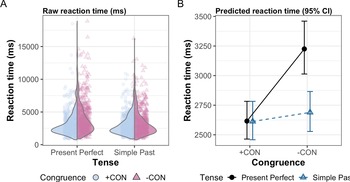
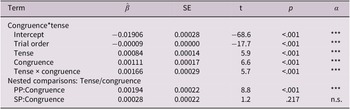
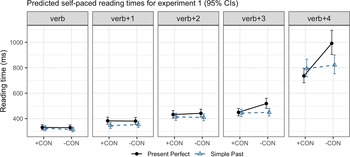


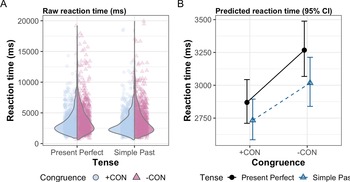
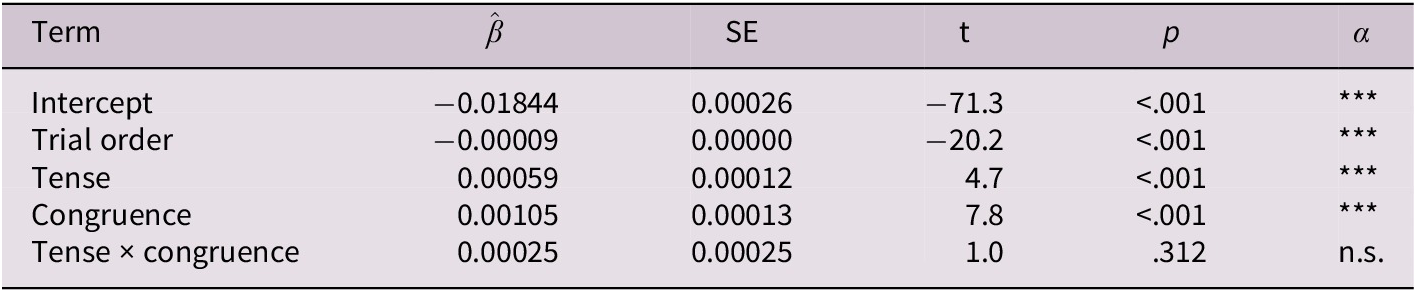
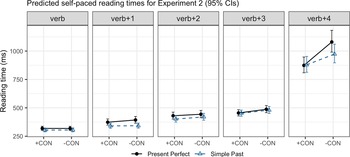
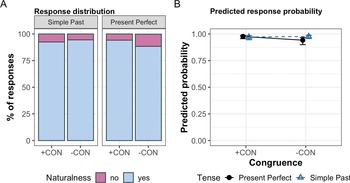
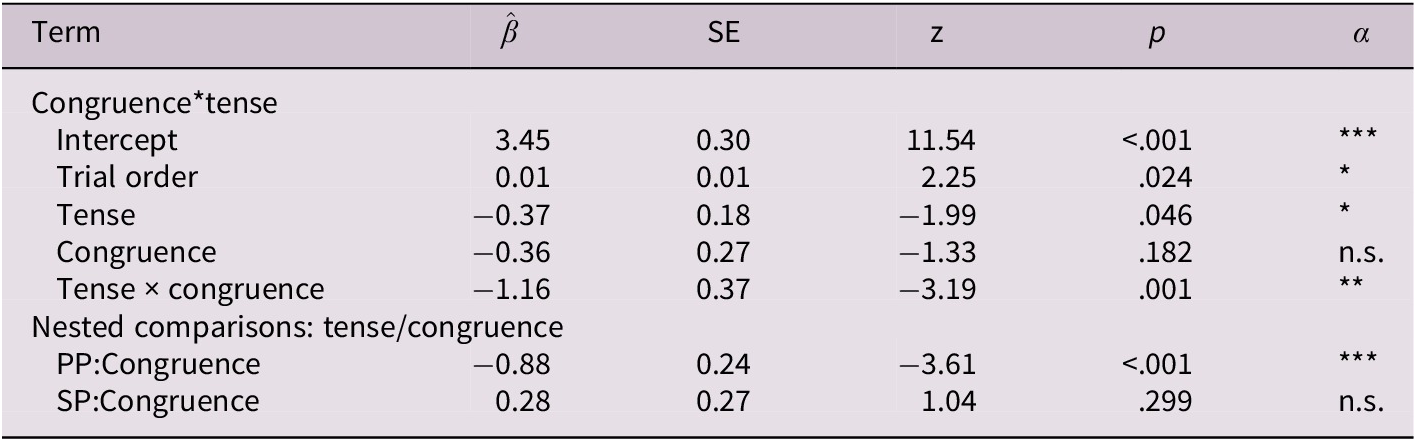
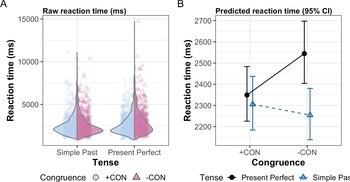
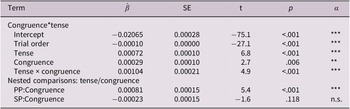
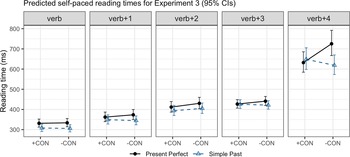
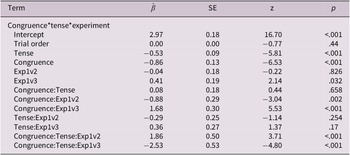
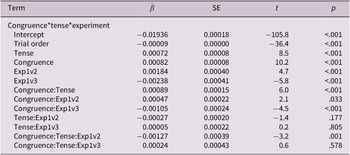

 Open access

