


Background
The reason for the differences in flow regime in West Antarctica (fast-streaming flow and nearly stagnant ridges), as well as for the recent stoppage of Ice Stream C, are still largely unknown. Streaming flow is not an isolated phenomenon, for analyses of aerial photography and SPOT imagery show that the up-glacial onset of ice streaming occurs over a broad zone (Reference Vornberger and WhillansVornberger and Whillans, 1986, Reference Vornberger and Whillans1990; Reference Merry and WhillansMerry and Whillans, 1993). Moreover, the shear margins can be traced over large distances. Once started, ice streams seem to be able to maintain their characteristics.
Field programs were initiated on Ice Streams B and C (Fig. 1), with the objective of testing the early inferences about the presence, extent and steadiness of ice streams, and to infer the mechanics controling their motion. Ice Stream C was selected for study because of the indications that it had stopped flowing. Studies were conducted on Ice Stream Β because it is active, has a simpler basal topography than other ice streams, but otherwise seems representative of most of the ice streams. Also, being next to the stopped Ice Stream C, it too may be changing, perhaps through capture of the drainage of Ice Stream C.
Location of ice streams (indicated by STIPPLING) draining into the Ross Ice Shelf.

Because both Ice Streams Β and C appear to be undergoing significant change, understanding their mechanics is crucial. To address this issue, surface velocities were measured on a local scale (by deploying strain grids: Reference WhillansWhillans and Van der Veen, 1993), on a regional scale (from repeat aerial photography: Reference Whillans and BindschadlerWhillans and Bindschadler, 1988; Reference WhillansWhillans and others, 1993), and on a large scale covering the entire ice stream and its catchment area. These large-scale velocities were determined by repeat occupation of Doppler satellite-tracking stations. The present contribution presents and discusses results of the large-scale survey of the ice streams. Preliminary results of many velocity determinations have been given in Reference Whillans and ShabtaieWhillans and others (1987), but the velocities presented here are more precisely determined and many additional measurements are included.
Methods
Poles were placed vertically in the surface of the ice sheet and surveyed on at least two occasions for position. The resulting vectors for surface velocity are presented in Table 1 and plotted in Figure 2 and 3. The base map for Figure 2 includes the major geographic features mapped from aerial photographs (Reference Vornberger and WhillansVornberger and Whillans, 1990), satellite imagery (Reference Merry and WhillansMerry and Whillans, 1993), as well as features on satellite imagery additional to those discussed by Merry and Whillans. Figure 3 shows velocity vectors together with elevation contours and the boundaries to the ice streams.
Velocity vectors superimposed on a sketch of major surface features from aerial photographs and satellite images. Some polar-grid intersections are indicated to aid correlations with the maps of Reference Retzlaff, Lord and BentleyRetzlaff and others (1993). The anticlines (also called warps) have been discussed by Reference Merry and WhillansMerry and Whillans (1993). The basal(?) features are surface ridges that are less simple in form than other linear features. We speculate that they are due to ice flowing over hogbacks in the bed (ends of dipping strata that resist erosion).

Velocity vectors superimposed on elevation contours from Reference Retzlaff, Lord and BentleyRetzlaff and others (1993). Heavy lines mark boundaries to ice-stream flow from Reference Merry and WhillansMerry and Whillans (1993) and Reference Vornberger and WhillansVornberger and Whillans (1990). Short lines perpendicular to contours indicate onset of ice-stream flow.

Positions and horizontal velocities of stations. Positions are in the WGS84 system. Velocity components are parallel to, and in the direction of 90° W longitude (grid west) and 180° longitude (grid south). The last column indicates how muck the more precisely determined ice speed differs from the values tabulated in Reference Whillans and ShabtaieWhillans and others (1987) (values that are new are so indicated)

The surveying was done using Transit (also called “Doppler”) satellite receivers. Most of the equipment were Magnavox model 1502 “Geoceivers”, which were left tracking at each site for about 24 h. As described in (Reference McDonald and WhillansMcDonald and Whillans 1988, Reference McDonald and Whillans1992), the data are reduced using precise, post-processed orbits for the satellites, or else they are linked in a network adjustment to other sites with positions so obtained. The earlier results in Reference Whillans and ShabtaieWhillans and others (1987) did not involve these precise orbits. In the present work, absolute positions of the survey stations are accurate to about 1 m. Relative positions for stations linked together in a network adjustment are more precise, but discussion here relates to absolute velocities, which are accurate to  , or typically 0.4 m a−1.
A few positions are calculated from tracking data provided by other groups. As indicated in Table 1, some of these positions are of lesser quality because fewer satellite passes were tracked. There are positions and velocities in Table 1 that lie outside the area of the figures and are not plotted.
Many stations have been surveyed three times, giving two velocity determinations. There is no significant change in velocity. Only vectors calculated from the longest time interval are presented. Positions are relative to the WGS84 ellipsoid. Heights above the geoid are about 40 m smaller (AUSLIG, 1980; Reference Rapp, Wang and PavlisRapp and others, 1991).
Ice Stream B
In drawing the boundary for the onset of ice-stream flow in Figure 3, active ice-stream flow is defined as grounded ice having a driving stress less than about 50 kPa and speeds in excess of about 100 m a−1 (expanding on a definition suggested by Reference BentleyBentley (1987)). Other definitions are possible but this definition emphasizes the essential anomaly of the ice streams in this vicinity (fast despite small driving stress). Other drainages, such as Rutford Ice Stream (Frolich and Doake, 1988) and Jakobshavns Isbras (Reference Echelmeyer, Clarke and HarrisonEchelmeyer and others, 1991), are not anomalous in this way and may be more like outlet glaciers.
Older maps of Ice Stream Β show different positions for the boundaries of the ice Stream in its upper reaches (Reference RoseRose, 1979; Reference Shabtaie, Whillans and BentleyShabtaie and others, 1987). The earlier maps are based on correlation of sites of strong radar back-scatter and the assumption that these sites represent lateral shear margins. It appears that some of these regions with dense crevasses do not correspond to shear margins.
For appropriately averaged surface slope, velocity vectors are perpendicular to surface-elevation contours from Reference Retzlaff, Lord and BentleyRetzlaffand others (1993). Up-glacier of the onset region of the ice stream (stations 50 to 65), the vectors are perpendicular to slope averaged over about 15 km in all directions (Fig. 3). Within the ice stream, flow is perpendicular to surface slope measured over 50 km along-flow and across the full width within the ice-stream boundaries, excluding the inter-stream ridges. The cause of the surface-slope variations within the ice stream and the reason that they have such a small effect on ice flow is not fully understood. Whatever the cause, averages of the driving stress for ice streams must be taken over larger distances in order to correlate with flow direction.
Where Ice Stream Β is well-defined, its width varies slowly. The width of tributary B2 varies by a factor of only 2 between the UpB camp and station 45, 150 km down-glacier. The width of tributary Bla varies even less over the same distance. The simplicity of the form of the ice-stream margins and the lack of clear basal topographic control on many of the margins (Reference Shabtaie and BentleyShabtaie and Bentley, 1988) indicates that some process, probably involving the transmission of shear stress between the inter-stream ridges and the ice stream, is determining the location and intensity of the shear margins.
In contrast to tributary B2 and the trunk of Ice Stream B, there is more basal relief and more important basal topographic control on the course of the sub-tributaries of tributary B1. Ridges Bla/Blb and B1/B2 (the unicorn) are associated with basal highs (Reference Retzlaff, Lord and BentleyRetzlaff and others, 1993). A comparison of the maps of velocity and bed elevation shows that tributary B1 tends to flow around, and not over, basal highs. The region of tributary B2 and the snake is remarkable for having little apparent bed-topographic control.
The headward onset of ice-stream flow is not marked by a simple boundary. Rather, the boundary wanders back and forth by at least 100 km. There is even an “island” in the ice-stream system (the unicorn). This indicates that the criterion for the onset of ice-stream flow is achieved separately at many different sites and that ice streams, once formed, tend to persist and coalesce.
The ice-stream system is changing with time. The most accurate determination of change over a large area is that of Reference Whillans and BindschadlerWhillans and Bindschadler (1988), who determined that output exceeds input for the Ice Stream B drainage basin. An average thinning over the catchment basin and ice stream of 0.06 m a−1 is indicated. The limit of error is 0.04 m a−1. This is believed to be the most accurate way to quote errors. However, for comparison with estimates by other authors, a standard error has been calculated by taking error limits on individual measurements as equal to twice the standard error and assuming that errors tend to cancel in a statistical way. The standard error is 0.01 ma−1.
Earlier studies over smaller areas show rapid thinning in the upper reaches of Ice Stream B, but these results are open to re-interpretation. In their small-area calculation, Reference Whillans and ShabtaieWhillans and others (1987) assumed that the strain rate between velocity determinations is homogeneous, an assumption that is now clearly inappropriate in view of the complexity of tributaries shown in Figure 2. In another small-area study, Reference Shabtaie, Bendey, Bindschadler and MacAyealShabtaie and others (1988) used freehand interpolation to determine velocity values between measurements. Nevertheless, thinning at the ice-stream head and inland migration of the onset of ice-stream flow is an attractive process to account for the overall negative mass balance of the ice stream, the excess discharge of the ice stream being due to evacuation of ice associated with headward thinning.
Ice Stream C
In great contrast to Ice Stream B, Ice Stream C is nearly stagnant. This confirms the early inferences. The region around the UpC camp is moving at only 1–13 m a−1. Velocities in the upper reaches are about 40 m a−1. The lower reach of Ice Stream C is completely stagnant (Reference Bindschadler, Stephenson, Roberts, MacAyeal and LindstromBindschadler and others, 1988).
Velocities on Ice Stream C are inadequate to evacuate the snow-accumulation rate. For mass balance, the speed would need to be similar to that of Ice Stream B, i.e. about 400 m a−1. Ice Stream C must now be thickening at about its snow-accumulation rate of 0.10 m a−1 (Reference Whillans and BindschadlerWhillans and Bindschadler, 1988). The flow direction of one station (81) is inconsistent with the direction of this relict ice stream; it shows a strong component of motion toward the margin. This also indicates non-steady flow.
Inter-Stream Ridges
Ice flows into the sides of Ice Stream Β all along its length. This flow usually enters the ice stream at an angle of about 45° to the main flow and is perpendicular to elevation contours on the inter-stream ridges.
The flow of ice from inter-stream ridge B/C is consistent with steady flow by internal creep. The discharge by internal creep using flow-law parameters from Reference HookeHooke (1981) balances the up-glacier accumulation reported by Reference Whillans and BindschadlerWhillans and Bindschadler (1988), but limits of error would allow thinning as fast as 0.3 m a−1 or thickening as fast as 0.1 ma−1 (Reference McDonaldMcDonald, 1990, p.83). Within uncertainties, principally associated with the flow law and the size of the catchment area, the ridge may be in balance and flowing without basal slip.
The steadiness of flow from ridge A/B cannot be assessed with even this level of imprecision. This is because the shape of the ridge is complex and catchment areas for the flow cannot be drawn with confidence.
Reference Whillans and ShabtaieWhillans and others (1987) argued that the velocity of station 27 is very anomalous. This station is at the tip of the unicorn (ridge B1/B2) and is moving across-flow. It seemed that such flow cannot be sustained by up-glacial snow accumulation and that the tip of the unicorn is being pushed by tributary BÍ or pulled sideways by tributary B2. This led to the suggestion that there may exist rafts of stiff ice that are being carried along by the ice stream. However, a less dramatic interpretation is now possible. Elevation contours (Fig. 3) indicate that ice is routed along the long axis of the unicorn. Station 27 seems to be at a special site, just where most of the discharge from the unicorn exits. The anomaly is not so much with the velocity as it is with the unusual topographic shape of the unicorn.
Longitudinal Tension and Compression
Along most of its length, the surface of Ice Stream Β is very flat. Consequently, the driving stress is small (less than 20 kPa; Reference Alley and WhillansAlley and Whillans, 1991, Fig. 2), yet the surface speed is very large. This combination of small driving stress and large speed places active ice streams in a category transitional between inland-ice flow and ice-shelf flow.
Perhaps longitudinal tension or compression is very important in countering gravity as described by the driving stress. In the models of Reference MacAyealMacAyeal (1989) and Reference HughesHughes (1992), the driving stress in ice streams is taken to be partly or largely balanced by longitudinal compression (MacAyeal) or tension (Hughes). The present data, together with strain rates measured earlier on the Ross Ice Shelf (Reference Thomas, MacAyeal, Eilers and GaylordThomas and others, 1984) can be used to evaluate longitudinal stresses and test this hypothesis.
The flowline selected for this calculation is shown in Figure 4. It begins at station 55, passes through tributary B2 and south of Crary Ice Rise and ends at station R13, close to the calving barrier. The longitudinal elevation profile, and measured surface velocity are shown in Figure 5. Data for stations 55 through 47 are from Table 1, and for station DNB from Reference Bindschadler, Stephenson, Roberts, MacAyeal and LindstromBindschadler and others (1988). For stations F7 through R13, velocities and strain rates (not shown) are from Reference Thomas, MacAyeal, Eilers and GaylordThomas and others (1984). The lines are not joined from F7 to DNB. This is because the two data sets were collected at different times, between which the velocities changed by 20% (Reference Stephenson and BindschadlerStephenson and Bindschadler, 1988). Ice thicknesses for the grounded stations are from Reference Retzlaff, Lord and BentleyRetzlaff and others (1993) and for the stations on the floating ice shelf from Reference Bentley, Clough, Jezek and ShabtaieBentley and others (1979).
Location of stations on the flowline used to calculate the role of gradients in longitudinal stress in opposing the driving stress. Marginal numbers are grid coordinates, with the Greenwich meridian as grid longitude 0°, and the South Pole at grid latitude 0° (Reference Bentley, Clough, Jezek and ShabtaieBentley and others, 1979). Stippling indicates lateral shear margins. The dotted line represents the grounding line (from Reference Shabtaie, Bendey, Bindschadler and MacAyealShabtaie and others, 1988).

Upper panel: longitudinal profile of the flowline shown in Figure 4. Lower panel: measured surface velocity ( heavy curve; scale on left ) and calculated fraction, ψ, of driving stress resisted by lateral drag and drag at the glacier base (stepped curve; scale on right).

Differential pushes and pulls (longitudinal stress gradients) are calculated from the available data as described in the Appendix. The fraction, ψ of the driving stress that is opposed by lateral drag and basal drag is shown in the lower part of Figure 5. Where ψ = 1, all resistance to flow is due to drag at the glacier sides and bed; for ψ = 0, longitudinal tensile or compressive gradients dominate, as would be the case if the glacier were spreading as a freely floating ice shelf (Reference WeertmanWeertman, 1957). For ψ > 1, local basal and lateral drag support a larger part of the glacier. Figure 5 shows that longitudinal stress gradients play small roles in controling the flow of the glacier, except for the region between stations F7 and G9.
The major uncertainties in the calculations are due to measurement errors. In particular, results are sensitive to relative errors in the second spatial derivative of ice velocity. For the grounded stations, relative ice speeds are accurate to 0.2 m a−1, but on the ice shelf the uncertainty is 25 m a−1 or somewhat worse. Therefore, to obtain meaningful results, gradients need to be calculated over larger horizontal distances on the ice shelf than on the grounded part of the flowline.
Longitudinal stresses are generally unimportant to the force balance. Reference Thomas and MacAyealThomas and MacAyeal (1982, Fig. 8) also found that the retarding force acting on the Ross Ice Shelf due to effects such as shearing past margins and the presence of ice rises is generally sufficient almost to balance the weight forces that induce ice-shelf spreading. Or, using the present notation, ψ ≈ 1 on most of the Ross Ice Shelf.
There is a special region near station G9, between Crary Ice Rise and the Transantarctic Mountains. Compression occurs up-glacier and tension down-glacier, and side drag is large; 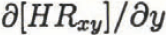 is about 0.8 kPa. Figure 5 does not depict this effect very well because side drag and driving stress are convolved. Driving stress fluctuates spatially by a large amount (from 0.9 to 0.1 kPa) on either side of station G9. Side drag
  more than balances the local driving stress; it supports some of the ice up-and down-glacier. The calculated amount of support depends on the values selected for the flow-law parameters but the favored values indicate support as much as 200 km of the glacier. This is a crucial site of large resistance, or throttle, because it controls much of the ice shelf. As has already been argued (e.g. Reference MacAyeal, Bindschadler, Shabtaie, Stephenson and BendeyMacAyeal and others, 1987), its mechanics are especially important. The role of this throttle is also significant because the region is changing as a large fold in the ice shelf passes (Reference Casassa, Jezek, Turner and WhillansCasassa and others, 1991) and due to the progressive up-glacial migration of Crary Ice Rise (Reference Bindschadler, Roberts and MacAyealBindschadler and others, 1989) and time changes in ice speed (Reference Stephenson and BindschadlerStephenson and Bindschadler, 1988).
Conclusions
The precise determinations of velocity confirm earlier work that Ice Stream Β is fast and the neighboring ice is slow. The speed contrast exceeds two orders of magnitude. Ice feeds into the ice stream along most of its sides but the bulk of input occurs at the up-glacial ends of several tributaries. The lateral shear margins show no sharp bends and are remarkable for being some of the longest simple features in the ice sheet.
Some authors have suggested that longitudinal tension or compression plays a large role in holding back or pulling along the ice stream. The velocity measurements demonstrate that this is not the case; rather, the major flow resistance comes from the bed and sides for almost the entire flowline studied here. The single major exception, where longitudinal stress is important, is next to Crary Ice Rise in the ice shelf. These large stresses point to the great importance of the ice rise in controling the flow of the ice shelf.
Ice Stream C, in contrast to Ice Stream B, is confirmed to be very slowly flowing. Velocities in the upper part are similar to those in the upper part of Ice Stream B. However, the main trunk of Ice Stream C is almost stagnant.
Acknowledgements
J. McDonald did most of the calculations for positions using satellite-tracking data. G. Casassa and C. Hulbe did further calculations. This research was supported by the U.S. National Science Foundation (grant No. DPP-9020760). This is Byrd Polar Research Center contribution No. 834.
The accuracy of references in the text and in this list is the responsibility of the authors, to whom queries should be addressed.
Appendix
To evaluate the role of longitudinal stress, consider the balance of forces in the ice-flow direction (Reference Van der Veen and WhillansVan der Veen and Whillans, 1989)

in which the x-axis is in the direction of flow and y is perpendicular to it, H represents ice thickness, and Rij
are the depth-averaged components of resistive stress. This equation states that the driving stress,  is balanced by drag at the glacier base,
  (which is zero for the ice shelf), lateral drag (second term on the right-hand side) and gradients in longitudinal stress (third term on the righthand side).
Let ψ denote the fraction of the driving stress that is opposed by basal drag and lateral drag. Then

and the balance equation can be written as

This equation is used to calculate ψ for each position along the fiowline. The driving stress is calculated from the glacier geometry, while the gradients in longitudinal stress are estimated from surface-strain rates.
The resistive stress, Rxx is related to deviatoric stresses, σij′ by neglecting bridging effects (Reference Van der Veen and WhillansVan der Veen and Whillans, 1989)

Invoking the constitutive relation (Reference PatersonPaterson, 1981, p. 3031)

gives

Here, Β represents the rate factor  from Reference WhillansWhillans and Van der Veen (1993)), and
  is the effective strain rate.
For Ice Stream B, strain rates are calculated from the ice speeds and the width of the ice stream. Longitudinal stretching is calculated from the ice speeds in Table 1:

Lateral spreading may be important where the width of the ice stream varies in the flow direction. In first approximation:

where W represents the width of the ice stream. Along the center line, other components of strain rate may be neglected and the effective strain rate is

with

from incompressibility. The quantities used to calculate Rxx are measurements of ice speed and ice stream width.
For the ice shelf, strain rates and rate factors from Reference Thomas, MacAyeal, Eilers and GaylordThomas and others (1984) are used. Also, for the ice shelf, it is easier to compute driving stress from ice thickness. Because the ice shelf is floating in ocean water, the surface elevation, h, is related to the total ice thickness, H:

where ρ and ρw denote the density of the ice shelf (0.897 Mg m−3) and sea water (1.028 Mg m−3) (Reference MacAyeal, Bindschadler, Shabtaie, Stephenson and BendeyMacAyeal and others, 1987), respectively. The driving stress is thus

Ice-thickness values have been taken from Reference Bentley, Clough, Jezek and ShabtaieBentley and others (1979).



