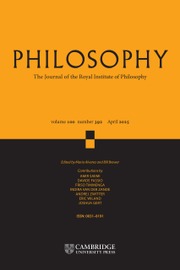





The Royal Institute of Philosophy turned a hundred in 2025. Philosophy, the Institute’s academic journal, marks its own centenary this year. This is a fitting occasion to celebrate the journal and, beyond it, the discipline itself.
The Institute and its two journals have as their mission ‘to educate the public in the subject of philosophy’. Through them, and a programme of lectures, conferences, training and teaching, online resources, funding, and partnerships with local groups and charities, the Institute takes philosophy to the public, across all people – including school children and prisoners – throughout the country and beyond. Think!, the Institute’s other journal, is still in its youth – having first appeared in 2002. It brings accessible writing by leading philosophers and other thinkers on big questions, old and new, putting them into sharper focus and helping readers hone their critical thinking. Our journal, in turn, feeds the sources of that thinking by promoting robust philosophical reflection while endeavouring to avoid obscurantism and needless technicalities.
One way to celebrate an academic discipline is to reflect on what it does, what it should do, and why. The current issue does that for philosophy, taking as its cue Bernard Williams’s ‘Philosophy as a Humanistic Discipline’, published in this journal twenty-five years ago. Williams describes the question at the heart of his paper – ‘What models or ideals or analogies should we look to in thinking about the ways in which philosophy should be done?’ – as an application of a fundamental philosophical question: ‘How should philosophy understand itself?’
His own answer spells out what he takes to be philosophy’s special relation to history – its own, but also the history of our ways of life, intellectual activities, and contingent cultural circumstances. The scope of ‘our’ here is meant to encompass anyone involved in what might be called ‘the philosophical enterprise’.
The papers in this issue offer a rich and varied response to the main themes in Williams’s piece. In the first of our five commissioned essays, Francey Russell explores a distinctive application of Williams’s concern with the ways in which the past, and our own past in particular, shapes and conditions our present and future. Kieran Setiya considers whether Williams’s scepticism about the rational vindication of the history of ethical change might reveal the pivotal contemporary concept of self-interest in philosophy, construed as a source of practical reason, to be fatally defective. John Skorupski explores Williams’s idea that philosophy can, and should be, at least in part, a humanistic discipline, examining its implications for the possibility of fitting the humanities into Williams’s own ‘absolute conception’ of the sciences. After giving a sympathetic elaboration of Williams’s diagnosis of ‘genealogical anxiety’ about our ethical outlook, Amia Srinivasan critically evaluates his own consoling solution – offering an ‘externalist’ alternative that she finds more stable. And Vida Yao draws on Williams’s vision of philosophy to imagine how he might respond to a young philosopher who, in 2026, wonders whether she should be doing philosophy at all, given the situation in which ‘we find ourselves’.
In the remaining three essays, selected from among many submissions, Williams’s themes serve as inspiration to bring out illuminating connections with other thinkers and disciplines. Louise Braddock construes philosophy as a form of humanistic enquiry in communication with other disciplines – specifically, with psychoanalysis – and Williams’s interlocutors here are two of his contemporaries (and friends), Stanley Cavell and Richard Wollheim. Alex Murphy takes issue with the idea, implicit in Williams’s critique of scientism, that our common-sense ‘manifest image’ is somehow immune to correction or refutation by scientific discovery. Instead, he offers a framework within which one may steer a path between this extreme anti-scientism and its opposite: the view that scientific theories could show our manifest image to be systematically mistaken. James Wilson presents a ‘friendly amendment’ to Williams’s view of the relation between philosophy, the humanities, and science and their respective methodologies. Framing the suggestion in John Dewey’s pragmatist but objectivist approach, Wilson proposes that ethics, like all forms of enquiry, works (best) when integrating experience (including aesthetic experience), reasoning and action.
The vertiginous technological, social and political changes we are witnessing necessitate directing our gaze to the future, in an effort to identify, understand and address the challenges they bring. Williams’s paper, and the diverse reflections on its themes from our contributors, remind us of the importance of also looking at our past, and of the role that philosophy –the passionate, intelligent and reflective enquiry in which we all have an interest – can and must play in giving us a deeper understanding of where we are, as well as clearsighted hope.

 Open access

