





Introduction
Since the 1940s, 2,4-dichlorophenoxyacetic-acid (2,4-D) has been used as an active ingredient in more than 1,500 commercial herbicide products worldwide (Islam et al. Reference Islam, Wang, Farooq, Khan, Xu, Zhu, Zhao, Muños, Li and Zhou2018). Products containing 2,4-D have been commonly used for burndown or postemergence management of more than 200 broadleaf weed species in labeled crops (e.g., corn [Zea mays L.], small grains, pasture, and turf; Aquino et al. Reference Aquino, Tunega, Haberhauer, Gerzabek and Lischka2007). Formulations of 2,4-D differ in their relative potential for volatilization, absorption, translocation, and weed control. Growers may select a formulation based on weed species present and the potential for off-target movement (OTM) toward neighboring susceptible crops (Aquino et al. Reference Aquino, Tunega, Haberhauer, Gerzabek and Lischka2007; Nice et al. Reference Nice, Johnson and Baumann2004). Many broadleaf crops are extremely sensitive to 2,4-D; however, recent development of herbicide-resistant crop cultivars allows growers to include such an herbicide in their weed management programs with no risk to crop safety (Nandula Reference Nandula2019).
In the United States, soybean is a high-value export crop for protein meal and oil production, cultivated on >30 million ha (USDA 2020). Enlist™ crops (developed by Corteva Agriscience) are resistant to 2,4-D and glyphosate; the most recent generation of this technology, Enlist E3™, confers additional resistance to glufosinate in soybean (Glycine max [L.] Merr.; Nandula Reference Nandula2019; Wright et al. Reference Wright, Shan, Walsh, Lira, Cui, Song, Zhuan, Arnold, Lyn, Yau, Russel, Cicchillo, Peterson, Simpson, Zhou, Pansamuel and Zhang2010). In 2019, 94% of hectares in the Unites States planted with soybean consisted of herbicide-resistant cultivars (USDA 2020). A survey conducted in the winter of 2020 with soybean growers and agronomists indicated that 14% of Wisconsin soybean acres managed by survey respondents would be planted with Enlist E3 in 2020 (the season when the technology became fully available to growers) and >80% of those acres would receive a postemergence application of 2,4-D choline, suggesting rapid adoption of the technology (Arneson and Werle Reference Arneson and Werle2020).
Two products containing the active ingredient 2,4-D choline, Enlist One® with Colex-D® technology and Enlist Duo® with Colex-D® technology (premix with dimethylammonium salt of glyphosate), are registered for use in 2,4-D-resistant crops (e.g., EnlistTM and Enlist E3TM). In 2,4-D-resistant soybean, these two products are labeled for preemergence use without any plant-back interval and postemergence up to full flowering stage (R2 growth stage; Anonymous 2020). Manuchehri et al. (Reference Manuchehri, Dotray and Keeling2017) reported an early postemergence application of 2,4-D choline or 2,4-D choline plus glyphosate provided effective control (>95%) of glyphosate-resistant Palmer amaranth (Amaranthus palmeri S. Watson) in the Texas High Plains. Inclusion of 2,4-D alone or in combination with other active ingredient(s) allows for an additional effective postemergence herbicide option for control of troublesome broadleaf weed species in soybeans (Manuchehri et al. Reference Manuchehri, Dotray and Keeling2017; Shyam et al. Reference Shyam, Chahal, Jhala and Jugulam2020). In contrast, the potential for 2,4-D OTM toward neighboring sensitive areas and/or susceptible crops represents a challenge for growers adopting this technology and has raised public concerns (Vieira et al. Reference Vieira, Butts, Rodrigues, Schleier, Fritz and Kruger2020).
Sublethal doses of synthetic auxin herbicides can cause significant injury and reduce yield of susceptible crops such as soybean, cotton (Gossypium hirsutum L.), grapes (Vitis vinifera L.), and numerous vegetable crops (Dittmar et al. Reference Dittmar, Ferrell, Fernandez and Smith2016; Egan et al. Reference Egan, Barlow and Mortensen2014; Mohseni-Moghadam et al. Reference Mohseni-Moghadam, Wolfe, Dami and Doohan2016). Soybean is more sensitive to dicamba than 2,4-D (Egan et al. Reference Egan, Barlow and Mortensen2014; Virginia et al. Reference Virginia, Loren, David, Keith, Alexander and Alan2012). In a meta-analysis by Egan et al. (Reference Egan, Barlow and Mortensen2014), exposure to dicamba at 56.1 g ae ha−1 was estimated to result in greater than 48% soybean yield loss, but no yield loss was observed for a corresponding rate of 2,4-D. The Enlist One® and Enlist Duo® labels list 2,4-D-susceptible soybean as a compatible crop (Anonymous 2020), therefore permitting applications of 2,4-D choline in 2,4-D-resistant soybean immediately adjacent to 2,4-D-susceptible soybean, regardless of wind direction. Typically, direct exposure to a sublethal dose of 2,4-D causes distinct soybean injury symptoms (e.g., epinasty and leaf strapping; Egan et al. Reference Egan, Barlow and Mortensen2014). Soybean injury from auxin herbicides is highly variable and is dependent on numerous factors, including soybean growth stage, cultivar selection, meteorological conditions, application parameters, active ingredient and the amount of active ingredient the plants are exposed to (Egan et al. Reference Egan, Barlow and Mortensen2014; Havens et al. Reference Havens, Hillger, Hewitt, Kruger, Marchi-Werle and Czaczyk2018; Solomon and Bradley Reference Solomon and Bradley2014). For example, Cuvaca et al. (Reference Cuvaca, Jovanovic, Scott and Knezevic2020) reported soybean exposure to 2,4-D at 106 g ae ha−1 resulted in 5% to 20% injury. Moreover, the rate required to cause crop response does not necessarily correlate with the rate required to cause yield loss. Robinson et al. (Reference Robinson, Davis, Simpson and Johnson2013) estimated 5% yield reduction following exposure to 2,4-D at a rate between 87 and 116 g ae ha−1. Soybean may be able to recover from exposure to sublethal doses of auxin herbicides, but such information under large-scale field conditions is relatively scarce (Egan et al. Reference Egan, Barlow and Mortensen2014; Soltani et al. Reference Soltani, Nurse and Sikkema2016). Previous research conducted in Brazil has shown that 2,4-D choline can reduce the drift risk regardless of application conditions compared to other 2,4-D formulations (Kalsing et al. Reference Kalsing, Rossi, Lucio, Zobiole, da Cunha and Minozzi2018).
Spray drift (particle and vapor) is a major source of OTM during and following a herbicide application (Matthews et al. Reference Matthews, Bateman and Miller2014; Soltani et al. Reference Soltani, Oliveira, Alves, Werle, Norsworthy, Sprague, Young, Reynolds, Brown and Sikkema2020). Downwind movement of spray droplets away from the target area is largely attributed as particle drift (Matthews et al. Reference Matthews, Bateman and Miller2014). Herbicides can also move to a neighboring area in the form of vapor within a few hours and up to ≥48 h after application (Matthews et al. Reference Matthews, Bateman and Miller2014; Soltani et al. Reference Soltani, Oliveira, Alves, Werle, Norsworthy, Sprague, Young, Reynolds, Brown and Sikkema2020). Herbicide physiochemical properties (i.e., vapor pressure) are key in predicting vapor drift potential; however, numerous environmental conditions such as temperature, humidity, wind, and the treated surface conditions (e.g., bare soil, dry vegetation, actively growing vegetation) can also influence herbicide volatility (Mueller and Steckel Reference Mueller and Steckel2021; Strachan et al. Reference Strachan, Casini, Heldreth, Scocas, Nissen, Bukun, Lindenmayer, Shaner, Westra and Brunk2010; Striegel et al. Reference Striegel, Oliveira, Arneson, Conley, Stoltenberg and Werle2021; Sosnoskie et al. Reference Sosnoskie, Culpepper, Braxton and Richburg2015). The 2,4-D choline formulation is reported to be 88% and 96% less volatile than the amine and ester formulations, respectively, and application with an approved nozzle could reduce spray drift up to 90% (Havens et al. Reference Havens, Hillger, Hewitt, Kruger, Marchi-Werle and Czaczyk2018; Hillger et al. Reference Hillger, Qin, Simpson and Havens2012). While the labels of 2,4-D choline products contain detailed application requirements to mitigate particle drift, including carrier volume range (94 to 140 L ha−1), spray nozzles that produce coarse to ultra-coarse droplets (>326 μm), low wind speed conditions (<6.7 m s−1), and absence of temperature inversion (Anonymous 2020), they don’t necessarily address vapor drift. Research on the OTM potential of 2,4-D choline applied according to label requirements under large-scale field conditions is lacking and represents a major topic of interest to growers adopting this novel technology. The objective of this large-scale field experiment was to evaluate OTM of 2,4-D choline by means of particle deposition during application, 2,4-D concentration in the air (0.5 to 48 h following application), and subsequent injury to neighboring 2,4-D-susceptible soybean.
Materials and Methods
Experiment Background
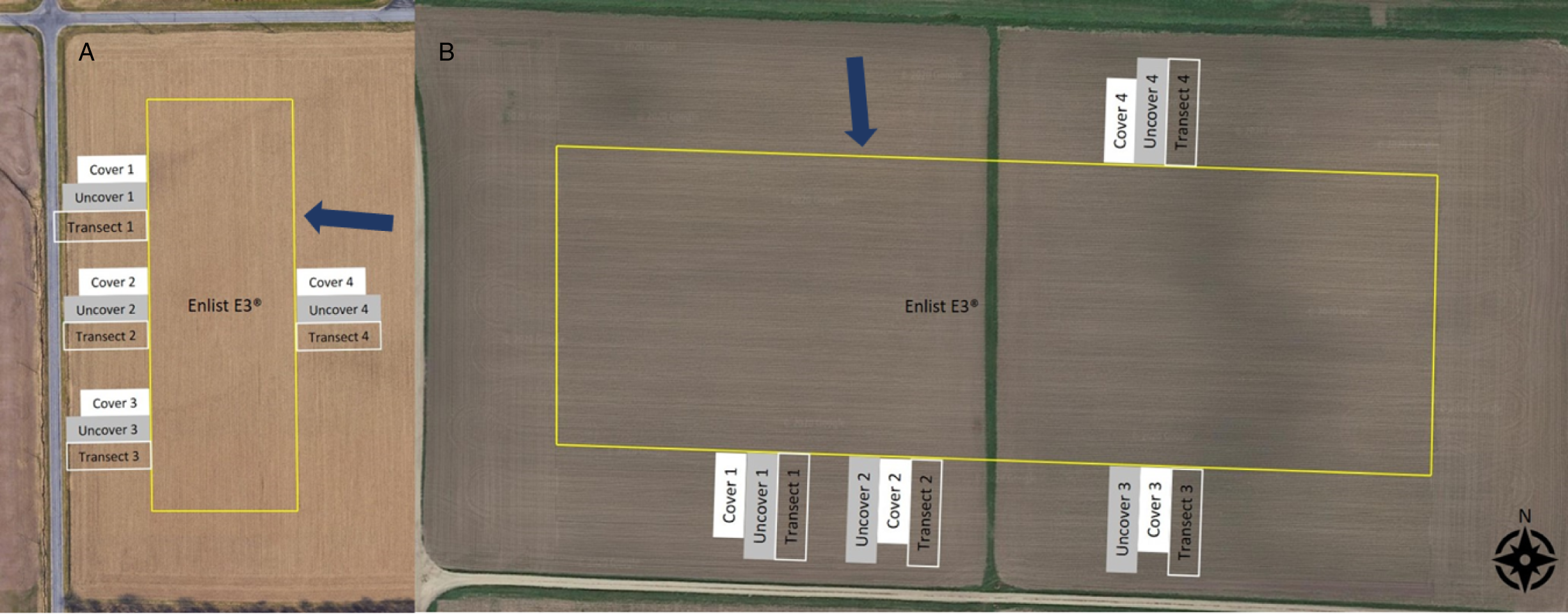
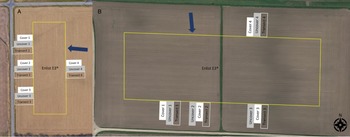
A large-scale field experiment was conducted in Wisconsin in 2019 (commercial production field near Sun Prairie, WI; 43.2064°N, 89.2253°W) and 2020 (University of Wisconsin-Madison Arlington Agricultural Research Station, Arlington, WI; 43.3197°N, 89.3350°W; Figure 1). The treated area (3.0 and 2.9 ha at the Sun Prairie and Arlington locations, respectively) was planted with a 2,4-D-resistant soybean cultivar and the area bordering the treated area was planted with a 2,4-D-susceptible soybean cultivar (Table 1). An application of 2,4-D choline at 785 g ae ha−1 plus dimethylammonium salt of glyphosate at 834 g ae ha−1 (Enlist Duo® with Colex-D® technology; Corteva Agriscience, Wilmington, DE) plus ammonium sulfate at 1,429 g ha−1 (S-Sul; American Plant Food Corporation, Galena Park, TX) was made at the R2 and V6 growth stages in 2019 and 2020, respectively (Table 1). In both years, herbicides were applied using a Demco field sprayer (Boyden, IA) with 13.7-m boom width, TTI11004 nozzles, 0.5-m nozzle spacing, 0.5-m boom height, 3.1 m s−1 travel speed, and 140 L ha−1 carrier volume. Immediately before application, three downwind transects (relative to the area to be treated with 2,4-D choline) and one upwind transect were established on the 2,4-D-susceptible soybean using plastic tarps (3 m wide by 16 m long by 1.5 m in height) kept above the soybean canopy by polyvinyl pipe frames similar to methodology adopted by Soltani et al. Reference Soltani, Oliveira, Alves, Werle, Norsworthy, Sprague, Young, Reynolds, Brown and Sikkema2020 (Figure 1). Meteorological data (air temperature, relative humidity, wind speed and direction) were collected with a Watchdog 2700 weather station (Spectrum Technologies, Aurora, IL) located immediately outside of the treated area during and up to 48 h after application with two external temperature sensors placed 0.66 m and 1.83 m from the ground (Table 1, Figures 2 and 3).
Field plot layout for the experiments conducted at a (A) commercial field near Sun Prairie, WI in 2019 and the (B) Arlington Agricultural Research Station near Arlington, WI, in 2020 to evaluate off-target movement of 2,4-D choline applications in 2,4-D-resistant soybean. Images are not on the same scale. Blue arrows indicate the approximate wind direction at the time of application.
Field background and meteorological conditions during 2,4-D choline application.

a Seeding rates varied by variety and site-year where at Sun Prairie, the 2,4-D-resistant variety was seeded at 291,584 seeds ha−1 and the 2,4-D-susceptible variety was seeded at 380,542 seeds ha−1. At Arlington, both varieties were seeded at 395,368 seeds ha−1. In both years, soybean planted in 0.76-m row spacing.
b Growth stage as defined by Fehr and Caviness (1977).
c Data are reported with ± sensor error.
d Pioneer (Johnston, IA), Corteva Agriscience (Wilmington, DE, USA)
e Stine Seed Company (Adel, IA)
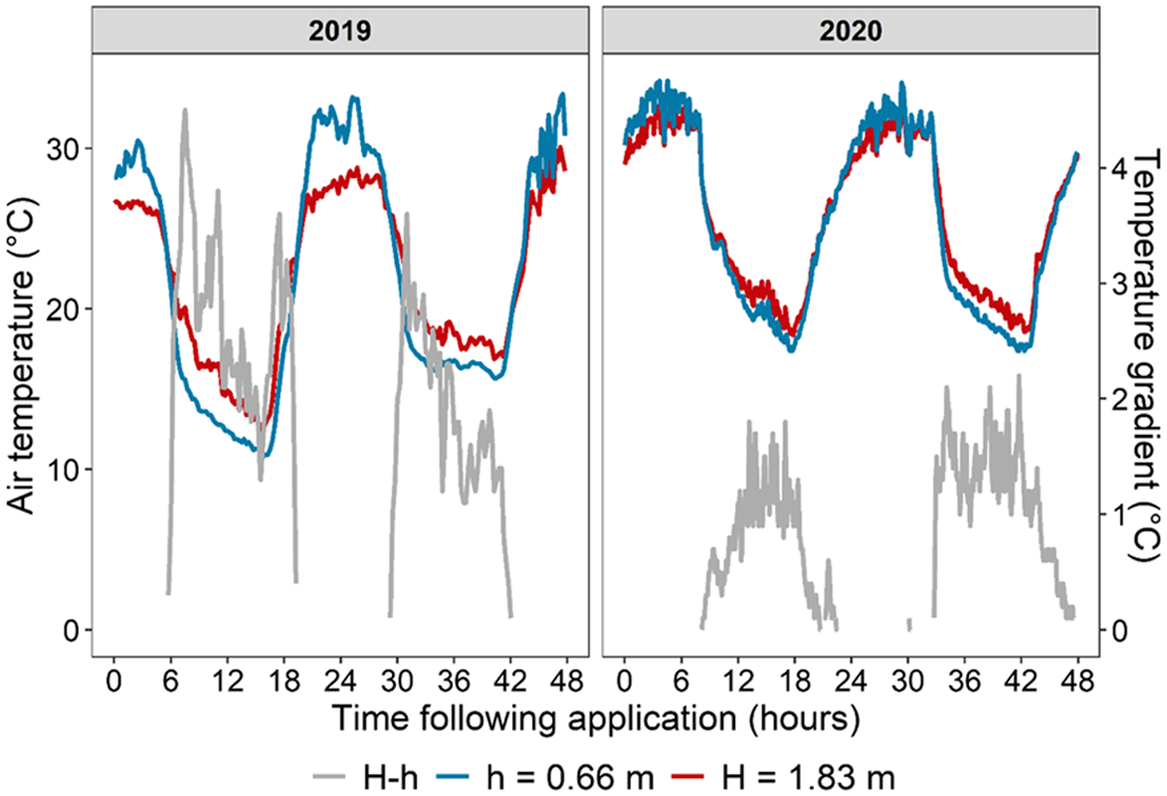
Temperature fluctuations and inversions (H-h) during the 48-h period following 2,4-D choline application for the experiments conducted at a commercial field near Sun Prairie, WI, in 2019, and the Arlington Agricultural Research Station near Arlington, WI, in 2020. H (1.83 m) and h (0.66 m), the temperatures of the highest and lowest sensors, respectively.
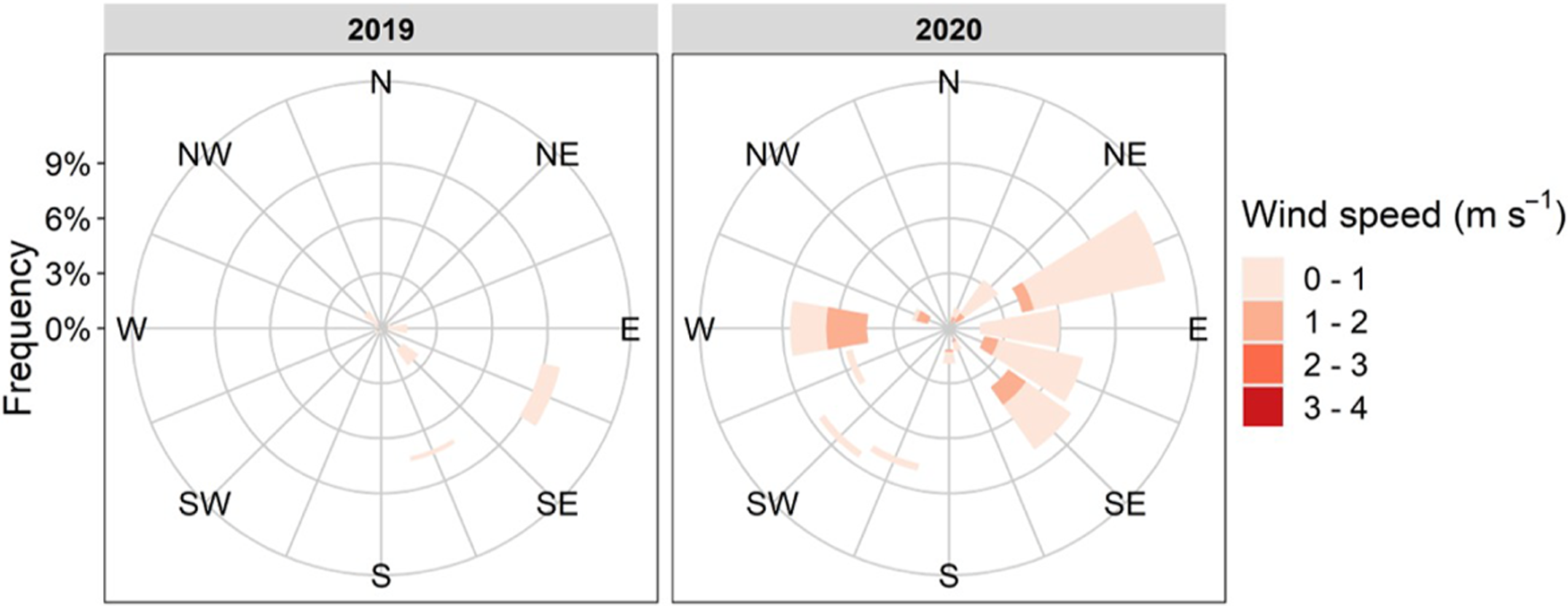
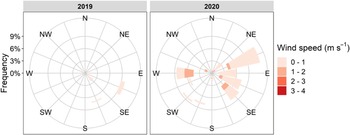
Wind rose plots demonstrating the average wind frequency, speed, and direction during the 48-h period following 2,4-D choline application for the experiments conducted at a commercial field near Sun Prairie, WI, in 2019 and the Arlington Agricultural Research Station near Arlington, WI, in 2020. Note the major wind directional changes after application in 2020.
Spray Particle Drift Assessments
Prior to 2,4-D choline application, 150-mm-diameter filter papers (Whatman no.1; Whatman, Maidstone, United Kingdom) were each affixed to an individual 15-cm by 15-cm cardboard slab that were positioned horizontally at the height of soybean canopy at multiple locations within (in-swath), upwind, and downwind of the treated area. For the in-swath assessments, eight and 10 filters were placed throughout the treated area in 2019 and 2020, respectively. Six filters were placed in three downwind transects and one upwind transect at 0.76 m, 1.52 m, 3.05 m, 6.10 m, 11.51 m, and 24.38 m starting from the edge of the treated area (Figure 1). Filter papers were collected 30 min after application, placed in 50-mL centrifuge tubes (Sarstedt AG & CO., Numbrecht, Germany), and transported to −20 C cold storage until overnight shipment for analysis. The upwind filters were collected before downwind filters and filters were collected from the farthest distance from the treated area inward in order to avoid contamination among samples. A separate team of individuals collected in-swath filters to avoid contamination.
Air Samples
Air samples were collected throughout the trial area for analysis of 2,4-D concentration. Low-volume air samplers consisting of pumps (AirChek 224-52; SKC Inc., Eighty-Four, PA) equipped with polyurethane foam (PUF, catalog no. 226-92; SKC Inc.) and powered by rechargeable batteries (Powercore + 20100 USB-C; Anker Innovations, Shenzhen, Guangdong, China) were affixed horizontally at 0.55 m above the soybean canopy. Flow rate of the air samplers were calibrated between 2.9 to 3.1 L min−1 using a Chek-Mate Calibrator (SKC Inc.). In 2019, due to equipment availability, four air samplers were used in total, with two placed in-swath and one each placed immediately adjacent (within 1 m) to the farthest distance of the upwind and downwind drift assessment transects from the treated area. In 2020, nine air samplers were used, with three placed in-swath, three placed immediately adjacent to downwind drift assessment transects, and three placed upwind in-line with the downwind samplers. The air samplers ran continuously from 30 min after application until 48 h after application. The PUFs were collected at 48 h after application, immediately placed in 50-mL centrifuge tubes (Sarstedt AG & CO.), and transported to −20 C cold storage until overnight shipment for analysis. To avoid contamination among samples, the in-swath, upwind, and downwind samplers were collected by separate teams of individuals.
Sample Analysis
Samples were shipped on dry ice to the Mississippi State Chemical Laboratory at Mississippi State University and stored at −20 C until processed and analyzed. All filter and PUF samples were prepared according to the extraction method described in Soltani et al. (Reference Soltani, Oliveira, Alves, Werle, Norsworthy, Sprague, Young, Reynolds, Brown and Sikkema2020). In short, the samples were extracted using 30 mL of methanol and homogenized with a SPEX SamplePrep Geno/Ginder® (OPS-Diagnostics, Lebanon, NJ). The supernatant was concentrated 50× with a TurboVap to 1 mL, filtered, evaporated, and solvent exchanged with 25% acetonitrile in water solution. Each batch of samples included a blank matrix sample and a matrix spiked sample that was fortified with a known concentration of 2,4-D to determine extraction efficiencies. Recoveries ranged between 70% and 130% and the level of detection for PUFs and filters were 3 ng per PUF or per filter.
Liquid Chromatography with Tandem Mass Spectrometry Method
Samples were analyzed on an Agilent 1290 performance liquid chromatograph (Agilent Technologies, Santa Clara, CA) coupled to an Agilent 6460 C triple quadrupole instrument (QQQ). Samples were injected onto an Agilent Zorbax Eclipse Pluss 100 mm column. The mobile phase consisted of (A) water containing 0.1% formic acid and (B) acetonitrile. The flow rate 0.3 mL min−1 with the following gradient program: 0 to 0.5 min of 25% B, 0.5 to 1 min of 50% B, and 1 to 4 min of 60% B. The Agilent’s Jet Stream electrospray ionization (ESI) interface was used in negative ion mode with the following settings: capillary voltage 4 kV, nebulizer pressure 276 kPa, sheath gas flow rate 11 L min−1, sheath gas temperature 350 C, dry gas temperature 200 C, and dry gas flow rate 10 L min−1.
Soybean Injury
Soybean injury was assessed at 21 d after treatment in the 2,4-D-susceptible soybean covered and noncovered areas upwind and downwind of the area treated with 2,4-D choline. In the covered areas, individual plants were assessed starting at 0.76 m from the treated area and every 0.76 m up to 15.2 m (2019) or 9.14 m (2020). In the noncovered areas, individual plants were assessed starting at 0.76 m from the treated area and every 0.76 m up to 15.2 m (2019) or 9.14 m (2020) and then every 3.81 m starting at 11.43 m up to the field edge (61 m and 53.3 m in 2019 and 2020, respectively). Three soybean plants at each distance were arbitrarily selected and evaluated on a 0% to 100% scale according to a method described by Behrens and Lueschen (Reference Behrens and Lueschen1979), with 0% indicating no observed crop injury and 100% indicating plant death.
Statistical Analyses
Analyses were conducted using R statistical software 4.0.2 (R Core Team 2020). A fixed effect model was fit to the 2,4-D air concentration (ng m−3) dataset from 2020 (stats package 4.0.2; R Core Team 2020) with sampler location (in-swath, upwind, and downwind) as a fixed effect. Normality and homogeneity of residual variance of the dataset were evaluated using the Shapiro-Wilk test (stats package; R Core Team 2020) and Levene’s test (car package 3.0-8; Fox and Weisberg Reference Fox and Weisberg2019), respectively. ANOVA was conducted using the car package (Fox and Weisberg Reference Fox and Weisberg2019) and when the main effect was significant, means were separated using Fisher’s protected LSD using the emmeans package 1.4.7 (Lenth Reference Lenth2020).
A three-parameter log-logistic model (drm function) of the drc package 3.0-1 (Ritz et al. Reference Ritz, Baty, Streibig and Gerhard2015) was fitted to the datasets of 2,4-D deposition (ng cm−2) and 2,4-D injury (%) on 2,4-D-susceptible soybean using the following equation:
 $$Y\;\left( x \right) = \frac{d}{{1 + {\text{exp}}\left( {b\left( {\log \left( x \right) - e} \right)} \right)}}$$
where
 $$Y$$
is 2,4-D deposition (ng cm−2) or 2,4-D-susceptible soybean injury (%),
$$Y$$
is 2,4-D deposition (ng cm−2) or 2,4-D-susceptible soybean injury (%),
 $$d$$
is the upper limit of
$$d$$
is the upper limit of
 $$Y$$
,
$$Y$$
,
 $$e$$
is the inflection point relative to
$$e$$
is the inflection point relative to
 $$d$$
(50% injury or deposition reduction related to the upper limit),
$$d$$
(50% injury or deposition reduction related to the upper limit),
 $$b$$
is the relative slope around
$$b$$
is the relative slope around
 $$e$$
, and
$$e$$
, and
 $$x$$
is the distance (m) from the 2,4-D-resistant soybean treated area. Model selection criterion of choice was log likelihood (using the mselect function in the drc package). The distance to 50% (D50) and to 90% (D90) reduction in 2,4-D deposition and injury on 2,4-D-susceptible soybean was determined using the ED function of drc package (Ritz et al. Reference Ritz, Baty, Streibig and Gerhard2015).
$$x$$
is the distance (m) from the 2,4-D-resistant soybean treated area. Model selection criterion of choice was log likelihood (using the mselect function in the drc package). The distance to 50% (D50) and to 90% (D90) reduction in 2,4-D deposition and injury on 2,4-D-susceptible soybean was determined using the ED function of drc package (Ritz et al. Reference Ritz, Baty, Streibig and Gerhard2015).
Results and Discussion
Meteorological Observations
Air temperature was 25.4 C and 28.7 C at the time of herbicide application in 2019 and 2020, respectively (Table 1). According to the parameters described by Bish et al. (Reference Bish, Farrell, Lerch and Bradley2019b), a temperature inversion was not present at the time of application in 2019 and 2020; however, temperature inversions were detected following applications in both years, occurred most frequently over the evening and early-morning hours, and were more pronounced in 2019 (Figure 2). At the time of application, relative humidity was 51.9% and 59.5% in 2019 and 2020, respectively. East/southeast and north/northeast wind with an average speed of 1.3 m s−1 was observed at the time of herbicide application in 2019 and 2020, respectively. Average wind speed during the 48-h period following herbicide application did not exceed 2 m s−1 (Figure 3). Major wind directional changes were observed during the 48-h period following herbicide application in 2020. No rainfall occurred during the 48 h following application (data not shown). Wind speed is a primary factor influencing particle drift of synthetic auxin herbicides (Jones et al. Reference Jones, Norsworthy and Barber2019). High temperatures and the presence of temperature inversion favor herbicide volatility and vapor drift (Bish et al. Reference Bish, Guinan and Bradley2019a, 2019b; Jones et al. Reference Jones, Norsworthy and Barber2019). Low relative humidity during herbicide application can also increase the potential for herbicide volatility (Behrens and Lueschen Reference Behrens and Lueschen1979; Mueller et al. Reference Mueller, Wright and Remund2013). In the Midwest U.S., temperature inversions commonly occur during spring and summer nights, favoring movement of suspended spray droplets and/or herbicide vapor trapped in the inversion layer (Bish et al. Reference Bish, Farrell, Lerch and Bradley2019b; Grant and Mangan Reference Grant and Mangan2019). Soltani et al. (Reference Soltani, Oliveira, Alves, Werle, Norsworthy, Sprague, Young, Reynolds, Brown and Sikkema2020) reported wind speed, temperature inversion, and air temperature as the main reasons for differences in the amount of OTM of dicamba across different locations in a multistate trial. In the current study, the low wind speeds during and after herbicide application may have helped to mitigate particle drift but would have favored vapor drift.
2,4-D Choline Deposition
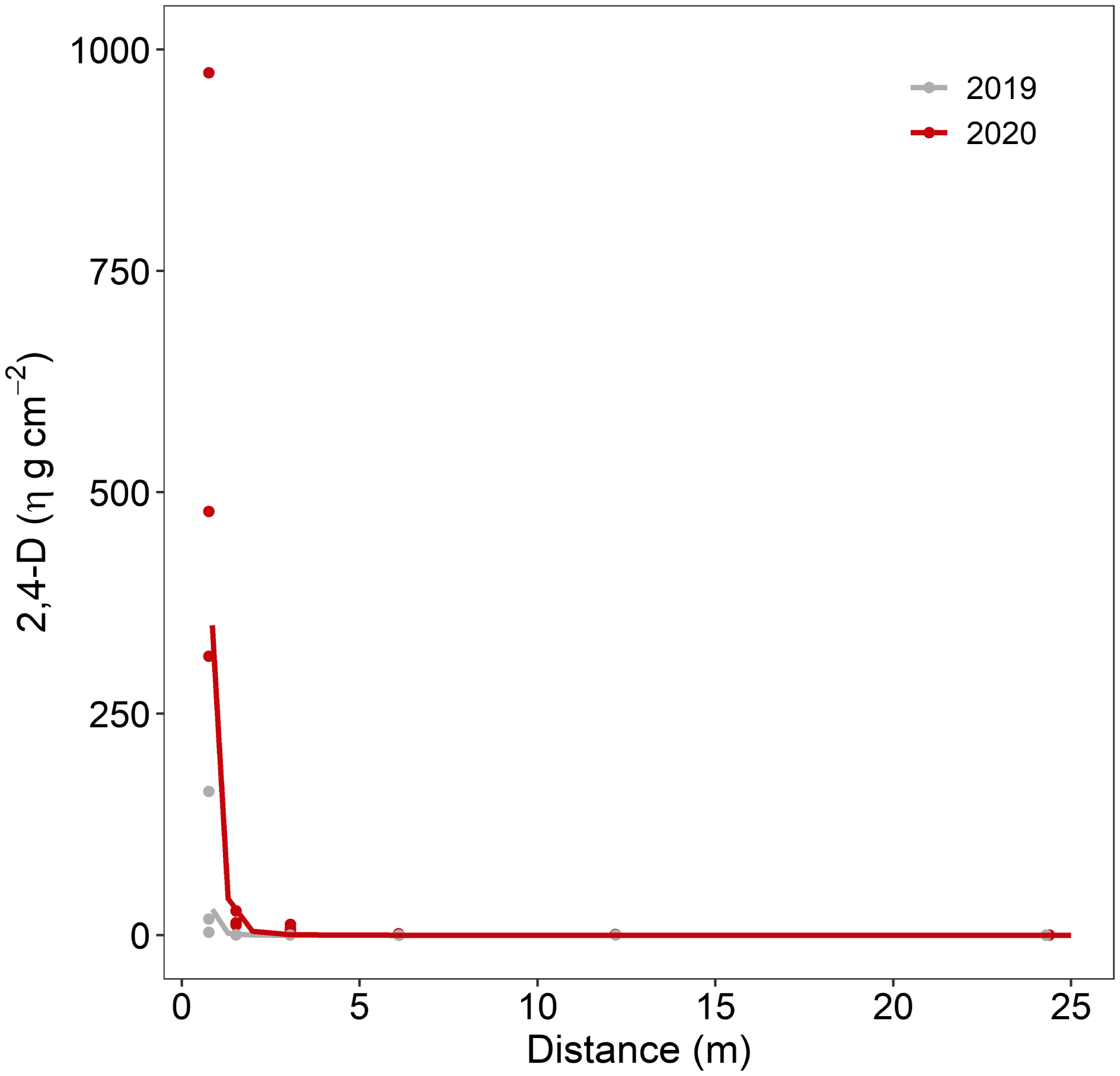
Average 2,4-D deposition collected in-swath from filter papers was 9,662 (±455) and 5,727 (±179) ng cm−2 in 2019 and 2020, respectively (environmental conditions and crop developmental stage at application, concentration in spray solution, and/or laboratorial conditions may help to explain the difference in in-swat deposition in 2019 and 2020). Deposition of 2,4-D in the downwind direction from application sharply decreased as distance from the 2,4-D choline-treated area increased (Figure 4). A three-parameter log-logistic model predicted that 90% of 2,4-D was deposited (D90 parameter) within 0.63 and 0.90 m from the edge of the treated area in 2019 and 2020, respectively. Higher wind speeds at the time of application would have likely resulted in higher predicted distance to 90% 2,4-D deposition. Spray particle drift is primarily carried to neighboring areas in the downwind direction (Jones et al. Reference Jones, Norsworthy and Barber2019; Soltani et al. Reference Soltani, Oliveira, Alves, Werle, Norsworthy, Sprague, Young, Reynolds, Brown and Sikkema2020). Our results indicate that particle drift was the main source of OTM of 2,4-D choline, as higher 2,4-D concentration was detected by filter papers in the downwind direction, and it was reduced with increasing distance from the edge of the application. Havens et al. (Reference Havens, Hillger, Hewitt, Kruger, Marchi-Werle and Czaczyk2018) observed that downwind deposition of 2,4-D was three times higher than upwind deposition, and reported that the level of 2,4-D deposition varied depending on nozzle selection and 2,4-D formulation. Spray parameters such as spray nozzle type, boom height, spray carrier volume, and spray pressure may significantly affect herbicide OTM (Carlsen et al. Reference Carlsen, Spliid and Svensmark2006; Creech et al. Reference Creech, Henry, Fritz and Kruger2015; Legleiter et al. Reference Legleiter, Young and Johnson2018). The application of 2,4-D choline in 2,4-D-resistant soybean cultivars require spray nozzles that produce larger droplets (326 to 622 μm; Anonymous 2020; Creech et al. Reference Creech, Henry, Fritz and Kruger2015, Dorr et al. Reference Dorr, Hewitt, Adkins, Hanan, Zhang and Noller2013; Legleiter et al. Reference Legleiter, Young and Johnson2018). The nozzles used herein (TTI11004) generate ultra-course spray droplets less prone to drift, partially justifying why most off-target particles deposited within 1 m from the edge of the treated area. Therefore, application of 2,4-D choline using nozzles that produce large droplets during low wind speed conditions could help to mitigate OTM.
Deposition of 2,4-D at various distances downwind from the 2,4-D choline treated area at a commercial field near Sun Prairie, WI, in 2019, and the Arlington Agricultural Research Station near Arlington, WI, in 2020. Deposition collected in-swath ranged from 7,587 to 11,155 ng cm−2 and averaged 9,662 ng cm−2 in 2019 (n = 8); ranged from 5,040 to 6,965 ng cm−2 and averaged 5,727 ng cm−2 in 2020 (n = 10). For Sun Prairie, WI, in 2019, Y(x) = 2,571/1 + exp{8.29[log(x) − 0.49]}; for Arlington, WI, 2020, Y(x)=2,679/1 + exp{5.41[log(x) − 0.60]}.
Air Concentration of 2,4-D During 48 h after Application
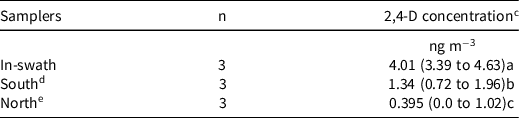
Differences were detected (P < 0.05) in 2,4-D air concentration with low-volume air samplers during the 48-h period following 2,4-D choline application in-swath and outside of the 2,4-D-treated area (Table 2). The concentration of 2,4-D detected by air samplers in-swath ranged from 3.44 to 5.88 ng m−3 in 2019, and 3.39 to 4.63 ng m−3 in 2020. Air concentration of 2,4-D was reduced 67% and 90% in the south (downwind) and north (upwind) directions, respectively, in comparison with the 2,4-D concentration detected in-swath in 2020. Herbicides can volatilize during application or after reaching the target area, and herbicide volatility is highly influenced by herbicide formulation, spray nozzle type, and meteorological conditions (Havens et al. Reference Havens, Hillger, Hewitt, Kruger, Marchi-Werle and Czaczyk2018; Strachan et al. Reference Strachan, Casini, Heldreth, Scocas, Nissen, Bukun, Lindenmayer, Shaner, Westra and Brunk2010). Although 2,4-D choline is a low volatility formulation (Simpson Reference Simpson2019; Sosnoskie et al. Reference Sosnoskie, Culpepper, Braxton and Richburg2015; Striegel et al. Reference Striegel, Oliveira, Arneson, Conley, Stoltenberg and Werle2021), vapor drift of synthetic auxins is known to increase during high-temperature conditions (Behrens and Lueschen Reference Behrens and Lueschen1979; Bish et al. Reference Bish, Guinan and Bradley2019a, 2019b; Jones et al. Reference Jones, Norsworthy and Barber2019). Vapor drift typically occurs within the first 48 h following herbicide application (Jones et al. Reference Jones, Norsworthy and Barber2019; Soltani et al. Reference Soltani, Oliveira, Alves, Werle, Norsworthy, Sprague, Young, Reynolds, Brown and Sikkema2020); therefore, 2,4-D concentration detected by air samplers during the 48-h period following application serve as a good estimate of vapor drift. However, the 2,4-D concentration detected in both upwind and downwind directions were low, suggesting that vapor drift was not a primary source of 2,4-D choline movement in this field experiment. Further studies are needed to evaluate the vapor drift of 2,4-D under different meteorological conditions.
Concentration of 2,4-D detected by low-volume air samplers during a 48-h period following 2,4-D choline application in-swath and outside of the 2,4-D-treated area at the Arlington Agricultural Research Station in 2020. a,b
a Means followed by a different letter are different at P<0.05 according to Fisher’s protected least significant difference.
b Air samplers at Sun Prairie in 2019 collected 5.88 and 3.44 ng m−3 in-swath (n = 2), 0.52 ng m−3 downwind (n = 1), and 0.12 ng m−3 upwind (n = 1) during a 48-h period following 2,4-D choline application.
c Data are presented as mean (lower-upper 95% confidence interval limits).
d Samplers southcentral, southeast, and southwest of 2,4-D choline-treated area, constituting the downwind direction at application at Arlington in 2020.
e Samplers northcentral, northeast, and northwest of 2,4-D choline-treated area, constituting the upwind direction at application.
Soybean Injury
In both years, no injury symptoms were observed in 2,4-D-susceptible soybean in the covered and noncovered areas at various distances upwind and downwind from the treated area 21 d after treatment (visual injury = 0%; data not shown). It is well established that exposure of nonresistant soybean cultivars to low doses of synthetic auxin herbicides may result in considerable injury and yield loss (Egan et al. Reference Egan, Barlow and Mortensen2014; Soltani et al. Reference Soltani, Nurse and Sikkema2016). Virginia et al. (Reference Virginia, Loren, David, Keith, Alexander and Alan2012) reported that 78 g ae ha−1 of 2,4-D amine caused 5% to 50% soybean injury after 2 wk of herbicide application. Cuvaca et al. (Reference Cuvaca, Jovanovic, Scott and Knezevic2020) reported soybean exposure to 2,4-D choline at 106 g ae ha−1 resulted in 5% to 20% injury. Results of this study showed that less than 10% of 2,4-D choline concentration detected in-swath reached 1 m away from the edge of the application (Figure 4). This suggests that a labeled application of 2,4-D choline would be unlikely to result in substantial injury to downwind adjacent 2,4-D-susceptible soybean.
Managing herbicide OTM has become one of the greatest challenges and concerns in chemical weed management in the current era of postemergence synthetic auxin herbicide use for weed control in soybean and cotton. Herbicide OTM contributes to economic losses in susceptible crops but could also be a considerable barrier to registration, acceptance, and adoption of new technologies such as Enlist E3TM. The current large-scale drift study provides information on OTM potential of the new 2,4-D choline herbicide formulation in soybean production. Downwind particle drift was identified as the primary source of OTM of 2,4-D choline. Moreover, Striegel et al (Reference Striegel, Oliveira, Arneson, Conley, Stoltenberg and Werle2021) reported no soybean injury from 2,4-D in low-tunnel field volatility experiments. Therefore, wind speed and direction are important considerations for 2,4-D choline applications. Risk of 2,4-D choline OTM can be further reduced by completing applications when the wind direction is toward nonsensitive areas (i.e., corn). No soybean injury was observed at any distance downwind from the treated area, indicating that 2,4-D-susceptible soybean can indeed be considered a compatible crop if 2,4-D choline herbicide is applied according to label requirements. Lastly, leaving an appropriate buffer zone, paying attention to wind direction at the time of application, and potential directional shifts following application can protect sensitive buffer areas and susceptible neighboring crops from herbicide OTM.
Acknowledgments
We thank the staff at University of Wisconsin-Madison Arlington Agricultural Research Station and the University of Wisconsin-Madison Cropping Systems Weed Science research group for their technical assistance in establishing this field study. Soybean seed, herbicide, and funding to purchase a weather station for this large-scale field study was provided by Corteva Agriscience. No conflict of interest has been declared.




 Open access

