




Introduction
Charting the movement of material commodities between ancient societies continues to provide important frameworks for archaeologists seeking to understand the nature of archaeo-economies, especially the rise of sociopolitical complexity (Brumfiel & Earle Reference Brumfiel and Earle1987; Oka & Kusimba Reference Oka and Kusimba2008; Abraham et al. Reference Abraham, Gullapalli, Raczek and Rizvi2016). Materials such as obsidian, glass and pottery are a mainstay within this field of study, where chemical signatures can reveal material sources and trace pathways to sites of consumption and deposition. Shell beads and ornaments are also common finds at many archaeological sites and, while taxonomic classification may sometimes identify the general bodies of water from which the shells were procured (i.e. coastal versus freshwater), less consideration has been given to the geochemical provenancing of shell artefacts (though see Shackleton & Renfrew Reference Shackleton and Renfrew1970; Shackleton & Elderfield Reference Shackleton and Elderfield1990; Vanhaeren et al. Reference Vanhaeren, d'Errico, Billy and Grousset2004; Eerkens et al. Reference Eerkens, Rosenthal, Stevens, Cannon, Brown and Spero2010; Peacock et al. Reference Peacock, Palmer, Xia, Bacon-Schulte, Carlock and Smith2010; Bajnóczi et al. Reference Bajnóczi2013).
Here, we report on the chemical analysis of a small sample of beads from Ban Non Wat, a settlement in the upper catchment of the Mun River in north-east Thailand (Figure 1), allowing an environmental insight into the production of shell disc beads in this area from c. 1750–450 BC. The inclusion of shell beads within burials was a widespread practice during the Neolithic and Bronze Age of Southeast Asia that reached an early apogee at Neolithic Khok Phanom Di where a woman was interred wearing approximately 121 000 shell specimens (Higham & Bannanurag Reference Higham and Bannanurag1990). While stone and glass beads, especially from the Iron Age, have been the subject of previous regional research, including application of provenance-based approaches (Francis Reference Francis1991; Pilditch Reference Pilditch1992; Klysubun et al. Reference Klysubun, Thongkam, Pongkrapan, Won-in, Thienprasert and Dararutana2011; Bellina Reference Bellina2014; Carter Reference Carter2015; Carter et al. Reference Carter, Dussubieux, Stark and Gilg2021; Seman et al. Reference Seman, Dussubieux, Cloquet and Pryce2021), shell beads have not figured prominently (Ciarla et al. Reference Ciarla, Rispoli and Yukongdi2017). Larger shell ornaments at Ban Non Wat include hundreds of Trochus and Tridacna bangles that are unquestionably marine in origin; a similar source is also generally assigned to the smaller disc beads but these have never been provenanced. Unfortunately, the morphological properties that might identify the original species of a shell are removed during the production of small disc beads. Thus, the taxonomic classification and indeed the number of species used to produce these items remains unknown. The present study aims to help identify if marine or freshwater shells were used and through this to examine the organisation of shell bead production, in order to illuminate possible sources and production centres, since no evidence for the manufacture of shell ornaments was found during the extensive excavations at Ban Non Wat.
Map showing the location of Ban Non Wat and places mentioned in the text (map by C.F.W. Higham, using GeoMapApp (www.geomapapp.org), after Ryan et al. Reference Ryan2009).

Ban Non Wat
Ban Non Wat is a moated prehistoric settlement located in the upper Mun Valley, north-east Thailand. This is a strategic location, lying on a choke point for exchange to the east of a pass over the Phetchabun Upland, that divides the Khorat Plateau from the broad plains of the Chao Phraya River (Figure 1). The Mun River is a natural conduit for exchange as it flows east to its confluence with the Mekong. Many exotic items, including marine shell jewellery, copper-base artefacts and ornaments of marble, glass, silver, gold, carnelian and agate, have been recovered from Ban Non Wat over 10 seasons of excavations by a joint University of Otago and Fine Arts Department of Thailand research programme that began in 2002 (Higham & Kijngam Reference Higham and Kijngam2009, Reference Higham and Kijngam2010, Reference Higham and Kijngam2012). Thirteen prehistoric periods of occupation have been identified through the analysis of mortuary practices and a programme of radiocarbon dating (Higham Reference Higham2024). The site was initially occupied by hunter-gatherers c. 17 000 BC, though this occupation phase is not further considered here. A second period of hunter-gatherer occupation is contemporary with the first Neolithic settlement (beginning c. 1750 BC), during which interments of both cultures shared the same burial ground. Hunter-gatherer burials are distinguished from Neolithic contemporaries by the flexed position of the dead, a widespread characteristic of hunter-gatherer mortuary treatment in Southeast Asia. A second Neolithic occupation (not included in this study) was succeeded c. 1050 BC by the first of five Bronze Age phases, which conclude with an Iron Age occupation c. 450 BC. From the initial Neolithic settlement until the abandonment of the site (c. AD 400), there is a continuity of culture with no evidence for an incoming population (Higham & Higham Reference Higham and Higham2009; Higham & Thosarat Reference Higham and Thosarat2020).
From the combined mortuary record of almost 700 burials, 13 represent indigenous hunter-gatherers, while two Neolithic and five Bronze Age burial phases incorporate around 270 inhumations within which the dead were commonly interred with small disc-shaped shell beads (Table 1). The number of these beads varies markedly, from a solitary specimen in 31 Neolithic 1 graves to 83 055 examples in the 32 Bronze Age 2 burials. Based on their positioning within burials, beads were often strung and worn as belts and necklaces. Richly furnished burials also often included beads adhering to the skulls that might represent the presence of a shroud or head covering. A surge in the number of beads with Bronze Ages 2 and 3 is matched by an increase in the number of other mortuary offerings, including early copper-base axes, bells, anklets, chisels and awls, marine shell bangles and earrings, and marble ornaments. The presence of these offerings is interpreted as symbolic of a rapid but ephemeral rise of social aggrandisers with access to exchange networks (Higham Reference Higham2024). Successful identification of the source of the shell beads, however, has been elusive; it is assumed that, like the bangles, they were probably marine.
Number of shell disc beads in each mortuary phase. Flexed: hunter-gatherer; Neo: Neolithic; BA: Bronze Age.

The total number of beads from hunter-gatherer and Neolithic burials is relatively low (n = 489, Table 1). From Bronze Age 1 to Bronze Age 3, the total number of beads in burials increases dramatically, before decreasing again in Bronze Age 4 and 5. Both the percentage of burials that include beads as well as the average number of beads across all individuals in a time period peak in Bronze Age 3, where every individual has at least some disc beads and the average number of beads per individual tops 6000. Clearly, beads were of great importance in mortuary contexts during Bronze Age 2 and 3.
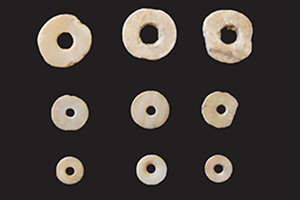
The shell disc beads from Ban Non Wat are broadly similar in shape and vary categorically, rather than continuously, by size (e.g. Figure 2A shows large, medium and small beads). Those associated with hunter-gatherer and Neolithic individuals are often chipped and rough around the edges (see Figure 2B), occasionally producing polygonal or even rectangular outlines, whereas Bronze Age beads are ground smooth along the edges and more circular (Figure 2A).
Examples of beads associated with A) Bronze Age burial 90 (n = 9; note different sizes) and B) hunter-gatherer burial 461 (n = 4; note rough and chipped outer margins) (figure by authors).

Isotopic approach
Many molluscs precipitate calcium carbonate (CaCO3) in sequential rings to form a protective exoskeleton by taking in calcium (Ca) and carbonate (CO32-) or bicarbonate (HCO3-) from the waters in which they grow. The precipitated calcite or aragonite often does not alter after formation. Thus, the carbon and oxygen within the crystal structure of a shell records diachronic information about the growing environment of the organism via the stable isotopic ratios of these two elements (13C/12C and 18O/16O) (Urey et al. Reference Urey, Epstein, McKinney and Mccrea1948; Mook & Vogel Reference Mook and Vogel1968). As the carbon and oxygen geochemistry of aqueous environments varies over both time and space, stable isotopic analyses of ancient shells can help archaeologists reconstruct aspects of the environment in which the organisms lived, such as temperature, elevation and the season shells were harvested (Deith Reference Deith, Fieller, Gilbertson and Ralph1895; Shackleton Reference Shackleton1973; Kennett & Voorhies Reference Kennett and Voorhies1996; Stephens et al. Reference Stephens, Mattey, Gilbertson and Murray-Wallace2008; Pérez et al. Reference Pérez, Batres, Rocchetta, Eppis, Bianchi and Luquet2020; Skippington et al. Reference Skippington, Manne and Veth2021). By extension, such information may provide key details about the lives of people in the past.
Empirical data show that the oxygen isotope ratio (δ18O) of biogenic carbonate from freshwater shells is generally in equilibrium with the oxygen isotopic composition of ambient water (δ18Ow) (Grossman & Ku Reference Grossman and Ku1986; Dettman et al. Reference Dettman, Reische and Lohmann1999; Versteegh et al. Reference Versteegh, Vonhof, Troelstra, Kaandorp and Kroon2010). The δ18Ow in freshwater systems is strongly correlated with patterns of precipitation where δ18Ow decreases with distance from the source of water (e.g. the ocean) and elevation. This trend is produced because water molecules containing the heavier 18O isotope condense and precipitate at a higher rate than those containing the lighter 16O isotope. With time, the 18O/16O ratio of water vapour in an air mass becomes depleted in 18O relative to 16O thereby altering the oxygen isotope ratio of rainfall as a storm tracks further inland (Kendall & Coplen Reference Kendall and Coplen2001). Local δ18Ow can also vary as a function of humidity, air temperature and altitude, due to this isotopic rainout effect. In addition, water temperature has a predictable effect on the δ18O of shell CaCO3 (δ18Oc), where δ18Oc decreases as temperature increases and vice versa (Grossman & Ku Reference Grossman and Ku1986). Together, these fractionation effects can lead to significant geographic and spatial variation in δ18Ow and δ18Oc.
By contrast, the 13C/12C ratio of a shell (δ13Cc) is strongly correlated with the 13C/12C ratio of dissolved inorganic carbon (DIC) in water. δ13CDIC is largely governed by plant and algae photosynthesis where plants preferentially utilise dissolved carbon dioxide containing the 12C isotope during growth, thereby increasing the δ13CDIC of the water. The decay of organic matter has the opposite effect on δ13CDIC because respiration releases 13C-depleted carbon dioxide. In addition, water temperature and/or metabolic effects within an organism can have a small but measurable effect on δ13Cc (Grossman & Ku Reference Grossman and Ku1986; Dettman et al. Reference Dettman, Reische and Lohmann1999; Goewert et al. Reference Goewert, Surge, Carpenter and Downing2007). Aside from metabolic effects, these other factors may vary in their intensity or magnitude across different aquatic environments, for example due to differences in sunlight, water depth or flow rates. These environmental differences may lead to significant spatial variation in δ13Cc across the landscape.
Provided variation over time within a particular body of water is smaller than that across different bodies of water, δ18Oc and δ13Cc can serve as markers of the original provenance of shells and their growing environment. We exploit this potential in our analysis of shell disc beads from Ban Non Wat.
Methods
Thirty-six beads associated with 12 individuals from Ban Non Wat were sampled for isotopic analysis (three beads per burial; see Table 2). Where possible (i.e. except in the case of very small beads), each specimen was sampled at multiple points. Prior to sampling, each bead was cleaned with deionised water and a toothbrush to remove any exogenous materials and left to dry. The outer surface of the bead was then lightly burred to remove the outermost layer of shell from the areas identified for sampling. Samples of carbonate were removed sequentially from the outer surface of the bead using a 0.5mm drill bit. Each sample was taken parallel to the orientation of shell growth rings to obtain estimates of water conditions at multiple points in the growth history of the organism. The linear distance between samples ranged from 1.0 to 2.0mm. Depth of sampling into the shell was restricted to the size of the drill bit, or approximately 0.5mm and powdered carbonate samples ranged from 60–100μg in weight. Figure 3 shows a bead from burial 461 (which contained a Neolithic female) after drilling; the six areas from which isotopic samples were removed appear as lighter-coloured parallel bands. In total, 124 isotopic measurements were made from the 36 beads sampled (see Table 2), or an average of 3.4 samples per bead, with a minimum of one and a maximum of seven samples from an individual bead. It was possible to sample beads with larger diameters more intensively due to the greater surface area, while some small beads could only be sampled once.
Beads sampled for stable isotope analysis from Ban Non Wat. Flexed: hunter-gatherer; Neo: Neolithic; BA: Bronze Age.

Shell bead from burial 461, showing sampling strategy for isotopic analysis (figure by authors).

We additionally sampled three modern freshwater mussel shells from the Mun River near Ban Non Wat, one example each of Hyriopsis bialata (n = 5 isotopic samples), Pilsbryoconcha exilis (n = 6 samples) and Pseudodon inoscularis (n = 25 samples). After removing the periostracum (the thin outer organic coating), these shells were also sampled parallel to the growth rings at 1mm intervals from the growing edge. Modern shell results are used to gain an estimate of isotopic variation within an individual shell, as well as the effects of modern water conditions on shell isotopic composition near the site, though we recognise that modern conditions could be quite different from ancient water conditions.
Isotopic analysis was conducted at the University of California Davis on a Micromass Optima isotope ratio mass spectrometer (IRMS). Prior to analysis on the IRMS, powdered CaCO3 samples were gently heated at 75°C in vacuo for 30 minutes to remove adsorbed water and subsequently reacted in 105% orthophosphoric acid at 90°C using an ISOCARB automated common acid bath system. The resulting carbon dioxide was purified through a series of cryotraps and introduced into the IRMS through a dual inlet system. Stable isotopic ratios are presented as the per mil (parts per thousand, ‰) deviation from the Pee Dee Belemnite (PDB) standard. External precision for δ18O and δ13C values is ±0.09 and ±0.07, respectively, based on multiple analyses of the calcite standards NBS-19 (limestone) and UCD-SM92 (marble).
Results
Stable isotope analysis
Figure 4 shows the isotopic results from the three modern shells. Samples were taken in the white-coloured area of each shell. The data do not display clear sinusoidal or cyclical shifts in isotopic ratios, as would be expected if our sampling covered annual shifts in water conditions, though it is probable that a full year's growth was not covered by the sampling of the H. bialata and P. exilis shells. Maximum isotopic variation within a modern shell is 3.5‰ for δ13C and 4.5‰ for δ18O. All three shells overlap in their isotopic range for δ13C and δ18O, though the extent of the range of each differs between shells.
δ18O and δ13C for three modern shells collected from the Mun River near Ban Non Wat (figure by authors).

Figure 5 plots δ18O and δ13C for the beads coded by time period, together with an ellipse showing the range of the three modern shells. Every isotopic sample is plotted; thus, some beads are represented by multiple points while others only one (depending on how many samples were taken from a bead). The cluster of four points on the far right of Figure 5, for example, represents a single bead from burial 430 (Bronze Age 4, group D).
δ18O against δ13C for samples from Ban Non Wat shell disc beads (figure by authors).

The three modern shells fall into the centre of the isotopic range of the prehistoric beads, suggesting that some of the beads from burials at Ban Non Wat could have been made from shells growing near the site, but that most were probably not. With the exception of the bead from burial 430, the δ18O and δ13C values of the Ban Non Wat shell beads fall within the range for freshwater shells (Keith et al. Reference Keith, Anderson and Eichler1964). The high δ13C values for the bead from burial 430 potentially indicate that this is the only shell in the whole dataset that was precipitated in marine or brackish water.
Figure 5 shows that the range in δ18O (7.7‰) and especially δ13C (14.9‰) within the beads is far greater than that observed in the modern shells (4.5‰ and 3.5‰, respectively). Even within a single burial, representing a short time span, values across beads have a range up to 4.8‰ in δ18O and 12.8‰ in δ13C. Together, this suggests that the archaeological beads are drawn from a greater range of growing environments than the sample of modern shells. There is also little to no correlation between δ18O and δ13C within the bead data set (note that this result also holds for the modern shells). While some studies of freshwater shells show significant and positive correlation in these isotopic systems (e.g. Versteegh et al. Reference Versteegh, Vonhof, Troelstra, Kaandorp and Kroon2010), others show weak or no correlation (Goewert et al. Reference Goewert, Surge, Carpenter and Downing2007). Lack of correlation here suggests that the two isotopic systems record independent aspects of the waters in which the shells grew in this region of Thailand. In particular, the distance to the coast (affecting mainly δ18O) is not correlated with the degree of plant and algal growth and/or decomposition (affecting mainly δ13C).
Some temporal trends are, however, apparent. Beads from hunter-gatherer and Neolithic burials fall towards the right side of the graph with generally higher δ13C values, while many of the Bronze Age (and particularly the Bronze Age 5) beads fall towards the left side, with generally lower δ13C values. δ18O seems to be less correlated with time, though Bronze Age 2 and 3 beads show more variation in δ18O than the other time periods. These findings suggest two possible interpretations. First, it is possible that regional water conditions changed markedly over time. Decreasing δ13C over time may indicate increasing organic load and decomposition (i.e. bacterial degradation of organics) within local river systems. This might occur, for example, if population levels were increasing regionally and more organic runoff from food processing, agricultural field fertilisation and human/animal defecation and the like were impacting local rivers. Second, decreasing δ13C could represent a change in regional bead production and distribution networks. For example, Neolithic beads may have been made mostly in locations with access to faster-moving waters or areas with higher rates of aquatic plant growth, while Bronze Age beads may have been obtained mostly from locations with slower-moving water with higher organic decomposition. A shift in the importance of beads from these two environments, with different underlying water conditions, could also produce the results in Figure 5.
Shell bead production
To explore the potential for shifting production centres and distribution networks further, we measured the external diameter, thickness and perforation diameter of each bead (including beads not measured for stable isotopes) for the 12 burials included in this study (n = 218 beads total). During this process, we noted that beads seemed to cluster in distinct size categories and that burials often contained beads from multiple size categories. This observation is borne out in the metric data (Figure 6). In a comparison between the thickness and diameter of beads from three Bronze Age burials (90, 105 and 263), it can be seen that bead thickness varies in a continuous fashion, but that there are clear size classes for bead diameter—with small beads measuring between 2 and 3.5mm in diameter, medium beads between 4 and 5mm and large beads between 5.5 and 6.7mm. Other burials show similar tri- or bi-modal distributions, although there is some overlap between size classes in different burials such that ‘medium’ sized beads in a different burial and/or time period might fall between the ‘medium’ and ‘large’ beads in Figure 6.
Bead thickness against diameter for beads from three Ban Non Wat burials. Burials 90 and 105 are from Bronze Age 2; burial 263 is from Bronze Age 3 (figure by authors).

Consideration of average δ13C against bead diameter reveals a pattern that seems to transgress time periods (Figure 7). In particular, the largest beads in all Bronze Age periods consistently have among the lowest δ13C values. Note that the difference in average δ13C for beads over 5.5mm in diameter (avg. = –14‰)—and for those less than 4.5mm (avg. = –7‰)—is twice as large as the largest absolute difference in δ13C observed within a single modern shell (Figure 3) and more than twice as large as the maximum range observed within a single bead (2.9‰; average range within a bead is 0.8‰). This suggests that the difference in δ13C among bead sizes is not due to random variations within shells but reflects the use of shells with different underlying δ13C values. This pattern does not hold for bead thickness, nor for perforation size, which seem to vary continuously (i.e. unimodally) among different δ13C values. No patterns are apparent when δ18O values are plotted against bead diameter.
Average δ13C plotted against bead diameter by time period at Ban Non Wat (figure by authors).

Our, admittedly small, sample of three modern shells in Figure 4 shows that different species growing in the same location overlap in their δ13C and δ18O isotopic composition. Therefore, the contrasting δ13C values by bead size are unlikely to represent the exploitation of different shellfish species from the same location for producing beads of larger or smaller size. Likewise, because freshwater shellfish species often vary in the thickness of their shells, we would expect a similar correlation between δ13C and bead thickness if exploitation of different species were responsible for the correlation with bead diameter.
Instead, we suggest that beads of different size were made from shells collected in different locations, especially during the Bronze Age when the pattern is most pronounced. The existence of multiple shell bead production centres near various bodies of water, each with different underlying conditions, could account for variation in δ13C values of the shells. A propensity for producing beads of different sizes at these different centres—for example, due to local cultural transmission processes—could then lead to the pattern observed at Ban Non Wat. Perhaps different bead templates were used in different centres and handed down between craft workers. At the same time, there is no apparent correlation between δ13C and bead perforation size. This suggests that a similar drilling technology may have been used across different bead production localities. For example, the use of stone drills made from blades removed from prepared cores could lead to similar perforation sizes (see Ciarla et al. Reference Ciarla, Rispoli and Yukongdi2017).
Assuming that beads of different sizes were made at different production centres, the inclusion of two or three sizes of beads within the same mortuary context indicates that the individuals buried with these items had access to multiple sources of beads during their lifetimes. This further points to the interconnectedness of Ban Non Wat and other settlements during the Bronze Age. Our sample size of beads from the Neolithic is much smaller, but the same pattern does not seem to emerge during this time period. In this respect, the isotopic and bead size data point to the important social connections that developed across the landscape among different bead production centres in north-east Thailand, especially during the Bronze Age.
Mortuary wealth within the Bronze Age central burial ground at Ban Non Wat reached a level not seen elsewhere in Southeast Asia (Higham Reference Higham2011, Reference Higham2024). As well as large numbers of exotic shell disc beads, mortuary offerings included bangles of marine origin, copper-based axes sourced from the mines of the Khao Wong Prachan Valley in central Thailand (Pryce Reference Pryce, Higham and Kijngam2011) and marble probably derived from the Phetchabun Upland. Restricted access to these valuables—demonstrated by their absence from Early Bronze Age burials elsewhere in the settlement—has been ascribed to the rise of social aggrandisers who maintained elite status for about 150 years (Higham Reference Higham2011, Reference Higham2024).
The number of beads, as with other exotic valuables, fell sharply in the later Bronze Age 4, and again with the Bronze Age 5 where we find a tight range of δ13C values consistent once again with a single and distinct source. Falling regional demand may have led to a reduction in the number of production centres that remained in use. No shell disc beads were found in any Iron Age grave, where glass, agate and carnelian beads took the place of shell disc beads as a form of mortuary offering and status symbol. As other sources of jewellery emerged, so shell ceased to be a preferred material.
Conclusions
All but one of the sampled beads from Ban Non Wat were made from shells from freshwater environments that persist today, across the low-lying wetlands of the Khorat Plateau. This contrasts with the presence in the same graves of bangles made from marine Tridacna and Trochus shells (Higham Reference Higham2011). Despite the excavation of a considerable area, no evidence for local bead manufacture was encountered at Ban Non Wat; both the beads and the bangles were likely imported to the site.
Isotopic data, paired with morphological attribute data (bead diameter), provide compelling evidence for different shell sources and bead manufacturing locations over time. The earliest beads—from burial 461, a flexed hunter-gatherer interment, radiocarbon dated to 1521–1423 cal BC—are morphologically distinct from later beads, in retaining the external ridges of the shell and an uneven circumference (Figure 2). The δ13C values of these early beads form a tight distribution, indicating that they all derive from the same production location. Yet they fall outside the isotopic range of modern shells, suggesting they were obtained from locations away from Ban Non Wat (or that local values were very different prior to modern times).
Relatively few shell disc beads were recovered from Neolithic 1 and 2 burials, but their numbers increase dramatically with the Early Bronze Age before declining again in the Late Bronze Age. Between c. 1050–800 BC, Early Bronze Age burials in the central part of the site reach a degree of mortuary wealth unmatched anywhere in Southeast Asia for the same period. Our data suggest that the individuals within these burials wore beads from several distinct production centres. As demand for shell disc beads rose regionally, it is likely that more centres of production emerged, with some producing distinctively sized items. Some of these centres must have been next to bodies of water with different underlying aquatic environments, resulting in a relationship between δ13C values and bead size.
Shell beads have been recovered at many other sites in Southeast Asia, and beyond, including evidence of Bronze Age production at the site of Tha Kae in central Thailand (Ciarla et al. Reference Ciarla, Rispoli and Yukongdi2017). Our work demonstrates the wealth of information contained within these artefacts and their potential for unlocking new insights into production and exchange in prehistoric societies. Application of similar analyses at other sites will strengthen our ability to identify and link potential water sources, production centres and consumer sites and thereby expand our understanding of exchange routes, links between regions and the role that shell beads played in projecting social status. Additional work should also seek to apply other isotopic systems, such as strontium, to shell bead provenance analysis, to cross-check the carbon and oxygen isotopic results.
Acknowledgements
We thank Jim Cassidy for initiating the study and connecting the authors, Susan Talcott, Brittany Elizondo, Tiffany Hirokawa and Roxanne Lamson for assistance in various steps of the stable isotope and bead measurement analysis, and two anonymous reviewers of an earlier draft. The excavation of Ban Non Wat was co-directed by Charles Higham and Rachanie Thosarat. We thank the National Research Council of Thailand and the Fine Arts Department for permitting us to undertake the fieldwork, the villagers of Ban Non Wat for their hospitality and contribution to the excavations, and our many colleagues who brought their expertise to the analysis of the site.
Funding statement
Funding for this work came from a University of California Davis Academic Senate Small Grant in Aid of Research to JWE. Excavations at Ban Non Wat were funded by the Marsden Fund and Earthwatch and its Research Corps.
Supplementary material
To view supplementary material for this article, please visit https://doi.org/10.15184/aqy.2024.86.


 Open access

