


The central role of collegial bodies may be observed in many quarters. Cabinets are the efficient secret at the center of parliamentary government (Bagehot [1867] Reference Bagehot2001; Cox Reference Cox2005; Weller, Grube, and Rhodes Reference Weller, Grube and Rhodes2021). Committees are at the nexus of policy making within legislatures (Black Reference Black1958; Fenno Reference Fenno1966; Krehbiel Reference Krehbiel1992; McConachie Reference McConachie1898). Corporate boards oversee the governance of firms (Adams, Hermalin, and Weisbach Reference Adams, Hermalin and Weisbach2010; Bainbridge Reference Bainbridge2002), and boards of trustees oversee the governance of nonprofit organizations (Darlington Reference Dartington, Smith, Rochester, Hedley, Smith, Rochester and Hedley2005). Supreme Courts (Carter and Burke Reference Carter and Burke2017; Dahl Reference Dahl1957) and constitutional courts (Vanberg Reference Vanberg2015) sit atop judicial systems. Central banks, usually controlled by a commission, set monetary policy (Blinder and Morgan Reference Blinder and Morgan2005; Blinder et al. Reference Blinder, Ehrmann, Fratzscher, De Haan and Jansen2008; Sibert Reference Sibert2006).
However, this body of work remains fragmented—not just in the phenomena under study but also in the theoretical objectives and methods employed. This fragmentation may owe something to the wide-ranging nature of the subject, which stretches across all social science disciplines and does not have a well-defined academic home.
What is missing is a framework that integrates existing work on small group decision making and deliberation into a systematic study of collegial bodies, while delineating the frontiers of future research. In this study, we lay out an agenda.
The first section grapples with matters of definition, comparing our approach with others and with adjacent topics such as deliberation, decision making, and the study of small groups. We next present a preliminary canvass of collegial bodies across the world and through history. Based on this canvass, we argue that most enduring organizations in the modern era, regardless of location, size, function, or sector, delegate important decision-making tasks to collegial bodies. We then tackle the problem of explanation and propose a functionalist account in which collegial bodies provide an optimal choice in settings where decision-making tasks are especially complex. In the next section, we discuss the special role of collegial bodies in complex decision-making settings such as those associated with governance. After providing methodological guidance for how the subject might be studied, we conclude with reflections on the relevance of collegial bodies to democratic theory.
Definition
One way to categorize decision-making processes is by the number of people involved and the power they enjoy. Following the Aristotelian typology, organizations may be governed by one, few, or many.
One refers here to the top leader in an organization, who may carry the title of monarch, president, prime minister, general secretary, chair, director, or CEO. This is the province of leadership studies (Bryman Reference Bryman2011).
Many captures an organization’s membership, which may be defined as citizens, shareholders, stakeholders, large assemblies (performing a representative role), or rank-and-file members. This is the orientation of most social science research, which tends to focus on large groups.
The present study centers on the few, defined as a body that (a) is small, (b) meets regularly over an extended period, and (c) is tasked with a nontrivial governance role.
There is no label that perfectly captures this set of characteristics, even though (as we show) the phenomenon is extraordinarily common. We could generate an acronym, such as Small Decision-making Body (“SDB”), but that would not resonate. Thus, we adopt the term collegial body, which is familiar and captures most of what we wish to communicate. Readers should appreciate that not all small bodies tasked with a nontrivial governance role and that meet regularly over an extended period are perfectly collegial in their operation. We leave this as a matter for empirical investigation.
In similar fashion, other attributes sometimes attached to collegial bodies are approached here as matters for empirical investigation, rather than as definitional criteria. Membership may be enshrined in a written contract and in formal titles, or the titles may be informal, such as a “kitchen cabinet.” The work of a collegial body may be remunerated or voluntary. Its mandate may be narrow—say, limited to a particular issue—or broad, extending to every issue facing an organization. Rules of protocol and decision making may vary. Decisions may be binding or advisory. Discussion might be open (public) or secret. Members might be selected and deselected in a variety of ways and might serve terms of varying length. The body may or may not be characterized by theoretical knowledge, professionalization, formal equality among members, decision-making autonomy, and collective decision making (Lazega Reference Lazega2001, 23; see also Baylis Reference Baylis1989, 7; Waters Reference Waters1989, 956; Weber Reference Weber, Roth and Wittich1978, 263, 271–82, 994–98, 1089–90). Decision making may or may not exhibit signs of deliberation. Multilevel relational infrastructures—interpersonal networks that extend within and beyond the organization’s membership (Lazega Reference Lazega2020)—may or may not exist (an issue taken up again later).
Varying definitions are often appropriate for different contexts, and we do not mean to legislate one definition for all uses of this well-traveled concept. For our context, a minimal definition is essential. It assists in the classificatory goal of distinguishing collegial bodies from other bodies, because the chosen attributes are few in number and readily observable in most contexts. Moreover, insofar as core attributes condition peripheral attributes, the latter are appropriately regarded as empirical implications, rather than defining features. We do not want to generate circularity by combining inputs and outputs in the same concept.
This approach to definition may be contrasted with other work centered on the activity of judgment and decision making, such as deliberative, consensual, coercive, majoritarian, collective, diffusionist, problem solving, goal driven, information driven, heuristic driven, and so forth (Blinder and Morgan Reference Blinder and Morgan2005; Charness and Sutter Reference Charness and Sutter2012; Feri, Irlenbusch, and Sutter Reference Feri, Irlenbusch and Sutter2010; Fisher and Ellis Reference Fisher and Ellis1990; Kahneman, Slovic, and Tversky Reference Kahneman, Slovic and Tversky1982; Kugler, Kausel, and Kocher Reference Kugler, Kausel and Kocher2012; Tindale and Winget Reference Tindale and Winget2019). Our approach is resolutely institutional. Rather than attempting to determine the nature of the process—for example, when and why deliberation occurs (Fishkin Reference Fishkin2009; Reference Fishkin2018; Steiner et al. Reference Steiner, Bächtiger, Spörndli and Steenbergen2005)—we start with the formal characteristics of an organization, distinguishing collegial bodies from other decision-making organs. Processual questions are viewed as matters for empirical investigation rather than definition.
In this respect, our approach mirrors the study of small groups, where group size defines the object of study and other features are regarded as matters for investigation (Arrow, McGrath, and Berdahl Reference Arrow, McGrath and Berdahl2000; Bales Reference Bales1950; Cooley Reference Cooley1909; Criswell, Solomon, and Suppes Reference Criswell, Solomon and Suppes1962; Forsyth Reference Forsyth2019; Homans Reference Homans1961; Napier and Gershenfeld Reference Napier and Gershenfeld1999; Verba Reference Verba1961). We are concerned with a particular type of small group: one in which members assemble regularly and are tasked with important governance responsibilities. Our assumption is that this species of small group is distinct from others. A cabinet is different from a choral group not in all respects but in enough to justify a distinct focus of study.
Our expectation is that this minimal, institutional definition of the subject provides a grounding for the development of a fruitful field of empirical study. Although concepts like deliberation are ambient and free-floating—different authors see their manifestations in different contexts (Mutz Reference Mutz2008)—the concept of a collegial body is relatively easy to specify, allowing knowledge to cumulate across studies.
One more point of clarification is required before we proceed. Collegiality may refer to a single body or an organization within which collegial bodies are situated. In the latter case, an organization is collegial insofar as it delegates important decision-making powers to collegial bodies.Footnote 1 Although there is evidently a good deal of overlap between collegial bodies and collegial organizations, the two applications are not always perfectly aligned. Occasionally, collegial bodies lie at the center of highly noncollegial organizations, as in the cases of royal councils and military juntas. We trust that these two applications of the term will be clear from the context.
Our Canvass
So defined, how prevalent are collegial bodies? In this section, we canvass the subject empirically, beginning with small organizations and then turning to large organizations. This is followed by several clarifications and interpretations, and a discussion of borderline cases and organizations that are resolutely noncollegial. We demonstrate that collegial bodies are extremely common, though not ubiquitous.
Small Organizations
We begin with what might be considered the native ground of collegial bodies: small organizations with membership that is denominated in the tens or hundreds. Pre-state political organizations including bands, tribes, villages, and various modes of governance deemed “traditional” or “premodern” fall into this category.Footnote 2
Among organizations that might be classified as modern, neighborhood organizations (Crenson Reference Crenson1983; Dilger Reference Dilger1992), clubs (Clark Reference Clark2000; Terpstra Reference Terpstra2000), and guilds (De Munck Reference De Munck2017; Ogilvie Reference Ogilvie2011) often operate in a collegial fashion. So, arguably, do some terrorist groups (McCormick Reference McCormick2003), gangs (Sanchez-Jankowski Reference Sanchez-Jankowski1991), and criminal syndicates (Lessing Reference Lessing2021, 863).
Note that in small organizations there is little to distinguish the many from the few, for the simple reason that the many are few. Most studies, including those just cited, suggest that decision making is conducted in formal or informal consultation with selected members of the organization, which is the collegial model.
Large Organizations
A more provocative claim is that decision making in large organizations—where the many are much more numerous than the few—is often conducted in a collegial fashion. To substantiate this claim, we conducted a canvass of (large) organizations around the world and through history that seemed to feature collegial modes of governance.
This canvass is not systematic. To begin with, empirical resources related to collegial governance are scarce. The bigger obstacle is that the population of theoretical interest—organizations—is hard to define and to bound. There is no widely recognized sampling frame that one may draw on. Accordingly, we sampled diverse types of organizations to illustrate some of the terrain across which our concept of collegial bodies applies. This may be described (loosely) as a diverse-case approach to case selection (Gerring Reference Gerring2017, chap. 4).
The results of our canvass are summarized in table 1. Large organizations are divided into 10 types: executive, legislative, judicial, military, agencies and commissions, local government, INGOs (international nongovernmental organizations), educational, private sector, and nonprofit sector. Each row in the table refers to a particular organization—for example, the Swiss Federal Council—or organizational type (e.g., cabinets). Organizations are listed individually where they do not fit a larger organizational type or where data coverage is limited. Sources are noted in the footnotes.
Collegial Bodies in Large Organizations

Notes. Numbers rounded to nearest integer. Empty cells indicate missing data. Sources are listed in the footnotes.
For each collegial body type we take note of its size, understood through the mean, median, mode, standard deviation, and—if the phenomenon is well-bounded—minimum and maximum values. (Where N = 1, the mean, median, and mode are identical, and standard deviation is zero.) The final columns note the expansiveness of the sample, understood as the number of observations, bodies, and polities that it encompasses. Missing values reflect an absence of information in our sources.
Immediately apparent is the partial and incomplete nature of our quest for data. With a few exceptions, such as cabinets, politburos, juntas, central banks, and Supreme Courts, collegial bodies have not been studied in a systematic fashion across the world. For most bodies, data are available only for one or several countries. Data that extend to before the twentieth century are even rarer. Accordingly, we regard table 1 as an illustration of what is currently known about an inchoate field of study that is only beginning to emerge.
For discussion’s sake, let us consider this canvass as if it were representative of what we would find if we were able to conduct a more systematic survey. Let us imagine that the distribution of values across the entries in this table is illustrative of the distribution of values across that larger, difficult-to-define population of interest.
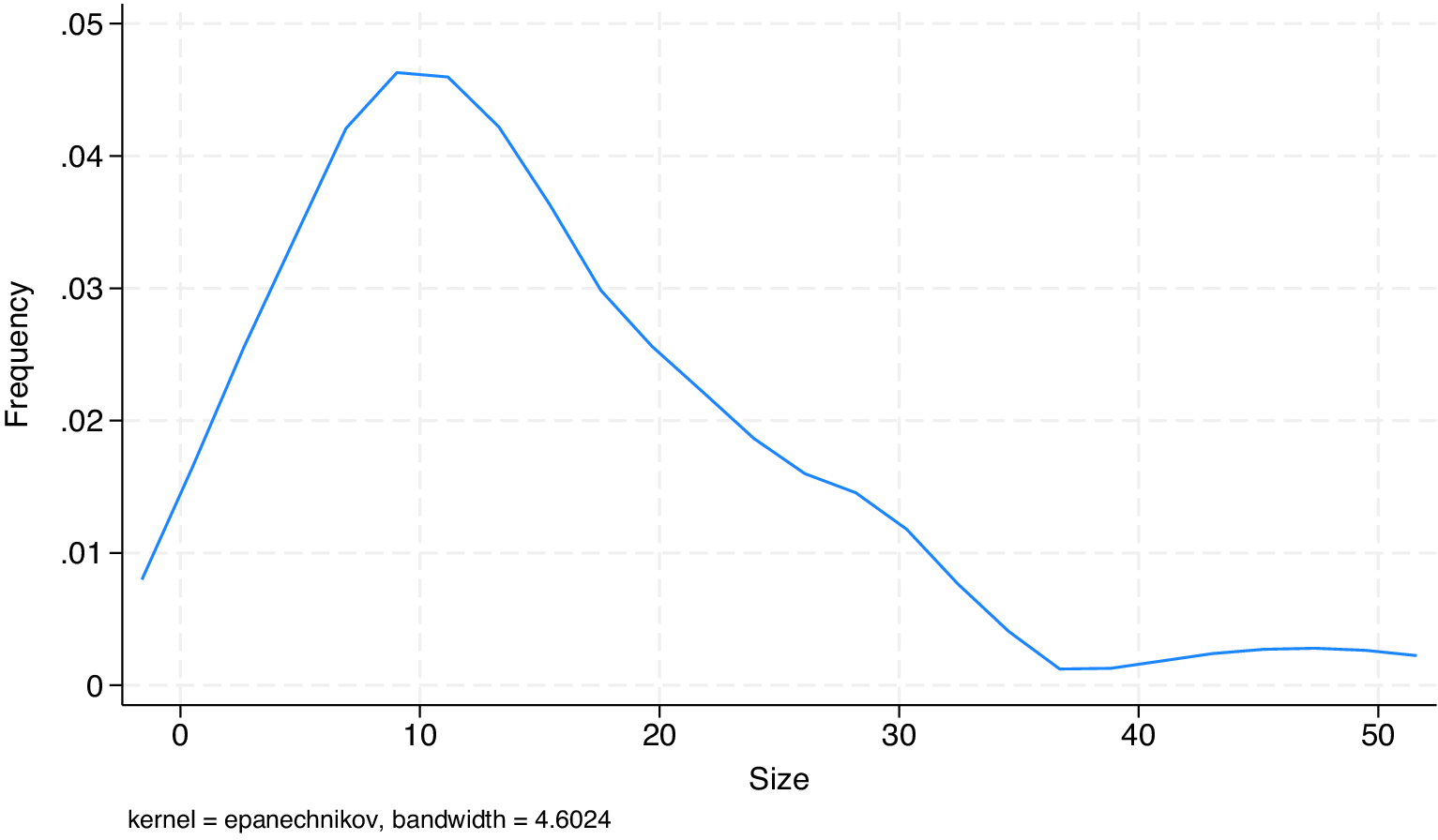
With this stipulation, it may be worthwhile to look more closely at mean values, which are portrayed in a kernel density plot shown in figure 1. Here, most collegial bodies cluster around a median value of 12. The distribution is right-skewed, as one expects with a scale that is bounded on the left. Recall also that we defined a collegial body as “small,” which may be differently interpreted, leading to a shorter or longer right tail. Because of the arbitrariness of the right tail, the median is more appropriate than the mean as a measure of central tendency.Footnote 30
Mean Size of Collegial Bodies
Notes. Kernel density plot of mean sizes of collegial bodies (from Table 1). Mean = 14.9, median = 12, min = 3, max = 47, standard deviation = 9.8, N = 26.

Beneath the Surface
Although lengthy, the list of organizations and organizational types in table 1 is by no means comprehensive. It is not even clear what being comprehensive would entail in the present context because the population of interest (“large organizations”) is difficult to define and even harder to grasp empirically, as noted. Even so, certain biases are evident within our chosen sample.
One bias exemplified in table 1 is toward regions of the world that are well documented and well researched, such as Europe, North America, and East Asia.
Another bias is toward formality. Where authority is formally vested in a board, cabinet, chamber, college, commission, committee, council, court, junta, or collective regency, the identity and function of collegial bodies are fairly apparent. In other instances, collegiality is informal and therefore harder to discern. This would be the case for collegial bodies known variously as kitchen cabinets, brain trusts, gray eminences, aides, confidants, counselors, right-hand men, consultants, staff, boon companions, friends, and family.
A third bias is toward major collegial bodies. Just as informal bodies exist in the shadow of formal bodies, smaller bodies often exist in the shadow of major bodies. Cabinets have cabinet committees, Politburos have Politburo committees, legislative committees have subcommittees, and so forth. Likewise, special or ad hoc committees that span different organizations—for example, different agencies within a government—or that cross public and private sectors often perform important roles (Krick Reference Krick2015; Maasen and Weingart Reference Maasen and Weingart2006; Zegart Reference Zegart2004). Because of their peripheral or interstitial quality, minor collegial bodies are harder to track.
These expected patterns of missingness prompt us to conclude that the visible traces of collegiality depicted in table 1 represent the tip of a much larger iceberg, underestimating the actual role of collegial bodies in large organizations and omitting small organizations entirely, as noted.
Of course, there is another possible interpretation. Sometimes, powers delegated to collegial bodies on an organizational chart are less impactful in practice than they are in theory. If the body enjoys no effective power, it does not qualify under our definition. Unfortunately, this is not easy to ascertain. Our wide-ranging canvass is not designed to discern the nuances of power, a matter difficult even for in-depth ethnographies to sort out. We assume that if there is a formal place for a small decision-making body, it probably plays some role in the functioning of an organization, at the very least in legitimating policy decisions. With this minimal understanding of the subject, it seems safe to conclude that collegial bodies are extraordinarily common.
This view is corroborated by survey research on workplace meetings. A recent study reports that there are some 55 million of these events every day in the United States and that CEOs spend more than half their time in such meetings (Rogelberg Reference Rogelberg2018, 13–14). If we assume that most meetings are regular (rather than one-off, ad hoc events) and involve ongoing face-to-face interaction and periodic decisions of value to an organization, that is further testament to the centrality of collegial governance in the contemporary era.
Borderline Cases
Our definition of collegial bodies is multidimensional, and each dimension—size, regularity, duration, and decision-making power—is a matter of degree. This means that many bodies qualify in some respects but not in others or not fully. In this section, we discuss some of these borderline cases.
Juries fit our definition of a collegial body with respect to size but not duration or policy-making scope. A jury’s purview is limited to deciding a specific case, after which it is disbanded. This hardly qualifies as a governance task, although it is an excellent example of small group deliberation (see Sunstein et al. Reference Sunstein, Hastie, Payne, Schkade and Viscusi2002).
Specialized work teams are essential to most organizations (Katzenbach and Smith Reference Katzenbach and Smith1993). With respect to size and regularity, they fit our definition of collegial bodies. However, their mandate is often more focused on implementation than on policy making, and they may be disbanded after that mandate has been accomplished.
Common pool resource (CPR) systems such as “fishing grounds, groundwater basins, grazing areas, irrigation canals, bridges, parking garages, mainframe computers, and streams, lakes, oceans, and other bodies of water” (Ostrom Reference Ostrom1990, 30) may be governed by collegial bodies. But it is probably the case that most CPRs are not.
Deliberative citizen forums (aka mini-publics) might have been included in our canvass (Fishkin Reference Fishkin2018). However, most are short in duration (typically several days), and some, such as deliberative opinion polls, are quite large.Footnote 31 Accordingly, there is less opportunity for participants to get to know one another, build trust, and exchange views and information. They are also rarely granted power to set the agenda and make binding decisions.Footnote 32 In these respects, deliberative citizen forums are quite different from collegial bodies in the wild.Footnote 33
As borderline cases, these group decision-making bodies might have been included in our canvass, and there is surely much that can be learned from their experiences. For now, we leave them aside, delegating to future researchers the task of how exactly to bound the concept of a collegial body.
Noncollegial Organizations
Having explored borderline cases, we turn to organizations that do not appear to incorporate collegial decision making at all or at least not to any great degree. Returning to the classical typology, these exceptions may be characterized as rule by one or rule by many.
Into the one category would fall personalist dictatorships (Jackson and Rosberg Reference Jackson and Rosberg1982) and monarchies (Gerring et al. Reference Gerring, Wig, Veenendaal, Weitzel, Teorell and Kikuta2021), as well as populist leaders who may receive democratic validation but govern in a personalist/plebiscitarian fashion (Kaltwasser et al. Reference Kaltwasser, Taggart, Espejo and Ostiguy2017; Weyland Reference Weyland2021). Those in this category may have no institutionalized role at all for collegial groups.
Into the many category would fall large assemblies operating on the principle of direct democracy such as ancient Greek poleis, Swiss Landsgemeinden (open assemblies), municipal-level participatory budgeting (Ganuza and Baiocchi Reference Ganuza, Baiocchi, Elstub and Escobar2019), as well as referenda and initiatives (Altman Reference Altman2010). Here, the effective decision-making body encompasses a sizable community.
In these noncollegial settings, legitimacy derives from the people at large, a charismatic ruler, or both, as implied by the concept dema-goguery. Of course, collegial groups may lie in the background, preparing the ground for public votes, advising leaders, and so forth (Bonaccio and Dalal Reference Bonaccio and Dalal2006; Schrah, Dalal, and Sniezek Reference Schrah, Dalal and Sniezek2006). But this is hard to prove and, in any case, would constitute a compromised role. We conclude that collegiality, even by the minimal terms of our definition, is not ubiquitous.
Size and Decision Making
We have demonstrated, in a rough-and-ready fashion, that collegial bodies play a central role in most modern organizations, whether small or large. We turn now to the explanatory question. To what do they owe this powerful position?
The immediate source of collegial bodies’ power lies in the institutions that grant them authority. Cabinets, committees, and boards of directors are empowered by formal rules, and other mechanisms of small-group influence are nurtured by informal norms. But this is not very satisfying as an explanation. What we want to understand is why these rules and norms are established in the first place. What is attractive about collegial decision making? Anecdotal evidence suggests it is not the pleasure of sitting in meetings.Footnote 34
A large body of research suggests that the size of a decision-making body affects its performance.Footnote 35 Therefore, we might gain some purchase on the actual use of collegial bodies by comparing their expected performance to single decision makers, on the one hand, and large bodies, on the other. Perhaps it is not coincidental that the actual size of most collegial bodies (as revealed in table 1 and figure 1), and the size that many experts regard as the optimal size for decision-making bodies,Footnote 36 lies between 5 and 15 individuals.
Following a wave of recent scholarship, we begin with Condorcet’s theorem. Although this famous theorem purports to show that the size of a group enhances the probability of a correct decision, we argue that the implications of this theorem in the real world are unclear and therefore bear ambiguously on our question. Next, we discuss dimensions along which size seems to have a monotonic relationship to performance—either promoting better decisions or worse decisions. Here, collegial bodies offer a compromise solution. Finally, we discuss dimensions of performance on which collegial bodies appear to enjoy an advantage over single decision makers and large bodies.
Arguments for/against Large Groups
If the goal of a decision-making body is to arrive at the correct decision, large groups may be superior to small groups (or individual decision makers) in certain situations. Condorcet postulated that if all decision makers are slightly more likely than not to make the correct decision, then increasing the size of the group increases the probability of a correct decision, asymptotically approaching 1 as the number of voters approaches infinity.
Although axiomatically true, Condorcet’s jury theorem invites several practical objections, ranging from theoretical assumptions of sincere voting to voter competence and especially independence.Footnote 37 Spiekermann and Goodin (Reference Spiekermann and Goodin2012) demonstrate in a simulation that the independence assumption can be relaxed when there are numerous and diverse opinion leaders or when citizens are not too strongly influenced by the messages of these leaders. We nonetheless wonder how often these conditions are satisfied in real-world politics. The Brexit vote, for instance, is an example where opinion leaders propagated misinformation and lies that affected the choices of citizens. Although the Brexit vote might have been an exceptional case, the upshot of framing research is that elite influence on citizens’ preferences is generally strong, because “citizens may not have the innate capacity to form preferences on their own, at least not without the message provided by strategic political communication” from elites (Druckman Reference Druckman2014, 468). There is also empirical evidence that individuals in a large group are prone to information cascades (Luppi and Parisi Reference Luppi and Parisi2013) or social influence (Lorenz et al. Reference Lorenz, Rauhut, Schweitzer and Helbing2011), thereby depriving the group of good information. Moreover, citizens are unlikely to have equal levels of expertise and acumen (Baharad, Nitzan, and Segal-Halevi Reference Baharad, Nitzan and Segal-Halevi2022).
Accordingly, there are reasons to doubt whether large groups are truly superior in solving problems, especially those that are highly complex. This does not mean that a smaller body is always superior, and surely this short rehearsal of positions is very far from adequately addressing the issue. But it means that we might want to consider the possibility that different sorts of tasks are differentially affected by size.
A Compromise Choice
Along most dimensions, it seems fair to say that the performance of a body is affected by size in a monotonic fashion. As size increases, performance is expected to deteriorate along dimensions such as (a) efficiency, (b) clarity of responsibility, and (c) secrecy, whereas it should improve along dimensions such as (d) credible commitment, (e) representativeness, and (f) transparency. Let us explore the logic of these relationships.
If the goal is efficiency, one expects performance to decline with size. A single individual is capable of making faster and more decisive decisions than a group of individuals. The cost of that decision in terms of the person-hours required to obtain information, coordinate with others, and participate in the actual decision making, as well as the costs to the organization of a delayed decision, should also be minimized. Likewise, free-riding is impossible if there is only one decision maker and is usually possible to counteract if there are only a few, whereas in a very large body, free-riding is virtually inevitable (Ingham et al. Reference Ingham, Levinger, Graves and Peckham1974; Kravitz and Martin Reference Kravitz and Martin1986; Mukhopadhaya Reference Mukhopadhaya2003; Sibert Reference Sibert2006). By these metrics, efficiency declines with size.
If the goal is to maximize clarity of responsibility, one also expects performance to decline with size. A single decision maker may be held accountable, whereas a large body may avoid accountability simply because there are so many decision makers. Thus, if principal-agent problems are expected, a single decision maker may be preferred.
If the goal is to maintain secrecy, one expects that achieving this goal will be impeded as the size of a body increases. It is hard to keep secrets in large groups. By the same token, if the goal is to achieve transparency, the viability of a body should increase with size.Footnote 38 Thus, where secrecy is prized over transparency (as, for example, in bargaining situations), a single decision maker may be preferred. Where transparency is prized over secrecy (as, for example, in situations where corruption or special pleading is suspected), large groups may be preferred.
If, however, the goal is to signal credible commitment, the size of a decision-making body may be an asset. The larger the group, the harder it will be to change positions, once they are publicly approved. This is why democracies are viewed as having more credible commitment to policies than dictatorships. Democratic leaders must contend with audience costs (Fearon Reference Fearon1994). Granted, these features are often associated with specific institutions that generate veto points within a decision-making apparatus (North Reference North1993). However, the same logic applies to the number of decision makers. A single decision maker may change their mind or may be replaced by someone else, whereas an entire country, if committed to a course of action, may be more dependable. With respect to assuring property rights or foreign policy commitments, this may be advantageous.
If the goal is to maximize representativeness, one expects performance to improve with size. It is impossible for a single individual, and difficult with a small body, to represent diverse views, backgrounds, and interests; however, the task becomes manageable in a large decision-making body. Studies show that the size of a group is a key element in achieving descriptive representation (Gerring, Jerzak, and Öncel Reference Gerring, Jerzak and Öncel2024), which explains why assemblies are looked on as prototypical vehicles for representation (Pitkin Reference Pitkin1967).
If size is monotonically related to performance along these (and presumably many other) dimensions, it follows that collegial bodies occupy a middling position, somewhere in between the one and the many. As such, we might expect this form of governance to be adopted where tasks impose conflicting demands. A cabinet, for example, is expected to fulfill many tasks, some of which demand secrecy and others openness; some of its tasks demand efficiency and clarity, whereas others demand representativeness. It is not the perfect choice along any of these dimensions, but it may be the best choice along all these dimensions, considered collectively. From this perspective, the few offers a compromise solution between the virtues of the one and the many.
A Best Choice
Having explored trade-offs (where collegial bodies offer a compromise choice), we turn to dimensions along which small groups may enjoy an advantage over both individual decision makers and large groups; that is, where the few are superior to the one and the many. We argue that this is likely to be true for expertise, division of labor, consensus, deliberation, and, possibly, rationality.
Questions of governance require expertise. When faced with a complex question, no single individual is likely to possess the knowledge needed to consider all the options and think through all the angles. A single decision maker is therefore likely to fall short. More heads are better—but only to a point. Because experts are in short supply, crowdsourcing may not be a viable approach to decision making (Karotkin and Paroush Reference Karotkin and Paroush2003). Likewise, information overload is not a problem for small groups because they can be compensated for their time and because they bring preexisting expertise to the table. Thus, from an informational perspective, assigning tasks to small groups is efficient (Krehbiel Reference Krehbiel1992).
Questions of governance usually require a division of labor. Expertise, as discussed, is required along multiple dimensions: technical, substantive, and so forth. In addition, different tasks may be delegated to different individuals. For both reasons, it often makes sense to distribute assignments among a small group, whose members can then pool their knowledge to reach a collective decision. Small bodies are ideally suited for this. Note that if division of labor were the only requirement, it could be achieved with a single leader who communicates independently with specialists in different areas. However, if something can be gained when these specialists communicate directly with each other, then a collective body is preferable to a hub-and-spokes network.
Questions of governance demand that members of an organization come together to reach some form of consensus—at least a “meta-consensus” on which decision makers agree; for instance, on the “nature of disputed choices” (Dryzek and Niemeyer Reference Dryzek and Niemeyer2006). Small size, when coupled with repeated interaction, usually fosters trust, mutuality, comity, and esprit de corps. These same features also facilitate bargaining, allowing members to reach across diverging interests and values to find compromise solutions. Quid pro quo agreements can be reached and subsequently enforced, because bystanders (members not directly engaged in the bargain) are there to bear witness and to hold participants to account. The confidentiality available in small groups protects the bargaining process from the prying eyes of those who might view it as capitulation or corruption. Finally, consensus is fostered if a group is granted collective responsibility for an outcome: this situation encourages members to reconcile divergent interests and perspectives in a mutually acceptable solution.Footnote 39 The key is that all members feel they have had a fair shake; that is, an equal shot at influencing the outcome. In this setting, there are strong incentives to support decisions reached by the group even if they lie far from one’s ideal point.
Questions of governance demand deliberation—extensive reason-giving, serious listening, and careful weighing of the evidence (Bächtiger et al. Reference Bächtiger, Dryzek, Mansbridge, Warren, Bächtiger, Dryzek, Mansbridge and Warren2018). And deliberation is encouraged when people with diverse but nonetheless relevant skillsets and backgrounds are brought together in a setting where they can exchange information and opinions freely and truthfully and where they can puzzle together. A small group setting allows for some degree of confidentiality, encouraging participants to reveal their true thoughts and ideas without fear of recrimination. It also allows sufficient time for everyone in the group to actively participate and to feel part of the process and for the discussion of minority viewpoints to be included. Conversations should be inclusive. Given these desiderata, it is questionable whether large groups can be fully deliberative. Indeed, both empirical and formal research has demonstrated that the deliberative quality and truthful information revelation are higher in small bodies (Meirowitz Reference Meirowitz2007).
For instance, respect accorded to colleagues in parliamentary committees—especially in smaller second chambers—are significantly higher than in plenary sessions (in first chambers), indicating that collegial norms of civility are in action (Steiner et al. Reference Steiner, Bächtiger, Spörndli and Steenbergen2005).Footnote 40 Notice, however, that although we know quite a bit about “conversational” styles in larger arenas, such as plenary sittings in parliaments (see, e.g., Hargrave and Blumenau Reference Hargrave and Blumenau2022), research on small collegial bodies is frequently hindered by data accessibility. As such, it remains an open question how much the interaction in small collegial bodies is driven by “deliberation” or “power” (Downey Reference Downey2024). We return to this point later.
Small groups may also be more rational than individual decision makers or large groups, in the sense of making decisions that have the highest expected utility (Charness and Sutter Reference Charness and Sutter2012; Feri, Irlenbusch, and Sutter Reference Feri, Irlenbusch and Sutter2010; Gersbach, Mamageishvili, and Tejada Reference Gersbach, Mamageishvili and Tejada2022; Kugler, Kausel, and Kocher Reference Kugler, Kausel and Kocher2012; Rockenbach, Sadrieh, and Mathauschek Reference Rockenbach, Sadrieh and Mathauschek2007). Small groups are able to entertain a wide variety of policy options. They can handle both strategy and tactics; they can think big and think small, following multiple pathways. By contrast, large bodies are less nimble: they can vote up or down and perhaps entertain a limited number of amendments, but they cannot seriously consider every side of every question. There is simply not enough room on the agenda or time in people’s lives. That is why small bodies usually set the agenda for larger bodies, even if the latter have ultimate say. A great deal more legislating occurs in committee than in plenary.
List et al. (Reference List, Luskin, Fishkin and McLean2013) show that small-group discussion enhances single-peaked preferences, which in turn discourages majority cycling, an oft-noted failing in democratic decision making. Summarizing a large body of economic research, Charness and Sutter (Reference Charness and Sutter2012, 158) state, “Groups are more likely to make choices that follow standard game-theoretic predictions, while individuals are more likely to be influenced by biases, cognitive limitations, and social considerations.” Considering the irrationality of electorates (Achen and Bartels Reference Achen and Bartels2017) and the instability of voting results (Riker Reference Riker1988), one may also consider small groups superior to large groups.
To be sure, small-group decision making is sometimes prone to groupthink (Janis Reference Janis1972), perspective homogeneity (Hong and Page Reference Hong and Page2004), risky conclusions (Kogan and Wallach Reference Kogan and Wallach1967), greater competitiveness (Gillet, Schram, and Sonnemans Reference Gillet, Schram and Sonnemans2009), and more polarized decisions (Moscovici and Zavalloni Reference Moscovici and Zavalloni1969). It may also be affected by group composition. In an experimental study, Karpowitz and Mendelberg (Reference Karpowitz and Mendelberg2014) analyzed the interaction of a small jury’s gender composition with its decision rule (unanimity vs. majority rules), showing that both the number of women and the type of decision rule strongly affect both women’s authority and the quality of process in these simulated juries.
We do not attempt to determine how frequent these group dynamics might be, where they are likely to occur, and how they might be avoided. Even so, there are many reasons to regard small groups as better equipped than large groups or single decision makers to solve complex questions such as those associated with policy making and governance. Following Aristotle, we propose that the middle way is sometimes the best.
Complexity
In the previous section, we constructed a functionalist case for why collegial bodies might be better in addressing problems associated with organizational governance than individual decision makers and large bodies. Briefly, where a decision-making attribute increases or decreases monotonically with size, collegial bodies offer a compromise choice, and for a few attributes, small size may be the optimal choice.Footnote 41
Evidently, the importance of these various attributes has a great deal to do with the context of the decision. Differently sized groups may be optimal for different tasks. Our claim, following Lazega (Reference Lazega, Klatetzki and Tacke2005), is that for tasks that are especially complex collegial bodies are often superior. A complex decision, for present purposes, is one that is multidimensional, technically demanding, dynamic (changing through time), and subject to conflicting interests or values.Footnote 42 In this setting, which, importantly, typifies most problems of governance and knowledge-based industries (Lazega Reference Lazega2001), small decision-making bodies may offer important advantages.
In the sections that follow we consider where collegial bodies come from and compare different organizational types. The discussions reveal the importance of complexity to the formation of collegial bodies.
Where Collegial Bodies Come From
In looking at the circumstances by which collegial bodies come into existence, it seems clear that they rarely seize power or destroy the competition. Collegial bodies are not well designed for violence or for new foundings. Instead, we argue that they arise because they are needed. Collegial power is therefore usually delegated.
In one scenario, individual leaders seek counsel for decisions they feel unable to reach on their own. For this purpose, they create collegial bodies. To ensure that they obtain honest and frank counsel, leaders grant these bodies a degree of autonomy and agree to treat members (formally at least) as coequals. The creation of royal councils offers an early example of this phenomenon (Baldwin Reference Baldwin1905). In more recent times, presidents create special commissions to assist them with the tasks of governance (Zegart Reference Zegart2004), and CEOs empanel working groups and teams to tackle specific problems (Katzenbach and Smith Reference Katzenbach and Smith1993).
In a second scenario, large groups—assemblies, plenary sessions, stakeholders, citizens—serve as the principal. They too find that they are incapable of handling the issues they must resolve; in this case, it is because they are too large. To solve their collective action problem they scope down, seeking counsel from a smaller body. Legislative committees and cabinets, as well as boards of directors, offer excellent examples. Collegial governance structures within law firms and large bureaucracies are other examples. Likewise, wherever it is necessary to bridge different levels of a hierarchical organization or different units, multilevel relational infrastructures may play an essential function, bringing cohesion to an otherwise fragmented organizational field (Lazega Reference Lazega2020). These collegial bodies are created by larger groups and, in principle, may be reshaped or revoked at their will.
Thus, whether authority is originally vested in one or in the many, it often ends up being shared with the few. Following our theory, this occurs wherever matters of governance are too complex to be handled by individual leaders or large assemblies. They need help.
We are familiar with the standard refrain: when things are especially complex, form a committee. Sometimes, this is a dilatory tactic. But it is also an acknowledgment that the sovereign authority—an individual or a large group—lacks the ability to reach a decision. It wishes to delegate this task, with the assumption that a smaller body, specially constituted for that purpose, will be more capable.
“On questions of importance,” Sah and Stiglitz (Reference Sah and Stiglitz1988, 451) note, “we are often reluctant to delegate decision making authority to any single individual.” By the same token, we may be equally reluctant to let the great masses of voters decide on matters of great complexity, such as setting interest rates or negotiating trade deals.
This stylized account of the birth of collegial bodies—as an act of delegation—offers some prima facie support for the thesis that they are highly functional. Why else would these bodies exist and be granted agenda-setting power in an extraordinarily wide-ranging variety of settings, both democratic and autocratic, if they were not of some use?
Organizational Types
Further evidence for our thesis may be garnered by comparing organizations according to their degree of collegiality; that is, according to how much power they delegate to collegial bodies. Here, too, we find that complexity is associated with collegiality.
The English word collegial was associated with the Christian church at a time when it was at the center of European intellectual life. Today, it is associated with the university, the latter-day center of intellectual endeavor, as well as with professional organizations such as in law and medicine (Lazega Reference Lazega2001; Reference Lazega, Klatetzki and Tacke2005). Governments also commonly adopt collegial forms of organization (Baylis Reference Baylis1989; Wheare Reference Wheare1955). All these organizations richly warrant the label complex.
By contrast, collegial bodies are less common among less complex endeavors. A manufacturer of widgets has little need for collegial bodies. Unless, that is, it is a large corporation in which case there are likely to be many complexities and therefore a need for a collegial style of governance such as a board of directors.
To be sure, the educational qualifications of workers may also affect their leverage with management and their desire for autonomy. This, in turn, may help explain why white-collar occupations are often more collegial in organization than their blue-collar counterparts (Freidson Reference Freidson1986; Gouldner Reference Gouldner1954; Kerr et al. Reference Kerr, Dunlop, Harbison and Myers1960, 289; Woodward Reference Woodward1965).
However, human capital explanations only go so far. Note that highly skilled workers exist in all sectors of society, but only in some sectors are they organized in a collegial manner. What distinguishes (A) a chemist working in a pharmaceutical laboratory from (B) a chemist working at a university, or (A) a lawyer working for a corporation from (B) a lawyer in a legal firm? Positions of type A and B have the same training and approximately the same skillset; thus, presumably they have the same degree of market leverage and the same Bildung. However, A’s job is simple in the sense of having relatively few dimensions, whereas B’s job is complex, involving many dimensions and a great deal of unpredictability. That is why, in our reading, B’s work environment is likely to be more collegial than A’s.
Another sort of evidence comes from comparing the degree of delegated power across different issue-positions within a legislature. Several recent studies show that power is more likely to be delegated to a collegial body when the policy is especially complex (Anastasopoulos and Bertelli Reference Anastasopoulos and Bertelli2020; Epstein and O’Halloran Reference Epstein and O’Halloran1999; Franchino Reference Franchino2004).
Testing the Thesis
Having laid down some arguments for why collegial bodies might offer superior governance, at least for decisions of considerable complexity, it is incumbent on us to suggest a methodological path forward. How might these assertions be studied?
As a point of departure, let us consider collegial bodies as a treatment. A collegial body, the reader will recall, is small, meets regularly over an extended period, and is tasked with a nontrivial governance role. Beyond these minimal requirements there are an infinite number of possible permutations involving secondary characteristics, which are reviewed in the first section. We leave these aside for the moment because they bear only peripherally on questions of research design.
Outcomes of interest include the attitudes and behavior of participants, other members of the organization, and stakeholders (e.g., a board of directors, shareholders, citizens). We might ask, for example, whether participation in a collegial body changes minds and, if so, whether it promotes consensus, optimal policy solutions, social trust, legitimacy, and other (un)desirable outcomes. Most of these outcomes are easy to measure insofar as they can be incorporated into surveys administered to the three groups of interest. To measure the quality of a policy solution, one might ask stakeholders.
In many respects, this research agenda mirrors research on decision making and deliberation in small groups, reviewed earlier. However, collegiality, as we have defined it, is more difficult to address with the tools common in those research streams, such as laboratory and survey experiments (Gastil Reference Gastil2018; Karpowitz and Mendelberg Reference Karpowitz, Mendelberg and Druckman2011; Van Dijk and De Dreu Reference Van Dijk, Carsten and Dreu2021).
First, the essence of a collegial body is its influence over outcomes that participants and other members of the organization care deeply about, a feature that is difficult to replicate in an artificial setting. Second, most collegial bodies enlist a membership that is “elite” in some respects; for example, education, expertise, experience, or status. These sorts of people are often difficult to identify; if identified, they are even more difficult to recruit into a time-consuming experimental protocol. Finally, the functioning of collegial bodies demands (by our definition) repeated close contact over a long period of time, whereas experiments usually focus on specific treatments and proximal outcomes.
For these reasons, we suppose that the most common experimental designs are not well suited to estimating total causal effects—although they may be suitable for testing very specific propositions understood as elements of the bundled treatment. Accordingly, we have greater hope for field experiments and natural experiments.
Exemplar
Let us consider a large organization such as a corporation or public agency that has multiple independent units (perhaps in different locations) and where the workplace is organized in a fairly hierarchical fashion, in which most employees work on well-defined tasks and each reports to a boss. Now, let us suppose that an ad hoc committee is formed to consider some pressing policy issue facing the organization. Everyone is aware of the issue, but only a select few are selected to serve on the committee. Ideally, participants are chosen from some but not all the organization’s units. Initially, the committee works in secret; after some point in time, members are instructed to consult with others in their unit.
This setup generates several treatment and comparison groups: (a) committee members, (b) members of a unit represented on the committee, and (c) members of a unit without committee representation. Each group may be surveyed at various points in time; for example, before the formation of the committee, at the end of the committee’s private deliberations, and after the committee has consulted publicly with other members of their unit.
If the treatment is randomized—participants in the committee are chosen randomly (perhaps from a subset of members judged to be eligible)—estimation is straightforward, subject to the usual problems of compliance and contamination, which may attenuate estimates. If the treatment is nonrandom, one may adopt a difference-in-difference design in which estimated effects are unbiased so long as the parallel trends assumption holds. In either case, the entire process could be closely observed in an ethnographic fashion, adding a wealth of detail with respect to mechanisms and intermediate outcomes that are difficult to track with standardized surveys.
As our exemplar, we chose large organizations with separate units, a setup that allows for a pure control and mitigates problems of contamination across groups. A modified design might be applied to smaller settings such as a legislature. Here, the treatment group might be an ad hoc committee formed to consider a particular policy or a standing committee where the consideration of a new issue enters the committee’s docket at a discrete point in time. In both cases, those not part of the committee form a control group. It is not a perfect control because members of a committee are never chosen randomly and factors of selection may serve as confounders. Additionally, one can anticipate considerable contamination across groups. Nonetheless, a crude difference-in-difference design is plausible.
Returning to the main design that is centered on large, decentralized organizations, we must come to terms with a potential flaw. Those in the control group do not receive the same information and may even receive considerably less information than those in the treatment group. Moreover, those outside the collegial body tasked with making a decision may not feel any responsibility to grapple with the policy decision in a serious manner. Being outside the collegial body, they are free of responsibility.
To deal with these confounders adequately, it may be necessary to form a fourth group, a control group whose characteristics and experiences mirror those in the treatment group in all respects except for group deliberation. For example, one might ask randomly chosen individuals in the organization to consider the same policy issue, offering them the same statement of purpose and the same research support or access to materials as those in the treatment group—with the caveat that they are not to exchange views on the policy question with others in the organization. If contamination between the collegial body and individual decision makers is anticipated, the design could be sequenced so that the latter do their work (in secret) before the collegial body meets.
Extensions
A secondary question concerns how formal and especially informal rules and norms affect the behavior of members of small collegial bodies. In Westminster´s World, Searing (Reference Searing1994) pioneered this avenue of research by personally interviewing MPs (both front- and backbenchers) about their experience within the British parliament. He found that MPs “accommodate” themselves to the rules of the game in the House of Commons, through which different political roles lead to different attitudes and behaviors. Gastil et al. (Reference Gastil, Deess, Weiser and Simmons2010) conducted similar research on juries in the United States, investigating how jury duty affects political attitudes and activities.
This research stream on small collegial bodies could be extended, ideally with greater attention to causal identification. One plausible approach enlists matching techniques. This allows for a comparison of members of small collegial bodies with nonmembers, the latter being similar on observable characteristics such as experience, age, gender, political orientation, and so forth. Naturally, one is limited to observable characteristics, which do not always capture potential confounders. Another approach uses regression discontinuity designs. Here, one might focus on the process of selection into a collegial body, comparing those who just made the cut with those who just missed the cut. Repeated interviews or surveys over time should reveal how institutional membership in such a body affects attitudes and behavior, as well as how rules and norms become institutionalized.
Our purpose here is not to anticipate all possible research designs and their respective threats to inference. Every research setting offers unique challenges. The point, rather, is to elucidate possibilities for investigating collegial bodies in a systematic fashion. The topic is difficult, posing greater obstacles than is typical of research on small-group dynamics, where lay subjects are the usual fodder for experimentation. But it is tractable so long as partners can be found among organizations that sponsor collegial bodies. Because the results may lead to better decision making within those organizations, we suppose that potential partners might be persuaded to cooperate.
A Brief Detour into Democratic Theory
Our aim in this article is to define the subject of collegial bodies; to demonstrate the extent to which they have become ensconced in decision making across public, private, and civic sectors; and to suggest a theoretical framework that might explain this ascendancy and a methodology for studying the subject. Our hope is that this offers a path forward for a subject that is at once familiar and exotic—familiar because all the phenomena listed in table 1 are well studied (at least in particular contexts) yet exotic because they have never been treated as part of a single research agenda.
Readers may discern a tinge of hopefulness in this research agenda. At the current time, prospects for democracy seem diminished. A two-century march toward greater democracy across the world has stalled and possibly even reversed in the first decades of the twenty-first century (Coppedge et al. Reference Coppedge, Gerring, Glynn, Knutsen, Lindberg, Pemstein, Seim, Skaaning and Teorell2020). Meanwhile, the case for democracy on the grounds of providing better governance is not self-evident (Gerring, Knutsen, and Berge Reference Gerring, Knutsen and Berge2022).
This study makes no normative claims for the viability of collegial governance. Much surely depends on the details—how collegial bodies are chosen, whom they are accountable to, how they operate, and so forth—that we have left aside. Even so, one is led to consider whether collegial bodies, if properly organized, might mitigate some of the oft-noted defects of democracy, particularly in its populist guises. In this conclusion, we briefly address collegial bodies as they intersect with democratic theory.
The size problem inherent in democracy has received considerable attention (Dahl and Tufte Reference Dahl and Tufte1973; Gerring and Veenendaal Reference Gerring and Veenendaal2020). Concisely stated, lay citizens do not have the time or the motivation to ponder the details of public policy (Elliott Reference Elliott2023). Nor do they have the training required to engaged in complex policy debates. And they are turned off by the strategic and conflictual aspects of politics, which appear unprincipled and self-interested (Hibbing and Theiss-Morse Reference Hibbing and Theiss-Morse2002). Citizens know what they want, in a general fashion (they have preferences), but they do not know how to get it. For that, they need help.
According to the theory of representative government, citizens delegate this task to elected officials, typically a legislature and an executive (who may be chosen by the legislature). These officials are clearly in a better position than lay citizens to make informed choices among policy options. However, the purview of policy today is so expansive (extending to virtually every aspect of human life) and so complex (drawing on highly technical studies across a range of disciplines) that no individual can possibly incorporate the knowledge or afford the time needed to sort through relevant policy alternatives and choose among them.
Elected officials cope with this overload through a division of labor in which specific tasks are delegated to small groups composed of persons with relevant expertise and background. This serves a deliberative and coordinating function because members with diverse constituencies and diverse stakes can be brought together to think through a problem and propose a course of action. Thus arises government by committee (Baylis Reference Baylis1989).
In a representative democracy, collegial bodies are accountable, in principle, to elected officials: cabinets to legislatures and executives, committees to the legislature, and so forth. A loose theory of democratic accountability is therefore consistent with the role we have sketched for collegial bodies.
However, it must be a fairly loose vision of accountability.Footnote 43 Note that delegation occurs in situations of complexity. The very complexity of the tasks mean that principal-agent relationships are attenuated. Even highly motivated elected officials are at pains to monitor all the work that goes on in a collegial body—much of which is private, only a small percentage of which is documented in minutes or reports, and most of which is highly technical. Small decision-making bodies often reduce accountability, making it easier for elite actors to decide against the majority wills of citizens. One might think that collegial bodies could be controlled through carefully calibrated incentives. Although this might be possible for a board of directors—for example, by compensating members via stock in the firm and preventing the short-term sale of that stock—it is much harder to devise a set of rewards and punishments that would align with the goals of a collegial body in government. This difficulty derives from the multidimensionality of the task at hand, the general problem of measurement of governance outcomes, and the fact that the collegial body is often the proposer rather than the implementer, attenuating its responsibility for the outcome.
Most important of all is the need to preserve decision-making autonomy. Recall that the utility of a collegial body derives from its ability to think independently. If this independence is compromised, perhaps to assure accountability, the body loses its raison d’être. A shackled body will tell its master only what its master wants to hear.
Complicating matters further, some collegial bodies such as Supreme Courts do not report directly to elected officials. Others such as central banks are usually granted a high degree of autonomy. And still others stretch across organizational levels and across different organizations, blurring lines of accountability.
Because of the attenuated nature of principal-agency relationships, one cannot account for the success and failure of collegial bodies by examining degrees of accountability. When collegial bodies work, it is not because their members are eager to please their bosses or fear repercussions from their bosses.
This is not to say that incentives do not matter; rather, incentives may be of a different flavor than that proposed by democratic theory. This includes professional standing, recognition by specialists (experts and media professionals) who follow a policy area, and “posterity.” Collegial bodies work best, we suppose, when members feel a sense of responsibility to solve the problem they have been assigned, allowing them to think both inside and outside the box.
In addition, one must reckon with specific features of a body that are likely to affect its ability to deliberate and decide: size, composition, decision rules, duration, mandate, resources, and so forth. We suspect that these microlevel factors are considerably more important than accountability, however the latter might be achieved.
It follows that collegial governance bears only a distant relationship to standard visions of democratic theory, most of which take as their point of departure the engagement of common citizens. This does not mean that collegial governance undermines democracy. It is reassuring to note that the polities often regarded as most collegial such as Switzerland and Norway are also highly democratic. Arguably, collegial bodies are critical to any polity that chooses leaders through free and fair elections; they step in where citizens and elected officials cannot go, namely into the complexities of policy making. Of course, one hopes that collegial bodies deliberate in the public interest, thinking about how best to achieve peace and prosperity. In this diffuse sense, they may be said to follow directives from the citizenry. However, we cannot understand their fealty to those objectives by focusing only on principal-agent relationships.
Collegial governance recalls an older tradition of work heralding—or in some cases, decrying—the rise of bureaucracy and technocracy in modern business and government (Burnham Reference Burnham1941; Chandler Reference Chandler1977; Djilas Reference Djilas1957; Galbraith Reference Galbraith1967; Mills Reference Mills1956). It jibes in certain respects with recent critiques of democracy, pointing in the direction of expertise and meritocracy over public opinion as a guide to good public policy (Bell Reference Bell2015; Jones Reference Jones2020; for a general discussion see Eyal and Medvetz Reference Eyal and Medvetz2023).
In contrast to work in these diffuse intellectual traditions, collegial bodies offer a specific point of empirical focus. They identify a set of institutions that already exist and have a history dating back for millennia. There is no need for utopian theorizing. Collegial bodies are not a newfangled intellectual toy whose implications for governance we can only speculate on. In each instance listed in table 1 and in many others one might identify, collegial bodies were invented to fulfill a concrete need.
Like the cabinet, which is perhaps the most famous instantiation of collegial governance in political settings, small bodies with important decision-making powers have existed in the shadows of political theory and political science. Arguably, the cabinet was able to perform its function as a “buckle” between the executive and the legislature (Bagehot Reference Bagehot[1867] 2001) because of its diminutive size.
We claim that blended forms of governance—in which small bodies combine with individual leaders and large bodies, creating “multilevel relational infrastructures” (Lazega Reference Lazega2020) to overcome the inherent limitations of both—offer optimal governance systems. As such, they may provide an Aristotelian middle way to reach intelligent decisions that are acceptable to broad publics (Ober Reference Ober2013). Following Bagehot (Reference Bagehot[1867] 2001), we urge our colleagues to rediscover the important role of collegial bodies in modern governance—not as an alternative to democracy but as an essential support.
Acknowledgments
For research assistance, we are grateful to Carina Schuster and Juliane Harter. For feedback on early drafts, we thank Tali Mendelberg and Kai Spiekermann.


 Open access

