





As adolescents undergo sexual maturation and physical growth during puberty, variations in the timing and tempo of pubertal development between individuals have been well regarded as critical cursors of behavioral and psychological well-being (Marceau, et al., Reference Marceau, Ram, Houts, Grimm and Susman2011). Two existing hypotheses may help researchers delve into how the timing of pubertal development is linked to psychosocial outcomes. For one, the developmental readiness hypothesis posits that early sexual maturation predisposes adolescents to psychological and behavioral disturbances due to a general lack of adequate skills to cope with challenges brought by physical and psychological transformations among early maturing adolescents (Ge, et al., Reference Ge, Kim, Brody, Conger, Simons, Gibbons and Cutrona2003). For the other, the maturational deviance hypothesis claims that adolescents with either early or late puberty are prone to developmental problems because of awkwardness and maladaptation to stress (Williams & Dunlop, Reference Williams and Dunlop1999).
Research has documented the linkage between early puberty and undesirable developmental outcomes, such as depressive symptoms, delinquency, and substance use among adolescent girls (Beltz, et al., Reference Beltz, Corley, Wadsworth, DiLalla and Berenbaum2020; Negriff, et al., Reference Negriff, Ji and Trickett2011; Mendle, et al., Reference Mendle, Beam, McKone and Koch2020). These effects may hold concurrently and prospectively over time during adolescence (Graber, Reference Graber2013) and even persist well in adulthood (Tsai, et al., Reference Tsai, Hsieh, Strong and Lin2014). Nevertheless, existing research has not reached an agreement regarding such linkage for adolescent boys (Negriff & Susman, Reference Negriff and Susman2011; Graber, Reference Graber2013). To date, research implies that early maturation, once regarded as a developmental advantage because of rapid physical growth, may have a sizable, concurrent effect on internalizing and externalizing problems for adolescent boys (Teunissen, et al., Reference Teunissen, Adelman, Prinstein, Spijkerman, Poelen, Engels and Scholte2011; Mendle & Ferrero, Reference Mendle and Ferrero2012; Dimler & Natsuaki, Reference Dimler and Natsuaki2015). Late maturing boys, however, received less research attention regarding their developmental outcomes, with recent literature suggesting that they are more likely to report an elevated level of depressive symptoms (Kaltiala-Heino, et al., Reference Kaltiala-Heino, Kosunen and Rimpelä2003; Negriff & Susman, Reference Negriff and Susman2011; Graber, Reference Graber2013; Beltz, Reference Beltz2018).
In addition to pubertal timing that is a well-researched and replicated area, the rate of pubertal progression, known as pubertal tempo, has recently drawn much attention to its linkage to adolescents’ psychosocial adjustment in pubertal development research (Mendle, Reference Mendle2014). To understand the linkage, the maturation compression theory posits that rapid maturing adolescents and their parent(s) may not have enough time to adapt to new physical and psychosocial changes, which in turn leaves adolescents vulnerable to various stressors and leads to undesirable developmental outcomes (Mendle, et al., Reference Mendle, Harden, Brooks-Gunn and Graber2010). A typical span from the onset to completion of sexual maturation lasts approximately 4 years, with striking extremes ranging from 1 to 7 years, reflecting significant individual differences in genetic composition, hormonal action, and psychosocial adaptation.
However, the assessment of pubertal tempo remains debatable. Among the limited empirical research to date, the measurement of pubertal tempo usually involves calculating critical events with two or more repetitions (Cheng, et al., Reference Cheng, Harris, Sritharan, Behan, Medlow and Steinbeck2020). More advanced methods, such as linear and logistic growth models, have been used to capture the trajectory of pubertal progression in recent studies with inconsistent results (Mendle, et al., Reference Mendle, Harden, Brooks-Gunn and Graber2010; Marceau, et al., Reference Marceau, Ram, Houts, Grimm and Susman2011; Castellanos-Ryan, et al., Reference Castellanos-Ryan, Parent, Vitaro, Tremblay and Seguin2013; Beltz, et al., Reference Beltz, Corley, Bricker, Wadsworth and Berenbaum2014). For instance, earlier investigations based on linear growth modeling suggested that the rapid pubertal tempo was associated with depressive symptoms (Mendle, et al., Reference Mendle, Harden, Brooks-Gunn and Graber2010) and substance use (Castellanos-Ryan, et al., Reference Castellanos-Ryan, Parent, Vitaro, Tremblay and Seguin2013) in boys, whereas the association was not significant in girls (Mendle, et al., Reference Mendle, Harden, Brooks-Gunn and Graber2010). Conversely, research investigating the nonlinear trajectory of pubertal development demonstrated contrasting findings that pubertal tempo and timing were salient predictors of psychological outcomes among girls but not boys (Marceau, et al., Reference Marceau, Ram, Houts, Grimm and Susman2011). It is plausible that the disparities in research findings stem from different methods of tempo estimation, and gender-specific development deserves a closer look (Susman, et al., Reference Susman, Houts, Steinberg, Belsky, Cauffman, DeHart, Friedman, Roisman and Halpern-Felsher2010; Horvath, et al., Reference Horvath, Knopik and Marceau2020).
The present paper focuses on the joint role of pubertal timing and tempo in psychosocial development among adolescent boys because they receive less research attention than girls. When studied separately, both early and late pubertal onsets have been linked to undesirable psychological and behavioral outcomes among adolescent boys (Graber, et al., Reference Graber, Seeley, Brooks-Gunn and Lewinsohn2004; Beltz, et al., Reference Beltz, Corley, Wadsworth, DiLalla and Berenbaum2020). Studies on pubertal tempo are rather inconclusive. A synthesized review of recent empirical research supports that a faster pubertal tempo is correlated with increased mood and externalizing behavior disturbance in adolescent boys (Cheng, et al., Reference Cheng, Harris, Sritharan, Behan, Medlow and Steinbeck2020). Nevertheless, two other studies reported a negative relationship between boys’ pubertal tempo and depression and problem behavior (Beltz, et al., Reference Beltz, Corley, Bricker, Wadsworth and Berenbaum2014; Marceau & Jackson, Reference Marceau and Jackson2017). Another critical developmental outcome, namely self-esteem, is largely ignored in the existing literature on puberty and psychosocial development despite its salient role in adolescents’ school adjustment, academic achievement, externalizing behavior, and mental well-being (Wang, Reference Wang2012; van Tuijl, et al., Reference van Tuijl, Bennik, Penninx, Spinhoven and de Jong2020; Lee & Feng, Reference Lee and Feng2021). In essence, late maturation may predispose adolescent boys to have a smaller body size, leading to lower self-esteem that is further correlated with elevated depressive symptoms and disruptive behaviors during adolescence and young adulthood (Graber, et al., Reference Graber, Seeley, Brooks-Gunn and Lewinsohn2004), which suggests a critical developmental sequence across psychosocial variables that needs to be adequately modeled longitudinally. The association between self-esteem and internalizing and externalizing problems is evident, but the direction of influences can be complex (Mann, et al., Reference Mann, Hosman, Schaalma and De Vries2004). For example, depressed mood and delinquency predicted each other at subsequent follow-up waves in an urban sample of US adolescent boys across ages 13.5–17.5 years (Beyers & Loeber, Reference Beyers and Loeber2003). A similar finding on adolescent internalizing and externalizing problems was also noted in an Asian setting, where the bidirectional relationship from the initial level of each domain to the developmental pattern of the other domain emerged among boys (Lee & Bukowski, Reference Lee and Bukowski2012). There is also cumulative evidence derived from developmental cascade models linking symptoms of externalizing and internalizing psychopathology (Masten, et al., Reference Masten, Roisman, Long, Burt, Obradović, Riley, Boelcke-Stennes and Tellegen2005), and self-esteem can be an important third variable, regarded as a shared etiology that explains the co-development of internalizing and externalizing problems (Lee & Stone, Reference Lee and Stone2012). Moreover, the associations just described might actually vary depending on pubertal development patterns because the evolutionary changes in physical and cognitive functions pertaining to pubertal progression may reshape how adolescents see themselves and how they react internally and externally to these changes. In this sense, the differences in pubertal timing and tempo may represent different developmental contexts where adolescents manifest disparities in their psychological and behavioral development. As such, pubertal timing and tempo should be regarded as critical moderating factors of other developmental outcomes.
Finally, sociodemographic and contextual factors should be considered simultaneously when studying pubertal development and its effect on psychosocial development. Empirical research has documented that psychosocial stressors, such as harsh parenting, family dysfunction, interpersonal conflict, or childhood adverse experience, may have potential relevance to pubertal timing and psychosocial consequences (Belsky, et al., Reference Belsky, Steinberg, Houts, Friedman, DeHart, Cauffman, Roisman, Halpern-Felsher and Susman2007; Conley & Rudolph, Reference Conley and Rudolph2009; Strong, et al., Reference Strong, Tsai, Lin and Cheng2016; Kelly, et al., Reference Kelly, Zilanawala, Sacker, Hiatt and Viner2017). There is also evidence showing the interaction effect between disadvantaged family and neighborhood conditions and pubertal timing on externalizing behavior (Ge, et al., Reference Ge, Brody, Conger, Simons and Murry2002). Among various sociodemographic and contextual covariates, we controlled for stressful life events related to adolescent boys’ important social and institutional agents (e.g., parents, peers) and the family environment in general (e.g., household income, parents’ highest level of education; Ge, et al., Reference Ge, Kim, Brody, Conger, Simons, Gibbons and Cutrona2003; Lerner, et al., Reference Lerner, Lerner, Bowers and Geldhof2015; McMahon, et al., Reference McMahon, Creaven and Gallagher2020) in the present study, addressing the person, process, and time components in the bioecological model (Bronfenbrenner & Evans, Reference Bronfenbrenner and Evans2000).
In sum, we argue that to better understand how pubertal timing and tempo are related to psychosocial development among adolescent boys, a comprehensive statistical model that simultaneously accounts for the pubertal timing, tempo, and psychosocial development over time is necessary. To this end, the growth mixture modeling (GMM) technique is deemed an ideal quantitative approach to answer the research questions. In brief, GMM aims to identify a substantively meaningful grouping of people and track their development longitudinally based on multiple pre-identified characteristics in order to describe heterogeneity in a population (Wang, et al., Reference Wang, Chan and Chen2018). In other words, GMM works as a form of longitudinal latent class analysis that allows for the assumption of more than one growth curve (Muthén & Shedden, Reference Muthén and Shedden1999). As some adolescents may show different timings of pubertal onset and tempos of pubertal progression, GMM can tailor variations in individuals and subgroups rather than population averages. Furthermore, sociodemographic and contextual variables can also be controlled for, considering the posterior probability of class membership and stability of the estimated classes (Kjeverud, et al., Reference Kjeverud, Ostlie, Schanke, Gay, Thoresen and Lerdal2020). This method has been applied in multiple areas of social science research, but less so in understanding the varying tempos of pubertal progression (Kerner & Muthén, Reference Kerner and Muthen2009). Therefore, the present study using GMM on a longitudinal dataset of self-report physical features firstly documented the typology of pubertal development. Further, we examined how the associations between psychosocial variables (i.e., self-esteem, depressive symptoms, and deviant behavior) across time vary by the patterns of pubertal development (see online Appendix A for the detailed path diagram).
Methods
Sample
We analyzed the longitudinal panel data from the Taiwan Youth Project (TYP), which was launched in 2000 and conducted by the Institute of Sociology, Academia Sinica, Taiwan (Yi, et al., Reference Yi, Wu, Chang and Chang2009). In TYP, two cohorts of junior high school students (i.e., seventh-grade and ninth-grade students, respectively, representing the first and last year of junior high school in Taiwan) participated in the study starting in 2000. All study participants resided in three counties in northern Taiwan and were recruited by a multistage-stratified and class-clustered sampling procedure. The first stratum was the school district, and the second was the urbanization level of living area. Afterward, public junior high schools were randomly selected. In each school, two classes in each grade were chosen, and all students were invited to participate in this self-administered questionnaire-based survey. Nearly, 3,000 adolescent boys and girls participated in the first wave of data collection, and they subsequently completed a survey questionnaire annually in the following years. The analytical sample only consisted of the seventh-grade adolescent boys, and their responses in the first three waves, respectively, completed in the spring semester of seventh (wave 1), eighth (wave 2), and ninth grades (wave 3), were analyzed. This study was approved by the Institutional Review Board of our institution.
Measures
Pubertal Development Scale
The Pubertal Development Scale (PDS) was used in all three waves of data collection to measure the physical changes at the passage of puberty between seventh and ninth grades (i.e., across the span of junior high school in Taiwan; Tsai, et al., Reference Tsai, Strong, Chen, Lee and Lin2018). Due to the availability of PDS items in TYP, four PDS items (i.e., body hair growth, skin changes, deepening of the voice, and facial hair growth) were selected in the analysis, in which adolescent boys responded to each question on a dichotomized score (0 = no change and 1 = at least some changes). The final PDS score was the sum of the four items (Kudar–Richardson-20 coefficient = 0.66). A higher score indicated a more advanced pubertal development (see Table 1 for a summary of the descriptive statistics).
Descriptive statistics of pubertal and psychosocial variables across grades ( n =1,368)
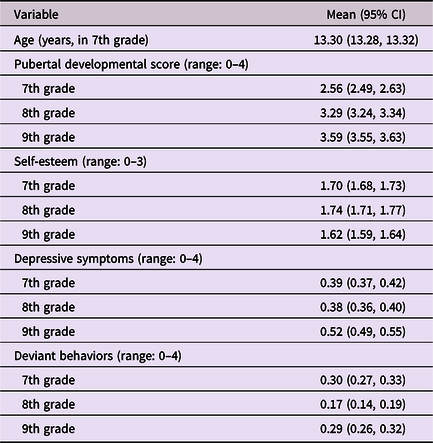
Note. Cell entries are mean (95% confidence interval).
Self-esteem
As one of the psychosocial variables, self-esteem was measured in all three waves by a six-item version of the Rosenberg Self-Esteem Scale on a 4-point Likert-type scale (1 = strongly disagree and 4 = strongly agree; Rosenberg, Reference Rosenberg1965). The scale score was the mean of the six items, and the range was rescaled from 0 to 3 (Cronbach’s α = 0.62; Lin & Tsai, Reference Lin and Tsai2016). A higher score suggested higher self-esteem.
Depressive symptoms
As the second psychosocial variable, adolescents’ depressive symptoms were measured in all three waves by a 16-item version of the Symptom Checklist-90-Revised (Derogatis, Reference Derogatis1983). Students were asked “Over the last week, have you felt certain degrees of [symptom]?” on a 5-point Likert-type scale (1 = none and 5 = very severe). The symptoms typically described adolescent depressive symptomatology in Taiwan, including “headaches,” “dizziness,” “loneliness,” “depression,” “worriedness,” “feeling like hurting others,” “feeling like arguing with others,” “feeling like screaming,” “insomnia,” “waking up early,” “light sleeping,” “muscle pain,” “feeling numb,” “feeling like something is stuck in your throat,” “feeling weak,” and “having suicidal feelings” (Lee, et al., Reference Lee, Tsai, Lin and Strong2017; Wang, et al., Reference Wang, Chan and Chen2018). The scale scores were the mean of the 16 items and rescaled from 0 to 4 (Cronbach’s α = 0.88). The higher the scale score, the more severe the depressive symptoms.
Deviant behaviors
Being the third psychosocial variable, participants responded to nine behaviors in all three waves that were considered deviant behaviors in the local context on a 5-point Likert-type scale (1 = never and 5 = always). The nine deviant behaviors included “running away from home,” “skipping class,” “blackmailing or bullying others,” “breaking items,” “stealing,” “smoking cigarette,” “drinking alcohol,” “chewing betel nuts,” and “using illicit drugs”. The scores were the mean of the nine items and then rescaled from 0 to 4 (Cronbach’s α = 0.95; Lin & Yi, Reference Lin and Yi2015; Tsai, et al., Reference Tsai, Strong and Lin2015).
Stressful life events and sociodemographic background characteristics
In order to make stronger inferences regarding the role of pubertal development per se, we included some socioeconomic factors, including the urbanization level of living area, parental education, and monthly household income reported in seventh grade (Ho, et al., Reference Ho, Lin, Tsai, Yu and Strong2020). A total of 20 negative life events, such as parental fighting, separation, or unemployment, grieving the loss of close relatives or pet animals, being involved in conduct problems, being socially isolated from school activities, tempted into substance use, or being seriously ill, were assessed in seventh grade to reflect major concerns potentially occurring in Taiwanese adolescents’ lives (Kudar–Richardson-20 coefficient = 0.78; see online Appendix B for full details; Lin, et al., Reference Lin, Pan and Yi2019).
Statistical analysis
To fully answer the research questions, data were analyzed using the manual BCH method suggested by Asparouhov and Muthén (Reference Asparouhov and Muthen2021) in Mplus 8.4 (Muthén & Muthén, Reference Muthén and Muthén1998-2017). First of all, an unconditional GMM was conducted to enumerate the latent classes of trajectories of pubertal progression over the 3 years in junior high school through the model comparison procedure. Participants’ responses to the PDS and the fixed and random effects in the intercepts and slopes of PDS over time were addressed simultaneously. The best-fitting model should correspond to the theoretical framework and existing literature when possible, reach an interpretable and meaningful classification (e.g., each class should account for a sizable number, such as 5% of the sample size, of participants), and have the lowest Bayesian information criterion (BIC). Moreover, the Lo–Mendell–Rubin test’s and bootstrapped likelihood ratio test’s p-values should become nonsignificant (i.e., greater than 0.05) when one more class beyond the best model is specified.
In the second step, we adopted the BCH method to avoid the common, undesirable class shift when including auxiliary variables in the mixture model. The BCH method calculates weights that reflect the measurement error of the latent class variable for each individual (Vermunt, Reference Vermunt2010; Bakk, et al., Reference Bakk, Oberski and Vermunt2014). In its final stage, the BCH method uses a weighted multigroup analysis, where the groups correspond to the latent classes, and thus the class shift is not possible because the classes are known (Bakk & Vermunt, Reference Bakk and Vermunt2016). Herein, we regressed three sets of psychosocial variables (i.e., levels of self-esteem, depressive symptoms, and deviant behavior from seventh to ninth grades) on each other at earlier levels in a cross-lagged panel model (CLPM). In addition, psychosocial variables were also regressed on the stressful life events and sociodemographic background characteristics by the latent class variable. Till this stage, the BCH method is arguably the best way to handle auxiliary variables even when they are nonnormally distributed (Asparouhov & Muthén, Reference Asparouhov and Muthen2021).
Third, we conducted a series of multigroup invariance tests to observe how the associations between psychosocial variables across time differ by the latent classes of pubertal development. In the null model, all autoregressive and cross-lagged regressive relationships were constrained to be invariant across the latent classes. Each CLPM autoregressive and cross-lagged regression was then allowed to vary across the latent classes, where equality constraints were removed for a single parameter at a time with the rest of the parameters fixed to be equal (van de Schoot, et al., Reference van de Schoot, Lugtig and Hox2012). Chi-square difference tests were then used to examine the multigroup invariance in the CLPM relationships between psychosocial variables. We also determined whether regression coefficients differed significantly between the latent classes using the Wald test.
Missing data
Data from 1,368 out of 1,378 boys (99.2%; M age = 13.3 in seventh grade) with at least one PDS score were analyzed. Across the three waves of data collection, there were 6 (0.4%), 56 (4.1%), and 95 (7.0%) adolescent boys that had missing data in one or more variables, although Little’s test of missing completely at random implied that the data were missing completely at random (χ2 = 10.696, df = 8, p = 0.22). Therefore, missing values in the PDS were handled by the full information maximum likelihood procedure in Mplus 8.4.
Results
GMM on the heterogeneity of pubertal development among adolescent boys
In the overall sample, the average PDS score increased over the study time (see Table 1 for details). Moreover, we observed a surge in depressive symptoms and a drop in self-esteem in ninth grade. Deviant behavior followed a U-shaped curve with the lowest level in eighth grade. To characterize the heterogeneity of pubertal development among adolescent boys, the enumeration process showed that the three-class solution without the linearity assumption fit the data the best in GMM, given its low BIC, high entropy, and the nonsignificant p-values of the LRT and adjusted LRT tests (see Table 2 for details). Although the four-class solution without the linearity assumption had the lowest BIC, one of the four classes accounted for only 1% of the students. As a result, the four-class solution was not favored, and we resorted to the three-class solution.
Summary of model fit indices in model comparison
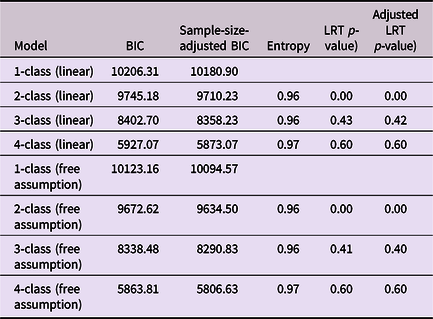
Note. The final choice of model is indicated in bold font. BIC = Bayesian information criterion. LRT = likelihood ratio test.
As shown in Figure 1, adolescent boys in the largest class of pubertal development (n = 971, 71% of the analytic sample) reported a high level of PDS score with a stationary growth throughout the junior high school stage. This class was thus named the average pubertal growth group to describe the size of this group and the growth trajectory. Another 21% (n = 288) of the adolescent boys did not report a comparable pubertal development to the average pubertal growth group until reaching ninth grade, but they reported a fast development in seventh and eighth grades. Accordingly, this class was termed the late-onset with rapid catch-up group. Finally, similar to the previous group, about 8% (n = 109) of the adolescent boys reported a low level of pubertal development in seventh grade, but the growth remained static over the course of junior high school. To describe the slow developmental trend, this class was named the late-onset with slow catch-up group. The class assignment was also estimated based on their sociodemographic background and experience of stressful life events in seventh grade (see online Appendix C for a summary). Adolescent boys who reported fights with parents in sixth grade tended to be classified into the average pubertal growth group, whereas those who reported a higher level of delinquency and poorer academic performance tended to be classified into the rapid catch-up group. Moreover, adolescent boys who reported that their parents were unemployed, that they broke up with good friends, and that they transferred to another school in sixth grade were more likely to be classified into the slow catch-up group than into the average pubertal growth group. Lastly, as summarized in online Appendix D, the estimated intercepts (i.e., marginal mean) of the three psychosocial variables varied across grades. For example, adolescent boys in the late-onset with slow catch-up group reported the lowest level of self-esteem in eighth grade, but they caught up with the other two groups in ninth grade. However, their self-report level of depressive symptoms and deviant behavior also climbed up. Some demographic and contextual factors were related to the psychosocial variables across time, but the trends were sporadic at best (see online Appendix E for details).
Estimated marginal mean of Pubertal Developmental Scale by classes of pubertal tempo and time point. Note. Class 1 = late-onset with rapid catch-up. Class 2 = late-onset with slow catch-up. Class 3 = average pubertal growth.

Multigroup analysis on the development of self-esteem, depressive symptoms, and deviant behavior among adolescent boys of varying pubertal classes
We further estimated the relationship between the three psychosocial variables (i.e., self-esteem, depressive symptoms, and deviant behavior) across years, separated by the pubertal classes in the multigroup analysis. After addressing the sociodemographic characteristics and contextual factors (see Table 3 for a summary), we estimated two types of regression coefficients. For one, the coefficients of the same psychosocial variable across grades should be considered autoregressive coefficients. For the other, the regression coefficients between psychosocial variables across grades (e.g., between seventh and eighth grade, between eighth and ninth grade) represented the cross-lagged effects between the outcomes. We found the regression coefficients presented in Table 3 mostly invariant across all three classes. The autoregressive coefficients were all statistically significant. After controlling for the level at preceding times, the magnitudes of the regression coefficients between changes in eighth and ninth grades were twice as large as that between changes in seventh and eighth grades for depressive symptoms and four times larger for deviant behavior, but the magnitudes of changes in self-esteem remained relatively stable between grades. The cross-lagged effects between psychosocial variables were relatively small. Nonetheless, the negative cross-lagged effects of depressive symptoms on changes in self-esteem remained significant throughout the junior high school stage. Also, eighth-grade self-esteem was negatively related to changes in ninth-grade depressive symptoms and deviant behavior.
Summary of cross-lagged effects of earlier self-esteem, depressive symptoms, and deviant behavior on later psychosocial variables, by class of pubertal tempo
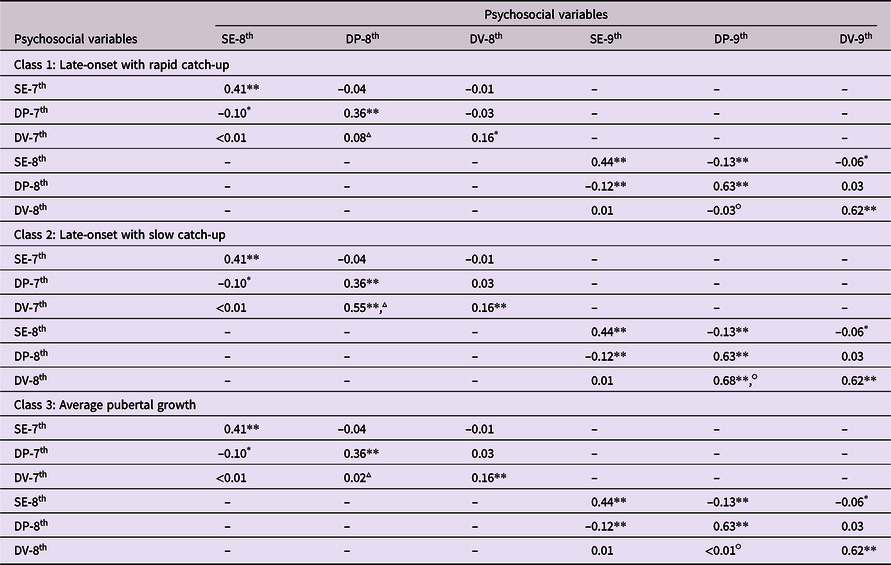
Note. Cell entries are unstandardized regression coefficients. SE = self-esteem. DP = depressive symptoms. DV = deviant behavior. 7th = seventh-grade. 8th = eighth grade. 9th = ninth grade.
* p < 0.05
** p < 0.01.
△ The Wald test showed the regression coefficients in Class 2 to be different from those in Class 1 (F = 6.21, p = 0.013) and Class 3 (F = 6.029, p = 0.014).
○ The Wald test showed the regression coefficients in Class 2 to be different from those in Class 1 (F = 7.10, p = 0.008) and Class 3 (F = 11.64, p < 0.001).
The model fit indices of the base model: Bayesian information criterion = 16076.17; sample-size adjusted Bayesian information criterion = 13941.73.
Based on chi-square difference tests examining the multigroup invariance, we noted that the relationships of deviant behavior to changes in depressive symptoms between two adjacent years were not invariant (Δχ2 = 7.73, p = 0.021 for the regression coefficients between changes in eighth-grade depressive symptoms and seventh-grade deviant behavior and Δχ2 = 12.38, p = 0.002 for the regression coefficients between changes in ninth-grade depressive symptoms and eighth-grade deviant behavior). It appeared that adolescent boys in the late-onset with slow catch-up group deserved a closer look, because the regression coefficients for the link between deviant behavior and subsequent changes in depressive symptoms were significant and positive only in this group. The Wald test found regression coefficients in the late-onset with slow catch-up group significantly different from those in the other two groups.
Discussion
We documented the heterogeneity in pubertal development and the differences in internalizing and externalizing problems between adolescent boys of different classes of pubertal development. Whereas most recent studies estimating pubertal tempo tended to hypothesize a linear or curvilinear growth trend, these assumptions largely fail to capture the multiplicity of pubertal growth that may differ in trends at different time points. Based on GMM, our data revealed two subclasses among the one-third of teenage boys who had a delay in pubertal development, which is somehow in contrast to the early- and late-onset dichotomy that researchers and practitioners have applied to understand adolescent pubertal development. Such heterogeneity in pubertal tempo, coupled with pubertal timing, helps explain the wide margin of individual differences in the years it takes to complete sexual maturation. Given that subjective measures of pubertal development tend to correlate with gonadal hormone levels, statistically modeled trajectories may hint at underlying biological mechanisms that time and rhyme with the physical changes (Balzer, et al., Reference Balzer, Garden, Amatoury, Luscombe, Paxton, Hawke, Handelsman and Steinbeck2019). Corresponding to this notion, Steinbeck and colleagues (Reference Steinbeck, Garden, Cheng, Luscombe and Handelsman2019) analyzed urine samples and found two distinct growth curves of gonadal hormones characterized by the stability of change over time. Individuals in these two hormone trajectories differed in hormonal and anthropometric parameters throughout puberty, highlighting the time-varying physiological effects of gonadal hormones on physical growth and explaining the meaningful heterogeneity in pubertal development.
When examining cross-lagged relationships between three psychosocial variables over time, we firstly observed that autoregressive paths were all significant, indicating stability in the studied psychosocial variables over time because the level at the earlier assessment was predictive of that at the later assessment. Secondly, we found a cascading relationship that the level of depressive symptoms in seventh grade was related to decreased self-esteem in eighth grade, and low self-esteem in eighth grade was subsequently associated with increased ninth-grade depressive symptoms and deviant behavior. Lastly, eighth-grade depressive symptoms also reciprocally predicted a decreased level of self-esteem in ninth grade. Our findings were supported by a prior Korean study that showed negative self-concept to be a significant mediator linking internalizing to externalizing problems (Lee & Stone, Reference Lee and Stone2012). Moreover, Lee and Stone’s study (2021) demonstrated bidirectional influences between internalizing problems and negative self-concept, which was also supported in our study.
However, the role of deviant behavior did not appear to initiate any cascading relationship, except in boys with late-onset and slow catch-up in pubertal development. In the multigroup analysis, they stood out from the other two groups. Their earlier levels of deviant behavior predicted changes in depressive symptoms in subsequent grades, where depressive symptoms may further lead to decreased self-esteem. The interpretation of the results can be twofold. First, pubertal tempo per se should be regarded as a moderator of the links among the three psychosocial variables. Different pubertal tempos may accentuate or diminish the possible effects of individual antecedent factors on psychological variables, which may have potential implications for intervention efforts when addressing adolescent psychological and behavioral issues. Second, deviant behavior seemed to play a pivotal role in psychosocial development in the late-onset with slow catch-up group. This can be addressed by targeting some deviant behaviors, such as cigarette smoking or alcohol drinking, which are regarded as signs of social maturity but may be atypical if shown too early in development (Agan, et al., Reference Agan, Costin, Deutz, Edelsbrunner, Záliš and Franken2015; Dijkstra, et al., Reference Dijkstra, Kretschmer, Pattiselanno, Franken, Harakeh, Vollebergh and Veenstra2015). Slow maturing boys, who are usually shorter and thinner than peers, may seek maturity status by resorting to disruptive behaviors as an emotional outlet for felt distress and low self-esteem (Barnes & Beaver, Reference Barnes and Beaver2010; Mier & Ladny, Reference Mier and Ladny2018). A vicious cycle may ensue, because deviant behavior in a given grade is further associated with an increase in depression in the subsequent grade. This finding highlights the longitudinal interrelationships between self-esteem, depressive symptoms, and deviant behavior. Timely intervention at an earlier stage with differential targets tailored to the status of pubertal tempo may prevent further development of these internalizing and externalizing problems in adolescents. More research is needed to replicate our results and better clarify the differential causal mechanisms across different pubertal tempos and stages.
In the auxiliary analysis (Aappendix D) controlling for earlier levels of psychosocial variables, we unexpectedly found that teenage boys in the late-onset with rapid catch-up group were estimated to have the lowest level of depressive symptoms in ninth grade despite their initial heightened level. In contrast, those in the late-onset with slow catch-up group were estimated to have the lowest self-esteem in eighth grade, and then their depression and deviant behavior surged in ninth grade, as their puberty progressed with time. This observation appears to challenge the maturation compression theory and contradict the current knowledge that surging hormones during the fast pubertal transition phase have a direct effect on the brain and act as the main driver of negative self-image, internalizing symptoms, and externalizing behaviors among adolescent boys (Michaud, et al., Reference Michaud, Suris and Deppen2006; Hughes, et al., Reference Hughes, Mundy, Romaniuk, Sawyer, Wake, Williams, Olds, Allen and Patton2018). Alternatively, the maturational deviance hypothesis may better explain our findings (Williams & Dunlop, Reference Williams and Dunlop1999), in that adolescents in the late-onset with slow catch-up group might undergo some sort of developmental stress that jeopardizes their psychological and behavioral well-being. In light of the social context where this study took place, teenage boys residing in East Asian countries are immersed in a family-oriented, collectivistic social setting where relationship harmony and value synchronism are highly weighted (Tsai, et al., Reference Tsai, Strong and Lin2015; Kweon, et al., Reference Kweon, Yun, Park and Kim2017). Any deviance from social norms is less desirable (Brown, Reference Brown, Feldman and Elliott1990), and so are the timing and tempo of pubertal development that are usually compared among peers. As adolescents spend increasingly more time with peers, late- and slow-progressing pubertal development and its associated physical appearance are likely to be seen as inferior because of social comparisons and thus cause stress to slow maturers. Although previous research has argued that the effects of pubertal tempo on psychological or behavioral outcomes may be short-lived because all individuals eventually experience this change by young adulthood (Chiang, et al., Reference Chiang, Chiu, Shang, Tsai and Gau2010), we cannot overlook its temporary downside. Therefore, due attention to adolescents showing such pubertal characteristics is essential when counseling on their pubertal passage.
Although not a primary objective of the current study, it is worth mentioning that some contextual factors play a part in the relationship between pubertal development and psychosocial variables. For instance, among the family-related factors, parent–child conflicts predicted delayed pubertal development, regardless of tempo classes. A similar association has recently been reported, stressing that the effects of the family environment must be considered within the context of parental characteristics (DiLalla, et al., Reference DiLalla, Pham, Corley, Wadsworth and Berenbaum2021). However, we did not observe any association between pubertal development and parental marital discord, which is usually implicated in girls’ pubertal development (Belsky, et al., Reference Belsky, Steinberg, Houts, Friedman, DeHart, Cauffman, Roisman, Halpern-Felsher and Susman2007). Moreover, despite previous research showing that the school- and peer-based stressful life events may also contribute to the pubertal tempo and psychosocial well-being in early to middle adolescence (Seiffge-Krenke, et al., Reference Seiffge-Krenke, Persike, Karaman, Cok, Herrera, Rohail, Macek and Han2013), the relationship between different types of stressors and pubertal development classification and psychosocial variables were sporadic in our analysis. More targeted research on these antecedent stressors with regard to the onset, tempo, and synchrony of pubertal progression and their relation with psychosocial well-being throughout adolescence may be needed in future work.
There are some limitations that warrant caution when interpreting our data. First of all, the majority (68.9%) of our sample was estimated to have an average score of 2.5 out of four on PDS in seventh grade. That is, we did not capture the very beginning of pubertal development that usually begins at age 9 or 10 years, and thus were unable to further identify those with extremely early pubertal onset. Adolescents assigned to the average pubertal growth group were actually an aggregate of early and on-time maturing adolescents, and they were assumed to have more advanced pubertal development, because of higher scores in subjective PDS, than their peers in the other two groups in seventh grade. This limitation restrained our analysis from testing the developmental readiness hypothesis. As we were not able to completely disentangle the timing and tempo associations throughout the entire pubertal development, our findings of pubertal tempo can only be applied to adolescent boys with late pubertal onset. Whether the findings apply to girls may also require more research on longitudinal data covering the pubertal progression of girls, which is usually earlier than that of boys. Moreover, the results should be better understood as correlational, despite the longitudinal design. In the present study, class membership was based on measurements conducted between seventh and ninth grade. Given that GMM is mainly a data-driven analysis, more pubertal development patterns may be observed with more waves of data. Second, it is worthy of attention that PDS items may be interpreted differently, as they are not necessarily identical to more objective measures of puberty. Youth in the early stages of development may overestimate their pubertal maturation (Schlossberger, et al., Reference Schlossberger, Turner and Irwin1992). Although there are differences between subjective and objective ratings on pubertal development, our analysis principally focused on comparing patterns of perceived pubertal development onward over the years of junior high school. Third, the psychological and behavioral variables were self-reported and thus subject to reporting bias. Unfortunately, a multi-informant design, including the report from parents and teachers, was not possible. Having parents’ or teachers’ perspectives on adolescents’ externalizing behaviors may provide different insights into future research.
Despite the limitations, our study demonstrated several strengths. For one, the representative and large sample of Taiwanese adolescents provided unique data for studying pubertal tempo and its relationship to adolescent development in the less researched Asian population. For the other, the GMM technique helped model various patterns of pubertal development and effectively challenged the one-size-fits-all assumption that prior studies relied upon. In light of our findings, we argue for relaxing the assumption of a linear or curvilinear growth trend and empirically examining whether and how adolescents vary in their pubertal development.
Conclusion
Using GMM, we characterized different pubertal development trajectories among adolescent boys. Incorporating key psychosocial indicators, we found that adolescent boys with late-onset and slow catch-up in pubertal development manifested the poorest psychological and behavioral well-being in terms of self-esteem, depressive symptoms, and deviant behavior. The interrelationships among psychological and behavioral variables also varied by different patterns of pubertal development. Self-esteem seemed to be a critical pathway in a cascading relationship linking depressive symptoms to deviant behavior across different patterns of pubertal development. The multigroup analysis further found the positive cross-lagged associations between deviant behavior and changes in depressive symptoms only significant in the late-onset with slow catch-up group. This finding indicates developmental challenges encountered by different pubertal development groups, and therefore individualized guidance should be provided accordingly. We encourage future researchers to systematically gauge the heterogeneity and fluidity of the psychosocial and pubertal development at the same time.
Supplementary material
The supplementary material for this article can be found at https://doi.org/10.1017/S0954579422000554
Acknowledgments
This study was supported by the research grant from the Ministry of Science and Technology, Taiwan (104-2314-B-006-081) to M.-C. Tsai, and by the research grant from the Ministry of Science and Technology, Taiwan (106-2410-H-018-006-MY2) to Y.-C.L. Wang. The Taiwan Youth Project was originally supported by the Academia Sinica and directed by Dr. Chin-Chun Yi. The Center for Survey Research of the Academia Sinica is responsible for the data distribution. We thank Dr. Yi and everyone else at the Academia Sinica and the Taiwan Youth Project for providing the data and all the other assistance regarding data management.
Funding statement
This study was supported by the research grant from the Ministry of Science and Technology, Taiwan (MOST 104-2314-B-006-081) to M.-C. Tsai, and by the research grant from the Ministry of Science and Technology, Taiwan ( MOST 109-2410-H-018-022 ) to Y.-C. L. Wang.
Conflict of interest
The authors have no conflict of interest to declare.


 Open access

