





Child sexual abuse is associated with numerous psychological consequences, such as post-traumatic stress disorder and internalizing and externalizing behavior problems in children (Hailes et al., Reference Hailes, Yu, Danese and Fazel2019). Behavior problems are a significant concern in children, as they predict later psychosocial maladaptation (Arslan et al., Reference Arslan, Lucassen, Van Lier, De Haan and Prinzie2021). Internalizing behavior problems in children comprise anxiety, depression, and somatic symptoms and are associated with mental health difficulties such as depressive symptoms and self-harm in adolescence (Gutman & Codiroli McMaster, Reference Gutman and Codiroli McMaster2020). Externalizing behaviors in children, namely aggressive behaviors and rule-breaking, are linked to delinquent and at-risk behaviors in adolescence and adulthood (Petersen et al., Reference Petersen, Bates, Dodge, Lansford and Pettit2015). Numerous studies have underscored the role of self-regulation in predicting psychosocial difficulties among normative children (Yan et al., Reference Yan, Shields, Zhang, Wu, Chen and Romer2022, for a review). However, little is known about the associations between the different emotional and cognitive components of self-regulation, namely emotion regulation and executive functioning, and behavior problems among vulnerable children, particularly sexually abused children. The present study aimed to identify profiles of self-regulation in a sample of sexually abused children and explored their possible associations with behavior problems.
Development of self-regulation and associated factors
Although there are debates on the conceptual definitions of self-regulation, it is generally agreed that self-regulation is the ability to effectively manage one’s emotions, cognition, and behaviors in response to environmental demands (Bridgett et al., Reference Bridgett, Burt, Edwards and Deater-Deckard2015). Calkins and Marcovitch (Reference Calkins, Marcovitch, Calkins and Bell2010) propose that two processes are implicated in self-regulation: emotion regulation and executive functions. They define emotion regulation as automatic and deliberate behaviors, strategies, and competencies that modulate one’s emotional response. This definition includes dispositional tendencies (bottom-up) and more voluntary, goal-oriented responses (top-down). Executive functions are defined as top-down cognitive processes responsible for regulating goal-directed behaviors (Friedman & Miyake, Reference Friedman and Miyake2017). It is accepted that three main executive functions, namely working memory, inhibitory control or inhibition, and cognitive flexibility, underlie more complex functions such as metacognition, planning, and organization (Friedman & Miyake, Reference Friedman and Miyake2017).
Self-regulation has usually been studied as a linear construct, but authors have suggested that its association with adaptative functioning might be more complex. For instance, Eisenberg and Morris (Reference Eisenberg, Morris, Kail and Reese2002) have proposed that for children to function adaptatively, they should not have a too-low or too-high level of self-regulation. Stemming from the classical work of Block and Block (Reference Block, Block and Collings1980) and current neuropsychological findings, they suggested that three self-regulation profiles of children can be observed: Under-regulation, Overregulation, and Optimal Regulation. These authors postulate that Under-regulation would be associated with more externalizing difficulties, while overregulation would predict more internalizing difficulties. However, most studies investigating this hypothesis have focused on under-regulation aspects of emotion and executive functions (Gruhn & Compas, Reference Gruhn and Compas2020; Lund et al., Reference Lund, Toombs, Radford, Boles and Mushquash2020). Studies on overregulation have mainly used temperamental measures of self-regulation, such as behavioral inhibition, which differs from inhibitory control by being automatic as opposed to deliberate (Nigg, Reference Nigg2017). However, there is emerging evidence that inhibitory control might be a mechanism through which children show overregulation patterns (Cardinale et al., Reference Cardinale, Subar, Brotman, Leibenluft, Kircanski and Pine2019).
Processes involved in the development of self-regulation are partly guided by genetics and maturation (Eisenberg & Morris, Reference Eisenberg, Morris, Kail and Reese2002; Nigg, Reference Nigg2017). However, environmental factors will also affect children’s developmental trajectories. Early life adversity, notably child maltreatment, has also been found to be associated with self-regulation. For instance, exposure to chronic or extreme stress, such as sexual abuse during childhood, has been associated with a dysregulation of the hypothalamic–pituitary–adrenal (HPA) axis responsible for regulating stress hormones (Wesarg et al., Reference Wesarg, Van Den Akker, Oei, Hoeve and Wiers2020). The dysregulation will affect the brain both structurally and functionally, particularly in parts of the brain responsible for self-regulation, namely the hippocampus, the amygdala, and the prefrontal cortex (Jedd et al., Reference Jedd, Hunt, Cicchetti, Hunt, Cowell, Rogosch, Toth and Thomas2015; McLaughlin et al., Reference McLaughlin, Peverill, Gold, Alves and Sheridan2015; Riem et al., Reference Riem, Alink, Out, Van Ijzendoorn and Bakermans-Kranenburg2015). Studies investigating the effects of maltreatment, including child sexual abuse, on self-regulation have found that maltreated children show poorer emotion regulation and executive functions than their non-abused peers (Gruhn & Compas, Reference Gruhn and Compas2020; Lund et al., Reference Lund, Toombs, Radford, Boles and Mushquash2020). A recent study conducted among school-aged children found that child sexual abuse was associated with difficulties in executive functioning (Amédée et al., Reference Amédée, Cyr, Jean-Thorn and Hébert2024). More specifically, compared to their normative peers, sexually abused children showed more executive functioning difficulties, according to parental reports, and poorer performance on cognitive flexibility tasks. This study also found that child sexual abuse was associated with poorer inhibition in boys but not in girls, suggesting that sex could be an important factor to consider when investigating executive functions in this population of children. Although this study represents a first step in understanding executive functions in sexually abused children, it did not investigate the possible effect of abuse characteristics. Yet, studies suggest that abuse characteristics, such as the identity of the abuser and the severity of the abuse, could predict psychological outcomes among sexually abused children (see Noll, Reference Noll2021 for a review).
Furthermore, studies have found that contextual rearing factors, such as parental level of education and neighborhood deprivation, are associated with both emotion regulation and executive functioning (Palacios-Barrios & Hanson, Reference Palacios-Barrios and Hanson2019; Taylor et al., Reference Taylor, Cooper, Jackson and Barch2020). For example, one study found structural and functional brain changes in children exposed to poverty (Palacios-Barrios & Hanson, Reference Palacios-Barrios and Hanson2019). Another study found that youth living in underprivileged neighborhoods performed lower on executive functioning tasks even after controlling for individual socioeconomic status (Taylor et al., Reference Taylor, Cooper, Jackson and Barch2020). However, little is known about how these factors are associated with self-regulation among sexually abused children. This is particularly important because economic deprivation and child maltreatment often co-occur (van IJzendoorn et al., Reference van IJzendoorn, Bakermans-Kranenburg, Coughlan and Reijman2020). Consequently, understanding how abuse characteristics, victimization history, and contextual rearing factors are associated with self-regulation will allow for a broader understanding of the development of sexually abused children.
There is theoretical and empirical justification that child sexual abuse represents a specific form of child maltreatment that deserves individual consideration (Finkelhor & Browne, Reference Finkelhor and Browne1985). First, child sexual abuse differs from other forms of maltreatment regarding the identity of the perpetrator. Although child sexual abuse is often perpetrated by someone known to the child, it is not always perpetrated by a caregiver. A recent study conducted in Australia found that less than ten percent of individuals reporting a history of child sexual abuse were sexually abused by a caregiver (Gewirtz-Meydan & Finkelhor, Reference Gewirtz-Meydan and Finkelhor2020). This is especially important because parents play an essential role in the development of children’s self-regulation. Consequently, contrary to children exposed to other forms of maltreatment, sexually abused children could benefit from parental support in terms of self-regulation. Second, there is evidence that cortisol concentration among sexually abused children differs from children exposed to other forms of maltreatment, such as neglect, suggesting that sexual abuse could affect the HPA axis differently (for a review: Bernard et al., Reference Bernard, Frost, Bennett and Lindhiem2017; Fogelman & Canli, Reference Fogelman and Canli2018). As HPA axis dysregulation is a predictor of later self-regulation difficulties, it is plausible that sexually abused children present specific self-regulation profiles (Wesarg et al., Reference Wesarg, Van Den Akker, Oei, Hoeve and Wiers2020). Third, child sexual abuse involves four dynamics (powerlessness, traumatic sexualization, stigmatization, and betrayal) that can hinder children’s functioning (Finkelhor & Browne, Reference Finkelhor and Browne1985). For instance, the dynamics of powerlessness, stigmatization, and betrayal could lead children to overregulate their emotions and behaviors to protect themselves, which, in turn, could lead to more internalizing behavior problems (Cantón-Cortés et al., Reference Cantón-Cortés, Cortés and Cantón2012; Langevin et al., Reference Langevin, Cossette and Hébert2020). Interestingly, traumatic sexualization, which is a dynamic unique to sexually abused children, could be associated with both overregulation and dysregulation. Studies conducted among adult victims of child sexual abuse have reported the presence of disorders associated with both overregulation (sexual dysfunction) and dysregulation (sexual compulsion) (Noll, Reference Noll2021).
Because of these unique dynamics, specialized intervention programs have been developed to help alleviate the deleterious consequences of child sexual abuse. However, they have mainly focused on targeting emotion dysregulation (Cloitre, Reference Cloitre2013; Cohen et al., Reference Cohen, Mannarino and Deblinger2017). Yet, there is preliminary evidence that suggests that sexually abused children experience more overregulation compared to their normative peers (Boisjoli & Hébert, Reference Boisjoli and Hébert2020; Langevin et al., Reference Langevin, Cossette and Hébert2020). Thus, it is essential to further investigate sexually abused children’s self-regulation to inform more tailored and effective interventions.
Child sexual abuse, self-regulation, and behavior problems
Studies among sexually abused children have focused on emotion dysregulation. Results of these studies have found that emotion dysregulation predicted internalizing and externalizing behavior problems among school-aged children exposed to child sexual abuse (Choi & Oh, Reference Choi and Oh2014; Hébert et al., Reference Hébert, Langevin and Oussaïd2018). A study among sexually abused preschoolers suggests that the association between emotion regulation and behavior problems might vary according to sex. More specifically, authors found a stronger association between emotion regulation and behavior problems in boys than girls (Langevin et al., Reference Langevin, Hébert and Cossette2015). However, these studies combined two facets of emotion regulation: emotion regulation competencies and emotional lability. Emotion regulation competencies reflect the use of strategies and skills to effectively manage emotions. Emotional lability taps into dispositional and bottom-up processes that guide children’s reactivity to the environment. A study using a sample of 46 maltreated children (Mean age = 9.59) found emotion regulation competencies to only predict internalizing symptoms, while emotion lability predicted both internalizing and externalizing behaviors (Muller et al., Reference Muller, Vascotto, Konanur and Rosenkranz2013). Another study found that emotional lability at age eight predicted internalizing behaviors a year later (Kim-Spoon et al., Reference Kim-Spoon, Cicchetti and Rogosch2013). This suggests that these facets of emotion regulation could have independent or additive effects on the development of behavior problems among sexually abused children.
The association between executive functions and behavior problems in maltreated children, including child sexual abuse, remains unclear. One study found that emotion regulation and executive functions mediated the association between child maltreatment and aggressive behavior in a sample of 50 school-aged children (Dileo et al., Reference Dileo, Brewer, Northam, Yucel and Anderson2017). Another study among maltreated preschoolers (n = 84) found no association between performance in executive function tasks and externalizing behaviors. However, results revealed that children with low executive functions were at a higher risk of presenting clinical levels of externalizing behaviors (Horn et al., Reference Horn, Roos, Beauchamp, Flannery and Fisher2018). Alternatively, one study found that executive functions did not mediate the association between maltreatment and disruptive behaviors among school-aged children (Bernardes et al., Reference Bernardes, Manitto, Miguel, Pan, Batistuzzo, Rohde and Polanczyk2020). These inconsistent findings could be explained by individual differences in the effect of child maltreatment on executive functions. For instance, a neuropsychological study found a sex difference in neural pathways underlying inhibition among maltreated adults (Elton et al., Reference Elton, Tripathi, Mletzko, Young, Cisler, James and Kilts2014). More precisely, increased maltreatment was associated with poorer inhibition in men. Conversely, elevated exposure to child maltreatment in women was associated with greater inhibition. There is also preliminary evidence that inhibition could have a curvilinear association with internalizing behaviors. A recent study conducted among a normative sample found that anxious children performed better in inhibition tasks (Cardinale et al., Reference Cardinale, Subar, Brotman, Leibenluft, Kircanski and Pine2019). This suggests that some children might indeed show profiles of overregulation. In the case of maltreated children, they may have to use their self-regulatory abilities as a strategy to prevent further harm (Demers et al., Reference Demers, Hunt, Cicchetti, Cohen-Gilbert, Rogosch, Toth and Thomas2022). While these strategies can be adaptative in the long term, this could lead to a pattern of overregulation, which could be associated with maladaptive behaviors.
The present study
This study stems from a developmental psychopathology approach, which stresses the importance of considering different risk and protective factors in understanding children’s development (Cicchetti, Reference Cicchetti1984). More precisely, the transactional socioecological model of maltreatment posits that there are multiple developmental trajectories for maltreated children, depending on the interaction of risk and protective factors (Cicchetti & Valentino, Reference Cicchetti, Valentino, Cicchetti and Cohen2006). The transactional socioecological model of maltreatment also proposes that factors related to children’s proximal environment will have a strong influence on their adaptation. The most proximal is the ontogenetic system, which encompasses genetic and biological processes. Consequently, children’s self-regulation, situated on the ontogenetic system, is likely to predict the development of behavior problems.
The first objective of this study was to delineate the self-regulation profiles of sexually abused children. To respond to the limitations of previous studies, we used both parent reports and child tasks to assess self-regulation in children. We hypothesized that there would be at least three profiles: Optimally regulated, Dysregulated, and Overregulated. Our second objective was to examine the association between socioeconomic characteristics and abuse history with self-regulation profiles. We postulated that (1) higher socioeconomic status will be associated with more adaptative self-regulation profiles, and (2) severe abuse, intrafamilial abuse, and cumulative maltreatment will be associated with less adaptative self-regulation profiles. The third objective was to examine the association between self-regulation profiles and behavior problems while considering the effect of sex. Because of the generally low agreement between parents and teachers, we used both respondents in this study (De Los Reyes et al., Reference De Los Reyes, Augenstein, Wang, Thomas, Drabick, Burgers and Rabinowitz2015). Considering that there is evidence that behavior problems can be concomitant to executive functioning difficulties, and to assess the stability of our findings, we also examined behavior problems at two assessment times in a six-month interval. Our hypotheses are that: (1) A Dysregulated profile will be associated with higher levels of internalizing and externalizing behavior problems; (2) The Overregulated profile will be associated with more internalizing behavior problems; (3) The Optimally regulated profile will be associated with lower levels of behavior problems; and (4) Gender will moderate the association between being classified in the Dysregulated or Overregulated profile and behavior problems.
Method
Participants
This study included 223 sexually abused children (76.9% girls) aged six to 12 years old (M = 8.94; SD = 1.88), their non-offending parents, and teachers. Parents and children were invited to participate twice at a six-month interval. The mean age at the first assessment was M = 8.94, SD = 1.88, and M = 9.69; SD = 1.93 at the second assessment. More than half of the sample (59.6%) had a familial income superior to 40,000 Canadian dollars and an education level higher than a high school diploma (54.7%). Less than a quarter of children lived with both biological parents (22.3%), and 15.4% of children had at least one parent born outside of Canada.
This study is part of a broader research project on the developmental trajectories of sexually abused children and was approved by the Institutional Review Board of CHU Sainte-Justine and of the Université du Québec à Montréal. Participants were recruited in specialized sexual abuse intervention centers in the province of Québec, Canada. Before receiving services, research assistants presented the project to parents and children. Prior to their participation, parents were informed that a refusal to participate would not affect the services received. Parents gave their written consent, and children their verbal assent. At the first assessment (T1), children completed questionnaires and computerized tasks with the assistance of a research assistant, and parents completed the questionnaires assessing children’s executive functions and behavior problems. Parents also signed a consent form to send a questionnaire to the child’s teachers at the first assessment. Teachers were not informed that children had sustained child sexual abuse. They received a five-dollar gift card for their time. At the second assessment (T2), parents completed questionnaires assessing children’s behavior problems.
Latent class indicators
Cognitive flexibility was measured by a computerized version of the Dimensional Change Card Sort task (Zelazo, Reference Zelazo2006). Children were asked to match images corresponding to the rule (color or shape) mentioned by the research assistant. Children practiced each dimension four times using yellow or green, representing a car or a truck. The task begins after successfully completing three out of four trials. Target images were fish and leaves in blue or red. Younger children (6–7 years old) had to match four out of five trials for each dimension before moving to the mixed trial of 30 randomly shuffled cards. Older children started at the mixed trial stage. A score is computed by adding the reaction time from the mixed trial and the accuracy rate (0–10).
Children aged six to seven must first match the cards consecutively along a single dimension, namely color. The test stops if the child does not correctly associate four of the five trials. If this step is successful, they must then match the pictures according to shape. If four of the five trials are successful, the child can complete the 30-picture task with both dimensions randomly shuffled. Children eight years and older begin the task at the shuffled card stage. Prior studies have demonstrated adequate psychometric properties for computerized versions of the DCCS (Ahmed et al., Reference Ahmed, Skibbe, McRoy and Tatar2022; Zelazo et al., Reference Zelazo, Anderson, Richler, Wallner-Allen, Beaumont and Weintraub2013).
Inhibition and visual attention were measured by a computerized version of the Flanker Task (Eriksen & Eriksen, Reference Eriksen and Eriksen1974). Children are asked to show the direction in which the central target points. They must be successful in three out of four practice trials to start the task. Younger children (6-7 years old) used fish as the target, and older children used arrows to complete 20 trials. Reaction time and accuracy score were calculated. A total score was then computed by adding the reaction time score and accuracy score. Prior studies have demonstrated adequate psychometric properties for computerized versions of the Flanker (McDermott et al., Reference McDermott, Perez-Edgar and Fox2007; Zelazo et al., Reference Zelazo, Anderson, Richler, Wallner-Allen, Beaumont and Weintraub2013).
Parents’ ratings of children’s executive functions were measured using a short version of the Behavior Rating Inventory of Executive Function (BRIEF; Gioia et al., Reference Gioia, Isquith, Guy and Kenworthy2015). Parents were asked to respond on a 3-point Likert scale (1 = Never to 3 = Always) to the 12-item questionnaire. Examples of items are “Gets stuck on one topic or activity” and “Resists or has trouble accepting a different way to solve a problem with schoolwork, friends, tasks, etc.”. To facilitate class interpretation, the scale was reversed, with a higher score representing higher executive functioning. Cronbach’s α in this study was α .85.
Emotion regulation was measured by two subscales of the Emotion Regulation Checklist (Shields & Cicchetti, Reference Shields and Cicchetti1997; French version by Langevin et al., Reference Langevin, Hébert and Cossette2010). This questionnaire is well validated across normative and at-risk samples. Parents were asked to respond using a 4-point Likert scale (0 = never to 3 = almost always) to assess emotion regulation competencies (15 items) and dysregulation (8 items). Examples of items for the emotion regulation subscale are: “is a cheerful child” and “shows appropriate negative emotions when reacting to hostile, aggressive or intrusive behaviors from other children.” Examples of the lability/negativity subscale include: “is easily frustrated or “manifest enthusiasm that others find intrusive or disruptive.” The lability/negativity scale was reversed to facilitate class interpretation, with a higher score representing lower emotional lability. The emotion regulation competencies subscale had a Cronbach’s α of .84 and the lability/negativity a Cronbach’s α of .73.
Covariates and outcomes
Sociodemographic
A sociodemographic questionnaire was completed by the parent. Two neighborhood deprivation indexes were derived from families’ postal codes using the Material and Social Deprivation Index (Pampalon et al., Reference Pampalon, Hamel, Gamache, Philibert, Raymond and Simpson2012). The social deprivation index measure is derived from the proportion of single-parent families and the proportion of individuals separated, widowed, divorced, or living alone. The material deprivation index is obtained using level of education, employment, and income data. The scores range from zero to four, with a high score indicating higher deprivation.
Adverse childhood events
Clinicians completed an adaptation (Hébert & Cyr, Reference Hébert and Cyr2010) of the History of Victimisation Form (Wolfe et al., Reference Wolfe, Gentile and Bourdeau1987) to collect the children’s history of abuse. This questionnaire documents the severity of the abuse: 0 = severe (unclothed touching) or 1 = very severe abuse (penetration or attempted penetration), the identity of the abuser (extrafamilial = 0; intrafamilial = 1), intrafamilial includes a person in the child’s immediate family (parent, stepparent, sibling, and stepsibling) or extended family (cousin, grandparent, aunt, or uncle). A composite score ranging from zero to four was also created to assess the number of forms of trauma sustained by the child (physical abuse, exposure to interparental violence, neglect, and emotional abuse).
Internalizing and externalizing behavior problems
Parents completed the Child Behavior Checklist (CBCL; Achenbach & Rescorla, Reference Achenbach and Rescorla2001) at the first and second assessments. Teachers completed the Teacher Report Form (TRF; Achenbach & Rescorla, Reference Achenbach and Rescorla2001) at the first assessment. Informants answered on a 3-point scale ranging from 0 = never to 2 = often if the child displayed the behavior. In the study, we used T-scores from the internalizing and externalizing behavior problems subscales. Both the CBCL and TRF versions are compatible. Children with scores between 60 and 63 are considered subclinical, and those higher than 63 are considered clinical. The Cronbach’s α for the internalizing behaviors was .90 for parents and .85 for teachers. The Cronbach’s α for externalizing behaviors was .92 for parents and α = .96 for teachers. Interrater agreement was fair Kappa = .22 (p < .001), 95% CI (0.16, 0.29) for internalizing behaviors, and Kappa = .33 (p < .001), 95% CI (0.28, 0.39).
Data analytic plan
Missing data analyses showed that data were missing completely at random as shown by the Little’s Missing Completely at random test which was not significant (χ 2 = 44.12, df = 35, p = .14).
Preliminary analyses were conducted with SPSS 25. Main analyses were conducted using Mplus 8 (Muthén & Muthén, Reference Muthén and Muthén1998–2023). Missing data was handled using full information likelihood (FIML) with the maximum likelihood robust (MLR) estimator. This method allows all participants to remain in the analysis while producing robust estimators for non-normal data (Lanza & Cooper, Reference Lanza and Cooper2016).
Five indicators were used to derive self-regulation profiles: Cognitive flexibility (DCCS), inhibition and attention (Flanker), parent’s rating of executive functions (BRIEF), emotion regulation competencies (ERC), and emotional lability/negativity (ERC). Indicators were first standardized, then successive Latent class analyses were tested (1–5 solutions). Age was added as a control variable in the model, given that child task performance is highly correlated with age (DCCS: r = .61, p < .001; Flanker: r = .57, p < .001). Multiple indices were used to estimate the ultimate class solution. First, a lower Akaike information criterion (AIC; Akaike, Reference Akaike1987), Bayesian information criterion (BIC; Schwarz, Reference Schwarz1978), and adjusted Bayesian information criterion (aBIC; Sclove, Reference Sclove1987) indicated a better fit. An entropy value closer to one indicates better class differentiation. To ensure the parsimony of the model, the bootstrapped likelihood ratio test (BLRT) and the Lo–Mendell–Rubin (LMR) adjusted likelihood ratio test were used. For these tests, a significant p-value indicated that an n was better than the n − 1 model. The best class solution was chosen in light of these indices as well as interpretability (Lanza & Cooper, Reference Lanza and Cooper2016).
Once the optimal class solution was chosen, we conducted analyses using the Bolck et al. (Reference Bolck, Croon and Hagenaars2004) method in Mplus (BCH). The BCH method, similar to analysis of variance (ANOVA), allows the comparison of means across profiles for covariates and outcomes. This method accounts for the uncertainty of profile assignment and minimizes potential class change. All outcomes were entered simultaneously under the AUXILIARY command on Mplus. This analysis provides an omnibus chi-square test if significant, pairwise comparisons can be examined. Finally, we conducted a series of moderation analyses using profile assignment (dummy-coded) as the independent variable, sex as moderator, and behavior problems (internalizing, externalizing) as the dependent variable.
Results
Descriptive statistics
The majority of children in the sample (90.1%) experienced severe (unclothed touching) or very severe abuse (penetration or attempted penetration). A large proportion of participants (77.6%) experienced intrafamilial abuse. Almost a third of the sample (27.7%) was abused by a biological parent or a stepparent, and almost two-thirds of the sample (62.9%) experienced more than one episode of sexual abuse. For most children (56.2%), the first reported episode of sexual abuse was after the age of six years old.
Fifty-eight percent of the sample experienced at least one other traumatic experience (physical abuse, exposure to intrafamilial violence, psychological abuse, neglect). In our sample, 30% of children experienced physical abuse, 39.6% psychological maltreatment, 28.6% neglect, 51.7% exposure to interparental violence. Correlation analyses were also conducted between indicators and outcome variables. Results are reported in Tables 1 and 2.
Descriptive statistics and correlations between latent profile indicators and behavior problems
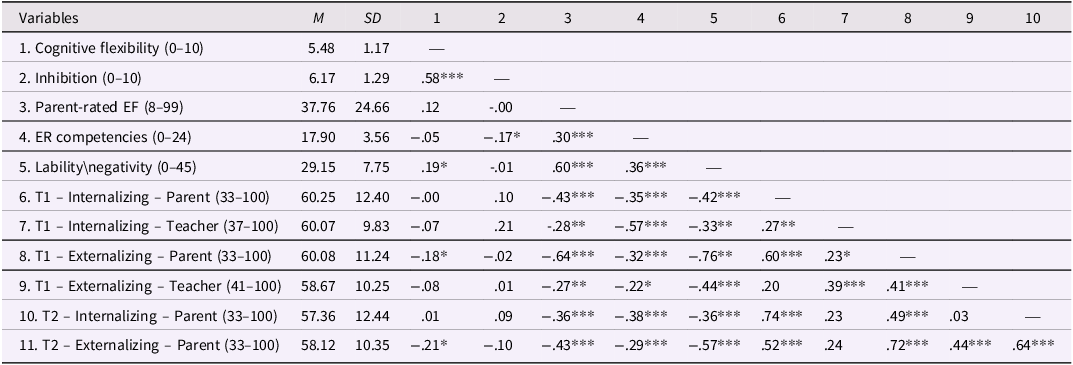
Note. EF = executive functions; ER = emotion regulation. T1 = first assessment; T2 = second assessment. *p < .05. **p < .01, ***p < .001.
Parent-rated EF and lability/negativity scores were reversed, with a higher score reflecting better functioning.
Correlations between SES, abuse characteristics, and latent profile indicators
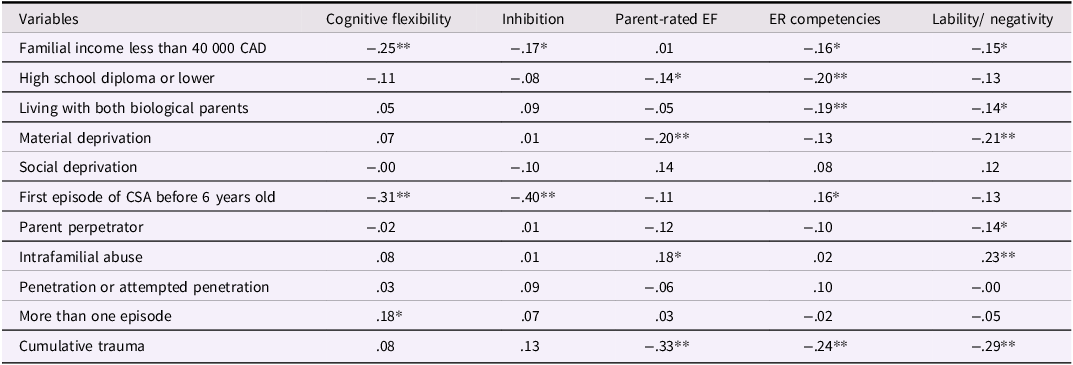
Note. EF = executive functions; ER = emotion regulation. *p < .05. **p < .01. ***p < .001.
Parent-rated EF and lability/negativity scores were reversed, with a higher score reflecting better functioning.
LCA model selection
Successive latent class models were tested (1–5). Table 3 shows the fit indices for each model. The three-profile solution showed the highest entropy value, and the aLMR was significant. The fourth-profile solution showed a lower AIC and aBIC. However, the aLMR and the BLRT were discordant. This solution also showed high classification probabilities (.85–.95), and the entropy value was satisfactory. The four-profile solution, yielding a discordant profile, was retained because the fourth profile added valuable insights into child self-regulation. Based on the model fit, theoretical considerations, and results from prior studies investigating profiles of self-regulation in children, we estimated that the four-profile model was the most appropriate.
The four-class solution
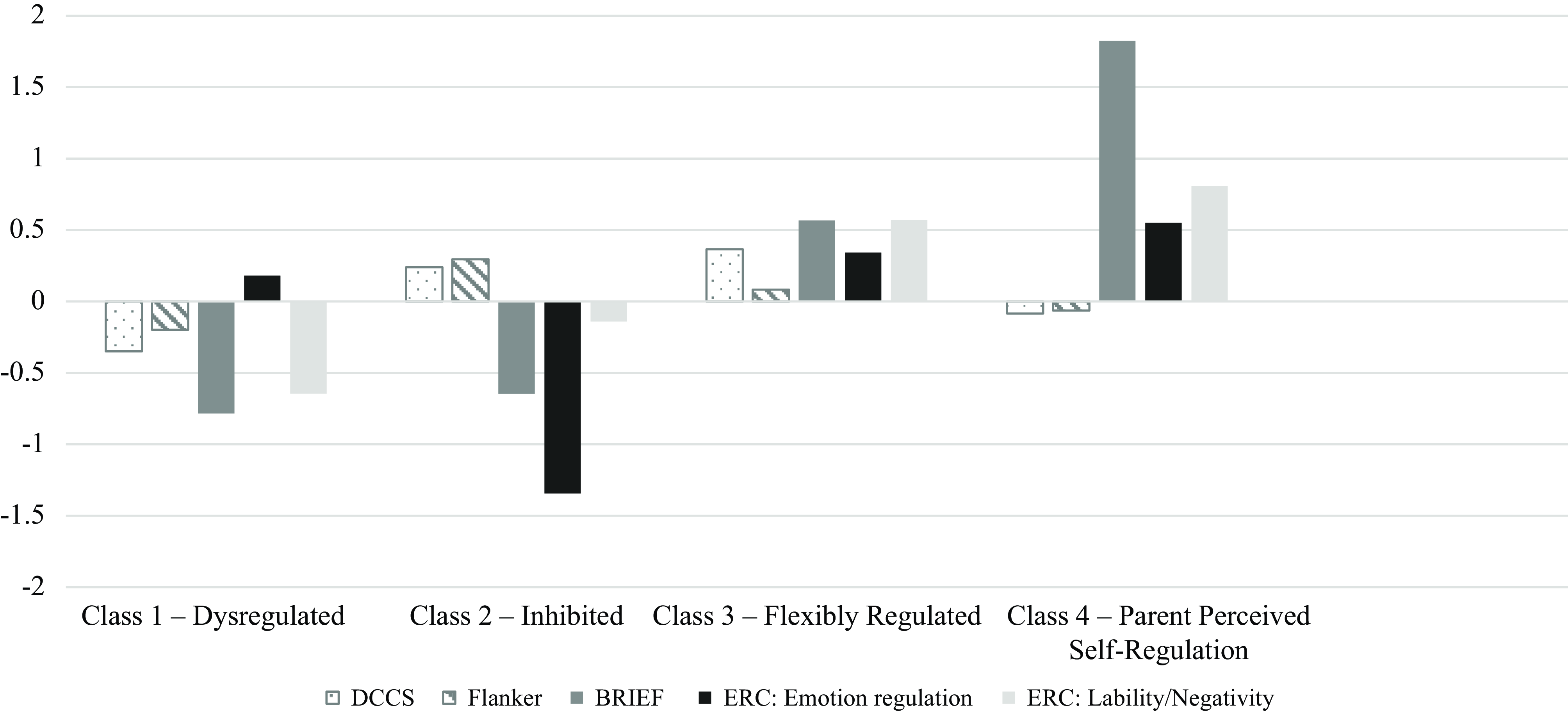
The largest profile, Dysregulated, comprised 38.82% of the children. They showed the lowest performance in executive function tasks and received the lowest parent-rated evaluations. Parents reported high emotion lability but slightly higher than average emotion regulation skills. The second profile, Inhibited, regrouped 18.61% of the children. These children had higher than average scores on the DCCS (cognitive flexibility) and the highest score on the Flanker task (inhibition). However, parents reported very low executive functions and extremely low emotion regulation competencies. The third profile, Flexibly Regulated, represented 28.39% of the children. Children within this profile performed the best on the cognitive flexibility task and had slightly higher than average inhibition. Their parents evaluated emotion regulation and executive functions as being above average. Lastly, children assigned to the fourth profile, Parent Perceived Self-Regulation, included 14.18% of the children. These children had slightly lower than average task performance, but parents evaluated their executive function and emotion regulation as very high. Profiles are presented in Figure 1.
Self-regulation profiles. DCCS = Dimensional Change Card Sort; BRIEF = Behavior Rating Inventory of Executive Function; ERC: Emotion Regulation Checklist. Mean scores are standardized.
Profile membership and socioeconomic characteristics
Analyses were conducted to compare profiles as a function of socioeconomic characteristics and abuse history. For dichotomous variables, mean scores represent a proportion. No differences were found among profiles on variables of child sex, χ 2 = 6.90, p = .08, parent immigrant status χ 2 = 2.68, p = .44, family income χ 2 = 0.37, p = .95, and social neighborhood deprivation χ 2 = 3.16, p = .37. Results indicate that children from the Parent Perceived Self-Regulation profile lived in more materially advantaged neighborhoods than children for the Dysregulated and Inhibited profiles. A lower proportion (26%) of caregivers from the Parent Perceived Self-Regulation profile had a high-school diploma or lower, compared to caregivers from the Dysregulated (48%) and Inhibited profiles (62%), χ2 = 8.86, p = .03. No significant difference was found between the Parent Perceived Self-Regulation and Flexibly Regulated profiles.
Profile membership and abuse history
No differences were found between profiles regarding abuse severity (severe vs very severe abuse) χ 2 = 4.17, p = .24, duration χ 2 = 3.45, p = .33 or parent as a perpetrator χ 2 = 2.65, p = .45. The Parent Perceived Self-Regulation (97.8%) and Inhibited (84.4%) profiles had the highest proportions of children who sustained intrafamilial CSA, compared to the Dysregulated (79.6%) and the Flexibly Regulated (73.4%) profiles. Overall, relative to children in the other profiles, children from the Dysregulated and Inhibited profiles sustained the highest number of other forms of abuse. Detailed results are reported in Table 4.
Fit indices for latent profile models with 1 to 5 profiles

4-profiles solution means of outcomes
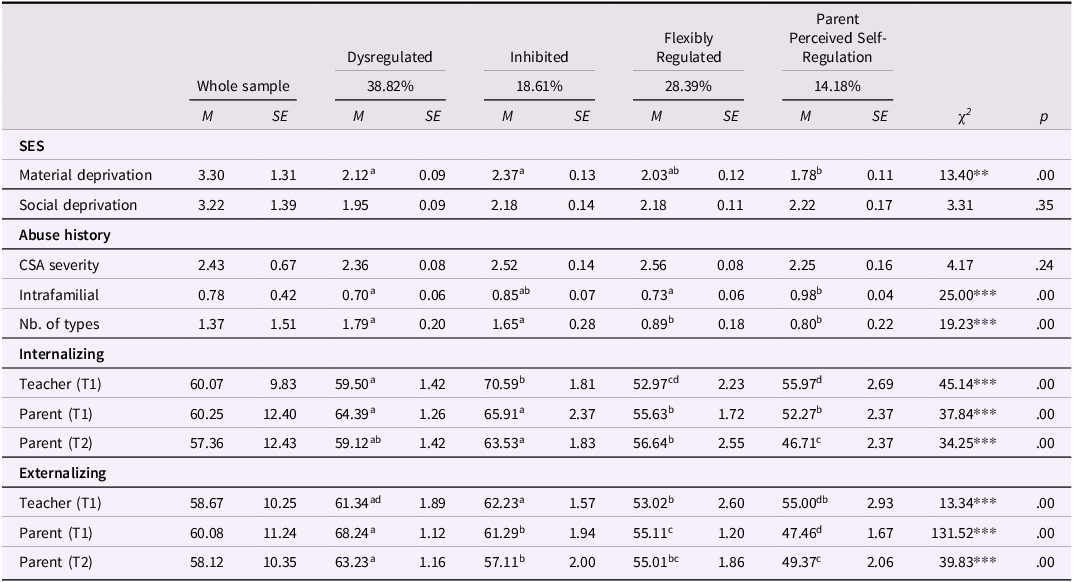
Note. *p < .05; ** p < .01; *** p < .001; different subscript letters denote subgroups whose means differ significantly (p < .05). SES = socioeconomic characteristics. CSA = child sexual abuse. Nb.= number. Low income: familial income lower than 40,000 CAD. Material deprivation and social deprivation refer to neighborhood deprivation.
Profile membership and behavior problems
Analyses were conducted to compare profiles as a function of behavior problems. Detailed results are reported in Table 4.
Internalizing behaviors - first assessment (T1)
According to parents, children from the Dysregulated and Inhibited had significantly higher levels of internalizing behaviors than those in the Flexibly Regulated and Parent Perceived Self-Regulation profiles. No significant differences were found between the Dysregulated and Inhibited profiles, nor between the Flexibly Regulated and Parent Perceived Self-Regulation profiles.
According to teachers, children from the Inhibited profile showed higher internalizing behaviors than children from the three other profiles. Children from the Dysregulated profile displayed significantly more internalizing behaviors than those from the Flexibly Regulated profile. However, their levels were similar to those of children from the Parent Perceived Self-Regulation profile. No significant differences were found between the Flexibly Regulated and the Parent Perceived Self-Regulation profiles.
Internalizing behaviors - second assessment (T2)
Parents reported no significant differences in levels of internalizing behaviors between children from the Dysregulated and Inhibited profiles. Children from the Dysregulated profile showed similar levels of internalizing behaviors than children from the Flexibly Regulated profile, but they showed higher levels than those in the Parent Perceived Self-Regulation profile. Children in the Inhibited profile showed significantly higher levels of internalizing behaviors than children from the Flexibly Regulated and Parent Perceived Self-Regulation profiles. A significant difference was also found between Flexibly Regulated and Parent Perceived Self-Regulation profiles, with children from the Parent Perceived Self-Regulation profile showing the lowest levels of internalizing behaviors.
Externalizing behaviors - first assessment (T1)
Parents reported that children from the Dysregulated profile showed significantly higher externalizing behaviors than children from the three other profiles. Children from the Inhibited profile showed significantly higher levels of externalizing behaviors than children from the Flexibly Regulated and the Parent Perceived Self-Regulation profiles. There was also a significant difference between children from the Flexibly Regulated and the Parent Perceived Self-Regulation profiles, with parents of children from the Parent Perceived Self-Regulation profile reporting the lowest levels of externalizing behaviors.
According to teachers, children from the Dysregulated profile showed more externalizing behaviors at school than children from the Flexibly Regulated profile. No significant differences were found between the Dysregulated and Inhibited profiles for teachers’ rating of externalizing behaviors. The difference between Dysregulated and Parent Perceived Self-Regulation was also not significant. Teachers reported more externalizing symptoms for children from the Inhibited profile than those from the Flexibly Regulated or the Parent Perceived Self-Regulation profiles. No significant differences were found between the Flexibly Regulated and the Parent Perceived Self-Regulation profiles.
Externalizing behaviors - second assessment (T2)
Regarding externalizing behaviors, parents of children from the Dysregulated reported significantly higher scores than those from the three other profiles. Children from the Inhibited profile showed similar levels of externalizing behaviors than children from the Flexibly Regulated profile. A significant difference was also found between children of the Flexibly Regulated and Parent Perceived Self-Regulation profiles. Parents of children from the Parent Perceived Self-Regulation reported significantly less externalizing behaviors than parents of children in the other profiles.
Moderation analyses
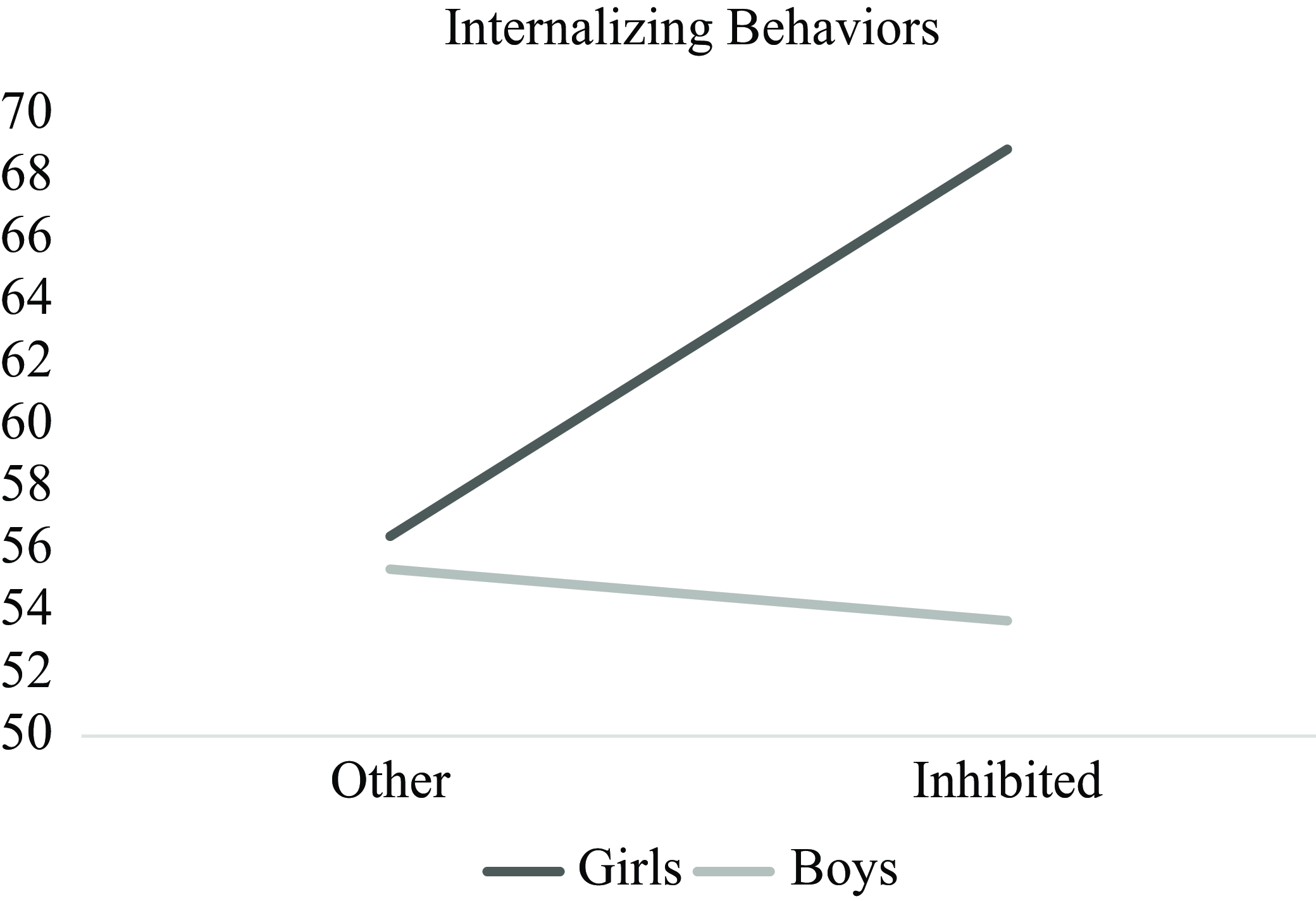
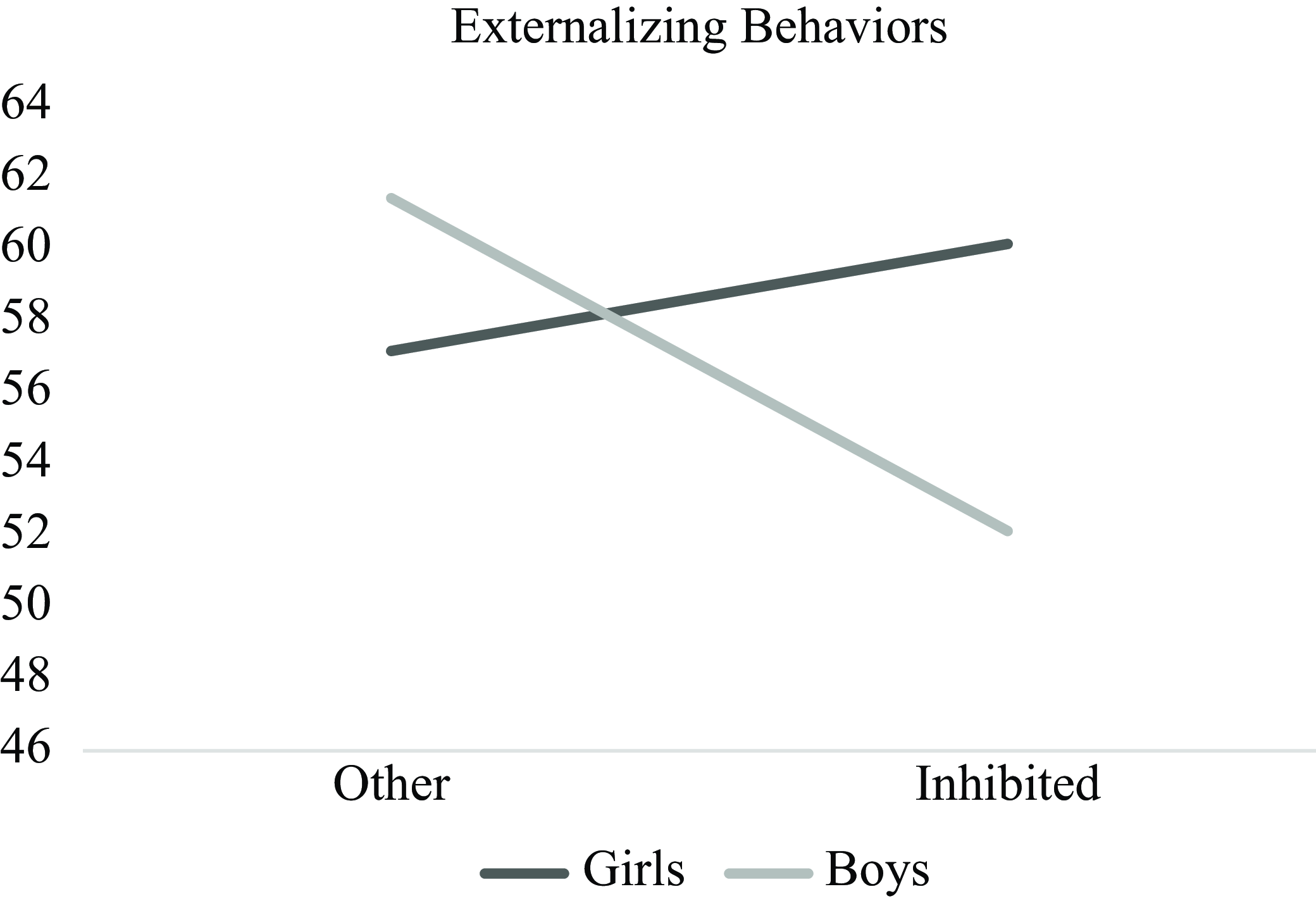
A series of moderation analyses was conducted to examine whether the association between profile classification and behavior problems varied by child’s sex. Figures 2 and 3 illustrate the results. Results revealed that interactions were not significant for parent and teacher-rated behavior problems assessed at Time 1. At the second assessment, interactions were only significant for the Inhibited profile.
Sex as a moderator between being assigned to the inhibited profile and internalizing behaviors. The y-axis represents T-scores on the CBCL.
Sex as a moderator between being assigned to the inhibited profile and externalizing behaviors. The y-axis represents T-scores on the CBCL.
Being assigned to the Inhibited profile predicted parents’ assessment of children’s internalizing behaviors, β = .28, p < .001. Sex did not predict internalizing behaviors β = −.04, p = .66. The profile by sex interaction was significant, β = −.18, p = .002. For girls, being assigned to the Inhibited profile was associated with more internalizing behaviors, β = .26, p < .001, 95% CI [0.15 ∼ 0.37], while for boys, profile assignment was not associated with internalizing behaviors β = −.07, p = .51, 95% CI [−0.32 ∼ 0.13].
The main effect of being assigned to the Inhibited profile on externalizing behavior was not significant β = .11, p = .14. The effect of sex on externalizing behaviors was significant β = .17, p = .05. The profile by sex interaction was also significant β = −.24, p = .003. For boys, being assigned to the Inhibited profile was associated with less externalizing behaviors, β = −.37, p = .002, 95% CI [−0.58 ∼ -0.12], while for girls, profile assignment was not associated with externalizing behaviors β = .10, p = .16, 95% CI [−0.05 ∼ 0.24].
Discussion
The purpose of this study was to delineate profiles of self-regulation in sexually abused children and explore their associations with rearing context, maltreatment history, and behavior problems. Although self-regulation is a known predictor of psychosocial functioning among normative samples of children, research among sexually abused children is limited. By examining the interplay between executive function and emotion regulation among sexually abused children, this study allows for a more nuanced understanding of children’s cognitive, emotional, and behavioral functioning.
Profiles of self-regulation
Results from the latent profile analysis showed four profiles: Dysregulated and Inhibited, Regulated and Parent Perceived Self-Regulation profiles. First, the largest profile, named Dysregulated, was composed of more than a third of our sample (38.82%). These children performed poorly in the tasks, and parents rated them as having the lowest level of executive function and the highest emotion lability. Second, the Inhibited profile was characterized by 18.61% of the sample. These children exhibited higher-than-average cognitive flexibility and the highest level of inhibition. However, parents reported very low emotion regulation competencies, low executive functions, and average emotional lability. Third, the Flexibly Regulated profile, regrouping 28.39% of children, reflected concordance between questionnaires and task performance. Children in this profile performed the best on cognitive flexibility, had higher than average scores in the inhibition task, and parents reported high levels of executive functions and emotion regulation. Fourth, the Parent Perceived self-regulation, representing 14.18% of the sample, was characterized by lower-than-average task performance and very high parent ratings of executive functions and emotion regulation. This profile is deemed discrepant because of the disparity between parents’ ratings of executive function and task performance.
Socioeconomic context and self-regulation profiles
Our study examined the association between sociodemographic and abuse characteristics and profiles. Results show that families of children in the Parent perceived self-regulation profile included a higher proportion of parents who completed post-secondary education and lived in the most economically advantaged neighborhoods compared to children from the Dysregulated and Inhibited profiles. Families of children from Parent Perceived Self-Regulation were similar to those of children in the Flexibly Regulated profile regarding parental level of education and neighborhood disadvantage. These results are partly supported by several studies that found an association between higher socioeconomic status and self-regulation (Johnson et al., Reference Johnson, Riis and Noble2016; Lawson et al., Reference Lawson, Hook and Farah2018; Vrantsidis et al., Reference Vrantsidis, Clark, Chevalier, Espy and Wiebe2020). A generally accepted explanation for this association is that children with highly educated parents have more access to resources, which allows them to provide an environment that facilitates the development of self-regulation. This can be achieved through access to experiences (e.g., visiting libraries), learning opportunities (e.g., books), and positive parental interactions (Rosen et al., Reference Rosen, Hagen, Lurie, Miles, Sheridan, Meltzoff and McLaughlin2020). However, results from our study demonstrate that this association is more complex than previously assumed. For instance, children from the Inhibited profile performed well in the tasks despite having lower socioeconomic status. Nonetheless, they also displayed poor executive functions and emotion regulation at home, which concur with results from previous studies. This highlights the importance of examining children’s overall self-regulation profile using multiple assessment methods.
Maltreatment history and self-regulation profiles
The present study also found that children in the Dysregulated and Inhibited profiles sustained more abuse and interpersonal trauma (i.e., neglect, physical abuse, psychological abuse, exposure to interparental violence) than children in the Parent Perceived Self-Regulation and Flexibly Regulated profiles. These results align with findings from studies showing associations between child maltreatment and self-regulation (Gruhn & Compas, Reference Gruhn and Compas2020; Lund et al., Reference Lund, Toombs, Radford, Boles and Mushquash2020). However, it is important to note that the findings of our study indicate that children in the Inhibited profile showed high performance in the executive functioning tasks, indicating that the association between cumulative maltreatment and task performance is not necessarily linear. One explanation could be that some children having sustained child maltreatment develop better executive functioning skills as a means to adapt to their environment. For example, children exposed to family violence can be more effective at paying attention to danger cues and responding quickly and accurately to instructions to prevent further harm (Mueller & Tronick, Reference Mueller and Tronick2020; Savopoulos et al., Reference Savopoulos, Bryant, Fogarty, Conway, Fitzpatrick, Condron and Giallo2023). A recent study among adult victims of child maltreatment found that they performed better in an inhibition task than their non-abused peers, suggesting that the increased inhibitory ability could be an adaptative process in response to maltreatment (Demers et al., Reference Demers, Hunt, Cicchetti, Cohen-Gilbert, Rogosch, Toth and Thomas2022). However, these abilities can be taxing, as they are susceptible to being paired with increased attention to danger cues (hypervigilance), which may lead to more internalizing problems.
One unexpected finding was that the Parent Perceived Self-Regulation profile was composed almost entirely of children who had sustained intra-familial CSA (97.5%). This could represent a potential explanation for the discrepancy between parent reports and child task performance. In the context of intra-familial abuse, parents may be more likely to underestimate the child’s difficulties as a means to protect the family’s image (Tener, Reference Tener2018). For instance, parents may minimize these difficulties due to the fear that acknowledging them could result in the child being removed from their care by Child Protective Services.
Self-regulation profiles and behavior problems
Another objective of our study was to examine the association between self-regulation profiles and behavior problems. Compared to children from the other profiles, those from the Dysregulated profile showed the highest levels of externalizing behaviors at home at both assessment points. At school, they showed similarly high levels of externalizing behaviors as children in the Inhibited profile but more externalizing behaviors than the two adaptive profiles. Parents and teachers of children in the Dyregulated profile also reported higher internalizing symptoms than children from the Flexibly Regulated and Parent Perceived Self-Regulation profiles. At the second assessment, children from this profile showed the highest level of externalizing behaviors. This suggests that children showing dysregulation are more at risk of displaying externalizing behavior problems over time. These results are in line with our hypothesis and consistent with the current literature on the association between low emotion regulation and behavior problems among sexually abused children (Hébert et al., Reference Hébert, Langevin and Oussaïd2018; Langevin et al., Reference Langevin, Hébert and Cossette2015). Although the association between executive functions and behavior problems has not been previously investigated among sexually abused children, results concur with studies among polyvictimized preschoolers and adolescents, which found an association between poor executive functions and behavior problems (Horn et al., Reference Horn, Roos, Beauchamp, Flannery and Fisher2018; Wei & Lü, Reference Wei and Lü2023).
As for the children from the Inhibited profile, they showed the highest levels of internalizing behavior problems at school and an average score of parent-reported internalizing behaviors that reached the clinical threshold (T > 63). They also displayed similarly high levels of externalizing behaviors at school than children in the Dysregulated profile, but not at home. As these children show the highest levels of inhibitory skills alongside very low levels of emotion regulation skills, it could be inferred that they may be overly inhibited, which may be translated into more internalizing problems. The moderation analyses also indicated a sex by profile interaction. More precisely, for girls, being in the Inhibited profile was associated with more internalizing behaviors, while for boys, it was associated with less externalizing behaviors. This supports the idea that inhibition is susceptible to interact with other variables, such as sex, in the development of adaptative or maladaptive behaviors. These results could be explained by the difference in gender socialization. Indeed, parental expectations for self-regulation tend to be higher in girls, which could lead to more prosocial behaviors and adaptative functioning during normal development (Meland & Kaltvedt, Reference Meland and Kaltvedt2019). However, in the context of child sexual abuse or when living in a family where maltreatment occurs, girls might engage in overly effortful regulation, which could lead to more internalizing behaviors. Although it might appear that being in the Inhibited profile might be a protective factor for boys, it is possible that these children are better at hiding their behaviors from their parents. This is further supported by the fact that children from the Inhibited profile showed subclinical levels of externalizing behaviors at school. Studies have found that parents tend to use harsher parenting practices, such as corporal punishment, in boys compared to girls (Finkelhor et al., Reference Finkelhor, Turner, Wormuth, Vanderminden and Hamby2019; Mehlhausen-Hassoen, Reference Mehlhausen-Hassoen2021). Consequently, lower displays of externalizing behaviors at home could protect them from further harm.
The third group of children, the Flexibly Regulated, showed consistently low levels of behavior problems across settings and time points. This suggests that these children are able to use their self-regulation skills flexibly in different contexts. It could be argued that these children are resilient despite having sustained child sexual abuse. These results are in line with a recent study using latent class analysis, which found that 25% of sexually abused children showed overall low symptomatology following the abuse (Hébert & Amédée, Reference Hébert and Amédée2020).
Finally, children from the Parent Perceived Self-Regulation showed the lowest levels of internalizing and externalizing behavior problems at home. According to teachers, the levels of behavior problems in these children are similar to those observed in children from the Flexibly Regulated profile. These results concur with studies that found a negative association between emotion regulation and behavior problems among sexually abused children (Hébert et al., Reference Hébert, Langevin and Oussaïd2018; Langevin et al., Reference Langevin, Hébert and Cossette2015). This result also aligns with a study that found that adolescents with a profile characterized by lower performance on executive function tasks but higher performance on affective tasks displayed similar levels of adaptation to adolescents with an overall high self-regulation profile (Chaku et al., Reference Chaku, Hoyt and Barry2021). One explanation could be that having high emotion regulation allows children to compensate for having lower-than-average raw executive functions.
Strengths and limitations
This study relied on a relatively large sample of sexually abused children to delineate profiles of self-regulation. Most studies relying on task assessments to measure self-regulation among maltreated children have used small samples (Lund et al., Reference Lund, Toombs, Radford, Boles and Mushquash2020). Using a person-centered approach provided a nuanced understanding of self-regulation among these children. However, some limitations should be noted. Firstly, more than half of our sample had sustained other forms of maltreatment. Therefore, we could not infer that these results are only attributable to child sexual abuse. We also were not able to assess if the profiles differed from those of normative children. Additionally, we did not directly measure working memory, a key executive function, although the DCSS tasks required children to retain the rules in their working memory. Emotion regulation was also only measured with questionnaires, which solely reflected parents’ assessment of children’s emotion regulation and not their raw abilities. Moreover, we only measured behavior problems six months after the first assessment, thus reducing the predictive value of our profiles. Finally, our analyses only included teachers’ ratings of behavior problems at the first assessment. Nonetheless, by using parents’ reports, we were able to show that self-regulation difficulties not only co-occurred with behavior problems but also predicted later adaptation.
Implication for research and practice
Results from this study highlight the heterogeneity found in sexually abused children’s self-regulation. As shown by our results, a large portion of our sample (38.82%) showed very low self-regulation, suggesting that sexually abused children could benefit from intervention targeting self-regulation. However, our results also show that task performance alone is insufficient to predict psychosocial adaptation. Therefore, when evaluating children’s self-regulation among sexually abused children, using multiple methods and multiple informants to gain a more complete picture of children’s abilities is warranted. In particular, our results support the use of specialized intervention programs like Trauma-Focused Cognitive Behavior Therapy, which includes modules targeting emotion regulation (TF-CBT; Cohen et al., Reference Cohen, Mannarino and Deblinger2017). TF-CBT has also been shown to improve executive functioning and emotion regulation. However, more research is needed to understand how this therapeutic approach affects children’s performance in executive function tasks (Lee & Brown, Reference Lee and Brown2022; Thornback & Muller, Reference Thornback and Muller2015).
This study also suggests that the one-size-fits-all intervention on executive function might not work for all children. For example, the Inhibited profile, characterized by more internalizing behaviors, showed the highest level of inhibition and attention. It could be inferred that these children show too much inhibition; therefore, inhibition training might be ineffective or even counterproductive. Future studies using larger samples and longitudinal designs should investigate the processes through which inhibition is associated with adaptation in sexually abused children. Children from the Flexibly Regulated profile may not benefit from executive function intervention, given that their self-regulation skills are already predictive of adaptive functioning. Researchers and clinicians should be attentive to the Parent-Percieved Self-Regulation profile, as parents seem to overestimate some of their children’s abilities and underestimate some of their difficulties.
Conclusion
To our knowledge, this study is the first to assess self-regulation profiles among sexually abused children. By using a person-centered analysis, we were able to highlight the heterogeneity of self-regulation among these children. Four profiles were identified; two profiles showed poor self-regulation, and two showed medium to high self-regulation. Our results suggest that children who sustain the most forms of abuse or trauma will present more self-regulation difficulties. As expected, our findings show that difficulty in self-regulation is associated with more behavior problems, while medium to high self-regulation is associated with better adaptation in sexually abused children. More research is needed to understand if these results persist over time and how familial factors can act as potential protective factors.
Funding statement
This manuscript was submitted in partial fulfillment of the requirements for a Ph.D. degree in psychology. Laetitia Mélissande Amédée was supported by a Vanier Canada Graduate Scholarship. This project was made possible by a grant awarded by the Canadian Institutes of Health Research (# 353537) to Martine Hébert. Martine Hébert and Chantal Cyr are supported by the Canada Research Chairs program.
Competing interests
None.


 Open access

