





1. Introduction
Active microrheology, describing the non-equilibrium mechanics of a probe motion in a colloidal dispersion, is a vibrant research field (Squires & Mason Reference Squires and Mason2010; Puertas & Voigtmann Reference Puertas and Voigtmann2014; Zia Reference Zia2017). The pioneering theoretical paradigm for arbitrary magnitude of the external force, motivated by early experiments (Furst Reference Furst2003; Habdas et al. Reference Habdas, Schaar, Levitt and Weeks2004), was introduced by Squires & Brady (Reference Squires and Brady2005) (denoted hereafter by SB05). The model problem considered by SB05 can be traced back to theoretical investigations of non-Brownian dispersions (Davis & Hill Reference Davis and Hill1992; Almog & Brenner Reference Almog and Brenner1997). It consists of Brownian bath particles dispersed in a viscous liquid (the ‘solvent’), with a Brownian probe being dragged through the dispersion. The probe experiences forces due to both the liquid and the bath particles. Assuming hydrodynamic radii small compared with those representing hard-sphere collisions, SB05 neglected hydrodynamic interactions. The particles therefore interact only through excluded volumes.
Assuming a statistically homogeneous dispersion, SB05 employed an averaging technique, considering both the case where the probe is dragged by a constant force and that where it is dragged at a constant velocity. In the fixed-force problem, they obtained the mean velocity of the probe, while in the fixed-velocity problem they calculated the mean force on the probe. Both averages are functionals of the pair-distribution function $g$
– the conditional probability for finding a bath particle in the vicinity of the probe. By interpreting these averaged relations in the dilute limit via a Stokes law template, SB05 defined an effective viscosity. Its dependence upon the deformed bath-particle microstructure, as expressed via
$g$
– the conditional probability for finding a bath particle in the vicinity of the probe. By interpreting these averaged relations in the dilute limit via a Stokes law template, SB05 defined an effective viscosity. Its dependence upon the deformed bath-particle microstructure, as expressed via $g$
, introduces an implicit nonlinear dependence upon the external forcing. In the dilute limit, the microstructure is governed by an advection–diffusion problem, where the forcing is manifested in a uniform ‘probability advection’, and the excluded-volume interactions are represented by a no-flux condition on an ‘exclusion sphere’, whose radius is the sum of the probe radius and the radius of a bath particle.
$g$
, introduces an implicit nonlinear dependence upon the external forcing. In the dilute limit, the microstructure is governed by an advection–diffusion problem, where the forcing is manifested in a uniform ‘probability advection’, and the excluded-volume interactions are represented by a no-flux condition on an ‘exclusion sphere’, whose radius is the sum of the probe radius and the radius of a bath particle.
In a dimensionless formulation, the microstructure problem is governed by a single parameter, the Péclet number $ P{\kern-1pt}e$
, expressing the magnitude of the external forcing. SB05 solved the leading-order problem for both small and large
$ P{\kern-1pt}e$
, expressing the magnitude of the external forcing. SB05 solved the leading-order problem for both small and large $ P{\kern-1pt}e$
. For small
$ P{\kern-1pt}e$
. For small $ P{\kern-1pt}e$
, they perturbed about the uniform equilibrium distribution. For large
$ P{\kern-1pt}e$
, they perturbed about the uniform equilibrium distribution. For large $ P{\kern-1pt}e$
, they identified a boundary layer about the upstream portion of the exclusion sphere, where
$ P{\kern-1pt}e$
, they identified a boundary layer about the upstream portion of the exclusion sphere, where $g=O( P{\kern-1pt}e)$
; outside that layer
$g=O( P{\kern-1pt}e)$
; outside that layer $g\approx 1$
, except in a downstream wake where
$g\approx 1$
, except in a downstream wake where $g\approx 0$
. SB05 found that the viscosity increment, relative to that of the solvent, approaches finite values in both limits, with the large-
$g\approx 0$
. SB05 found that the viscosity increment, relative to that of the solvent, approaches finite values in both limits, with the large- $ P{\kern-1pt}e$
limit smaller by a factor of two. SB05 verified their ‘force-thinning’ prediction using a semi-numerical solution of the advection–diffusion problem, constructed using eigenfunction expansions.
$ P{\kern-1pt}e$
limit smaller by a factor of two. SB05 verified their ‘force-thinning’ prediction using a semi-numerical solution of the advection–diffusion problem, constructed using eigenfunction expansions.
The force thinning predicted by SB05 is in agreement with the Brownian simulations of Carpen & Brady (Reference Carpen and Brady2005) and is qualitatively supported by experiments (Meyer et al. Reference Meyer, Marshall, Bush and Furst2006; Wilson et al. Reference Wilson, Harrison, Schofield, Arlt and Poon2009; Sriram, Meyer & Furst Reference Sriram, Meyer and Furst2010) carried out under conditions where the hard-sphere model is applicable. The paradigm of SB05 was later generalised to incorporate hydrodynamic interactions for both the fixed-force (Khair & Brady Reference Khair and Brady2006) and fixed-velocity (Swan & Zia Reference Swan and Zia2013) models. The related calculation of probe diffusion under an external force was carried out by Zia & Brady (Reference Zia and Brady2010).
Our interest is in illuminating the approach to the Newtonian plateau at large $ P{\kern-1pt}e$
. To that end, we revisit the problem of SB05, focusing upon the asymptotic limit
$ P{\kern-1pt}e$
. To that end, we revisit the problem of SB05, focusing upon the asymptotic limit $ P{\kern-1pt}e\to \infty$
. Going beyond the leading-order calculation of SB05, we calculate the
$ P{\kern-1pt}e\to \infty$
. Going beyond the leading-order calculation of SB05, we calculate the $\textrm {ord}(1)$
correction to the
$\textrm {ord}(1)$
correction to the $\textrm {ord}( P{\kern-1pt}e)$
approximation for
$\textrm {ord}( P{\kern-1pt}e)$
approximation for $g$
in the boundary layer, observing a divergence at the equator. This breakdown indicates the formation of an equatorial transition region. Continuing downstream, this region connects to a transition layer surrounding the wake. Following asymptotic analysis in the separate asymptotic regions, we obtain a refined large-
$g$
in the boundary layer, observing a divergence at the equator. This breakdown indicates the formation of an equatorial transition region. Continuing downstream, this region connects to a transition layer surrounding the wake. Following asymptotic analysis in the separate asymptotic regions, we obtain a refined large- $ P{\kern-1pt}e$
approximation to the effective viscosity increment. It is corroborated by a finite-difference numerical solution of the microstructure problem.
$ P{\kern-1pt}e$
approximation to the effective viscosity increment. It is corroborated by a finite-difference numerical solution of the microstructure problem.
The paper is arranged as follows. In the next section we review the physical problem addressed by SB05, their key approximations and the averaged expressions they derived for the effective viscosity increment. The advective–diffusive problem governing the deformed microstructure is discussed in § 3. In these two sections we generally follow the notation of SB05, although certain deviations were found beneficial. Section 4 describes the force thinning discovered by SB05 and outlines the objective of the present contribution in that context. The boundary-layer problem is analysed in § 5. The equatorial-region scalings are identified in § 6, where an appropriate universal problem is formulated and solved. The effective viscosity increment is calculated in § 7. The transition layer surrounding the wake is discussed in § 8. In § 9 we describe a finite-difference scheme for the solution of the microstructure problem, tailored to the boundary-layer structure at large $ P{\kern-1pt}e$
. We conclude in § 10, proposing possible future extensions.
$ P{\kern-1pt}e$
. We conclude in § 10, proposing possible future extensions.
2. Background: effective viscosity
The system considered by SB05 consists of a colloidal ‘probe’ particle and colloidal ‘bath’ particles (average number density $n$
), dispersed in a liquid bath of viscosity
$n$
), dispersed in a liquid bath of viscosity $\eta$
. The self-diffusivities of the probe and bath particles are denoted by
$\eta$
. The self-diffusivities of the probe and bath particles are denoted by $D_a$
and
$D_a$
and $D_b$
, respectively. The interaction (e.g. electrostatic or steric) between the particles is modelled via excluded volumes, with the hard-sphere radii of the probe and bath particles denoted by
$D_b$
, respectively. The interaction (e.g. electrostatic or steric) between the particles is modelled via excluded volumes, with the hard-sphere radii of the probe and bath particles denoted by $a$
and
$a$
and $b$
, respectively. These are assumed sufficiently larger than the hydrodynamic radii, so the hydrodynamic interactions can be neglected. The hydrodynamic radii, which determine the hydrodynamic mobilities, do not play an explicit role in the following description.
$b$
, respectively. These are assumed sufficiently larger than the hydrodynamic radii, so the hydrodynamic interactions can be neglected. The hydrodynamic radii, which determine the hydrodynamic mobilities, do not play an explicit role in the following description.
The probe is dragged by an external force $F$
in a fixed direction in space, specified by the unit vector
$F$
in a fixed direction in space, specified by the unit vector $\hat {\boldsymbol {{k}}}$
. By averaging over all possible configurations of the bath particles, it was shown by SB05 that the average probe velocity
$\hat {\boldsymbol {{k}}}$
. By averaging over all possible configurations of the bath particles, it was shown by SB05 that the average probe velocity $\langle \boldsymbol {U} \rangle$
is given by
$\langle \boldsymbol {U} \rangle$
is given by
 \begin{align} \langle \boldsymbol {U} \rangle = \frac {D_a}{k_BT}\left [\hat {\boldsymbol {{k}}} F - nk_BT\oint _{|\boldsymbol {x}|=a+b} \hat {\boldsymbol {n}} g(\boldsymbol {x}/\ell )\, \mathrm {d} S\right ]. \end{align}
Here, $k_BT$
is the thermal energy and
$k_BT$
is the thermal energy and $g(\boldsymbol {x}/\ell )$
is the pair-distribution function – the conditional probability density for finding a bath particle at position
$g(\boldsymbol {x}/\ell )$
is the pair-distribution function – the conditional probability density for finding a bath particle at position $\boldsymbol {x}$
relative to the probe particle. The integration is carried out over an ‘exclusion sphere’, of radius
$\boldsymbol {x}$
relative to the probe particle. The integration is carried out over an ‘exclusion sphere’, of radius $a+b$
, centred about the probe. The normalising length scale
$a+b$
, centred about the probe. The normalising length scale $\ell$
is to be specified later. Note that the pre-factor
$\ell$
is to be specified later. Note that the pre-factor $D_a/k_BT$
is the Stokes–Einstein mobility in free solution.
$D_a/k_BT$
is the Stokes–Einstein mobility in free solution.
By symmetry $\langle \boldsymbol {U} \rangle$
is in the direction of
$\langle \boldsymbol {U} \rangle$
is in the direction of $\hat {\boldsymbol {{k}}}$
. SB05 introduced a Stokes drag interpretation for the probe motion,
$\hat {\boldsymbol {{k}}}$
. SB05 introduced a Stokes drag interpretation for the probe motion,
 \begin{align} \hat {\boldsymbol {{k}}} F = \frac {\eta _{\textit{eff}}}{\eta } \frac {k_BT}{D_a}\langle \boldsymbol {U} \rangle , \end{align}
which serves to define an effective viscosity $\eta _{\textit{eff}}$
of the bath. Substitution into (2.1) yields, upon forming the dot product with
$\eta _{\textit{eff}}$
of the bath. Substitution into (2.1) yields, upon forming the dot product with $\hat {\boldsymbol {{k}}}$
,
$\hat {\boldsymbol {{k}}}$
,
 \begin{align} \frac {\eta }{\eta _{\textit{eff}}} = 1-\frac {nk_BT}{F}\hat {\boldsymbol {{k}}}\boldsymbol {\cdot }\oint _{|\boldsymbol {x}|=a+b} \hat {\boldsymbol {n}} g(\boldsymbol {x}/\ell )\, \mathrm {d} S. \end{align}
SB05 also considered the companion problem where the probe is dragged at a fixed speed, say $U$
, in a fixed direction specified by the unit vector
$U$
, in a fixed direction specified by the unit vector $\hat {\boldsymbol {{k}}}$
. Here they found that (2.1) is replaced by
$\hat {\boldsymbol {{k}}}$
. Here they found that (2.1) is replaced by
 \begin{align} \hat {\boldsymbol {{k}}} U = \frac {D_a}{k_BT}\left [\langle \boldsymbol {F} \rangle - nk_BT\oint _{|\boldsymbol {x}|=a+b} \hat {\boldsymbol {n}} g(\boldsymbol {x}/\ell )\, \mathrm {d} S\right ], \end{align}
wherein $\langle \boldsymbol {F} \rangle$
is the average external force required to drag the probe, which by symmetry is in the direction of
$\langle \boldsymbol {F} \rangle$
is the average external force required to drag the probe, which by symmetry is in the direction of $\hat {\boldsymbol {{k}}}$
. The Stokes law interpretation used in this fixed-velocity case is
$\hat {\boldsymbol {{k}}}$
. The Stokes law interpretation used in this fixed-velocity case is
 \begin{align} \langle \boldsymbol {F} \rangle = \frac {\eta _{\textit{eff}}}{\eta }\frac {k_BT}{D_a} U \hat {\boldsymbol {{k}}}. \end{align}
Substitution into (2.4) yields, upon forming the dot product with $\hat {\boldsymbol {{k}}}$
,
$\hat {\boldsymbol {{k}}}$
,
 \begin{align} \frac {\eta _{\textit{eff}}} {\eta }= 1+\frac {nD_a}{U}\hat {\boldsymbol {{k}}}\boldsymbol {\cdot }\oint _{|\boldsymbol {x}|=a+b} \hat {\boldsymbol {n}} g(\boldsymbol {x}/\ell )\, \mathrm {d} S. \end{align}
The rheological quantity of interest is the viscosity increment $\eta _{\textit{eff}}-\eta$
. For a dilute dispersion, the fractional increment for a fixed force is found from (2.3) as
$\eta _{\textit{eff}}-\eta$
. For a dilute dispersion, the fractional increment for a fixed force is found from (2.3) as
 \begin{align} \frac {\eta _{\textit{eff}}-\eta } {\eta }=\frac {nk_BT}{F}\hat {\boldsymbol {{k}}}\boldsymbol {\cdot }\oint _{|\boldsymbol {x}|=a+b} \hat {\boldsymbol {n}} g(\boldsymbol {x}/\ell )\, \mathrm {d} S. \end{align}
Similarly, the fractional increment for a fixed velocity is found from (2.6) as
 \begin{align} \frac {\eta _{\textit{eff}}-\eta } {\eta }=\frac {nD_a}{U}\hat {\boldsymbol {{k}}}\boldsymbol {\cdot }\oint _{|\boldsymbol {x}|=a+b} \hat {\boldsymbol {n}} g(\boldsymbol {x}/\ell )\, \mathrm {d} S \end{align}
(which is not restricted to dilute systems). By defining the velocity scale
 \begin{align} U \stackrel {\text {def}}{=} \frac {D_a}{k_BT}F \end{align}
for the fixed-force problem, the fixed-force expression (2.7) coincides with the fixed-velocity expression (2.8). We shall use the latter.
At this stage a dimensionless notation is beneficial, using the position vector $\boldsymbol {r}=\boldsymbol {x}/\ell$
and the differential areal element
$\boldsymbol {r}=\boldsymbol {x}/\ell$
and the differential areal element $\mathrm {d}{A}=\mathrm {d} S / \ell ^2$
. The Péclet number is defined as
$\mathrm {d}{A}=\mathrm {d} S / \ell ^2$
. The Péclet number is defined as
 \begin{align} P{\kern-1pt}e = \frac {U\ell }{D}, \end{align}
where $D$
is the diffusivity of a bath particle relative to the probe. Upon choosing
$D$
is the diffusivity of a bath particle relative to the probe. Upon choosing $\ell$
as dimensional radius of the exclusion sphere,
$\ell$
as dimensional radius of the exclusion sphere,
 \begin{align} \ell =a+b, \end{align}
approximation (2.8) reads
 \begin{align} \frac {\eta _{\textit{eff}}-\eta } {\eta }=\frac {3\phi }{4\pi P{\kern-1pt}e}\frac {D_a}{D} \left(\frac {a+b}{b}\right)^3\hat {\boldsymbol {{k}}}\boldsymbol {\cdot }\oint _{|\boldsymbol {r}|=1} \hat {\boldsymbol {n}} g(\boldsymbol {r})\, \mathrm {d}{A}. \end{align}
Here $\phi =(4\pi b^3/3)n$
is the average volume fraction of the bath particles. With definition (2.9), (2.12) applies for both the fixed-force and fixed-velocity scenarios. As explained by SB05,
$\phi =(4\pi b^3/3)n$
is the average volume fraction of the bath particles. With definition (2.9), (2.12) applies for both the fixed-force and fixed-velocity scenarios. As explained by SB05, $D=D_a+D_b$
for the fixed-force problem and
$D=D_a+D_b$
for the fixed-force problem and $D=D_b$
for the fixed-velocity problem.
$D=D_b$
for the fixed-velocity problem.
Defining
 \begin{align} {V} = \frac {3}{2\pi P{\kern-1pt}e}\hat {\boldsymbol {{k}}}\boldsymbol {\cdot }\oint _{|\boldsymbol {r}|=1} \hat {\boldsymbol {n}} g(\boldsymbol {r})\, \mathrm {d}{A}, \end{align}
the fractional increment (2.12) is factored as
 \begin{align} \frac {\eta _{\textit{eff}}-\eta } {\eta }=\frac {\phi }{2}\frac {D_a}{D}\left (\frac {a+b}{b}\right )^3 {V}. \end{align}
The quantity $V$
isolates the effect of external forcing upon the fractional viscosity increment. Its pre-factor in (2.14) is independent of that forcing.
$V$
isolates the effect of external forcing upon the fractional viscosity increment. Its pre-factor in (2.14) is independent of that forcing.
3. Microstructure
The evaluation of the viscosity increment using (2.13)–(2.14) amounts to the calculation of the pair-distribution function $g$
. Using a reference frame moving with the probe, SB05 derived the problem governing
$g$
. Using a reference frame moving with the probe, SB05 derived the problem governing $g$
in the dilute limit. It consists of the advection–diffusion equation
$g$
in the dilute limit. It consists of the advection–diffusion equation
 \begin{align} \boldsymbol {\nabla } \boldsymbol {\cdot } (\boldsymbol {\nabla } g+ P{\kern-1pt}e \,\hat {\boldsymbol {{k}}} \,g) = 0, \end{align}
the no-flux condition
 \begin{align} \hat {\boldsymbol {n}} \boldsymbol {\cdot } ( \boldsymbol {\nabla } g+ P{\kern-1pt}e \,\hat {\boldsymbol {{k}}} \,g) = 0 \quad \text {at}\; |\boldsymbol {r}|=1 \end{align}
and the far-field condition
 \begin{align} \lim _{|\boldsymbol {r}|\to \infty }g=1. \end{align}
The above linear problem defines $g(\boldsymbol {r})$
as a (nonlinear) function of the single parameter
$g(\boldsymbol {r})$
as a (nonlinear) function of the single parameter $ P{\kern-1pt}e$
.
$ P{\kern-1pt}e$
.
We employ here cylindrical coordinates $(\varpi ,\varphi ,z)$
, with the
$(\varpi ,\varphi ,z)$
, with the $z$
axis pointing in the direction
$z$
axis pointing in the direction $\hat {\boldsymbol {{k}}}$
and the origin at
$\hat {\boldsymbol {{k}}}$
and the origin at $\boldsymbol {r}=\boldsymbol {0}$
, as well as spherical polar coordinates
$\boldsymbol {r}=\boldsymbol {0}$
, as well as spherical polar coordinates $(r,\theta ,\varphi )$
with the polar angle
$(r,\theta ,\varphi )$
with the polar angle $\theta$
measured from the positive
$\theta$
measured from the positive $z$
axis. The exclusion sphere now coincides with
$z$
axis. The exclusion sphere now coincides with $r=1$
. By axial symmetry,
$r=1$
. By axial symmetry, $g$
is independent of the azimuthal angle
$g$
is independent of the azimuthal angle $\varphi$
. The advection–diffusion equation (3.1) is alternatively written
$\varphi$
. The advection–diffusion equation (3.1) is alternatively written
 \begin{align} \nabla ^2 g + P{\kern-1pt}e \frac {\partial g}{\partial z} = 0. \end{align}
Since the boundary condition (3.2) applies at $r=1$
, where
$r=1$
, where $\hat {\boldsymbol {n}}=\hat {\boldsymbol {e}}_r$
, it simplifies to
$\hat {\boldsymbol {n}}=\hat {\boldsymbol {e}}_r$
, it simplifies to
 \begin{align} \frac {\partial g}{\partial r} + P{\kern-1pt}e \,g \cos \theta = 0\quad \text {at} \; r=1. \end{align}
Also, condition (3.3) becomes
 \begin{align} \lim _{r\to \infty }g=1. \end{align}
When using spherical coordinates, we write (with a slight abuse of notation) $g(r,\theta ; P{\kern-1pt}e)$
instead of
$g(r,\theta ; P{\kern-1pt}e)$
instead of $g(\boldsymbol {r})$
. Equation (3.4) then reads
$g(\boldsymbol {r})$
. Equation (3.4) then reads
 \begin{align} \frac {\partial ^2g}{\partial r^2} + \frac {2}{r}\frac {\partial g}{\partial r} + \frac {1}{r^2\sin \theta } \frac {\partial }{\partial \theta } \left (\sin \theta \, \frac {\partial g}{\partial \theta }\right )+ P{\kern-1pt}e\left (\cos \theta \frac {\partial g}{\partial r} - \frac {\sin \theta }{r}\frac {\partial g}{\partial \theta }\right ) =0. \end{align}
Equations (3.5)–(3.7) define a linear problem governing $g$
. With
$g$
. With $\mathrm {d}{A}=2\pi \sin \theta \,\mathrm {d}\theta$
at
$\mathrm {d}{A}=2\pi \sin \theta \,\mathrm {d}\theta$
at $r=1$
, expression (2.13) simplifies to
$r=1$
, expression (2.13) simplifies to
 \begin{align} {V}( P{\kern-1pt}e) = \frac {3}{ P{\kern-1pt}e}\int _0^\pi g(1,\theta ; P{\kern-1pt}e)\sin \theta \cos \theta \, \mathrm {d} \theta . \end{align}
For future reference, we also write the governing equations in the cylindrical coordinates, where (with another abuse of notation) the pair-distribution function is referred to as $g(\varpi ,z; P{\kern-1pt}e)$
. Equation (3.4) then reads
$g(\varpi ,z; P{\kern-1pt}e)$
. Equation (3.4) then reads
 \begin{align} \frac {\partial ^2g}{\partial \varpi ^2} + \frac {1}{\varpi }\frac {\partial g}{\partial \varpi } + \frac {\partial ^2g}{\partial z^2} + P{\kern-1pt}e\, \frac {\partial g}{\partial z} =0, \end{align}
while condition (3.5) becomes
 \begin{align} \varpi \frac {\partial g}{\partial \varpi } + z\frac {\partial g}{\partial z} + P{\kern-1pt}e \,g z = 0\quad \text {at} \ \varpi ^2+z^2=1. \end{align}
4. From small to large $ P{\kern-1pt}e$

SB05 considered both small and large $ P{\kern-1pt}e$
. For small
$ P{\kern-1pt}e$
. For small $ P{\kern-1pt}e$
, perturbing upon a uniform distribution of
$ P{\kern-1pt}e$
, perturbing upon a uniform distribution of $g$
, they obtained
$g$
, they obtained
 \begin{align} g-1 \approx \frac { P{\kern-1pt}e}{2}\cos \theta , \end{align}
from which they found that
 \begin{align} \lim _{ P{\kern-1pt}e\to 0}{V}( P{\kern-1pt}e) =1. \end{align}
At the limit of large $ P{\kern-1pt}e$
, SB05 identified three asymptotic regions: a boundary layer of
$ P{\kern-1pt}e$
, SB05 identified three asymptotic regions: a boundary layer of $O( P{\kern-1pt}e^{-1})$
width, where
$O( P{\kern-1pt}e^{-1})$
width, where $g=O( P{\kern-1pt}e)$
, about the upstream portion of the exclusion sphere; an advection-dominated region outside it, where
$g=O( P{\kern-1pt}e)$
, about the upstream portion of the exclusion sphere; an advection-dominated region outside it, where $g\approx 1$
; and a wake downstream of the sphere, where
$g\approx 1$
; and a wake downstream of the sphere, where $g\approx 0$
, bounded by the cylindrical surface
$g\approx 0$
, bounded by the cylindrical surface $\varpi =1$
. Using the leading-order boundary-layer solution, SB05 found that
$\varpi =1$
. Using the leading-order boundary-layer solution, SB05 found that
 \begin{align} \lim _{ P{\kern-1pt}e\to \infty }{V}( P{\kern-1pt}e) =\frac {1}{2}. \end{align}
To illustrate the force thinning from (4.2) to (4.3), SB05 also addressed the problem of arbitrary $ P{\kern-1pt}e$
. Thus, by transforming (3.4) to a modified Helmholtz equation, SB05 obtained a semi-numerical solution of
$ P{\kern-1pt}e$
. Thus, by transforming (3.4) to a modified Helmholtz equation, SB05 obtained a semi-numerical solution of $g$
using an eigenfunction expansion.
$g$
using an eigenfunction expansion.
Our interest is in the approach to the large- $ P{\kern-1pt}e$
Newtonian plateau (4.3). As a prelude to our analysis, we illustrate in figure 1 the numerical solution of the problem (3.4)–(3.6) for
$ P{\kern-1pt}e$
Newtonian plateau (4.3). As a prelude to our analysis, we illustrate in figure 1 the numerical solution of the problem (3.4)–(3.6) for $ P{\kern-1pt}e=100$
, using a finite-difference scheme. The scalings indicated in the figure hint towards the asymptotic investigation in the next sections. The numerical scheme itself is discussed in § 9.
$ P{\kern-1pt}e=100$
, using a finite-difference scheme. The scalings indicated in the figure hint towards the asymptotic investigation in the next sections. The numerical scheme itself is discussed in § 9.
Top: diagram of the microstructure problem (3.4)–(3.6) for the pair-distribution function $g$
outside the exclusion sphere
$g$
outside the exclusion sphere $r=1$
, with arrows indicating the streaming flow in the probe-fixed reference frame. The
$r=1$
, with arrows indicating the streaming flow in the probe-fixed reference frame. The $g$
contours (calculated numerically using the finite-difference method described in § 9 with
$g$
contours (calculated numerically using the finite-difference method described in § 9 with $ P{\kern-1pt}e = 100$
) illustrate the typical structure of the solution for large
$ P{\kern-1pt}e = 100$
) illustrate the typical structure of the solution for large $ P{\kern-1pt}e$
, with the asymptotic estimates of
$ P{\kern-1pt}e$
, with the asymptotic estimates of $g$
derived in §§ 5, 6 and 8. Bottom: schematic illustrating the two-part non-uniform numerical grid. The dashed segment is the equator
$g$
derived in §§ 5, 6 and 8. Bottom: schematic illustrating the two-part non-uniform numerical grid. The dashed segment is the equator $\theta =\pi /2$
.
$\theta =\pi /2$
.

5. The limit
$ P{\kern-1pt}e\gg 1$
: boundary-layer analysis

Henceforth, we consider the limit
 \begin{align} P{\kern-1pt}e\gg 1. \end{align}
At leading order, it follows from the governing equation (3.4) that $g$
is uniform on ‘streamlines’ parallel to
$g$
is uniform on ‘streamlines’ parallel to $\hat {\boldsymbol {{k}}}$
, i.e.
$\hat {\boldsymbol {{k}}}$
, i.e.
 \begin{align} g \text { is a function of $\varpi $ alone}. \end{align}
It then follows from the far-field condition (3.6) that
 \begin{align} g\approx 1. \end{align}
This solution, however, cannot satisfy the no-flux condition (3.5) at leading order. A boundary layer is therefore formed about the exclusion sphere $r=1$
. In the terminology of matched asymptotic expansions (Hinch Reference Hinch1991) the solution (5.3) is regarded as an ‘outer’ one. We note that it is an exact solution of (3.4) and (3.6) at all algebraic orders. We therefore conclude that
$r=1$
. In the terminology of matched asymptotic expansions (Hinch Reference Hinch1991) the solution (5.3) is regarded as an ‘outer’ one. We note that it is an exact solution of (3.4) and (3.6) at all algebraic orders. We therefore conclude that
 \begin{align} g=1+\exp , \end{align}
wherein ‘exp’ stands for exponentially small terms – that is, terms that are asymptotically smaller than any negative powers of $ P{\kern-1pt}e$
– which are triggered by asymptotic matching.
$ P{\kern-1pt}e$
– which are triggered by asymptotic matching.
Following SB05, we examine a boundary layer of $O( P{\kern-1pt}e^{-1})$
width where
$O( P{\kern-1pt}e^{-1})$
width where $g$
is
$g$
is $O( P{\kern-1pt}e)$
. We employ the rescaled radial coordinate
$O( P{\kern-1pt}e)$
. We employ the rescaled radial coordinate
 \begin{align} r = 1 + P{\kern-1pt}e^{-1}\zeta , \end{align}
and define
 \begin{align} g(r,\theta ; P{\kern-1pt}e) = {p}(\zeta ,\theta ; P{\kern-1pt}e). \end{align}
Upon using (5.5)–(5.6), the advection–diffusion equation (3.7) becomes
 \begin{align} \frac {\partial ^2{p}}{\partial \zeta ^2} & + \frac {\partial {p}}{\partial \zeta } \cos \theta + P{\kern-1pt}e^{-1}\left (2\frac {\partial {p}}{\partial \zeta } - \frac {\partial {p}}{\partial \theta } \sin \theta \right ) \nonumber \\ &+ P{\kern-1pt}e^{-2}\left [-2\zeta \frac {\partial {p}}{\partial \zeta } + \frac {1}{\sin \theta }\frac {\partial }{\partial \theta }\left (\sin \theta \,\frac {\partial {p}}{\partial \theta }\right ) + \zeta \sin \theta \,\frac {\partial {p}}{\partial \theta }\right ] + O( P{\kern-1pt}e^{-3}{p}) = 0, \end{align}
while the no-flux condition (3.5) reads
 \begin{align} \frac {\partial {p}}{\partial \zeta } + {p} \cos \theta = 0 \quad \text {at} \ \zeta = 0. \end{align}
In addition, $p$
must also satisfy
$p$
must also satisfy
 \begin{align} \lim _{\zeta \to \infty } {p} = 1, \end{align}
representing asymptotic matching with (5.4).
The governing equation (5.7) is integrated once using condition (5.8) to yield
 \begin{align} \frac {\partial {p}}{\partial \zeta } + {p} \cos \theta = & P{\kern-1pt}e^{-1} \int _0^\zeta \left (-2\frac {\partial {p}}{\partial \zeta } + \frac {\partial {p}}{\partial \theta } \sin \theta \right ) \, \mathrm {d}\zeta \nonumber \\ + & P{\kern-1pt}e^{-2}\int _0^\zeta \left [2\zeta \frac {\partial {p}}{\partial \zeta } - \frac {1}{\sin \theta }\frac {\partial }{\partial \theta }\left (\sin \theta \,\frac {\partial {p}}{\partial \theta }\right ) - \zeta \sin \theta \,\frac {\partial {p}}{\partial \theta } \right ] \mathrm {d}{\zeta } + O( P{\kern-1pt}e^{-3}{p}) . \end{align}
In what follows, we solve (5.10) subject to (5.9). Since $p=O( P{\kern-1pt}e)$
, we expand it as
$p=O( P{\kern-1pt}e)$
, we expand it as
 \begin{align} {p}(\zeta ,\theta ; P{\kern-1pt}e)= P{\kern-1pt}e\, {p}_{-1}(\zeta ,\theta ) + {p}_0(\zeta ,\theta ) + P{\kern-1pt}e^{-1} {p}_1(\zeta ,\theta ) + O( P{\kern-1pt}e^{-2}), \end{align}
and solve order by order.
5.1. Evaluation of
${p}_{-1}$

At $\textrm {ord}( P{\kern-1pt}e)$
the problem posed by (5.10) and (5.9) reads
$\textrm {ord}( P{\kern-1pt}e)$
the problem posed by (5.10) and (5.9) reads
 \begin{align} \frac {\partial {p}_{-1}}{\partial \zeta } + {p}_{-1} \cos \theta = 0, \quad \lim _{\zeta \to \infty } {p}_{-1} = 0. \end{align}
The solution of (5.12 a) is
 \begin{align} {p}_{-1}(\zeta ,\theta ) = f_{-1}(\theta )\mathrm {e}^{-\zeta \cos \theta }. \end{align}
To satisfy condition (5.12 b), the boundary layer must be restricted to the upstream hemisphere:
 \begin{align} 0 \lt \theta \lt \pi /2, \end{align}
whereby (5.12 b) is trivially satisfied. We note that
 \begin{align} \int _0^\infty {p}_{-1}(\zeta ,\theta ) \, \mathrm {d}{\zeta } = \frac {f_{-1}(\theta )}{\cos \theta }. \end{align}
5.2. Wake
In the absence of a boundary layer at the ‘back’ hemisphere, the outer solution downstream must satisfy the no-flux condition (3.10). The only possible solution of (5.2) which is compatible with that condition at leading order is the trivial one. It therefore follows that $g$
must vanish in a wake downstream of the exclusion sphere. Since the trivial solution satisfies (3.9) and (3.10) exactly, we conclude that (cf. (5.4))
$g$
must vanish in a wake downstream of the exclusion sphere. Since the trivial solution satisfies (3.9) and (3.10) exactly, we conclude that (cf. (5.4))
 \begin{align} g = \exp \quad \text {for}\ \varpi \lt 1 \ `\text {behind' the exclusion sphere}. \end{align}
5.3. Solvability
We determine $f_{-1}(\theta )$
by a solvability condition which we derive at the next asymptotic order. At
$f_{-1}(\theta )$
by a solvability condition which we derive at the next asymptotic order. At $\textrm {ord}(1)$
, equation (5.10) and condition (5.9) give, respectively,
$\textrm {ord}(1)$
, equation (5.10) and condition (5.9) give, respectively,
 \begin{align} \frac {\partial {p}_0}{\partial \zeta } + {p}_0 \cos \theta = -2 \left .{p}_{-1}\right |_0^\zeta + \sin \theta \frac {\partial }{\partial \theta } \int _0^\zeta {p}_{-1}\,\mathrm {d}{\zeta }, \end{align}
 \begin{align} \lim _{\zeta \to \infty } {p}_0 = 1. \end{align}
We can derive the requisite solvability condition by evaluating (5.17) at $\zeta =\infty$
using (5.13)–(5.15) and (5.18) to obtain the first-order ordinary differential equation
$\zeta =\infty$
using (5.13)–(5.15) and (5.18) to obtain the first-order ordinary differential equation
 \begin{align} 1 = 2\frac {f_{-1}(\theta )}{\cos \theta } + \tan \theta \,\frac {\mathrm {d} }{\mathrm {d} \theta }\left [\frac {f_{-1}(\theta )}{\cos \theta }\right ], \end{align}
whose general solution is
 \begin{align} \frac {f_{-1}(\theta )}{\cos \theta } = \frac {1}{2} + \frac {C_{-1}}{\sin ^2\theta }. \end{align}
Requiring regularity at $\theta =0$
necessitates
$\theta =0$
necessitates $C_{-1}=0$
. Thus,
$C_{-1}=0$
. Thus, $f_{-1}(\theta )= (1/2)\cos \theta $
. Substitution into (5.13) gives
$f_{-1}(\theta )= (1/2)\cos \theta $
. Substitution into (5.13) gives
 \begin{align} {p}_{-1}(\zeta ,\theta ) = \frac {\cos \theta }{2}\,\mathrm {e}^{-\zeta \cos \theta } . \end{align}
We note that
 \begin{align} \int _0^\zeta {p}_{-1}(\zeta ,\theta ) \,\mathrm {d}{\zeta } = \frac {1-\mathrm {e}^{-\zeta \cos \theta }}{2} \end{align}
and
 \begin{align} \int _0^\infty \zeta {p}_{-1}(\zeta ,\theta ) \,\mathrm {d}{\zeta } = \frac {1}{2\cos \theta }. \end{align}
Substitution into (3.8) of (5.11) and (5.21) reproduces (4.3), already obtained by SB05. (SB05 did not employ a solvability approach; rather, they obtained the counterpart of the present $f_{-1}$
using an integral flux argument. Note that (4.3) was derived in Appendix D of Khair & Brady (Reference Khair and Brady2006) using a solvability approach.) To go beyond this leading-order result we need the
$f_{-1}$
using an integral flux argument. Note that (4.3) was derived in Appendix D of Khair & Brady (Reference Khair and Brady2006) using a solvability approach.) To go beyond this leading-order result we need the $\textrm {ord}(1)$
term
$\textrm {ord}(1)$
term ${p}_0$
.
${p}_0$
.
5.4. Evaluation of
${p}_0$

We can now actually solve for $ {p}_0$
. Substituting (5.21)–(5.22) into (5.17) yields
$ {p}_0$
. Substituting (5.21)–(5.22) into (5.17) yields
 \begin{gather} \frac {\partial {p}_0}{\partial \zeta } + {p}_0 \cos \theta = (1-\mathrm {e}^{-\zeta \cos \theta })\cos \theta - \frac {\zeta }{2}\mathrm {e}^{-\zeta \cos \theta }\sin ^2\theta . \end{gather}
Using the integrating factor $\mathrm {e}^{\zeta \cos \theta }$
we find that the general solution of this first-order equation is
$\mathrm {e}^{\zeta \cos \theta }$
we find that the general solution of this first-order equation is
 \begin{gather} {p}_0(\zeta ,\theta ) = f_0(\theta )\mathrm {e}^{-\zeta \cos \theta } + 1 - \zeta \mathrm {e}^{-\zeta \cos \theta }\cos \theta - \frac {\zeta ^2}{4}\mathrm {e}^{-\zeta \cos \theta }\sin ^2\theta . \end{gather}
Given (5.14), condition (5.18) is trivially satisfied.
To derive a solvability condition on $f_0$
, we continue to the next asymptotic order. At
$f_0$
, we continue to the next asymptotic order. At $\textrm {ord}( P{\kern-1pt}e^{-1})$
, we find from (5.10) that
$\textrm {ord}( P{\kern-1pt}e^{-1})$
, we find from (5.10) that
 \begin{align} \frac {\partial {p}_1}{\partial \zeta } + {p}_1 \cos \theta & = -2\left .{p}_0\right |_0^\zeta + \sin \theta \frac {\partial }{\partial \theta } \int _0^\zeta {p}_0\,\mathrm {d}\zeta \nonumber \\ & \quad + 2 \int _0^\zeta \zeta \frac {\partial {p}_{-1}}{\partial \zeta } \,\mathrm {d}\zeta - \frac {1}{\sin \theta }\frac {\partial }{\partial \theta }\left (\sin \theta \,\frac {\partial }{\partial \theta } \int _0^\zeta {p}_{-1} \mathrm {d}\zeta \right ) \nonumber \\ &\quad - \sin \theta \,\frac {\partial }{\partial \theta } \int _0^\zeta \zeta {p}_{-1}\, \mathrm {d}{\zeta }. \end{align}
This equation is subject to
 \begin{align} \lim _{\zeta \to \infty } {p}_1 = 0, \end{align}
obtained from (5.9).
We now apply the limit $\zeta \to \infty$
to (5.26), where its left-hand side vanishes by virtue of (5.27). The various terms on the right-hand side of (5.26) are evaluated in that limit using (5.21)–(5.22) and (5.25). The first term is simply
$\zeta \to \infty$
to (5.26), where its left-hand side vanishes by virtue of (5.27). The various terms on the right-hand side of (5.26) are evaluated in that limit using (5.21)–(5.22) and (5.25). The first term is simply $2f_0(\theta )$
. In evaluating the second term, interchanging the order of integration and differentiation requires some care. Making use of
$2f_0(\theta )$
. In evaluating the second term, interchanging the order of integration and differentiation requires some care. Making use of
 \begin{align} \int _0^\infty [{p}_0(\zeta ,\theta ) - 1]\,\mathrm {d}\zeta = \frac {f_0(\theta )}{\cos \theta } - \frac {1}{\cos \theta } - \frac {\sin ^2\theta }{2\cos ^3\theta }, \end{align}
this term is obtained as
 \begin{align} \sin \theta \,\frac {\mathrm {d} }{\mathrm {d} \theta } \left [\frac {f_0(\theta )}{\cos \theta } - \frac {1}{\cos \theta } - \frac {\sin ^2\theta }{2\cos ^3\theta }\right ]. \end{align}
Integration by parts of the third term gives $-1$
. The fourth term vanishes, while the fifth, using (5.23), is
$-1$
. The fourth term vanishes, while the fifth, using (5.23), is $ ({1}/{2})\tan ^2\theta$
. Adding these up we obtain the first-order ordinary differential equation
$ ({1}/{2})\tan ^2\theta$
. Adding these up we obtain the first-order ordinary differential equation
 \begin{align} \sin \theta \,\frac {\mathrm {d} }{\mathrm {d} \theta } \left [\frac {f_0(\theta )}{\cos \theta }\right ] + 2f_0(\theta ) = \frac {1}{\cos ^2\theta } + \frac {3\sin ^2\theta }{2\cos ^4 \theta }, \end{align}
whose general solution is
 \begin{align} \frac {f_0(\theta )}{\cos \theta } = \frac {C_0}{\sin ^2\theta } + \frac {1}{2\cos ^3\theta }. \end{align}
Regularity at $\theta =0$
yields
$\theta =0$
yields $C_0 = 0$
. Substitution back into (5.25) then furnishes the result
$C_0 = 0$
. Substitution back into (5.25) then furnishes the result
 \begin{align} {p}_0(\zeta ,\theta )=1 + \mathrm {e}^{-\zeta \cos \theta }\left (\frac {1}{2\cos ^2\theta } - \zeta \cos \theta - \frac {\zeta ^2}{4}\sin ^2\theta \right ). \end{align}
Thus, the boundary-layer solution is
 \begin{align} {p}(\zeta ,\theta ; P{\kern-1pt}e) & = P{\kern-1pt}e\,\frac {\cos \theta }{2}\mathrm {e}^{-\zeta \cos \theta } \nonumber \\ & \qquad + \left \{1 + \mathrm {e}^{-\zeta \cos \theta }\left (\frac {1}{2\cos ^2\theta } - \zeta \cos \theta - \frac {\zeta ^2}{4}\sin ^2\theta \right )\right \} + O( P{\kern-1pt}e^{-1}). \end{align}
In particular,
 \begin{align} {p}(0,\theta ; P{\kern-1pt}e) = P{\kern-1pt}e \frac {\cos \theta }{2} + \left (1 + \frac {1}{2\cos ^2\theta }\right ) + O( P{\kern-1pt}e^{-1}). \end{align}
5.5. Boundary-layer breakdown
The solution (30) proposed by SB05 for the boundary-layer problem, while not originally posed as an asymptotic expansion, is eventually recast in (35) as the sum of an $\textrm {ord}( P{\kern-1pt}e)$
term and an
$\textrm {ord}( P{\kern-1pt}e)$
term and an $\textrm {ord}(1)$
term. Ignoring slight typos, the first term agrees with the present (5.21). (The exponent appearing in equation (30) of SB05 is dimensional; apparently, the factor
$\textrm {ord}(1)$
term. Ignoring slight typos, the first term agrees with the present (5.21). (The exponent appearing in equation (30) of SB05 is dimensional; apparently, the factor $U/D$
there needs to be removed. The exponent appearing in equation (35) of SB05,
$U/D$
there needs to be removed. The exponent appearing in equation (35) of SB05, $-Uz\cos\theta/D$
, while dimensionless, does not agree with the correct one
$-Uz\cos\theta/D$
, while dimensionless, does not agree with the correct one $-\zeta\cos\theta$
. For it to agree,
$-\zeta\cos\theta$
. For it to agree, $\cos\theta$
must be removed and
$\cos\theta$
must be removed and $z$
needs to be replaced with the projection
$z$
needs to be replaced with the projection $z-(a+b)\cos\theta$
. In any event, these typos do not affect equation (36) of SB05).
$z-(a+b)\cos\theta$
. In any event, these typos do not affect equation (36) of SB05).
The uniform $\textrm {ord}(1)$
term in equation (35) of SB05 is tantamount, in the present notation, to
$\textrm {ord}(1)$
term in equation (35) of SB05 is tantamount, in the present notation, to ${p}_0=1$
. This term does not satisfy condition (5.8) at
${p}_0=1$
. This term does not satisfy condition (5.8) at $\textrm {ord}(1)$
, and is therefore erroneous. The error is carried to equation (36) of SB05 – the counterpart of the present (5.34). The oversight of SB05 (propagated into the microrheology literature – see (26) of Puertas & Voigtmann (Reference Puertas and Voigtmann2014)) may be traced to their original (30), which seems like an attempt to superpose upon the boundary-layer solution a constant term that satisfies the approach to the uniform outer solution.
$\textrm {ord}(1)$
, and is therefore erroneous. The error is carried to equation (36) of SB05 – the counterpart of the present (5.34). The oversight of SB05 (propagated into the microrheology literature – see (26) of Puertas & Voigtmann (Reference Puertas and Voigtmann2014)) may be traced to their original (30), which seems like an attempt to superpose upon the boundary-layer solution a constant term that satisfies the approach to the uniform outer solution.
The oversight did not affect the remaining analysis of SB05, who were only interested in the leading-order viscosity increment. In going beyond that leading-order calculation, however, the difference between equation (36) of SB05 and the present (5.34) is striking. Indeed, a naive attempt to substitute (5.34) into (3.8) so as to obtain the asymptotic correction to (4.3) would fail: due to the $1/\cos ^2\theta$
term in (5.34), the integral appearing in (3.8) diverges logarithmically at
$1/\cos ^2\theta$
term in (5.34), the integral appearing in (3.8) diverges logarithmically at $\textrm {ord}(1)$
. This failure indicates a breakdown of expansion (5.11), and with it the very boundary-layer structure, as
$\textrm {ord}(1)$
. This failure indicates a breakdown of expansion (5.11), and with it the very boundary-layer structure, as $\theta \nearrow \pi /2$
. It suggests the asymptotic formation of a transition region about the equator
$\theta \nearrow \pi /2$
. It suggests the asymptotic formation of a transition region about the equator $\theta = \pi /2$
, which we address next.
$\theta = \pi /2$
, which we address next.
6. Equatorial region
With the first term in the parentheses of (5.32) diverging as $\theta \nearrow \pi /2$
, the boundary-layer solution (5.11) breaks down near the equator. Introducing for convenience the latitude angle
$\theta \nearrow \pi /2$
, the boundary-layer solution (5.11) breaks down near the equator. Introducing for convenience the latitude angle
 \begin{gather} \vartheta = \frac {\pi }{2} - \theta \ll 1, \end{gather}
we observe that the two asymptotic terms in (5.34) behave there as $ ({1}/{2}) P{\kern-1pt}e\,\vartheta$
and
$ ({1}/{2}) P{\kern-1pt}e\,\vartheta$
and $ ({1}/{2})\vartheta ^{-2}$
, respectively. Hence, these terms become comparable at
$ ({1}/{2})\vartheta ^{-2}$
, respectively. Hence, these terms become comparable at
 \begin{align} \vartheta = O( P{\kern-1pt}e^{-1/3}), \end{align}
for which
 \begin{align} g = O( P{\kern-1pt}e^{2/3}). \end{align}
Considering now (5.21) and noting that $\zeta \cos \theta \sim \zeta \vartheta$
near the equator, we see that the boundary layer ‘expands’ in the radial direction to
$\zeta \cos \theta \sim \zeta \vartheta$
near the equator, we see that the boundary layer ‘expands’ in the radial direction to $\zeta =O( P{\kern-1pt}e^{1/3})$
, or, equivalently (recall (5.5)), to
$\zeta =O( P{\kern-1pt}e^{1/3})$
, or, equivalently (recall (5.5)), to
 \begin{align} r-1 = O( P{\kern-1pt}e^{-2/3}). \end{align}
We therefore investigate an equatorial region, of $O( P{\kern-1pt}e^{-1/3})$
angular extent about the equator and
$O( P{\kern-1pt}e^{-1/3})$
angular extent about the equator and $O( P{\kern-1pt}e^{-2/3})$
radial extent about
$O( P{\kern-1pt}e^{-2/3})$
radial extent about $r=1$
, where the pair-distribution function is
$r=1$
, where the pair-distribution function is $O( P{\kern-1pt}e^{2/3})$
(see figure 1).
$O( P{\kern-1pt}e^{2/3})$
(see figure 1).
6.1. Stretched cylindrical coordinates
In order to gain physical intuition for the transition region, we consider first stretched cylindrical coordinates on the scales (6.2) and (6.4):
 \begin{align} t = - P{\kern-1pt}e^{1/3} z, \quad y = P{\kern-1pt}e^{2/3}(\varpi -1). \end{align}
Defining
 \begin{align} g(\varpi ,z; P{\kern-1pt}e) = {G}(y,t; P{\kern-1pt}e), \end{align}
equation (3.9) becomes
 \begin{align} \frac {\partial {G}}{\partial t}=\frac {\partial ^2{G}}{\partial y^2 } + P{\kern-1pt}e^{-2/3} \left (\frac {\partial {G}}{\partial y} + \frac {\partial ^2{G}}{\partial t^2 } \right )+ O \big( P{\kern-1pt}e^{-4/3} \big). \end{align}
We interpret this as a perturbed one-dimensional heat equation, with the downstream coordinate being a time-like variable. With the surface $\varpi ^2+z^2=1$
becoming
$\varpi ^2+z^2=1$
becoming
 \begin{align} y = -\frac {t^2}{2} - P{\kern-1pt}e^{-2/3} \frac {t^4}{8} + O \big( P{\kern-1pt}e^{-4/3} \big), \end{align}
condition (3.10) reads, on that surface,
 \begin{align} \frac {\partial {G}}{\partial y} - t {G} + P{\kern-1pt}e^{-2/3} \left (y \frac {\partial {G}}{\partial y} + t \frac {\partial {G}}{\partial t}\right ) = 0. \end{align}
We interpret this as a ‘parabolically’ moving no-flux boundary, with perturbations. Equations (6.7)–(6.9) are subject to the condition
 \begin{align} \lim _{y \to \infty } {G} = 1, \end{align}
representing asymptotic matching with (5.4).
Following (6.3), we pose the asymptotic expansion
 \begin{align} {G}(y,t; P{\kern-1pt}e) = P{\kern-1pt}e^{2/3} {G}_{-2}(y,t) + O(1). \end{align}
At $O( P{\kern-1pt}e^{2/3})$
, we then find from (6.7)–(6.10) that
$O( P{\kern-1pt}e^{2/3})$
, we then find from (6.7)–(6.10) that
 \begin{align} \frac {\partial {G}_{-2}}{\partial t} = \frac {\partial ^2{G}_{-2}}{\partial y^2} \quad \text {for}\ y \gt -\frac {t^2}{2}, \\[-24pt] \nonumber \end{align}
 \begin{align} \frac {\partial {G}_{-2}}{\partial y} = t {G}_{-2} \quad \text {at}\ y = -\frac {t^2}{2}, \\[-24pt] \nonumber \end{align}
 \begin{align} \lim _{t \to \infty } {G}_{-2} = 0. \end{align}
The partial differential equation (6.12) is parabolic with a time-like coordinate $t$
. Hence, we require an ‘initial condition’, which is obtained from matching with the boundary-layer solution (5.11) in the limit
$t$
. Hence, we require an ‘initial condition’, which is obtained from matching with the boundary-layer solution (5.11) in the limit $t\to -\infty$
. Using the leading-order boundary-layer solution (5.21) in conjunction with (6.26), this requirement yields the limiting behaviour
$t\to -\infty$
. Using the leading-order boundary-layer solution (5.21) in conjunction with (6.26), this requirement yields the limiting behaviour
 \begin{align} {G}_{-2} \sim -\frac {t}{2} \mathrm {e}^{ty+t^3/2} \quad \text {as} \ t\to -\infty \ \text {with} \ \text {$ty+\frac {t^3}{2}$ fixed}. \end{align}
Further, we can derive a conservation law for ${G}_{-2}$
as follows. Integration of (6.12) from
${G}_{-2}$
as follows. Integration of (6.12) from $y=-t^2/2$
to
$y=-t^2/2$
to $\infty$
yields, upon making use of (6.13)–(6.14),
$\infty$
yields, upon making use of (6.13)–(6.14),
 \begin{align} \int _{-t^2/2}^\infty \frac {\partial {G}_{-2}}{\partial t} \, \mathrm {d} y + t {G}_{-2}(-t^2/2,t) = 0, \end{align}
or, making use of Leibniz’s rule,
 \begin{align} \frac {\mathrm {d} }{\mathrm {d} t} \int _{-t^2/2}^\infty {G}_{-2} (y,t) \, \mathrm {d} y = 0, \end{align}
so that $\int _{-t^2/2}^\infty {G}_{-2}(y,t) \, \mathrm {d} y$
is independent of
$\int _{-t^2/2}^\infty {G}_{-2}(y,t) \, \mathrm {d} y$
is independent of $t$
; substitution of (6.15) then yields
$t$
; substitution of (6.15) then yields
 \begin{align} \int _{-t^2/2}^\infty {G}_{-2}(y,t)\, \mathrm {d} y = \frac {1}{2} \quad \text {for all }t. \end{align}
The leading-order equatorial transport (6.12)–(6.13) can be interpreted as a one-dimensional heat-like equation with a no-flux boundary that first ( $t\lt 0$
) moves in and accumulates the pair-distribution probability in its way, and then (
$t\lt 0$
) moves in and accumulates the pair-distribution probability in its way, and then ( $t\gt 0$
) moves out again, leaving behind a diffusing peak. Thus, the ‘local’ behaviour of the transition-region solution far downstream, unaffected by the boundary condition that has moved far away, is that of the unbounded heat equation:
$t\gt 0$
) moves out again, leaving behind a diffusing peak. Thus, the ‘local’ behaviour of the transition-region solution far downstream, unaffected by the boundary condition that has moved far away, is that of the unbounded heat equation:
 \begin{align} {G}_{-2}(y,t) \sim \frac {Q}{(4\pi t)^{1/2}} \mathrm {e}^{-{y^2}/{4t}} \quad \text {as} \ t\to \infty \ \text {with} \ y^2/t \ \text{fixed}. \end{align}
From (6.18) we then find
 \begin{align} Q=\frac {1}{2}. \end{align}
6.2. Stretched spherical coordinates
With the differential equation (6.12) adopting a simple form, the formulation in terms of the $(y,t)$
coordinates is physically illuminating. For numerical and asymptotic calculations, however, it is preferable for the exclusion-sphere boundary to coincide with a coordinate surface. We therefore employ another local formulation in term of stretched spherical coordinates
$(y,t)$
coordinates is physically illuminating. For numerical and asymptotic calculations, however, it is preferable for the exclusion-sphere boundary to coincide with a coordinate surface. We therefore employ another local formulation in term of stretched spherical coordinates $(X,Y)$
, defined by
$(X,Y)$
, defined by
 \begin{align} r = 1 + P{\kern-1pt}e^{-2/3} Y, \quad \theta = \frac {\pi }{2} - P{\kern-1pt}e^{-1/3} X, \end{align}
and replace (6.6) with
 \begin{align} g(r,\theta ; P{\kern-1pt}e) = \tilde G(X,Y; P{\kern-1pt}e). \end{align}
Introducing (6.21)–(6.22) into (3.7) and (3.5) gives
 \begin{align} \frac {\partial ^2\tilde G}{\partial Y^2} + X \frac {\partial \tilde G}{\partial Y} + \frac {\partial \tilde G}{\partial X} +O( P{\kern-1pt}e^{-2/3}\tilde G) = 0 \quad \text {for} \ Y \gt 0 , \\[-24pt] \nonumber \end{align}
 \begin{align} \frac {\partial \tilde G}{\partial Y} + X\tilde G + O( P{\kern-1pt}e^{-2/3}\tilde G) = 0 \quad \text {at} \ Y = 0. \end{align}
These equations are subject to the condition
 \begin{align} \lim _{Y \to \infty } \tilde G = 1, \end{align}
representing asymptotic matching with (5.4).
Similarly to (6.11), we pose the asymptotic expansion
 \begin{align} \tilde G(X,Y; P{\kern-1pt}e) = P{\kern-1pt}e^{2/3} \tilde G_{-2}(X,Y) + O(1). \end{align}
At $O( P{\kern-1pt}e^{2/3})$
, we then find from (6.23)–(6.25) that
$O( P{\kern-1pt}e^{2/3})$
, we then find from (6.23)–(6.25) that
 \begin{align} \frac {\partial ^2\tilde G_{-2}}{\partial Y^2 } + X \frac {\partial \tilde G_{-2}}{\partial Y} + \frac {\partial \tilde G_{-2}}{\partial X} = 0 \quad \text {for}\ Y \gt 0, \end{align}
 \begin{align} \frac {\partial \tilde G_{-2}}{\partial Y} + X\tilde G_{-2} = 0 \quad \text {at}\ Y = 0, \\[-24pt] \nonumber \end{align}
 \begin{align} \lim _{Y \to \infty } \tilde G_{-2} = 0. \end{align}
As before, the ‘initial condition’ is obtained from matching with the boundary-layer solution (5.11) in the limit $X \to \infty$
. This gives
$X \to \infty$
. This gives
 \begin{align} \tilde G_{-2} \sim \frac {X}{2}\mathrm {e}^{-XY} \quad \text {as} \ X \to \infty \ \text {with} \ \text {$XY$ fixed}. \end{align}
We again derive a conservation law. Integration of (6.27) from $Y=0$
to
$Y=0$
to $\infty$
yields, upon making use of (6.28)–(6.29),
$\infty$
yields, upon making use of (6.28)–(6.29),
 \begin{align} \quad \int _0^\infty \frac {\partial \tilde G_{-2}}{\partial X}\,\mathrm {d} Y=0 \quad \text {for all }X. \end{align}
Interchanging the order of integration and imposing the initial condition (6.30) reveals that
 \begin{align} \int _0^\infty \tilde G_{-2}(X,Y)\, \mathrm {d} Y = \frac {1}{2} \quad \text {for all }X. \end{align}
We note that the problem (6.27)–(6.29) is recovered from (6.12)–(6.14) by the transformation
 \begin{align} t \mapsto -X, \quad y \mapsto Y - \frac {X^2}{2}, \quad G_{-2} \mapsto \tilde {G}_{-2}. \end{align}
Thus, (6.30) and (6.32) directly follow from (6.15) and (6.18), respectively.
Performing a local analysis in the limit $X \to \infty$
with
$X \to \infty$
with $XY$
fixed, we find using (6.27)–(6.29) that (6.30) is refined to
$XY$
fixed, we find using (6.27)–(6.29) that (6.30) is refined to
 \begin{align} \tilde G_{-2} = \left [\frac {X}{2} + \left (\frac {1}{2X^2} - \frac {Y^2}{4}\right ) + o(X^{-2})\right ]\mathrm {e}^{-XY} \quad \text {as} \ X \to \infty \ \text {with} \ \text {$XY$ fixed}. \end{align}
Note that the second term in the brackets matches the boundary-layer correction (5.32).
We solve the universal problem (6.27)–(6.30) numerically using a finite-difference method. The $Y$
direction is discretised using an exponentially stretched grid with relative resolution 0.1 %, and the solution is evolved in the time-like coordinate X from the initial condition (6.34) at
$Y$
direction is discretised using an exponentially stretched grid with relative resolution 0.1 %, and the solution is evolved in the time-like coordinate X from the initial condition (6.34) at $X = 10$
in steps of size
$X = 10$
in steps of size $0.001$
to
$0.001$
to $X = -10$
. The resulting variation of
$X = -10$
. The resulting variation of $\tilde G_{-2}$
with
$\tilde G_{-2}$
with $Y$
at certain values of
$Y$
at certain values of $X$
in that range is displayed in figure 2.
$X$
in that range is displayed in figure 2.
Variation of the leading-order equatorial deformation $\tilde G_{-2}$
with
$\tilde G_{-2}$
with $Y$
for the indicated positive values of
$Y$
for the indicated positive values of $X$
, as obtained from the numerical solution of the universal problem. The inset shows the comparable variations for
$X$
, as obtained from the numerical solution of the universal problem. The inset shows the comparable variations for $X\leqslant 0$
. The dotted curve depicts the far-field solution (6.19)–(6.20), transformed using (6.33) for
$X\leqslant 0$
. The dotted curve depicts the far-field solution (6.19)–(6.20), transformed using (6.33) for $X=-10$
.
$X=-10$
.

In terms of the $(X,Y)$
coordinates, the local far-field solution (6.19)–(6.20) represents a diffusing Gaussian at large negative
$(X,Y)$
coordinates, the local far-field solution (6.19)–(6.20) represents a diffusing Gaussian at large negative $X$
, centred about
$X$
, centred about $Y=X^2/2$
with peak value
$Y=X^2/2$
with peak value $(-16\pi X)^{-1/2}$
. This explains the pulse-like behaviour observed in the inset of figure 2, as illustrated there for
$(-16\pi X)^{-1/2}$
. This explains the pulse-like behaviour observed in the inset of figure 2, as illustrated there for $X=-10$
.
$X=-10$
.
Both the refined behaviour (6.34) and the numerical results for $\tilde G_{-2}$
at
$\tilde G_{-2}$
at $Y=0$
are required in the asymptotic evaluation of the effective viscosity, which is performed next.
$Y=0$
are required in the asymptotic evaluation of the effective viscosity, which is performed next.
7. Evaluation of
$V$

We can now evaluate $V$
at large
$V$
at large $ P{\kern-1pt}e$
, going beyond (4.3). Given (5.16), the integral in (3.8) only needs to be taken up to a small angle past the equator
$ P{\kern-1pt}e$
, going beyond (4.3). Given (5.16), the integral in (3.8) only needs to be taken up to a small angle past the equator $\theta =\pi /2$
. Recalling (see (6.2)) that the angular extent of the equatorial region is
$\theta =\pi /2$
. Recalling (see (6.2)) that the angular extent of the equatorial region is $O( P{\kern-1pt}e^{-1/3})$
, we may replace (3.8) by
$O( P{\kern-1pt}e^{-1/3})$
, we may replace (3.8) by
 \begin{align} {V}( P{\kern-1pt}e) = \frac {3}{ P{\kern-1pt}e}\int _0^{\frac {\pi }{2}+\varDelta } g(1,\theta ; P{\kern-1pt}e)\sin \theta \cos \theta \, \mathrm {d} \theta , \end{align}
where the choice
 \begin{align} P{\kern-1pt}e^{-1/3}\ll \varDelta \ll 1 \end{align}
ensures that the entire contribution of the equatorial region is covered.
On the upstream hemisphere $0 \lt \theta \lt \pi /2$
, the boundary-layer solution is given by (cf. (5.34))
$0 \lt \theta \lt \pi /2$
, the boundary-layer solution is given by (cf. (5.34))
 \begin{align} g(1,\theta ; P{\kern-1pt}e) = P{\kern-1pt}e \frac {\cos \theta }{2} + \left (1 + \frac {1}{2\cos ^2\theta }\right ) + O( P{\kern-1pt}e^{-1}). \end{align}
Using (6.21)–(6.22) and the equatorial-region solution (6.26), we find that near the equator
 \begin{gather} g(1,\theta ; P{\kern-1pt}e) = P{\kern-1pt}e^{2/3} \tilde G_{-2}\left (X= P{\kern-1pt}e^{1/3}({\pi }/{2}-\theta ),Y=0\right ) + O(1). \end{gather}
Our goal is to evaluate the integral appearing in (7.1) using these two complementary approximations. The $\textrm {ord}( P{\kern-1pt}e)$
contribution to that integral is obtained as
$\textrm {ord}( P{\kern-1pt}e)$
contribution to that integral is obtained as $ P{\kern-1pt}e/6$
from integrating the leading term in (7.3) over the upstream hemisphere (5.14). This contribution reproduces the leading-order approximation (4.3).
$ P{\kern-1pt}e/6$
from integrating the leading term in (7.3) over the upstream hemisphere (5.14). This contribution reproduces the leading-order approximation (4.3).
In going beyond $\textrm {ord}( P{\kern-1pt}e)$
we expect two
$\textrm {ord}( P{\kern-1pt}e)$
we expect two $\textrm {ord}(1)$
contributions to the integral. The first originates in the
$\textrm {ord}(1)$
contributions to the integral. The first originates in the $\textrm {ord}(1)$
correction in (7.3), integrated over the upstream hemisphere. The second arises from the leading
$\textrm {ord}(1)$
correction in (7.3), integrated over the upstream hemisphere. The second arises from the leading $\textrm {ord}( P{\kern-1pt}e^{2/3})$
term in the equatorial-region expansion (7.4): indeed, we note that
$\textrm {ord}( P{\kern-1pt}e^{2/3})$
term in the equatorial-region expansion (7.4): indeed, we note that $\cos \theta = \textrm {ord}( P{\kern-1pt}e^{-1/3})$
there, as is the extent of the integration domain.
$\cos \theta = \textrm {ord}( P{\kern-1pt}e^{-1/3})$
there, as is the extent of the integration domain.
Due to the diverging term in the $\textrm {ord}(1)$
correction in (7.3), the associated hemispherical integral diverges towards the equator; this divergence is cut off by the equatorial-region solution: see indeed (6.34). We therefore anticipate (Hinch Reference Hinch1991) that the
$\textrm {ord}(1)$
correction in (7.3), the associated hemispherical integral diverges towards the equator; this divergence is cut off by the equatorial-region solution: see indeed (6.34). We therefore anticipate (Hinch Reference Hinch1991) that the $\textrm {ord}(1)$
contribution incorporates logarithms of
$\textrm {ord}(1)$
contribution incorporates logarithms of $ P{\kern-1pt}e$
.
$ P{\kern-1pt}e$
.
Employing the cutoff-like parameter (cf. (7.2))
 \begin{align} P{\kern-1pt}e^{-1/3}\ll \chi \ll 1, \end{align}
we split the integral appearing in (7.1) at $\theta = \pi /2-\chi$
. Thus, we write it as
$\theta = \pi /2-\chi$
. Thus, we write it as
 \begin{align} \left (\int _0^{\frac {\pi }{2}-\chi } + \int _{\frac {\pi }{2}-\chi }^{\frac {\pi }{2}+\varDelta }\right )g(1,\theta ; P{\kern-1pt}e)\sin \theta \cos \theta \, \mathrm {d} \theta \stackrel {\text {def}}{=} I_{\textit{hemisphere}} + I_{\textit{equator}} . \end{align}
We now proceed to evaluate the integral to $\textrm {ord}(1)$
in the limit
$\textrm {ord}(1)$
in the limit $ P{\kern-1pt}e\gg 1$
. The result must be independent of both
$ P{\kern-1pt}e\gg 1$
. The result must be independent of both $\varDelta$
and
$\varDelta$
and $\chi$
.
$\chi$
.
Using the boundary-layer approximation (7.3) we readily find the ‘hemispherical’ contribution:
 \begin{align} I_{\textit{hemisphere}}\sim P{\kern-1pt}e\frac {1 - \sin ^3\chi }{6} + \frac {\cos ^2\chi - \ln\sin \chi }{2}, \end{align}
which becomes, upon making use of (7.5),
 \begin{align} I_{\textit{hemisphere}} \sim P{\kern-1pt}e \frac {1 - \chi ^3}{6} + \frac {1 - \ln \chi }{2}. \end{align}
The asymptotic error in (7.8) is algebraically small, i.e. smaller than some negative power of $ P{\kern-1pt}e$
. We identify the above-mentioned
$ P{\kern-1pt}e$
. We identify the above-mentioned $ P{\kern-1pt}e/6$
term, which reproduces (4.3). It is accompanied by the
$ P{\kern-1pt}e/6$
term, which reproduces (4.3). It is accompanied by the $\textrm {ord}(1)$
term
$\textrm {ord}(1)$
term $1/2$
, as well as intermediate terms (note that
$1/2$
, as well as intermediate terms (note that $ P{\kern-1pt}e\, \chi ^3\gg 1$
) that depend upon
$ P{\kern-1pt}e\, \chi ^3\gg 1$
) that depend upon $\chi$
. These must be cancelled out by the ‘equatorial’ contribution.
$\chi$
. These must be cancelled out by the ‘equatorial’ contribution.
Using (6.21), the equatorial contribution is
 \begin{align} I_{\textit{equator}} \sim \int _{-\textit { Pe}^{1/3}\varDelta }^{\textit { Pe}^{1/3}\chi } \tilde G_{-2}(X,0) X \, \mathrm {d}{X}. \end{align}
Since the attenuation towards the wake is attained exponentially fast (recall (6.19)), we simply replace $ P{\kern-1pt}e^{1/3}\varDelta$
by
$ P{\kern-1pt}e^{1/3}\varDelta$
by $\infty$
. The upper integration limit, on the other hand, must be handled with care. Since
$\infty$
. The upper integration limit, on the other hand, must be handled with care. Since $\tilde G_{-2}(X,0)$
actually diverges as
$\tilde G_{-2}(X,0)$
actually diverges as $X/2$
at large
$X/2$
at large $X$
(see (6.30)), it is clearly forbidden to replace
$X$
(see (6.30)), it is clearly forbidden to replace $ P{\kern-1pt}e^{1/3}\chi$
by
$ P{\kern-1pt}e^{1/3}\chi$
by $\infty$
. We accordingly subtract the asymptotic behaviour
$\infty$
. We accordingly subtract the asymptotic behaviour $X/2$
. But this is insufficient, since the
$X/2$
. But this is insufficient, since the $\textrm {ord}(X^{-2})$
correction to
$\textrm {ord}(X^{-2})$
correction to $X/2$
(see (6.34)) would result in a logarithmically divergent integral. We therefore need to subtract the two-term far-field behaviour (cf. (6.34)):
$X/2$
(see (6.34)) would result in a logarithmically divergent integral. We therefore need to subtract the two-term far-field behaviour (cf. (6.34)):
 \begin{align} \tilde G_{-2}(X,0) \sim \frac {X}{2} + \frac {1}{2X^2} \quad \text {as} \ X \to \infty . \end{align}
To avoid a spurious singularity at $X=0$
we subtract (7.10) only for
$X=0$
we subtract (7.10) only for $X\gt 1$
. We therefore obtain
$X\gt 1$
. We therefore obtain
 \begin{align} I_{\textit{equator}} & \sim \int _{-\infty }^{\textit { Pe}^{1/3}\chi } \left [ \tilde G_{-2}(X,0) - \left (\frac {X}{2} + \frac {1}{2X^2}\right )H(X-1)\right ]X \, \mathrm {d}{X} \nonumber \\ & + \int _1^{\textit { Pe}^{1/3} \chi } \left (\frac {X^2}{2} + \frac {1}{2X}\right )\, \mathrm {d}{X} , \end{align}
wherein $H$
is the Heaviside step function.
$H$
is the Heaviside step function.
With the above form, the integrand of the first integral decays faster than $1/X$
as
$1/X$
as $X\to \infty$
. It is therefore legitimate to replace the endpoint
$X\to \infty$
. It is therefore legitimate to replace the endpoint $ P{\kern-1pt}e^{1/3}\chi$
of that integral by
$ P{\kern-1pt}e^{1/3}\chi$
of that integral by $\infty$
. Evaluating the second integral explicitly we obtain
$\infty$
. Evaluating the second integral explicitly we obtain
 \begin{align} I_{\textit{equator}} \sim \mathcal J+ \frac { P{\kern-1pt}e\,\chi ^3 - 1}{6} + \frac {1}{2}\ln \big( P{\kern-1pt}e^{1/3} \chi \big ), \end{align}
wherein
 \begin{align} \mathcal J= \int _{-\infty }^\infty \left [ \tilde G_{-2}(X,0) - \left (\frac {X}{2} + \frac {1}{2X^2}\right )H(X-1)\right ]X \, \mathrm {d}{X} \end{align}
is a pure number which is defined by the universal problem governing $\tilde G_{-2}$
. Making use of the numerical solution of that problem yields
$\tilde G_{-2}$
. Making use of the numerical solution of that problem yields $\mathcal J=-0.1591$
.
$\mathcal J=-0.1591$
.
Adding up (7.8) and (7.12), we conclude that
 \begin{align} I_{\textit{hemisphere}} + I_{\textit{equator}} \sim \frac { P{\kern-1pt}e + \ln P{\kern-1pt}e +6\mathcal J+2}{6}. \end{align}
where, as required, the dependence upon $\chi$
has cancelled out. Substitution into (7.1) yields
$\chi$
has cancelled out. Substitution into (7.1) yields
 \begin{align} {V}( P{\kern-1pt}e) \sim \frac {1}{2} + \frac {\ln P{\kern-1pt}e + 6\mathcal J+2}{2 P{\kern-1pt}e} \quad \text {as} \ P{\kern-1pt}e\to \infty . \end{align}
8. Transition layer
The jump at $\varpi =1$
between (5.4) and (5.16) necessitates a transition layer which emerges at the equatorial region and propagates downstream to
$\varpi =1$
between (5.4) and (5.16) necessitates a transition layer which emerges at the equatorial region and propagates downstream to $z\lt 0$
. Since the transition layer is detached from the sphere
$z\lt 0$
. Since the transition layer is detached from the sphere $r=1$
, it does not directly affect the microrheology – recall (3.8). Nonetheless, its analysis is provided here for completeness.
$r=1$
, it does not directly affect the microrheology – recall (3.8). Nonetheless, its analysis is provided here for completeness.
The transition layer widens by diffusion, so on an $O(1)$
axial length scale we expect the layer to reach an
$O(1)$
axial length scale we expect the layer to reach an $O( P{\kern-1pt}e^{-1/2})$
thickness. We accordingly employ the stretched coordinate
$O( P{\kern-1pt}e^{-1/2})$
thickness. We accordingly employ the stretched coordinate $\rho$
, defined by
$\rho$
, defined by
 \begin{align} \varpi = 1 + P{\kern-1pt}e^{-1/2}\rho . \end{align}
For convenience we also employ $\tau =-z$
which is positive downstream of the exclusion sphere. Defining
$\tau =-z$
which is positive downstream of the exclusion sphere. Defining
 \begin{align} g(\varpi ,z; P{\kern-1pt}e) = h(\rho ,\tau ; P{\kern-1pt}e), \end{align}
equation (3.9) becomes
 \begin{align} \frac {\partial h}{\partial \tau } =\frac {\partial ^2h}{\partial \rho ^2} + P{\kern-1pt}e^{-1/2} \frac {\partial h}{\partial \rho } + O( P{\kern-1pt}e^{-1}h). \end{align}
In addition to (8.3), $h$
needs to satisfy the matching conditions
$h$
needs to satisfy the matching conditions
 \begin{align} \lim _{\rho \to \infty }h = 1, \quad \lim _{\rho \to -\infty }h = 0, \end{align}
representing the approach to (5.4) and (5.16), respectively.
Like in the equatorial region, the governing equation (8.3) is parabolic and requires an initial condition. This comes from matching upstream to the large- $t$
behaviour of the equatorial region, but some progress can also be made by instead considering the integral balance:
$t$
behaviour of the equatorial region, but some progress can also be made by instead considering the integral balance:
 \begin{align} \int _{-\infty }^{\infty } \left [ h-H(\rho )- P{\kern-1pt}e^{-1}\frac {\partial h}{\partial \tau }\right ] \left(1+ P{\kern-1pt}e^{-1/2}\rho \right) \,\mathrm {d}\rho =\frac {1}{2} P{\kern-1pt}e^{1/2} \quad \forall \tau \gt 0, \end{align}
which we derive in Appendix A. It is evident from (8.5) that $h=\textrm {ord}( P{\kern-1pt}e^{1/2})$
. We therefore write
$h=\textrm {ord}( P{\kern-1pt}e^{1/2})$
. We therefore write
 \begin{align} h(\rho ,t; P{\kern-1pt}e) \sim P{\kern-1pt}e^{1/2}\,h_{-1} (\rho ,\tau ). \end{align}
At leading order, $\textrm {ord}( P{\kern-1pt}e^{1/2})$
, we find from (8.3)–(8.5) that
$\textrm {ord}( P{\kern-1pt}e^{1/2})$
, we find from (8.3)–(8.5) that
 \begin{align} \frac {\partial h_{-1}}{\partial \tau } = \frac {\partial ^2h_{-1}}{\partial \rho ^2}, \quad \lim _{\rho \to \pm \infty }h_{-1} = 0, \quad \int _{-\infty }^\infty h_{-1}(\rho ,\tau ) \,\mathrm {d}{\rho } = \frac {1}{2} , \end{align}
for all $\tau \gt 0$
. Note that the normalisation condition (8.7
c) constitutes a continuation of (6.18).
$\tau \gt 0$
. Note that the normalisation condition (8.7
c) constitutes a continuation of (6.18).
A solution of (8.7), proportional to the Green’s function of the one-dimensional heat equation, is
 \begin{align} h_{-1} = \frac {\mathrm {e}^{-(\rho -\varPhi )^2/4\tau }}{2(4\pi \tau )^{1/2}}, \end{align}
where $\varPhi$
is an arbitrary constant. Asymptotic matching of (8.6) and (8.8) with the equatorial-region expansion (6.11) using (6.19)–(6.20) yields
$\varPhi$
is an arbitrary constant. Asymptotic matching of (8.6) and (8.8) with the equatorial-region expansion (6.11) using (6.19)–(6.20) yields $\varPhi =0$
.
$\varPhi =0$
.
While (8.3) and (8.5) appear to suggest that the leading-order correction to (8.6) is $\textrm {ord}(1)$
, matching with the equatorial region actually triggers asymptotically larger homogeneous ‘eigensolutions’. Indeed, a detailed analysis (not shown here) reveals an
$\textrm {ord}(1)$
, matching with the equatorial region actually triggers asymptotically larger homogeneous ‘eigensolutions’. Indeed, a detailed analysis (not shown here) reveals an $\textrm {ord}( P{\kern-1pt}e^{1/3})$
leading-order correction, which can be interpreted as an asymptotically small shift
$\textrm {ord}( P{\kern-1pt}e^{1/3})$
leading-order correction, which can be interpreted as an asymptotically small shift $\varPhi = O( P{\kern-1pt}e^{-1/6})$
of the Green’s function (8.8); this, in turn, originates from an
$\varPhi = O( P{\kern-1pt}e^{-1/6})$
of the Green’s function (8.8); this, in turn, originates from an $\textrm {ord}(1)$
shift of
$\textrm {ord}(1)$
shift of $y$
in (6.19) – recall indeed the slight mismatch in the inset of figure 2.
$y$
in (6.19) – recall indeed the slight mismatch in the inset of figure 2.
The analysis in this section revolved around the interaction between transport on the $O(1)$
axial length scale – corresponding to the size of that sphere – and on the equatorial length
$O(1)$
axial length scale – corresponding to the size of that sphere – and on the equatorial length $O( P{\kern-1pt}e^{-1/3})$
. In addition, the solution (8.8) introduces the much longer
$O( P{\kern-1pt}e^{-1/3})$
. In addition, the solution (8.8) introduces the much longer $O( P{\kern-1pt}e)$
restoration length where the transition layer has grown to
$O( P{\kern-1pt}e)$
restoration length where the transition layer has grown to $O(1)$
thickness thus filling the wake and reinstating the outer solution (5.4).
$O(1)$
thickness thus filling the wake and reinstating the outer solution (5.4).
9. Comparison with a finite-difference solution
For the purpose of verification, we have constructed a numerical solution of the full equations (3.4)–(3.6) for various values of $ P{\kern-1pt}e$
using a finite-difference scheme. In order to resolve the boundary-layer structures at large
$ P{\kern-1pt}e$
using a finite-difference scheme. In order to resolve the boundary-layer structures at large $ P{\kern-1pt}e$
, we use a combination of two non-uniform grids as shown in figure 1 (bottom). A spherical grid is used upstream and in a small downstream region, with radial refinement near the surface of the exclusion sphere and azimuthal refinement near the poles and equator. A cylindrical grid is used downstream away from the exclusion sphere, with axial refinement near the equator and radial refinement near
$ P{\kern-1pt}e$
, we use a combination of two non-uniform grids as shown in figure 1 (bottom). A spherical grid is used upstream and in a small downstream region, with radial refinement near the surface of the exclusion sphere and azimuthal refinement near the poles and equator. A cylindrical grid is used downstream away from the exclusion sphere, with axial refinement near the equator and radial refinement near $\varpi = 1$
. Interpolation is used across the interface between the two grids. The resulting equations are solved in Matlab using the built-in linear solver.
$\varpi = 1$
. Interpolation is used across the interface between the two grids. The resulting equations are solved in Matlab using the built-in linear solver.
The numerical scheme is second order in the spatial resolution; with $1\,\%$
relative resolution (i.e. 20 times finer than the sample grid in figure 1) we have verified (by comparison with a finer grid) that the relative error is less than
$1\,\%$
relative resolution (i.e. 20 times finer than the sample grid in figure 1) we have verified (by comparison with a finer grid) that the relative error is less than $10^{-4}$
for
$10^{-4}$
for $ P{\kern-1pt}e$
up to
$ P{\kern-1pt}e$
up to $10^6$
. With that relative error, the
$10^6$
. With that relative error, the $\textrm {ord}(1)$
corrections to the
$\textrm {ord}(1)$
corrections to the $\textrm {ord}( P{\kern-1pt}e)$
leading-order
$\textrm {ord}( P{\kern-1pt}e)$
leading-order $g$
values are accurately reproduced for
$g$
values are accurately reproduced for $ P{\kern-1pt}e \lesssim 10^{4}$
. In the subsequent comparison, we did not need to go beyond
$ P{\kern-1pt}e \lesssim 10^{4}$
. In the subsequent comparison, we did not need to go beyond $ P{\kern-1pt}e=100$
.
$ P{\kern-1pt}e=100$
.
Using the numerically generated solution, $V( P{\kern-1pt}e)$
is calculated using (3.8). The results are plotted in figure 3. They are in excellent agreement with the large-
$V( P{\kern-1pt}e)$
is calculated using (3.8). The results are plotted in figure 3. They are in excellent agreement with the large- $ P{\kern-1pt}e$
asymptotic approximation (7.15).
$ P{\kern-1pt}e$
asymptotic approximation (7.15).


10. Concluding remarks
In classical macrorheology, there is an interest in understanding the nonlinear dependence upon the shear magnitude, and in particular the dependence of the effective viscosity upon the Péclet number under strong shear (Brady & Morris Reference Brady and Morris1997; Morris & Katyal Reference Morris and Katyal2002). Our interest is in the analogous limit in the comparable microrheological problem. Using a detailed analysis of the microstructure at large Péclet numbers, we have derived a closed-form approximation for the variation of the viscosity increment with the Péclet number.
In our asymptotic analysis, we have employed throughout the Fraenkel interpretation of matched asymptotic expansions (Fraenkel Reference Fraenkel1969), where terms that differ by a logarithm of the expansion parameter are considered to be of the same asymptotic order. With that interpretation, our key result (7.15) constitutes a two-term approximation. With the asymptotic error being algebraically small, the excellent agreement between (7.15) and the viscosity increment predicted by the numerical scheme, as depicted in figure 3, is hardly surprising.
Beyond the direct contribution to microrheology, the present analysis may be of fundamental interest in boundary-layer theory – in particular, the structure of boundary layers about spherical surfaces. For ‘conventional’ hydrodynamic advection, associated with an imposed uniform flow, such layers typically break down at the rear stagnation point, morphing into a narrow wake. This is the case for the problem of solute transport at large Péclet numbers (Levich Reference Levich1962) and vorticity transport about bubbles at large Reynolds numbers (Moore Reference Moore1963; Harper Reference Harper1972). The present problem is somewhat non-conventional, as the boundary layer breaks down at the equator, resulting in a broad wake. While there are known examples in the literature of equatorial breakdown (Stewartson Reference Stewartson and Görtler1958; Schnitzer, Frankel & Yariv Reference Schnitzer, Frankel and Yariv2013), they are associated with certain fore–aft symmetries that are absent in uniform-flow advection. In the present problem, the ‘early’ breakdown may be traced back to the neglect of hydrodynamic interactions. With an advection term which is uniform throughout, the equatorial breakdown is a consequence of the blunt violation of the no-flux condition.
There are two natural follow-ups of the present contribution. The first involves the calculation of the velocity fluctuations – a tensor that was calculated by SB05 at leading order. The second is concerned with the calculation of the longitudinal and transverse force-induced diffusivities. In their analysis of that problem, Zia & Brady (Reference Zia and Brady2010) employed the physical model of SB05, as used here, where hydrodynamic interactions are neglected. Based upon the leading-order boundary-layer solution for a vectorial ‘displacement’ field, Zia & Brady (Reference Zia and Brady2010) obtained the leading-order diffusivities at small and large $ P{\kern-1pt}e$
. In the latter limit, both the longitudinal and transverse diffusivities are proportional to
$ P{\kern-1pt}e$
. In the latter limit, both the longitudinal and transverse diffusivities are proportional to $ P{\kern-1pt}e$
. An analysis in the spirit of the present one could provide the (presumably
$ P{\kern-1pt}e$
. An analysis in the spirit of the present one could provide the (presumably $\textrm {ord}(1)$
) corrections in that asymptotic limit.
$\textrm {ord}(1)$
) corrections in that asymptotic limit.
Other future directions, which have to do with the interactions between the probe and the bath particles, appear more challenging. The first involves extending the present work to incorporate hydrodynamic interactions (Khair & Brady Reference Khair and Brady2006). The second has to do with the validity of the underlying hard-sphere approximation. That approximation implicitly assumes that the range $d$
of colloidal interaction is small compared with the size of the exclusion sphere,
$d$
of colloidal interaction is small compared with the size of the exclusion sphere, $d\ll \ell$
, whereby the interaction only appears as a no-flux boundary condition (preventing colloids from effectively passing through each other). In large-
$d\ll \ell$
, whereby the interaction only appears as a no-flux boundary condition (preventing colloids from effectively passing through each other). In large- $ P{\kern-1pt}e$
investigations (both in SB05 and the present contribution) the restriction is stricter, as
$ P{\kern-1pt}e$
investigations (both in SB05 and the present contribution) the restriction is stricter, as $d$
must be small compared with the boundary-layer thickness
$d$
must be small compared with the boundary-layer thickness $\ell / P{\kern-1pt}e$
. If this is not the case, the boundary-layer analysis must be revised.
$\ell / P{\kern-1pt}e$
. If this is not the case, the boundary-layer analysis must be revised.
Declaration of interests
The authors report no conflict of interest.
Funding
G.G.P. was supported by the Leverhulme Trust through Research Project Grant RPG-2021-161.
Appendix A. Normalisation condition for the transition layer
Motivated by (5.4), we rewrite the conservative version (3.1) of the advection–diffusion equation in terms of $g-1$
:
$g-1$
:
 \begin{align} \boldsymbol {\nabla } \boldsymbol {\cdot } [\boldsymbol {\nabla } (g-1)+ P{\kern-1pt}e \,\hat {\boldsymbol {{k}}} \,(g-1)]= 0. \end{align}
Interpreting the quantity in the brackets as a flux density, we consider the flux through an arbitrary closed surface $\mathcal S$
encapsulating the excluding sphere
$\mathcal S$
encapsulating the excluding sphere $r=1$
:
$r=1$
:
 \begin{align} \oint _{\mathcal S} \mathrm {d} A \, \hat {\boldsymbol {n}} \boldsymbol {\cdot } [\boldsymbol {\nabla } (g-1)+ P{\kern-1pt}e \,\hat {\boldsymbol {{k}}} \,(g-1)], \end{align}
where, consistently with the notation of § 2, $\hat {\boldsymbol {n}}$
is an outward-pointing unit vector normal to
$\hat {\boldsymbol {n}}$
is an outward-pointing unit vector normal to $\mathcal S$
. Due to (A1) and Gauss’s theorem, the flux (A2) is an invariant of the problem, independent of
$\mathcal S$
. Due to (A1) and Gauss’s theorem, the flux (A2) is an invariant of the problem, independent of $\mathcal S$
. On the boundary
$\mathcal S$
. On the boundary $r=1$
, where (3.2) applies, this flux becomes
$r=1$
, where (3.2) applies, this flux becomes
 \begin{align} - P{\kern-1pt}e \,\hat {\boldsymbol {{k}}} \boldsymbol {\cdot } \oint _{r=1} \mathrm {d}{A} \, \hat {\boldsymbol {n}} , \end{align}
which vanishes by Gauss’s theorem. It follows that
 \begin{align} \oint _{\mathcal S} \mathrm {d} A \, \hat {\boldsymbol {n}} \boldsymbol {\cdot } [\boldsymbol {\nabla } (g-1)+ P{\kern-1pt}e \,\hat {\boldsymbol {{k}}} \,(g-1)] = 0 \end{align}
for any $\mathcal S$
encapsulating the sphere
$\mathcal S$
encapsulating the sphere $r=1$
.
$r=1$
.
We take $\mathcal S$
as a finite cylinder of arbitrary radius
$\mathcal S$
as a finite cylinder of arbitrary radius $\varpi =R\gt 1$
, with an axis that coincides with
$\varpi =R\gt 1$
, with an axis that coincides with $\varpi =0$
, one end cap at
$\varpi =0$
, one end cap at $z\gt 1$
(‘upstream’) and the other end cap at
$z\gt 1$
(‘upstream’) and the other end cap at $z\lt -1$
(‘downstream’). Since (5.4) is approached exponentially fast, the contributions to (A4) from the upstream cap and the lateral surface
$z\lt -1$
(‘downstream’). Since (5.4) is approached exponentially fast, the contributions to (A4) from the upstream cap and the lateral surface $\varpi =R$
vanish, and we are only left with the downstream-cap contribution. Since the location of that cap is arbitrary, it follows that
$\varpi =R$
vanish, and we are only left with the downstream-cap contribution. Since the location of that cap is arbitrary, it follows that
 \begin{gather} \int _0^\infty \left [\frac {\partial g}{\partial z} + P{\kern-1pt}e (g-1)\right ]\varpi \,\mathrm {d}\varpi = 0 \quad \forall z\lt -1. \end{gather}
The integral in (A5) spans the transition layer about $\varpi = 1$
, whose thickness is
$\varpi = 1$
, whose thickness is $\textrm {ord}( P{\kern-1pt}e^{-1/2})$
. We introduce the cutoff-like parameter
$\textrm {ord}( P{\kern-1pt}e^{-1/2})$
. We introduce the cutoff-like parameter
 \begin{align} P{\kern-1pt}e^{-1/2} \ll \varLambda \ll 1 \end{align}
and split the integral in (A5) as
 \begin{align} \int _0^\infty = \underbrace {\int _0^{1-\varLambda }}_{\text {wake}} + \underbrace {\int _{1-\varLambda }^{1+\varLambda }}_{\text {transition layer}} +\underbrace {\int _{1+\varLambda }^\infty }_{\text {outer}}, \end{align}
where, consistently with (A6), the first integral is interpreted as a wake contribution, the second as a transition-layer contribution and the third as an outer contribution. Given (5.4), the latter is exponentially small. Using (5.16), the wake contribution is $- P{\kern-1pt}e\int _0^{1-\varLambda }\varpi \,\mathrm {d}\varpi$
, that is,
$- P{\kern-1pt}e\int _0^{1-\varLambda }\varpi \,\mathrm {d}\varpi$
, that is,
 \begin{align} -\frac { P{\kern-1pt}e}{2}(1-2\varLambda +\varLambda ^2). \end{align}
All that remains is to calculate the transition-layer contribution. It is expressed using (8.1)–(8.2) as
 \begin{align} P{\kern-1pt}e^{-1/2}\int _{-\varLambda \textit { Pe}^{1/2}}^{\varLambda \textit { Pe}^{1/2}} \left [ P{\kern-1pt}e (h-1) - \frac {\partial h}{\partial \tau }\right ](1+ P{\kern-1pt}e^{-1/2}\rho ) \,\mathrm {d}\rho . \end{align}
Before making use of $\varLambda P{\kern-1pt}e^{1/2}\gg 1$
, we rewrite (A9) as
$\varLambda P{\kern-1pt}e^{1/2}\gg 1$
, we rewrite (A9) as
 \begin{align} & P{\kern-1pt}e^{-1/2} \left \{ \int _{-\varLambda \textit { Pe}^{1/2}}^{\varLambda \textit { Pe}^{1/2}} \left [ P{\kern-1pt}e (h-H(\rho ))-\frac {\partial h}{\partial \tau } \right ](1+ P{\kern-1pt}e^{-1/2}\rho ) \,\mathrm {d}\rho\right. \nonumber\\ & \qquad \left.- P{\kern-1pt}e \int _{-\varLambda \textit { Pe}^{1/2}}^0 (1+ P{\kern-1pt}e^{-1/2}\rho ) \,\mathrm {d}\rho \right \}, \end{align}
wherein $H$
is the Heaviside step function. In that form, the integrand of the first integral decays as
$H$
is the Heaviside step function. In that form, the integrand of the first integral decays as $\rho \to \pm \infty$
(see (8.4)). Since we expect that (8.4) are attained exponentially fast when leaving the transition layer, we may now replace
$\rho \to \pm \infty$
(see (8.4)). Since we expect that (8.4) are attained exponentially fast when leaving the transition layer, we may now replace $\varLambda P{\kern-1pt}e^{1/2}$
by
$\varLambda P{\kern-1pt}e^{1/2}$
by $\infty$
in that integral. By explicitly evaluating the second integral, the transition-layer contribution becomes
$\infty$
in that integral. By explicitly evaluating the second integral, the transition-layer contribution becomes
 \begin{align} P{\kern-1pt}e^{-1/2} \left \{ \int _{-\infty }^{\infty } \left [ P{\kern-1pt}e (h-H(\rho ))-\frac {\partial h}{\partial \tau }\right ](1+ P{\kern-1pt}e^{-1/2}\rho ) \,\mathrm {d}\rho + P{\kern-1pt}e^{3/2} \frac {\varLambda ^2-2\varLambda }{2} \right \}. \end{align}
Addition of (A8) and (A11) yields
 \begin{align} -\frac { P{\kern-1pt}e}{2} + P{\kern-1pt}e^{-1/2} \int _{-\infty }^{\infty } \left [ P{\kern-1pt}e (h-H(\rho ))-\frac {\partial h}{\partial \tau }\right ](1+ P{\kern-1pt}e^{-1/2}\rho ) \,\mathrm {d}\rho , \end{align}
where the dependence upon $\varLambda$
disappeared, as it should. From (A5) we then find
$\varLambda$
disappeared, as it should. From (A5) we then find
 \begin{align} \int _{-\infty }^{\infty } \left [ h-H(\rho )- P{\kern-1pt}e^{-1}\frac {\partial h}{\partial \tau }\right ](1+ P{\kern-1pt}e^{-1/2}\rho ) \,\mathrm {d}\rho =\frac {1}{2} P{\kern-1pt}e^{1/2} \quad \forall \tau \gt 1 . \end{align}
The integral balance (A13) provides a normalisation condition for $h$
. In fact, we can easily relax the restriction on
$h$
. In fact, we can easily relax the restriction on $\tau$
, showing that the condition equally applies for all
$\tau$
, showing that the condition equally applies for all $\tau \gt 0$
. (This was to be expected, since the transition layer does not undergo any change at
$\tau \gt 0$
. (This was to be expected, since the transition layer does not undergo any change at $\tau =1$
.) The resulting modification provides the requite condition (8.5).
$\tau =1$
.) The resulting modification provides the requite condition (8.5).


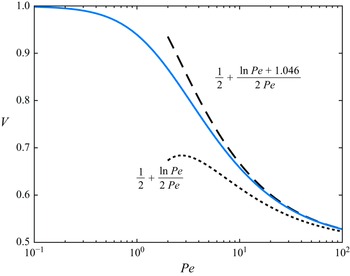


 Open access

