


Introduction
In the third millennium BC, large cities and settlements emerged in south-eastern Iran, such as Shahr-i Sokhta, Shahdad, Tepe Yahya and Konar Sandal (Lamberg-Karlovsky Reference Lamberg-Karlovsky1970; Tosi Reference Tosi1983; Hakemi Reference Hakemi and Sajjadi1997; Sajjadi Reference Sajjadi2003; Madjidzadeh & Pittman Reference Madjidzadeh and Pittman2008). Evidence for both metallurgy and the processing of semi-precious stones, such as lapis lazuli and chlorite, demonstrates the region's key role in exchange between the Bronze Age cultures of Western Asia. Despite its importance, however, this area has seen few excavations.
Iranian Baluchistan, including Bampur Valley, is poorly documented archaeologically. Until the investigations reported here, archaeological work in the region was limited to soundings at Khurab and Damin (Stein Reference Stein1937), and excavations at Tepe Bampur (de Cardi Reference de Cardi1970; Sajjadi Reference Sajjadi2005). Recent surveys, however, have increased archaeological knowledge of the region. Bampur Valley was surveyed in 2002 by Rahbar (Rahbar Reference Rahbar2003) and later by Mortazavi (Mortazavi & Mosapour Negari Reference Mortazavi and Negari2010); excavations were conducted at Bampur 14 in 2003 by Rahbar (Figures 1 & 2), with further survey by Moradi in 2010 (Moradi et al. Reference Moradi and Sarhaddi-Dadian2014; Mutin et al. Reference Mutin2017a). This article reports results of the 2003 excavations at Bampur 14.
The location of Bampur 14 in south-eastern Iran (courtesy of F. Desset), and general view of the Site (A & B) (courtesy of H. Moradi).

Bampur 14: excavation area and plan of graves (figure by M. Rahbar).

Bampur 14
Bampur 14 cemetery sits on a low ridge on the southern bank of the Bampur River, near the village of Saidabad (27°09´40″N, 60°23´19″E; 498m asl). It extends 100 × 50m and probably had around 150 graves. The site has, unfortunately, suffered illegal looting. In 2003, three 10 × 10m trenches and one 2 × 2m test trench were opened, marking the first large-scale excavation of a prehistoric cemetery in Bampur Valley. Fifteen graves were discovered, of which 10 (Graves 1–4, 7, 9–11, 14 & 15) had intact grave goods (Figure 2; Table 1). Due to the damage caused by illegal excavations, there are doubts about the identification of 5, 6, 8, 12 and 13 as graves.
Graves and their finds.

The Bampur 14 graves take three forms: square, circular and irregular. Graves 1, 3, 7, 9 and 10 comprised square pits with crouched inhumations. This recalls type 6 graves at Shahr-i Sokhta (Sajjadi Reference Sajjadi2003: 27 & fig. 4) and grave 336 at Shahdad (Hakemi Reference Hakemi and Sajjadi1997: 513). Graves 4, 11, 14 and 15 were circular pits lined with mud or mudbricks. These are similar to type 8 graves at Shahr-i Sokhta (Sajjadi Reference Sajjadi2003: 27 & fig. 4). Grave 2 is a different shape; made from unbaked mudbricks, it had a semi-circular western end, and irregular northern and eastern sides. A 0.50m-wide entrance—blocked with bricks—provided access at the south end.
Finds
The quantity and type of grave goods varies significantly between the graves. The circular graves collectively contained only four ceramic vessels, while one square grave (10) yielded 100 vessels. Circular graves contained no stone beads, and few artefacts. Ceramics placed with bodies were usually deposited in two different layers. Most objects were placed near the body, but some were deposited approximately 0.7m higher, probably during the closing of the grave. Perhaps due to fluctuating environmental conditions, preservation of human remains is poor, with bones surviving only as fragments. The exception is Grave 15, where a semi-intact, crouched inhumation was preserved.
Pottery and other finds
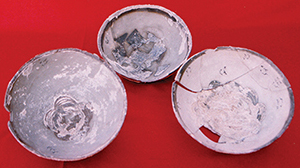
The ceramic vessels recovered total 209, comprising 92 red-ware (44.5 per cent) and 117 grey-ware (55.5 per cent) (Figures 3, 4 & 5). Other grave goods include beads of stone and bone; an animal horn; spears, daggers, an axe, a seal (Figure 6), a goblet and various small utensils of copper-bronze; chert blades; and a stone column. Although no complete stone vessels were found, their presence is demonstrated by five fragments made from brown-speckled white marble, discovered in Graves 7, 10 and 11. The copper-bronze objects have parallels with material from Kerman, Iranian Baluchistan, Central Asia and the Indo-Iranian borderlands (Hakemi Reference Hakemi and Sajjadi1997: 640, figs 11–16; Heydari et al. Reference Heydari, Desset and Vidale2019: 54, pl. 21: 125/53). The small stone column and the copper-bronze compartmented seal, both found in Grave 11, have comparanda at other sites in Central Asia (Gonur, Toglok, Altyn Depe), Afghanistan (Dashly, Godar-i Shah, Hirdai-Tepe, Mundigak), Pakistan (Mehrgarh, Kulli, Sibri) and Iran (Shahdad, Damin, Susa, Hissar, Tureng, Shah Tepe and Shahr-i Sokhta), and should be regarded as evidence for connections with the Bactria-Margiana Archaeological Complex cultures of north-eastern Iran and Central Asia (Schmidt Reference Schmidt1937: fig. 61: H. 3250 & H. 1842; Hakemi Reference Hakemi and Sajjadi1997: 639 & figs 1–4; Boroffka & Sava Reference Boroffka and Sava1998). For this reason, Grave 11 probably dates to the late third/early second millennium BC. Otherwise, the grave goods recovered from Bampur 14 belong to the Bampur I–IV periods, dated to the late fourth to mid-third millennium BC. Comparisons can also be established with Konar Sandal and Hajjiabad-Varamin, Spidej, Damin, Tepe Yahya IVC-B, Shahr-i Sokhta II-III, Spidej, Kech-Makran Late Period IIIa and Miri Qalat IIIb (de Cardi Reference de Cardi1970; Lamberg-Karlovsky Reference Lamberg-Karlovsky1970; Tosi Reference Tosi1983; Sajjadi Reference Sajjadi2003; Besenval Reference Besenval, Jarrige and Lefèvre2005; Besenval et al. Reference Besenval, Marcon, Buquet, Mutin, Franke-Vogt and Weisshaar2005; Madjidzadeh & Pittman Reference Madjidzadeh and Pittman2008; Didier Reference Didier2013; Mutin Reference Mutin2013; Didier & Mutin Reference Didier, Mutin, Frank and Cortesi2015; Heydari et al. Reference Heydari, Desset and Vidale2015; Reference Heydari, Desset and Vidale2019; Mutin et al. Reference Mutin, Minc, Lamberg-Karlovsky and Tosi2017b; Eskandari et al. Reference Eskandari2021).
Pottery vessels from various graves (scales in cm) (photograph by M. Rahbar).

Pottery vessels from various graves (scale in cm) (photograph by Y. Saeidpour).

Pottery vessels from various graves (scales in cm) (figure by M. Rahbar).

Illustrations of metal finds and the stone column (scales in cm) (figure by M. Rahbar).

Conclusions
Most graves at Bampur 14 date to the late fourth to mid-third millennium BC, with one (11) probably belonging to the late third to early second millennium BC. Similarities between finds from this cemetery and other sites in the region show that the material culture of Bampur 14 belongs to a horizon extending from Kerman province to Pakistani Baluchistan (Fairservis Reference Fairservis1961; Wright Reference Wright1984, Reference Wright and Frifelt1989). A nearby site, Qasemabad 4, with a similar ceramic assemblage, may be the settlement with which the Bampur 14 cemetery was associated.
Acknowledgments
The authors are very grateful to Hossein Moradi for his guidance and help; Francois Desset for his comments and editing; the anonymous reviewers for their useful suggestions; and finally to John MacGinnis for his editing of the English.
Funding statement
This research received no specific grant from any funding agency or from commercial and not-for-profit sectors.



