

Introduction
The teaching of classical languages – particularly Ancient Greek and Latin – faces a crucial challenge today: how can we transmit the cultural legacy of antiquity within a society shaped by rapid communication, immersive technologies, and increasingly visual, interactive, and experiential modes of learning? The temporal, linguistic, and conceptual distance separating today’s students from the ancient world often results in disaffection, a sense of alienation, or a perception of irrelevance, especially when teaching still relies on traditional content-driven and transmissive models.
Yet, the educational value of Greek and Latin – in terms of logic, argumentative rigor, linguistic structure, symbolic thought, and anthropological insight – not only persists, but becomes even more essential in an age defined by algorithms, automation, and artificial intelligence (Hunt and Bulwer Reference Hunt and Bulwer2025).
In this context, classical language teaching is called to reinvent its methods and forms of communication. Rather than sacrificing content depth, educators must find new ways to make classical material culturally meaningful, communicatively effective, and cognitively engaging for new generations of learners. As Hattie (Reference Hattie2009) emphasises, the quality of teaching and the design of learning environments significantly influence educational outcomes. It is not enough to transmit content; learning must be made authentic, motivating, and transformative.
In recent years, the growing interest in the educational potential of video games has led to their increasing recognition as tools capable of promoting engagement, critical thinking, and active learning – even in the humanities. As Hunt (Reference Hunt2022) notes, the coronavirus disease 2019 (Covid-19) pandemic marked a turning point for Latin teaching, forcing educators to experiment with digital strategies and integrate new technological skills into their regular classroom practice. Moreover, recent studies (Cannatella Reference Cannatella2022; Di Donato and Taddei Reference Di Donato and Taddei2024) have shown that game-based learning can foster a creative and immersive relationship with classical heritage, harnessing narrative, simulation, and interaction. What is more, Ferding and Gandolfi (Reference Ferdig, Gandolfi, Wolf and Perron2023) offer an extensive overview of how games are employed for teaching and learning, addressing current industry trends such as eSports, game communities, and extended reality, as well as key debates on game toxicity, addiction, and media determinism. Projects such as Gaming the Past (Adelani, Reference Adelani2024) and The Trojan War (Salapata et al., Reference Salapata, Tracy and Loke2024) demonstrate how historical and mythological games can stimulate source analysis, ethical reasoning, and learning through play. In Italy several meaningful initiatives have emerged as well, showing how video games can serve as inclusive and motivating tools, especially for students less responsive to traditional school approaches.
From a theoretical perspective, the effectiveness of video games in education is grounded in 2 major frameworks: the sociocultural model of situated learning (Vygotsky Reference Vygotsky1978), which emphasises the role of mediated environments in fostering active knowledge construction; and the reinforcement-based logic of behaviourist education (Vu Reference Vu2017), which employs feedback, levels, and rewards to sustain motivation. Video games thus represent complex pedagogical spaces in which digital languages and classical content intertwine in polysemic ways, giving rise to interdisciplinary and culturally meaningful learning experiences.
In an educational landscape increasingly shaped by digital environments, pedagogical practice must also engage with the transformation of subjectivity itself. As Benanti and Maffettone (Reference Benanti and Maffettone2024) note, the relationship between human beings and technology can no longer be understood in purely instrumental terms: we live in a techno-human condition, in which technology actively contributes to shaping individual and collective identity. In this context, technology becomes not only a tool, but also a form of cultural expression and self-representation. The figure of the ‘augmented human’ emerges – one who is capable of acting, thinking, and creating in symbiosis with algorithmic systems, thus generating new forms of learning, interaction, and design. From this perspective, the authors propose the concept of digital paideia: a renewed form of humanistic education that does not oppose tradition and innovation, but integrates them, reviving classical values through the codes and languages of the present. The ethical foundation of this vision lies in digital sustainability – defined as the safeguarding of personal dignity and freedom in technologically saturated environments.
Faced with this profound transformation, teaching cannot merely use technology as an add-on; rather, it must critically engage with its meaning and direct its use towards ethical and humanistic educational goals. Even in the field of classical languages, this opens new avenues for an integral education – one that can bring tradition and innovation and memory and future into meaningful dialogue.
Research context and objectives
The case study presented in this article concerns a high school student enrolled in a science, technology, engineering, art, and maths (STEAM)-focused classical high school in Southern Italy, with a strong personal passion for both Ancient Greek and Mathematics. Motivated by an educational stimulus received at school and a personal interest, the student independently designed an interactive video game using Python and integrated artificial intelligence (AI) tools within the Unity platform with the aim of engaging younger audiences with classical culture.
The project, which combines mythology, storytelling, classical language elements, and digital interaction, serves as a tangible example of digital paideia: an educational model that harmonises tradition and innovation, regenerating ancient knowledge through contemporary technologies in an ethical and intentional manner. In this light, the student’s creative act is not seen as an isolated effort, but as a possible educational response to the challenges facing Greek and Latin instruction in the digital age.
Within this framework, digital paideia is conceived as a form of augmented classical education – a model that combines cultural depth, technological design, and anthropological awareness. The use of technology is not aimed at simplifying content, but at making it more accessible and meaningful, especially for students who live and learn in increasingly interactive, multisensory, and dynamic environments.
The student’s video game functions as a hybrid educational space where innovation and tradition meet, and where creativity becomes a form of cultural agency. Its primary goal is not entertainment in the strict sense, but rather cultural and educational: to offer children and young people an accessible and engaging interactive experience that introduces them to the richness of the classical world. Through digital environments, mythological symbols, and etymological storytelling, the game seeks to foster curiosity, critical thinking, and active learning, promoting a view of classical culture as a living and shareable legacy.
The originality of this initiative becomes particularly significant when considered in the context of the student’s educational background. In Italy, the school system, regulated by the Ministry of Education and Merit (Ministero dell’Istruzione e del Merito, MIM), is divided into 2 main cycles: the first includes primary school (ages 6–11 years) and lower secondary school (ages 11–14); the second includes upper secondary school (ages 14–19), comprising licei (classical, scientific, linguistic, human sciences, arts, and music high school), as well as technical and vocational institutes (Figure 1).
Education in Italy (European Commission: European Education and Culture Executive Agency et al., Reference Baïdak, De Coster and Sicurella2021).
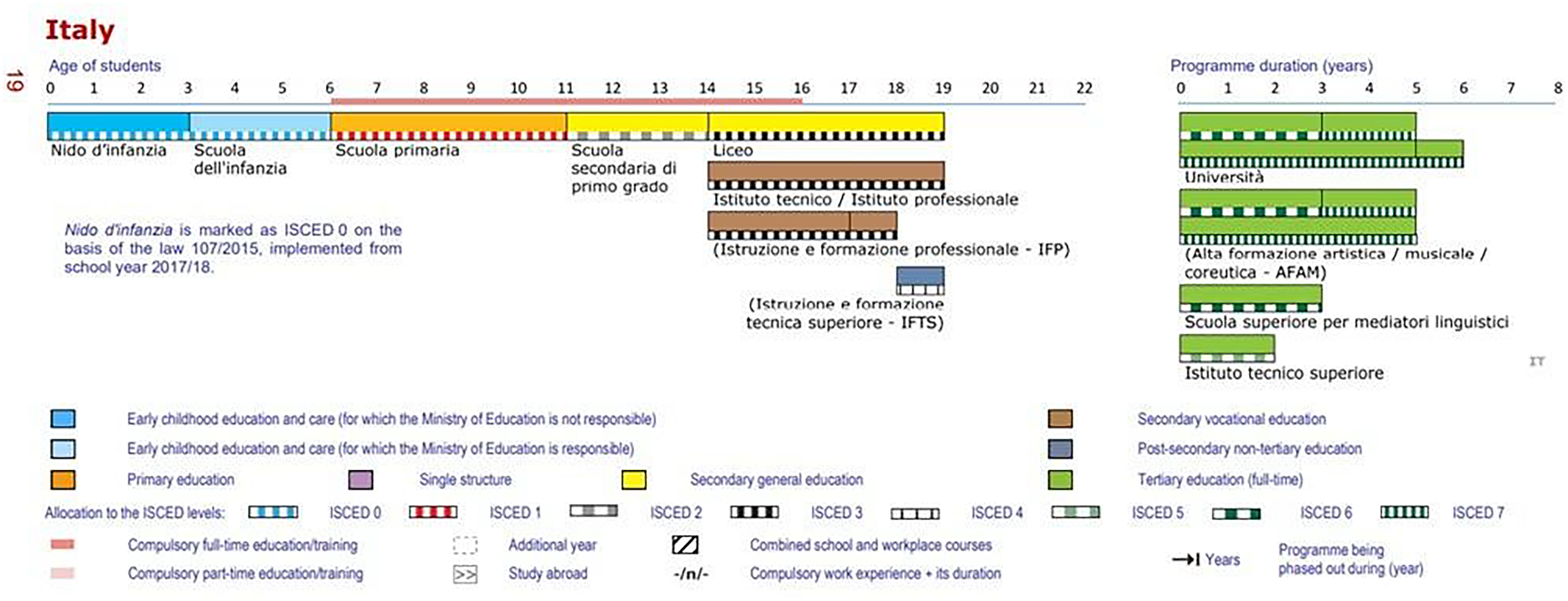
Figure 1 Long description
A line graph depicting the education system in Italy, showing the progression of students from early childhood education to tertiary education. The x-axis represents the age of students, ranging from 0 to 22 years. The y-axis represents the programme duration in years, ranging from 0 to 8 years. The graph is divided into different educational stages: Nido d'infanzia, Scuola dell'infanzia, Scuola primaria, Scuola secondaria di primo grado, Liceo, Istituto tecnico / Istituto professionale, Istruzione e formazione professionale - I F P, Istruzione e formazione tecnica superiore - I F T S, and Universita. Each stage is color-coded to indicate different types of education, such as early childhood education and care, primary education, secondary general education, secondary vocational education, post-secondary non-tertiary education, and tertiary education. The graph also includes symbols to indicate compulsory full-time education/training, additional years, combined school and workplace courses, compulsory work experience, and study abroad. All values are approximated.
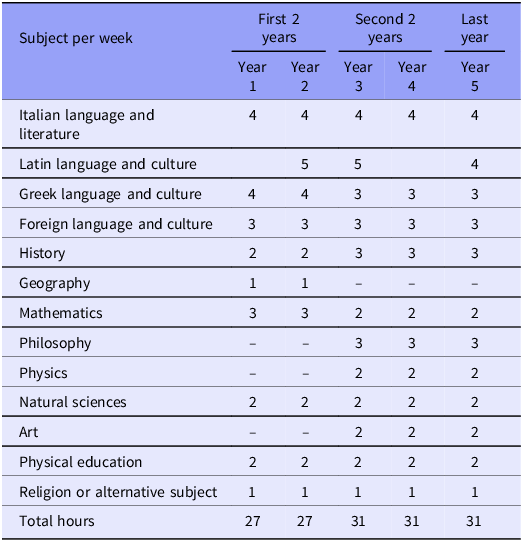
Since the 2010/2011 academic year, a national education reform has distinguished between 5-year upper secondary school programmes and regionally administered vocational training pathways (Istruzione e Formazione Professionale, IFP). In particular, technical and vocational institutes are designed to prepare students for direct entry into the workforce, whilst licei – and especially the classical high school – offer a predominantly theoretical and humanistic education (Table 1). Within this framework, the autonomous adoption of a complex development tool such as Unity – typically associated with technical or professional curricula – and the creation of an educational video game highlight not only strong self-directed learning abilities, but also the development of skills already aligned with real-world professional contexts.
Organisation of the classical high school subjects

Table 1 Long description
The table outlines the weekly hours dedicated to various subjects in a classical high school curriculum over five years. It includes subjects such as Italian language and literature, Latin language and culture, Greek language and culture, foreign language and culture, history, geography, mathematics, philosophy, physics, natural sciences, art, physical education, and religion or alternative subject. Each subject's weekly hours are detailed for each year, with notable trends such as consistent hours for Italian language and literature, a gradual reduction in Greek language and culture, and the introduction of philosophy and physics in later years. The total weekly hours increase from 27 in the first two years to 31 in the last three years.
The STEAM curriculum context and research objectives
The STEAM curriculum includes, in addition to the standard Liceo Classico (classical high school) programme, several subject enhancements. In the first 2 years (the biennio), an Art History module is introduced in English, taught using the content and language integrated learning (CLIL) methodology, with one weekly hour dedicated to this subject. Mathematics is reinforced throughout the 5-year programme with one additional hour per week: 4 hours weekly during the biennio and 3 hours in the final 3 years (triennio). Additionally, one extra hour of Natural Sciences (which includes chemistry, biology, and Earth science) is provided during the triennio, bringing the weekly total for that subject to 3 hours (MIM 2010). On the basis of this context, the objectives of this study are:
-
To explore how a student’s autonomous initiative can contribute to the transmission of classical culture in innovative ways;
-
To analyse the educational and symbolic meaning of the project in light of the concepts of digital paideia and the techno-human condition (Benanti and Maffettone Reference Benanti and Maffettone2024);
-
To reflect on the pedagogical implications of integrating humanities content and digital tools for the enhancement of Greek and Latin education.
This research is guided by the following central question: How can the autonomous creation of an educational video game by a high school student serve as a meaningful example of digital paideia applied to the teaching of Greek and Latin?
Methodology
This research adopts a qualitative, interpretive approach focused on a single, emblematic case study (Bryman Reference Bryman2016). Through interviews with the student, direct observation of the developed video game, analysis of the materials produced, and theoretical contextualisation, the study aims to explore the cultural and pedagogical significance of the student’s creative act.
To analyse the content of the student interview, an inductive thematic analysis was used, following the approach proposed by Braun and Clarke (Reference Braun and Clarke2006). The interview, conducted in a free narrative form, was considered as a whole unit of analysis, with the goal of allowing meaningful themes to emerge organically from the participant’s own expression.
Coding was carried out through a careful and iterative reading of the text, identifying semantic patterns, conceptual clusters, and particularly relevant passages from educational, cognitive, and pedagogical perspectives. The identified themes were grouped into macro-categories, each subdivided into descriptive subthemes, and assigned representative qualitative codes.
This method made it possible to highlight the complexity of the student’s experience, revealing both the personal motivations behind the project and the independently developed skills and methodological choices. The analysis focused on 5 key dimensions:
-
Individual motivation and school context
-
The educational function of the video game
-
The development of transversal competencies
-
The implicit pedagogical approach
-
The digital reinterpretation of classical culture
The methodology, in summary, privileges a symbolic and educational reading aimed at understanding how the integration of humanistic and digital languages can influence the teaching of Greek and Latin.
The analysis followed a hermeneutic approach, seeking to grasp the internal coherence of the project, its expressed and implicit educational intentions, and its symbolic relevance to classical language pedagogy.
Data collection tools
To carry out the investigation, qualitative tools were employed to capture the full complexity of the case study. Specifically, the following methods were used:
-
1. Documentary and textual analysis of the video game
An in-depth study of the video game’s structure was conducted, focusing on textual, narrative, linguistic, and iconographic content. The analysis examined:
-
Explicit references to Greek mythology and culture
-
The modes of presenting classical content (for example, texts, puzzles, dialogues)
-
The use of specialist vocabulary and any inclusion of ancient Greek language elements
-
Aesthetic and symbolic choices used to represent antiquity
-
-
2. Direct and participatory observation
The game was tested and observed during simulated sessions with peers to evaluate interaction dynamics, engagement levels, and responses to classical content. Observations were recorded through narrative field notes and critical reflections, which supported the interpretation of the game’s educational value.
-
3. Semi-structured interview with the student-creator
An individual semi-structured interview was conducted with the student who created the project. The interview aimed to explore:
-
The motivations behind the game’s development
-
The creative process and sources of inspiration
-
The student’s personal perception of classical culture and its relationship with technology
-
The educational and communicative intentions of the product
The interview was fully transcribed and analysed interpretively to extract key conceptual elements consistent with the study’s theoretical framework.
-
-
4. Critical reinterpretation within a theoretical framework
Finally, the data were interpreted through the conceptual lens of the techno-human condition (Benanti and Maffettone Reference Benanti and Maffettone2024), with the aim of connecting the emerging findings to a broader educational context oriented towards the construction of a digital paideia.
Case analysis
Student profile
The student featured in this study is 17 years old and currently in the third year of a STEAM-oriented classical high school in southern Italy. In October, a Latin and Greek teacher proposed a challenging assignment to the class: how to make classical culture more accessible to younger generations. The student, who is equally passionate about the humanities (particularly Ancient Greek and mythology) and STEM subjects such as mathematics and computer science, chose to combine these interests into a personal project: an educational video game built with Python and enriched with artificial intelligence functions to enable user interaction.
In the previous 2 years, the student had participated with classmates in an immersive virtual reality project using CoSpaces, as documented by the authors. Within this context, a mathematics teacher introduced them to basic programming skills using Python and supported their first experiments with AI.
Presentation of the video game
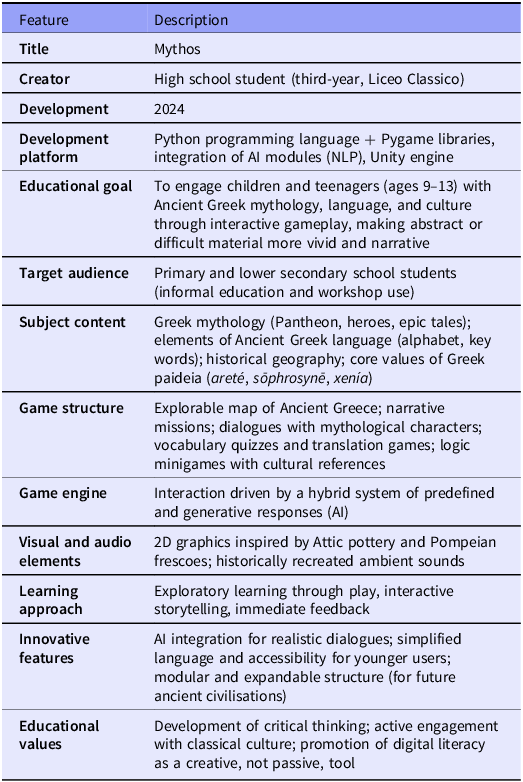
The student creatively developed a synthesis between disciplines by designing and building an educational video game, as summarised in Table 2.
Technical overview of the educational video game Mythos
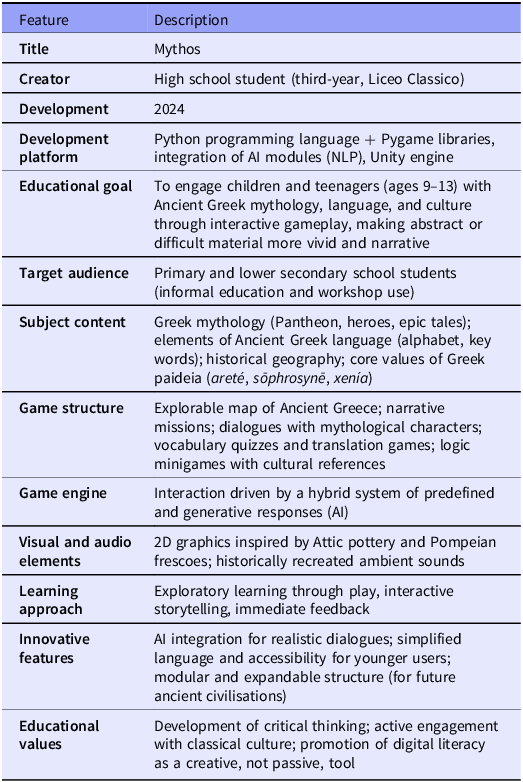
Table 2 Long description
A table comparing the educational video game Mythos, detailing features, descriptions, and educational goals. The table has 12 rows and 2 columns. The first column lists features such as Title, Creator, Development, Development platform, Educational goal, Target audience, Subject content, Game structure, Game engine, Visual and audio elements, Learning approach, Innovative features, and Educational values. The second column provides descriptions for each feature, including the title Mythos, the creator being a high school student, the development year 2024, and the use of Python programming language and Unity engine. The educational goal is to engage children and teenagers with Ancient Greek mythology, language, and culture through interactive gameplay. The target audience is primary and lower secondary school students. The subject content includes Greek mythology, elements of Ancient Greek language, historical geography, and core values of Greek paideia. The game structure involves an explorable map of Ancient Greece, narrative missions, dialogues with mythological characters, vocabulary quizzes, translation games, and logic minigames. The game engine is driven by a hybrid system of predefined and generative responses using AI. Visual and audio elements include 2D graphics inspired by Attic pottery and Pompeian frescoes, and historically recreated ambient sounds. The learning approach is exploratory learning through play, interactive storytelling, and immediate feedback. Innovative features include AI integration for realistic dialogues, simplified language and accessibility for younger users, and a modular and expandable structure. Educational values include the development of critical thinking, active engagement with classical culture, and the promotion of digital literacy as a creative tool.
The video game, developed in Italian using the Unity graphic engine, is designed to offer an immersive experience that blends fun with the learning of Ancient Greek. Within the game, well-known myths are interwoven with engaging educational elements, enabling players to explore and discover common Greek vocabulary in a dynamic environment.
Users interact with a variety of mythological characters, including mortals, gods, goddesses, animals, and monstrous creatures. Taking on the role of the protagonist, players experience unique adventures and complete missions that vary according to the myth selected. Along the way, the player encounters Ancient Greek terms that share surprising affinities with Italian, enhancing learning through visual association and consistent reuse of new vocabulary. The linguistic connection between Greek and Italian fosters more effective retention of verbs and nouns.
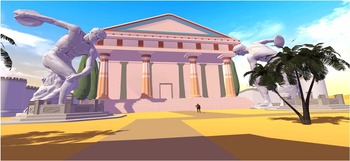
The game culminates in a final challenge, where players must apply the knowledge and strategies acquired during gameplay in a conclusive showdown. Figures 2–5 show selected screenshots of the video game.
Home screen of the video game.
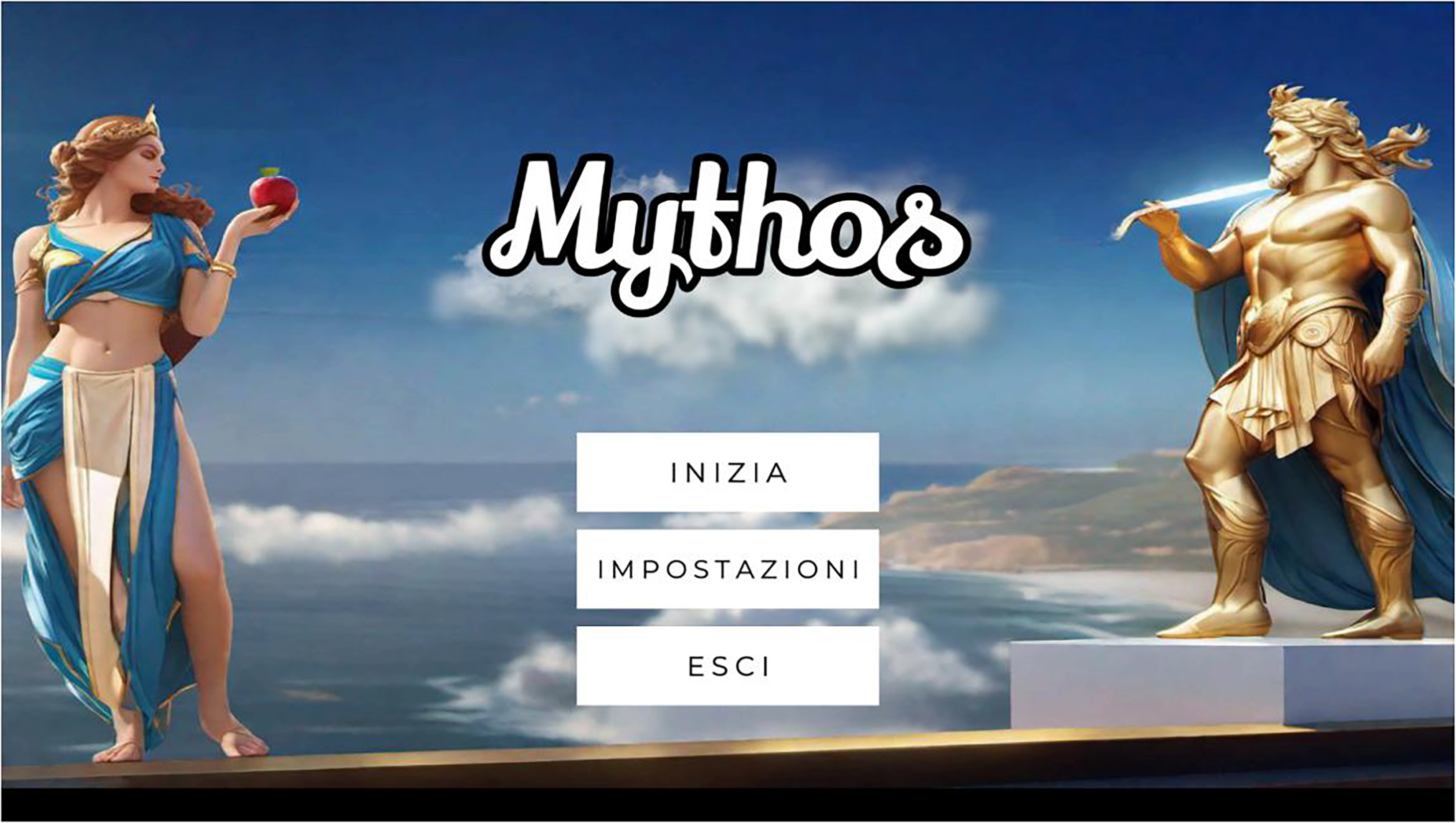
Figure 2 Long description
The home screen of the video game Mythos features two classical figures, a woman holding an apple and a man holding a scroll, set against a backdrop of a cloudy sky and a coastal landscape. The game's title, 'Mythos,' is prominently displayed at the top in a stylized font. Below the title, there is a menu with three options written in Italian: 'Inizia,' 'Impostazioni,' and 'Esci.' The woman is dressed in a blue and white toga, while the man is depicted in golden armor, holding a scroll in his right hand. The overall design evokes a mythological theme, suggesting the game's focus on classical mythology.
Example of an in-game scenario.
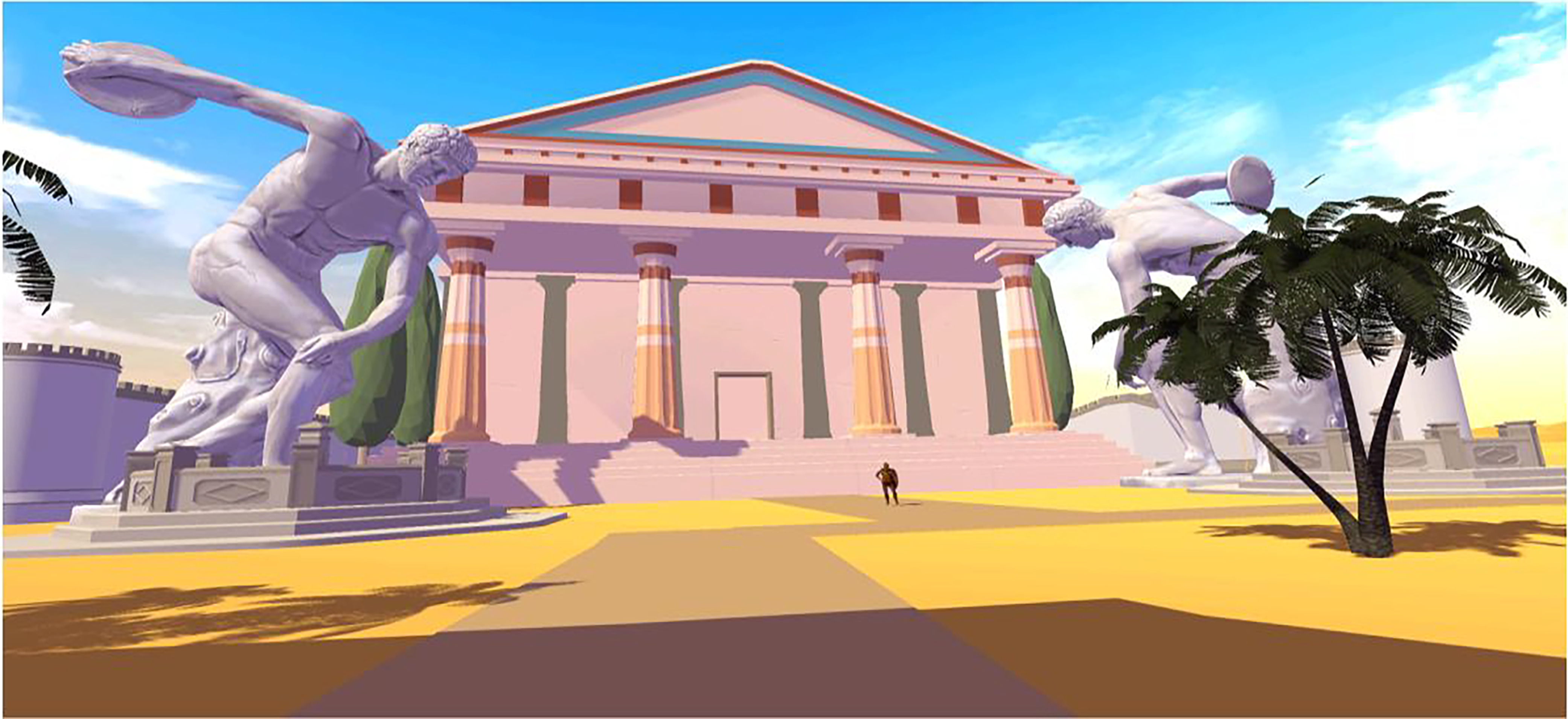
Figure 3 Long description
The image depicts a virtual environment with a classical-style building featuring tall columns and a triangular pediment. Two large statues of muscular figures flank the building, each holding a discus. The scene includes palm trees and a yellow pathway leading to the building. A person is seen walking towards the structure under a bright blue sky with scattered clouds.
Example of an in-game scenario.

Figure 4 Long description
The image depicts an in-game scenario with a large horse statue prominently displayed in the center. The horse is rearing up on its hind legs, standing on a circular pedestal. Behind the horse, there are buildings with red roofs and white walls, suggesting a town or village setting. The sky is clear and blue, with some clouds visible. In the foreground, there is a text box in Italian that reads 'Missione Completata Sapevi che...' followed by a paragraph of text explaining the etymology of the word 'cavallo' in Italian. The text box also includes an 'X' in the bottom right corner, likely indicating a way to close or dismiss the message.
Example of an in-game scenario.
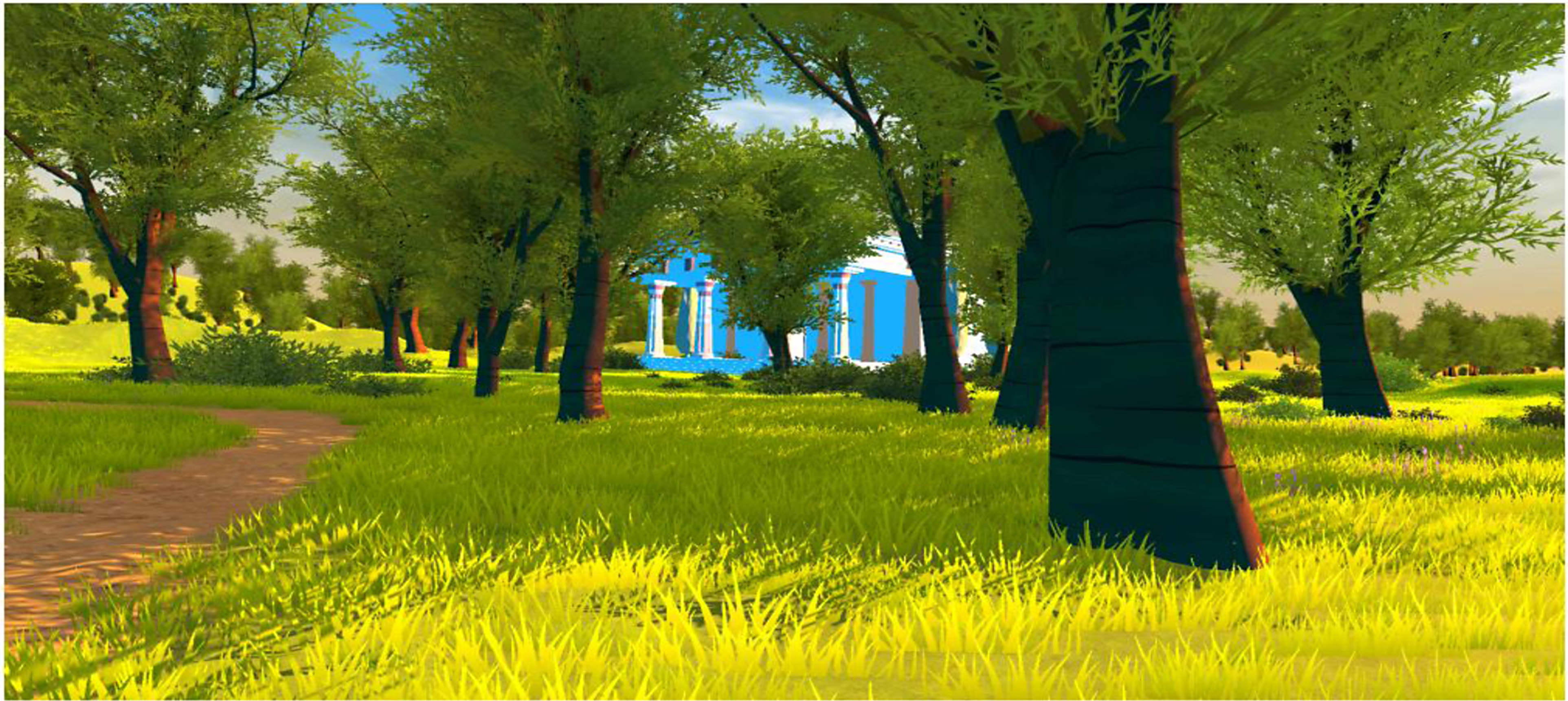
Figure 5 Long description
The image depicts a serene virtual park setting with a winding dirt path that meanders through the scene. Tall trees with green foliage and brown trunks line the path, creating a natural canopy. The grass is a vibrant green, and various shrubs and plants are scattered throughout the area. In the distance, a blue structure with columns is partially visible, adding a touch of architectural interest to the otherwise natural landscape. The sky above is clear with a few clouds, suggesting a bright and sunny day.
Presentation of an example of field notes for the test of the game “Mythos”
Date: 23 April 2025
Location: Classroom of the Classical High School
Session duration: 30 minutes
Number of participants: 4 students (2 male, 2 female, aged 15–16 years)
-
1. Descriptive observation
-
The participants were immediately curious about the game interface, set in a scenario inspired by Ancient Rome, and they began exploring without waiting for detailed explanations.
-
Interaction with the platform was natural: all players quickly understood the implicit rules through exploration.
-
During the phases when they moved from the Italian word to its Latin or Greek etymology, multiple verbal interactions occurred amongst participants: they compared hypotheses and commented aloud, sometimes with irony, but always staying focused on the objective.
-
A particularly interesting moment occurred when 2 players noticed that a Latin etymology suggested multiple plausible solutions: this generated a brief cooperative discussion that led to a shared solution.
-
An increasing competition between groups was observed, which did not compromise internal collaboration.
-
Signs of engagement: laughter, requests to “replay” a part, emotional reactions to the successful completion of a phase (spontaneous applause).
-
-
2. Critical and analytical reflections
-
The game seems to stimulate experiential learning and collaborative problem solving; although the environment is playful, the focus on etymologies activates authentic linguistic reflection.
-
Interactivity facilitates the construction of meanings and not simply memorisation: students were not looking for ‘the right answer’ but the logic of linguistic derivation.
-
The most visible soft skills were collaboration, communication, and situational leadership, and some students led the group without imposing themselves, encouraging dialogue.
-
The ‘historical–immersive’ interface also worked on an emotional level: it brought ‘to life’ content that is often perceived as abstract or anachronistic.
-
Emerging questions:
-
○ What would happen if the game were tested on younger students?
-
○ Can the competitive aspect help or hinder learning in different contexts?
-
○ What is the role of teacher mediation during these sessions?
-
-
Interview with the student
Below is the full interview with the student explaining how the idea for the video game originated.
Starting from a challenge launched by the Latin and Greek teacher, I investigated what I wanted to propose as an innovative and enjoyable idea for an introduction to Latin. So, I decided to create a Serious Game that, beyond defining an idea about the discipline itself, would make evident to what extent Latin is directly linked to Romance languages and how we can benefit from studying this classical ‘dead’ language. First, I specify that Serious Games are video games that go beyond mere entertainment but rather connect it to the development of one or more educational skills (hard skills) and also the human qualities necessary not only for school life (soft skills). I want to emphasise that Serious Games are considered such if they include 3 components: a formative component (the Serious Game must have an educational intent), a playful component (the Serious Game must have a clear game content), and a simulation component (the Serious Game must have the aspect of a reality simulation). If, indeed, the situation presented inside the Serious Game has a high degree of realism, it will be much easier for the user to apply the digitally obtained knowledge to real life. Moreover, playing can develop soft skills and thus education is understood in a broader sense. The first to be considered a true Serious Game was America’s Army, presented in 2002, a video game that was not based on a school educational link but was focused on the responsibilities of members of the American Army. Serious Games thus originated as military life simulators (Wargames) and were implemented as tools for school education only later. So, after thorough research, I understood that creating a Serious Game for Latin would be ideal. But how can a Serious Game be linked to a classical language? What are the beneficiary and active skills we can derive from it? I wanted to create an enjoyable video game by implementing a multiplayer lobby (matches amongst multiple players) so as to allow users to interact with others to find solutions. Consequently, the user will test their leadership skills (soft or life skills), confronting their ally to reach a solution through experimenting with new strategies destined to strengthen, useful for developing critical thinking and promoting problem solving (soft skill). So I chose Unity (game development engine…) to bring the atmosphere of the Latin world back to life on screen, recreating the classical environment. Having done this, all I had left was to assign players an objective, which would soon make necessary and consolidate the use of the logical–deductive method and user collaboration.
The game consists of 2 steps: From the definition to the Italian word derived from Latin/Greek and from the word to the Latin/Greek etymology. In this way, each player, besides acquiring the human qualities already mentioned, will increasingly approach a conception of constructive and self-regulated learning. Thus, they will actively develop new learning strategies and develop the metacognitive method that promotes the growth of each student not only at school but also in everyday life.
To conclude, I want to emphasise that my project Ludo Disciplina aims to convey, starting from the creativity and beauty of the classical Latin language, a strong message that seeks to internationally remind the necessity of promoting the human qualities of students.
Data analysis
To analyse the content of the student interview, an inductive qualitative thematic analysis was adopted, following the approach proposed by Braun and Clarke (Reference Braun and Clarke2006). The interview, conducted in a free narrative form, was considered in its entirety as the unit of analysis, with the goal of spontaneously identifying significant themes emerging from the participant’s expressed content.
Coding was carried out through careful and repeated readings of the text, identifying semantic recurrences, conceptual cores, and passages particularly relevant from formative, cognitive, and pedagogical perspectives. The themes were organised into macro-categories, each divided into sub-themes or descriptive categories, which were associated with representative qualitative codes.
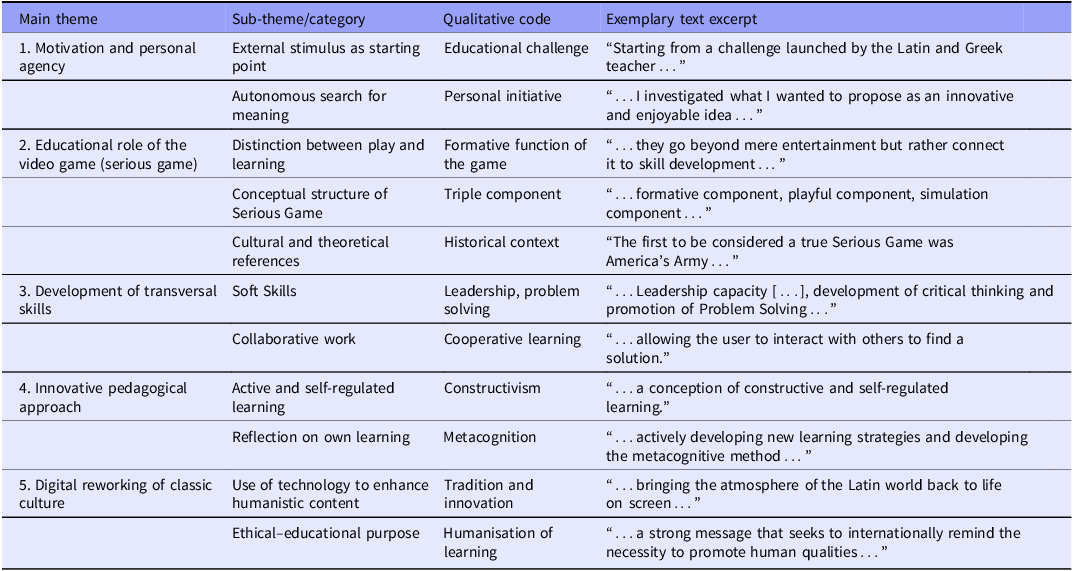
This method highlighted the complexity of the experience narrated by the student, emphasising both the personal motivations behind the project and the skills developed as well as the methodological choices made independently. The analysis focused particularly on 5 dimensions: individual motivation and school context; the educational function of the video game; the development of transversal skills; the implicit pedagogical approach; and the digital reworking of classical culture. Table 3 presents the entire analysis process.
Thematic analysis – student interview
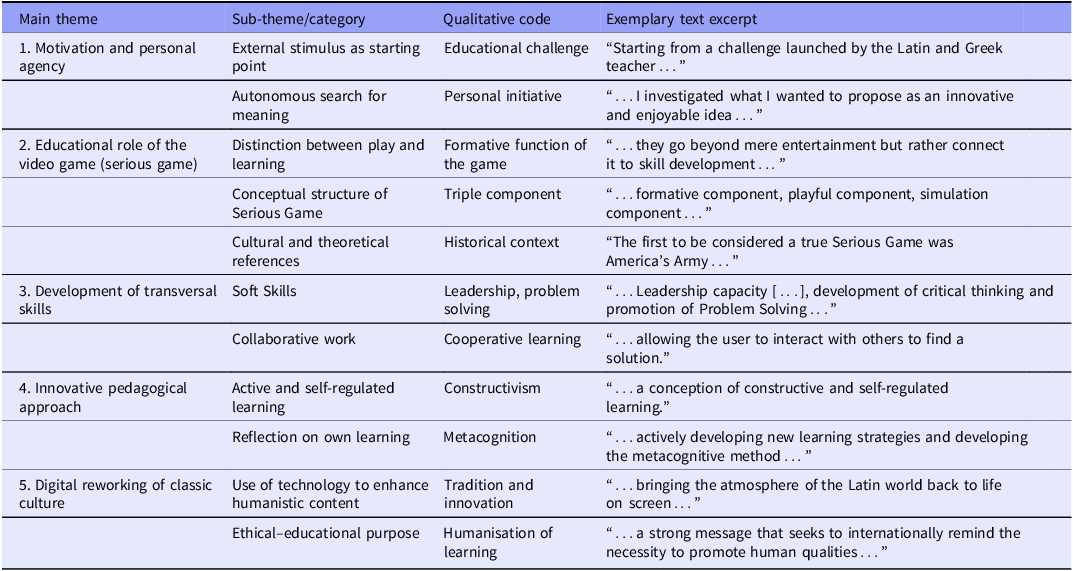
Table 3 Long description
The table presents a thematic analysis of a student interview, highlighting the complexity of the student's experience with a project involving video games. It emphasizes personal motivations, skills developed, and methodological choices. The analysis focuses on five dimensions: individual motivation and school context, the educational function of the video game, the development of transversal skills, the implicit pedagogical approach, and the digital reworking of classical culture. The table has five main themes, each with sub-themes, qualitative codes, and exemplary text excerpts. The first theme, Motivation and personal agency, includes sub-themes like External stimulus as starting point and Autonomous search for meaning, with qualitative codes such as Educational challenge and Personal initiative. The second theme, Educational role of the video game, distinguishes between play and learning, highlighting the formative function of the game and its conceptual structure, which includes a triple component: formative, playful, and simulation components. The third theme, Development of transversal skills, focuses on soft skills like leadership and problem-solving, and collaborative work through cooperative learning. The fourth theme, Innovative pedagogical approach, discusses active and self-regulated learning through constructivism and reflection on own learning through metacognition. The fifth theme, Digital reworking of classic culture, explores the use of technology to enhance humanistic content and the ethical-educational purpose of humanizing learning. The table provides a detailed breakdown of these themes and their qualitative codes, along with exemplary text excerpts that illustrate each point.
The interview reveals a highly reflective student profile, capable of integrating humanistic content and digital tools within a broad and innovative educational vision. Cognitive, relational, and value-based dimensions intertwine in a project that exceeds the curricular expectations of a classical high school, positioning the student as the true protagonist of their own learning.
Discussion
The analysed interview highlights important aspects when compared with the initial theoretical framework:
-
1. Personal motivation and school context: The student shows a high degree of agency and autonomy (Mezirow Reference Mezirow2003). The teacher’s proposal acts as a catalyst, but the project’s elaboration stems from an internal and reflective motivation (Lave and Wenger Reference Lave and Wenger2006).
-
2. Definition and enhancement of the Serious Game: The intervention demonstrates advanced meta-reflective and theoretical knowledge (Bruner Reference Bruner1998). The student builds a bridge between digital practice and pedagogical framework, making explicit the methodological assumptions of their work.
-
3. Transversal skills and personal development: There is strong attention to the student’s integral development. The game is not only a means to learn content, but also a formative device that enhances relational and decision-making skills (Benanti and Maffettone Reference Benanti and Maffettone2024; Ferding and Gandolfi Reference Ferdig, Gandolfi, Wolf and Perron2023).
-
4. Pedagogical approach and meaningful learning: The interview reflects a vision of learning as an active, reflective, and strategic process, in line with constructivist pedagogy and transformative education paradigms (Vygotskij Reference Vygotsky1978; Vu Reference Vu2017).
-
5. Enhancement of classical culture through innovation: Classical culture is renewed and updated through technological language (Hunt Reference Hunt2022). It is not nostalgia, but a functional reinvention that makes it alive and useful for the present (Hattie Reference Hattie2009).
Thus, this project was not a mere technical exercise. It enacted a cultural synthesis, where the depth of humanistic content was conveyed through languages familiar to younger generations. It was a form of creative translation that did not trivialise knowledge but reformulated it to make it accessible. Moreover, the fact that it was carried out by a student demonstrates that integration between classical and digital can emerge bottom-up, through authentic and meaningful personal experiences (Cannatella Reference Cannatella2022).
The high school student’s experience, mastering programming tools and artificial intelligence to create a video game introducing younger students to classical culture, represents an emblematic example of the ‘techno-human condition’ described by Benanti and Maffettone (Reference Benanti and Maffettone2024). This creative act is not only a technical use of digital tools but also an ethical and formative act in which the machine becomes a means to humanise and transmit beauty, culture, and memory. Technology, in fact, is configured as an anthropological environment within which an augmented subjectivity articulates, capable of integrating technical–scientific skills and educational intentionality. The video game thus becomes a kind of digital agora, an interactive and participatory space where classical knowledge is resemantised and made accessible, embodying digital paideia: a model that does not replace tradition but regenerates it, creating a bridge between worlds and generations.
In light of this perspective, the young humanist programmer’s gesture is a concrete expression of digital paideia, in which technique is not a mere vehicle but an ethical and formative environment. Moreover, the project embodies a form of digital sustainability, in which technology amplifies human capacity to communicate and transmit cultural values without replacing or diminishing it. The student becomes not a mere user but a co-creator of a new educational experience that combines tradition and innovation in a responsible perspective.
Furthermore, the student developed the video game on classical myths using the Unity platform, an autonomous choice that represented a qualitative leap beyond the planned educational path. Although he had only learned basic programming in Python during math lessons, the student independently tackled a tool known to be more complex and generally considered beyond the reach of a high school student without specific technical training (authors). This initiative not only highlighted high personal motivation and self-learning ability, but also demonstrated skills already applicable professionally, since Unity is widely used in commercial video game development.
This dynamic exemplifies digital project work guided by formative purpose, anthropological responsibility, and digital sustainability: founding values of integral humanistic education in the algorithmic era. This paradigm opens important perspectives for teaching, suggesting paths in which students can be active and creative protagonists, able to forge new cultural languages. In particular, an interpretation through the lens of techno-human anthropology (Benanti and Maffettone Reference Benanti and Maffettone2024) highlights:
-
Humans as a bridge between times and knowledge: this student does not separate the past from the present; he uses technical language to bring alive what belongs to the ancient world. In this sense, he is heir to both Prometheus and Plato: lighting fires in young minds, bringing them the gift of knowledge not with sermons but through an interactive, immersive, current experience. This is already a philosophical action and, in a profound sense, educational.
-
Creativity as a high form of the human: creating a video game is not just a technical act but an imaginative and narrative act. It requires empathy (knowing how children feel), cultural understanding (translating the Greek world into a playful language), logical design (code, algorithms, AI), and an ethical goal (promoting cultural beauty). This creative act manifests a high form of the human: integrating reason, imagination, and will oriented to the good.
-
A form of contemporary paideia: in the Greek world, paideia was the formation of man through culture, beauty, and truth. Today, this young person proposes a digital paideia: educating through new tools without losing content depth. There is no betrayal of the classical, but regeneration. The medium changes, the message renews.
-
Intelligence as relationship and gift: choosing to create something for others, for ‘the younger ones’, is not only a sign of competence but also of relationship. Intelligence, in the highest sense, is not just calculation ability but also the capacity to give meaning, build bridges, and help others grow.
-
An example of anthropological hope: in a time when technology is often feared to extinguish humanity, this gesture shows the opposite: an alliance between humanism and technology, between past and future, is possible. Such a young person is not an isolated exception, but a sign of what humanity can become if harmoniously educated.
Another notable element is that the project originated from a Latin and Greek teacher who issued a challenging task (Bruner Reference Bruner1998). The presented case offers important insights for teaching classical languages. According to the multidimensional educational leadership framework proposed by James et al. (Reference James, Connolly and Hawkins2020), the teacher’s action can be viewed through the structural, human, political, and symbolic dimensions of leadership action:
-
Structural dimension: The teacher placed the task within the normal curricular activity, exploiting possibilities offered by competency-based teaching. The task was open, authentic, and interdisciplinary, yet coherent with the subject’s educational goals. Organisational structure was managed flexibly, allowing student autonomy.
-
Human dimension: The teacher showed attention to students’ motivational needs and potential, fostering a climate of trust and encouragement. The proposal stimulated personal commitment, making the student feel valued and free to express themselves. The teacher’s role was that of a discreet facilitator.
-
Political dimension: The task represented a form of innovation, potentially atypical for a classical high school. The teacher acted knowingly, building consensus around the initiative and leveraging recognised educational goals (such as education for cultural and digital citizenship). He exercised internal political leadership, negotiating spaces of autonomy and legitimacy.
-
Symbolic dimension: The teacher’s action had strong symbolic value, conveying the idea that classical culture can be alive and transmitted with current languages. The video game became an alternative narration of ancient knowledge, and the teacher a cultural mediator capable of linking past and present.
The analysed experience shows how classical language teaching can be renewed without losing its identity, supported by conscious and multidimensional educational leadership (Nussbaum Reference Nussbaum2010). The teacher-leader did not simply ‘give a task’ but designed a learning environment that fostered motivation, creativity, and interdisciplinary connection (Coutet Reference Coutet2024). Classical culture, in this perspective, is not simplified or trivialised but reinterpreted expressively and communicatively, valuing languages and tools close to students’ world (Buday et al., Reference Buday, Baranowski and Thompson2012; Di Donato and Taddei Reference Di Donato and Taddei2024).
Therefore, this educational experience can also be read in light of the broader transformations characterising the current phase of the so-called fifth industrial revolution (Benanti and Maffettone Reference Benanti and Maffettone2024), where digital technologies are no longer conceived solely as automation tools but as allies of human ingenuity. By proposing a creative task integrating classical knowledge and digital languages, the teacher acted in harmony with this vision: not merely introducing technology in class, but promoting a human-centred innovation that values culture, ethics, and creativity (Dewey Reference Dewey1938).
In conclusion, the presented case demonstrates how classical subjects’ teaching can be renewed through innovative didactic practices and how the teacher can act as a catalyst for activating creative, interdisciplinary, and culturally relevant processes.
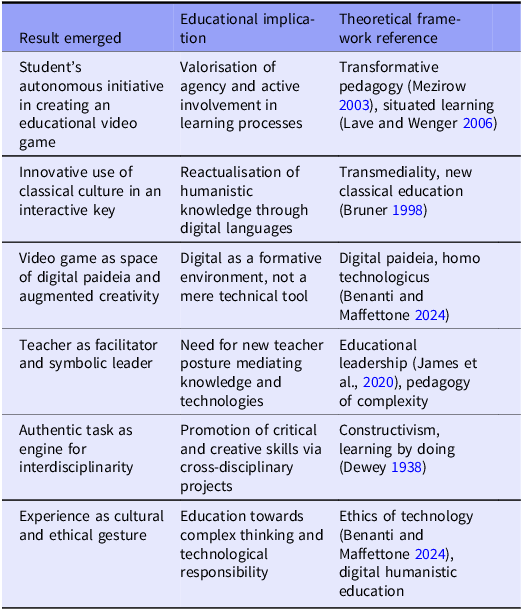
This mapping (Table 4) shows how an apparently individual experience, the autonomous creation of a video game, can become a model of digital paideia: a bridge between tradition and innovation, between classical content and contemporary expressive forms, capable of renewing classical language teaching and the school’s role in the 21st century.
Summary table
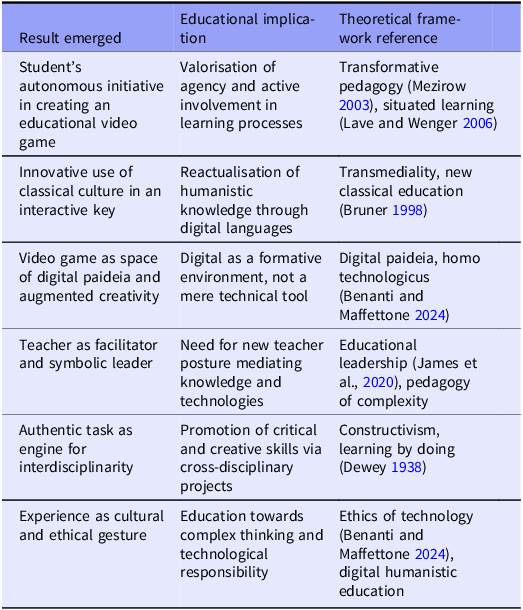
Table 4 Long description
A table with five columns and six rows, detailing the results emerged, educational implications, and theoretical framework references for various aspects of creating educational video games. The columns are labeled Result emerged, Educational implication, and Theoretical framework reference. The rows describe different outcomes such as student's autonomous initiative in creating an educational video game, innovative use of classical culture, video game as space of digital paideia, teacher as facilitator, authentic task as engine for interdisciplinarity, and experience as cultural and ethical gesture. Each row provides specific educational implications and references to theoretical frameworks supporting these outcomes.
Limits and future research directions
The study is based on a single case and does not allow for generalisations. However, it offers useful insights for educational reflection. Further research could open new horizons by building on previous years’ experimentation, involving the mathematics teacher in designing introductory Unity courses aimed at classical high school students; analyse similar cases in different contexts; study the role of educational leadership in classical high schools from a comparative perspective; and investigate the impact of creative practices on disciplinary learning and students’ representations of classical culture.
Conclusions
The case analysed shows how the teaching of classical culture can draw new energy from the convergence between humanistic education and digital tools, generating a digital paideia capable of renewing the cultural transmission of classical languages in a contemporary key. The act of creating a video game that tells the Greek world, carried out by an Italian classical high school student enrolled in a STEAM program, represents a form of digital paideia: an education that integrates and directs technology towards the common good.
This act, in light of the theoretical framework examined, takes on a broader significance. It exemplifies how the techno-human condition does not necessarily lead to depersonalisation or a reduction of the human, but can, on the contrary, generate new forms of responsibility, creativity, and educational care. Such a seemingly simple gesture – a educational video game – can be read as a profoundly anthropological and cultural act: it is where the human seeks itself, surpasses itself, and gives itself.
For the teaching of Greek and Latin, this implies both a challenge and an opportunity: the teacher can work by seeking languages and tools capable of bringing tradition into the present without cultural compromises, with pedagogical intelligence and an anthropological vision. Through distributed educational leadership, the teacher acts as an activator of meaning and change, showing that the future of classical culture can also pass through unexpected tools such as the video game. In this perspective, students are not only recipients of the classical heritage but co-creators of its rebirth, when placed in conditions to express their creative and critical potential also through the technologies of their time.
The challenge for teaching Greek and Latin is to use contemporary tools without relinquishing disciplinary depth.





 Open access

