

1. Introduction
The scientific literature has long argued that deforestation compromises ecosystem services (IPCC, 2019). Increasing evidence now points to the possibility of irreversible tipping points, where deforestation destroys an ecosystem's ability to support environmental health and human welfare, as well as rent generation (Lovejoy and Nobre, Reference Lovejoy and Nobre2018; Lenton et al., Reference Lenton, Rockström, Gaffney, Rahmstorf, Richardson, Steffen and Schellnhuber2019). “Savannization” of the Brazilian Amazon, in which tropical rainforest shifts into a scrubland ecosystem similar to that of the Cerrado, is now feared, along with a loss of ecosystem resilience (Silvério et al., Reference Silvério, Brando, Balch, Balch, Putz, Nepstad, Oliveira-Santos and Bustamante2013; Boulton et al., Reference Boulton, Lenton and Boers2022; Shirai et al., Reference Shirai, Courtenay, Agerström, Freitas, Baccaro and Trad2024). Tipping is certainly a threat, given that tropical, developing countries often have land-use policies that favour primary native forest clearing and open-access exploitation, both by land users and governments. Indeed, governments have increasingly pursued rents at the expense of forests: at the 26th Conference of the Parties, Indonesia publicly backtracked on its deforestation reduction commitment, citing a need to support economic development over environmental protection. Similarly, Brazil's lack of Forest Code enforcement has favoured resource extraction and reversed progress on recent reductions in deforestation (Schons et al., Reference Schons, Lima, Amacher and Merry2019).
We explore the potential for changes in forest ecosystems due to rent-seeking that can eventually result in a tipping point, and we show how this point depends on the harvesting of primary (native) forests and a land-use transition into agriculture, as well as the rate of reforestation or afforestation. Secondary forest establishment through planting or natural regeneration is common now in tropical forest countries and is specifically encouraged by policies like REDD+. However, we investigate formally whether a shift from primary to secondary forest in the presence of deforestation can prevent tipping, finding that it may not.
Our analysis incorporates two novel elements: imperfect substitutability between primary and secondary forests in the production of ecosystem services, and an endogenous time to reach a known ecological collapse point. We show how preferences by a national or regional decision-maker for rent generation can drive collapse even when a tipping point is known with certainty, suggesting that resolving uncertainty may not protect globally critical ecosystem services. Our new approach establishes that policies to encourage secondary forest reforestation and afforestation are not panaceas; rather, the most influential policies are those that target parameters directly affecting rent generation and the private costs of land tenure for primary and secondary forests.
2. Forest transitions and ecological collapse
The forest transition model traces its origins to Mather's (Reference Mather1992) “turning point” that divides two phases of deforestation and reforestation, marking the minimum level of net forested land area. A substantial literature in economics has ignored this and focused only on deforestation through the conversion of primary forests to agriculture (Hartwick et al., Reference Hartwick, Van Long and Tian2001; Barbier et al., Reference Barbier, Damania and Léonard2005). These studies establish now-accepted drivers of deforestation, such as property rights risk, preferential land-use titling and increased road building and access. Secondary forests have been discussed as a potential backstop for lost primary forests, but there is concern that this land use is not de jure title-secured as compared to agricultural land (Meyfroidt et al., Reference Meyfroidt, Rudel and Lambin2010; Barbier et al., Reference Barbier, Delacote and Wolfersberger2017; Wolfersberger et al., Reference Wolfersberger, Amacher, Delacote and Dragicevic2021). In the absence of de jure tenure rights, private landowners must incur costs of protecting secondary forests from ingress, expropriation and lack of government enforcement (Costello and Kaffine, Reference Costello and Kaffine2008; Franca et al., Reference Franca, Persson, Carvalho and Lentini2023). These costs are typically modelled through a “tenure cost “function that depends on the potential loss in rents that can occur from a lack of property rights (Bohn and Deacon, Reference Bohn and Deacon2000). Tenure costs also include any policies that increase de facto tenure security, such as REDD+ (Clarke et al., Reference Clarke, Reed and Shrestha1993; Hotte, Reference Hotte2005).
2.1. Ecosystem services in primary and secondary forests
The transitions literature documents declining global benefits from the replacement of primary with secondary forests, despite the fact that secondary forests are found to have higher environmental value than agricultural land (Meyfroidt et al., Reference Meyfroidt, Rudel and Lambin2010; Matos et al., Reference Matos, Magnago, Aquila Chan Miranda, de Menezes, Gastauer, Safar, Schaefer, da Silva, Simonelli, Edwards and Martins2020). Compared with primary forests, though, secondary forests generally fall short in terms of non-market ecosystem service provision, including biodiversity, water yield, climate regulation and carbon storage (Barlow et al., Reference Barlow, Gardner, Araújo, Ávila-Pires, Bonaldo, Costa, Espósito, Ferreira, Hawes, Hernández and Hoogmoed2007; Luyssaert et al., Reference Luyssaert, Schulze, Borner, Knohl, Hessenmöller, Law, Ciais and Grace2008; Gibson et al., Reference Gibson, Lee, Koh, Brook, Gardner, Barlow, Peres, Bradshaw, Laurance, Lovejoy and Sodhi2011; Martin et al., Reference Martin, Newton, Pfeifer, Khoo and Bullock2015; Rozendaal et al., Reference Rozendaal, Bongers, Aide, Alvarez-Dávila, Ascarrunz, Balvanera, Becknell, Bentos, Brancalion, Cabral and Calvo-Rodriguez2019; Flach et al., Reference Flach, Abrahão, Bryant, Scarabello, Soterroni, Ramos, Valin, Obersteiner and Cohn2021; Jones et al., Reference Jones, Ellison, Ferraz, Lara, Wei and Zhang2022).
Some policies have been proposed to enhance the substitutability between primary and secondary forests, including mandatory natural regeneration or diameter-limit harvesting rules, but these are costly (Crouzeilles et al., Reference Crouzeilles, Ferreira, Chazdon, Lindenmayer, Sansevero, Monteiro, Iribarrem, Latawiec and Strassburg2017). Moreover, Wilson et al. (Reference Wilson, Schelhas, Grau, Nanni and Sloan2017) argue that while spontaneously, naturally regenerated forests perform relatively well in terms of carbon sequestration and diversity of non-timber products, they are relatively poor at supporting commercial food and fibre production. The environmental value of secondary forests also depends on sustainable management, which may not occur. Indeed, ecologists have recently documented a trend toward “ephemerality” of these forests, defined as establishment followed by clearing or abandonment after only one growth cycle (Reid et al., Reference Reid, Fagan, Lucas, Slaughter and Zahawi2019). Jakovac et al. (Reference Jakovac, Junqueira, Crouzeilles, Peña-Clarso, Mesquita and Bongers2021) and especially Piffer et al. (Reference Piffer, Rosa, Tambosi, Metzger and Uriarte2022) establish ephemerality within the Brazilian Atlantic Forest, observing rapid turnover of regrowing forests in nearly 20 municipalities and an average regrowth time of only 7.9 years before abandonment or re-clearing.
2.2. Tipping points
Ecologists have long recognized that regimes can shift, resulting in a change from one ecological system to another (Folke et al., Reference Folke, Carpenter, Walker, Scheffer, Elmqvist, Gunderson and Holling2004). Economists have studied tipping in open-access pelagic fisheries, where a regime shift leads to extinction, as well as in problems related to water quality and climate (Dechert and O'Donnell, Reference Dechert and O'Donnell2006; Lemoine and Traeger, Reference Lemoine and Traeger2016; Dietz et al., Reference Dietz, van der Ploeg, Rezai and Venmans2021). However, there are no studies, to our knowledge, that integrate a tipping point into a model of forest transitions. This is alarming, given that mounting evidence points to the increasing risk of tipping points in tropical forests as a consequence of deforestation. Silvério et al. (Reference Silvério, Brando, Balch, Balch, Putz, Nepstad, Oliveira-Santos and Bustamante2013) argue that this will occur through a regime change from tropical forest cover to one characterized by tropical savannas with longer dry seasons and fire-adapted species. This process of “savannization” has recently been documented along the eastern and southern edges of the Amazon (Rocha and Sollmann, Reference Rocha and Sollmann2023).
Deforestation plays an important role in tipping, most likely by altering the hydrologic cycle or by increasing the chance of fire (Boulton et al., Reference Boulton, Lenton and Boers2022; Xu et al., Reference Xu, Zhang, Riley, Xue, Nobre, Lovejoy and Jia2022; Flores et al., Reference Flores, Montoya, Sakschewski, Nascimento, Staal, Betts, Levis, Lapola, Esquível-Muelbert, Jakovac and Nobre2024). The Amazon forest generates much of its own rainfall as climate systems move across the continent, a process that cannot be maintained by non-forested land use. Deforestation leads to increased fire frequency and intensity through land clearing, which results in increased drying of the forest floor (Cochrane and Laurance, Reference Cochrane and Laurance2002). Evidence suggests that the replacement of primary forest with secondary forests (so-called “secondarization”) may not prevent tipping because relatively impoverished secondary forest systems lack the structural complexity and moisture retention of primary forests. For example, Alencar et al. (Reference Alencar, Nepstad and Diaz2006) found that fires are twice as frequent and burn a greater proportion of the area when occurring in secondary forests compared to primary forest systems.
These observations have led to dire predictions. Lovejoy and Nobre (Reference Lovejoy and Nobre2018) estimate that tipping will occur when the Amazon reaches 20–25 per cent deforestation. Flores et al. (Reference Flores, Montoya, Sakschewski, Nascimento, Staal, Betts, Levis, Lapola, Esquível-Muelbert, Jakovac and Nobre2024) go further to evaluate how interacting drivers alter feedbacks, predicting that by 2050, up to 47 per cent of the Amazon could face a tipping point. Crossing any tipping point would most likely lead to irreversible change in this ecosystem (Xu et al., Reference Xu, Zhang, Riley, Xue, Nobre, Lovejoy and Jia2022; Drüke et al., Reference Drüke, Sakschewski, von Bloh, Billing, Lucht and Thonicke2023). If possible, restoring the structure of primary forests would be costly and take centuries (Rozendaal et al., Reference Rozendaal, Bongers, Aide, Alvarez-Dávila, Ascarrunz, Balvanera, Becknell, Bentos, Brancalion, Cabral and Calvo-Rodriguez2019), but it is more likely impossible due to changes in soil quality and biodiversity (Piazza and Roy, Reference Piazza and Roy2020) as well as negative climate feedback loops (Pereira and Viola, Reference Pereira and Viola2020).
After crossing the tropical forest-savannah tipping point, the fire- and climate-altered Amazon is predicted to undergo a period of transition that involves the die-off of the remaining primary forest over approximately 50 years (Cai et al., Reference Cai, Lenton and Lontzek2016). Once the system has transitioned into savannah, many of the ecosystem services necessary to support forests and agriculture would be seriously compromised. In African systems, where the transition from tropical forest to savannah is already occurring, the consequences have included increased erosion, decreased soil fertility and soil compaction (Badejo, Reference Badejo1998). Efforts to clear savannah to support agricultural cultivation in South America, including in the Brazilian cerrado, have met with mixed success due to similarly unfavourable soil characteristics and a need for irrigation (Donoghue et al., Reference Donoghue, Furley, Stuart, Haggis, Trevaskis and Lopez2019). Savannah systems tend to have a much more variable climate with long dry periods, requiring irrigation to support agriculture, yet the soils also tend to have a low water-retention capacity. As a result, land in savannah has generally been considered unsuitable for agriculture and has been used instead for low-density grazing and limited softwood harvesting.
3. Dynamic forest transition model with ecological collapse
We now develop a model of deforestation and tipping. Let  $L$ equal total land area, made up of primary forest, $F\left( t \right)$; secondary forest, $S\left( t \right),{\text{ }}$which can include idle or abandoned land; and agriculture, given by $L - F\left( t \right) - S\left( t \right)$ at each time point t. Land can be converted from primary forest into secondary forest or agriculture, or from agriculture into secondary forest. However, once land is converted into secondary forest, we assume that it may not be converted back into agriculture. This reflects the fact that secondary forests are generally established on land that is of relatively low quality for agriculture. It is also consistent with the economic literature on irreversibility and pulse harvesting-driven deforestation (Amacher et al., Reference Amacher, Koskela and Ollikainen2009) and the ecological literature that argues that most forest loss is permanent (Pendrill et al., Reference Pendrill, Gardner, Meyfroidt, Persson, Adams, Azevedo, Bastos Lima, Baumann, Curtis, De Sy and Garrett2022).
Without a loss of generality, we assume a time period  $t$ corresponds to a single secondary forest rotation. Secondary forests are assumed identical, with the same rotation length for all new and existing secondary forest land units, and with period rent defined as the present value of the secondary forest rotation.Footnote 1 Deforestation reduces the stock of primary forest whereas reforestation or afforestation augments the stock of secondary forest. The equations of motion governing the forest land units are:
 \begin{equation}\dot F\left( t \right) = - d\left( t \right)\end{equation}
 \begin{equation}\dot S\left( t \right) = r\left( t \right)\end{equation}
 with 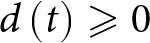 $d\left( t \right) \geqslant 0$,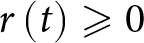 $r\left( t \right) \geqslant 0$, and where the net change in forest land each period is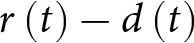 $r\left( t \right) - d\left( t \right)$. The forest transitions literature defines two moments related to (1) and (2): the turning point occurs when the rate of reforestation equals the rate of deforestation and net forest cover is at a minimum,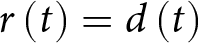 $r\left( t \right) = d\left( t \right)$; and the transition point occurs when primary forest area equals secondary forest area,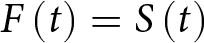 $F\left( t \right) = S\left( t \right)$, a point of reference to policymakers that is straightforward to observe and measure.
Consistent with an open-access problem, the revenues earned for primary forest timber, secondary forest products, and agricultural products depend linearly on their world prices,  ${p_F}$, ${p_S}$ and ${p_A},{\text{ }}$respectively. Deforestation in period $t$ yields one-time harvest revenues in the amount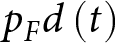 ${p_F}d\left( t \right)$, where ${p_F}$ is the unit price for timber harvested from native hardwood species. Deforestation incurs harvesting costs given by the convex function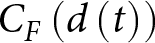 ${C_F}\left( {d\left( t \right)} \right)$. The difference ${p_F}d\left( t \right) - {C_F}\left( {d\left( t \right)} \right)$ defines profit from selling harvested primary forest timber less the costs of clearing these forests.
There are two possible ways of expressing rents to secondary forests. If secondary forests are ephemeral, i.e., planted and harvested for a single cycle and abandoned thereafter, it would be appropriate to express secondary forest rents as a function of reforested area, in the same way that harvest revenue and costs are expressed for primary forest. In this case, profit from a secondary forest rotation is given by  ${p_S}r\left( t \right) - {C_S}\left( {r\left( t \right)} \right)$, where ${p_S}$ is the world price of secondary forest products and the convex function ${C_S}\left( \cdot \right)$ includes the costs of planting, maintenance and harvesting. Conversely, if secondary forests are perennial, i.e., periodically harvested and replanted over the long run, then secondary forest rents should be a function of the total land area in secondary forest, i.e., ${p_S}S\left( t \right) - {C_S}\left( {S\left( t \right)} \right)$. We first explore the ephemeral version, while section 6 presents the perennial version and discusses the implications of ephemeral versus perennial management to the timing of ecosystem collapse.
Agricultural land provides few to no ecosystem services relative to forested land in tropical countries. Following Wolfersberger et al. (Reference Wolfersberger, Amacher, Delacote and Dragicevic2021), we express annual rents obtained from land in agriculture as the world price for agricultural products multiplied by land area in agricultural production,  ${p_A} \cdot \left( {L - F\left( t \right) - S\left( t \right)} \right)$.
Consistent with the literature on tropical deforestation (Bohn and Deacon, Reference Bohn and Deacon2000) and the forest transitions literature (Wolfersberger et al., Reference Wolfersberger, Amacher, Delacote and Dragicevic2021), private tenure costs to enforce de facto property rights in secondary forests are a convex function of reforestation, 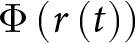 $\Phi \left( {r\left( t \right)} \right)$. These costs are increasing in secondary forest reforestation. It is certainly possible in tropical countries that other land uses such as agriculture are not fully secure as well. In this case, we can think of our cost function as the relative difference in costs of protecting tenure across all land uses that arise once primary forests are removed. If secondary forests are relatively less secure than other cleared land uses, as the majority of literature has shown and argued, then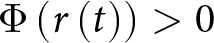 $\Phi \left( {r\left( t \right)} \right) \gt 0$. However, if secondary forests are somehow more secure than agricultural uses (such as grazing), as argued by Besley (Reference Besley1995), then we can simply assume that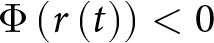 $\Phi \left( {r\left( t \right)} \right) \lt 0$. Given that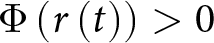 $\Phi \left( {r\left( t \right)} \right) \gt 0{\text{ }}$is commonly accepted, we maintain this throughout the analysis.
Let  $E\left( t \right)$ denote generally an ecosystem service (or a vector of services) that supports timber and non-timber products as well as non-market services that are essential to sustaining tropical forest systems, including biodiversity, fire dynamics and regional climate maintenance:
 \begin{equation}E\left( t \right) = k\left( {F\left( t \right),S\left( t \right)} \right).\end{equation}
 The form of  $E\left( t \right)$ reflects likely interdependencies between primary and secondary forests in the production of ecosystem services. This function could also reflect ecosystem services of primary and secondary forest land net of any ecosystem services if that land were converted to agricultural uses instead.
We define a tipping point as occurring when ecosystem service provision falls below a known minimum threshold,  $E_{min}$. Our most important question is where the tipping point occurs relative to the turning point and transition point defined. Tipping occurs in period T, when $E\left( T \right) = k\left( {F\left( T \right)\!, S\left( T \right)} \right) = {E_{min}}$. There is thus an isoquant that defines the combinations of primary and secondary forests associated with the threshold level of ecosystem service production.Footnote 2 Note that the tipping point in our problem is not simply a reflection of total forest cover, because the system could reach the tipping point even if all cleared land is reestablished as secondary forests. Once the tipping point is crossed, a transition period of primary and secondary forests die-off would occur, followed by the encroachment and establishment of savannah species, estimated to occur on the order of 50 years (Cai et al., Reference Cai, Lenton and Lontzek2016).
3.1. Dynamic optimization problem
The specification of the decision-maker is not essential here, as we seek to study whether rents will be dissipated and the system driven to collapse under the classical open-access externality problem in the absence of de jure forest property rights. The decision-maker could be a national-level government exploiting an open-access resource for rent maximization, but that defines rents to forest harvesting and agriculture as well as ecosystem services, and that recognizes that private landowners must invest in protecting de facto tenure rights for secondary forest. Governments may be more concerned with ecosystem service benefits, or they may be more concerned with economic growth at the expense of primary forest protection, but this model spans these cases through differing parameter values. The decision problem is to solve for deforestation and reforestation according to:Footnote 3
 \begin{align}& \mathop {max}\limits_{d\left( t \right),r\left( t \right)} \mathop \int \limits_0^T {e^{ - \delta t}}\left\{ b\left( {E\left( t \right)} \right) + {p_F}d\left( t \right) - {C_F}\left( {d\left( t \right)} \right) + {p_S}r\left( t \right) - {C_S}\left( {r\left( t \right)} \right)\right. \nonumber\\ & \quad \left. + \, {p_A}\left( {L - F\left( t \right) - S\left( t \right)} \right) - \Phi \left( {r\left( t \right)} \right) \right\}dt + {e^{ - \delta T}}{V_a}\left( {F\left( T \right),S\left( T \right)} \right),\end{align}
 where  $\delta $ is the discount rate, (4) is subject to (1)–(3) and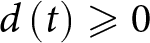 $d\left( t \right) \geqslant 0$ and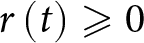 $r\left( t \right) \geqslant 0$. The first portion of the objective functional captures the net benefits prior to ecosystem collapse. In period $T$, the level of ecosystem services reaches the threshold $E\left( T \right) = {E_{min}}$. The function ${V_a}\left( \cdot \right)$ captures the maximized value function after collapse. Additionally, we have initial conditions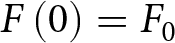 $F\left( 0 \right) = {F_0}$ and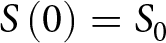 $S\left( 0 \right) = {S_0}$, and free-endpoint transversality conditions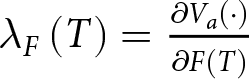 ${\lambda _F}\left( T \right) = \frac{{\partial {V_a}\left( \cdot \right)}}{{\partial F\left( T \right)}}$ and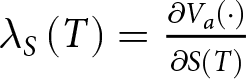 ${\lambda _S}\left( T \right) = \frac{{\partial {V_a}\left( \cdot \right)}}{{\partial S\left( T \right)}}$ .
Irreversible tipping point problems of this type are typically solved by starting with the solution to the post-threshold problem and then solving the problem prior to the tipping point (Lemoine and Traeger, Reference Lemoine and Traeger2016). The present-value Hamiltonian for the pre-tipping point problem in (4) is:
 \begin{align}& H\left( {t,F\left( t \right),S\left( t \right),d\left( t \right),r\left( t \right),{\lambda _F}\left( t \right),{\lambda _S}\left( t \right)} \right) = b\left( {k\left( {F\left( t \right),S\left( t \right)} \right)} \right)\nonumber\\ & \quad + \, {p_A}\left( {L - F\left( t \right) - S\left( t \right)} \right) + {p_F}d\left( t \right) - {C_F}\left( {d\left( t \right)} \right) + {p_S}r\left( t \right) - {C_S}\left( {r\left( t \right)} \right)\nonumber\\ & \quad - \Phi \left( {r\left( t \right)} \right) - {\lambda _F}\left( t \right)d\left( t \right) + {\lambda _S}\left( t \right)r\left( t \right).\end{align}
Taking the equations of motion (1)–(2), deriving Pontryagin's Maximum Principle conditions (see online appendix), and reducing these characterizes the optimal paths of deforestation and reforestation:
 \begin{equation} - {C_F}''\dot d\left( t \right) = {p_A} + \delta \left( {{p_F} - {C_F}'} \right) - b'\frac{{\partial k}}{{\partial F\left( t \right)}}\end{equation}
 \begin{align}\left( {C_S^{''} + {\Phi ^{''}}} \right)\dot r\left( t \right) = {p_A} - \delta \left( {{p_S} - C_S^{'}} \right) + \delta \Phi ' - b'\frac{{\partial k}}{{\partial S\left( t \right)}}.\end{align}
These paths clearly depend on the marginal benefits of clearing land for agriculture, the discounted marginal net revenues earned from harvesting primary forest, and the marginal ecosystem service benefits of primary forest. Reforestation also depends on the tenure costs associated with secondary forest protection.
The paths in (6)–(7) are identical to those derived in the transitions literature only when ecosystem service benefits are separable in primary and secondary forests,  $b\left( {E\left( t \right)} \right) = {b_F}\left( {F\left( t \right)} \right) + {b_S}\left( {S\left( t \right)} \right)$, which also requires that primary and secondary forests are perfect substitutes. If the two forest types are not perfect substitutes, the forest transitions model (were it to include a tipping point) would understate the potential for collapse. We argue that this is in direct contradiction with observed changes in the Amazon forest we outlined earlier, and we will show that incorporating the potential for the two types of forests to be imperfect substitutes has critical implications for policy to prevent or forestall a tipping point.
4. Numerical simulation for the Brazilian Amazon case
We turn now to a numerical simulation given the dimensionality inherent in (4). We draw on Wolfersberger et al. (Reference Wolfersberger, Amacher, Delacote and Dragicevic2021) to specify functional forms and calibrate model parameters to the case of the Brazilian Amazon. Since a time period corresponds to a secondary forest rotation, we set it as 10 years, within the range of 6–13 years found by Petit and Montagnini (Reference Petit and Montagnini2004). The model is solved as an open-loop, free-endpoint dynamic optimization problem with a time horizon of 100 periods, using Python's GEKKO package. If the ecosystem service production function lies above  ${E_{min}}$ at the end of the problem's time horizon, we report that no tipping point is reached.
Parameterization of deforestation harvest costs, secondary forest planting and harvest costs, and tenure costs are as follows: deforestation costs are 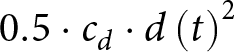 $0.5\cdot c_d\cdot d\left(t\right)^2$; secondary forest planting and harvest costs are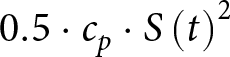 $0.5\cdot c_p\cdot S\left(t\right)^2$; and tenure costs are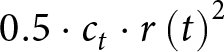 $0.5\cdot c_t\cdot r\left(t\right)^2$. To capture imperfect substitutability between forest types in ecosystem service production, a generalized constant elasticity of substitution (CES) production function is used:
 \begin{equation}E\left( t \right) = \alpha {\left( {{\beta _F}F{{\left( t \right)}^\rho } + {\beta _S}S{{\left( t \right)}^\rho }} \right)^{1/\rho }}\end{equation}
 where  $\alpha \gt 0$ is an efficiency parameter; and the share parameters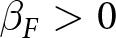 ${\beta _F} \gt 0$ and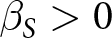 ${\beta _S} \gt 0$ define primary and secondary forest intensity in ecosystem service production, where ${\beta _F} + {\beta _S} = 1$. The substitution parameter $\rho $ is defined as $\rho = \left( {\sigma - 1} \right)/\sigma ,$ where $\sigma $ is the elasticity of substitution between primary and secondary forests in ecosystem service production. As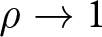 $\rho \to 1$, primary and secondary forests become more perfect substitutes. The case of complementarity ( $\rho \lt 0$) is irrelevant in the context of our study system.Footnote 4 We thus restrict attention to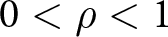 $0 \lt \rho \lt 1$.Footnote 5 The dollar value of net benefits associated with ecosystem services are given by the linear function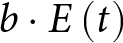 $b \cdot E\left( t \right)$, where an increase in the parameter $b$ reflects an increase in the weight that the decision maker places on the production of the (non-market) ecosystem service.
After a tipping point is reached, primary and secondary forests could continue to provide some value for timber and non-timber forest products during a transition period of dieback. We anticipate that the value function in the problem after collapse would be negligible, in which case 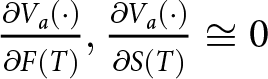 $\frac{{\partial {V_a}\left( \cdot \right)}}{{\partial F\left( T \right)}},\frac{{\partial {V_a}\left( \cdot \right)}}{{\partial S\left( T \right)}} \cong 0$ and the transversality conditions become ${\lambda _F}\left( T \right) = {\lambda _S}\left( T \right) = 0$.
4.1. Parameterization
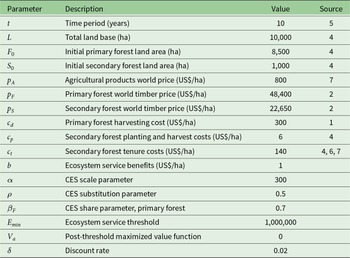
There is a paucity of studies reporting all the necessary parameters in our model for tropical forests. Additionally, some studies report estimates based on standing tree volume per hectare (ha), while others report estimates based on forest hectares. In cases where we obtain cost or price information based on volume, we convert these inputs to a per-hectare basis using published figures for trees per hectare or volume per hectare measurements for planted and native tropical forests. We use published exchange rates and inflation to adjust revenues and costs to 2021 U.S. dollars (US$). Table 1 contains our baseline parameter values on a land area basis. We initially assume that 85 per cent of the land base is primary forest, 10 per cent is secondary forest and 5 per cent is agriculture. In the United States, agricultural land rent ranges from US$84 to 1084/ha (USDA, 2020). As a starting point, we assume that agricultural land rent for a 10-year period is US$800/ha, which places annual rents at the lower end of the published range of estimates. Using a low value for agricultural rents implies that our collapse estimates will be relatively conservative, given slower conversion of primary forests to agriculture, but this will be tested in sensitivity analysis.
Baseline simulation model assumptions
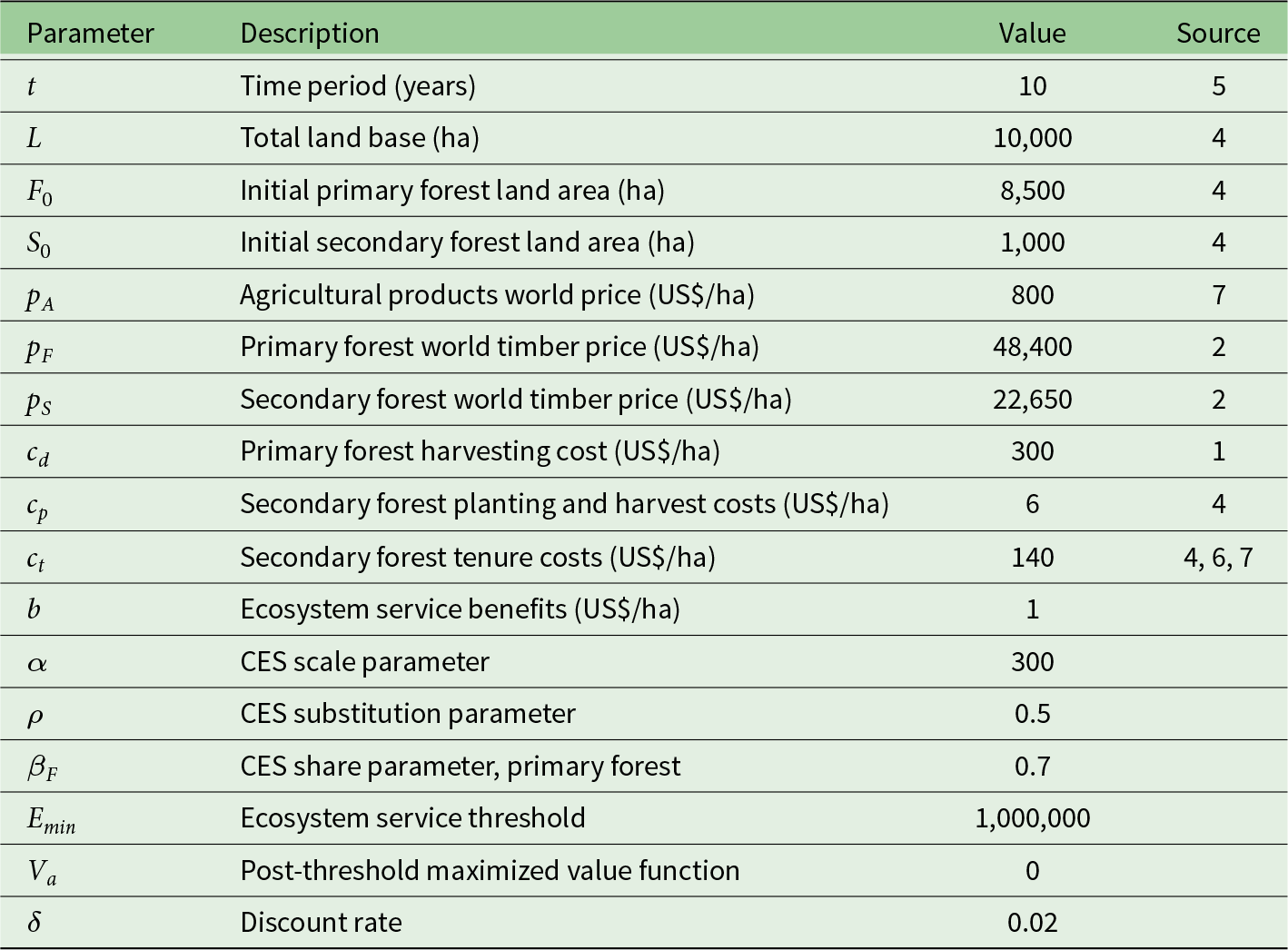
Table 1 Long description
The table lists baseline input assumptions for a land use and forestry simulation, including time horizon, land areas, commodity prices, management costs, and preference and ecosystem service settings. The modeled period is 10 years over a total land base of 10,000 hectares. Initial land cover is dominated by primary forest at 8,500 hectares, with 1,000 hectares of secondary forest. Agricultural product price is 800 US dollars per hectare, while timber prices are much higher: 48,400 US dollars per hectare for primary forest and 22,650 US dollars per hectare for secondary forest. Costs include 300 US dollars per hectare for primary forest harvesting, 6 US dollars per hectare for secondary forest planting and harvest, and 140 US dollars per hectare for secondary forest tenure. Ecosystem service benefits are set to 1 US dollar per hectare, with an ecosystem service threshold of 1,000,000 and a post-threshold maximized value function of 0. A constant elasticity of substitution structure is parameterized with a scale value of 300, a substitution setting of 0.5, and a primary forest share of 0.7, and future values are discounted at 2 percent. Some parameters have no source listed, and one cost parameter cites multiple sources, so provenance varies across inputs.
Sources: [1] Bauch et al. (Reference Bauch, Amacher and Merry2007); [2] ITTO (2021); [3] Garzuglia and Saket (Reference Garzuglia and Saket2003); [4] Parajuli et al. (Reference Parajuli, Joshi and Maraseni2019); [5] Petit and Montagnini (Reference Petit and Montagnini2004); [6] Wolfersberger et al. (Reference Wolfersberger, Amacher, Delacote and Dragicevic2021); [7] USDA (2020).
Timber harvest stumpage prices and mill gate prices are proprietary information and not easily obtained. We therefore use reported regional prices and forest harvest volume levels in the International Tropical Timber Organization (ITTO) April 2021 (16th–30th) Tropical Timber Market Report to compute revenues from harvesting. Market prices in this report range from US$63–3,259/m3. Using the volume-area estimates of Garzuglia and Saket (Reference Garzuglia and Saket2003) and a base primary forest timber price of US$400/m3, we assume primary forest harvesting revenue equals US$48,400/ha, which represents a median value. For secondary forests, we use a reported composite timber price for plantations in Brazil, reported by ITTO (2021), and assume that harvesting revenue is US$22,650/ha. This is considerably lower than for harvesting primary forests, but it makes sense given that primary forests contain highly desirable and high-volume exported species.
Bauch et al. (Reference Bauch, Amacher and Merry2007) estimated forest harvesting cost in the Brazilian Amazon for secondary forests along the BR-163 highway. Their reported costs for harvesting primary forests ranged from $R143.62192.86/m3. Using their exchange rate (US$0.34 = $R1.00) and the reported rate of inflation between 2007 and 2021, we convert this harvesting cost to US$48.83–65.57/m3 of wood harvested. To restate this figure on a per-hectare basis, we again make use of the only study of forest stocking values in tropical forests we are aware of (Garzuglia and Saket, Reference Garzuglia and Saket2003), who find that wood volume averaged 151 m3/ha. For comparison purposes, this is roughly 10 times the volume typically found in a mature temperate mixed hardwood-softwood forest. They also estimated primary forest harvesting costs as high as $R7,373–9,901/ha. These results are comparable to those of Bauch et al. (Reference Bauch, Amacher and Merry2007). We calibrate the cost parameter  ${c_d}$ to ensure that our assumed base case primary forest harvesting cost falls within these ranges. Harvesting cost is reasonably slightly less than 20 per cent of the primary forest harvesting revenue in our base model.
Secondary forest management costs include the costs of planting as well as the costs of harvesting secondary forest products. Regeneration costs are generally low in cases where trees are planted in rows, but we will consider greater costs of establishment in the sensitivity analysis to reflect natural regeneration methods. Most of the general planting cost studies have been conducted in temperate forest regions. A recent report by Parajuli et al. (Reference Parajuli, Joshi and Maraseni2019) finds a range of estimates per acre, which we convert to US$247–1,112/ha. We set planting and harvesting costs at US$450/ha. Referring to table 1, the cost to manage secondary forests is less than 10 per cent of the cost of harvesting native forests, which reflects the difficulty of harvesting in natural forests with dense over- and under-stories. For secondary forests, harvesting costs in our base model are about 30 per cent of harvesting revenues.
There is no literature we are aware of that estimates tenure costs for planted forests in countries with weak or unenforced property rights. We explore the importance of tenure costs in the simulation but start with the assumption that the annual secondary forest tenure cost equals an upper bound of US$10,500/ha. This cost is significantly higher than the secondary forest planting cost in present value terms. It is also lower than the primary forest harvesting cost, because otherwise, it would not be profitable to replace converted primary forests with secondary forests.
4.2. Policy scenarios
The first class of policies we consider are those that influence the substitutability between primary and secondary forests, such as diameter limit harvesting. Policies that improve the production of ecosystem services in secondary forests would increase  $\rho $, pushing it towards its upper limit value of one.Footnote 6 Our second class of policies are those that influence (lower) tenure costs. We explore these types of policies by varying the parameter, ${c_t}$. Third, we consider policies that increase costs of harvesting primary forest tracts, captured by the parameter ${c_d}$. Finally, we consider changes to the ecosystem service benefit weight, $b$. Increasing $b$ is the goal of climate policies like REDD+ as well as payment for ecosystem service programs. An ecosystem benefit parameter of zero represents a decision maker that favors extraction and rent generation. However, even for a low value of $b$, there exists some incentive to delay a tipping point in the sense that after the system crosses a threshold, future rents will disappear.
5. Results and sensitivity analysis
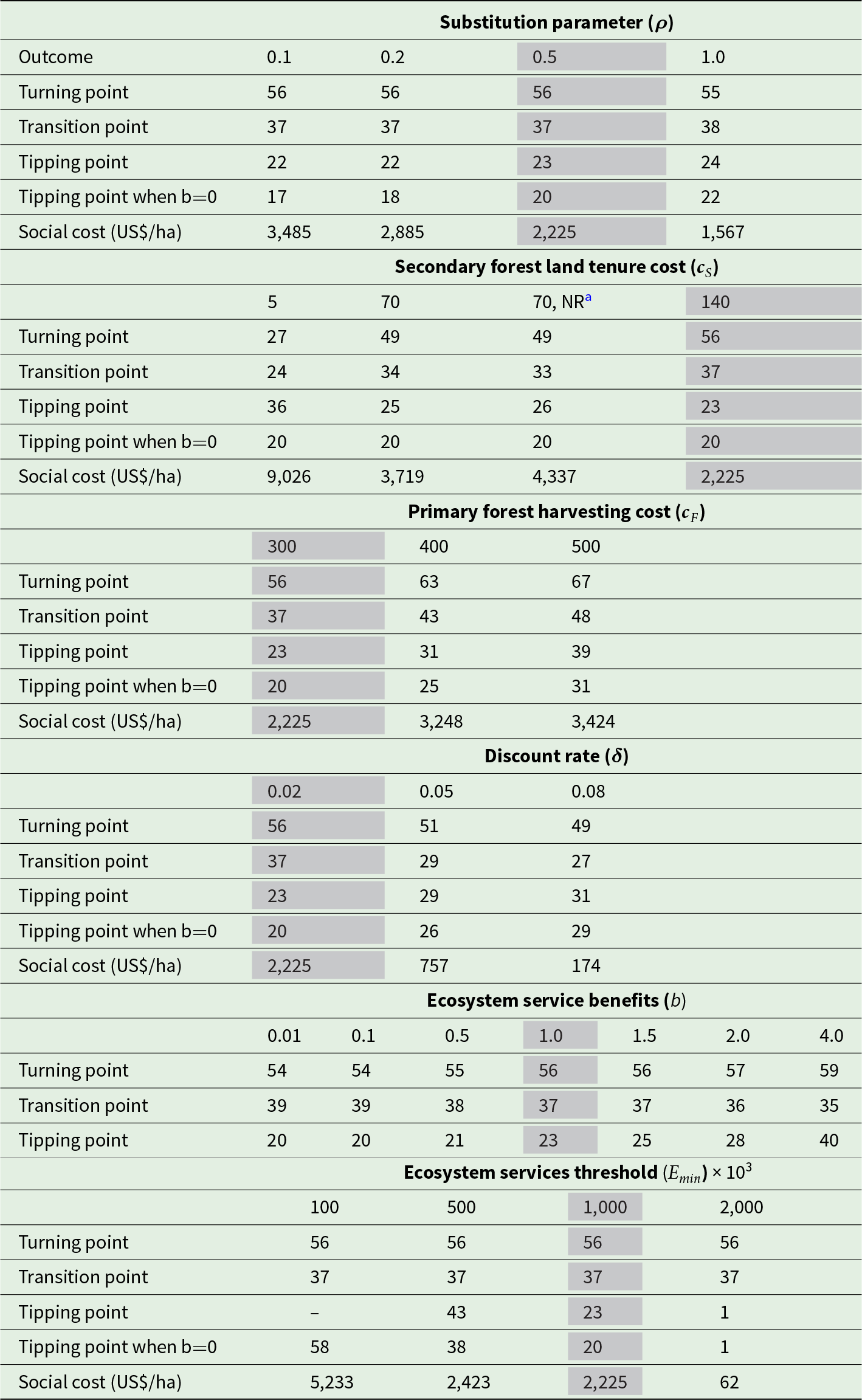
Table 2 reports simulation results, with baseline results and parameter values shaded in grey. In the baseline, the turning point (56 periods, or roughly 560 years) and transition point (37 periods) are moot given that tipping occurs in 23 periods. The tipping point occurs when 50 per cent of the initial land area in primary forest has been deforested, which is conservative compared to estimates in the ecological literature ranging from 20per cent to 40 per cent. If a decision maker has a strong preference for monetary rent generation ( $b = 0$), we see a tipping point three decades sooner.
Simulation model results for timing, transition and turning periods
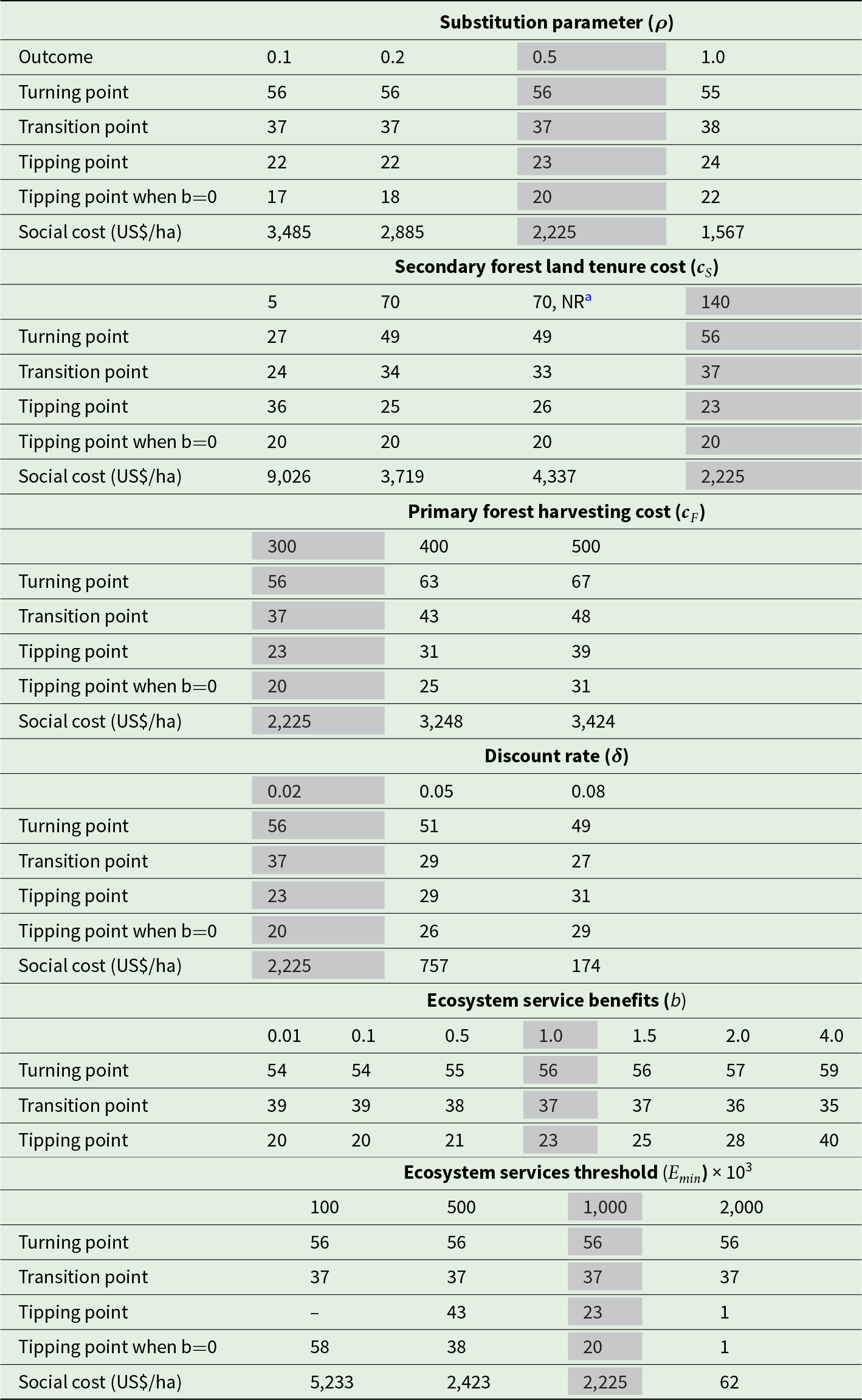
Table 2 Long description
The table reports model outcomes for turning, transition, and tipping points, plus social cost per hectare, under alternative values for several parameters. Changing the substitution parameter from 0.1 to 1.0 leaves turning and transition points nearly unchanged (about 55 to 56 and 37 to 38), while social cost falls from 3,485 to 1,567. Raising secondary forest land tenure cost from 5 to 140 shifts the turning point upward from 27 to 56 and lowers social cost from 9,026 to 2,225, with tipping points varying between 23 and 36. Increasing primary forest harvesting cost from 300 to 500 raises turning, transition, and tipping points (56 to 67; 37 to 48; 23 to 39) and increases social cost from 2,225 to 3,424. Increasing the discount rate from 0.02 to 0.08 reduces social cost dramatically from 2,225 to 174, while turning and transition points decline from 56 to 49 and 37 to 27 and tipping points rise from 23 to 31. As ecosystem service benefits rise from 0.01 to 4.0, the tipping point increases strongly from 20 to 40, while turning points rise slightly (54 to 59) and transition points fall slightly (39 to 35). Raising the ecosystem services threshold from 100 to 2,000 keeps turning and transition points fixed at 56 and 37, but tipping outcomes change markedly, including a missing tipping value at 100 and a very low tipping point of 1 at 2,000, with social cost dropping to 62. One row reports tipping points under a scenario with zero secondary forest management cost, and one tipping value is not reported for the lowest threshold, so comparisons there should be made cautiously.
a Shaded columns correspond to baseline parameter values. This scenario assumes that secondary forest management costs are zero, which represents spontaneous regeneration (Wilson et al., Reference Wilson, Schelhas, Grau, Nanni and Sloan2017).
Social costs are also reported in table 2 as the difference in (4) evaluated for the baseline value of  $b$ and using the optimal controls for this case, relative to the objective functional at the baseline value of $b$ but evaluated at nonoptimal controls solved for the case when $b$ is close to zero.Footnote 7 The baseline level of social cost totals slightly over US$2,225/ha.Footnote 8
The first set of sensitivity results in table 2 consider how substitutable secondary forests are for primary forests for ecosystem services. We do not find a protective effect as this substitution increases. For changes in the most plausible range ( $\rho $ = 0.2 to 0.5), the turning and transition points remain unchanged. At an extreme when primary and secondary forests are perfect substitutes ( $\rho $ = 1), the tipping point is delayed by only one decade.
The results in table 2 show that the most significant effects on turning and tipping points arise from changes in the cost parameters for secondary forest tenure and primary forest harvesting. As the tenure cost parameter  ${c_S}{\text{ }}$decreases from 140 to 70, the turning point occurs seven periods earlier, while the tipping point occurs two periods later. With a nearly complete elimination of tenure costs, the tipping point is delayed by 13 periods relative to the baseline. When tenure costs fall, we also see a shift in favor of secondary forest establishment. This result holds true even when the decision maker has a strong preference for rent generation (low b) because the effect of a tenure cost reduction is to increase the rents earned in secondary forest production relative to those in agriculture. However, unlike agriculture, secondary forest plantings also contribute to the production of ecosystem services. Thus, it is possible to enhance rent generation while also preserving ecosystem function over a longer time horizon. Overall, the effects of changes in tenure costs are larger than those that arise from changes in primary and secondary forest substitutability, $\rho $.
The third column of results in table 2 for the tenure cost scenarios captures the case when the tenure cost parameter is equal to 70, but planting costs are also set to zero (consistent with natural regeneration as opposed to a concerted planting effort). The results are very similar to the case with positive planting costs, leading us to conclude that tenure cost is more effective in delaying collapse than, for example, providing planting subsidies for secondary forests.
Increases in the primary forest harvesting costs parameter,  ${c_F}$, also show significant delays in turning and transition points, but the impact on tipping is most interesting. An increase from 300 to 400 for this parameter delays the turning point by seven periods, the transition point by six periods, and the tipping point by eight periods. Even when the decision maker has a strong preference for rent generation, this cost exerts a strong influence on the tipping point. Increasing agricultural rents has the same effect as decreasing primary forest harvesting costs: higher agricultural rents create an incentive to accelerate deforestation and mean an earlier tipping point. The magnitude of the effect differs, however: increasing agricultural rents by a factor of 10 advances the tipping point to within a decade or less.
The discount rate influences the paths of deforestation and reforestation and thus the turning and tipping points through opposing effects. We therefore examine a change in the rate from the baseline level of 2 per cent up to 8 per cent. As the discount rate increases, the turning point occurs earlier in time, as does the transition point. However, the tipping point occurs later. With a higher discount rate, the rate of secondary forest establishment accelerates earlier in time, leading to an increase in net forest cover and a delay in the tipping point.Footnote 9 The online appendix presents the sensitivity analyses of table 2 using a discount rate of 5 per cent. The results are qualitatively similar to those with a 2 per cent discount rate, although there are more scenarios in which a tipping point is not crossed within 100 periods.
The results in table 2 also capture a range of values for the ecosystem service benefit parameter,  $b$. The impact on the tipping point is of utmost interest here. As $b$ increases, we see only a slight delay in the turning point, but an earlier forest cover transition and a delay in ecosystem collapse. With a strong preference for rent generation ( $b = 0.01$), the tipping point occurs in period 20, however, this point doubles (40 decades) if there is a strong preference for ecosystem services (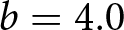 $b = 4.0$). Moreover, in all other scenario analyses, a reduction in this parameter universally advances the timing of the tipping point.
The final results in table 2 report outcomes for different ecosystem service thresholds,  ${E_{min}}$. A reduction in the threshold by 50 per cent delays the tipping point by 20 periods, at which time 84per cent of the original primary forest will have been harvested. If the threshold falls low enough, the system does not collapse within the 100 periods modelled. As the tipping point is delayed in time, the social costs rise because the consequences of a decision maker that fails to consider ecosystem services are ever greater. An increase in the threshold advances the tipping point, resulting in collapse at a lower level of deforestation.
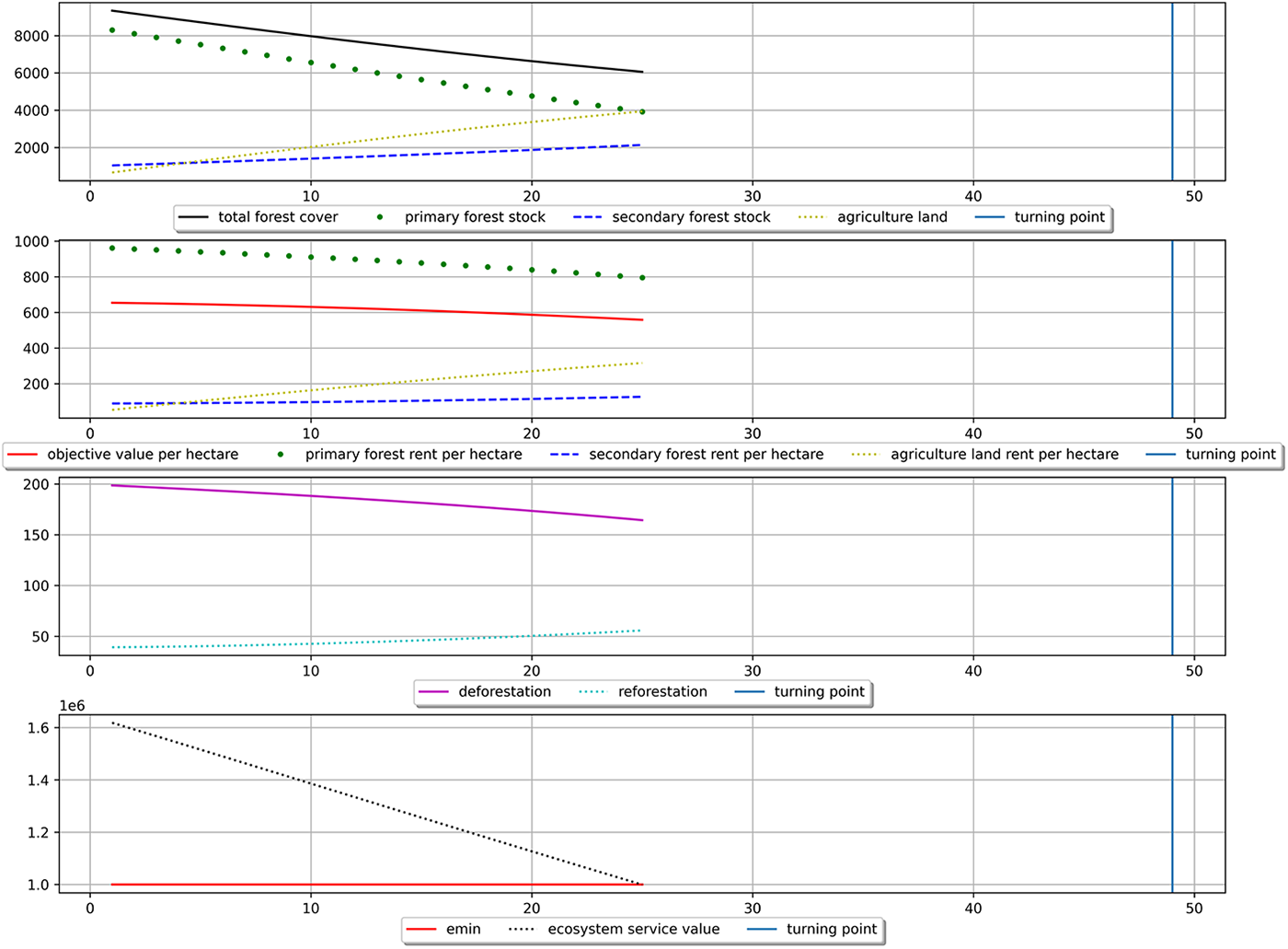
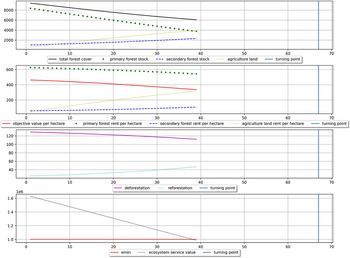
A graphical depiction of deforestation and reforestation results is given in figures 1 and 2 for two cases: when the secondary forest land tenure cost parameter is equal to 70 (figure 1) and when the primary forest harvesting cost parameter is equal to 500 (figure 2). Each figure presents the paths of the state variables (along with total forest cover, defined as the sum of primary and secondary forest land area), the paths of the control variables and the path of ecosystem service production. Comparing the two figures clearly shows what we have discussed above, namely that an increase in the cost of harvesting primary forest or a decrease in tenure cost significantly reduces the rate of deforestation and also allows for a faster rate of reforestation. Both of these cases combine to slow the decline in ecosystem service production and significantly delay the tipping point.
Optimal paths of deforestation, reforestation and ecosystem service production when 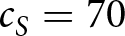 ${c_S} = 70$.
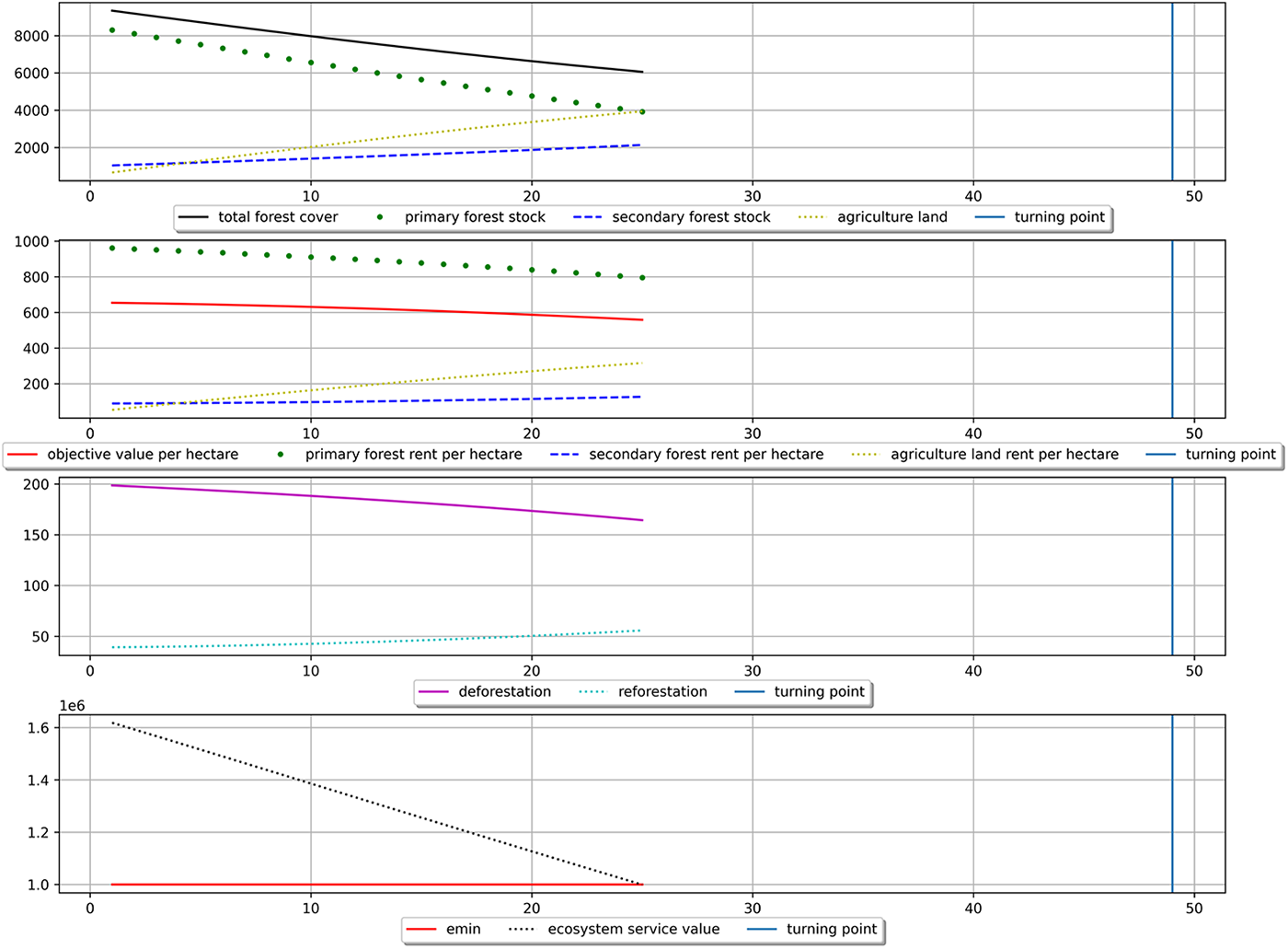
Figure 1 Long description
The first graph shows total forest cover, primary forest stock, secondary forest stock and agriculture land over time. The x-axis represents time from 0 to 50 and the y-axis shows hectares from 0 to 8000. Total forest cover decreases from 8000 to 6000 hectares. Primary forest stock declines from 4000 to 2000 hectares, while secondary forest stock remains stable around 2000 hectares. Agriculture land increases slightly. A turning point is marked near time 30. The second graph displays land rent per hectare for primary forest, secondary forest and agriculture. The x-axis is time from 0 to 50 and the y-axis is rent per hectare from 0 to 200. Primary forest rent decreases from 150 to 100, secondary forest rent remains around 50 and agriculture land rent is stable at 20. A turning point is marked near time 30. The third graph illustrates deforestation and reforestation rates. The x-axis is time from 0 to 50 and the y-axis is rates from 0 to 100. Deforestation decreases from 80 to 20, while reforestation increases from 10 to 60. A turning point is marked near time 30. The fourth graph shows ecosystem service value over time. The x-axis is time from 0 to 50 and the y-axis is value from 0 to 100. The value decreases from 90 to 30. A turning point is marked near time 30. Overall, the graphs indicate a correlation between decreasing forest cover and ecosystem service value, with changes in land rent and deforestation/reforestation rates around the turning point.
Optimal paths of deforestation, reforestation and ecosystem service production when 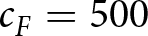 ${c_F} = 500$.
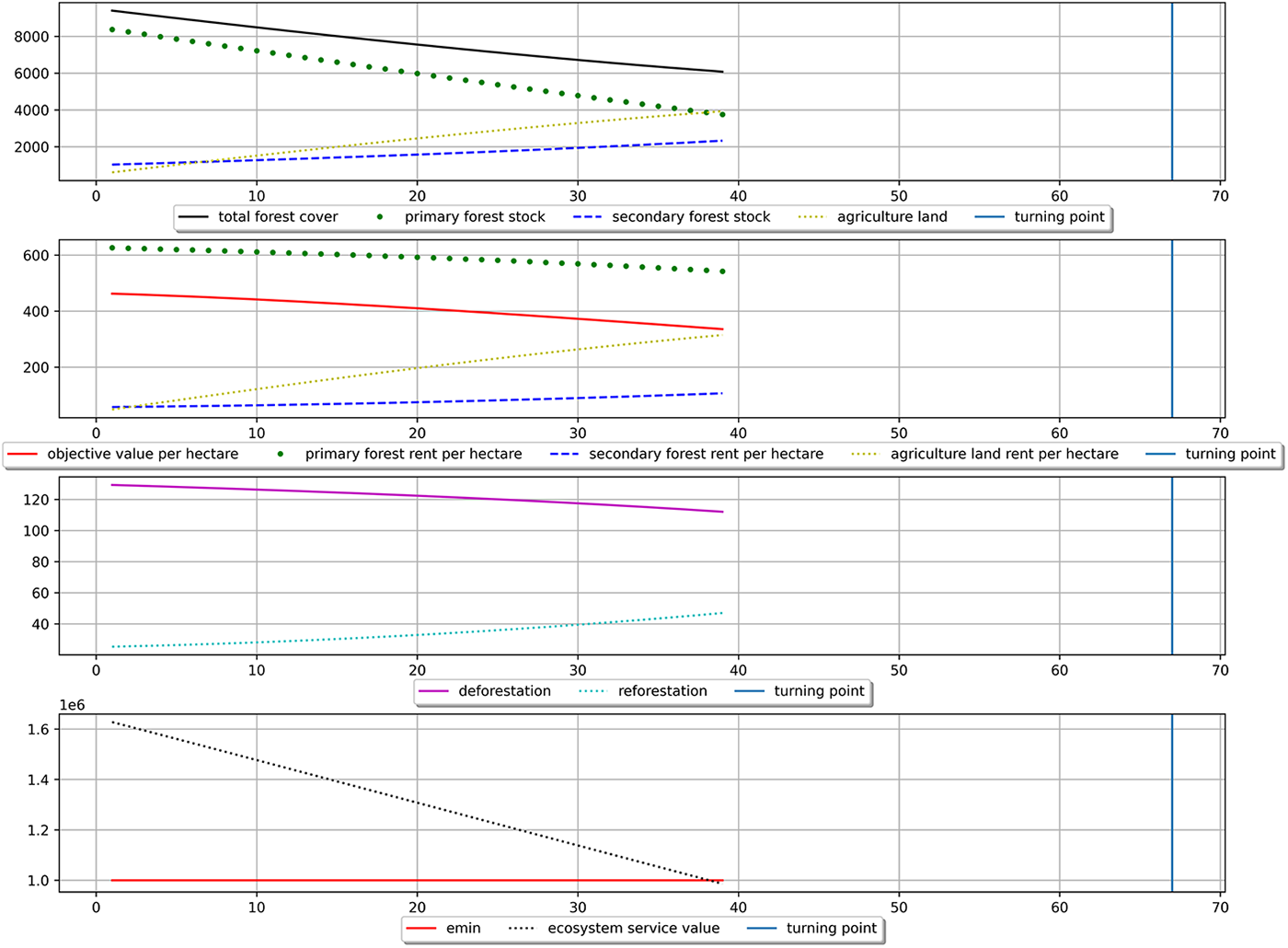
Figure 2 Long description
The image consists of three line graphs depicting various aspects of forest management over time. The first graph shows total forest cover, primary forest stock, secondary forest stock, agriculture land and a turning point. The x-axis is labeled ′Time′ and the y-axis is labeled ′Area in hectares,′ ranging from 0 to 9000. Total forest cover decreases from 8000 to 6000 hectares, while primary and secondary forest stocks also decline. The second graph illustrates the rent per hectare for primary forest, secondary forest and agriculture land, with a turning point. The x-axis is labeled ′Time′ and the y-axis is labeled ′Rent per hectare,′ ranging from 0 to 600. Primary forest rent decreases from 500 to 300, while secondary forest rent remains stable. The third graph shows deforestation, reforestation and ecosystem service value over time, with a turning point. The x-axis is labeled ′Time′ and the y-axis is labeled ′Value,′ ranging from 0 to 150. Deforestation decreases, reforestation increases and ecosystem service value declines from 100 to 50. The turning point is marked at 50 on the x-axis in all graphs.
6. Ephemerally versus perennially managed secondary forests
Finally, we relax an important assumption about secondary forest exploitation. The problem in (4) assumes that secondary forests are ephemeral and harvested after only one rotation. This does not align with long-term sustainable management over multiple rotations, which should be the goal of policy reform. We now consider how our results would change if secondary forests were established and managed through a long-term sequence of rotations; in other words, we consider “perennial” secondary forests. The new problem becomes:
 \begin{align}&\mathop {max}\limits_{d\left( t \right),r\left( t \right)} \mathop \int \limits_0^{T} {e^{ - \delta t}}\left\{ b\left( {E\left( t \right)} \right) + {p_F}d\left( t \right) - {C_F}\left( {d\left( t \right)} \right) + {p_S}S\left( t \right) - {C_S}\left( {S\left( t \right)} \right)\right. \nonumber\\ & \quad \left. + \, {p_A}\left( {L - F\left( t \right) - S\left( t \right)} \right) - \Phi \left( {r\left( t \right)} \right) \right\}dt + {e^{ - \delta T}}{V_a}\left( {F\left( T \right),S\left( T \right)} \right).\end{align}
 In (9) we now have secondary forest area,  $S\left( t \right)$, as a variable in the rent function in place of reforestation, $r\left( t \right)$. The inclusion of $S\left( t \right)$, and the fact that periods in our model are thought of as secondary forest rotation periods, simply implies that secondary forests once established become permanent managed working forests.
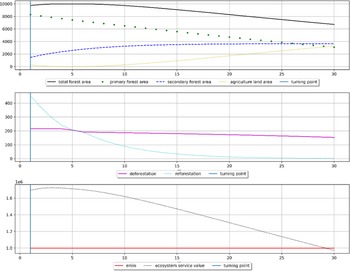
Using our baseline parameters and (9), there are striking differences in our results (figure 3). In the top panel, permanently managed secondary forests mean very early turning points. In the middle panel, sustainable management means greater secondary forest rent and, therefore, a greater incentive to replace deforested land with plantation forestry rather than agriculture. The reforestation rate is very high early, and the deforestation rate slows as more land is chosen for secondary forests rather than agriculture upon clearing. This implies that forest land area transitions are reached prior to the tipping point, which occurs in period 29. The tipping point, thus, is pushed further out than the turning point and is three periods later when secondary forests are managed over multiple rotations.
Optimal paths of deforestation, reforestation and ecosystem service production with perennial secondary forests.
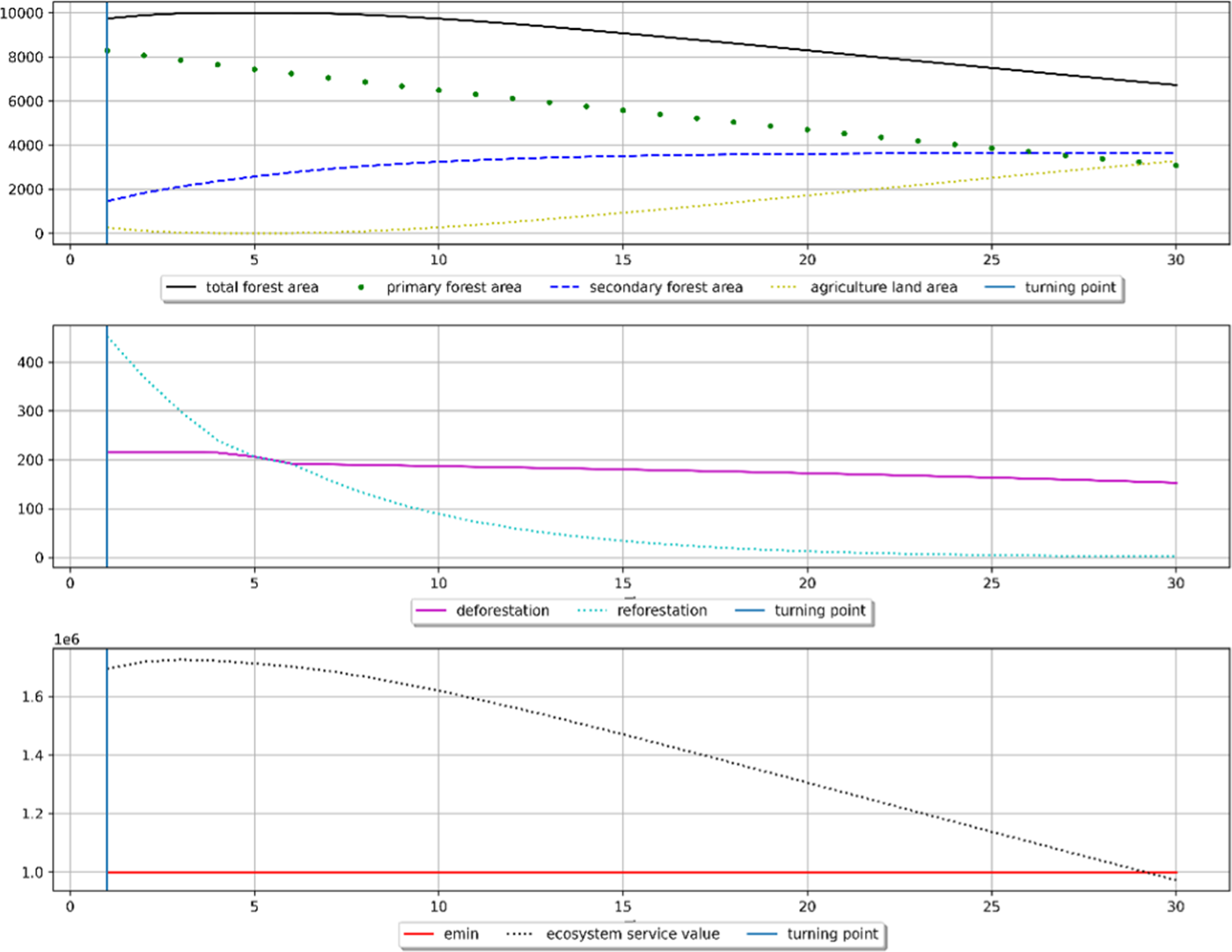
Figure 3 Long description
The image consists of three line graphs. The top graph shows forest area changes over time. The x-axis is labeled ′Time (periods)′ ranging from 0 to 36. The y-axis is labeled ′Area (hectares)′ ranging from 0 to 20000. It includes lines for total forest area, primary forest area, secondary forest area, agriculture land area and a turning point. The middle graph displays deforestation and reforestation rates. The x-axis is labeled ′Time (periods)′ ranging from 0 to 36. The y-axis is labeled ′Rate (hectares per period)′ ranging from 0 to 600. It includes lines for deforestation, reforestation and a turning point. The bottom graph shows ecosystem service value over time. The x-axis is labeled ′Time (periods)′ ranging from 0 to 36. The y-axis is labeled ′Ecosystem Service Value (units)′ ranging from 0 to 2. It includes lines for value and a turning point. Key trends include a decrease in primary forest area and an increase in secondary forest area, a high initial reforestation rate and a steady ecosystem service value.
7. Discussion and conclusions
We find in this article that ecosystem collapse often precedes a turning point where reforestation rates exceed deforestation. Moreover, reaching a turning point provides no guarantee of avoiding ecosystem collapse. Thus, policy objectives targeting only forest cover increases may be misguided. We therefore identify policies that can delay the tipping point and avoid catastrophic loss of ecosystem services. Surprisingly, efforts to ensure that secondary forests better mimic primary forests have only a limited effect on the time to ecosystem collapse. The same conclusion applies to shifting from ephemeral to perennial secondary forest systems, which is a stated goal in recent policy discussions (FAO, 2022). At best, these can delay a tipping point by only two to three decades. The most alarming new finding in our model is how fast land-allocation decisions made purely to maximize rents will drive a forest system to ecological collapse; such an objective is inconsistent with any idea of sustainability, yet is playing out right now in tropical, developing countries where governments seek revenue and development. It therefore appears unlikely that our new results are overly pessimistic on this point.
The most significant way to avoid collapse, and our most important result, is targeting costs of secondary forest tenure protection and primary forest harvesting. A decrease in the cost of protecting secondary forests from property rights risks, or an increase in the cost of clearing primary forests, pushes tipping significantly further into the future. More importantly, changes in these parameters increase the time between the turning point and the tipping point, potentially reducing the risk of ecosystem collapse by slowing the rate of decline in ecosystem service provision over time. Investment in well-defined and enforceable property rights for secondary forest establishment is clearly critical based on our parameters; so too are efforts to increase the costs of harvesting primary forests, which is a provision in REDD+ policies.
Although our analysis does not need to presuppose a decision-maker type, our results show that such a consideration needs to be studied in further work. A regional or national decision-maker that may optimally drive the system to a tipping point generates social costs at a global scale. Arguably, programmes like REDD+ demonstrate an effort to increase the weight attached to non-market ecosystem services in the decision-making calculus of regional and national decision-makers. Such global-scale policy instruments compensate regional decision-makers for any sacrifices made in terms of rent generation in efforts to sustain the function of these critical systems.
There are a number of limitations to our approach and data. As in all economics work, we have monetized ecosystem services under assumptions, given the absence of studies at present that estimate the value of all ecosystem services for a tropical forest. We have also treated the ecosystem tipping threshold as exogenous and known, yet there is a great deal of uncertainty surrounding this point, and policy choices may depend on this uncertainty. Finally, this analysis has not modelled the mechanics by which thresholds arise, nor the spatial attributes of ecosystem change in the Brazilian Amazon. It might prove important to develop a bioeconomic spatial modelling approach to capture how and where changes occur, e.g., how change spreads from forest margins to the interior, or from older to newer deforestation frontiers.
Supplementary material
The supplementary material for this article can be found at https://doi.org/10.1017/S1355770X25100089.
Competing interests
The authors declare no competing interests.






 Open access

