





Impact statement
Bioregional Mineralisation with Agricultural Resources for Construction (BIOARC) demonstrates how regionally sourced agricultural residues and locally isolated bacterial strains can generate structurally viable construction materials, strengthening circular value chains between farming and building sectors. By embedding material production within bioregional ecologies, the project advances low-impact construction strategies that reduce reliance on conventional mineral-intensive systems while supporting local economies.
Background
The environmental burden of construction has intensified interest in materials that can reduce dependence on carbon-intensive, mineral-based products. Recent global reporting identifies buildings and construction as a major source of energy-related CO2 emissions, underscoring the need to rethink both operational performance and the embodied impacts of material production (United Nations Environment Programme 2024). Within this context, bio-based materials are increasingly recognised as an important component of circular construction strategies, offering opportunities to valorise agricultural by-products, reduce waste streams and establish stronger connections between regional resource systems and the built environment (Abaide et al. Reference Abaide, Tres, Zabot and Mazutti2019; Fanelsa et al. Reference Fanelsa, Bekemans, Islam and Waal2025; Overturf et al. Reference Overturf, Ravasio, Zaccheria, Tonin, Patrucco, Bertini, Canetti, Avramidou, Speranza, Bavaro and Ubiali2020). BIOARC investigates how agricultural residues can be transformed into construction materials through biologically mediated mineralisation processes. The project is founded on the principle of bioregional innovation, which seeks to reconnect material production with local ecological, cultural and agricultural contexts. Rather than relying on globally standardised material supply chains, BIOARC explores how locally available agricultural by-products and microbial resources can be combined to create region-specific construction materials and circular value chains. This approach aligns with emerging discussions on bioregional architecture and design practices that emphasise place-based resource use, regional resilience and ecological stewardship.
A distinguishing aspect of BIOARC is its focus on regional microbial ecologies as an integral component of material development. Alongside agricultural residues, the project investigates naturally occurring mineralising bacteria isolated from each participating bioregion. Field sampling campaigns have been completed across limestone-rich landscapes near Bergamo (Italy), quarry and limestone environments near Paris (France), limestone-associated sites near Munich (Germany) and calcium-rich soils in the Warmia region of Poland. These microbial communities are being evaluated for their capacity to induce calcium carbonate precipitation and act as biological binders within agricultural fibre composites. By pairing local biomass resources with locally sourced bacterial strains, BIOARC extends the concept of bioregional innovation beyond material sourcing alone, establishing place-based biological material systems in which both the feedstock and the mineralising organisms originate from the same regional context.
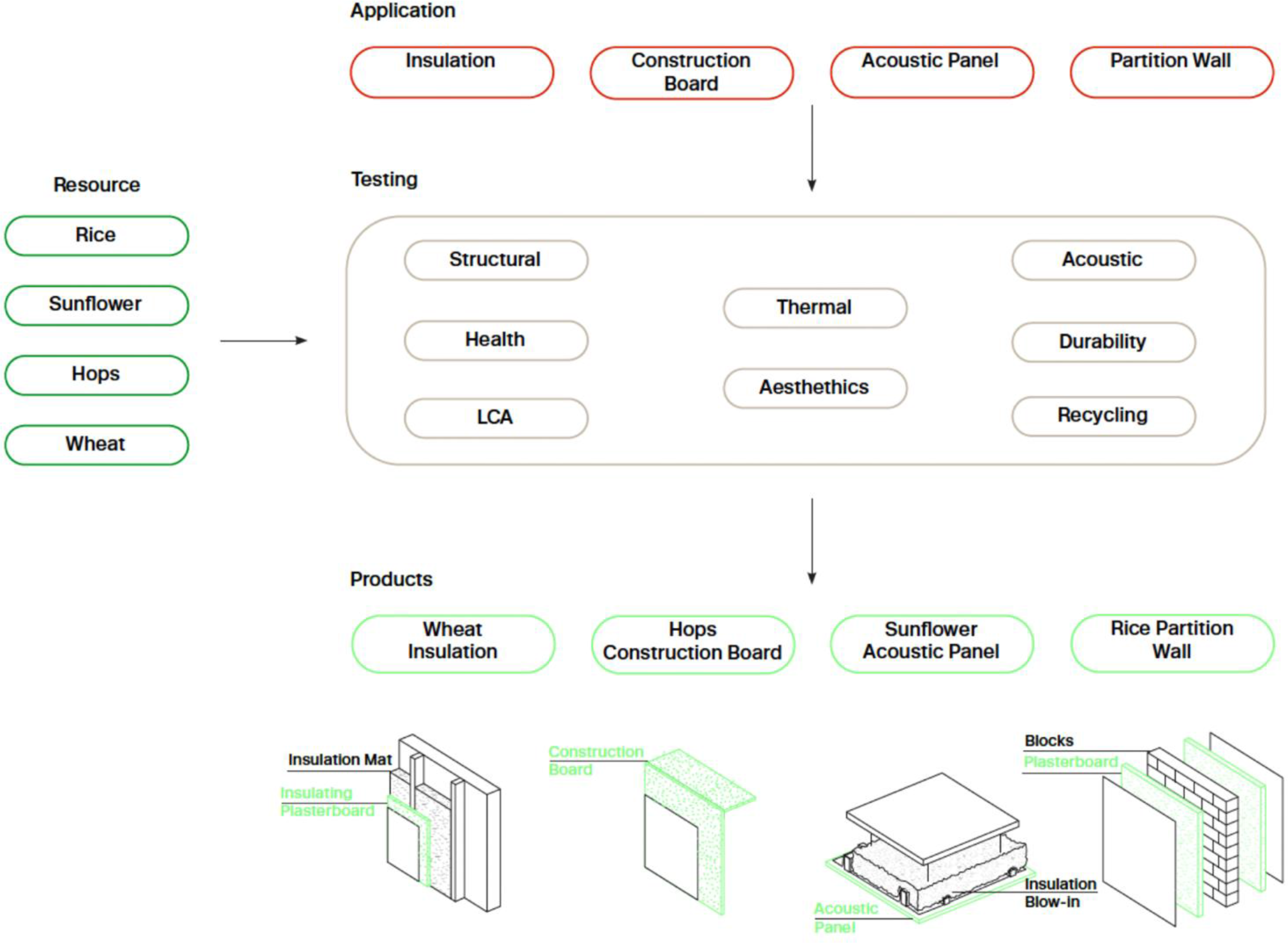
The project develops building components including acoustic panels, insulation boards, partition wall systems and construction boards from agricultural secondary biomass across four European bioregions: wheat in Warmia (Poland), sunflower in Terres de Sol (France), hops in Hallertau (Germany) and rice in Terre d’Acqua (Italy). These agricultural landscapes were selected not only because they generate significant volumes of underutilised residues, but also because they represent distinct cultural and ecological contexts capable of supporting regional material ecosystems. By working with agricultural by-products that are deeply embedded in local food production systems, BIOARC seeks to establish new relationships between agriculture, material manufacturing and construction (Figure 1).
Overview of the BIOARC material development pathway. Agricultural residues sourced from four European bioregions (rice, sunflower, hops and wheat) are transformed into bio-based construction products through a process of material development and performance evaluation. Testing criteria include structural, thermal, acoustic, environmental, durability, health, aesthetic and circularity assessments, which collectively inform the selection of appropriate construction applications. The resulting products include insulation boards, construction boards, acoustic panels and partition wall systems, illustrated through representative building assembly scenarios.

Figure 1. Long description
A diagram of the BIOARC material development pathway. The diagram represents a process of transforming agricultural residues into bio-based construction products. The resources include rice, sunflower, hops, and wheat. These resources undergo testing for structural, health, life cycle assessment (LCA), thermal, aesthetics, acoustic, durability, and recycling properties. The applications of these tested materials include insulation, construction board, acoustic panel, and partition wall. The resulting products are wheat insulation, hops construction board, sunflower acoustic panel, and rice partition wall. Each product is illustrated with a representative building assembly scenario.
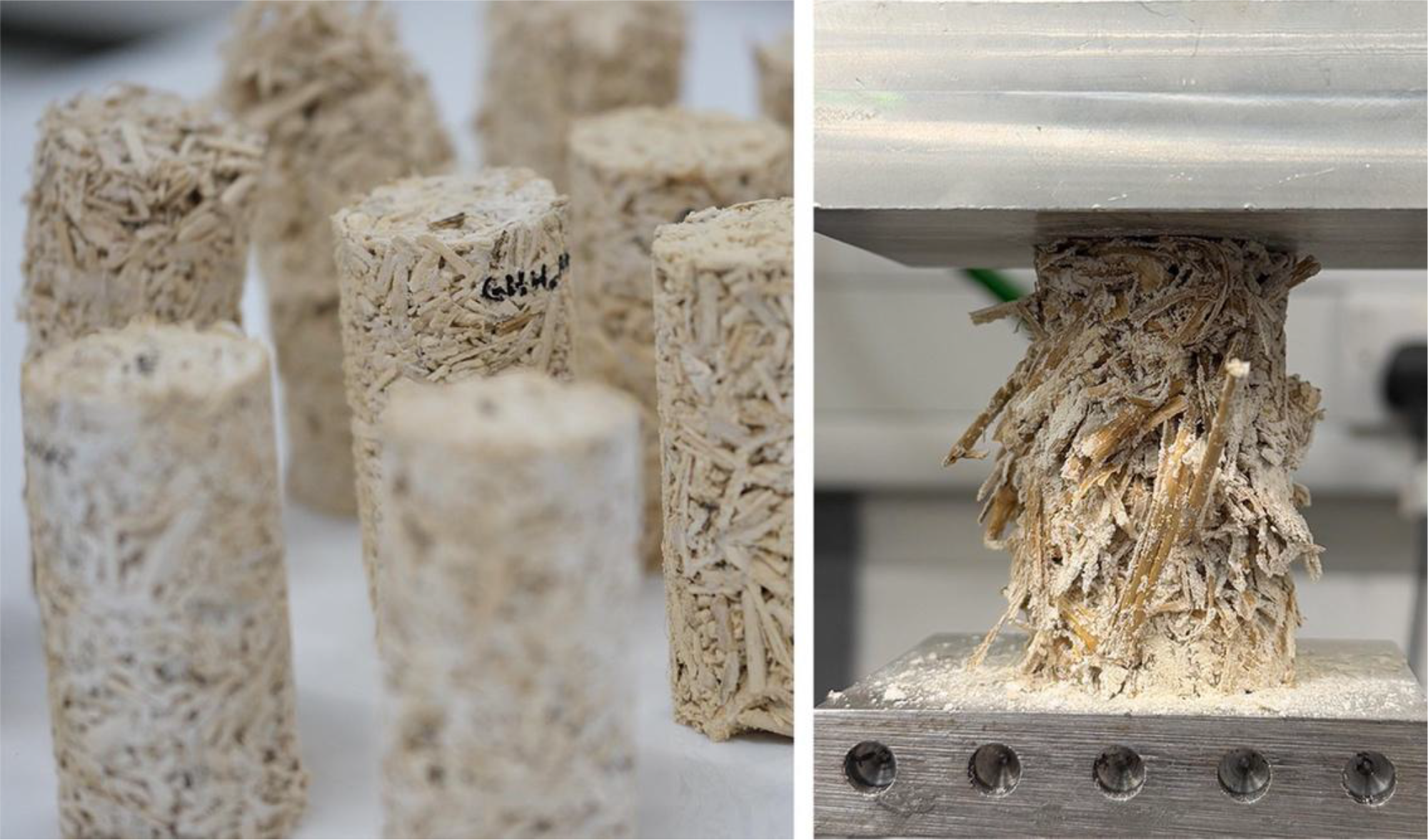
The project builds upon advances in microbially induced calcium carbonate precipitation (MICP), a biomineralisation process in which microorganisms induce the formation of calcium carbonate crystals that act as mineral binders within a material matrix (Chuo et al. Reference Chuo, Mohamed, Mohd Setapar, Ahmad, Jawaid, Wani, Yaqoob and Mohamad Ibrahim2020; DeJong et al. Reference DeJong, Mortensen, Martinez and Nelson2010). Unlike conventional binder systems that rely on energy-intensive industrial processes, microbial mineralisation operates under ambient conditions and offers opportunities to consolidate plant-based materials through biological activity. BIOARC combines this process with the CrescoBind manufacturing approach developed by Cresco Biotech, a bio-based moulding technology that enables the formation and handling of agricultural fibre composites prior to mineralisation (Figure 2). The CrescoBind process provides a scalable manufacturing route for producing board-scale components from agricultural residues while supporting subsequent biomineralisation and the evaluation of regionally isolated bacterial strains as locally adapted biological binders. By integrating local biomass resources, regional microbial ecologies and biologically mediated manufacturing processes, BIOARC explores alternative pathways for producing construction materials that are simultaneously low-carbon, circular and regionally grounded. Through the development and evaluation of prototype building products, the project contributes to ongoing efforts to establish resilient and place-based material systems for the built environment.
Prototype biomineralised composite materials and performance evaluation. Cylindrical samples produced from agricultural residues using the CrescoBind process (left) and compression testing of the resulting material (right). Mechanical testing forms part of the assessment framework used to translate agricultural by-products into construction-oriented materials suitable for building applications.

Description
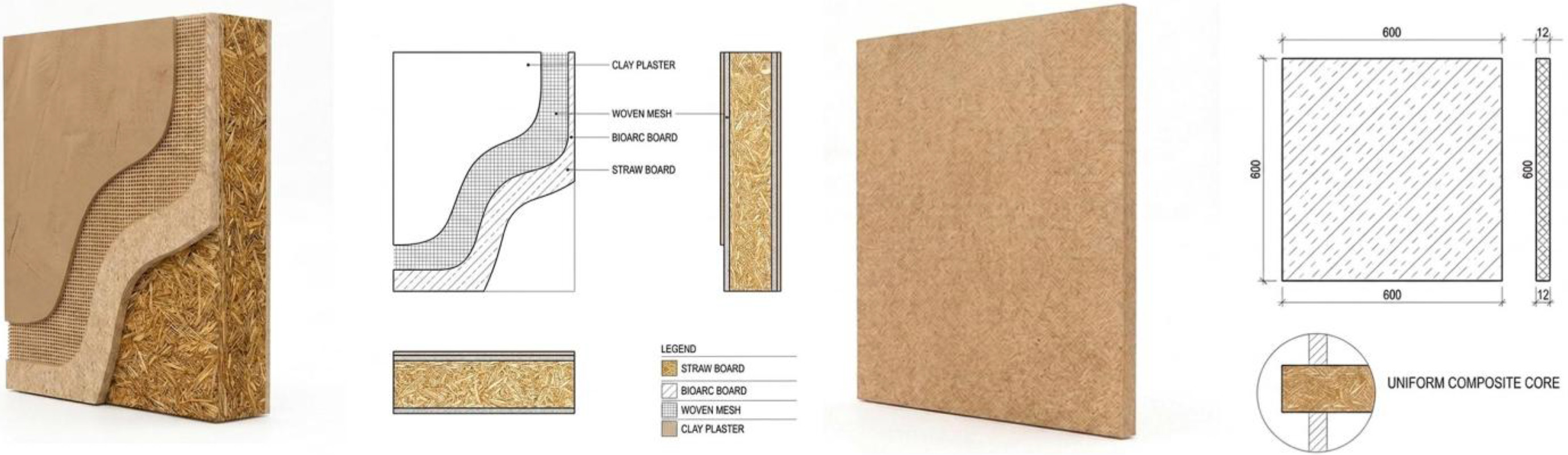
The demonstration will be presented as a material display centred around a 600 × 600 mm biomineralised panel prototype and an accompanying A4-scale wall assembly model (Figure 3). The wall model illustrates how the material may be integrated within a typical construction build-up, providing visitors with a direct connection between material development and architectural application. Alongside the panel, visitors will be able to examine the agricultural biomass from which the materials are derived, including residues sourced from BIOARC’s participating bioregions. These biomass samples will be presented in their raw form, enabling direct comparison between agricultural by-products and the resulting construction materials. The display aims to make visible the material transformation that occurs as agricultural residues are consolidated into rigid, construction-oriented components.
Physical artefacts proposed for exhibition within the BIOARC demonstrator. Left: A4-scale wall assembly model showing a potential interior wall application of a biomineralised BIOARC board combined with straw insulation, reinforcement mesh and clay plaster. Right: a 600 × 600 mm biomineralised panel sample fabricated from agricultural biomass. The two elements are presented together to communicate both material performance and potential construction integration.

The demonstrator will also present the biological dimension of the project through examples of mineralising bacterial cultures and microscopy imagery showing bacterial activity and calcium carbonate crystal formation. These elements provide insight into the biomineralisation processes that underpin material development within BIOARC.
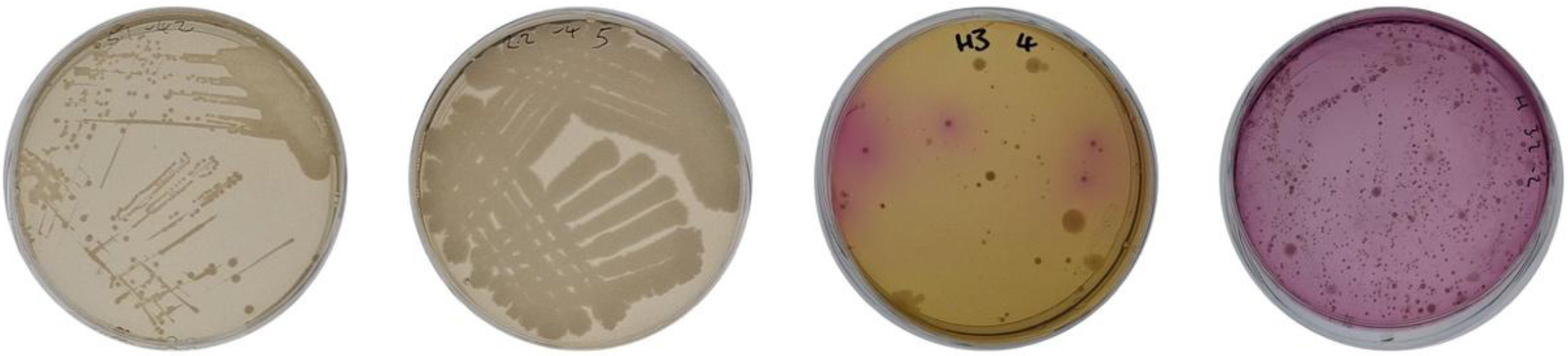
The mineralised construction samples exhibited in this demonstration have been produced using the model ureolytic bacterium Sporosarcina pasteurii, a widely studied organism commonly used in MICP research. While evaluation and optimisation of the regional bacterial isolates is ongoing (Figure 4), S. pasteurii provides a robust and well-characterised platform for demonstrating the material concept and manufacturing approach. The exhibited samples therefore represent both a validated biomineralisation pathway and a stepping stone toward future construction products based on locally sourced microbial communities.
Soil samples from each BIOARC region were screened for bacteria capable of supporting biomineralisation. Bacteria collected from local soil samples were grown on a specialised growth medium. Colonies that turned the medium pink were selected for further testing, indicating their potential to create the chemical conditions needed for mineral formation. These strains were then isolated and preserved for future development within BIOARC’s bioregional material systems.

Together, the wall assembly, biomass samples and biological artefacts demonstrate the transformation from loose agricultural residue into coherent construction materials. The display communicates BIOARC’s broader vision of bioregional innovation, in which local biomass resources, regional microbial ecologies and biologically mediated manufacturing processes are brought together to create circular, place-based construction systems.
Technical details
There will be no live biological cultures. Petri plate will be resin covered and closed. Fibres and soil samples in closed containers.
Spatial setup
On the table we will have a 600 × 600 mm biomineralised panel, one A4-scale cutaway wall assembly model showing how the panel is integrated into a building system, then there will be two glass containers containing the fibres and soil, alongside a petri dish and a magnifier.
Visitor interaction
Visitors will be able to touch the panels and look through the magnifier.
Technical requirements
One display table, approximately 1.2 × 0.6 m.
Data availability statement
Data availability is not applicable to this article as no new data were created or analysed in this study.
Acknowledgements
The authors acknowledge the contributions of the BIOARC consortium partners for their collaboration in the development, sourcing and regional coordination of the biomass materials presented in this study. The interdisciplinary exchange between academic, industrial and regional partners has been central to the realisation of the bioregional material systems described here.
Author contributions
Conceptualisation: T.H.A; E.J; E.S; Ö.T Methodology: E.J; E.S; J.H Investigation: T.H.A; E.J; E.S; J.H; Ö.T Data curation: T.H.A; E.J; E.S; J.H; Ö.T Visualisation: T.H.A; E.J; E.S; J.H; Ö.T Writing original draft: T.H.A Writing – review & editing: T.H.A; E.S; Ö.T; M.D.R; M.Z Supervision: M.D.R; M.Z Funding acquisition: E.J; E.S; M.D.R; N.Z Project administration: E.J; E.S; M.D.R; M.Z All authors approved the final submitted draft.
Financial support
This work was supported by the European Union’s Horizon programme through BIOARC Bioregional mineralisation with agricultural resources for construction (Grant no:101215956).
Competing interests
E.J. and E.S. are affiliated with Cresco Biotech Ltd., a partner organisation in the BIOARC project and developer of the CrescoBind technology referenced in this work. The remaining authors declare no competing interests.
Ethical standards
Not applicable.

 Open access

