


Introduction
The Roman Empire's camel-riding armed forces were named the Dromedarii. Although both dromedary camels Camelus dromedaries and Bactrian camels Camelus bactrianus were used by these armies, the Romans did not deem it necessary to distinguish between the two species (Nefedkin, Reference Nefedkin2012; Tomczak, Reference Tomczak2016). It could be that the Romans did not need to distinguish between one-humped and two-humped camels as they performed similarly in war. Descriptions of camels from Pliny the Elder and Aristotle (Bostock & Riley, Reference Bostock and Riley1855) portray their similar temperament and endurance in contrast to that of the horse (one of the roles of the Dromedarii was to counter enemy cavalry). Even today, the global database for livestock (FAOSTAT, undated) does not distinguish between domesticated one- and two-humped camels (Faye, Reference Faye2020). However, failing to distinguish the two species of two-humped camels could have conservation ramifications given that one is at risk of extinction.
Camel evolution and distribution
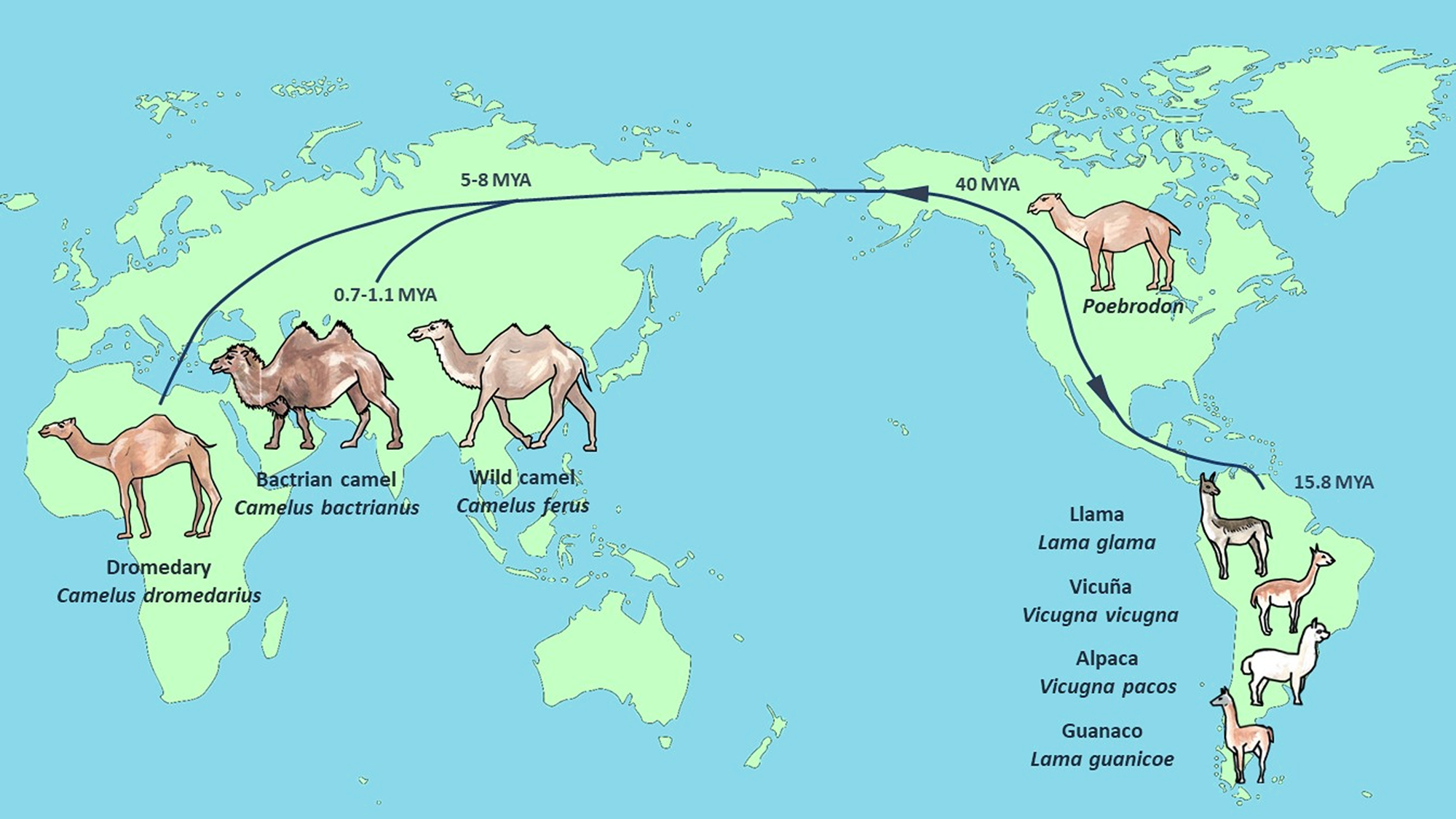
After dispersing from the North American continent to Eurasia, the ancestors of modern camelids diverged into the New World camels, Lamini, which include the llama Lama glama, alpaca Vicugna pacos, vicuña Vicugna vicugna and guanaco Lama guanicoe, and the Old World camels, Camelini (Burger et al., Reference Burger, Ciani and Faye2019). There are three species of Old World camels: the one-humped domestic dromedary Camelus dromedarius, the two-humped domestic Bactrian camel Camelus bactrianus (the species that the Romans came into contact with first; Nefedkin, Reference Nefedkin2012) and the Critically Endangered two-humped wild camel Camelus ferus (Mongolian: хавтгай, khavtgai; Chinese: 野骆驼, ye luo tuo; Hare, Reference Hare2008; Fig. 1). The one- and two-humped camels are estimated to have diverged c. 4.4 (CI 1.9–7.2) million years ago (Wu et al., Reference Wu, Guang, Al-Fageeh, Cao, Pan and Pan2014). Divergence estimates for the wild camel and Bactrian camel vary depending on whether maternal or paternal DNA is used but range from 0.7 (Ji et al., Reference Ji, Cui, Geng, Gao, Zhang and Yu2009) to 1.1 (CI 0.6–1.8) million years ago (Mohandesan et al., Reference Mohandsen, Fitak, Corander, Yadamsuren, Chuluunbat and Abdelhadi, O.2017) from mitochondrial studies to c. 27,000 years ago based on the male-specific region of the Y chromosome (Felkel et al., Reference Felkel, Wallner, Chuluunba, Yadamsuren, Faye and Brem2019). The Bactrian camel is monophyletic (Ji et al., Reference Ji, Cui, Geng, Gao, Zhang and Yu2009) and so originated from one wild population, with a single domestication process having occurred c. 4,000–6,000 years ago (Burger et al., Reference Burger, Ciani and Faye2019), leaving no wild C. bactrianus population, which is similar to the domestication process of the dromedary (Almathen et al., Reference Almathen, Charruau, Mohandesan, Mwacharo, Orozco-terWengel and Pitt2016) or the horse (Gaunitz et al., Reference Gaunitz, Fages, Hanghøj, Albrechtsen, Khan and Schubert2018). The domestication of the Bactrian camel occurred long after the estimated time of its divergence from the wild camel, such that the wild camel is neither the direct progenitor of the Bactrian camel nor a feral version of the species but a sister species.
The evolution of the three Old World camelid species (dromedary Camelus dromedarius, Bactrian camel Camelus bactrianus and wild camel Camelus ferus) and the New World camelid species (guanaco Lama guanicoe, llama Lama glama, alpaca Vicugna pacos and vicuña Vicugna vicugna) from the ancestral Poebrodon. MYA, million years ago.
Here we argue for the use of the accurate English common name of wild camel for C. ferus, ideally alongside its Indigenous names to correctly differentiate these Critically Endangered wild animals from their domesticated congeners.
Camel names
Despite the extensive evidence supporting a species-level distinction between C. ferus and C. bactrianus (Han, Reference Han, Reading, Enkhbileg and Galbaatar2002; Ji et al., Reference Ji, Cui, Geng, Gao, Zhang and Yu2009; Silbermayr et al., Reference Silbermayr, Orozco-Terwengel, Charrau, Enkhbileg, Walzer and Vogl2009; Jirimutu et al., Reference Jirimutu, Wang, Ding, Chen, Sun and Sun2012; Mohandesan et al., Reference Mohandsen, Fitak, Corander, Yadamsuren, Chuluunbat and Abdelhadi, O.2017; Felkel et al., Reference Felkel, Wallner, Chuluunba, Yadamsuren, Faye and Brem2019; Fitak et al., Reference Fitak, Mohandsen, Corander, Yadamsuren, Chuluunbat and Abdelhadi2020; Ming et al., Reference Ming, Yuan, Yi, Ding, Hasi and Chen2020), the English common names currently used for C. ferus are wild Bactrian camel, wild two-humped camel and wild camel. As the name Bactrian camel refers to the potential place of domestication in the ancient region of Bactria (modern-day Afghanistan), we believe that the use of Bactrian should not be applied when describing the wild species as it is inaccurate and confuses the distinction between these species. Throughout this text we use the English common name wild camel to describe C. ferus and Bactrian camel to describe C. bactrianus. We are not proposing this name but reporting a position taken by most wild camel researchers who, writing in English, now use wild camel or wild two-humped camel exclusively in research publications (Farnworth et al., Reference Farnworth, Campbell and Adams2011; Burger et al., Reference Burger, Ciani and Faye2019; Lado et al., Reference Lado, Elbers, Rogers, Melo-Ferreira, Yadamsuren and Corander, J.2020).
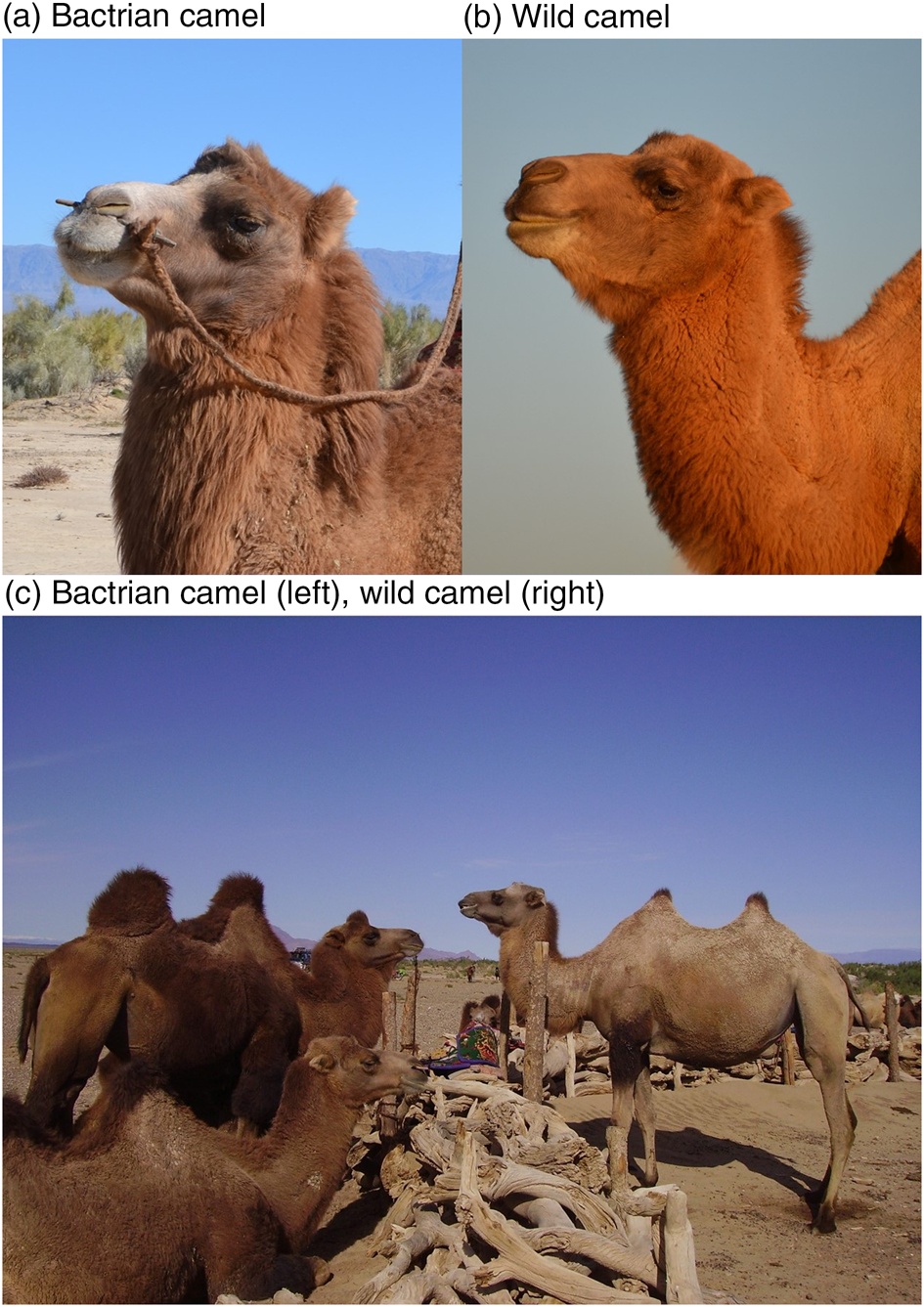
The wild camel, originally given the scientific name Camelus bactrianus ferus, reverted to the first available name based on a wild population (as a standard naming change for presumed progenitor species, not because of species distinction), C. ferus (Gentry et al., Reference Gentry, Clutton-Brock and Groves2004). Wild camels were first described by the Russian explorer and geographer Nikolaj Przwalski in 1878 (Hare, Reference Hare2008). Unknown to the Western world until this point, wild camels were presumed to be either a feral version of the Bactrian camel or the wild ancestor from which the Bactrian camel was domesticated, hence this species being named C. bactrianus ferus, meaning wild/feral Bactrian camel. Throughout its range across Mongolia and China, the wild camel was thought of and consequently named locally as a separate species from the Bactrian camel (Hare, Reference Hare1997) based on both the behavioural characteristics of wildness and distinct morphological differences (Plate 1). These differences include smaller, pyramid-shaped humps, smaller body and slimmer legs in the wild camel (Ji et al., Reference Ji, Cui, Geng, Gao, Zhang and Yu2009) and a flatter skull. The name for the wild camel in Mongolia is хавтгай (khavtgai) translating to ‘flat head’. In China the animal is called 野骆驼 (ye luo tuo), which means ‘wild camel’.
Morphological differences between the Bactrian camel Camelus bactrianus, in part (a) and individuals to the left in (c), and wild camel Camelus ferus, in part (b) and individual to the right in (c). Camelus ferus has smaller, pyramid-shaped humps, a smaller body, slimmer legs and a flatter skull. Top photos: Anna M. Jemmett. Bottom photo: Pauline Charruau.
Confusion of common names, and implications
Scientific naming is determined by taxonomy, which itself ought to be underpinned by evolutionary, genetic, morphological and ecological evidence of species distinction. It facilitates the accurate identification and classification of a species (Suren, Reference Suren2018), which is important for determining conservation status. Scientific names are vital for scientists and practitioners who work in species conservation as they facilitate global understanding and provide consistency irrespective of the language spoken. However, they are not widely used beyond the conservation and scientific community. This is where a common name is important. A common name allows scientists to communicate with a wider non-specialist audience (Sarasa et al., Reference Sarasa, Alasaad and Pere2012). Therefore, common names also play a crucial role as descriptors that facilitate the distinction between one species and another whilst also providing a more emotional connector between people and other species. Common names mean that everyone can appreciate diversity (Ehmke et al., Reference Ehmke, Fitzimmons and Garnett2018).
The wild camel has long been known to be distinct from the Bactrian camel in Mongolia, with the domestic Bactrian camel being named тэмээ (temee) and the wild camel being named хавтгай (khavtgai). This distinction was not recognized in the West until genetic data (Silbermayr et al., Reference Silbermayr, Orozco-Terwengel, Charrau, Enkhbileg, Walzer and Vogl2009; Jirimutu et al., Reference Jirimutu, Wang, Ding, Chen, Sun and Sun2012) confirmed this view. There have been calls for Indigenous names to be reinstated in taxonomy where possible, in part because they reflect cultural and historical knowledge of species ecology but also because, as is the case here, Indigenous naming is often constant whereas English common naming may change with taxonomic change (Gillman & Wright, Reference Gillman and Wright2020). Given that so many cultural values are linked to species, care should be taken when considering naming or renaming. Something as simple, and serious, as a name can have long-lasting ramifications for both local people and species conservation. For example, in biodiversity reporting in New Zealand, using Māori species names has been shown to ‘support the cultural aspirations of Māori, helps to retain the Māori language and implicitly acknowledges Indigenous relationships with the environment’ (Wehi et al., Reference Wehi, Carter, Harawira, Fitzgerald, Lloyd, Whaanga and McLeod2019, p. 1). Although our focus here is on correcting an inaccuracy in English common naming for wild camels, we also encourage the use of Indigenous names alongside English common names wherever possible.
Critically, common names can affect human perceptions of a species' value, invoking emotional responses that can have both positive and negative consequences for the conservation of that species. This phenomenon is widespread. In Europe, for example, local renaming of ibex to wild goat lowered people's perceptions of the animal's conservation importance (Sarasa et al., Reference Sarasa, Alasaad and Pere2012). In New Zealand, the public saw lethal control as more acceptable for ‘feral’ cats than ‘stray’ cats (Farnworth et al., Reference Farnworth, Campbell and Adams2011). In Australia, there is a distinction between the use of ‘wild dog’ in livestock production literature, where messaging is often focused on species control, and the use of ‘dingo’ in conservation literature (Kreplins et al., Reference Kreplins, Gaynor, Kennedy, Baudains, Adams and Bateman2018). Also in Australia, there was a call to create a stable list of standardized common names for subspecies of threatened birds, as depending on the name used, common names can either reduce or increase conservation appeal (Ehmke et al., Reference Ehmke, Fitzimmons and Garnett2018). As with the wild camel, there is a lack of consistent, accurate nomenclature for Lycaon pictus (a mix of African wild dog, painted hunting dog or painted hunting wolf), which confuses audiences and may alter public perceptions of the species (Blades, Reference Blades2020).
Conservation status of the wild camel
Although the wild camel is categorized as Critically Endangered on the IUCN Red List (Hare, Reference Hare2008) and is a large, charismatic mammal (Macdonald et al., Reference Macdonald, Burnham, Hinks, Dickman, Malhi and Macdonald2015), its risk of extinction may not be obvious because of the inaccurate information available to the public (EDGE, 2021). The widely held image of double-humped camels is the domestic animal, not this rare species. There are currently 934 Bactrian camels in captivity across 263 zoos and private collections (Zoological Information Management System, 2020). In Mongolia alone, national statistics estimated the 2021 population of Bactrian camels to be 454,038 (Mongolian Statistical Database, 2022). Although there is no accurate global population estimate, the FAOSTAT database, which does not distinguish between Bactrian and dromedary camels, estimates the total global domestic camel population to be > 35 million (Faye, Reference Faye2020). Regarding the wild camel, there are just 41 in captivity, in a single institution in Mongolia, and < 1,000 remaining in the wild across Mongolia and China (Fig. 2; Hare, Reference Hare2008). It is therefore understandable that the first animal that comes to mind when thinking of a two-humped camel is the Bactrian camel as most people will be more aware of this species. They will have seen it on television, in zoos or private collections or working as a beast of burden, and so will presume correctly that this species is safe from the risk of extinction.
Current range of the wild camel Camelus ferus (data from the IUCN Red List; Hare, Reference Hare2008).

Zoological institutions are partly responsible for inaccuracies in naming by failing to distinguish wild camels from the Bactrian camels held in their collections. Zoological institutions could be using the plight of the wild camel to advertise the Bactrian camels they have on display. On 8–12 March 2021 we searched the websites of all zoological organizations recorded on the Zoological Information Management System as holding Bactrian camels, to assess how they referred to them. Of 263 institutions, 134 (all in Europe or North America) had some relevant information on their websites. We found that of 133 institutions reporting the common name, 2% incorrectly referred to their camels as ‘wild camel’. However, 16% of 102 institutions that reported the scientific name did so incorrectly, using C. ferus to advertise C. bactrianus. A total of 85 institutions reported the IUCN Red List status of C. bactrianus and of these 84% reported it as Critically Endangered. A correct Red List status for C. bactrianus would be Not Evaluated rather than the commonly reported Critically Endangered. This could be in part due to the IUCN Red list using C. bactrianus as a synonym for C. ferus (Hare, Reference Hare2008). Of the 96 institutions that used information pertaining to both species, in terms of either naming or extinction threat, only 21 (22%) stated explicitly that there are two separate species. By unknowingly or intentionally advertising the Bactrian camel as C. ferus and/or as Critically Endangered, institutions are failing to distinguish the two species and their respective conservation status. This could generate a perception of the species as safe in captivity at numerous institutions, which is not the case. In addition, the Oxford English Dictionary definition of the Bactrian camel is ‘The two-humped camel, which has been domesticated but is still found wild in central Asia. Camelus ferus (including the domesticated C. bactrianus), family Camelidae’ (Oxford English Dictionary, undated). With such misinformation, confusion is understandable.
Conclusion
Use of inappropriate English common names for the wild camel could contribute to the continued confusion in species distinction, and risks generating or reinforcing the perception that this Critically Endangered species is at least safe in captivity. In English texts, we advocate using only the English common name ‘wild camel’, and not ‘Bactrian’, to describe C. ferus. Indigenous names should also be used either in place of English common names or alongside them wherever possible. Unlike the Romans, we have good reason to distinguish between camel species.
Acknowledgements
We acknowledge our coauthor, friend and inspiration, John Hare, who is no longer with us in person, but lives on in our drive to save the wild camel. This research was funded by the Wild Camel Protection Foundation. We thank two anonymous reviewers for their helpful comments.
Author contributions
Study design: AMJ, JGE; analysis, writing: all authors.
Conflicts of interest
None.
Ethical standards
This research abided by the Oryx guidelines on ethical standards.


 Open access

