

Since the terminal Pleistocene, Indigenous peoples in North America have used earth ovens to cook a variety of plants and animals (Thoms Reference Thoms2009). Archaeologists may be most familiar with the camas (Camassia quamash) ovens of the Pacific Northwest (Fulkerson and Tushingham Reference Fulkerson and Tushingham2021; Lyons and Ritchie Reference Lyons and Ritchie2017; Thoms Reference Thoms1989) or the agave (Agave sp.) ovens of the American Southwest and Mexico (Koenig and Miller Reference Koenig and Miller2023). Yet the North American archaeological record abounds with oven features constructed in a variety of shapes and sizes used for cooking a multitude of plant and animal resources (Black and Thoms Reference Black and Thoms2014). Researchers, however, have paid little attention to variations in earth oven morphology over the long term and how changes in oven technology relate to types and quantities of foods cooked and to other, more general, aspects of Indigenous land use and subsistence patterns (Black and Thoms Reference Black and Thoms2014:210).
The extensive record of thermal features sampled during cultural resource management (CRM) projects in Wyoming presents an opportunity to evaluate long-term changes in cooking technology in relationship to Indigenous adaptive systems in a marginal semiarid, high-altitude environment. This article focuses on a dataset of 1,283 thermal features dating to the Early and Middle Holocene (>4000 radiocarbon years BP; approximately >4475 cal BP) that represent a period of dramatic change in Indigenous subsistence patterns in the Northern Plains and beyond (Thoms Reference Thoms2009). Most features were deliberately excavated basins or pits containing charcoal, carbon-rich sediments, or both, and many had heat-oxidized walls and fire-cracked rock (FCR). For this article, we interpret nearly all of these features (n = 1,209) as earth ovens due primarily to their depth (≥10 cm) and the presence of dense layers of charcoal and other evidence suggestive of prolonged heat, such as oxidized sediment and varying amounts of FCR (Black and Thoms Reference Black and Thoms2014; Koenig and Miller Reference Koenig and Miller2023; Smith et al. Reference Smith, Martin and Johansen2001; Thoms Reference Thoms2008a, Reference Thoms2008b, Reference Thoms2009; Wandsnider Reference Wandsnider1997). We acknowledge that some were likely used for cooking by means other than baking and that a given feature may have been used for a variety of cooking and noncooking purposes (e.g., Driver Reference Driver1961; Loeb Reference Loeb, Lowie and Olson1934:52; Mehta Reference Mehta2007).
We argue that changes in earth oven cooking technology from the late Pleistocene through the middle Holocene reflect changes in the types and quantities of processed resources and in residential and logistical mobility strategies in which the changing food resources were embedded (Wardle Reference Wardle, Wardle, Hitchcock, Schmader and Yu2023; Yu Reference Yu2009). These technological changes included the introduction of small, simple earth ovens using charcoal heating elements with minimal, if any, FCR entering into the archaeological record; an increased diversity of earth oven size and form followed. In contrast to other regions, however, these changes apparently focused on processing small quantities of starchy geophytes for immediate consumption, rather than the large-scale, intensive processing of inulin-rich geophytes in a front-loaded strategy such as that of the Pacific Northwest (Tushingham and Bettinger Reference Tushingham and Bettinger2013). Although this article follows previous oven research emphasizing diet breadth expansion (Thoms Reference Thoms2008a) and changes in mobility (Wardle Reference Wardle, Wardle, Hitchcock, Schmader and Yu2023), it also considers oven morphology and landscape location in the context of their roles within the cultural system, including the reuse of persistent places, level of long-term storage, feasting, and other types of associated activities.
The Wyoming Study Area
Wyoming is located at an environmental crossroad between the Plains, Rocky Mountains, and Great Basin (Kornfeld et al. Reference Kornfeld, Frison and Lou Larson2010). Much of the study area consists of the Wyoming Basin, a series of high-elevation intermountain basins and low uplifts within the Middle Rocky Mountain physiographic province (Knight et al. Reference Knight, Jones, Reiners and Romme2014). The climate is semiarid with long, cold, windy winters; cool, short summers; and short growing seasons. Vegetation is primarily sagebrush steppe, with broad areas of mixed desert shrubland and riparian vegetation along perennial watercourses, and mountain ranges rising to more than 4,000 m in elevation. Large game animals such as bison (Bison sp.), pronghorn (Antilocapra americana), elk (Cervus canadensis), deer (Odocoilus sp.), and big horn sheep (Ovis canadensis) inhabit different environmental zones (Kornfeld et al. Reference Kornfeld, Frison and Lou Larson2010). However, unlike other areas in western North America, Wyoming lacks high densities of floral resources, such as pinyon nuts (Pinus edulis), acorns (Quercus sp.), and camas that would support extensive processing, long-term storage, and major reductions in residential mobility (see Tushingham and Bettinger Reference Tushingham and Bettinger2013).
In general, the Wyoming archaeological record follows the continental model of changing Indigenous subsistence strategies in which early colonizing populations (>12,000 cal BP) focused largely on megafauna hunting (Mackie et al. Reference Mackie, Surovell, O’Brien, Kelly, Pelton, Haynes, Frison, Yohe, Steve and Heather2020; Smith and McNees Reference Smith and McNees1990), and by around 10,000 cal BP, populations had adapted to changing environments by expanding their diet to include more plants and small animals (Kornfeld et al. Reference Kornfeld, Frison and Lou Larson2010). This transition is best exemplified by the presence of ground stone artifacts, the increasing frequency of small game, the decreasing presence of artiodactyl remains, and earth ovens (Byers et al. Reference Byers, Smith and Broughton2005; Smith et al. Reference Smith, Reust and Richard2003). These changes in subsistence strategies beginning around 10,000 cal BP are contemporaneous with a nearly 3,000-year period of regional aridity (Pastor et al. Reference Pastor, Goodrick, Buenger, Johnson and Darlington2015) and low frequencies of radiocarbon dates across the state (Jones Reference Jones2019). A major change in Indigenous settlement patterns marked by increased population begins around 7500 cal BP and includes the reuse of locations by fairly mobile foragers who constructed housepits and slab-lined cylindrical basin ovens that probably served as markers on the landscape (Smith Reference Smith2003; Smith and McNees Reference Smith and McNees1999, Reference Smith and McNees2011).
Earth Ovens and Variation of Cooking Features
Although archaeological differences among various cooking methods may seem trivial, it is imperative for archaeologists to recognize diversity in feature morphology and so consider how changes in feature attributes relate to cooking behavior. The most basic contrast is between surface hearths and cooking features that require the excavation of a basin or pit. Surface features represent locations of controlled fire where people cooked food via direct contact with flame and coals, which is undeniably one of the oldest cooking technologies used by humans (Karkanas et al. Reference Mehta2007). Most surface fires were constructed in open air settings and within inconsequential or very shallow pits (<10 cm; Surovell and Waguespack Reference Surovell, Waguespack, Robert and Bonnie2007:Table 8.1). Due to a preservation bias against ephemeral surface features in most depositional environments (Hladek Reference Hladek2022), true surface thermal features are relatively uncommon within the archaeological record, and different methods are required to identify “invisible” hearths (Mackie et al. Reference Mackie, Surovell, O’Brien, Kelly, Pelton, Haynes, Frison, Yohe, Steve and Heather2020; Sergant et al. Reference Sergant, Crombé and Perdaen2006; Surovell and Waguespack Reference Surovell, Waguespack, Robert and Bonnie2007:223).
Most cooking features identified archaeologically in Wyoming and beyond instead consist of basins or pits. Ethnographic and archaeological evidence indicates that the use of basins as cooking facilities took various forms, including baking, steaming, and stone heating for boiling (Thoms Reference Thoms2008a, Reference Thoms2008b, Reference Thoms2009; Wandsnider Reference Wandsnider1997). Following Black and Thoms (Reference Black and Thoms2014) and others (Smith et al. Reference Smith, Martin and Johansen2001; Smith and McNees Reference Smith and McNees1999), we argue that most basin and pit features identified archaeologically in the study area are not surface features but instead are earth ovens of varying sizes and complexity used for baking plants, animal foods, or both. Oven features have a much better chance of preservation and identification because of their subterranean character, usually coupled with darkly stained fill reflecting the generation of abundant charcoal and the frequent presence of durable cook stone (Black and Thoms Reference Black and Thoms2014).
At the most basic level, earth ovens are semi-subterranean baking facilities constructed for the purpose of applying consistent heat over a prolonged time to transform food chemically or physically to increase its nutritional or edibility value (Black and Thoms Reference Black and Thoms2014; Dering Reference Dering1999; Wandsnider Reference Wandsnider1997). They typically consist of a basin or pit built to contain a heating element. Some heating elements consist of only a bed of charcoal, but rocks are frequently added to retain heat and release it over an extended period (Black and Thoms Reference Black and Thoms2014). Above the oven heating element are placed layers of green packing material and food, and then the entire system is sealed with an earthen cap that smothers the coals. After the system is sealed, the food and packing material are heated to near the boiling point of water (100°C), creating a moist cooking environment where plant carbohydrates (starches and inulin) and animal tissues (lipid and collagen) are hydrolyzed, and meat proteins are denatured (Darlington Reference Darlington and Buenger2004; Wandsnider Reference Wandsnider1997). A significant amount of variation can occur within these parameters: ovens range from very simple, shallow basins containing only a bed of charcoal to deep pits with large rock heating elements.
Many factors influence oven technology. Foremost among these are the cooking temperature and duration necessary to adequately cook food resources with different processing requirements (Figure 1), which in turn conditions oven design choices. These choices include the type of fuel wood and packing material (see Koenig Reference Koenig2023), but most critically the depth of the pit, the ratio of surface area to volume (which decreases with relative depth and pit morphology; Darlington Reference Darlington and Buenger2004:487), and the use (or not) of rock as part of the heating element. The greater the required heat and the longer the required duration, typically the greater the depth, the less the surface area to volume ratio, and the more likely a rock heating element will be used. Cooking times vary from a few hours (small animals) to 10–20 hours for starchy plants like springparsley (Cymopterus bulbosus) and fatty animal tissue like bison, to more than 36 hours for inulin-rich plants like agave and camas (Wandsnider Reference Wandsnider1997). Importantly, shorter-duration ovens can be successful without rock heating elements, but longer cooking times and foods with more complex carbohydrates require the use of cook stone (Thoms et al. Reference Thoms, Short, Kamiya and Laurence2018).
Relationship between earth oven cooking time, cooking temperature, and the amount of rock heating element required to render different foods edible. Figure adapted from Thoms (Reference Thoms2009:Figure 15) and Wandsnider (Reference Wandsnider1997:Figure 7).

Cooking Feature Trends from the Late Pleistocene through the Middle Holocene in Wyoming
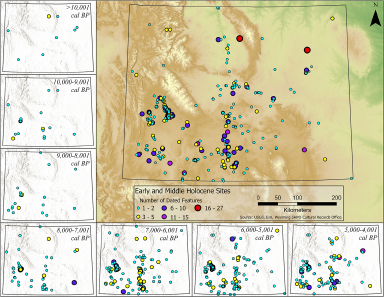
Our research is based on a sample of 1,283 radiocarbon-dated features from 490 sites across Wyoming, although most are concentrated in the western Wyoming Basin in the southwestern part of the state (Figure 2; Supplemental Table 1; see Koenig Reference Koenig2023). The sample, which serves as our basis for identifying trends in cooking technology in the study area through time, was compiled from the radiocarbon dataset generated by Kelly and colleagues (Reference Kelly, Mackie, Robinson, Meyer, Berry, Boulanger and Codding2022; Supplemental Table 1). It was culled to include only directly dated thermal features older than 4,000 radiocarbon years BP (RCYBP), which covers the period from roughly the late Pleistocene / Early Holocene to the end of the Middle Holocene and the transition from the Early to Late Archaic in culture-historic chronologies of the Wyoming Basin (Thompson and Pastor Reference Thompson and Pastor1995; Supplemental Text 1). Data were compiled for each feature from site forms and investigation reports digitally curated in the WyoTrack database managed by the Wyoming State Historic Preservation Office Cultural Records Office. A variety of attributes were encoded in the dataset, including feature form, dimensions (length, width, depth, volume), FCR presence/absence, FCR mass, and feature contents. It is important to note, however, that data were not available for all features because of changes in recording strategies over the past several decades.
Distribution of all Early and Middle Holocene radiocarbon-dated features in the database, with inset maps showing the locations of sites by 1,000-year time periods. Shown relative to the state of Wyoming. Most of the dated features are from the Wyoming Basin in southwest Wyoming. Spatial data provided by the Wyoming SHPO Cultural Records Office. (Color online)

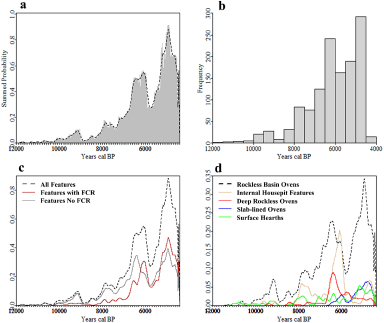
To analyze general changes in oven characteristics through time, we generated several summed probability distribution (SPD) models of radiocarbon dates (Figure 3). SPDs are statistical means for visualizing the frequency of radiocarbon dates. Radiocarbon assays are calibrated using the rcarbon package in R and the IntCal20 calibration curve (Supplemental Text 1; Crema and Bevan Reference Crema and Bevan2023; R Core Team 2023; Reimer et al. Reference Reimer, Austin, Bard, Bayliss, Blackwell, Bronk Ramsey and Butzin2020) and are smoothed using a 200-year moving average. The broadest trend in the data is an increase in the number of dated thermal features in Wyoming through time (Figure 3a, 3b; Supplemental Figure 1). The increasing frequency of thermal features in the sample is unsurprising considering SPDs from other areas of North America show the same pattern (Kelly et al. Reference Kelly, Mackie, Robinson, Meyer, Berry, Boulanger and Codding2022) and an increase in radiocarbon dates through time is an expectation of taphonomic biases (Surovell et al. Reference Surovell, Byrd Finley, Smith, Brantingham and Kelly2009). The small number of features older than 11,000 cal BP included in this analysis is also not surprising given the relative lack of Late Pleistocene features identified across North America (Surovell and Waguespack Reference Surovell, Waguespack, Robert and Bonnie2007).
Summed probability distribution (a) and histogram (b) of all dated features used in this analysis. Black-dashed line (a) represents a 200-year running average. Additional SPDs showing the changes in features with and without FCR (c) and additional feature morphologies discussed in text (d). (Color online)

We infer from their small size and absence of rock that most features older than 10,000 cal BP (n = 12) are non-oven fire features, and we consider most features with depths less than 10 cm to represent surface hearths (Surovell and Waguespack Reference Surovell, Waguespack, Robert and Bonnie2007). These very shallow, rockless thermal features constitute less than 10% of the entire sample (n = 74) but persist in limited frequency throughout the Middle Holocene (Figure 3d).
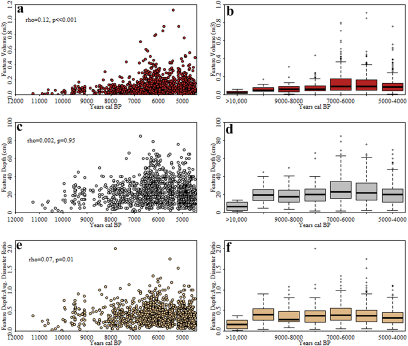
Around 10,000 cal BP, features become deeper, better-defined basins as indicated by a notable increase in size, depth, and volume: This trend continues through time (Figure 4). We argue that it reflects a change from cooking on or in flames or coals to short-duration baking, which we interpret as the introduction of relatively simple earth ovens as part of the regional cooking technology. This is in turn followed by a gradual increase in the proportion of features with FCR, especially after around 7500 cal BP (Figure 3c). More specialized oven forms also appear in the record during the Middle Holocene (Figure 3c, 3d), particularly deep ovens associated with housepits beginning about 8000 cal BP (Smith Reference Smith2003; Smith and McNees Reference Smith and McNees2011) and slab-lined cylindrical basins beginning around 6300 cal BP (Smith and McNees Reference Smith and McNees1999; see also Pastor et al. Reference Pastor, Goodrick, Buenger, Johnson and Darlington2015).
Differences in Early Holocene feature morphologies: (a, b) feature volume, (c, d) feature depth), and (e, f) depth: average diameter ratio.

The earliest example of shallow basin ovens in the dataset are from Battle Spring Draw (48SW13156; Craven Reference Craven and Craig2005). There, a series of occupations dating from about 10,600 to 9100 cal BP contain 11 excavated medium (38 × 41 × 11 cm average size) to large (80 × 66 × 12 cm average size) basin features. One feature from Battle Spring Draw contains a single small FCR fragment, but by and large the features lack FCR, as does the associated component (nine pieces of FCR weighing 58 g).
Simple basin ovens that lack or nearly lack FCR are the most common form in the dataset (n = 545). They typically contain charcoal and carbon-stained sediments that we interpret as the remains of charcoal heating elements, but they are shallow (depths about 10–39 cm) with average diameters ranging from around 20 to 80 cm (Figure 5a). The lack of cook stone suggests short-term cooking, likely of small quantities of animals, starchy geophytes, or both (Smith et al. Reference Smith, Reust and Richard2003). Some of these rockless ovens might once have contained cook stone that was subsequently removed, which would be reflected in nearby FCR concentrations. Various factors, including availability of the relevant data in the literature and problems of association, preclude identification of discarded FCR with these ovens. We contend instead that most of the rockless earth ovens in the sample were constructed without a rock element. They represent the final use of the ovens after which there would have been no reason to remove the underlying heating element once the food was cooked (Black and Thoms Reference Black and Thoms2014). This is attested by numerous ovens with intact heating elements in the archaeological record of the region. Furthermore, the area surrounding most rockless ovens associated with the Middle Holocene excavated by Smith and McNees contained only very low quantities and densities of FCR.
Examples of Early to Middle Holocene earth ovens from Wyoming: (a) 9100 cal BP shallow basin oven with small quantity of FCR; (b) deep rockless oven dating to around 6200 cal BP; (c) slab-lined cylindrical oven dating to 5500 cal BP; and (d) basin oven with FCR heating element dating to 4890 cal BP. Photographs provided by Lance McNees. Images (a,b,d) are from Lost Creek Pipeline Project (Smith Reference Smith and McNees2005); image (c) originally reported by McGuire and colleagues (Reference McGuire, Jack, Linda and Michael1986:Plate 4h). (Color online)

The earliest feature with FCR appears around 10,000 cal BP, but there is not a major increase in FCR frequency until around 7500 cal BP (Figure 3c). This pattern is interpreted as reflecting the intentional increased use of cook stone. A perm test function in rcarbon (Figure 6; Supplemental Text 1; Supplemental Table 2), which compares different SPDs to determine how date frequencies change through time (Crema and Bevan Reference Crema and Bevan2023), shows that features with FCR are overrepresented for the periods 6219–5861 and 5299–4416 cal BP; this indicates a significant change in earth oven technology from primarily rockless ovens to more features incorporating FCR. The increased importance of cook stone within Indigenous baking pits is also evidenced by increasing FCR mass recorded for features through time (Figure 7). The number of features in the dataset for which the original investigators recorded both FCR presence and FCR mass is low (151 of 544 features with FCR [28%]). Subject to this limitation, however, we can evaluate changes in FCR mass through time. Most features in this subsample contain <10 kg of FCR (n = 118), with 19 features containing 10–20 kg of rock and only 14 features with more than 20 kg. Of interest, the earliest feature with greater than 5 kg of FCR dates to around 7100 cal BP—nearly 3,000 years after the oldest feature with FCR—and all features with greater than 10 kg of FCR date after about 6000 cal BP. This suggests that the adoption and increased use of ovens with rock heating elements was related to processing foods with extended baking requirements. This increase in the size of FCR heating elements also corresponds with the presence of deeper rockless ovens and formal slab-lined cylindrical basins, indicating the diversification of oven technology.
Summed probability distribution showing frequency of features with FCR through time. The scaled SPD for all features is indicated by the gray band. Periods of time where there are more features with FCR than expected are indicated by red bands, whereas the blue bands indicate instances when there are fewer features than expected. Features with FCR comprise more of the overall assemblage after 5500 cal BP. (Color online)

Histogram (a) showing the overall mass of FCR (earth oven heating elements) within the sample. All the features with more than 10 kg of rock occur after 5900 cal BP (b), which also corresponds with an increase in the range of earth oven heating element masses (c).

The overall size of features with FCR before about 7500 cal BP remains nearly identical (between 20–40 cm deep and 30–80 cm in diameter) to those without FCR, suggesting that cook stone was being added to an existing technology to enable a longer cooking duration, an increase in the amount of food, or cooking different varieties of food (Figure 8; Supplemental Text 2; Supplemental Figure 2; Supplemental Table 3). Likewise, feature volume, depth, and depth:average diameter for features both with and without FCR younger than 10,000 cal BP increase across the duration of the sample. In particular, the volume of features without FCR shows a very weak positive correlation (features get slightly larger over time; Spearman’s rho = 0.085, p = 0.03), and FCR features become deeper relative to their diameter (Spearman’s rho=0.14, p = 0.002). Overall, the sample of features with FCR are deeper (average depth 27.7 vs. 22.6 cm) and larger (average volume 0.13 vs. 0.1 m3 [about a 26 L difference]) than features without FCR, suggesting a subtle difference in oven morphologies due to the addition of FCR.
Differences in feature morphologies between features with and without FCR: (a–b) feature volume, (c–d) feature depth and (e–f) depth: average diameter ratio.

Sites included in the SPD analysis such as 48SU375 are excellent examples of the diversification of different ovens, from rockless shallow basin features to those with FCR (Smith et al. Reference Smith, Reust and Richard2003). The earliest component dating between 9610 and 9345 cal BP consisted of 18 basins, each with less than 5 kg of FCR, along with two large FCR discard concentrations. The latter two components (8850 and 4720–4475 cal BP) had basins that more frequently contained rock heating elements than the earlier component. Each of the three components had remains representing similar activities. Ground stone from Components I and III contained springparsley starch granules (Joyce et al. Reference Joyce, Louderback and Robinson2022). Additional sites not included in the SPD analysis such as 48LN1185 (McDonald Reference McDonald1993), the Vegan site (McKern and Creasman Reference McKern and Creasman1991), and the Deep Hearth site (Rood and Pope Reference Rood and Clark Pope1993) also show similar oven diversity.
Larger, deeper, and more specialized oven forms begin to appear around 8600–8000 cal BP but especially increase in frequency after 7500 cal BP, suggesting the adoption of new cooking technologies used to cook different types of food resources or foods in greater quantities. The first of these forms had larger, deeper ovens lacking FCR (n = 74), many of which were associated with housepits. These deep ovens date mostly from 8000 to 4000 cal BP, with the greatest number dating from 6600 to 5600 cal BP (Figure 3d). Some of the larger pit ovens measure more than 80 cm in diameter and 70 cm deep. These pits typically display oxidized walls and contain charcoal and darkly charcoal-stained sediment, indicating that fuel was burned to create a layer of coals above which food was added and the pit sealed with earth (Figure 5b). However, the absence or near-absence of FCR within these deep ovens suggests that the Indigenous inhabitants probably did not use them for the long-duration baking of inulin- or fructan-rich geophyte species (Wandsnider Reference Wandsnider1997). Instead, they were likely used to cook starch-rich roots, which still necessitated baking for digestibility (Wandsnider Reference Wandsnider1997), and the larger capacity may reflect the need to bake larger quantities of starchy geophytes.
As stated earlier, many of the deep, rockless ovens are associated with housepits. A total of 174 ovens from housepits are included in the current dataset (Figure 3d), of which 24 features are classified as deep rockless ovens and 80 are classified as shallow rockless ovens. Middle Holocene housepits are encountered frequently in the Wyoming Basin and adjacent areas (Buenger and Goodrick Reference Buenger and Goodrick2019; Larson Reference Larson1997; Smith Reference Smith2003). Buenger and Goodrick (Reference Buenger and Goodrick2019; Supplemental Table 1) report on 101 housepits at 53 sites in Wyoming that date from approximately 8000 to 3400 cal BP, with most occurring between 7400 and 4475 cal BP. These houses are typically circular to ovate in plan view (about 3 × 2.9 m), basin-shaped in profile, and less than 40 cm deep and were most likely covered with a brush superstructure (Figure 9). Of the 41 housepits analyzed by Smith (Reference Smith2003), only one lacked at least one pit measuring more than 40 cm in diameter and at least 15 cm deep, with the number of ovens found within or on the edge of housepits ranging from one to seven. Deep pit ovens associated with housepits almost universally lacked substantial rock heating elements. The association of housepits with deep rockless pit ovens suggests a functional correlation between the changes that led to the widespread adoption of houses and the use of deep, rockless ovens during the Middle Holocene, but the nature of those changes requires further investigation.
Examples of Middle Holocene housepits from Wyoming containing deep earth oven pits: (top) Elk Head site dating 4360–4020 cal BP (Martin and Smith Reference Martin and Smith1999); (bottom) Beacon Housepit site dating 6210–5770 cal BP (Fleming et al. Reference Fleming, McClelland, Pahr and Luoma2010). Photographs provided by Craig Smith (a) and Lance McNees (b). (Color online)

The other specialized larger and often deeper earth oven form consists of slab-lined cylindrical pits (n = 52; Figure 5c). They appear in the archaeological record beginning as early as 8615 cal BP (McGuire et al. Reference McGuire, Joyner, Kainer and Miller1984), but most date between 5090 and 4000 cal BP, overlapping with but skewed later than housepits and rockless deep intramural pits (Figure 3d; Smith and McNees Reference Smith and McNees1999:Table 1; Pastor et al. Reference Pastor, Goodrick, Buenger, Johnson and Darlington2015:Figure 3.3). They have vertical or nearly vertical walls lined with closely fitted slabs and have flat to slightly rounded bases. Most are between 50 and 85 cm in diameter and 20 and 55 cm deep. The slab linings are generally continuous around the basin interior. Many of the slabs were deliberately shaped to obtain a tight fit, and most were oxidized by exposure to heat. The pits typically have a basal layer of charcoal, indicating that they contained a bed of coals (Smith and McNees Reference Smith and McNees1999). They have minimal, if any, rock in their matrix, indicating that the charcoal and slab lining itself functioned as the heating element to retain and distribute heat. Only one slab-lined oven is known from within a housepit (48SW2590; Peterson and Smith Reference Peterson and Smith2012).
These slab-lined ovens reflect both the general diversification of oven forms during the Middle Holocene and the addition of a specific, highly formalized, distinctive form to the oven category. Direct evidence of the resource baked in the basin is lacking. However, given the possible function of the slab lining as a distinctive rock heating element, they might have served as ovens for baking foods requiring longer cook times, including geophytes with more complex carbohydrates (e.g., sego lily [Calochortus nuttallii] or onion [Allium spp.]; Smith et al. Reference Smith, Martin and Johansen2001); these ovens may also have been used to denature meat from large animals (Wandsnider Reference Wandsnider1997), suggesting a contrast with the intramural deep pits lacking rock associated with housepits.
Changes in Earth Oven Technology and Implications for Forager Adaptive Systems
The preceding section describes changes in cooking feature form through time in Wyoming, particularly the appearance and increasing frequency of earth ovens during the Early Holocene after 10,000 cal BP, followed by increased size and complexity through time, especially during the Middle Holocene after about 7500 cal BP. This section discusses those changes in relation to broader economic and cultural contexts in the marginal semiarid, high-altitude environment of Wyoming.
Early Holocene Earth Oven Intensification: Small Game and Starchy Geophytes (10,000–7500 cal BP)
The introduction of basin ovens beginning slightly before 10,000 cal BP and continuing through the Middle Holocene marks the beginning of a major shift in subsistence and adaptive strategies to a diversified subsistence economy including plants and smaller animals as Indigenous people adapted to an increasingly dry, more populous environment by expanding their diet (Kornfeld et al. Reference Kornfeld, Frison and Lou Larson2010). This transition is reflected in the addition of simple earth ovens, mostly lacking rock, to the Indigenous cooking technology that would have been suited for processing starchy geophytes (Joyce et al. Reference Joyce, Louderback and Robinson2022; Smith et al. Reference Smith, Reust and Richard2003).
The incorporation of earth ovens and geophytes, generally associated with low return rates and high processing costs, signals what Thoms (Reference Thoms2008a) deems a “carbohydrate revolution.” He maintains that the increasing frequency of earth ovens during the Early Holocene represents “land-use intensification” defined as “a trend through the millennia toward expenditure of more energy per unit area to recover more food from the same landscape to feed more people” (Thoms Reference Thoms2009:575). Like Binford (Reference Binford2001), Thoms argues this earth oven intensification is the result of intrinsic population growth and the reduction of territories and fewer big-game animals per capita. Even though it was more costly to harvest geophytes and build earth ovens, the archaeological record of the study area demonstrates that Indigenous peoples began to use earth ovens and rely on geophytes as a critical food resource. Evidence from the southern Great Plains in Texas suggests that the same process occurred elsewhere on the continent at the same time (Koenig Reference Koenig2023).
Early Holocene shallow basin ovens occur on sites representing relatively short-term occupations by residentially mobile peoples who periodically returned to these site locations (Smith et al. Reference Smith, Reust and Richard2003). Rockless basin ovens from Battle Spring Draw (Craven Reference Craven and Craig2005) date to about 10,600–9100 cal BP and are well-studied examples of this behavioral shift; other sites such as Blue Point (Johnson and Pastor Reference Johnson and Pastor2003) and 48SW8842 (Pool Reference Pool2001) that were not included in the SPD analysis further support short-term occupations during the Early Holocene. Each of these three early earth oven sites (Battle Spring Draw, Blue Point, and 48SW8842) are adjacent to playas or floodplains that would have supported starchy geophytes such as biscuitroot/springparsley (Cymopterus bulbosus and Lomatium spp.) and bitterroot (Lewisia rediviva). Analyses of ground stone from Components AU4-AU1 (8008–1620 cal BP) at 48SW8842 identified springparsley starch granules, demonstrating a long and consistent history of starchy geophyte processing (Joyce et al. Reference Joyce, Louderback and Robinson2022). Geophytes would have been available in April and May when the aboveground parts of the plants are visible (Supplemental Text 2; Smith and McNees Reference Smith and McNees2005).
In addition to geophytes, small mammals like jackrabbit (Lepus sp.) and ground squirrel (Spermopilus sp.) are also frequently represented within these Early Holocene assemblages. Geophyte and small game processing are both suggestive of diet breadth expansion and intensification (Morgan Reference Morgan2015). No Early Holocene features older than about 7500 cal BP yielded remains of large to medium mammals, suggesting that larger animals were either killed at greater distances from the oven processing sites and their bones were not transported (Darlington Reference Darlington2019) or they were not present within the hunting range (Byers et al. Reference Byers, Smith and Broughton2005). Instead, the faunal assemblages associated with simple basin ovens are dominated by small mammals that the site occupants opportunistically captured near the site for immediate consumption.
Basin ovens lacking rock remain common in the archaeological record after 10,000 cal BP, indicating that Indigenous inhabitants of the high basins continued to construct and use simple ovens. Although ovens clearly get larger between 10,000 and 7500 cal BP, most were likely still used for baking starchy geophytes or small game based on the minimal mass of cook stone. There is little to no evidence to suggest that the Indigenous people were processing inulin-rich geophytes such as camas.
Early earth oven sites in Wyoming lack unequivocal evidence for storage, as do Middle Holocene oven and housepit sites. The geophyte patches near the sites likely did not provide sufficient density for overwinter storage (Smith and McNees Reference Smith and McNees2005), supporting the hypothesis that foods were consumed immediately, rather than stored for later (Smith Reference Smith2020). The lack of long-term storage required the Indigenous inhabitants to maintain a high level of residential mobility. In contrast, the occurrence of dense fields of inulin-rich camas in the Pacific Northwest allowed for the extensive processing of camas in earth ovens so that a front-loaded strategy could be used for overwinter storage during the Later Holocene (Thoms Reference Thoms1989; Tushingham and Bettinger Reference Tushingham and Bettinger2013).
Middle Holocene Oven Diversification (7500–4500 cal BP)
A dramatic increase in the variety of Wyoming oven features begins around 7500 cal BP, coinciding with the transition to the Middle Holocene. This diversity included increased oven volume and depth, increased use of cook stone, and new oven forms, such as ovens with more substantial rock heating elements, deep rockless ovens associated with housepits, and slab-lined cylindrical ovens.
The persistence of rockless ovens indicates that Indigenous peoples likely continued to cook starchy geophytes and small mammals using charcoal heating elements. However, the larger average volume and greater depth of ovens suggest that they were cooking greater quantities of such resources, especially starchy geophytes, including in large rockless ovens within housepits. These larger-capacity rockless ovens may also signal the provisioning of larger residential groups occupying housepit locales.
Conversely, the increased frequency of features with cook stone and more substantial rock heating elements suggests that cooking technology was also adapted to include additional resources. The still low quantities of cook stone in the dataset suggests, at most, short to intermediate cooking times rather than the long-term cooking required for inulin-rich geophytes. Therefore, the data suggest that geophytes with intermediate baking requirements such as wild onion and sego lily were added to the diet (Smith et al. Reference Smith, Martin and Johansen2001) but not inulin-rich geophytes such as camas. Camas do occur around the wet meadows of northwestern Wyoming and along the Green and Bear Rivers of southwest Wyoming (Francis Reference Francis, David and Michael2000; McNees et al. Reference McNees, Schneider, McClelland, Harding, Lowe and Smith1996), but the preponderance of the sites in the dataset are from drier areas that lack inulin-rich geophytes.
The increased but still moderate use of cook stone and the concomitant increase in oven size might also reflect the increased cooking of fatty meat from large game. The remains of small mammals are frequently associated with Early Holocene features (Rood Reference Rood2018), but after 7500 cal BP the frequency of oven features containing large game increases dramatically (Figure 10). Meat ovens are known from the Northern Plains ethnographically (Linderman Reference Linderman2002:139; Murdock Reference Murdock1934:268) and archaeologically (Brink and Dawe Reference Brink and Dawe2003; Frison Reference Frison1973), and this dataset demonstrates that meat ovens have substantial time depth in Wyoming. Sites such as Trappers Point (48SU1006), an Early to Middle Holocene pronghorn kill site (Miller et al. Reference Miller, Sanders and Julie1999), contain numerous oven features that were used for bulk processing large game, and these features may have been used to provision feasts and aggregations associated with mass kills (following Hayden Reference Hayden2014). Given evidence that Indigenous people in the study area used large-game deboning meat-transport strategies, meat ovens might be more heavily represented in the sample than the faunal data alone suggest (Darlington Reference Darlington2019).
Increase in the number of features with large/medium mammal remains after about 7500 cal BP. (Color online)

The diversification of Middle Holocene ovens was apparently driven by more than just the inclusion of more and different foods, however. The presence of housepits and slab-lined cylindrical ovens indicates intentional investment in facility construction, likely mapped onto productive areas of the landscape (Smith and McNees Reference Smith and McNees1999, Reference Smith and McNees2011). The relationship between housepits and ovens further suggests that site occupants were incorporating logistical strategies into geophyte processing via the transport of foods back to residential sites for baking, rather than building the features within dense stands of geophytes. This logistical strategy was undoubtedly embedded within a system of high annual residential mobility, but the presence of earth ovens within the household domestic space suggests that Indigenous foragers periodically returned and reused the established housepits and oven locations over decades and centuries, thereby establishing “persistent places” (Schlanger Reference Schlanger, Rossingnol and Wandsnider1992) associated with geophyte patches (Smith Reference Smith2003; Smith and McNees Reference Smith and McNees2011; see also Wardle Reference Wardle, Wardle, Hitchcock, Schmader and Yu2023). This use of persistent places was probably due to the dry conditions and possibly increased population during the Middle Holocene (Eckerle Reference Eckerle, Larson and Francis1997; Smith Reference Smith2003). Adaptation to this dry, patchy environment required the inhabitants to focus on, and return to, locations with predictable geophyte resources and may indicate long-term geophyte management strategies (Carney et al. Reference Carney, Tushingham, McLaughlin and d’Alpoim Guedes2021).
Conclusions and Future Research
As documented in Koenig and Miller (Reference Koenig and Miller2023), earth ovens are associated with a wide range of adaptive strategies along the forager-to-farmer continuum, and the technology was tailored to meet the requirements of these diverse cultural systems. The Wyoming dataset evidences this changing earth oven technology through time in a single geographic area where inulin-rich geophytes were rare and where other resources occurred in densities that generally supported processing for immediate consumption only.
The dataset of 1,283 dated thermal features provides an opportunity to evaluate changes in earth oven technology during the Early and Middle Holocene and how morphological differences reflect and relate to the broader adaptive systems, shifting climate, growing population, intensification, and cultural expression. Although there is clear variation of thermal features within the dataset, we argue that the majority are some type of earth oven, rather than surface thermal features (Black and Thoms Reference Black and Thoms2014). Ovens lacking FCR probably served as baking pits for a resource such as springparsely, a starchy geophyte not requiring long-term heat treatment provided by a rock heating element (Wandsnider Reference Wandsnider1997). Ovens in the sample containing FCR occur on a continuum from minimal to moderate cook stone, suggesting the cooking or detoxifying of small geophytes, such as sego lily or wild onion, or cooking large game meat. Ovens containing a substantial rock heating element that suggest cooking inulin/fructan-rich geophytes, such as camas, are mostly absent from the sample.
Early Holocene earth oven types are limited to rockless shallow basin ovens, the earliest of which date to before 10,000 cal BP. This form continues into the Middle Holocene, but a dramatic increase in oven variation began around 7500 cal BP, including deeper oven pits often associated with housepits, slab-lined cylindrical ovens, increasing numbers of ovens containing rock, and increasing (but still mostly small to moderate) mass of cook stone. Many of these earth oven varieties occurred on sites that foragers reused over hundreds of years (Smith and McNees Reference Smith and McNees1999, Reference Smith and McNees2011). Given the marginal high-basin environments, especially during the Middle Holocene dry period, the inhabitants likely only occupied each residential camp for a short time while processing geophytes or other resources. The limited abundance and availability of this resource precluded the collection and baking for long-term occupations and storage.
The changes in oven form through time also seem to reflect more general changes in adaptive strategies. The Early Holocene rockless ovens occur on sites representing short-term occupations by residentially mobile peoples who periodically returned to locations near patches of starchy geophytes, which were apparently cooked in small quantities and consumed immediately (Smith Reference Smith2020; Smith et al. Reference Smith, Reust and Richard2003). By contrast, the dramatic shift in the variety and forms of oven features beginning around 7500 cal BP suggests both an expansion of the types and quantity of resources being cooked and an increased reliance on logistical strategies, including the transport of geophytes back to residential sites, possibly in response to a growing population amid increasingly arid conditions and more patchy resources (Smith Reference Smith2003). In that regard, the Middle Holocene use of earth ovens more closely resembles that of the Basin/Range area of southern Arizona, an area of discontinuous and scarce resources where the foragers intensely employed earth oven cooking and repeatedly reused locations as a means to counter niche limitations (Yu Reference Yu2009). This contrasts with the record of Indigenous oven use in the Pacific Northwest, where the abundance and availability of camas allowed for their bulk procurement and processing in a front-loaded strategy for overwinter storage that facilitated the creation and continued stability of the village settlement pattern (Ames and Marshall Reference Ames and Marshall1981; Lepofsky and Peacock Reference Darlington and Buenger2004; Thoms Reference Thoms1989).
Recognizing how the diversity of thermal features and earth ovens changes through time and across space allows us to ask more specific questions about Indigenous cooking technology. CRM archaeologists are the researchers who will continue to build this dataset, and we encourage archaeologists to create and formalize standards for how we record thermal features. This should include documenting the total mass of FCR present within a feature, and emphasis should continue to be placed on macrobotanical analyses via flotation (Bach Reference Bach1997). Additional insights may be gained from starch grain and lipid residue analysis of feature rock and ground stone (Joyce et al. Reference Joyce, Louderback and Robinson2022).
Some future research questions require no additional fieldwork and can be evaluated using data already compiled via the hundreds of CRM projects conducted in the Rocky Mountains and Northern Plains. For instance, this study focused only on the Early Holocene data from Wyoming because of the availability of digital data via the Wyoming SHPO’s WyoTrack database (Koenig Reference Koenig2023). The same information presented here is archived by other SHPO and THPO offices. Using these already collected data, we can begin evaluating how feature locations on the landscape change through time and the spatial relationships between ovens and other activity areas (cf. Mackie et al. Reference Mackie, Surovell, O’Brien, Kelly, Pelton, Haynes, Frison, Yohe, Steve and Heather2020), including intramural versus extramural housepit ovens and how oven features relate to mass kill sites (Brink and Dawe Reference Brink and Dawe2003; Miller et al. Reference Miller, Sanders and Julie1999). Predictive modeling based on existing data could be used to estimate the types of foods processed at different locations (Smith and McNees Reference Smith and McNees2005). Other questions provide opportunities for future Indigenous collaboration emphasizing the use of ovens within descendant communities (see Van Alst and Grover Reference Alst and Emily2024), as well as collaborative experimental work to evaluate how feature size reflects the different types and amounts of foods cooked (Koenig Reference Koenig2023; Smith et al. Reference Smith, Martin and Johansen2001). There are myriad other oven research questions that we hope will be pursued moving forward, enabling archaeologists to continue to place earth oven use (and disuse) into the bigger picture of Indigenous histories.
Supplementary Material
The supplemental material for this article can be found at https://doi.org/10.1017/aaq.2025.3.
Supplemental Text 1. Explanation of how radiocarbon dates were culled, calculation of summed probability distributions, summed probability distribution R code, and references cited for Supplemental Table 1.
Supplemental Text 2. Discussion of statistics presented in Supplemental Table 3 and summary of macrobotanical remains associated with Wyoming oven features.
Supplemental Figure 1. Plot of the differences in SPDs using the rcarbon binsense function and bins ranging from 0–200 years (Crema and Bevan 2023). Binning the radiocarbon dates has no effect on the SPD.
Supplemental Figure 2. Changes in feature morphology through time by 1,000 year bins: (a,b) feature volume, (c,d) feature depth, and (e,f) depth:average diameter ratio. See Supplemental Table 3 for statistical comparisons.
Supplemental Table 1. Database of Early and Middle Holocene Dated Thermal Features from Wyoming.
Supplemental Table 2. Periods during the Early and Middle Holocene when Features with FCR Comprise Significantly Higher or Lower Proportions of the Feature Assemblage.
Supplemental Table 3. W Statistic or T Statistic and (p-values) for Wilcoxon Rank Sum Tests and t-Tests for Variation of Thermal Feature Morphology through Time. See Supplemental Figure 2 for visualization
Acknowledgments
The many CRM excavations in Wyoming over the past 40 years provided the data that made this article possible. We thank the numerous archaeologists who conducted these investigations for their efforts. The radiocarbon analysis would not have been possible without the assistance and guidance of the staff at the Wyoming SHPO Cultural Records Office. Thank you to Todd Surovell and Madeline Mackie for assisting with the R coding for the summed probability distributions. Koenig’s dissertation committee at the University of Wyoming (Surovell, Doering, Kelly, Innes, Currano, Black) provided insightful comments on an earlier version of this article. Feedback from Stephen Black and three anonymous reviewers improved the final manuscript. Jennifer Segovia assisted with the Spanish abstract.
Funding Statement
This research received no specific grant funding from any funding agency, commerical, or not-for-profit sectors.
Data Availability Statement
All primary records are available to researchers via the Wyoming SHPO Cultural Records Office. Supplemental Table 1 provides all radiocarbon dates, and primary source materials are listed in Supplemental Text 1.
Competing interests
The authors declare none.



 Open access

