





Introduction
Over the past decade, the use and development of biotechnology-derived traits in row-crop agriculture has led to incredible advancements (Behrens et al. Reference Behrens, Mutlu, Chakraborty, Dumitru, Jiang, LaVallee, Herman, Clemente and Weeks2007). Adoption of glyphosate-resistant crops resulted in reduced use of other herbicides in cotton and soybean [Glycine max (L.) Merr.] production systems (Riar et al. Reference Riar, Norsworthy, Steckel, Stephenson, Eubank and Scott2013). The adoption of glyphosate-resistant cotton and soybean varieties in the United States reached over 50% of total crop area within 6 yr of commercial introduction, accompanied by a marked increase in glyphosate usage in these crops (Kniss Reference Kniss2018). However, overuse of glyphosate has led to the development and proliferation of glyphosate-resistant weed species (Dickson et al. Reference Dickson, Scott, Burgos, Salas and Smith2011; Heap Reference Heap2020; Kruger et al. Reference Kruger, Johnson, Weller, Owen, Shaw, Wilcut, Jordan, Wilson, Bernards and Young2009; Nandula et al. Reference Nandula, Reddy, Koger, Poston, Rimando, Duke, Bond and Ribeiro2012; Norsworthy et al. Reference Norsworthy, Griffith, Scott, Smith and Oliver2008; Steckel et al. Reference Steckel, Main, Ellis and Mueller2008; Vieira et al. Reference Vieira, Samuelson, Alves, Gaines, Werle and Kruger2018). Of these resistant weed species, Palmer amaranth [Amaranthus palmeri (S. Wats.)] has become one of the most troublesome weeds in row-crop production across most of the southern United States (Bagavathiannan and Norsworthy Reference Bagavathiannan and Norsworthy2016; Webster and Macdonald Reference Webster and Macdonald2001).
Cotton resistant to dicamba, glyphosate, and glufosinate is commercially available to growers (ISAAA 2015). Behrens et al. (Reference Behrens, Mutlu, Chakraborty, Dumitru, Jiang, LaVallee, Herman, Clemente and Weeks2007) suggested that dicamba tolerance was pursued because it is environmentally safe, does not persist in soil, has a relatively low to no toxicity to humans and other wildlife, and effectively controls broadleaf weed species. Crops resistant to dicamba were developed through the insertion of the dicamba monooxygenase (DMO) gene isolated from Stenotrophomonas maltophilia (Behrens et al. Reference Behrens, Mutlu, Chakraborty, Dumitru, Jiang, LaVallee, Herman, Clemente and Weeks2007). Soybean lines displayed tolerance to dicamba at of 2.8 and 5.6 kg ha–1 in greenhouse studies, and complete tolerance was also confirmed in field trials, where no hindrance in agronomic performance due to applications of dicamba were observed (Behrens et al. Reference Behrens, Mutlu, Chakraborty, Dumitru, Jiang, LaVallee, Herman, Clemente and Weeks2007).
XtendFlex® cotton varieties resistant to glyphosate, glufosinate, and dicamba have been commercially available since 2015, allowing growers to apply multiple herbicides to control glyphosate-resistant and difficult-to-control weeds (Bollman Reference Bollman2013; ISAAA 2015). Burndown herbicide applications containing both glyphosate and dicamba effectively controlled glyphosate-resistant horseweed (15 to 30 cm in height) [Conyza canadensis (L.) Cronq.] in field studies conducted in Mississippi (Eubank et al. Reference Eubank, Poston, Nandula, Koger, Shaw and Reynolds2008). Applications containing acetochlor + dicamba PRE increased control on Palmer amaranth infesting cotton by 13% to 17% (Cahoon et al. Reference Cahoon, York, Jordan, Everman, Seagroves, Culpepper and Eure2015). Similar combinations applied POST in dicamba-resistant soybean resulted in increased control of giant ragweed [Ambrosia trifida (L.)], Palmer amaranth, and waterhemp [Amaranthus tuberculatus (Moq.) J.D. Sauer] when compared to POST-applied treatments of glyphosate alone (Byker et al. Reference Byker, Soltani, Robinson, Tardif, Lawton and Sikkema2013; Johnson et al. Reference Johnson, Young, Matthews, Marquardt, Slack, Bradley, York, Culpepper, Hager, Al-Khatib, Steckel, Moechnig, Loux, Bernards and Smeda2010; Vink et al. Reference Vink, Soltani, Robinson, Tardif, Lawton and Sikkema2012).
No cotton injury was observed 18 to 23 d following dicamba applied PRE (Cahoon et al. Reference Cahoon, York, Jordan, Everman, Seagroves, Culpepper and Eure2015; Dodds et al. Reference Dodds, Bollman, Mills, Culpepper, Miller, Norsworthy, Steckel and York2012; Reynolds et. al Reference Reynolds, Dodds, Reynolds, Dixon and Samples2013). Cahoon et al. (Reference Cahoon, York, Jordan, Everman, Seagroves, Culpepper and Eure2015) observed that when glufosinate was applied alone or in combination with dicamba early POST (EPOST), cotton injury ranged from 3% to 6% in North Carolina and 9% to 14% in Georgia. Application of glyphosate resulted in injury of 2% or less when applied EPOST to XtendFlex® cotton. Glyphosate applied in combination with dicamba increased injury from 1% to 6% in North Carolina and 9% to 13% in Georgia. Similar results were reported by Dixon et al. (Reference Dixon, Dodds, Copeland, Reynolds, Samples, Barber, Main and Mills2014).
Palmer amaranth and waterhemp have an extended germination period, which poses a challenge for POST herbicide application timing (Steckel Reference Steckel2007). In this scenario, very-long-chain fatty acid–inhibiting herbicides such as S-metolachlor can provide residual control of Palmer amaranth and waterhemp when applied PRE and POST (Hay et al. Reference Hay, Shoup and Peterson2018; Steckel et al. Reference Steckel, Sprague and Hager2002). Everman et al. (Reference Everman, Clewis, York and Wilcut2009) reported that the addition of S-metolachlor to POST glufosinate applications on cotton provided extended weed control and increased cotton lint yields. Clewis et al. (Reference Clewis, Miller, Koger, Baughman, Price, Porterfield and Wilcut2008) reported that EPOST glyphosate applications including S-metolachlor in the spray mix resulted in excellent grass control while causing minimal (<1%) cotton injury. In another study, Clewis et al. (Reference Clewis, Wilcut and Porterfield2006) reported that the addition of S-metolachlor to glyphosate POST applications increased Palmer amaranth and other broadleaves control and also increased cotton lint yield compared to glyphosate-alone applications.
Few studies investigate EPOST applications on XtendFlex® cotton containing combinations of S-metolachlor, glufosinate, and glyphosate, and the resultant effects on visual estimations of injury, crop growth and development, and yield. Therefore, this research was initiated to quantify the effect of herbicide tank-mixture combinations on visual estimations of injury, growth and development, and yield of XtendFlex® cotton.
Materials and Methods
Experiments were conducted from 2015 to 2017 at the R.R. Foil Plant Science Research Center at Starkville, MS and the Black Belt Research Center in Brooksville, MS. Planting, application, data collection and harvest dates are given in Table 1. Cotton was planted on conventionally tilled beds at both locations in all years. Deltapine 1522 B2XF (Bayer CropScience, St. Louis, MO) was seeded at 13.1 seeds per meter of row with fertility, insecticide, and plant growth regulator use based on Mississippi State University Extension recommendations (Mississippi State University Extension 2020a). Plots consisted of four 97-cm-spaced rows that were 12 m in length. Applications were made to three- to six-leaf cotton, with the center two rows treated, leaving the outside rows as buffers between plots. Experiments located at the Starkville site were furrow-irrigated as needed. Experiments located in Brooksville were grown under rain-fed conditions.
Dates of planting, rating, and growth and development data collection of XtendFlex® cotton for the years 2015–2017 in Starkville and Brooksville, MS. a
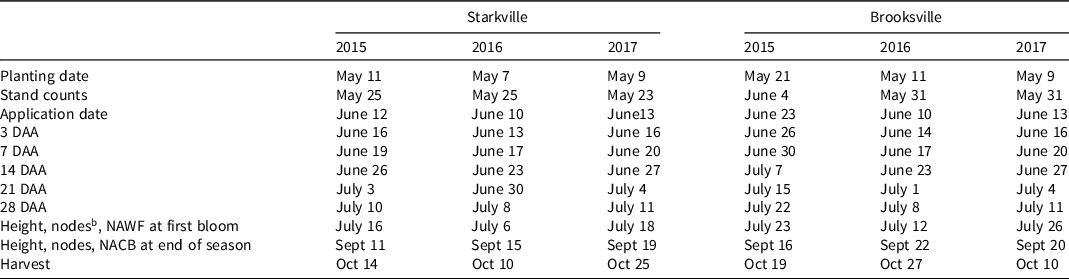
a Abbreviations: DAA, days after application; NACB, Number of mainstem nodes above the cracked boll; NAWF, Number of mainstem nodes above the first position white flower.
b Number of mainstem nodes
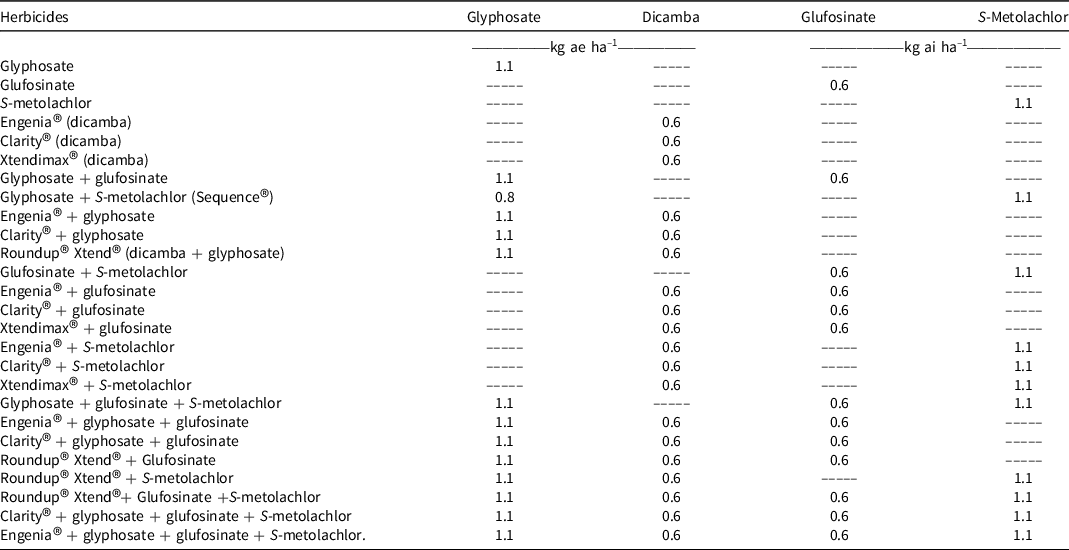
Experiments were conducted using a randomized complete block design. Treatment combinations were developed to simulate potential herbicide combinations for use in XtendFlex® cotton (Bayer CropScience, St. Louis, MO). Herbicide combinations were developed prior to current label restrictions regarding tank combinations with new dicamba formulations. Treatments consisted of a nontreated control as well as applications containing any of the following products alone or in combinations (Table 2): S-metolachlor (Dual Magnum®, Syngenta Crop Protection, Greensboro, NC), glyphosate (Roundup Powermax®, Bayer CropScience, St. Louis, MO), glufosinate (Liberty 280 SL®, Bayer CropScience, Durham, NC), and three different dicamba formulations (Clarity® and Engenia®, BASF Ag Products, Research Triangle Park, NC; Xtendimax®, Bayer CropScience, St. Louis, MO). Premixture formulations of glyphosate + S-metolachlor (Sequence®, Syngenta Crop Protection, Greensboro, NC) and dicamba + glyphosate (Roundup® Xtend®, Bayer CropScience, St. Louis, MO) were tested to mimic common grower applications. Applications were made using a CO2-propelled backpack sprayer calibrated to deliver 140 L ha–1 using TTI 110015 (TeeJet Technologies Spraying Systems Co., Glendale Heights, IL) nozzles at 317 kPa.
Herbicide combinations used and rates applied (kg ai ha–1 or kg ae ha–1) in 2015, 2016, and 2017 at Starkville and Brooksville, MS.
In 2015 and 2016, 32% urea ammonium nitrate was utilized as N fertilizer, whereas 30-0-0-2.5 S (a local blend) was utilized in 2017. In all years, N fertilizer was injected into the soil in a split application. In all 3 yr, N at 56 kg ha–1 was applied at planting and N at 78 kg ha–1 was applied at the third week of squaring at the Starkville location. In all 3 yr at the Brooksville location, N fertilizer was applied in a single application at 134 kg ha–1 the third week of squaring. Fertilizer in the form of P2O5 and K2O was applied at each location based on soil test recommendations. Plots were scouted weekly at both locations using appropriate methodology for weed and insect pests with pesticide and harvest aid applications applied based on Mississippi State University Extension service recommendations (University of Tennessee 2020). Plots were maintained free of weeds through hand weeding after treatment applications.
Data collection included visual estimations of injury ratings at 3, 7, 14, 21, and 28 d after application (DAA) (Table 1). Additional data collection included stand counts collected 28 d after planting, cotton height (cm), total mainstem nodes, and nodes above whiteflower (NAWF) at first bloom (Table 1). Data collection at the end of the season included cotton height, total mainstem nodes, and nodes above cracked boll (NACB) (Table 1). Seed cotton yield was collected using a two-row spindle picker set up for small-plot research. Prior to harvest, 25 boll samples were hand harvested from each plot. Each sample was ginned on a 10-saw Continental Eagle (Lubbock, Texas) laboratory gin. Gin turnout was determined by dividing the lint mass after ginning by the seed cotton mass prior to ginning and multiplying by 100.
All data were subjected to ANOVA using the PROC GLIMMIX procedure SAS v9.4. Means were separated using Fisher’s protected LSD (α ≤ 0.05). Degrees of freedom were calculated using the Kenward-Roger Method. Single degree-of-freedom contrasts was used to compare injury levels of applications containing either glufosinate or S-metolachlor to applications that contained the combination of these herbicides.
Colby’s equation was applied on injury data from tank combinations for potential herbicide synergism, antagonism, or additivity (Colby Reference Colby1967) (Equation 1):
 $$E = \left( {X + Y} \right) - \left( {\frac{{XY}}{{100}}} \right){\rm{\;}}100$$
where E is the expected cotton injury (%) of herbicides A and B mixture, and X and Y are the observed cotton injuries of herbicides A and B applied individually. Pairwise T-test comparisons were performed in SAS v9.4 (SAS® 9.4. SAS® Institute Inc., Cary NC) on values pooled across year and location. The herbicide mixture was considered synergistic if the expected cotton injury was significantly lower than the observed injury. The herbicide combination was considered antagonistic if the expected cotton injury was greater than the observed injury (Ganie and Jhala Reference Ganie and Jhala2017).
Results and Discussion
Trends were similar across years and locations regarding visible crop injury, effects on cotton growth and development, as well as cotton yield; therefore, data were pooled over years and locations.
Crop Injury from Applications
Herbicide(s) evaluated affected visible crop injury level at 3, 7, 14, and 21 DAA (P < 0.0001). Chlorotic injury was never present, and injury at all rating intervals was present as necrotic spotting on plant tissue. Necrotic symptomology was not observed on growth, emerging after herbicide applications.
At 3 DAA, cotton injury ranged from 11% to 42% (Table 3). Crop injury was increased following three and four-way tank mixtures containing glyphosate and S-metolachlor (39% to 42%). Crop injury (11% to 17%) was observed at 3 DAA following applications of glyphosate, S-metolachlor, and three formulations of dicamba. All other treatments resulted in 18% to 31% crop injury. Individual treatments and treatment combinations were evaluated using Colby’s method to determine if treatment combinations were additive, synergistic, or antagonistic with respect to crop injury (Colby Reference Colby1967). Based on Colby’s method, application of Engenia or Xtendimax® + S-metolachlor were synergistic in their effect on crop injury at 3 DAA (Table 4). The expected injury from dicamba + S-metolachlor applications were 24% and 23% for Engenia and Xtendimax® tank mixtures, respectively, whereas the observed level of crop injury for both herbicide mixtures was 31% (Table 4). Applications of Clarity® + glufosinate + glyphosate as well as Roundup® Xtend® + glufosinate or Roundup® Xtend® + glufosinate + S-metolachlor were antagonistic with respect to cotton injury at 3 DAA. Expected cotton injury following applications of Clarity® + glufosinate + glyphosate, Roundup® Xtend® + glufosinate, or Roundup® Xtend® + glufosinate + S-metolachlor were 38%, 38%, and 46%, respectively, whereas the observed levels of crop injury were 31%, 24%, and 39%, respectively (Table 4).
Effect of herbicide application on crop injury at 3, 7, 14, and 21 d after application (DAA) pooled across years and locations. a
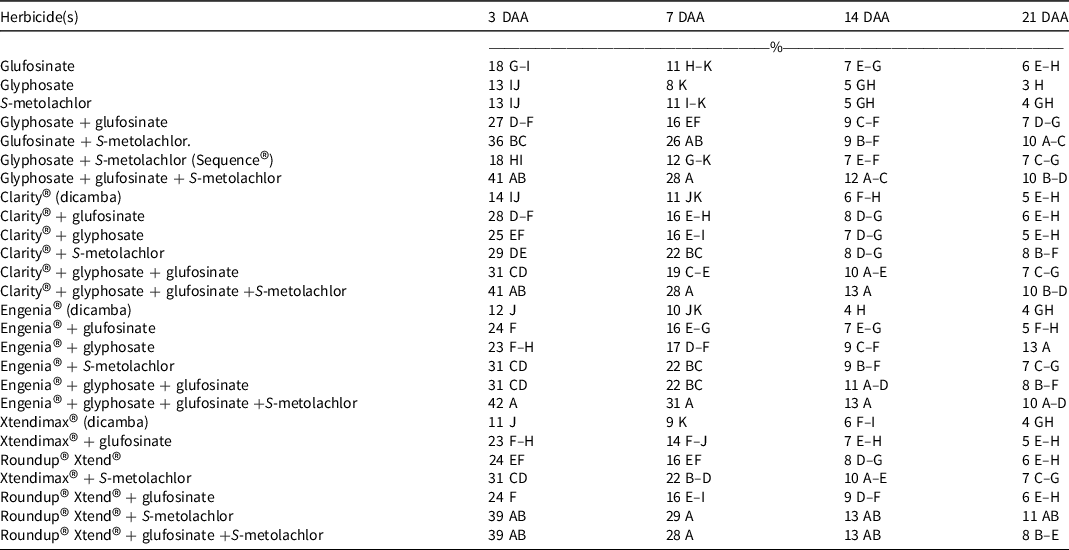
a Means within a column followed by the same letter are not significantly different (α ≤ 0.05).
Effect of herbicide application on cotton injury based on Colby’s Method at 3 d after the three- to six-leaf application.
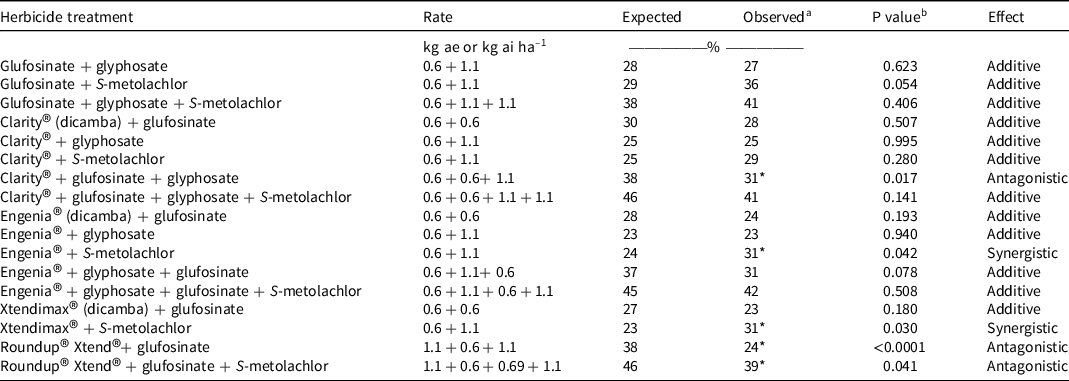
a Asterisks denote observed values for treatments that were significantly different from the expected values.
b P values denote significant differences between observed and expected values for each herbicide combination.
In general, cotton injury at 7 DAA dissipated. Injury ranged from 8% to 31% (Table 3). Similar to visual estimations of injury at 3 DAA, the greatest level of cotton injury at 7 DAA resulted from two-, three-, and four-way tank mixtures containing glufosinate and S-metolachlor (26% to 31%). The least amount of cotton injury (8% to 11%) at 7 DAA was observed following applications of glufosinate, glyphosate, S-metolachlor, glyphosate + S-metolachlor, or any dicamba formulation. Colby’s analysis indicates that the only antagonistic effect at 7 DAA was observed following applications of Roundup® Xtend® + glufosinate (Table 5). The expected level of cotton injury at 7 DAA from this application was 26%; however, only 16% injury was observed.
Effect of herbicide application on cotton injury based on Colby’s method at 7 d after the three- to six-leaf application.
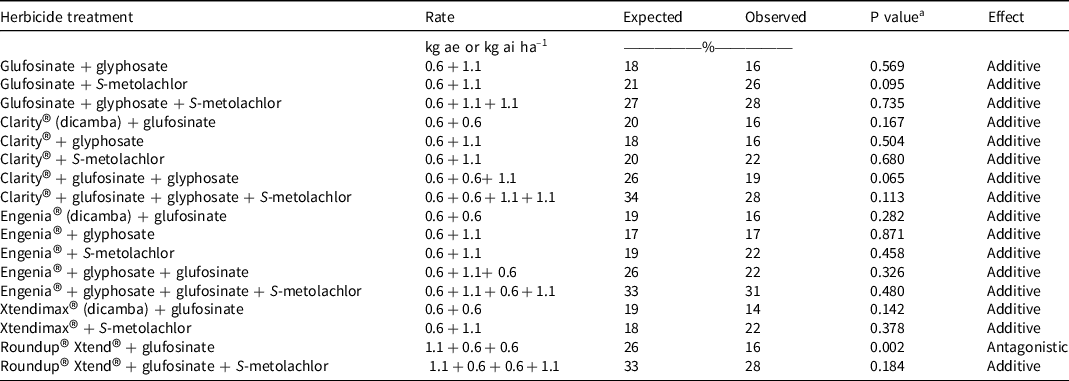
a P values denote significant differences between observed and expected values for each herbicide combination.
Cotton injury observed at 14 DAA further dissipated compared to previous rating intervals. Injury ranged from 4% to 13% (Table 3). The greatest visible level of cotton injury at 14 DAA resulted from two, three-, and four-way tank mixtures (10% to 13%). The least amount of cotton injury at 14 DAA resulted from applications of glyphosate alone, S-metolachlor alone, any dicamba formulation alone, and glufosinate + Xtendimax® (4% to 7%). Based on Colby’s method, applications of Clarity® + glufosinate + glyphosate, Xtendimax® + glufosinate, and Roundup® Xtend® + glufosinate were antagonistic with respect to cotton injury at 14 DAA (Table 6). Expected injury 14 DAA following applications of Clarity® + glufosinate + glyphosate, Xtendimax® + glufosinate, and Roundup® Xtend®+ glufosinate were 17%, 12%, and 14%, respectively, whereas the observed crop injury was 9%, 7% and 8%, respectively.
Effect of herbicide application on cotton injury based on Colby’s method at 14 d after the three- to six-leaf application.
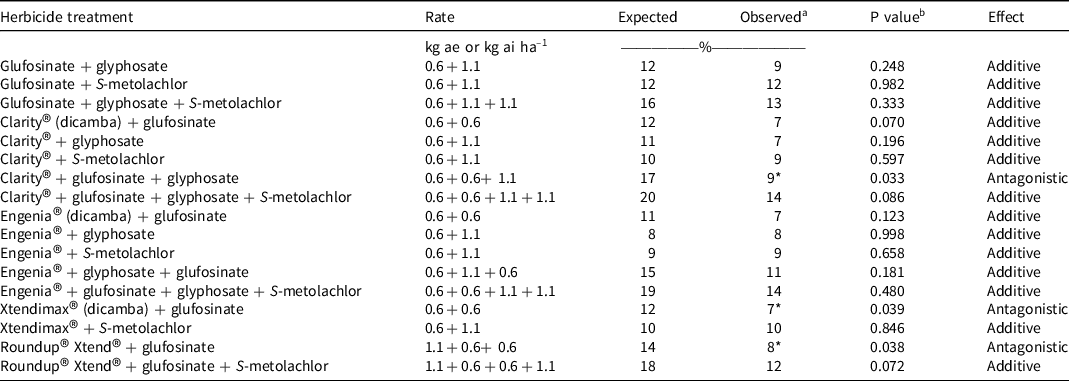
a Asterisks denote observed values for treatments that were significantly different from the expected values.
b P values denote significant differences between observed and expected values for each herbicide combination.
Range of cotton injury at 21 DAA was similar to the range observed at 14 DAA (3% to 13%) (Table 3). The greatest level of visual estimations of cotton injury at 21 DAA resulted from applications of glufosinate + S-metolachlor (10%), Engenia® + glyphosate (13%), Engenia® + glyphosate + glufosinate + S-metolachlor (10%), and Roundup® Xtend® + S-metolachlor (11%). The least amount of cotton injury at 21 DAA was observed following applications of glufosinate alone, glyphosate alone, S-metolachlor alone, Clarity® alone or tank-mixed with glyphosate or glufosinate, Engenia® alone or tank-mixed with glufosinate, and Xtendimax® alone or tank-mixed with glufosinate at 3% to 6% injury (Table 3). Crop injury dissipated by 28 DAA (P = 0.3748).
Plant Growth and Development Parameters
Herbicide combinations had a significant impact on cotton height at first bloom and at the end of the season (P < 0.0001), as well as the number of mainstem nodes present at the end of the season (P = 0.0256). Herbicide combinations did not have an impact on the number of mainstem nodes present at bloom (P = 0.5159). There was no delay in maturity observed at bloom when evaluating NAWF (P = 0.7505). Similarly, herbicide combinations did not affect maturity at the end of the year when evaluating NACB (P = 0.5762).
At first bloom (60 to 65 d after planting), cotton was 63 to 70 cm in height (Table 7). There were no apparent trends observed when evaluating cotton height at first bloom compared to visual estimations of injury observed due to herbicide application. Cotton that was not treated with herbicides at the four- to six-leaf stage was taller at first bloom (70 cm). Similarly, cotton treated with Xtendimax® alone at the three- to six-leaf stage was 68 cm tall. Cotton height following all other treatments ranged from 63 to 67 cm. Height differences at first bloom, while significant, are minimal in nature and did not translate into yield reductions. No differences were present in total nodes at first bloom due to herbicide application and ranged from 13 to 15 nodes (data not shown). In addition, no differences in NAWF were present at first bloom due to herbicide application and ranged from 8 to 9 NAWF (data not shown).
Effect of herbicide application on cotton growth and development parameters pooled across years and locations. a,b
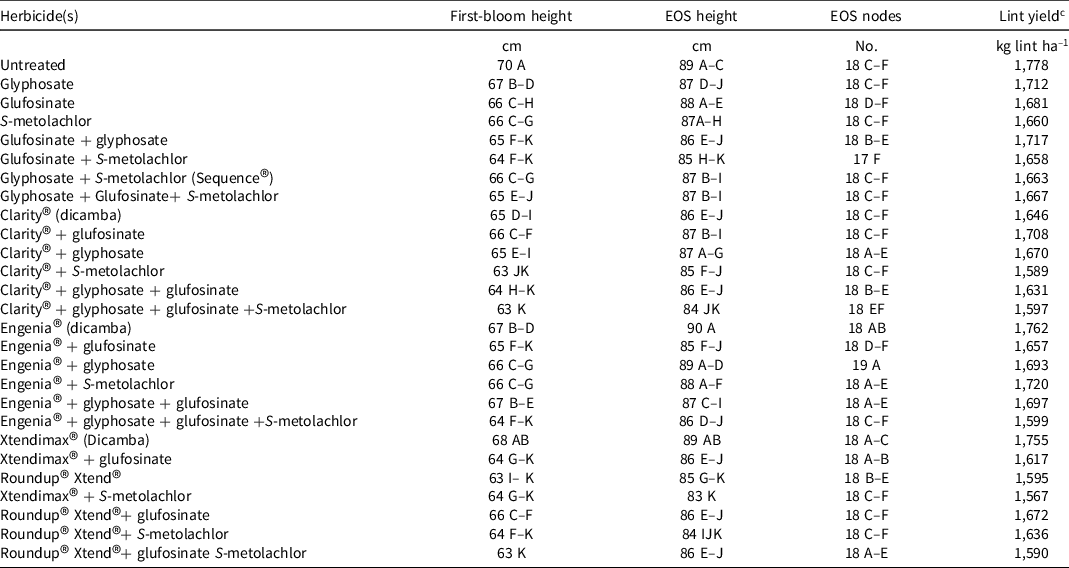
a Abbreviation: EOS, end of the growing season.
b Means within a column followed by the same letter are not significantly different (α ≤ 0.05).
c Parameters that were not significantly affected by herbicide combinations.
At the end of the growing season, cotton height ranged from 83 to 90 cm (Table 7). As with cotton height at first bloom, no trends were present with respect to cotton height at the end of the season. Cotton height at the end of the season following application of glufosinate alone, S-metolachlor alone, Clarity® + glyphosate, Engenia® alone or tank-mixed with glyphosate or S-metolachlor, and Xtendimax® alone ranged from 87 to 90 cm and was not different compared to cotton that did not receive herbicide applications. In addition, the greatest difference in height was 7 cm, which is minimal and did not translate into yield differences. Total nodes at the end of the season ranged from 17 to 19 (Table 7). Again, while differences were present, there was no clear impact on total nodes at the end of the season due to variation across experimental locations. NACB just prior to harvest aid application ranged from 3 to 4 with no differences present due to herbicide application (data not shown). No differences in NACB indicates that herbicide application and subsequent crop injury had no impact on crop maturity at the end of the season. No differences in lint yield due to herbicide application were present at the end of the season (P = 0.2089). Lint yield at the end of the growing season ranged from 1,589 to 1,777 kg lint ha–1 (Table 7).
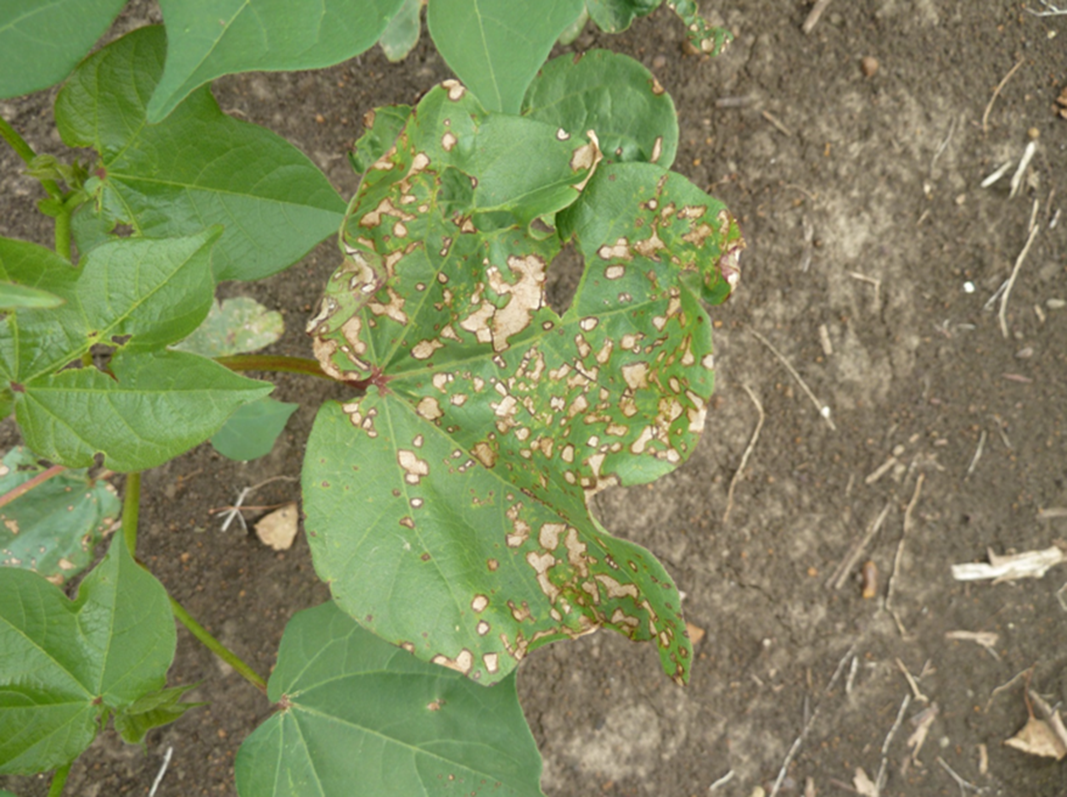
Applications of glufosinate alone at 0.6 kg ai ha–1 resulted in crop injury between 3% and 13% depending on the rating period (Table 3). Cotton injury was present in the form of necrotic speckling on leaves. Similar findings have been observed in other cotton herbicide technology platforms. Glufosinate injury observed on XtendFlex® cotton in this study at 3 and 7 DAA were similar to results from Dodds et al. (Reference Dodds, Main, Barber, Burmester, Collins, Edmisten, Stephenson, Whitaker and Boykin2015), who observed similar injury levels on WideStrike® cotton (12% at 7 DAA) following glufosinate applications (0.6 kg ai ha–1) at three-leaf stage. WideStrike® cotton has glufosinate tolerance, as this trait was used as a selectable marker during variety development (Dodds et al. Reference Dodds, Main, Barber, Burmester, Collins, Edmisten, Stephenson, Whitaker and Boykin2015). Culpepper et al. (Reference Culpepper, York, Roberts and Whitaker2009) observed glufosinate injury on WideStrike® cotton following two or three POST glufosinate applications at 430 and 860 g ae ha–1 (10% to 20%), whereas authors observed up to 36% cotton injury following glufosinate POST applications at 860 g ae ha–1 in a different experiment. However, these authors reported that cotton injury dissipated at 14 and 21 DAA, and cotton yields were not reduced by glufosinate alone and glufosinate tank mixtures. Raper et al. (Reference Raper, Butler, Denton, Steckel and Hayes2019) reported that increasing visible injury from LibertyLink® to XtendFlex® to WideStrike® cultivars are expected following late POST glufosinate applications, with a sharp increase in visible injury from XtendFlex® to WideStrike® cultivars. Authors also reported in the same study that sequential applications of glufosinate with or without applications of S-metolachlor will likely not affect yields of LibertyLink®, WideStrike®, or XtendFlex® cultivars (Raper et al. Reference Raper, Butler, Denton, Steckel and Hayes2019). Vann et al. (Reference Vann, York, Cahoon, Buck, Askew and Seagroves2017a, 2017b) reported that minimal and transient foliar necrosis (<5%) was observed following POST dicamba + glufosinate applications on XtendFlex® cotton. XtendFlex® cotton recovered relatively quickly, and crop injury was <10% at 14 DAA herein. Although reductions in plant height were present at first bloom, these reductions were minimal at harvest time (Table 7). As reported in previous studies with LibertyLink®, WideStrike®, or XtendFlex®, visible injury following POST applications of glufosinate did not affect cotton lint yield at the end of the season in this study (Dodds et al. Reference Dodds, Main, Barber, Burmester, Collins, Edmisten, Stephenson, Whitaker and Boykin2015; Raper et al. Reference Raper, Butler, Denton, Steckel and Hayes2019; Sweeney and Jones Reference Sweeney and Jones2015, Whitaker et al. Reference Whitaker, York, Jordan and Culpepper2011;Wright et al. Reference Wright, Shrestha, Hutmacher, Banuelos, Hutmacher, Rios, Dennis, Wilson and Avila2014). Randell et al. (Reference Randell, Hand, Vance and Culpepper2020) reported that POST applications of glufosinate and glyphosate alone or in tank mixture to cotton (DP1646B2XF and PHY430W3FE) resulted in <11% cotton injury and did not influence cotton height throughout the season.
Steckel et al. (Reference Steckel, Stephenson, Bond, Stewart and Barnett2012) reported 18% cotton injury following glufosinate POST applications to WideStrike® cotton, whereas more injury was observed when glufosinate was tank-mixed with S-metolachlor (23%) and glyphosate (25%). These authors also reported cotton yield reduction for glufosinate + glyphosate (1,200 kg ha–1), glufosinate + S-metolachlor (1,250 kg ha–1), and glufosinate + glyphosate + S-metolachlor (1,170 kg ha–1) tank mixtures when compared to the control (1,470 kg ha–1). Barnett et al. (Reference Barnett, Culpepper, York and Steckel2015) reported 3% to 11% injury to WideStrike® cotton following POST applications of glufosinate, where higher injuries were observed with multiple glufosinate applications. These authors also observed that one, two, and three POST glufosinate applications negatively influenced cotton height and NACB, whereas three glufosinate applications reduced cotton yield (Barnett et al. Reference Barnett, Culpepper, York and Steckel2015). Applications of glufosinate + glyphosate increased crop injury observed herein at 3 (27%) and 7 DAA (16%) when compared to applications of the two respective herbicides alone (18% and 11% for glufosinate; and 13% and 8% for glyphosate) (Table 3). Whitaker et al. (Reference Whitaker, York, Jordan and Culpepper2011) observed increased injury on WideStrike® cotton when comparing applications containing glufosinate at 430 g ae ha–1 alone or tank-mixed to glyphosate (up to 11%) to applications containing glyphosate alone (0%) at 5 DAA. Although reductions in height in this study were present at first bloom and at the end of the year, yield was unaffected at the end of the growing season. Again, these results differed from findings from Steckel et al. (Reference Steckel, Stephenson, Bond, Stewart and Barnett2012), who observed a significant reduction in yield compared to the nontreated control when WideStrike® cotton was subjected to applications of glufosinate alone or in tank mixture.
Cotton plants were sprayed at two-leaf stage in the experiment conducted by Steckel et al. (Reference Steckel, Stephenson, Bond, Stewart and Barnett2012), whereas plants sprayed herein were at the three- to six-leaf stage. Whitaker et al. (Reference Whitaker, York, Jordan and Culpepper2011) did not observe any adverse effects on Widestrike® cotton yield from applications of glufosinate + S-metolachlor to one- to two-leaf stages. Additional research is necessary to further investigate the effect of cotton growth stage and other variables such as weather conditions on differences in cotton yield penalties observed among the studies mentioned following POST herbicide applications. Application technique could also have influenced the differences observed among the aforementioned studies, as droplet size directly influences herbicide activity, especially glufosinate (Butts et al. Reference Butts, Samples, Franca, Dodds, Reynolds, Adams, Zollinger, Howatt, Fritz, Hoffmann and Kruger2018). Applications performed herein used TTI11005 nozzles producing Ultra Coarse spray quality (ASABE S572.1). Whitaker et al. (Reference Whitaker, York, Jordan and Culpepper2011) sprayed treatments using a XR11002 with Fine to Medium spray quality (ASABE S572.1), whereas the nozzle design is not reported in the study conducted by Steckel et al. (Reference Steckel, Stephenson, Bond, Stewart and Barnett2012).
Applications containing the two-way combination of glufosinate + S-metolachlor produced greater crop injury at 3 and 7 DAA compared to the two-way combinations of glufosinate + glyphosate or the Sequence® premix (glyphosate + S-metolachlor) (Table 3). Similar injury has been observed on WideStrike® cotton. Whitaker et al. (Reference Whitaker, York, Jordan and Culpepper2011) and Steckel et al. (Reference Steckel, Stephenson, Bond, Stewart and Barnett2012) both observed increased levels of injury at 5 DAA with applications containing the combination of glufosinate + S-metolachlor (up to 20% and 22%, respectively). Applications containing dicamba + S-metolachlor produced similar crop injury levels at 3 and 7 DAA when compared to applications of glufosinate + S-metolachlor (Table 3). Although higher levels of injury were present, and plant height was reduced, cotton lint yield was unaffected by herbicide application. Stephenson et al. (Reference Stephenson, Bond, Landry and Edwards2013) reported that applications of S-metolachlor at two- to three-leaf cotton reduced plant height (5%) and number of nodes (6%) at 21 DAA, although cotton yield was not affected.
Applications containing dicamba (regardless of formulation) in combination with glyphosate or glufosinate produced similar levels of injury at 3, 7, and 14 DAA (Table 3). Similar to injury symptomology present following applications of glufosinate alone, injury was present in the form of necrotic spotting on leaves. Moreover, the addition of glyphosate or glufosinate increased injury when compared to the respective dicamba formulation contained within the herbicide combination at 3 and 7 DAA. However, in all cases, increases in crop injury at 3 and 7 DAA were determined to be additive based on the Colby method. Results at 7 DAA agree with observations by Cahoon et al. (Reference Cahoon, York, Jordan, Everman, Seagroves, Culpepper and Eure2015) and Dixon (Reference Dixon, Dodds, Copeland, Reynolds, Samples, Barber, Main and Mills2014), who also observed an increase in visual estimations of injury at 7 DAA when comparing applications of dicamba + glyphosate to dicamba alone.
Applications containing a three-way combination of glyphosate + glufosinate + S-metolachlor (41%), and four-way combinations of all dicamba formulations + glyphosate + glufosinate + S-metolachlor (39% to 42%) resulted in the greatest crop injury observed at 3 DAA (Table 3). At 7 DAA, combinations of Engenia® + S-metolachlor and Xtendimax® + S-metolachlor resulted in significantly less injury compared to four-way herbicide combinations. There were no differences in the number of mainstem nodes present at the end of the growing season between these treatments and the nontreated control (Table 7).
The addition of glufosinate + S-metolachlor resulted in greater injury for a longer period of time (Figure 1). Increased levels of injury were present at 3, 7, 14, and 21 DAA for applications containing glufosinate + S-metolachlor (P < 0.0001) when contrasted to applications containing glufosinate or S-metolachlor. However, differences in magnitude of injury decreased at each rating interval. At 3 DAA, herbicide combinations containing glufosinate or S-metolachlor had 27% injury compared to 40% from combinations containing both herbicides. At 7 DAA, herbicide combinations containing glufosinate or S-metolachlor had 18% injury compared to 28% from combinations containing both herbicides. At 14 DAA, herbicide combinations containing glufosinate or S-metolachlor had 9% injury compared to 12% from combinations containing both herbicides. At 21 DAA, herbicide combinations containing glufosinate or S-metolachlor had 7% injury compared to 10% from combinations containing both herbicides. Steckel et al. (Reference Steckel, Stephenson, Bond, Stewart and Barnett2012) also observed that treatments receiving glufosinate + S-metolachlor produced greater injury but also negatively affected the yield of WideStrike® cotton. There were no differences in yield when associated with single degrees of contrast of the treatments evaluated.
Cotton injury following early POST application of glufosinate + S-metolachlor. Picture was taken at 14 d after applications.
Cotton injury varied by herbicide combination. However, injury was the greatest at 3, 7, 14, and 21 DAA for applications containing both glufosinate and S-metolachlor. Crop injury decreased at each rating interval and dissipated by 28 DAA. Height reductions were present at first bloom and at the end of the season. However, cotton yield was unaffected even when injury at 3 DAA was >30%. Current labels for dicamba formulations registered for use in the United States restrict the combination of glufosinate with the dicamba formulations Engenia® and Xtendimax®. Based on this study’s reports, growers may apply a variety of tank mixtures and expect no yield penalty on XtendFlex® cotton. However, illegal applications not approved on current labels are not endorsed. Furthermore, if growers are concerned about cotton injury after herbicide applications, the use of glufosinate in combination with S-metolachlor should be approached with caution in XtendFlex® cotton.
Acknowledgments
This study was partially supported by Bayer CropScience. No conflicts of interest have been declared.


 Open access

