Individuals who are food insecure are at higher risk of poor diet and diet-related diseases( Reference Andreyeva, Tripp and Schwartz 1 ). Consequently, it is essential to maximize the nutritional quality of foods available through food pantries to help clients meet their dietary needs, particularly intakes of vegetables and whole grains( Reference Bazerghi, McKay and Dunn 2 , Reference Simmet, Depa and Tinnemann 3 ). In response, Feeding America, the largest hunger relief organization in the USA, has committed to increase the supply of and demand for healthier products (e.g. fresh produce) throughout its network of food banks and food pantries( 4 ).
Research with food pantry clients indicates they desire nutritious products( Reference Campbell, Ross and Webb 5 ); however, clients may not be familiar with some types of healthier foods or know how to prepare them( Reference Dave, Thompson and Svendsen-Sanchez 6 ). Food pantry staff also report that one barrier to stocking a range of healthy products is the concern that clients will not choose unfamiliar foods they do not know how to prepare( Reference Cooksey-Stowers, Read and Wolff 7 ). Common strategies to help clients become more familiar with healthy foods include creating tailored recipe tips( Reference Clarke, Evans and Hovy 8 ), providing cooking lessons( Reference Caspi, Davey and Friebur 9 ) and allowing clients to taste prepared dishes( Reference Keller-Olaman, Edwards and Elliott 10 ). A newer strategy is providing a recipe along with the ingredients bundled together( Reference Utter and Denny 11 ). Bundling is considered an attractive option for promoting nutritious products in pantries because it makes preparing fresh meals at home more convenient and facilitates trying unfamiliar ingredients. A randomized trial designed to promote whole grains found that the intervention of giving clients a bag of ingredients for a whole-grain meal and providing nutrition education increased clients’ self-efficacy for eating whole grains( Reference Yao, Ozier and Brasseur 12 ). The current study builds upon this work by examining the combination of providing access to ingredient bundling and recipe tasting as a strategy to increase client selection of healthy, targeted foods in a food pantry.
Specifically, the present study examines the impact of providing access to ingredient bundles and recipe tastings on client selection of target food items that were identified a priori by pantry staff as nutritious, less frequently selected items. We compare the proportion of clients who chose to select kale, brown rice and whole-wheat pasta across three groups: those receiving recipe tasting only; those receiving combined ingredient bundle and recipe tasting; and those receiving no intervention.
Methods
Design
The present between-subjects study compared three experimental conditions: Treatment 1 (T1), recipe tastings only; Treatment 2 (T2), ingredient bundle plus recipe tastings; and Control, no intervention. The primary outcome measures were the proportions of clients selecting three target foods: kale, brown rice and whole-wheat pasta. The secondary outcomes included proportions of clients selecting the three target foods from the shelves only. Tertiary outcomes included the probability of selecting target items by condition after adjusting for family size and intervention week.
Setting
The study was conducted over three consecutive weeks (nine total days) between November and December 2016 in a food pantry in Bridgeport, CT, USA. The pantry is open three days per week and clients are permitted to shop once per month. All items in the food pantry are displayed on shelves in a small room, organized by food type. The pantry is ‘client-choice’, which means clients select items from different food categories based on personal preferences and family size. There are limits to the number of items clients are allowed to take for most categories; however, when particular foods are not being selected quickly enough, this policy is waived. For items that do have limits, those with larger family size have higher limits (i.e. are permitted to take an additional item). In this pantry, kale, whole-wheat pasta and brown rice had been identified as items that were not frequently selected, so they did not count towards the clients’ limits. These are the items that the pantry staff identified to target in the current study.
Participants
All clients who attended the pantry during the three weeks of data collection were included in the study (n 448). Clients may shop once per month, so each study participant was exposed to only one condition. Clients who came on one of the three Wednesdays were in T1 (n 128); those who came on one of the three Fridays were in T2 (n 160); and those who came on one of the three Mondays were in the Control condition (n 160). No personal identifiers were collected.
Recipe and ingredient bundle development
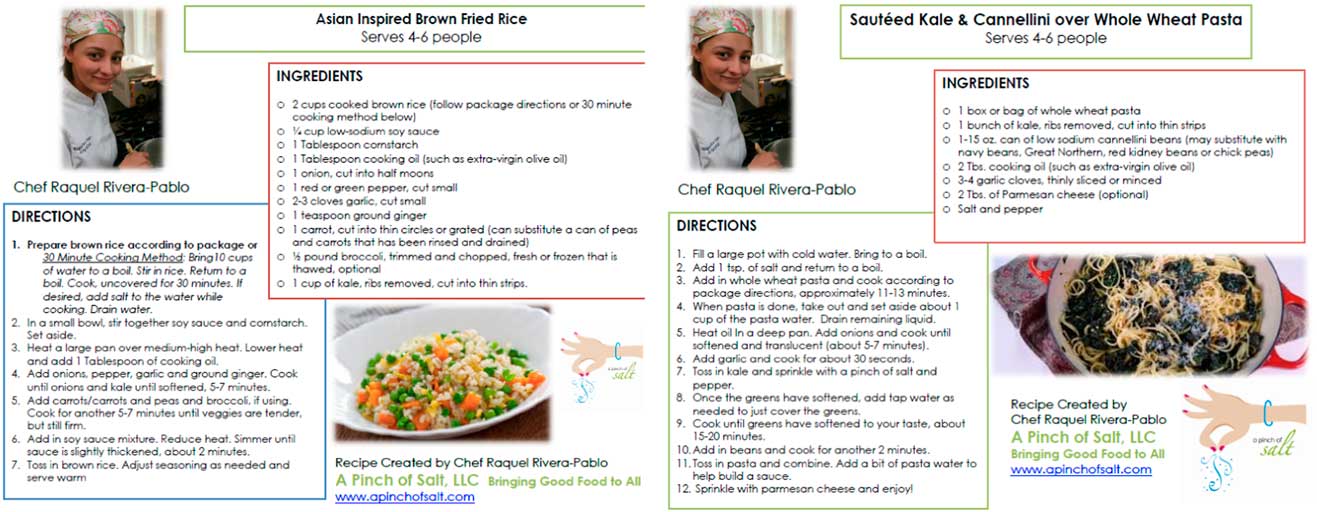
We used a community-engaged approach in the development of the intervention. Conversations with pantry volunteers and staff determined the target items selected for bundles, recipes and recipe tastings. We hired a community chef familiar with this food pantry to design recipes around the target foods using ingredients she identified as low-cost and frequently available in this pantry. To maintain the client-choice dynamic, clients could choose between two recipes that included kale and whole grains: (i) Asian-Inspired Brown Fried Rice and (ii) Sautéed Kale and Cannellini Beans over Whole Wheat Pasta.
The food pantry director and the regional pantry coordinator were consulted regarding the design of the ingredient bundle. Considerations included limiting material costs and packaging. Ingredient bundles contained one recipe and all ingredients required to prepare the meal for four people. Design of the bundle went through several phases and each time incorporated feedback from pantry organizers and the community partners.
Procedures
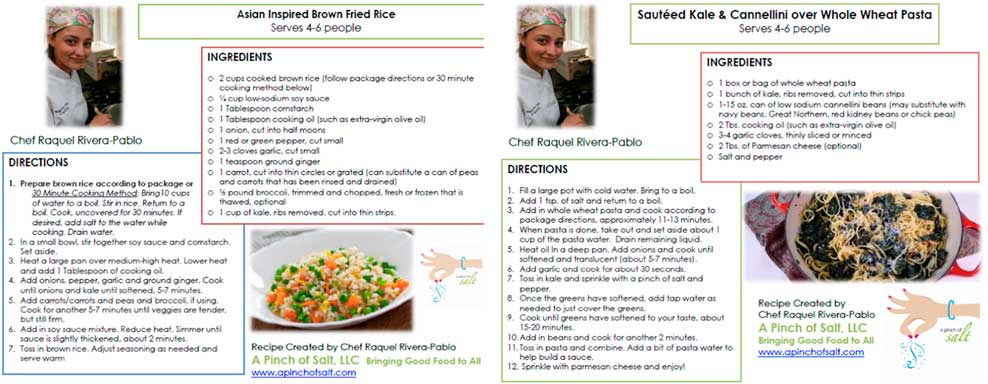
All data collection was supervised by one of the authors (E.C.S.). Seven student research assistants were trained on the protocol. On each of the data collection days, three research assistants attended the site. During T1, both recipes were prepared, labelled and placed in crockpots in the pantry waiting room. A research assistant offered clients a recipe (Fig. 1) and sample of each meal as they waited in line to shop.
(colour online) Recipes used for meal kits and recipe tastings, prepared by a community chef
During T2, the recipe tasting protocol was carried out and the ingredient bundles were displayed on a table in the food pantry. As clients shopped and approached the table, they were offered the ingredients and recipe to make the meal that was being tasted. Clients were invited to select only one of the two bundles. All ingredients in the ingredient bundles were available in the pantry on all of the data collection days, with the exception of the condiments (i.e. soya sauce, olive oil). On the Control days, the pantry functioned normally. The study was determined to be exempt under the Yale University Institutional Review Board for Research involving Human Subjects because the data collection was unobtrusive, observational and anonymous.
Data collection
In-person, direct observational data collection was conducted on all three weekdays the pantry was open. In each of the conditions, research assistants stood unobtrusively in the shopping area and observed the clients shopping. The researchers used standardized data collection forms and recorded the number of target foods selected by each client from both the shelves and ingredient bundle (if they selected one). We also collected data on each client’s family size because they entered the pantry with a slip of paper denoting this information. To minimize pantry disruption, we did not ask clients any additional information (e.g. race/ethnicity, marital status).
Despite the variable inventory inherent in food pantries, the number and mix of products available were held constant for all clients. To accomplish this, the researchers immediately replaced products to ensure a consistent number of target items and alternatives in each target food group (e.g. spinach, white pasta) were displayed on the shelves at any given time.
Data analyses
Data were analysed using the statistical software package Stata version 15. The χ 2 test was used to assess differences in the proportion of clients selecting one or more of the target foods across the three conditions. Omnibus tests were followed by post hoc pairwise comparisons for each target item (i.e. kale, brown rice, whole-wheat pasta) using Bonferroni-adjusted levels of P=0·017 per test (i.e. P=0·05/3) to determine whether there were significant differences between each study condition. First, the total proportion of clients who selected targeted items (which included selection from ingredient bundles and shelves combined in T2) were compared across conditions. Second, because ingredient bundles were not available for T1 or the Control group, we also assessed the proportion of clients by study condition who selected target foods from the shelves only. Next, we used the logit and oddsrisk commands to conduct logistic regressions and convert the odds ratios into risk ratios. Risk ratios can be used to compare the probability of an event across different groups. These models controlled for family size and intervention week( Reference Damon, King and Leibtag 13 ).
Results
The proportion of clients in each condition selecting at least one of each target food is presented in Fig. 2. For T1 and the Control group, the bars illustrate the proportion of clients selecting the target item from the shelves. For T2, the stacked bar illustrates the proportion of clients selecting the target item from the bundle alone, the bundle and shelf, and the shelf alone. Results of the omnibus χ 2 tests confirm that the total proportion of clients that selected target items was not equally distributed across conditions for kale (χ 2=59·7, df=2, P<0·001), brown rice (χ 2=46·0, df=2, P<0·001) and whole-wheat pasta (χ 2=36·5, df=2, P<0·001). Post hoc pairwise comparisons using Bonferroni corrections indicated that the combined proportion of clients that selected kale (from bundle and shelf) was higher among clients in T2 (48·1 %) than clients in T1 (18·0 %; T2 v. T1=1·53; se=0·28, z=5·53, P<0·0001) and the Control group (13·8 %; T2 v. Control=1·86; se=0·28, z=6·68, P<0·001). The proportion of clients selecting kale did not differ significantly between the Control group and T1. Results of post hoc pairwise comparison revealed the same patterns for the combined selection of brown rice and whole-wheat pasta. For brown rice, a greater proportion of T2 clients selected this item (26·9 %) compared with T1 (3·9 %; T2 v. T1=2·20; se=0·49, z=4·5, P<0·0001) and Control clients (5·6 %; T2 v. Control=1·81; se=0·39, z=4·7, P<0·0001) and selection did not differ between T1 and Control. Similarly, for whole-wheat pasta a greater proportion of T2 clients (18·1 %) selected this item compared with T1 (1·8 %; T2 v. T1=2·61; se=0·74, z=3·52, P<0·01) and Control (2·5 %; T2 v. Control=2·16; se=0·55, z=3·95, P<0·0001). Combined selection of whole-wheat pasta did not differ between T1 and Control.
Comparisons of the proportion of food pantry clients (n 448) who selected one or more target item across the three experimental groups ( , Treatment 2 (n 160), bundle selection only;
  , Treatment 2 (n 160), shelf and bundle selection;
  , Treatment 2 (n 160), shelf selection only;
  , Treatment 1 (n 128);
  , Control (n 160)), Bridgeport, CT, USA, November and December 2016. The χ
2 test was used to assess differences in the proportion of clients selecting one or more of the target foods (from either shelf or bundle) across the three conditions. Post hoc pairwise comparisons using Bonferroni corrections were used to assess differences by treatment group. a,bProportion values with unlike superscript letters indicate total selection (bundle and shelf) were significantly different (P<0·05)
, Control (n 160)), Bridgeport, CT, USA, November and December 2016. The χ
2 test was used to assess differences in the proportion of clients selecting one or more of the target foods (from either shelf or bundle) across the three conditions. Post hoc pairwise comparisons using Bonferroni corrections were used to assess differences by treatment group. a,bProportion values with unlike superscript letters indicate total selection (bundle and shelf) were significantly different (P<0·05)
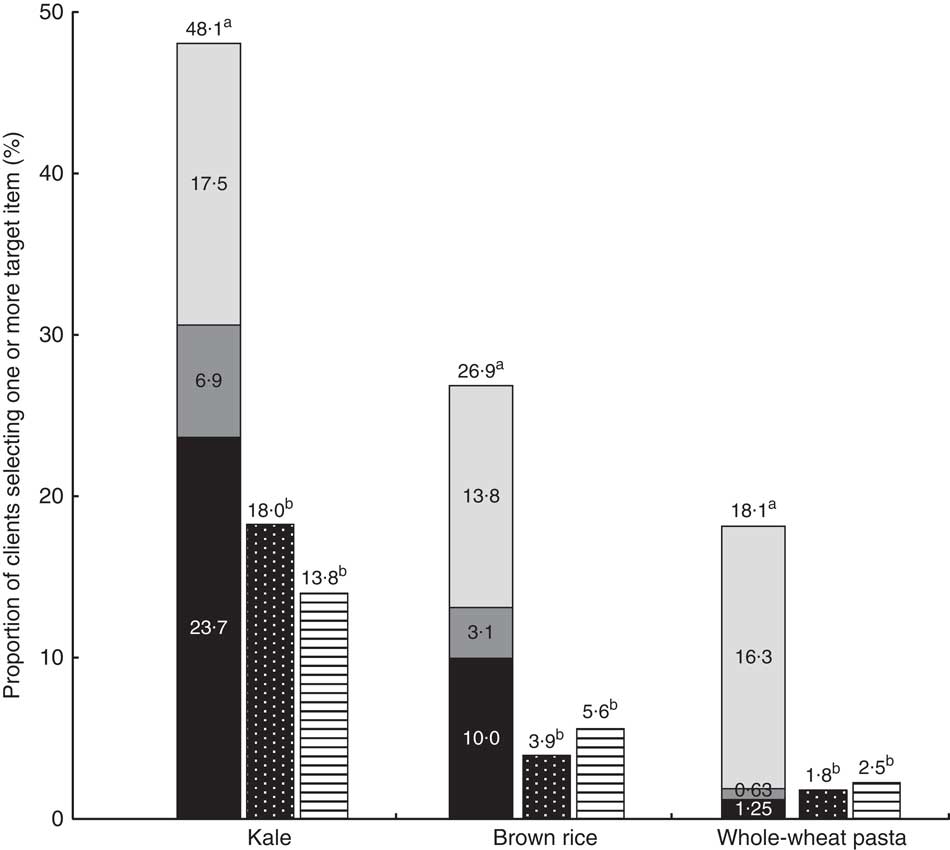
In order to examine whether T2 led to greater selection of the target foods in addition to the product obtained in the bundle, we compared the proportion of clients taking each target item from the shelves across the three conditions. The proportion of participants who took kale from the shelf varied across study conditions (χ 2=6·6, df=2, P=0·036). Post hoc pairwise analyses using Bonferroni-adjusted α showed that kale shelf selection in T2 (23·7 %) was higher than in the Control group (13·8 %; T2 v. Control=0·74; se=0·30, z=1·42, P<0·037), but there were no significant differences in shelf selection between T2 and T1, or between T1 and the Control group. Similarly, brown rice selection from the shelves was not equally distributed across conditions (χ 2=45·1, df=2, P<0·001). Post hoc analyses using Bonferroni corrections revealed brown rice selected from shelves was higher among clients in T2 (13·1 %) than among those in T1 (3·9 %; T2 v. T1=2·2; se=0·49, z=4·49, P<0·001) as well as among the Control group (5·6 %; T2 v. Control=1·89; se=0·49, z=4·49, P<0·001), but did not differ significantly between clients in T1 and the Control group. Finally, the proportion of clients selecting whole-wheat pasta from the shelves did not differ across conditions (χ 2=0·207, df=2, P=0·902).
To further compare the proportion of people taking each target item across study conditions, we used logistic regressions to calculate odds ratios. Three models were tested (T1 v. Control; T2 v. Control; T2 v. T1) for each of the three target foods, for a total of nine models. The models controlled for family size and intervention week. The odds ratios are presented in Table 1. For all target items, the odds ratios comparing T2 with both T1 and Control were statistically significant. T1 did not statistically differ from Control. There was no effect of intervention week on selection of target foods. Kale was the only target food significantly influenced by family size (OR=1·22; 95 % CI 1·07, 1·44).
Summary of logistic regression models for experimental groups, predicting selection of target foods by food pantry clients (n 448), Bridgeport, CT, USA, November and December 2016

RR, risk ratio; T1, Treatment 1; T2, Treatment 2.
The results shown here represent three logistic regression models (T1 v. Control; T2 v. Control; T2 v. T1) for each of the three target foods (brown rice, kale and whole-wheat pasta), for a total of nine models. Each model is adjusted for family size (number of family members) and intervention week (1, 2 or 3).
We converted odds ratios to risk ratios to compare the likelihood of selecting each of the target items in one condition v. another. Risk ratios are also presented in Table 1. Compared with the Control group, the likelihood of T2 clients selecting at least one package of the target item was 3·20 times higher for kale, 4·76 times higher for brown rice and 7·25 times higher for whole-wheat pasta. Compared with T1, T2 clients were 2·67 times more likely to select kale, 7·67 times more likely to select brown rice and 11·43 times more likely to select whole-wheat pasta.
Discussion
The present study used a community-engaged research approach to increase selection of healthy foods in a pantry by offering ingredient bundles and providing recipe tastings. Providing recipes and allowing clients to taste prepared meals did not increase selection of targeted foods compared with no intervention; however, when paired with ingredient bundles to make a meal, the likelihood of clients selecting the target items more than tripled when compared with no intervention and more than doubled when compared with tasting alone.
These findings are consistent with recent food pantry research demonstrating that clients can be nudged towards healthier target items with small, unobtrusive techniques, such as placing foods at the front of a display( Reference Wilson, Just and Swigert 14 ). Nudges are simple, inexpensive strategies that manipulate how choices are presented in order to alter people’s behaviour in a desired way. Many nudges are designed to operate on an automatic unconscious level (v. controlled conscious) by making the healthy choice the easier cognitive choice. Ingredient bundles provide an easier cognitive choice because they save consumers the time and effort required to search for recipe items in a store( Reference Harris and Blair 15 ).
Interestingly, there appeared to be a spillover effect from the ingredient bundles: clients in T2 took more brown rice and kale from the shelves than clients who did not have access to the bundles. It is possible that clients wanted to prepare the meal for more than four people, so they took extra ingredients from the shelves.
The finding that clients exposed to recipe tastings alone were no more likely to select target foods than the control group is surprising, as we expected the tasting to have some impact. Because the recipe tasting took place while clients were waiting to shop and there was a gap in time between tasting and shopping, it is possible that even clients who enjoyed the recipe did not remember to look for all the ingredients once it was their turn to shop. It is notable that a recent survey of food pantry clients asking about their preferences for nutrition interventions found clients rated ingredient bundles more favourably than recipe tastings, indicating that clients may view bundles as a more attractive and convenient strategy than tastings( Reference Cooksey-Stowers, Martin and Schwartz 16 ). Future research should interview clients after recipe tastings to better understand how they experience these tastings and why their shopping behaviour does or does not change.
The present study has limitations. First, clients were not randomly assigned to conditions. However, there is no reason to believe clients who attend the pantry on different days of the week vary systematically in their knowledge, skills or attitudes towards the target foods. Second, the study measured food selection only. We do not know whether clients prepared the recipes at home, and if they did, whether they consumed the foods. However, there is evidence that clients do not want to take food from pantries that they do not intend to eat( Reference Remley, Zubieta and Lambea 17 ), suggesting that they would not have taken the bundles if they did not intend to use them. Third, we did not measure the number of people who tasted recipes or whether those who tasted the recipes were more or less likely to select the target foods. Future research should collect information on tastings and assess whether tasting is associated with food choice.
Conclusions
Ingredient bundles are a promising strategy to promote nutrient-dense items in a food pantry that might otherwise be less popular among clients. Future research should replicate this study with a larger sample, randomization of the days of the week, follow-up data examining consumption of selected items, and assessment of possible mediators such as taste and convenience( Reference Glanz, Basil and Maibach 18 ). Future work in this area might also assess strategies to sustain the provision of ingredient bundles in the face of challenges inherent to the food pantry setting (e.g. unpredictable weekly produce and lack of herbs, oils and spices).
Acknowledgements
Acknowledgements: The authors thank the staff and volunteers of Eatsmart Food Pantry who gave their time and the Robert Wood Johnson Foundation for providing funds for this study. They thank Raquel Rivero-Pablo for her help preparing and developing the recipes. The authors also thank the research assistants, Talea Corneilius, Sharon Wang, Grace Carroll, Rebecca Valderrama, Rachel Clare, Diana Gonzalez and Xuewei Zhang, who assisted with the study. Financial support: This work was supported by the Robert Wood Johnson Foundation. The Robert Wood Johnson Foundation had no role in the design, analysis or writing of this article. Conflict of interest: None. Authorship: All authors contributed to the design of the study, E.C.S. and K.C.S carried out the study and analysed the data, and all authors contributed to the writing of the article. Ethics of human subject participation: This study was conducted according to the guidelines laid down in the Declaration of Helsinki and all procedures involving human subjects was granted exemption under the Yale University Institutional Review Board for Research involving Human Subjects.