




Introduction
The centuries leading up to the sixth millennium BC are perceived as a key period of development for Neolithic societies across southern Europe, the Aegean, Anatolia, Syria and Mesopotamia. With the spread of Neolithisation from the Near East through western Anatolia and into Europe came changes in subsistence practices and foodways, and the expansion of pottery production. At the same time, communities were also coping with environmental and climatic challenges in the wake of the 8.2ka event, which saw increased aridity and climate instability in the northern hemisphere (Biehl & Nieuwenhuyse Reference Biehl and Nieuwenhuyse2016; Biehl & Rosenstock Reference Biehl and Rosenstock2022). Some of these challenges, whether short- or long-term, may have precipitated societal adaptations but it is also possible that many Neolithic groups were sufficiently resilient to cope without significant change (Biehl & Rosenstock Reference Biehl and Rosenstock2022: 5–6).
In the southern Levant this period is known as the Early Pottery Neolithic (EPN, 6400/6200‒5900/5500 BC; Garfinkel Reference Garfinkel1993; Banning Reference Banning1998, Reference Banning, Yasur-Landau, Cline and Rowan2019: 99‒100; Twiss Reference Twiss2007: 24–25; Bar & Rosenberg Reference Bar and Rosenberg2011: 32; Goring-Morris & Belfer-Cohen Reference Goring-Morris and Belfer-Cohen2020: tab. 1). The relatively limited available radiocarbon database frames two EPN archaeological cultures in the southern Levant—the Yarmukian culture (6300‒5800 cal BC) and the Lodian/Jericho IX culture (5900/5800‒5600/5500 cal BC) associated with the EPN—followed by the Late Pottery Neolithic (LPN) Wadi Rabah culture (5600/5500–4800 cal BC; Gopher & Barkai Reference Gopher and Barkai2012: 1533–35). The Neolithic coastal settlements of the southern Levant are characterised by sedentary villages, the earliest being the Pre-Pottery Neolithic C (PPNC; 7000–6400 cal BC) submerged village at Atlit-Yam (Galili et al. Reference Galili1993, Reference Galili, Horwitz, Eshed, Rosen, Bailey, Harff and Sakellariou2019: 52) and the contemporaneous coastal site at Ashkelon (Perrot & Gopher Reference Perrot and Gopher1996; Garfinkel & Dag Reference Garfinkel and Dag2008). Later, a fully developed Mediterranean subsistence economy thrived during the LPN coastal Wadi Rabah culture (e.g. Neve Yam and Kfar Samir; Galili et al. Reference Galili, Horwitz, Eshed and Rosen2019: 54). There is, however, a noticeable temporal gap in coastal settlements during the EPN. The best-known Yarmukian sites of EPN date (Sha‘ar Hagolan, Jericho and Munḥata) are both located inland (Stekelis Reference Stekelis1950; Garfinkel Reference Garfinkel1993; Banning Reference Banning, Yasur-Landau, Cline and Rowan2019) and there are only two known coastal EPN sites in Israel—Neve David (Shochat et al. Reference Shochat, Yeshurun, Friesem, Kaufman, Porat, Rosen and Nadel2019) and Habashan Street (Kaplan Reference Kaplan1972). A third potential example, from which a wooden basket provides a radiocarbon date of the end of the eighth millennium BP, is the submerged site of Kfar Samir North (Galili et al. Reference Galili, Horwitz, Eshed, Rosen, Bailey, Harff and Sakellariou2017: fig. 7.2: 5, tab. 7.1). None of these EPN sites presents clear evidence of architecture; instead, all are characterised by pits containing typical EPN ceramic and flint assemblages. These finds are better attributed to ephemeral occupations, especially when compared to assemblages from the larger inland sites of Sha‘ar Hagolan or Jericho (Kenyon & Holland Reference Kenyon and Holland1982; Garfinkel Reference Garfinkel1993: 117). Presently, Yarmukian finds are known only from Byblos on the Lebanon coast (Dunand Reference Dunand1973; Badreshany Reference Badreshany2016: 15).
This fragmented evidence of human coastal occupation in the EPN of the southern Levant coincides with the 8.2ka event and its aftermath, characterised by rapid cooling and arid conditions effectively causing drought in much of the eastern Mediterranean (Bar-Matthews et al. Reference Bar-Matthews, Ayalon, Kaufman and Wasserburg1999: 91; Migowski et al. Reference Migowski, Stein, Prasad, Negendank and Agnon2006: 425). Through the Holocene, such rapid climate events may have been responsible for shifts in settlement patterns, and even for societal collapse, especially for early farming communities such as the EPN, which relied on precipitation and stable temperatures for agricultural success (Weninger et al. Reference Weninger2006; Flohr et al. Reference Flohr, Fleitmann, Matthews, Matthews and Black2016; Matero et al. Reference Matero, Gregoire, Ivanovic, Tindall and Haywood2017; Rollefson Reference Rollefson, Khalaily, Re'em, Vardi and Milevski2020). While the 8.2ka event may have had an adverse effect on some Neolithic communities (e.g. at Çatalhöyük), others may have been less affected (Weninger et al. Reference Weninger2006; Flohr et al. Reference Flohr, Fleitmann, Matthews, Matthews and Black2016; Matero et al. Reference Matero, Gregoire, Ivanovic, Tindall and Haywood2017). The limited number of archaeological sites identified on the coastal plain of the southern Levant indicates that this area may have suffered the effects of climatic instability, though the nature of the impact is debated (Migowski et al. Reference Migowski, Stein, Prasad, Negendank and Agnon2006; Maher et al. Reference Maher, Banning and Chazan2011; Flohr et al. Reference Flohr, Fleitmann, Matthews, Matthews and Black2016: fig. 3b; Shochat et al. Reference Shochat, Yeshurun, Friesem, Kaufman, Porat, Rosen and Nadel2019; Rollefson Reference Rollefson, Khalaily, Re'em, Vardi and Milevski2020). Here, we present the results of the first excavation at the submerged EPN settlement of Habonim North (Figure 1), shedding new light on the supposed EPN coastal habitation hiatus and offering insights into the social resilience of coastal communities around the 8.2ka climatic event.
a & b) the submerged Neolithic site of Habonim North, located approximately 100m west of the current shoreline off the Carmel Coast, Israel; c) excavation areas A and B (maps created with Esri and MAPI libraries; figure by authors).

Underwater excavation areas and methods
The site of Habonim North is located off the Carmel Coast of Israel, approximately 200m south of Tel Nami, at a depth of 2.5–3.0m below present sea level, between the current coastline and a submerged aeolianite (kurkar) ridge (Figure 1). It was first identified (between 2015 and 2017) by Ehud Galili (pers. comm.) and rediscovered in 2018 during an underwater archaeological survey (Arkin Shalev et al. Reference Arkin Shalev, Nickelsberg and Yasur-Landau2022). Underwater excavations have been conducted jointly by the University of California, San Diego, and the University of Haifa in two main areas: A and B (Figure 1). In total, five 1 × 1m squares and two installations (constructed features within the site) were excavated: two squares in an open space in area A; three squares on either side of two stone walls (W001 and W002; Figure 2); and two round installations (L013 and L015; Figure 2) in area B. The sediments in both areas are rich in anthropogenic remains, including pottery, lithics, bone and botanical assemblages, which provide information about the extent of the site and the intensity of its occupation. Investigations have employed a combination of methods including a water-pump-activated dredge system to remove sand and the manual collection of larger artefacts (Galili et al. Reference Galili1993: 134–35). Stratigraphic excavation, finds collection and documentation (i.e. registration, drawing, photography and 3D modelling) follow terrestrial methods, employing a 0.5 × 0.5m grid and the excavation of 50mm-deep spits (Bar-Yosef & Mazar Reference Bar-Yosef and Mazar1982). All excavated sediments were systematically wet sieved through 2mm, 1mm and 0.5mm geological mesh sieves to recover smaller finds.
Top half) plan of structures in area B; lower half) orthophoto of excavated contexts in area B (figure by authors).

Results
Architecture
Excavation has identified three main strata: Stratum I, the most recent, is an approximately 0.5m-thick sand deposit that accumulated over the abandoned site. The underlying Stratum II is represented by contemporaneous architectural features in area B: adjoining walls W001 and W002, the latter delimiting a cobblestone layer into which two stone installations were set. The sediments excavated adjacent to W001 and W002 abutted them and were thus likely the living surfaces associated with these walls. Excavation did not continue below the walls’ foundations. The earliest phase, Stratum III, is represented by archaeological sediments excavated within the stone installations, but below the foundation level of their lining stones; these deposits therefore pre-date the installations and possibly the walls as well.
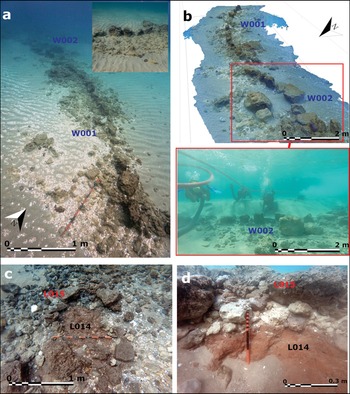
Architectural remains consist of two curvilinear walls on a north-west/south-east axis and two round stone installations. W001, an approximately 8m-long feature, is built of a single row of boulders, standing upright on their narrow edges, ranging from 0.3 × 0.2 × 0.1m to 0.4 × 0.3 × 0.15m (length × width × height; Figure 3a). On either side of the wall are smaller stones (cobbles) that may have been part of a supporting system. Based on the curvature of the wall, the area to its west is interpreted as the interior of an enclosed structural space, which was excavated as locus (L) 007 (as a 1 × 1m square next to the southern section of the wall) and L019 (next to the northern part of the wall, yielding a collection of finds). The area immediately to the east of the wall is interpreted as a space outside the structure and was investigated with another 1 × 1m square (L006). Slightly farther to the east, another finds assemblage was recovered from a habitation surface (L009) representing the same context as L006. Wall 002 abuts W001 on its north-western edge. It too extends from north-west to south-east but curves in the opposite direction to W001, enclosing a space to its east. W002 is approximately 5m long and constructed of boulders that are larger than those composing W001, ranging in size from 0.5 × 0.3 × 0.2m to 0.6 × 0.4 × 0.3m (Figure 3b). All but one boulder stand upright, encircling a single large boulder to the east of the wall. A 1 × 1m square was excavated in this space (L011).
Architectural features identified during excavation: a) wall 001; b) wall 002; c) one of two round-stone installations (L105); d) section of L105 demonstrating shallow nature of features and sediment below them (photographs and figure by authors).

North-west of W002 is a layer of cobblestones. Such layers have been identified at other Yarmukian sites (e.g. in rooms K and G of Building I at Sha‘ar Hagolan; Garfinkel et al. Reference Garfinkel, Ben-Shlomo and Marom2012: fig. 5), at earlier PPNB sites and in later periods (Roskin et al. Reference Roskin, Asscher, Khalaily, Ackermann and Vardi2022: 221). This layer includes two round stone-built installations (L013 and L015), both constructed of a single course of stones (0.3 × 0.4 × 0.15m) arranged in a 1.5m-diameter circle (Figure 3c & d). These features may be the remains of pit linings. The 11 sediments excavated from within both structures yielded a variety of finds, including lithics, pottery and charred botanical remains (mainly seeds). The sediment excavated below L015 also contained lithics and charred remains, attesting to an earlier habitation phase at the site.
Ceramic finds
The excavated squares yielded a rather uniform EPN pottery assemblage (n = 32), of value for relative dating. Distinctive EPN characteristics include light-coloured ware with coarse temper, the knob handle from a storage jar (Figure 4, no. 5) and the painted rim of a hole-mouth jar (Figure 4, no. 3). Such vessel types have been recovered from Yarmukian and Jericho IX sites, including Naḥal Zehora II (Strata IV–III), Munḥata (Layer 2b), Ard el-Samra (Area C, Layer 3; Area F, Layer 2) and Neve David (Levels 3–1) (Garfinkel Reference Garfinkel1993: 118–20; Getzov et al. Reference Getzov2009: fig. 29; Gopher & Barkai Reference Gopher and Barkai2012: 89, 361–62; Shochat et al. Reference Shochat, Yeshurun, Friesem, Kaufman, Porat, Rosen and Nadel2019: fig. 18). Another characteristic EPN attribute of some of the Habonim assemblage is painted decoration, including red-slipped or red-painted bands, common on Jericho IX wares from Neve David and Mishmar Ha‘emeq (Figure 5; Barzilai & Getzov Reference Barzilai and Getzov2011: 18; Shochat et al. Reference Shochat, Yeshurun, Friesem, Kaufman, Porat, Rosen and Nadel2019: 171–73); the nearby site of Neve David has yielded decorated sherds almost identical to those from Habonim North (Shochat et al. Reference Shochat, Yeshurun, Friesem, Kaufman, Porat, Rosen and Nadel2019: fig. 18.6–8). Additionally, one sherd (Figure 5, no. 11) bears an incised decoration very similar to the herringbone decoration—a Yarmukian feature, with only a few cases in Jericho IX contexts—which has been identified at Neve David, Mishmar Ha‘emeq, Naḥal Zehora and Sha‘ar Hagolan (Garfinkel Reference Garfinkel1993: fig. 4; Barzilai & Getzov Reference Barzilai and Getzov2011: fig. 5.1; Gopher & Baraki 2012: fig. 10.2.24; Shochat et al. Reference Shochat, Yeshurun, Friesem, Kaufman, Porat, Rosen and Nadel2019: fig. 18.5).
Pottery recovered from area B: (1–3) bowl and holemouth jar rims; (4–5) knob and ledge handles; (6–8) bowl and jug bases (figure by authors).

Pottery: sherds with red-painted decorations of the Jericho IX tradition; detail of sherd with red paint and incisions (11), common in Yarmukian/Jericho IX assemblages (figure by authors).

Botanical finds
An initial analysis of approximately 300 well-preserved plant remains from seven loci allows species-level identification of most of the material. The assemblage comprises two crop plants, emmer wheat (Triticum dicoccum) and lentil (Lens culinaris?), plus two obligatory weeds, darnel (Lolium temulentum) and brittle-spiked canary grass (Phalaris paradoxa), and five wild plants (Cephalaria joppensis, Chenopodium album, Lolium rigidum, Malva parviflora, Scorpiurus sp.; see online supplementary material (OSM) Table S1). Wheat, lentil and their accompanying weeds would have grown in cultivated fields on fertile and moist soils. The other wild plants include ruderal species and herbaceous and nutrient-rich plants that grow in various habitats and can be found currently along the Carmel Coast and in neighbouring regions (Danin Reference Danin2004).
Samples of three charred botanical remains were radiocarbon dated (at Beta Analytic Radiocarbon Laboratory, see OSM Table S2). A wood charcoal sample from burnt sediment in area B associated with the northern face of W002 (Figure 6) yielded a radiocarbon age of 6070–5990 cal BC; two seeds from area A (open space) are dated to 6022–5902 cal BC and 5482–5339 cal BC. The earliest of the two dates from area A and the date of the sample from area B fall within the range of the Jericho IX culture. These dates link the site to the timespan between the Yarmukian and Jericho IX phases (Gopher & Barkai Reference Gopher and Barkai2012: 1534–35), in agreement with the presence of pottery with characteristics of both cultures at Habonim North. The third radiocarbon date (one of the two from area A) corresponds with the Wadi Rabah phase and may indicate continuous occupation of the site through the LPN.
a & b) location of sampled burnt patch near W002; c) sample containing wood charcoal and a mud-brick fragment (see Table S2 for 14C date) (figure by authors).

Lithic assemblages
The flint assemblage from Habonim North comprises 187 items, mostly reflecting an ad hoc industry dominated by flake production (n = 65, 34.4%; see Table S3). Cores with two striking platforms are the most common (n = 17, 47.2%). In four examples the striking platforms are opposed, reflecting bidirectional reduction technology. There are 46 tools from several typological groups (see Table S4), among them bifacial tools (n = 5, 10.9%) including an adze (Figure 7, no. 1) and a broken bifacial tool (Figure 7, no. 2) but no sickle blades or arrowheads. In the Levant, bifacial tools used for woodworking first appear in the Late Epipalaeolithic period and become an important component in Neolithic and Chalcolithic flint assemblages (Barkai & Yerkes Reference Barkai, Yerkes, Longo and Skakun2008; Barkai Reference Barkai, Edmonds and Davis2011; Shea Reference Shea2013). They have been found in submerged PPNC contexts at Atlit-Yam and LPN contexts at Kfar Galim (Galili & Weinstein-Evron Reference Galili and Weinstein-Evron1985: fig. 8; Galili et al. Reference Galili1993: fig. 12). The overall characteristics of the small assemblage from Habonim North place it in the continuum between the PPNC and the LPN, presenting evidence for in situ knapping and daily activities (Table S3).
Flint bifacial tools: 1) adze; 2) broken bifacial tool (figure by authors).

The ground-stone assemblage includes four basalt tools from area B: two mortar fragments (Figure 8a, nos. 1–2), a flat disc-shaped grinding stone (Figure 8a, no. 3) and a fragment of a worked grinding stone with a smoothed/polished surface (Figure 8a, no. 4). Basalt does not occur naturally on the Carmel Coast, and its presence in the assemblage thus indicates the existence of trade networks (see Rosenberg & Garfinkel Reference Rosenberg, Garfinkel, Rosenberg and Garfinkel2014: 276–77). In addition, a kurkar (a local term for coastal aeolian sandstone) feature roughly 0.3 × 0.2m with a circular depression (0.1m diameter) identified as either a stone bowl or a stone with a cup mark was found west of W001 and left on site (Figure 8b). Similar items have been recovered at the later LPN site of Kfar Galim (Galili & Weinstein-Evron Reference Galili and Weinstein-Evron1985: fig. 11).
a) basalt ground-stone tools; b) in situ kurkar bowl (figure by authors).

Half of a piriform limestone mace-head was recovered 5m east of W001 (L008). The object is 60mm long and 50mm wide, pierced by a drilled hole and has a smoothed exterior (Figure 9, no. 1). Stone mace-heads are known as early as the PPNB and continue into the Chalcolithic period in the Levant (Rosenberg Reference Rosenberg2010) and Early Bronze Age (Rosenberg & Golani Reference Rosenberg and Golani2012). In EPN contexts they appear at sites such as Ḥamadiya, ‘Ain Ghazal, Naḥal Zehora II and Sha‘ar Hagolan, from which 13 were recovered from Sha'ar Hagolan alone (Rosenberg Reference Rosenberg2010). Along the Israeli Coastal Plain mace-heads have been recovered from LPN sites such as Neve Yam and Tel Kabri (Rosenberg Reference Rosenberg2010).
Stone objects: 1) half of a mace-head; 2) basalt pebble with cross incision and possible percussion mark (figure by authors).

Another notable find is an incised oval basalt pebble. The rounded upper part is marked with two perpendicular grooves forming a cross (Figure 9, no. 2). Incised pebbles are commonly recovered from Yarmukian sites in Israel and as far north as Byblos (Dunand Reference Dunand1973) and are common also in seventh-millennium BC Cypriot contexts (Simmons Reference Simmons1994; Clarke Reference Clarke, Bolger and Maguire2010). Currently, the largest assemblages of incised pebbles found in Israel come from Sha‘ar Hagolan and Munḥata, featuring a variety of incised patterns (Perrot Reference Perrot1964: 328; Gopher & Orrelle Reference Gopher and Orrelle1996; Garfinkel Reference Garfinkel, Rosenberg and Garfinkel2014). Some scholars suggest a symbolic meaning for these items, possibly as identity markers, based on their findspots within houses at Sha‘ar Hagolan (cf. Garfinkel Reference Garfinkel, Rosenberg and Garfinkel2014). One of the pebbles found at Sha‘ar Hagolan is a close parallel to the one found at Habonim North, in terms of both material and incised pattern (Garfinkel Reference Garfinkel, Rosenberg and Garfinkel2014: fig. 13.20).
Some of the artefacts are related to maritime activities. Several stone fishing net-sinkers were recovered from the site, including the putative internal space of W001 (L007; Figure 10). Fishing net-sinkers are common at coastal sites such as Atlit-Yam and at later LPN sites such as Neve Yam as early as the PPNB and PPNC (Galili et al. Reference Galili1993: fig. 15; Reference Galili, Horwitz, Eshed, Rosen, Bailey, Harff and Sakellariou2017: 119). These indicate the continuity of maritime activities from the PPNC to the EPN and later.
Stone objects from area B with connection to marine activities, probably fishing-net sinkers (figure by authors).

Zooarchaeology
A first study of faunal remains from Habonim North has identified the taxa of 10 bones from area B. These are five caprine (sheep or goat) tooth and limb bone fragments, two equine cheek teeth, and a single bone each from Persian fallow deer (Dama dama mesopotamica), gazelle (Gazella gazella) and wild pig/boar (Sus scrofa). This list indicates utilisation of both wild and domestic resources.
Discussion
The data presented above potentially shift understanding of settlement continuity and the effect of the 8.2ka climatic event on coastal communities in the southern Levant.
Evidence of an EPN village at Habonim North
The archaeological finds from the submerged site of Habonim North indicate that it was a settlement dating to the EPN—a phase that has, until now, been almost entirely missing from the archaeological record of the southern Levantine coast. The pottery assemblage at Habonim North is dominated by red-painted sherds and incised decoration that are typical of the Yarmukian and Jericho IX cultures. An incised basalt pebble, common in Yarmukian assemblages (Gopher & Orrelle Reference Gopher and Orrelle1996; Garfinkel Reference Garfinkel, Rosenberg and Garfinkel2014), also supports an EPN date for the site. Similar incised basalt pebbles were discovered in Sha‘ar Hagolan and Byblos (Dunand Reference Dunand1973; Garfinkel Reference Garfinkel, Rosenberg and Garfinkel2014; Badreshany Reference Badreshany2016).
Other lithic finds point to the Pottery Neolithic more generally. Two of the three radiocarbon dates presented here place the site at the end of the sixth millennium BC—corresponding either with the late Yarmukian or the start of the Jericho IX culture—while a third radiocarbon date hints at the possibility of continuing occupation through the subsequent Wadi Rabah phase (Gopher & Barkai Reference Gopher and Barkai2012: 1534–35; Banning Reference Banning, Yasur-Landau, Cline and Rowan2019). This correlation between typological and absolute dating presents the first indication of an EPN settlement on the Carmel Coast. At Neve David, EPN occupation was deduced strictly from the pottery assemblage, which is similar to that found at Habonim North; while at Kfar Samir, the recovery of a basket provided a radiocarbon date from this period in the absence of any clear archaeological context (Shochat et al. Reference Shochat, Yeshurun, Friesem, Kaufman, Porat, Rosen and Nadel2019).
The new radiocarbon dates from Habonim North coincide with the latest dates from PPNC Atlit-Yam (Galili et al. Reference Galili1993) and the earliest LPN Wadi Rabah sites along the Carmel Coast (Galili et al. Reference Galili, Horwitz, Eshed and Rosen2019: 52), thus bridging this chronological gap. As a result, the site of Habonim North fills the last supposed gap in the coastal habitation record, which is believed to have lasted until the Early Bronze Age phase Ib (Yasur-Landau Reference Yasur-Landau, Yasur-Landau, Cline and Rowan2019; Nickelsberg et al. Reference Nickelsberg, Shahack-Gross, Yasur-Landau, Yasur-Landau, Gambash and Levyin press).
First signs of EPN architecture on the coast
EPN structures on the eastern Mediterranean coast are rare, previously encountered only at Byblos. Furthermore, only a few inland EPN sites have yielded architectural remains, including Sha‘ar Hagolan, Munḥata, Hagoshrim, Jericho and ‘Ain Ghazal—the latter displaying reused PPNB structures (Perrot Reference Perrot1964: 325–26; Garfinkel Reference Garfinkel1993: 127–28; Reference Garfinkel, Banning and Chazan2006: 104–5; Getzov Reference Getzov1999; Kafafi Reference Kafafi, Banning and Chazan2006). At Mishmar Ha‘emeq, Ard el-Samra and Neve David only pit dwellings were identified (Getzov et al. Reference Getzov2009; Barzilai & Getzov Reference Barzilai and Getzov2011; Shochat et al. Reference Shochat, Yeshurun, Friesem, Kaufman, Porat, Rosen and Nadel2019).
The features W001 and W002 at Habonim North may represent two types of structure. The first, with a row of stones placed on their narrow edge, is similar to partition walls identified between household units at ‘Ain Ghazal (Kafafi Reference Kafafi, Banning and Chazan2006: 83–84). The second is probably the outer lining of a thicker wall, such as that of Complex II at Sha‘ar Hagolan or walls identified at Munḥata (Perrot Reference Perrot1964: 325–27; Garfinkel et al. Reference Garfinkel, Ben-Shlomo and Marom2012: figs. 4 & 9).
The effect of the 8.2ka climatic event on coastal communities
The evidence from Habonim North is incompatible with the collapse of coastal settlements in the wake of the 8.2ka event. Instead, it presents a resilient, sedentary site with a complex and diverse economic system that included local production as well as long-distance exchange postdating the 8.2ka climatic event.
The roots of this resilience probably lie in a combination of the already robust subsistence economy of the PPNC and additional diversification efforts made to buffer climatic uncertainty (e.g. Ryan & Rosen Reference Ryan, Rosen, Biehl and Nieuwenhuyse2016). The domesticated plant remains from Habonim North show a continuity of the Mediterranean subsistence economy with similarities to the botanical assemblages from PPNC Atlit-Yam—that is, the presence of wheat and lentils (Kislev et al. Reference Kislev, Hartmann and Galili2004; Hartmann-Shenkman et al. Reference Hartmann-Shenkman, Kislev, Galili, Melamed and Weiss2015)—and the LPN site of Naḥal Zehora II (Kislev & Hartmann Reference Kislev, Hartmann and Gopher2012). Wheat was the main food crop during the PPNC and continued its role in EPN Habonim North and LPN Naḥal Zehora. Likewise, lentils continued to accompany wheat throughout these periods. The two Lolium species are also represented at all three sites. At the same time, Malva parviflora and Phalaris paradoxa are present only at the two early sites, Atlit-Yam and Habonim North. Similarities in the main crops, their weeds and the wild plants indicate the continuity of agricultural practices in the Carmel Coast area from the PPNC to the Pottery Neolithic. The zooarchaeological assemblage also indicates the utilisation of domestic and wild animals, while fishing appears to have supplemented the diet of the local community, resembling the economic system at PPNC Atlit-Yam.
Diversification is evident in the addition of non-local raw materials and goods, which likely arrived through exchange. This is seen in the basalt finds, made of a material that is not found along the Carmel Coast, which have typological parallels from inland sites. Unexpected evidence of diversification is seen in the heterogeneous provenance (i.e. at last two sources, a local coastal and imported coastal) of pottery (see OSM: Ceramic petrography), a technological innovation and new addition to the EPN material repertoire. These results suggest that the village communities established during the PPNC represent the foundations of a resilient society capable of withstanding environmental changes that would have disrupted or displaced earlier societies.
Conclusion
The site of Habonim North offers new evidence showing how coastal EPN societies in the southern Levant successfully navigated the climatic uncertainty associated with the 8.2ka event. While a break in the settlement record at this time was hypothesised to suggest that this event may have precipitated the abandonment of coastal settlements, the data provided here show that the social and economic systems that were established during the PPNC continued into the EPN and contributed to the ability of communities to withstand the stress of environmental and climate change. Control and management of local resources even enabled the introduction of new types of material culture during this period of uncertainty. These results indicate that early Neolithic societies were resilient and sustainable, providing the foundation for the later social and economic changes that lead to the development of urbanism.
Supplementary material
To view supplementary material for this article, please visit https://doi.org/10.15184/aqy.2024.32.
Acknowledgements
We thank the Leon Recanati Institute for Maritime Studies Maritime Workshop, led by Amir Yurman and Moshe Bachar, without whom this excavation could not have succeeded. Rami Tzadok and Tufik Bariah provided boating services. Olivia Ayers, Adellina Cini, Ghavin Deonarain, Chandler Houghtalin, Silvana Kreines, Sára Lantos, Alyssa Pietraszek, Nicolás Ramudo, Marko Runjajić and Tanya Sokolsky assisted in the excavation and post-excavation processing.
Funding Statement
This research was funded by the Koret Foundation (Grant no. 19-0295), aiming to support research collaborations focusing on marine archaeology between UC San Diego's Scripps Center for Marine Archaeology (SCMA) and the University of Haifa's Leon Recanati Institute for Maritime Studies (RIMS). Roey Nickelsberg is supported by a Haifa Center for Mediterranean History PhD Scholarship, the Nathan Rotenstreich Scholarship for outstanding PhD students in the humanities and the Sir Maurice and Lady Irene Hatter Research Grant from RIMS. Further funding was afforded by the Israel Science Foundation (Grant no. 697/20) granted to Ruth Shahack-Gross.




 Open access

