




1. Introduction
Code-switching (CS), the practice of integrating elements from different languages within a single utterance, is a defining feature of multilingual speech across many communities. Rather than occurring randomly, CS is systematic, reflecting the interaction of grammatical constraints with extralinguistic factors (Deuchar, Reference Deuchar2020). Studying these mechanisms not only sheds light on how bi−/multilingual speakers navigate linguistic interactions in the face of divergent grammatical systems but also provides critical insights into the nature of the human language faculty that remain obscured in monolingual grammars (López, Reference López2020).
In this study, we examine CS patterns in mixed noun phrases (NPs) in Portuguese-German CS as produced by second-generation children from Portuguese families living in the German-speaking part of Switzerland.
The Portuguese migrant population in Switzerland represents a promising testing ground for studying CS habits. Although it is one of the largest immigrant groups in the country, it differs significantly from more well-established multilingual communities, such as the Spanish–English community in Miami (cf. Parafita Couto & Gullberg, Reference Parafita Couto and Gullberg2019), since it is characterized by cyclical patterns of movement and return to Portugal. These cyclical movements contribute to sustained Portuguese input, support intergenerational transmission of the heritage language (HL), and create sociolinguistic conditions that favour the emergence and maintenance of CS among second-generation speakers, rather than a shift to the majority language.
While Portuguese migration to Switzerland began in the late 1960s, it only increased substantially in the 1990s, driven primarily by economic opportunities and the political and social stability Switzerland offers (Marques, Reference Marques2008). In fact, a notable feature of the Portuguese diaspora is the strong desire to eventually return to Portugal (Kabatek, Reference Kabatek, Glaser, Kabatek and Sonnenhauser2024), which plays a key role in the intergenerational transmission of Portuguese. Importantly, this community cannot yet be described as a long-standing diaspora extending beyond the second (or third) generation. Despite the presence of approximately 270,000 Portuguese nationals in Switzerland in 2024 (Bundesamt für Statistik, 2024) – making Portuguese the second most spoken non-national language at home after English – the language is often described as “silent” (Kabatek, Reference Kabatek, Glaser, Kabatek and Sonnenhauser2024), with limited visibility in Swiss public life and minimal representation in the Swiss educational system. Portuguese is mainly used in domestic settings, within Portuguese cultural and sports associations, religious practices, and in HL classes offered by the Camões Institute, the Portuguese governmental organization responsible for providing Portuguese language classes abroad. These HL classes constitute a well-established network that supports the active use and maintenance of Portuguese, even among younger generations (Gonçalves & Vizentini, Reference Gonçalves, Vizentini, Souza and Melo-Pfeifer2021).
Taken together, this sociolinguistic profile reveals a migrant population with a substantial number of first-generation L1 Portuguese speakers who display varying degrees of competence in the societal language (SL), alongside a second-generation raised bilingually – with Portuguese as an HL and the SL as the dominant one. Despite the size and long-standing presence of the Portuguese community in Switzerland, bilingual speech practices in this population – particularly CS – have not been investigated systematically to date. The present study therefore offers the first experimental account of CS patterns in this community. As will be shown in Section 7.1, CS habits are largely absent in the first generation, whereas younger speakers engage in CS more frequently, acting as active initiators of this practice.
What makes second-generation speakers, aged 8–16, particularly interesting for investigating CS is not only that they are early bilinguals but also that they have already acquired the core features of their HL and SL grammars, while their linguistic abilities are still developing (see, e.g., Flores & Rinke, Reference Flores and Rinke2024; Rinke & Flores, Reference Rinke and Flores2018, on subject realization in Portuguese). The key question is whether ongoing linguistic development goes hand in hand with an expansion or more experienced use of CS. Previous research comparing adults and children has shown that children are sensitive to CS patterns in the input (Phillips & Deuchar, Reference Phillips, Deuchar, Røyneland and Blackwood2021). However, if the parent generation does not code-switch – as in the population studied here – children must develop their own rules. Which intra- and extralinguistic factors guide them in this process?
The question of how bi-/multilingual speakers combine elements from different languages in a single utterance has been a driving force in CS research for decades. Early work (Poplack, Reference Poplack1980) proposed that CS occurs only where the syntactic structures of both languages align, thus avoiding grammatical violations. However, empirical data, such as Papiamento-Dutch utterances where the Papiamento adjective precedes the Dutch noun, contrary to Papiamento’s monolingual order (Parafita Couto & Gullberg, Reference Parafita Couto and Gullberg2019), demonstrate that CS can occur even with structural mismatches. Languages with differing adjective–noun orders like German (obligatorily prenominal adjectives – e.g., ein schöner Tag – “a beautiful day”) and Portuguese (preferentially postnominal adjectives – e.g., um dia lindo – “a day beautiful”) present an ideal pair for studying how bilinguals resolve such conflicts in CS.
Two dominant theoretical models address these patterns. The matrix-language framework (MLF; Myers-Scotton, Reference Myers-Scotton1993, Reference Myers-Scotton2002) posits that one language, the matrix language (ML), provides the grammatical structure, including word order, while the embedded language (EL) supplies lexical items that must conform to the ML’s syntax. In contrast, Cantone and MacSwan’s (Reference Cantone, MacSwan, Isurin, de Bot and Winford2009) approach within the minimalist program (MP) postulates that word order in CS is determined by the language-specific properties of the lexical items involved, independent of the ML. In MP-based accounts, adjectives are base-generated prenominally, with postnominal placement in Romance languages like Portuguese arising from overt noun movement, a process unavailable in German.
Empirical studies using naturalistic data, elicitation tasks, acceptability judgements, and electrophysiological measures (e.g., Parafita Couto et al., Reference Parafita Couto, Deuchar, Fusser, Stell and Yakpo2015; Parafita Couto & Gullberg, Reference Parafita Couto and Gullberg2019; Stadthagen-González et al., Reference Stadthagen-González, Parafita Couto, Párraga and Damian2019; van Osch et al., Reference van Osch, Parafita Couto, Boers and Sterken2023; Vaughan-Evans et al., Reference Vaughan-Evans, Parafita Couto, Boutonnet, Hoshino, Webb-Davies, Deuchar and Thierry2020) have revealed systematic yet variable CS patterns. These findings point to structured variation shaped by the interaction of multiple linguistic factors, which no single theoretical model can fully capture. As a result, both the MLF and MP face challenges in accounting for the full range of attested adjective–noun orderings.
In addition, a robust cross-linguistic tendency has emerged where noun insertion is favoured over adjective insertion. Building on previous findings, we take a closer look at the role of linguistic factors, in particular, the (in)flexibility of the grammars involved (see Section 2). Whereas German adjectives always occupy the prenominal position, in Portuguese, pre- and postnominal adjectives are structurally possible, their position depending on interpretation and adjective type. Hence, in contrast to German, acquiring the (flexible) placement of adjectives in Portuguese involves sensitivity to the adjective type and interpretative distinctions.
Against this background, we aim to investigate to what extent these linguistic differences shape the CS patterns observed in bilingual children’s speech. At the same time, and based on the empirical patterns emerging from our data, we seek to advance current theoretical accounts by proposing the Constraint Integration Model (CIM), which accounts for CS within the noun phrase by integrating language-specific grammatical properties, insertion type, and word-order constraints through an order of constraints. In addition, this study considers the role of extralinguistic factors such as age, language proficiency, exposure, and attitudes towards the SL and the HL.
2. Some brief remarks on adjective–noun order in Portuguese and German and potential switching sites
We start by taking a closer look at the linguistic differences between Portuguese and German regarding the placement of attributive adjectives.
Portuguese and German differ (in similar ways to Spanish/Welsh/English or Spanish/Papiamento/Dutch, as investigated in previous studies) with respect to the placement options of the attributive adjective. German shows strict prenominal placement for all adjective types, as illustrated in (1):

Portuguese displays greater flexibility in adjective placement, depending on its type and interpretation. Although a comprehensive overview is beyond our scope, we briefly highlight several key facts. Attributive adjectives can occur pre- and postnominally (2a–b), but the unmarked and most frequent placement is postnominal, as shown in (2a):

In (2a-b), pre- and postnominal positions show interpretational differences. The prenominal position typically yields an appositive reading (e.g., “being beautiful” as an inherent property), while the postnominal position can be either restrictive or appositive. In (3), prenominal use signals an individual-level reading (the stars are inherently visible (especially bright or permanent in the sky)), whereas postnominal placement allows for a stage-level reading (stars are visible in this specific situation (e.g., due to a clear sky tonight)) (Brito, Reference Brito and Mateus2003; Veloso & Raposo, Reference Veloso, Raposo and Raposo2013):

Non-subsective or adverbial adjectives – such as intensional adjectives (falso “false,” see ex. 4) only appear in prenominal position (Veloso & Raposo, Reference Veloso, Raposo and Raposo2013):

Colour adjectives are intersective and show a strong preference for the postnominal position. Even when the colour is an inherent property of the noun, the prenominal position is ungrammatical (5a) or restricted to poetical or literary contexts (5b):

Other adjectives such as nationalities behave similarly and only occur postnominally:

Among the various syntactic accounts proposed to model contrasting adjective placement, the prominent approach by Cinque (Reference Cinque2005) posits a universal hierarchy of functional projections within the noun phrase. Adjectival modifiers, depending on their type and interpretation, are merged in specific functional projections that are universally located to the left of the constituent they modify. In this model, the Germanic prenominal order represents the base configuration. Romance postnominal adjective placement is derived by noun movement across the functional projection containing the adjective, whereas noun movement is not allowed in German.
3. The role of linguistic constraints on CS within the NP
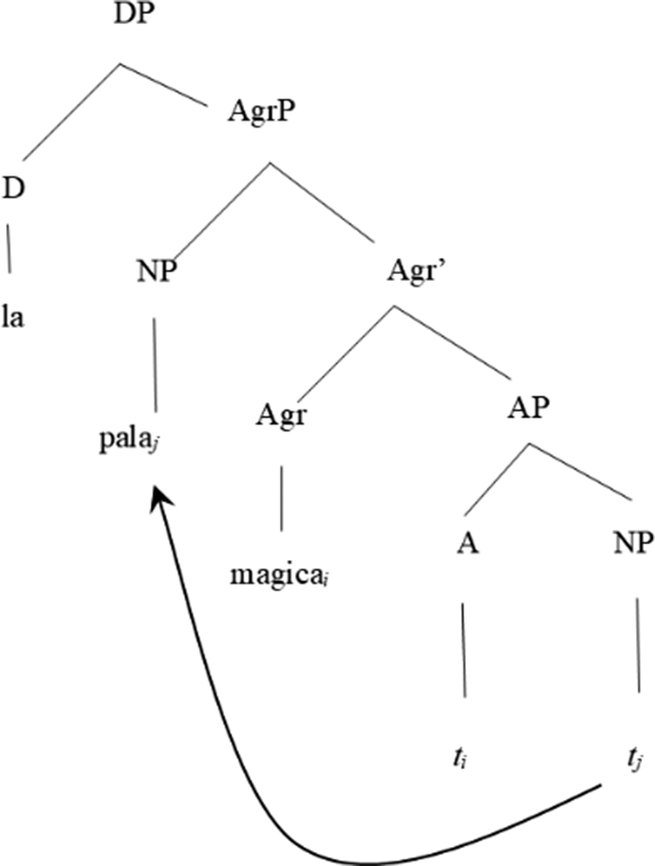
Grammatical constraints on CS have been the subject of extensive research for the past five decades (Parafita Couto et al., Reference Parafita Couto, Bellamy, Ameka and Cabrelli2023). Evidence from various language combinations shows that intra-NP switches, such as between noun and adjective, are less common than switches at NP boundaries (Balam & Parafita Couto, Reference Balam and Parafita Couto2019; Torres Cacoullos & Vélez Avilés, Reference Torres Cacoullos and Vélez Avilés2024). Nonetheless, such intra-NP switches do occur and have played a central role in the development of the two influential theoretical accounts mentioned above, the MLF and the approach based on the MP. The MLF (Myers-Scotton, Reference Myers-Scotton1993, Reference Myers-Scotton2002) posits that the ML provides the grammatical structure, including word order, while the EL supplies lexical items that must conform to the ML’s syntax. The ML is typically identified by the language of the verb’s inflectional morphology, and its word order is expected to prevail in mixed utterances (Parafita Couto et al., Reference Parafita Couto, Pouw, Laanen and López2024). Thus, in Portuguese-German CS, the MLF predicts that adjective–noun order will follow the ML, regardless of the language of the adjective. In contrast to the MLF’s asymmetric approach (different syntactic frames in which lexical items are inserted), the MP (Chomsky, Reference Chomsky1995) adopts a symmetric model of CS (Cantone & MacSwan, Reference Cantone, MacSwan, Isurin, de Bot and Winford2009). This model is based on the assumption that CS utterances result from the merging of lexical items from the two languages, guided by their features and general principles of syntactic derivation. Cantone and MacSwan (Reference Cantone, MacSwan, Isurin, de Bot and Winford2009) explore adjective–noun order in CS by Italian-German bilingual speakers. Adopting Cinque’s (Reference Cinque1999) universal base structure, they assume that adjectives are merged prenominally in an adjective phrase above the NP and subsequently move higher to attach to the head of an agreement phrase (AgrP). Depending on language-specific features, the noun moves across the adjective to check strong features of this AgrP (N-Adj-order; Italian) or not (Adj-N order; German) (see Figure 1).
Derivation of noun–adjective order in Italian according to Cantone and MacSwan (Reference Cantone, MacSwan, Isurin, de Bot and Winford2009: 268)

Postnominal placement in Romance languages thus arises from overt noun movement across the adjective. In their proposal, the position of the adjective in a CS utterance reflects the syntactic properties of its source language. Independently of the ML, an Italian adjective surfaces in postnominal position due to noun movement, while a German adjective remains prenominally. This leads to the descriptive generalization that adjective–noun word order is determined by the language of the adjective.
Although the MLF and the MP diverge in their fundamental assumptions about how mixed nominal constructions with adjective–noun order are formed, their predictions partially converge. In some cases, the observed word order aligns exclusively with one model (e.g., when a postnominal Italian adjective is inserted in a German ML utterance (MP)); in others, it is consistent with both (e.g., when a noun is inserted in the noun phrase (MLF, MP) without changes of adjective order), or it conforms to neither (e.g., when an Italian noun is inserted in a German ML utterance and the German adjective appears postnominally).
The varying predictions have prompted a growing body of empirical research, particularly through acceptability judgement tasks, to better understand how bilingual speakers process and evaluate such structures. Stadthagen-González et al. (Reference Stadthagen-González, Parafita Couto, Párraga and Damian2019) investigated adjective–noun order in Spanish–English CS and found that neither MLF nor the MP alone fully accounts for the acceptability of these switches. Instead, their findings suggest that both the ML and the language of the adjective may influence word-order acceptability. Additionally, Vanden Wyngaerd (Reference Vanden Wyngaerd2016) and De Nicolás and López (Reference De Nicolás and López2022) observed that, while their data most closely matched MP predictions, word order in mixed determiner phrases is influenced by a combination of factors, including the ML and the language of the adjective. Vaughan-Evans et al. (Vaughan-Evans et al., Reference Vaughan-Evans, Parafita Couto, Boutonnet, Hoshino, Webb-Davies, Deuchar and Thierry2020) reached similar conclusions in an ERP study, additionally showing that community-specific CS practices – particularly those reflecting the predominant use of the ML – can modulate grammatical processing.
Few studies have explored adjective–noun switching in children. Arnaus Gil et al. (Reference Arnaus Gil, Eichler, Jansen, Patuto, Müller, Geeslin and Díaz-Campos2012) examined the placement of adjectives within code-switched DPs produced in spontaneous speech by 12 simultaneous bilingual children acquiring German and Romance languages (French, Italian, Spanish). While the children’s productions showed variability, the authors observe a general preference for adjective–noun order across language combinations.
Van Osch et al. (Reference van Osch, Parafita Couto, Boers and Sterken2023) further investigated adjective position in Papiamento–Dutch and Spanish–Dutch heritage speakers (children, teenagers, and adults) in the Netherlands. Their findings, consistent with adult studies, suggest that word-order patterns are partially determined by the ML, partially by the language of the adjective, or by both, although these factors could not be fully disentangled.
Interestingly, a robust cross-linguistic tendency that has emerged in CS within modified NPs is for noun insertions to be favoured over adjective insertions, likely reflecting underlying constraints on structural compatibility (as also reflected by overlapping predictions of the MLF and MP) (Parafita Couto et al., Reference Parafita Couto, Deuchar, Fusser, Stell and Yakpo2015; Stadthagen-González et al., Reference Stadthagen-González, Parafita Couto, Párraga and Damian2019; Van Osch et al., Reference van Osch, Parafita Couto, Boers and Sterken2023; Vaughan-Evans et al., Reference Vaughan-Evans, Parafita Couto, Boutonnet, Hoshino, Webb-Davies, Deuchar and Thierry2020).
Crucially, these findings indicate that so far, no single model can fully account for the observed CS patterns. In the present study, we therefore adopt an integrated account of grammatical constraints on CS – rather than a wholesale adoption of either the MLF or MP − by examining the combined effects of the ML, the language of the adjective and the type of insertion, while also taking into consideration the specific constraints regulating the (in)flexibility of adjective position in different languages. In addition, we examine the role of extralinguistic factors in shaping the CS patterns that emerge from the interaction of these linguistic constraints.
4. Extralinguistic factors modulating CS
Sociocultural context is a critical factor shaping CS patterns in multilingual communities, influencing not only the directionality and frequency of switches but also specific linguistic preferences (Carter et al., Reference Carter, Deuchar, Davies and Parafita Couto2011; Deuchar, Reference Deuchar2020; Parafita Couto et al., Reference Parafita Couto, Pouw, Laanen and López2024). Comparative studies have shown that language attitudes, social identity, and community norms lead to systematic variation in CS behaviour (Balam et al., Reference Balam, Parafita Couto and Stadthagen-González2020). Although CS is an inherent aspect of bilingualism, it is often socially stigmatized, for example, in US Spanish, where it is associated with ideologies of non-prestige and “incorrect” language use (Otheguy & Stern, Reference Otheguy and Stern2011).
While such attitudes have been argued to influence bilingual language behaviour, evidence suggests that their effects are often more robust in metalinguistic judgements than in spontaneous production, where speakers may code-switch despite holding negative attitudes towards it. Studies across bilingual communities show that attitudes towards CS, whether favourable or unfavourable, do not consistently predict acceptability judgements, even when they correlate with production patterns (Badiola et al., Reference Badiola, Delgado, Sande and Stefanich2018; Parafita Couto et al., Reference Parafita Couto, Deuchar, Fusser, Stell and Yakpo2015). Recent work on US Spanish further supports this view: Amodeo Williams and Brandy (Reference Amodeo Williams, Brandy, Zago, Muntendam and Parafita Couto2025) found that neither attitudes towards CS and US Spanish nor participants’ reports of correction significantly affected acceptability judgements of a non-standard structure. These findings suggest that explicit evaluations are not directly shaped by attitudes, even in stigmatized contexts. At the same time, community norms and sociohistorical factors remain decisive. In Papiamento–Dutch, Welsh–English, and Miami Spanish–English and Nicaraguan Spanish–English Creole, the societally less dominant language often functions as the ML, despite lower prestige, reflecting the community’s linguistic vitality rather than individual attitudes alone (Blokzijl et al., Reference Blokzijl, Deuchar and Parafita Couto2017; Parafita Couto & Gullberg, Reference Parafita Couto and Gullberg2019).
Although direct child–adult comparisons are limited, evidence from tightly-knit communities suggests that children can adopt adult-like CS norms early on when community practices are strong (Balam et al., Reference Balam, Lakshmanan and Parafita Couto2021; Phillips & Deuchar, Reference Phillips, Deuchar, Røyneland and Blackwood2021). While exposure is not strictly necessary for the emergence of CS, it is crucial for the stabilization of structurally regular and socially appropriate CS patterns over time. Research demonstrates that patterns of gender assignment in CS are influenced by language dominance and exposure (Boers et al., Reference Boers, Sterken, van Osch, Parafita Couto, Grijzenhout and Tat2020). Van Osch et al. (Reference van Osch, Parafita Couto, Boers and Sterken2023) highlight that children require sustained and consistent exposure to code-switched input to develop adult-like grammatical patterns. However, adults tend to conform more closely to community CS norms, while younger bilinguals display greater variability.
At the same time, CS habits may newly initiate in second-generation (heritage) speakers, often among children themselves, when their parents are L1-dominant first-generation migrants without CS habits. In such contexts, CS patterns are initiated and developed within the peer group of early bilingual children, while older speakers often avoid switching and may even view it negatively. For instance, research on Spanish–English bilinguals in the US demonstrates that second-generation speakers use CS more frequently than first-generation migrants, who tend to maintain strict language separation (Toribio, Reference Toribio2002). A similar generational divide is seen in Gaelic–English families in Scotland, where older speakers prioritize Gaelic and view CS as a threat to language maintenance, while younger speakers, exposed to both languages, naturally develop CS practices (Smith-Christmas, Reference Smith-Christmas2012). These differences highlight how sociocultural dynamics shape language use: parents may resist CS to preserve the HL, whereas children often adopt it as part of their bilingual identity.
In addition to sociocultural dynamics, language proficiency influences the emergence and frequency of CS. Some studies have shown that high proficiency in both languages has a positive influence on the propensity to switch (Parafita Couto et al., Reference Parafita Couto, Pouw, Laanen and López2024; Poplack, Reference Poplack1980; van Osch et al., Reference van Osch, Parafita Couto, Boers and Sterken2023). Because language exposure and proficiency play a role, age may also be associated with a speaker’s inclination to code-switch. Older children and teenagers, who often have had more exposure to both languages and reached higher proficiency, might show a greater tendency to code-switch than younger children. In addition, positive language attitudes, particularly towards the majority language (German in our case), seem to facilitate switching, reflecting comfort with integrating elements from the majority language into the minority one (see Badiola et al., Reference Badiola, Delgado, Sande and Stefanich2018; Parafita Couto et al., Reference Parafita Couto, Pouw, Laanen and López2024; van Osch et al., Reference van Osch, Parafita Couto, Boers and Sterken2023).
5. The present study
5.1 Participants
Forty-nine Portuguese-German bilingual children and teenagers, aged 8–16 years (mean = 140 months, SD = 26.2, min = 94, max = 188), participated in this study. All participants are heritage speakers of European Portuguese (EP), born to Portuguese migrant families living in a German-speaking canton in Switzerland. All children had Portuguese parents with migration background. Six children were born in Portugal and migrated to Switzerland before the age of 6; the remaining 43 were born in Switzerland, though only 14 are simultaneous bilinguals. The other 35 participants are successive bilinguals, having acquired Portuguese as their L1 from birth and Standard German (along with Swiss German) as an early second language (L2), when they entered kindergarten, pre-school, or primary school (between ages 3 and 6). The mean age of onset of bilingualism (AoO) is 2.6 years (SD = 2.0). All participants attended HL classes, being enrolled in these classes for 3–11 years (mean length of HL instruction = 88.3 months, SD = 17.8).Footnote 2 They are active bilinguals who use Portuguese and (Standard and Swiss) German on a daily basis.
5.2 Methods
This study uses a controlled elicited imitation task (EIT) to examine CS patterns – marking, to our knowledge, the first application of this method for this purpose with bilingual children and adolescents (cf. Lipski, Reference Lipski2019 for its use with adult bilinguals). The EIT enables the systematic manipulation of key linguistic variables, making it possible to examine how speakers reproduce CS constructions under varying grammatical conditions. Because participants are asked to repeat sentences they hear, the task provides indirect access to their linguistic intuitions: dispreferred structures are expected to trigger hesitations, modifications, or avoidance, offering an especially informative window into children’s CS behaviour. Importantly, unlike judgement tasks, which often reflect prescriptive norms that reject CS, the EIT captures real-time processing and production, offering a compromise between experimental control and ecological validity (Torregrossa et al., Reference Torregrossa, Listanti, Bongartz and Marinis2024). Finally, the structured format of the task enhances replicability and comparability across studies, while the inclusion of multiple experimental conditions allows us to assess whether task-induced effects are uniform or selectively constrained by grammatical and extralinguistic factors.
5.3 Materials
The testing materials include two instruments, a background questionnaire and the EIT with switched and non-switched utterances.
Questionnaire. The questionnaire was filled out by the children and included five sets of questions. The first set gathered biographic information related to their gender, current age, the country of birth and age of emigration (if applicable), the AoO of bilingualism, and the length of enrollment in HL classes.
The second set of questions focused on their proficiency in Portuguese and in Standard German. Participants were asked to rate their proficiency in each language in the four skills: reading, writing, listening, and speaking, on a three-point scale (not very good, good, very good).
The third set of questions aimed to quantify participants’ language use in their daily routines. They had to list the five people with whom they had the most contact on a daily basis and to specify which language(s) they used to communicate with each person. The four options were (i) (almost only) Portuguese, (ii) (almost only) German, (iii) Portuguese and German almost to the same extent, and (iv) another language.
The fourth part included questions about participants’ attitudes towards Portuguese and German. Participants were asked to rate each language on a 5-point Likert scale, indicating how they perceived it based on four pairs of opposing adjectives (unpleasant–pleasant, difficult–easy, useless–useful, and ugly–beautiful), with 1 representing the negative and 5 the positive. This scale offered insight into participants’ subjective impressions of each language’s value, ease, and appeal. Additionally, participants were asked whether they identified as Portuguese, Swiss, or a mixture of both.
Finally, the fifth part focussed on CS habits. Children/teenagers were asked to select on a 4-point scale, ranging from “it never applies to me” to “it applies very often to me” whether they mix Portuguese and German when they talk to family members and Portuguese friends. Additionally, they marked, on the same scale, whether their guardians mix Portuguese and German when talking to them or to other Portuguese people. Then, participants selected their guardians’ typical reaction to their mixing, choosing between (i) “they do not want me to mix the languages,” (ii) “sometimes they call my attention when I mix the languages,” (iii) “they do not mind if I mix the languages,” (iv) “they like to mix languages when they talk to me.”
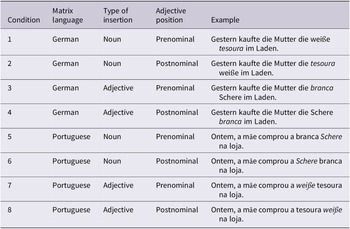
Experimental design. Experimental items consisted of a sentence in German or Portuguese including a determiner phrase in object position with an insertion (a switched element), organized according to three different factors: (1) “matrix language,” (2) “type of insertion,” and (3) “position of the adjective vis-á-vis the noun.” The ML (the language of the overall sentence excluding the insertion) could be either German or Portuguese. The type of insertion could be either an adjective or a noun from the other language. The position of the adjective could be either pre- or postnominal. This led to a 2 × 2 × 2 design, resulting in eight experimental conditions. Each condition included 32 distinct sentences, for a total of 256 experimental items, which were distributed across eight lists. Every participant repeated 32 experimental sentences and saw every sentence only in one of the conditions (Table 1).
Test conditions

“Yesterday, my mother bought the white scissors in the shop.”
We selected only adjectives denoting colours or nationalities, which are generally less variable in Portuguese than other adjective types, typically occupying a fixed postnominal position (see Section 2). Each adjective appeared twice: once agreeing with a feminine and once with a masculine noun.Footnote 3
The task also included 16 unilingual control items, either in German or in Portuguese. Half of them followed the grammatical adjective order in the target language (prenominal in German and postnominal in Portuguese) and the other half included a DP with an ungrammatical word order (with a postnominal adjective in German and a prenominal adjective in Portuguese).
Procedure. The experiment was conducted online via the Gorilla platform (https://app.gorilla.sc/). Participants were recruited with the support of the Camões network coordination in Switzerland and their HL teachers, who sent the Gorilla link to the participants, after obtaining the parental consent.
First, participants provided their own consent via the consent button and received information about the experiment’s procedures. After verifying sound quality and testing their recordings’ quality, they completed the background and attitudes questionnaire. They then received instructions for the EIT. The EIT sentences were presented aurally, accompanied by a picture showing the object included in the target NP (see Figure 2). The participants were instructed to hear the sentence and to repeat it when a microphone image appeared on the screen. After the sentence was played, the microphone icon appeared for 10 seconds, followed by an image of a hand signalling the end of the recording time, before the next item appeared on the screen. The main task was preceded by a short training period which included two training items in the unilingual mode, one in each language.
Screenshot of a test screen

The task took children between 30 and 60 minutes to complete. The study received ethical approval from the Research Ethics Committee for Social Sciences and Humanities of the University of Minho (Reference: CEICSH 102/2023_ADENDA 1).
6. Research questions and predictions
This study is guided by three central research questions.
RQ1 – Grammatical factors shaping code-switching: Which linguistic factors influence the likelihood of accurately repeating code-switched nominal expressions, and how can these patterns be explained?
If the ML is the decisive predictor of the accuracy of repetitions (Myers-Scotton, Reference Myers-Scotton2002), we expect that German ML sentences will favour prenominal adjectives, and Portuguese ML postnominal adjectives, independently of the language of the adjective. If the language of the adjective determines the accuracy of repetition (Cantone & McSwan, Cantone & MacSwan, Reference Cantone, MacSwan, Isurin, de Bot and Winford2009), we predict that prenominal placement will be more accurately repeated with German adjectives, which corresponds to the conditions with noun insertion in German ML/adjective insertion in Portuguese ML. Postnominal placement will be more accurate with Portuguese adjectives, corresponding to the conditions with adjective insertion in German ML/noun insertion in Portuguese ML.
Finally, we may find differences between the two languages: in German, the lack of a postnominal adjective position may override other factors, leading to a strong tendency to repeat prenominal CS patterns, whereas in Portuguese, greater syntactic flexibility and the general focus on adjective type and interpretation may permit a wider range of CS patterns and give more importance to the language of the adjective.
RQ2 – Role of extralinguistic factors: How do individual-level extralinguistic factors – such as age, language proficiency, and attitudes – influence the likelihood of producing switched utterances in child-led, emergent bilingual contexts?
We expect proficiency in both languages, age, and attitudes to affect children’s CS behaviour, though with differing strengths. Language proficiency is expected to facilitate CS: speakers with higher proficiency in both Portuguese and German are predicted to produce switched utterances more frequently, reflecting greater linguistic resources and flexibility (Parafita Couto et al., Reference Parafita Couto, Pouw, Laanen and López2024; Poplack, Reference Poplack1980; van Osch et al., Reference van Osch, Parafita Couto, Boers and Sterken2023). Age is also predicted to be positively associated with CS frequency. Older children and adolescents, who typically have had more prolonged exposure to both languages and higher proficiency levels, are expected to code-switch more often than younger children (Boers et al., Reference Boers, Sterken, van Osch, Parafita Couto, Grijzenhout and Tat2020; van Osch et al., Reference van Osch, Parafita Couto, Boers and Sterken2023). The effect of language attitudes is expected to be more limited. While positive attitudes towards CS and towards the majority language may increase the likelihood of producing switched utterances, previous research suggests that such effects are weaker and less consistent than those of proficiency and age (Amodeo Williams & Brandy, Reference Amodeo Williams, Brandy, Zago, Muntendam and Parafita Couto2025; Badiola et al., Reference Badiola, Delgado, Sande and Stefanich2018; Parafita Couto et al., Reference Parafita Couto, Deuchar, Fusser, Stell and Yakpo2015).
RQ3 – Systematicity of CS in an emerging bilingual community: Do systematic CS patterns arise in this newly developing bilingual population, despite the absence of established community-level CS norms?
We predict that the second-generation bilingual children investigated here will display systematic CS behaviour. Specifically, their productions will reflect the influence of identifiable grammatical constraints, mirroring patterns observed in more established bilingual communities (e.g., Parafita Couto et al., Reference Parafita Couto, Deuchar, Fusser, Stell and Yakpo2015). This would suggest that systematic CS can emerge among peers as part of their developing bilingual competence, even when adult input does not model or reinforce it.
7. Results
7.1 Self-rated proficiency, attitudes, and CS habits
Based on participants’ questionnaire responses (see Questionnaire), we briefly outline their self-assessed proficiency in Portuguese and German, language attitudes, as well as their and their parents’ CS habits, attitudes towards CS, and reasons for switching.
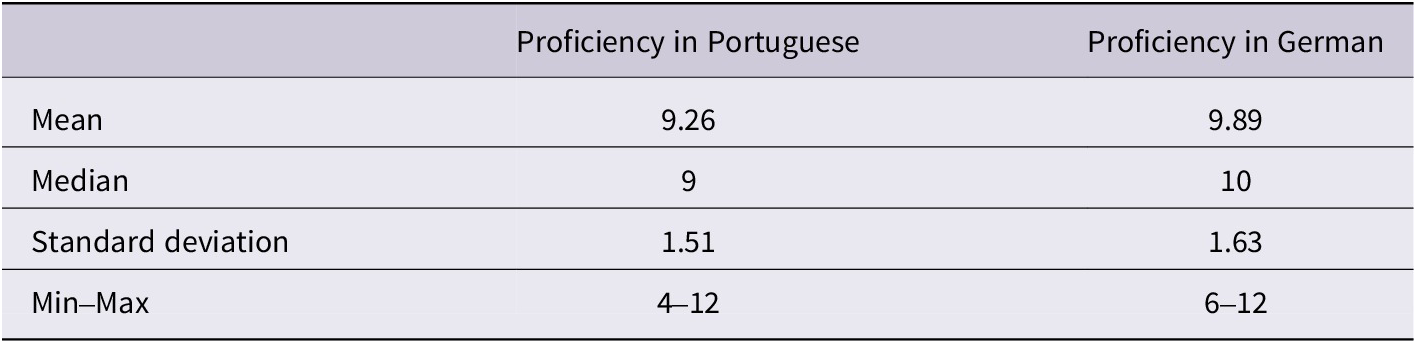
Table 2 presents the self-assessment scores, which result from the sum of their assessment of the four skills (each on a 3-point scale, resulting in a maximum of 12 points for each language).
Participants’ self-assessment

The results show evenly distributed scores for Portuguese and German, with a slightly higher mean score and median for German, ranging from 4 to 12 in Portuguese and from 6 to 12 in German.
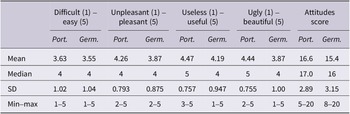
To assess children’s attitudes towards Portuguese/German, we asked them to rate each language in relation to four pairs of opposing adjectives (the negatively connotated adjective being 1 and the positively connotated one being 5, see Questionnaire). Table 3 shows the participants’ mean ratings (median, SD, minimum, and maximum) for each pair and language and the computed attitude score (the sum of the four categories):
Characterization of Portuguese and German through adjective pairs

Results show higher (more positive) values for Portuguese in each of the categories and for the total score, indicating participants’ more positive attitude towards their HL.
As for the question regarding participants’ identification as being (i) Portuguese, (ii) Swiss, and (iii) a mixture of both cultures, the results indicate that 51.1% of the bilinguals identify solely as Portuguese, while the other 48.9% consider themselves a mixture of Portuguese and Swiss. No participant identified as exclusively Swiss.
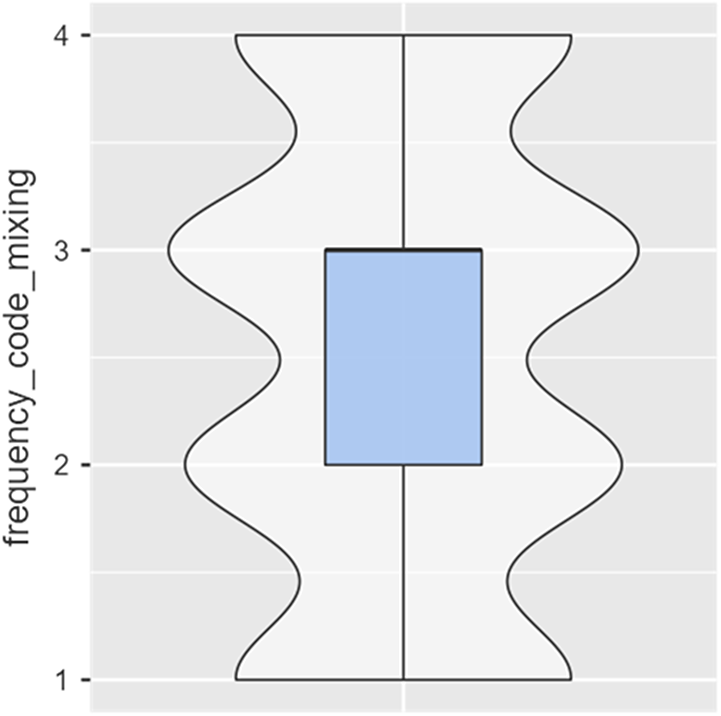
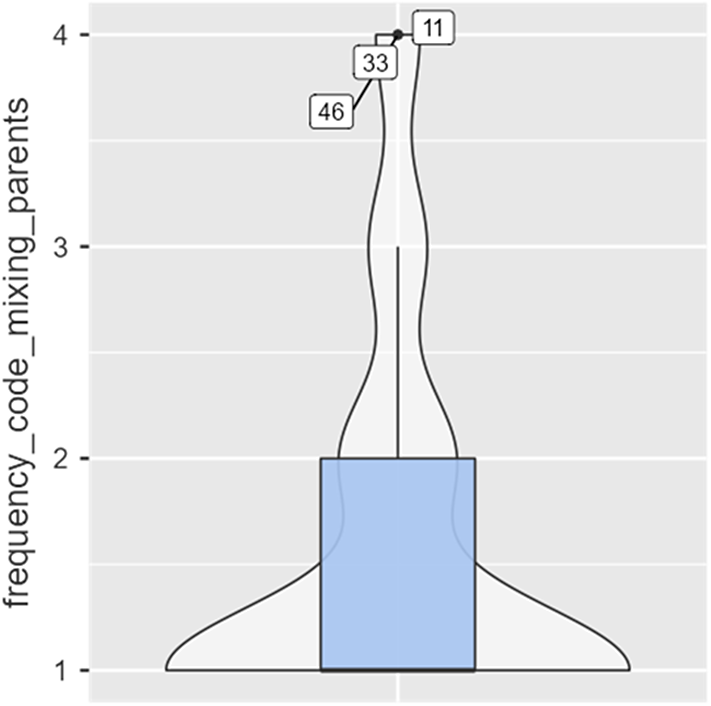
To assess CS habits, we asked the participants to rate their own and their parents’ frequency of mixing on a 4-point scale (1 = never; 4 = very often). Figures 3 and 4 show that the children/adolescents engage more in CS (mean = 2.51, SD = 1.06; median = 3) than their parents (mean = 1.53, SD = 0.905; median = 1). The second-generation bilinguals admit to frequently resort to CS, while CS is almost absent in the first generation, as assessed through their children.
Self-assessed frequency of CS

Frequency of parents’ CS

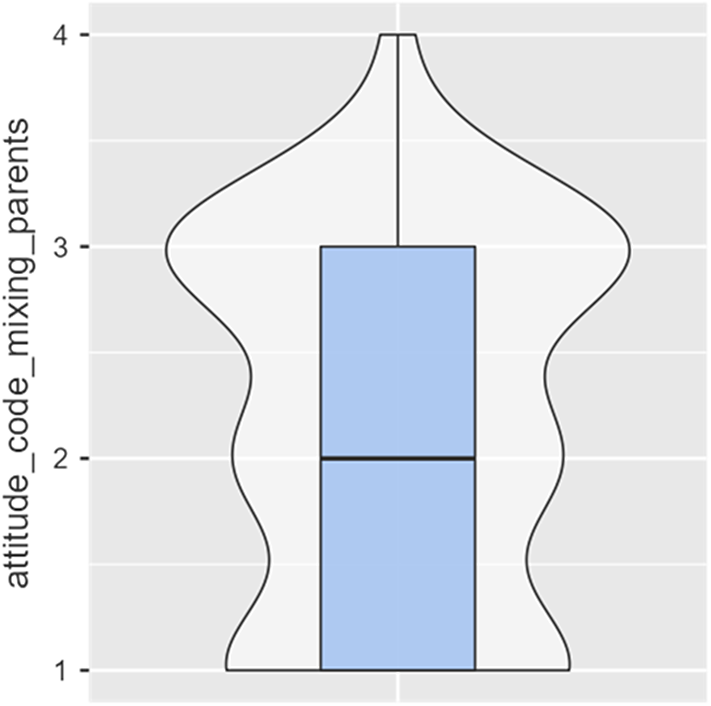
Finally, Figure 5 shows the participants’ responses when asked about their parents’ attitude towards their CS (negative:1 – supportive: 4). The results show a tendentially negative attitude towards mixing, with a median of 2 (“sometimes they call my attention when I mix the languages”) (mean = 2.15, SD = 0.884).
Parents’ attitudes towards CS according to the children

7.2. Elicited imitation task
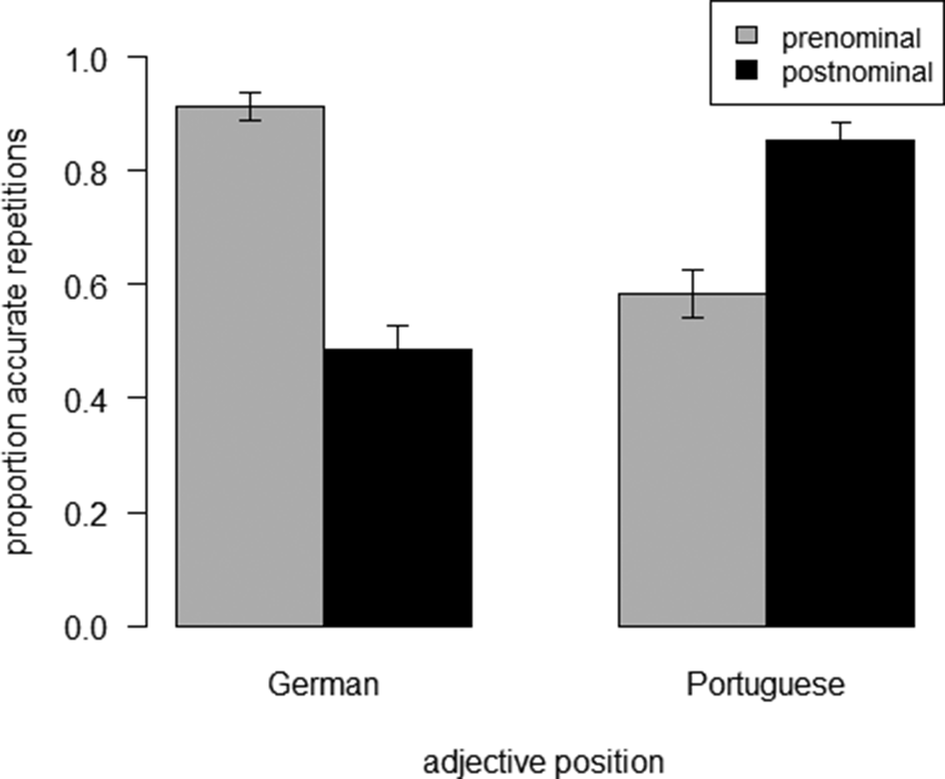
Analysis of the control items. Figure 6 shows the mean proportions of participants’ accurate repetitions of the target NPs (and ± 1.0 standard error) in the unilingual sentences as a function of their language (German/Portuguese) and the position of the adjective (prenominal/postnominal). For German, the mean score was 0.91 (SD = 0.28) for prenominal adjectives and 0.49 (SD = 0.50) for the postnominal position. For Portuguese, the mean score was 0.58 (SD = 0.49) when the adjective was prenominal and 0.86 (SD = 0.35) when it was postnominal.
Mean proportions of accurate repetitions (bar plots) and ±1.0 standard errors as a function of the language of the target nominal phrases (German Portuguese) and the position of the adjective (prenominal vs. postnominal), unilingual control items

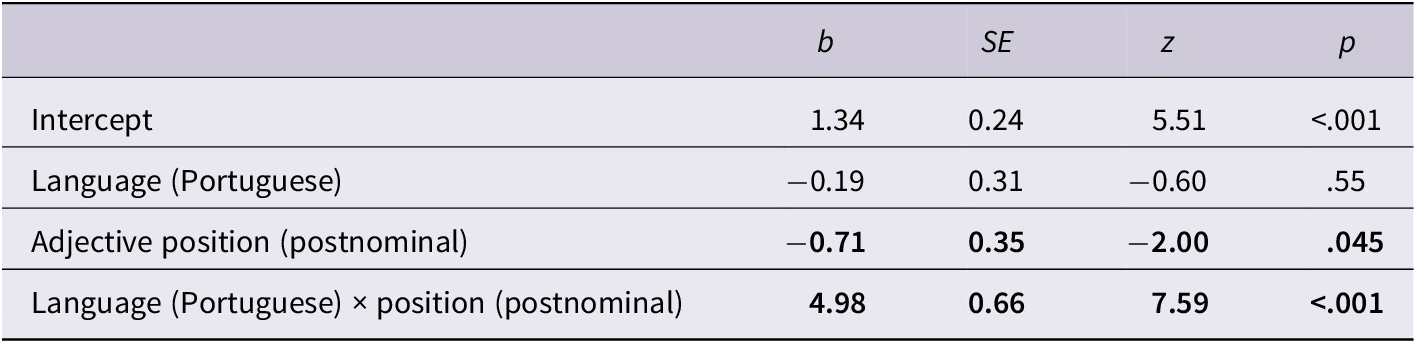
We ran a generalized linear mixed-effects model with the accurate repetition of the target NPs (0 vs. 1) as the dependent variable. Fixed effects included the interaction between the language and the position of the adjective. The variables representing the language and the position of the adjective were contrast-coded. The model also included by participant random slopes for the position of the adjective. The results, reported in Table 4, reveal a significant effect of the adjective position, with participants being less likely to repeat the target sentence accurately when the adjective was in the postnominal position (negative estimate). Additionally, a significant interaction between the language of the target nominal phrases and the position of the adjective suggests that this tendency was reversed when the language was Portuguese.
Parameters of the generalized linear mixed-effects analysis, with the accurate repetition of the target nominal phrases as the dependent variable. Language, adjective position, and their interaction were included as fixed effects. Significant effects are indicated in bold.

The resulting model was glmer (accuracy ~1 + NP_language * adjective position + (1 + adjective position|Participant) + (1|Item), data = data, family = binomial, control = glmerControl(optimizer = “bobyqa”))
We used the emmeans function from the emmeans R package (Lenth, Reference Lenth2020) to identify significant pairwise contrasts. The analysis revealed the following significant contrast: German prenominal adjectives versus Portuguese prenominal adjectives (b = 2.68, SE = 0.49, z = 5.43, p < .001), prenominal position versus postnominal position in German (b = 3.20, SE = 0.53, z = 6.04, p < .001), prenominal position versus postnominal position in Portuguese (b = −1.78, SE = 0.43, z = −4.13, p < .001), and German postnominal adjectives versus Portuguese postnominal adjectives (b = −2.30, SE = 0.41, z = 5.59, p < .001).
The results show that the repetition accuracy for control items reflects the target grammar of each language: In German, as expected, prenominal adjectives were repeated more accurately than postnominal ones; in Portuguese, the reverse was true. Overall, the control item results confirm that the EIT effectively captured children’s sensitivity to the underlying grammatical constraints of each language.
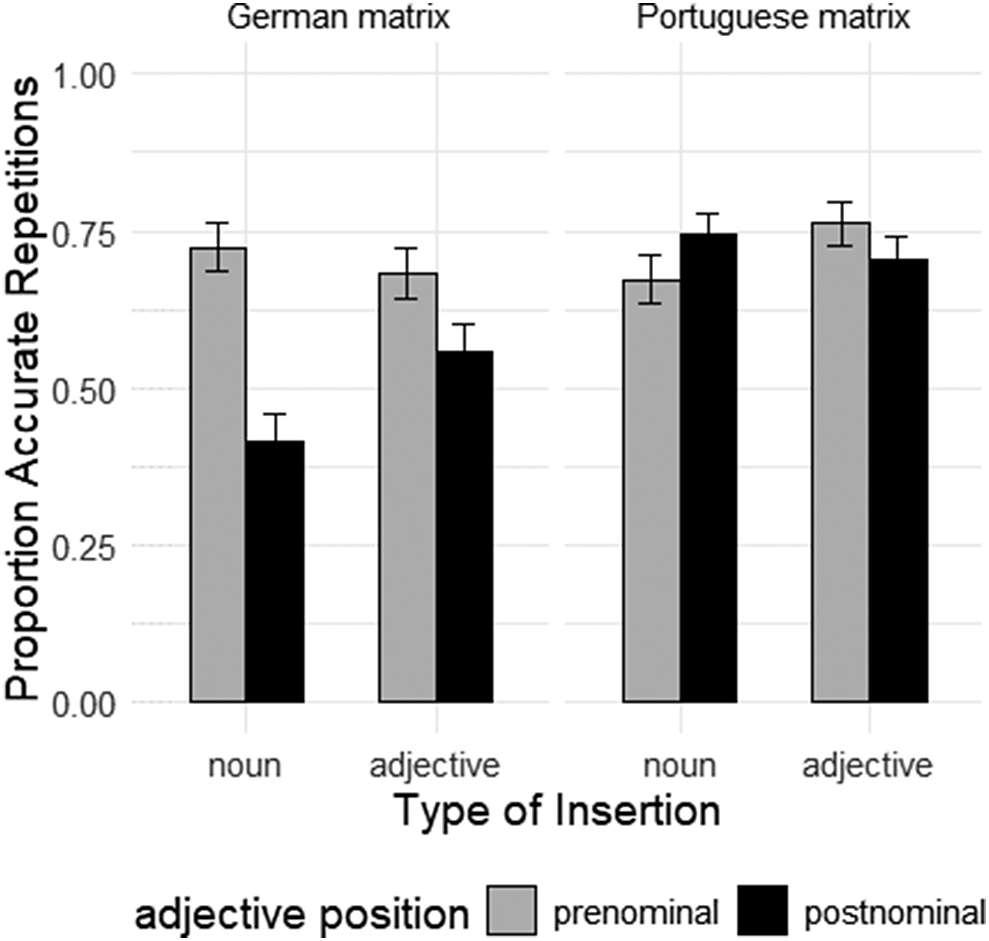
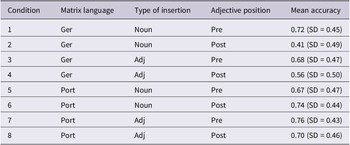
Analysis of the experimental conditions. Figure 7 reports the mean proportions of accurate repetitions of the target items (and ± 1.0 standard error) as a function of the ML (German on the left, Portuguese on the right), the type of insertion (noun or adjective), and the position of the adjective (prenominal or postnominal). Descriptive results are presented in Table 5.
Mean proportions of accurate repetitions (bar plots) and ± 1.0 standard errors as a function of the ML (German vs. Portuguese), the type of insertion (noun vs. adjective), and the position of the adjective (prenominal vs. postnominal)

Descriptive results

In German ML, the mean proportion of accurate repetitions with noun insertion was 0.72 (SD = 0.45) with a prenominal and 0.41 (SD = 0.49) with a postnominal adjective. With adjective insertion, it was 0.68 (SD = 0.47) with a prenominal adjective and 0.56 (SD = 0.50) with a postnominal adjective. Descriptively, the position of the adjective seems to be the most relevant factor: prenominal adjectives are more accurately repeated than postnominal ones, independent of the type of insertion. The role of the other factors is less clear: Noun insertions obtained slightly higher accuracy rates, but only with prenominal adjectives. Postnominal adjectives are slightly more accurate if the adjective is in Portuguese, whereas prenominal adjectives are slightly more accurate if the adjective is in German.
In Portuguese ML, the mean proportion of accurate repetitions with noun insertion was 0.67 (SD = 0.47) with a prenominal and 0.74 (SD = 0.44) with a postnominal adjective, whereas with adjective insertion it reached 0.76 (SD = 0.43) with a prenominal and 0.70 (SD = 0.46) with a postnominal adjective. For Portuguese ML, the role of the ML is less clear than for German: postnominal adjectives are only slightly more accurately repeated if the adjective is in Portuguese (noun insertions), but not, if the adjective is in German (adjective insertion). This points to a more important role of the language of the adjective if Portuguese is the ML. The role of type of insertion is less clear: adjective insertion is slightly more accurately repeated than noun insertion.
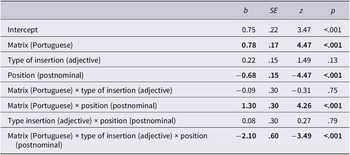
We ran a generalized linear mixed-effects model with the accurate repetition of the target nominal phrases (0 vs. 1) as the dependent variable. The fixed effects included the interaction between the ML, the type of insertion, and the position of the adjective. These variables were all contrast-coded. The model also included by-participant random slopes for ML and random intercepts for items.
The results, reported in Table 6, reveal a significant effect of the ML, with participants being more likely to repeat switched NPs accurately when the ML was Portuguese. There was also a significant negative effect of the position of the adjective, as participants were less likely to repeat NPs accurately with a postnominal adjective. The significant interaction between ML and adjective position suggests that the negative effect of postnominal adjectives on repetition accuracy was reduced or reversed (as shown in Figure 7) when the ML was Portuguese. Additionally, the significant three-way interaction between ML, adjective position, and type of insertion indicates that the effect of the interaction between ML and adjective position on repetition accuracy was further modulated by the type of insertion. Specifically, in Portuguese, the facilitative effect of postnominal position was reduced in cases of adjective insertion compared to noun insertion.
Parameters of the generalized linear mixed-effects analysis, with the accurate repetition of the target nominal phrases as the dependent variable. Fixed effects include the interaction between ML, type of insertion, and adjective position. Significant effects are indicated in bold.

The resulting model was: m1 < − glmer (accuracy ~1 + matrix * insertion type* adjective position (1 + matrix|Participant) + (1|Item), data = data, family = binomial, control = glmerControl(optimizer = “bobyqa”))
We used again the emmeans function to identify relevant pairwise contrasts. The analysis revealed that the condition with German ML, noun insertion, and the postnominal adjective (condition 2, see Figure 7) showed significant differences from most other conditions, in particular, from condition 1 (German ML, noun insertion, preverbal adjective) and 3 (German ML, adjective insertion, preverbal adjective), but not from the condition where the ML was German and the adjective was postnominal (condition 4). Furthermore, condition 4 significantly differed from the condition with German ML, noun insertion, and adjective in prenominal position (condition 1). This reflects the general low accuracy of repetitions of postnominal adjectives in German ML clauses – independent of type of insertion and language of the adjective. This tendency reveals that the factor ML (i.e., the prevalence of prenominal adjectives) is the most relevant predictor of repetition accuracy if the ML is German.
Furthermore, condition 4 (German ML, adjective insertion, postnominal position) also differed from two conditions where the ML was Portuguese: one with (German) noun insertion and an (Portuguese) adjective in postnominal position (condition 6) and another one with (German) adjective insertion in prenominal position (condition 7).
This shows that the CS constraints for Portuguese are more flexible than for German. While for German the ML is the dominant constraint – imposing prenominal adjective position, independently of the language of the adjective and the type of insertion – for Portuguese we observe an interaction of both the ML and the language of the adjective, as predicted by the MP. In the case of German noun insertion with a Portuguese adjective, the postnominal order, typical of Portuguese, is favoured. When a German adjective is inserted, the prenominal order, typical for German, is more accurately repeated. Thus, in general, for German matrix sentences the MLF model is most predictive for all patterns, while for Portuguese matrix sentences the MP model is more adequate. We attribute the differing patterns to the grammatical flexibility of each language: German restricts adjectives to prenominal position, while Portuguese allows both pre- and postnominal placement, depending on adjective type and semantic/pragmatic interpretation.
The effect of extralinguistic factors on participants’ CS behaviour. In addition to analysing specific CS patterns within the NP, we examined whether participants maintained a CS mode without switching to a unilingual mode when presented with code-switched stimuli (experimental items) or adopted a CS mode when presented with unilingual stimuli (control items). We interpreted maintenance of CS in the experimental items and shifts to CS in control items as indicators of participants’ propensity to code-switch. To quantify this tendency, we calculated, for each participant, the total number of instances in which they either maintained CS or switched to a CS mode. To investigate the factors influencing participants’ CS behaviour, we conducted a multiple regression analysis, using this total as the dependent variable and a set of independent variables known to affect CS.
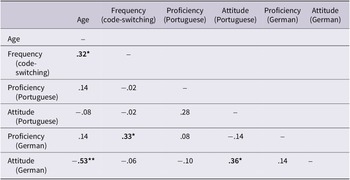
Table 7 presents the correlation matrix for the variables included in the multiple regression. The results revealed positive correlations between age and frequency of CS, as well as between German proficiency and frequency of CS. We also found a positive correlation between attitudes towards German and attitudes towards Portuguese. In contrast, age and attitude towards German were negatively correlated, suggesting that younger children tend to have more favourable attitudes towards this language.
Correlation matrix between age, frequency of CS, Portuguese proficiency, attitude towards Portuguese, German proficiency, and attitude towards German. Significant correlations are shown in bold.

One asterisk (*) indicates significance at p ≤ .05 and two asterisks (**) indicate significance at p ≤ .001.
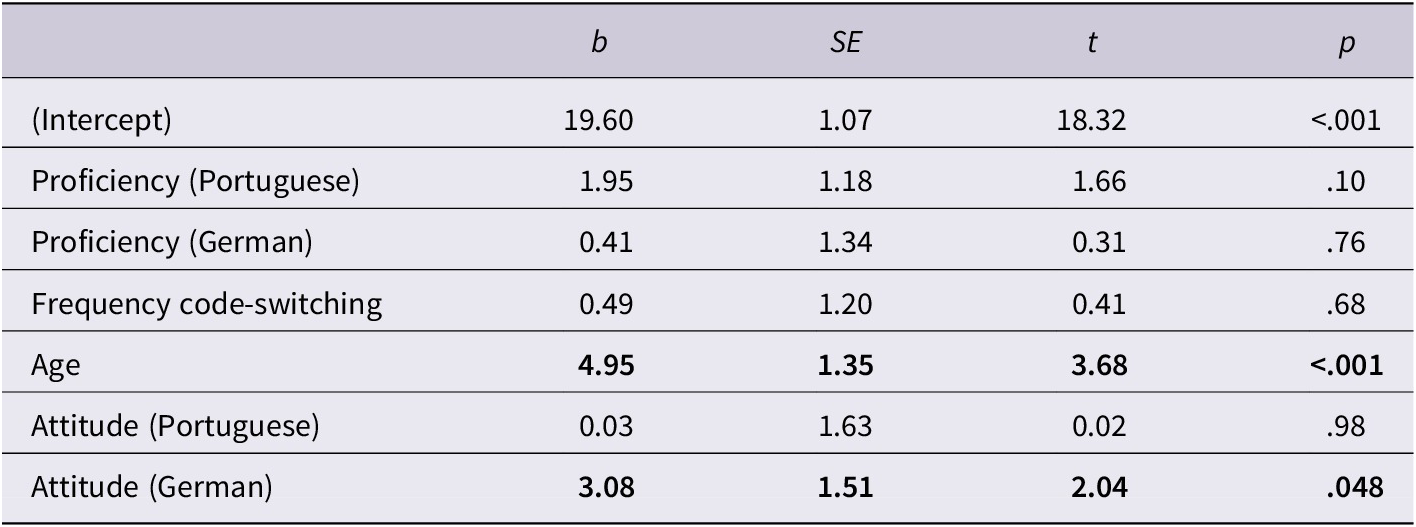
Table 8 presents the results of the multiple regression. The independent variables include Portuguese proficiency, German proficiency, self-assessed frequency of CS, age, attitude towards Portuguese, and attitude towards German.Footnote 4 The results indicate a significant effect of both age and attitude towards German: Older participants and those with more positive attitudes towards German were more likely to code-switch. The overall model was significant (F(6,38) = 3.84, p = .004). The model explained approximately 37.8% of the variance in the dependent variable (R2 = .378) with an adjusted R2 of .279.
Results of the multiple regression with the total number of instances in which participants either maintained a CS mode or switched to it as dependent variable and Portuguese proficiency, German proficiency, frequency of CS, age, attitude towards Portuguese, and attitude towards German as independent ones. Significant effects are shown in bold.

The resulting model was: m0 < − lm (total_score_code_mixing ~1 + Port_proficiency + Germ_proficiency + frequency_code_mixing + age + Attitude_PORT + Attitude_GERM, data = data).
8. Discussion
The present study investigated CS within the NP as produced by Portuguese-German bilingual children and adolescents, all heritage speakers of EP living in a German-majority environment in Switzerland. We employed an EIT controlling for linguistic factors such as the ML of the utterance, the type of insertion, and the position of the adjective. We also examined the role of age, proficiency, and attitudes towards the two languages for the frequency of CS.
Starting with the linguistic factors, their relevance is modulated by the grammar of the language containing the code-switch: In German matrix sentences, repetition accuracy is predominantly predicted by prenominal adjective position. Thus, for German, adjective position is the key factor – regardless of the language of the adjective – aligning with MLF predictions. In contrast, Portuguese matrix sentences show more flexibility and the language of the adjective is the decisive factor, as predicted by the MP (see the significant three-way interaction in Table 6): accuracy is higher for postnominal adjectives when the adjective is Portuguese, and for prenominal adjectives when it is German.
We argue that the differential strategies across German and Portuguese reflect children’s sensitivity to language-specific grammatical constraints: Prenominal position is categorical in German, as noun raising within the NP is not available. Children acquiring German as L1 produce prenominal adjectives by age two, initially showing complementary distribution between determiners and adjectives (Clahsen et al., Reference Clahsen, Eisenbeiss, Vainikka, Hoekstra and Schwartz1994). By age three, complex NPs including a determiner and a prenominal adjective emerge (Bittner, Reference Bittner1998). While agreement errors may persist and semantically complex adjectives emerge later (Weicker, Reference Weicker2019), the prenominal position is an early and stable property in German child language.
In contrast, adjective placement in Portuguese is more complex to acquire, as it requires integrating syntactic, semantic, and pragmatic information, because children need to pay attention to adjective type (e.g., subsective vs. intensional adjectives) and semantic interpretation (e.g., stage-level vs. individual-level interpretation, see Section 2). While, to our knowledge, no studies exist for EP, research on Brazilian Portuguese shows that postnominal adjective position is most frequent and appears earliest (Name, Reference Name2008; Prim, Reference Prim2019). Prenominal adjectives emerge later, depending on adjective type and semantic/pragmatic context. For Italian, Cardinaletti and Giusti (Reference Cardinaletti, Giusti, Anderssen, Bentzen and Westergaard2011) show that descriptive adjectives almost always occur postnominally (with some exceptions of bello “beautiful” and grande “big”). The authors conclude that with most adjectives children tend to obligatorily move the NP in Italian at initial stages. Bilingual children acquiring the varying adjective position in Italian as HL in combination with a prenominal adjective language like Swedish have been shown to produce both adjective orders but to overuse prenominal adjectives (Bernardini, Reference Bernardini and Müller2003).
The present study focuses on colour and nationality adjectives because both classes are well established in children’s input, semantically transparent, and relatively stable in their canonical postnominal position in Portuguese, making them suitable for isolating word-order effects without introducing additional semantic or pragmatic ambiguity. The fact that children nonetheless show variation with these typically postnominal adjectives – considerably more so than with German prenominal adjectives – indicates the general availability of both pre- and postnominal adjective positions in Portuguese. We acknowledge that such variation would likely be even more pronounced with other adjective classes, particularly evaluative or intensional adjectives, for which prenominal placement is licensed and occurs more frequently. Consequently, the present findings should be interpreted as capturing CS behaviour with structurally less ambiguous adjectives, and future work should extend this approach to a broader range of adjective types in order to further probe the interaction between adjective semantics, position, and CS.
The asymmetry between German and Portuguese follows naturally from their underlying typological profiles. German lacks a productive postnominal adjectival position, which severely restricts the space of licit mixed NPs and leads to a strong bias for prenominal word order whenever German is the ML. Portuguese, by contrast, allows both pre- and postnominal adjectives, but the distribution of positions is lexically and interpretively conditioned; in this more flexible system, the language of the adjective becomes a comparatively stronger determinant of word order in CS, especially for classes like colour and nationality adjectives that are canonically postnominal in monolingual usage. These findings suggest that in typologically mismatched pairings, rigid word-order systems such as German exert strong constraints when serving as MLs, whereas more flexible systems like Portuguese accommodate a broader range of mixed configurations, making adjective language particularly influential.
Together with previous production, judgement and ERP studies on adjective–noun CS, the present results support a view in which matrix-language structure, typological (in-)flexibility, and the lexical properties of the adjective jointly constrain mixed NPs, thus arguing for a more integrated theory of grammatical constraints on CS rather than a wholesale adoption of either the MLF or MP. We therefore propose the Constraint Integration Model (CIM), which formalizes CS within NPs as the outcome of two ranked, interacting constraints operating at distinct grammatical interfaces. Unlike the MLF (which privileges matrix structure) or MP (which privileges lexical features), CIM posits a hierarchical constraint system:
-
− C1: Matrix Spine Constraint (higher-ranked): The ML determines the available structural positions (syntactic slots) within the NP.
-
− C2: Lexical Distributional Constraint (lower-ranked): The adjective’s language supplies its canonical position/movement profile.
When C1 and C2 align, it leads to convergence. When they conflict, it leads to harmonic resolution biased towards the higher-ranked constraint, such that C1 dominates C2. CIM directly captures the asymmetry that our data show: typologically rigid MLs (German) enforce convergence on ML-defined slots regardless of adjective language, while typologically flexible MLs (Portuguese) permit adjective-language effects.
CIM advances beyond hybrid MLF/MP approaches by introducing typological flexibility as a formal parameter that (i) quantifies the degree of structural “play’” the ML permits, and (ii) predicts when/why lexical constraints can “surface” in production. This parameter explains why there are differences in Portuguese–German CS, Spanish–English CS, Welsh–English CS, and Papiamento–Dutch CS, resolving a key gap in prior models. Finally, CIM generates clear cross-linguistic predictions: In language pairs where both systems are rigid (e.g., German–English), only ML-driven convergence is expected. In rigid-flexible pairings (German–Portuguese), adjective-language effects should emerge exclusively when the ML is flexible. In pairings involving two flexible systems (e.g., Spanish–Italian), CIM predicts maximal adjective-language effects.
Our second research question focussed on extralinguistic factors. The results demonstrate that individual-level factors play a significant role. The regression analysis showed that older age and more positive attitudes towards German were significant predictors of a greater propensity to produce CS. This aligns with earlier research (e.g., Boers et al., Reference Boers, Sterken, van Osch, Parafita Couto, Grijzenhout and Tat2020; van Osch et al., Reference van Osch, Parafita Couto, Boers and Sterken2023), showing that older children/adolescents with greater metalinguistic awareness and linguistic experience tend to adhere more to CS practices.
Although age enters the models as a continuous predictor rather than as a categorical comparison between younger and older children, the results nonetheless point to a developmental component in CS behaviour. Older participants show a higher likelihood of producing switched utterances in the EIT, consistent with the view that cumulative exposure and increasing proficiency in both languages facilitate the emergence of systematic CS patterns over time. This aligns with previous work highlighting the role of sustained bilingual input in the stabilization of CS. Moreover, the greater tendency of older children to align with ML-sensitive patterns suggests that developmental gains in proficiency and metalinguistic awareness are accompanied by a more fine-grained integration of structural constraints on CS.
Moreover, the fact that positive attitudes towards German (and not the HL Portuguese) predict CS suggests that identifying with the SL may facilitate the integration of German lexicon into Portuguese utterances. Children with less positive attitudes towards the SL may more strictly separate their languages in conversation, restricting German mainly to the school environment.Footnote 5 Although not statistically significant, participants’ identification as Portuguese and more positive evaluations of the HL suggest that their CS behaviour reflects a balanced bilingual strategy rather than language shift or dominance. Overall, the influence of individual-level factors such as age and attitudes supports the systematic nature of CS in this group. Furthermore, the generational difference in CS frequency – with children switching more than their parents – points to the emergence of a peer-driven bilingual practice within the younger generation (Smith-Christmas, Reference Smith-Christmas2012; Toribio, Reference Toribio2004), which appears to be fostered not only by developmental factors such as age and proficiency but also by positive orientations towards bilingual and bicultural language use.
The higher accuracy of CS repetition when Portuguese served as ML points in the same direction and shows that children and teenagers may be more accustomed to CS in Portuguese-dominant conversations. Given the established Portuguese community, everyday conversations with Portuguese-German bilinguals are common, whereas German, especially Standard German, is largely confined to the school context, where interlocutors typically do not speak Portuguese. Indeed, previous studies on multilingual communities show that the minority language often serves as ML (Parafita Couto & Gullberg, Reference Parafita Couto and Gullberg2019).
This brings us to our third research question. Our study shows that systematic and rule-governed CS patterns arise in this young bilingual population despite the absence of community-level CS norms. This may also relate to the bilingual group’s sociolinguistic profile. Self-assessment scores indicate relatively balanced proficiency in Portuguese and German, with a slight advantage for German. Regular use within the families and intergenerational transmission illustrate the strong status of Portuguese within the migrant community (see Torregrossa et al., Reference Torregrossa, Flores and Rinke2023) and supports the development of active, balanced bilingualism in the second generation. Attitudes mirror the consistent presence of Portuguese: participants rated Portuguese more positively than German across all dimensions, reflecting strong emotional and cultural ties to the HL. The positive correlation between attitudes towards both languages indicates that valuing one goes hand in hand with valuing the other language, pointing to a generally favourable stance towards bilingualism. Furthermore, self-reported CS patterns reveal generational differences. Parents sometimes reprimand their children for mixing languages, reflecting a common first-generation perception of CS as interference rather than competence (Schwartz, Reference Schwartz2010; Smith-Christmas, Reference Smith-Christmas2012). Younger bilinguals, likely due to early dual-language exposure and bilingual peer interactions, show positive attitudes towards CS (Toribio, Reference Toribio2004).
We acknowledge that only a residual number of studies have examined CS habits among Portuguese migrant communities in Europe. This work includes, for example, research on Portuguese-speaking migrants in Luxembourg (Stell & Parafita Couto, Reference Stell and Parafita Couto2012), but, to our knowledge, no comparable systematic evidence exists for Portuguese migrants in Switzerland. While self-report measures may not fully capture actual CS behaviour, we recognize this as a limitation of the present study and emphasize the need for further empirical research on CS practices in these communities.
9. Conclusion
To conclude, in line with previous research, our findings support an integrated approach to CS, shaped by grammatical properties, individual-level, and sociocultural factors. We observed that accuracy of code-switches in German utterances was predicted by the ML’s adjective position, with adjectives tending to be produced in prenominal position regardless of their language. In contrast, in Portuguese utterances, the adjective’s language was the key predictor. Results also showed that CS habits are further modulated by participants’ age and language attitudes. Taken together, our study reveals that even without transmission of established norms, CS in this emerging bilingual population functions as a systematic communication strategy, shaped by both intra- and extralinguistic factors.
Acknowledgements
This study received ethical approval from the Comissão de Ética para a Investigação em Ciências Sociais e Humanas (CEICSH) from the Universidade do Minho, under approval number CEICSH 102/2023 (Adenda 1). Written informed consent was obtained from the participants’ parents or legal guardians prior to participation. In addition, participants completed an online consent form before taking part in the questionnaire and experimental task, thereby indicating their assent to participate.
Funding statement
This work was funded by national funds through FCT – Fundação para a Ciência e a Tecnologia, I.P., under project UID/00305/2025. We would also like to thank the coordinator and the teachers of the Camões Institute (EPE Suíça) for their support in recruiting participants and facilitating the implementation of the study.
Competing interests
The author declares none.


 Open access

